


Most landlords measure the cost of a defaulting tenant in one number: the rent that stopped arriving. In practice, that is usually the smallest part of the bill.
According to Takeem's State of Rent 2025 report, tenant defaults across the UAE increased 2.25 times year-on-year, and payment delays quadrupled over the same period. As default becomes a more common event rather than a rare one, understanding its full cost, not just the missed rent, is becoming essential for anyone renting out a property.
What a Default Actually Costs
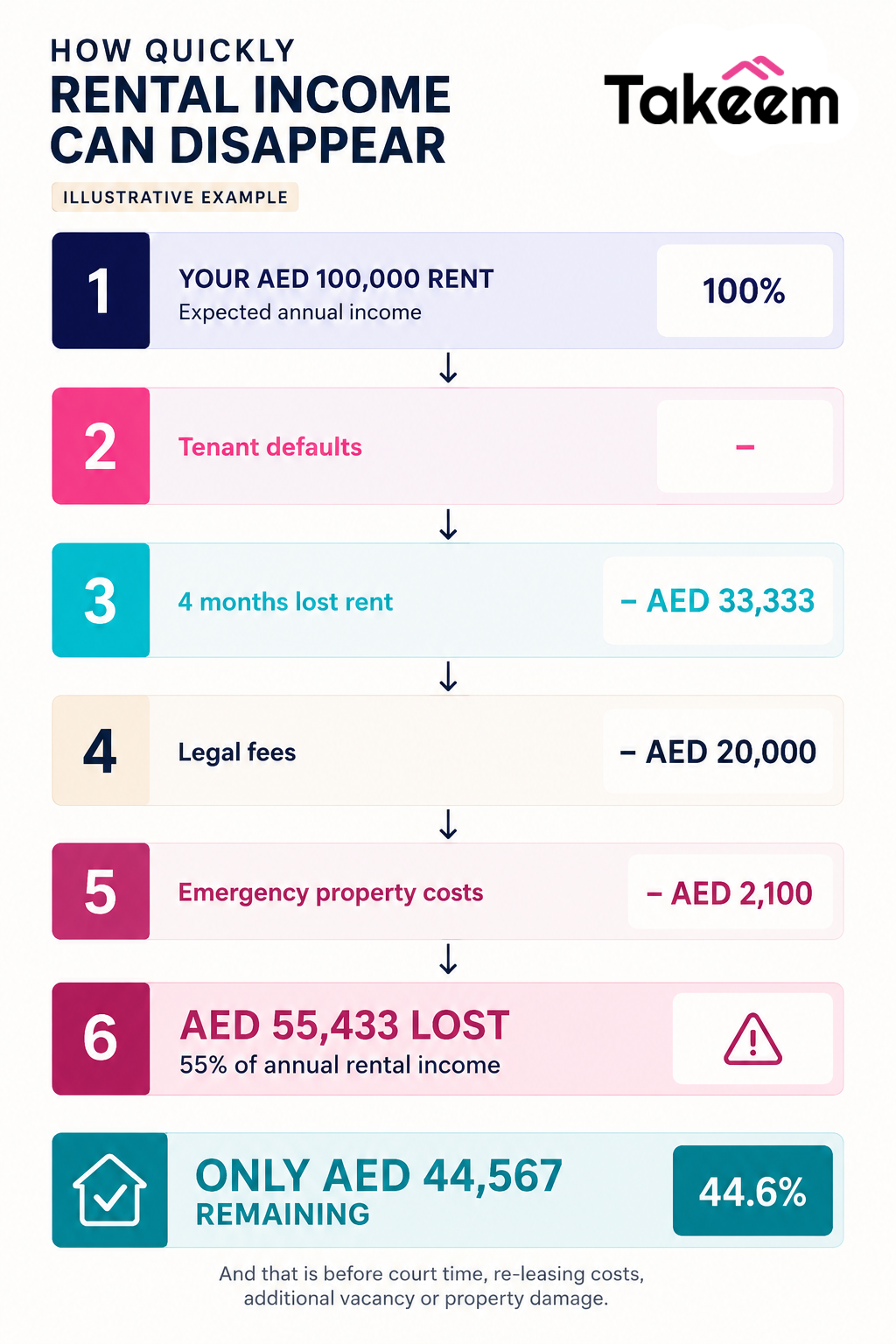
Unpaid rent is the visible cost. The maths below sets out a simple, illustrative scenario to show how quickly the other costs can add up.
Assume an annual rent of AED 100,000.
1. Lost rent while the default is resolved
If it takes a landlord an average of four months to resolve the default and recover the property, in this scenario that works out to:
AED 100,000 ÷ 12 × 4 = AED 33,333
2. Legal costs
If the landlord engages external private legal counsel to pursue the case, in this scenario that adds approximately AED 20,000.
3. Emergency maintenance and property costs
Unexpected maintenance or intervention during the dispute, in this scenario, comes to around AED 2,100.
| Cost | Amount (AED) |
|---|---|
| Lost rent (4 months) | 33,333 |
| Legal fees | 20,000 |
| Emergency property costs | 2,100 |
| Total direct impact | 55,433 |
In this illustrative example, that is 55.4% of the landlord's entire expected annual rental income, gone before the property has even been re-let. The landlord is left with an effective AED 44,567 from the AED 100,000 they budgeted for the year.
This Is Only the Direct Cost
The AED 55,433 figure is a simple, illustrative example, not a worst case. It does not include:
- Landlord time spent chasing payments
- Calls and meetings with lawyers
- Court appearances
- Administrative work and documentation
- Property damage beyond the maintenance allowance
- Cleaning and reinstatement
- Re-leasing costs and agent commission for a new tenant
- Additional vacancy after recovering the property
- Mortgage payments still due while rent is unpaid
- Service charges and other property expenses
- The general stress and management burden of the dispute
Add these in, and the real economic impact of a single default can potentially run higher still.
Why Landlords Have Always Preferred Fewer Cheques
This is the maths behind a habit that often puzzles tenants: landlords' longstanding preference for one, two, or four cheques over monthly payments.
The issue was never that landlords disliked monthly rent. The issue is risk.
If a tenant paying monthly defaults early in the tenancy, the landlord may have collected very little rent while still facing months of lost income and the recovery costs above. With one or two cheques upfront, some of that risk is already covered before a default can even happen. A landlord is not really weighing up one missed payment. They are weighing up a meaningful share of the year's income on the property.
Tenants Want Flexibility. Landlords Want Certainty.
The UAE rental market is nonetheless moving toward more flexible payment structures. Tenants increasingly want to pay monthly rather than fronting large sums at the start of a lease, and landlords stand to benefit from that shift too. Monthly payment options can widen the pool of prospective tenants, help a property lease faster, and improve affordability without lowering the headline rent.
What landlords need first is confidence that offering that flexibility does not dramatically increase their downside. Monthly payments become a much easier choice to consider once the rental income behind them is protected.
Protection Behind the Payment
This is the problem the Takeem Rental Guarantee (TRG) is built to address.
Takeem provides landlords with the Takeem Rent Guarantee, structured protection behind the rental contract, with the underlying protection provided through Takeem's underwriting partners. Rather than asking landlords to accept more risk in exchange for offering tenants flexibility, TRG is designed to reduce the financial consequences if a tenant defaults, covering missed rent and certain emergency property costs within the terms of the guarantee. Today, Takeem has onboarded more than 55,000 residential units, representing over AED 5 billion in annual rental value.
Flexibility for tenants should not mean additional risk for landlords. The future of renting in the UAE is not simply monthly payments. It is monthly payments with protection behind them.
With that protection in place, offering tenants a monthly payment structure becomes the landlord's own choice, made with confidence, rather than a risk taken on faith.
The Real Question
The rental market is moving toward greater flexibility. But flexibility only works at scale if both sides of the transaction are protected.
For tenants, monthly payments can improve affordability and cash flow. For landlords, the question has always been the same one: what happens if the tenant stops paying?
Takeem Rent Guarantee is designed to help answer that question: protecting rental income and giving landlords the confidence to offer the payment flexibility tenants increasingly expect.
Rent, Own, Relax.
See how Takeem Rent Guarantee can protect your rental income at Takeem Landlords.