

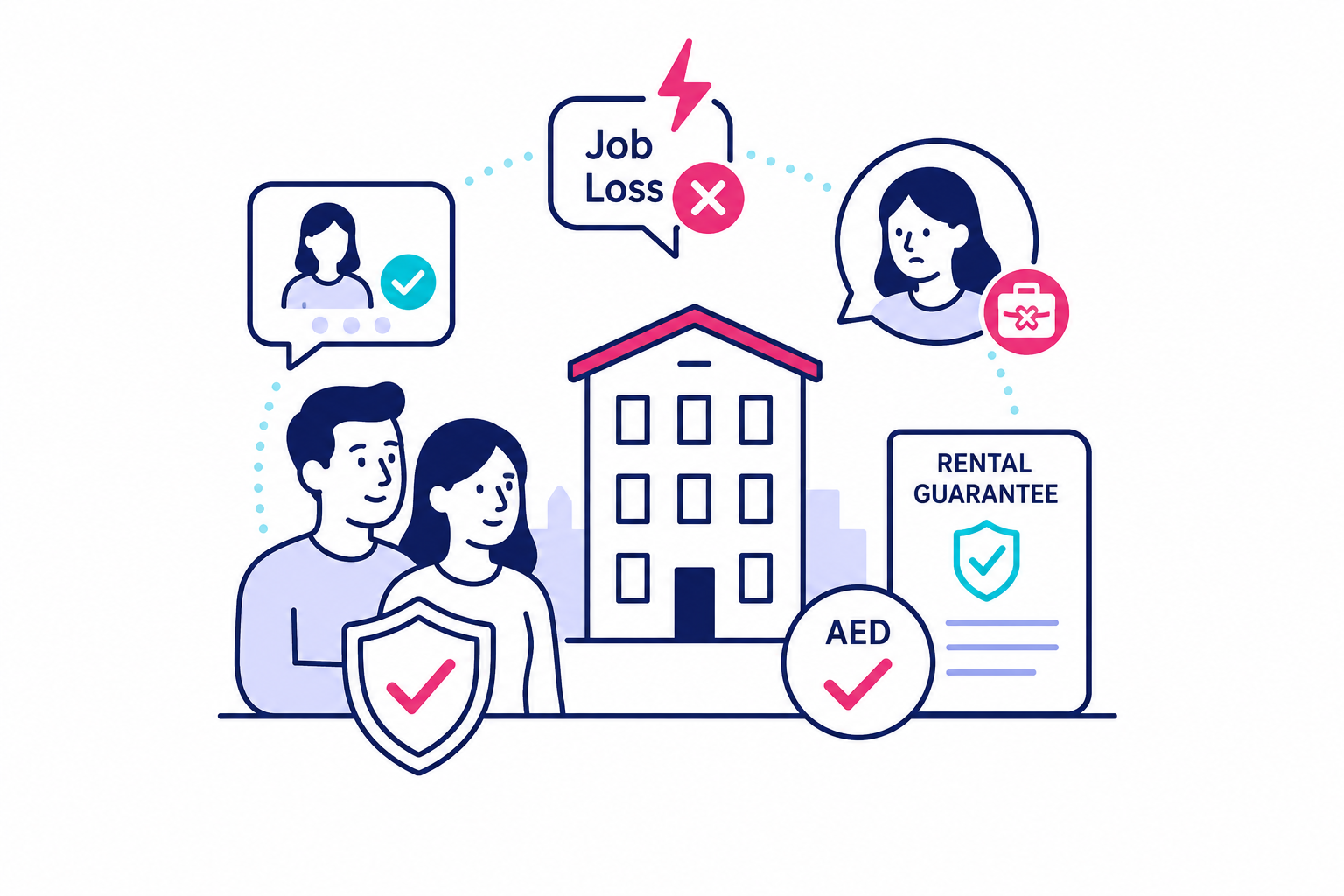
A tenant who has never missed a rent payment in three years messages to say she has lost her job. It happens the same week her landlords bring their newborn home from the hospital.
This is the exact scenario every landlord pictures when they think about rental default: a reliable tenant hits a stretch of bad luck, and suddenly the mortgage payment on an investment property is not covered. For M.C and N.C, first-time property investors in Dubai Sports City, the worry never got the chance to become a crisis.
A Tenant With a Clean Record, Then a Job Loss
M.C and N.C bought their one-bedroom apartment in Dubai Sports City as their first investment property, mortgaged, with annual rent set at AED 40,000. They found Takeem through word of mouth in Dubai's Serbian community, not an ad or a campaign, just one person telling another.
Their tenant, S.A.K, worked in real estate and had rented from them for three years without missing a single payment. When M.C and N.C signed up for the Takeem Rental Guarantee, it was not because they doubted her. It was for the yield enhancement of moving to a more frequent rent collection schedule and for the maintenance cover that came with it.
On 8 April, S.A.K messaged to say she had lost her job. The timing could not have been worse: M.C and N.C were bringing their first child home that same week.
What the Rental Guarantee Actually Covered
Nobody scrambled. There was no call to a lawyer, no case filed, and no conversation about how to cover the mortgage that month during a week that should have been entirely about their newborn.
- The landlord avoided legal fees, missed rent, lost time, and any pressure to sell into a soft market.
- The tenant got four months to find new work without her tenancy record or her dignity taking a hit.
- The regulator had one fewer dispute to process, since the case never needed to reach the Rental Disputes Centre.
That is the outcome TRG is built to produce: a default that resolves quietly, without turning into a dispute for any of the three parties involved.
The Cost and the Return
This is one real, anonymized case from Takeem's own portfolio, not a projection or an average. The figures are exact.
| What it cost | What it returned |
|---|---|
| TRG cost: AED 1,600 for the year | Annual net benefit: AED 4,500 (yield uplift of AED 4,000 plus maintenance cover of AED 2,100, minus the AED 1,600 TRG cost) |
| Default payout: AED 13,333 | |
| Legal costs avoided: an estimated AED 8,000 to AED 20,000 |
Put together, that is a benefit-to-cost ratio of 22.15x. Measured against the annual rent, the standing benefit alone (before the default) works out to an 11.3% yield increase. Add in the payout and the legal costs avoided, and the increase reaches 94.6%. Over the seven months from taking out TRG to the payout landing, the return on the AED 1,600 spent came to 2,115%.
There is another way to look at the same numbers. If M.C and N.C renewed TRG every year for the next two decades and never had another default, that single April payout alone would still cover roughly 21 years of TRG renewals, with the annual yield and maintenance benefit sitting on top the entire time.
Why the Math Works Even Without a Default
The AED 4,500 annual net benefit is not contingent on anything going wrong. It comes from the yield uplift of moving to more frequent rent collection, a choice the landlord made and Takeem made comfortable, plus the maintenance cover, minus what TRG costs for the year. A landlord earns that benefit whether or not a tenant ever defaults.
The default payout is the part that only shows up when something does go wrong, and it is the part that changes the entire calculation. Most years, TRG pays for itself through the standing benefit. In the year a tenant loses their income, it also absorbs the one cost that actually threatens a landlord's cash flow.
What This Means for Other Landlords
Not every property will produce a 2,115% return, and no two rental situations are identical. What holds across cases is the underlying design: a fixed, known cost each year, set against a downside that is capped rather than open-ended. A landlord cannot control whether a good tenant loses their job. What TRG changes is what that event costs when it happens.
Probability is not something a landlord can manage. Severity is. See how TRG could work for your property at Takeem Landlords.