

For anyone asking how to professionalize my rental business, the answer depends on the type of rental operation. A vehicle-rental business in the UAE needs the appropriate commercial licence and operational approvals before it begins trading. Across the country, the business must carry out only the activity specified on its licence. These foundations shape how you can operate and grow.
Choosing a rental model is only part of the decision. You also need a setup plan that fits your customers, clear operating records, and a realistic view of maintenance, seasonal demand, and cash flow.
This guide explains how to compare rental models, prepare for licensing and approval steps, and organize the documents and processes that support daily operations. You’ll also learn how to plan for upkeep and demand changes, monitor costs, and protect cash flow as your business develops.
Key Takeaways
- Choose a rental model around your target customers, operating scope and reasons for selecting it, then document the decision.
- Map the required licence, approvals and supporting documents before launch so your business setup matches the activity you plan to carry out.
- Build maintenance routines and seasonal demand planning into your operating process to prepare for changing costs and availability.
- Track expected income, recurring expenses and cash reserves to spot pressure on cash flow early and plan more confidently.
- For landlords seeking support with rental income and urgent property maintenance, explore how Takeem’s Landlord Rental Guarantee may fit.
Rental business models and customer segments
- Define the rental model before choosing vehicles or setting prices. One operator might serve tourists seeking short-term transport, while another targets residents needing longer rentals. Write down your customer, rental period, vehicle type, operating area, and expected booking channel. This focus helps you assess demand and estimate whether each booking can contribute to profit after operating costs.
- Compare mainland and free zone structures against your intended customers and operating scope. A mainland setup may suit a business targeting customers across local markets; a free zone may fit a narrower operating plan. Foreign investors can have 100% ownership options in many cases, depending on the setup. Record why your chosen structure fits, and compare it with reasonable alternatives before committing.
- Build a plan around customer needs and default risks. Set clear booking, payment, deposit, return, and damage procedures before accepting a reservation. For example, explain how a late return affects the booking and how you document vehicle condition at handover. Use consistent terms across quotes and rental agreements, so customers understand charges and staff apply the same process.
- What rental software is best for inventory, bookings, payments, and customer management? Choose a system that connects these workflows and lets staff see vehicle availability, booking status, payment records, and customer history in one place. Test it with a sample booking, payment, return, and damage record before adopting it.
- What accounting, tax, and invoicing rules apply to UAE rental businesses? For Dubai vehicle rentals, customer charges are subject to VAT at the standard rate of 5%. The corporate tax rate in Dubai is 9%, according to the Federal Tax Authority; maintain organized invoices and expense records, then have the full rental documentation reviewed by a qualified UAE tax professional.
- How can I manage deposits, late returns, damage claims, and refunds fairly? State deposit conditions, return deadlines, damage assessment steps, and refund timing in the rental agreement. Record vehicle condition at pickup and return, then match any proposed deduction to the agreement and dated evidence.
- Plan marketing around the customers your model can serve reliably. Use accurate vehicle descriptions, clear rental terms, and booking information that reflects actual availability. Invite customers to leave honest reviews after completed rentals, and respond professionally to specific feedback. Review recurring comments to identify friction, such as unclear return instructions, then improve the process instead of making unsupported advertising claims.
Separate the investment case from a vehicle’s appeal. A luxury vehicle’s model name alone does not establish a business purpose for renting it. If you claim brand exposure as a business benefit, support that claim with a clear brief and planned outputs. Assess the vehicle against your customer segment, booking demand, operating costs, and documented business use rather than relying on its prestige. Give the complete rental documentation file to a qualified UAE tax professional for review under current applicable rules.
The page describes an investment model that can begin with a single vehicle and says it can generate returns from the first month. Treat those statements as a model to assess, not a substitute for testing demand and costs for your own rental plan. Set out the assumptions behind expected bookings, expenses, and use, then review them against actual business records as the operation develops.
Business setup steps and required documents
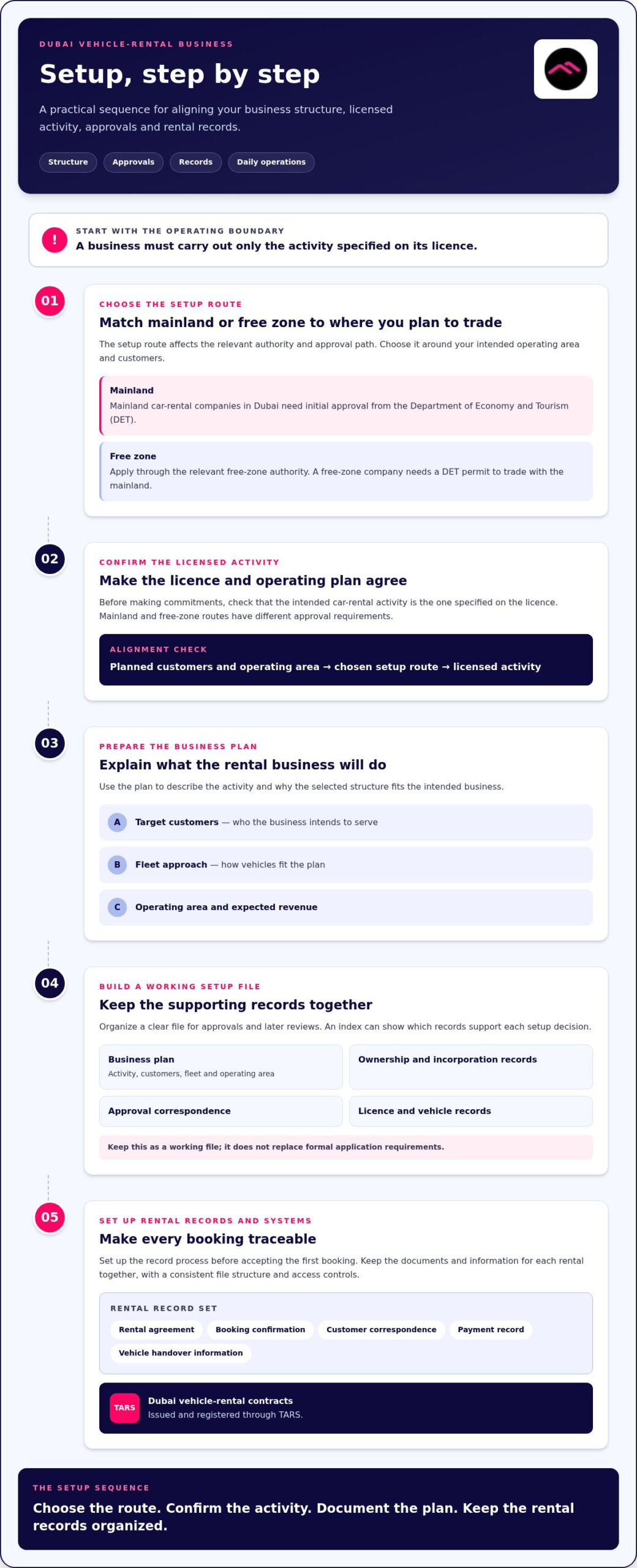
Set up the business in Dubai by matching its licensed activity, approval path, and operating plan. Then organize the records and systems that support each rental.
-
Complete Business Setup Steps
Choose mainland or free-zone setup based on where you plan to trade. Mainland car-rental companies in Dubai need initial approval from the Department of Economy and Tourism (DET); free-zone companies apply through their relevant free-zone authority. Prepare a business plan describing the activity, target customers, fleet approach, operating area, and expected revenue. Use it to explain why the chosen structure fits your intended business.
- Confirm the licensed activity before making commitments. Car-rental businesses must carry out only the activity specified on their licence. Mainland and free-zone setup routes also differ in their approval requirements. A free-zone company needs a permit from DET to trade with the mainland. Map the planned customer journey and operating area against the chosen route so the business plan and licence activity align.
- Organize a setup file for approvals and later reviews. Keep the business plan, ownership and incorporation records, approval correspondence, licence documents, and vehicle records together. Treat this as a working file, not a substitute for formal application requirements. A clear index helps you identify which records support each setup decision, such as the selected activity, operating location, and fleet plan.
-
Establish Systems and Processes
Set up a record process before accepting the first booking. Store each rental agreement, booking confirmation, customer correspondence, payment record, and vehicle handover information together. In Dubai, vehicle-rental contracts are issued and registered through TARS. Use a consistent file structure and access controls, and avoid relying on scattered messages or staff memory to reconstruct a rental later.
- Register and prepare vehicles through the applicable process. In Dubai, rental vehicles must be registered under the company, and the RTA licenses vehicles used by rental businesses. Build vehicle records that connect each vehicle to its registration, licence, inspection information, and rental history. Keep records current as the fleet changes, rather than treating approval as a one-time setup task.
- Assign responsibility for each approval and operational record. A named staff member can track licence renewals, vehicle files, booking records, and revenue reconciliation, while management reviews exceptions. Use a regular review routine to find missing agreements or mismatched charges. This creates a clear trail from approval and booking through payment and vehicle return.
Maintenance, seasonal demand and competition risks
- Set a preventive maintenance schedule for every vehicle. Track inspection dates, service history, recurring faults, and time out of service in one fleet record. In Dubai, rental businesses must comply with approved vehicle inspection requirements, and the RTA licenses rental vehicles. Treat inspection readiness as an operating task, not a repair decision made only after a breakdown. This helps you plan vehicle availability and maintenance spending.
- Build maintenance into each vehicle’s operating budget. Track actual spending against that annual range, separating routine servicing from accident repairs and other claims. Compare costs by vehicle type and usage, so a luxury vehicle’s higher upkeep does not disappear inside an average fleet figure.
- Check vehicle age against the relevant RTA schedule before buying or adding fleet vehicles. Dubai’s published maximum rental-vehicle age schedule includes bands of 3, 4, 6, 7 and 10 years, depending on vehicle class. Record each vehicle’s class and age alongside its licence and inspection details. This prevents a purchase decision from overlooking an operating constraint.
- Plan staffing and vehicle availability around demand changes. Dubai received almost 10 million visitors in the first half of 2025, so tourist bookings can influence transport demand. Compare booking patterns across your own calendar, customer segment, and vehicle category. Use those records to schedule maintenance during quieter periods, while keeping enough ready vehicles for expected demand.
- Prepare a response plan for seasonal peaks and weaker booking periods. Review reservations, cancellations, utilization, and service downtime together before changing fleet allocation. For example, a rise in airport-related bookings may call for more suitable vehicles, while slower demand can create time for inspections. Avoid expanding based only on a busy period; compare demand across the full operating cycle.
- Compete through reliable service and clear vehicle information, not unsupported promises. Keep descriptions, availability, return instructions, and condition records consistent across booking channels. If you plan promotional stickers or advertisements on vehicles in Dubai, obtain written RTA approval before placing them. Review customer feedback for recurring service problems, then assign an action and track whether the next review cycle shows improvement.
Rental business risks and cash-flow planning
Connect rental risks to cash flow before committing to fleet purchases or expansion. A booking can bring revenue, but repairs, delays, and unpaid charges affect when cash is available.
-
Assess Rental Business Risks
List the risks that could interrupt rental income, then assign each one an owner and response. For rental cars, include accidents, theft, damage disputes, late returns, and vehicle downtime. Track how each incident affects bookings and cash receipts. Review licensing documents and vehicle records together so a missing approval or record does not become an avoidable operating delay.
- Build a rolling cash-flow forecast using expected booking receipts and scheduled costs. Separate money collected from amounts still due, then map insurance, maintenance, licensing, payroll, and fleet payments against their due dates. A rise in tourism-driven bookings can increase receipts, but it can also increase vehicle use and wear. Update the forecast as reservations change, rather than treating projected revenue as cash already received.
-
Review Insurance Needs and Costs
Include comprehensive insurance covering accidents, theft, and liabilities in your risk plan. Premiums depend on factors such as fleet composition, vehicle use, coverage terms, and claims history. Record renewal dates and policy details with each vehicle’s documents, then compare the premium against projected cash flow. This keeps insurance costs visible and separate from maintenance spending.
-
Calculate Pricing and Profitability
Set each rental price by calculating direct costs, allocated overhead, expected utilization, and vehicle depreciation. To assess utilization, compare booked rental days with available rental days for the same vehicle and period. Estimate depreciation from the vehicle’s purchase cost and expected useful period, then include that allocation when reviewing profit. Don’t price from competitor listings alone; choose a rate that supports your cost base.
- Protect cash flow with clear payment controls. Match each booking to its agreed payment schedule, deposit terms, and return date. Reconcile collected payments against invoices and bank records, then follow up on overdue balances using documented reminders. Keep deposits separate in your records from earned rental revenue until you have assessed the agreement’s return and damage conditions.
- Stress-test the forecast before buying more vehicles. Model a slower booking period, an unexpected repair, and a delayed customer payment. Check whether available cash still covers scheduled expenses and essential servicing. If tourism demand softens, pause discretionary fleet additions and prioritize vehicles with stronger booking patterns. This makes cash-flow planning a practical decision tool, not just an accounting report.
What systems and processes should I set up to run a rental business professionally?
To answer “how to professionalize my rental business,” build repeatable workflows for contracts, vehicle records, payments, and customer support. In Dubai, digital rental processes should also account for TARS and vehicle compliance.
- Centralize booking and contract records. Store each booking confirmation, rental agreement, customer correspondence, and payment record under one booking reference. In Dubai, vehicle-rental contracts are issued and registered through TARS. Make the contract file easy for authorized staff to retrieve, so they can resolve questions using the same dated record rather than scattered messages.
- Document the rental purpose and outcome. Before arranging a rental, record the activity, participants, dates, and intended outcome. Obtain managerial approval for the business rationale and retain it with the dated brief. After the rental, note what took place and keep the record factual. If plans change, document what changed and why instead of replacing the original brief.
- Keep a timely usage log. A practical answer to “how to professionalize my rental business” is to maintain clear, current usage records. Record which vehicle was used, by whom, and for which business activity. Separate personal use from business use, and update the log close to the rental dates. If a booking’s purpose changes, record the revision and retain related correspondence.
- Reconcile agreements, usage, and charges. Compare final rental dates and charges with the signed agreement. Then check the usage log against the stated business purpose. Resolve mismatches through dated notes and supporting records. Keep invoices and related correspondence together so a reviewer can follow the transaction from approval through final payment without relying on staff recollection.
- Maintain vehicle and system compliance records. Keep each vehicle’s inspection and licensing information with its fleet record, and track system certificates by renewal date. In Dubai, rental businesses must report digital-system failures within three hours. The GPS tracking system must be approved by the Security Industry Regulatory Agency (SIRA), and its installation certificate must be renewed every year. Assign responsibility for recording incidents and renewals.
- Set clear payment and exception workflows. Match each invoice to the booking, agreement, and payment record. Flag late payments, disputed charges, and refunds for review, then document the decision and its supporting evidence. A consistent digital trail helps staff handle exceptions using the same process. For landlords managing rental payments, explore support for rental income workflows as a related next step.
Use the original brief as the reference point when circumstances shift: preserve it, and add a clear account of what changed and why. Maintain rental-use records promptly, identifying use as personal or business so the distinction remains clear.
At closeout, compare the actual rental dates and charges with the agreement, then review the usage log in light of the stated business purpose. UAE operators should also manage traffic fines and keep vehicles compliant with safety standards. For customer care, Dubai car rental businesses are advised to provide support 24/7, with particular attention to tourists.
Takeem: Landlord Rental Guarantee
Takeem’s Landlord Rental Guarantee may suit landlords seeking support with rental income, rather than vehicle-fleet operations. The guarantee also includes an emergency property maintenance service, connecting income support with a practical response to urgent property issues. Property investors with large portfolios can explore a rental guarantee designed for their needs, while agents can sell the Landlord Rental Guarantee for healthy commissions.
Consider this option if your rental business includes residential properties and you want a dedicated solution alongside your own records, payment processes, and maintenance planning. Takeem also offers landlords automated recurring payment solutions to accept monthly tenant payments digitally. To discuss whether these offerings fit how to professionalize my rental business, visit Takeem online.
Turn Your Next Decision Into a Stronger Operation
The next step is to choose one improvement you can put into practice now, then make it part of your regular operating routine. A clear process for reviewing decisions helps your rental business adapt as customers, costs, and priorities shift. If you’re still asking how to professionalize my rental business, identify where more dependable rental income or property maintenance support would make the greatest difference.
Takeem offers a Landlord Rental Guarantee, including an option for property investors with large portfolios. Agents can also sell the Landlord Rental Guarantee for healthy commissions. These offerings are relevant to landlords, portfolio investors, and agents, rather than operators focused solely on vehicle rentals.
Consider whether that support fits your property goals and business model. Contact Takeem to discuss your rental business and explore the next step that suits your plans. Build deliberately, improve one process at a time, and keep your business moving forward.
Frequently Asked Questions
What are the Legal Requirements & Business Setup?
A UAE vehicle-rental business needs a commercial licence and the relevant operational approvals before launch. First, define the rental activity and operating scope, then match the application route to the chosen mainland or free-zone structure. Assemble the business plan and company records into one application file, keeping activity descriptions consistent across documents. In Dubai, mainland companies seek initial approval from the Department of Economy and Tourism, while free-zone companies apply through their authority.
How do I improve customer service, marketing, and repeat bookings for a rental business?
Make the booking experience clear before customers commit, then follow through after the rental. Send a confirmation stating the agreed vehicle, collection and return details, and payment terms. After return, ask for specific feedback and respond to concerns with a practical next step. Use recurring comments to improve instructions or booking messages. For example, if customers often ask about return procedures, make those steps easier to find before booking.
What safety, maintenance, and inventory controls reduce losses and liability?
Use a condition record at every handover, with dated notes and photographs of visible damage, fuel level, and included accessories. Have staff compare the return condition with that record before closing the booking. Tag a vehicle with a reported defect and keep it unavailable until it has been assessed and cleared for use. Link each vehicle’s maintenance history to its inventory record so staff can see its status before assigning it.