

What makes a rent payment method acceptable: the way you pay, or what your tenancy agreement says? The legal rent payment methods UAE tenants and landlords can use aren’t decided by convenience alone. The agreed method, payment schedule and transaction records all matter, especially if a payment is delayed or disputed.
Cheques, bank transfers and digital options such as Direct Debit can each support rent collection. The agreement should make clear which method and schedule apply to the tenancy. The tenancy agreement and its registration provide important context for understanding the agreed terms.
This guide explains how to compare common payment methods, what proof to keep and how to follow the schedule in your contract. It also covers how landlords can use Direct Debit for digital monthly collection, with trusted platforms like Takeem simplifying the process. The aim is a practical, traceable process that helps both parties keep a clear record of rent payments.
Key Takeaways
- Assess legal rent payment methods Dubai by checking the agreed terms in the tenancy contract, not just the payment type.
- Compare cheques, bank transfers and digital collection by how each fits the agreed schedule and records each payment.
- Keep payment instructions and transaction evidence organised so you can trace payments and resolve discrepancies.
- Use a checklist to review payment details and document any mutually agreed changes.
- Landlords can use Takeem’s Direct Debit setup to accept monthly tenant payments digitally.
Legal rent payment methods in the UAE: what makes an arrangement clear?
A payment method is the channel used to transfer rent. The contract sets out how and when that channel must be used. A cheque, bank transfer or digital payment does not, by itself, establish the rent amount, due date or instalment schedule. Start with the tenancy agreement to understand what the landlord and tenant have agreed.
For anyone comparing legal rent payment methods Dubai, this distinction matters. A method may be used in the market without automatically applying to every tenancy. Consider the agreement, any written changes and the rules that apply to the tenancy together.
What should the tenancy agreement say about rent payments?
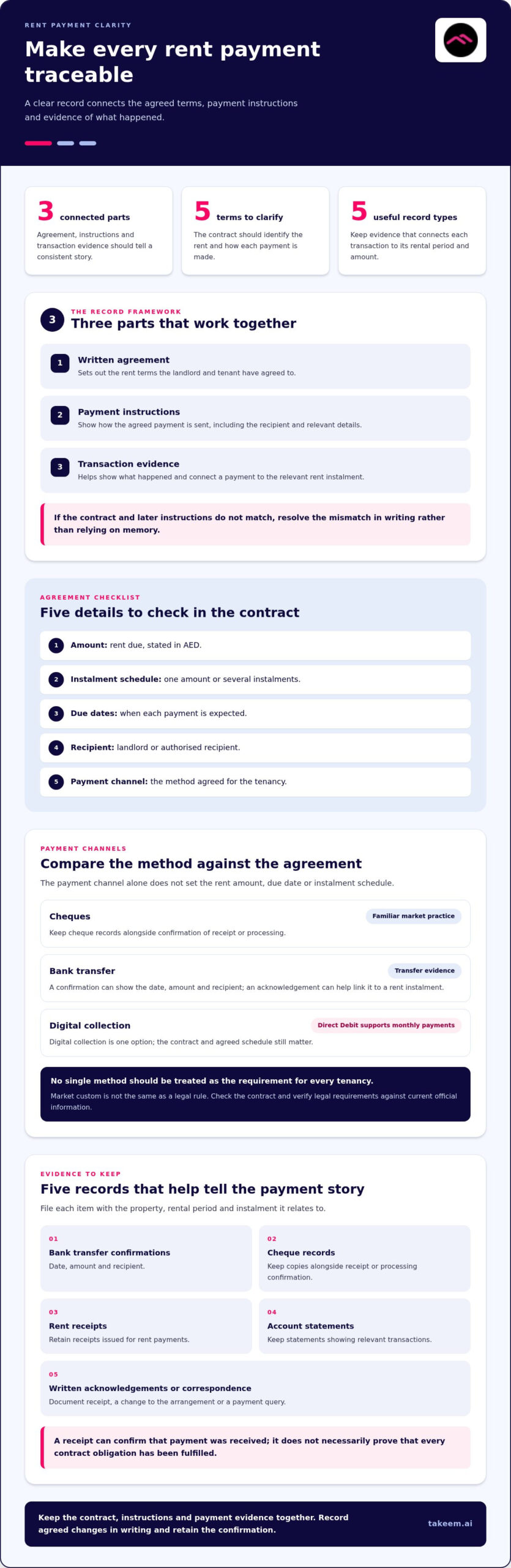
Check that the contract clearly identifies:
- Amount: the rent due, stated in AED.
- Instalment schedule: whether rent is paid in one amount or several instalments.
- Due dates: when each payment is expected.
- Recipient: the landlord or authorised recipient who should receive the funds.
- Payment channel: the agreed method, such as cheques, bank transfer or digital collection.
Specific wording prevents avoidable uncertainty. For example, “monthly payment” should include clear due dates and instructions for sending funds. If the parties agree to change the method or schedule, record the change in writing and keep the confirmation with the tenancy documents. A message or signed addendum can document what was agreed, but don’t assume a change automatically alters legal rights or obligations. Check the contract requirements and applicable rules.
Clear payment terms define what is due and when; traceable evidence helps show whether the agreed payment was made.
Does one payment method apply to every tenancy?
No single method should be treated as the legal requirement for every rental across the UAE. The accepted channel and schedule can depend on the contract and the rules applicable to the tenancy. Cheques are a familiar market practice, while bank transfers and digital collection are also used. Market custom is not the same as a legal rule, so verify legal questions against current official information.
Rental arrangements are subject to applicable laws and registration procedures. For general background on the department, see the Land Department on Wikipedia; use current official UAE information to verify legal requirements and procedures.
Initiatives do not create a universal payment rule either. The Flexi Rent initiative supports participating companies in offering more flexible schedules, but participation is voluntary. Its availability does not mean every landlord must accept monthly payments. Read the contract, confirm any written arrangement and distinguish what the parties agreed from what the law requires.
How rent payment rules, contracts, and records fit together
A dependable rent record has three parts: the written agreement, the instructions used to make each payment and evidence showing what happened. These should tell a consistent story. If the contract sets one schedule but a later message suggests another, it may be unclear which arrangement the parties followed. Keep the documents together and resolve mismatches in writing rather than relying on memory.
Which payment details should tenants and landlords review?
Compare the signed tenancy agreement with the payment instructions and any later written arrangements. Check the payee’s name and account details, the amount in AED, due dates, number of instalments and agreed payment channel. Also review how to request or confirm a change. A payment sent to the wrong recipient or on a different date can be harder to reconcile if the records do not explain the discrepancy.
If both parties agree to revise a schedule or channel, get written confirmation stating what changes and when the new arrangement starts. Keep it with the signed contract and related correspondence. This creates a clearer record of the parties’ understanding, but does not by itself establish the legal effect of the change. For legal questions, verify the current requirements that apply to the tenancy.
What records help resolve a rent payment dispute?
Keep evidence that connects each transaction to a specific rental period and the agreed amount. Useful records may include:
- Bank transfer confirmations showing the date, amount and recipient.
- Cheque copies or other cheque records, alongside confirmation of receipt or processing.
- Receipts issued for rent payments.
- Account statements showing the relevant transactions.
- Written acknowledgements or correspondence confirming receipt, a change or a payment query.
File each item with the property, rental period and instalment it relates to. A transfer confirmation may show that money left an account, while the landlord’s acknowledgement can help connect it to a particular rent instalment. If an amount differs from the contract, keep the explanation and any related agreement with the payment record. No single document guarantees a particular outcome in a dispute; the complete record and applicable rules may matter.
A receipt can confirm that a payment was received, but it doesn’t necessarily prove that every contract obligation has been fulfilled. Other instalments, dates or agreed terms may also need to be accounted for. Keep tenancy registration and transaction records accessible. Registration procedures can vary across the UAE, so use the official process that applies to the tenancy.
For landlords seeking a more structured digital collection workflow, Takeem’s Direct Debit setup supports monthly tenant payments. Clear instructions and retained records remain essential to reconciling each payment.
Cheques, bank transfers, and digital rent payments compared
There isn’t one payment channel that suits every tenancy. Rent is commonly paid by post-dated cheques, often in one to four instalments across the year. Bank transfers and digital collection offer other workflows. When comparing the legal rent payment methods Dubai tenants and landlords are considering, focus on how each method fits the agreed schedule and records each payment.
| Method | Workflow | Records to retain | Practical considerations |
|---|---|---|---|
| Cheque | The tenant provides a cheque for the agreed amount and date; the landlord presents it for payment. | Cheque copy or details, handover acknowledgement, and confirmation of payment or account entry. | Track each cheque against its due date and rental period. Issuing a cheque and funds clearing are distinct events. |
| Bank transfer | The tenant sends the agreed amount to the recipient’s specified account. | Transfer confirmation, relevant account statement, and receipt or written acknowledgement. | Use accurate recipient details and a payment reference that identifies the property or rent period. |
| Digital collection | Payments are arranged through an agreed digital process, which may include recurring monthly collection. | Payment authorisation or setup record, transaction history, and relevant notifications or acknowledgements. | Confirm the schedule, authorisation process and steps for handling a failed or disputed payment. |
How do cheque payments differ from bank transfers?
A cheque creates a dated payment instruction, while a bank transfer records an electronic instruction to move funds. For either method, note the intended rent period and amount, then separately confirm whether payment was received or cleared. A cheque handover record alone does not establish that funds cleared. A transfer confirmation should also be reconciled with the recipient’s account records. Check current official UAE information for the legal consequences of a dishonoured cheque or any enforcement process.
What changes when rent is collected digitally?
Digital collection can help organise recurring payments against an agreed schedule, but it still needs clear setup and oversight. The parties should understand the required authorisation, how payment notices or acknowledgements will be handled, and who will follow up if a collection fails. Reconcile each transaction against the agreed rent period instead of assuming a scheduled collection succeeded. Takeem facilitates Direct Debit setup for landlords accepting monthly tenant payments digitally. This is a collection option, not a universal replacement for other methods or a legal conclusion.
Flexible instalments also depend on context. The Flexi Rent initiative allows participating companies to offer schedules such as monthly, quarterly or semi-annual, but participation is voluntary. Don’t assume it applies to every property or changes an existing tenancy’s terms. Check the initiative’s current conditions and confirm the schedule agreed for the tenancy.
A practical checklist for agreeing and managing rent payments
A reliable payment routine starts before the first transfer or cheque and continues through each instalment. Use this sequence to keep the agreement, payment activity and records aligned. It is a practical administration checklist, not a substitute for checking the current rules that apply to your tenancy.
- Review the agreement before signing. Confirm the rent amount in AED, named recipient, payment frequency, due dates and accepted channel. Check how the contract records instalments and whether payment instructions match its terms. Resolve unclear details with the other party before relying on an assumption.
- Confirm the first payment instructions. Check the recipient’s name and account details or cheque payee, as relevant. Make sure the requested amount and date match the agreed schedule. Save the instructions and relevant contact details securely so you can access them when payment is due.
- Set up a simple tracking system. Create a ledger or calendar with one entry for each rental period. Include the due date, amount, payment channel and status, then attach the confirmation or receipt. Landlords can use it to reconcile rent; tenants can check what they have paid and what remains due.
- Record any change before using it. If both parties agree to a different channel or schedule, document what changes, when it takes effect and which payments it covers. Keep the written confirmation with the tenancy documents. Don’t treat a conversation or one-off exception as proof that all future payments follow the revised arrangement.
- Respond calmly to a missed or delayed payment. Review the contract and payment instructions. Check whether the payment was initiated, sent to the correct recipient and recorded against the right rental period. Preserve confirmations and correspondence, then communicate promptly and factually with the other party to clarify the status and next steps. Avoid assuming a delay has a particular legal consequence; procedures depend on current rules and circumstances.
- Reconcile after every payment. Match the bank entry, cheque record or digital collection record to the correct instalment. Note any correction, partial payment or unresolved difference in writing, and retain receipts and acknowledgements. If a disagreement becomes a legal dispute, consult current official guidance or qualified legal advice for the relevant jurisdiction.
Takeem facilitates Direct Debit setup for landlords accepting tenant payments digitally. Explore Direct Debit and rent guarantee options as separate landlord services; neither changes the need to follow the agreed payment terms.
A consistent checklist makes legal rent payment methods Dubai easier to manage in practice: verify the arrangement, document changes and reconcile each payment rather than relying on memory.
Digital rent collection with Takeem: a practical next step for landlords
Once the payment terms and recordkeeping process are clear, landlords can consider how they want to collect rent. Direct Debit offers a digital option for monthly payments and an alternative to coordinating post-dated cheques. It does not set the tenancy’s legal terms or guarantee that a payment will succeed. The contract and applicable rules remain the reference points.
How landlord Direct Debit setup can support monthly collection
Takeem facilitates Direct Debit setup for landlords accepting monthly tenant payments digitally. Recurring collection can help landlords organise rent by payment period instead of handling each instalment as a separate cheque handover. A defined schedule and consistent transaction tracking can make it easier to review what was due, what was received and what needs follow-up.
Align the digital workflow with the tenancy’s written terms. The parties should understand the monthly amount and due date, the recipient, the collection method and the authorisation process. Keep setup information and transaction records with the tenancy documents. A digital instruction is not a substitute for clear agreement, and a scheduled collection should still be reconciled against the actual payment record.
- Match the schedule: ensure monthly collection aligns with the agreed payment frequency and due dates.
- Keep the record connected: identify each transaction with the relevant rental period and agreed amount.
- Plan for exceptions: decide how the parties will communicate and document a failed, delayed or disputed payment.
When a landlord may consider a digital collection workflow
This approach may suit landlords who want to move away from coordinating post-dated cheques and prefer monthly collection. It can also help bring payment dates and transaction records into a more consistent administrative routine. The practical fit depends on the tenancy arrangement and the parties’ agreement. Digital collection is an option, not a universal replacement for other methods or a conclusion about what the law permits.
When comparing legal rent payment methods Dubai, keep the decision grounded in the contract: confirm that the chosen channel and schedule are documented, and retain records that correspond to each payment. If the parties want to change an existing arrangement, document the proposed change clearly and check the current rules before treating it as effective.
Takeem’s rental guarantee is a separate landlord service, not a payment method and not a factor that determines whether a collection arrangement is legally acceptable. Landlords can consider the services for their distinct purposes: digital monthly collection and rental income protection.
Ready to explore a digital monthly collection workflow? Explore Takeem’s landlord solution for Direct Debit setup and a separate rental guarantee option.
Make your next rent collection step a confident one
Choose a collection process that supports the way you manage your rental, while keeping the tenancy terms and applicable rules at the centre of the decision. Treat digital collection as an operational choice, not a substitute for clear agreement or legal guidance.
Takeem facilitates Direct Debit setup for landlords accepting monthly rent digitally. Landlords can also consider Takeem’s rental guarantee service, which includes emergency property maintenance coverage. These are separate options: one supports rent collection, while the other is a landlord service with its own purpose.
Explore Takeem’s digital rent collection solution for a more organised monthly collection workflow.
Frequently Asked Questions
Is there one legally required rent payment method across the UAE?
No, don’t assume one payment method applies to every tenancy. A method commonly used in the rental market, such as post-dated cheques, isn’t automatically a legal requirement. The tenancy terms, any documented arrangement between the parties and rules for the relevant jurisdiction all matter. For questions about legal rent payment methods Dubai or another emirate, verify the current position through official sources before relying on a definitive legal interpretation.
Can a landlord ask for rent by post-dated cheque?
Post-dated cheques are a familiar option in some rental arrangements, but whether they apply to your tenancy depends on its terms and applicable rules. Check how many cheques are specified, their dates and the amount assigned to each rental period. Keep a record of each cheque provided and any receipt or acknowledgement. If the requested arrangement differs from the signed terms, discuss and document the discrepancy rather than assuming either party’s position.
Are bank transfers acceptable for paying rent?
A bank transfer may be used if it fits the parties’ documented arrangement and applicable rules. Before sending rent, verify the recipient details using trusted payment instructions, especially if account information changes. Add a clear reference, such as the property identifier and rental period, if the banking process allows it. Keep the confirmation and check it against the account record. The transfer evidence helps trace the payment, but may not settle every disagreement on its own.
Can rent be paid monthly instead of by cheque instalments?
Monthly rent may be arranged if the landlord and tenant agree and document the frequency, amount and due dates. Payment frequency is separate from the payment channel: monthly rent could be collected digitally or through another agreed method. Don’t assume a flexible-payment initiative applies to every tenancy. Check its current eligibility and conditions through official information, then make sure the tenancy documents reflect the arrangement the parties intend to follow.
What proof should I keep after paying rent?
Keep the tenancy agreement and payment instructions alongside evidence for each transaction. Depending on the method, that may include a bank or digital confirmation, cheque record, rent receipt or written acknowledgement. File records by rental period and amount so you can distinguish one instalment from another. These documents can support a clear account of events, but keeping them doesn’t guarantee a particular result if a dispute arises.
Can a landlord collect rent through Direct Debit?
Direct Debit can be a digital collection option when the setup, required authorisation and agreed payment terms are in place. Takeem facilitates Direct Debit setup for landlords accepting monthly tenant payments. Landlords should align the collection schedule with the tenancy arrangement and keep transaction records. Direct Debit is a collection workflow, not legal advice or a promise that every payment will be collected successfully. The parties remain responsible for understanding and documenting their agreed terms.
What should I do if a rent payment is delayed or disputed?
Start by comparing the due date and amount in the tenancy documents with the payment confirmation and account record. Save relevant messages, receipts and any explanation for a delay or correction, then contact the other party promptly and keep the discussion factual. If you agree on a temporary or revised arrangement, record it in writing. Don’t assume a specific remedy or deadline applies; consult current official guidance or qualified legal advice for your jurisdiction.