
Tag: Direct Debit Rent

  • Property Agent Partnership UAE: Build Trust and Add Landlord Value

    Property Agent Partnership UAE: Build Trust and Add Landlord Value

    A stronger landlord relationship can start with support beyond the property search. A property agent partnership UAE gives agents a way to introduce practical options for rental income support and digital rent collection, helping landlords address concerns about monthly payments. The value is clearest when the service meets a need the landlord has already raised.

    Landlords want confidence in rental income, while agents need useful services that extend the conversation beyond a tenancy agreement. A partnership with Takeem lets agents introduce a Landlord Rental Guarantee and Direct Debit setup, offering a digital alternative to relying on post-dated rent cheques. The rental guarantee also includes emergency property maintenance, and agents can earn commissions through the partnership.

    In this guide, you’ll learn how rental income support and monthly Direct Debit collection can add value for landlords, how to explain the options clearly, and how the partnership complements your client relationship without turning your role into property management.

    Key Takeaways

    • A property agent partnership UAE can extend landlord support beyond a property transaction with relevant rental income options.
    • Takeem’s rental guarantee and Direct Debit setup give landlords options for income support and digital monthly rent collection.
    • Compare post-dated cheque collection with Direct Debit to explain a digital alternative to landlord clients.
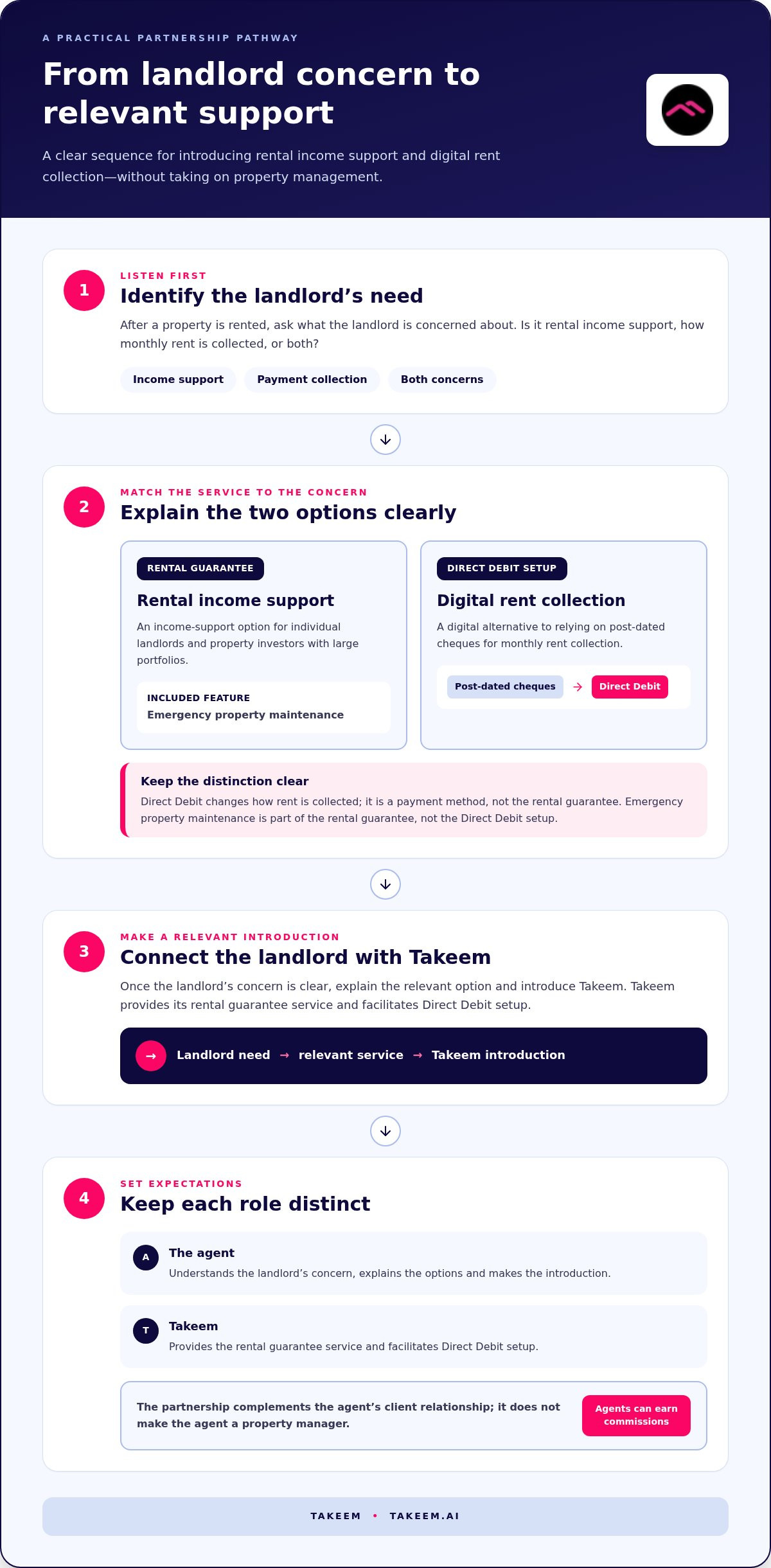
    • Use a simple sequence: identify the landlord’s need, explain the relevant option, make an introduction, and clarify each party’s role.
    • The partnership complements an agent’s client relationship. Takeem’s rental guarantee also includes emergency property maintenance.

    Why a Property Agent Partnership in the UAE Can Strengthen Landlord Trust

    An agent’s work with a landlord doesn’t necessarily end when a property is found or leased. Once a tenant moves in, the landlord may still be thinking about whether rent will arrive as expected, how payments will be collected, and what support is available if an issue arises. Agents who can respond to these ongoing needs have a reason to stay useful after the transaction and keep the relationship active.

    A relevant service partnership gives agents another way to support that conversation. For example, an agent can introduce a landlord to rental income support or digital monthly rent collection through Direct Debit. These options address different needs: the rental guarantee provides income support, while Direct Debit changes how payments are collected. Takeem partners with real estate agents, who can earn commissions through the partnership.

    A property agent partnership in the UAE connects an agent’s landlord clients with relevant rental support services, complementing the agent’s relationship without making the agent a property manager. The agent can identify a need and make an introduction. Takeem provides its rental guarantee and facilitates Direct Debit setup. Keeping those roles clear helps set expectations and keeps the partnership focused.

    Understanding the wider property market can help agents put landlord conversations in context. This overview of real estate market background offers further reading. This guide focuses on a practical question: how agents can add useful landlord support after a rental transaction, rather than simply helping someone locate an agent.

    What landlord clients need after a property is rented

    Rental income and payment collection can remain on a landlord’s mind throughout a tenancy. A landlord may want to explore income-support options or move away from relying on post-dated cheques for monthly rent. An agent can listen for the specific concern, explain the service that addresses it, and offer a useful next step. The aim is to make a relevant introduction, not to promise a risk-free tenancy or take on property-management responsibilities.

    How partnership value differs from agent discovery

    Agent discovery helps landlords compare professionals by profile, language or listings. That answers a different question from what an agent can introduce after a property is rented. A service partnership focuses on extending landlord support, for example by connecting a client with rental guarantee services or Direct Debit setup. This guide explores that ongoing value rather than functioning as a directory. Agents interested in the rental guarantee option can also explore a related guide on rental guarantees for real estate agents.

    The difference is practical: discovery helps a landlord find representation; partnership can help an agent continue a relevant conversation after leasing. By making a clear introduction and describing the service accurately, agents can add value while keeping their role distinct from property management.

    How a Rental Guarantee and Direct Debit Partnership Works

    A rental guarantee and Direct Debit partnership connects an agent’s landlord clients with Takeem’s rental guarantee service and digital rent collection setup. These are related but distinct services: the rental guarantee provides rental income support, while Direct Debit gives landlords a way to accept monthly rent payments digitally instead of relying on post-dated cheques.

    The partnership creates a clear route from a landlord’s need to a relevant service. An agent can recognise a concern, explain the broad options, and introduce Takeem. Takeem provides the rental guarantee service and facilitates Direct Debit setup. Emergency property maintenance is included as part of the rental guarantee, giving agents another service feature to explain when discussing the offering.

    Direct Debit changes how rent is collected; it is a payment method, not the rental guarantee itself. Keeping that distinction clear helps landlords understand what each service does. Digital collection and rental income support serve different purposes, so describe them separately.

    The landlord services an agent can introduce

    Takeem’s rental guarantee service is for individual landlords as well as property investors with large portfolios. An agent can introduce it as an income-support option and explain that emergency property maintenance is included. The landlord can then consider the service in relation to their needs.

    For collection, Direct Debit setup gives landlords a digital alternative to coordinating post-dated cheques. For example, an agent speaking with a landlord who wants monthly payments handled digitally can explain that Takeem facilitates Direct Debit for rent collection. This addresses the payment process, while the rental guarantee remains a separate service. Emergency property maintenance is part of the rental guarantee, not the Direct Debit setup.

    The agent’s role alongside Takeem

    An agent remains the relationship partner: they understand the landlord’s concerns, introduce relevant support and help make the offering understandable. Takeem provides its rental guarantee service and facilitates Direct Debit setup. Making an introduction doesn’t make the agent the service provider, and the partnership doesn’t turn Takeem into a property management company.

    A practical conversation can stay focused on three points:

    • Identify the need: Is the landlord asking about rental income support, digital monthly collection, or both?
    • Explain the distinction: Describe the rental guarantee and Direct Debit as separate services with different roles.
    • Make the introduction: Connect the landlord with Takeem to discuss the relevant service and its features.

    This straightforward approach lets agents add a relevant option to landlord conversations while keeping responsibilities clear. Agents who want to understand the services behind a property agent partnership UAE can explore Takeem’s landlord support and see how rental guarantees, Direct Debit setup and included emergency maintenance fit together.

    What Makes a Property Agent Partnership Valuable to Landlords?

    A transaction-focused agent helps a landlord find a tenant or complete a lease. The relationship can go further when the agent also introduces relevant support for concerns that continue during the tenancy, such as rental income support or how rent is collected. This gives the landlord a useful next step while keeping the agent’s role distinct from the service provider’s.

    That difference is the value of a property agent partnership UAE landlords can understand: it extends the conversation, not the agent’s responsibilities by default. For example, an agent might explain that Takeem offers a rental guarantee service and facilitates Direct Debit setup for digital monthly rent collection. These are separate service components that address different needs.

    Compare payment processes without promising outcomes

    Post-dated cheques and Direct Debit involve different ways of arranging rent collection. The practical distinction is how the payment is handled, not a promised difference in speed, cost or convenience. A landlord can consider whether a digital monthly payment setup suits their preferred collection process. A separate guide on moving from cheques to Direct Debit can provide more payment context.

    Collection approach What the landlord can expect to consider
    Post-dated cheques Rent collection is arranged around cheques provided for future payment dates.
    Direct Debit setup Takeem facilitates a digital setup for landlords to accept monthly rent payments from tenants.

    The table compares collection methods, not protection. Direct Debit is a payment method; a rental guarantee is a separate service. Keeping that distinction visible helps landlords decide which need they’re addressing.

    Keep client expectations and responsibilities clear

    Introducing another provider can raise a fair concern: will the landlord know who is responsible for what? A concise explanation can prevent confusion. The agent makes a relevant introduction and remains clear about their existing client responsibilities. Takeem provides its rental guarantee and facilitates Direct Debit setup; the partnership doesn’t make the agent the service provider or Takeem a property management company.

    Before making an introduction, agents can keep the discussion grounded in three points:

    • Name the need: Is the landlord asking about rental income support, rent collection, or both?
    • Describe the service plainly: Explain the rental guarantee and Direct Debit separately, without suggesting one includes the other.
    • Keep claims measured: Describe the service features accurately and avoid promising a particular outcome.

    This approach makes the partnership easier to understand. The landlord can consider a relevant service, while the agent preserves trust through a transparent introduction and clear expectations.
    Property Agent Partnership UAE: Build Trust and Add Landlord Value

    How Agents Can Introduce Rental Income Support to Landlords

    A useful introduction starts with the landlord’s concern, not with a pitch. A question about rental income, payment collection or post-dated cheques can open a practical conversation, but the partnership won’t be relevant to every landlord. Listen first, then explain the service that connects to what the client wants to address.

    Recognise when a landlord conversation is relevant

    Look for a clear signal: a landlord may ask about income support, describe their current cheque-based collection process, or say they’d prefer to accept rent digitally each month. Ask an open question, such as, “Which part of rent collection or income planning would you most like to improve?” Their answer helps you judge whether an introduction would be useful, rather than assuming every client needs the same option.

    Explain the offer transparently

    Keep the service components distinct. Takeem’s rental guarantee is an income-support service, and emergency property maintenance is included as part of it. Direct Debit setup is a separate option for accepting monthly rent payments digitally. Explain your role as making an introduction, not setting the service terms or promising a particular result. A guide to presenting rental guarantees to landlord clients can help agents develop this conversation further.

    A practical sequence keeps the discussion clear and client-led:

    1. Identify the need. Listen for concerns about rental income or a wish to change how monthly payments are collected. Ask a follow-up question before recommending an option.
    2. Explain the relevant service. If the concern is income support, describe the rental guarantee. If it’s the payment process, explain that Takeem facilitates Direct Debit setup for digital monthly rent collection. If both matter, distinguish the two.
    3. Make the introduction. Once the landlord is interested, connect them with Takeem to discuss the relevant service and its features.
    4. Clarify roles. Let the landlord know you’re introducing a service provider. The partnership complements your client relationship; it doesn’t make you the provider or Takeem a property management company.

    For example, an agent might say: “You mentioned wanting a digital way to collect monthly rent. Takeem facilitates Direct Debit setup for landlords. It also offers a separate rental guarantee service that includes emergency property maintenance. I can introduce you so you can discuss the relevant option.” This wording separates the services and explains the introduction without promising an outcome.

    A property agent partnership connects landlords with relevant support while allowing agents to remain focused on their client relationship. That’s the purpose to communicate: a considered introduction, not a blanket recommendation. To explore landlord rental support and Direct Debit setup, learn about Takeem’s landlord services.

    Partner with Takeem to Add Landlord Support Across the UAE

    A property agent partnership can give agents a practical way to extend support beyond finding a tenant or completing a lease. Takeem works with landlords and property investors across the UAE, offering rental guarantee services, Direct Debit setup for digital monthly rent collection, and emergency property maintenance as part of its rental guarantee service. Agents can introduce these options when they match a landlord’s concerns, while continuing to focus on their own client relationship.

    The value is in having relevant support to discuss, not in promising a particular financial outcome. Rental income support and payment collection address different needs, so a clear explanation helps landlords understand what they’re considering. Agents can also earn commissions through a partnership with Takeem. Keep the conversation focused on the services and the client’s priorities.

    Which landlord clients may find the service relevant?

    Takeem serves individual landlords and investors with large property portfolios. The services may be relevant when a landlord wants to explore rental income support, move from post-dated cheques to digital monthly collection, or consider both. Start with the client’s stated need rather than making a blanket recommendation. Takeem provides rental guarantee services and facilitates digital collection, not property management.

    A simple way to consider relevance is to listen for what the landlord is trying to address:

    • Income support: The landlord wants to explore a rental guarantee service.
    • Payment collection: The landlord is interested in accepting monthly rent digitally through Direct Debit.
    • More than one concern: The landlord wants to discuss income support and collection as distinct service needs.

    These prompts help agents tailor an introduction without overloading the conversation. If a landlord is focused only on payment collection, keep the discussion there. If they ask about rental income support, explain the rental guarantee separately and mention that emergency property maintenance is included as part of that service.

    Explore a partnership with Takeem

    For agents, a partnership can complement existing landlord relationships with an additional service to introduce when appropriate. It doesn’t replace the agent’s responsibilities to their clients or turn the agent into the service provider. Takeem provides the rental guarantee, facilitates Direct Debit setup and includes emergency property maintenance as part of the rental guarantee. Clear boundaries help keep the introduction useful and expectations grounded.

    If these services align with the needs you hear from landlord clients, explore how a property agent partnership UAE can fit into your conversations. You can Explore a property agent partnership with Takeem and learn more about connecting landlords with rental support and digital collection.

    Make the Next Landlord Conversation More Valuable

    The strongest partnership conversations begin with listening. Rather than introducing a service to every landlord, use what clients tell you to spot where additional support could be relevant. That keeps recommendations personal, makes the purpose easier to understand and helps preserve the trust you’ve built through your work.

    A property agent partnership UAE can be a considered extension of your client relationships, not a script to follow or a replacement for your professional role. Think about the questions landlords raise most often, then decide how a clear, appropriate introduction could help address those needs. A well-timed conversation can create a more useful experience for clients over the course of a tenancy.

    Explore how a partnership can support your work with landlords. Explore a property agent partnership with Takeem.

    Frequently Asked Questions

    What is a property agent partnership in the UAE?

    A property agent partnership in the UAE is a collaboration in which an agent introduces landlord clients to relevant rental services rather than providing those services personally. Takeem offers rental guarantees, setup for digital monthly rent collection through Direct Debit, and emergency property maintenance as part of its rental guarantee service. The partnership is distinct from property management.

    Can real estate agents earn commission through a rental guarantee partnership?

    Yes. Takeem offers real estate agents the opportunity to partner and earn commissions. This can add a commercial dimension to introducing a landlord to a relevant service, but it shouldn’t determine whether that service suits the client. Agents can keep the recommendation focused on the landlord’s stated needs and explain the service in plain language.

    Is Takeem a property management company?

    No, Takeem isn’t a property management company. It provides rental guarantee services, facilitates Direct Debit setup for landlords to accept monthly rent digitally, and includes emergency property maintenance as part of its rental guarantee service. These offerings aren’t the same as managing a property on a landlord’s behalf. For example, introducing a landlord to a rent collection option doesn’t mean the agent or Takeem has taken over the landlord’s broader property responsibilities.

    How does Direct Debit help landlords collect rent digitally?

    Takeem facilitates Direct Debit setup so landlords can accept monthly rent payments from tenants digitally. It offers an alternative to relying on post-dated cheques, with collection arranged through a digital payment method rather than cheque-based handling. Direct Debit concerns payment collection, not rental income protection.

    Does Takeem’s rental guarantee include emergency property maintenance?

    Yes. Emergency property maintenance is included as part of Takeem’s rental guarantee service, adding a maintenance component alongside rental income support. Agents can explain this clearly by stating that emergency property maintenance forms part of the rental guarantee.

    Can agents introduce Takeem to landlords with just one property or larger portfolios?

    Yes. Takeem serves individual landlords as well as property investors with large portfolios. An agent can consider the same broad service categories with either audience, then focus the conversation on the landlord’s needs. For one landlord, digital monthly collection may be the main interest; an investor with multiple properties may want to discuss rental income support.

    Does a Takeem partnership operate across the UAE?

    Takeem serves landlords and property investors across the United Arab Emirates, so agents can discuss its services with clients on a country-wide basis. Agents can focus introductions on the landlord’s interest in rental income support, digital monthly collection or the rental guarantee service.

  • Tenant Rent Default Risk in the UAE: Protect Rental Profit

    Tenant Rent Default Risk in the UAE: Protect Rental Profit

    What happens to your rental profit when a tenant misses a payment, and how long can your cash flow absorb the gap? For UAE landlords, tenant rent default risk UAE is more than an overdue instalment: arrears can build, reduce income available for expenses, and make it harder to predict when rent will arrive. A vacant property creates a different loss because there’s no tenant or rent to collect.

    It’s reasonable to want dependable rental income, but no collection method or protection should be treated as a promise that default won’t happen. Understanding the difference between late rent, ongoing default, and vacancy helps you identify your exposure and assess what each option can and can’t address.

    This guide explains how missed payments can reduce rental profit, compares practical ways to manage exposure across the UAE, and outlines what to check before choosing a rental guarantee or digital collection option. Direct Debit can streamline monthly rent collection without guaranteeing payment, while emergency maintenance coverage supports property care rather than replacing lost rent.

    Key Takeaways

    • Distinguish overdue rent, tenant default, and a void period to identify which income risk you’re facing.
    • Trace how missed payments can affect rental profit alongside ongoing ownership and reletting costs.
    • Assess tenant rent default risk UAE with a practical comparison of payment processes, digital collection, and rental guarantees.
    • Review payment terms, cash-flow sensitivity, and records to make your exposure clearer before choosing protections.
    • Check the terms and limitations of each option: Direct Debit supports collection, while a rental guarantee and emergency maintenance address different needs.

    Tenant rent default risk in the UAE: what landlords should distinguish first

    An expected rent payment hasn’t arrived. Is it a short delay, a growing arrears balance, or the start of a longer income gap? That uncertainty can make it difficult to plan for property expenses. To assess tenant rent default risk UAE landlords need to separate the missed payment, the tenant’s ongoing payment situation, and any period when the property has no tenant.

    What counts as missed rent or tenant default?

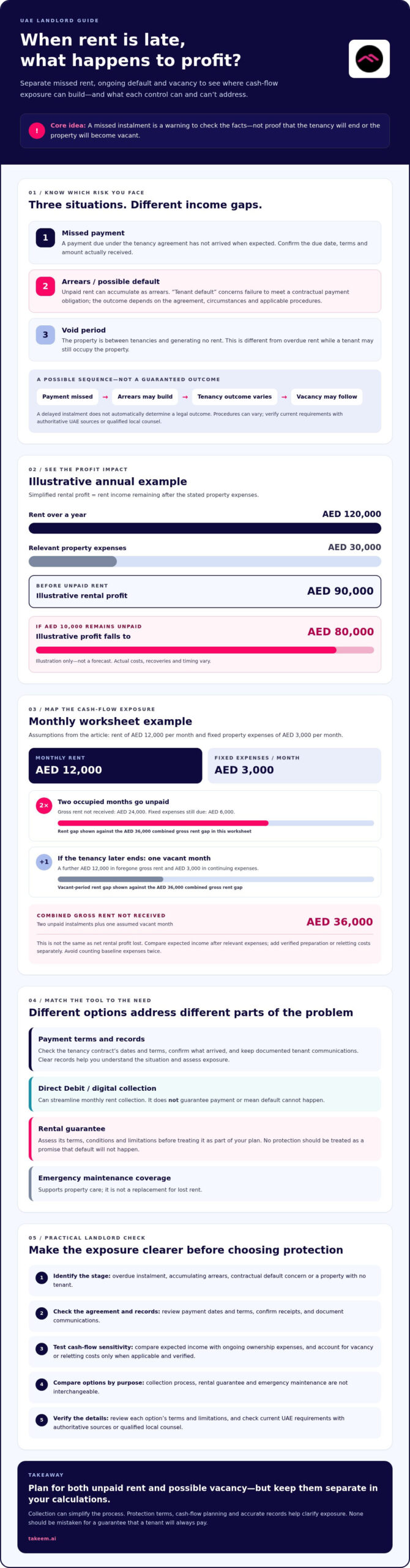
    A missed payment is a payment due under the tenancy agreement that hasn’t arrived when expected. Rent arrears are rent payments that remain unpaid and accumulate over time. Tenant default describes a failure to meet a contractual payment obligation, but whether a particular situation amounts to default, and what follows, depends on the agreement, circumstances, and applicable procedures.

    One delayed instalment doesn’t automatically determine a legal outcome. Start with the records: check the payment dates and terms in the tenancy contract, confirm what has actually been received, and keep documented communications with the tenant. Landlords can review information about the Ejari registration system as part of understanding tenancy registration. Verify current requirements and any legal implications with authoritative UAE sources or qualified local counsel. Procedures can vary, so don’t assume the same steps apply in every situation.

    How is tenant default different from a void period?

    A void period is time when a property is between tenancies and generating no rent. By contrast, a tenant may still occupy the property while rent is overdue. Default may eventually lead to a vacant property, but that outcome and its timing aren’t automatic. Keeping the terms clear helps landlords assess whether the immediate concern is unpaid rent, lost rent between tenancies, or both.

    Hypothetical example: Suppose a property earns AED 120,000 in rent over a year and has AED 30,000 in relevant property expenses. Rental profit, simplified here as income remaining after those expenses, is AED 90,000. If AED 10,000 of rent remains unpaid and expenses are unchanged, the illustrative profit falls to AED 80,000. This example isn’t a forecast: actual costs, recoveries, and timing vary.

    That distinction matters because ownership costs may continue whether rent is late or the property is empty. A void period can also involve costs to prepare the property for reletting. Treating arrears and vacancy as separate risks gives landlords a clearer basis for deciding what records, cash-flow planning, and protections to assess next.

    How tenant default can reduce rental profit and create further exposure

    A missed instalment is the start of a possible sequence, not proof that a property will become vacant. As payments remain outstanding, rent arrears may build. The landlord may follow up under the tenancy agreement and applicable procedures; the tenancy may then be resolved, continued, or eventually end. Only after it ends might a void period begin, and the timing depends on the circumstances and process. This distinction helps landlords assess tenant rent default risk UAE without treating every stage as a certain outcome.

    Which financial effects should landlords include?

    Separate the income you expected from cash obligations and any additional costs. Fixed ownership expenses may continue while rent is unpaid or the property is vacant. Include reletting costs only when they apply and can be verified. Use the following as an illustrative worksheet, not a market average or forecast:

    • Assumptions: Monthly rent of AED 12,000; fixed property expenses of AED 3,000 per month.
    • While occupied: Two instalments go unpaid. Gross rent not received is AED 24,000, while AED 6,000 in fixed expenses still falls due.
    • If the tenancy later ends: Assume one further month without a tenant, adding AED 12,000 in foregone gross rent and AED 3,000 in continuing expenses.
    • If verified: Add any actual, relevant property-preparation or reletting costs separately.

    Under these assumptions, the missed and vacant-period rent totals AED 36,000 in gross income not received. That isn’t the same as net rental profit lost. Compare the amount with expected income after relevant expenses, and account separately for applicable additional costs. Don’t count ordinary expenses twice if they were already included in your baseline profit calculation. Individual properties and expense structures differ.

    Lost rent during occupancy is unpaid income from a tenant still in the property; lost rent during a void period is income that can’t accrue because no tenancy is in place.

    When can default turn into a void-period risk?

    A tenancy ending can create a vacancy, but default doesn’t automatically end an agreement or set a move-out date. Include reletting time as a separate planning assumption, not a guaranteed consequence. For a fuller breakdown of the impact of missed rental payments, consult the published guide alongside your own records and property figures.

    Planning can also start before a tenancy begins. The Etihad Credit Bureau tenant screening announcement is a useful reference when exploring screening options. Verify current availability and any applicable requirements before relying on a service. To compare a rental guarantee with digital rent collection, review Takeem’s rental-risk options and check the relevant terms for your circumstances.

    Compare UAE rent-risk controls: payment collection, processes, and guarantees

    No single measure addresses every source of rental-income uncertainty. A clear process helps landlords track obligations and respond consistently. Digital collection changes how payments are requested and received, while a rental guarantee may offer protection subject to its written terms. Compare each option against the specific exposure you want to manage rather than assuming that any one of them prevents tenant default.

    Control Purpose and potential benefit Limitations and questions to verify
    Landlord processes Keep payment terms, due dates, records, and communications organised. This can make it easier to spot an overdue payment and know what to check next. Good records don’t recover rent by themselves. Check what the tenancy agreement says, what procedures apply, and which notices or documents may be relevant. Verify legal steps with current authoritative UAE sources or qualified local counsel.
    Digital collection Provides a digital way to collect monthly rent. Direct Debit setup can replace post-dated cheques as a collection method and may make payment tracking more straightforward. It doesn’t guarantee successful collection or prevent default. Ask how setup works, what happens if a payment isn’t collected, and what records are available. Confirm the process with the provider.
    Rental guarantee May provide a defined form of protection for landlords, depending on the product’s terms and the landlord’s eligibility. Coverage, exclusions, claim evidence, and payment conditions can differ. Review the current written terms and ask how arrears, tenancy changes, and periods without a tenant are treated.

    What can digital rent collection change?

    Takeem’s Direct Debit setup lets landlords digitally accept monthly tenant payments. Compared with post-dated cheques, it changes the collection method, not the underlying payment obligation. A scheduled digital collection can still fail, so landlords should continue to monitor records and follow their agreed process. For more detail, see the published guide to modernising UAE rent collection with Direct Debit.

    What should landlords verify in a rental guarantee?

    Read the current written terms before treating a guarantee as a fit for your tenant rent default risk UAE plan. Confirm covered events, eligibility, exclusions, required claim evidence, and payment conditions. Ask specifically how the arrangement handles accumulated arrears, changes to a tenancy, and any time when the property has no tenant. For context, consult the published UAE guide to landlord rental guarantees, then compare its explanation with the terms offered to you.

    These controls can complement one another, but they serve different purposes. A landlord might use organised records to manage follow-up, digital collection to handle monthly payments, and separately assess whether a rental guarantee matches their exposure. Compare the practical details before choosing. Don’t assume a collection tool provides income protection or that a guarantee covers every period or loss.

    Tenant Rent Default Risk in the UAE: Protect Rental Profit

    A practical UAE checklist for assessing tenant default exposure

    A useful review turns uncertainty into decisions you can document. Before a tenancy begins, assess the payment arrangement and your ability to absorb disruption. If a payment is missed, verify the facts and follow the relevant agreement and procedures rather than acting on assumptions. This checklist can help UAE landlords assess tenant rent default risk UAE without treating any outcome as inevitable.

    What should landlords review before a tenancy begins?

    Start with the paperwork and cash flow. Check the tenancy agreement, rent amount and due dates, payment method, and how you and the tenant will communicate about payment questions. Confirm that relevant registrations and records are in order for your circumstances. For tenant checks or other safeguards, seek qualified UAE guidance on what’s lawful and appropriate.

    • Payment terms: Note when rent is due, how it should be paid, and what the agreement says about a missed instalment.
    • Documentation: Set up a clear record of the agreement, payment dates, receipts, notices, and landlord-tenant communications.
    • Cash-flow sensitivity: Test several scenarios using your actual figures. For example, model one missed instalment, several unpaid instalments, and a separate period with no tenant. Include continuing property expenses and any reletting costs you can verify. These are planning scenarios, not predictions or typical UAE outcomes.
    • Available protections: Compare collection methods and any rental guarantee against the specific risks you want to address. Review current written terms, including eligibility, exclusions, evidence, and payment conditions.

    What should landlords do after a payment is missed?

    First, check the bank or collection record against the payment schedule in the tenancy agreement. Contact the tenant with a clear, factual message, then retain dated copies of the communication and any response. Record the amount outstanding and update the payment history. If a notice or formal step may be required, verify the applicable procedure with a qualified UAE professional. Don’t rely on assumed timelines or attempt self-help measures.

    Next, revisit your cash-flow scenarios. Separate rent still outstanding from costs that continue, and consider vacancy only if the tenancy ends. If you have a rental guarantee, check its claim process and required evidence promptly against the current written terms. A collection service can support the payment process, but it doesn’t itself guarantee successful collection.

    Quick checklist: Prevention means reviewing terms and appropriate checks; collection means tracking payments and keeping dated records; income protection means assessing written guarantee terms; vacancy planning means modelling reletting time separately from arrears.

    If you’re comparing protections, review Takeem’s rental guarantee and Direct Debit options and confirm which terms fit your circumstances.

    How Takeem’s rental guarantee and digital collection fit into a landlord’s plan

    Once you’ve mapped your exposure and reviewed the available controls, assess whether a provider’s services fit your rental plan. Takeem serves individual landlords and property investors with large portfolios across the UAE. Its service categories include landlord rental guarantees, digital monthly rent collection through Direct Debit, and emergency property maintenance as part of the rental guarantee service.
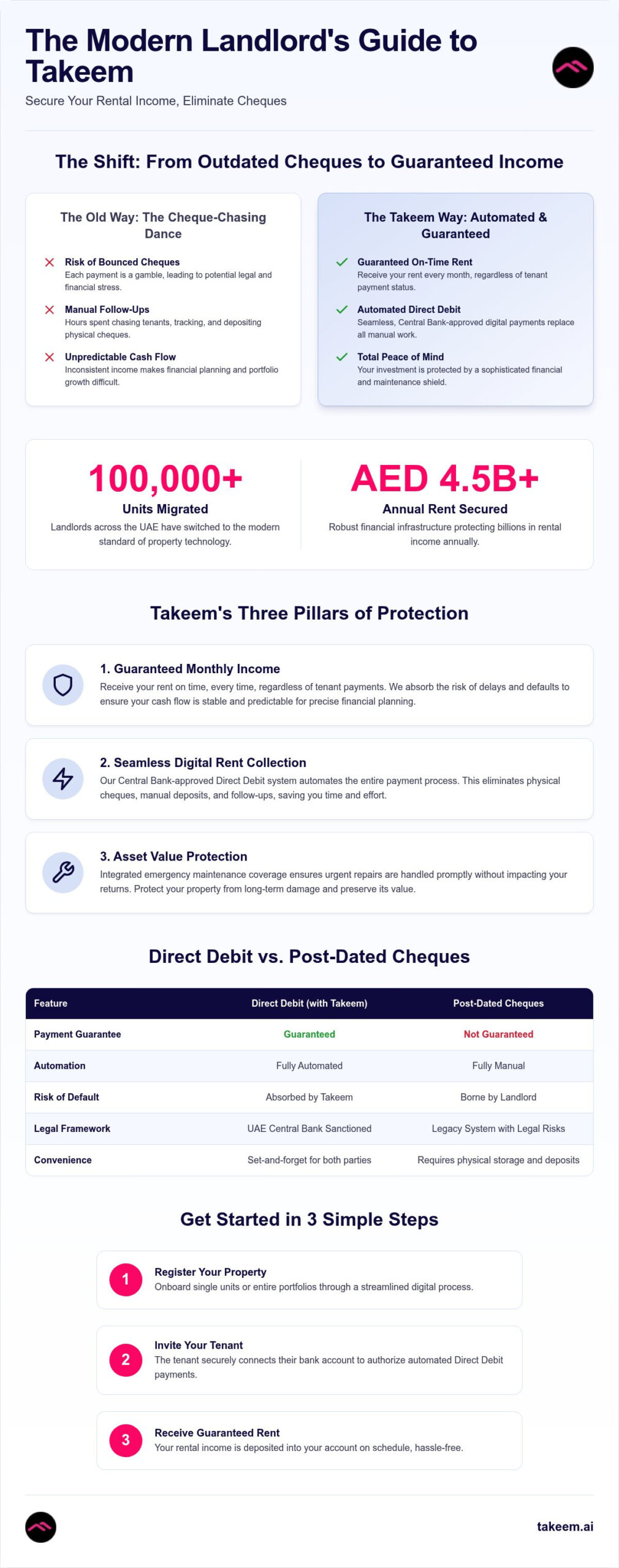
    These options address different needs. Direct Debit provides a digital method for accepting monthly rent, but it doesn’t prevent default or guarantee successful collection. Assess a rental guarantee against its written terms and your own risk scenarios. Emergency maintenance supports property care; don’t assume it covers rent losses.

    Which landlord situations may warrant exploring a rental guarantee?

    Landlords who want to assess ways to manage the financial impact of missed rent may wish to compare rental guarantees with their cash-flow needs. This may include an individual landlord with limited capacity to absorb an income interruption or an investor reviewing exposure across a larger portfolio. Neither situation means a particular product is automatically suitable. Compare the actual written coverage with scenarios you’ve modelled, including arrears and any possible period without a tenant.

    What should landlords ask before taking the next step?

    Request current details before deciding. Ask what events are covered, who is eligible, what exclusions apply, what evidence a claim requires, and how payment conditions work. Clarify how the terms address arrears, tenancy changes, and vacancy. These details determine whether the arrangement matches your tenant rent default risk UAE plan. Don’t rely on a general description in place of the current agreement.

    For Direct Debit, confirm how setup works, what information or authorisation is required, how payment activity is recorded, and what responsibilities remain with you if a collection doesn’t go through. Keep your own tenancy and payment records, and verify any applicable legal or procedural questions with qualified UAE professionals. A digital process may simplify collection, but it doesn’t replace those responsibilities.

    Check the fit for both your property and portfolio needs. Review the terms, limitations, and process before making a decision, and compare them with your own cash-flow assumptions rather than expecting a particular outcome.

    Explore Takeem’s rental guarantee and digital rent collection to review the available service information and assess whether it suits your circumstances.

    Build a rental plan around the risks you can control

    Protecting rental profit starts with clear distinctions: arrears are unpaid rent, while a void period is time without a tenant. They affect income in different ways. Tenant rent default risk UAE landlords face is best assessed by looking at payment terms, records, ongoing expenses, and possible vacancy separately.

    Landlord processes, digital collection, and rental guarantees serve different purposes. Direct Debit can support monthly rent collection, but it doesn’t guarantee payment. Before choosing a rental guarantee, check current eligibility, covered events, exclusions, claim evidence, and payment conditions against your own cash-flow scenarios.

    Takeem offers rental guarantee services to landlords and property investors across the UAE, supports digital monthly rent collection through Direct Debit, and includes emergency property maintenance as part of its rental guarantee package. Verify current service terms, including the maintenance scope, before deciding whether the options fit your needs.

    To compare the available options, explore Takeem’s rental guarantee and digital rent collection and review the service information for your circumstances.

    Frequently Asked Questions

    What is tenant rent default risk for a UAE landlord?

    Tenant rent default risk UAE landlords face is the possibility that a tenant doesn’t pay rent as agreed, reducing the income available for property expenses and affecting cash flow. A missed instalment is a payment event; arrears are rent that remains unpaid, while default depends on the agreement and circumstances. This risk is distinct from a void period, when the property has no tenant and isn’t generating rent.

    How can a missed rent payment affect rental profit?

    A missed rent payment can reduce rental profit because expected income is lower while relevant ownership expenses may continue. If rent is due but not received, calculate the unpaid amount separately from recurring property costs and any verified expenses associated with reletting. Don’t treat gross rent not received as the same as net profit lost. The actual impact depends on your income, expenses, timing, and any later recovery.

    Is a tenant default the same as a void period?

    No. Tenant default concerns a failure to meet a payment obligation under the tenancy agreement, while a void period is time when the property is between tenancies and earning no rent. A tenant may remain in occupation while rent is overdue, so default doesn’t automatically mean the property is vacant. A tenancy ending may lead to a void period, but whether and when that happens depends on the circumstances and applicable process.

    Can Direct Debit prevent a tenant from defaulting on rent?

    No. Direct Debit changes how monthly rent is collected; it doesn’t ensure that a payment will be made or prevent a tenant from defaulting. It gives landlords a digital collection method, and Takeem offers Direct Debit setup for accepting monthly tenant payments. Landlords should still monitor collection records, check the tenancy’s payment terms, and follow up appropriately if a payment doesn’t arrive.

    What should a UAE landlord check in a rental guarantee?

    Review the current written terms before deciding whether a rental guarantee suits your circumstances. Check covered events, eligibility, exclusions, required claim evidence, the claims process, and payment conditions. Ask how the arrangement treats accumulated arrears, tenancy changes, and periods when the property has no tenant. Compare those details with your own cash-flow scenarios, and seek clarification rather than relying on broad descriptions or assuming every loss is covered.

    What should I do when a tenant misses a rent payment in the UAE?

    Check your payment records and tenancy agreement first, then contact the tenant with a clear, factual message. Keep dated records of the missed payment, notices, agreements, and communications. Avoid assuming that one delay determines a legal outcome, and don’t take self-help action based on general advice. If you’re considering a formal step, verify the current procedure with a qualified UAE professional, since applicable requirements can depend on the circumstances.

    Can a rental guarantee cover a vacant property or void period?

    It depends on the specific guarantee’s written terms, so don’t assume a vacant period is covered. Ask the provider directly whether protection applies to unpaid rent while a tenant remains in the property, time after a tenancy ends, or both. Confirm eligibility, exclusions, claim evidence, and payment conditions in writing. This distinction matters because arrears and rent foregone while a property is vacant are separate exposures.

  • How to Reduce Landlord Stress in the UAE: A Practical 2026 Guide

    How to Reduce Landlord Stress in the UAE: A Practical 2026 Guide

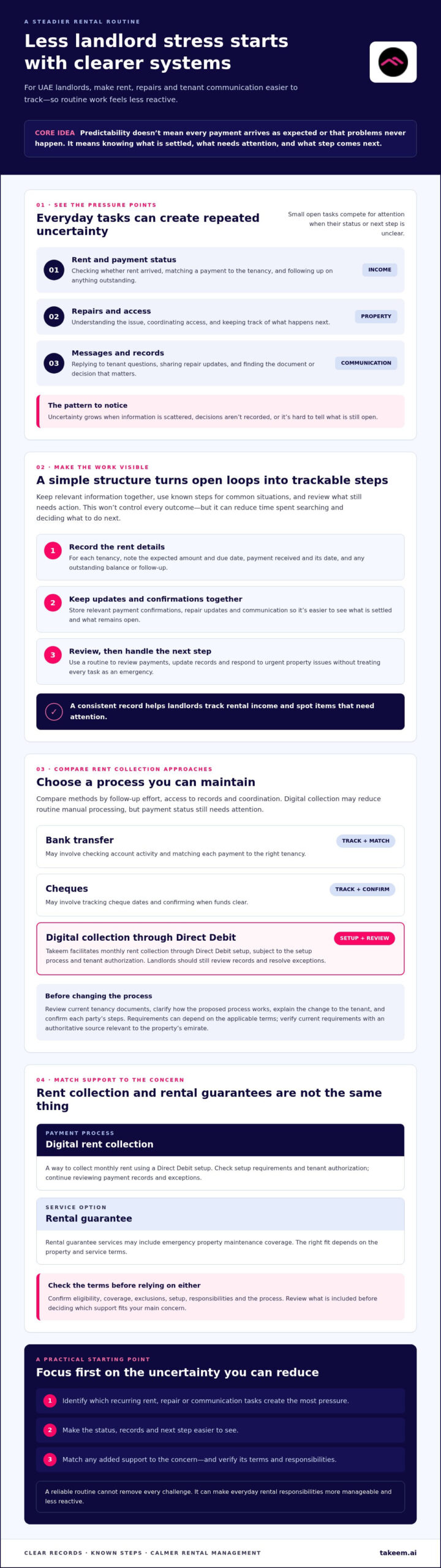
    What if a calmer rental business came from making rent, repairs, and tenant communication more predictable, rather than doing more? For UAE landlords, payment follow-ups can take time, unexpected maintenance can disrupt the week, and scattered messages can make routine administration feel like a second job. To reduce landlord stress UAE property owners need a clear system for recurring tasks, not just a plan for the next problem.

    These pressures are part of owning a rental property, but they don’t have to dictate your routine. This guide covers practical ways to create a steadier rental income process, reduce manual payment administration, and respond more confidently when urgent maintenance is needed. Clear records, communication habits, and agreed procedures can also make day-to-day decisions easier.

    Options include digital monthly rent collection through Direct Debit setup and rental guarantee services that include emergency property maintenance coverage. The right fit depends on your property and the service terms, so confirm eligibility, coverage, and the process before deciding. The goal is a rental routine that feels more manageable and less reactive.

    Key Takeaways

    • Map recurring rent, repair, and communication tasks to identify where uncertainty is adding pressure.
    • Compare payment methods by follow-up effort, record access, and coordination. Check the terms and requirements before changing your process.
    • Understand the difference between digital rent collection and a rental guarantee, and review coverage terms before relying on either.
    • Use a simple routine to review payments, update records, and handle urgent property issues without treating every task as an emergency.
    • To reduce landlord stress UAE landlords can match support to their main concern and confirm eligibility, exclusions, setup, and responsibilities.

    How landlord stress builds up across everyday rental responsibilities

    Owning a rental property can mean keeping several small details in mind at once: whether rent has arrived, which messages need a reply, what a repair requires, and where the relevant records are stored. Each task may be manageable on its own. Together, they can leave a landlord checking and rechecking because the next step or current status isn’t clear.

    Rental-management stress often comes from repeated uncertainty about income, property, and communication. Rent being paid doesn’t automatically remove that uncertainty. A landlord may still need to reconcile a payment, answer a tenant’s question, arrange access for a repair, or find the right document. These open tasks compete for attention and can interrupt work or personal time.

    Some sources of friction are within a landlord’s control, such as how payments are tracked, where records are kept, and how requests are handled. Other factors, including an unexpected property issue or a tenant’s response time, can’t always be controlled. Separating the two helps you focus on what you can improve. General stress management techniques can also help people respond to pressure, but a clearer rental process addresses practical sources of uncertainty.

    Which rental tasks create the most day-to-day pressure?

    Payment timing can prompt follow-ups and record checks, particularly when information is spread across messages, bank records, or other documents. Maintenance requests add another layer: a landlord may need to understand the issue, coordinate access, and track what happens next. Tenant communication is recurring too, from routine questions to repair updates. Without a consistent place to record decisions, even a resolved request can leave uncertainty about what was agreed.

    What does a calmer rental process look like?

    Predictability means having clear records, known steps for common situations, and fewer avoidable follow-ups. It doesn’t mean every payment arrives exactly as expected or that a property problem never occurs. For example, a landlord who logs each payment and keeps repair updates together can quickly see what’s settled and what still needs action. That simple structure won’t control every outcome, but it can reduce the time spent finding information and deciding what to do next.

    To reduce landlord stress UAE landlords can start by identifying which tasks repeatedly create uncertainty, then make those steps easier to track. A reliable routine won’t remove every challenge, but it can make everyday responsibilities feel more manageable and less reactive.

    Reduce rental-payment uncertainty with clear systems and digital collection

    Rent collection involves different steps depending on the method agreed with the tenant. A bank transfer may require checking account activity and matching a payment to the right tenancy. When cheques are used, landlords may need to track dates and confirm when funds clear. Digital collection can reduce routine manual processing, but it doesn’t remove the need to monitor payment status or follow up when something needs attention.

    A consistent record is the foundation. For each tenancy, note the expected amount and due date, the payment received and its date, and any outstanding balance or follow-up. Keep confirmations and relevant communication together so you can see what’s settled. Consistent payment records make rental income easier to track and help landlords spot items that need attention.

    How can landlords make rent tracking less manual?

    Choose a process you can maintain, whether that’s a structured spreadsheet, a financial tracking tool, or digital collection. Takeem facilitates monthly rent collection through Direct Debit setup, subject to the setup process and tenant authorization. This may reduce repetitive processing, though landlords should still review records and resolve exceptions. For more detail, read the guide to rental guarantees and Direct Debit.

    Before adopting a new method, review the current tenancy documents and clarify how the proposed process will work. Payment arrangements and procedures can depend on the applicable terms, so verify current requirements with an authoritative source relevant to the property’s emirate. Explain the proposed change clearly to the tenant and confirm the steps each party needs to take.

    What should landlords check before changing payment processes?

    Before enrolling in a Direct Debit service, ask how setup works, what authorization is required, how payment records can be accessed, and how exceptions are handled. Review the service terms and understand each party’s responsibilities. A clear process can reduce avoidable confusion, but no collection method guarantees that every payment issue disappears.

    These checks can help reduce landlord stress UAE landlords experience by making income tracking more orderly. If digital collection or rental guarantee options may suit your needs, review Takeem’s landlord solutions and confirm the relevant terms, setup, and eligibility before deciding.

    Compare practical ways to manage maintenance and rental-income worries

    Maintenance concerns and rental-income uncertainty call for different kinds of preparation. A landlord can build a process for assessing property issues, while income concerns may lead them to review payment arrangements or consider a rental guarantee. Specialist support or service-based coverage may address a specific gap, but the terms determine what’s included and what the landlord still needs to handle.

    • Self-managed preparation: Keep relevant property information and contacts organised, and decide how reports will be recorded and assessed. This helps you prepare, but you remain responsible for coordinating the response.
    • Specialist support: Seek help for a specific need, and confirm the provider’s role, boundaries, and any steps you must take.
    • Service-based coverage: Review the written scope, exclusions, and escalation process. Coverage can support a response process, but it isn’t a substitute for understanding what the agreement protects.

    How can a landlord prepare for urgent property issues?

    Set expectations for how a tenant should report an urgent issue and how you’ll assess its priority. Clear information about the reported problem can help you decide what action to take and coordinate the next steps. Timely attention may help protect the property’s condition, though it can’t guarantee a particular outcome. If a provider offers maintenance coverage, verify which issues qualify, what’s excluded, and how escalation works. Takeem includes emergency property maintenance coverage as part of its rental guarantee service. Confirm the coverage scope and process. For more context, read the UAE landlord guide to rental guarantees with maintenance.

    When might a rental guarantee be relevant?

    A rental guarantee may be worth considering if rental-income uncertainty is a key concern. It differs from collection administration: a collection method concerns how payments are accepted and tracked, while the guarantee agreement defines which income-related circumstances may be covered. Neither should be assumed to include full property management. Check eligibility, exclusions, covered circumstances, and responsibilities before deciding. The UAE guide to landlord rental guarantees can help you identify questions to ask.

    Tenancy responsibilities and procedures can vary across the UAE. Verify current requirements with authoritative sources relevant to the property’s emirate, and review your tenancy documents before deciding how to proceed. Matching support to the concern it is designed to address can help reduce landlord stress UAE landlords experience, while keeping expectations grounded in the service terms.

    How to Reduce Landlord Stress in the UAE: A Practical 2026 Guide

    Build a simple routine to reduce landlord admin and avoidable follow-ups

    A repeatable check-in turns scattered reminders into a manageable process. Set aside a regular time to review routine items, then handle urgent property reports through a separate process so they don’t get lost in monthly admin. Keep tenancy documents, payment records, maintenance history, and relevant service contacts together in an accessible, secure location. If you have multiple properties, use a consistent record format for each tenancy.

    What should a monthly landlord check-in include?

    Compare expected and received payments against your records. Then review tenant messages and maintenance requests for anything unresolved. For each open item, note the next action, who is responsible, and any agreed follow-up date. Record completed actions too. This creates a useful reference if a question arises later and helps prevent routine follow-ups from depending on memory.

    • Payments: Mark what’s expected, received, or still outstanding, and record any follow-up needed.
    • Communication: Review unanswered messages and capture decisions or agreed next steps.
    • Property issues: Check open maintenance requests and update the record when action is taken.
    • Documents: Confirm key tenancy records and relevant contacts are stored securely and easy to find.

    Adapt this checklist to your tenancy agreements and portfolio. The goal isn’t to create more paperwork. It’s to make each review answer the same practical question: what needs attention, and what can wait?

    How can landlords make urgent situations easier to handle?

    Decide in advance how a tenant should report an urgent property issue, where you’ll record it, and how you’ll assess and escalate it. Clarify who takes each step, including any provider or service contact involved, before an incident occurs. Check the relevant service terms and responsibilities so you know what falls within any coverage and what remains yours to coordinate. A defined route helps distinguish urgent reports from routine requests without assuming every issue follows the same timeline.

    Separating monthly checks from urgent events can help reduce landlord stress UAE landlords may feel when every message seems to demand immediate attention. A simple process won’t prevent every disruption, but it can make the next action clearer and reduce avoidable chasing. If digital rent collection or rental-income support fits your needs, explore how Takeem supports rental income and collection.

    Choose support that fits your UAE rental responsibilities

    Start with the pressure point you want to address. If repeated payment checks take up your time, look for a collection process that makes monthly payments and records easier to follow. If uncertainty about rental income is the main concern, assess a rental guarantee by its written terms. If urgent property issues worry you, focus on the coverage scope and escalation process. These options address different needs, so don’t assume one replaces the others or removes every landlord responsibility.

    What should landlords ask before choosing a rental support service?

    Before committing, ask for clear answers about what the service covers, what it excludes, and what remains your responsibility. For digital collection, confirm the setup steps, any tenant authorization required, and how you can review payment records. For a rental guarantee or maintenance coverage, check eligibility, applicable terms, covered circumstances, exclusions, and how to raise or escalate an issue. Compare the answers with your tenancy documents and make sure you understand the arrangement before proceeding.

    Clear terms matter because a service can only address the concerns it’s designed to cover. A rental guarantee isn’t the same as rent collection or full property management. Digital collection can help organise payment administration, but it doesn’t guarantee that every payment will arrive without follow-up. Ask who handles each step, and get responsibilities explained in writing.

    How can Takeem fit into a lower-stress rental process?

    Takeem serves landlords and property investors across the UAE with a Landlord Rental Guarantee and Direct Debit setup for digitally accepting monthly tenant payments. Emergency property maintenance coverage is included as part of the rental guarantee service. These offerings may suit landlords looking to address income concerns, manual collection tasks, or maintenance uncertainty, but fit depends on the service terms and the landlord’s circumstances.

    Before deciding, confirm current eligibility, guarantee terms and exclusions, the Direct Debit setup process and tenant authorization requirements, and the scope and process for emergency maintenance coverage. This makes it easier to compare the support with your existing arrangements and identify what you’ll still manage yourself.

    A clearer match between your main concern and the support available can help reduce landlord stress UAE property owners face, without expecting any service to solve every challenge. For a low-pressure next step, review Takeem’s rental support options and confirm whether the terms fit your needs.

    Reduce landlord stress UAE: Make your next rental decision more predictable

    A calmer rental routine starts with knowing what needs attention and where to find the information you need. Clear payment records, a regular review of tenant communication, and an agreed process for property issues can reduce avoidable follow-ups without suggesting every challenge is preventable. To reduce landlord stress UAE property owners can match support to the concern at hand, whether that’s payment administration, rental-income uncertainty, or emergency maintenance.

    Takeem facilitates digital monthly rent collection through Direct Debit setup, and emergency property maintenance coverage is included as part of its rental guarantee service. The right fit depends on your circumstances, so review eligibility, setup requirements, coverage, and terms before deciding.

    Explore Takeem’s rental support options to see whether they align with your rental responsibilities. A few clear processes and well-informed choices can make the work of being a landlord feel more manageable.

    Frequently Asked Questions

    How can I reduce stress as a landlord in the UAE?

    Build a predictable routine for payments, tenant messages, records, and property issues. Track expected and received rent in one place, note follow-up dates, and keep documents and relevant contacts organised. Use a separate process for urgent reports so they don’t get lost among monthly tasks. To reduce landlord stress UAE property owners can also assess support options for their specific concern, while checking service terms and responsibilities before committing.

    Can landlords in the UAE collect rent through Direct Debit?

    Yes, Direct Debit setup is an option for landlords to digitally accept monthly tenant payments. Confirm the setup process and tenant authorization requirements before enrolling, along with how payment records can be reviewed and how exceptions are handled. Takeem facilitates monthly rent collection through Direct Debit setup. A digital method may reduce routine manual processing, but landlords should still monitor payment status and follow up where needed.

    Does a rental guarantee remove all landlord risks?

    No. A rental guarantee shouldn’t be treated as protection against every income, property, or tenant-related risk. The agreement’s terms determine which circumstances are covered, any exclusions, and what responsibilities remain with the landlord. Review the current eligibility requirements and coverage details before relying on a guarantee. It also doesn’t replace clear payment records, a process for tenant communication, or preparation for property issues.

    What should a landlord do when a tenant reports an emergency repair?

    Record the report, clarify the issue and its location, and follow the response process set out in your tenancy arrangements or applicable service terms. Keep communication and actions documented, and confirm who is responsible for coordinating each next step. If you have maintenance coverage, check its scope, exclusions, and escalation process rather than assuming every issue is included. Addressing a report promptly can help you assess what action is needed.

    Is rental guarantee coverage the same as property management?

    No. A rental guarantee and property management are different. A rental guarantee may address specified rental-income concerns, subject to the agreement’s terms. It doesn’t mean the provider manages the property or handles every tenancy task. Landlords should check which responsibilities remain theirs and whether the service addresses their particular needs. Takeem offers rental guarantee services, but it isn’t a property management provider.

    How can I keep track of rent payments across multiple properties?

    Use a consistent record for each property or tenancy, with the expected payment, due date, amount received, date received, and any outstanding follow-up. Keep payment confirmations and relevant communication linked to the same record. A regular review helps you identify what needs attention without searching through separate messages and documents. Digital monthly collection through Direct Debit setup may reduce manual processing, but records should still be checked.

    What should I check before choosing a landlord rental guarantee?

    Ask what the guarantee covers, which circumstances are excluded, and what responsibilities remain yours. Confirm current eligibility, applicable terms, and how to raise a claim or request support. If emergency property maintenance coverage is included, clarify its scope and process. For any linked Direct Debit setup, check the steps, tenant authorization requirements, and record access. Read the full terms and ask for explanations of any points that aren’t clear before committing.

  • Protecting UAE Rental Income from Tenant Job Loss

    Protecting UAE Rental Income from Tenant Job Loss

    What happens to your property’s ROI when your tenant’s monthly salary suddenly disappears? In the UAE’s evolving 2026 market, relying on a stack of post-dated cheques is no longer a viable strategy for risk management. If a tenant faces redundancy, those cheques often become liabilities rather than assets, leading to bounced payments and expensive legal battles. You aren’t alone in feeling the stress of potential vacancies or the administrative burden of chasing funds. The challenge of protecting rental income from tenant job loss requires a shift from traditional, reactive methods to a proactive, tech-driven shield that ensures your bank account stays healthy regardless of your tenant’s employment status.

    We understand that your primary goal is maintaining a continuous monthly cash flow without the friction of manual oversight. You deserve the peace of mind that comes from knowing your investment is insulated against market volatility. This article explores how modern rental guarantees and digital Direct Debit systems are replacing the “cheque bounce” culture with streamlined, secure liquidity. You’ll discover how to leverage fintech solutions to eliminate cash flow gaps, reduce your administrative workload, and safeguard your assets against the financial fallout of tenant unemployment.

    Key Takeaways

    • Recognize why relying on post-dated cheques is a high-risk strategy in 2026 and how they leave your cash flow vulnerable during a tenant’s unemployment.
    • Identify the most effective methods for protecting rental income from tenant job loss by utilizing fintech-backed guarantees over traditional, reactive insurance policies.
    • Learn to implement a secure, digital payment framework using Direct Debit to eliminate the administrative friction and risks associated with manual cheque collection.
    • Discover how a comprehensive Rental Guarantee provides continuous monthly liquidity and includes essential benefits like emergency property maintenance coverage.
    • Understand the transition from a “cheque bounce” culture to a modern, proactive investment strategy that secures your property yield on a national scale.

    The Financial Risk of Tenant Job Loss in the UAE Rental Market

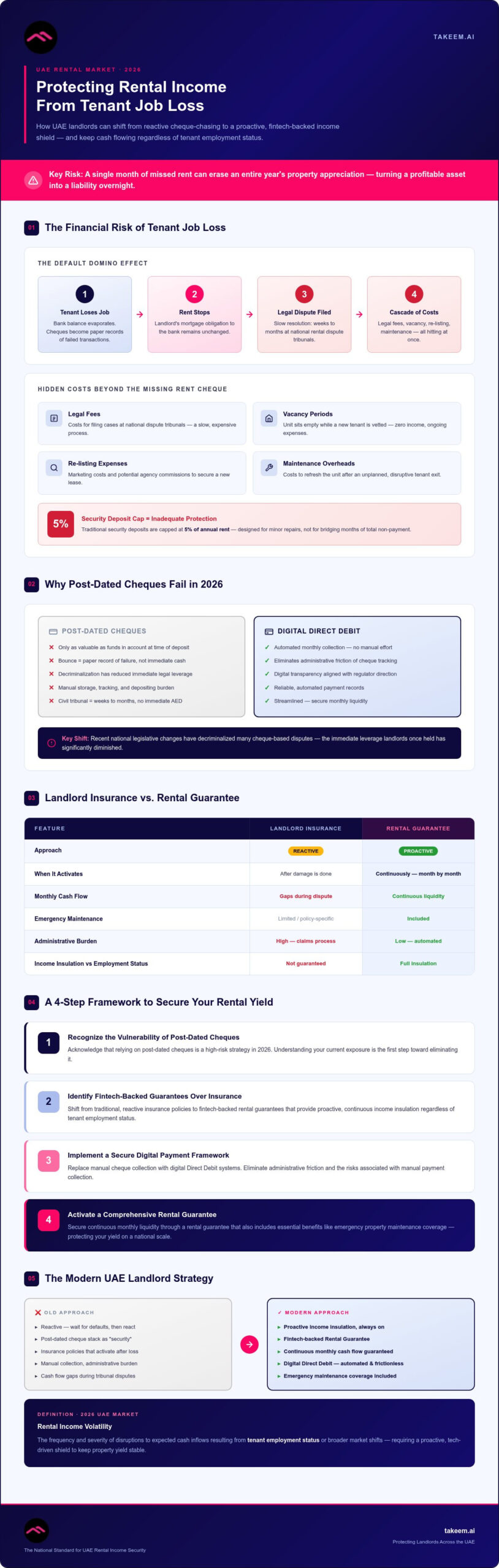
    Employment stability is the bedrock of rental yield in the UAE. Because the majority of the tenant population is tied to professional visas, any shift in the labor market creates a direct ripple effect on property performance. Industry reports suggest that tenant job loss remains the primary driver for rental defaults across the country. It’s a sudden, high-impact event that leaves landlords vulnerable. Protecting rental income from tenant job loss isn’t just about financial planning; it’s about survival in a competitive market. A single month of missed rent can effectively erase an entire year’s property appreciation, turning a profitable asset into a liability overnight.

    When a lease defaults, the landlord faces a cascade of hidden costs that extend far beyond the missing rent check. These include:

    • Legal Fees: Costs associated with filing cases at national dispute tribunals.
    • Vacancy Periods: The time the unit sits empty while a new tenant is vetted.
    • Re-listing Expenses: Marketing costs and potential agency commissions to secure a new lease.
    • Maintenance Overheads: Costs to refresh the unit after an unplanned exit.

    Understanding the Impact on Investor Cash Flow

    Missed rent creates a dangerous domino effect. Many investors leverage their properties, meaning monthly rent is earmarked for mortgage repayments to local banks. When a tenant loses their income, the landlord’s obligation to the bank remains unchanged. Traditional security deposits, typically capped at 5% of the annual rent, are rarely sufficient to cover the financial gap. They’re designed for minor repairs, not for bridging months of total non-payment. In the 2026 economic landscape, rental income volatility is defined as the frequency and severity of disruptions to expected cash inflows resulting from tenant employment status or broader market shifts.

    The Legal Reality of Non-Payment

    Seeking justice through national rental dispute tribunals is often a slow and expensive process. While the legal framework is robust, the timeline for a resolution can stretch from several weeks to several months. During this period, the property remains occupied without generating income, while the landlord incurs mounting administrative costs. While some property owners look toward landlord insurance to handle specific legal expenses, these policies are inherently reactive. They kick in only after the damage is done. True security comes from proactive income insulation, ensuring that monthly payments continue regardless of the tenant’s career trajectory.

    Why Post-Dated Cheques Fail to Protect Landlords in 2026

    For decades, the post-dated cheque was the primary instrument of security in the UAE rental market. In 2026, however, this reliance has become a significant vulnerability. The inherent flaw is simple: a cheque is only as valuable as the funds available in the tenant’s account at the precise moment of deposit. When a tenant faces unemployment, their bank balance often evaporates quickly. In these instances, a cheque becomes nothing more than a paper record of a failed transaction. It doesn’t provide the liquidity you need to cover your own financial obligations.

    A bounced cheque is merely a symptom of the underlying issue, not a solution to the loss of income. While the legal system provides a framework for recovery, it doesn’t put cash back into your account immediately. The national shift toward digital transparency has signaled the decline of the “cheque culture,” as both regulators and investors seek more reliable, automated methods for monthly collection. If you are serious about protecting rental income from tenant job loss, you must look beyond traditional paper and embrace fintech solutions that offer actual security.

    The Limitations of Criminal and Civil Recourse

    Recent national legislative changes have significantly altered the landscape of cheque-related offenses. The decriminalization of many cheque-based disputes means that the immediate leverage landlords once held has diminished. While you can still pursue civil action, “justice” in a tribunal doesn’t translate to immediate AED in your bank account. The process is often lengthy and administratively draining. Beyond the legal hurdles, the sheer burden of manually storing, tracking, and depositing physical cheques creates unnecessary friction in your investment strategy. Relying on a reactive legal process is a poor substitute for a proactive income guarantee.

    Modernizing the Collection Process

    The transition to digital systems is not just about convenience; it’s about payment success rates. Direct Debit offers a streamlined, automated alternative to the manual cheque cycle. By integrating payments into a digital framework, you reduce the risk of human error and missed deadlines. There’s also a notable psychological shift among modern tenants. In 2026, professionals prioritize automated digital payments over manual ones, viewing them as a standard part of their financial commitment.

    You can learn more about this transition in our guide on Modernizing UAE Rentals. To ensure your cash flow remains uninterrupted, consider implementing a professional Direct Debit setup that removes the stress of physical collection and places your rental yields on a secure, modern foundation.

    Comparing Income Protection: Landlord Insurance vs. Rental Guarantees

    When investors look for ways to mitigate risk, they often find themselves choosing between traditional insurance and modern rental guarantees. While both products aim to provide security, they operate on fundamentally different philosophies. Traditional landlord insurance is a reactive tool. It’s designed to compensate you for specific losses, such as property damage or legal expenses, after an event has occurred. In contrast, a Rental Guarantee is a proactive fintech service. It prioritizes the continuity of your cash flow, ensuring that protecting rental income from tenant job loss is a seamless process rather than a bureaucratic hurdle.

    The most critical difference for UAE landlords in 2026 is the speed of disbursement. A typical insurance claim for loss of rent can take anywhere from 30 to 90 days to process. During this window, you’re still responsible for mortgage payments and service charges in AED. A Rental Guarantee removes this waiting period by providing immediate monthly disbursements. This ensures your bank account reflects the expected yield on the scheduled date, regardless of whether the tenant has paid or is facing employment difficulties.

    Landlord Insurance: The Traditional Route

    Standard insurance policies often come with a list of exclusions that can leave landlords vulnerable during a tenant’s job loss. Many policies require a specific “trigger event,” such as a formal eviction notice or proof of malicious intent, before a claim is even considered. Proving a financial loss to an insurance adjuster is a complex, time-consuming task that requires extensive documentation. Additionally, insurance is a usage-based product; filing a single claim for missed rent can cause your premiums to rise significantly the following year. This makes it a costly and cumbersome method for managing the recurring risk of rental default.

    Rental Guarantees: The Fintech Evolution

    Modern platforms like Takeem have evolved the protection model by using sophisticated data to vet tenants and guarantee monthly yields. Instead of waiting for a default to happen, these systems integrate with Direct Debit to monitor payment health in real time. If a tenant’s circumstances change, the guarantee kicks in to bridge the gap, meaning the landlord never sees a disruption in their monthly income. This “seamless” approach is particularly valuable for investors with large portfolios who cannot afford the administrative drag of multiple insurance claims. A Rental Guarantee acts as a sophisticated financial shield, ensuring monthly liquidity for modern investors regardless of tenant circumstances. By shifting the risk to a professional guarantor, you secure your investment against the unpredictable nature of the job market.

    Protecting UAE Rental Income from Tenant Job Loss

    A 4-Step Framework to Secure Your Rental Yield

    Moving from a reactive to a proactive investment strategy requires a structured approach. In the 2026 market, simply hoping for the best is not a management plan. By following a clear, fintech-driven framework, you can build a resilient portfolio that withstands individual tenant crises. This process shifts the focus from chasing payments to maintaining automated liquidity. Protecting rental income from tenant job loss becomes a byproduct of a well-engineered system rather than a constant manual struggle.

    Step 1 & 2: Vetting and Automation

    The first step involves moving beyond traditional paper salary certificates. Modern proptech tools allow you to verify a tenant’s financial health in real-time by analyzing digital payment histories and debt-to-income ratios. This level of scrutiny identifies red flags before the lease is even signed. Once a tenant is approved, the second step is to transition the lease to a Direct Debit payment structure immediately. Setting up this mandate at the start of the tenancy ensures that your collection process is automated from day one, removing the friction of physical cheque management.

    Implementing these digital foundations is essential for any modern landlord. You can find a deeper dive into these processes in The Ultimate Guide to Landlord Rental Guarantees in the UAE (2026). By automating the “front end” of your tenancy, you significantly reduce the risk of human error or intentional payment delays.

    Step 3 & 4: Guarantee and Maintenance

    The third step is the implementation of a professional Rental Guarantee. This acts as your financial bridge. If a tenant loses their job, the guarantee provider ensures your monthly AED disbursement continues without interruption. This is the ultimate shield for your cash flow. Finally, the fourth step is to bundle emergency property maintenance into your protection package. Maintenance is a critical component of income protection; it prevents tenants from initiating “rent strikes” or withholding payments due to unresolved repair issues.

    A well-maintained property also retains its capital value and attracts higher-quality tenants in the future. For more information on how these services work together, consult The Landlord’s Guide to Rental Guarantees with Maintenance. Choosing a provider with national UAE coverage ensures that your entire portfolio is protected under a single, sophisticated umbrella. To begin securing your investment today, set up your Landlord Rental Guarantee with Takeem and experience the peace of mind that comes with guaranteed monthly liquidity.

    Takeem: The National Standard for UAE Rental Income Security

    Takeem addresses the core vulnerability of the UAE rental market by stepping in as the professional guarantor of your monthly yield. When the primary concern is protecting rental income from tenant job loss, Takeem provides a robust financial shield that traditional methods simply cannot match. By shifting the risk from the individual landlord to a sophisticated national institution, we ensure that your rent reaches your account in AED without fail. This isn’t just a service; it’s the modern standard for property investment in 2026, designed to stabilize the national market one lease at a time.

    The transition begins with a seamless Direct Debit setup. This removes the friction of physical cheque collection and the “cheque bounce” culture that has historically plagued the industry. Beyond cash flow, Takeem prioritizes the physical integrity of your investment. Our Rental Guarantee includes emergency property maintenance coverage, ensuring your property remains in top-tier condition regardless of the tenant’s financial situation. This proactive maintenance prevents tenant dissatisfaction and protects the capital value of the asset. It creates a win-win scenario where the property is well-kept and the income is secure.

    Peace of Mind for Individual Landlords

    For the individual landlord, the first of the month often brings a sense of “wait and see” anxiety. Takeem eliminates this stress by handling the administrative and legal heavy lifting if a tenant defaults. If your tenant faces redundancy, you won’t have to navigate national tribunals or chase payments yourself; we manage the entire process while keeping your disbursements on schedule. By integrating Takeem into your management strategy, protecting rental income from tenant job loss becomes a passive, automated process. This allows you to transition your property from a source of constant administrative anxiety into a truly secure financial asset that performs with clinical efficiency.

    Solutions for Large-Scale Investors

    Portfolio investors managing hundreds of units need a system that scales without increasing headcount. Takeem offers a standardized approach to income security across a diverse national property portfolio. By centralizing rent collection through digital mandates, we significantly reduce the operational overhead of manual cheque management and reconciliation. This high-tech shield allows professional investors to focus on strategic growth rather than the day-to-day friction of rental defaults or vacancy gaps. Secure your rental income with Takeem’s national guarantee today and experience the future of professional landlord protection.

    Securing Your Financial Future in the UAE Rental Market

    The rental landscape in 2026 demands a shift from outdated manual processes to sophisticated, tech-driven protection. We’ve explored how moving beyond the “cheque bounce” culture and implementing a proactive framework can insulate your investment. By prioritizing digital Direct Debit and comprehensive vetting, you eliminate the friction that often leads to financial gaps. Protecting rental income from tenant job loss isn’t just about recovering funds; it’s about ensuring your cash flow remains uninterrupted and your property stays in top-tier condition through integrated emergency maintenance.

    You don’t have to carry the burden of market volatility alone. Takeem offers a national standard for security, providing a professional shield that traditional insurance simply can’t match. You can enjoy guaranteed monthly cash flow regardless of tenant payment status while benefiting from a seamless digital setup. Protect your property investment with Takeem’s Rental Guarantee today. It’s time to transform your property from a source of administrative stress into a secure, high-performing financial asset. Your peace of mind is just one digital mandate away.

    Frequently Asked Questions

    What exactly is a rental guarantee in the UAE?

    A rental guarantee is a proactive financial service where a provider like Takeem acts as the guarantor of your monthly yield. Unlike traditional methods, it ensures you receive your AED payments on time even if the tenant defaults. This service is designed for both individual landlords and large portfolio investors, providing a high-tech shield that secures monthly liquidity and includes additional benefits like emergency property maintenance coverage.

    How does Direct Debit help if a tenant loses their job?

    Direct Debit serves as the digital foundation for protecting rental income from tenant job loss by replacing unreliable post-dated cheques. It allows for real-time monitoring of payment health and ensures that funds are pulled automatically from the tenant’s account. If a payment fails due to unemployment, the system immediately triggers the rental guarantee, ensuring the landlord’s cash flow remains uninterrupted while the provider handles the recovery process.

    Can I get income protection for an existing tenant who is already in the property?

    Yes, you can transition an existing tenancy into a protected one by moving the payment structure from cheques to digital Direct Debit. Once the tenant is vetted through the Takeem platform and the digital mandate is signed, the rental guarantee can be applied. This allows you to secure your current assets against future market volatility or sudden employment changes without waiting for a new lease cycle to begin.

    Does a rental guarantee cover legal fees for eviction?

    A comprehensive rental guarantee through Takeem handles the administrative and legal heavy lifting associated with tenant defaults. If a tenant is unable to pay due to job loss, the provider manages the dispute resolution process and the necessary legal filings at national tribunals. This removes the financial burden of legal fees from the landlord, allowing you to focus on your portfolio while your income is protected.

    How is a rental guarantee different from traditional landlord insurance?

    The primary difference lies in the speed of disbursement and the proactive nature of the service. Traditional insurance is reactive, often requiring a 30 to 90 day claims cycle and proof of a trigger event before paying out. A rental guarantee ensures immediate monthly payments, bridging the gap the moment a payment is missed. It prioritizes continuous cash flow rather than just compensating for a loss after it happens.

    What happens to my emergency maintenance coverage if the tenant stops paying?

    Your emergency maintenance coverage remains active as part of the integrated protection package, even if a tenant stops paying rent. This is a critical feature because it ensures your property’s capital value is maintained and prevents tenants from using repair issues as a justification for non-payment. Takeem continues to protect the physical asset while simultaneously guaranteeing the monthly rental income, providing a total security solution.

    Is Direct Debit mandatory for all UAE rentals in 2026?

    While the UAE Central Bank and national regulators have heavily promoted digital payments, Direct Debit is not mandatory for every single rental contract in 2026. However, it has become the gold standard for professional landlords and institutional investors. Most modern lease agreements now favor digital mandates over traditional cheques because they offer higher transparency, better security, and a more streamlined collection process for both parties.

    How long does it take to set up a rental guarantee with Takeem?

    Setting up a rental guarantee is a brisk and efficient digital process designed to respect your time. Once the tenant’s financial health is verified through our proptech vetting tools, the Direct Debit mandate can be established almost immediately. Most landlords find they can have their protection package active within a few business days, transitioning their property from a source of anxiety to a secure financial asset with minimal friction.

  • How to Deal with a Tenant Who Pays Rent Late: A UAE Landlord’s Guide

    How to Deal with a Tenant Who Pays Rent Late: A UAE Landlord’s Guide

    If you’re still waiting for a physical cheque to clear or chasing a tenant via WhatsApp, your rental business is already behind the curve. For many landlords across the UAE, the first of the month has become a source of anxiety rather than a day of financial growth. You’ve likely experienced the frustration of a bounced cheque or the hollow promise of payment by next week, both of which stall your personal cash flow and leave you feeling like a debt collector instead of an investor.

    We understand that your priority is a stable, predictable return on your property. This guide outlines exactly how to deal with a tenant who pays rent late by combining legal precision with modern efficiency. You’ll discover the specific steps to take within the UAE legal framework, including the 30 day notice period required by the Rental Dispute Centre (RDC). Beyond just enforcement, we’ll preview how digital Direct Debit systems and rental guarantees can eliminate the uncertainty of manual payments for good. By the end of this article, you’ll have a clear roadmap to secure your income and protect your assets without the emotional drain of constant follow ups.

    Key Takeaways

    • Understand the formal 30-day notice process through the Notary Public to ensure your legal standing remains airtight within the UAE.
    • Learn the essential legal and communication steps for how to deal with a tenant who pays rent late to ensure immediate payment and long-term security.
    • Identify the administrative risks of traditional post-dated cheques and the benefits of switching to secure, automated Direct Debit mandates.
    • Discover how a Landlord Rental Guarantee provides a sophisticated shield for your income, offering 100% peace of mind regardless of tenant behavior.
    • Gain insights into using national resources like the Rental Dispute Centre (RDC) to resolve conflicts with efficiency and confidence.

    Immediate Steps: Communication and Documentation

    The first 48 hours after a missed payment determine whether you’ll resolve the issue quickly or enter a months-long dispute. When considering how to deal with a tenant who pays rent late, your initial reaction should be clinical rather than emotional. Panic leads to aggressive WhatsApp messages that hold little weight in a legal setting, while silence encourages future delays. You need to establish a position of professional authority from the very first day of arrears.

    Reviewing Your Tenancy Contract

    Before you reach out, revisit your signed Ejari-registered contract. Most unified contracts in the UAE specify a clear due date, but some include an additional grace period of three to seven days. It’s vital to confirm if you’ve explicitly agreed to any late payment penalties. While you can include these clauses, the Rental Dispute Centre (RDC) often scrutinizes excessive fees, so ensure any charges align with standard landlord-tenant law principles. Distinguishing between a tenant who has a temporary banking glitch and one showing a pattern of default is your first step toward a resolution.

    The Power of Professional Tone

    Shift your communication from casual messaging apps to formal email trails immediately. A digital paper trail is your strongest asset if the situation ever reaches a legal tribunal. Your first reminder should be concise, authoritative, and helpful. It should state the exact amount due in AED, the original due date, and a request for a payment confirmation or transfer receipt. Maintaining a professional distance prevents the emotional escalation that often leads to total communication breakdowns.

    Use a “First Warning” approach that sets a firm deadline, typically 24 to 48 hours from the email date. This establishes that while you’re reasonable, you’re also disciplined about your cash flow. If the tenant provides a specific reason for the delay, acknowledge it, but don’t waive your rights. Always conclude with a clear timeline for the next formal step, ensuring the tenant knows that further delays will trigger a more serious legal process.

    Documenting the Delay

    A clear, updated ledger is your best friend if you eventually need to visit the RDC. Don’t rely on memory or scattered bank statements. Create a simple, professional document that tracks every interaction. This level of detail shows the authorities that you’ve been proactive and fair, making it much easier to secure a judgment in your favor. Your ledger should include:

    • The exact date the rent was due and the amount in AED.
    • The date and time of every reminder sent via email or post.
    • Summaries of any responses or promises made by the tenant.
    • A running balance of any outstanding amounts, including previous late incidents.

    Precision is mandatory when you move from professional reminders to legal action. In the UAE, the law provides a clear structure for recovery, but skipping a single step can invalidate your entire claim. Understanding how to deal with a tenant who pays rent late means mastering the transition from a landlord to a legal claimant. You don’t want to find yourself in a hearing only to realize your documentation doesn’t meet the court’s strict standards.

    Serving a Formal Legal Notice

    The most critical document in your arsenal is the 30-day notice. To hold weight in court, this notice must be served through a Notary Public or via registered mail. This 30-day legal notice is the mandatory precursor to an eviction case. Once served, the clock begins ticking. The tenant has exactly 30 days to settle the outstanding AED balance or vacate the premises. If they pay within this window, the legal path for eviction usually closes, though your right to collect late fees may remain depending on your contract terms. It’s a binary system; the payment is either made in full, or the case moves to the next stage.

    Filing a Case with the Rental Dispute Centre

    The Rental Dispute Centre (RDC) acts as the primary judicial body for property matters across the Emirates. If the 30-day notice period expires without resolution, you can formally file a dispute case. You’ll need to provide your Ejari certificate, the original tenancy contract, and clear proof of the missed payments. Keep in mind that filing a case involves costs, usually around 3.5% of the annual rent. These fees are often recoverable if you win, but they represent an immediate cash flow impact. Learning more about avoiding rental disputes UAE can save you from this administrative burden before it starts.

    It’s also vital to distinguish between a simple delay and a bounced cheque. Recent changes in UAE law have decriminalized most bounced cheque cases, moving them into the civil sphere. This makes the process of obtaining an executive order faster but changes the leverage you have over a defaulting tenant. While eviction is a powerful tool, it’s often the most expensive and time-consuming route. Proactive solutions, like a Landlord Rental Guarantee, allow you to bypass these legal hurdles entirely by ensuring your bank account stays full even when a tenant’s is empty. This shift from reactive enforcement to proactive protection is the hallmark of a modern property investor.

    Cheques vs. Direct Debit: Why Traditional Methods Fail

    The “cheque culture” has long been the backbone of UAE real estate, but it’s fundamentally a reactive system. When you’re figuring out how to deal with a tenant who pays rent late, you’ll likely realize the problem started with a signed piece of paper that carries no real-time guarantee of funds. Relying on post-dated cheques creates a fragile financial bridge between you and your income. This bridge is easily broken by a change in the tenant’s circumstances or a simple clerical oversight.

    The Risk of the Post-Dated Cheque

    Storing and managing physical cheques is an administrative burden that modern investors shouldn’t have to carry. You’re forced to manually track banking dates, visit branches, and wait for clearing cycles. All the while, you hope the notification for “insufficient funds” doesn’t arrive. The stress of a bounced cheque is now compounded by the legal shift in the UAE, where most instances have moved from criminal offenses to civil matters. This modernization means landlords can no longer rely on the threat of immediate police action to ensure payment. Cheques have become a slow, manual method in a country that is rapidly moving toward a digital-first economy.

    The Rise of Direct Debit in the UAE

    The solution lies in shifting from a physical collection model to a digital mandate. Modernizing UAE rentals means adopting Direct Debit, which pulls the AED amount directly from the tenant’s account on the agreed date. This automation removes the human element of forgetting to deposit a cheque or the tenant failing to transfer funds. It’s a proactive shield for your cash flow.

    Implementing a Direct Debit system provides real-time transparency. Both parties see the status of the transaction immediately, which reduces the friction and awkward conversations that occur when rent is overdue. This change isn’t just about efficiency; it’s about preserving the landlord-tenant relationship. By removing the need for manual chasing, you transform a potentially confrontational dynamic into a seamless, professional interaction. For those wondering how to deal with a tenant who pays rent late, the most effective strategy is to replace the outdated collection method entirely. Digital mandates provide the stability your portfolio needs to thrive in the competitive UAE market.

    How to Deal with a Tenant Who Pays Rent Late: A UAE Landlord’s Guide

    How to Automate Rent Collection to Prevent Delays

    Prevention is always more cost-effective than litigation. While the legal framework provides a safety net, the most successful investors avoid the question of how to deal with a tenant who pays rent late by removing the opportunity for delay. Automation transforms rent collection from a monthly chore into a silent, background process. By integrating fintech solutions, you establish a system where payment is the default state rather than a manual event. The process begins with robust vetting. Using digital history and credit checks allows you to predict payment behavior before a contract is even signed. When you combine high-quality tenant selection with automated collection, you create a sophisticated shield for your investment.

    Digital Onboarding and Mandates

    Transitioning an existing tenant from traditional cheques to a digital mandate is often simpler than landlords expect. It involves setting up a Direct Debit mandate for the entire tenancy term, which carries full legal validity across the UAE. This shift significantly reduces human error, such as forgetting to sign a cheque or miscalculating a date. For the tenant, it offers a seamless experience that removes the administrative burden of physical cheque handovers. You’re not just securing your income; you’re modernizing their living experience.

    Monitoring Your Portfolio Performance

    A professional approach requires visibility. Modern dashboards allow you to monitor your incoming cash flow at a glance, providing a consolidated view of your entire portfolio. These systems act as early warning indicators, notifying you of failed digital transactions long before they become serious arrears. This proactive data allows you to intervene with a polite nudge or a fintech-driven automated reminder before the 30-day legal window is even necessary. Learning more about optimising property portfolio rental income UAE can help you scale this efficiency across multiple units.

    Adopting a “set and forget” mindset allows you to focus on asset growth rather than debt collection. When you automate, you’re no longer wondering how to deal with a tenant who pays rent late because the system handles the nudges and pulls for you. It’s time to retire the ledger and the chequebook in favor of a more stable, digital future. You can set up Direct Debit for your property today to ensure your rental income arrives on time, every time.

    Securing Your Cash Flow with Rental Guarantees

    Traditional advice on how to deal with a tenant who pays rent late usually centers on the “chase.” It suggests more phone calls, firmer emails, or eventually, the stress of the courtroom. While these steps are part of the legal framework, they don’t solve the immediate problem: your missing AED income. A Landlord Rental Guarantee represents a fundamental shift in property investment. Instead of reacting to a default, you proactively secure your cash flow through a sophisticated financial shield that ensures you get paid even when the tenant stalls.

    How a Rental Guarantee Works

    The mechanism is designed for total efficiency. When you opt for a guarantee, the financial responsibility for the rent shifts. Takeem pays you the full amount due on the scheduled date, effectively acting as a buffer between you and the tenant’s bank account. We then handle the collection process, legal notices, and any necessary follow ups. This removes the emotional burden of the “late rent” conversation and preserves your professional distance. You’re no longer a debt collector; you’re a strategic investor with a protected bottom line. For a deeper dive into the mechanics, explore the ultimate guide to landlord rental guarantees.

    Protecting Your Asset Value

    Financial default is rarely an isolated event. Often, a tenant who struggles with rent also begins to neglect the property, leading to a decline in asset value. This is why emergency maintenance is a critical component of a comprehensive guarantee package. By including maintenance coverage, you ensure that the physical state of your unit remains high, even if the tenancy becomes difficult. It’s a dual layer of protection: one for your bank account and one for your property’s long term worth.

    Integrating maintenance into your financial strategy prevents small issues from becoming expensive repairs. If a tenant stops communicating, you still have the peace of mind that emergency issues are handled by professionals. You can learn more about this integrated approach in our guide to rental guarantees with maintenance UAE. This holistic solution is the only way to achieve 100% peace of mind in a localized market that demands both agility and stability. By moving beyond simple insurance, you’re not just hoping for payment; you’re guaranteeing it.

    Secure Your Rental Future with Modern Solutions

    Managing a property portfolio shouldn’t feel like a constant pursuit of missing funds. You’ve learned that knowing how to deal with a tenant who pays rent late involves a strategic mix of legal rigor and digital innovation. By moving beyond physical cheques and embracing automated Direct Debit mandates, you eliminate the administrative friction that often leads to delays. While the UAE legal framework provides a clear 30-day path for recovery, the most successful landlords choose to bypass the stress of the Rental Dispute Centre entirely by securing their income at the source.

    Transitioning to a proactive model protects your cash flow and your asset’s physical condition. With guaranteed monthly payments and national UAE maintenance coverage, you can focus on scaling your investments while the technology handles the logistics. It’s time to replace the uncertainty of “cheque culture” with a seamless, digital-first approach that prioritizes your peace of mind. Secure your rental income today with Takeem’s Rental Guarantee and experience the stability of a truly modern property business. Your journey toward stress-free rent collection starts here.

    Frequently Asked Questions

    What is the legal grace period for rent payment in the UAE?

    The legal grace period is typically defined within your specific tenancy contract, often ranging between three to seven days. However, under UAE law, formal eviction proceedings for non-payment can only begin after a 30-day notice is served. Understanding how to deal with a tenant who pays rent late requires recognizing that while a contract might allow a few days, the legal enforcement clock only starts with formal notification through the Notary Public.

    Can I lock my tenant out of the property if they are late with rent?

    No, you cannot lock a tenant out or disconnect utilities, as these actions are considered illegal “self-help” measures in the UAE. Eviction is a strictly judicial process managed by the Rental Dispute Centre (RDC). Attempting to force a tenant out without a court order can lead to significant legal penalties for the landlord. The only professional way to resolve persistent non-payment is through established legal channels and filing a formal dispute.

    How do I serve a 30-day legal notice for non-payment of rent?

    To serve a 30-day legal notice, you must use a Notary Public or send it via registered mail to ensure it’s legally binding. This notice informs the tenant they have 30 days to settle the outstanding AED balance or face eviction. This step is a mandatory precursor for any case filed at the RDC. It’s vital to keep the proof of service, as this document is the absolute foundation of your legal claim in court.

    Is a bounced rent cheque still a criminal offence in the UAE?

    Following legal reforms in 2022, a bounced rent cheque is generally no longer a criminal offense in the UAE. It has transitioned into a civil matter, allowing landlords to seek an executive order for payment through the courts more efficiently. While this speeds up the recovery of funds, it removes the immediate threat of police intervention. This shift highlights why many modern investors are moving toward secure digital collection methods like Direct Debit to ensure stability.

    What is the cost of filing a case at the Rental Dispute Centre?

    Filing a dispute case at the Rental Dispute Centre typically costs 3.5% of the property’s total annual rent. There’s usually a minimum fee of AED 500 and a maximum cap of AED 20,000 for these filings. These costs cover the administrative and judicial processing of your claim. While these fees are often recoverable if the judgment is in your favor, they represent an initial cash flow impact that landlords should factor into their recovery strategy.

    Can a rental guarantee service really pay me if my tenant stops paying?

    Yes, a Landlord Rental Guarantee from a provider like Takeem is designed to pay you even if the tenant defaults. The service acts as a financial buffer; Takeem pays the agreed rent directly to your account on the due date and then manages the collection and legal process with the tenant. This ensures your personal or business cash flow remains uninterrupted, effectively removing the financial risk and emotional stress associated with problematic or late-paying tenants.

    How do I switch from post-dated cheques to Direct Debit mid-tenancy?

    To switch from cheques to Direct Debit mid-tenancy, you and your tenant must sign an addendum to the existing tenancy contract. This document should state that future payments will be collected via a digital mandate rather than physical cheques. Once the addendum is signed, you can set up the Direct Debit through Takeem’s platform. This provides a more professional, automated experience for both parties and helps prevent the common issue of how to deal with a tenant who pays rent late.

    What happens if a tenant ignores the 30-day legal notice?

    If a tenant ignores the 30-day legal notice and fails to pay the outstanding AED amount, the landlord gains the right to file an eviction case at the RDC. Once the case is filed, the court will review the documentation and, if the claim is valid, issue a judgment for eviction and payment of arrears. This process can take several weeks, which is why proactive solutions like rental guarantees are becoming the preferred choice for risk-averse investors.

  • The Complete Guide to Takeem: Modernizing Rental Income in the UAE

    The Complete Guide to Takeem: Modernizing Rental Income in the UAE

    What if your rental income was as certain as the sunrise, completely independent of a tenant’s signature or the risk of a bounced cheque? Most UAE landlords accept the “cheque-chasing” dance as an inevitable part of property ownership. You’ve likely spent hours on manual follow-ups or felt the sting of unexpected maintenance bills that suddenly erase your monthly profit. It’s a friction-heavy process that feels increasingly out of step with the UAE’s digital-first economy.

    This Complete guide to Takeem shows you how to reclaim your time and secure your financial future by transitioning to a seamless, Central Bank-approved rental guarantee system. You’ll discover how to replace outdated paper cheques with automated Direct Debit and build a sophisticated safety net around your investment. We’ll explore how Takeem secures over AED 4.5 billion in annual rent and why more than 100,000 units have already migrated to this modern standard of property technology. From guaranteed cash flow to integrated emergency maintenance, it’s time to transform your rental property into a truly passive, protected asset.

    Key Takeaways

    • Learn how to replace the uncertainty of post-dated cheques with secure, automated Direct Debit payments sanctioned by the UAE legal framework.
    • This Complete guide to Takeem details how the Landlord Rental Guarantee protects your cash flow against tenant defaults and payment interruptions.
    • Discover how integrated emergency property maintenance coverage reduces the stress of unexpected repairs and preserves your rental yield.
    • Understand the streamlined onboarding process for registering single units or large portfolios to achieve truly hands-off rental management.
    • Explore how real estate agents can leverage the Takeem ecosystem to offer value-added services and earn commissions through a structured referral model.

    What is Takeem? The Evolution of UAE Rental Management

    Takeem is a fintech-driven rental guarantee platform designed to modernize how property owners in the Emirates handle their assets. It isn’t just a payment app; it’s a comprehensive financial shield. The mission is clear: end the era of post-dated cheques and the constant uncertainty that plagues traditional rental agreements. As the real estate market in the UAE evolves, the need for centralized, secure payment systems has never been higher. This Complete guide to Takeem breaks down how this Central Bank-approved technology serves individual landlords, large-scale investors, and real estate agents alike.

    In 2026, the shift toward digital payments is no longer a luxury. It’s a necessity for anyone serious about property investment. Takeem acts as a tech-savvy guide, providing a sophisticated shield against traditional industry pain points. It provides the digital infrastructure needed to align with global financial standards while protecting your bottom line. By replacing the manual, high-friction process of collecting physical cheques with a streamlined Direct Debit system, it transforms rental income into a predictable asset class.

    The Problem with Traditional Rent Collection

    Traditional methods rely on physical cheques, which creates a significant administrative “drag.” You have to store, track, and deposit them manually. If a cheque bounces, you’re suddenly thrust into a stressful cycle of legal and financial risks. Manual follow-ups for late payments aren’t just annoying; they erode the actual profitability of your rental yield. Every hour spent chasing a tenant is an hour of lost productivity. In a market as fast-moving as Dubai or Abu Dhabi, these outdated practices are no longer sustainable for serious investors who value their time and peace of mind.

    Takeem’s Three Pillars of Protection

    To solve these issues, Takeem operates on three core pillars that provide a sophisticated safety net for your property. These pillars ensure that your investment remains a source of growth rather than a source of stress.

    • Guaranteed Monthly Income: You receive your rent on time, every time, regardless of whether the tenant has paid. This stabilizes your cash flow and allows for precise financial planning.
    • Seamless Digital Rent Collection: By utilizing Direct Debit, Takeem automates the entire payment process. It’s faster, more secure, and eliminates the need for physical interaction.
    • Asset Value Protection: The platform includes emergency maintenance coverage. This ensures that urgent repairs don’t become financial burdens that eat into your returns or lead to long-term property damage.

    By integrating these features, Takeem moves the UAE rental market toward a more transparent and efficient future. It allows you to scale your portfolio without increasing your workload, ensuring that your property management is as modern as the skyline itself.

    The Landlord Rental Guarantee: How Takeem Secures Your Income

    Takeem functions as a robust financial intermediary, effectively decoupling your income from your tenant’s immediate bank balance. When you activate the Landlord Rental Guarantee, the platform ensures you receive your funds even if the tenant faces a temporary liquidity crisis or a delay in their payment cycle. This Complete guide to Takeem highlights how this mechanism creates a predictable environment for property owners. Whether you own a single studio apartment or a collection of diverse properties, the platform stabilizes your cash flow by absorbing the risk of late payments. The guarantee acts as a sophisticated shield against tenant default and market volatility, ensuring your investment remains a reliable source of revenue.

    By sitting between the owner and the tenant, Takeem removes the friction of collection and the stress of potential arrears. It’s a proactive approach that prioritizes the landlord’s financial health. Instead of waiting for a cheque to clear, you can rely on a system designed to keep your capital moving. You don’t have to worry about the tenant’s personal circumstances because the platform manages the risk on your behalf.

    Emergency Property Maintenance Integration

    Protecting the value of your asset requires more than just timely rent. It demands immediate action when things go wrong. Takeem integrates emergency property maintenance directly into its guarantee package, recognizing that a leaking pipe or electrical failure can quickly escalate into a costly renovation. An “emergency repair” typically includes urgent plumbing, electrical, or cooling issues that threaten the habitability of the unit. By providing a 24/7 response, the platform removes the stress of midnight phone calls and ensures that professional contractors are dispatched instantly to preserve your property’s condition. This seamless integration ensures that your asset value stays protected without requiring your constant attention.

    Benefits for Large Portfolio Investors

    For investors managing dozens or hundreds of units, the administrative burden of traditional management can be overwhelming. Takeem allows you to scale your operations without the need to increase your management headcount. It standardizes income across your entire portfolio, meaning you can forecast your annual returns with high accuracy. With over AED 4.5 billion in annual rent already secured, the platform provides the stability required for institutional-grade portfolios. You can find more detailed insights in the definitive guide to landlord rental guarantees. This level of security is why so many large-scale investors are moving their assets to the platform. If you’re ready to modernize your approach, you can explore how the guarantee works for your specific property type.

    Direct Debit vs. Cheques: The Future of UAE Rental Payments

    The transition from paper cheques to digital Direct Debit represents a fundamental shift in the UAE’s financial infrastructure. For decades, post-dated cheques were the only way to manage rental risk, but they created a fragile system prone to human error and bank rejection. This Complete guide to Takeem demonstrates how digital collection aligns with the UAE Central Bank’s vision for a paperless, tech-forward economy. By moving to Direct Debit, you eliminate the “bounced cheque” cycle entirely. In Dubai, filing a rental dispute at the Rental Disputes Center can cost 3.5% of the annual rent in fees alone. Avoiding just one dispute through automated collection preserves your yield and removes a significant legal headache.

    Direct Debit is inherently more secure because it’s a pull-based system authorized through secure banking channels. Unlike a physical cheque, which can be lost, damaged, or signed incorrectly, a digital mandate remains active and verifiable. It provides a level of certainty that traditional methods simply cannot match. For the landlord, this means moving away from the anxiety of “cheque day” and toward a professional, automated revenue stream that functions with calm efficiency.

    How Takeem Sets Up Digital Collection

    The onboarding process is designed for speed and transparency. Tenants authorize the Direct Debit through a secure portal that integrates directly with UAE banking standards and Central Bank-approved technology. Once the mandate is active, the system handles the heavy lifting. It automates receipts and updates your accounting in real-time, providing a clear audit trail for every transaction. You don’t have to visit the bank or manually track which payments have cleared; the platform acts as a reliable facilitator that stays one step ahead of your administrative needs.

    Direct Debit: A Benefit for Tenants Too

    Modern tenants in the UAE increasingly prefer monthly flexibility over the stress of writing four large cheques. Offering automated monthly transfers through Takeem makes your property more competitive and can significantly improve tenant retention. It reduces the financial burden of large upfront payments, allowing reliable tenants to manage their cash flow more effectively. When a tenant feels financially secure, they’re more likely to renew their lease, which reduces your vacancy risk. You can read more about modernizing UAE rentals through Direct Debit to understand how this shift creates a more stable ecosystem for everyone involved. This transition isn’t just about technology; it’s about building a professional relationship based on modern financial standards.

    The Complete Guide to Takeem: Modernizing Rental Income in the UAE

    How to Get Started with Takeem: A Step-by-Step Guide

    Transitioning to a digital rental management system should be a smooth, rewarding process. This Complete guide to Takeem outlines a clear path from manual cheque collection to fully automated, guaranteed income. The journey begins with creating a secure landlord or investor profile through the platform’s intuitive, Central Bank-approved interface. Once registered, you’ll verify your identity and ownership status to ensure every transaction meets the highest regulatory standards. You then invite your tenants into the ecosystem via a secure link, where they can authorize digital payments. Activation of the rental guarantee and emergency maintenance coverage is the final step. It provides the peace of mind that defines the modern UAE property market. Verification happens quickly. This prevents unnecessary delays in your cash flow.

    Onboarding for Individual Landlords

    For owners of single units, the documentation process is designed for speed and clarity. You’ll need to upload your Emirates ID and the relevant Title Deed to verify property ownership. After these are validated, you can set your specific rental terms and payment schedules within the dashboard. A critical step is verifying your bank account via IBAN to ensure secure, timely rent disbursements. This structured approach eliminates the guesswork and legal ambiguity often found in traditional contracts. By digitizing these records, you create a permanent, accessible history of your rental business. It’s far more reliable than a folder full of paper receipts.

    Large Portfolio Integration

    Investors managing extensive assets require a more robust, scalable solution that respects their time. Takeem offers a bulk upload feature that allows you to import property data for hundreds of units simultaneously, avoiding the tedium of manual entry. To maintain operational control, you can assign specific roles to property managers or administrative staff within the dashboard. This hierarchy ensures that everyone has the necessary access while maintaining strict data security. The platform also provides customized reporting tools that generate audit-ready financial statements. These reports provide a granular view of your portfolio’s performance. They make year-end reviews and financial audits significantly more efficient for your accounting team. This efficiency allows you to scale without friction.

    Ready to secure your assets? Register your property today and join the growing number of investors modernizing their rental income.

    The Takeem Ecosystem: Opportunities for Real Estate Agents

    Real estate agents in the Emirates operate in one of the most competitive landscapes globally. To thrive, you must offer more than just property listings; you need to provide tangible financial security. By integrating Takeem into your workflow, you move from being a transactional contact to a trusted financial advisor. You aren’t just finding a tenant for your clients. You’re securing their entire annual revenue. This Complete guide to Takeem highlights how agents can use these digital tools to close deals faster. You no longer have to wait for a tenant to find their chequebook or for a courier to deliver physical documents. Everything is handled via a secure, mobile-friendly interface, allowing you to finalize contracts in hours rather than days.

    The partnership model is designed to be mutually beneficial. Agents earn healthy commissions for every successful rental guarantee referral, creating a consistent revenue stream that complements traditional agency fees. It strengthens the agent-landlord relationship by removing the primary source of friction: payment uncertainty. When a landlord knows their income is protected, they’re far more likely to remain loyal to the agency that provided that peace of mind.

    The Strategic Advantage for Agencies

    Agencies that manage properties often face significant operational overhead. Tracking physical cheques, managing bounced payments, and coordinating urgent repairs can drain your team’s productivity. Takeem reduces this burden by automating the collection and maintenance process. The dedicated Agent Dashboard allows you to track all your referrals, active guarantees, and earned commissions in real-time. It provides a level of transparency that modernizes your agency’s operations. By offering a fintech-backed guarantee, you differentiate your brand as a sophisticated, tech-forward firm that prioritizes client protection over traditional, high-friction methods.

    Conclusion: The Peace of Mind Standard

    This Complete guide to Takeem has detailed a fundamental shift in the UAE rental market. In 2026, the standard for property ownership has evolved. It’s no longer about the administrative stress of “managing properties.” It’s about the calm efficiency of owning guaranteed assets. By replacing paper cheques with secure Direct Debit and adding a layer of emergency maintenance protection, Takeem provides the ultimate safety net for the modern landlord. This transition aligns your investment with global financial standards while securing your cash flow against the unexpected. It’s time to move beyond the uncertainty of the past. Secure your portfolio today and transform your rental income into a predictable, protected, and truly passive asset.

    Secure Your Financial Future in the UAE Property Market

    The transition from traditional paper-based methods to a digital-first rental ecosystem is no longer a future concept; it’s the current standard for successful property ownership. This Complete guide to Takeem has demonstrated how you can eliminate the administrative burden of post-dated cheques while securing your yield against tenant defaults. By utilizing Central Bank-approved digital payment technology, you gain a level of transparency and reliability that traditional methods simply cannot match.

    Beyond automated collection, the integration of comprehensive emergency property maintenance ensures your asset remains in peak condition without requiring your constant intervention. This platform is already trusted by leading UAE property companies and investors who prioritize stability and growth. It’s time to stop chasing payments and start managing a truly passive asset. You have the tools to protect your portfolio and scale your operations with total confidence.

    Secure your rental income with Takeem today and experience the peace of mind that comes with modern, guaranteed property management.

    Frequently Asked Questions

    Is Takeem’s digital rent collection legally recognized in the UAE?

    Yes, digital collection via Direct Debit is fully recognized and supported by the UAE legal framework. This Complete guide to Takeem highlights that the platform utilizes technology approved by the UAE Central Bank to ensure all transactions are secure and compliant. It provides a modern, paperless alternative to traditional cheques that aligns with the nation’s digital transformation goals and financial regulations.

    What happens if a tenant fails to pay their rent via Direct Debit?

    Your income remains protected through the Landlord Rental Guarantee. If a tenant’s Direct Debit fails, Takeem ensures you still receive your monthly rent on time. The platform absorbs the payment risk, acting as a financial buffer so your cash flow stays consistent. This allows you to avoid the stress and legal costs typically associated with bounced cheques and manual debt recovery in the UAE.

    Does Takeem replace my existing property management company?

    No, Takeem is designed to complement your current management structure rather than replace it. While a management company handles day-to-day tenant relations and leasing, Takeem provides the financial infrastructure for rent guarantees and digital collection. It serves as a specialized fintech layer that adds an extra level of security and automation to your existing property investment strategy without disrupting current operations.

    What kind of maintenance issues are covered by the emergency service?

    The integrated emergency maintenance covers urgent repairs that threaten the property’s integrity or tenant safety. This includes critical plumbing leaks, complete electrical failures, and air conditioning breakdowns during the summer months. By providing 24/7 coverage for these specific issues, the platform preserves your asset’s value and ensures you aren’t bothered by midnight repair requests or unexpected contractor fees that erode your yield.

    Can I use Takeem for multiple properties across different emirates?

    Yes, you can manage a diverse portfolio across Dubai, Abu Dhabi, and the Northern Emirates from a single dashboard. The platform is built to scale, allowing you to register single apartments or hundreds of units simultaneously. This centralized approach makes it easy to standardize your rental income and maintenance protocols regardless of where your properties are located within the UAE’s borders.

    How much does the rental guarantee service cost for a landlord?

    Service costs are typically structured to be competitive within the UAE market and vary based on your specific portfolio needs. Because every investment is unique, we recommend visiting the platform for a detailed breakdown or a tailored quote. This ensures you receive accurate information that reflects your property type, location, and the specific level of coverage required for your rental assets.

    Is the Takeem platform approved by the UAE Central Bank?

    Yes, the platform’s digital payment technology is Central Bank-approved, ensuring your transactions meet the highest security and regulatory standards. This Complete guide to Takeem confirms that the Direct Debit infrastructure is built on stable, regulated frameworks. This approval provides landlords and tenants with the confidence that their financial data and monthly transfers are handled by a recognized and secure institution.

    How long does it take to set up a new landlord account?

    The onboarding process is highly efficient and can be completed in just a few minutes. Once you upload the required documentation, such as your Emirates ID and Title Deed, the verification team works quickly to authorize your account. You can then begin inviting tenants to the digital ecosystem and activating your rental guarantee coverage almost immediately, ensuring no disruption to your monthly income cycle.