
Tag: Dubai real estate

  • How to Issue a Rent Notice to a Tenant in Dubai

    How to Issue a Rent Notice to a Tenant in Dubai

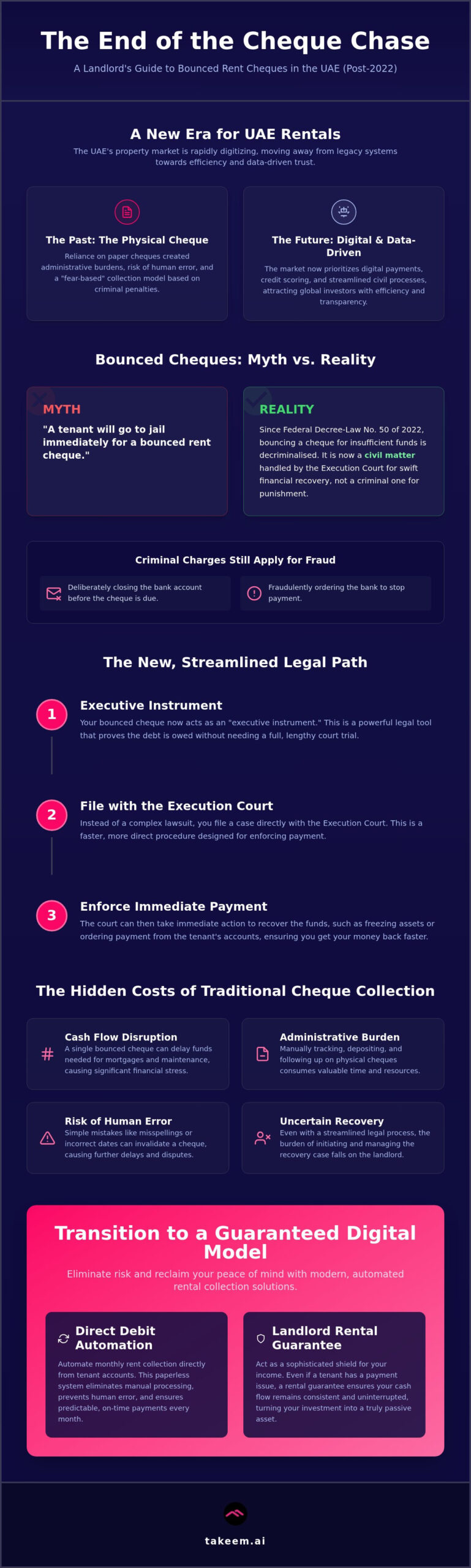
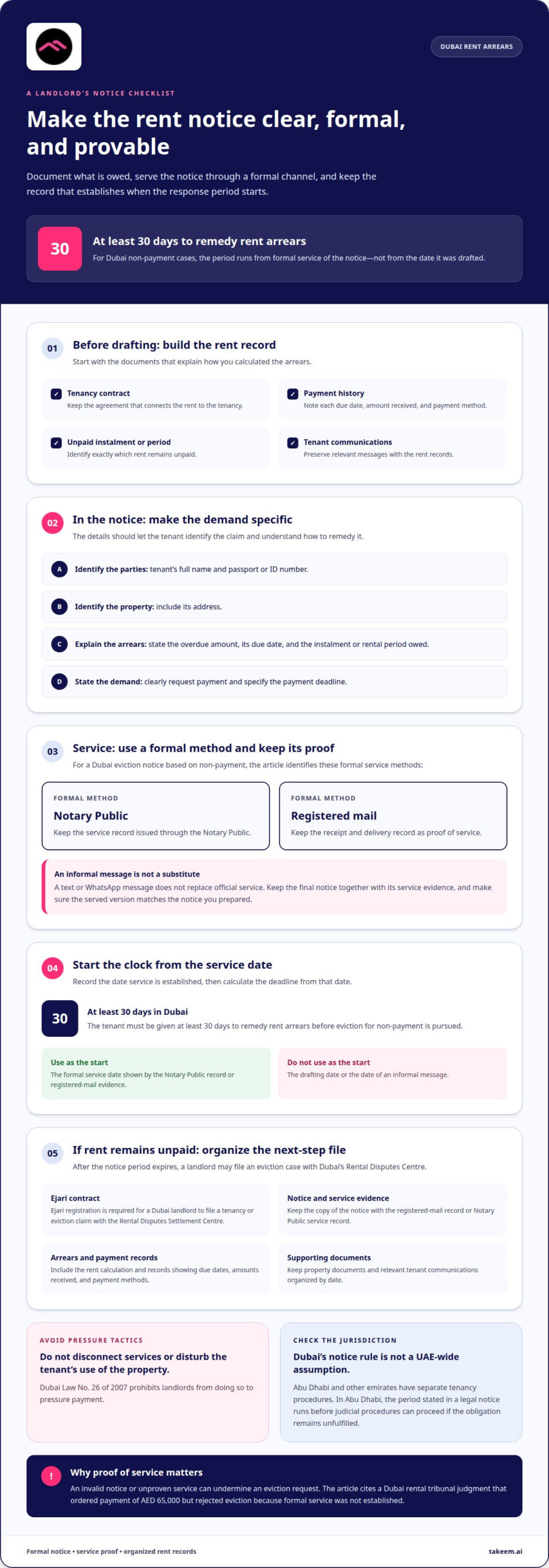
    When dealing with rental arrears, a landlord typically must give a tenant at least 30 days to remedy unpaid rent before pursuing eviction for non-payment. Understanding how to issue a legal notice to a tenant for non-payment starts with that statutory deadline: the notice should identify the unpaid balance and demand payment, and it should be served through official channels or registered mail to help prove delivery.

    Unpaid rent can put significant pressure on property owners and managers. A formal notice gives the tenant a defined opportunity to settle the arrears. If the tenant still does not pay after the notice period expires, the landlord may file a formal eviction case with the local Rental Disputes Centre or relevant jurisdiction.

    Here at Takeem, we explain what to include in the notice, how to serve it and keep proof, and what the 30-day period means in practice. You’ll also see what steps may follow if the arrears remain unpaid, so you can approach the process with a clear record and a more confident understanding of what comes next.

    Key Takeaways

    • Make the notice specific by identifying the tenant and property, stating the rent owed and the period it covers, and setting out the payment deadline.
    • Keep a clear record of rent due, payments received, and communications so the arrears can be documented if the dispute progresses.
    • Organize the tenancy agreement, notice, and supporting records before taking the next step in a rental dispute.
    • For landlords seeking a broader approach to rental income risk, Takeem’s Landlord Rental Guarantee may be relevant; it also includes emergency property maintenance as part of the Rental Guarantee.

    What happens if a tenant doesn’t pay rent in Dubai?

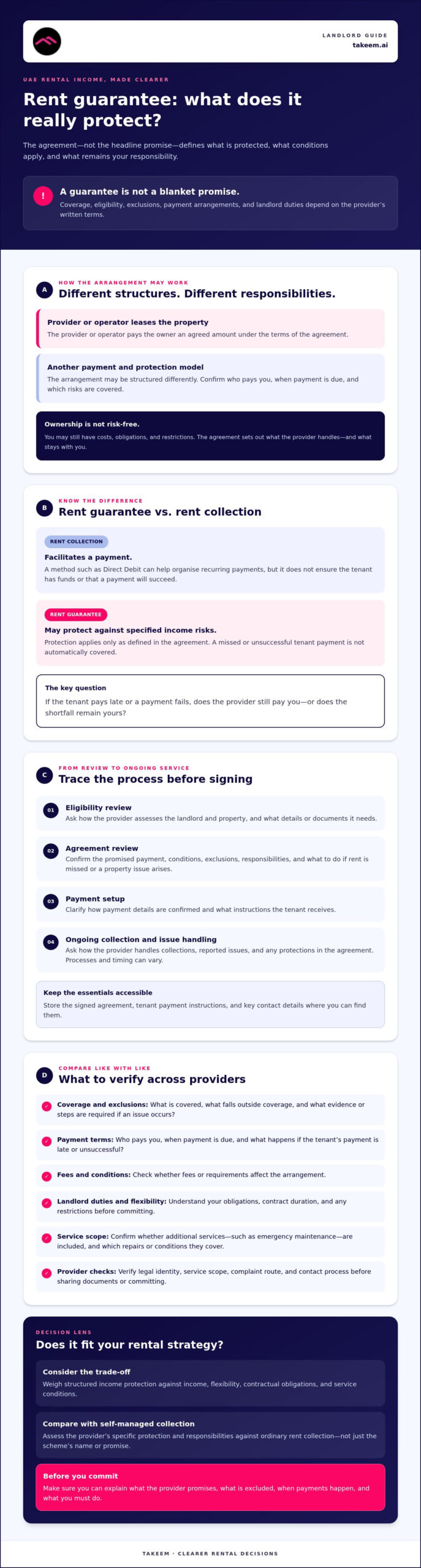
    Address rent arrears with a formal notice, then follow the proper dispute process if the debt remains unpaid. The method of service and proof of delivery both matter.

    1. First, apply the rules for the property’s emirate. In Dubai, a landlord must give a tenant at least 30 days to remedy rent arrears before pursuing eviction for non-payment, according to UAE Legislation. If the tenant fails to pay after the notice period expires, the landlord may file an eviction case with the Rental Disputes Centre. Abu Dhabi and other emirates have separate tenancy procedures, so Dubai’s notice rule should not be assumed to apply across the UAE. In Abu Dhabi, the period stated in a legal notice runs before judicial procedures can proceed if the obligation remains unfulfilled.
    2. Choosing a Formal Notice Service Method

      For a Dubai eviction notice based on non-payment, serve it through a Notary Public or registered mail. These methods create a formal delivery record; a text or WhatsApp message is not a substitute for official service. Keep the notice and proof of service together. Check the tenant and property details, and use a method that documents when the notice was served.

    3. Proving Service and Starting the Notice Period

      Keep the proof of service issued through the Notary Public or the registered-mail delivery record. The 30-day period runs from service of the notice, so record the service date and calculate the deadline from it. Do not treat the date you drafted or sent an informal message as the start date. If delivery cannot be established, the landlord may struggle to prove that the tenant received the required opportunity to remedy the arrears.

    4. Do not disconnect services or disturb the tenant’s use of the property to pressure payment. Dubai Law No. 26 of 2007 prohibits landlords from doing so. An invalid notice or unproven service can undermine an eviction request; a Dubai rental tribunal judgment ordered payment of AED 65,000 but rejected eviction because formal service was not established. The cost to issue and serve a notice depends on the service method and document handling, with the applicable amount provided after a quote request.

    Information to include in a rent-payment notice

    Base the notice on clear rent records, accurate tenancy details and a specific payment demand. This helps the tenant understand the arrears and how to remedy the default.

    1. Gathering Evidence of Unpaid Rent

      Before drafting the notice, gather the tenancy contract and rent-payment records. Note each due date, amount received and payment method, then identify the unpaid instalment or rental period. Keep relevant tenant communications with these records. This evidence shows how you calculated the arrears, particularly if the tenant disputes the balance or leaves before paying.

    2. Preparing Rent-Notice Information

      Clearly identify both parties and the rented property. State the tenant’s full name, passport or ID number, and property address. Specify the overdue amount, its due date and the instalment or period owed, then state the payment deadline and demand payment. These details connect the amount claimed to the tenancy contract.

    3. Allowing Time to Remedy Rent Default

      Give the tenant the required opportunity to pay before pursuing eviction for non-payment in Dubai. The landlord must allow at least 30 days to remedy rent arrears, according to UAE Legislation. State the deadline clearly and calculate it from formal service, rather than from the notice’s drafting date. Avoid wording that confuses this rent-default period with notice for another tenancy issue.

    4. If the tenant leaves without paying, preserve the contract, arrears calculation, payment records and notice evidence. A landlord may pursue unpaid rent through Dubai’s Rental Disputes Centre, or RDC, using the supporting documents for the claim. Organize the records by date so the parties can follow the balance from each due payment to the amount demanded. For future rent collection, a Direct Debit setup for landlords can support digital tenant payments.
    How to Issue a Rent Notice to a Tenant in Dubai

    How to serve and prove delivery of the notice

    Use a formal service method and keep its delivery record. If the dispute reaches Dubai’s Rental Disputes Centre, organized documents help show what was sent and when.

    1. When considering how to issue a legal notice to a tenant for non-payment, use a Notary Public or registered mail rather than relying on an informal message. Keep the served notice and proof of service together. Confirm that the document served matches the final version, including the tenant’s details, property address, rent claimed and payment demand. Any mismatch can make it harder to connect the delivery evidence to the rent dispute.
    2. Record the service date and keep the delivery evidence as soon as it is available. When working out how to issue a legal notice to a tenant for non-payment, distinguish the formal service date from the date you drafted the notice. Store the registered-mail receipt or Notary Public service record with the notice. A draft date alone does not prove that the tenant received it.
    3. Keep tenancy documents ready in case the tenant does not pay and you need to file a claim. Ejari registration is required for a Dubai landlord to file a tenancy or eviction claim with the Rental Disputes Settlement Centre. Relevant records include the Ejari contract, evidence of non-payment, a copy of the notice, property documents and tenant communications. Keep rent records showing due dates, amounts received and payment methods.
    4. Prepare documents for the RDC in the required form. Documents submitted to the centre must be translated into Arabic and accompanied by a memorandum outlining contract terms and relevant details. The RDC is associated with the Dubai Land Department, but handles rental disputes rather than notice delivery. Certain eviction notices after lease expiry require service through a Notary Public or registered mail 12 months before the scheduled eviction date. That period concerns lease-expiry eviction, not rent arrears.

    Notice period and time to resolve non-payment

    Track the formal service date, response deadline and next procedural step separately. A clear timeline helps distinguish the tenant’s opportunity to pay from any later rental dispute.

    1. Start counting from formal service, not from the date you drafted the notice. In Dubai, the tenant has at least 30 days to remedy rent arrears before the landlord pursues eviction for non-payment. Use the service record to identify the deadline, then note it alongside the unpaid instalments. A text or email sent earlier does not replace formal service for this purpose.
    2. Use the notice period to give the tenant a clear opportunity to settle the arrears. If payment arrives, update the rent ledger with the amount and date received, then calculate any remaining balance against the tenancy agreement. If the tenant pays only part, record it accurately; the outstanding amount remains central to any later claim.
    3. If the tenant fails to pay after the 30-day period expires, the landlord may file an eviction case with Dubai’s Rental Disputes Centre. Keep the formal notice, evidence of service, contract and payment records ready for filing. The centre’s process may include an amicable settlement stage before the dispute proceeds. A hearing and judgment follow the applicable case process, so keep records organized by date.
    4. Continue documenting rent due while the case is considered. Filing an eviction claim does not relieve the tenant from paying rent while the claim is considered and until judgment is issued and executed, under Article 31 of Dubai Law No. 26 of 2007. This means the rent ledger should continue beyond the original notice period. If you want to manage rental-income risk alongside formal procedures, explore Takeem’s Landlord Rental Guarantee.

    Takeem: Landlord Rental Guarantee

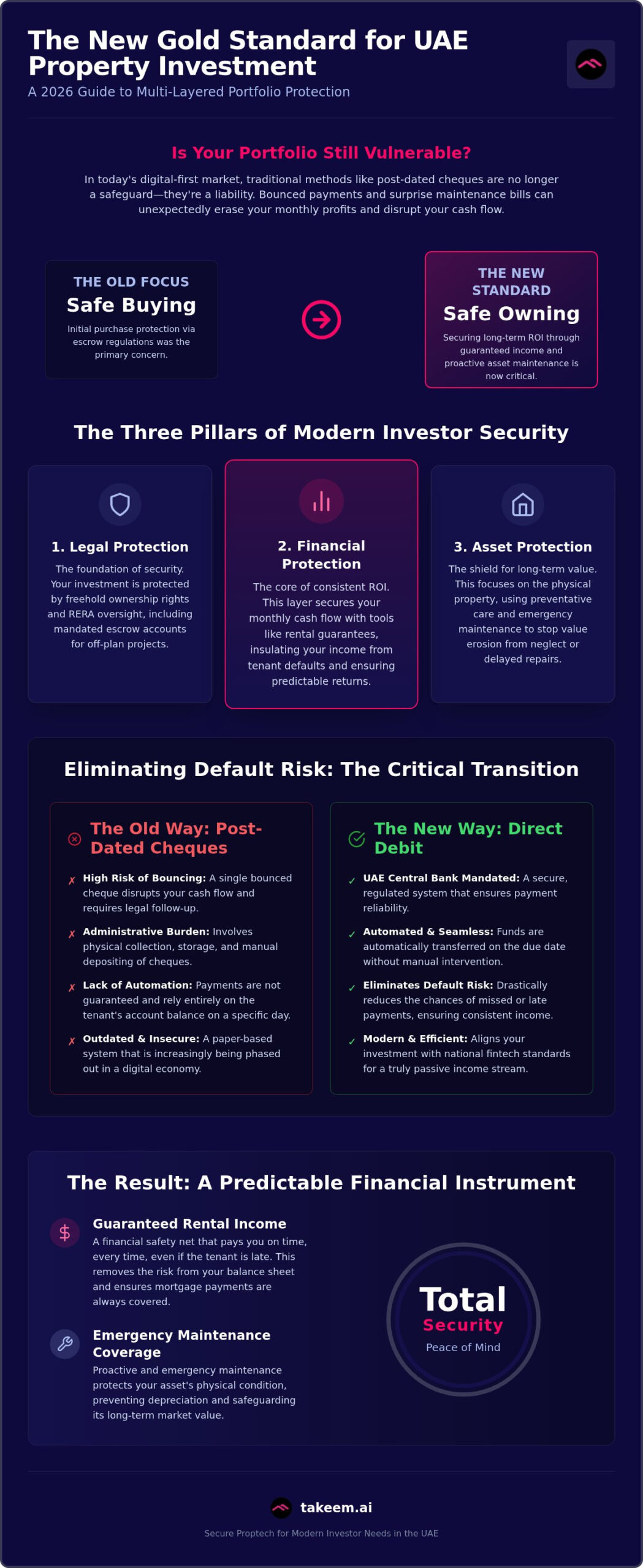
    Takeem offers a Landlord Rental Guarantee for landlords seeking a structured way to manage rental-income risk. This can be relevant when arrears make income planning less predictable, alongside the formal notice and dispute steps described above. Takeem also offers a Rental Guarantee for Property Investors with Large property Portfolios. The Rental Guarantee includes emergency property maintenance service, addressing a separate property concern as part of the offering. These options do not replace a correctly served rent notice or the Dubai Rental Disputes Centre process. They support landlords with rental-income planning and property maintenance while managing a tenancy. Contact Takeem to discuss the Landlord Rental Guarantee.

    Build a steadier approach to rental risk

    Use this tenancy issue as a prompt to strengthen your preparation for future rental cycles. A consistent process for tracking obligations and organizing tenancy records can help you act promptly when a payment concern arises. Knowing how to issue a legal notice to a tenant for non-payment is one part of protecting your position; planning for rental-income uncertainty is another.

    Takeem offers a Landlord Rental Guarantee, including an option for property investors with large portfolios. Agents can also sell Takeem’s Landlord Rental Guarantee for healthy commissions. If you’re considering how rental protection could fit your approach, contact Takeem to discuss its rental guarantee. Take the next step with a clearer plan for your property income.

    Frequently Asked Questions

    When is a landlord entitled to serve an eviction notice to a tenant?

    In Dubai, a landlord may pursue eviction for non-payment if rent arrears remain unresolved after the required notice period. Article 25 of Dubai Law No. 26 of 2007, as amended by Law No. 33 of 2008, sets out eviction grounds, including rent default. Before acting, identify the reason for eviction and match it to the relevant legal ground. A notice for unpaid rent is not interchangeable with one for another ground.

    Dubai rent apartment not paid, how should I deal with it?

    Start by matching the rent ledger with the tenancy agreement and payment records. Write to the tenant about the specific unpaid instalment and keep their response with the account records. If payment does not resolve the issue, follow Dubai’s formal notice process rather than relying on informal messages. Keep the communication focused on the amount due and how to settle it.

    What legal recourse do landlords have for unpaid rent in Dubai?

    A landlord can bring an unpaid-rent claim to Dubai’s Rental Disputes Centre, including a claim seeking rent recovery and eviction where applicable. Under Decree No. 26 of 2013, parties are referred to mediation before proceeding through the Rental Disputes Settlement Centre. Prepare a clear account of payments and arrears so the dispute can be assessed against the tenancy agreement. The process can address rent recovery even when the tenant has left.

    Does the 30-day period start when the legal notice is notarised?

    The period starts when the notice is served, not simply when it is notarised. For example, if notarisation happens before delivery, use the documented service date to track the tenant’s deadline. Keep the Notary Public’s record of when service occurred. Notarisation alone does not establish when the tenant received the formal notice.

    Does the 30-day period start when the rent cheque bounces?

    No. A bounced cheque can help document a missed rent payment, but it does not itself start the notice period for eviction due to rent arrears. The relevant starting point is formal service of the rent notice. Keep the bank’s returned-cheque record with the rent ledger, and track the notice deadline from the documented service date, not the cheque’s return date.

    How many days’ notice must a landlord give a tenant for unpaid rent in the UAE?

    In Dubai, the landlord must allow at least 30 days to remedy rent arrears before pursuing eviction for non-payment. That period should not be treated as a uniform UAE-wide deadline: tenancy procedures differ by emirate. In Abu Dhabi, the period specified in the legal notice runs before judicial procedures can proceed if the tenant has not fulfilled the obligation. Identify the property’s emirate before setting the deadline.

  • Cost of Evicting a Tenant in Dubai: Fees and Process

    Cost of Evicting a Tenant in Dubai: Fees and Process

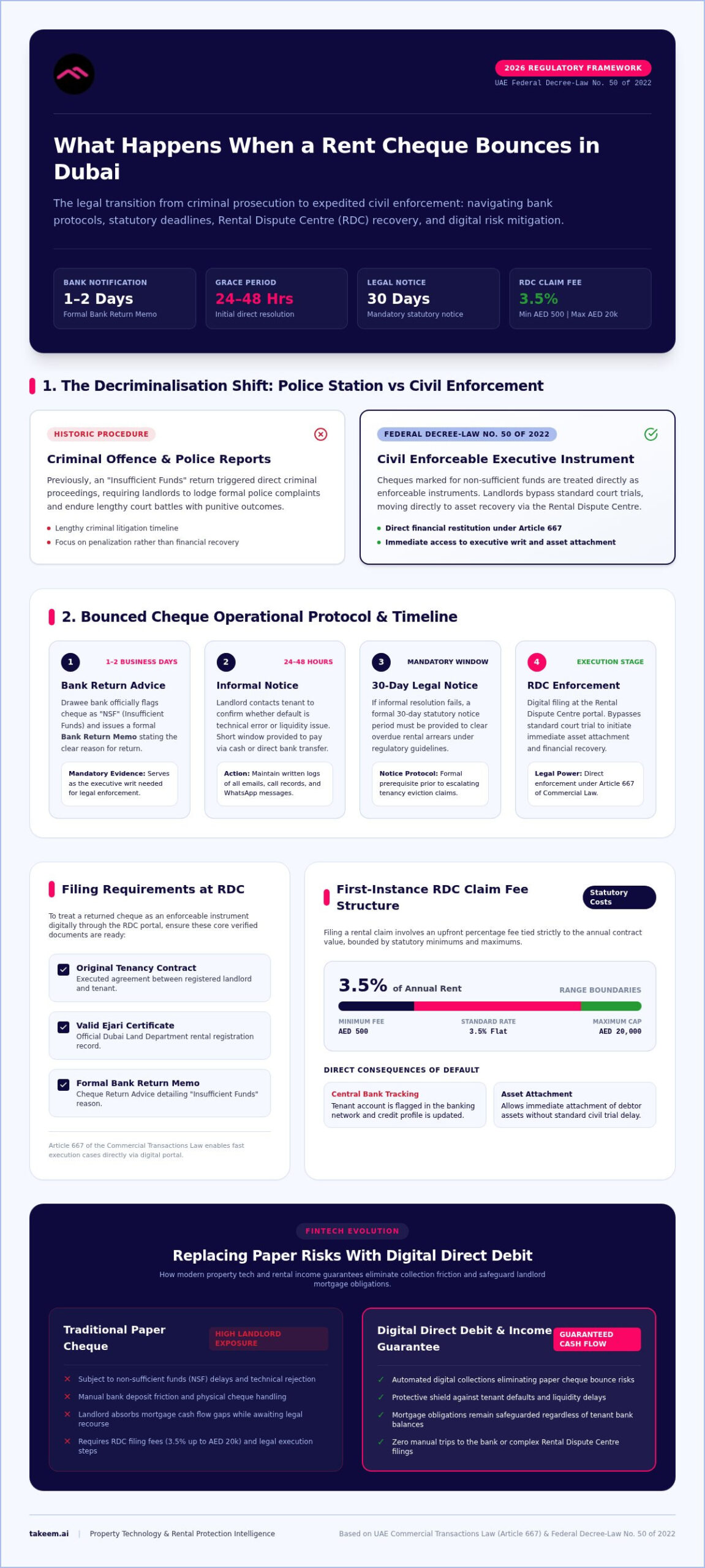
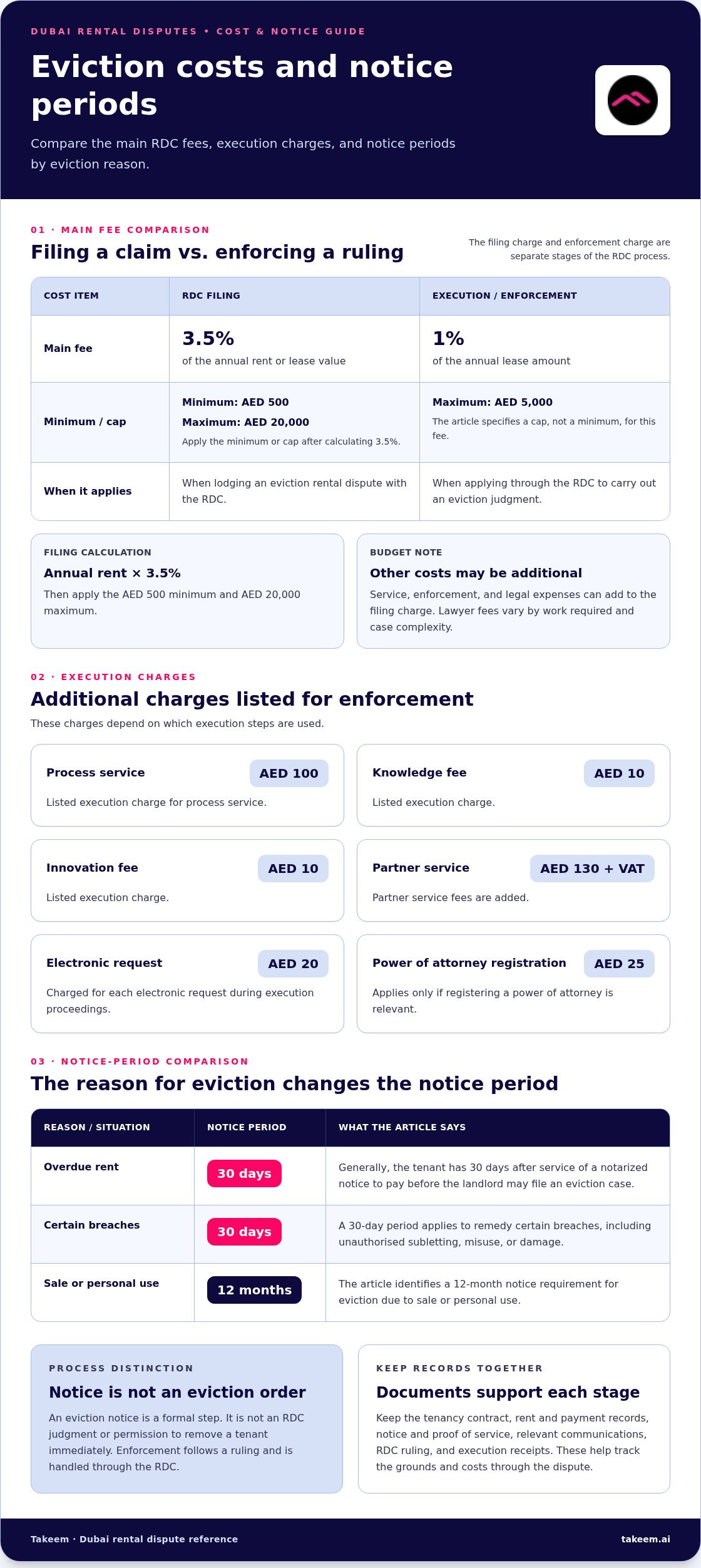
    The cost of evicting a tenant in Dubai includes a Rental Disputes Center filing fee of 3.5% of the annual rent, with a minimum of AED 500 and a cap of AED 20,000. Eviction enforcement adds a fee of 1% of the annual lease amount, capped at AED 5,000. The notice period depends on the reason: non-payment and certain breaches generally involve a 30-day notice, while eviction for sale or personal use requires 12 months’ notice.

    An eviction notice is a formal step, not an order to remove a tenant immediately. The cost of evicting a tenant in Dubai and the timeline depend on whether the parties settle or the dispute proceeds to a hearing and enforcement. This guide explains how RDC filing and enforcement fees work, what can affect the timeline, and the rules for eviction due to personal use or sale, so you can understand the process before deciding what to do next.

    Key Takeaways

    • Estimate the RDC filing fee using the annual rent, then account for the minimum and maximum fee limits.
    • Match the notice period to the reason for eviction, since non-payment and personal-use cases follow different rules.
    • Build settlement and hearing time into your plans; mediation may resolve a dispute before a full hearing.
    • Budget separately for service and enforcement costs, which can add to the initial filing expense.
    • For eviction due to sale or personal use, understand the notice requirements and restrictions that may apply after the tenant leaves.

    How much does it cost to file an eviction case at the RDC in 2026?

    Dubai’s Rental Disputes Center (RDC) registration fee for an eviction dispute is 3.5% of annual rent, subject to a minimum of AED 500 and a cap of AED 20,000. The total depends on the rent and any additional filing, service, enforcement, or legal costs.

    RDC Registration Fee

    The registration fee is the main charge for lodging an eviction rental dispute with Dubai’s RDC, also called the Rental Disputes Settlement Centre. Calculate 3.5% of the annual rent or lease value, then apply the AED 500 minimum and AED 20,000 maximum. For example, a calculated fee below AED 500 is raised to the minimum; a calculation above AED 20,000 is capped.

    The landlord filing the claim should budget for the registration charge. Keep the tenancy contract, rent records, notices, and relevant communications together, so the case documents support the stated grounds for eviction. A tenant who remains after the notice period may face an RDC case, but filing does not by itself establish that the landlord’s claim will succeed.

    Responsibility for Eviction Costs

    Responsibility for eviction costs concerns who pays charges as a case proceeds, so it matters when setting a realistic budget. The landlord bringing the claim should plan to pay the RDC registration fee at filing. The tenant may incur separate expenses responding to the dispute, while the final treatment of case costs depends on the decision and circumstances.

    Keep filing receipts and records of each expense. This helps distinguish the initial payment from any costs addressed later in the dispute.

    Lawyer Charges and Estimated Total

    Lawyer charges are professional fees for work such as preparing a claim, reviewing evidence, or attending proceedings. They are separate from the RDC registration calculation. Fees vary with the work required, the dispute’s complexity, and whether the case proceeds beyond filing, so there is no single charge that applies to every eviction.

    The total cost of evicting a tenant in Dubai therefore starts with 3.5% of annual rent, subject to the AED 500 minimum and AED 20,000 cap, then adds relevant service, enforcement, and legal expenses. Without the annual rent and case scope, a single total would be misleading. Use the fee formula first, then itemise other costs.

    Tenant Challenges and Cost Recovery

    A tenant can challenge an eviction claim by responding to the RDC dispute and presenting relevant tenancy records, payment evidence, and communications. A notice or claim can be disputed on its facts, and the RDC considers the evidence presented by both sides.

    A tenant seeking to recover costs can include the request in the dispute and keep receipts supporting the amount claimed. Recovery is not automatic; it depends on the case and the RDC’s ruling. For either party, clear records help connect each claimed expense to the rental dispute.

    What Is an Eviction Notice?

    An eviction notice is a formal written notice stating why a landlord seeks possession and what action the tenant must take. In Dubai, notice periods are described under Law No. (26) of 2007, as amended by Law No. (33) of 2008, according to Government of Dubai.

    The notice gives the tenant a defined period to respond or remedy a breach. For overdue rent, the tenant generally has 30 days after service of a notarized notice to pay before the landlord may file an eviction case. A 30-day period also applies to remedy certain breaches, including unauthorised subletting, misuse, or damage.

    Service matters. A landlord may send the notice through registered email, the official WhatsApp or mobile number recorded in the Ejari contract, registered mail, or a licensed legal notification provider. A notary public can notarise the notice. Keep the notice and proof of service, as these help establish when the response period began.

    From Notice to RDC Proceedings

    If the tenant does not comply within the applicable period, the landlord may file a rental dispute with Dubai’s Rental Disputes Center (RDC), also known as the Rental Disputes Settlement Centre. The claim should identify the tenancy agreement, the stated reason for eviction, and the steps already taken. The notice is evidence, not an RDC judgment or permission to remove the tenant.

    After a ruling, enforcement is a separate stage. A landlord seeking to carry out an eviction judgment applies for execution through the RDC. The enforcement fee is 1% of the annual lease amount, capped at AED 5,000. The execution process applies the judgment through formal channels, rather than allowing a landlord to bypass the RDC.

    Enforcement Fees and Practical Records

    RDC eviction enforcement can include further charges beyond the percentage fee. The listed execution charges include AED 100 for process service, AED 10 as a knowledge fee, and AED 10 as an innovation fee. Partner service fees of AED 130 plus VAT are also added, while each electronic request during execution proceedings costs AED 20. Registering a power of attorney, if applicable, costs AED 25.

    These charges depend on which execution steps are used. For example, the AED 25 power-of-attorney registration fee applies only when relevant, and electronic request fees depend on requests submitted. Keep the lease contract, payment history, notice, service evidence, RDC ruling, and execution receipts together. Those records help distinguish notice-stage expenses from fees incurred after judgment.

    Before filing or enforcement, match the reason in the notice to the supporting documents and applicable period. A tenant disputing the claim should respond through the RDC rather than treating the notice as a final order. Landlords should follow the RDC process after the notice period: changing locks or cutting utilities is not a lawful substitute for an eviction order.

    Amicable settlement and case timelines

    The usual path runs from written eviction notice to the response period, RDC filing, possible settlement, hearing, judgment, and enforcement. A non-payment dispute may take around two to four months from notice service to enforcement, while mediation at Dubai’s Rental Disputes Settlement Centre often reaches settlement within 15 days.

    Timelines depend on the reason for eviction and whether the parties resolve the rental dispute. For unpaid rent, the tenant generally has 30 days after service of a notarized notice to pay before filing. If the tenant does not remedy the issue, the landlord can file with the RDC and provide the notice and supporting records.

    An illustrative RDC timeline places notice service on Day 1 and filing on Day 30. Hearings are typically held within 30-45 days of filing. First-instance rulings are targeted within about 30 days, although the hearing date, evidence, and case progress affect when a decision arrives.

    Settlement can shorten the route to a decision. At mediation, the landlord and tenant can discuss payment, move-out arrangements, or another written agreement. RDC mediation often achieves settlement within 15 days, but a failed negotiation means the dispute continues through hearings and judgment.

    If no agreement is reached, an illustrative timeline places the first-instance hearing and judgment around Day 60-75. The appeal window and start of execution fall around Day 75-90 in that example. A tenant appealing an RDC judgment must file within 15 days, so the decision and its deadlines need prompt attention.

    Enforcement follows the judgment and any applicable appeal stage. The illustrative timeline estimates enforcement and physical eviction around Day 90-120. These milestones explain why a filed rental dispute is not resolved immediately: notice, hearing, judgment, and execution are separate stages, each requiring time.

    Registered mail, registered email, or another permitted service method creates a record of when the eviction notice was sent. Retain the written notice, delivery evidence, rental contract, payment history, and settlement communications. These documents help establish the notice date and clarify which events occurred before filing.

    Lease expiry follows a longer schedule than the non-payment example. A Dubai eviction upon lease expiry has a realistic planning window of 13 to 16 months, including the 12-month notice period. A landlord should distinguish that route from a breach-based claim, because the applicable notice and process change the expected timeline.

    Use the timeline as a planning framework, not a fixed deadline. The RDC caseload, the tenant’s response, mediation outcome, hearing schedule, and enforcement steps all affect the final date. Accurate service records help the parties identify the right next step at each stage.

    Cost of Evicting a Tenant in Dubai: Fees and Process

    Eviction for personal use or sale

    At tenancy end, grounds include sale, use by the owner or a first-degree relative, demolition, or major renovation. Non-payment, lease expiry, and landlord-use cases differ mainly in their notice periods and timelines. Filing fees are based on annual rent.

    Grounds for Eviction

    Specified grounds for eviction at the end of a Dubai tenancy include selling the property, personal use by the owner or a first-degree relative, demolition, and major renovation. The ground matters because it determines the notice requirement and the evidence needed to support the landlord’s claim.

    For sale, personal use, demolition, or major renovation, the landlord must give 12 months’ notice before the intended eviction date. The legal framework includes Law No. (26) of 2007, amended by Law No. (33) of 2008, according to Government of Dubai. A legal notice should clearly state the reason and intended date, with proof that it was served through a permitted method.

    For a planned demolition or renovation, the tenant has the first right of refusal to return once the property is ready, provided the tenant is informed within 30 days of the notice. That future right makes the stated grounds and the notice record important beyond the move-out date. Keep the registered service evidence and any relevant plans or sale documentation with the tenancy records.

    Costs Across Eviction Case Types

    Eviction costs cover expenses related to notice, filing, and any later enforcement. Comparing case types matters because the notice period can affect how long the landlord carries rental and legal costs before possession changes.

    For non-payment, a tenant generally has 30 days after service of a notarized notice to pay before the landlord may file. A non-payment eviction may take around two to four months from notice service to enforcement. Lease expiry requires a different planning horizon: an eviction upon expiry may take 13 to 16 months, including the 12-month notice period.

    For sale or personal use, the required notice is 12 months before the intended eviction date. The filing fee is based on annual rent, not on whether the landlord cites non-payment, lease expiry, or personal use. Later expenses can vary with service, execution, and whether the parties settle or proceed to judgment.

    Commercial cases have an additional restriction: after eviction for personal use, the landlord cannot rent the property to someone else for three years. The stated purpose is therefore more than a formality. If a rental dispute reaches the RDC, the landlord should keep the legal notice, registered delivery record, and documents supporting the grounds together.

    A notary can formalise the notice, while the RDC determines a contested claim through its proceedings. A notice alone is not a judgment, and a landlord must use the formal process to enforce an eviction. Tenants can review the stated grounds, notice date, and supporting records to identify what to address in a response.

    What are the court, service, and execution fees for evicting a tenant in Dubai?

    Dubai’s Rental Disputes Center (RDC) charges can arise at filing and again during enforcement. Separate the registration fee from execution charges, then add only applicable service or document costs. This avoids treating every listed fee as payable in every eviction case.

    For enforcement, the RDC fee is 1% of the annual lease amount, capped at AED 5,000. For example, calculate the percentage against the annual lease amount, then apply the cap if the result exceeds AED 5,000. This execution fee follows the judgment stage; it is separate from the initial rental dispute registration fee.

    Other listed enforcement charges include:

    • AED 100 for process service.
    • AED 10 as a knowledge fee and AED 10 as an innovation fee.
    • AED 130 plus VAT in partner service fees.
    • AED 20 for each electronic request submitted during execution proceedings.
    • AED 25 to register a power of attorney, if applicable.

    These amounts have different triggers. The AED 25 charge applies only when registering a power of attorney, while AED 20 applies per electronic request. Partner service fees are listed in addition to enforcement fees. Add those items according to the steps taken, rather than assuming one flat total applies to every execution file.

    Translation can be another document cost: one quoted Dubai schedule lists AED 100 when the tenant is not of Arabic nationality. It is a quoted fee, not an RDC court charge. Notice preparation and legal representation are separate expenses, and their cost depends on the work and case requirements. Keep invoices separate from RDC receipts when calculating the outlay.

    For a practical estimate, begin with the annual lease amount and apply the 1% enforcement rate, subject to the AED 5,000 cap. Then include process service, knowledge and innovation fees, partner service fees, and any applicable power-of-attorney or electronic-request charges. Add translation only where needed. This itemised approach makes clear which amounts relate to the RDC and which arise from additional services.

    Landlords can also separate dispute costs from rent collection operations. A digital Direct Debit setup for monthly tenant payments supports accepting rent digitally; it does not replace an RDC filing or enforcement process. For an eviction file, retain the judgment, execution receipts, service records, and invoices so each cost has a corresponding document.

    Takeem: Landlord Rental Guarantee

    Takeem offers a Landlord Rental Guarantee for landlords seeking support with rental-related risk alongside the formal RDC process. It does not replace an eviction notice, filing, or enforcement, but it can help landlords plan for rental income and property costs.

    Property investors with large portfolios can consider Takeem’s Rental Guarantee for Property Investors with Large property Portfolios. Agents can also sell the Landlord Rental Guarantee for healthy commissions. Emergency property maintenance is included in the Rental Guarantee, providing support beyond the eviction process.

    To learn how Takeem’s Landlord Rental Guarantee can support rental planning alongside eviction rules, visit takeem.ai.

    Plan for steadier rental operations

    An eviction dispute can expose gaps in a landlord’s wider rental strategy, from income planning to preparing for vacant periods. Consider how you will manage rental risk before the next tenancy begins. The cost of evicting a tenant in Dubai is one part of that decision; consistent rent collection and a clear plan for property-related needs also matter.

    Takeem offers a Landlord Rental Guarantee, including an option for property investors with large portfolios. Agents can also sell the guarantee for healthy commissions. These options may suit landlords considering how to support rental income beyond handling an individual dispute.

    Take the next step at a pace that suits your property strategy. Contact Takeem to discuss its Landlord Rental Guarantee and explore whether it fits your needs. A thoughtful plan can help you move forward with greater clarity.

    Frequently Asked Questions

    Legal Notice to Tenant to Vacate: Which Notice Applies?

    The reason for eviction determines which notice applies. For overdue rent or certain remediable breaches, including unauthorised subletting, misuse, or damage, the tenant generally receives 30 days to remedy the issue. Sale, personal use, demolition, or major renovation requires 12 months’ notice before the intended eviction date. Identify the ground clearly in the notice, because the applicable period and supporting documents differ.

    Can a Tenant Be Evicted Immediately in Dubai?

    No. A landlord cannot immediately remove a tenant by changing the locks or cutting utilities. The landlord must follow the applicable notice process and, if the tenant does not comply, pursue the matter through the Rental Disputes Center (RDC). Physical eviction requires an RDC order and formal enforcement. A tenant who receives a notice should keep it and its delivery details, then respond through the proper dispute process if they contest the claim.

    Can a landlord evict a tenant before the tenancy contract expires?

    A landlord may pursue eviction before the contract ends for grounds such as unpaid rent or certain unresolved breaches, but must follow the relevant notice and RDC process. For unpaid rent, the tenant generally has 30 days after service of a notarized notice to pay before filing. Sale or personal use follows a different route, with notice required before the intended eviction date. The contract and stated reason shape the process.

    What are the Dubai Rental Dispute Center (RDC) filing fees for an eviction case?

    The RDC registration fee for an eviction dispute is 3.5% of annual rent or lease value, with a minimum of AED 500 and a maximum of AED 20,000. For example, calculate the percentage against the annual rent, then apply the minimum or cap if needed. This is the filing registration charge, not a complete estimate of legal, service, or enforcement expenses that may arise later.

    How much notice must a landlord give to evict a tenant in Dubai, and how must it be served?

    The notice period depends on the eviction ground: it is generally 30 days for overdue rent or certain breaches, and 12 months for sale, personal use, demolition, or major renovation. A landlord may serve notice through registered email, registered mail, a licensed legal notification provider, or the official WhatsApp or mobile number listed in the Ejari contract. Keep proof of service and the notice copy.

    What extra costs can arise from enforcement, unpaid rent, or property handover in a Dubai eviction?

    Enforcement can add a fee of 1% of the annual lease amount, capped at AED 5,000, plus charges such as AED 100 for process service and AED 20 for each electronic execution request. Unpaid rent should be calculated from the payment record and distinguished from enforcement expenses. At handover, document the property’s condition and any damage with dated records, then separate supported repair claims from ordinary wear.

  • Rental payment security in Dubai: how much does it cost

    Rental payment security in Dubai: how much does it cost

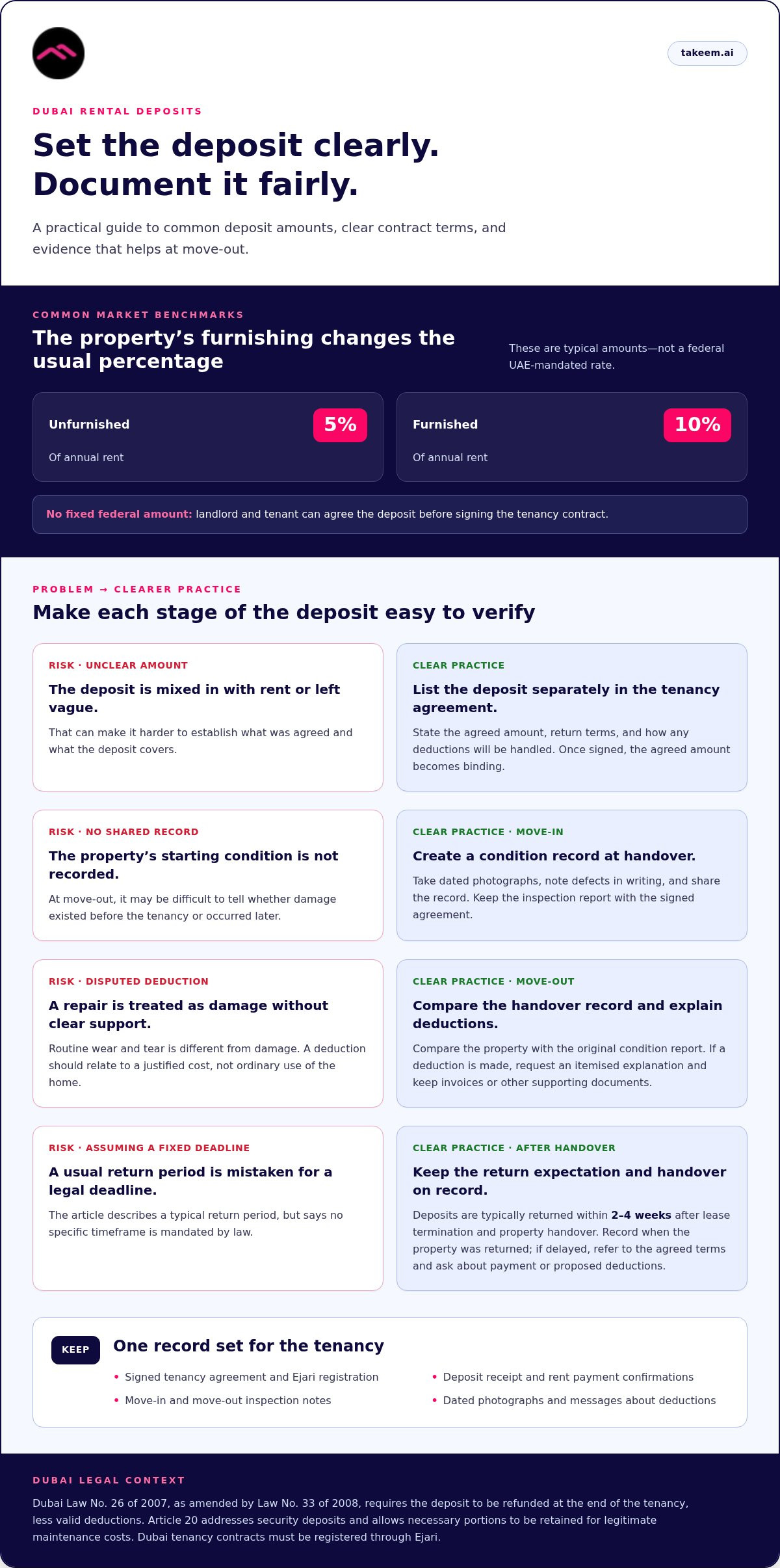
    The rental security deposit across the country is usually a percentage of annual rent, not a single fixed fee. For rental payment security, the typical deposit is 5% of annual rent for an unfurnished property and 10% for a furnished one. No federal UAE law mandates a fixed deposit amount, so the amount can be agreed before the tenancy contract is signed.

    That upfront cost can shape a tenant’s moving budget, while clear deposit terms help both sides understand what happens at the end of the tenancy. The deposit is generally refundable when the property is returned in good condition, subject to any valid deductions.

    This guide explains how the usual percentages apply, what to consider when assessing property and resident eligibility, and how deposit rules interact with other rental costs. It also covers potential benefits for landlords and property companies, helping you understand the options and make an informed decision with Takeem.

    Key Takeaways

    • Understand what can affect a rental deposit and how the agreed amount becomes part of the tenancy contract.
    • Use a traceable payment method and keep a receipt so there’s a clear record of rent and deposit payments.
    • Learn how landlords can handle legitimate maintenance deductions and what tenants should document at move-out.
    • See why paying before signing carries risk and which contract details help protect both parties.
    • Explore how Takeem’s Landlord Rental Guarantee may support landlords, property investors and agents.

    Eligible properties and residents

    In Dubai, the usual rental deposit depends on whether the home is furnished. For an unfurnished property, the typical deposit is 5% of annual rent; for a furnished property, it is 10%. These are common market amounts, not a federal UAE-mandated rate. The landlord and tenant can negotiate the deposit before signing the tenancy contract.

    There is no single property or resident category defined by these typical percentages. They provide a practical reference for residential tenancies, while the agreed deposit amount and contract terms determine what applies to a particular home. A furnished apartment, for example, commonly uses the 10% benchmark, while an unfurnished apartment commonly uses 5%.

    The deposit is separate from rent. List it separately in the tenancy agreement, with clear terms for its return and any deductions. Once signed, the agreed amount becomes binding. Dubai requires tenancy contracts to be registered through Ejari, so keep the registered contract alongside payment records and evidence of the property’s condition.

    Dubai Law No. 26 of 2007, as amended by Law No. 33 of 2008, requires landlords to refund the deposit upon expiry of the tenancy contract, less valid deductions. The deposit is refundable when the tenant returns the property in good condition. A deduction should relate to a justified cost, such as damage beyond normal wear and tear, rather than routine use of the home.

    Before move-in, document the property’s condition. Take dated photographs of existing damage, note defects in writing, and share the record with the landlord or agent. For example, recording a cracked tile at handover helps distinguish pre-existing damage from damage during the tenancy. Keep the inspection report with the signed agreement.

    At move-out, compare the property with the original condition report. Ordinary wear and tear is different from damage, and evidence can help clarify the difference. If the landlord makes a deduction, request an itemised explanation and keep invoices or other supporting documents. Disputes can arise over whether a repair was justified or the issue existed before the tenancy.

    A bounced rent cheque leaves that instalment unpaid. Replace the payment using a traceable method and keep written confirmation of the arrangement. Any further consequences depend on the tenancy terms and applicable rules.

    Dubai tenants should keep the signed tenancy agreement, Ejari registration, deposit receipt, rent-cheque copies or bank-transfer confirmations, and messages about payments or deductions. Store move-in and move-out inspection notes and dated photographs with these records to make the payment history and property condition easy to establish.

    After lease termination and property handover, Dubai security deposits are typically returned within 2-4 weeks. This is a usual return period, not a legal deadline: no specific timeframe is mandated by law. A Dubai rental security deposit is refundable when the tenant moves out, provided the property is returned in good condition. To make the handover clear, tenants can keep a written record of when the property was returned and retain communications about the deposit. If the return takes longer than expected, they can refer to the agreed tenancy terms and ask the landlord for an update on the payment and any proposed deductions.

    Residents considering Dubai’s FlexiRent initiative should review the rental options with the participating property management company and ensure the agreed terms are included in the tenancy contract. Check the contract for what the parties have accepted, including the terms that apply to the tenancy. Ask for clarification before signing if an option or condition is unclear, and keep a copy of the final agreement. This helps ensure the arrangement is recorded alongside the other tenancy terms.

    Landlord and property company benefits

    A clearly documented security deposit gives Dubai landlords a defined source for justified maintenance deductions and makes expectations easier to explain before move-in. For example, the tenancy contract can state the deposit amount, the return process, and how documented damage beyond normal wear will be assessed. Specific terms reduce ambiguity for both parties.

    Article 20 of Dubai Law No. 26 of 2007 addresses security deposits and allows landlords to retain necessary portions for legitimate maintenance costs, according to Dubai Government. This does not make every repair a valid deduction. Landlords should distinguish damage from normal wear and retain documentation that connects each deduction to the property’s condition.

    Start the record at handover. The landlord or property company can prepare a condition report, photograph existing defects, and give the tenant a copy. At move-out, comparing the report with the property’s condition helps clarify whether a repair is justified. For example, a documented broken fixture that was intact at move-in differs from a surface worn through normal use.

    Ejari registration creates an official record of the tenancy contract and its parties, giving landlords and tenants a shared reference to the agreed terms if a dispute arises. Dubai requires tenancy contracts to be registered through Ejari. Keep the registration details with the contract and payment records to establish which agreement applies.

    For a real estate company handling furnished and unfurnished homes, consistent documentation can make deposit decisions more consistent across properties. A standard handover form, dated photographs, and written repair-cost records help teams explain deductions clearly. They also make it easier to distinguish unpaid rent from a maintenance claim, rather than combining them into one unexplained amount.

    Payment records support the same process. A bank-transfer confirmation or cheque receipt can show when rent or a deposit was paid. Match each transaction to the tenancy agreement and record whether it covers rent, the security deposit, or another agreed payment. Clear labels help property teams reconcile accounts and answer questions without relying on memory.

    If a landlord requests cash or payment to a personal account, use a traceable method where possible, such as a bank transfer or a cheque payable to the landlord named on the title deed. Request a receipt and ensure the tenancy agreement lists the deposit separately from rent. This creates a clear record for both sides.

    For landlords who want a more structured way to record monthly rent, digital rent collection for landlords can support clearer payment tracking. A consistent record helps property companies see which payments have arrived and which require follow-up, while keeping payment history connected to the relevant tenancy.

    Rental payment security in Dubai: how much does it cost

    What payment methods are safe for paying rent in Dubai?

    For rental payment security in Dubai, a bank transfer or cheque provides a traceable record of rent paid. Make a cheque payable to the landlord named on the property title deed. Check the recipient’s details against the tenancy documents before paying. This helps link the payment to the right landlord and property.

    A bank transfer gives the tenant a dated record that includes the recipient and payment reference. Use a clear reference, such as the property address and rent instalment, and save the confirmation. If the agreement names an agent or representative, make sure the payment instructions match the documented arrangement before sending funds.

    Cheques remain a common way to pay rent in Dubai. The first rent cheque is due upfront along with the initial fees. Check that the amount, date, payee, and tenancy period match the signed agreement. Keep a copy or image of each cheque and any receipt confirming the landlord received it.

    Cash is harder to trace than a bank transfer or cheque. If you pay in cash, get a signed receipt immediately. It should identify the payer, recipient, property, purpose of payment, date, and amount in AED. Keep it with the tenancy contract to avoid confusing rent and deposit payments later.

    Whichever method you use, record rent separately from the security deposit. The tenancy contract should list the deposit separately and explain its return terms. For example, label a transfer reference “security deposit” rather than simply “payment.” This helps both parties reconcile their records and identify what each transaction covered.

    Dubai requires tenancy contracts to be registered through Ejari. Keep the Ejari details with the signed contract and use the property and tenancy information when labelling payments. This creates a consistent record across the agreement, registration, and bank history. If an agent provides payment instructions, retain them with the relevant tenancy documents.

    Before sending funds, compare the payee name and payment details with the contract and landlord information. If the requested recipient differs, pause the transaction and seek written clarification through the documented tenancy contact. Don’t rely on a verbal change alone. Save any messages explaining an agreed change with the final payment confirmation.

    Monthly payment arrangements can also use direct debit, with the tenant authorising recurring payments from an account. Landlords should align the schedule and amount with the tenancy agreement. Tenants should keep the setup confirmation and monitor bank records. If a payment is missed or duplicated, both parties can compare transaction dates and details.

    Good rental payment security in Dubai also means keeping a single set of records for each tenancy. Store the contract, Ejari details, payment instructions, transaction confirmations, cheque copies, and receipts together. Label each item by payment purpose and period. These records help resolve questions about individual rent instalments without relying on memory.

    Is it safe to pay rent or a deposit before signing a tenancy contract in Dubai?

    Paying before signing the tenancy contract creates avoidable uncertainty. The signed agreement should identify the property, landlord, rent schedule, security deposit, and refund terms. In Dubai, the deposit amount can be negotiated before signing, but the agreed terms become binding once the contract is signed. Complete the agreement before transferring rent or deposit funds.

    Dubai has no statutory security-deposit cap, so landlords and tenants can agree on an amount. An 8% deposit or a flat د.إ 15,000 deposit does not, by itself, mean the landlord is breaking the law. The key is to record the agreed amount and return conditions clearly in the tenancy contract.

    Before signing, compare the contract details with the property and the person receiving payment. Confirm that the landlord’s name matches the title deed and that the address and rent schedule describe the home you intend to rent. If an agent provides payment instructions, keep them with the tenancy documents.

    Use a traceable payment method, such as a bank transfer or a cheque payable to the landlord named on the title deed. Avoid handing over cash without a receipt. Keep the transaction confirmation, cheque copy, or signed receipt, and ensure it identifies whether the funds cover rent or the deposit.

    The tenancy agreement should show the security deposit as a separate line from rent. It should also explain when the deposit is returned and which deductions may apply. For example, a contract that records a د.إ 15,000 deposit separately gives both parties a clear reference if they later disagree about the payment or refund.

    The first rent cheque is due upfront along with the initial fees. It is especially important to distinguish rent from the deposit and other payments in your records. Match each cheque or transfer to the corresponding contract item. Keep the first rent receipt and deposit receipt separately, even if both payments are made on the same day.

    Rental security deposits in Dubai are governed primarily by Law No. 26 of 2007. The deposit amount may vary by agreement, because Dubai does not set a statutory cap. A common market reference is 2-6 months’ rent paid in advance, so clarify whether the proposed amount is a deposit or prepaid rent before signing.

    After signing, tenancy contracts in Dubai must be registered through Ejari. Keep the signed contract, Ejari details, payment receipts, and written payment instructions together. If a landlord changes the recipient account or payment method, get the change in writing and retain the message with the original agreement.

    For landlords arranging recurring monthly collections after a tenancy is documented, set up digital direct debit for rent to accept tenant payments electronically.

    Confirm any new payment instructions before sending funds and keep a written record of what was agreed. Do not treat a payment instruction as a replacement for the signed tenancy terms. The Dubai rental contract should list the security deposit separately from rent and include its return terms. Make sure the amount paid is identified as the deposit, not rent or another payment, so your records match the agreement.

    Tenants in Dubai should request a receipt for the security deposit and ensure the refund terms are stated in the tenancy agreement. Keep the receipt with the signed agreement and payment confirmation. If the receipt shows a different amount or purpose, request corrected documentation before relying on it. Clear, matching records help both parties refer to the agreed payment and refund conditions if questions arise.

    Takeem: Landlord Rental Guarantee

    Takeem offers a Landlord Rental Guarantee for landlords seeking added support with rental income and property maintenance. Property investors with large portfolios can also consider its Rental Guarantee for Property Investors with Large property Portfolios. Agents can offer Takeem’s Landlord Rental Guarantee to clients and earn commissions.

    The Rental Guarantee also includes an emergency property maintenance service. It may suit landlords seeking rental-related support alongside maintenance, as well as investors managing multiple properties. Agents can offer it to their clients.

    To discuss whether Takeem’s Landlord Rental Guarantee fits your needs, visit takeem.ai.

    Plan your next rental decision with confidence

    A clear approach to rental payment security in Dubai starts with deciding what level of rental income protection and administrative support suits your property. For landlords, this can form part of a wider review of how rental income fits into financial planning. For property investors, it can help frame discussions about managing risk across a portfolio.

    Use what you’ve learned to assess your priorities before the next tenancy begins. Consider whether your current arrangements provide the structure and support you want, then explore an option that fits those needs. The right next step depends on your role, whether you own a single rental property, oversee a larger portfolio, or work with landlords as an agent.

    Takeem offers rental security options for landlords, property investors, and agents. If you’d like to discuss your requirements, contact Takeem about rental security. A considered decision now can help you move into your next tenancy with a clearer plan.

    Frequently Asked Questions

    How Much Does It Cost?

    Budget roughly 13-15% of annual rent for additional upfront payments, excluding the first rent cheque. This estimate can include the security deposit, agency fee, Ejari registration, and utility deposits. The actual total depends on the property and the services connected to it. For example, district cooling charges may add a separate deposit where that service applies, while moving costs depend on distance and furniture.

    How Much Is It?

    The rental security deposit is typically 5% of annual rent for an unfurnished property and 10% for a furnished one. To calculate it, multiply the annual rent by the applicable percentage. For an annual rent of د.إ 100,000, that means د.إ 5,000 unfurnished or د.إ 10,000 furnished. The amount is agreed between landlord and tenant before signing the tenancy contract.

    What About Fees?

    Separate charges can apply beyond the deposit. Ejari registration is stated at د.إ 220, and the typical agency fee is 5% of annual rent, with a minimum of د.إ 5,000. Utility deposits may also affect the move-in budget: DEWA’s stated deposit is د.إ 2,000 for an apartment and د.إ 4,000 for a villa. These are distinct from rent and the refundable rental deposit.

    What Happens If There Is a Dispute?

    For a rental dispute, the Dubai Rental Dispute Center handles claims between landlords and tenants. Its registration fee is 3.5% of annual rent; financial-claim fees range from د.إ 500 to د.إ 15,000, depending on the claim. Keep the tenancy contract, payment evidence, and relevant messages together. For a deposit complaint, tenants can file within 30 days of vacating if deductions are unjustified or undocumented.

    Can tenants pay Dubai rent by bank transfer, card, or instalments, and what fees apply?

    Tenants can use bank transfers or rent cheques when those methods match the agreed payment terms. Card acceptance and any associated charge depend on the arrangement with the landlord. Under Dubai’s voluntary FlexiRent initiative, participating property management companies may offer monthly, quarterly, or semi-annual instalments. The selected option is agreed with the participating company and incorporated into the tenancy contract, so clarify the payment terms before signing.

  • Legal Rent Payment Methods in the UAE: A 2026 Guide

    Legal Rent Payment Methods in the UAE: A 2026 Guide

    What makes a rent payment method acceptable: the way you pay, or what your tenancy agreement says? The legal rent payment methods UAE tenants and landlords can use aren’t decided by convenience alone. The agreed method, payment schedule and transaction records all matter, especially if a payment is delayed or disputed.

    Cheques, bank transfers and digital options such as Direct Debit can each support rent collection. The agreement should make clear which method and schedule apply to the tenancy. The tenancy agreement and its registration provide important context for understanding the agreed terms.

    This guide explains how to compare common payment methods, what proof to keep and how to follow the schedule in your contract. It also covers how landlords can use Direct Debit for digital monthly collection, with trusted platforms like Takeem simplifying the process. The aim is a practical, traceable process that helps both parties keep a clear record of rent payments.

    Key Takeaways

    • Assess legal rent payment methods Dubai by checking the agreed terms in the tenancy contract, not just the payment type.
    • Compare cheques, bank transfers and digital collection by how each fits the agreed schedule and records each payment.
    • Keep payment instructions and transaction evidence organised so you can trace payments and resolve discrepancies.
    • Use a checklist to review payment details and document any mutually agreed changes.
    • Landlords can use Takeem’s Direct Debit setup to accept monthly tenant payments digitally.

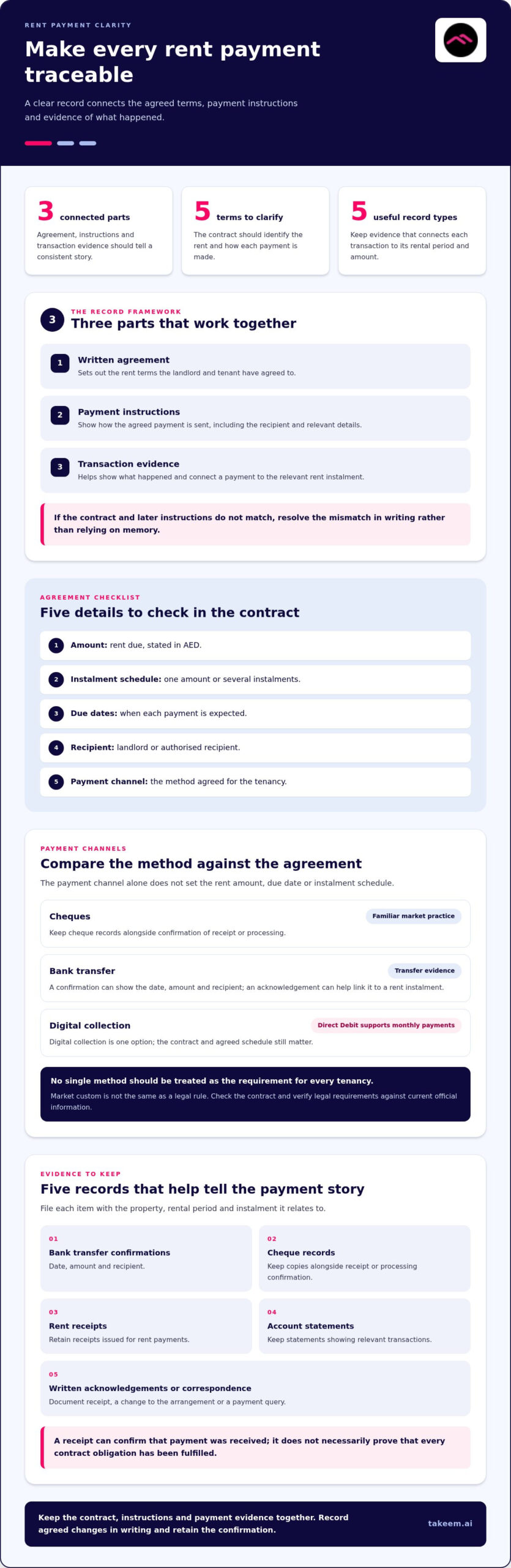
    A payment method is the channel used to transfer rent. The contract sets out how and when that channel must be used. A cheque, bank transfer or digital payment does not, by itself, establish the rent amount, due date or instalment schedule. Start with the tenancy agreement to understand what the landlord and tenant have agreed.

    For anyone comparing legal rent payment methods Dubai, this distinction matters. A method may be used in the market without automatically applying to every tenancy. Consider the agreement, any written changes and the rules that apply to the tenancy together.

    What should the tenancy agreement say about rent payments?

    Check that the contract clearly identifies:

    • Amount: the rent due, stated in AED.
    • Instalment schedule: whether rent is paid in one amount or several instalments.
    • Due dates: when each payment is expected.
    • Recipient: the landlord or authorised recipient who should receive the funds.
    • Payment channel: the agreed method, such as cheques, bank transfer or digital collection.

    Specific wording prevents avoidable uncertainty. For example, “monthly payment” should include clear due dates and instructions for sending funds. If the parties agree to change the method or schedule, record the change in writing and keep the confirmation with the tenancy documents. A message or signed addendum can document what was agreed, but don’t assume a change automatically alters legal rights or obligations. Check the contract requirements and applicable rules.

    Clear payment terms define what is due and when; traceable evidence helps show whether the agreed payment was made.

    Does one payment method apply to every tenancy?

    No single method should be treated as the legal requirement for every rental across the UAE. The accepted channel and schedule can depend on the contract and the rules applicable to the tenancy. Cheques are a familiar market practice, while bank transfers and digital collection are also used. Market custom is not the same as a legal rule, so verify legal questions against current official information.

    Rental arrangements are subject to applicable laws and registration procedures. For general background on the department, see the Land Department on Wikipedia; use current official UAE information to verify legal requirements and procedures.

    Initiatives do not create a universal payment rule either. The Flexi Rent initiative supports participating companies in offering more flexible schedules, but participation is voluntary. Its availability does not mean every landlord must accept monthly payments. Read the contract, confirm any written arrangement and distinguish what the parties agreed from what the law requires.

    How rent payment rules, contracts, and records fit together

    A dependable rent record has three parts: the written agreement, the instructions used to make each payment and evidence showing what happened. These should tell a consistent story. If the contract sets one schedule but a later message suggests another, it may be unclear which arrangement the parties followed. Keep the documents together and resolve mismatches in writing rather than relying on memory.

    Which payment details should tenants and landlords review?

    Compare the signed tenancy agreement with the payment instructions and any later written arrangements. Check the payee’s name and account details, the amount in AED, due dates, number of instalments and agreed payment channel. Also review how to request or confirm a change. A payment sent to the wrong recipient or on a different date can be harder to reconcile if the records do not explain the discrepancy.

    If both parties agree to revise a schedule or channel, get written confirmation stating what changes and when the new arrangement starts. Keep it with the signed contract and related correspondence. This creates a clearer record of the parties’ understanding, but does not by itself establish the legal effect of the change. For legal questions, verify the current requirements that apply to the tenancy.

    What records help resolve a rent payment dispute?

    Keep evidence that connects each transaction to a specific rental period and the agreed amount. Useful records may include:

    • Bank transfer confirmations showing the date, amount and recipient.
    • Cheque copies or other cheque records, alongside confirmation of receipt or processing.
    • Receipts issued for rent payments.
    • Account statements showing the relevant transactions.
    • Written acknowledgements or correspondence confirming receipt, a change or a payment query.

    File each item with the property, rental period and instalment it relates to. A transfer confirmation may show that money left an account, while the landlord’s acknowledgement can help connect it to a particular rent instalment. If an amount differs from the contract, keep the explanation and any related agreement with the payment record. No single document guarantees a particular outcome in a dispute; the complete record and applicable rules may matter.

    A receipt can confirm that a payment was received, but it doesn’t necessarily prove that every contract obligation has been fulfilled. Other instalments, dates or agreed terms may also need to be accounted for. Keep tenancy registration and transaction records accessible. Registration procedures can vary across the UAE, so use the official process that applies to the tenancy.

    For landlords seeking a more structured digital collection workflow, Takeem’s Direct Debit setup supports monthly tenant payments. Clear instructions and retained records remain essential to reconciling each payment.

    Cheques, bank transfers, and digital rent payments compared

    There isn’t one payment channel that suits every tenancy. Rent is commonly paid by post-dated cheques, often in one to four instalments across the year. Bank transfers and digital collection offer other workflows. When comparing the legal rent payment methods Dubai tenants and landlords are considering, focus on how each method fits the agreed schedule and records each payment.

    Method Workflow Records to retain Practical considerations
    Cheque The tenant provides a cheque for the agreed amount and date; the landlord presents it for payment. Cheque copy or details, handover acknowledgement, and confirmation of payment or account entry. Track each cheque against its due date and rental period. Issuing a cheque and funds clearing are distinct events.
    Bank transfer The tenant sends the agreed amount to the recipient’s specified account. Transfer confirmation, relevant account statement, and receipt or written acknowledgement. Use accurate recipient details and a payment reference that identifies the property or rent period.
    Digital collection Payments are arranged through an agreed digital process, which may include recurring monthly collection. Payment authorisation or setup record, transaction history, and relevant notifications or acknowledgements. Confirm the schedule, authorisation process and steps for handling a failed or disputed payment.

    How do cheque payments differ from bank transfers?

    A cheque creates a dated payment instruction, while a bank transfer records an electronic instruction to move funds. For either method, note the intended rent period and amount, then separately confirm whether payment was received or cleared. A cheque handover record alone does not establish that funds cleared. A transfer confirmation should also be reconciled with the recipient’s account records. Check current official UAE information for the legal consequences of a dishonoured cheque or any enforcement process.

    What changes when rent is collected digitally?

    Digital collection can help organise recurring payments against an agreed schedule, but it still needs clear setup and oversight. The parties should understand the required authorisation, how payment notices or acknowledgements will be handled, and who will follow up if a collection fails. Reconcile each transaction against the agreed rent period instead of assuming a scheduled collection succeeded. Takeem facilitates Direct Debit setup for landlords accepting monthly tenant payments digitally. This is a collection option, not a universal replacement for other methods or a legal conclusion.

    Flexible instalments also depend on context. The Flexi Rent initiative allows participating companies to offer schedules such as monthly, quarterly or semi-annual, but participation is voluntary. Don’t assume it applies to every property or changes an existing tenancy’s terms. Check the initiative’s current conditions and confirm the schedule agreed for the tenancy.

    Legal Rent Payment Methods in the UAE: A 2026 Guide

    A practical checklist for agreeing and managing rent payments

    A reliable payment routine starts before the first transfer or cheque and continues through each instalment. Use this sequence to keep the agreement, payment activity and records aligned. It is a practical administration checklist, not a substitute for checking the current rules that apply to your tenancy.

    1. Review the agreement before signing. Confirm the rent amount in AED, named recipient, payment frequency, due dates and accepted channel. Check how the contract records instalments and whether payment instructions match its terms. Resolve unclear details with the other party before relying on an assumption.
    2. Confirm the first payment instructions. Check the recipient’s name and account details or cheque payee, as relevant. Make sure the requested amount and date match the agreed schedule. Save the instructions and relevant contact details securely so you can access them when payment is due.
    3. Set up a simple tracking system. Create a ledger or calendar with one entry for each rental period. Include the due date, amount, payment channel and status, then attach the confirmation or receipt. Landlords can use it to reconcile rent; tenants can check what they have paid and what remains due.
    4. Record any change before using it. If both parties agree to a different channel or schedule, document what changes, when it takes effect and which payments it covers. Keep the written confirmation with the tenancy documents. Don’t treat a conversation or one-off exception as proof that all future payments follow the revised arrangement.
    5. Respond calmly to a missed or delayed payment. Review the contract and payment instructions. Check whether the payment was initiated, sent to the correct recipient and recorded against the right rental period. Preserve confirmations and correspondence, then communicate promptly and factually with the other party to clarify the status and next steps. Avoid assuming a delay has a particular legal consequence; procedures depend on current rules and circumstances.
    6. Reconcile after every payment. Match the bank entry, cheque record or digital collection record to the correct instalment. Note any correction, partial payment or unresolved difference in writing, and retain receipts and acknowledgements. If a disagreement becomes a legal dispute, consult current official guidance or qualified legal advice for the relevant jurisdiction.

    Takeem facilitates Direct Debit setup for landlords accepting tenant payments digitally. Explore Direct Debit and rent guarantee options as separate landlord services; neither changes the need to follow the agreed payment terms.

    A consistent checklist makes legal rent payment methods Dubai easier to manage in practice: verify the arrangement, document changes and reconcile each payment rather than relying on memory.

    Digital rent collection with Takeem: a practical next step for landlords

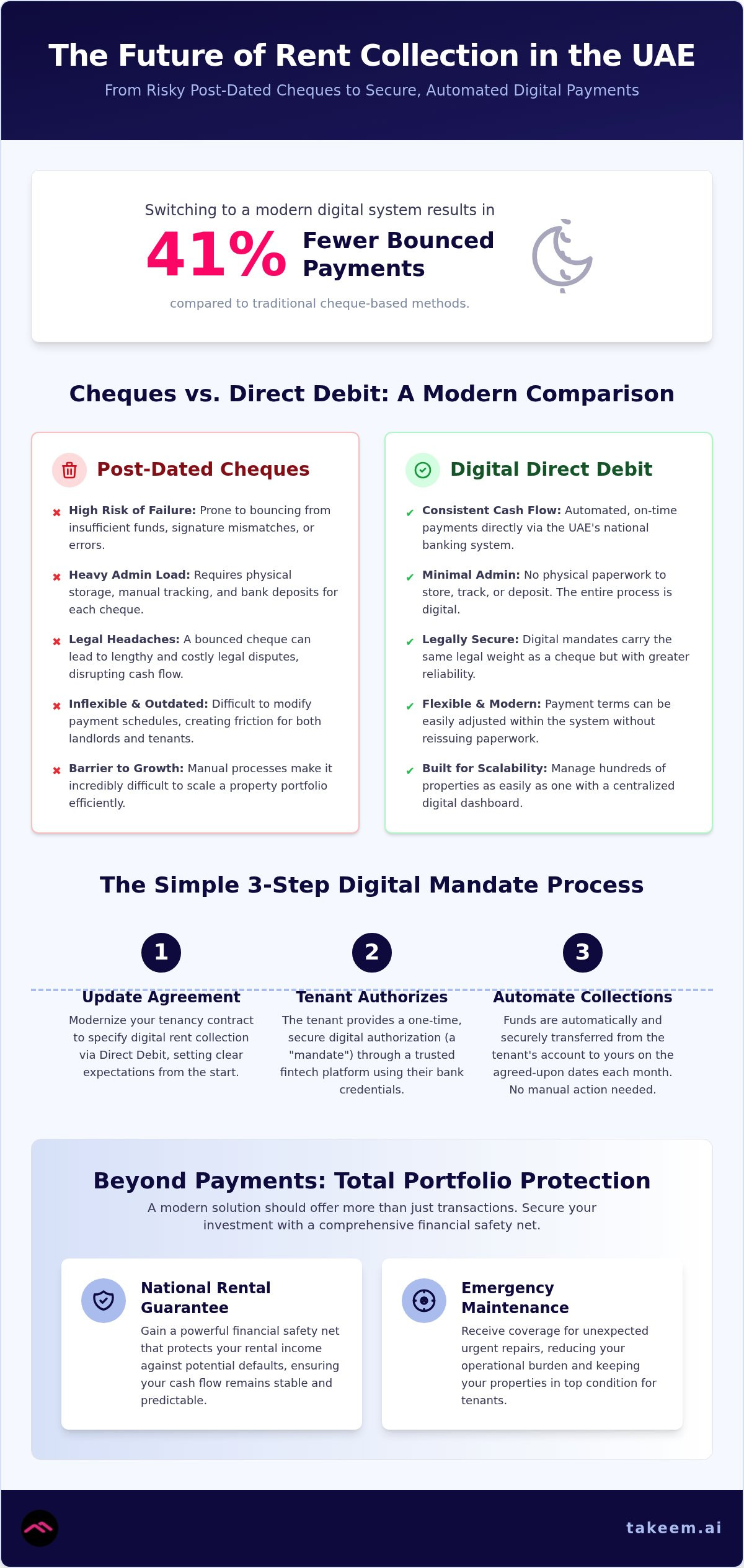
    Once the payment terms and recordkeeping process are clear, landlords can consider how they want to collect rent. Direct Debit offers a digital option for monthly payments and an alternative to coordinating post-dated cheques. It does not set the tenancy’s legal terms or guarantee that a payment will succeed. The contract and applicable rules remain the reference points.

    How landlord Direct Debit setup can support monthly collection

    Takeem facilitates Direct Debit setup for landlords accepting monthly tenant payments digitally. Recurring collection can help landlords organise rent by payment period instead of handling each instalment as a separate cheque handover. A defined schedule and consistent transaction tracking can make it easier to review what was due, what was received and what needs follow-up.

    Align the digital workflow with the tenancy’s written terms. The parties should understand the monthly amount and due date, the recipient, the collection method and the authorisation process. Keep setup information and transaction records with the tenancy documents. A digital instruction is not a substitute for clear agreement, and a scheduled collection should still be reconciled against the actual payment record.

    • Match the schedule: ensure monthly collection aligns with the agreed payment frequency and due dates.
    • Keep the record connected: identify each transaction with the relevant rental period and agreed amount.
    • Plan for exceptions: decide how the parties will communicate and document a failed, delayed or disputed payment.

    When a landlord may consider a digital collection workflow

    This approach may suit landlords who want to move away from coordinating post-dated cheques and prefer monthly collection. It can also help bring payment dates and transaction records into a more consistent administrative routine. The practical fit depends on the tenancy arrangement and the parties’ agreement. Digital collection is an option, not a universal replacement for other methods or a conclusion about what the law permits.

    When comparing legal rent payment methods Dubai, keep the decision grounded in the contract: confirm that the chosen channel and schedule are documented, and retain records that correspond to each payment. If the parties want to change an existing arrangement, document the proposed change clearly and check the current rules before treating it as effective.

    Takeem’s rental guarantee is a separate landlord service, not a payment method and not a factor that determines whether a collection arrangement is legally acceptable. Landlords can consider the services for their distinct purposes: digital monthly collection and rental income protection.

    Ready to explore a digital monthly collection workflow? Explore Takeem’s landlord solution for Direct Debit setup and a separate rental guarantee option.

    Make your next rent collection step a confident one

    Choose a collection process that supports the way you manage your rental, while keeping the tenancy terms and applicable rules at the centre of the decision. Treat digital collection as an operational choice, not a substitute for clear agreement or legal guidance.

    Takeem facilitates Direct Debit setup for landlords accepting monthly rent digitally. Landlords can also consider Takeem’s rental guarantee service, which includes emergency property maintenance coverage. These are separate options: one supports rent collection, while the other is a landlord service with its own purpose.

    Explore Takeem’s digital rent collection solution for a more organised monthly collection workflow.

    Frequently Asked Questions

    Is there one legally required rent payment method across the UAE?

    No, don’t assume one payment method applies to every tenancy. A method commonly used in the rental market, such as post-dated cheques, isn’t automatically a legal requirement. The tenancy terms, any documented arrangement between the parties and rules for the relevant jurisdiction all matter. For questions about legal rent payment methods Dubai or another emirate, verify the current position through official sources before relying on a definitive legal interpretation.

    Can a landlord ask for rent by post-dated cheque?

    Post-dated cheques are a familiar option in some rental arrangements, but whether they apply to your tenancy depends on its terms and applicable rules. Check how many cheques are specified, their dates and the amount assigned to each rental period. Keep a record of each cheque provided and any receipt or acknowledgement. If the requested arrangement differs from the signed terms, discuss and document the discrepancy rather than assuming either party’s position.

    Are bank transfers acceptable for paying rent?

    A bank transfer may be used if it fits the parties’ documented arrangement and applicable rules. Before sending rent, verify the recipient details using trusted payment instructions, especially if account information changes. Add a clear reference, such as the property identifier and rental period, if the banking process allows it. Keep the confirmation and check it against the account record. The transfer evidence helps trace the payment, but may not settle every disagreement on its own.

    Can rent be paid monthly instead of by cheque instalments?

    Monthly rent may be arranged if the landlord and tenant agree and document the frequency, amount and due dates. Payment frequency is separate from the payment channel: monthly rent could be collected digitally or through another agreed method. Don’t assume a flexible-payment initiative applies to every tenancy. Check its current eligibility and conditions through official information, then make sure the tenancy documents reflect the arrangement the parties intend to follow.

    What proof should I keep after paying rent?

    Keep the tenancy agreement and payment instructions alongside evidence for each transaction. Depending on the method, that may include a bank or digital confirmation, cheque record, rent receipt or written acknowledgement. File records by rental period and amount so you can distinguish one instalment from another. These documents can support a clear account of events, but keeping them doesn’t guarantee a particular result if a dispute arises.

    Can a landlord collect rent through Direct Debit?

    Direct Debit can be a digital collection option when the setup, required authorisation and agreed payment terms are in place. Takeem facilitates Direct Debit setup for landlords accepting monthly tenant payments. Landlords should align the collection schedule with the tenancy arrangement and keep transaction records. Direct Debit is a collection workflow, not legal advice or a promise that every payment will be collected successfully. The parties remain responsible for understanding and documenting their agreed terms.

    What should I do if a rent payment is delayed or disputed?

    Start by comparing the due date and amount in the tenancy documents with the payment confirmation and account record. Save relevant messages, receipts and any explanation for a delay or correction, then contact the other party promptly and keep the discussion factual. If you agree on a temporary or revised arrangement, record it in writing. Don’t assume a specific remedy or deadline applies; consult current official guidance or qualified legal advice for your jurisdiction.

  • Automated Rental Income: 2026 Guide for UAE Landlords

    Automated Rental Income: 2026 Guide for UAE Landlords

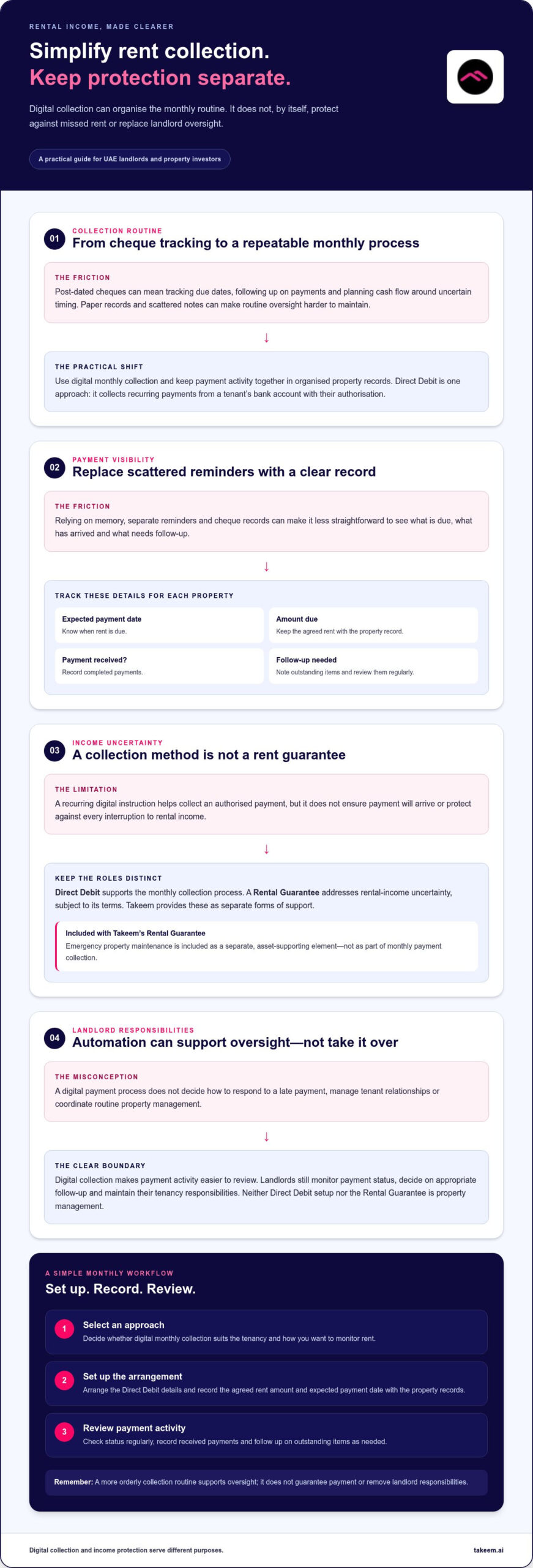
    What if making rental income more predictable didn’t require handing over control of your property? For landlords searching for automated rental income, the practical starting point is a simpler way to collect rent each month. Post-dated cheques can mean tracking due dates, following up on payments and planning cash flow around uncertain timing. Digital collection can reduce that administration, but it doesn’t automatically protect against missed rent.

    It helps to separate the moving parts. Direct Debit setup supports monthly digital rent collection, while a rental guarantee addresses income uncertainty as a separate service. Takeem provides both for landlords and property investors across the UAE, with emergency property maintenance included in its Rental Guarantee service. Neither service is property management.

    This guide explains what can be automated, how digital collection compares with cheque-based administration, and where income protection fits. It also shows how to organise payment records and choose a practical next step without confusing a smoother collection process with protection against every disruption.

    Key Takeaways

    • See which rental-income tasks can be digitised, from payment records to a consistent monthly collection routine.
    • Understand how automated rental income Dubai can streamline administration without removing landlord oversight or responsibilities.
    • Compare Direct Debit, rental guarantees and property management by the different needs each addresses.
    • Use a staged checklist to organise property records and track payment status across one or more properties.
    • See how Takeem’s Direct Debit setup and Rental Guarantee serve distinct roles, with emergency property maintenance included in the guarantee service.

    What Does Automated Rental Income Mean for UAE Landlords?

    Automated rental income means using digital processes to collect rent, record payment activity and track what is due. Instead of relying only on cheque dates, paper records and manual reminders, a landlord can use digital collection and organised records to follow monthly payments. For landlords exploring automated rental income Dubai, the goal is not to remove oversight. It is to make that oversight easier to maintain.

    Moving from post-dated cheques to digital monthly collection changes how rent is administered, not the landlord’s role. A digital process can make payment activity easier to review, but it doesn’t decide how to respond to a late payment or replace attention to tenancy responsibilities.

    Payment automation organises how rent is collected; rental-income protection addresses the risk of income being interrupted. These services are related, but they do different jobs.

    Which parts of rent administration can be automated?

    Digital collection involves setting up a payment method for rent and using it for recurring monthly payments. Direct Debit is one approach: it allows payments to be collected from a tenant’s bank account with their authorisation. For a plain-language overview of the method, see Direct Debit Explained. Takeem provides Direct Debit setup for landlords moving to digital monthly rent collection.

    Digital records can also make routine oversight more consistent. Record the expected rent date, whether payment has been received and any follow-up needed. Keeping this information together makes upcoming and completed payments easier to review and can support cash-flow planning. It won’t ensure a payment arrives, but it can reduce reliance on scattered notes or memory.

    Collection is only one part of owning a rental property. A payment process doesn’t coordinate maintenance, manage tenant relationships or make broader property-management decisions. Keeping these responsibilities distinct shows what digital collection can simplify and what still needs separate attention.

    What automation cannot promise on its own

    A recurring digital instruction doesn’t guarantee that rent will always be paid. Payment processing is a way to collect an authorised payment, not protection against every interruption to rental income. If a payment is missed, the landlord still needs to understand the situation and decide what action is appropriate under the tenancy arrangement.

    Income protection is a separate consideration. A rental guarantee addresses rental-income uncertainty subject to its terms, while Direct Debit supports the collection process. Takeem provides both as distinct forms of rental-income support. Its Rental Guarantee also includes emergency property maintenance, an asset-supporting element separate from monthly payment collection.

    Automation also doesn’t replace landlord decisions, tenancy obligations or professional advice. Treat it as administrative support: establish a clear collection routine, keep records organised and review payment status regularly. Digital tools can make rent oversight more orderly without taking responsibility away from the landlord.

    How Digital Rent Collection Works from Setup to Monthly Payment

    A practical digital collection routine has three parts: choose an approach, establish the payment arrangement, then review each month’s activity. This creates a repeatable process instead of relying on separate reminders and cheque records. For landlords considering automated rental income Dubai, the aim is to make payment administration easier to follow while keeping a clear view of what is due and received.

    Direct Debit is a method for collecting recurring payments from a bank account with the payer’s authorisation. In a rental arrangement, the landlord sets up digital monthly collection with the tenant. Takeem provides Direct Debit setup to support the move from post-dated cheques to digital payments. Keep the agreed payment details and expected date in the property records, and use the applicable setup details to guide the process.

    A useful workflow is to:

    • Select an approach: Decide whether digital monthly collection suits the tenancy and how you want to monitor rent.
    • Set it up: Arrange the Direct Debit details and record the agreed rent amount and expected payment date with the property records.
    • Review activity: Check payment status regularly, record received payments and follow up on outstanding items as needed.

    Moving from cheque handling to digital collection

    With post-dated cheques, landlords may need to organise cheque dates and track which payments are due. Digital monthly collection changes the routine: payment details and records can be reviewed as part of a recurring monthly process. Cheques remain part of some rental arrangements, so consider the transition property by property rather than assuming the same approach suits every tenancy.

    Consistency is the benefit. A regular review routine helps landlords spot an outstanding payment and see what income is expected, without confusing collection with income protection. Takeem’s guide to rental guarantees and Direct Debit explains how these two parts of rental-income support serve different purposes.

    What landlords should track after setup

    Keep a simple record for each property, whether in a spreadsheet or a system you already use. Include the expected payment date, amount due, whether payment has been received and any outstanding item that needs follow-up. Add notes when you take action, so the record shows the payment’s current status, not just its due date.

    For a portfolio, consistent records make it easier to review properties together and identify payments that need attention. A clear monthly routine could involve checking each property’s status on a chosen day, updating the records and noting anything unresolved. This supports planning without suggesting that digital collection prevents missed payments.

    Landlords looking to streamline monthly collection can explore Takeem’s landlord solutions, including Direct Debit setup and rental-income support.

    Direct Debit, Rental Guarantees, and Property Management: What Is Different?

    These services can all relate to rental income, but they address different needs. Direct Debit provides a way to collect payments. A rental guarantee offers income-protection support under its applicable terms. Property management covers a broader range of property-related responsibilities. Separating these roles helps landlords identify what they need without assuming a digital payment method includes protection or day-to-day management.

    Use this comparison to identify the task each option supports:

    Option Purpose Landlord task supported Important limitation
    Direct Debit Collect rent digitally from a tenant’s bank account with authorisation. Organising recurring rent collection and reviewing payment activity. It’s a payment method, not a guarantee that rent will always arrive.
    Rental guarantee Provide rental-income protection support under the service terms. Addressing income uncertainty through a separate support arrangement. Conditions and coverage depend on the applicable terms; it isn’t a payment collection method.
    Property management Handle broader responsibilities associated with managing a property. Coordinating property-related tasks beyond rent collection. Neither Direct Debit nor a rental guarantee should be treated as full property management.

    Digital collection versus rental-income protection

    Think of collection as the route rent takes to reach the landlord, and protection as a separate response to income uncertainty. Takeem provides both Direct Debit setup and rental guarantee services, but each has a distinct purpose. A landlord rental guarantee guide can help clarify what to consider when reviewing the protection side. For automated rental income Dubai, assess collection and protection separately.

    For example, a landlord may use digital collection to organise monthly payments and make payment activity easier to review. That setup alone doesn’t protect against missed rent. A rental guarantee is a separate service, and its scope depends on its applicable terms. Neither option removes the landlord’s own decisions and responsibilities.

    Where emergency maintenance fits

    Takeem’s Rental Guarantee includes emergency property maintenance coverage. This is an included element of the service, not a claim to coordinate every routine repair or provide broad property management. Understanding that boundary helps landlords distinguish asset-supporting coverage from ongoing maintenance administration. The rental guarantee and maintenance guide explores how maintenance fits alongside income protection.

    Consider each need on its own: payment collection, income protection and broader property responsibilities. This makes it easier to choose support that matches the task without assuming one service covers every part of rental ownership.

    Automated Rental Income: 2026 Guide for UAE Landlords

    How to Introduce Automated Rent Collection Across Your Properties

    A smooth transition starts with your current process, not with a new tool. Before introducing digital collection, map how each property handles rent today. Note the payment approach, expected dates, where you record receipt and how you follow up on outstanding amounts. This gives you a practical baseline and shows which repetitive steps may be simpler to manage through a consistent digital process.

    Start with a clear picture of your rental workflow

    Review each property individually. One tenancy may use post-dated cheques, while another may already follow a monthly digital routine. Record the differences rather than assuming every tenant or agreement can move in the same way. Then identify manual tasks, such as updating payment notes or checking separate records, that a consistent digital process could make easier to oversee.

    Keep communication clear throughout the change. Tenants should understand the collection arrangement and the payment details relevant to their tenancy. Landlords need to retain a clear view of expected and received rent. Digital collection can streamline administration, but it doesn’t remove the need to monitor activity or address questions and outstanding payments.

    Use this staged checklist to plan the transition:

    • Map the process: Record how each property currently collects rent and how payment status is tracked.
    • Organise the records: Keep property and tenancy details, expected payment dates and receipt status together.
    • Set the routine: Choose a regular time to review collection activity and update records.
    • Account for the arrangement: Use the relevant service terms and setup details to guide the plan for each property.

    Consistent digital records make rental-income oversight clearer by showing what is due, what has arrived and what still needs attention. That visibility can support cash-flow planning, but it doesn’t guarantee payment or replace landlord judgment.

    Adapt the process for a larger portfolio

    With multiple properties, inconsistent record-keeping can make a monthly review harder than it needs to be. Use the same basic fields for each property, such as expected payment date, amount due, payment status and follow-up required. A consistent process helps you compare like with like and spot unresolved items without relying on memory or searching through unrelated notes.

    Keep the system practical. You don’t need a particular dashboard, integration or reporting format to establish good oversight. Start with reliable records and a routine you can maintain, then adapt it to the size and needs of your portfolio. The property portfolio income guide offers further context for investors organising rental income across multiple properties.

    For a practical next step, explore Takeem’s landlord solutions, including Direct Debit setup for digital monthly rent collection.

    How Takeem Connects Digital Rent Collection with Income Protection

    Takeem provides landlords and property investors with two distinct forms of rental-income support: Direct Debit setup for monthly digital rent collection, and a Rental Guarantee that provides income-protection support under its service terms. They address separate priorities within a rental-income plan. Digital collection helps organise administration; the guarantee offers a separate layer of support. Neither is full property management or a promise that every payment will arrive.

    For landlords exploring automated rental income Dubai, the value lies in matching support to the task. A consistent collection routine can make payment oversight easier to maintain, while a rental guarantee addresses income uncertainty under its applicable terms. Takeem’s Rental Guarantee also includes emergency property maintenance coverage. This is an included element of the guarantee service, not a promise to handle every repair or routine maintenance task.

    A practical fit for individual landlords and investors

    For an individual landlord, monthly digital collection can reduce the effort of organising recurring payments and reviewing their status. Investors with multiple properties can use a consistent record-keeping routine across their portfolio to see which payments are due and which have been received. The Rental Guarantee is a separate option for income protection, with its scope governed by the relevant service terms.

    The distinction matters. Direct Debit supports the collection process; it doesn’t itself protect rental income. A guarantee doesn’t replace collection setup or the landlord’s own oversight. Considering each need separately helps keep the arrangement clear, whether the priority is reducing cheque administration, addressing income uncertainty or both.

    Choose a next step that matches your priority

    Start with the friction you want to reduce. If handling post-dated cheques and tracking monthly payments takes too much administration, Direct Debit setup offers a route to digital monthly collection. If your main concern is rental-income uncertainty, review Takeem’s Rental Guarantee as a separate form of support. The applicable terms determine the guarantee’s scope, so don’t assume it covers every circumstance.

    Before deciding, note how rent is currently collected, what you want to make easier and which properties the change should apply to. This review can help you focus on the right next step without adding unnecessary complexity or treating a collection method as income protection.

    Takeem connects digital collection and rental-income support while keeping their roles distinct. Explore rental-income solutions with Takeem to find support that fits your priority.

    Make Your Next Rent Cycle Easier to Oversee

    A useful next step doesn’t have to involve changing every property at once. Choose one part of your rental-income process that creates avoidable friction, such as tracking payment status or organising collection dates. Set a clear routine around it, then use what you learn to decide whether to extend the approach across your portfolio. Small, deliberate changes can make automated rental income Dubai easier to manage without adding layers of administration.

    As you plan, keep your priorities distinct. If you want a more organised collection process, focus on digital monthly payment setup. If you’re considering income protection, review the relevant rental guarantee terms and how they fit your circumstances. Takeem supports landlords and property investors across the UAE with these separate forms of rental-income support, and emergency property maintenance is included as part of its Rental Guarantee service.

    Choose the step that addresses your immediate priority, then build from there. Explore Takeem’s rental-income solutions and move toward a clearer approach to overseeing your rental income.

    Frequently Asked Questions

    Can rental income be automated?

    Yes, landlords can automate parts of rent administration, including recurring collection and payment record-keeping. For example, a landlord with monthly rent due on a set date can use digital collection and record each payment’s status. Exceptions still need attention, and landlords remain responsible for decisions about their properties. Automation can make a routine more consistent, but it can’t remove every manual task or guarantee income.

    How does Direct Debit rent collection work for landlords in the UAE?

    Direct Debit lets a landlord collect recurring rent from a tenant’s bank account after the tenant authorises the arrangement. The landlord sets up the collection details, monitors payment activity and records the outcome. Takeem provides Direct Debit setup for landlords seeking digital monthly rent collection. Keep the agreed payment details and any changes organised with the relevant tenancy records.

    Does automated rent collection guarantee that tenants will pay?

    No. Automated collection provides a way to request or collect a payment, but it doesn’t ensure the tenant’s payment will be completed. If income protection is also a priority, consider a rental guarantee as a separate form of support and review its applicable service terms. Landlords looking at automated rental income Dubai should treat collection and protection as distinct parts of their plan, not interchangeable services.

    What happens if a tenant’s Direct Debit payment fails?

    A failed payment means the landlord should check the recorded status rather than assume why the transaction didn’t complete. Note the due date, the status shown and any follow-up. Then communicate with the tenant through the agreed channel to understand the next step under the tenancy arrangement. Direct Debit setup doesn’t resolve a missed payment automatically, so maintain a clear record of any outstanding rent and action taken.

    Can landlords use digital rent collection for multiple properties?

    Yes. Landlords can organise digital collection across multiple properties while keeping each tenancy’s payment details and status distinct. Use a consistent record format with property reference, tenant, amount due, expected date and payment status. This makes it easier to review the portfolio without mixing up transactions. Takeem provides rental-income services for landlords and property investors, including those with large property portfolios.

    Does rental-income automation replace property management?

    No. Automating rent collection supports payment administration, not the full range of property-management responsibilities. Landlords still make decisions about their properties, maintain tenancy records and handle matters outside the collection process. Keep a separate process for maintenance, tenant communication and other property tasks. This distinction sets realistic expectations about what digital collection can simplify and what still requires landlord attention.

    Can a rental guarantee include emergency property maintenance?

    Yes. Takeem’s Rental Guarantee includes emergency property maintenance coverage as part of the service. This is a specific included element, not a promise to cover every repair or replace routine property management. Landlords considering a guarantee should review the applicable service terms to understand its scope and how it relates to their property. Keeping maintenance records and reporting issues through the relevant process can also help with oversight.

  • Guaranteed Rent Schemes in the UAE: A Landlord’s 2026 Guide

    Guaranteed Rent Schemes in the UAE: A Landlord’s 2026 Guide

    What happens to your cash flow when a tenant misses a payment, and does a rent guarantee actually protect you? A guaranteed rent scheme Dubai landlords consider can offer more predictable income, but the agreement, not the headline promise, determines what is protected.

    It’s reasonable to want greater certainty without giving up more income or flexibility than you intend. Schemes can use different structures: a provider or operator may lease the property and pay the owner an agreed amount, or the agreement may set out another payment and protection model. Before you commit, check what happens when rent is late, which exclusions apply, and whether fees or conditions affect the arrangement.

    This guide explains how rent guarantee schemes work in the UAE and how they differ from ordinary rent collection. You’ll learn what to compare, which payment and protection details to verify, and how to assess whether a Takeem provider fits your rental strategy. It also covers contract duration, income trade-offs, and payment processes, so you can review an offer with clearer expectations before signing.

    Key Takeaways

    • A guaranteed rent scheme Dubai landlords consider is only as clear as its agreement. Check what the provider promises, what conditions apply, and what falls outside the coverage.
    • Before signing, map the process from eligibility review and payment setup to ongoing collection, and clarify each party’s responsibilities.
    • Compare providers using the same criteria, including exclusions, fees, payment timing, and landlord duties. Weigh these against self-managed rent collection.
    • Verify the provider’s legal identity, service scope, complaint route, and contact process before sharing documents or committing.
    • Assess whether structured income protection and digital collection suit your rental strategy, while accounting for contractual obligations and service conditions.

    What Is a Guaranteed Rent Scheme in the UAE, and What Does It Promise?

    A guaranteed rent scheme is an agreement in which a provider commits to pay a landlord rent or another agreed amount under specified terms. The arrangement may shift certain rental-income risks to the provider, but it doesn’t make property ownership risk-free. You may still have costs, obligations, and restrictions. The agreement defines what the provider is responsible for and what remains yours.

    The structure can vary. A provider or operator may lease the property and pay the owner an agreed sum; another arrangement may use a different payment and protection model. The basic idea of a guaranteed rental transaction is that an owner receives an agreed sum from another party that takes on rental-related responsibilities. For a UAE-focused overview, see this UAE landlord rental guarantee guide.

    A guaranteed rent scheme Dubai landlords consider should be assessed by its written terms, not its name or headline promise. Coverage, eligibility, exclusions, payment arrangements, and landlord responsibilities depend on the provider’s agreement. A guarantee is also different from property management: it covers specified income or services, while property management involves broader oversight. Don’t assume a rent guarantee includes that work.

    What can a guaranteed rent scheme cover?

    Depending on the agreement, a scheme may address particular rental-income risks or set out agreed payments to the landlord. These features aren’t standard across the market. Check whether payment depends on the property being occupied, whether missed tenant payments are covered, and what conditions apply. Read the exclusions and eligibility requirements, and confirm in writing what evidence or steps the provider requires if an issue arises.

    Check any additional package services separately from the payment terms. For example, a provider may include emergency property maintenance, but that doesn’t automatically mean every repair is covered. Confirm the service scope, conditions, and your responsibilities before relying on it.

    How is a rent guarantee different from rent collection?

    Rent collection facilitates payment. A rent guarantee may protect against specified income risks, but only as defined in the agreement. A collection method such as Direct Debit can help organise recurring payments, but it doesn’t ensure that a tenant has funds available or guarantee that a payment will succeed.

    Ask who is expected to pay you, when payments are due, and what happens if a tenant’s payment is late or unsuccessful. Then check whether the provider’s stated protection applies in that situation or whether the shortfall remains yours. This distinction helps you compare a guarantee with ordinary rent collection based on actual responsibilities, not assumptions.

    How a UAE Rent Guarantee Works: Agreements, Payments, and Responsibilities

    A rent guarantee process typically starts with the provider checking whether the landlord and property meet its criteria. Before agreeing, clarify what information is needed, what the provider commits to pay, how payments are handled, and which situations are excluded. The agreement should identify each party’s role, including what you must do if a tenant misses a payment or a property issue arises.

    After you review and sign the terms, setup may involve confirming payment details and giving the tenant instructions for paying rent. The provider may have separate processes for collecting payments, handling reported issues, or applying the agreement’s protections. Don’t assume these steps or their timing are standard. Ask the provider to explain its current process, and keep the signed agreement, payment instructions, and key contact details accessible. For more context, read this UAE guide to rental guarantees and Direct Debit.

    What should landlords expect during setup?

    Ask what property and landlord details or documents the provider needs, how it assesses eligibility, and what must be completed before the arrangement starts. These are points to confirm, not a universal checklist. Setup steps and timing vary, so verify Takeem’s current process directly rather than relying on an assumed start date. Store the final agreement and tenant payment instructions where you can find them easily.

    Payment instructions and provider processes are separate. The tenant needs clear directions on how and when to pay; the provider should explain how payments are collected or processed under the agreement. Direct Debit can support monthly digital rent collection, but it doesn’t guarantee that a tenant’s payment will succeed. If you’re considering a guaranteed rent scheme Dubai landlords can use, confirm what happens after an unsuccessful payment and whether any income protection applies.

    Which responsibilities remain with the landlord?

    Confirm who communicates with the tenant, receives reports, and handles service requests. A rental guarantee doesn’t automatically include full property management, so establish which tasks stay with you and which, if any, the provider agrees to perform. If emergency maintenance is included, check its written scope, conditions, reporting process, and any landlord responsibilities.

    Takeem provides rental guarantee services, facilitates monthly digital rent collection through Direct Debit, and includes emergency property maintenance as part of its rental guarantee service. Confirm the precise terms and process directly. Reviewing Takeem’s landlord rental guarantee information can help you identify questions about eligibility, payments, and responsibilities before proceeding.

    How to Compare Guaranteed Rent Schemes: Terms, Fees, and Alternatives

    Start your comparison with the written offer, not the scheme’s label. A provider may describe a payment as guaranteed, but the agreement determines what qualifies, when payment is due, and what happens if conditions aren’t met. The written agreement matters more than the label because it defines the protection, exclusions, and obligations you can actually rely on.

    Use the same questions for each provider. Terms and service fees vary, so request full fee details and payment conditions in writing instead of relying on broad claims or unverified pricing.

    Compare What to check
    Coverage How does the agreement define covered rent or income? Which circumstances can affect payment?
    Exclusions and eligibility Which properties or landlords qualify, and what situations are excluded or conditional?
    Fees What service fees apply, how are they charged, and can any other charges arise under the agreement?
    Payment timing Who pays you, when are payments due, and how are late or unsuccessful tenant payments handled?
    Landlord duties What reporting, tenant communication, maintenance, or other obligations remain yours?

    Which agreement terms should landlords compare?

    Read the definitions closely. Confirm how the provider defines covered rent, what makes a property eligible, and which exclusions or events can affect payment. Ask how you must report a missed payment, how the provider assesses it, and what happens next. Review cancellation and renewal terms, including any duties that continue after the agreement ends. A guaranteed rent scheme Dubai offer is easier to assess when these answers are explicit and consistent across providers.

    Compare the guarantee with self-managed rent collection based on the service you need. Managing collection yourself may give you direct oversight of payment instructions and follow-up. A guarantee may provide specific income protection under agreed conditions. Neither approach suits every landlord; consider your tolerance for payment uncertainty, preferred level of involvement, and the actual scope and cost of each option.

    When might digital rent collection be useful?

    Recurring digital collection, such as Direct Debit, may reduce reliance on cheque-based workflows and help organise monthly payments. It doesn’t guarantee a successful payment, and setup may depend on the tenant, account, and provider process. Review the Direct Debit setup guide for landlords, then confirm the applicable requirements and payment handling directly with the provider.

    Guaranteed Rent Schemes in the UAE: A Landlord’s 2026 Guide

    A Landlord’s Due-Diligence Checklist Before Choosing a Rent Guarantee

    A checklist helps you test a provider’s promises before sharing sensitive documents or signing. A polished proposal isn’t a substitute for checking who you’re contracting with, what the service includes, and how the agreement works in practice. For a guaranteed rent scheme Dubai landlords are considering, confirm each point in writing and keep the provider’s responses with the contract.

    • Verify the provider’s legal identity. Confirm the contracting entity’s full legal name and check that it matches the name on the agreement and payment instructions.
    • Define the protection. Ask which events are covered, which are excluded, what conditions apply, and what information is needed to submit a request.
    • Clarify the money flow. Confirm all service fees, who pays you, the payment schedule, and how late or unsuccessful payments are handled.
    • Understand the process. Request the setup steps, reporting route, complaint process, and contact method for routine questions and service requests.
    • Check the exit terms. Review cancellation, renewal, and continuing obligations, including any notice requirements stated in the agreement.
    • Get maintenance details in writing. If maintenance is included, confirm its scope and conditions, how to report an issue, and any stated service response times.

    What questions should you ask a provider?

    Ask the provider to explain how it assesses eligibility and handles a missed payment, from your first notification through its decision under the agreement. Request written answers about fees, payment timing, setup, exclusions, and cancellation instead of relying on verbal assurances. For maintenance, clarify what is included and what remains your responsibility. This UAE guide to rental guarantees with maintenance can help you frame your questions.

    How can you assess service fit for your property?

    Compare the provider’s documented eligibility criteria with your property and tenancy details before sending records. Then map its workflow against your current rent collection and record-keeping process: who receives payment updates, where you keep supporting documents, and how you’ll follow up on an issue. Legal or regulatory requirements can depend on the specific arrangement, so seek advice from qualified UAE counsel if you’re unsure how the agreement applies.

    After completing these checks, you can review Takeem’s landlord guarantee service and confirm its current eligibility, fees, coverage, and processes directly before deciding whether it fits your requirements.

    Is a Guaranteed Rent Scheme Right for Your UAE Property?

    A rent guarantee may be worth exploring if you value a defined payment process and want to reduce the manual work involved in collecting rent. It isn’t automatically right for every landlord or property. The decision depends on the agreement’s protection, fees, eligibility rules, and obligations, as well as how much control you want over rent collection and tenant communication.

    Which landlords may benefit from a structured guarantee?

    Individual landlords and investors managing larger property portfolios may value agreed payment processes and digital collection options. Recurring Direct Debit collection can support monthly payment administration, while a rental guarantee may address specified income risks under its terms. Neither feature guarantees a particular financial outcome. Consider whether the service matches your property and tenancy, and weigh its convenience against exclusions, conditions, fees, and contractual limits.

    Compare the proposed arrangement with your current process. If you already collect rent efficiently and are comfortable handling follow-up, self-managed collection may remain suitable. If you want support with defined rental-income arrangements and digital payment collection, a provider may be worth assessing. Focus on the agreement and the tasks it actually covers, rather than assuming a guarantee includes full property management.

    What are the next steps to explore Takeem?

    Before contacting a provider, note your property details, tenancy arrangements, and preferred payment process. Prepare questions about eligibility, fees, payment timing, exclusions, cancellation terms, and the responsibilities you would retain. This makes it easier to assess whether a proposal fits your rental strategy and compare its written terms with your requirements.

    Takeem provides rental guarantee services for individual landlords and property investors with large portfolios, facilitates monthly digital rent collection through Direct Debit, and includes emergency property maintenance as part of its rental guarantee service. Confirm current terms, fees, eligibility, payment processes, and the precise scope and conditions of maintenance directly with Takeem. Review the agreement before signing, and ask for written clarification wherever a term is unclear.

    To explore whether the service may fit your property, explore rental guarantee options with Takeem and discuss your requirements and current service details with the provider.

    Choose a Rental Arrangement With Clear Terms

    A rent guarantee can offer a more structured approach to rental income, but it isn’t a promise of risk-free ownership. The agreement defines what protection applies, when payments are made, which exclusions matter, and what responsibilities remain with you. Compare those details with ordinary rent collection, and confirm fees, eligibility, cancellation terms, and any maintenance conditions before signing.

    If you’re assessing a guaranteed rent scheme Dubai landlords may consider, focus on whether its payment process and protections fit your property and rental strategy. Takeem serves landlords and property investors across the UAE, combining rental guarantee support with Direct Debit collection and emergency maintenance as part of its rental guarantee service. Confirm current terms, the payment process, and maintenance scope directly before deciding.

    Explore rental guarantee options with Takeem and discuss your requirements with the provider. Start by asking clear questions and carefully reviewing the agreement.

    Frequently Asked Questions

    What is a guaranteed rent scheme?

    A guaranteed rent scheme is an agreement where a provider commits to pay a landlord rent or another agreed amount under defined conditions. The agreement explains what income protection applies, how payments are arranged, and which exclusions or landlord duties may affect it. It isn’t a promise of risk-free ownership, and the name alone doesn’t establish the level of protection. Review the written terms before deciding whether the arrangement fits your property.

    Is guaranteed rent the same as rent collection?

    No. Rent collection facilitates the tenant’s payment, while a rent guarantee may address specified rental-income risks under the provider’s agreement. Direct Debit, for example, can support monthly digital collection, but it doesn’t ensure that a tenant’s payment will succeed. Check who collects rent, who pays you, and what happens after a late or unsuccessful payment. Those details distinguish payment administration from contractual income protection.

    How does a guaranteed rent scheme work in the UAE?

    A landlord typically checks eligibility, reviews the provider’s agreement, completes the required setup, and follows the payment and reporting process set out in writing. The agreement should clarify covered rent, payment arrangements, exclusions, fees, and each party’s responsibilities. A guaranteed rent scheme Dubai landlords consider may differ from another provider’s offer, so confirm current terms directly rather than assuming one standard model applies across the UAE.

    What happens if a tenant misses a rent payment?

    The next steps depend on the signed agreement. It may specify how quickly you must report the missed payment, what information the provider needs, how the event is assessed, and whether it qualifies for protection. Don’t assume every missed or delayed payment is covered. Ask the provider to explain the process and exclusions before signing, and keep payment records and required communications accessible.

    Can a guaranteed rent scheme replace post-dated cheques?

    A rent guarantee and a payment method are separate parts of an arrangement. Takeem facilitates monthly digital rent collection through Direct Debit, which can help landlords transition from traditional cheque-based collection. Setup requirements and payment options may depend on the provider and tenancy. Confirm with the provider and tenant how payments will be authorised, collected, and recorded, and whether existing payment instructions need to change.

    How much does a guaranteed rent scheme cost?

    Costs vary by provider and agreement, so there isn’t one fee that applies to every landlord or property. Request a written breakdown of service fees, how and when they’re charged, and whether other conditions could affect the total cost. Compare those details with the scope of protection, payment process, exclusions, and your responsibilities. Confirm Takeem’s current fees directly before committing.

    Does a rent guarantee include property maintenance?

    Maintenance isn’t automatically included in every rent guarantee; check the specific agreement for its scope and conditions. Takeem includes an emergency property maintenance service as part of its rental guarantee offering, but landlords should confirm what qualifies, how to report a request, and what responsibilities remain with them. A maintenance component doesn’t by itself mean the provider offers full property management or covers every repair.

  • Rental Guarantee Service in the UAE: How Landlords Can Compare Their Options

    Rental Guarantee Service in the UAE: How Landlords Can Compare Their Options

    When comparing a rental guarantee service UAE providers offer, don’t rely on the headline promise alone. Check how missed payments are handled, what the agreement covers, and how rent collection fits into the arrangement.

    It’s reasonable to want more predictable income and fewer payment concerns. But guarantees can come with conditions, exclusions, and claim steps that affect how useful the protection is in practice. A guarantee and digital rent collection are related, but they aren’t interchangeable: one addresses income protection under agreed terms, while the other provides a payment method.

    This guide explains how rental guarantees work and what to check before choosing a provider, including payment conditions, exclusions, fees, and responsibilities. It also covers how Direct Debit rent collection and emergency maintenance may fit into a service model. Takeem offers landlords and property investors a rental guarantee that can be paired with digital monthly rent collection, with emergency maintenance included as part of the package. Use the questions below to assess whether the coverage and support suit your property and needs.

    Key Takeaways

    • Read the written agreement to understand what income protection covers, how to make a claim, and which exclusions or conditions apply.
    • Compare a rental guarantee service Dubai providers offer with rent collection as separate but complementary parts of the service.
    • Before choosing a provider, compare eligibility, payment timing, fees, responsibilities, and support using current written terms.
    • Ask how Direct Debit setup works and what emergency maintenance includes, including its scope, reporting process, and exclusions.
    • Use a checklist to assess your needs, gather relevant documents, and request written answers before deciding whether a provider fits your property.

    What Does a Rental Guarantee Service Mean for UAE Landlords?

    A rental guarantee service is a contractual arrangement intended to protect a landlord’s rental income if a tenant doesn’t pay, subject to the provider’s stated conditions. It’s related to the broader concept of rent insurance, which concerns protection against rental income loss. The exact scope depends on the agreement. The service name alone won’t tell you which missed payments qualify, when a payment may be made, or what you must do first.

    A rental guarantee can help protect rental income, but the written terms determine what is covered, when support applies, and what the landlord must do. Before signing, check payment timing, eligibility, exclusions, claim requirements, and each party’s responsibilities. These details help you judge whether the service fits your needs instead of relying on assumptions about its label.

    What may a rental guarantee service include?

    Providers may combine income protection with other services, but coverage and support vary. A package might address eligible missed rent, while a separate service component may support digital collection or property maintenance. Don’t assume a particular feature or level of protection is standard.

    Takeem’s model brings together a rental guarantee, Direct Debit setup for digital monthly rent collection, and emergency property maintenance as part of the guarantee package. Before proceeding, confirm the agreement’s coverage, exclusions, claim requirements, and payment conditions. For maintenance, clarify what is included, how requests are handled, and which limitations apply.

    How is a guarantee different from collecting rent?

    Rent collection is the process of receiving a tenant’s payment, whether it goes to the landlord or is handled through an agreed service arrangement. Direct Debit can support scheduled digital monthly payments, but it describes a payment method. It does not promise that rent will always arrive or that the landlord will be compensated if it doesn’t.

    A guarantee is a separate contractual promise with defined conditions. It sets out when the provider may be responsible for eligible rental income and what the landlord must do to qualify. Read the agreement alongside the collection setup. Check how a failed payment is managed, what notice or documents may be required, and when the guarantee process applies.

    When comparing a rental guarantee service Dubai landlords can use, keep the two needs distinct: collection helps move payments through a chosen process, while protection addresses specified losses under contract. Understanding both helps you compare providers on substance, not just convenience.

    How Rental Guarantees and Digital Rent Collection Work Together

    A rental guarantee and digital rent collection can sit within one landlord service model, but they perform different jobs. Collection provides a way to request and process scheduled payments. A guarantee sets out what may happen if rental income is missed and the agreement’s conditions are met. Assess each part separately, then check how they connect.

    A practical sequence is to review the guarantee agreement, confirm eligibility and claim conditions, understand the collection process, and complete any required payment setup. Before signing, clarify the responsibilities of the landlord, tenant, and provider. For background on how these services can work together, see this guide to rental guarantees and Direct Debit.

    What happens during setup and monthly collection?

    Setup requirements vary, so confirm the provider’s current process rather than assuming every arrangement works the same way. With Direct Debit, ask how payment authorisation is obtained, which dates or schedules apply, and how the landlord and tenant receive payment updates. Get clear instructions for what happens if a payment fails or information needs to be corrected.

    Accurate records matter. Confirm that tenancy and payment details are complete and up to date, and ask which party must report changes. Takeem facilitates Direct Debit setup for landlords, but confirm its specific requirements and payment workflow directly. For broader context on the landlord-tenant framework, consult this overview of rental laws.

    Where does the rental guarantee fit in?

    Collection activity doesn’t automatically trigger or define guarantee support. The written guarantee agreement controls which income risks may be covered and what steps the landlord must take. Check who is responsible for paying under the agreement, when a payment may be due, what event qualifies, and what documents or notices may be required. Confirm how a failed collection attempt relates to a possible claim.

    Digital rent collection moves payments through a chosen process; contractual income protection applies only under the guarantee’s stated conditions. Keeping that distinction clear helps landlords avoid treating a scheduled debit as proof that rent is guaranteed.

    Landlords comparing a rental guarantee service Dubai providers offer can request the collection workflow and guarantee terms in writing, then review them side by side. If Takeem is on your shortlist, review Takeem’s rental guarantee offering and confirm its current setup and contract details before deciding.

    How to Compare a Rental Guarantee Service Dubai Landlords Can Use

    Compare the written terms, not just a provider’s headline promise. Two services may use similar language but set different eligibility rules, claim steps, payment conditions, and support responsibilities. Use the table as a starting point, then confirm every detail in the provider’s current agreement. For wider context, read this UAE landlord rental guarantee guide.

    What to compare Questions to ask
    Coverage Which income risks or services are covered, and what conditions apply?
    Eligibility Which landlords, properties, and tenancy arrangements qualify?
    Exclusions Which events or circumstances fall outside the agreement?
    Payment timing Who pays an eligible claim, when might payment occur, and what steps come first?
    Fees What charges apply, when are they due, and can they change on renewal?
    Support What collection or maintenance support is included, and how are issues escalated?

    These are provider-specific terms, not standard features. A report on the first rental guarantee service describes a UAE model linking rental protection with emergency maintenance. Still, verify the scope and conditions in each provider’s own agreement.

    Which contract terms deserve close attention?

    Find the exact event that triggers protection, the evidence you must submit, any deadlines, and the process for making a claim. Check exclusions carefully. Clarify what happens if the agreement renews, the tenant changes, or other circumstances shift. If a clause raises questions about UAE legal or regulatory requirements, ask a qualified UAE professional to review it rather than relying on a provider summary.

    A broad promise can sound reassuring but leave practical questions unanswered. Ask what the landlord must do before and after a missed payment, how the provider communicates decisions, and whether collection records or notices are required. The process matters as much as the stated coverage.

    How should landlords assess service fit?

    Start with your property count, cash-flow priorities, and preferred rent-collection method. If you own several properties, ask how the terms and responsibilities apply across them. Don’t assume a provider offers portfolio reporting or consistent handling unless it confirms those capabilities in writing. Compare the full service scope, including any Direct Debit setup or emergency maintenance, rather than choosing based on one feature or an unverified claim.

    For a structured comparison, request written answers to the same questions from each provider. Landlords considering Takeem can review Takeem’s rental guarantee service and confirm current eligibility, exclusions, fees, payment conditions, and support terms before deciding.

    Rental Guarantee Service in the UAE: How Landlords Can Compare Their Options

    A Landlord’s Checklist for Evaluating Coverage and Property Support

    A clear checklist makes provider conversations easier to compare. Define what you need first, gather relevant property and tenancy details, compare written terms, and clarify who is responsible for each step. Decide only when important questions have answers. For a broader look at how guarantees and maintenance may fit together, read this guide to rental guarantees with maintenance.

    What should you prepare before requesting a proposal?

    Prepare a concise overview of each property, its tenancy arrangements, the current rent-collection method, and your priorities, such as income protection, digital collection, or maintenance support. For multiple properties, a portfolio summary can help providers understand your requirements without including unnecessary sensitive information. Ask what documents they need, why they need them, and how submitted information will be handled.

    • Define your needs: Identify the payment risks and support requirements you want to address.
    • Gather relevant details: Note property and tenancy information, current collection arrangements, and any changes already planned.
    • Compare the written offer: Review coverage, eligibility, exclusions, fees, payment conditions, and responsibilities.
    • Resolve open questions: Request written clarification before accepting or signing.

    What questions should you ask each provider?

    Use the same questions with each provider so you can compare answers consistently. Ask what triggers coverage, what evidence is needed, how a claim is handled, and which exclusions apply. For collection, clarify payment authorisation, timing, notifications, and failed-payment handling. Confirm fees, payment schedules, responsibilities, and renewal and termination conditions in the current written agreement.

    Assess emergency maintenance separately from rental protection. Ask what types of issues are included, how to report them, what response process applies, and which work or circumstances are excluded. Takeem includes emergency property maintenance as part of its rental guarantee package, but confirm the current scope, process, and limitations in the agreement. A general mention of maintenance is not a complete description of support.

    Before deciding, list any unanswered questions and ask the provider to respond in writing. Keep the responses with the proposed agreement so you can check whether the final terms match what was discussed. If you’re evaluating Takeem’s rental guarantee and property support, review Takeem’s rental guarantee offering and confirm the details relevant to your property before proceeding.

    Choosing a UAE Rental Guarantee Provider and Taking the Next Step

    The right provider is the one whose written coverage, responsibilities, and service scope match your property needs. A polished promise is not enough. Check how the agreement handles eligible missed rent, what you must do to make a claim, and whether digital rent collection or property support fits your priorities. If terms remain unclear, pause and ask for written clarification before you commit.

    When might a combined service be worth considering?

    A combined model may suit landlords who want to assess income protection and digital monthly rent collection together. They address different needs: collection provides a payment process, while a guarantee operates under the contract’s conditions. Emergency maintenance may also be relevant if asset support matters to you. Confirm what the package includes, how requests are handled, and which limitations apply.

    For landlords with several properties, compare how the proposed arrangement fits your portfolio and cash-flow priorities rather than assuming one setup suits every unit. This property portfolio rental income guide offers additional considerations for investors.

    What should happen before you sign?

    Review the complete agreement and check that its terms match what you were told. Confirm current eligibility, fees, coverage, exclusions, claim requirements, and the landlord’s responsibilities. If Direct Debit is part of the arrangement, ask about authorisation, payment timing, setup requirements, and what happens if a payment fails. For maintenance support, verify the scope, reporting process, and exclusions.

    Also clarify how to contact the provider about a claim or maintenance issue, what conditions must be met before support applies, and how renewal or termination works. Keep a record of answers and any documents that form part of the agreement. If you need an interpretation of legal obligations, consult a qualified professional familiar with applicable UAE requirements.

    Takeem provides rental guarantee services across the UAE, with Direct Debit setup for digital monthly rent collection and emergency property maintenance included as part of its rental guarantee package. Confirm current eligibility, fees, payment conditions, and package terms directly before deciding whether the service fits your needs. To explore the offering, explore Takeem’s rental guarantee service.

    Choose a Rental Guarantee That Fits Your Property

    A rental guarantee is useful when its written coverage and conditions match your needs. Before choosing a rental guarantee service Dubai landlords can consider, compare eligibility, exclusions, claim requirements, payment timing, fees, and who handles each step. Keep digital rent collection distinct from income protection, then assess extra support, such as emergency maintenance, against its documented scope.

    Takeem serves landlords and property investors across the UAE. Its offering combines rental guarantee services with Direct Debit setup for digital monthly rent collection and emergency property maintenance as part of the guarantee package. Confirm current eligibility, fees, payment conditions, and maintenance terms directly so you understand how the arrangement applies to your property.

    Ready to explore an option that brings these service components together? Explore Takeem’s rental guarantee service and review the details before deciding. With clear questions and careful contract review, you can take the next step with greater confidence.

    Frequently Asked Questions

    What is a rental guarantee service in the UAE?

    A rental guarantee service is a contractual arrangement that may protect a landlord’s rental income if a tenant doesn’t pay, subject to the agreement’s conditions. Assess a rental guarantee service Dubai landlords consider by its written coverage, exclusions, claim process, and payment terms, not just its name. Takeem provides rental guarantee services across the UAE, but landlords should confirm current eligibility and contractual conditions directly before proceeding.

    Is a rental guarantee the same as rent collection?

    No. Rent collection is the process for receiving a tenant’s payment, while a rental guarantee is a separate contractual promise that may apply to specified income risks. Direct Debit can provide a way to arrange digital monthly rent payments, but it doesn’t by itself guarantee income or compensation after a missed payment. Check both the collection workflow and guarantee agreement to understand how each works and where responsibilities sit.

    Can landlords replace post-dated rent cheques with Direct Debit?

    Landlords may be able to use Direct Debit for digital monthly rent collection, but confirm that the proposed setup works for the tenancy and all parties involved. Takeem facilitates the transition from traditional cheques to Direct Debit; confirm its setup requirements and supported payment workflow directly. Before changing payment arrangements, clarify authorisation, payment dates, notifications, and what needs to be documented or updated in the tenancy arrangements.

    How much does a rental guarantee service cost?

    Rental guarantee fees depend on the provider and the terms of the proposed service, so request a current written quote rather than relying on an industry estimate. Ask what the fee covers, when it is payable, whether it changes at renewal, and whether any other charges apply. Compare quotes only after checking that coverage, exclusions, payment conditions, collection, and support responsibilities are similar.

    What should a landlord check before signing a rental guarantee agreement?

    Check the exact coverage trigger, eligibility requirements, exclusions, claim evidence, deadlines, payment conditions, and landlord responsibilities. Review fees, renewal and termination terms, and any requirements if the tenant or tenancy details change. Ask how a claim is submitted and handled, and request written clarification for unclear wording. If you need an interpretation of UAE legal obligations, consult a qualified professional familiar with the applicable requirements.

    Does a rental guarantee service include emergency property maintenance?

    Not every provider includes maintenance, so verify the package rather than assuming it is standard. Takeem includes emergency property maintenance as part of its rental guarantee package. Before agreeing, confirm which issues are covered, how to report a request, what response process applies, and which exclusions or limitations may affect support. Review these details in the current written terms so you understand the service scope.

    What happens if a tenant’s Direct Debit payment fails?

    A failed Direct Debit means the scheduled payment hasn’t been collected through that attempt. The next steps depend on the provider’s payment process and the guarantee agreement. Ask who notifies the landlord and tenant, whether another payment attempt or alternative method is available, and what actions are required. A failed collection doesn’t automatically establish a guarantee claim, so check the agreement’s conditions and claim procedure.

  • Digital Rent Collection in Dubai: The Landlord’s Guide to Secure UAE Payments

    Digital Rent Collection in Dubai: The Landlord’s Guide to Secure UAE Payments

    Looking into digital rent collection UAE options can help landlords move away from tracking post-dated cheques and following up on delayed payments. Across the Emirates, scheduled monthly payments through Direct Debit offer an alternative that can reduce manual processing and support a more consistent rent collection routine.

    Cheques may feel familiar, but a payment method alone can’t remove the uncertainty of a returned cheque or delayed resolution. Digital collection offers a more streamlined way to receive rent. A rental guarantee is separate and may provide another layer of protection for rental income, subject to its terms.

    This guide explains how to transition from cheque-based rent collection to Direct Debit through Takeem, what to review when setting up digital payments, and how automated collection differs from income protection. It also covers how a digital payment process and a rental guarantee can support a more structured approach to rental operations.

    Key Takeaways

    • Learn how digital rent collection can replace cheque handling with scheduled monthly Direct Debit payments.
    • Compare digital collection with post-dated cheques by considering payment processing and administrative work.
    • Prepare for a transition by reviewing tenancy agreements, payment schedules and cheque expiry dates before choosing a Direct Debit provider.
    • Understand the difference between automated collection and a rental guarantee: one supports rent collection, while the other may protect income if a tenant defaults.
    • Consider how a rental guarantee package that includes emergency property maintenance can offer landlords additional support.

    Modernising UAE Real Estate: The Evolution of Digital Rent Collection

    Digital rent collection replaces paper-based payment handling with electronic methods, such as Direct Debit, to collect rent on an agreed schedule. Instead of storing post-dated cheques and arranging deposits, landlords can use a digital process for recurring payments and keep clearer records. Across the UAE, this shift reflects a broader move towards connected, paperless financial processes in the property sector.

    Digital workflows can make rental transactions easier to track by bringing payment schedules and records together. Landlords and tenants can check whether a payment was scheduled, processed or needs attention. Digital collection doesn’t remove every payment risk, and it doesn’t make cheques unlawful. Post-dated cheques remain a legal and widely used method in the UAE. The practical difference is that landlords and investors can choose a more automated approach for their rental operations.

    The Limitations of the Traditional Cheque System

    Physical cheques require ongoing administration. Landlords or their representatives must store them securely, monitor due dates and deposit each cheque. If a cheque is returned for insufficient funds, expected rent may not arrive on time. Under UAE rules in effect in 2026, insufficient-funds cases are generally handled through civil enforcement, including a possible court execution case. Fraud-related conduct can still carry criminal consequences, so recovering funds may involve legal steps and delays.

    Why UAE Landlords Are Embracing Digital Transformation

    With Direct Debit, a tenant authorises a payment that is collected from their bank account on a scheduled basis. It is a pull-payment method, distinct from a tenant manually initiating each transfer. The underlying Direct Debit system supports recurring payments, but landlords should confirm the provider’s process and applicable UAE requirements before switching.

    Monthly collection can help landlords plan cash flow more consistently than relying on a small number of quarterly or bi-annual payments. It may also give tenants a payment rhythm aligned with regular income. Payment frequency can support convenience, but it can’t guarantee tenant retention.

    For investors, digital processes can reduce cheque handling and make payment activity easier to review across a portfolio. Direct Debit setup offers one route to scheduled monthly rent collection, while a rental guarantee addresses a separate concern: protection against tenant default. Together, they can support a more considered approach to rental operations.

    How Direct Debit Facilitates Seamless Rental Payments

    Direct Debit is an automated pull-payment method. After a tenant authorises a mandate, the payment provider requests the agreed rent from the tenant’s bank account according to the schedule. Instead of preparing and depositing a separate cheque for each payment, both parties use a recurring payment arrangement. Scheduled collection can reduce manual reminders and data entry, but landlords should still monitor payment status and follow up if a collection fails.

    For tenants, a predictable monthly schedule can make payment timing easier to manage. For landlords, it can support a steadier collection routine and reduce repetitive administration. It is not a true “set and forget” system: landlords should continue reviewing records and checking that the payment mandate and tenancy details are correct.

    Security and Authorisation in Digital Payments

    The UAE Direct Debit System (UAEDDS) is the national framework for processing recurring Direct Debit payments through participating banks. A digital mandate records the tenant’s authorisation for scheduled collections, reducing reliance on issuing a new physical cheque for each payment. The exact authorisation steps and available protections depend on the provider and participating bank. Before setup, ask how mandates are verified, how payment data is protected, and how to manage a dispute or failed collection. For wider regulatory context, consult this overview of UAE fintech regulations.

    Don’t assume every fintech uses the same encryption or data-protection controls. Review the provider’s documentation and confirm how it handles access, records, consent changes and payment notifications. Clear answers help you decide whether the process suits your tenants and portfolio.

    Clearer Oversight for Property Investors

    For landlords with multiple properties, coordinating cheque dates and manually updating records can become difficult to scale. A digital process can bring payment schedules and records together. If a provider offers a dashboard, landlords may be able to review collection statuses in one place. Confirm what information is available and how often it updates rather than assuming every platform provides real-time reporting.

    Automation can reduce human error, such as recording the wrong due date or overlooking a cheque. It won’t eliminate every mistake, so check tenancy details and payment instructions before activating a mandate. Takeem provides Direct Debit setup for landlords and connects digital collection with rental income protection. Learn more about rental guarantee with direct debit UAE, or explore Takeem’s landlord solutions to see how these services may fit your collection process.

    Digital Collection vs. Post-Dated Cheques: A Risk Analysis

    Digital rent collection and post-dated cheques organise rent payments differently, but neither method removes every risk. Cheques require landlords to store each payment and deposit it on the due date, after which the bank must process it. Direct Debit follows an authorised schedule, so collection can take place without handling a physical cheque. Processing times depend on the banks and payment arrangements involved. Confirm when funds are expected to reach your account rather than assuming every digital payment clears instantly.

    For tenants, writing several cheques at the start of a tenancy can mean planning around large, less frequent payments. An agreed monthly digital mandate can make payment timing more predictable. For landlords, the operational difference is the amount of recurring manual work: tracking cheque dates, arranging deposits and recording outcomes, compared with reviewing scheduled collections and their status. The time saved varies by portfolio and process, so track your current administrative workload and compare it after a transition rather than relying on a generic estimate.

    Legal and Financial Security

    Post-dated cheques remain legal and widely used in the UAE, but the legal position on bounced cheques has changed. Under Federal Decree-Law No. 14 of 2020, effective January 2, 2022, insufficient-funds cases are generally handled through civil enforcement rather than criminal prosecution. A holder may pursue an execution case, and banks must make partial payment when funds are available. Fraud-related conduct can still carry criminal consequences. Digital collection avoids cheque handling, but a failed collection may still require follow-up. Neither method should be mistaken for guaranteed income.

    Digital payment histories can make it easier to review scheduled collections, payment outcomes and communications if a disagreement arises. Keep the tenancy agreement and relevant records together. Digital records can help clarify what happened, but they don’t replace the agreement or resolve a dispute by themselves. To reduce the risk of rental disputes, use clear terms and consistent documentation. Bank fees vary by institution and payment method, so compare applicable charges before assuming digital collection will cost less than cheque processing.

    Operational Efficiency for Modern Landlords

    Automation reduces repeated tasks, but it won’t eliminate administration. Landlords still need to review collection status, maintain accurate tenant and payment details, and agree on any change to a payment date with the tenant. Check whether the provider allows mandate updates and how those changes take effect. An organised digital process can create a more professional experience for tenants, while transparent communication remains important to satisfaction and retention.

    When assessing digital rent collection Dubai options, weigh the convenience of scheduled payments against processing timelines, provider terms and the separate protection you may need if rent is not received.

    Digital Rent Collection in Dubai: The Landlord’s Guide to Secure UAE Payments

    Steps to Transition a Property Portfolio to Digital Payments

    A smooth move from cheques to Direct Debit starts with an inventory, not a rushed portfolio-wide switch. Review each tenancy agreement, payment schedule and cheque expiry date. Note renewal dates, tenant contact details, rent amounts and any payment exceptions. This gives you a clear view of which tenancies to consider first and where you may need to clarify contract terms or coordinate a change with the tenant.

    • Audit your records: Match each property and tenant to the correct rent amount, due date, agreement and remaining cheques.
    • Assess providers: Ask how their Direct Debit setup works in the UAE, what authorisation tenants must provide, how failed collections are reported and what records you can access.
    • Plan the changeover: Agree on the timing with tenants and avoid overlapping a digital collection with a cheque for the same rent period.
    • Test and review: Confirm mandate details before activation, then check the first collection and reconcile it against your tenancy records.

    Onboard Tenants with Clear Communication

    Explain the change in practical terms: the tenant authorises scheduled rent collection, receives clear payment information and no longer needs to prepare a separate cheque for each due date. Set out the collection date, how the mandate is authorised, where questions should go and what happens if a payment doesn’t complete. Avoid promising that a collection can never fail. Reassurance comes from transparent steps and a clear record of consent. Real estate agents can also support conversations with landlords and explore a rental guarantee for real estate agents.

    Scale Consistently Across Multiple Properties

    For a larger portfolio, use a consistent record format across every unit. Standardise property identifiers, tenant names, payment dates and reference details so collections can be reconciled and reviewed without guesswork. If your provider offers a central dashboard, check whether it can show collection status across units and export records for financial reporting. Don’t assume every platform has the same tracking or reporting functions.

    Roll out in manageable groups, review the first payment cycle for each group, then resolve data or communication gaps before moving on. This creates a repeatable process for managing property portfolio rental income UAE without losing sight of individual tenancy details. Takeem provides Direct Debit setup for landlords. Explore Takeem’s landlord Direct Debit setup as you plan your transition.

    Beyond Collection: Integrating Rental Guarantees and Maintenance

    Automating rent collection makes payments easier to schedule and track, but it can’t prevent a tenant from defaulting. Landlords need to distinguish between collecting rent and protecting rental income. Direct Debit streamlines the payment process. A rental guarantee provides a separate layer of protection if a tenant fails to pay, subject to the guarantee’s terms.

    This distinction matters for investors planning around rental income. A scheduled payment that doesn’t complete still needs attention. A guarantee may help address the income risk, while clear records and an agreed process help landlords respond to a missed payment. Review the provider’s terms so you understand what’s covered and what steps apply if a tenant defaults.

    The Value of Combining Income Protection and Maintenance

    Takeem offers a Landlord Rental Guarantee that includes emergency property maintenance. These services address different concerns: tenant default can affect expected income, while an urgent property issue may need attention to protect the home and support a positive tenancy experience. Combining both in a guarantee package can simplify how landlords consider income protection and property upkeep, but it doesn’t mean rent collection prevents maintenance problems.

    Maintenance matters to tenants, too. Addressing property issues appropriately can support a more dependable rental experience and help protect the asset over time. Check the service’s scope and process with the provider so you know what is included and how maintenance requests are handled.

    Planning for a More Hands-Off Investment

    Digital payments, a rental guarantee and emergency maintenance can reduce some recurring tasks and uncertainty, helping landlords take a more investment-focused role. They don’t make ownership entirely passive or replace property management. Landlords still need to understand their agreements, review payment records and stay informed about the property and tenant relationship.

    For longer-term financial planning, it is useful to separate expected rent from protection against default. Scheduled digital collection can make payment activity easier to monitor, while a rental guarantee may offer additional peace of mind if a tenant fails to pay. Together, these measures can support a more structured approach to income planning, but confirm the guarantee’s terms rather than assuming every situation is covered.

    To explore how Direct Debit setup and rental income protection could fit your portfolio, review Takeem’s landlord solutions.

    Digital Rent Collection Dubai: Build a More Secure, Modern Rental Strategy

    Moving from post-dated cheques to Direct Debit can simplify monthly rent collection and reduce repetitive manual handling. Automation is only one part of a resilient rental strategy: payment records help you monitor collections, while a rental guarantee can provide a separate layer of protection if a tenant defaults.

    For landlords exploring digital rent collection Dubai, the opportunity is to combine a smoother payment process with more structured income planning. Takeem supports the transition to monthly Direct Debit and offers a Landlord Rental Guarantee that includes emergency property maintenance. Review the terms carefully to understand the protection provided and what the maintenance service covers.

    You don’t need to modernise every tenancy at once. Start by reviewing agreements and payment dates, communicate clearly with tenants, then check the first digital collection cycle. A deliberate transition can help you build a more efficient rental process while keeping individual tenancy details in view.

    Explore Takeem’s digital rent collection and rental guarantee to take the next step towards a more structured approach to managing rental income.

    Frequently Asked Questions

    Is digital rent collection legally valid in the UAE?

    Digital rent collection can be used for rental payments in the UAE, provided the payment method is agreed and set up appropriately. Post-dated cheques also remain a legal payment method. Check your tenancy agreement, confirm any required amendment with the tenant, and ask the payment provider about its Direct Debit process and applicable requirements. For current regulatory guidance, consult a qualified UAE legal professional or the relevant authority.

    Can I replace existing post-dated cheques with Direct Debit mid-tenancy?

    A mid-tenancy change usually requires coordination with the tenant and agreement on the revised payment arrangement. Review the tenancy contract first, then document the new method, collection dates and any changes to payment terms in writing. Coordinate the transition with your provider so a Direct Debit collection doesn’t overlap with a cheque for the same rent period. Don’t cancel or disregard existing cheques until the replacement arrangement is confirmed.

    What happens if a tenant’s Direct Debit payment fails?

    A failed collection means the rent hasn’t been received through that payment attempt. Check the provider’s notification for the reason, then contact the tenant promptly to agree on the next step. Follow the provider’s process for correcting account or mandate details and arranging another payment. Don’t assume a rental guarantee automatically covers every failed collection. If you have one, review its terms, eligibility conditions and notification requirements.

    How does digital rent collection benefit property investors with large portfolios?

    Digital collection can reduce the work of tracking cheque dates, arranging deposits and manually recording payments across multiple properties. A consistent schedule and organised payment records can make it easier to review rental income and identify collections that need follow-up. If a provider offers a portfolio dashboard or reporting tools, check what information it shows and how often it updates. Automation helps with oversight, but accurate property and tenant data still matters.

    Does digital collection require a specific type of UAE bank account?

    Account requirements depend on the Direct Debit provider and the banks involved, so confirm them before onboarding tenants. Ask whether rent is collected from the tenant’s account, where landlord payments are deposited, and whether any account eligibility or verification steps apply. Also check what account details are needed, who can access them and how payment records are provided. Don’t assume every provider supports the same banks or account types.

    Are there additional fees for landlords using digital rent collection services?

    Fees can vary by provider, bank and service arrangement, so review the current terms before choosing a setup. Ask for an itemised explanation of any setup, collection, transaction or account-related charges, and clarify whether a failed payment or mandate change could incur a fee. Compare the full cost with your existing process rather than assuming digital collection is free or always less expensive. Confirm charges directly with the provider.

    How do I set up a rental guarantee alongside digital collection?

    Contact a provider that offers both landlord rental guarantees and Direct Debit setup, then review each service’s terms separately. Ask what the guarantee covers, what exclusions or conditions apply, and what steps you must take if a tenant defaults. Takeem provides rental guarantees and helps landlords set up monthly Direct Debit collection. Its guarantee package also includes emergency property maintenance. Confirm the specific coverage and process before proceeding.

    Is my tenant’s financial data secure when using digital payment platforms?

    Security depends on the provider’s systems and processes, so ask how it protects payment details and limits access to tenant information. Before setup, check how the tenant authorises the mandate, how data is stored and shared, and what procedures apply if information is exposed or a payment is disputed. Review the provider’s privacy and security documentation, and use its official channels for submitting account details. Avoid assuming all platforms use identical protections.

  • What Happens If a Tenant’s Cheque Bounces in Dubai? A 2026 Landlord Guide

    What Happens If a Tenant’s Cheque Bounces in Dubai? A 2026 Landlord Guide

    You’ve just received that dreaded notification from the bank: “Insufficient Funds.” In the past, this meant a trip to the police station, but in 2026, the rules of the game have fundamentally changed. The shift from criminal penalties to civil enforcement has left many property owners feeling exposed and uncertain about their financial security. We understand the immediate stress that comes with a missed payment, especially when your own mortgage obligations don’t stop just because your tenant’s cash flow did. The anxiety of wondering what happens if a tenant’s cheque bounces in Dubai is a burden no landlord should have to carry in a modern market.

    This guide will demystify the current legal framework, showing you exactly how to navigate the Rental Disputes Center to recover your funds quickly. You’ll discover how the law now treats cheques as enforceable instruments, allowing for faster debt recovery without lengthy court battles. More importantly, we’ll show you how to move beyond the bounced cheque headache entirely. We’ll preview how to leverage fintech solutions like digital Direct Debits and rental guarantees to ensure your income is protected, regardless of your tenant’s bank balance. It’s time to replace outdated paper risks with seamless, guaranteed digital stability.

    Key Takeaways

    • Learn how UAE regulations have shifted from criminal penalties to civil enforcement, transforming how you’ll recover unpaid rent in 2026.
    • Understand exactly what happens if a tenant’s cheque bounces in Dubai, including the mandatory 30-day notice period and bank notification protocols.
    • Discover how to use the Rental Dispute Centre to treat a returned cheque as an enforceable instrument for immediate asset attachment.
    • Explore the transition to digital Direct Debits to automate your collections and remove the friction of physical cheque handling.
    • See how a rental income guarantee can secure your cash flow by providing a protective shield against tenant defaults and payment delays.

    Immediate Consequences of a Bounced Rent Cheque in the UAE

    When a bank refuses to process a payment due to insufficient funds, the instrument is officially classified as a dishonoured cheque. Understanding what happens if a tenant’s cheque bounces in Dubai starts with recognizing that this isn’t just a missed deadline; it’s a financial trigger. Under Federal Decree-Law No. 50 of 2022, while the act of bouncing a cheque for non-sufficient funds is no longer an automatic criminal offense, it remains a serious civil matter. The moment the bank marks the cheque as “NSF,” a digital trail begins that impacts both parties immediately. This shift in the law means the focus has moved from police reports to direct financial recovery.

    The Role of the Bank and Notification

    Modern UAE banking systems are highly integrated with the Central Bank. When you present a rent cheque that can’t be cleared, the drawee bank is legally required to notify the bearer of the reason for rejection. This usually happens within one to two business days. The bank generates a formal “Cheque Return Advice” or “Bank Return Memo,” which serves as the primary legal evidence of the default. This document is the essential first step in the recovery process, as it transforms the paper cheque into an enforceable executive writ. Simultaneously, the bank logs the incident, which can lead to the tenant’s account being flagged and their credit profile being updated to reflect the default. For a landlord, this memo is your golden ticket to the Rental Disputes Center.

    Initial Landlord-Tenant Communication

    Your first move should be professional and proactive. Contact the tenant immediately to confirm if the bounce was a technical error or a genuine liquidity issue. It’s standard practice to offer a short grace period, typically 24 to 48 hours, for the tenant to provide the funds via bank transfer or cash. However, you must document every interaction. If the tenant doesn’t resolve the balance within this window, you’ll need to prepare for more formal steps. Keep a record of all emails, WhatsApp messages, and call logs. These records support your case if you eventually need to file a claim at the Rental Disputes Center. Clear, firm communication often resolves the issue before it escalates into a legal battle.

    As a landlord, you have the right to demand a clear “Reason for Return” statement from the bank. This statement is vital for distinguishing between a simple balance issue and potential bad faith, such as a closed account or an intentionally altered signature. While these immediate consequences create significant stress, modern property technology is moving toward eliminating these manual hurdles. Transitioning to a digital Direct Debit setup or securing a Landlord Rental Guarantee provides a sophisticated shield, ensuring your cash flow remains steady even when a tenant’s bank account doesn’t cooperate.

    Recovering unpaid rent used to be a long, punitive process. Today, the focus has shifted toward speed and financial restoration. If you’re wondering what happens if a tenant’s cheque bounces in Dubai, the answer lies within the Rental Dispute Centre (RDC). Instead of starting a criminal case, you now leverage the cheque’s status as an enforceable executive instrument. This means you don’t necessarily have to sit through a months-long trial to get a judgment. You can go straight to enforcement. This shift ensures that landlords can pursue their funds with professional efficiency rather than waiting on criminal proceedings.

    To begin the process, you’ll need a specific set of documents. Ensure you have your original tenancy contract, a valid Ejari certificate, and the formal bank return memo. These pieces of evidence allow you to file a claim digitally through the RDC portal. Filing a first-instance rental claim typically requires a fee of 3.5% of the annual rent, with a minimum of AED 500 and a cap of AED 20,000. While the legal system is robust, many landlords are choosing to avoid these hurdles entirely by switching to digital direct debit rent collection. This modern approach reduces the likelihood of ever needing to visit the RDC.

    Filing an Execution Case

    Under Article 667 of the Commercial Transactions Law, a bounced cheque with an “insufficient funds” certificate carries the power of a writ of execution. You can file an execution case directly. An execution judge can then issue orders to recover the debt without a full trial on the merits of the case. In 2026, these resolutions are faster than ever, often resulting in account garnishments or travel bans for the debtor within weeks. This streamlined path ensures your capital isn’t locked away in a legal vacuum for years. If you want to bypass this stress, consider a rental guarantee solution that keeps your income flowing while the legalities are handled in the background.

    Eviction Procedures for Non-Payment

    While recovering the money is one goal, regaining control of your property is another. To evict a tenant for non-payment, you must strictly follow Article 25 of the Dubai Tenancy Law. This requires serving a formal 30-day notice through a Notary Public or registered mail. If the tenant fails to pay within those 30 calendar days, the RDC can issue an eviction order. Stick to the legal framework to ensure your rights remain protected. Using the law correctly is the only way to secure your investment and maintain your reputation as a professional landlord.

    The legal landscape for UAE property investors reached a turning point with the full implementation of Federal Decree-Law No. 50 of 2022. By 2026, the transition from criminal to civil enforcement is complete. Many owners still ask what happens if a tenant’s cheque bounces in Dubai now that jail time isn’t the standard penalty for insufficient funds. The reality is that the law has prioritized financial restitution over punitive measures. This shift allows you to focus on recovering your capital rather than navigating the criminal justice system. It’s a move toward a more commercial, efficient market that favors active recovery.

    Understanding Civil vs. Criminal Liability

    Under current Rental Dispute Centre (RDC) guidelines, criminal liability is strictly reserved for cases demonstrating fraud or bad faith. This includes instances where a tenant intentionally signs in a way that prevents clearance, closes an account before the cheque is presented, or issues a stop-payment order without a legal basis. For the vast majority of landlords, a default due to non-sufficient funds is now a civil matter. The cheque itself is now a writ of execution under UAE law, granting you the power to skip the trial phase and move directly to asset attachment. This streamlined mechanism is designed to settle debts without the delays of traditional litigation.

    Mitigating Risk in a Decriminalised Market

    Relying on paper cheques in a decriminalised market can feel like holding a false security. While civil enforcement is faster than it used to be, it still requires your time and legal fees to manage. Smart investors are shifting their focus from recovery to prevention. You can find detailed strategies for avoiding rental disputes in the UAE by adopting tech-driven verification and payment systems. The cost-benefit analysis of pursuing legal action often reveals that preventing a default is far more profitable than chasing one through the courts. Modern landlords are choosing tools that provide a protective shield before the bank even processes a payment.

    None of these protections work effectively without a valid Ejari. A registered contract is your primary foundation for any legal claim in the UAE. Without it, you lack the standing to use the RDC’s streamlined execution services or verify what happens if a tenant’s cheque bounces in Dubai regarding your specific unit. Ensure your documentation is flawless and your tenancy is registered from day one. This proactive approach, combined with modern fintech solutions, ensures your portfolio remains resilient in a changing regulatory environment.

    What Happens If a Tenant's Cheque Bounces in Dubai? A 2026 Landlord Guide

    Transitioning to Secure Digital Rent Collection via Direct Debit

    The UAE is rapidly moving away from the cumbersome era of paper cheques. For years, the market relied on physical booklets, but the rise of digital proptech has introduced a more stable alternative. Direct Debit systems, integrated with the UAE Central Bank’s UAEDDS, provide a level of oversight that physical instruments simply can’t match. You no longer need to store stacks of post-dated cheques in a safe or manually deposit them at a bank branch. Instead, the system handles the heavy lifting, providing real-time tracking and automated notifications for every transaction.

    This technology changes the psychological dynamic between you and your tenant. When a payment is automated, it fosters a monthly subscription mindset similar to utility bills or gym memberships. This shift significantly reduces the likelihood of a default. Rather than asking what happens if a tenant’s cheque bounces in Dubai, you’re looking at a dashboard that confirms a successful transfer. If a payment fails, automated retries can be triggered instantly, often resolving the issue before you even realize there was a glitch in the tenant’s account balance.

    The Benefits of Digital Monthly Payments

    Moving to a monthly payment schedule through digital mandates improves tenant affordability. When tenants aren’t pressured to provide massive lump-sum payments via four cheques, their financial stress drops, and your risk of a total default decreases. This model creates a predictable cash flow that integrates seamlessly with modern financial management tools. You can view your entire portfolio’s performance at a glance and access funds without the typical three-day clearing wait. For a deeper look at this evolution, read our guide on Modernizing UAE Rentals: From Cheques to Direct Debit.

    Setting Up a Direct Debit System

    Transitioning to this system requires a digital mandate, authenticated through the tenant’s banking app or UAE Pass. This process aligns with the Central Bank’s UAEDDS and Noqodi payment gateways, ensuring your collections are legally robust and compliant with national standards. You don’t need a physical cheque book anymore; the digital mandate serves as the permanent authorization for the entire lease term. It’s a cleaner, more professional way to manage property assets in 2026. You can set up your digital rent collection today and eliminate the risks associated with traditional banking instruments.

    The era of manual banking is closing. By adopting these fintech solutions, you’re not just avoiding a headache; you’re future-proofing your investment strategy. You gain a level of transparency that paper cheques could never provide, allowing you to focus on growing your portfolio rather than chasing payments. Secure, digital, and automated collection is the new standard for the sophisticated UAE landlord.

    Eliminating Rental Risk with Takeem’s Income Guarantee

    The ultimate goal for any property investor is to achieve passive income without the friction of administrative disputes. Instead of constantly worrying about what happens if a tenant’s cheque bounces in Dubai, modern landlords are shifting toward a model where income is promised, not just expected. Takeem’s Landlord Rental Guarantee represents this shift, moving the burden of default risk away from the owner and onto a sophisticated fintech platform. By doing so, you transform your property from a source of potential legal stress into a reliable financial asset. This isn’t just about collecting money; it’s about institutionalizing the security of your yield.

    Why a Guarantee Beats a Cheque

    Traditional cheques are reactive; they only tell you there’s a problem after the damage is already done. Even with the Rental Dispute Centre’s streamlined execution files, you’re still looking at weeks or months of legal uncertainty. A Landlord Rental Guarantee provides immediate cash flow stability. If a tenant defaults, the guarantee kicks in to cover the rent, ensuring your mortgage payments and reinvestment plans remain on track. This financial shield offers a level of security that no paper instrument can match. For a deeper dive into how these schemes function, consult The Definitive Guide to Landlord Rental Guarantees.

    Proactive Asset Protection

    True security goes beyond just the monthly rent. Takeem integrates income protection with an emergency property maintenance service to safeguard the physical value of your investment. This dual approach is especially valuable for property investors with large property portfolios who cannot afford to manage individual defaults or urgent repairs across dozens of units. With over 117,000 active units protected as of late 2026, the system is built to handle high-volume demands with calm efficiency. We manage the entire collection and default process, acting as a reliable facilitator that stays one step ahead of your needs.

    Transitioning to a secure, cheque-free future means you’ll never have to ask what happens if a tenant’s cheque bounces in Dubai again. You gain the freedom to scale your portfolio with confidence, knowing that both your income and your assets are under a professional protective shield. It’s time to leave the uncertainty of 20th-century banking behind and embrace a modern, guaranteed approach to property investment.

    Securing Your Financial Future in a Digital Market

    The UAE property market has evolved into a sophisticated, civil-led landscape where financial recovery is prioritized over criminal punishment. While understanding what happens if a tenant’s cheque bounces in Dubai is essential for any property owner, the most successful investors are those who move beyond the risks of paper banking. You now have the tools to treat cheques as executive instruments for faster recovery, but the ultimate goal is to remove the possibility of default from your balance sheet entirely.

    By transitioning to digital collection and institutional guarantees, you protect your cash flow from the unpredictability of human behavior. Takeem provides a comprehensive shield that includes guaranteed monthly payments regardless of tenant default and integrated emergency maintenance coverage. This seamless transition from paper cheques to Direct Debit ensures your portfolio remains resilient and profitable. Secure your rental income today with Takeem’s digital guarantee and enjoy the peace of mind that comes with a truly protected investment. Your path to a stress-free rental yield starts here.

    Frequently Asked Questions

    Is a bounced cheque still a criminal offence in the UAE in 2026?

    No, a bounced cheque for insufficient funds is generally a civil matter in the UAE. Under Federal Decree-Law No. 50 of 2022, the legal system shifted toward commercial execution rather than police action. Criminal charges only apply if you can prove fraud, such as the tenant closing their account before the cheque was presented. For most landlords, the focus is now on civil recovery through the courts rather than criminal prosecution.

    What is the first thing a landlord should do when a rent cheque bounces?

    You must immediately request a formal Cheque Return Advice from your bank. This document serves as the primary evidence of default. Once you have this, contact your tenant to see if the issue was a technical error. If they don’t replace the funds within 24 to 48 hours, this memo allows you to proceed with a civil execution file to recover the debt through the proper channels.

    Can I evict a tenant immediately if their cheque bounces?

    Immediate eviction isn’t permitted under national tenancy laws. You’re required to serve a formal 30-day notice via the Notary Public or registered mail. If the tenant fails to pay within this period, you can then file an eviction case. Understanding what happens if a tenant’s cheque bounces in Dubai involves following these specific statutory timelines to ensure your legal rights remain fully protected during the dispute resolution process.

    How long does the Rental Dispute Centre take to resolve a bounced cheque case?

    Execution cases for returned cheques are significantly faster than traditional lawsuits. Since the cheque acts as a writ of execution, you can often receive an enforcement order within a few weeks. This process bypasses the trial phase, allowing a judge to order bank account freezes or travel bans quickly. It’s a highly efficient mechanism designed to restore your cash flow with minimal administrative delay compared to standard litigation.

    What are the fees for filing a case at the Rental Dispute Centre?

    Filing a standard rental claim at the Rental Dispute Centre costs 3.5% of the annual rent. This fee has a minimum of AED 500 and a maximum cap of AED 20,000. If you’re specifically filing for the execution of a bounced cheque, there are additional administrative costs for process service and electronic requests. These fees are a necessary investment to secure a legally binding recovery order and protect your investment yield.

    How does Direct Debit help prevent rent payment defaults?

    Direct Debit replaces the manual uncertainty of cheques with automated, digital mandates. It fosters a monthly payment mindset for tenants, which naturally reduces the risk of major defaults. The system provides real-time tracking and automated retries if a payment fails initially. This proactive approach eliminates the physical handling of post-dated cheques and aligns your rental collection with modern, national banking standards for maximum security and predictable cash flow.

    Can I travel if I have a bounced cheque case against me as a tenant?

    Yes, a tenant can face a travel ban if a landlord files an execution case for a bounced cheque. Once the court issues an execution order, the judge has the authority to impose travel restrictions until the debt is settled. This is one of the most effective civil tools available to ensure tenants take their financial obligations seriously. It remains a primary deterrent in the current national legal framework for debt recovery.

    What is a rental guarantee and how does it protect my income?

    A Landlord Rental Guarantee is a professional shield that ensures you receive your rent even if the tenant defaults. Takeem’s solution provides guaranteed monthly payments, effectively removing the risk of a bounced payment from your portfolio. It also includes emergency property maintenance coverage to protect your asset’s physical condition. This comprehensive service allows you to focus on portfolio growth while the platform manages the complexities of collection and default risk management.

  • Digital Rent Payments in Dubai: Guide for UAE Landlords

    Digital Rent Payments in Dubai: Guide for UAE Landlords

    Did you know that switching to a modern digital system can result in 41% fewer bounced payments compared to traditional methods? For years, property owners across the UAE have relied on stacks of post-dated cheques, despite the constant anxiety of a signature mismatch or the risk of insufficient funds. You’ve likely spent far too many hours manually managing physical paperwork or worrying about the legal headaches that follow a returned cheque. It’s a cumbersome process that often feels out of step with the nation’s rapid digital transformation.

    Modernizing your property portfolio with digital rent payment solutions Dubai is no longer just a convenience; it’s a strategic necessity for long-term financial security. You deserve a system that works as hard as you do, providing automated monthly cash flow without the friction of legacy paper trails. This guide shows you exactly how to transition from outdated cheques to a secure, tech-driven framework that protects your rental income. We’ll explore how Direct Debit technology and comprehensive rental guarantees work together to provide steady cash flow, legal security, and total peace of mind for your rental business.

    Key Takeaways

    • Modernize your rental business by moving away from manual cheque management toward automated digital rent payment solutions Dubai that integrate directly with the national banking infrastructure.
    • Discover how Direct Debit mandates streamline fund movement, providing faster processing speeds and a significant reduction in the administrative friction associated with physical paperwork.
    • Compare the reliability of digital mandates against legacy post-dated cheques to eliminate the uncertainty of bounced payments and ensure consistent monthly cash flow.
    • Follow a practical roadmap to update your tenancy agreements for digital compatibility and select a fintech partner that offers integrated income protection.
    • Learn how to secure your property portfolio with a national rental guarantee that provides a financial safety net and emergency maintenance coverage.

    The Evolution of Rental Payments: Why Digital Solutions are Replacing Cheques

    The national rental market is undergoing a fundamental shift in how transactions are handled. For decades, the post-dated cheque (PDC) served as the primary instrument for securing rental income. It was a physical commitment. However, the evolution of rental payments has reached a turning point where paper is no longer practical. National initiatives are driving a transition toward a “cheque-less” society, moving the industry toward higher efficiency and reduced risk.

    Investors managing large portfolios often find themselves buried under administrative tasks. Storing, tracking, and depositing hundreds of physical cheques every month creates significant operational drag. Modern digital rent payment solutions Dubai address this by automating the entire lifecycle of a payment. This transformation isn’t just about convenience; it’s about building a scalable foundation for property portfolios that can grow without increasing manual labor.

    The Limitations of Post-Dated Cheques

    Relying on physical cheques presents an administrative nightmare. Each slip of paper must be physically stored, tracked against a calendar, and manually deposited at a bank. If a signature doesn’t match or a date is written incorrectly, the payment fails before it even reaches the clearing house. The legal and financial consequences of a bounced cheque are severe, often leading to lengthy disputes and disrupted cash flow. For those trying to scale a portfolio, managing these paper risks becomes a barrier to growth. It’s difficult to maintain professional oversight when your primary security relies on a piece of paper that can be lost or damaged.

    Defining Modern Digital Collection Systems

    Modern systems go far beyond a simple bank transfer initiated by a tenant. While a manual transfer requires the tenant to remember the due date and log in to their app, automated systems remove the human element. The UAE Direct Debit System (UAEDDS) provides a national standard for these recurring transactions, ensuring that funds move securely and predictably. Integration of digital rent payment solutions Dubai ensures that payments are triggered on the exact due date without requiring manual intervention from either party. Digital rent collection is the automated, legally-backed transfer of funds from tenant to landlord. This creates a seamless experience that mirrors the efficiency of a modern financial institution.

    How Direct Debit Works for UAE Landlords and Investors

    Direct Debit is the engine behind modern rental management across the Emirates. Unlike manual transfers or cheques, it operates through a standardized digital framework connected directly to the national banking infrastructure. This system ensures that funds move precisely on the agreed date without requiring any action from either party once established. By utilizing digital rent payment solutions Dubai, investors can replace the uncertainty of physical collections with a reliable, automated stream of income that respects their time and professional boundaries.

    The Direct Debit Mandate Process

    A mandate is a digital authorization provided by the tenant that allows a landlord’s chosen platform to collect specific amounts on set dates. Understanding how direct debit rent payments work is essential for setting clear expectations with your residents. Tenants authorize this through secure portals, often using their digital ID or bank credentials. This digital mandate carries the same legal weight as a physical signature but offers significantly more flexibility. If a payment schedule needs to be modified, it can be adjusted within the system according to national guidelines. This avoids the tedious process of returning and reissuing physical cheques whenever terms change.

    Fintech Integration and Security

    Fintech platforms act as the secure bridge between the landlord and the national banking network. These platforms must adhere to strict encryption and data protection standards required for UAE financial services. By removing the risk of human error, such as a landlord forgetting to deposit a cheque or a tenant miscalculating a transfer date, the system maintains a high level of accuracy. The implementation of digital rent payment solutions Dubai within your operations eliminates the need for manual tracking. For landlords with multiple units, the efficiency of automated reconciliation is invaluable. Every transaction is logged in real-time, providing an audit trail that physical cheques simply cannot match. This level of transparency ensures that you always have a clear view of your portfolio’s performance.

    The transition to a digital-first approach means you no longer have to guess when your funds will arrive. Automated notifications keep you informed the moment a payment is initiated and settled. This real-time visibility allows for better financial planning and faster reinvestment strategies. If you’re looking to modernize your collection process, you can explore how to set up secure Direct Debit for your properties to ensure your cash flow remains uninterrupted and fully protected.

    Cheques vs. Direct Debit: A Risk and Efficiency Comparison

    Choosing between legacy paper and modern automation is a choice between manual risk and systemic reliability. Physical cheques are notoriously fragile. A simple signature mismatch or a missing date can stall your cash flow for weeks. In contrast, digital rent payment solutions Dubai offer a resilient alternative. Data shows that digital systems result in 41% fewer bounced payments than traditional methods. This reliability isn’t just a convenience; it’s a fundamental upgrade to your business model.

    Processing speed also favors the digital approach. While a cheque requires physical transit and bank clearance times, a digital mandate moves funds with precision. Modern tenants also value this transparency. They prefer seeing their payment history on a dashboard rather than wondering when a landlord will finally deposit their post-dated cheque. This shift reduces friction and builds a more professional relationship between both parties. You’ll also eliminate the hidden costs of manual management, such as courier fees and the time spent on bank visits.

    Security and Default Mitigation

    When a physical cheque bounces, the recovery process is often slow and confrontational. You’re left holding a piece of paper with no immediate recourse. Digital systems handle failures with much higher efficiency. If a transaction doesn’t go through, the system provides instant notification and allows for automated re-attempts. This proactive approach is a core part of Avoiding Rental Disputes in the UAE. It ensures that minor issues don’t escalate into long-term income losses, providing a layer of protection that paper simply cannot offer.

    Operational Scalability for Investors

    Scaling a portfolio with physical cheques is an administrative trap. Managing 100 units means tracking 100 or more individual pieces of paper every month. A digital dashboard consolidates this entire operation into a single view. You can monitor your entire portfolio’s health in seconds, significantly reducing the administrative overhead that eats into your yields. This level of oversight is vital for Optimising Property Portfolio Rental Income. By removing the manual burden, you free up time to focus on acquisition and growth rather than chasing signatures and bank visits.

    Digital Rent Payments in Dubai: Guide for UAE Landlords

    Implementing Digital Rent Collection: A Step-by-Step Roadmap

    Transitioning to a digital-first model is a deliberate process that ensures your property portfolio remains protected and efficient. It’s not just about changing software; it’s about shifting your operational culture to a more reliable standard. By integrating digital rent payment solutions Dubai, you create a streamlined environment where manual intervention is the exception rather than the rule. This roadmap provides the clarity needed to move your operations into the modern era with confidence.

    Legal Preparation and Contracts

    Your first task is ensuring legal documents reflect these new methods. While Ejari registration remains the national standard, your supplementary tenancy agreements must explicitly state that payments will be collected via Direct Debit. This clarity prevents misunderstandings and provides a solid legal footing for both parties. When speaking with residents, focus on the convenience of cheque-free living. They no longer need to worry about the security of physical chequebooks or the risk of missing a payment due to logistical issues. The transition period is the phase where legacy cheques are phased out for active mandates. During this time, you’ll securely return post-dated cheques to tenants as their digital authorizations go live, building trust through transparency.

    Platform Setup and Automation

    Once the legal groundwork is laid, you can focus on the technical implementation. Choosing a fintech partner that offers both collection services and income protection is vital for long-term stability. You’ll need to connect your corporate or personal bank account to a secure collection gateway that complies with national financial regulations. This connection allows for the automated movement of funds on the exact date specified in your agreements.

    Setting up the system involves more than just picking dates. You should establish automated reminders that notify tenants a few days before a collection occurs, reducing the likelihood of insufficient funds. Additionally, modern platforms allow you to integrate emergency maintenance alerts directly into your management workflow. This ensures that your assets are protected physically as well as financially. If you’re ready to start this transition, you can onboard your properties today to begin collecting rent digitally while securing your annual income.

    Takeem: Beyond Payments with the National Rental Guarantee

    While many platforms focus solely on the transaction, true financial security requires a deeper layer of protection. Takeem elevates the standard by combining automated collection with the UAE’s first Central Bank-approved rental guarantee. This approach ensures that your monthly income isn’t just scheduled; it’s guaranteed. By integrating digital rent payment solutions Dubai, you secure a reliable cash flow that remains uninterrupted even if a tenant defaults on their obligations. It’s a shift from merely processing payments to actively protecting your investment’s future.

    The Power of the Rental Guarantee

    The primary risk for any property investor is the uncertainty of tenant behavior. A bounced cheque or a missed transfer can disrupt your mortgage payments and investment cycles. Takeem’s Landlord Rental Guarantee acts as a sophisticated shield, providing 100% coverage for your expected income. This safety net allows you to manage your portfolio with the same confidence as a major financial institution. For a deeper look at these protections, consult The Definitive Guide to Landlord Rental Guarantees. It’s about moving from a reactive stance to a proactive, protected position where your yields are secured regardless of market fluctuations.

    Integrated Asset Maintenance and Value

    Preserving the physical integrity of your property is just as vital as securing the rent. Emergency repairs can be costly and stressful, often occurring at the most inconvenient times. Takeem includes emergency property maintenance as a core component of its guarantee package. This integrated service ensures that urgent issues are addressed promptly by qualified professionals, preventing minor leaks from becoming major structural problems. This holistic approach is detailed in The Landlord’s Guide to Rental Guarantees with Maintenance. By protecting both your cash flow and your asset’s physical condition, you maintain long-term property value and high tenant satisfaction.

    Real estate agents also play a crucial role in this ecosystem. By helping their clients transition to digital rent payment solutions Dubai, they aren’t just modernizing a portfolio; they’re earning healthy commissions. This partnership model rewards agents for introducing sophisticated security measures to their network, creating a win-win scenario for all parties involved. It’s a modern way to grow a real estate business while providing tangible, high-value protection to investors who value stability and innovation.

    Securing Your Rental Future in the UAE

    Transitioning from manual cheque management to automated systems isn’t just a trend; it’s a fundamental upgrade for your property business. By adopting digital rent payment solutions Dubai, you eliminate the constant risk of bounced cheques and the administrative burden of physical paperwork. You’ve seen how Direct Debit mandates provide a secure, legally-backed bridge between tenants and landlords, ensuring funds move with precision. Combining this technology with a comprehensive rental guarantee creates a sophisticated shield for your portfolio. You can now protect your cash flow against defaults while preserving asset value through integrated emergency maintenance. This modern approach allows you to scale your investments with absolute confidence and professional oversight. It’s time to leave legacy paper behind and embrace a system built for the future of the Emirates. Modernise your rent collection with Takeem’s Digital Guarantee to experience the calm efficiency of a fully protected rental income. Your growth starts with a more secure foundation.

    Frequently Asked Questions

    Is Direct Debit legally recognized for rent payments in the UAE?

    Direct Debit is fully recognized as a legal and secure method for rent collection across the Emirates. The UAE Central Bank supports the UAEDDS framework to streamline recurring payments and reduce the national reliance on paper instruments. This digital mandate carries the same legal weight as a physical signature on a cheque. It provides a more transparent audit trail for both landlords and tenants, making it the preferred standard for modern property management.

    Can I stop using post-dated cheques for existing tenancies?

    You can transition to digital collection at any point during a tenancy if both the landlord and tenant agree to a contract amendment. Once you’ve established a secure mandate, you’ll enter a transition period where physical cheques are phased out. It’s standard practice to return the remaining post-dated cheques to the tenant once the first digital payment is successfully processed. This move simplifies your administrative tasks and eliminates the risk of cheque loss.

    What is the difference between a digital payment solution and a rental guarantee?

    A digital payment solution is the tool used to move money, whereas a rental guarantee is a financial shield that protects your income. While many digital rent payment solutions Dubai focus on the mechanics of the transfer, they don’t necessarily protect you if the tenant’s account is empty. Takeem’s guarantee ensures you receive your rent on time even if the tenant defaults, providing a level of security that a simple bank transfer cannot match.

    How does Takeem handle a tenant who fails to pay their rent?

    When a tenant fails to meet their payment obligation, Takeem activates the rental guarantee to pay the landlord directly. This proactive approach ensures your monthly cash flow stays consistent regardless of the tenant’s financial situation. You don’t have to deal with the stress of chasing payments or managing legal disputes alone. The platform handles the recovery process while you continue to receive your guaranteed income without any interruption or administrative friction.

    Is emergency maintenance included in all digital rent payment plans?

    Emergency property maintenance is specifically included as part of Takeem’s Landlord Rental Guarantee package to help preserve your property’s long-term value. This isn’t a standard feature of basic payment apps; it’s a specialized service designed for comprehensive asset protection. If an urgent repair is needed, the guarantee covers the response to ensure the issue doesn’t escalate. This integrated approach protects your physical investment just as effectively as it secures your monthly rental income.

    How do real estate agents benefit from partnering with Takeem?

    Real estate agents can earn healthy commissions by helping their clients transition to more secure and automated property management tools. Partnering with Takeem allows agents to provide a value-added service that protects the landlord’s income and the property’s physical condition. It’s a strategic way for agents to build stronger relationships with high-volume investors while modernizing their service portfolio. This partnership creates a more professional and reliable rental ecosystem for everyone involved in the transaction.

    Does the tenant need a specific UAE bank account for Direct Debit setup?

    Tenants must have a valid account with a UAE-based financial institution that participates in the national Direct Debit System. Most major banks across the country are fully integrated, allowing for a smooth and secure setup process through digital portals. The system uses the tenant’s existing banking infrastructure to authorize recurring mandates without the need for manual monthly intervention. This ensures that funds move reliably between accounts on the exact dates specified in the tenancy contract.

    What happens if a tenant wants to revert to paying by cheque?

    While a tenant might request a return to cheques, landlords aren’t obligated to agree if the contract specifies digital payments. Reverting to paper reintroduces the administrative nightmare of tracking, storing, and depositing physical slips. Most property owners find that digital rent payment solutions Dubai offer much higher reliability and transparency. Sticking with a digital mandate protects you from the high risk of bounced cheques and ensures your income remains guaranteed and fully automated.

  • Property Investment Protection in Dubai: The 2026 National UAE Investor Guide

    Property Investment Protection in Dubai: The 2026 National UAE Investor Guide

    What if the traditional post-dated cheque, once the bedrock of UAE real estate, is now the biggest vulnerability in your portfolio? In 2026, property investment protection in the UAE has moved beyond simple legal paperwork into the realm of automated fintech and operational security. You’ve likely felt the stress of a bounced cheque or the sudden drain of a surprise maintenance bill that wipes out your monthly profit. It’s frustrating to watch your ROI fluctuate because of factors that feel entirely out of your control.

    We understand that you want predictability and total security for your hard-earned assets. This guide will show you how to lock in your cash flow and secure your properties using the latest national UAE security standards. We’ll explore the definitive shift to the UAE Central Bank’s Direct Debit System and the rise of modern rental guarantees that ensure you never miss a payment. From eliminating paper-based risks to automating emergency repairs, you’re about to master the new gold standard for safeguarding your UAE property portfolio in a digital-first market.

    Key Takeaways

    • Understand how the 2026 regulatory landscape has evolved, making property investment protection Dubai a multi-layered strategy that combines legal rights with advanced fintech safeguards.
    • Discover how a Landlord Rental Guarantee provides a reliable financial safety net, insulating your monthly cash flow from the risks of tenant non-payment.
    • Learn why transitioning from post-dated cheques to the UAE National Direct Debit System is essential for eliminating payment defaults and administrative friction.
    • Identify the critical role of emergency maintenance coverage in preventing asset depreciation and ensuring the long-term preservation of your property’s value.
    • Explore the streamlined process for scaling your national portfolio by migrating to a secure proptech platform designed for modern investor needs.

    The UAE property market has matured into a global destination for sophisticated capital. It’s no longer a market defined by speculation; instead, it’s a regulated environment where international investors seek stability. While the legal foundation is strong, true property investment protection Dubai has evolved. It now requires a multi-layered strategy that spans legal, financial, and operational safeguards to truly secure your wealth.

    In the 2026 market, the conversation has shifted from “safe buying” to “safe owning.” Most investors know their initial purchase is protected by strict escrow regulations. The real risk now lies in the operational phase: the years spent managing tenants and maintaining the physical asset. Property investment protection is the seamless integration of guaranteed rental income and proactive asset maintenance.

    The Three Pillars of Modern Investor Security

    To build a resilient portfolio, you must look at security through three distinct lenses:

    • Legal Protection: This is your baseline. You benefit from freehold ownership rights and the oversight of the Real Estate Regulatory Agency (RERA), which mandates escrow accounts for all off-plan projects to protect your principal.
    • Financial Protection: This layer secures your monthly cash flow. It involves using financial tools to insulate your income from tenant defaults, ensuring you receive your rent even if a tenant faces liquidity issues.
    • Asset Protection: This focuses on the physical unit. It involves preventative care and emergency maintenance to ensure your property value doesn’t erode due to neglect or delayed repairs.

    National Standards for Rental Security

    The UAE’s regulatory evolution has been relentless in its pursuit of transparency. We’ve moved from the era of manual Ejari registrations to a fully integrated digital ecosystem. Proptech now plays a central role by providing real-time data for both individual owners and those managing large portfolios. This digital shift provides a level of oversight that traditional property management simply can’t match.

    Traditional management often falls short because it’s reactive. It waits for a problem to happen before solving it. High-yield property investment protection Dubai requires a proactive stance. By leveraging modern technology, investors can now automate rent collection and maintenance schedules, turning a complex physical asset into a predictable financial instrument. This systemic approach reduces friction and ensures that your investment remains a source of passive income rather than a source of stress.

    Guaranteed Rental Income: The Mechanics of Modern Income Protection

    Yield figures in the UAE are impressive, but they don’t tell the whole story. A paper yield of 7% means nothing if a tenant defaults or a cheque bounces. This is where modern property investment protection Dubai strategies pivot from hope to certainty. A landlord rental guarantee acts as a sophisticated financial safety net. It ensures that your bank account receives the expected funds on time, regardless of the tenant’s immediate financial situation or liquidity.

    For investors with mortgage obligations, this isn’t just a luxury; it’s a necessity. Missing a payment because of a bounced cheque can impact your credit standing and lead to costly late fees. By securing your income, you maximize your net effective yield. You’re effectively removing the “risk premium” associated with residential rentals. This stability is a key reason why the government revises real estate investor visa rules periodically to encourage long-term commitment. The UAE environment is designed for those who treat property as a professional asset class rather than a side hobby.

    How Rental Guarantees Mitigate Default Risk

    The process begins with rigorous tenant vetting. We look beyond basic documents to assess long-term stability and payment history. If a payment is delayed or missed, the guarantee provider steps in to cover the rent. The risk shifts from your personal balance sheet to a tech-enabled institution. You don’t have to worry about legal filings, police reports for bounced cheques, or the stress of chasing payments. The provider handles the friction and the recovery process, while you enjoy uninterrupted liquidity for your lifestyle or reinvestment needs.

    Benefits for Large Portfolio Investors

    Managing ten or twenty units across different Emirates is a massive logistical hurdle. Portfolio investors often face fragmented reporting and inconsistent cash flows that make financial planning difficult. A rental guarantee standardizes the entire experience. It turns a scattered collection of assets into a single, predictable revenue stream that looks great on a balance sheet. You can plan your next acquisition with total confidence, knowing your existing units are performing as expected every single month. It’s about professionalizing your approach to property investment protection Dubai. To see how this fits your specific portfolio needs, you can explore the Landlord Rental Guarantee options available today.

    Cheques vs. Direct Debit: Eliminating the Risk of Rental Default

    For decades, the post-dated cheque was the only way to manage rentals in the Emirates. It was a physical security measure that, ironically, created significant operational insecurity for owners. In the modern context of property investment protection Dubai, relying on paper in a digital-first economy is an unnecessary strategic risk. While cheques were once the legal standard, they’re now the primary source of administrative friction and payment failure.

    The UAE Direct Debit System (UAEDDS) is the primary tool for modernizing rent collection, replacing manual paperwork with secure, automated digital mandates. This shift isn’t just about convenience; it’s about institutional-grade security. Transitioning to digital collection removes the human error associated with physical cheque management and bank processing delays.

    The Problem with Post-Dated Cheques

    Physical cheques carry hidden costs that erode your net yield. You face the administrative burden of secure storage and the recurring task of manual bank deposits. When a cheque bounces, the result is immediate financial and legal friction. You’re forced to deal with police reports and RERA filings just to access funds that were already promised to you. This reactive cycle is the opposite of modern protection. Additionally, the lack of flexibility in cheque installments often leads to tenant liquidity issues, as large quarterly payments are harder to manage than steady monthly outflows.

    The Strategic Advantage of Direct Debit

    Direct Debit transforms your rental income into a predictable, automated stream. By implementing a rental guarantee with direct debit UAE, you align your property with the national standard for financial efficiency. Automation improves tenant retention because it simplifies their lives, reducing the likelihood of “accidental” defaults.

    Professional investors gain a significant edge through enhanced data security and clear audit trails. Every transaction is recorded digitally, providing a transparent financial history that’s essential for portfolio reporting or future financing. Digital mandates are harder to dispute and easier to manage at scale. This systemic approach is a cornerstone of property investment protection Dubai, ensuring that your time is spent on growth rather than chasing paper. It’s a clean, efficient, and proactive way to secure your capital in 2026.

    Property Investment Protection in Dubai: The 2026 National UAE Investor Guide

    Preserving Long-Term Asset Value with Emergency Maintenance Coverage

    Financial security is only one side of the coin. If the physical structure of your unit deteriorates, the most secure rent collection system in the world won’t save your ROI. True property investment protection Dubai requires a holistic approach that treats the physical asset as the foundation of your wealth. A property in disrepair doesn’t just lose market value; it drives away high-quality tenants and increases vacancy periods. In a competitive market like the UAE, the condition of your apartment or villa is your strongest leverage for maintaining premium rental rates.

    High-value national property assets require 24/7 protection. A burst pipe at 3:00 AM or a failed AC unit in the middle of a July afternoon can’t wait for business hours. When these issues are ignored, they escalate into structural damage that costs significantly more to fix. Integrating emergency maintenance into your income protection strategy ensures that your property remains a top-tier asset without requiring your constant personal attention.

    The Hidden Costs of Deferred Maintenance

    Many owners underestimate how quickly small issues compound. A minor leak can lead to mold or flooring damage, which directly impacts your property’s resale value and long-term rental yields. For international investors, managing these emergencies from a distance is a significant source of stress. You’re often at the mercy of unknown contractors who may overcharge for sub-standard work. Proactive maintenance reduces the likelihood of major structural failures, allowing you to sleep soundly knowing your capital is physically secure.

    Integrating Maintenance into the Guarantee

    The most efficient way to manage a portfolio is through a single point of contact. By bundling emergency maintenance with your rental guarantee, you eliminate the need to juggle multiple service providers. This integration ensures that quality standards are maintained across your entire national portfolio, regardless of where the units are located. It also stabilizes your monthly expenses. Instead of facing sudden, large out-of-pocket costs for urgent repairs, you benefit from a predictable coverage model. This professionalized approach turns a potentially chaotic operational burden into a streamlined, tech-enabled process. You can secure both your income and your asset’s physical integrity by opting for an integrated rental guarantee with maintenance coverage today.

    Scaling Your National Portfolio with Takeem’s Secure Proptech

    Expanding a real estate portfolio across the UAE requires more than just capital; it requires an operational system that can handle complexity without increasing risk. With Dubai’s property market recording over AED 252 billion in transactions in the first quarter of 2026 alone, the pace of growth is relentless. Takeem acts as a protective shield for investors, transforming a collection of individual units into a professional, tech-enabled asset class. By centralizing property investment protection Dubai into a single platform, you can scale your holdings without being limited by the administrative weight of traditional management.

    For real estate agents, the Landlord Rental Guarantee represents a powerful tool for client retention and market differentiation. Agents can offer these protections to their clients, earning healthy commissions while providing a level of security that traditional agencies can’t match. It’s a shift from simply closing a sale to providing long-term investment stability, ensuring that every landlord they represent enjoys a frictionless ownership experience.

    The Takeem Advantage for Professional Landlords

    Professional landlords need predictability to fuel their next acquisition. Takeem removes the “cheque-chasing” bottleneck by digitizing the entire collection process through the UAE National Direct Debit System. This digital-first approach provides several key advantages for scaling:

    • Guaranteed Income: You receive your rent on time, every time, allowing for aggressive yet safe portfolio expansion.
    • Comprehensive Shielding: Your protection covers both the financial side (tenant payments) and the physical side (emergency maintenance).
    • Operational Efficiency: Automated reporting and digital audit trails replace manual spreadsheets and physical cheque storage.

    Getting Started: A Frictionless Transition

    Transitioning your existing portfolio to a secure digital environment is a straightforward process designed to minimize disruption for you and your tenants. You don’t have to wait for a new contract to start; you can begin modernizing your property investment protection Dubai today. The roadmap to a secure digital payment stream follows a simple, logical path:

    First, you set up the Direct Debit mandate for your current tenants. This replaces the need for future post-dated cheques and establishes a secure link to the UAE Central Bank’s system. Next, you activate your rental guarantee and emergency maintenance coverage through the Takeem platform. This step immediately transfers the risk of non-payment and repair emergencies away from your personal balance sheet. Finally, you can request a national portfolio risk assessment. This provides a deep dive into your holdings, identifying potential vulnerabilities and ensuring every unit is optimized for maximum protection and yield. By following this roadmap, you secure your next rental payment digitally and position your portfolio for sustainable growth in the 2026 market.

    Future-Proofing Your UAE Real Estate Legacy

    Success in the 2026 market requires a shift from reactive management to proactive shielding. By moving away from the vulnerabilities of post-dated cheques and embracing the UAE National Direct Debit System, you eliminate the primary source of rental default. True property investment protection Dubai isn’t just about legal rights; it’s about operational excellence that secures your income and preserves your physical asset’s value through automated maintenance. You’ve seen how modern fintech can transform a high-maintenance portfolio into a streamlined, high-yield financial instrument.

    Takeem provides the essential infrastructure for this transformation. With guaranteed monthly rental income and 24/7 emergency property maintenance included, you can scale your holdings across the Emirates with total peace of mind. The seamless transition from cheques to Direct Debit ensures your cash flow remains uninterrupted and your tenants remain satisfied. It’s time to professionalize your approach and protect your wealth from traditional market frictions.

    Take the next step toward a more secure financial future. Secure your national UAE property portfolio with Takeem’s rental guarantee today. Your journey toward stress-free ownership starts with a single digital mandate.

    Frequently Asked Questions

    Is property investment protection mandatory for landlords in the UAE?

    Property investment protection Dubai isn’t legally mandated, but it’s become an operational standard for sophisticated investors. While the government provides a strong legal framework, the responsibility for securing rental income and physical asset value lies with the owner. Choosing to implement these safeguards protects you from the volatility of tenant behavior and unexpected maintenance costs that can erode your net yields. It’s a proactive choice for long-term wealth security.

    How does a rental guarantee differ from standard property insurance?

    Standard property insurance typically covers structural damage or liability resulting from fire or accidents. In contrast, a rental guarantee specifically secures your cash flow by protecting against tenant non-payment. It acts as a financial safety net that ensures you receive your monthly rent on time. Many guarantee packages also include emergency maintenance, which covers the immediate repairs that traditional insurance policies often exclude from their scope.

    Can I switch from post-dated cheques to Direct Debit mid-tenancy?

    You can absolutely transition to Direct Debit during an active lease. The process involves getting the tenant to sign a digital mandate, which then replaces the remaining post-dated cheques in your possession. Most tenants prefer this shift because it removes the stress of manual cheque management and allows for more flexible monthly budgeting. It’s a clean, efficient way to modernize your collection process without waiting for a contract renewal.

    What happens if a tenant defaults while I am under a rental guarantee?

    If a tenant fails to make a payment, the guarantee provider steps in to cover the rent. You won’t have to wait for legal proceedings or police reports to access your funds. The service ensures your liquidity remains intact while the provider handles the recovery and legal friction with the tenant. This shift of risk from your balance sheet to a professional entity is the core benefit of modern property investment protection Dubai.

    Does the emergency maintenance coverage include major structural repairs?

    Emergency maintenance coverage focuses on urgent, immediate repairs like plumbing leaks, electrical failures, or AC breakdowns. These are the issues that require a 24/7 response to prevent further damage or tenant displacement. While major structural overhauls or renovations aren’t typically included, the proactive nature of this coverage often prevents small issues from escalating into the kind of massive structural problems that require heavy capital expenditure later.

    How does digital rent collection improve my overall rental yield?

    Digital collection improves your yield by eliminating the administrative costs of manual cheque processing and reducing the risk of bounced payments. It also tends to improve tenant retention, as the convenience of automated payments makes staying in your property more attractive. By removing these hidden costs and stabilizing your income, you maximize the net effective return on your capital compared to traditional, manual methods that involve significant friction.

    Is Takeem’s service available for properties across the entire UAE?

    Yes, Takeem provides national coverage across all seven Emirates. Whether your portfolio is concentrated in Dubai’s freehold zones or spread across Abu Dhabi and Sharjah, you can implement the same level of protection and digital collection. This national reach allows portfolio investors to standardize their management and reporting, ensuring a consistent experience for both the landlord and the tenants regardless of the property’s specific location in the country.

    What are the benefits for real estate agents partnering with Takeem?

    Agents benefit by offering a high-value security product that differentiates them from competitors. Partnering with Takeem allows agents to earn healthy commissions while providing their clients with a robust Landlord Rental Guarantee. It shifts the agent’s role from a simple transaction facilitator to a strategic advisor who protects the client’s long-term wealth. This added value leads to higher client satisfaction, stronger trust, and more frequent repeat business from investors.

  • Bounced Rent Cheque UAE: 5 Myths and the Modern Reality for Landlords in 2026

    Bounced Rent Cheque UAE: 5 Myths and the Modern Reality for Landlords in 2026

    Imagine it is the first of the month and you are counting on a rental payment to cover your mortgage. Instead of a cleared transaction, you receive a notification for a bounced rent cheque UAE. Since the landmark 2022 decriminalisation of cheques, many landlords feel they have lost their primary leverage, leaving them stuck in a stressful cycle of chasing tenants and facing legal uncertainty. You likely feel that the traditional security of a post-dated cheque has evaporated, replaced by the fear of delayed cash flow and complex court processes.

    It is time to move past the “cheque chase” and reclaim your peace of mind. This article provides the legal truth about dishonoured cheques in 2026 and reveals how you can eliminate rental income risk through modern digital collection. We will debunk five persistent myths regarding the civil versus criminal distinction; provide a clear roadmap for legal recovery; and explore a sophisticated way to ensure you never have to deal with a physical cheque again. By the end of this guide, you will understand how to transition from legacy liabilities to a future of guaranteed, seamless income.

    Key Takeaways

    • Understand the 2022 legislative shift that transitioned dishonoured cheques from a criminal offence to a streamlined civil enforcement matter.
    • Learn how a bounced rent cheque UAE now serves as an executive instrument, allowing you to seek immediate payment through the Execution Court without a lengthy trial.
    • Identify the hidden administrative costs and credit risks associated with traditional cheque collection and how they disrupt your financial stability.
    • Discover the mechanics of Direct Debit mandates as a modern, paperless alternative that automates your rental income.
    • Explore how a Landlord Rental Guarantee acts as a sophisticated shield, ensuring consistent cash flow even in the event of tenant payment issues.

    The Reality of Rental Payments in the UAE Today

    The UAE property sector is witnessing a profound transformation in how financial obligations are met. For decades, the post-dated cheque was the undisputed king of the rental market. It provided landlords with a high level of psychological and legal security, largely because the threat of criminal prosecution acted as a powerful deterrent against non-payment. However, this reliance on paper is increasingly at odds with the nation’s digital-first vision. In the first seven months of 2026 alone, the UAE’s rental market registered 214,445 rental contracts, a 1.9% increase from the previous year. This massive volume makes the manual processing of physical paper not just inefficient, but a significant operational bottleneck.

    When a bounced rent cheque UAE occurs in 2026, the repercussions are different than they were five years ago. The legislative shift that began in early 2022 moved these disputes from the police station to the civil courts. While this modernises the legal system, it also places the burden of recovery squarely on the landlord. A dishonoured payment is no longer just a tenant’s legal problem; it is a direct threat to the landlord’s liquidity. For property investors who rely on timely rent to service mortgages, even a single delay can trigger a chain reaction of financial stress. Dealing with a bounced rent cheque UAE can disrupt your entire investment strategy, turning a passive asset into a management nightmare.

    The Evolution of the UAE Rental Market

    The transition from criminal penalties to civil settlements reflects a 30-year maturity of the local real estate market. The UAE is prioritising financial transparency and the growth of digital proptech to attract global investors. We see this in the moderation of rental growth, which has slowed to a range of 4% to 6% in early 2026 compared to the double-digit spikes of previous years. In this more stable and mature environment, the “fear-based” model of cheque collection is being replaced by data-driven trust and credit-based systems. Landlords now look at credit scores rather than just the physical paper in their hands.

    Why Landlords are Seeking Cheque Alternatives

    Managing a portfolio requires precision, yet physical cheques are prone to simple human errors. A slight misspelling of a name or a mismatched date can render the document useless. Understanding what is a rent cheque and its strict formal requirements highlights why so many landlords are frustrated by the “human element” of paper. Beyond the risk of error, the administrative burden of visiting banks and tracking physical books is exhausting. Modern landlords demand predictable, monthly cash flow that mirrors the digital world they live in, leading to a surge in demand for UAE cheque alternatives for rent that offer more reliability than a signature on a page.

    Myth vs. Reality: Is a Bounced Rent Cheque Still a Criminal Offence?

    Since the implementation of Federal Decree-Law No. 50 of 2022, a significant amount of confusion has persisted in the UAE rental market. Many landlords still operate under the assumption that a bounced rent cheque UAE is a criminal matter that allows for immediate police intervention. This is no longer the reality. The legal framework has fundamentally shifted from a system focused on penal punishment to one prioritising financial restitution. This change reflects the UAE’s commitment to a more mature and commercially focused economy.

    Myth #1: The Tenant Will Go to Jail Immediately

    The most common misconception is that a tenant will face immediate imprisonment if their cheque returns. With the removal of Article 401 of the Penal Code, the act of issuing a cheque with insufficient funds was effectively decriminalised. In the context of UAE rent as of 2026, decriminalisation means that a cheque bouncing due to lack of funds is strictly a civil financial dispute, handled by execution courts rather than criminal prosecutors. Unless there’s evidence of specific criminal intent, the police won’t arrest a tenant for a standard bounce. This move toward a civil settlement model is designed to provide a more efficient path for creditors to recover their funds without clogging the criminal justice system.

    The Real Criminal Exceptions

    While the “insufficient funds” scenario is now civil, criminal liability hasn’t vanished entirely. It remains a powerful deterrent against genuine fraud and bad faith. Criminal charges still apply if a tenant engages in deceptive practices. These include:

    • Deliberately closing their bank account before the cheque is presented.
    • Ordering the bank to stop payment without a valid legal reason.
    • Signing the cheque in a way that intentionally makes it unpayable.
    • Engaging in forgery or providing a cheque from a third party without authorisation.

    In these specific cases, the law still treats the action as a crime. However, for the vast majority of landlords, a standard bounced rent cheque UAE will fall under civil jurisdiction. This shift makes it more important than ever to vet tenants thoroughly or transition to a modern rental guarantee that removes the need for legal chasing altogether. By focusing on restitution, the UAE legal system now provides faster ways to claim your money through the execution judge, which we’ll explore in the next section. The goal is no longer to punish the drawer but to ensure the beneficiary receives their due payment as quickly as possible.

    When a bounced rent cheque UAE occurs, the clock starts ticking immediately. While the legal system has shifted away from criminal penalties, it has replaced them with a highly efficient civil enforcement mechanism. Landlords no longer need to endure years of litigation to prove a debt exists. Instead, the law now treats the physical cheque as an “Executive Deed,” allowing you to bypass the traditional trial phase and move straight to enforcement. This streamlined approach is designed to restore your cash flow with minimal delay, provided you follow the correct procedural steps.

    Step 1: Obtaining the Bank Memo

    Your first priority is securing a formal “Reason for Return” statement from the bank. This document is the foundation of your legal claim. Under current regulations, banks are now required to offer “partial payment” if the tenant’s account does not cover the full amount. For example, if a cheque is for AED 20,000 but the account only holds AED 12,000, the bank must pay you the available balance unless you choose to refuse it. Once you have the memo, it is professional practice to allow a 72-hour window for the tenant to rectify the situation before escalating. Clear communication often resolves “human error” issues without the need for court intervention.

    Step 2: Filing for Direct Execution

    If the tenant remains unresponsive, you can proceed with a Direct Execution filing. In 2026, this process is largely digital and remarkably fast. Because the cheque is an executive instrument, you can approach the execution judge at the Rental Dispute Centre (RDC) directly. You aren’t asking the court to decide if the tenant owes you money; the bounced cheque already proves that. The RDC acts as a mediator and facilitator, ensuring that the legal recovery path remains clear. Most modern UAE legal resolutions for non-payment are now initiated within days of the filing, reflecting the efficiency of a tech-forward judiciary.

    Step 3: Enforcing the Judgement

    Once the execution judge issues an order, several powerful enforcement tools become available to ensure you receive your funds. These include:

    • Travel Bans: Restricting the tenant from leaving the country until the debt is settled.
    • Bank Account Freezes: Directing banks to freeze funds in other accounts held by the tenant.
    • Asset Seizure: In extreme cases, the court may order the attachment of the tenant’s movable property.

    While these tools are effective, they come with a “cheque chase” tax. You will face court filing fees, legal translation costs for non-Arabic documents, and potentially lawyer’s fees. These expenses can quickly erode your rental yield. For property investors, the best strategy is often to avoid this cycle entirely. You can learn more about Solving the Problem of Bounced Rent Cheques for Good by transitioning to digital systems that guarantee payment before a bounce even occurs.

    Bounced Rent Cheque UAE: 5 Myths and the Modern Reality for Landlords in 2026

    The Hidden Costs of Traditional Cheque Collection

    Most landlords focus purely on the face value of a bounced rent cheque UAE, but the true financial impact goes far deeper. When a payment fails, you aren’t just missing a deposit; you are incurring what we call the “Cheque Chase” tax. This invisible drain on your resources includes court filing fees, which are often a percentage of the cheque’s value, and the cost of legal translations for documents required by the Rental Dispute Centre. These out-of-pocket expenses accumulate quickly, often before you have recovered a single dirham of the original debt.

    The ripple effect extends to your own financial obligations. If you rely on rental income to service a mortgage, a single bounced rent cheque UAE can force you into a technical default with your bank. This delay may trigger late payment penalties on your loan and, more critically, result in a negative report to the Al Etihad Credit Bureau (AECB). Your credit score is a vital asset in the UAE’s financial ecosystem. Damaging it because of a tenant’s failure is a high price to pay for sticking with an outdated paper-based system. Exploring modern UAE cheque alternatives for rent collection is no longer optional for landlords who want to protect their financial standing.

    Financial Erosion Beyond the Rent Amount

    Legal fees and administrative costs are only the beginning of the erosion. The “Opportunity Cost” of your time is equally significant. Spending hours coordinating with banks, visiting the RDC, and following up with execution judges takes you away from higher-value activities or your professional life. A two-month rental default represents over 16% of your annual gross income, meaning that for a property with a standard 5% net yield, a single payment failure completely erases your annual profit margin and leaves you in a deficit after recovery costs.

    The Risk of Property Neglect

    There is a documented correlation between payment defaults and a decline in property maintenance. A tenant struggling to meet their financial obligations is unlikely to report minor leaks or wear and tear, leading to long-term damage to your physical asset. In some cases, the friction of the legal “chase” can turn the relationship adversarial. A disgruntled tenant who feels pressured by execution orders may not treat your property with the care it deserves, leading to high refurbishment costs once they finally vacate the unit.

    Protecting your investment requires a shift from reactive legal chasing to proactive income security. You can find a comprehensive breakdown of how to shield your portfolio in The Ultimate Guide to Landlord Rental Guarantees in the UAE (2026). To eliminate these hidden costs entirely, many investors are now opting for a guaranteed rental income model that ensures they get paid on time, every time, regardless of tenant behaviour.

    Transitioning to a Guaranteed Digital Payment Model

    While the legal system provides a path for recovery after a bounced rent cheque UAE occurs, the most successful investors in 2026 have moved beyond reactive measures. The goal is no longer to win a court case; it is to ensure the dispute never happens. By transitioning to a digital payment model, you replace a 30-year-old paper liability with a streamlined financial process. This shift aligns with the UAE Central Bank’s move toward a paperless economy, specifically through the approved Direct Debit Marketplace which has modernised how rent is collected across the Emirates.

    The Benefits of Direct Debit for Landlords

    Direct Debit mandates offer a level of precision that physical cheques cannot match. Payments are automated and pulled directly from the tenant’s bank account on a set date, eliminating common excuses like “the cheque is in the mail” or “I forgot to drop it off.” Because the system is digital, you avoid the administrative friction of visiting bank branches or dealing with rejected documents due to signature mismatches. For a deeper look at how this technology protects your cash flow, read our Direct Debit Benefits for UAE Landlords: 2026 Guide. This automation ensures your income is as predictable as your mortgage obligations.

    Why a Rental Guarantee is the Ultimate Security

    A digital mandate is a significant upgrade, but a Landlord Rental Guarantee provides the ultimate shield. Takeem acts as a sophisticated facilitator, ensuring that your monthly income remains uninterrupted even if a tenant faces a temporary financial hurdle. We step in to guarantee the payment, allowing you to maintain your liquidity without the stress of the “cheque chase.” This institutional stability transforms your property into a truly “hands-off” investment. Additionally, our guarantee includes emergency property maintenance, providing a comprehensive safety net that protects both your income and the physical integrity of your asset.

    Making the Switch in 2026

    Transitioning your portfolio is a straightforward process that begins with updating your tenancy contract to reflect digital payment terms. In the current market, where annual rent growth has moderated to between 4% and 6%, tenants are increasingly looking for flexibility. Pitching Direct Debit as a way to facilitate monthly payments rather than large, quarterly cheques is a powerful incentive for high-quality tenants. It reduces their upfront financial burden while securing your long-term yield. You don’t have to accept the risk of a bounced rent cheque UAE as an inevitable part of the business. You can secure your rental income today with Takeem’s Guarantee and join the new era of sophisticated, tech-forward property investment.

    Future-Proofing Your Property Investment

    The era of paper-based uncertainty is coming to an end. We’ve explored how the UAE legal framework now treats a bounced rent cheque UAE as an executive instrument, speeding up recovery while still leaving the administrative burden on your shoulders. You now understand that the true cost of a dishonoured payment isn’t just the missing rent; it’s the risk to your credit score and the erosion of your annual yield. Reliance on traditional paper is a legacy liability that no longer fits the speed of the modern market.

    By moving toward a digital-first approach, you can reclaim your time and financial stability. You can Switch to Guaranteed Rental Income with Takeem to eliminate cheque bounce risk entirely. Our solution provides secure monthly Direct Debit payments and includes emergency maintenance, ensuring your portfolio remains a high-performing, hands-off asset. Step into a more efficient future where your income is protected and your peace of mind is guaranteed.

    Frequently Asked Questions

    Is a bounced rent cheque still a criminal offence in the UAE in 2026?

    No, a bounced rent cheque UAE is no longer a criminal offence in the majority of cases following the 2022 legislative reforms. It is now primarily a civil matter focused on the direct recovery of funds through the execution courts. Criminal liability only remains in specific instances of bad faith, such as a tenant intentionally closing their account or issuing a stop-payment order without a valid legal basis.

    Can I still file a police report if my tenant’s cheque bounces?

    You cannot file a police report for a cheque that returns simply because of insufficient funds. Instead, you must obtain a formal return memo from the bank and proceed directly to the execution judge at the Rental Dispute Centre. Police reports are now strictly reserved for cases involving criminal fraud, forgery, or the intentional use of a closed account to deceive the landlord.

    How long does it take to recover money from a bounced cheque through the UAE courts?

    Recovery times have improved significantly under the modern direct execution process, often allowing enforcement to begin within days of filing. Since the cheque itself acts as an executive deed, you bypass the traditional trial phase entirely. The total duration depends on the tenant’s assets; however, the court can quickly implement bank account freezes and travel bans to secure your funds.

    What is the “Direct Execution” law for cheques in the UAE?

    The Direct Execution law, established by Federal Decree-Law No. 50 of 2022, grants a cheque the status of an “Executive Instrument.” This means the beneficiary can take a dishonoured cheque directly to the execution court to demand payment without filing a separate civil lawsuit. It streamlines the recovery process by treating the physical cheque as a final court order for the amount owed.

    Can a tenant be banned from travelling if they have a bounced rent cheque?

    Yes, an execution judge has the authority to impose a travel ban on a tenant as part of the enforcement proceedings. If the debt is not settled, the court can restrict the tenant’s movement to ensure they remain in the country to meet their financial obligations. This tool is typically used alongside bank account freezes and asset attachments to pressure the tenant into a settlement.

    What are the alternatives to post-dated cheques for UAE landlords?

    The most reliable alternatives are digital Direct Debit mandates and Landlord Rental Guarantees. These modern systems replace physical paper with automated bank-to-bank transfers, which reduces administrative friction and human error. A rental guarantee offers the highest level of security by ensuring your monthly income is paid on time, regardless of whether the tenant has sufficient funds in their account at that moment.

    How does Direct Debit help prevent rent defaults?

    Direct Debit prevents a bounced rent cheque UAE by automating the collection process directly through the UAE Central Bank’s system. This removes the risk of “lost” cheques or signature mismatches that often cause delays. By facilitating monthly payments, it aligns better with the tenant’s cash flow, making it easier for them to maintain sufficient funds compared to large, quarterly cheque payments.

    What happens if a tenant has insufficient funds for a Direct Debit payment?

    If a Direct Debit fails, the system provides an immediate notification, allowing you to address the issue much faster than with a physical cheque. The landlord can then re-present the mandate or initiate civil enforcement steps. If you have a Landlord Rental Guarantee, the provider pays your rent on the scheduled date and takes over the responsibility of recovering the funds from the tenant.