

A strong credit score can still leave important questions unanswered. The red flags to look for in tenant applications include income that does not match supporting documents, inconsistent employment or rental history, and references that are difficult to verify. Treat credit as one part of the decision, not the whole picture.
An applicant’s credit record can help you assess their history of meeting financial commitments. But a score alone does not show whether their current income can cover the rent or whether their application is consistent. A clear, evidence-based review gives you a fuller picture.
This guide explains how to assess credit information alongside income and employment details, spot gaps or discrepancies, and review screening reports and references. It also covers how to interpret concerns in a UAE rental application without treating one unexplained detail as proof of a problem.
Key Takeaways
- Validate employer and landlord references independently, and look for details that don’t align across the application.
- Ask for context behind urgent move-in requests or frequent relocations before treating them as signs of risk.
- Read eviction and background reports alongside the applicant’s circumstances, rather than relying on one result alone.
- Use the same screening approach for every applicant and pay attention to how clearly they respond to reasonable requests for information.
1. How Do You Spot Income and Employment Fraud?
Start with consistency. Compare the employer, job title, salary, work dates, and rental history listed in the application with supporting documents. The most useful red flags to look for in tenant applications are mismatches between records, not job titles alone. One written affordability benchmark is monthly income equal to three times the rent. Consider income stability and existing commitments alongside that benchmark.
For identity checks, compare the applicant’s identity document with the name and details on their application and income records. In the UAE, landlords may request identity documents and proof of income while respecting applicants’ privacy. Supporting evidence can include pay information, bank statements, tax returns where relevant, and employer details. Look for mismatched names, dates, or figures, and ask for an explanation before deciding.
Income documents should tell a coherent story. Compare the stated salary with pay records and bank deposits, then check whether employment dates match the application. Unusually rounded salary figures or unexplained gaps call for follow-up, not automatic rejection. For a self-employed applicant, assess income using available tax returns or bank statements. For casual or variable income, look for a pattern across records rather than treating one strong month as typical.
Verify employment using contact details you obtain independently, rather than relying only on a number provided in the application. Confirm the applicant’s role and employment dates with an appropriate employer representative. Vague or inconsistent responses call for clarification. Record the contact, response, and any document discrepancies so your decision is based on evidence.
Apply the same care to rental references. Contact the previous landlord using independently verified details, confirm the tenancy and move-out date, and ask about payment consistency, lease conduct, and property condition. A reference who cannot confirm basic tenancy details may not be reliable. These are red flags to look for in tenant applications when answers conflict with the applicant’s rental history. Record the response and weigh it alongside the other evidence.
2. What Are the Biggest Red Flags in UAE Rental Applications?
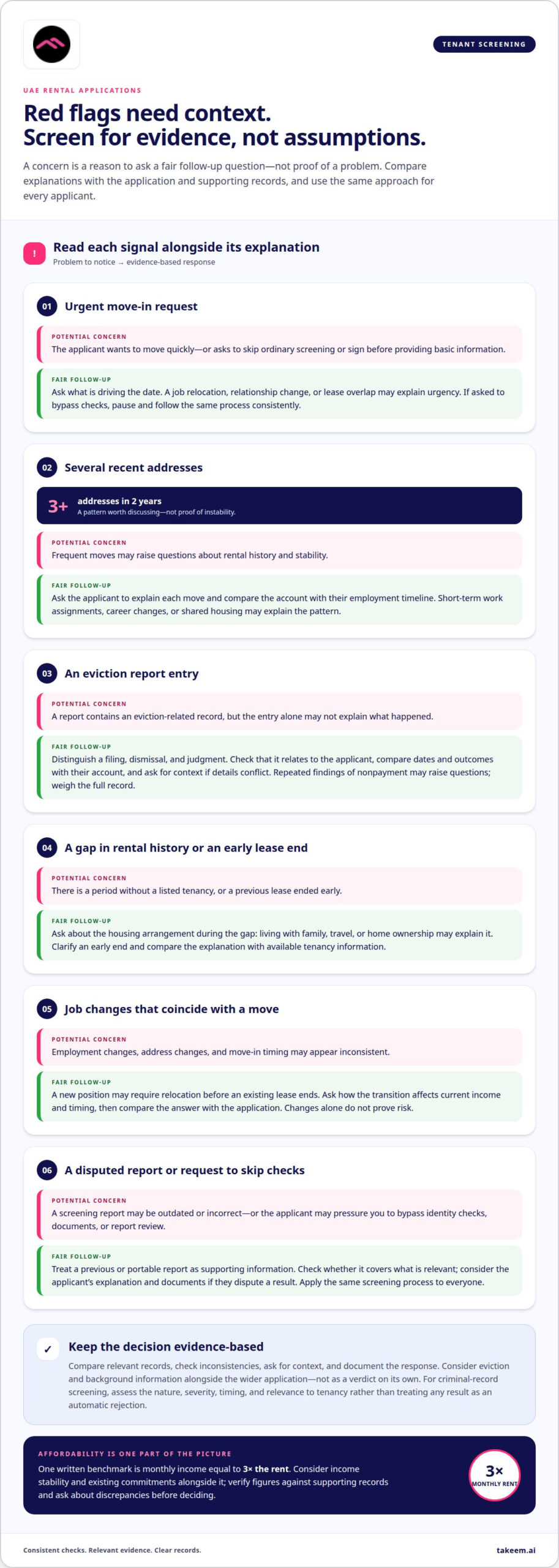
A prospective tenant seeking an urgent move-in may have a practical reason, such as a job relocation, relationship change, or lease overlap. Ask what is driving the requested date and whether it fits the applicant’s stated circumstances. A request to skip ordinary screening or sign before providing basic information calls for a pause and consistent follow-up, not an instant conclusion.
Frequent relocations call for context, but do not prove instability. Three or more addresses in two years may be worth discussing, though short-term work assignments, career changes, or shared housing could explain the pattern. Ask the applicant to explain each move, then compare the account with their employment timeline. Document the explanation and assess it using the same criteria as for other applicants.
Review eviction information by distinguishing a filing from its outcome. A dismissed filing does not mean the same thing as a judgment, while repeated findings of nonpayment may raise questions about rental reliability. Check that the report relates to the applicant and ask for context if dates or outcomes appear inconsistent. Consider the record alongside the wider application rather than treating one entry as decisive.
Gaps in rental history may reflect living with family, travelling, or owning a home between tenancies. Ask about the applicant’s housing arrangement during the gap and record the response. If a previous lease ended early, clarify whether this followed a fixed-term arrangement, a change in family needs, or a dispute. Assess the explanation against the tenancy information available.
Job changes can also explain address changes or an urgent move-in request. For example, a new position may require an applicant to relocate before an existing lease ends. Ask how the transition affects current income and timing, then compare the answer with the application. Several changes do not prove risk by themselves; contradictions or pressure to bypass the usual process deserve closer review.
3. How Should You Use Eviction Reports and a Background Check?
Treat an eviction report as a record to interpret, not a verdict. Check whether the entry describes a filing, dismissal, or judgment, then compare its dates with the applicant’s account. A dismissed filing from years ago differs from repeated judgments for nonpayment. If details appear inconsistent, ask the applicant for context and consider the response alongside other relevant records.
Criminal-record screening calls for an individualized assessment. Consider the nature, severity, and timing of the conduct, and its connection to tenancy, rather than treating any result as an automatic rejection. In the UAE, use consistent criteria focused on relevant tenancy information, such as verified ability to pay and rental records. Avoid basing a decision on irrelevant personal characteristics, and document your reasons.
A prospective tenant may provide a previous or portable screening report. Treat it as supporting information and check whether it covers what is relevant to your screening process. Reports may contain outdated or incorrect entries. If an applicant disputes a result, consider their explanation and supporting documents before relying on it. Weigh a credit report or background result alongside the wider application, not in isolation.
Pressure to bypass screening or lease procedures is a reason to pause. Use the same process for every applicant, even when move-in timing is urgent or a co-signer is offered. Requests to skip identity checks, documentation, or report review call for clarification. They should not replace evidence-based screening or consistent decision-making.
For UAE rental screening, apply the same documented criteria to each applicant and focus on information relevant to the tenancy. Consider income evidence, rental history, and report accuracy, while handling personal documents responsibly. Do not assume that a particular criminal or credit entry automatically determines eligibility. A fair, consistent review weighs the context, relevance, and reliability of each record before you decide.
4. Applicant transparency
Transparency is more than a complete form. It also means the prospective tenant can explain information clearly and consistently. Compare the application with the applicant’s employment timeline, rental history, and screening report. If an address is missing or a move-out date differs, ask a focused question and record the response. A direct explanation can help distinguish an oversight from a pattern that needs closer review.
For incomplete or inconsistent applications, identify the exact gap, request clarification, and compare the answer with supporting records. Give every applicant the same opportunity to resolve missing details, then document anything that remains unexplained. A blank employment field, for example, may be a form error; repeated omissions across income and rental history warrant closer consideration.
Pay attention to how an applicant responds to reasonable follow-up. Promptly supplying a missing document or correcting an error supports transparency. Changing explanations about an eviction, employment dates, or a previous tenancy deserve further review. A response is not proof of misconduct, so weigh it alongside the report and other relevant information.
A credit check can raise questions, but it does not explain the full financial picture. Ask how the applicant’s current circumstances relate to the report, then consider payment history and verified income together. For example, a low score following a recent period of financial difficulty calls for different consideration from a report containing unexplained inconsistencies. Keep your assessment focused on evidence relevant to the tenancy.
Set expectations at the outset: explain which records the application requests, how follow-up works, and when applicants can clarify errors. This makes the process more predictable and encourages fuller disclosure. Keeping a clear record of questions, answers, and decisions also helps you apply your criteria consistently. Assess openness through specific, documented responses, not first impressions.
For a clearer payment process after approval, streamline how tenants pay rent.
Takeem: Direct Debit setup for Landlords to digitally accept monthly payments from tenants
Takeem helps landlords accept monthly rent payments digitally through Direct Debit setup. Once screening is complete and a tenancy begins, this provides a structured way to collect recurring payments without changing how carefully you assess applicants.
For landlords seeking support beyond payment collection, Takeem also offers a Landlord Rental Guarantee, including an option for property investors with large portfolios. The services address different needs: Direct Debit setup supports digital rent collection, while the rental guarantee is a separate option for landlords seeking rental protection.
Choose the arrangement that fits your rental operations and support needs. Contact Takeem to discuss its landlord payment and rental guarantee options.
Make your next rental decision with a clear process
Use a consistent, documented approach to turn application details into a reasoned decision. When questions arise, separate what you can verify from what needs clarification, and base the final decision on relevant evidence. This makes the red flags to look for in tenant applications easier to assess without letting urgency or assumptions take over.
After choosing a tenant, consider how you want to manage the tenancy’s financial risks and payment process. Takeem offers a Landlord Rental Guarantee, a Rental Guarantee for Property Investors with Large property Portfolios, and a Landlord Rental Guarantee that Agents can sell for healthy commissions. These options address rental protection needs, while Direct Debit setup helps landlords collect monthly tenant payments digitally.
Explore the option that fits your rental needs and contact Takeem to discuss rental guarantee or payment options. A thoughtful screening process is a strong start; choose the right next step to support your tenancy with confidence.
Frequently Asked Questions
What about a tenant’s credit score?
A credit score is one indicator, not a complete measure of rental reliability. Consider what lies behind it: a short credit history, high balances, or a recent payment issue can each have different implications. For example, compare the report with current income evidence and the applicant’s explanation. Focus on whether the overall financial picture supports the tenancy, not on one score in isolation.
Are Frequent Moves a Red Flag for Landlords?
Frequent moves may warrant questions, but they do not automatically indicate a risky tenant. A prospective tenant may have relocated for a fixed-term work assignment, changed household needs, or moved between shared homes. Ask for a brief reason for each move and compare the dates with employment and rental records. Look for unexplained contradictions, not simply a high number of addresses.
How Can Rental History and a Current Landlord Reveal Warning Signs?
A current or previous landlord can provide useful context about how a tenant handled day-to-day responsibilities. Ask neutral questions about communication, lease compliance, and any unresolved concerns. A specific example, such as repeated delays responding to requests for access for repairs, is more informative than a general opinion. Consider the reference alongside documented tenancy information rather than relying on one person’s impression.
How Do Income Verification and Employment Verification Help?
Income and employment checks help establish whether an application reflects a workable, current financial situation. Consider how often income arrives and whether the timing aligns with rent obligations. Commission-based earnings, for example, may vary, so one high-income month may not represent the usual pattern. Compare available records with the applicant’s stated role and income, then clarify material differences before deciding.
How Do You Spot Income and Employment Fraud?
Look for inconsistencies across separate documents, such as different employer names or conflicting salary details. A polished document can still contain information that does not match the rest of the application. For example, compare the stated pay period with the dates on earnings records. If a detail is unclear, ask the applicant to explain it and assess the response against the other evidence.
How Should You Use Eviction Reports and a Background Check?
Use reports as prompts for careful review, not as automatic grounds for a decision. First, confirm that the record belongs to the applicant and understand the result. Then consider its relevance to the tenancy and whether other information supports or conflicts with it. If the applicant identifies an error, pause before relying on the entry and allow them to provide context or supporting documents.