

What if a tenant passes every check but struggles to pay rent months later? In the UAE, tenant screening vs rent guarantee is not an either-or choice. Screening helps you assess risk before signing, while a rental guarantee is designed to protect rental income if non-payment occurs under its terms.
Thorough checks support a consistent, fair decision, but they can’t predict every change in a tenant’s circumstances. Since April 2026, the Etihad Credit Bureau’s Tenant Screening service has allowed landlords to request a prospective tenant’s credit score with the tenant’s consent through UAE PASS. That score offers useful insight, not a promise of future payment.
This 2026 checklist explains what screening can and can’t tell you, and how to weigh additional income protection for your UAE property. You’ll compare practical checks with the role of a rental guarantee, then consider how Takeem’s guarantee, emergency maintenance coverage and separate Direct Debit rent collection may fit into your approach. The goal is to make a clear decision based on your property’s risks, not to choose between prevention and protection as if they were substitutes.
Key Takeaways
- Set written, relevant criteria and apply them consistently. Keep identity, rental history, references and ability-to-pay evidence distinct.
- Understand the difference in tenant screening vs rent guarantee: screening informs your decision, while a guarantee offers an additional form of rental income protection.
- Use the checklist to identify which risks your screening process can address and where uncertainty remains for your property.
- Record your applicant assessment separately from any rental guarantee application or eligibility decision.
- Explore how Takeem’s rental guarantee, emergency maintenance coverage and separate Direct Debit rent collection can support your approach.
Tenant screening vs. rent guarantee: what risk does each address?
As a UAE landlord, you can assess an applicant before agreeing to a tenancy, protect rental income if payment problems arise later, or use both approaches. Tenant screening gathers relevant information before a tenancy to support a consistent rental decision. A rent guarantee is a separate service intended to protect rental income under its terms. One informs your choice; the other may offer protection if a covered risk occurs.
This distinction matters because an approval reflects information available at a particular time. Employment, income and personal circumstances can change after move-in. Even a careful assessment can’t foresee every later disruption, so treat screening as a decision-making tool, not a promise of future payment or a trouble-free tenancy.
What does tenant screening tell a landlord?
Screening helps you review relevant information, such as identity, rental history, references and evidence of ability to pay. The purpose of tenant screening is to inform selection through a repeatable process. In the UAE, the Etihad Credit Bureau’s Tenant Screening service, launched in April 2026, lets landlords request a prospective tenant’s credit score with explicit consent through UAE PASS. It provides a score, not a full credit report.
Compare evidence against criteria you apply consistently. An income record is evidence to assess; a guess based on someone’s name, nationality or appearance is an assumption. Neither a credit score nor a reference predicts every future event. A tenant may face hardship after approval, even when the information available supported a reasonable decision.
What does a rent guarantee address?
A rent guarantee focuses on income protection, not on deciding whether an applicant is suitable. It is intended to help protect rental income in circumstances covered by the service. The specific protection depends on the terms, including eligibility, exclusions, duration and the claims process. Review those details before including a guarantee in your property’s risk plan.
Takeem’s rental guarantee serves landlords and property investors across the UAE and includes emergency property maintenance coverage. That maintenance component is an additional feature, distinct from screening and income protection itself. Digital monthly rent collection through Direct Debit is another practical feature, but collecting rent digitally does not assess an applicant or protect against non-payment.
Screening assesses the applicant before the tenancy; a rent guarantee is a separate layer intended to protect income if a covered payment risk arises afterward. In practice, the approaches address different questions:
- Before approval: Does the available, relevant information support proceeding with this applicant?
- After approval: What income protection applies if payment problems occur under the service terms?
- Across both: Which risks remain outside the information reviewed or the protection provided?
Considering both stages helps you avoid treating a strong application as certainty. A consistent screening process supports a fair, evidence-based choice, while a suitable income-protection layer can address a different exposure. Neither removes every risk, but together they can support a more considered rental protection decision.
How to screen tenants consistently across the UAE
A repeatable process helps you compare applications using relevant evidence instead of instinct. Set your criteria before reviewing applicants, then follow the same sequence for each person. This makes decisions easier to explain and supports a consistent process across your rental properties.
Which applicant details should landlords assess?
Organise the review by information type. Request only details that help assess the proposed tenancy, and make the same requests of each applicant. Separate identity information from rental history, references and ability-to-pay evidence so that one strong or weak document doesn’t determine the whole decision by default.
- Identity: Check that the applicant’s identifying details correspond across the information provided.
- Rental history: Review relevant past tenancy information where available, noting gaps or matters that need clarification.
- References: Consider what a previous landlord or other appropriate reference can directly speak to. Don’t treat an opinion as proof of every aspect of a tenancy.
- Ability to pay: Review suitable evidence, such as income documentation, in relation to the rent and your written criteria. One document is a snapshot, not a complete forecast.
Evidence may be incomplete or come in different formats. Give applicants a consistent opportunity to provide relevant clarification, and record what informed your assessment. Don’t fill gaps with assumptions about a person’s background or circumstances.
How can landlords keep the process fair and documented?
Write criteria that relate to the property and tenancy, such as whether the available ability-to-pay evidence meets your stated standard. Apply those criteria in the same order to each application. If you make an exception or reach a different conclusion, record the specific evidence and reason rather than relying on a general impression.
A practical workflow is to:
- Define the criteria and documents needed before advertising or reviewing applications.
- Assess identity, rental history, references and ability-to-pay evidence separately.
- Note missing information, clarifications received and the reason for the final decision.
- Keep applicant records securely, restrict access to people who need them for the assessment, and avoid collecting information without a clear purpose.
UAE tenancy administration and data-handling requirements can depend on the relevant jurisdiction and on how information is collected or used. Don’t assume a process used for one emirate automatically applies throughout the country. Before adopting a checklist, verify current requirements for the property’s location and your screening process, including how applicant information should be handled and retained.
A written record also helps keep applicant selection separate from any later protection decision. In the tenant screening vs rent guarantee comparison, screening documents why you assessed an applicant in a particular way; a guarantee application has its own eligibility criteria and terms. If you’re considering a separate income-protection layer, explore Takeem’s rental guarantee for landlords and property investors across the UAE.
Tenant screening vs. rent guarantee: compare protection, limits, and fit
These approaches address different stages of rental risk. Screening helps you decide whether to proceed with an applicant; a rent guarantee may help protect income if a covered payment problem occurs. There is no universal winner. Identify the gap you need to manage, then understand what each approach can realistically do.
| Comparison point | Tenant screening | Rent guarantee |
|---|---|---|
| Timing | Before agreeing to a tenancy, while assessing an applicant. | Relevant under the service terms if a covered issue arises during the applicable period. |
| Purpose | Inform a rental decision using relevant applicant information. | Provide a separate layer of rental income protection. |
| Information or basis | Application details and supporting evidence, such as identity, rental history, references and ability-to-pay information. | Eligibility assessment and the guarantee’s written terms, including covered circumstances. |
| Key limitation | A decision input, not a promise of future payment or tenancy outcomes. | Protection is not universal. Eligibility, exclusions, duration and claims requirements depend on the service terms. |
The comparison shows why neither approach should be mistaken for the other. A well-supported applicant assessment can help you make a considered choice, but circumstances may change after move-in. A guarantee, in turn, doesn’t decide whether an applicant is a suitable match. Its value depends on whether the property and situation meet the eligibility requirements and whether the event falls within its cover.
When is stronger screening the immediate priority?
Start by strengthening screening if your criteria are unclear, applicants receive different requests, or decisions rely heavily on informal impressions. Written, property-relevant criteria and a record of the evidence considered make decisions more consistent and easier to explain. This improves the process, not the certainty of the outcome. Screening can’t remove every risk of non-payment, damage or tenancy difficulty.
When might a rent guarantee add another layer?
Consider a guarantee when maintaining rental income is a priority and you want protection beyond the information available at application stage. Compare its eligibility, exclusions, duration and claims process with your needs. Don’t assume every missed payment or tenancy issue is covered. Screening and income protection can work together: one informs selection, while the other may respond to specified risks after approval.
For landlords weighing that additional layer, explore rental income protection with Takeem. Takeem’s rental guarantee is available to landlords and property investors across the UAE. Compare its terms with the risks you want to address, and keep the guarantee decision distinct from your applicant assessment.
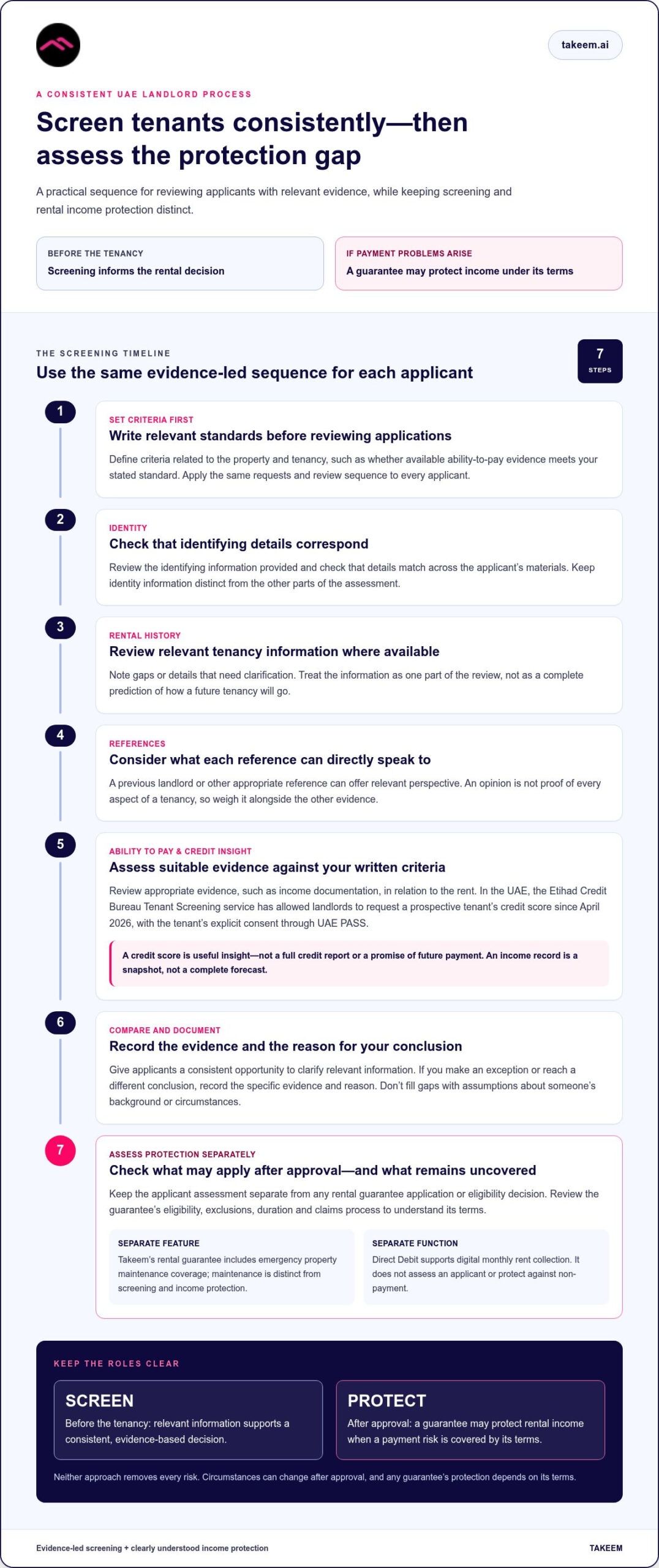
UAE landlord checklist: make screening and income protection work together
A reliable rental protection process has two distinct records: one explains how you assessed the applicant, and the other captures any separate decision about income protection. Keep both tied to the property and tenancy. This is useful when you rent in more than one emirate, where documentation and administrative processes may differ. Verify current requirements for the property’s location rather than assuming one checklist applies everywhere.
Before approving an applicant
Set your criteria in writing before reviewing applications. Specify the information needed to assess identity, rental history, references and ability to pay, and request it consistently. Then check that each application is complete enough to assess against those criteria. If something is missing, record the gap and any relevant clarification instead of filling it with an assumption.
- Confirm relevance: Collect only information that supports the stated rental decision.
- Keep evidence distinct: Note which documents, references or other information informed each part of the assessment.
- Record the rationale: Explain how the evidence relates to your criteria and why you reached your decision.
- Protect applicant information: Store records securely, limit access appropriately and verify current UAE requirements for handling personal data.
Keep the record factual and concise. For example, note whether the evidence provided met a written ability-to-pay criterion, rather than describing an applicant with a broad personal judgement. A clear rationale supports consistency if you review the decision later or compare applications for another property.
Before relying on a rent guarantee
Assess income protection separately from tenant selection. Read the service terms and understand who or what is eligible, which circumstances are covered, what exclusions apply, the relevant duration and what steps a claim requires. Don’t treat a guarantee as automatic or unconditional. Protection depends on the terms and on whether the circumstances meet them.
- Match protection to the property: Consider how important predictable rental income is to your plans and what financial exposure you want to address.
- Map the process: Understand how the guarantee fits with the tenancy documentation, payment schedule and your records of rent due and received.
- Separate decisions: Keep applicant screening notes distinct from any guarantee application or eligibility decision.
- Review operational features: Digital monthly rent collection through Direct Debit can support payment administration, but it’s separate from screening and doesn’t itself provide income protection.
This practical tenant screening vs rent guarantee checklist helps you identify what your decision process covers and where an additional protection layer may fit. Takeem’s rental guarantee serves landlords and property investors across the UAE and includes emergency property maintenance coverage. Explore Takeem’s rental income protection as you build an approach that pairs consistent applicant assessment with a clear understanding of service terms.
How Takeem adds rental income protection beyond screening
A sound applicant review helps you make a consistent tenancy decision, but it can’t tell you how a tenant’s circumstances may change later. Takeem’s rental guarantee gives landlords and property investors across the UAE an additional rental income protection option, not a substitute for screening. The two can fit at different points in your process: assess the applicant, make your tenancy decision, then consider whether a guarantee suits your remaining income risk.
Takeem’s service also includes emergency property maintenance coverage. This is a practical component of the rental guarantee, not a screening feature. Digital monthly rent collection through Direct Debit is another operational option. It supports rent collection but doesn’t assess an applicant or replace income protection.
How does Takeem fit after tenant screening?
Keep the steps distinct. Review the application against your written criteria, document the evidence behind your tenancy decision, then consider whether additional income protection suits the property and your priorities. A guarantee’s eligibility and protection depend on the applicable service terms and covered circumstances. Don’t treat it as automatic or assume every situation is included.
For a closer look at how this type of protection fits a landlord’s wider approach, see Takeem’s guide to landlord rental guarantees in the UAE. Use the details to inform your decision while keeping the applicant assessment and guarantee decision separate.
What practical steps can landlords take next?
Turn your screening process into a short, repeatable record. Confirm the application is complete, review the same relevant categories for each applicant, note the evidence and rationale, and store personal information carefully. Then identify the main income risk that remains for the property. Is your priority smoother rent collection, protection if a covered payment issue occurs, or coordinating both?
- Review your criteria: Make sure they’re written, relevant to the tenancy and consistently applied.
- Identify the gap: Note what your applicant review can’t predict once the tenancy begins.
- Understand the terms: Consider eligibility, covered circumstances, exclusions, duration and claim steps before relying on any protection.
- Separate collection from protection: Direct Debit can support monthly rent collection, while the rental guarantee addresses income protection under its terms.
This is the practical distinction behind tenant screening vs rent guarantee: one informs whom you approve; the other may add protection after that decision, subject to its terms. If you’re ready to consider that additional layer, explore Takeem’s rental guarantee service and its digital rent collection approach.
Build a rental protection plan that fits your next tenancy
Decide where uncertainty matters most for your property. Set a clear standard for applicant decisions, then consider whether the remaining income risk calls for additional protection. This turns tenant screening vs rent guarantee into a practical planning choice, not a contest between interchangeable tools.
As you put that approach into practice, keep your screening records, tenancy administration and protection decisions organised. Revisit the plan when your property or rental priorities change, and understand the applicable service terms before relying on any protection. A considered process can help you make confident decisions without assuming that any one measure removes every risk.
Takeem serves landlords and property investors across the UAE with a rental guarantee that includes emergency property maintenance coverage, alongside a separate Direct Debit setup for digital monthly rent collection. Explore Takeem’s rental guarantee service to consider how these options could fit your rental approach. With clear criteria and protection chosen for your needs, you can move forward with greater confidence.
Frequently Asked Questions
Is tenant screening enough to protect rental income in the UAE?
No. Tenant screening vs rent guarantee compares assessing an applicant with considering protection if a later payment problem occurs. Verified income at application time, for example, can support a decision but can’t show whether the tenant’s circumstances will change months later. If you need another layer, compare service terms carefully and consider how delayed rent could affect your property finances.
Can a rent guarantee replace tenant screening?
No. A rent guarantee doesn’t replace an applicant review. Screening helps you decide whether to enter a tenancy; a guarantee has separate eligibility conditions and terms. Keep those decisions distinct. Choosing a tenant doesn’t automatically mean the property qualifies for protection, and a guarantee application doesn’t establish whether the applicant meets your rental criteria. Review both processes before finalising your arrangements.
What should landlords check when screening a tenant in the UAE?
Review identifying and tenancy information, relevant rental history, appropriate references and evidence that helps you assess ability to pay. Consider what each item demonstrates: a reference may speak to a past tenancy, while income evidence offers a limited view of finances. Keep notes tied to written criteria, and avoid collecting details without a clear assessment purpose. Verify current UAE requirements for tenancy documents and personal information handling.
Does tenant screening guarantee that rent will be paid on time?
No. Screening reflects information available during the application, not every later change in a tenant’s life, so it can’t guarantee timely rent payments. If a payment is late, compare the amount and due date against your records and tenancy documents. Keep communications and payment records organised. Any additional protection depends on the service terms and whether the situation meets its conditions.
Is a rent guarantee the same as landlord insurance?
Not necessarily. The terms may refer to different arrangements, and a name alone doesn’t establish what a contract or policy covers. A rent guarantee may focus on rental income protection, while an insurance policy may address other defined risks. Before deciding, check the wording for covered events, exclusions, eligibility and claim requirements. Don’t assume one arrangement includes the protections of another.
Can landlords use tenant screening and a rent guarantee together?
Yes. They can form separate parts of a landlord’s approach, provided the property and situation meet the guarantee’s terms. To keep the processes clear, file applicant assessment notes separately from guarantee documents, then keep tenancy and rent-payment records organised as well. This makes it easier to see which decision each record supports if you need to review it later.
What happens if a tenant passes screening but later misses rent?
Passing screening doesn’t prevent a later missed payment. Check the tenancy records and payment history, retain relevant communications, and follow the applicable procedures for the property’s jurisdiction. If you have a rental guarantee, review its terms and required documentation before relying on it, since eligibility and response depend on the circumstances. Verify current UAE requirements before taking formal action; don’t assume the same process applies everywhere.