
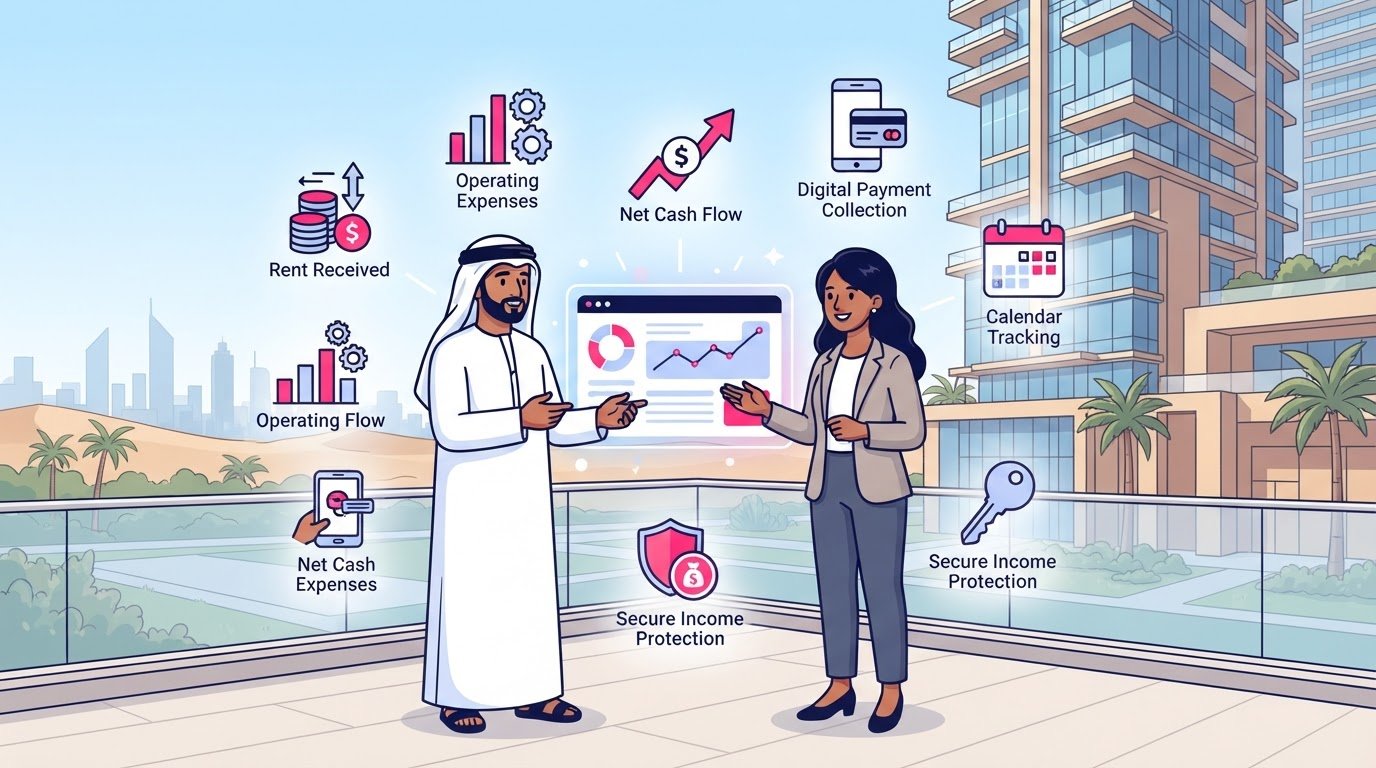
When rent arrives late or property costs rise, a record of rent due alone won’t show whether your portfolio is on track. The right landlord financial tools UAE landlords use should make rent received, expenses and net cash flow easier to monitor, while reducing the effort of payment administration.
It’s understandable to look for one platform that handles everything. In practice, a clear setup connects tools with different roles: digital collection supports monthly rent payments, while rental income protection addresses the risk of tenant non-payment. These functions can work together, but they aren’t interchangeable.
This 2026 guide explains the main financial tools available to UAE landlords and how to choose a practical combination for your property count and priorities. You’ll learn what to look for in cash-flow tracking, digital rent collection and income protection, and how Takeem’s Direct Debit setup and Rental Guarantee fit into that picture. The aim is a clearer view of rental performance and a more organised approach to payments, without treating one service as an all-purpose financial platform.
Key Takeaways
- See how landlord financial tools Dubai can support clear rental records, digital payments and income protection, without treating them as one all-purpose platform.
- Distinguish gross rent, operating expenses and net cash flow to assess a property’s financial performance more clearly.
- Compare spreadsheets and accounting tools, digital rent collection and rental income protection by the job each performs.
- Use a practical workflow to organise property records, select a collection method and review results across one property or a portfolio.
- Understand how Takeem’s Direct Debit setup and Rental Guarantee address separate parts of rental finance administration for landlords and investors across the UAE.
Role of Landlord Financial Tools in the UAE Market
Landlord financial tools help owners collect, track and protect rental income. They bring recurring tasks into a more consistent process: confirming whether rent arrived, recording property expenses and assessing what remains after costs. For a landlord with one property, clear records make monthly reviews easier. Across a portfolio, consistent categories help show which properties need closer attention.
The phrase landlord financial tools Dubai can refer to several kinds of support, not one all-purpose platform. Payment collection handles how rent is received. Cash-flow tracking organises income and expenses for review. Rental income protection addresses the financial risk of a tenant not paying. Each function solves a different problem.
Financial tools also have boundaries. They are not automatically property-management services, tenant finance or listing platforms. A listing platform helps market a property; tenant finance concerns how a tenant pays or funds rent. Neither necessarily provides an owner with organised financial records or protection against non-payment. Landlords can combine separate tools to cover distinct needs instead of expecting one system to do everything.
Regulatory context matters too. Rental frameworks and processes can vary across the UAE, so landlords should understand the rules that apply to each tenancy. The Real Estate Regulatory Agency (RERA) is one part of the broader regulatory landscape. A financial record-keeping process can help landlords stay organised, but it doesn’t replace understanding the requirements that apply to a specific tenancy.
Which rental finance tasks can digital tools support?
Digital workflows can reduce scattered notes and manual follow-ups by keeping key financial details in a consistent place. Depending on the tools used, landlords can record rent received, log operating expenses and review payment status against expected rent dates. For example, a pending payment status can prompt a follow-up, while an expense entry helps explain why net cash flow changed that month.
- Collection: Accept rent through a digital payment workflow rather than relying only on cheque-based administration.
- Tracking: Organise rent and expense records by property and period.
- Review: Compare expected payments with recorded receipts to identify items needing attention.
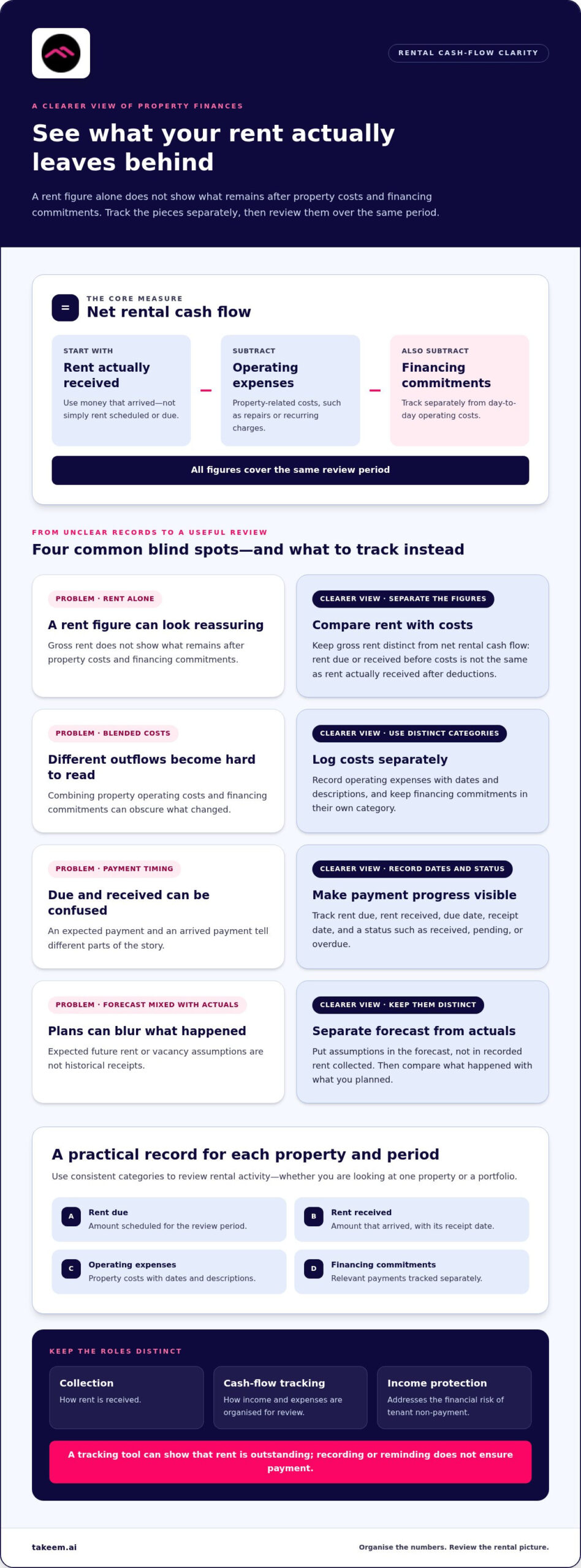
These tools support visibility and administration. A tracking tool can show that rent is outstanding, but recording or reminding doesn’t ensure payment. Collection and income protection are separate functions.
Financial tools versus property management
Financial tools focus on the money side of renting: receiving payments, organising financial information or protecting rental income. Property management covers broader operational work associated with running a property. The distinction is useful when comparing services: a collection method or financial record system should not be assumed to handle operational responsibilities.
Featured-snippet distinction: Landlord financial tools help collect, track or protect rental income; property management handles broader property operations.
For a practical setup, identify the gap first. If payments are hard to follow, focus on collection and payment records. If expenses are unclear, standardise tracking. If non-payment is the concern, consider income protection as a separate layer. Combining functions can make rental finances easier to monitor without confusing administration with protection.
How rental cash-flow tools reveal the health of a property
A rent figure on its own can look reassuring, but it doesn’t show what remains after property costs and financing commitments. Cash-flow tracking brings those figures together so landlords can see what came in, what went out and what is still due. It’s a practical way to review a property’s financial activity, not a full investment-yield calculation.
Net rental cash flow is rent actually received minus operating expenses and financing commitments over the same period. Gross rent is the rent due or received before costs are deducted. Operating expenses are property-related costs, such as repairs or recurring charges. Track financing commitments separately so they aren’t mixed up with day-to-day operating costs.
Which figures should landlords monitor?
Use separate categories for rent due, rent received, operating expenses and financing commitments. Record dates as well as amounts: the due date shows when payment was expected, while the receipt date shows when funds arrived. Add a clear status, such as received, pending or overdue, to distinguish timing delays from missing records.
- Rent due: The amount scheduled for the review period.
- Rent received: The amount that has actually arrived, with its receipt date.
- Operating expenses: Costs paid or incurred for the property, with dates and descriptions.
- Financing commitments: Relevant payments tracked separately from operating costs.
Keep forecasts distinct from actuals. If you expect a property to be vacant for part of a future period, record that assumption in the forecast, not as rent collected. This keeps historical results factual and makes it easier to compare what happened with what you planned.
Illustrative example, hypothetical figures only: Suppose a property has د.إ 8,000 in rent received during a month, د.إ 1,200 in operating expenses and a د.إ 2,500 financing commitment. Its net cash flow for that period is د.إ 4,300. If rent was due earlier but arrived later, record both dates so the monthly view reflects timing as well as the final amount.
How to use a cash-flow review without overcomplicating it
Set a consistent monthly review and use the same categories for every property. Start by matching recorded receipts against rent due, then enter expenses and financing commitments. Finally, compare actual figures with the previous period or your forecast. A simple, repeatable process is more useful than a complicated dashboard that’s difficult to keep current.
Review each property before combining figures into a portfolio total. A portfolio summary gives an overall view, but property-level records help explain differences. One property may have higher expenses, while another may show a payment delay. Combining figures too early can hide those details and make comparisons less useful.
Update records when payments or costs occur, then review actual receipts and expenses regularly. Tracking can support informed decisions, but it doesn’t promise improved returns or replace tailored financial advice. For landlords considering a separate layer for payment administration or income protection, digital rent collection and rental income protection address those needs alongside cash-flow tracking.
Compare landlord financial tools by the job they perform
Choosing among landlord financial tools in Dubai is easier when you start with the problem you need to solve. A spreadsheet or accounting tool helps organise financial records. Digital collection supports receiving rent. Rental income protection addresses the risk of non-payment. These functions can complement one another, but they aren’t interchangeable, and no single tool needs to cover every need.
| Function | Benefit | Limitation |
|---|---|---|
| Spreadsheet or accounting tool | Organises rent, expenses and other financial entries for review. | Records depend on accurate, timely data entry; a record alone doesn’t collect rent or protect income. |
| Digital rent collection | Provides a digital workflow for receiving rent and can reduce reliance on cheque-based administration. | Collection handles payment administration, not full cash-flow analysis or protection from non-payment. |
| Rental income protection | Addresses the financial exposure associated with tenant non-payment. | It doesn’t replace payment records, expense tracking or regular cash-flow reviews. |
Cash-flow tracking tools versus digital rent collection
Tracking records and organises figures; digital collection supports the payment process. For example, a landlord might use a spreadsheet to record the rent expected and the date it arrives, while a separate collection setup enables tenants to pay digitally. The landlord can then compare payment information with their records to reconcile receipts. Don’t assume the two tools connect automatically: the workflow may involve entering or checking details separately. Neither function alone ensures rent will be paid.
Match the choice to the bottleneck. If you can’t easily see rent received alongside expenses, improve record-keeping. If manual payment administration takes time, consider a digital collection method. Takeem’s Direct Debit setup supports landlords in digitally accepting monthly tenant payments, while financial records remain a separate part of monitoring property performance.
Income protection and maintenance are different safeguards
Rental income protection is distinct from both recording a payment and processing it. It addresses income uncertainty rather than documenting whether rent arrived. Takeem’s Rental Guarantee protects landlords against tenant non-payment, but landlords still need clear records to review receipts and expenses. Protection and tracking answer different questions.
Emergency property maintenance is another distinct feature. It can support property upkeep, but it isn’t a cash-flow tool and doesn’t replace financial records or payment collection. Takeem includes emergency property maintenance as part of its Rental Guarantee service. For a closer look at how those elements relate, explore this guide to rental guarantees with maintenance.
A practical setup may combine a record-keeping method, a collection workflow and income protection, with each assigned a clear role. Prioritise the gap that causes the most friction, then add other functions where they address a distinct need. That keeps the system understandable and avoids expecting a payment or protection service to do the work of an accounting tool.
Build a practical financial workflow for one property or a portfolio
A reliable workflow makes financial administration repeatable. Start with the records you need, choose a suitable way to collect rent, then review actual activity on a regular schedule. The setup can stay simple for one property and expand as your portfolio grows. Assign each step a clear purpose rather than expecting one tool to handle every financial task.
- Map the properties. Give each property a distinct record and note its tenancy periods, rent due dates and relevant payment details. This creates a clear starting point for monitoring income and expenses.
- Standardise the records. Use the same categories across properties, such as rent due, rent received, operating expenses and financing commitments. Record dates and payment status consistently, too.
- Choose a collection method. Decide how tenants will pay and how you’ll record each receipt. A digital option, such as Direct Debit setup, can support monthly rent collection. Keep the resulting payment information available for reconciliation.
- Review the results. Compare expected rent with actual receipts, enter expenses and examine property-level cash flow before drawing conclusions about the whole portfolio.
Separate one-time setup from recurring administration. Initial setup means creating property records, choosing consistent categories and establishing the collection workflow. Recurring work means recording receipts and expenses, checking payment status and reviewing results. Keeping these routines distinct helps prevent an organised setup from becoming outdated through inconsistent follow-through.
A repeatable monthly review for rental finances
At each monthly review, compare rent due with rent received and note timing differences rather than treating a late receipt as if it arrived on the due date. Categorise actual operating expenses the same way each month, then compare the current period with earlier ones. One unusual month can prompt a closer look, but it isn’t enough on its own to establish a lasting trend.
Keep forecasts separate from actual records. If you expect a vacancy or a future cost, label it as an assumption; don’t enter it as collected rent or an expense already paid. This gives you a dependable record of what happened while keeping planning information useful.
When a landlord has several properties
Use shared reporting categories but preserve an individual record for every property. First review each property’s income, expenses and payment timing. Then interpret the combined portfolio figures. This helps identify whether an overall change comes from one property or appears across several, and supports meaningful comparisons without losing detail. For deeper analysis, see this property portfolio rental income guide.
For landlords looking to make monthly collection part of the workflow, this guide to setting up Direct Debit for landlords covers the setup topic. Landlords exploring landlord financial tools Dubai can also consider how digital collection and rental income protection fit alongside their own records. Explore Takeem’s Direct Debit and Rental Guarantee services as potential parts of that setup.
How Takeem connects rental income protection with digital collection
Once the roles of tracking, collection and income protection are clear, landlords can decide which functions their setup needs. Takeem serves landlords and property investors across the UAE with rental guarantee services and Direct Debit setup for digital monthly rent collection. These offerings address related but distinct parts of rental finance administration: one protects against tenant non-payment, while the other supports the process of accepting monthly payments.
Rental guarantee and digital monthly collection
A rental guarantee is relevant when a landlord wants to address the financial risk of tenant non-payment. Direct Debit setup gives landlords a digital method to accept monthly tenant payments. Neither replaces the landlord’s own financial records. Continue recording rent due, receipts and expenses so you can review actual cash flow, whether rent is collected digitally or through another agreed method.
Used together, these functions can contribute to a broader financial workflow: digital collection supports payment administration, rental guarantee addresses income exposure, and separate records provide visibility into what was received and spent. Keep the roles distinct. A collection process doesn’t by itself provide income protection, and a rental guarantee isn’t a general-purpose accounting system. For a deeper explanation of how rental guarantees work, see this UAE rental guarantee guide.
Takeem’s Rental Guarantee service also includes emergency property maintenance. This property upkeep feature is part of the rental guarantee service, not a substitute for payment records, cash-flow reviews or a property-management service. Keeping these distinctions clear helps landlords understand what each part of a financial setup is intended to address.
What landlords can consider as a next step
Start with the issue you most want to address. If rent administration is difficult to follow, consider whether a digital monthly collection method fits your workflow. If income uncertainty is the priority, explore rental guarantee as a separate protection function. If both matter, consider how collection and protection can sit alongside your existing records. The right combination depends on your portfolio and financial priorities.
Landlord financial tools Dubai searches often bring together services that perform very different jobs. Takeem focuses on rental income protection and Direct Debit setup for landlords, not property management or standalone accounting software. You can use your preferred record-keeping method to monitor receipts, expenses and property-level performance.
If you’re ready to explore how digital collection or rental income protection could fit your rental finance workflow, explore Takeem’s landlord solutions.
Set your next rental finance priority
Your next step doesn’t need to be a full system overhaul. Choose one point of friction to address first, such as uncertainty about payment status or a desire to protect rental income. A focused decision makes it easier to see whether a tool is helping and keeps your process manageable as your property needs change.
Think of your setup as something you can refine over time, not a permanent technology decision. The landlord financial tools Dubai landlords choose should fit the way they handle rent and records today, while leaving room to adapt as their priorities or portfolio evolve. Keep the goal practical: make financial decisions with a clearer view of what needs attention.
If you’re ready to explore options for rent collection and income protection, explore Takeem’s landlord solutions. A considered first step can make rental finance administration feel more organised and easier to manage.
Frequently Asked Questions
Can landlords in the UAE collect rent digitally instead of using cheques?
Yes, landlords can use digital methods to accept rent, including monthly Direct Debit when the arrangement is set up for the tenancy. Before changing methods, agree on how payment will be made and keep a record of the arrangement, due dates and receipts. Takeem provides Direct Debit setup for landlords to digitally accept monthly tenant payments. Digital collection changes the payment workflow; it doesn’t remove the need to track what was received.
What financial records should a landlord keep for each rental property?
Keep records that let you trace each transaction to a property and tenancy. A practical file can include the tenancy agreement, rent schedule, payment confirmations, expense invoices and receipts, and notes explaining unusual adjustments or refunds. Record dates and payment references where available. For example, attach a repair invoice to the relevant property record instead of storing it only in a general inbox. Consistent documentation makes later reviews and queries easier to resolve.
How can a landlord track rental cash flow each month?
Use a monthly cut-off date and reconcile the period against bank or payment records, rather than relying on memory. Mark each expected receipt as received, pending or outstanding, then match expenses to invoices or receipts. Compare the month with previous periods, but investigate a change before treating it as a pattern. The phrase landlord financial tools Dubai covers different ways to organise this process, from a simple ledger to accounting software.
Are rental guarantees the same as landlord insurance?
No, don’t assume they provide the same protection. A rental guarantee is designed around rental income risk, while landlord insurance is governed by the specific policy and risks it covers. Their scope, conditions and exclusions can differ. Compare the written terms rather than relying on the product label, and consider whether maintenance is included as a separate service feature. Takeem’s Rental Guarantee addresses tenant non-payment and includes emergency property maintenance.
Can financial tools help landlords manage properties from abroad?
They can make financial oversight more convenient from a distance if the landlord can access payment records and property accounts digitally. For example, a landlord abroad could review recorded receipts and expenses without waiting for paper files to be sent. However, financial tools don’t automatically handle inspections, tenant communication or other operational property-management tasks. Set clear processes for who records transactions and how supporting documents are stored, so remote reviews remain useful.
What should landlords compare before adopting a digital rent collection tool?
Compare how the payment method fits your tenancy schedule and what steps tenants must take to use it. Review any applicable charges, how you’ll identify and reconcile receipts, and what information is available when a payment is delayed or not recorded. Consider how the process will fit your existing records, too. A clear collection workflow should make payment administration easier to follow without being mistaken for income protection or accounting software.