

When dealing with rental arrears, a landlord typically must give a tenant at least 30 days to remedy unpaid rent before pursuing eviction for non-payment. Understanding how to issue a legal notice to a tenant for non-payment starts with that statutory deadline: the notice should identify the unpaid balance and demand payment, and it should be served through official channels or registered mail to help prove delivery.
Unpaid rent can put significant pressure on property owners and managers. A formal notice gives the tenant a defined opportunity to settle the arrears. If the tenant still does not pay after the notice period expires, the landlord may file a formal eviction case with the local Rental Disputes Centre or relevant jurisdiction.
Here at Takeem, we explain what to include in the notice, how to serve it and keep proof, and what the 30-day period means in practice. You’ll also see what steps may follow if the arrears remain unpaid, so you can approach the process with a clear record and a more confident understanding of what comes next.
Key Takeaways
- Make the notice specific by identifying the tenant and property, stating the rent owed and the period it covers, and setting out the payment deadline.
- Keep a clear record of rent due, payments received, and communications so the arrears can be documented if the dispute progresses.
- Organize the tenancy agreement, notice, and supporting records before taking the next step in a rental dispute.
- For landlords seeking a broader approach to rental income risk, Takeem’s Landlord Rental Guarantee may be relevant; it also includes emergency property maintenance as part of the Rental Guarantee.
What happens if a tenant doesn’t pay rent in Dubai?
Address rent arrears with a formal notice, then follow the proper dispute process if the debt remains unpaid. The method of service and proof of delivery both matter.
- First, apply the rules for the property’s emirate. In Dubai, a landlord must give a tenant at least 30 days to remedy rent arrears before pursuing eviction for non-payment, according to UAE Legislation. If the tenant fails to pay after the notice period expires, the landlord may file an eviction case with the Rental Disputes Centre. Abu Dhabi and other emirates have separate tenancy procedures, so Dubai’s notice rule should not be assumed to apply across the UAE. In Abu Dhabi, the period stated in a legal notice runs before judicial procedures can proceed if the obligation remains unfulfilled.
-
Choosing a Formal Notice Service Method
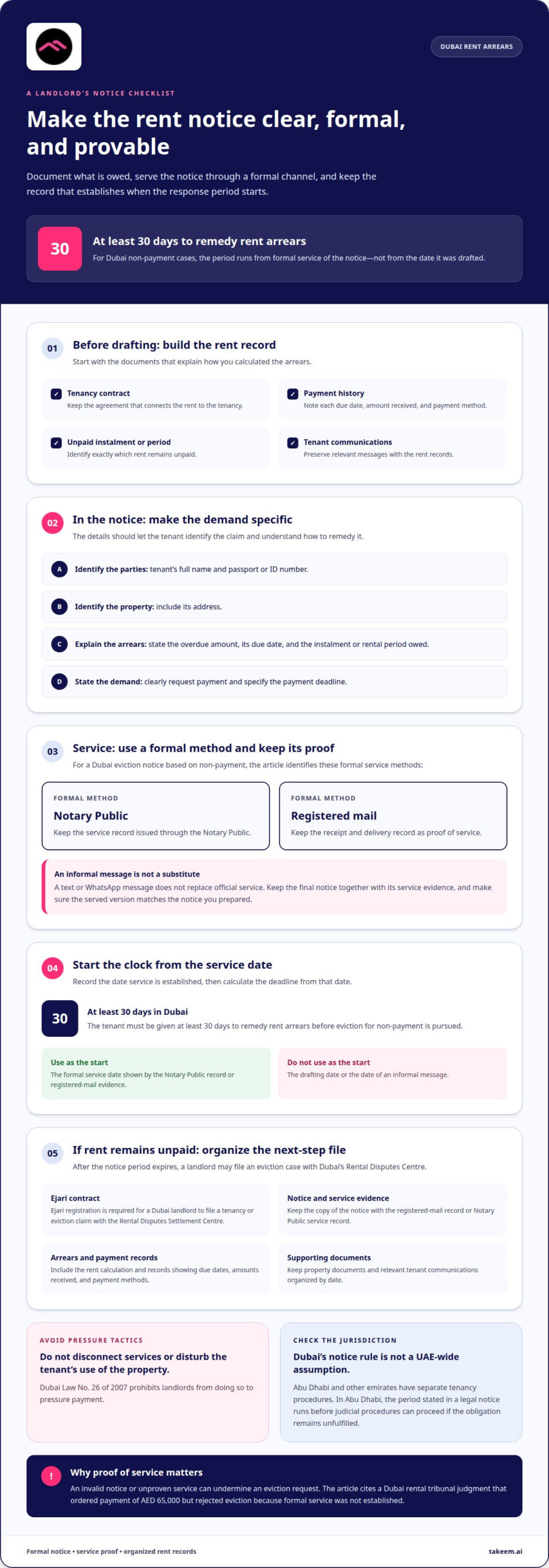
For a Dubai eviction notice based on non-payment, serve it through a Notary Public or registered mail. These methods create a formal delivery record; a text or WhatsApp message is not a substitute for official service. Keep the notice and proof of service together. Check the tenant and property details, and use a method that documents when the notice was served.
-
Proving Service and Starting the Notice Period
Keep the proof of service issued through the Notary Public or the registered-mail delivery record. The 30-day period runs from service of the notice, so record the service date and calculate the deadline from it. Do not treat the date you drafted or sent an informal message as the start date. If delivery cannot be established, the landlord may struggle to prove that the tenant received the required opportunity to remedy the arrears.
- Do not disconnect services or disturb the tenant’s use of the property to pressure payment. Dubai Law No. 26 of 2007 prohibits landlords from doing so. An invalid notice or unproven service can undermine an eviction request; a Dubai rental tribunal judgment ordered payment of AED 65,000 but rejected eviction because formal service was not established. The cost to issue and serve a notice depends on the service method and document handling, with the applicable amount provided after a quote request.
Information to include in a rent-payment notice
Base the notice on clear rent records, accurate tenancy details and a specific payment demand. This helps the tenant understand the arrears and how to remedy the default.
-
Gathering Evidence of Unpaid Rent
Before drafting the notice, gather the tenancy contract and rent-payment records. Note each due date, amount received and payment method, then identify the unpaid instalment or rental period. Keep relevant tenant communications with these records. This evidence shows how you calculated the arrears, particularly if the tenant disputes the balance or leaves before paying.
-
Preparing Rent-Notice Information
Clearly identify both parties and the rented property. State the tenant’s full name, passport or ID number, and property address. Specify the overdue amount, its due date and the instalment or period owed, then state the payment deadline and demand payment. These details connect the amount claimed to the tenancy contract.
-
Allowing Time to Remedy Rent Default
Give the tenant the required opportunity to pay before pursuing eviction for non-payment in Dubai. The landlord must allow at least 30 days to remedy rent arrears, according to UAE Legislation. State the deadline clearly and calculate it from formal service, rather than from the notice’s drafting date. Avoid wording that confuses this rent-default period with notice for another tenancy issue.
- If the tenant leaves without paying, preserve the contract, arrears calculation, payment records and notice evidence. A landlord may pursue unpaid rent through Dubai’s Rental Disputes Centre, or RDC, using the supporting documents for the claim. Organize the records by date so the parties can follow the balance from each due payment to the amount demanded. For future rent collection, a Direct Debit setup for landlords can support digital tenant payments.
How to serve and prove delivery of the notice
Use a formal service method and keep its delivery record. If the dispute reaches Dubai’s Rental Disputes Centre, organized documents help show what was sent and when.
- When considering how to issue a legal notice to a tenant for non-payment, use a Notary Public or registered mail rather than relying on an informal message. Keep the served notice and proof of service together. Confirm that the document served matches the final version, including the tenant’s details, property address, rent claimed and payment demand. Any mismatch can make it harder to connect the delivery evidence to the rent dispute.
- Record the service date and keep the delivery evidence as soon as it is available. When working out how to issue a legal notice to a tenant for non-payment, distinguish the formal service date from the date you drafted the notice. Store the registered-mail receipt or Notary Public service record with the notice. A draft date alone does not prove that the tenant received it.
- Keep tenancy documents ready in case the tenant does not pay and you need to file a claim. Ejari registration is required for a Dubai landlord to file a tenancy or eviction claim with the Rental Disputes Settlement Centre. Relevant records include the Ejari contract, evidence of non-payment, a copy of the notice, property documents and tenant communications. Keep rent records showing due dates, amounts received and payment methods.
- Prepare documents for the RDC in the required form. Documents submitted to the centre must be translated into Arabic and accompanied by a memorandum outlining contract terms and relevant details. The RDC is associated with the Dubai Land Department, but handles rental disputes rather than notice delivery. Certain eviction notices after lease expiry require service through a Notary Public or registered mail 12 months before the scheduled eviction date. That period concerns lease-expiry eviction, not rent arrears.
Notice period and time to resolve non-payment
Track the formal service date, response deadline and next procedural step separately. A clear timeline helps distinguish the tenant’s opportunity to pay from any later rental dispute.
- Start counting from formal service, not from the date you drafted the notice. In Dubai, the tenant has at least 30 days to remedy rent arrears before the landlord pursues eviction for non-payment. Use the service record to identify the deadline, then note it alongside the unpaid instalments. A text or email sent earlier does not replace formal service for this purpose.
- Use the notice period to give the tenant a clear opportunity to settle the arrears. If payment arrives, update the rent ledger with the amount and date received, then calculate any remaining balance against the tenancy agreement. If the tenant pays only part, record it accurately; the outstanding amount remains central to any later claim.
- If the tenant fails to pay after the 30-day period expires, the landlord may file an eviction case with Dubai’s Rental Disputes Centre. Keep the formal notice, evidence of service, contract and payment records ready for filing. The centre’s process may include an amicable settlement stage before the dispute proceeds. A hearing and judgment follow the applicable case process, so keep records organized by date.
- Continue documenting rent due while the case is considered. Filing an eviction claim does not relieve the tenant from paying rent while the claim is considered and until judgment is issued and executed, under Article 31 of Dubai Law No. 26 of 2007. This means the rent ledger should continue beyond the original notice period. If you want to manage rental-income risk alongside formal procedures, explore Takeem’s Landlord Rental Guarantee.
Takeem: Landlord Rental Guarantee
Takeem offers a Landlord Rental Guarantee for landlords seeking a structured way to manage rental-income risk. This can be relevant when arrears make income planning less predictable, alongside the formal notice and dispute steps described above. Takeem also offers a Rental Guarantee for Property Investors with Large property Portfolios. The Rental Guarantee includes emergency property maintenance service, addressing a separate property concern as part of the offering. These options do not replace a correctly served rent notice or the Dubai Rental Disputes Centre process. They support landlords with rental-income planning and property maintenance while managing a tenancy. Contact Takeem to discuss the Landlord Rental Guarantee.
Build a steadier approach to rental risk
Use this tenancy issue as a prompt to strengthen your preparation for future rental cycles. A consistent process for tracking obligations and organizing tenancy records can help you act promptly when a payment concern arises. Knowing how to issue a legal notice to a tenant for non-payment is one part of protecting your position; planning for rental-income uncertainty is another.
Takeem offers a Landlord Rental Guarantee, including an option for property investors with large portfolios. Agents can also sell Takeem’s Landlord Rental Guarantee for healthy commissions. If you’re considering how rental protection could fit your approach, contact Takeem to discuss its rental guarantee. Take the next step with a clearer plan for your property income.
Frequently Asked Questions
When is a landlord entitled to serve an eviction notice to a tenant?
In Dubai, a landlord may pursue eviction for non-payment if rent arrears remain unresolved after the required notice period. Article 25 of Dubai Law No. 26 of 2007, as amended by Law No. 33 of 2008, sets out eviction grounds, including rent default. Before acting, identify the reason for eviction and match it to the relevant legal ground. A notice for unpaid rent is not interchangeable with one for another ground.
Dubai rent apartment not paid, how should I deal with it?
Start by matching the rent ledger with the tenancy agreement and payment records. Write to the tenant about the specific unpaid instalment and keep their response with the account records. If payment does not resolve the issue, follow Dubai’s formal notice process rather than relying on informal messages. Keep the communication focused on the amount due and how to settle it.
What legal recourse do landlords have for unpaid rent in Dubai?
A landlord can bring an unpaid-rent claim to Dubai’s Rental Disputes Centre, including a claim seeking rent recovery and eviction where applicable. Under Decree No. 26 of 2013, parties are referred to mediation before proceeding through the Rental Disputes Settlement Centre. Prepare a clear account of payments and arrears so the dispute can be assessed against the tenancy agreement. The process can address rent recovery even when the tenant has left.
Does the 30-day period start when the legal notice is notarised?
The period starts when the notice is served, not simply when it is notarised. For example, if notarisation happens before delivery, use the documented service date to track the tenant’s deadline. Keep the Notary Public’s record of when service occurred. Notarisation alone does not establish when the tenant received the formal notice.
Does the 30-day period start when the rent cheque bounces?
No. A bounced cheque can help document a missed rent payment, but it does not itself start the notice period for eviction due to rent arrears. The relevant starting point is formal service of the rent notice. Keep the bank’s returned-cheque record with the rent ledger, and track the notice deadline from the documented service date, not the cheque’s return date.
How many days’ notice must a landlord give a tenant for unpaid rent in the UAE?
In Dubai, the landlord must allow at least 30 days to remedy rent arrears before pursuing eviction for non-payment. That period should not be treated as a uniform UAE-wide deadline: tenancy procedures differ by emirate. In Abu Dhabi, the period specified in the legal notice runs before judicial procedures can proceed if the tenant has not fulfilled the obligation. Identify the property’s emirate before setting the deadline.