
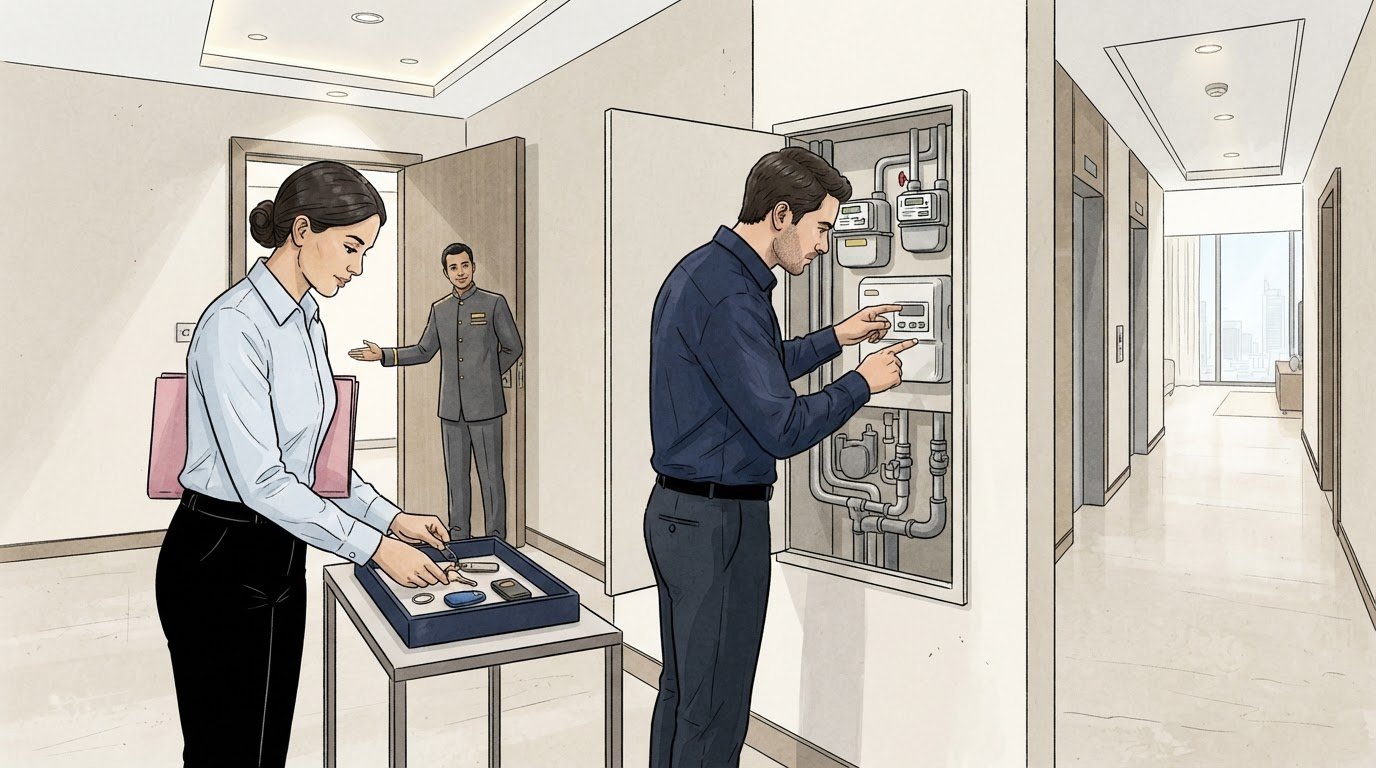
The paperwork is only one part of a well-prepared handover. An essential checklist for new landlords in the UAE starts with the title deed, passport copy and Emirates ID. The person signing the tenancy contract must be the owner or hold the owner’s power of attorney, alongside required local lease registration where applicable.
Before the tenant moves in, Takeem helps you document the property’s condition and utility meter readings, organise the keys and building access, and clarify how utilities and maintenance will be handled. A clear record helps both parties understand the property’s starting condition and their responsibilities.
This checklist covers the records to prepare, the photos and readings to capture, and the access details and move-in arrangements to confirm. It also highlights lease clauses worth reviewing, including maintenance responsibilities and early termination, so you can complete the handover with fewer loose ends.
Key Takeaways
- Prepare ownership and tenancy records, then create a signed move-in record with dated photos and utility readings.
- List every key, access card, remote and parking detail handed over, and account for any building move-in approval.
- Coordinate Ejari, utility activation and building services before move-in so access and essential connections are ready.
- Clarify repair responsibilities and early-termination terms in the lease; Takeem’s Direct Debit setup can help landlords accept tenant payments digitally.
Recording property details and utility meter readings
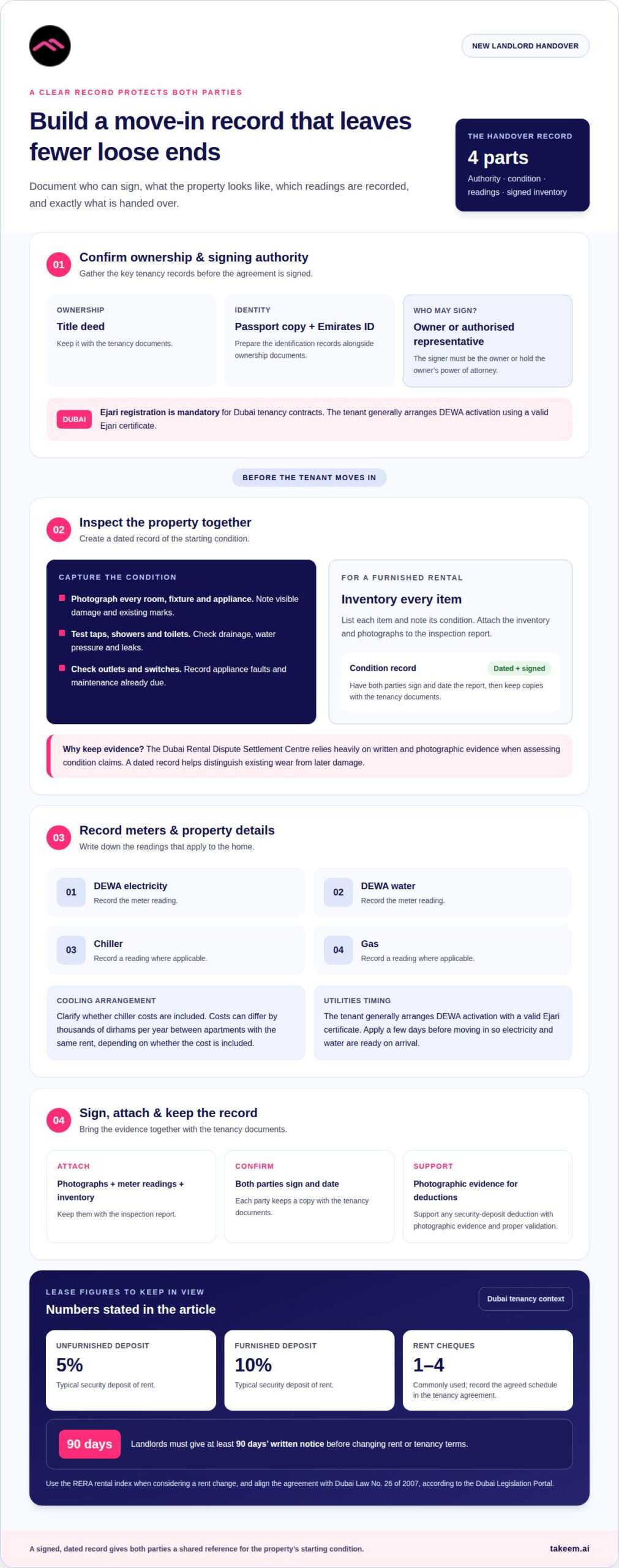
An essential checklist for new landlords in Dubai starts with records that establish ownership and signing authority. Keep the title deed, passport copy and Emirates ID with the tenancy documents. The person signing the tenancy agreement must be the owner or hold the owner’s power of attorney.
Inspect the property with the tenant before handover. Photograph every room, fixture and appliance, and note visible damage or existing marks. Test taps, showers and toilets, then check drainage, water pressure, leaks, outlets and switches. A dated, signed report gives both parties a shared record of the property’s condition.
- Record DEWA electricity and water meter readings, plus chiller and gas readings where applicable.
- For a furnished rental, list each item and note its condition.
- Record appliance faults or maintenance already due before the tenant moves in.
Attach photographs, readings and the inventory to the inspection report. Have both parties sign and date it, then keep copies with the tenancy documents. The Dubai Rental Dispute Settlement Centre relies heavily on written and photographic evidence when assessing condition claims. This essential checklist for new landlords in Dubai also helps distinguish existing wear from later damage.
Typical security deposits are 5% of rent for an unfurnished rental and 10% for a furnished one. Support any deduction with photographic evidence and proper validation. Dubai rental agreements commonly use one to four rent cheques, so record the agreed schedule in the tenancy agreement.
Landlords must give at least 90 days’ written notice before changing rent or tenancy terms. Use the RERA rental index when considering a rent change, and align the agreement with Dubai Law No. 26 of 2007, according to the Dubai Legislation Portal.
Ejari registration is mandatory for Dubai tenancy contracts. Without it, the contract does not provide DEWA activation or standing at the Rental Dispute Settlement Centre. Keep insurance policies, service-charge records and ongoing property bills together. These costs depend on the property and the cover or services selected.
Building access, parking and move-in procedures
Some Dubai buildings require formal move-in approval before a tenant can bring in furniture or arrange a move. Include the building’s approval process in the handover plan, and record any booking details, access instructions or restrictions provided by building management. This helps prevent confusion on move-in day.
For utilities, the tenant generally arranges activation with DEWA using a valid Ejari certificate. Apply a few days before moving in so electricity and water are ready on arrival. Cooling arrangements need separate attention: chiller costs can differ by thousands of dirhams per year between apartments with the same rent, depending on whether the cost is included.
- Write down the number of keys, access cards, parking remotes, gate openers and mailbox keys handed over.
- Record which doors, gates or shared facilities each card or remote opens, without including sensitive access codes in a widely shared record.
- Identify any parking bay assigned to the rental and note its access method in the contract or handover record.
- Settle final utility bills and collect keys, remotes and access cards when the tenancy ends.
During handover, have the tenant acknowledge receipt of each item in writing. A signed inventory makes it easier to compare what was provided with what is returned, helping reduce disputes about missing keys or access devices. Keep a copy with the property documents and signed tenancy contract.
Make the move-in sequence clear: secure any building approval, agree on the move date, arrange utility activation, then hand over the documented access items. Dubai has two main telecom providers for tenants setting up internet. Keeping provider arrangements and building instructions in the move-in record gives both parties a clear reference.
For landlords who also want to streamline rent collection after move-in, digital tenant payment setup can support accepting monthly payments.
Confirming parking, gas, internet and move-in permits
Make building access part of the move-in plan, not a last-minute detail. Some Dubai buildings require formal move-in approval, so establish the process and arrange the required approval before the tenant’s moving date. Keep the approval details with the tenancy contract and move-in record, giving the tenant a clear reference for the scheduled move.
Clarify parking arrangements too. Identify the bay assigned to the rental, explain how the tenant can access it, and record any parking remote handed over. If parking is not included in the rental, state that clearly in the agreement. Clear terms help avoid disputes about whether a space forms part of the rent.
- Record the parking bay, access method and any remote provided.
- Note whether the home has piped gas, as not all Dubai apartments do.
- Clarify who arranges gas service and whether the tenant needs a separate connection.
- Include building move-in approval instructions with the handover documents.
Check the gas arrangement before the tenant plans to use a cooker or other gas appliance. If the property has no piped supply, explain the arrangement for that home. When gas is connected, record relevant readings at handover alongside the other utility details.
For internet, television and phone setup, identify the available connection points and any equipment provided with the property. Dubai has two main telecom providers. The tenant can use the tenancy documents and registered Ejari details when arranging service. Clarify whether existing equipment stays in the home or belongs to the outgoing occupant.
Coordinate the practical steps: confirm any building approval, identify parking access, document the gas arrangement, and share the information needed for internet and TV setup. Arrange utility activation a few days before move-in so electricity and water are active on arrival. A written record supports a smooth handover and makes each party’s responsibilities easier to follow.
Reviewing maintenance and early-termination clauses
Before renting an apartment in Dubai, set out maintenance responsibilities in the tenancy agreement. Landlords are normally responsible for property maintenance and repairs. The contract can assign minor maintenance to the tenant, so define what counts as minor work and who arranges it.
Be specific. State who handles AC servicing, plumbing problems and appliance repairs. AED 500 is a common maintenance-cost threshold in Dubai rental contracts, but the agreement should explain how its threshold applies. Record the process for reporting a fault, arranging access and approving work. This avoids uncertainty when a repair affects the property’s use.
Before move-in, test the provided appliances and note any maintenance due. Keep an inspection record describing existing faults and the condition of each appliance. A landlord must provide a safe, habitable property before handover. Clear notes help distinguish a known issue from a later repair request.
- Specify responsibility for routine servicing and urgent repairs.
- Set out how the tenant reports problems and how access is arranged.
- Clarify responsibility for minor maintenance in the tenancy agreement.
- Address subleasing, repairs and key return in any relevant lease addendum.
Include an early-termination clause that explains the agreed process, notice method and any applicable conditions. For eviction in specific cases, Dubai landlords must provide 12 months’ written notice. This is not a blanket notice period for every tenancy ending, so state the relevant contractual process clearly and keep written notices with the property records.
Routine repainting at the end of a tenancy is the owner’s responsibility. Document the property’s condition in a joint inspection, then use the signed record to clarify any discussion about repairs or repainting.
For landlords looking to combine rental protection with emergency property maintenance, explore the Landlord Rental Guarantee.
Takeem: Direct Debit setup for Landlords to digitally accept monthly payments from tenants
Takeem provides landlords with Direct Debit setup to digitally accept monthly tenant payments. It can be a practical next step once the tenancy agreement, property records and move-in arrangements are in place, especially if you want to collect rent digitally.
Set up the payment arrangement alongside the agreed rent schedule, and keep the tenancy documents clear. Digital acceptance supports rent collection, while the signed agreement remains the record of the tenant’s payment obligations. For landlords seeking rental protection too, Takeem offers a Landlord Rental Guarantee that includes emergency property maintenance.
To explore digital rent collection for your property, contact Takeem about its Direct Debit setup for landlords.
Set up your rental for the next stage
A prepared tenancy is the start of a repeatable rental process. Turn the essential checklist for new landlords in Dubai into a consistent standard for each new tenant, then keep your records and payment arrangements organised throughout the tenancy. That discipline can make future handovers easier to manage.
For additional rental support, Takeem offers a Landlord Rental Guarantee, including an option for property investors with large portfolios. Agents can also sell the guarantee for healthy commissions. Choose support that fits your role and rental needs while keeping the clear agreement and records that underpin the tenancy.
Ready to discuss the next step for your rental? Contact Takeem about your rental. A considered setup now can help you move forward with greater clarity and confidence.
Frequently Asked Questions
What documents do landlords need in Dubai?
Landlords generally need a title deed, passport copy and Emirates ID to document ownership and identify the parties to the rental. If someone signs for the owner, that person must hold the owner’s power of attorney. Keep the tenancy agreement and Ejari certificate with these records. A clear file can also include the unit details and signed handover documents, connecting the paperwork to the correct home.
Are there companies that can manage tenancy contracts and related processes?
Yes. Property management companies in Dubai may help find tenants, prepare rental agreements and support timely rent payments. These services cover broader tenancy processes. Takeem provides landlords with Direct Debit setup to digitally accept monthly tenant payments. This supports rent collection, but is not the same as managing tenancy contracts or the full rental process.
Can a landlord modify a tenancy contract?
Yes, tenancy terms can be amended, but landlords must give tenants at least 90 days’ written notice before changing rent or amending tenancy terms. Put any agreed change in a written record, identify the clause being changed and have both parties sign it. Keep that signed amendment with the original agreement so the current terms are easy to distinguish from earlier wording.
How do I avoid rental scams in Dubai?
Verify the broker’s registration for free through the Dubai REST app or Dubai Brokers app. Confirm that the person signing has authority from the property owner, and ensure the tenancy contract will be registered in Ejari. Keep payment records and signed documents together, and don’t rely on informal messages as proof of an agreement. These steps help establish who is involved and which property the rental concerns.
How do I know if the rent I am quoted is fair?
Use the RERA rental index as a reference when assessing a proposed rent or increase, then compare the property with similar homes. Consider the apartment’s condition, furnishing, location and whether cooling costs are included, since chiller arrangements can materially affect yearly expenses. Review the specific tenancy terms too: the rent alone may not reflect the full cost of occupying the property.
How many cheques is normal for Dubai rent?
Dubai rental agreements commonly use one to four rent cheques. The number determines how payments are divided across the rental period, so read the payment dates and amounts in the tenancy agreement before signing. Confirm, for example, that each cheque’s date matches the agreed schedule. Keep a copy of the payment terms with the contract to avoid confusion later.