

If you’re still waiting for a physical cheque to clear or chasing a tenant via WhatsApp, your rental business is already behind the curve. For many landlords across the UAE, the first of the month has become a source of anxiety rather than a day of financial growth. You’ve likely experienced the frustration of a bounced cheque or the hollow promise of payment by next week, both of which stall your personal cash flow and leave you feeling like a debt collector instead of an investor.
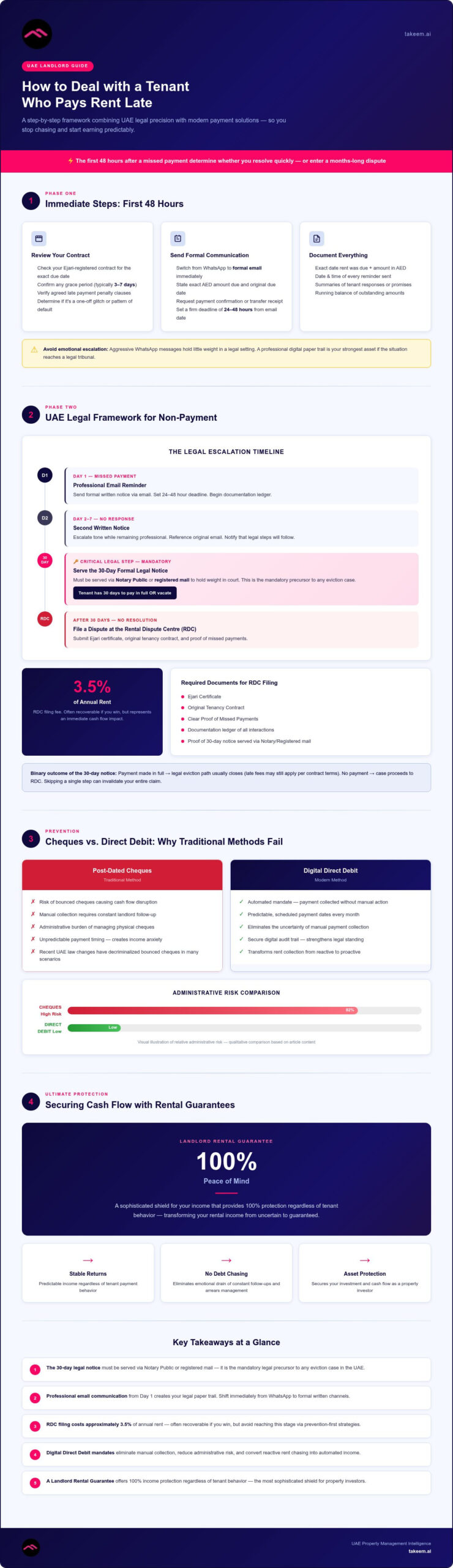
We understand that your priority is a stable, predictable return on your property. This guide outlines exactly how to deal with a tenant who pays rent late by combining legal precision with modern efficiency. You’ll discover the specific steps to take within the UAE legal framework, including the 30 day notice period required by the Rental Dispute Centre (RDC). Beyond just enforcement, we’ll preview how digital Direct Debit systems and rental guarantees can eliminate the uncertainty of manual payments for good. By the end of this article, you’ll have a clear roadmap to secure your income and protect your assets without the emotional drain of constant follow ups.
Key Takeaways
- Understand the formal 30-day notice process through the Notary Public to ensure your legal standing remains airtight within the UAE.
- Learn the essential legal and communication steps for how to deal with a tenant who pays rent late to ensure immediate payment and long-term security.
- Identify the administrative risks of traditional post-dated cheques and the benefits of switching to secure, automated Direct Debit mandates.
- Discover how a Landlord Rental Guarantee provides a sophisticated shield for your income, offering 100% peace of mind regardless of tenant behavior.
- Gain insights into using national resources like the Rental Dispute Centre (RDC) to resolve conflicts with efficiency and confidence.
Immediate Steps: Communication and Documentation
The first 48 hours after a missed payment determine whether you’ll resolve the issue quickly or enter a months-long dispute. When considering how to deal with a tenant who pays rent late, your initial reaction should be clinical rather than emotional. Panic leads to aggressive WhatsApp messages that hold little weight in a legal setting, while silence encourages future delays. You need to establish a position of professional authority from the very first day of arrears.
Reviewing Your Tenancy Contract
Before you reach out, revisit your signed Ejari-registered contract. Most unified contracts in the UAE specify a clear due date, but some include an additional grace period of three to seven days. It’s vital to confirm if you’ve explicitly agreed to any late payment penalties. While you can include these clauses, the Rental Dispute Centre (RDC) often scrutinizes excessive fees, so ensure any charges align with standard landlord-tenant law principles. Distinguishing between a tenant who has a temporary banking glitch and one showing a pattern of default is your first step toward a resolution.
The Power of Professional Tone
Shift your communication from casual messaging apps to formal email trails immediately. A digital paper trail is your strongest asset if the situation ever reaches a legal tribunal. Your first reminder should be concise, authoritative, and helpful. It should state the exact amount due in AED, the original due date, and a request for a payment confirmation or transfer receipt. Maintaining a professional distance prevents the emotional escalation that often leads to total communication breakdowns.
Use a “First Warning” approach that sets a firm deadline, typically 24 to 48 hours from the email date. This establishes that while you’re reasonable, you’re also disciplined about your cash flow. If the tenant provides a specific reason for the delay, acknowledge it, but don’t waive your rights. Always conclude with a clear timeline for the next formal step, ensuring the tenant knows that further delays will trigger a more serious legal process.
Documenting the Delay
A clear, updated ledger is your best friend if you eventually need to visit the RDC. Don’t rely on memory or scattered bank statements. Create a simple, professional document that tracks every interaction. This level of detail shows the authorities that you’ve been proactive and fair, making it much easier to secure a judgment in your favor. Your ledger should include:
- The exact date the rent was due and the amount in AED.
- The date and time of every reminder sent via email or post.
- Summaries of any responses or promises made by the tenant.
- A running balance of any outstanding amounts, including previous late incidents.
Understanding the UAE Legal Framework for Non-Payment
Precision is mandatory when you move from professional reminders to legal action. In the UAE, the law provides a clear structure for recovery, but skipping a single step can invalidate your entire claim. Understanding how to deal with a tenant who pays rent late means mastering the transition from a landlord to a legal claimant. You don’t want to find yourself in a hearing only to realize your documentation doesn’t meet the court’s strict standards.
Serving a Formal Legal Notice
The most critical document in your arsenal is the 30-day notice. To hold weight in court, this notice must be served through a Notary Public or via registered mail. This 30-day legal notice is the mandatory precursor to an eviction case. Once served, the clock begins ticking. The tenant has exactly 30 days to settle the outstanding AED balance or vacate the premises. If they pay within this window, the legal path for eviction usually closes, though your right to collect late fees may remain depending on your contract terms. It’s a binary system; the payment is either made in full, or the case moves to the next stage.
Filing a Case with the Rental Dispute Centre
The Rental Dispute Centre (RDC) acts as the primary judicial body for property matters across the Emirates. If the 30-day notice period expires without resolution, you can formally file a dispute case. You’ll need to provide your Ejari certificate, the original tenancy contract, and clear proof of the missed payments. Keep in mind that filing a case involves costs, usually around 3.5% of the annual rent. These fees are often recoverable if you win, but they represent an immediate cash flow impact. Learning more about avoiding rental disputes UAE can save you from this administrative burden before it starts.
It’s also vital to distinguish between a simple delay and a bounced cheque. Recent changes in UAE law have decriminalized most bounced cheque cases, moving them into the civil sphere. This makes the process of obtaining an executive order faster but changes the leverage you have over a defaulting tenant. While eviction is a powerful tool, it’s often the most expensive and time-consuming route. Proactive solutions, like a Landlord Rental Guarantee, allow you to bypass these legal hurdles entirely by ensuring your bank account stays full even when a tenant’s is empty. This shift from reactive enforcement to proactive protection is the hallmark of a modern property investor.
Cheques vs. Direct Debit: Why Traditional Methods Fail
The “cheque culture” has long been the backbone of UAE real estate, but it’s fundamentally a reactive system. When you’re figuring out how to deal with a tenant who pays rent late, you’ll likely realize the problem started with a signed piece of paper that carries no real-time guarantee of funds. Relying on post-dated cheques creates a fragile financial bridge between you and your income. This bridge is easily broken by a change in the tenant’s circumstances or a simple clerical oversight.
The Risk of the Post-Dated Cheque
Storing and managing physical cheques is an administrative burden that modern investors shouldn’t have to carry. You’re forced to manually track banking dates, visit branches, and wait for clearing cycles. All the while, you hope the notification for “insufficient funds” doesn’t arrive. The stress of a bounced cheque is now compounded by the legal shift in the UAE, where most instances have moved from criminal offenses to civil matters. This modernization means landlords can no longer rely on the threat of immediate police action to ensure payment. Cheques have become a slow, manual method in a country that is rapidly moving toward a digital-first economy.
The Rise of Direct Debit in the UAE
The solution lies in shifting from a physical collection model to a digital mandate. Modernizing UAE rentals means adopting Direct Debit, which pulls the AED amount directly from the tenant’s account on the agreed date. This automation removes the human element of forgetting to deposit a cheque or the tenant failing to transfer funds. It’s a proactive shield for your cash flow.
Implementing a Direct Debit system provides real-time transparency. Both parties see the status of the transaction immediately, which reduces the friction and awkward conversations that occur when rent is overdue. This change isn’t just about efficiency; it’s about preserving the landlord-tenant relationship. By removing the need for manual chasing, you transform a potentially confrontational dynamic into a seamless, professional interaction. For those wondering how to deal with a tenant who pays rent late, the most effective strategy is to replace the outdated collection method entirely. Digital mandates provide the stability your portfolio needs to thrive in the competitive UAE market.
How to Automate Rent Collection to Prevent Delays
Prevention is always more cost-effective than litigation. While the legal framework provides a safety net, the most successful investors avoid the question of how to deal with a tenant who pays rent late by removing the opportunity for delay. Automation transforms rent collection from a monthly chore into a silent, background process. By integrating fintech solutions, you establish a system where payment is the default state rather than a manual event. The process begins with robust vetting. Using digital history and credit checks allows you to predict payment behavior before a contract is even signed. When you combine high-quality tenant selection with automated collection, you create a sophisticated shield for your investment.
Digital Onboarding and Mandates
Transitioning an existing tenant from traditional cheques to a digital mandate is often simpler than landlords expect. It involves setting up a Direct Debit mandate for the entire tenancy term, which carries full legal validity across the UAE. This shift significantly reduces human error, such as forgetting to sign a cheque or miscalculating a date. For the tenant, it offers a seamless experience that removes the administrative burden of physical cheque handovers. You’re not just securing your income; you’re modernizing their living experience.
Monitoring Your Portfolio Performance
A professional approach requires visibility. Modern dashboards allow you to monitor your incoming cash flow at a glance, providing a consolidated view of your entire portfolio. These systems act as early warning indicators, notifying you of failed digital transactions long before they become serious arrears. This proactive data allows you to intervene with a polite nudge or a fintech-driven automated reminder before the 30-day legal window is even necessary. Learning more about optimising property portfolio rental income UAE can help you scale this efficiency across multiple units.
Adopting a “set and forget” mindset allows you to focus on asset growth rather than debt collection. When you automate, you’re no longer wondering how to deal with a tenant who pays rent late because the system handles the nudges and pulls for you. It’s time to retire the ledger and the chequebook in favor of a more stable, digital future. You can set up Direct Debit for your property today to ensure your rental income arrives on time, every time.
Securing Your Cash Flow with Rental Guarantees
Traditional advice on how to deal with a tenant who pays rent late usually centers on the “chase.” It suggests more phone calls, firmer emails, or eventually, the stress of the courtroom. While these steps are part of the legal framework, they don’t solve the immediate problem: your missing AED income. A Landlord Rental Guarantee represents a fundamental shift in property investment. Instead of reacting to a default, you proactively secure your cash flow through a sophisticated financial shield that ensures you get paid even when the tenant stalls.
How a Rental Guarantee Works
The mechanism is designed for total efficiency. When you opt for a guarantee, the financial responsibility for the rent shifts. Takeem pays you the full amount due on the scheduled date, effectively acting as a buffer between you and the tenant’s bank account. We then handle the collection process, legal notices, and any necessary follow ups. This removes the emotional burden of the “late rent” conversation and preserves your professional distance. You’re no longer a debt collector; you’re a strategic investor with a protected bottom line. For a deeper dive into the mechanics, explore the ultimate guide to landlord rental guarantees.
Protecting Your Asset Value
Financial default is rarely an isolated event. Often, a tenant who struggles with rent also begins to neglect the property, leading to a decline in asset value. This is why emergency maintenance is a critical component of a comprehensive guarantee package. By including maintenance coverage, you ensure that the physical state of your unit remains high, even if the tenancy becomes difficult. It’s a dual layer of protection: one for your bank account and one for your property’s long term worth.
Integrating maintenance into your financial strategy prevents small issues from becoming expensive repairs. If a tenant stops communicating, you still have the peace of mind that emergency issues are handled by professionals. You can learn more about this integrated approach in our guide to rental guarantees with maintenance UAE. This holistic solution is the only way to achieve 100% peace of mind in a localized market that demands both agility and stability. By moving beyond simple insurance, you’re not just hoping for payment; you’re guaranteeing it.
Secure Your Rental Future with Modern Solutions
Managing a property portfolio shouldn’t feel like a constant pursuit of missing funds. You’ve learned that knowing how to deal with a tenant who pays rent late involves a strategic mix of legal rigor and digital innovation. By moving beyond physical cheques and embracing automated Direct Debit mandates, you eliminate the administrative friction that often leads to delays. While the UAE legal framework provides a clear 30-day path for recovery, the most successful landlords choose to bypass the stress of the Rental Dispute Centre entirely by securing their income at the source.
Transitioning to a proactive model protects your cash flow and your asset’s physical condition. With guaranteed monthly payments and national UAE maintenance coverage, you can focus on scaling your investments while the technology handles the logistics. It’s time to replace the uncertainty of “cheque culture” with a seamless, digital-first approach that prioritizes your peace of mind. Secure your rental income today with Takeem’s Rental Guarantee and experience the stability of a truly modern property business. Your journey toward stress-free rent collection starts here.
Frequently Asked Questions
What is the legal grace period for rent payment in the UAE?
The legal grace period is typically defined within your specific tenancy contract, often ranging between three to seven days. However, under UAE law, formal eviction proceedings for non-payment can only begin after a 30-day notice is served. Understanding how to deal with a tenant who pays rent late requires recognizing that while a contract might allow a few days, the legal enforcement clock only starts with formal notification through the Notary Public.
Can I lock my tenant out of the property if they are late with rent?
No, you cannot lock a tenant out or disconnect utilities, as these actions are considered illegal “self-help” measures in the UAE. Eviction is a strictly judicial process managed by the Rental Dispute Centre (RDC). Attempting to force a tenant out without a court order can lead to significant legal penalties for the landlord. The only professional way to resolve persistent non-payment is through established legal channels and filing a formal dispute.
How do I serve a 30-day legal notice for non-payment of rent?
To serve a 30-day legal notice, you must use a Notary Public or send it via registered mail to ensure it’s legally binding. This notice informs the tenant they have 30 days to settle the outstanding AED balance or face eviction. This step is a mandatory precursor for any case filed at the RDC. It’s vital to keep the proof of service, as this document is the absolute foundation of your legal claim in court.
Is a bounced rent cheque still a criminal offence in the UAE?
Following legal reforms in 2022, a bounced rent cheque is generally no longer a criminal offense in the UAE. It has transitioned into a civil matter, allowing landlords to seek an executive order for payment through the courts more efficiently. While this speeds up the recovery of funds, it removes the immediate threat of police intervention. This shift highlights why many modern investors are moving toward secure digital collection methods like Direct Debit to ensure stability.
What is the cost of filing a case at the Rental Dispute Centre?
Filing a dispute case at the Rental Dispute Centre typically costs 3.5% of the property’s total annual rent. There’s usually a minimum fee of AED 500 and a maximum cap of AED 20,000 for these filings. These costs cover the administrative and judicial processing of your claim. While these fees are often recoverable if the judgment is in your favor, they represent an initial cash flow impact that landlords should factor into their recovery strategy.
Can a rental guarantee service really pay me if my tenant stops paying?
Yes, a Landlord Rental Guarantee from a provider like Takeem is designed to pay you even if the tenant defaults. The service acts as a financial buffer; Takeem pays the agreed rent directly to your account on the due date and then manages the collection and legal process with the tenant. This ensures your personal or business cash flow remains uninterrupted, effectively removing the financial risk and emotional stress associated with problematic or late-paying tenants.
How do I switch from post-dated cheques to Direct Debit mid-tenancy?
To switch from cheques to Direct Debit mid-tenancy, you and your tenant must sign an addendum to the existing tenancy contract. This document should state that future payments will be collected via a digital mandate rather than physical cheques. Once the addendum is signed, you can set up the Direct Debit through Takeem’s platform. This provides a more professional, automated experience for both parties and helps prevent the common issue of how to deal with a tenant who pays rent late.
What happens if a tenant ignores the 30-day legal notice?
If a tenant ignores the 30-day legal notice and fails to pay the outstanding AED amount, the landlord gains the right to file an eviction case at the RDC. Once the case is filed, the court will review the documentation and, if the claim is valid, issue a judgment for eviction and payment of arrears. This process can take several weeks, which is why proactive solutions like rental guarantees are becoming the preferred choice for risk-averse investors.