

A landlord’s strongest protection isn’t simply what the tenancy contract says. It comes from aligning the contract with legal duties and keeping a clear record of every important step. If you’re seeking understanding landlord rights in Abu Dhabi, knowing how those pieces fit together can help you handle rent, repairs, notices, and tenant disputes with greater confidence.
It’s reasonable to want clear answers about what you can require, what you’re responsible for, and how to respond when a tenant disagrees. The rules can differ across the UAE, and the 0% rent increase cap introduced on June 2, 2026, makes it especially important to check which requirements apply to your property and contract. This guide explains the main landlord rights and responsibilities, the records and written notices to keep, and the steps to take if a dispute arises, from conciliation through Taswea to a formal ruling by the Rental Dispute Settlement Committee. It also distinguishes legal protections from optional operational tools, such as digital rent collection and rental guarantees.
Key Takeaways
- Understanding landlord rights in Abu Dhabi starts with distinguishing legal and contractual entitlements from informal rental practices.
- Use the signed tenancy agreement as a reference for agreed rent, duration, payment terms, and each party’s responsibilities.
- Before acting on rent changes, maintenance, property access, renewal, or termination, check the relevant contract terms and applicable rules.
- Build a clear dispute record by preserving documents and communicating in writing, then identify the official route for your specific case.
- Digital rent collection can help organise payment records, but operational tools don’t replace legal compliance or alter either party’s rights.
What landlord rights in Abu Dhabi mean in practice
Landlord rights are the legal and contractual entitlements a property owner may rely on during a tenancy, within the limits of the duties owed to the tenant. They are not a blanket licence to act as the landlord chooses: each entitlement depends on the applicable law, the tenancy agreement, and the circumstances of the property. This guide focuses on the relevant tenancy framework. Procedures elsewhere in the UAE may differ.
Understanding landlord rights in Abu Dhabi means looking at the applicable rules and the agreement together, rather than relying on informal rental practices or assumptions carried over from another emirate. A term written into an agreement can help clarify what the parties agreed, but it doesn’t override a legal requirement.
Which rules shape a landlord’s rights?
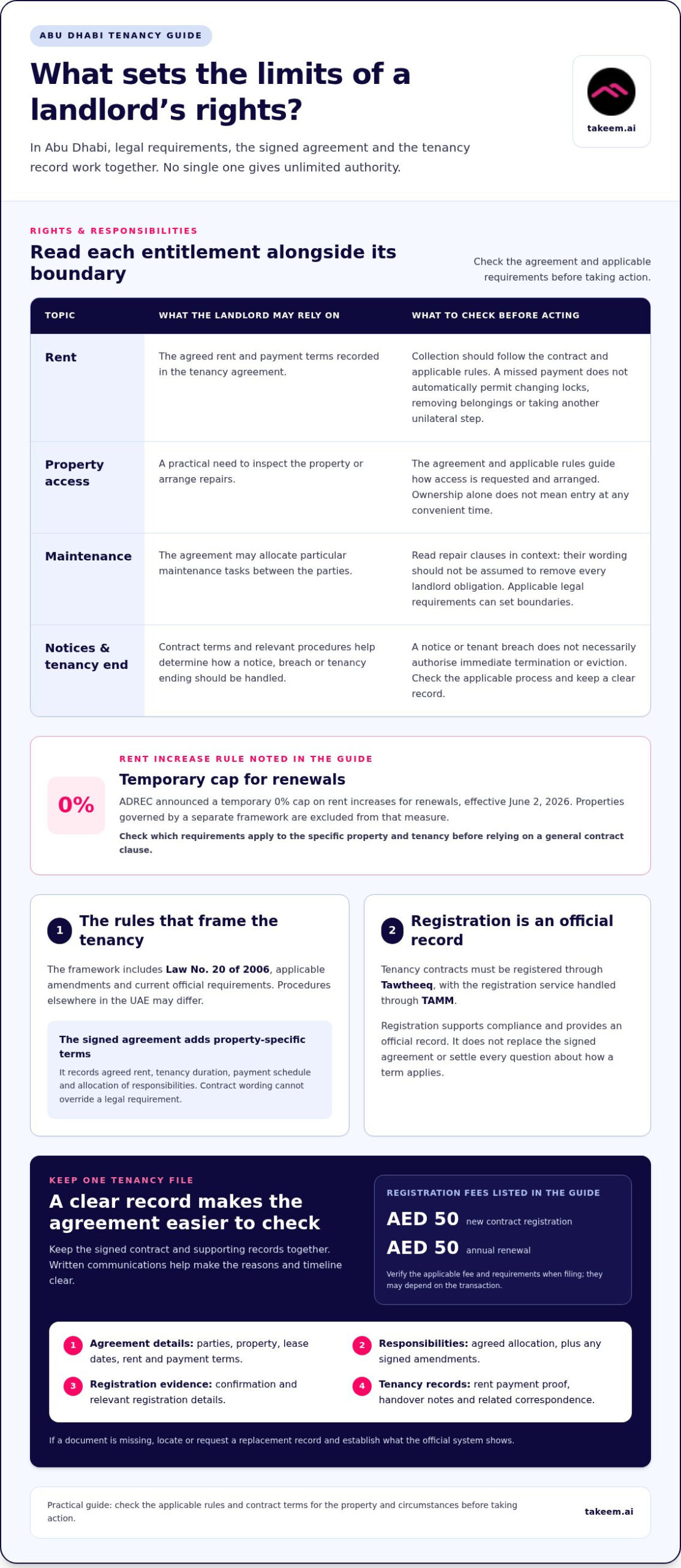
The tenancy framework includes Law No. 20 of 2006, alongside applicable amendments and current official requirements. The signed agreement adds property-specific terms, such as the rent, duration, payment schedule, and allocation of responsibilities. Together, these sources help establish what each party can expect. For a general introduction to the legal relationship, see Landlord-tenant law; local rules determine how that relationship works.
Tawtheeq is the tenancy contract registration system, and tenancy contracts must be registered. Registration provides an official record of the tenancy; it doesn’t replace the signed agreement or settle every question about how a term applies. Before acting, check current official guidance and the contract’s registration details. For example, ADREC announced a temporary 0% cap on rent increases for renewals effective June 2, 2026, with properties governed by a separate framework excluded from that measure. This illustrates why a general contract clause may need to be read alongside rules that apply to the property and tenancy.
Rights come with responsibilities
A landlord may expect rent to be paid according to the agreed terms, but collection should follow the contract and applicable rules. A missed payment doesn’t automatically give the landlord authority to change the locks, remove a tenant’s belongings, or take another unilateral step. The proper response depends on the agreement and the relevant legal process.
Property access requires similar care. A landlord may have a practical reason to inspect or arrange repairs, but the agreement and applicable rules should guide how access is requested and arranged. Ownership alone doesn’t grant permission to enter whenever convenient. Keep written records of requests and agreed arrangements.
Maintenance, property condition, notices, privacy, and the end of a tenancy also need a case-specific review. The agreement may allocate certain tasks, while legal requirements can set boundaries on that allocation. For instance, a repair clause should be read in context, not assumed to remove every landlord obligation. Likewise, a notice or tenant breach doesn’t necessarily authorise immediate termination or eviction. Check the relevant terms and official procedures before taking action, and document communications so the reasons and timeline are clear.
How Abu Dhabi tenancy contracts and registration affect landlord rights
A signed tenancy agreement turns the parties’ understanding into a written record. It can help establish the agreed rent, lease duration, payment schedule, and allocation of responsibilities if a question or dispute arises. It is important evidence, but it doesn’t operate in isolation: applicable law and current requirements still apply, and contract wording cannot override them.
Keep the signed agreement, details of the parties and property, lease dates, rent and payment terms, agreed responsibilities, registration evidence, amendments, and handover records together. This concise file makes it easier to check what was agreed and identify any missing or disputed information.
What to document in the tenancy agreement
Check that the agreement identifies the landlord and tenant, accurately describes the property, and states the tenancy term, rent, payment schedule, and responsibilities agreed by the parties. If the parties later change a term, keep the signed amendment with the original contract. Don’t rely on an informal conversation to prove a change.
Keep handover records, such as condition notes and relevant correspondence, in the same tenancy file. They can help clarify what was recorded at the start of the lease and how later concerns were raised. A sample clause found online may not suit the property or comply with current requirements, so don’t assume copying it makes it legally sufficient.
Why registration and records matter
Tenancy contracts are registered through Tawtheeq, with the registration service handled through TAMM. Registration creates an official record and supports compliance, while a copy of the signed agreement and related documents preserves the detail behind that record. To access the government service, landlords can use Register a Tenancy Contract through TAMM. The current guidance lists a fee of د.إ 50 for a new contract registration and د.إ 50 for an annual renewal; verify the applicable fee and requirements when filing, as they may depend on the transaction.
Keep the registration confirmation alongside the contract, amendments, and proof of rent payments. If a document is missing, locate or request a replacement record and establish what the official system shows. Don’t assume that one missing copy automatically removes every landlord right. The effect of a registration gap can depend on the circumstances, and failure to register may weaken a landlord’s position in a dispute. Check current requirements and seek appropriate legal guidance where the consequences are unclear.
Registration and income protection serve different purposes. A rental guarantee is an income-management option, not a substitute for a valid contract, registration, or compliance with landlord duties. Landlords comparing operational tools can review rental guarantee options separately from their legal obligations.
Rent, maintenance, access, and ending a tenancy: where rights need care
Rent, repairs, access, and tenancy endings can raise urgent questions, but acting quickly isn’t the same as acting lawfully. Understanding landlord rights in Abu Dhabi means checking the specific agreement alongside rules that apply to the property and situation. Use the table as a starting point, not a substitute for reviewing current requirements before taking action.
| Issue | Landlord’s possible interest | Tenant’s corresponding interest | What to verify |
|---|---|---|---|
| Rent | Receive payment as agreed | Pay under the agreed terms | Contract, payment history, applicable rent rules |
| Maintenance | Keep the property in usable condition | Have necessary repairs addressed and meet agreed upkeep duties | Repair type, contract allocation, applicable legal duties |
| Access | Inspect or arrange necessary work | Privacy and agreed arrangements for entry | Contract terms, purpose, communication, applicable rules |
| Ending a tenancy | Seek non-renewal or termination where permitted | Receive valid notice and follow the applicable process | Reason, notice method and timing, relevant procedure |
Rent, repairs, and access during the tenancy
Read rent terms together with receipts, bank records, or other payment evidence. If a payment is late or disputed, document the amount, due date, and communication rather than assuming the disagreement permits immediate action. The tenancy framework generally places major maintenance and necessary repairs on the landlord unless the agreement provides otherwise; tenants are generally responsible for minor repairs and ordinary upkeep. The specific issue and contract still matter.
Keep written records of repair requests, responses, and any agreed access arrangements. Ownership alone doesn’t establish permission to enter at any time. Don’t force entry, change locks, or interrupt essential services to pressure a tenant. Check the agreement and applicable rules before arranging access or responding to a breach.
Renewal, termination, and eviction
These terms describe different events. Expiry is the end date written into a lease; non-renewal is a decision not to continue it. Termination means ending a tenancy under an applicable basis or process, while eviction concerns the tenant’s removal from the property. Don’t treat one event as automatic authority for another.
For non-renewal, current guidance under Law No. 20 of 2006 states that written notice must be given at least two months before expiry for residential tenancies and three months for commercial tenancies. Confirm the rule that applies to the property and contract, including the correct notice method and any relevant amendments. Other termination or eviction grounds require their own verification; a tenant’s alleged breach doesn’t, by itself, justify self-help eviction. Use the applicable formal procedure and preserve notices and delivery records.
A practical process for documenting and resolving landlord-tenant disputes
A rent disagreement or repair complaint can escalate when the facts are scattered across messages, receipts, and handwritten notes. A clear sequence helps you assess the issue, communicate accurately, and identify the appropriate official route. Understanding landlord rights in Abu Dhabi also means recognising that evidence supports your position, but can’t guarantee a particular outcome.
- Review the agreement. Identify the relevant clause, dates, payment terms, and any signed changes. Compare the issue with what the parties agreed, then consider applicable rules.
- Preserve the evidence. Keep the signed contract and amendments, Tawtheeq registration evidence, payment records, notices, inspection records, and repair correspondence. Save dated messages and retain copies in a secure, organised file.
- Communicate in writing. State the issue, relevant dates, and requested next step in a calm, factual way. Keep a copy of each message and any reply. Avoid threats or assumptions about what the other party must do.
- Identify the official route. If direct communication doesn’t resolve the matter, verify the appropriate dispute channel and current filing instructions for your case before submitting anything.
Build a clear evidence trail
Before seeking dispute resolution, organise the contract, registration record, payment history, notices, inspection evidence, and repair communications in date order. A short timeline can clarify when the issue began, what each party said, and what steps followed. Keep original files where possible, label copies clearly, and distinguish confirmed facts from your interpretation. This preparation makes the record easier to review, but it doesn’t determine how a dispute will be decided.
Good documentation can also help prevent misunderstandings from turning into formal claims. Clear payment records, prompt written updates, and a record of agreed actions create a shared reference point. For additional prevention practices, consult the site’s guide to avoiding rental disputes.
Use the appropriate formal route
The dispute process begins with conciliation through the Abu Dhabi Real Estate Settlement Centre, known as Taswea. If the parties don’t reach agreement, the matter can proceed to the Rental Dispute Settlement Committee (RDSC) for a formal ruling. The correct route and procedure depend on the dispute, so verify the current jurisdiction and official instructions before filing.
Check the latest guidance for the required documents, filing channel, deadlines, and applicable fees. The research available for this guide reports a typical filing fee of 3.5% to 4% of annual rent, capped at د.إ 10,000 for standard lease claims, but confirm the amount and how it applies to your case with the relevant authority. A qualified UAE legal professional can help interpret contract terms and case-specific requirements. This guide is general information, not legal advice.
Accurate payment records can make routine rent administration easier to track. Explore digital rent collection options as an operational tool, separate from legal compliance and dispute procedures.
Protect rental operations while respecting landlord rights
Legal compliance sets the boundaries of a tenancy. Operational tools can make routine tasks easier, but they don’t change those boundaries. Understanding landlord rights in Abu Dhabi means keeping that distinction clear: rent collection systems and income-management services may support administration, while the contract and applicable law continue to define the parties’ rights and duties.
Digital rent collection as an operational option
For landlords who want to move beyond relying only on cheques, Direct Debit can support recurring digital rent collection. A digital process can make it easier to organise payment entries and review whether expected instalments were received. Takeem facilitates Direct Debit setup for landlords to accept monthly tenant payments digitally.
Keep payment records alongside the tenancy file, and record any missed, partial, or disputed payment accurately. A digital transaction history is useful for administration and may help establish what was paid and when. It doesn’t, by itself, prove that every legal or contractual requirement has been met. Landlords still need to follow the agreed payment terms, maintain required records, and address any disagreement through the appropriate process.
Choosing a payment method is a practical decision, not a change to the tenancy. Direct Debit doesn’t amend the agreement, create a new right to collect rent, or decide what happens after a payment fails. Make sure the payment arrangement is clearly understood by both parties and consistent with the tenancy terms. Store records securely and keep communications about payment changes in writing.
Where a rental guarantee fits, and where it doesn’t
A rental guarantee can be considered as an optional income-management service. Takeem offers rental guarantees to landlords and property investors. The service is separate from the legal relationship created by a tenancy agreement: it doesn’t determine tenant obligations, expand a landlord’s statutory rights, or replace compliance with applicable law.
Keep the purpose clear. A guarantee is a commercial arrangement, not a legal remedy for a tenancy breach and not a substitute for documenting the agreement, following notice requirements, or using the proper dispute process. Review its terms as a separate operational decision, while continuing to manage the tenancy in line with current rules. This distinction helps landlords assess practical support without confusing it with legal protection.
Clear administration can reduce avoidable uncertainty, but no payment tool or income service removes the need to handle each tenancy lawfully. For a practical option to support rental income management, explore Takeem’s Landlord Rental Guarantee service. Before acting on a rent, maintenance, notice, or dispute issue, verify the current requirements that apply to your property and contract.
Make your next tenancy decision with confidence
Strong rental operations start with a simple habit: pause before acting, check the current rule that applies, and keep a clear record of the decision. That discipline turns understanding landlord rights in Abu Dhabi into a practical approach you can carry into each tenancy, even when circumstances change. For case-specific questions, seek qualified legal advice and verify the latest official guidance before relying on a notice, contract term, or procedure.
Operational support can help keep routine rental tasks organised without changing either party’s legal position. Takeem facilitates digital rent collection through Direct Debit and offers rental guarantees that include emergency property maintenance as part of the service. These are optional operational tools, not substitutes for legal compliance or a way to determine tenant rights.
If you’re considering an income-management option for your rental, explore Takeem’s landlord rental guarantee service. With current information, careful records, and a measured next step, you can manage your tenancy with greater clarity and confidence.
Frequently Asked Questions
Can a landlord increase rent in Abu Dhabi?
For renewals, the temporary rent freeze sets the annual increase cap at 0%, effective June 2, 2026, until further notice, according to ADREC. For a new lease on a previously rented property, the rent is capped at the rate in the most recent registered tenancy contract. Properties governed by a separate framework are excluded from the freeze. Check the property’s applicable rules before setting or changing rent.
How much notice must a landlord give before ending a tenancy in Abu Dhabi?
For non-renewal, current guidance states that written notice must be given at least two months before a residential contract expires, or three months before a commercial contract expires. These periods concern non-renewal, not every kind of termination or eviction. Check the lease and applicable rules to confirm the required notice method and timing for your situation. Keep a copy of the notice and evidence of when it was delivered.
Can a landlord evict a tenant without going through a formal process?
No. A landlord shouldn’t remove a tenant, change locks, or cut essential services to force them out. Even if rent is overdue or another contract term appears to have been breached, the landlord must use the applicable formal process rather than taking unilateral action. Keep records of the issue and communications, then verify the correct dispute route and requirements for the specific case before acting.
Who is responsible for repairs in a rented property?
Generally, the landlord is responsible for major maintenance and necessary repairs that keep the property fit for use, unless the tenancy agreement provides otherwise. Tenants are generally responsible for minor repairs and ordinary upkeep. For example, a structural problem may call for a different response than routine care. Review the contract and applicable rules, document the reported issue, and keep records of repair arrangements and completed work.
Does a landlord have the right to enter a rented property?
Not simply because they own it. Entry should be handled in line with the tenancy agreement and applicable rules, while respecting the tenant’s privacy. For a planned inspection or repair, communicate the purpose and proposed arrangements in writing and retain the response. Don’t assume that a tenant’s breach automatically permits entry. If access is disputed, review the relevant terms and seek guidance before attempting to enter.
What happens if a tenancy contract is not registered in Abu Dhabi?
Tawtheeq registration is mandatory. An unregistered contract may create practical problems, including difficulties for the tenant activating utilities or obtaining parking permits, and may weaken the landlord’s position if a dispute arises. It doesn’t automatically establish that every landlord right disappears. For understanding landlord rights in Abu Dhabi, distinguish the missing registration record from the underlying contract, then check the current official requirements and how they apply.
Where can a landlord resolve a rental dispute in Abu Dhabi?
Rental disputes begin with conciliation through the Abu Dhabi Real Estate Settlement Centre, known as Taswea. If the parties can’t reach an agreement, the matter may proceed to the Rental Dispute Settlement Committee for a formal ruling. Before filing, verify the correct route, jurisdiction, documents, fees, deadlines, and submission method for your case through current official guidance. A qualified UAE legal professional can help interpret case-specific issues.
Can a landlord collect rent through Direct Debit instead of cheques?
Yes, digital monthly rent collection through Direct Debit can be an operational alternative to relying only on cheques. Make sure the payment method is agreed and consistent with the tenancy terms; don’t assume a landlord can change the agreed method unilaterally. Keep transaction records and follow up on failed or disputed payments through the usual agreed and lawful channels. Takeem facilitates Direct Debit setup for landlords accepting monthly tenant payments digitally.