
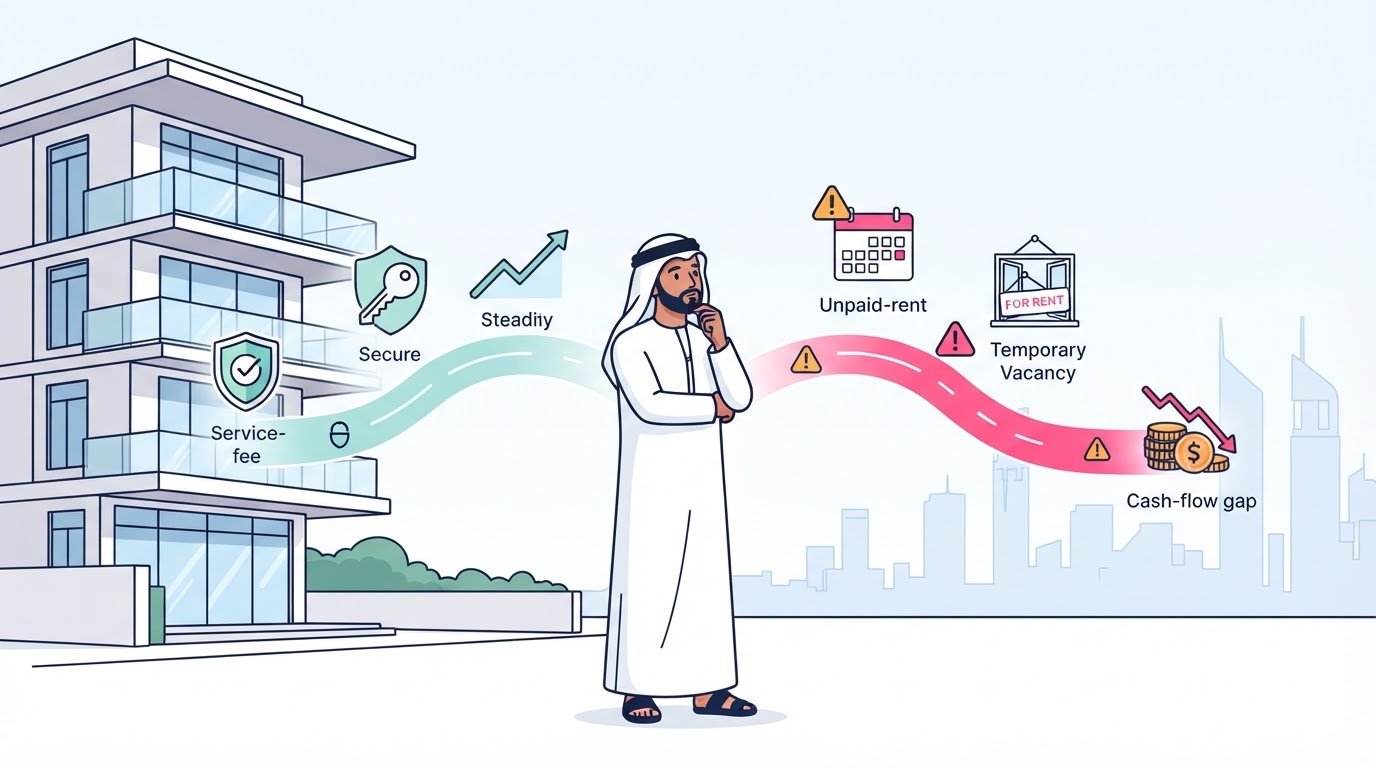
The lower-cost option may leave your rental income more exposed. For UAE landlords, the cost of rental guarantee vs risk of default is not simply a predictable fee compared with an uncertain missed payment. A tenant default can also create a longer cash-flow gap, time spent re-letting the property and pressure on your investment returns.
It makes sense to weigh a recurring service fee carefully, especially when the timing and scale of a default are uncertain. A more useful question is how much a realistic downside scenario could cost you in AED, and whether the guarantee agreement addresses the risks you want to manage.
This guide shows you how to estimate exposure from rent arrears and vacancy, then compare that estimate with a guarantee fee over the same period. It also explains which agreement terms to review before deciding. Takeem’s rental guarantee can be considered alongside digital Direct Debit for monthly rent collection and the emergency property maintenance included in the service.
Key Takeaways
- Assess the cost of rental guarantee vs risk of default by comparing the fee with a clearly defined downside scenario over the same period.
- Estimate exposure using unpaid rent and relevant disruption costs, then identify the point at which a potential loss equals the fee.
- Compare a guarantee with self-insuring: avoiding a service fee also means retaining the financial risk and administration of a default.
- Review the agreement’s protection scope, conditions, exclusions and claims process to understand how its terms fit your priorities.
- Assess rent protection separately from Direct Debit collection, and include emergency maintenance in your wider review of Takeem’s rental guarantee.
Rental guarantee cost vs. default risk: what are landlords actually comparing?
The cost of rental guarantee vs risk of default compares a known service fee with a potential loss if rent goes unpaid. The fee is planned; the loss is uncertain. It might be limited to a late payment, or grow if arrears continue, the property becomes vacant, or expected income is needed to meet property obligations.
Default exposure is the landlord’s potential financial loss from unpaid rent and related disruption before any protection under an agreement is applied. This separates the risk you want to manage from the fee you would pay for a service. A rental guarantee generally involves transferring some rental-income risk to another party, as outlined in this neutral overview of what a rental guarantee is. Its value depends on the written agreement, not the label alone.
What does a rental guarantee fee pay for?
Assess the service package alongside its agreement. Takeem provides a rental guarantee for UAE landlords and property investors, supports monthly rent collection through Direct Debit, and includes emergency property maintenance within its guarantee service. These features address different needs: income protection, payment administration and maintenance support. Read the agreement to understand its scope and conditions. Do not assume a particular event, payment timeline, limit or exclusion applies unless the wording says so.
What counts as the risk of tenant default?
Start with unpaid rent, then consider the possible knock-on effects. A missed payment can create a short-term cash-flow gap. Prolonged arrears can increase the amount outstanding, while a vacant period after a tenancy ends can extend the loss of rental income. Recovery efforts can also take time, even if they do not create a direct cost.
The impact depends on the rent, the duration of the disruption and the property’s obligations. For a simple illustration, a landlord receiving د.إ 8,000 per month could model one month of unpaid rent separately from several months of arrears and a subsequent vacant period. This is an example, not a prediction or UAE market average. Add only relevant disruption costs, then compare the total exposure with the guarantee’s actual fee and written protection terms.
How to estimate your rental default exposure and break-even point
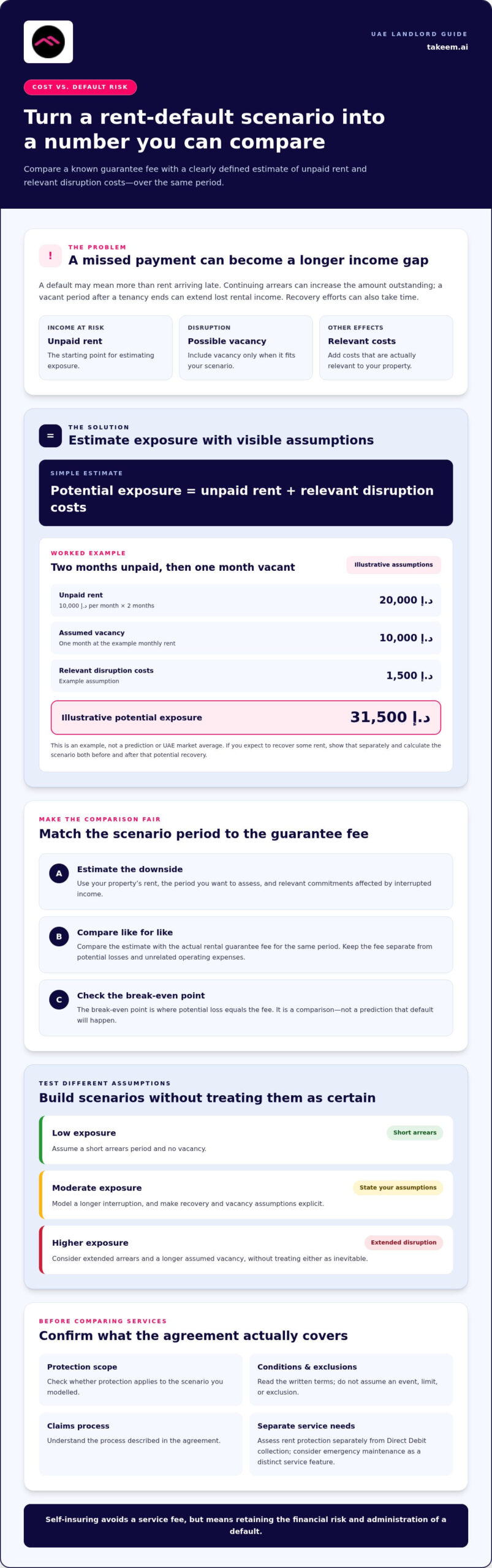
Use your own figures to make the decision concrete. Start with this simple formula:
Potential exposure = unpaid rent + relevant disruption costs
Compare the estimate with the actual rental guarantee fee for the same period. The break-even point is a comparison, not a prediction that default will happen. It shows how much potential loss would equal the fee. You can then check whether the agreement’s protection applies to the scenario you modelled. The formal risk assessment framework from the National Institute of Standards and Technology offers a structured approach to identifying risks and assessing their potential impact, principles landlords can apply to their own estimates.
Which figures should landlords include in the calculation?
Use the property’s rent, the period you want to assess and known property commitments that could be affected by an income interruption. Model different arrears durations, and state your assumptions about recovery and any vacancy that might follow. Keep each input visible so you can adjust it instead of treating one scenario as certain.
For example, suppose a landlord uses monthly rent of د.إ 10,000, assumes two months of unpaid rent, and adds one month of vacancy plus د.إ 1,500 in relevant disruption costs. The illustrative exposure is د.إ 31,500: د.إ 20,000 in unpaid rent, د.إ 10,000 in assumed vacancy and د.إ 1,500 in disruption costs. These are example assumptions, not a forecast or market average. If you expect to recover some rent, show that separately and calculate the scenario both before and after that potential recovery.
How can you compare scenarios without false precision?
Build low, moderate and higher-exposure scenarios using assumptions that fit your property and planning horizon. Keep the guarantee fee separate from potential losses and unrelated operating expenses. Then compare the fee with the protection that may apply over the same period, using the agreement’s terms.
- Low exposure: a short arrears period, with no assumed vacancy.
- Moderate exposure: a longer interruption, with recovery and vacancy assumptions stated.
- Higher exposure: extended arrears and a longer assumed vacancy, without treating either as inevitable.
The cost of rental guarantee vs risk of default is easier to assess when each scenario uses clear inputs and matching time periods. Include Takeem’s rental guarantee in your comparison, and review the rental guarantee service alongside your exposure estimate and the written agreement.
Rental guarantee vs. self-insuring against default: compare the trade-offs
Self-insuring means retaining the financial risk instead of paying a service fee to transfer or manage specified risks. It may suit a landlord with enough reserves to absorb an interruption, but it is not automatically cheaper or safer. A rental guarantee can support more predictable income planning, subject to its agreement. It does not remove every risk: the written terms determine what protection applies.
A reliable tenant can make protection seem unnecessary. But the decision is about the financial impact of interrupted rent, not a prediction about a tenant’s behaviour. Focus on your property’s exposure, the reserves available to absorb a loss and the specific risks addressed by the agreement. This keeps the comparison grounded in your circumstances.
| Consideration | Self-insuring | Rental guarantee |
|---|---|---|
| Fee certainty | No guarantee service fee, but losses can be uncertain. | A service fee is part of the cost; compare it with the protection stated in the agreement. |
| Retained risk | The landlord remains responsible for losses if rent goes unpaid. | Specified risks may be managed or transferred according to the agreement’s scope and conditions. |
| Administration | The landlord handles rent follow-up and related administration. | Direct Debit can support digital monthly rent collection; this is payment administration, distinct from rent protection. |
| Maintenance support | Maintenance arrangements remain separate from self-insuring against default. | Takeem’s guarantee service includes emergency property maintenance. Consider this separately from rent protection and its written terms. |
When might retaining the risk suit a landlord?
Keeping the risk may be workable if a temporary income interruption would not destabilise your wider finances. Consider the reserves available for each property and whether rental income is concentrated in one asset or spread across a portfolio. Self-insuring avoids a service fee, but you still carry the potential loss, recovery effort and cash-flow pressure. It is not universally cheaper or safer.
When might predictable protection be more valuable?
Some landlords prefer steadier planning to retaining every rent-related uncertainty. For a larger portfolio, consistent administration and visibility across properties may also matter. Assess maintenance support as a separate service value, not as proof that rent protection covers a particular expense. The cost of rental guarantee vs risk of default comes down to your capacity to absorb a loss and the specific risks addressed by the agreement.
Which rental guarantee terms matter most when weighing its cost?
A headline description cannot tell you how a guarantee will work in a specific case. The written agreement sets out the protection available, so compare its scope and conditions with the default scenarios you used to estimate exposure. A service fee is easier to evaluate when you understand what it covers, what it does not, and what steps you must take to make a claim.
How should landlords assess coverage and exclusions?
Read the agreement for the circumstances treated as covered default, the evidence or actions required from you, and how to start a claim. Note any stated timeframes, limits and exclusions. Do not assume one guarantee follows another’s terms, or that a broad label means every unpaid-rent situation is covered. The contract wording determines what protection applies to your property and circumstances.
Use this checklist as you review the agreement:
- Protection scope: Which default circumstances are described?
- Conditions: What records, notices or other actions are required?
- Timeframes and limits: What does the agreement specify, and for how long?
- Exclusions: Which situations fall outside the stated protection?
- Claim process: How is a claim submitted, and what information is needed?
- Service fee: What period does it cover, and how does it compare with your exposure over that same period?
How do collection and maintenance features affect value?
Direct Debit provides a digital method for collecting monthly rent. It supports payment administration, but it is not rent protection by itself. Assess it as a separate feature: it can modernise payment collection, while the guarantee agreement governs the protection it provides.
Takeem’s rental guarantee also includes emergency property maintenance. Consider this as a separate service component that may matter to asset care, and review its terms separately from the agreement’s income-protection provisions. Maintenance support does not, by itself, change the scope of rent protection.
The cost of rental guarantee vs risk of default is best judged against the agreement’s wording, not the service label or a list of features alone. Review Takeem’s rental guarantee and maintenance service as part of your comparison, then match its terms to the risks you want to manage.
Decide whether a rental guarantee fits your UAE property strategy
A useful decision does not start with the fee alone. Work through your exposure, the agreement and the service features in sequence. Your decision should reflect your property, cash-flow priorities and tolerance for uncertainty, not a prediction that a tenant will default.
A practical decision checklist for landlords and investors
- Record your assumptions: Note the rent, the period you are assessing and any property commitments that depend on rental income.
- Model plausible disruption: Consider different arrears durations and any possible vacancy. Keep assumptions visible so you can revise them.
- Match scenarios to the agreement: Compare each scenario with the stated protection, conditions, exclusions and claim process.
- Compare like with like: Set the service fee beside the potential exposure over the same period, then assess whether the service features add value for your strategy.
- Review as circumstances change: Revisit the calculation if your portfolio, cash-flow needs or investment plans change.
For a single property, a short interruption may have a different effect than it would across a portfolio with concentrated rental income. Reassess the figures as your holdings and priorities evolve. A decision that fits today may need another look after an acquisition, a change in financing commitments or a shift in how much uncertainty you are comfortable retaining.
What does a more predictable rent process look like?
Digital monthly collection through Direct Debit offers an alternative to relying on post-dated cheques for rent administration. Collection and income protection play different roles: Direct Debit supports the monthly payment process, while the rental guarantee’s written terms define its protection. Takeem’s guarantee service also includes emergency property maintenance, a separate component to consider alongside rent-related protection.
For more context, consult a UAE rental guarantee guide when reviewing the protection model, and a digital rent collection guide when considering how monthly payments are administered. Together, these topics can help you assess the service as a whole without assuming collection itself prevents default or that maintenance changes the guarantee’s coverage.
After estimating your exposure and reviewing the terms, consider Takeem’s landlord rental guarantee for rental-income planning alongside digital rent collection and emergency maintenance support.
Make a clearer decision for your rental strategy
The cost of rental guarantee vs risk of default is best assessed using your own figures, not a prediction about whether a tenant will pay. Estimate plausible rent disruption and related costs, then compare that exposure with the fee over the same period.
Next, read the agreement closely. Its stated protection, conditions and claims process determine how the guarantee applies. Assess service features separately: Direct Debit supports digital monthly rent collection, while emergency property maintenance is included within Takeem’s rental guarantee service. These features address distinct needs and can each inform your rental-income planning.
With a clear view of your exposure and priorities, you can decide whether retaining the risk or choosing more predictable support fits your property strategy. Explore Takeem’s rental guarantee for landlords to take a more informed step toward managing rental income.
Frequently Asked Questions
Is a rental guarantee worth the cost compared with tenant default?
It depends on the service fee, your potential exposure and the agreement’s exact scope. To assess the cost of rental guarantee vs risk of default, compare the fee with realistic scenarios for unpaid rent and related disruption over the same period. Do not assume default is certain or that every loss is covered. Consider how much financial uncertainty you are comfortable retaining and whether the agreement’s protection and related services suit your needs.
How do I calculate the break-even point for a rental guarantee?
Compare the guarantee fee for a chosen period with your estimated exposure if rent goes unpaid during that period. Your scenario can include unpaid rent and relevant disruption costs, based on assumptions you can explain and adjust. Break-even is a comparison tool, not a forecast that default will occur. Review the agreement’s scope, conditions and exclusions too, since the fee can only be meaningfully compared with risks the service addresses.
Does a rental guarantee cover every missed rent payment?
No. Do not assume every missed payment or default circumstance is covered. The protection available depends on the specific agreement, including its conditions, limits, exclusions, required actions and claim process. Read the wording before comparing a guarantee with self-insuring. Identify the exact risk you are considering and check whether the agreement addresses it. A service label or general description alone cannot establish how protection applies to your circumstances.
Can Direct Debit prevent tenant default?
No. Direct Debit provides a digital method for collecting monthly rent, but it does not eliminate default risk or replace income protection. These features address different parts of the payment process: collection supports rent administration, while the rental guarantee agreement defines its protection. Assess each separately, considering the administration of digital collection alongside the written terms that govern protection and its role in your rental-income planning.
What costs should landlords include when assessing default risk?
Start with rent that could go unpaid, then consider the duration of disruption and property commitments affected by an income gap. Make assumptions about potential recovery time and vacancy explicit so you can adjust them. Use figures for your own property rather than unsupported market averages. Compare the resulting scenarios with the guarantee fee over a matching period, and review whether the agreement addresses the risks in your calculation.
Does a rental guarantee include property maintenance?
Maintenance support depends on the service and its agreement, so assess it as a separate component rather than assuming every guarantee includes it. Takeem’s rental guarantee service includes emergency property maintenance. Consider how this feature relates to your asset-care needs, and read the applicable terms for its scope and conditions. Keep maintenance value separate from your rent-default calculation so you can assess both clearly.