
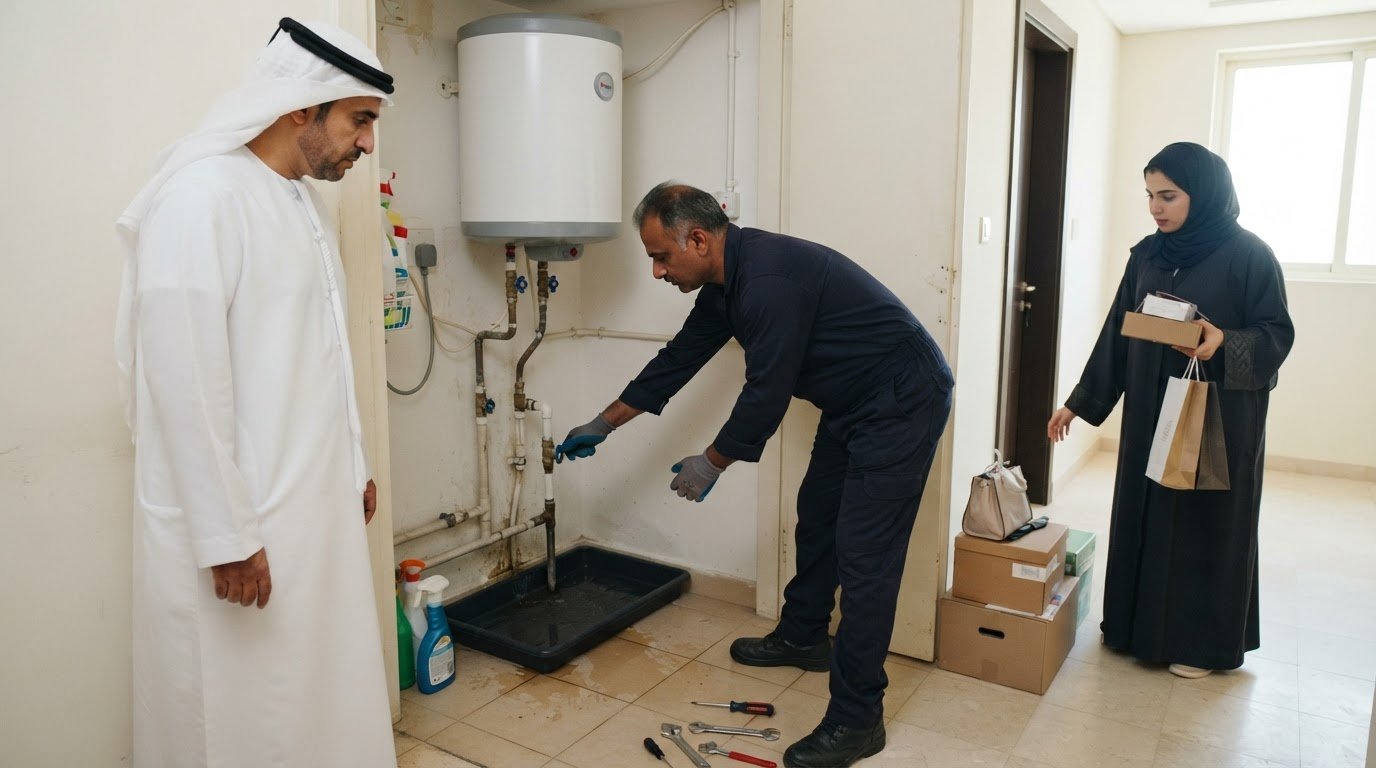
Rent rules across the UAE are not simply a matter of setting a payment date and enforcing it. A practical landlord guide to RERA laws in Dubai and nationwide starts with the tenancy contract and the legal notice process: Dubai Law No. (26) of 2007 regulates landlord-tenant relationships, and according to the Dubai Legislation Portal, a landlord may seek eviction for unpaid rent if the tenant has not paid within 30 days after receiving written notification.
As part of our national services at Takeem, landlords need to understand their responsibilities during a tenancy, how permitted rent increases are calculated, and what steps apply if a tenant does not pay or a landlord refuses rent. The right approach depends on the agreement and the rules that apply, so keep clear records and give proper notice. This landlord guide to RERA laws in Dubai explains key tenancy rules, landlord obligations, rent increases and payment disputes, helping you make informed decisions about what to do next.
Key Takeaways
- Understand which Dubai tenancy law governs your rental and how it shapes landlord and tenant responsibilities.
- Learn why a written tenancy contract and Ejari registration matter for a clear rental record.
- Use the rent-increase rules and rental index to understand whether an adjustment may be permitted.
- Know how payment terms, written notice and the dispute process can affect rent refusal or non-payment.
What Governs Your Rental According to Dubai Tenancy Law?
Dubai’s rental rules govern contracts, rent adjustments and disputes. Knowing which authority handles each issue helps landlords follow the correct process.
Dubai Rental Law and Regulatory Authorities
Dubai Law No. (26) of 2007 regulates landlord-tenant relationships in Dubai, according to the Dubai Legislation Portal. The Real Estate Regulatory Agency (RERA) oversees rental-law implementation, while the Rental Disputes Settlement Centre (RDC) handles rental disputes. Ejari is Dubai’s system for regulating rental agreements. These roles matter: registration records the rental agreement, and the RDC is the forum for disputes rather than the rental regulator.
Unpaid Rent Dispute Procedures
The RDC handles disputes when a landlord and tenant cannot resolve a rental issue directly. A landlord may seek eviction if the tenant fails to pay rent within 30 days after receiving written notification, according to the Dubai Legislation Portal. Keep the tenancy agreement, payment records and written notice together to clarify the amount and timeline in dispute. The RDC aims to expedite resolution, giving parties a formal route for addressing unpaid rent.
Smart Rental Index and Rent Increases
The Smart Rental Index is part of Dubai’s rent-adjustment framework, which also references Law No. 2 of 2011. It helps place proposed rent increases against an index average for comparable rentals. If the current rent is at or within 10% of the rental index average, a landlord cannot increase it. That threshold makes the current rent’s position against the index central to assessing an adjustment.
RERA Rental Index and Rent Calculator
The RERA Rental Index and calculator help assess whether a rent increase may be permitted. The calculator uses the property’s location, type, current rent and number of rooms to compare the rent with the relevant index average. A general impression of market rents is not enough to establish eligibility. Using details specific to the property gives landlords and tenants a clearer basis for discussing rent at renewal.
Landlord Obligations Dubai: What You’re On the Hook For?
Dubai landlords must follow the written tenancy agreement and applicable tenancy legislation. The rules cover registration, property condition, rent changes and valid notices.
Tenancy Contracts and Ejari Registration
A written tenancy contract records the agreed rental terms, while Ejari registration records the rental agreement. Under Article 4 of Law No. (26) of 2007, a tenancy contract makes the agreement official. Registration gives both parties a clearer record of the property, rent, and contract period. Ejari registration costs approximately د.إ220.
Landlord and Tenant Rights and Responsibilities
Landlords must provide a property fit for living in and handle structural and major repairs under Article 16 of Law No. (26) of 2007. Article 34 protects tenants from utility disconnection or lockouts during an active tenancy. Tenants must pay rent and utilities as agreed and maintain the property. Commercial tenants may face eviction if premises remain unoccupied for 30 consecutive days or 90 non-consecutive days in a year without valid reason, unless otherwise agreed.
Tenancy Legislation and Recent Changes
Law No. (33) of 2008 amended Dubai’s tenancy framework under Law No. (26) of 2007. Either party proposing contract amendments must give notice at least 90 days before expiry. Filing fees are one cost to consider when pursuing a rental dispute. Ejari registration and dispute filing are separate costs. A landlord who breaches tenancy obligations may face a rental dispute handled by the RDC.
Eviction, Renewal, and Ending Tenancies
For specified eviction grounds, landlords must give at least 12 months’ written notice before the eviction date. The notice must be served through a Notary Public or registered mail. A valid fixed-term contract cannot be ended unilaterally during its term unless both parties agree. If a tenant remains after expiry and the landlord doesn’t object, the lease renews for another year under the same terms. For rent administration, digital rent collection can help landlords accept monthly payments.
Decree No. 43 of 2013 and rent increases
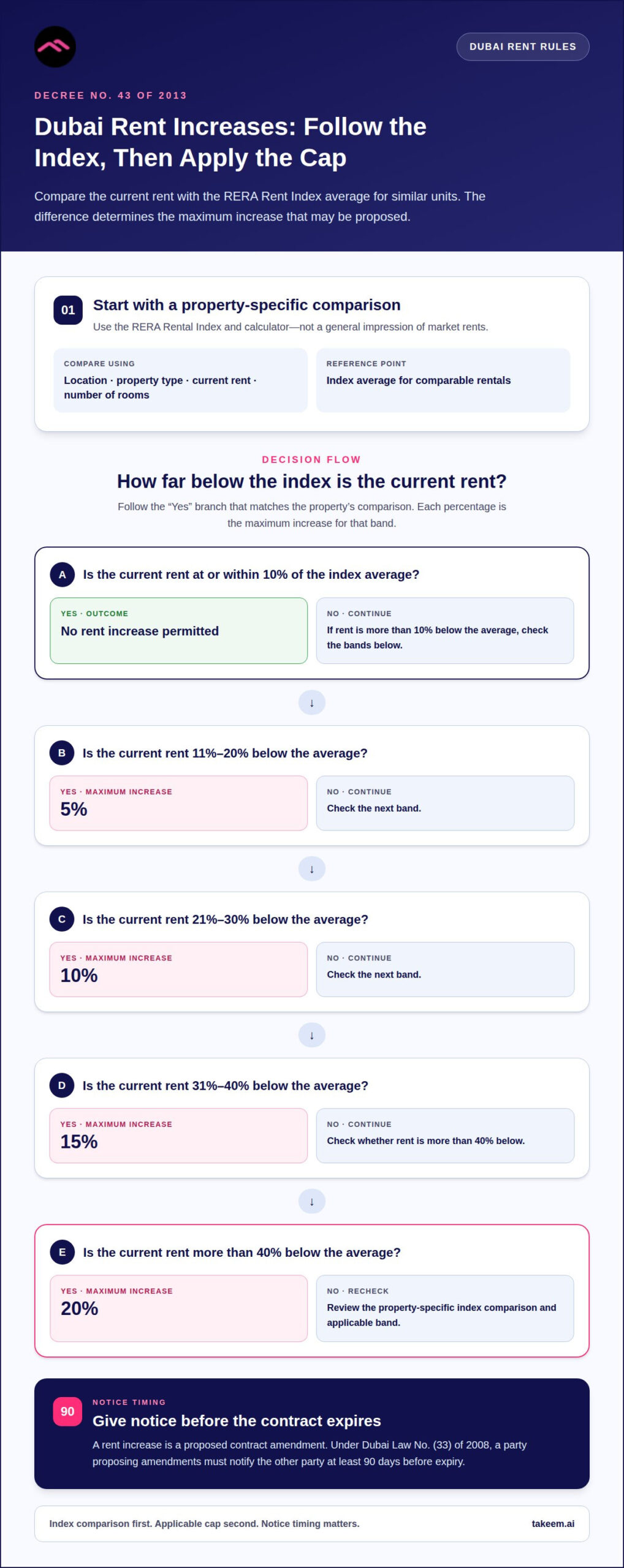
Dubai’s rent-increase rules link the permitted adjustment to how far the current rent is below the RERA Rent Index average. That difference sets the maximum increase a landlord may propose.
Decree-Based Rent Increase Rules
Dubai Decree No. 43 of 2013 sets maximum rent increases according to the difference between current rent and the index average for similar units. The bands limit how much landlords can propose at renewal, even when market asking rents have changed. For landlords and tenants, comparing the current rent with the relevant average is the starting point for understanding an adjustment, not simply choosing a new figure.
The applicable band depends on the percentage by which the current rent falls below the index average, and any proposed increase must stay within that band. Comparing the figures helps both parties discuss renewal terms and avoid proposing an amount above the permitted limit.
RERA Rent Index Bands
The bands set four maximum increases: 5% when rent is 11% to 20% below the average, 10% when it is 21% to 30% below, and 15% when it is 31% to 40% below. When current rent is more than 40% below the average, the maximum increase is 20%.
Apply the band to the difference from the comparable-unit average, not to a general estimate of real estate prices. For instance, a rent 25% below the average falls within the 10% maximum band. The comparison gives both parties a consistent basis for considering a renewal proposal.
Required Rent Increase Notice
A rent increase is a proposed contract amendment, so timing matters. Under Dubai Law No. (33) of 2008, a party proposing amendments must notify the other party at least 90 days before the contract expires. This gives landlords and tenants time to consider the change before renewal, rather than introducing it after the existing term ends.
A tenant has 30 days to respond to a proposed rent increase. Keep the proposal and response connected to the contract’s expiry date, so both parties can follow the notice timeline. The notice and response timelines serve different purposes: one concerns raising a proposed amendment, while the other gives the tenant time to answer.
Rent payment and refusal to accept rent
The tenancy agreement sets the payment schedule if it specifies rent dates and instalments. If it does not state payment dates, rent is payable in four equal instalments in advance each year. Keep the signed agreement and payment records together so you can establish the agreed dates and amounts if a dispute arises.
If a landlord refuses a payment, the parties may disagree about whether rent was offered or received. Record the date, amount and method of the attempted payment, along with any response. Keep messages, transfer records and other evidence. These details help distinguish non-payment from a dispute about accepting or processing rent.
If the parties cannot resolve the issue, the Rental Disputes Settlement Centre handles rental disputes in Dubai. Organise the contract, payment schedule, communications and payment evidence into a clear timeline. This provides a formal route to resolve the dispute instead of relying on informal exchanges. The Dubai Land Department lists the Centre as part of Dubai’s rental-dispute framework.
A filing fee may apply when a dispute is brought to the Centre. The usual fee is 3.5% of the disputed amount, subject to a minimum of د.إ500 and a cap of د.إ20,000. This is a dispute-filing cost, not a rent charge. Keep the disputed figure and supporting records clear when preparing the case.
For landlords, the practical takeaway is to make the contract’s payment terms clear and preserve evidence whenever rent is offered, received or refused. A documented record supports a more focused discussion and helps explain each party’s position if settlement is needed. To digitally accept recurring monthly tenant payments, set up Direct Debit for rent collection.
Takeem: Direct Debit setup for Landlords to digitally accept monthly payments from tenants
Takeem provides Direct Debit setup so landlords can accept monthly tenant payments digitally. It may suit landlords seeking a digital method for recurring rent collection alongside the payment terms in their tenancy agreement. Direct Debit setup supports collection but does not change the agreement, rent due dates or Dubai’s legal notice requirements. Those remain governed by the contract and applicable tenancy rules.
After setting clear payment terms and keeping accurate records, landlords can consider support for managing rental income. Takeem also offers a Landlord Rental Guarantee and a Rental Guarantee for Property Investors with Large property Portfolios. These are separate from Direct Debit setup.
To discuss Direct Debit setup for tenant payments, contact Takeem.
Make Your Next Rental Decision With Confidence
Use this landlord guide to RERA laws in Dubai as a reference when setting up your rental processes. Consider which parts of your operation need support, such as digital rent collection or rental income protection. Takeem offers a Landlord Rental Guarantee, a Rental Guarantee for Property Investors with Large property Portfolios, and a Landlord Rental Guarantee that Agents can sell for healthy commissions.
Each option addresses a different rental need, so consider what fits your role and portfolio. Clear payment arrangements and a suitable support model can help you approach landlord responsibilities with greater structure. For a conversation about your rental requirements, contact Takeem to discuss your rental.
Consider your rental priorities and take the next step that best fits them.
Frequently Asked Questions
RERA Rental Index: How Much You Can Charge?
The permitted increase depends on how far the current rent is below the average for comparable units. The maximum bands are 5%, 10%, 15% and 20%, with the applicable band determined by that gap. For a property-specific assessment, the rent calculator uses location, property type, current rent and number of rooms. Compare similar units before discussing a renewal figure.
What Are RERA Tenancy Laws?
Dubai tenancy rules govern the relationship between landlords and tenants, including contracts, property responsibilities, rent changes and disputes. A landlord guide to RERA laws in Dubai helps explain how Law No. (26) of 2007 and its amendment, Law No. (33) of 2008, apply. For example, proposed contract changes must be communicated before expiry within the required notice period. A written agreement clarifies each party’s obligations.
What Happens If a Tenant Doesn’t Pay Rent?
A landlord may seek eviction if rent remains unpaid 30 days after the tenant receives written notification. Keep the notice, tenancy agreement and payment history together to show the amount claimed and relevant dates. If the parties cannot resolve the disagreement, the Rental Disputes Settlement Centre handles rental disputes. A clear chronology helps distinguish missed payment from a delayed or disputed payment.
What is the difference between DLD and RERA?
The Dubai Land Department (DLD) established the Real Estate Regulatory Agency (RERA), which oversees the implementation of Dubai’s rental laws. RERA’s responsibilities include rental regulation and the rental index. Although their names are related, the DLD and RERA are different bodies. Understanding RERA’s regulatory role helps landlords distinguish oversight from the process for resolving a specific tenancy dispute.
What landlords must follow?
Landlords must meet their obligations under the tenancy contract and Dubai rental legislation. For example, Article 16 of Law No. (26) of 2007 makes landlords responsible for providing a property fit to live in and handling structural and major repairs. They must also follow applicable notice rules when proposing contract amendments or seeking eviction. Keep contract terms and formal communications consistent.
What should you do if there is a rent problem in Dubai?
First identify whether the issue concerns missed payment, refusal to accept rent or a disagreement about an increase. Gather the tenancy agreement, payment records and relevant written messages, then put the events in date order. This landlord guide to RERA laws in Dubai can help you understand the relevant rental process. If direct discussion does not resolve the matter, the Rental Disputes Settlement Centre handles disputes in Dubai.