You’ve just received that dreaded notification from the bank: “Insufficient Funds.” In the past, this meant a trip to the police station, but in 2026, the rules of the game have fundamentally changed. The shift from criminal penalties to civil enforcement has left many property owners feeling exposed and uncertain about their financial security. We understand the immediate stress that comes with a missed payment, especially when your own mortgage obligations don’t stop just because your tenant’s cash flow did. The anxiety of wondering what happens if a tenant’s cheque bounces in Dubai is a burden no landlord should have to carry in a modern market.
This guide will demystify the current legal framework, showing you exactly how to navigate the Rental Disputes Center to recover your funds quickly. You’ll discover how the law now treats cheques as enforceable instruments, allowing for faster debt recovery without lengthy court battles. More importantly, we’ll show you how to move beyond the bounced cheque headache entirely. We’ll preview how to leverage fintech solutions like digital Direct Debits and rental guarantees to ensure your income is protected, regardless of your tenant’s bank balance. It’s time to replace outdated paper risks with seamless, guaranteed digital stability.
Key Takeaways
- Learn how UAE regulations have shifted from criminal penalties to civil enforcement, transforming how you’ll recover unpaid rent in 2026.
- Understand exactly what happens if a tenant’s cheque bounces in Dubai, including the mandatory 30-day notice period and bank notification protocols.
- Discover how to use the Rental Dispute Centre to treat a returned cheque as an enforceable instrument for immediate asset attachment.
- Explore the transition to digital Direct Debits to automate your collections and remove the friction of physical cheque handling.
- See how a rental income guarantee can secure your cash flow by providing a protective shield against tenant defaults and payment delays.
Immediate Consequences of a Bounced Rent Cheque in the UAE
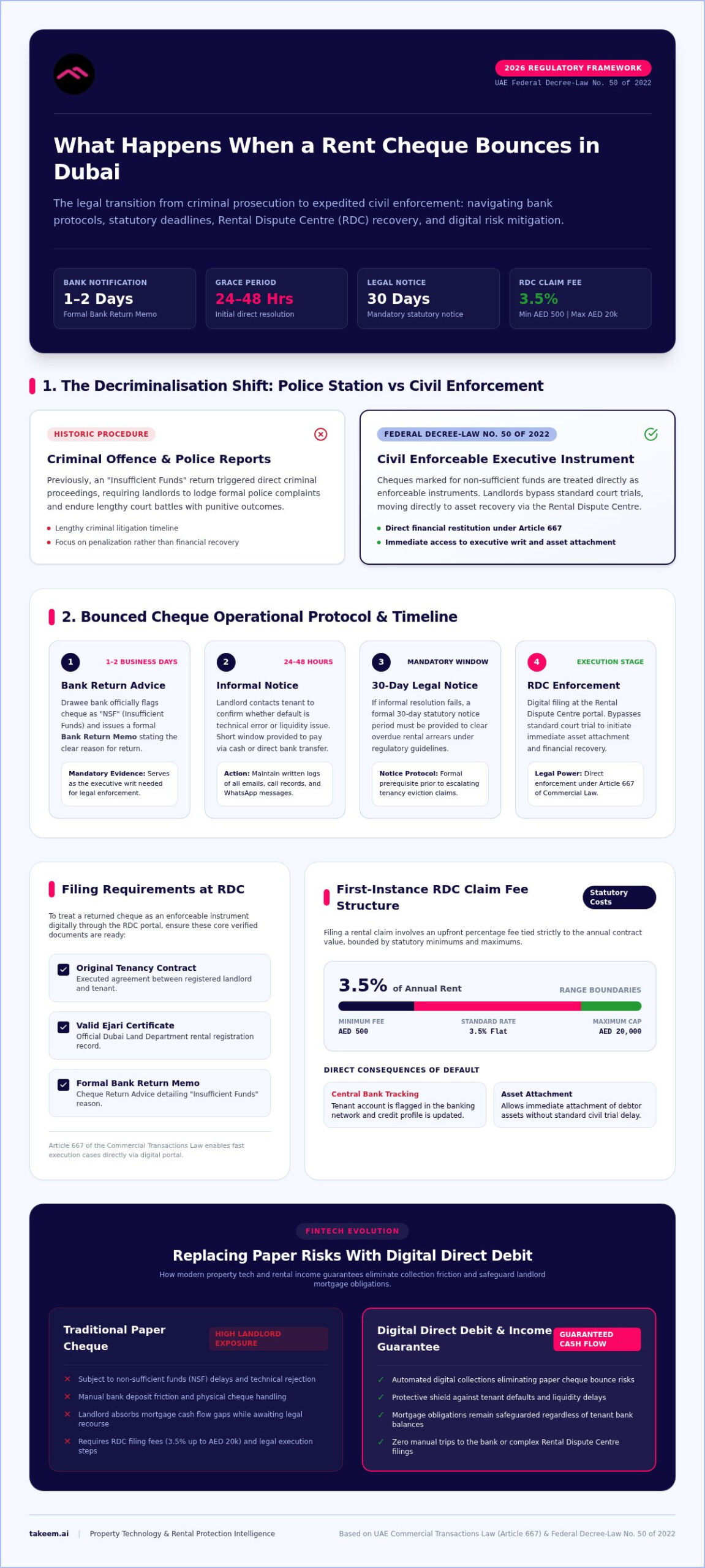
When a bank refuses to process a payment due to insufficient funds, the instrument is officially classified as a dishonoured cheque. Understanding what happens if a tenant’s cheque bounces in Dubai starts with recognizing that this isn’t just a missed deadline; it’s a financial trigger. Under Federal Decree-Law No. 50 of 2022, while the act of bouncing a cheque for non-sufficient funds is no longer an automatic criminal offense, it remains a serious civil matter. The moment the bank marks the cheque as “NSF,” a digital trail begins that impacts both parties immediately. This shift in the law means the focus has moved from police reports to direct financial recovery.
The Role of the Bank and Notification
Modern UAE banking systems are highly integrated with the Central Bank. When you present a rent cheque that can’t be cleared, the drawee bank is legally required to notify the bearer of the reason for rejection. This usually happens within one to two business days. The bank generates a formal “Cheque Return Advice” or “Bank Return Memo,” which serves as the primary legal evidence of the default. This document is the essential first step in the recovery process, as it transforms the paper cheque into an enforceable executive writ. Simultaneously, the bank logs the incident, which can lead to the tenant’s account being flagged and their credit profile being updated to reflect the default. For a landlord, this memo is your golden ticket to the Rental Disputes Center.
Initial Landlord-Tenant Communication
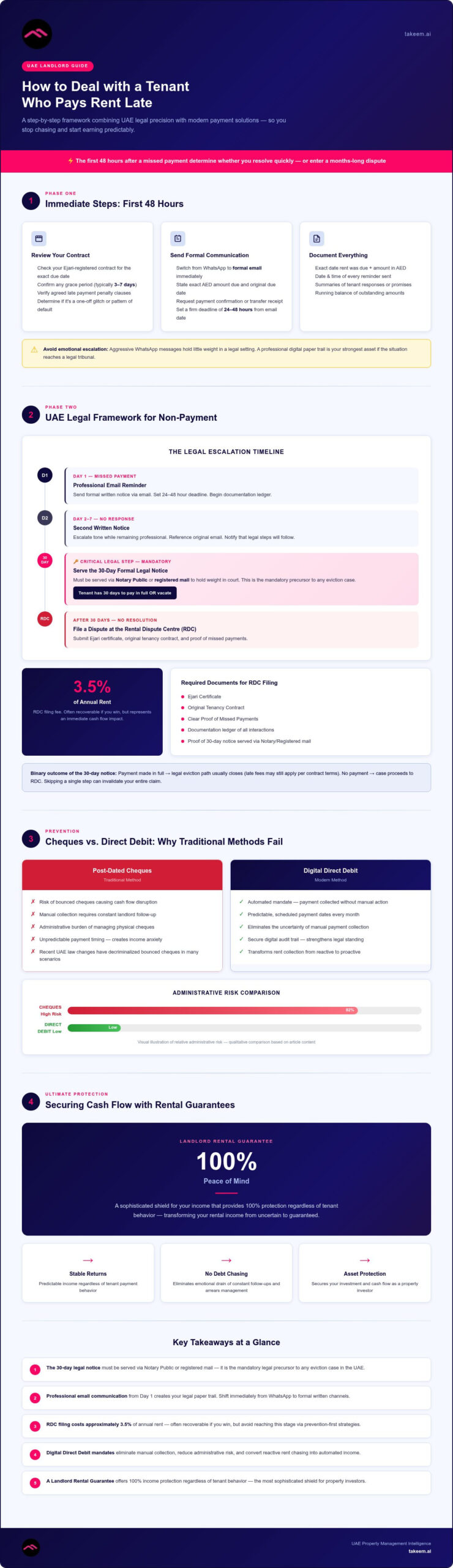
Your first move should be professional and proactive. Contact the tenant immediately to confirm if the bounce was a technical error or a genuine liquidity issue. It’s standard practice to offer a short grace period, typically 24 to 48 hours, for the tenant to provide the funds via bank transfer or cash. However, you must document every interaction. If the tenant doesn’t resolve the balance within this window, you’ll need to prepare for more formal steps. Keep a record of all emails, WhatsApp messages, and call logs. These records support your case if you eventually need to file a claim at the Rental Disputes Center. Clear, firm communication often resolves the issue before it escalates into a legal battle.
As a landlord, you have the right to demand a clear “Reason for Return” statement from the bank. This statement is vital for distinguishing between a simple balance issue and potential bad faith, such as a closed account or an intentionally altered signature. While these immediate consequences create significant stress, modern property technology is moving toward eliminating these manual hurdles. Transitioning to a digital Direct Debit setup or securing a Landlord Rental Guarantee provides a sophisticated shield, ensuring your cash flow remains steady even when a tenant’s bank account doesn’t cooperate.
The Path to Recovery: Legal Recourse and the Rental Dispute Centre
Recovering unpaid rent used to be a long, punitive process. Today, the focus has shifted toward speed and financial restoration. If you’re wondering what happens if a tenant’s cheque bounces in Dubai, the answer lies within the Rental Dispute Centre (RDC). Instead of starting a criminal case, you now leverage the cheque’s status as an enforceable executive instrument. This means you don’t necessarily have to sit through a months-long trial to get a judgment. You can go straight to enforcement. This shift ensures that landlords can pursue their funds with professional efficiency rather than waiting on criminal proceedings.
To begin the process, you’ll need a specific set of documents. Ensure you have your original tenancy contract, a valid Ejari certificate, and the formal bank return memo. These pieces of evidence allow you to file a claim digitally through the RDC portal. Filing a first-instance rental claim typically requires a fee of 3.5% of the annual rent, with a minimum of AED 500 and a cap of AED 20,000. While the legal system is robust, many landlords are choosing to avoid these hurdles entirely by switching to digital direct debit rent collection. This modern approach reduces the likelihood of ever needing to visit the RDC.
Filing an Execution Case
Under Article 667 of the Commercial Transactions Law, a bounced cheque with an “insufficient funds” certificate carries the power of a writ of execution. You can file an execution case directly. An execution judge can then issue orders to recover the debt without a full trial on the merits of the case. In 2026, these resolutions are faster than ever, often resulting in account garnishments or travel bans for the debtor within weeks. This streamlined path ensures your capital isn’t locked away in a legal vacuum for years. If you want to bypass this stress, consider a rental guarantee solution that keeps your income flowing while the legalities are handled in the background.
Eviction Procedures for Non-Payment
While recovering the money is one goal, regaining control of your property is another. To evict a tenant for non-payment, you must strictly follow Article 25 of the Dubai Tenancy Law. This requires serving a formal 30-day notice through a Notary Public or registered mail. If the tenant fails to pay within those 30 calendar days, the RDC can issue an eviction order. Stick to the legal framework to ensure your rights remain protected. Using the law correctly is the only way to secure your investment and maintain your reputation as a professional landlord.
Navigating the Decriminalisation of Cheques: What Landlords Must Know
The legal landscape for UAE property investors reached a turning point with the full implementation of Federal Decree-Law No. 50 of 2022. By 2026, the transition from criminal to civil enforcement is complete. Many owners still ask what happens if a tenant’s cheque bounces in Dubai now that jail time isn’t the standard penalty for insufficient funds. The reality is that the law has prioritized financial restitution over punitive measures. This shift allows you to focus on recovering your capital rather than navigating the criminal justice system. It’s a move toward a more commercial, efficient market that favors active recovery.
Understanding Civil vs. Criminal Liability
Under current Rental Dispute Centre (RDC) guidelines, criminal liability is strictly reserved for cases demonstrating fraud or bad faith. This includes instances where a tenant intentionally signs in a way that prevents clearance, closes an account before the cheque is presented, or issues a stop-payment order without a legal basis. For the vast majority of landlords, a default due to non-sufficient funds is now a civil matter. The cheque itself is now a writ of execution under UAE law, granting you the power to skip the trial phase and move directly to asset attachment. This streamlined mechanism is designed to settle debts without the delays of traditional litigation.
Mitigating Risk in a Decriminalised Market
Relying on paper cheques in a decriminalised market can feel like holding a false security. While civil enforcement is faster than it used to be, it still requires your time and legal fees to manage. Smart investors are shifting their focus from recovery to prevention. You can find detailed strategies for avoiding rental disputes in the UAE by adopting tech-driven verification and payment systems. The cost-benefit analysis of pursuing legal action often reveals that preventing a default is far more profitable than chasing one through the courts. Modern landlords are choosing tools that provide a protective shield before the bank even processes a payment.
None of these protections work effectively without a valid Ejari. A registered contract is your primary foundation for any legal claim in the UAE. Without it, you lack the standing to use the RDC’s streamlined execution services or verify what happens if a tenant’s cheque bounces in Dubai regarding your specific unit. Ensure your documentation is flawless and your tenancy is registered from day one. This proactive approach, combined with modern fintech solutions, ensures your portfolio remains resilient in a changing regulatory environment.
Transitioning to Secure Digital Rent Collection via Direct Debit
The UAE is rapidly moving away from the cumbersome era of paper cheques. For years, the market relied on physical booklets, but the rise of digital proptech has introduced a more stable alternative. Direct Debit systems, integrated with the UAE Central Bank’s UAEDDS, provide a level of oversight that physical instruments simply can’t match. You no longer need to store stacks of post-dated cheques in a safe or manually deposit them at a bank branch. Instead, the system handles the heavy lifting, providing real-time tracking and automated notifications for every transaction.
This technology changes the psychological dynamic between you and your tenant. When a payment is automated, it fosters a monthly subscription mindset similar to utility bills or gym memberships. This shift significantly reduces the likelihood of a default. Rather than asking what happens if a tenant’s cheque bounces in Dubai, you’re looking at a dashboard that confirms a successful transfer. If a payment fails, automated retries can be triggered instantly, often resolving the issue before you even realize there was a glitch in the tenant’s account balance.
The Benefits of Digital Monthly Payments
Moving to a monthly payment schedule through digital mandates improves tenant affordability. When tenants aren’t pressured to provide massive lump-sum payments via four cheques, their financial stress drops, and your risk of a total default decreases. This model creates a predictable cash flow that integrates seamlessly with modern financial management tools. You can view your entire portfolio’s performance at a glance and access funds without the typical three-day clearing wait. For a deeper look at this evolution, read our guide on Modernizing UAE Rentals: From Cheques to Direct Debit.
Setting Up a Direct Debit System
Transitioning to this system requires a digital mandate, authenticated through the tenant’s banking app or UAE Pass. This process aligns with the Central Bank’s UAEDDS and Noqodi payment gateways, ensuring your collections are legally robust and compliant with national standards. You don’t need a physical cheque book anymore; the digital mandate serves as the permanent authorization for the entire lease term. It’s a cleaner, more professional way to manage property assets in 2026. You can set up your digital rent collection today and eliminate the risks associated with traditional banking instruments.
The era of manual banking is closing. By adopting these fintech solutions, you’re not just avoiding a headache; you’re future-proofing your investment strategy. You gain a level of transparency that paper cheques could never provide, allowing you to focus on growing your portfolio rather than chasing payments. Secure, digital, and automated collection is the new standard for the sophisticated UAE landlord.
Eliminating Rental Risk with Takeem’s Income Guarantee
The ultimate goal for any property investor is to achieve passive income without the friction of administrative disputes. Instead of constantly worrying about what happens if a tenant’s cheque bounces in Dubai, modern landlords are shifting toward a model where income is promised, not just expected. Takeem’s Landlord Rental Guarantee represents this shift, moving the burden of default risk away from the owner and onto a sophisticated fintech platform. By doing so, you transform your property from a source of potential legal stress into a reliable financial asset. This isn’t just about collecting money; it’s about institutionalizing the security of your yield.
Why a Guarantee Beats a Cheque
Traditional cheques are reactive; they only tell you there’s a problem after the damage is already done. Even with the Rental Dispute Centre’s streamlined execution files, you’re still looking at weeks or months of legal uncertainty. A Landlord Rental Guarantee provides immediate cash flow stability. If a tenant defaults, the guarantee kicks in to cover the rent, ensuring your mortgage payments and reinvestment plans remain on track. This financial shield offers a level of security that no paper instrument can match. For a deeper dive into how these schemes function, consult The Definitive Guide to Landlord Rental Guarantees.
Proactive Asset Protection
True security goes beyond just the monthly rent. Takeem integrates income protection with an emergency property maintenance service to safeguard the physical value of your investment. This dual approach is especially valuable for property investors with large property portfolios who cannot afford to manage individual defaults or urgent repairs across dozens of units. With over 117,000 active units protected as of late 2026, the system is built to handle high-volume demands with calm efficiency. We manage the entire collection and default process, acting as a reliable facilitator that stays one step ahead of your needs.
Transitioning to a secure, cheque-free future means you’ll never have to ask what happens if a tenant’s cheque bounces in Dubai again. You gain the freedom to scale your portfolio with confidence, knowing that both your income and your assets are under a professional protective shield. It’s time to leave the uncertainty of 20th-century banking behind and embrace a modern, guaranteed approach to property investment.
Securing Your Financial Future in a Digital Market
The UAE property market has evolved into a sophisticated, civil-led landscape where financial recovery is prioritized over criminal punishment. While understanding what happens if a tenant’s cheque bounces in Dubai is essential for any property owner, the most successful investors are those who move beyond the risks of paper banking. You now have the tools to treat cheques as executive instruments for faster recovery, but the ultimate goal is to remove the possibility of default from your balance sheet entirely.
By transitioning to digital collection and institutional guarantees, you protect your cash flow from the unpredictability of human behavior. Takeem provides a comprehensive shield that includes guaranteed monthly payments regardless of tenant default and integrated emergency maintenance coverage. This seamless transition from paper cheques to Direct Debit ensures your portfolio remains resilient and profitable. Secure your rental income today with Takeem’s digital guarantee and enjoy the peace of mind that comes with a truly protected investment. Your path to a stress-free rental yield starts here.
Frequently Asked Questions
Is a bounced cheque still a criminal offence in the UAE in 2026?
No, a bounced cheque for insufficient funds is generally a civil matter in the UAE. Under Federal Decree-Law No. 50 of 2022, the legal system shifted toward commercial execution rather than police action. Criminal charges only apply if you can prove fraud, such as the tenant closing their account before the cheque was presented. For most landlords, the focus is now on civil recovery through the courts rather than criminal prosecution.
What is the first thing a landlord should do when a rent cheque bounces?
You must immediately request a formal Cheque Return Advice from your bank. This document serves as the primary evidence of default. Once you have this, contact your tenant to see if the issue was a technical error. If they don’t replace the funds within 24 to 48 hours, this memo allows you to proceed with a civil execution file to recover the debt through the proper channels.
Can I evict a tenant immediately if their cheque bounces?
Immediate eviction isn’t permitted under national tenancy laws. You’re required to serve a formal 30-day notice via the Notary Public or registered mail. If the tenant fails to pay within this period, you can then file an eviction case. Understanding what happens if a tenant’s cheque bounces in Dubai involves following these specific statutory timelines to ensure your legal rights remain fully protected during the dispute resolution process.
How long does the Rental Dispute Centre take to resolve a bounced cheque case?
Execution cases for returned cheques are significantly faster than traditional lawsuits. Since the cheque acts as a writ of execution, you can often receive an enforcement order within a few weeks. This process bypasses the trial phase, allowing a judge to order bank account freezes or travel bans quickly. It’s a highly efficient mechanism designed to restore your cash flow with minimal administrative delay compared to standard litigation.
What are the fees for filing a case at the Rental Dispute Centre?
Filing a standard rental claim at the Rental Dispute Centre costs 3.5% of the annual rent. This fee has a minimum of AED 500 and a maximum cap of AED 20,000. If you’re specifically filing for the execution of a bounced cheque, there are additional administrative costs for process service and electronic requests. These fees are a necessary investment to secure a legally binding recovery order and protect your investment yield.
How does Direct Debit help prevent rent payment defaults?
Direct Debit replaces the manual uncertainty of cheques with automated, digital mandates. It fosters a monthly payment mindset for tenants, which naturally reduces the risk of major defaults. The system provides real-time tracking and automated retries if a payment fails initially. This proactive approach eliminates the physical handling of post-dated cheques and aligns your rental collection with modern, national banking standards for maximum security and predictable cash flow.
Can I travel if I have a bounced cheque case against me as a tenant?
Yes, a tenant can face a travel ban if a landlord files an execution case for a bounced cheque. Once the court issues an execution order, the judge has the authority to impose travel restrictions until the debt is settled. This is one of the most effective civil tools available to ensure tenants take their financial obligations seriously. It remains a primary deterrent in the current national legal framework for debt recovery.
What is a rental guarantee and how does it protect my income?
A Landlord Rental Guarantee is a professional shield that ensures you receive your rent even if the tenant defaults. Takeem’s solution provides guaranteed monthly payments, effectively removing the risk of a bounced payment from your portfolio. It also includes emergency property maintenance coverage to protect your asset’s physical condition. This comprehensive service allows you to focus on portfolio growth while the platform manages the complexities of collection and default risk management.