
Tag: rental management

  • UAE Property Portfolio Rent Collection Guide 2026

    UAE Property Portfolio Rent Collection Guide 2026

    A rent payment isn’t fully under control just because it has arrived. Across several properties, due dates, payment records and follow-ups can quickly become scattered, making property portfolio rent collection harder to track and cash flow less predictable.

    If you manage payments across a portfolio, you need a clear view of what’s been collected, what’s outstanding and what needs attention. Repeating manual reminders each month takes time, while moving from post-dated cheques to digital monthly payments can feel like a major change. A consistent process can help you make that transition without losing visibility.

    This guide explains how to build a reliable rent collection workflow for your UAE properties, from setting up payment records to facilitating monthly Direct Debit collection. It also covers how to approach a transition from cheques and consider rental guarantees and emergency maintenance as part of a broader plan for rental income.

    Key Takeaways

    • Bring rent obligations, payment status and reconciled records into one portfolio-wide view so outstanding items are easier to identify.
    • Use a repeatable property portfolio rent collection workflow, with clear responsibility for records, reminders and reporting.
    • Compare cheques, Direct Debit and software-led tracking by their effect on payment administration, tenant steps and oversight.
    • Roll out a consistent process in stages: map properties, standardise records, pilot the workflow, then review it before expanding.
    • Consider digital monthly collection alongside rental guarantees and emergency maintenance when planning for more predictable rental income.

    Property portfolio rent collection: where fragmented processes create friction

    Property portfolio rent collection is the process of requesting, recording, monitoring and reconciling rent across multiple properties. It gives landlords a consistent way to track each payment obligation instead of relying on scattered reminders, bank records or memory. An effective process shows what was due, what arrived and what still needs attention.

    Rent collection is one part of a broader set of property responsibilities. Property management can also include maintenance, tenant relations and financial management, as outlined in this Property Management Overview. Rent collection focuses on the movement and recording of rental payments. It doesn’t replace broader property management, accounting or tenant administration, though accurate collection records can support those activities.

    What changes when rent collection spans multiple properties?

    Each property may have its own tenancy dates, payment arrangements and records. As the portfolio grows, landlords need to coordinate more due dates and check more sources to understand the overall position. For example, a payment noted in a message may never be entered in the main tracker. The rent may have arrived, but the portfolio overview still shows it as outstanding.

    A late payment is a specific exception to follow up. Repeatedly missing updates, unclear ownership of records or inconsistent tracking point to a process problem. Treating each delay as a one-off can leave the same administrative gap in place. A shared routine makes exceptions easier to spot and handle consistently.

    Which collection signals should a landlord be able to see?

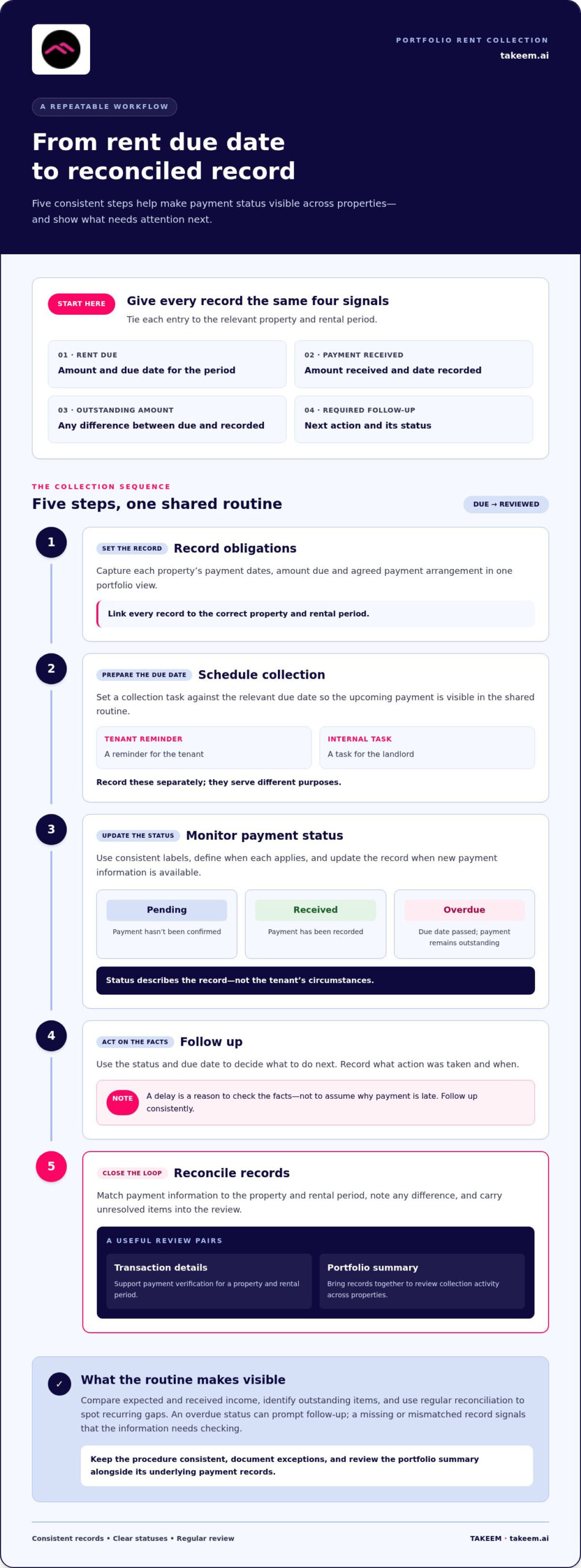
    For each property and tenancy, a useful record should answer four questions: what rent is due, what payment has been received, what amount remains outstanding and what follow-up is required. Tie each entry to the relevant property and payment period so you can review individual cases and the portfolio as a whole.

    • Rent due: the amount and due date recorded for the period.
    • Payment received: the amount received and the date it was recorded.
    • Outstanding amount: any difference between the amount due and the payment recorded.
    • Required follow-up: the next action and its status, such as a reminder to send or a payment to verify.

    Consistent records let landlords compare expected and received income, supporting cash flow planning without guaranteeing a particular outcome. The overview is only as reliable as its inputs. If a payment or follow-up isn’t recorded promptly, portfolio-level visibility can lag behind what has actually happened. Start with complete records and update them regularly.

    How a reliable property portfolio rent collection workflow operates

    A dependable workflow turns each tenancy’s payment terms into a repeatable sequence. For property portfolio rent collection, the goal isn’t simply to mark payments as received. It’s to move from the amount due to a reviewed, reconciled record, with a clear next step whenever a payment needs attention.

    1. Record obligations. Capture each property’s payment dates, amount due and agreed payment arrangement in one portfolio view. Tie each record to the correct property and rental period.
    2. Schedule collection. Set a collection task against the relevant due date. A tenant reminder and an internal task for the landlord serve different purposes, so record them separately.
    3. Monitor status. Use consistent labels such as pending, received and overdue. Define when each label applies, then update it when new payment information is available.
    4. Follow up. Use the status and due date to decide what to do next. Record what action was taken and when. Don’t assume the reason for a delay before speaking with the tenant.
    5. Reconcile records. Match payment information to the property and rental period, note any difference, and carry unresolved items into the review.

    These steps make exceptions visible, but don’t automatically resolve them. An overdue status can prompt timely follow-up, while a missing or mismatched record signals that the information needs checking. Keep the procedure consistent, with a documented exception where a tenancy’s agreed arrangement differs.

    From rent due date to payment-status review

    Bring tenancy payment dates into a shared calendar or tracker instead of managing each property through a separate routine. Use “pending” for a payment that hasn’t been confirmed, “received” once it has been recorded, and “overdue” when the due date has passed and the payment remains outstanding. These labels describe the record, not the tenant’s circumstances. Follow up based on the facts available.

    Why reconciliation and reporting matter as portfolios grow

    A transaction record captures an individual payment, including its property and rental period. A portfolio summary brings those records together to show collection activity across properties. Both are useful: transaction details support verification, while the summary helps landlords review the whole portfolio. Regular reconciliation can reveal recurring gaps, such as payments that take longer to record or follow-ups that remain open. Those patterns give landlords a practical basis for refining the workflow.

    Portfolio visibility depends on consistent payment records and regular review. Set a recurring review point, compare the portfolio summary with the underlying payment entries, and note any item that still needs action. For landlords introducing digital monthly collection, Direct Debit setup for landlords can form part of a consistent collection workflow.

    Cheques, Direct Debit, and rent collection software: compare the workflow

    These approaches address different parts of rent collection. Cheques are a payment method landlords coordinate and track. Direct Debit supports recurring digital collection, while rent collection software helps organise payment information. A landlord can use a payment method alongside a tracking tool, but neither a recordkeeping system nor a payment channel is the same as rental income protection.

    Approach Payment administration Visibility Tenant process Portfolio oversight
    Cheque-based collection Requires coordination of cheque dates and receipt records. Depends on recording cheque status and updating records consistently. Payment is made by cheque according to the agreed arrangement. Landlords bring separate property records together for a portfolio view.
    Digital Direct Debit Collection is organised digitally on a recurring basis. Payment information still needs to be reviewed and recorded clearly. Tenants follow a digital process to authorise collection. Consistent records help landlords review activity across properties.
    Software-led tracking Helps organise collection information; the payment method is separate. Can bring records into a structured view, depending on the tool and its setup. Doesn’t determine by itself how a tenant makes payment. Can support reporting, but accuracy depends on complete, updated inputs.

    No single approach suits every tenancy. An existing cheque arrangement may remain practical for some properties, while digital monthly collection may suit others. Treat the move as an operational choice: compare how each arrangement fits the tenancy, the records you need and the time required to administer it. For context on the transition, see this UAE guide to rental guarantees and Direct Debit.

    What changes when a landlord moves from cheques to digital monthly collection?

    The work shifts from tracking individual cheque dates and receipt updates to organising recurring digital collection and reviewing its status. Landlords still need a clear record for each tenancy and a defined follow-up process for exceptions. A gradual transition gives landlords and tenants time to adjust their routines without requiring every property to move at once.

    When does rent collection software help, and what does it not replace?

    Tracking tools can organise payment information and make portfolio reporting easier to review. They don’t collect rent or protect rental income by themselves. Takeem facilitates digital monthly collection through Direct Debit setup and provides rental guarantee services as a separate income-protection consideration. Landlords planning a digital workflow can explore Direct Debit setup for landlords as part of that decision.
    UAE Property Portfolio Rent Collection Guide 2026

    How to organise rent collection across a growing UAE property portfolio

    Adding properties can make an informal collection routine harder to maintain. A phased rollout lets landlords standardise the essentials, test the workflow and preserve a clear record as payment arrangements change. Start with the information you already have, then expand once the pilot process is working consistently.

    1. Map the portfolio. List every property and tenancy, including payment dates, current collection method, relevant records and known open payment items.
    2. Standardise the register. Use consistent property names, date formats and payment-status labels. This makes records easier to compare and reduces confusion when reviewing multiple tenancies.
    3. Select the workflow. Decide how payments will be collected, where records will be kept, who will update them and how exceptions will be followed up. Keep the process practical for the portfolio’s current arrangements.
    4. Pilot on a manageable subset. Test the workflow with properties that reflect the portfolio’s different payment arrangements. Use the pilot to identify unclear steps before expanding the process.
    5. Onboard and review. Explain payment-process changes to tenants, share required setup steps and keep existing records accessible. Review unresolved items and refine the workflow before applying it across the portfolio.

    For a broader investor perspective on organising income across properties, see these portfolio rental income strategies for UAE investors.

    Create a portfolio-wide collection register

    Include a property identifier, tenancy payment schedule, collection method, current payment status and a reference to supporting records. Assign responsibility for routine updates and exception follow-up, even if the landlord handles both. Define what each status means and record the date of each update, so another authorised person can understand an entry without relying on informal context.

    Introduce a new collection process without losing visibility

    Explain the payment process, timing and required setup steps clearly to tenants. During a transition, retain access to earlier records and distinguish existing arrangements from new ones in the register. Review the pilot at a set interval. Check incomplete entries, pending setup and unresolved payment items, then adjust instructions or responsibilities before a wider rollout.

    Regular review can show where the workflow needs attention, such as a recurring delay in recording a payment or a step tenants find unclear. Use these observations to make practical improvements without assuming every tenancy should follow an identical process. Landlords introducing digital monthly collection can explore Direct Debit setup for landlords as one part of their rollout plan.

    How Takeem supports portfolio rent collection and income protection

    A consistent collection process helps landlords track payment activity, but it addresses only one part of rental income planning. Takeem supports landlords and property investors across the UAE with Direct Debit setup for digital monthly rent collection, alongside rental guarantee services for individual landlords and large property portfolios. These services bring payment workflow and income protection into the same broader conversation without treating them as the same thing.

    With Direct Debit setup, landlords can digitally accept monthly payments from tenants. This provides a route from cheque-based routines to digital collection, while keeping the landlord’s own records and review process central. For a portfolio, consider this collection approach alongside each property’s payment arrangements rather than assuming one workflow automatically fits every tenancy.

    Connecting digital collection with rental income protection

    Digital collection concerns how monthly payments are accepted. A rental guarantee addresses a different landlord concern: rental income protection under the service’s terms. Those terms govern the protection, so landlords should consider them separately from the steps involved in setting up collection. Don’t assume a payment delay or property issue receives identical treatment in every case.

    Emergency property maintenance is included as part of Takeem’s rental guarantee service. It’s a relevant consideration for landlords weighing income protection and property-related support together, but it isn’t a rent tracking feature or a substitute for clear payment records. The landlord rental guarantee guide offers further context on how guarantees fit into a landlord’s planning.

    A clear next step for landlords and property investors

    Before choosing a new approach to property portfolio rent collection, bring together a few essentials. A concise overview helps clarify what you need from monthly collection and what you want to protect across the portfolio:

    • Property count and tenancy mix: note the properties involved and any differences in payment arrangements.
    • Current payment process: identify how rent is accepted and where payment records are maintained.
    • Portfolio priorities: decide whether your focus is digital monthly collection, rental income protection or both.

    This preparation gives landlords and investors a clearer basis for considering how Direct Debit setup and rental guarantee support may fit their needs. Takeem’s services connect digital collection with a broader approach to rental income, with emergency property maintenance included as part of the rental guarantee service. Explore Takeem’s portfolio rent collection and protection approach to consider the next step for your portfolio.

    Make your next collection step deliberate

    Your next move doesn’t need to change every tenancy at once. Choose one improvement that fits your portfolio’s current priorities, assign it an owner and set a review point. That could mean making records easier to maintain, introducing digital monthly collection or considering how income protection fits your wider investment plan.

    Takeem facilitates digital monthly rent collection through Direct Debit setup and provides rental guarantee services for individual landlords and investors with large portfolios. Emergency property maintenance is included as part of the rental guarantee service. These options let landlords consider payment workflow and protection as related, but distinct, parts of their approach to rental income.

    Use your portfolio’s size, existing payment arrangements and priorities to decide what a practical next step looks like. A more deliberate property portfolio rent collection process can begin with one clear change and grow as your needs evolve.

    Explore Takeem’s digital rent collection and rental guarantee support to take the next step for your portfolio.

    Frequently Asked Questions

    How can I collect rent across multiple properties more efficiently?

    Use one repeatable process across your properties while preserving each tenancy’s specific payment arrangement. For example, align collection reviews with a regular weekly or monthly routine instead of checking each property only when a due date comes to mind. A central portfolio view can help you spot unresolved items, and a consistent process makes property portfolio rent collection easier to oversee as you add properties.

    Can landlords in the UAE collect rent through Direct Debit?

    Yes. Landlords can use Direct Debit setup to accept digital monthly rent payments from tenants. It offers an alternative to coordinating post-dated cheques, with the tenant and landlord following the relevant setup process. Takeem facilitates this transition for landlords. As with any payment method, keep a clear record of what was expected and what was received so you can review collection activity.

    Is rent collection software the same as rental income protection?

    No. Rent collection software organises payment information and related records, while rental income protection is a separate service with its own terms. A tracker may help you identify a payment that needs follow-up, but it doesn’t protect income if rent is missed. Consider each need separately: operational visibility on one side, and the protection offered under a rental guarantee’s terms on the other.

    What should a property portfolio rent collection tracker include?

    Alongside payment status, include a property reference, tenancy period, agreed collection method, due date, amount expected, amount recorded and the source or date of the latest update. A notes field can capture a discrepancy, such as a payment that appears in a bank record but hasn’t yet been matched to a tenancy. These details make reviews more useful and help distinguish missing information from an unpaid amount.

    How do I move tenants from cheque-based rent payments to digital collection?

    Plan the change tenancy by tenancy. Explain what is changing, when the new process is intended to begin and what setup action the tenant needs to complete. Keep the existing arrangement and its records visible until the digital process is established, so the transition doesn’t create a gap in your tracking. Provide a clear way to raise setup questions, then record the transition status for each tenancy.

    Does a rent guarantee service manage my property portfolio?

    No. A rental guarantee service and property management are different. A guarantee relates to rental income protection under its terms. Property management can include broader operational responsibilities for a property. Takeem provides rental guarantee services for individual landlords and investors with large portfolios, but the guarantee doesn’t replace a landlord’s wider property or tenant administration responsibilities.

    How can landlords protect a rental portfolio from missed payments?

    Combine accurate payment records and a defined follow-up routine with a separate review of rental income protection. If a payment is missed, document the amount, tenancy period and communication so the situation can be assessed using accurate information. Takeem’s rental guarantee service is one option for landlords and investors to consider. The applicable terms determine the protection, so don’t assume every delay is treated identically.

  • Building a Positive Landlord-Tenant Relationship: A Practical Guide

    Building a Positive Landlord-Tenant Relationship: A Practical Guide

    What if the best way to avoid rental disputes is to make expectations clear before a problem arises? Building a positive landlord-tenant relationship doesn’t mean agreeing on everything. It means setting out responsibilities, communicating early, and handling concerns fairly so small misunderstandings are less likely to grow.

    That matters in the UAE, where landlords and tenants need a dependable rental experience while respecting the tenancy agreement and applicable requirements in the relevant emirate. If responsibilities are unclear or maintenance concerns are raised only after frustration builds, cooperation can quickly become difficult. A calm, consistent process helps both sides understand what to expect and what to do next.

    This guide covers practical ways to clarify expectations, choose communication habits, and document rent, maintenance requests, and other concerns. It also explains how to be cooperative while keeping formal tenancy obligations clear. Predictable rent collection can support a smoother tenancy, too. Takeem helps landlords collect monthly rent digitally through Direct Debit, and emergency property maintenance is included in its rental guarantee service. These tools can support reliable processes alongside respectful communication.

    Key Takeaways

    • Building a positive landlord-tenant relationship starts with setting out responsibilities and communication expectations clearly.
    • Keep messages concise and factual, including the issue, relevant timing, and requested next step.
    • Be cooperative without treating informal conversations as changes to agreed tenancy terms.
    • When concerns arise, follow a fair process: review the agreement, communicate, document the issue, and agree on next steps.
    • Direct Debit rent collection and emergency maintenance included in Takeem’s rental guarantee service can support more dependable tenancy processes.

    Why building a positive landlord-tenant relationship starts with clear expectations

    A tenancy runs more smoothly when both parties understand how everyday matters will be handled. Respectful communication helps, but goodwill alone can’t settle questions about rent payments, repairs, access, or how to raise a concern. Clear expectations give each person a practical reference point before uncertainty turns into frustration.

    Cooperation is valuable, but it shouldn’t require either party to set aside a legitimate concern. A tenant should be able to report an issue clearly, and a landlord should be able to explain a decision respectfully. Building a positive landlord-tenant relationship means making room for both considerate interactions and appropriate boundaries.

    What does a healthy landlord-tenant relationship look like?

    Trust shows up in everyday actions: updates arrive when expected, important details are recorded, and questions are discussed without personal attacks. The relationship can remain professional; neither person needs to become a friend. A positive rental relationship is one where both parties communicate respectfully, follow agreed processes, and address concerns with clear information.

    Predictability matters as much as warmth. If each person knows where to send a maintenance concern and what information to include, it’s easier to respond constructively. Keeping a clear record of key messages also helps both sides refer to the same facts instead of relying on different recollections.

    Why expectations matter from the start

    Assumptions can create friction even when both people are acting in good faith. A tenant may expect to report a repair by phone, while the landlord expects a written message. One person may think a payment has been received, while the other is waiting for confirmation. Agreeing on practical communication habits early can prevent these avoidable misunderstandings.

    Review the tenancy agreement and clarify everyday details that may not be obvious. For example, discuss how payment records will be shared, where repair requests should go, and how updates will be provided if a resolution takes time. These conversations don’t replace the agreement. They help both parties understand how to apply it in day-to-day situations.

    • Payments: Confirm the agreed payment method and how receipt or a query will be communicated.
    • Repairs: Clarify how to describe a problem, share relevant details, and receive progress updates.
    • Contact: Agree on a suitable channel for routine messages and a reasonable approach to response times.

    These are shared points to clarify, not reasons to assume one side is at fault. A brief conversation before an issue arises can make it easier to discuss the facts calmly if plans or expectations differ later.

    Rental relationships also operate within formal tenancy obligations. The Landlord-tenant law overview provides general background on the rights and duties involved, but it isn’t UAE-specific legal advice. Requirements can vary by emirate, so treat this guidance as a communication framework and check the current rules that apply in the relevant emirate when legal questions arise.

    Use consistent communication to build trust during a tenancy

    Once the tenancy is underway, trust grows through reliable interactions, not just good intentions. Landlords and tenants can agree on a suitable channel for routine messages, such as email or a messaging platform, and clarify what a reasonable response looks like. The right rhythm depends on the issue, but both parties benefit from knowing where a message should go and when to follow up.

    How should landlords and tenants raise concerns?

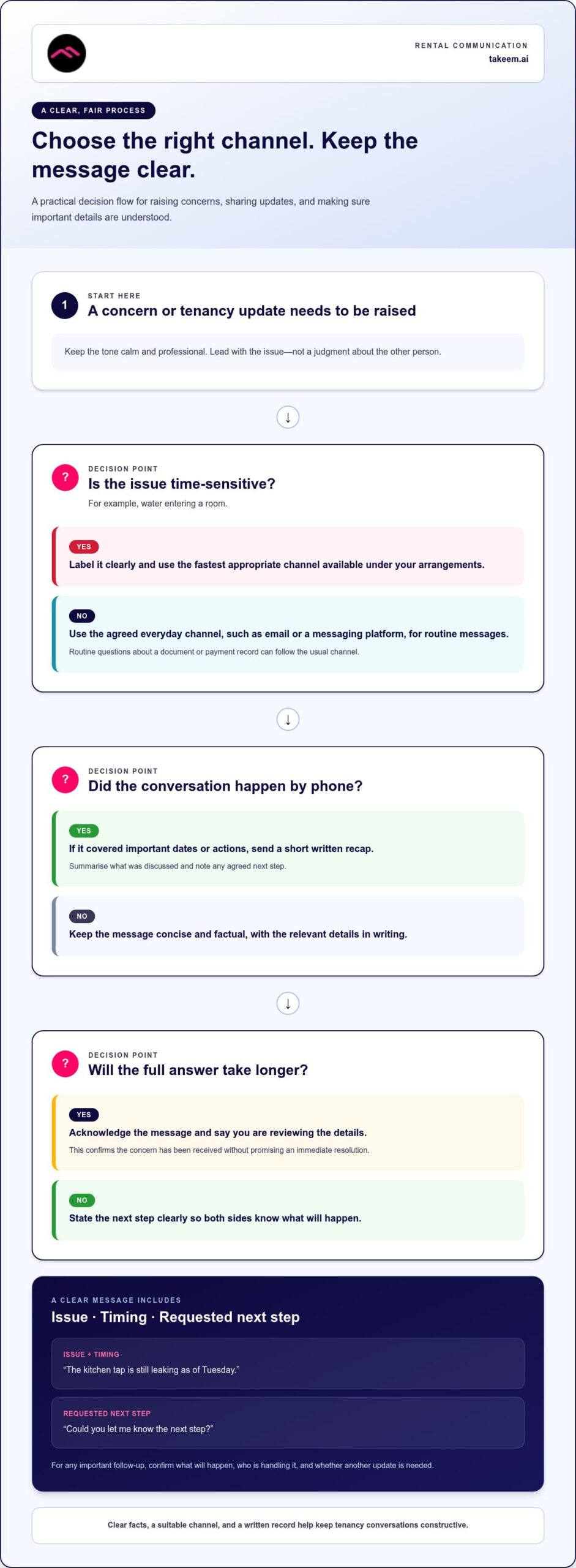
    Lead with the specific issue, not a judgment about the other person. Instead of “You never deal with repairs,” a tenant could write, “The kitchen tap is still leaking as of Tuesday. Could you let me know the next step?” This gives the recipient useful facts and a clear request. A landlord raising a payment query can identify the relevant payment period and ask for clarification without assuming why a payment appears delayed.

    For conversations involving dates, responsibilities, or agreed actions, a calm written follow-up can prevent different recollections later. Keep it brief: summarise what was discussed, note any agreed next step, and invite correction if anything has been misunderstood. Confirm the same basic points before moving forward: what will happen, who is handling it, and whether another update is needed.

    A quick acknowledgement also matters when the full answer will take longer. A message such as “I’ve received your note and am reviewing the details” confirms that the concern hasn’t been missed. It doesn’t promise an immediate resolution; it lets the other person know the conversation is active.

    Set a practical communication rhythm

    Not every message needs the same level of urgency. A routine question about a document or payment record can usually follow the agreed everyday channel. A time-sensitive issue, such as water entering a room, should be clearly labelled and raised through the fastest appropriate channel available under the parties’ arrangements. If a conversation happens by phone, send a short written recap when it covers important dates or actions.

    Agree how routine tenancy updates will be shared, including payment confirmations, repair progress, or changes to a planned visit. Keep updates factual, and avoid sending repeated messages across several channels unless the issue genuinely needs escalation. For rent collection, a consistent digital process can make payment records easier to follow. Takeem’s guide to rental guarantees and Direct Debit explains how digital monthly rent collection can replace post-dated cheques.

    Timely, specific communication turns uncertainty into a clear next step. These habits support building a positive landlord-tenant relationship without requiring constant contact or agreement on every issue. Landlords can also use Takeem’s rental guarantee and Direct Debit options to support structured rent collection alongside direct, respectful communication.

    Balance cooperation with clear boundaries and tenancy responsibilities

    A constructive tenancy needs both goodwill and clarity. Flexibility can help the parties handle a practical change, such as agreeing on a different time for a planned visit. But a friendly discussion doesn’t automatically change the tenancy agreement or replace applicable requirements. Clear boundaries make cooperation safer: each person can be considerate while still understanding what has been agreed.

    For formal responsibilities, refer to the tenancy agreement and the current requirements that apply in the relevant UAE emirate. Rules can differ, and a general relationship guide can’t determine the outcome of a specific dispute. If you need an interpretation of your obligations or advice about a disagreement, seek guidance from a qualified legal professional.

    How can both parties maintain fair boundaries?

    Coordinate tenancy-related arrangements respectfully. Give reasonable notice where appropriate, explain the purpose of a request, and allow time to discuss practical constraints. If a request feels difficult to accommodate, describe the concern and refer to the relevant agreement or requirement. For example: “That timing doesn’t work for me. Can we discuss another option that fits the agreed arrangements?” This invites a solution without threats or personal criticism.

    Courtesy supports a working relationship, but it shouldn’t be mistaken for consent to change agreed terms. If both parties want to adjust an arrangement, state what they understand the change to be and record any agreement clearly. For formal changes or disputed interpretations, check the applicable rules and seek qualified legal guidance as needed.

    Keep records without making communication adversarial

    Keeping relevant messages, agreed actions, and payment records is a practical habit, not a signal of distrust. Clear documentation helps both parties track what was discussed, what remains outstanding, and what follow-up is expected. It can also reduce reliance on memory if circumstances change or the same issue comes up again.

    Keep records focused and organised. Save messages about important arrangements, note agreed actions and dates, and retain relevant rent payment confirmations. Avoid turning every casual exchange into a formal notice; record what matters to the tenancy. These suggestions are general organisational guidance, not a statement about legal evidence requirements. For a dispute, ask a qualified legal professional what records and steps are relevant.

    The distinction between constructive flexibility and assumed changes is simple: discuss, clarify, and record rather than relying on an unspoken understanding. The table below shows how that difference can play out in everyday situations.

    Constructive flexibility Unclear or assumed change
    Both parties discuss a proposed adjustment and confirm what they’ve agreed. One party treats a friendly conversation as approval to change an agreed term.
    A request includes context and allows time to coordinate a practical response. A request is treated as an instruction, without considering the agreement or relevant requirements.
    Important decisions and payment details are recorded for easy reference. Each person relies on a different recollection of what was said or paid.

    These habits support building a positive landlord-tenant relationship because they protect mutual respect without blurring responsibilities. A clear record and a courteous conversation work together: one preserves the facts, while the other keeps the next step constructive.

    Building a Positive Landlord-Tenant Relationship: A Practical Guide

    Follow a fair process when rent, repairs, or disagreements arise

    A concern is easier to address when both parties work from the same facts. Rather than reacting to an assumption or letting frustration build, use a consistent process to understand the issue, check the relevant agreement, and agree on a practical next step. This keeps the discussion focused on resolution without overlooking either person’s concerns.

    What to do when a concern first comes up

    Start by describing what happened, when it happened, and what part of the tenancy agreement may be relevant. Give the other person a chance to share their understanding before deciding who is responsible. Then set a clear next action, including who will follow up and when an update is expected. Avoid blame until the facts and responsibilities are understood.

    1. Identify the issue. State the concern in plain, specific terms and include relevant dates or records.
    2. Check the agreement. Review the section that may relate to the payment, repair, or arrangement, and consider applicable requirements in the relevant emirate.
    3. Communicate calmly. Explain what you understand and invite the other party to clarify any missing details.
    4. Document the discussion. Keep a concise record of the concern, relevant responses, and any agreed actions.
    5. Agree on next steps. Confirm who will do what and how progress or completion will be communicated.

    The details will vary by situation. If a rent payment appears outstanding, the tenant can share the payment date and available confirmation, while the landlord checks the relevant records before following up. For a maintenance concern, describe the affected area, when the issue began, and any changes observed. Record updates and agreed actions. If there’s a misunderstanding about an arrangement, each person can refer to the relevant message or agreement and state what they understood before deciding how to proceed.

    Make rent and maintenance processes predictable

    Clear payment expectations and respectful early communication can prevent a question from becoming an avoidable conflict. If a payment record seems incorrect, raise the query promptly with the relevant details rather than making assumptions. Likewise, document a maintenance report and subsequent updates so both parties can track what has been discussed and what remains to be done.

    Predictable processes reduce avoidable tenancy friction by making responsibilities and next steps easier to see. Direct Debit rent collection can support a consistent payment process, while emergency property maintenance is included as part of Takeem’s rental guarantee service. These are process supports, not substitutes for respectful communication or legal advice. For additional practical guidance, see guidance on avoiding rental disputes.

    If a concern remains unresolved, involves formal obligations, or requires interpreting the agreement, the parties may need qualified legal advice or an appropriate dispute-resolution channel in the relevant emirate. The right route depends on the circumstances, and no informal process can promise a particular outcome. To add structure to rent collection and tenancy processes, explore Takeem’s rental guarantee options.

    Create a more dependable rental experience with clear processes

    A dependable tenancy isn’t built on goodwill alone. Clear expectations help both parties understand what to do, consistent updates keep important information moving, and fair processes give concerns a practical path forward. Together, these habits make everyday interactions more predictable without suggesting that every disagreement can be avoided.

    That structure matters for rent and maintenance, where uncertainty about timing or follow-up can create extra friction. A clear payment process helps both parties understand how rent is collected and how records are checked. A clear maintenance process helps ensure a reported issue and its updates are easier to track. Both still rely on respectful communication and attention to the tenancy agreement.

    Where digital rent collection fits

    Landlords can use Direct Debit to collect monthly rent digitally rather than relying on post-dated cheques. A consistent method can make payment timing and records easier to follow, giving both parties a clearer basis for raising or resolving a query. If a payment appears different from what either party expects, they can refer to the relevant records and discuss the facts.

    Digital collection is one useful process, not a substitute for a respectful conversation. It doesn’t independently prevent disputes or guarantee tenant satisfaction. It can support clearer payment routines when expectations are understood and questions are raised constructively. Takeem provides landlords and property investors across the UAE with rental guarantees and digital rent collection through Direct Debit. Emergency property maintenance is included as part of its rental guarantee service.

    For landlords considering how a rental guarantee may fit into their plans, this guide to rental income guarantees offers focused information on the topic.

    Turn good intentions into repeatable habits

    Agree on practical routines and revisit them if they stop working. That might mean confirming the channel for tenancy updates, keeping payment records in an accessible format, and deciding how either party will follow up on an unresolved issue. The goal isn’t to create extra formality. It’s to make the next step clear before a small concern becomes a larger source of frustration.

    Both parties can also make space for a brief check-in when a recurring point causes confusion. Is a payment confirmation easy to understand? Are maintenance updates reaching the right person? Does each side know who is following up? Raise concerns early and focus on a workable adjustment, while keeping formal obligations tied to the agreement and applicable requirements.

    Building a positive landlord-tenant relationship depends on repeatable actions, not a promise that every interaction will be smooth. Clear processes support the relationship; courtesy and open communication give those processes a human touch. Landlords exploring practical support can explore Takeem’s rental solutions, including rental guarantees, Direct Debit rent collection, and emergency maintenance included with its rental guarantee service.

    Make your next tenancy more dependable

    Building a positive landlord-tenant relationship is an ongoing practice, shaped by how both parties handle the next question, request, or unexpected change. A useful next step is to turn good intentions into a few simple shared habits: clarify how updates will be handled, raise concerns early, and check that agreed actions have been completed. Small, steady improvements can make a tenancy feel more predictable without requiring either party to ignore a valid concern.

    Landlords can also consider where practical support could make rental routines easier to manage. Takeem facilitates digital monthly rent collection through Direct Debit, and emergency property maintenance is included as part of its rental guarantee service. These tools support tenancy processes, while clear communication and applicable obligations remain important.

    Explore the options available for your rental needs and choose a next step that fits your approach to dependable tenancies. Explore Takeem’s rental solutions for landlords. With clear processes and respectful communication, both parties can move forward with greater confidence.

    Frequently Asked Questions

    How often should a landlord communicate with a tenant?

    There’s no single schedule that suits every tenancy. Agree on routine check-ins and communicate whenever an update or decision is needed. For example, a landlord might share a brief update after a repair visit, while a tenant can flag a change that affects an agreed arrangement. The aim of building a positive landlord-tenant relationship isn’t constant messaging. It’s keeping each other informed at useful moments.

    Should landlords and tenants communicate in writing?

    Written communication is useful for messages that involve dates, payment questions, repair updates, or agreed actions. A quick call may help clarify a point, but a short follow-up message can confirm what each person understood. For example, after discussing a repair visit, recap the agreed timing and any preparation needed. Use the channel both parties have agreed on, and keep important messages clear and relevant.

    What should a landlord do if a tenant raises a complaint?

    A landlord should acknowledge the concern, gather relevant details, and consider the agreement and circumstances before deciding on a response. If a tenant reports persistent noise, for instance, ask for the dates and times rather than dismissing the concern or blaming a neighbour immediately. Explain what will happen next, or why more information is needed. If the issue involves legal interpretation or remains unresolved, seek qualified guidance.

    How can a tenant raise a problem without damaging the relationship?

    Raise the issue calmly, describe what happened, and make a specific request. For example: “The bedroom window won’t close fully, and I noticed it on Monday. Could you advise on the next step?” This gives the landlord useful information without making a personal accusation. If the issue is sensitive, choose a private, appropriate channel and keep the message focused on resolving the problem rather than assigning blame.

    What records should landlords and tenants keep?

    Keep copies of the signed tenancy agreement, relevant payment confirmations, and messages about important arrangements. For maintenance, retain the original report and meaningful updates, such as a revised appointment or confirmation that work was completed. A simple folder organised by date can make details easier to retrieve during follow-up. Store records securely and remember that this practical habit doesn’t determine what may be required in a formal dispute.

    Do landlord-tenant rules apply the same way across the UAE?

    Don’t assume that the same tenancy rules or procedures apply identically in every emirate. For a question about a notice, responsibility, or dispute process, identify which emirate’s requirements are relevant and consult current official guidance or a qualified legal professional. General relationship advice can help parties communicate constructively, but it can’t settle a legal interpretation or replace advice tailored to the tenancy and its circumstances.

    Can Direct Debit help improve the landlord-tenant relationship?

    Direct Debit can give landlords a digital way to collect monthly rent instead of relying on post-dated cheques. A consistent payment method may make it easier for both parties to understand the collection process and discuss a payment query using clear records. Takeem facilitates Direct Debit rent collection for landlords. It can support a more orderly routine, but it doesn’t replace respectful communication or guarantee a dispute-free tenancy.

  • How to Choose Reliable Tenants: A Fair, Evidence-Based Screening Process

    How to Choose Reliable Tenants: A Fair, Evidence-Based Screening Process

    What if the strongest rental applicant isn’t the one with the neatest paperwork? If you’re wondering how to choose reliable tenants, it’s understandable to focus on the risk of late or missed rent. A more confident decision comes from weighing relevant evidence consistently, not searching for a risk-free applicant.

    A clear process helps you compare applications fairly, recognise strengths, and follow up when information is missing or unclear. This guide explains how to set consistent criteria, review details such as rental history and ability to meet the rent, and verify information appropriately. You’ll also learn why a gap deserves a follow-up question rather than an automatic rejection.

    Screening is one part of managing rental risk, not a guarantee of what will happen after move-in. Once you’ve selected a tenant, practical payment processes and rental income protection can complement your decision. In the UAE, Takeem supports landlords with digital monthly rent collection through Direct Debit and rental guarantees, with emergency property maintenance included in its guarantee service.

    Key Takeaways

    • Learn how to choose reliable tenants by assessing applicants against clear, relevant criteria rather than relying on first impressions.
    • Set out requirements and requested documents before reviewing applications, then use the same verification steps for each applicant.
    • Compare evidence, follow-up needs, and assessment notes so different circumstances don’t lead to unfair comparisons.
    • Use neutral follow-up questions to clarify gaps, and base your decision on the complete application rather than expecting a flawless applicant.
    • After selection, use clear tenancy terms, consistent payment processes, and organised records to support practical rental expectations.

    Why choosing reliable tenants takes more than a good first impression

    A tenancy decision can affect your rental cash flow, the care your property receives, and the working relationship you build with the person living there. A friendly conversation may feel reassuring, but it can’t show the whole picture. Nor can a polished application tell you on its own how a tenancy will unfold.

    When considering how to choose reliable tenants, assess whether relevant information supports an applicant’s ability and willingness to meet the agreed obligations. Screening helps you estimate risk; it can’t predict every future event or guarantee that rent will always be paid on time. A sound process makes the decision more considered, not risk-free.

    Evidence-based assessment weighs verifiable information against consistent criteria. An assumption relies on appearance, personal background, or a first impression. Keeping that distinction clear helps you focus on the tenancy rather than subjective impressions.

    What does a reliable tenant mean in practice?

    Reliability is best assessed through relevant indicators, not a single supposed sign. Clear communication, consistent information across an application, and a willingness to clarify a reasonable question can help you understand an applicant’s circumstances. Where information can be appropriately verified, that may add useful context.

    No single document, income source, or personal trait proves how someone will behave in the future. Treat evidence as part of the wider picture, and separate what an applicant has shown from what you might infer. Avoid stereotypes and comparisons based on superficial similarities.

    Why a consistent process protects both sides

    Set relevant criteria before reviewing applications, then apply them in the same way to each applicant. This makes comparisons more orderly and gives you a clear basis for recording whether information met a requirement, needs follow-up, or remains insufficient. Consistent notes also help you revisit the decision without relying on memory or an initial impression.

    Transparency benefits applicants, too. Stating requirements and requested documents at the outset helps people understand what you’ll assess and gives them a fair opportunity to provide relevant information. It also helps establish practical expectations before a tenancy begins, reducing avoidable misunderstandings.

    Screening is part of a wider set of decisions about responsibilities, communication, and rental risk. The broad overview of landlord-tenant law provides context on the legal framework governing these relationships. For UAE-specific decisions, don’t assume a general international overview determines local requirements. Clear expectations matter after selection, too. This guidance on avoiding rental disputes in the UAE explores related risk-management considerations.

    A measured approach improves the quality of the decision without promising certainty. Define reliability through relevant evidence and apply your standards consistently to assess applicants with greater confidence and fairness.

    How to screen rental applicants using a repeatable process

    A repeatable workflow turns a stack of applications into a structured decision. It also helps you explain what you assessed and why, rather than relying on memory or changing your standards as you go. Before inviting applications, tell prospective tenants what information you’ll request and which relevant criteria you’ll use.

    Set the criteria before reviewing applications

    Choose criteria connected to the tenancy, such as the applicant’s ability to meet the rent and willingness to agree to the proposed tenancy terms. Use the same core questions and assessment steps for each person. Avoid relying on protected characteristics, personal background, or assumptions unsupported by relevant evidence. Screening rules can depend on applicable requirements, so verify current UAE and relevant emirate rules before deciding what to ask or assess.

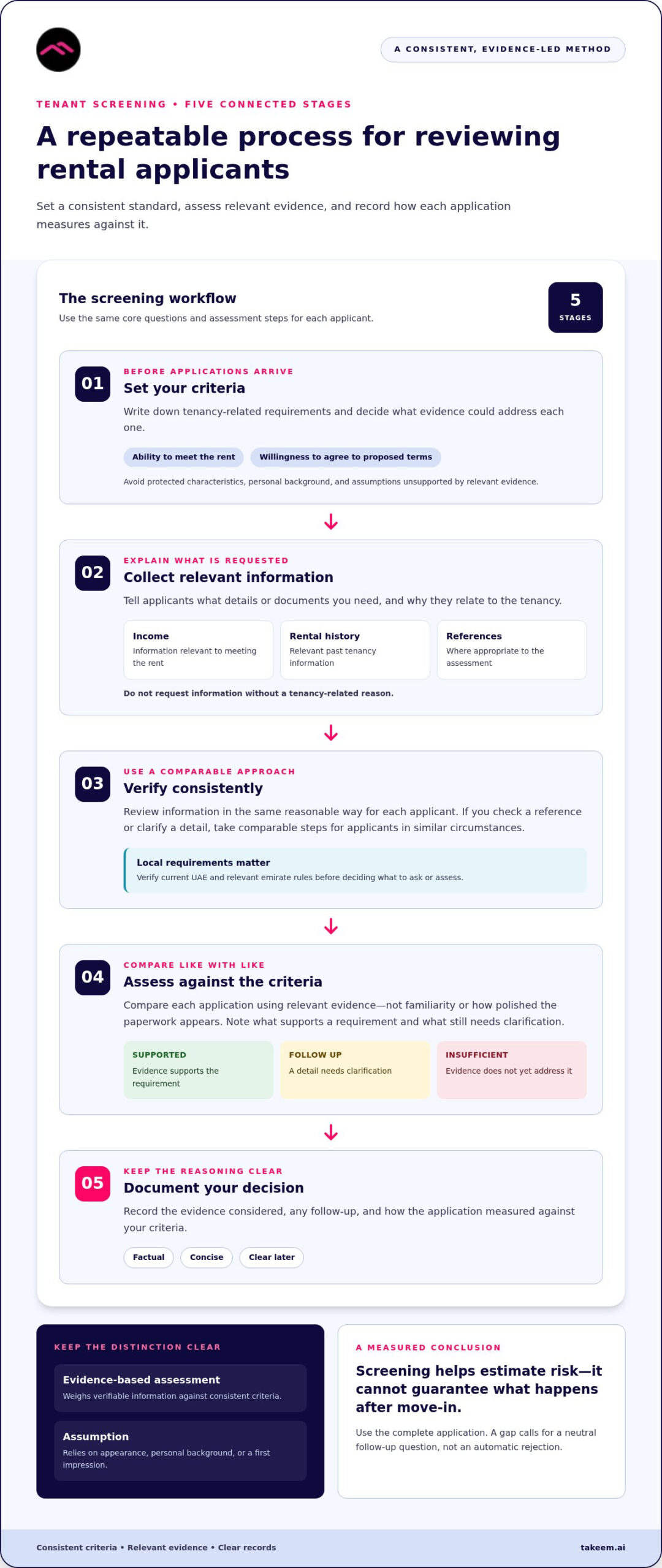
    1. Set your criteria. Write down the relevant requirements before applications arrive. Decide what evidence could address each one, and use consistent standards for everyone.
    2. Collect relevant information. Tell applicants what documents or details you’re requesting, such as information about income, rental history, or references where appropriate. Explain the purpose and don’t request information without a tenancy-related reason.
    3. Verify consistently. Review information using the same reasonable approach for each applicant. If you check a reference or clarify a detail, take comparable steps for other applicants in similar circumstances.
    4. Compare against the criteria. Assess each application based on relevant evidence, not on who seems most familiar or presents information in the most polished format. Note where the evidence supports a requirement and where clarification is still needed.
    5. Document your decision. Record the evidence considered, any follow-up, and how the application measured against your criteria. Keep the explanation factual and concise so the reasoning remains clear later.

    Set criteria, collect relevant information, verify it consistently, compare applications against the same standards, and document your reasoning. Each step informs a decision but cannot guarantee a tenancy outcome.

    Verify relevant details and keep a clear record

    Compare income details with other relevant information an applicant provides, and review references or rental history where appropriate and permitted. Look for consistency, not perfection. If a date, amount, or reference is unclear, ask a neutral follow-up question that gives the applicant a chance to explain. A gap is a reason to clarify, not an automatic trigger for rejection.

    Handle application information with care. Collect and retain only what’s appropriate for screening, and verify current UAE and applicable emirate requirements for data collection, use, and retention when setting your process. Don’t assume every check is permitted or necessary. A clear record captures relevant facts and reasoning, not subjective commentary.

    Once you’ve assessed applicants, screening can sit alongside other rental-risk measures. Landlords can consider rental guarantee options for landlords as a separate way to manage rental income risk. A guarantee complements careful tenant selection; it doesn’t replace consistent assessment or eliminate every tenancy risk.

    How to compare applicants fairly when their circumstances differ

    Applicants may provide different kinds of evidence, have different income patterns, or have varying levels of rental history. A fair comparison doesn’t require identical circumstances. It means applying the same relevant standards, giving each applicant a reasonable opportunity to clarify information, and recording what the evidence does and doesn’t show.

    Use a simple comparison table to keep the assessment focused. Complete one for each applicant, using the same criteria and neutral language. Avoid ranking applicants by who seems most familiar or presents the most polished application.

    Criteria Evidence provided Follow-up needed Assessment notes
    Ability to meet rent Income information relevant to the applicant’s circumstances Clarify a gap or explain variable amounts Record how the information relates to the stated criterion
    Rental history Available rental records or references Ask for context if details are incomplete Note what the evidence can reasonably establish
    Communication Responses to tenancy-related questions Follow up on an unanswered point Describe the response factually, without inferring character

    A missing document and conflicting information aren’t the same thing. Missing information means you don’t yet have evidence to assess a point. A discrepancy, such as dates or amounts that don’t align across documents, needs careful clarification. Neither should be treated as a conclusion by itself. Give the applicant a chance to explain, then record whether the response resolves the question.

    Which signals are useful, and which are not proof?

    A consistent payment history, where relevant information is available, can provide context about past obligations. Responsive communication can show how an applicant handles tenancy-related questions. Neither predicts every future action. References may support an assessment, but consider what the referee can reasonably confirm, such as the nature and duration of a previous tenancy. A positive reference is not a guarantee.

    Nationality, family status, accent, and appearance aren’t evidence of payment reliability. Keep comparisons tied to relevant information and avoid turning personal impressions into criteria. A polished application may be easy to review, but presentation alone doesn’t prove future conduct.

    How to handle gaps, unusual income, or limited rental history

    Ask neutral, consistent questions when income varies, documents need context, or an applicant has little rental history. For a self-employed applicant, assess relevant information using the same underlying standard you apply to other applicants, while recognising that supporting evidence may look different. Limited rental history is a gap in one type of evidence, not proof of unreliability.

    When deciding how to choose reliable tenants, weigh evidence against the same relevant standards without expecting every applicant’s circumstances to look alike. A careful comparison supports a reasoned decision, not certainty.

    How to Choose Reliable Tenants: A Fair, Evidence-Based Screening Process

    How to make a confident decision without expecting zero risk

    A strong decision doesn’t require a flawless application. It requires weighing the complete information against criteria set in advance, then being clear about what the evidence supports and what remains uncertain. Compare each applicant against the same essential requirements while allowing for differences in how they document their circumstances.

    Screening can inform a rental decision, but it can’t remove every tenancy risk or guarantee what happens after move-in. The goal is a reasoned choice, not certainty. If a relevant detail is unclear, ask a neutral question and consider the response alongside the rest of the application.

    A practical decision framework for landlords

    Use a short matrix to separate evidence from unanswered questions and material concerns. “Material” means directly relevant to a pre-set tenancy criterion, not simply unusual or unfamiliar. Record facts rather than labels, and check applicable UAE and emirate requirements before making or communicating a decision.

    Strengths
    Relevant information supports the stated criteria. Note what the evidence shows without treating it as a promise of future conduct.

    Unanswered questions
    A document or detail is missing or unclear. Identify the specific point to clarify and whether the applicant’s response resolves it.

    Material concerns
    Verified information conflicts with a relevant criterion or remains insufficient after reasonable follow-up. Record the evidence and its connection to the criterion.

    After reviewing the matrix, consider the application as a whole. A strength in one area doesn’t automatically cancel a material concern in another, and an unanswered question shouldn’t be treated as a confirmed problem. If follow-up provides relevant context, update your notes. If essential information remains insufficient, base the decision on that gap and your stated criteria, not speculation.

    How to communicate a decision professionally

    Once you’ve reached a decision, communicate it respectfully and without unnecessary delay. Keep any explanation factual and consistent with the criteria you applied. Don’t disclose another applicant’s personal information or compare people in a way that reveals private details. Before sending a decision, make sure your records support the reason you plan to give and that your communication follows applicable requirements.

    If an applicant needs to provide further information, state the specific point clearly and allow a reasonable opportunity to respond within your process. For a declined application, avoid vague judgments about character; refer only to relevant criteria and the information assessed. A professional, consistent explanation helps keep the process clear for both parties.

    Choosing a tenant is one part of managing rental risk. After assessing applicants, landlords may also consider rental income protection for landlords as a complementary measure. Takeem’s rental guarantee options offer another way to consider income protection alongside a careful, evidence-based decision.

    Protecting Rental Income After Choosing a Tenant

    Careful screening helps you make an informed selection, but it’s only one part of managing a tenancy. Once you’ve selected an applicant, clear written terms, an organised payment process, and accurate records help turn expectations into practical routines. Separate safeguards can also help you manage rental income risk without treating any one measure as a substitute for responsible tenant selection.

    Set clear expectations once an applicant is selected

    Make sure the tenancy terms clearly set out the rent, due dates, responsibilities, and agreed communication channels. Both parties should understand what’s expected and how tenancy-related matters will be handled. Keep relevant records, such as payment information and important communications, organised so you can refer to them if a question arises.

    A predictable payment arrangement can make collection easier to administer. Digital monthly rent collection through Direct Debit is an option for landlords who want to accept tenant payments digitally. A payment method is an administrative tool, not evidence that a tenant will always pay on time. Clear arrangements support a well-run tenancy, but they don’t predict individual behaviour.

    For practical context on post-selection processes, explore the guide to Direct Debit rent collection. It discusses how payment administration can fit into a broader approach to managing rental arrangements.

    Add income protection as a separate layer of risk management

    Tenant assessment and rental income protection address different questions. Screening considers whether relevant information supports an applicant’s ability and willingness to meet agreed obligations. A rental guarantee is a separate consideration for landlords concerned about rental income risk. It doesn’t screen applicants or remove every risk, and it shouldn’t be a reason to relax a fair, evidence-based selection process.

    Takeem provides rental guarantees for landlords and property investors in the UAE and facilitates digital monthly rent collection through Direct Debit. Emergency property maintenance is included as part of its rental guarantee service. These options support rental-risk management and tenancy administration after you’ve assessed an application. They complement, rather than replace, clear terms, consistent records, and sound judgment.

    As you consider how to choose reliable tenants, keep the stages distinct: assess applicants fairly, agree clear expectations with the selected tenant, then consider how payment administration and income protection fit your needs. The UAE landlord guide to rental guarantees offers further context on this separate layer of protection.

    If you’re reviewing ways to support rental income and payment processes after selection, explore Takeem’s landlord solutions as part of your broader approach to managing rental risk.

    Make your next rental decision with confidence

    Put your screening approach into practice with the next application you receive. A consistent process becomes more useful when you keep your criteria clear, assess evidence carefully, and review whether each step supports a fair decision. That gives you a practical foundation for deciding how to choose reliable tenants without expecting any process to predict every outcome.

    Then consider what will support the tenancy after selection. Clear payment arrangements and appropriate safeguards can complement your decision, while keeping the tenant assessment grounded in evidence. Takeem offers landlords rental income protection and digital payment options, with emergency property maintenance included in its rental guarantee service.

    Take the next step at your pace. Explore Takeem’s landlord solutions to see how they may fit into your approach to rental risk. With a clear process and practical support in place, you can move forward with greater confidence.

    Frequently Asked Questions

    Is a credit report enough to tell whether a tenant is reliable?

    No. A credit report offers limited information and can’t establish how someone will act throughout a tenancy. If a report is lawfully accessible and relevant, consider it alongside other appropriate evidence, such as the application and references. A report may raise a question that needs context rather than settle the decision. Before relying on one, verify current UAE requirements for access, consent, and personal-data handling.

    Can I reject a rental applicant who has no previous landlord reference?

    Not solely because the reference is missing. The applicant may be renting for the first time, or a previous landlord may be unavailable. Ask a neutral question about the gap, then assess other relevant evidence using your established criteria. A missing reference is different from a reference that raises a substantiated concern. Keep your reasoning tied to documented information and check applicable requirements before requesting or using personal data.

    How can I assess a self-employed tenant’s ability to pay rent?

    Assess relevant evidence consistently rather than assuming self-employment means income is unreliable. If appropriate and permitted, you might ask for documents that help explain income patterns, such as records covering different periods. Give the applicant a chance to explain fluctuations or gaps, then consider whether the information supports their ability to meet the proposed rent. Before collecting financial documents, verify current rules on requests and personal-data handling.

    What should I do if an applicant’s documents contain conflicting information?

    Pause and identify the exact discrepancy before drawing a conclusion. For example, if dates or amounts differ between documents, ask the applicant to clarify the specific point or provide corrected information. Assess the response using the same criteria applied to other applicants, and record what changed or remains unresolved. A discrepancy alone isn’t proof of misconduct. Make sure your checks and records follow applicable UAE requirements.

    Can landlords ask for personal information during tenant screening?

    Request information only when it’s relevant to assessing the tenancy, and handle it responsibly. Explain why you need a particular document rather than collecting extra personal details “just in case.” What you may request, how you may use it, and how long you may retain it can depend on applicable rules and circumstances. Verify current UAE and relevant emirate requirements before collecting or storing applicant information.

    Does choosing a reliable tenant guarantee that rent will always be paid on time?

    No. Screening can help you make a more informed choice, but a tenant’s circumstances can change, so no assessment can promise every payment will arrive on time. Clear written terms and an agreed payment process help set expectations and keep rent administration orderly. If you want to consider income protection, assess rental guarantee options separately from screening. They’re an additional risk-management consideration, not proof that a tenant will never miss rent.