

Tag: Rental Payments

  • Monthly Rent vs. Annual Cheques: The UAE Landlord’s Guide to 2026

    Monthly Rent vs. Annual Cheques: The UAE Landlord’s Guide to 2026

    The era of the post-dated cheque is finally coming to an end, and for UAE landlords, this is the most significant security upgrade in a generation. You’ve likely spent years relying on a physical stack of paper as your only safety net, even while dreading the administrative headache and the constant risk of a default. When weighing the pros and cons of monthly rent vs annual cheques in 2026, the traditional method no longer offers the protection it once did. It’s time to trade manual stress for digital certainty.

    We understand that predictable cash flow is the heartbeat of your investment. This guide reveals how the UAE rental market is shifting toward a digital-first model that secures your income without the legal vulnerabilities of traditional paper. You’ll discover how to stabilize your revenue, reduce administrative burdens, and increase tenant retention by embracing modern payment standards. We’ll break down the latest 2026 regulations and show you exactly how to protect your assets with a sophisticated, tech-driven approach to property management that prioritizes your peace of mind.

    Key Takeaways

    • Understand how the 2026 UAE rental landscape has shifted from physical paper to digital-first expectations, prioritizing speed and efficiency.
    • Compare the strategic benefits of monthly rent vs annual cheques to secure a more predictable and stable cash flow for your property portfolio.
    • Learn why traditional cheques are no longer the ultimate security measure and how digital systems offer superior protection against rental defaults.
    • Discover the practical steps to modernize your lease agreements and transition to a seamless, automated Direct Debit collection system.
    • Explore how a Landlord Rental Guarantee provides 100% income certainty while handling both payment collection and emergency maintenance.

    The Evolution of Rental Payments in the UAE Market

    For decades, the UAE rental market operated on a foundation of physical paper. Post-dated cheques (PDCs) were the standard because they provided landlords with a perceived legal safety net. In an era before sophisticated credit scoring and digital banking, a physical cheque was the ultimate commitment. But as we move through 2026, the traditional “1-cheque” or “4-cheque” models are becoming relics of a slower age. The Central Bank of the UAE has actively promoted the transition toward a cheque-less society, replacing manual processes with automated, secure digital frameworks.

    Landlords are no longer just competing on property quality; they’re competing on the ease of the transaction. The debate of monthly rent vs annual cheques is now centered on efficiency and risk mitigation. By moving away from rigid annual payments, proactive investors are securing their income streams while aligning with the national push for digital transformation. This evolution represents a shift from reactive collection to proactive financial management.

    From Post-Dated Cheques to Digital Standards

    Managing a portfolio of physical cheques is an administrative burden that modern technology has finally solved. Storing, tracking, and manually depositing paper is prone to human error and physical loss. It’s a friction-heavy process that complicates financial forecasting and adds layers of unnecessary work for property owners.

    “Relying on paper-based systems creates unnecessary friction that slows down the growth of even the most robust property portfolios.”

    With the widespread adoption of UAEPASS and digital signatures, lease agreements are now finalized in minutes rather than days. These tools, integrated with the Ejari registration system, provide a secure foundation for digital rent collection. This infrastructure ensures that every contract is legally recorded while enabling the seamless transition to automated monthly payments.

    Why the Market is Moving Toward Monthly Cycles

    Today’s tenants expect payment flexibility that mirrors their monthly income cycles. When comparing monthly rent vs annual cheques, the monthly model significantly broadens your pool of qualified applicants. Most UAE professionals manage their finances on a 30-day loop, and offering terms that match this reality makes your property more attractive and accessible.

    • Better Cash Flow: Monthly payments match the monthly salary cycles of UAE professionals, reducing the financial strain on tenants.
    • Higher Retention: Tenants are more likely to renew when the payment structure is manageable and integrated into their digital banking habits.
    • Reduced Vacancy: Properties offering flexible terms often see shorter vacancy periods compared to those demanding single-cheque payments.

    This shift isn’t just about convenience. It’s a strategic move to ensure your assets remain high-performing in a competitive market that increasingly values agility and digital transparency.

    Comparing Annual Cheques vs. Monthly Direct Debit

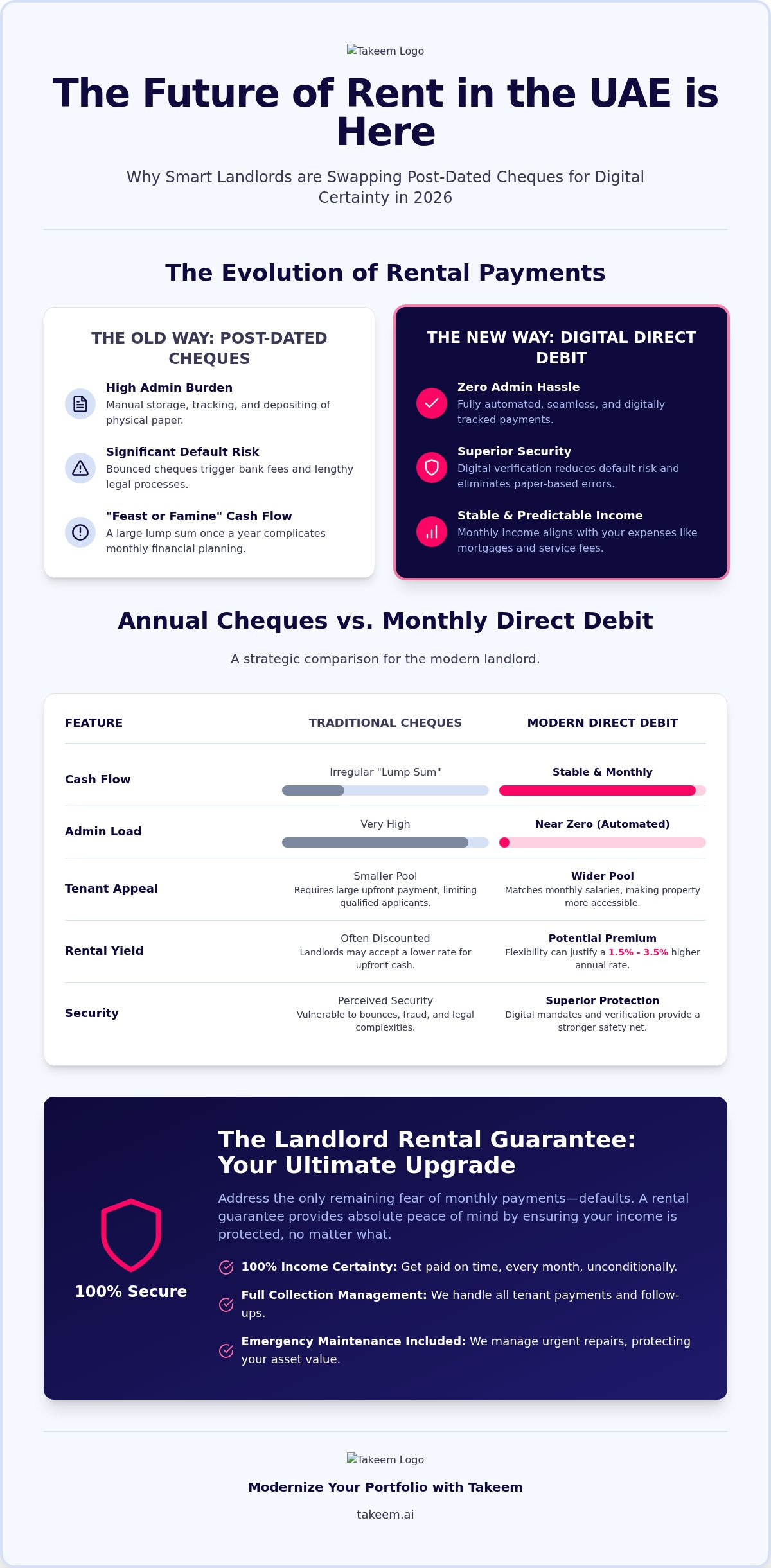
    Choosing between monthly rent vs annual cheques is essentially a choice between front-loaded cash and operational stability. While a single-cheque payment provides immediate liquidity, it often forces landlords to accept a lower annual rate in exchange for the upfront bulk. Conversely, monthly payments allow you to capture a premium for the flexibility offered to the tenant. Research indicates that platforms offering monthly payment options in 2026 often include convenience fees ranging from 1.5% to 3.5% of the annual rent. This shift ensures your property remains competitive while maximizing the total annual yield.

    The Hidden Costs of Cheque Management

    Physical cheques carry risks that aren’t always visible on the balance sheet. Bounced cheques incur bank fees and trigger a time-consuming legal recovery process. There’s also the constant risk of paper being lost, damaged, or incorrectly filled out; these issues require manual intervention and awkward conversations with tenants. Switching to a Direct Debit setup for landlords eliminates these human error factors. Automated systems ensure that the digital rent collection UAE market thrives on is precise, verifiable, and stress-free.

    Cash Flow Advantages of Monthly Collection

    Most property investors face monthly obligations, such as mortgage repayments and service charges. Receiving a massive lump sum once a year creates a “feast or famine” cycle that can complicate long-term financial planning. Monthly Direct Debits align your income directly with these recurring expenses. This steady rhythm improves the overall liquidity of your portfolio, making it easier to reinvest capital or handle unexpected repairs without dipping into personal reserves.

    Security in the 2026 market is no longer tied to a piece of paper. It’s tied to the reliability of the system. While cheques were once considered the ultimate safeguard, digital mandates provide a more transparent and enforceable trail of payment history. By offering monthly terms, you aren’t just assisting the tenant; you’re building a “set and forget” income stream that requires zero manual tracking. This modern approach transforms your property from a high-maintenance chore into a streamlined financial asset.

    Solving the Security Gap: Why Landlords Fear Monthly Rent

    The transition to monthly payments often triggers a specific anxiety for property owners: the fear of twelve potential failures instead of one. If a tenant defaults on a monthly installment, landlords worry they lack the leverage provided by a physical cheque. However, the debate over monthly rent vs annual cheques requires a cold look at modern legal realities. In 2026, the security once offered by post-dated cheques has largely shifted toward digital mandates that provide better transparency and faster resolution.

    Security isn’t found in the physical possession of paper. It’s found in the speed of information and the reliability of the collection system. While a single-cheque payment feels like a guarantee, it’s actually a single point of failure. Digital systems offer a continuous stream of data that allows you to manage risks in real time.

    The Myth of Cheque Security in 2026

    Holding a physical cheque feels secure; it’s a tangible asset in your hand. Yet, this is often a false sense of security. A cheque is merely a promise to pay, and in the current UAE legal system, the decriminalization of most bounced cheque cases has changed the enforcement dynamic. Pursuing a bounced cheque through the courts can be a lengthy, expensive process that doesn’t guarantee the immediate recovery of funds. Physical paper doesn’t ensure that the money is actually in the account when the date arrives.

    Relying on paper also means you only discover a lack of funds when you attempt to deposit the cheque. This delay creates a blind spot in your financial planning. By understanding the shift in regulations, you can better implement strategies for Avoiding Rental Disputes in the UAE. Modern landlords are realizing that a bank-verified digital mandate is a more reliable indicator of a tenant’s financial health than a stack of paper.

    How Direct Debit and Fintech Bridge the Trust Gap

    The UAE Direct Debit System (UAEDDS) replaces the uncertainty of paper with technical precision. When a payment is processed digitally, the system provides immediate feedback. If a transaction fails, you’re notified instantly, allowing for rapid intervention rather than waiting for a bank’s manual return process. This speed is critical for maintaining a stable portfolio.

    Fintech acts as a sophisticated shield against non-payment by integrating automated notifications and traceable payment histories. These systems create a bank-verified paper trail that is far more robust than a single physical document. When you weigh monthly rent vs annual cheques, the digital model offers a level of oversight that was previously impossible. It bridges the trust gap by providing both parties with a transparent, efficient, and legally recognized framework for every transaction.
    Monthly Rent vs. Annual Cheques: The UAE Landlord’s Guide to 2026

    Moving your portfolio to a digital model is a strategic upgrade that doesn’t require the overhead of a full property management firm. It starts with a clear audit of your current assets. Review your existing lease agreements to identify upcoming renewal dates. These milestones are the perfect opportunity to introduce the shift from monthly rent vs annual cheques without disrupting active contracts. By phasing the transition, you can test digital workflows on a few units before scaling across your entire portfolio.

    Legal Framework for Direct Debit in the UAE

    To ensure a smooth transition, your contracts must reflect modern payment standards. Update your lease clauses to specify Direct Debit as the primary collection method. This ensures compliance with national financial regulations and aligns with the UAE Central Bank’s push for digital adoption. For a deeper look at specific clause requirements, consult our Modernizing UAE Rentals guide. This proactive legal stance protects you while streamlining the onboarding of new tenants.

    Once the legal foundation is set, the next steps involve selecting a technical partner and securing your income. Follow this logical progression to modernize your operations:

    • Select a partner: Choose a provider for Direct Debit setup for landlords to automate monthly collection.
    • Integrate guarantees: Layer your collection with a Landlord Rental Guarantee to ensure 100% income security regardless of tenant behavior.
    • Automate reconciliation: Use digital dashboards to sync payments with your accounting, simplifying tax reporting and financial tracking.

    Communicating the Change to Tenants

    Success depends on how you frame the change. Tenants often view the move to monthly payments as a massive benefit. It eliminates the cost of chequebooks and helps them budget more effectively alongside their salaries. When communicating, emphasize that this is a value-add service. Clear, digital communication reduces friction and addresses concerns about automated withdrawals. Framing the shift as a move toward convenience makes the transition feel like an upgrade rather than an imposition.

    If you encounter resistance, focus on the convenience of the digital experience. There are no physical cheques to sign, courier, or replace if lost. By highlighting the security of the UAE Direct Debit System, you build trust while modernizing your operations. The goal is a seamless experience where the debate of monthly rent vs annual cheques is resolved by the sheer efficiency of the new system.

    Takeem: Guaranteed Rental Income for the Modern Landlord

    The debate over monthly rent vs annual cheques often leaves landlords caught between tenant demand for flexibility and their own need for financial security. Takeem resolves this conflict by providing a fintech-first solution that prioritizes the landlord’s safety. By shifting the risk away from the property owner, we ensure that your cash flow remains uninterrupted regardless of tenant behavior. Large portfolio investors are increasingly adopting our platform to de-risk their UAE assets because it standardizes income across hundreds of units. This predictability is the foundation of institutional-grade property management in a digital economy.

    Beyond Collection: The Power of a Rental Guarantee

    Most digital platforms focus solely on the mechanics of collection, leaving the landlord to bear the risk of a failed transaction. Takeem goes further by providing a true Landlord Rental Guarantee. If a tenant’s Direct Debit fails, Takeem steps in to pay you directly. This mechanism ensures that your income is 100% certain, allowing you to plan reinvestments or mortgage payments with total confidence. It provides the sophisticated oversight needed for Optimising Property Portfolio Rental Income. You’re no longer just collecting rent; you’re managing a guaranteed financial asset with a protective expert by your side.

    Our Direct Debit setup for landlords digitally accepts monthly payments while maintaining the legal rigor required in the UAE market. It replaces the administrative burden of physical paper with a streamlined, automated process. This integration is essential for modernizing your operations without sacrificing the peace of mind that used to come from holding a physical annual cheque. It’s a seamless transition that benefits both the landlord’s balance sheet and the tenant’s experience.

    Integrated Maintenance and Asset Protection

    Protecting your income is only half the battle; protecting the physical property is equally vital for long-term rental yield. Takeem includes emergency property maintenance as part of its guarantee package. This secondary layer of protection ensures that urgent repairs are handled swiftly, preventing minor issues from escalating into expensive structural damage. Maintenance coverage isn’t just a perk; it’s a yield-protection strategy. When emergency repairs are integrated into your rental guarantee, you ensure the asset remains in peak condition for future renewals.

    High-performing portfolios require both financial stability and physical integrity. By combining guaranteed income with maintenance coverage, Takeem offers a sophisticated shield against the most common pain points in the industry. You can now offer the flexible terms tenants want while enjoying a level of security that exceeds the old cheque-book model. The modern choice of monthly rent vs annual cheques is clear when your income is backed by a professional guarantee. Secure your portfolio today with a Landlord Rental Guarantee and transform how you manage your UAE investments.

    Secure the Future of Your Property Portfolio

    The transition from physical paper to digital mandates is the most significant evolution in the UAE rental landscape. Modern investors recognize that holding onto traditional methods creates unnecessary friction and administrative strain. When evaluating monthly rent vs annual cheques, the strategic advantage lies in the consistency and transparency of automated systems. You can now offer the flexible terms tenants expect while maintaining a level of security that paper cheques simply cannot match in the current legal environment.

    By modernizing your collection process, you transform your property into a high-performing financial asset that requires zero manual tracking. Takeem acts as your protective expert, providing a sophisticated shield that covers every aspect of your investment’s health. Secure your rental income today with Takeem’s Landlord Rental Guarantee to enjoy guaranteed monthly payments even if tenants default, 24/7 emergency maintenance coverage, and a seamless digital Direct Debit setup. It’s time to trade manual stress for the calm efficiency of a tech-forward portfolio. Your path to a more stable and profitable future starts with a single digital step.

    Frequently Asked Questions

    Is monthly rent collection legal for UAE landlords in 2026?

    Monthly rent collection is fully legal and officially encouraged by UAE regulators in 2026. While landlords aren’t mandated to offer monthly terms, the Central Bank of the UAE and national land departments promote the UAE Direct Debit System (UAEDDS) as a modern alternative to paper. This shift aligns the market with global standards and provides a transparent framework for both parties within the legal tenancy structure across the country.

    What happens if a tenant’s Direct Debit payment fails?

    If a Direct Debit fails, the system provides immediate digital notification, allowing you to address the issue instantly. For landlords using the Takeem Landlord Rental Guarantee, this failure doesn’t impact your cash flow. Takeem pays the rent even if the tenant defaults, ensuring 100% income certainty. This eliminates the waiting period and legal uncertainty typically associated with waiting for a bounced cheque to be returned by the bank’s manual processing department.

    Are Direct Debit payments safer than post-dated cheques for landlords?

    Digital mandates are significantly safer than post-dated cheques in the 2026 landscape. The decriminalization of most bounced cheque cases has reduced their traditional legal leverage. In contrast, digital payments provide a verifiable, bank-sanctioned trail and immediate transparency. When comparing monthly rent vs annual cheques, digital systems offer superior risk management by identifying payment issues in real time rather than months after a paper cheque was signed, allowing for much faster resolution.

    How do I set up Direct Debit for my rental property without a management company?

    You don’t need a traditional property management company to implement digital collection. Takeem provides a direct-to-landlord portal for Direct Debit setup, allowing you to digitally accept monthly payments from tenants. This fintech-first approach gives you institutional-grade tools without the high fees of a management firm. You simply register your property, invite your tenant to the mandate, and the system automates the recurring collection process on your behalf while providing full visibility of your income.

    Does Takeem’s rental guarantee cover the entire year’s rent?

    Yes, the Takeem Landlord Rental Guarantee is designed to protect your total contracted income for the duration of the lease agreement. Whether you manage an individual unit or a large portfolio, the guarantee ensures you receive your monthly payments regardless of tenant behavior. This provides a level of financial stability that traditional 1-cheque or 4-cheque models cannot replicate, as your revenue becomes a guaranteed, predictable stream for the full year.

    Is emergency maintenance included in all Takeem rental guarantee packages?

    Emergency property maintenance is a standard feature included in Takeem’s rental guarantee packages. This service provides 24/7 coverage for urgent repairs, such as plumbing or electrical failures, protecting your asset’s physical value. By integrating maintenance with income protection, the package acts as a comprehensive shield for your investment. This ensures that minor emergencies don’t escalate into costly structural issues that could impact your long-term rental yield or tenant retention rates.

    Can I switch my current cheque-paying tenant to monthly Direct Debit mid-lease?

    You can switch an existing tenant to monthly Direct Debit mid-lease by signing a simple addendum to the tenancy contract. This amendment must be registered to ensure the new payment terms are legally recognized. Many tenants welcome the transition when weighing monthly rent vs annual cheques, as it improves their personal budgeting. Once the addendum is signed, you can initiate the digital setup to replace the remaining post-dated cheques currently in your possession.

    What are the bank fees associated with Direct Debit vs. cheques in the UAE?

    Traditional cheques often incur hidden costs, including bank fees for bounces and the administrative time-cost of manual deposits. While platforms facilitating digital payments in 2026 may charge convenience fees ranging from 1.5% to 3.5% of the annual rent, these are often offset by the premium landlords can charge for flexible terms. Digital collection reduces the financial risk of human error and legal recovery costs, making it a more cost-effective solution for maintaining long-term portfolio liquidity.
  • Direct Debit Benefits for UAE Landlords: 2026 Guide

    Direct Debit Benefits for UAE Landlords: 2026 Guide

    What if the era of the post-dated cheque, and the legal headache of it bouncing, was finally over for your property portfolio? You’ve likely spent years chasing physical paper, making manual bank trips, and worrying about the “insufficient funds” notification that disrupts your monthly cash flow. It’s a stressful way to manage high-value assets in the dynamic UAE property market. Understanding the benefits of direct debit for landlords UAE is no longer just about convenience; it’s about securing your financial future under the latest Central Bank regulations.

    Transitioning to the UAE Direct Debit System (UAEDDS) eliminates the risks of physical cheques and secures your rental income with automated precision. We’ll show you how this digital shift provides better financial protection against defaults and reduces your administrative burden. This guide explores how the new Federal Decree-Law No. (6) of 2025 is reshaping the market, moving you toward a “set and forget” model that ensures every dirham of rent arrives exactly when it’s due. By the end of this article, you’ll understand why digital automation is the new standard for professional property investment in 2026.

    Key Takeaways

    • Understand how the UAE Direct Debit System (UAEDDS) is replacing traditional post-dated cheques to align with the 2026 Central Bank regulatory standards.
    • Discover the core benefits of direct debit for landlords UAE, including stabilized monthly cash flow and the total elimination of manual bank visits and “cheque-run” logistics.
    • Learn the practical steps for drafting digital mandates and verifying tenant bank compatibility within the national financial framework.
    • Explore how to manage payment risks through automated notifications and sophisticated rental guarantees that ensure you get paid even if a transaction fails.
    • See how Takeem integrates Direct Debit with emergency maintenance and income protection to provide a comprehensive, “set and forget” property investment strategy.

    The Evolution of UAE Rent Collection: From Cheques to Digital Mandates

    For decades, the United Arab Emirates rental market relied almost exclusively on post-dated cheques (PDCs) as the primary security for rental income. While this system provided a physical paper trail, it also created significant administrative friction. Landlords had to manually store, track, and deposit cheques, often facing delays or legal hurdles when a payment failed. In 2026, this legacy approach is rapidly giving way to a more sophisticated infrastructure. The transition toward a paperless economy is driven by the UAE Central Bank’s commitment to digital transformation, ensuring that property investors can manage their portfolios with modern efficiency.

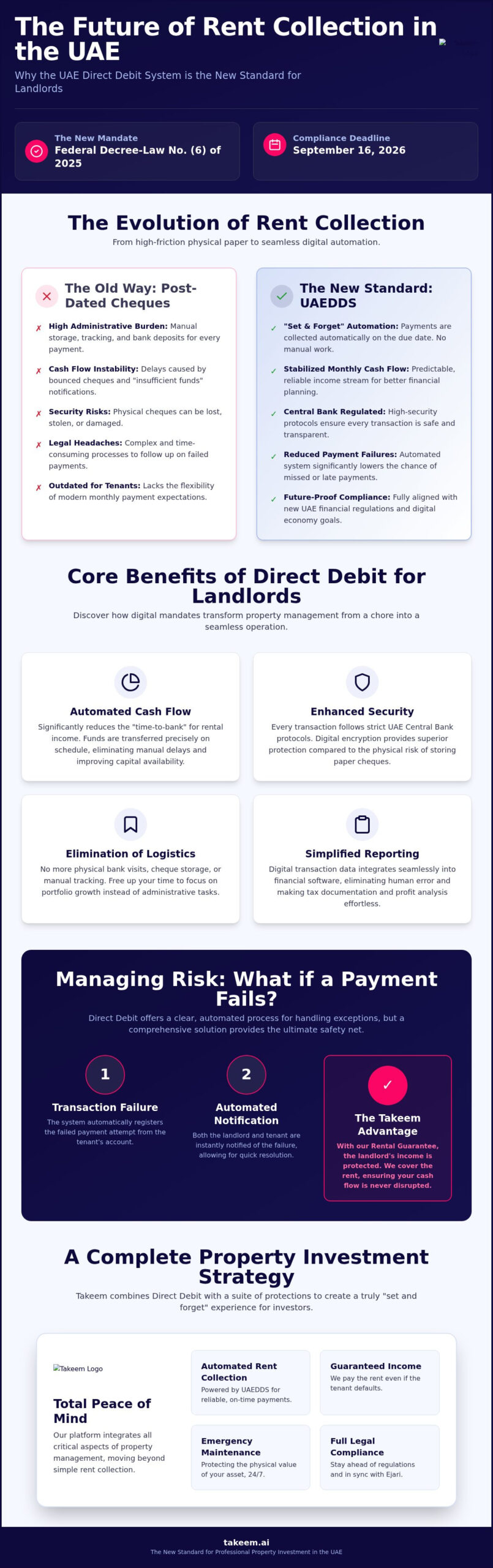
    One of the most significant Direct Debit advantages is the move toward a unified national system. The legal standing of digital mandates has been strengthened by Federal Decree-Law No. (6) of 2025, which overhauled the financial regulatory framework. With the compliance deadline of September 16, 2026, approaching, the shift from physical cheques to digital mandates is no longer just a trend. It is a fundamental change in how property business is conducted across the Emirates.

    Why Post-Dated Cheques are Becoming Obsolete

    Physical cheques carry inherent risks that don’t align with a modern investment strategy. Storing dozens of cheques for a large portfolio is a logistical burden and a security risk. If a cheque is lost or damaged, the process of requesting a replacement can take weeks. Additionally, the legal complexities of bounced rent cheque UAE situations, while streamlined in recent years, still involve administrative delays and potential loss of income. Modern tenants also expect more flexibility. They’re increasingly looking for monthly payment options rather than committing to large, multi-month payouts via a few physical cheques. This shift in tenant behavior makes the old system unsustainable for landlords who want to remain competitive. For a detailed comparison of the most effective UAE cheque alternatives for rent, understanding the full range of digital options available in 2026 is essential for any serious property investor.

    Understanding the UAE Direct Debit System (UAEDDS)

    The UAEDDS is the national standard for recurring payments, enabling seamless transfers from a tenant’s account to a landlord’s account. This system, regulated by the UAE Central Bank, provides a secure and transparent environment for both parties. By utilizing this framework, you can realize the primary benefits of direct debit for landlords UAE, such as consistent cash flow and reduced manual intervention. The system integrates directly with platforms like Ejari in Dubai, ensuring that your rental collection is always in sync with your formal tenancy agreements. It’s a proactive solution that replaces the reactive nature of cheque collection with a steady, automated pulse of income.

    Top Benefits of Direct Debit for Landlords in the UAE

    The transition to digital mandates represents a pivotal moment in the evolution of UAE rent collection. For landlords, the most immediate gain is the stabilization of income. Unlike the unpredictable nature of physical cheques, which require manual handling and a physical presence at a bank, digital systems operate on a “set and forget” basis. This is one of the primary benefits of direct debit for landlords UAE, as it ensures that rental payments are processed with surgical precision on the exact due date without you ever having to leave your office.

    Security is another cornerstone of this shift. Every transaction follows Central Bank-approved protocols, providing a level of encryption that physical paper simply cannot match. You no longer need to worry about the security of storing post-dated cheques in a safe or the risk of them being lost in transit. It’s about creating a frictionless environment where capital moves securely and predictably, allowing you to focus on portfolio growth rather than administrative logistics.

    Automated Cash Flow Management

    Automation significantly reduces the “time-to-bank” for your rental income. In a traditional setup, a cheque might sit on a desk for days before someone finds the time to visit a branch. With Direct Debit, the funds move as soon as the mandate triggers. This speed is vital for property investors with large portfolios who need to reinvest capital or cover mortgage obligations promptly. Digital data also integrates directly into your financial reporting. This eliminates human error in tracking payments, making tax documentation and profit analysis a seamless part of your workflow rather than a month-end chore.

    Attracting High-Quality Tenants

    Tenant expectations in 2026 have shifted toward digital-first experiences. High-quality tenants often prefer the financial flexibility of monthly payments over the strain of writing a single cheque for 100,000 AED or more. By offering Direct Debit, you position your property as a tech-forward asset in a competitive national market. This modern approach often leads to higher tenant retention rates. When rent payments are invisible and automated, the friction of the renewal process is greatly reduced. For those looking to maximize these advantages, exploring a rental guarantee service can further secure your portfolio against the unexpected while maintaining this digital efficiency.

    Setting Up Direct Debit for Rentals: Step-by-Step

    Transitioning from traditional cheques to a digital mandate is a structured process designed for maximum security. It starts with verifying that your tenant’s financial institution is fully integrated with the UAEDDS framework. Most major banks across the Emirates now support this, but confirming compatibility early prevents technical friction during the first payment cycle. Once verified, the setup moves into the formal documentation phase, where the payment schedule is locked into the tenancy agreement. This precision ensures that every benefits of direct debit for landlords UAE, from cash flow stability to reduced admin, is realized from day one.

    Execution requires a clear digital trail. After the contract is signed, the landlord or their representative initiates the mandate through a Central Bank-approved service provider. The tenant then receives a notification to authorize the recurring transfer. This isn’t a manual “push” payment; it’s a permanent instruction that remains active for the duration of the lease. Once the first payment is successfully executed, the automated schedule takes over, allowing you to manage your portfolio with a “set and forget” mindset that physical cheques never allowed.

    Standardizing the Tenancy Agreement

    To ensure your digital collection is legally sound, your tenancy agreement must include specific clauses authorizing digital rent collection via UAEDDS. These clauses should outline the exact instalment frequency, whether you’ve agreed on monthly, quarterly, or semi-annual payments. It’s vital to align these details with the national Ejari registration system in Dubai or the relevant registration portals in Abu Dhabi. By mirroring the Ejari data in your digital mandate, you create a unified legal record. This synchronization provides a sophisticated shield against disputes, as the payment schedule is officially recorded with both the bank and the property authorities.

    The Digital Mandate Approval Process

    The approval phase is where the digital transformation truly shines. Tenants sign the mandate through secure banking portals or mobile apps, using multi-factor authentication for added security. Their bank then verifies the instruction, confirming that the account details are correct and the recurring payment is authorized. This process is significantly faster than the old “cheque-run” logistics and eliminates the risk of signature mismaries or dating errors. The digital mandate serves as a legally binding instruction to the tenant’s bank to transfer funds on the agreed dates. This high level of transparency ensures that both parties have a clear, immutable record of the financial commitment, further cementing the benefits of direct debit for landlords UAE as the modern standard for property investment.

    Direct Debit Benefits for UAE Landlords: 2026 Guide

    Managing Risks: What Happens When a Direct Debit Fails?

    Even with advanced automation, technical or financial hurdles can occasionally disrupt a payment cycle. A failed digital mandate usually stems from one of two sources: a technical error within the UAEDDS framework or, more commonly, insufficient funds in the tenant’s account. One of the key benefits of direct debit for landlords UAE is the immediate visibility these failures provide. Unlike a cheque that might sit in a bank’s processing queue for days, digital systems trigger instant notifications. This transparency allows you to address the issue before it impacts your monthly financial obligations or mortgage commitments.

    In the modern digital era, non-payment through a direct debit is treated as a breach of the tenancy contract. It lacks the historical criminal weight associated with bounced rent cheques in the UAE, which reflects the UAE’s shift toward a more mature, civil-focused financial market. This transition simplifies the legal landscape. It moves the focus away from police reports and toward streamlined resolution through property tribunals like the Dubai Land Department (DLD) or Abu Dhabi Real Estate Centre (ADREC). It’s a cleaner, more professional way to handle disputes without the friction of the old “criminality” model.

    Immediate Actions for Failed Payments

    Most digital payment platforms offer a 24-hour grace period. This window allows for automated re-attempts if the initial failure was due to a temporary technical glitch or a slight delay in the tenant’s salary transfer. If the payment still fails, digital property management tools enable instant, recorded communication with the tenant. Clear, automated reminders often resolve the issue without the need for aggressive intervention. However, if the situation persists, you must understand what to do when a tenant stops paying rent to protect your national property interests effectively.

    The Limitation of “Payment Only” Systems

    It’s vital to distinguish between a collection mechanism and a financial guarantee. A Direct Debit mandate is a powerful tool for moving money, but it cannot create funds where none exist. If a tenant’s account is empty on the first of the month, the mandate will simply return a failure notice. This is the primary gap in standard payment-only systems. While automation reduces admin, it doesn’t solve the #1 landlord fear: the empty bank account on the 1st of the month. To truly secure your income, you need to move beyond simple collection. You can set up a rental guarantee that bridges this gap, ensuring you receive 100% of your rent even if the digital mandate fails.

    The Takeem Advantage: Combining Direct Debit with Rental Guarantees

    While digital mandates solve the logistics of collection, they don’t solve the risk of a tenant’s account being empty. This is where Takeem transforms the experience. By moving beyond a simple collection tool to a fully guaranteed rental income service, you ensure your investment performs regardless of your tenant’s immediate liquidity. It’s the ultimate evolution of the national property market, turning a payment mechanism into a comprehensive financial safety net.

    Transitioning your entire portfolio to this model means you’re no longer just a landlord chasing cheques. You’re a sophisticated investor managing a high-performance asset class. In the competitive landscape of 2026, where efficiency is the primary driver of success, the combination of digital precision and financial guarantees is the only way to stay ahead of market shifts and ensure long-term stability.

    100% Income Security for UAE Landlords

    A Rental Guarantee acts as a sophisticated shield against the unexpected. Even if the UAEDDS mandate returns a failure notice, Takeem ensures you get paid on time. This level of protection is essential for investors with large property portfolios who manage high overheads or mortgage repayments. Knowing your monthly income is secured provides a level of peace of mind that traditional cheques never could. Many professionals now consider this the best way to collect rent because it removes the variable of tenant default from your financial projections.

    Protecting the Asset: Emergency Maintenance

    One of the key benefits of direct debit for landlords UAE is the ability to bundle financial security with physical care. Takeem includes emergency property maintenance as part of its guarantee service. If a critical repair is needed, the issue is handled through an integrated service without you needing to find a contractor or dip into your personal reserves. This integration preserves your asset’s long-term value while you enjoy a truly hands-off income stream. It’s a holistic approach that recognizes professional property management is about protecting both the cash flow and the physical asset. You get to focus on growth while the system handles the friction of daily operations.

    Secure Your Property Portfolio for the Digital Era

    The UAE real estate market has reached a definitive turning point. The traditional reliance on physical cheques is quickly becoming a legacy practice, replaced by a secure, Central Bank-regulated infrastructure that prioritizes speed and transparency. By leveraging the benefits of direct debit for landlords UAE, you eliminate the logistical friction of manual bank visits and the constant legal anxiety of bounced payments. This transition allows you to professionalize your income stream and align your business with the sophisticated 2026 regulatory environment.

    Adopting digital mandates is the first step toward achieving total financial immunity. When you combine automated processing with a robust rental guarantee, you protect your cash flow against tenant defaults and ensure your assets are preserved through integrated emergency maintenance. It is a proactive, hands-off strategy designed for the modern investor who values both growth and security. Don’t let outdated paper systems slow down your progress.

    Secure your rental income with Takeem’s Digital Collection and Guarantee. Take the leap into a paperless, protected future today.

    Frequently Asked Questions

    Is Direct Debit mandatory for all new rental contracts in the UAE?

    Direct Debit isn’t strictly mandatory by federal law yet, but it’s the government’s preferred standard for 2026. While you can still legally accept physical cheques, the Central Bank and authorities like the Dubai Land Department strongly encourage digital mandates. Many major developers and institutional landlords have already made it a mandatory condition for all new leases to ensure transparency and financial security.

    Can I still use post-dated cheques if my tenant prefers them?

    Yes, you can still accept post-dated cheques if both parties agree to this method in the contract. However, doing so means you’ll miss out on the automated efficiency and security of the UAEDDS. You’ll remain responsible for the manual storage, tracking, and physical depositing of paper cheques, which carries a higher risk of administrative errors compared to the modern benefits of direct debit for landlords UAE.

    How much does it cost a landlord to set up a Direct Debit mandate?

    Setup costs depend on whether you use a bank or a specialized service provider. For instance, some providers charge a transaction fee of approximately 5 AED plus VAT per collection. There may also be annual platform fees, which can reach around 6,000 AED depending on the size of your business. Many landlords find these costs are easily offset by the time saved and the reduction in manual processing errors.

    What happens if a tenant cancels their Direct Debit mandate without my consent?

    Cancelling a mandate without mutual agreement is considered a breach of your tenancy contract. The digital system provides an immediate notification if a tenant attempts to revoke the authorization. Because the mandate is a legally binding instruction linked to your registered Ejari or tenancy agreement, you have clear grounds to escalate the matter to the relevant rental dispute center for a swift legal resolution.

    Does Direct Debit work for both residential and commercial properties nationally?

    Yes, the UAEDDS framework is a national system that supports all property types across the Emirates. Whether you’re collecting rent for a residential apartment in Dubai or a commercial warehouse in Abu Dhabi, the process remains the same. This unified standard allows property investors with diverse, national portfolios to manage all their rental income through a single, streamlined digital channel rather than handling various physical payment methods.

    Is the Noqodi system the only way to collect rent via Direct Debit?

    No, Noqodi is a prominent digital wallet often used for government payments, but it’s not your only option. Most major commercial banks in the UAE now offer direct integration with the Central Bank’s UAEDDS. You can also choose specialized proptech platforms that bundle direct debit collection with advanced features like income guarantees and emergency maintenance, providing a more comprehensive shield for your property investment.

    How long does it take for the funds to reach my account after the due date?

    Funds typically settle into your bank account within one to three business days after the scheduled due date. The exact timing depends on the processing cycles of the tenant’s bank and your own financial institution. This digital timeline is significantly more predictable than the traditional cheque clearing process, which often involves manual delays, physical transit time, and longer bank verification periods.

    Can I switch from cheques to Direct Debit in the middle of an existing contract?

    Yes, you can transition to digital payments mid-contract as long as your tenant provides written consent. You’ll need to sign a simple addendum to the tenancy agreement and have the tenant authorize the new digital mandate through their banking portal. This allows you to immediately start enjoying the benefits of direct debit for landlords UAE without having to wait for the next formal lease renewal cycle. If you’re evaluating all available UAE cheque alternatives for rent before making this switch, a comprehensive comparison of digital payment methods can help you choose the most secure and efficient solution for your portfolio.