Tag: Rental Yield

  • Rental Guarantee ROI Calculator for Property Investors

    Rental Guarantee ROI Calculator for Property Investors

    A property’s rent can look attractive while its return tells a different story. Rental yield is annual rental income divided by the property value, multiplied by 100; net yield also accounts for recurring costs. A rental guarantee ROI calculator can help bring those figures into one view, but its result depends on the rent, expenses and area data entered.

    When assessing a UAE property investment, look beyond the advertised rent. This guide explains how to calculate gross and net rental yield, use local rent figures to test your estimate, and apply capitalization rate to assess potential returns. It also covers ownership costs that can change the result, helping you compare a property’s income potential with a clearer view of what you may retain.

    Key Takeaways

    • Use local area rent data to ground your income assumptions before assessing a property’s potential.
    • Compare capitalization rate with other return measures to see how operating income relates to property value.
    • Account for vacancy and guarantee exclusions when considering how rental income could change over time.
    • Use internal rate of return to assess the timing of cash flows across an investment’s holding period.

    What is rental yield?

    Rental yield measures annual rental income against a property’s value. Calculate gross yield by dividing annual rent by the purchase price, then multiplying by 100. For example, enter annual rent and the property’s purchase price to see the gross percentage before expenses. This measure gives investors a consistent starting point for comparing property investments across the UAE.

    Net rental yield accounts for recurring ownership expenses. Subtract annual service charges and other regular costs from rent, then divide the remainder by the purchase price and multiply by 100. Include maintenance and vacancy assumptions to avoid treating every period as occupied.

    A rental yield calculator needs the purchase price, expected annual rent and recurring expenses. For a vacant property, enter estimated rent and costs, keeping in mind that the result depends on those assumptions. Outputs may include gross yield, net yield and annual net income. A rental guarantee ROI calculator can help organize income assumptions, but yield alone does not account for every investment cost or cash-flow timing.

    Compare properties using consistent inputs. Record each property’s estimated rent, service charges, maintenance assumptions and value, then compare gross and net yields. Area-level rent data can help you assess whether an expected rent is realistic, while building-level expenses show how costs affect returns. Apply the same calculation method to every property in a portfolio.

    First-time buyers, landlords and portfolio investors can use yield calculations to screen opportunities or compare buildings before purchase. Rental income may also be relevant when considering a buy-to-let mortgage. Separately, according to the Federal Authority for Identity, Citizenship, Customs & Port Security, the AED 2,000,000 property investment threshold applies to a 10-year UAE Golden Visa residence permit, and fees and costs do not count toward that threshold. Visa eligibility and rental yield are distinct measures.

    Capitalization rate

    Capitalization rate, or cap rate, estimates a property’s annual operating return against its value. Divide net operating income by the investment asset’s value or current market value. Multiply by 100 to express the result as a percentage. Using current market value shows how income compares with what an apartment is worth today, while purchase price reflects the original investment basis.

    Build the calculation from annual income and operating expenses. Start with the rent collected over a year, then subtract recurring costs of operating the property. Include applicable building charges and regular upkeep so the estimate reflects operating costs, not rent alone. Use costs specific to the property and its ownership arrangements.

    Keep inputs consistent when comparing properties. Use the same income period and expense categories for each apartment. If one estimate includes maintenance and another does not, their cap rates are not directly comparable. A rental yield calculator can organize rent, value and recurring costs, but cap rate specifically relates operating income to asset value.

    Follow this sequence: estimate annual rent, list recurring operating expenses, subtract those expenses to find net operating income, then divide by the property’s current market value. The purchase price helps assess the original deal, while market value frames the return against the property’s present worth. Record which value you use, because changing the denominator changes the percentage even when income stays the same.

    Cap rate is a comparison tool, not a complete forecast of investor cash flow. Mortgage payments and changing rent affect cash available to an owner, while operating costs influence net income. Review the assumptions behind each figure before comparing a portfolio. For landlords considering how rental income is supported, rental guarantee options can be part of the wider investment discussion.
    Rental Guarantee ROI Calculator for Property Investors

    What risks or exclusions can reduce returns from a UAE rental guarantee?

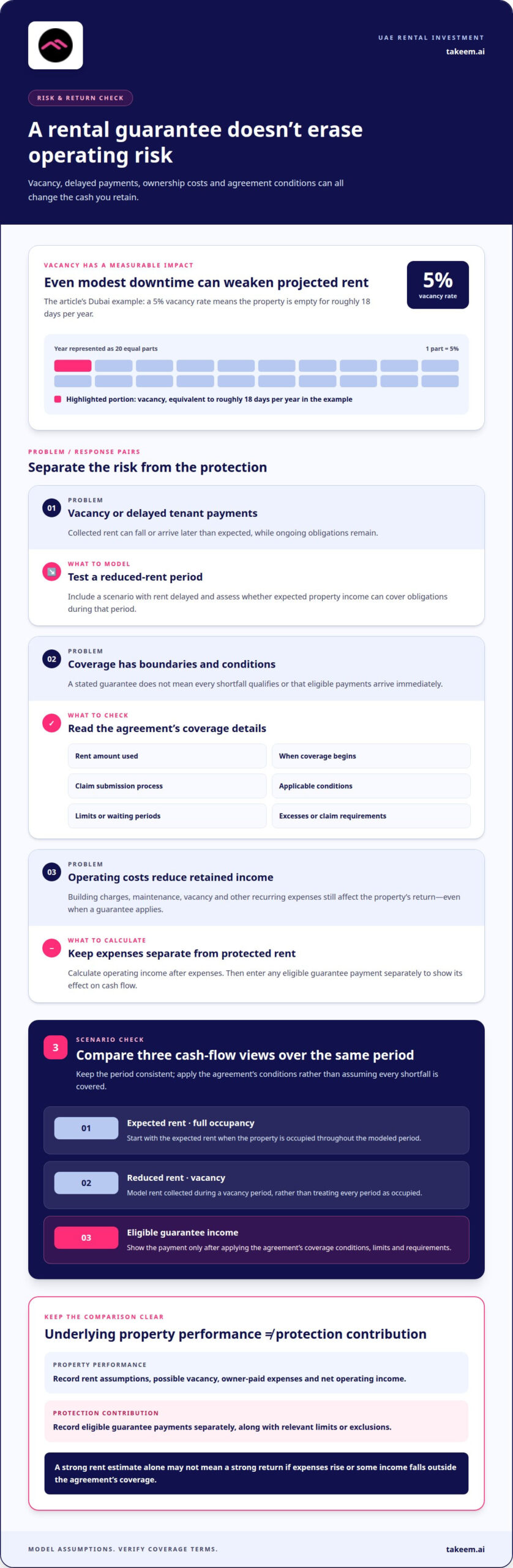
    A rental guarantee can support income planning, but it does not remove every investment risk. Vacancy, delayed tenant payments and changes in operating expenses can affect cash flow. Model these separately from any guaranteed amount. For example, include a scenario where rent is delayed and assess whether expected property income can cover ongoing obligations during that period.

    Before including guaranteed income in a projection, review the agreement’s coverage boundaries. Identify the rent amount used, when coverage begins, how claims are submitted and which conditions apply. Check the actual terms for limits, waiting periods, excesses or claim requirements. Each condition can affect the amount or timing of eligible payments, so reflect it in the relevant cash-flow period.

    Ownership costs still affect returns. Building charges, maintenance, vacancy and other recurring expenses can reduce retained income, even when a guarantee applies. Keep these costs visible instead of treating protected rent as net income. Calculate operating income after expenses, then enter any eligible guarantee payment separately to show its effect on cash flow.

    Use three scenarios in a rental guarantee ROI calculator: expected rent with full occupancy, reduced rent collected during a vacancy, and eligible guarantee income after applying the agreement’s conditions. Compare cash flows over the same period. This makes the effects of occupancy and coverage terms easier to see without assuming that every shortfall qualifies for payment.

    For each property, record the rent assumption, possible vacancy periods, owner-paid expenses, and relevant guarantee limits or exclusions. Then calculate net operating income both with and without eligible payments. This separates the property’s underlying performance from the protection’s contribution. A strong rent estimate alone may not mean a strong return if expenses rise or some income falls outside the agreement’s coverage.

    A 5% vacancy rate means a Dubai property is empty for roughly 18 days per year, illustrating how even modest downtime can reduce collected rent and weaken projected returns.

    Internal rate of return

    Internal rate of return (IRR) expresses an investment’s cash flows as an annual rate, accounting for how long each amount remains invested. Unlike a simple total-return percentage, IRR accounts for when money is invested and returned. That timing matters for UAE rental property, where income arrives over time and sale proceeds may come much later.

    Build the calculation as a dated sequence of cash flows. Record the initial acquisition outlay first, then enter rental income and operating expenses in the periods when they occur. Add capital spending when it happens and include net sale proceeds at the planned exit. IRR is the discount rate that balances the present value of inflows and outflows.

    For a clear comparison, keep the cash-flow basis consistent. An unlevered property IRR measures the asset’s performance before mortgage financing. An equity IRR includes the investor’s borrowing and repayment cash flows. Mixing these approaches can make properties appear comparable despite different financing assumptions. Use the same cash-flow categories and timing for each investment in a portfolio analysis.

    A 65% total ROI over 5 years is approximately equivalent to a 10.5% annualised ROI. The annualised figure helps compare investments held for different periods, but it doesn’t show the whole cash-flow pattern. Two properties can produce the same total return while distributing income differently. Earlier receipts affect IRR differently from cash received near the end of the holding period.

    Use an IRR calculation alongside rental yield and capitalization rate, not as a replacement. Test how occupancy, operating expenses, financing and exit value affect the dated cash flows. For a projection that includes rental-income protection, explore rental guarantee options as part of your investment planning.

    IRR is an annual rate that reflects how long each invested amount remains invested. Read the result alongside the underlying cash-flow sequence: the annual rate accounts for money committed for different periods, rather than showing a simple total return. Review the assumptions behind each dated entry before relying on comparisons, and keep property-level and investor-level cash flows distinct.

    Takeem

    Takeem offers rental guarantee options for landlords and property investors, including those with large portfolios. These offerings can complement the yield, capitalization rate and cash-flow calculations discussed above. They do not replace those measures; they address rental income protection as one part of the investment picture.

    The Rental Guarantee also includes emergency property maintenance. Real estate agents can partner with Takeem to offer the Landlord Rental Guarantee to their clients in exchange for commissions. The right fit depends on your role and portfolio, so consider how rental income protection relates to your investment assumptions.

    To discuss how Takeem’s rental guarantee options fit your property investment, contact Takeem.

    Make your next investment decision with clarity

    Move from a promising headline rent to a decision grounded in the assumptions behind it. Before committing, consider expected rental income, operating costs, financing and holding period together. A rental guarantee ROI calculator can organize that analysis, but its value lies in showing how each input affects the investment you are considering.

    Then consider how rental income protection fits your objectives, whether you are assessing one property or a broader portfolio. Takeem offers rental guarantee options for landlords, property investors with large portfolios and real estate agents. Contact Takeem to discuss the offering that fits your investment question, without treating a projected return as a promise.

    Discuss your rental return assumptions with Takeem and take a considered next step toward your property investment goals.

    Frequently Asked Questions

    How can I achieve a high ROI?

    Focus on net cash flow rather than headline rent alone. Compare properties using consistent assumptions, then test how different rent, occupancy and exit scenarios affect returns. A rental guarantee ROI calculator can organize those scenarios, but it cannot improve the underlying deal. For example, assess whether income still meets your target after financing and ownership expenses.

    What costs and fees should be included in a UAE rental ROI calculator?

    Separate one-time acquisition costs from recurring expenses and financing cash flows. For Dubai purchases, include the Dubai Land Department transfer fee of 4% of the property price. Also account for relevant building charges, maintenance, management costs and mortgage payments using the property’s actual figures. Keeping purchase costs separate from annual operating expenses makes it easier to understand which inputs affect ongoing income and which affect initial capital.

    Are UAE rental guarantees paid monthly, annually, or as a fixed return?

    Rental guarantee payment timing depends on the arrangement’s terms; don’t treat it as a universal fixed return. Rent collection and guarantee payments are separate considerations. Dubai residential rent is typically paid using 1 to 4 post-dated cheques per year, while Takeem also provides landlords with Direct Debit setup for monthly tenant payments. Model the actual expected cash-flow dates when assessing an investment’s return.

  • Calculate True Rental Yield for UAE Properties

    Calculate True Rental Yield for UAE Properties

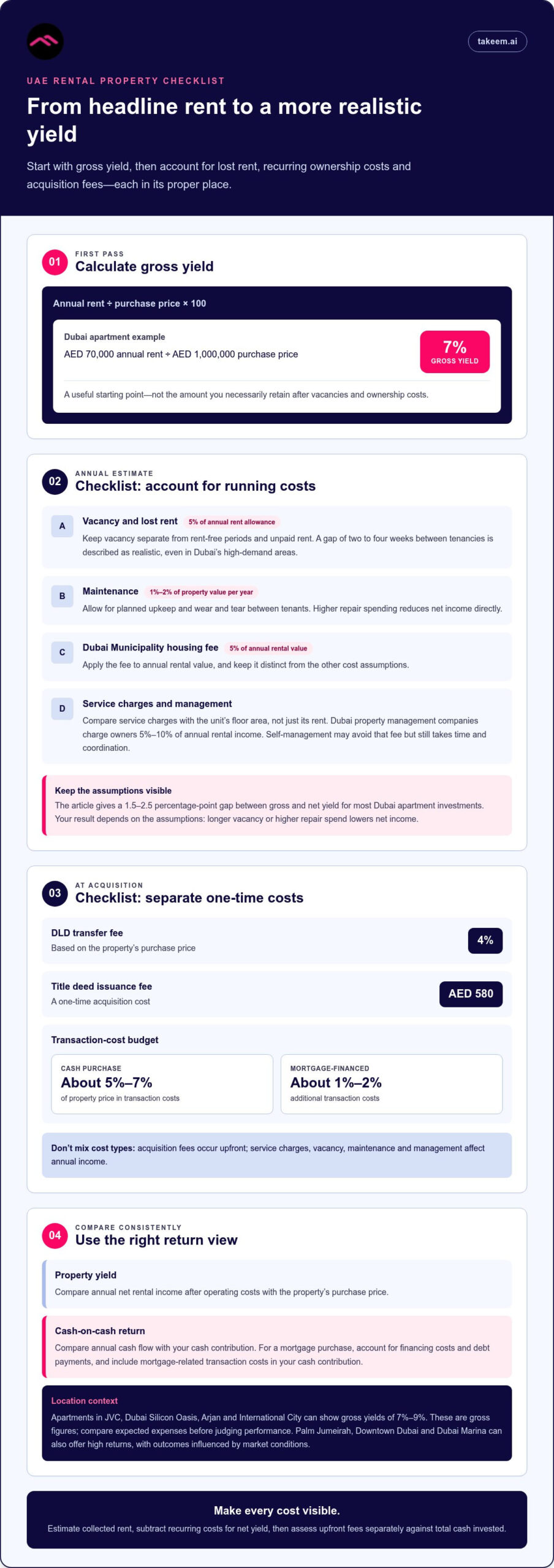
    A 7% gross yield can look very different once vacancy and ownership costs are included. When calculating true rental yield in the UAE, divide annual rent by the purchase price for gross yield, then account for costs and unoccupied periods to estimate net yield. For example, a Dubai apartment bought for د.إ 1,000,000 and rented for د.إ 70,000 per year has a gross rental yield of 7%.

    That headline figure is a useful starting point, but it doesn’t show how much you may actually retain. A realistic estimate accounts for property costs and time between tenancies.

    This guide explains how to calculate gross and net yield, account for vacancy and ownership expenses, and assess how property type, location and DLD transfer fees affect the result. You’ll be better equipped to compare UAE investment properties beyond their advertised rent.

    Key Takeaways

    • Compare local yield figures carefully: Dubai apartments in JVC, Dubai Silicon Oasis, Arjan and International City can show gross yields of 7% to 9%, while costs reduce net returns.
    • Build vacancy, service charges, the housing fee and maintenance into your estimate to get a more realistic view of rental income.
    • Include Dubai’s 4% DLD transfer fee and other purchase costs when assessing your total investment, not just the property price.
    • If rental-income protection is part of your plan, explore Takeem’s Landlord Rental Guarantee, which includes emergency property maintenance.

    Rental yield by location and property type

    Location and property type shape both rent potential and recurring costs. In Dubai, apartments in JVC, Dubai Silicon Oasis, Arjan, and International City produce gross rental yields of 7% to 9%. These are gross figures, so compare them with expected expenses before judging performance. Palm Jumeirah, Downtown Dubai, and Dubai Marina can also offer high real estate returns, but market conditions influence outcomes.

    Service charges can change the comparison. Compare the charge with the unit’s floor area, not just its rent.

    Property management also affects net income. Dubai management companies charge owners 5% to 10% of annual rental income. A self-managed property may avoid that fee, while still requiring time and coordination for tenancy issues and repairs. Include the management approach in every property comparison.

    Cash and mortgage purchases affect cash-on-cash return differently. A mortgage adds financing costs and debt payments, reducing the cash flow available to the owner; cash-on-cash return compares annual cash flow with the investor’s cash contribution. Mortgage-financed Dubai purchases add approximately 1% to 2% in transaction costs.

    Rental yield measures property performance, not an investor’s tax assessment. Treat rental income and property gains as separate tax questions, since the applicable treatment depends on the owner’s circumstances and holding structure.

    Dubai Decree No. (43) of 2013 sets a maximum permitted rent increase of 0% when current rent is up to 10% below the market average. Tenancy contract terms, renewal timing, and eviction rules can also affect income continuity, so include potential turnover when forecasting rent.

    Common risks include vacancy, service charges, management fees and maintenance. Dubai’s summer months tend to be slower for the real estate market, which can affect returns. Compare each property’s location, type, costs and likely rental demand instead of relying on a single headline yield.

    Using rent, vacancy and ownership-cost assumptions

    Estimate net yield using the rent you expect to collect, not just the advertised annual amount. Then account for vacancy and recurring ownership costs to see how your assumptions affect the result.

    Maintenance and Vacancy Allowances

    Allow for both planned upkeep and gaps between tenancies. A maintenance allowance of 1% to 2% of property value per year can account for wear and tear between tenants. A 5% vacancy allowance on annual rent provides a separate buffer, while a two-week to four-week vacancy between tenancies is realistic even in Dubai’s high-demand areas.

    Add community charges to the same estimate. The Dubai Municipality housing fee is 5% of the annual rental value. Keep each cost distinct so you can adjust assumptions without obscuring their effect.

    Rent-Free Periods and Bad Debt

    Vacancy reduces collected rent, while rent-free periods lower income even when a property is occupied. Unpaid rent has a similar effect, so base your net-yield calculation on expected receipts rather than contracted rent.

    For a practical estimate, subtract expected lost rent and recurring costs from annual rent, then compare the result with the property’s value. Keep vacancy and non-payment as separate allowances so you can see which assumption is driving the change.

    Apply the Dubai Municipality housing fee to annual rental value, then account for service charges and maintenance. The gap between gross and net rental yield for most Dubai apartment investments is 1.5 to 2.5 percentage points. Your assumptions matter: a longer vacancy or higher repair spend reduces net income directly.

    Landlords who want to streamline monthly rent acceptance can consider a digital Direct Debit setup. It supports payment collection, while vacancy and maintenance still need their own allowances in the yield calculation.

    Calculate True Rental Yield for UAE Properties

    Acquisition costs and DLD transfer fees

    A Dubai rental property’s purchase price is only part of its initial investment. The Dubai Land Department (DLD) transfer fee is 4% of the purchase price, and the title deed issuance fee is AED 580. Include these one-time charges when estimating the capital required to acquire the property.

    For a cash purchase in Dubai, transaction costs are approximately 5% to 7% of the property price. Mortgage-financed purchases add approximately 1% to 2% in transaction costs. These figures help set an acquisition budget, but they also affect how you interpret the investment’s return.

    Keep operating expenses separate from purchase costs. Service charges, maintenance, vacancy and management affect annual income; DLD transfer and title deed fees arise during acquisition. This separation shows which costs recur and which occur at the outset.

    To compare yields, calculate annual net rental income after operating costs and compare it with the property’s purchase price. To account for entry costs, also compare the return with your total cash invested, including acquisition charges. The first view measures property performance; the second shows how upfront costs affect your return.

    Mortgage financing changes the amount of cash invested and adds financing obligations. To calculate cash-on-cash return, compare annual cash flow after operating expenses and mortgage payments with your cash contribution. Include mortgage-related transaction costs in that contribution rather than treating the property price as your only upfront outlay.

    Use a consistent method for every Dubai property you compare. Record the purchase price, 4% DLD transfer fee, AED 580 title deed issuance fee, and other transaction costs. Then estimate annual rent after operating costs. This makes the effect of acquisition costs visible instead of allowing one-time fees to disappear from the investment calculation.

    Gross rental yield calculation

    Gross yield gives a first-pass comparison of rent against a property’s purchase price. Calculate it as annual rent divided by purchase price, then multiply by 100. Dubai apartments have an average gross rental yield of approximately 7%, but an average cannot predict a specific unit’s return.

    Use a consistent calculation for every property. First, set the annual rent figure using the expected rent for that unit. Next, divide by the purchase price, not the down payment or mortgage amount. Finally, multiply by 100 to express the result as a percentage. The formula is: annual rent ÷ purchase price × 100 = gross rental yield.

    For a useful comparison, use inputs covering the same period and property type. Compare annual apartment rent with apartment purchase prices rather than mixing apartments and villas. Use the same rent basis across shortlisted properties, too. Projected rent and signed tenancy rent are different inputs, so label estimates clearly.

    Gross yield excludes vacancy, service charges, maintenance, management costs and financing. It’s quick to calculate, but incomplete as a measure of spendable income. Use it to screen or compare properties, then subtract operating expenses to estimate net yield. Keep acquisition fees separate when assessing the full investment, as they affect the total capital committed.

    Dubai apartment yields vary by location and ownership costs, so a percentage alone can obscure important differences. Check that rent assumptions reflect the unit and community, then compare the gross yield with expected expenses. A higher gross yield does not automatically mean higher net income if recurring costs are also greater.

    Use gross yield as the opening calculation, not the final decision. For landlords focused on steadier rental income, explore rental income protection as a separate part of the investment plan.

    Takeem: Landlord Rental Guarantee

    Takeem offers a Landlord Rental Guarantee for property owners seeking more structure around rental income. The guarantee includes emergency property maintenance, connecting income planning with an ownership concern that can affect net returns.

    For landlords with larger portfolios, Takeem also offers a Rental Guarantee for Property Investors with Large property Portfolios. This may be relevant when you’re considering how rental income arrangements fit across multiple properties. Agents can also sell Takeem’s Landlord Rental Guarantee for healthy commissions.

    A yield calculation helps you understand expected property performance; a rental guarantee is a separate way to address rental-income uncertainty. Consider the offering in light of your portfolio and investment approach. To discuss Takeem’s Landlord Rental Guarantee, contact Takeem.

    Make your next property decision with confidence

    A yield estimate is most useful when you revisit it as your investment changes. A new tenancy, updated operating assumptions or a shift in your ownership goals can all change what you expect from a property. Treat the calculation as a working decision tool, not a figure to set once and forget.

    Use your analysis of calculating true rental yield in the UAE to identify what matters most in your case: projected income, reliable rent collection or managing ownership risks. If rental-income support is your next step, Takeem offers a Landlord Rental Guarantee, including an option for investors with large property portfolios. Agents can also sell the guarantee for healthy commissions.

    To discuss your rental-income needs, contact Takeem about UAE rental yield. A clear next step can help you move from estimates to a more considered investment plan.

    Frequently Asked Questions

    How do you calculate gross and net rental yield for a UAE property?

    Gross yield compares annual rent with the purchase price; net yield accounts for recurring operating expenses. Divide annual rent by the purchase price and multiply by 100 for gross yield. For net yield, subtract operating expenses from annual rent before dividing. Keep the calculation period consistent, and distinguish estimated rent from rent supported by an existing tenancy agreement.

    What costs should be included when calculating true rental yield in the UAE?

    Include costs that reduce rental income or require ongoing owner spending, such as service charges, maintenance, vacancy, management and the Dubai Municipality housing fee. Separate recurring expenses from acquisition costs, which arise when buying. This distinction helps you compare annual property performance with the full cash needed to purchase and hold the investment.

    What are typical property management fees and leasing costs in the UAE?

    In Dubai, property management companies charge owners 5% to 10% of annual rental income. Leasing costs should also be reflected when they apply, because tenant placement expenses reduce the owner’s net proceeds. Track management and leasing separately in your forecast: one may recur during ownership, while leasing costs relate to securing or replacing a tenant.

    How do Dubai Land Department fees, registration charges, and agency commissions affect rental yield?

    Dubai’s DLD transfer fee is 4% of the purchase price, and the title deed issuance fee is AED 580. These acquisition charges increase the capital invested, lowering returns measured against total investment. Agency commissions reduce income or increase transaction costs, depending on the service and timing, so include them in the relevant year’s cash-flow calculation.

    What are average rental yields by area and property type in Dubai, Abu Dhabi, and other UAE emirates?

    Dubai apartments in JVC, Dubai Silicon Oasis, Arjan, and International City have gross yield benchmarks of 7% to 9%; Dubai apartments average approximately 7%. These figures don’t describe Abu Dhabi or other emirates. For those markets, compare like-for-like properties using local rent, purchase price, vacancy, and ownership expenses rather than applying Dubai benchmarks nationwide.

  • Tenant Rent Default Risk in the UAE: Protect Rental Profit

    Tenant Rent Default Risk in the UAE: Protect Rental Profit

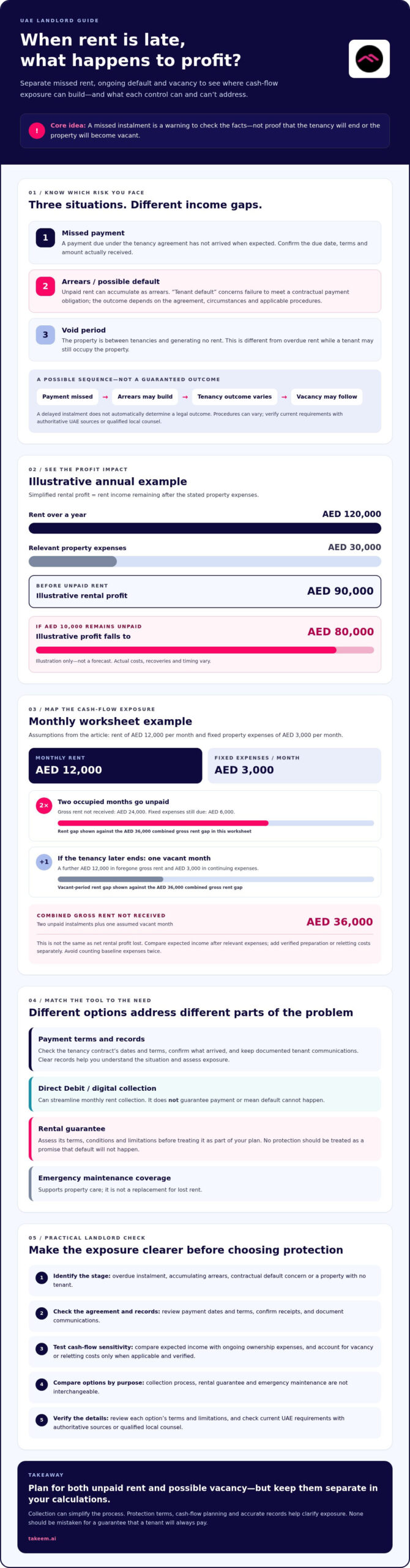
    What happens to your rental profit when a tenant misses a payment, and how long can your cash flow absorb the gap? For UAE landlords, tenant rent default risk UAE is more than an overdue instalment: arrears can build, reduce income available for expenses, and make it harder to predict when rent will arrive. A vacant property creates a different loss because there’s no tenant or rent to collect.

    It’s reasonable to want dependable rental income, but no collection method or protection should be treated as a promise that default won’t happen. Understanding the difference between late rent, ongoing default, and vacancy helps you identify your exposure and assess what each option can and can’t address.

    This guide explains how missed payments can reduce rental profit, compares practical ways to manage exposure across the UAE, and outlines what to check before choosing a rental guarantee or digital collection option. Direct Debit can streamline monthly rent collection without guaranteeing payment, while emergency maintenance coverage supports property care rather than replacing lost rent.

    Key Takeaways

    • Distinguish overdue rent, tenant default, and a void period to identify which income risk you’re facing.
    • Trace how missed payments can affect rental profit alongside ongoing ownership and reletting costs.
    • Assess tenant rent default risk UAE with a practical comparison of payment processes, digital collection, and rental guarantees.
    • Review payment terms, cash-flow sensitivity, and records to make your exposure clearer before choosing protections.
    • Check the terms and limitations of each option: Direct Debit supports collection, while a rental guarantee and emergency maintenance address different needs.

    Tenant rent default risk in the UAE: what landlords should distinguish first

    An expected rent payment hasn’t arrived. Is it a short delay, a growing arrears balance, or the start of a longer income gap? That uncertainty can make it difficult to plan for property expenses. To assess tenant rent default risk UAE landlords need to separate the missed payment, the tenant’s ongoing payment situation, and any period when the property has no tenant.

    What counts as missed rent or tenant default?

    A missed payment is a payment due under the tenancy agreement that hasn’t arrived when expected. Rent arrears are rent payments that remain unpaid and accumulate over time. Tenant default describes a failure to meet a contractual payment obligation, but whether a particular situation amounts to default, and what follows, depends on the agreement, circumstances, and applicable procedures.

    One delayed instalment doesn’t automatically determine a legal outcome. Start with the records: check the payment dates and terms in the tenancy contract, confirm what has actually been received, and keep documented communications with the tenant. Landlords can review information about the Ejari registration system as part of understanding tenancy registration. Verify current requirements and any legal implications with authoritative UAE sources or qualified local counsel. Procedures can vary, so don’t assume the same steps apply in every situation.

    How is tenant default different from a void period?

    A void period is time when a property is between tenancies and generating no rent. By contrast, a tenant may still occupy the property while rent is overdue. Default may eventually lead to a vacant property, but that outcome and its timing aren’t automatic. Keeping the terms clear helps landlords assess whether the immediate concern is unpaid rent, lost rent between tenancies, or both.

    Hypothetical example: Suppose a property earns AED 120,000 in rent over a year and has AED 30,000 in relevant property expenses. Rental profit, simplified here as income remaining after those expenses, is AED 90,000. If AED 10,000 of rent remains unpaid and expenses are unchanged, the illustrative profit falls to AED 80,000. This example isn’t a forecast: actual costs, recoveries, and timing vary.

    That distinction matters because ownership costs may continue whether rent is late or the property is empty. A void period can also involve costs to prepare the property for reletting. Treating arrears and vacancy as separate risks gives landlords a clearer basis for deciding what records, cash-flow planning, and protections to assess next.

    How tenant default can reduce rental profit and create further exposure

    A missed instalment is the start of a possible sequence, not proof that a property will become vacant. As payments remain outstanding, rent arrears may build. The landlord may follow up under the tenancy agreement and applicable procedures; the tenancy may then be resolved, continued, or eventually end. Only after it ends might a void period begin, and the timing depends on the circumstances and process. This distinction helps landlords assess tenant rent default risk UAE without treating every stage as a certain outcome.

    Which financial effects should landlords include?

    Separate the income you expected from cash obligations and any additional costs. Fixed ownership expenses may continue while rent is unpaid or the property is vacant. Include reletting costs only when they apply and can be verified. Use the following as an illustrative worksheet, not a market average or forecast:

    • Assumptions: Monthly rent of AED 12,000; fixed property expenses of AED 3,000 per month.
    • While occupied: Two instalments go unpaid. Gross rent not received is AED 24,000, while AED 6,000 in fixed expenses still falls due.
    • If the tenancy later ends: Assume one further month without a tenant, adding AED 12,000 in foregone gross rent and AED 3,000 in continuing expenses.
    • If verified: Add any actual, relevant property-preparation or reletting costs separately.

    Under these assumptions, the missed and vacant-period rent totals AED 36,000 in gross income not received. That isn’t the same as net rental profit lost. Compare the amount with expected income after relevant expenses, and account separately for applicable additional costs. Don’t count ordinary expenses twice if they were already included in your baseline profit calculation. Individual properties and expense structures differ.

    Lost rent during occupancy is unpaid income from a tenant still in the property; lost rent during a void period is income that can’t accrue because no tenancy is in place.

    When can default turn into a void-period risk?

    A tenancy ending can create a vacancy, but default doesn’t automatically end an agreement or set a move-out date. Include reletting time as a separate planning assumption, not a guaranteed consequence. For a fuller breakdown of the impact of missed rental payments, consult the published guide alongside your own records and property figures.

    Planning can also start before a tenancy begins. The Etihad Credit Bureau tenant screening announcement is a useful reference when exploring screening options. Verify current availability and any applicable requirements before relying on a service. To compare a rental guarantee with digital rent collection, review Takeem’s rental-risk options and check the relevant terms for your circumstances.

    Compare UAE rent-risk controls: payment collection, processes, and guarantees

    No single measure addresses every source of rental-income uncertainty. A clear process helps landlords track obligations and respond consistently. Digital collection changes how payments are requested and received, while a rental guarantee may offer protection subject to its written terms. Compare each option against the specific exposure you want to manage rather than assuming that any one of them prevents tenant default.

    Control Purpose and potential benefit Limitations and questions to verify
    Landlord processes Keep payment terms, due dates, records, and communications organised. This can make it easier to spot an overdue payment and know what to check next. Good records don’t recover rent by themselves. Check what the tenancy agreement says, what procedures apply, and which notices or documents may be relevant. Verify legal steps with current authoritative UAE sources or qualified local counsel.
    Digital collection Provides a digital way to collect monthly rent. Direct Debit setup can replace post-dated cheques as a collection method and may make payment tracking more straightforward. It doesn’t guarantee successful collection or prevent default. Ask how setup works, what happens if a payment isn’t collected, and what records are available. Confirm the process with the provider.
    Rental guarantee May provide a defined form of protection for landlords, depending on the product’s terms and the landlord’s eligibility. Coverage, exclusions, claim evidence, and payment conditions can differ. Review the current written terms and ask how arrears, tenancy changes, and periods without a tenant are treated.

    What can digital rent collection change?

    Takeem’s Direct Debit setup lets landlords digitally accept monthly tenant payments. Compared with post-dated cheques, it changes the collection method, not the underlying payment obligation. A scheduled digital collection can still fail, so landlords should continue to monitor records and follow their agreed process. For more detail, see the published guide to modernising UAE rent collection with Direct Debit.

    What should landlords verify in a rental guarantee?

    Read the current written terms before treating a guarantee as a fit for your tenant rent default risk UAE plan. Confirm covered events, eligibility, exclusions, required claim evidence, and payment conditions. Ask specifically how the arrangement handles accumulated arrears, changes to a tenancy, and any time when the property has no tenant. For context, consult the published UAE guide to landlord rental guarantees, then compare its explanation with the terms offered to you.

    These controls can complement one another, but they serve different purposes. A landlord might use organised records to manage follow-up, digital collection to handle monthly payments, and separately assess whether a rental guarantee matches their exposure. Compare the practical details before choosing. Don’t assume a collection tool provides income protection or that a guarantee covers every period or loss.

    Tenant Rent Default Risk in the UAE: Protect Rental Profit

    A practical UAE checklist for assessing tenant default exposure

    A useful review turns uncertainty into decisions you can document. Before a tenancy begins, assess the payment arrangement and your ability to absorb disruption. If a payment is missed, verify the facts and follow the relevant agreement and procedures rather than acting on assumptions. This checklist can help UAE landlords assess tenant rent default risk UAE without treating any outcome as inevitable.

    What should landlords review before a tenancy begins?

    Start with the paperwork and cash flow. Check the tenancy agreement, rent amount and due dates, payment method, and how you and the tenant will communicate about payment questions. Confirm that relevant registrations and records are in order for your circumstances. For tenant checks or other safeguards, seek qualified UAE guidance on what’s lawful and appropriate.

    • Payment terms: Note when rent is due, how it should be paid, and what the agreement says about a missed instalment.
    • Documentation: Set up a clear record of the agreement, payment dates, receipts, notices, and landlord-tenant communications.
    • Cash-flow sensitivity: Test several scenarios using your actual figures. For example, model one missed instalment, several unpaid instalments, and a separate period with no tenant. Include continuing property expenses and any reletting costs you can verify. These are planning scenarios, not predictions or typical UAE outcomes.
    • Available protections: Compare collection methods and any rental guarantee against the specific risks you want to address. Review current written terms, including eligibility, exclusions, evidence, and payment conditions.

    What should landlords do after a payment is missed?

    First, check the bank or collection record against the payment schedule in the tenancy agreement. Contact the tenant with a clear, factual message, then retain dated copies of the communication and any response. Record the amount outstanding and update the payment history. If a notice or formal step may be required, verify the applicable procedure with a qualified UAE professional. Don’t rely on assumed timelines or attempt self-help measures.

    Next, revisit your cash-flow scenarios. Separate rent still outstanding from costs that continue, and consider vacancy only if the tenancy ends. If you have a rental guarantee, check its claim process and required evidence promptly against the current written terms. A collection service can support the payment process, but it doesn’t itself guarantee successful collection.

    Quick checklist: Prevention means reviewing terms and appropriate checks; collection means tracking payments and keeping dated records; income protection means assessing written guarantee terms; vacancy planning means modelling reletting time separately from arrears.

    If you’re comparing protections, review Takeem’s rental guarantee and Direct Debit options and confirm which terms fit your circumstances.

    How Takeem’s rental guarantee and digital collection fit into a landlord’s plan

    Once you’ve mapped your exposure and reviewed the available controls, assess whether a provider’s services fit your rental plan. Takeem serves individual landlords and property investors with large portfolios across the UAE. Its service categories include landlord rental guarantees, digital monthly rent collection through Direct Debit, and emergency property maintenance as part of the rental guarantee service.

    These options address different needs. Direct Debit provides a digital method for accepting monthly rent, but it doesn’t prevent default or guarantee successful collection. Assess a rental guarantee against its written terms and your own risk scenarios. Emergency maintenance supports property care; don’t assume it covers rent losses.

    Which landlord situations may warrant exploring a rental guarantee?

    Landlords who want to assess ways to manage the financial impact of missed rent may wish to compare rental guarantees with their cash-flow needs. This may include an individual landlord with limited capacity to absorb an income interruption or an investor reviewing exposure across a larger portfolio. Neither situation means a particular product is automatically suitable. Compare the actual written coverage with scenarios you’ve modelled, including arrears and any possible period without a tenant.

    What should landlords ask before taking the next step?

    Request current details before deciding. Ask what events are covered, who is eligible, what exclusions apply, what evidence a claim requires, and how payment conditions work. Clarify how the terms address arrears, tenancy changes, and vacancy. These details determine whether the arrangement matches your tenant rent default risk UAE plan. Don’t rely on a general description in place of the current agreement.

    For Direct Debit, confirm how setup works, what information or authorisation is required, how payment activity is recorded, and what responsibilities remain with you if a collection doesn’t go through. Keep your own tenancy and payment records, and verify any applicable legal or procedural questions with qualified UAE professionals. A digital process may simplify collection, but it doesn’t replace those responsibilities.

    Check the fit for both your property and portfolio needs. Review the terms, limitations, and process before making a decision, and compare them with your own cash-flow assumptions rather than expecting a particular outcome.

    Explore Takeem’s rental guarantee and digital rent collection to review the available service information and assess whether it suits your circumstances.

    Build a rental plan around the risks you can control

    Protecting rental profit starts with clear distinctions: arrears are unpaid rent, while a void period is time without a tenant. They affect income in different ways. Tenant rent default risk UAE landlords face is best assessed by looking at payment terms, records, ongoing expenses, and possible vacancy separately.

    Landlord processes, digital collection, and rental guarantees serve different purposes. Direct Debit can support monthly rent collection, but it doesn’t guarantee payment. Before choosing a rental guarantee, check current eligibility, covered events, exclusions, claim evidence, and payment conditions against your own cash-flow scenarios.

    Takeem offers rental guarantee services to landlords and property investors across the UAE, supports digital monthly rent collection through Direct Debit, and includes emergency property maintenance as part of its rental guarantee package. Verify current service terms, including the maintenance scope, before deciding whether the options fit your needs.

    To compare the available options, explore Takeem’s rental guarantee and digital rent collection and review the service information for your circumstances.

    Frequently Asked Questions

    What is tenant rent default risk for a UAE landlord?

    Tenant rent default risk UAE landlords face is the possibility that a tenant doesn’t pay rent as agreed, reducing the income available for property expenses and affecting cash flow. A missed instalment is a payment event; arrears are rent that remains unpaid, while default depends on the agreement and circumstances. This risk is distinct from a void period, when the property has no tenant and isn’t generating rent.

    How can a missed rent payment affect rental profit?

    A missed rent payment can reduce rental profit because expected income is lower while relevant ownership expenses may continue. If rent is due but not received, calculate the unpaid amount separately from recurring property costs and any verified expenses associated with reletting. Don’t treat gross rent not received as the same as net profit lost. The actual impact depends on your income, expenses, timing, and any later recovery.

    Is a tenant default the same as a void period?

    No. Tenant default concerns a failure to meet a payment obligation under the tenancy agreement, while a void period is time when the property is between tenancies and earning no rent. A tenant may remain in occupation while rent is overdue, so default doesn’t automatically mean the property is vacant. A tenancy ending may lead to a void period, but whether and when that happens depends on the circumstances and applicable process.

    Can Direct Debit prevent a tenant from defaulting on rent?

    No. Direct Debit changes how monthly rent is collected; it doesn’t ensure that a payment will be made or prevent a tenant from defaulting. It gives landlords a digital collection method, and Takeem offers Direct Debit setup for accepting monthly tenant payments. Landlords should still monitor collection records, check the tenancy’s payment terms, and follow up appropriately if a payment doesn’t arrive.

    What should a UAE landlord check in a rental guarantee?

    Review the current written terms before deciding whether a rental guarantee suits your circumstances. Check covered events, eligibility, exclusions, required claim evidence, the claims process, and payment conditions. Ask how the arrangement treats accumulated arrears, tenancy changes, and periods when the property has no tenant. Compare those details with your own cash-flow scenarios, and seek clarification rather than relying on broad descriptions or assuming every loss is covered.

    What should I do when a tenant misses a rent payment in the UAE?

    Check your payment records and tenancy agreement first, then contact the tenant with a clear, factual message. Keep dated records of the missed payment, notices, agreements, and communications. Avoid assuming that one delay determines a legal outcome, and don’t take self-help action based on general advice. If you’re considering a formal step, verify the current procedure with a qualified UAE professional, since applicable requirements can depend on the circumstances.

    Can a rental guarantee cover a vacant property or void period?

    It depends on the specific guarantee’s written terms, so don’t assume a vacant period is covered. Ask the provider directly whether protection applies to unpaid rent while a tenant remains in the property, time after a tenancy ends, or both. Confirm eligibility, exclusions, claim evidence, and payment conditions in writing. This distinction matters because arrears and rent foregone while a property is vacant are separate exposures.

  • Landlord Emergency Maintenance Plan UAE: Myths vs. Financial Reality in 2026

    Landlord Emergency Maintenance Plan UAE: Myths vs. Financial Reality in 2026

    What if your most expensive property repair wasn’t a financial disaster, but a pre-funded line item in your investment strategy? For many landlords, the stress of managing emergency maintenance for rental portfolios UAE from abroad is a constant drain on both time and mental energy. You likely agree that unpredictable repair costs and tenant disputes over “unhabitable” claims are the primary obstacles to a truly passive income stream. It’s frustrating to see a single AC failure during a summer heatwave wipe out months of hard-earned rental yield.

    This article promises to transform that reactive headache into a secure, yield-protecting asset strategy. We’ll explore how modern innovations, like the Takeem Rental Guarantee launched in April 2026, are shifting the financial reality for property owners. You’ll discover how to achieve predictable monthly costs and zero-contact management while protecting your property’s long-term capital appreciation. We’ll analyze the impact of recent national regulatory updates and show you why digital Direct Debit payments are the key to maintaining a healthy maintenance fund without the traditional, exhausting chase for post-dated cheques.

    Key Takeaways

    • Learn why viewing emergency maintenance for rental portfolios UAE as a financial hedge rather than a cost is essential for preserving your net-positive yield.
    • Understand the legal realities of repair responsibilities to prevent tenant disputes and ensure compliance with the latest national housing standards.
    • Identify the limitations of traditional annual maintenance contracts and how integrated guarantees provide more comprehensive protection for your investment.
    • Discover the direct correlation between proactive property care and your ability to command higher rents and minimize vacancy periods.
    • See how digital payment systems like Direct Debit facilitate a set-and-forget maintenance strategy that protects your cash flow from unexpected shocks.

    Understanding the High Stakes of Emergency Maintenance in the UAE

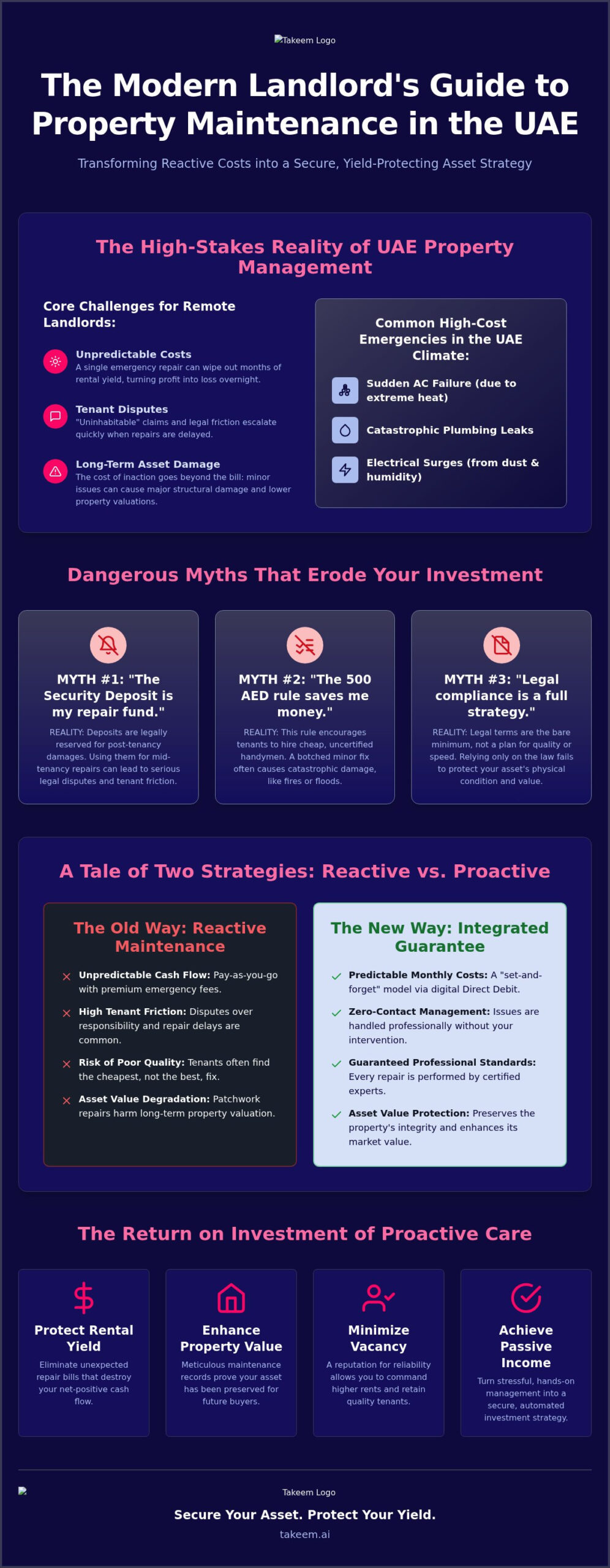
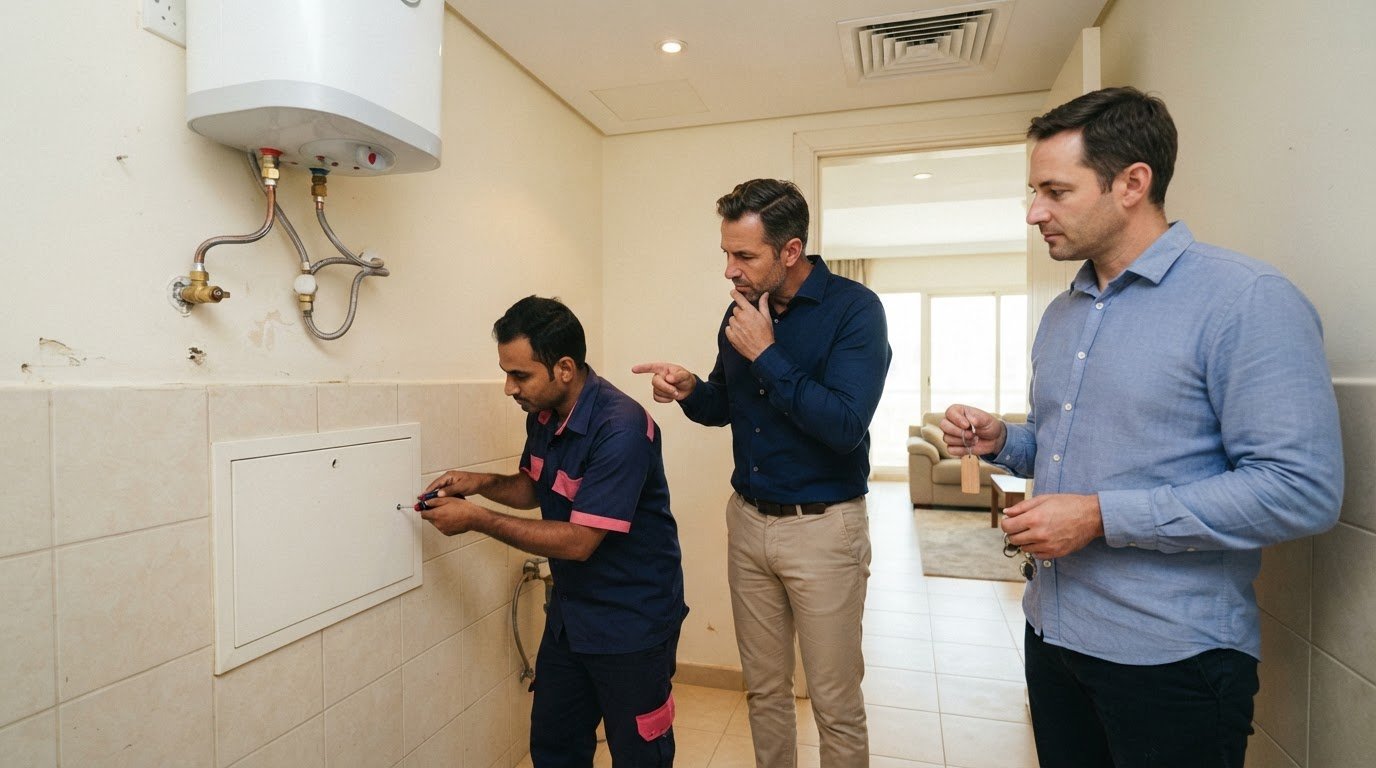
    Managing a property in the UAE involves unique challenges that go far beyond standard wear and tear. When you oversee emergency maintenance for rental portfolios UAE, you aren’t just fixing a broken pipe; you’re protecting a high-value financial asset. A reactive, pay-as-you-go approach is often the quickest way to erode your return on investment. Crisis-mode repairs usually come with premium emergency fees and lead to higher tenant turnover. Rapid response times directly correlate with tenant retention, as residents prioritize reliability in a market where “unhabitable” claims can quickly escalate into legal disputes. Common emergencies in this region typically include sudden AC failures, catastrophic plumbing leaks, and electrical surges that can cripple a home’s infrastructure within minutes.

    The Cost of Inaction: Beyond the Repair Bill

    Delaying a repair might seem like a short-term saving, but the long-term consequences are severe. A minor plumbing leak can penetrate flooring and walls, causing structural damage that requires thousands of Dirhams to remediate. Beyond the physical damage, your maintenance history plays a vital role in future property valuations. Savvy buyers and investors look for meticulous records that prove the asset has been preserved. Understanding foundational landlord-tenant legal principles is crucial for staying compliant with national standards. UAE law protects a tenant’s right to a habitable environment. Failing to address urgent issues can lead to legal friction or contract termination, leaving you with a vacant unit and a disrupted cash flow.

    Why the UAE Climate Demands a Proactive Plan

    The environmental conditions in the UAE are unforgiving for mechanical systems. Extreme summer heat puts immense pressure on HVAC units, causing them to fail exactly when they are needed most. Fine dust and high humidity act as silent killers for electrical components, leading to unexpected shorts and surges. Without a proactive strategy, these environmental factors turn minor vulnerabilities into total system failures. Emergency maintenance is a 24/7 financial safeguard that ensures your property remains operational and your rental yield stays protected regardless of the weather. By shifting from a reactive mindset to a structured plan, you eliminate the friction of managing contractors from afar and secure your investment against the most predictable environmental risks.

    Relying on the law as your only defense is a risky gamble for any serious investor. Many landlords assume that because a contract specifies tenant obligations, their asset is inherently protected. This isn’t the case. While legal frameworks provide a skeleton for responsibility, they don’t ensure the quality or speed of the work performed. When managing emergency maintenance for rental portfolios UAE, waiting for a tenant to fulfill a legal duty often leads to significant property degradation. Legal compliance is the bare minimum; it isn’t a strategy for long-term wealth preservation.

    The Security Deposit Trap

    Landlords frequently view the security deposit as a versatile insurance policy. It isn’t. Legally, you can’t dip into these funds for repairs during an active tenancy without facing significant friction. Deposits are designed to cover damage beyond normal wear and tear specifically at the end of the term. If you rely on these funds to fix an active plumbing issue, you’re likely to face a legal dispute. A structured maintenance plan ensures you don’t have to choose between your monthly cash flow and your property’s integrity. It keeps the deposit reserved for its actual purpose: protecting you against move-out damages.

    The 500 AED Rule Fallacy

    The common “500 AED rule” suggests that tenants should cover minor repairs. This is often the biggest threat to your investment. If a tenant is responsible for a 300 AED electrical fault, they’ll naturally look for the cheapest solution. This usually involves uncertified handymen who lack the expertise to handle complex UAE infrastructure. A poorly executed minor repair can easily escalate into a catastrophic fire or flood. Establishing a professional standard for every intervention is vital. It’s why many savvy investors are moving toward a comprehensive rental guarantee that includes managed maintenance to eliminate these grey areas entirely.

    Don’t fall for the “new build” myth either. Even in recently handed-over units, mechanical failures are common. Snagging lists rarely cover every eventuality, and developer warranties can take weeks to process. An emergency plan fills the gap between a developer’s slow response and your tenant’s immediate needs. It ensures that your asset remains a premium product from day one. By removing the burden of minor repairs from the tenant, you maintain total control over who touches your property’s vital systems, ensuring all work meets professional standards and protects your long-term capital appreciation.

    Comparing Traditional AMCs vs. Integrated Maintenance Plans

    For years, the Annual Maintenance Contract (AMC) was the standard for property upkeep. It functioned as a standalone agreement where landlords paid an upfront fee for a set number of service visits. However, standalone AMCs often fail to address the holistic needs of an investor. They operate in a vacuum, disconnected from the actual rental income and the financial health of the portfolio. This fragmentation creates friction. When an urgent issue arises, the landlord still has to manage the contractor, verify the scope, and often pay extra for parts that the contract excludes. Managing emergency maintenance for rental portfolios UAE through these disconnected services leads to unpredictable costs that can easily derail your monthly cash flow.

    Feature Comparison: Standalone vs. Integrated

    The primary difference lies in the breadth of coverage and the speed of intervention. Standalone AMCs frequently limit call-outs or have restrictive response times that don’t account for the urgency of a UAE summer. In contrast, an integrated rental guarantee with maintenance UAE treats the property as a revenue-generating asset that must stay operational. These modern plans align the interests of the provider with the landlord. Because the rental income is guaranteed, the provider is incentivized to keep the property in peak condition to prevent vacancies. This shift moves maintenance from a grudging expense to a strategic hedge against income loss.

    • Response Window: Integrated plans prioritize rapid resolution to prevent tenant dissatisfaction and potential legal claims.
    • Financial Transparency: Traditional AMCs often hide costs in the fine print; integrated plans offer a streamlined structure that covers both labor and parts within defined limits.
    • Operational Scope: Standalone contracts focus on fixing things when they break. Integrated plans focus on maintaining the asset’s value to ensure the rental income remains secure.

    The Fintech Advantage in Property Upkeep

    The most significant innovation in this space is the marriage of property technology and financial services. By utilizing a direct debit rent guarantee UAE, landlords can automate the funding of their maintenance plans. This eliminates the need for manual bank transfers or the stress of chasing tenants for repair contributions. It’s a cleaner, more professional way to manage a portfolio.

    When you automate rent collection via Direct Debit, the system can seamlessly allocate a portion of the monthly income toward the maintenance fund. This creates a “set and forget” ecosystem. Landlords no longer need to manually approve minor transactions or worry about cash flow gaps during an emergency. The system provides real-time digital logs and reporting. You get full visibility into every repair without the need for constant phone calls or emails. This digital transformation ensures that emergency maintenance for rental portfolios UAE is no longer a reactive burden but a streamlined, tech-driven component of your investment strategy.

    Landlord Emergency Maintenance Plan UAE: Myths vs. Financial Reality in 2026

    How Proactive Maintenance Guarantees Your Long-Term Rental Yield

    Most property owners view repairs as a drain on resources. This is a fundamental misunderstanding of asset management. When you implement emergency maintenance for rental portfolios UAE, you aren’t spending money; you’re buying insurance for your future income. A unit that sits idle for three days due to a catastrophic plumbing failure represents a direct loss of rental yield. When you factor in the administrative time spent sourcing contractors and the risk of tenant dissatisfaction, the true cost of a vacancy far exceeds the price of a proactive plan. Well-managed properties consistently command higher rents because they offer a friction-free living experience that tenants are willing to pay a premium for.

    Yield Protection Through Asset Longevity

    Consistent care significantly extends the lifespan of your property’s most expensive components. In the unforgiving UAE heat, an AC compressor that receives regular, professional servicing will outlast a neglected unit by several years. This deferral of major capital expenditures (CapEx) keeps more profit in your pocket. Professional documentation of your property’s upkeep also allows you to justify rent increases within national frameworks by proving the home is maintained to a superior standard. Linking a high-quality landlord maintenance service UAE to your investment strategy ensures a higher resale value. Prospective buyers pay a premium for assets with a clean, verifiable bill of health and no hidden structural liabilities.

    Risk Mitigation for Portfolio Investors

    Managing a single unit is a task; scaling to a large portfolio is a business. A standardized maintenance plan allows you to provide a consistent tenant experience across diverse properties without increasing your administrative load. It removes the need for individual repair approvals and keeps your cash flow predictable across the entire year. A comprehensive maintenance plan acts as a sophisticated buffer against market volatility by ensuring your units remain the most attractive and reliable options for high-quality residents regardless of economic shifts. This stability is the bedrock of long-term wealth creation in the property market. Implementing a robust landlord income protection UAE strategy alongside your maintenance plan ensures that both your physical asset and your monthly cash flow are shielded from unpredictable disruptions.

    Beyond the spreadsheets, there’s a powerful psychological component to property management. Happy tenants who feel their home is respected and well cared for are significantly more likely to pay on time and stay longer. Reduced turnover is the “secret sauce” of high-yield portfolios. You can secure your rental yield today by moving away from reactive repairs and adopting a modern, integrated strategy that protects both your income and your asset’s physical integrity.

    Asset Protection: The Takeem Rental Guarantee and Maintenance Solution

    Modern property investment requires more than just owning a unit; it demands a sophisticated shield against the friction of daily operations. Takeem represents the evolution of this industry. By integrating emergency maintenance for rental portfolios UAE into a comprehensive financial guarantee, the platform removes the volatility traditionally associated with property ownership. You no longer need to spend your evenings managing contractors or mediating with tenants during a plumbing crisis. Instead, the focus shifts to receiving a consistent, guaranteed income while the physical asset is protected by a system designed for resilience. This transition from reactive problem-solving to passive income security is the hallmark of a mature investment strategy.

    The All-in-One Landlord Shield

    The core strength of this solution lies in its ability to combine income protection with an immediate response to urgent repairs. It creates a seamless ecosystem where the financial and physical health of your portfolio are managed in tandem. Real estate agents play a vital role here, acting as strategic facilitators who help landlords implement these protections to ensure long-term tenant satisfaction. Moving your assets under this umbrella is a straightforward process that replaces uncertainty with a professional standard of care. If you’re looking to upgrade your current management style, transitioning to a landlord rental guarantee provides the comprehensive coverage necessary to thrive in a competitive market.

    This protection extends beyond simple repairs. It acts as a buffer between your cash flow and the unpredictable nature of property wear and tear. By leveraging advanced fintech protocols, the platform ensures that maintenance is funded and executed without the usual administrative delays. It’s a cleaner, more efficient way to operate. You get the stability of a traditional institution with the agility of a tech-forward partner, ensuring your property remains a premium asset that attracts high-quality residents year after year.

    Getting Started: A Seamless Transition

    Onboarding your portfolio is designed to be frictionless. Whether you manage a single apartment or a large-scale collection of villas, the process is logical and highly efficient. The shift begins with moving away from the outdated reliance on post-dated cheques. By setting up Direct Debit, you automate your monthly rent collection, which in turn facilitates the “set and forget” maintenance strategy we’ve explored. This digital transformation eliminates the stress of manual tracking and creates a transparent, real-time log of all property activities. It’s time to stop worrying about the next “unhabitable” claim and start enjoying the security of a protected investment. You can Secure your rental income and asset today with Takeem and experience the calm efficiency of modern property management.

    Securing Your Investment Future in the UAE

    The landscape of property management is shifting from manual, reactive tasks to streamlined digital ecosystems. We’ve explored how legal compliance alone isn’t a strategy and why traditional maintenance contracts often leave gaps in your monthly cash flow. By integrating emergency maintenance for rental portfolios UAE into a broader financial guarantee, you transform a potential liability into a predictable asset. This modern approach ensures that environmental risks and tenant disputes no longer dictate your monthly yield.

    Takeem provides the sophisticated shield you need to thrive. With 24/7 emergency maintenance support and guaranteed monthly income via Direct Debit, you can finally enjoy the peace of mind that comes with a truly passive investment. It’s time to leave the stress of post-dated cheques behind and join the ranks of trusted UAE portfolio investors who prioritize growth over administrative friction. Protect your property and guarantee your income with Takeem’s all-in-one plan. Your portfolio deserves the security of a forward-thinking partner dedicated to your long-term success.

    Frequently Asked Questions

    Is a landlord legally required to have an emergency maintenance plan in the UAE?

    While UAE law doesn’t mandate a specific “plan” document, it strictly requires landlords to deliver and maintain a property in good condition. Failing to address urgent repairs can lead to legal penalties or rent reductions. Having structured emergency maintenance for rental portfolios UAE ensures you meet these legal obligations without the stress of manual coordination. It acts as a professional safeguard that prevents minor issues from becoming costly legal liabilities.

    What qualifies as an emergency repair under UAE rental laws?

    Emergency repairs generally include any failure that renders the property unhabitable or poses an immediate risk to health and safety. In the UAE’s specific climate, a total AC failure during the summer months is almost always classified as an emergency. Other common examples include major plumbing bursts that risk flooding, total electrical failure, or structural damage. These issues require immediate intervention to protect the resident and preserve the long-term value of your physical asset.

    Can I deduct emergency repair costs from my tenant’s security deposit?

    You cannot typically deduct the cost of structural or major emergency repairs from a security deposit. Deposits are legally reserved for damages caused by tenant negligence or breach of contract. Since landlords are responsible for the property’s essential infrastructure, using the deposit for maintenance can lead to successful legal claims from the tenant. A dedicated maintenance plan protects your cash flow so you don’t have to touch the deposit for its unintended purpose.

    How does an emergency maintenance plan affect my annual rental yield?

    A proactive plan stabilizes your rental yield by replacing unpredictable, high-cost repair bills with a fixed, manageable fee. It eliminates the premium emergency rates charged by contractors for last-minute call-outs. Additionally, well-maintained units experience lower vacancy rates and higher tenant retention. By preserving the property’s condition, you also protect the capital appreciation of the asset, ensuring your total return on investment remains net-positive over the long term.

    What happens if a landlord refuses to fix a major structural issue?

    If a landlord neglects major structural repairs, the tenant has the right to seek legal recourse through national regulatory bodies. The tenant may be granted a rent reduction or the right to terminate the lease without penalty. In extreme cases, the authorities might allow the tenant to fix the issue themselves and deduct the cost from future rent. Using an integrated maintenance solution prevents these high-friction scenarios by ensuring repairs are handled automatically and professionally.

    Are AC repairs considered major or minor maintenance in the UAE?

    AC repairs are almost universally considered major maintenance in the UAE, especially when they involve the compressor or internal machinery. While tenants might be responsible for basic filter cleaning, the landlord must ensure the system functions effectively to combat extreme temperatures. Because AC failure is the most common emergency in the region, including it in a structured maintenance package is essential for any landlord who wants to avoid sudden, heavy financial outlays.

    How do digital rent payments via Direct Debit help with property maintenance?

    Transitioning to Direct Debit ensures that a portion of the monthly rental income is always available to fund maintenance needs. It removes the cash flow gaps that often occur when waiting for post-dated cheques to clear. This digital setup allows for a “set and forget” approach where repair costs are pre-funded. It provides the liquidity needed for immediate 24/7 response times, ensuring that emergency maintenance for rental portfolios UAE remains a seamless part of your financial strategy.

    Can real estate agents offer maintenance plans as part of their management services?

    Real estate agents can significantly enhance their value proposition by offering integrated maintenance and rental guarantees. By partnering with fintech platforms like Takeem, agents can provide landlords with a secure income stream and automated repair services. This doesn’t just protect the landlord; it also earns the agent healthy commissions while reducing the administrative burden of property management. It’s a modern, professional way for agents to differentiate themselves in a competitive property market.

  • Choosing UAE Landlord Maintenance for Better Rental Yield

    Choosing UAE Landlord Maintenance for Better Rental Yield

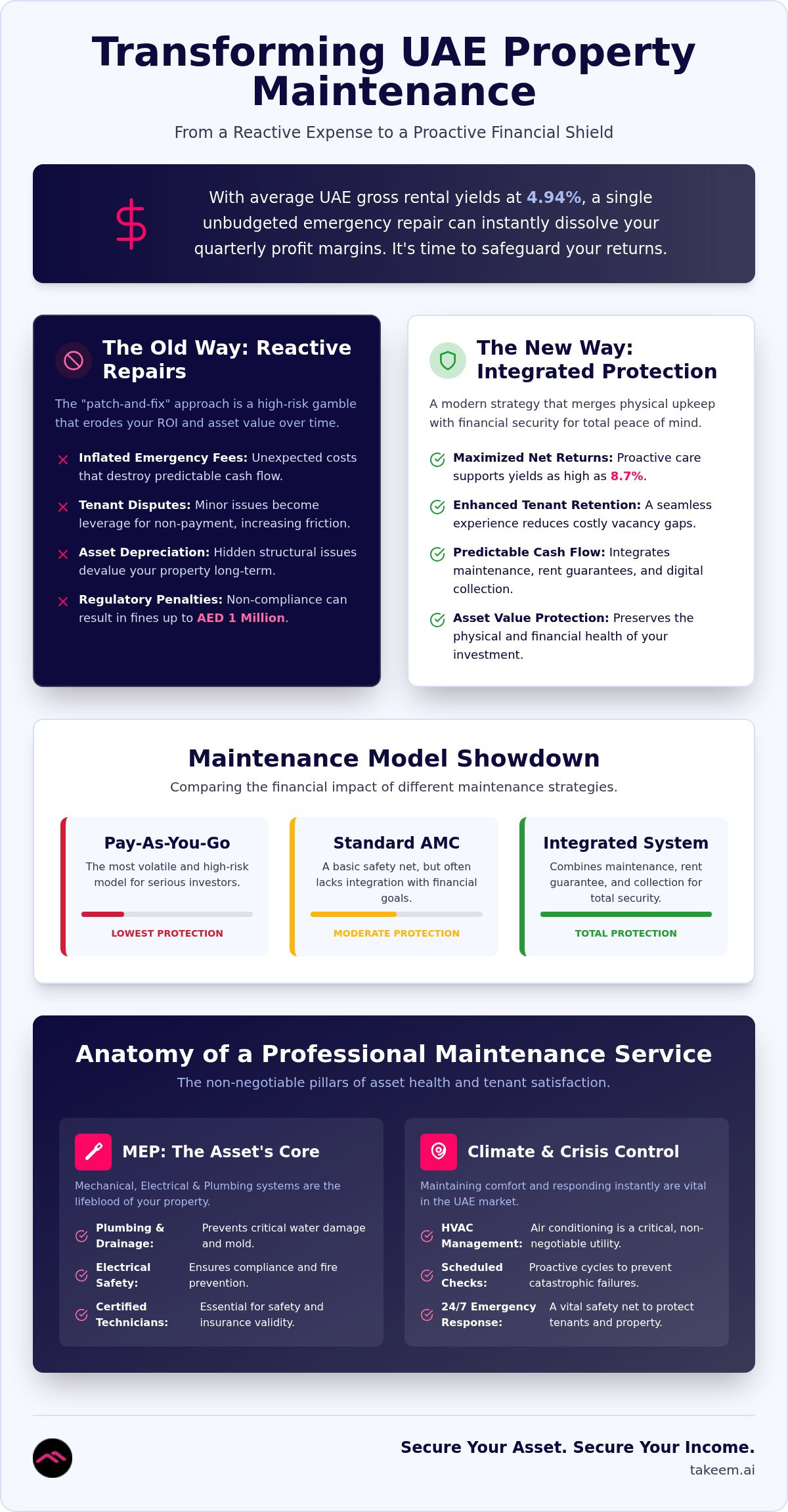
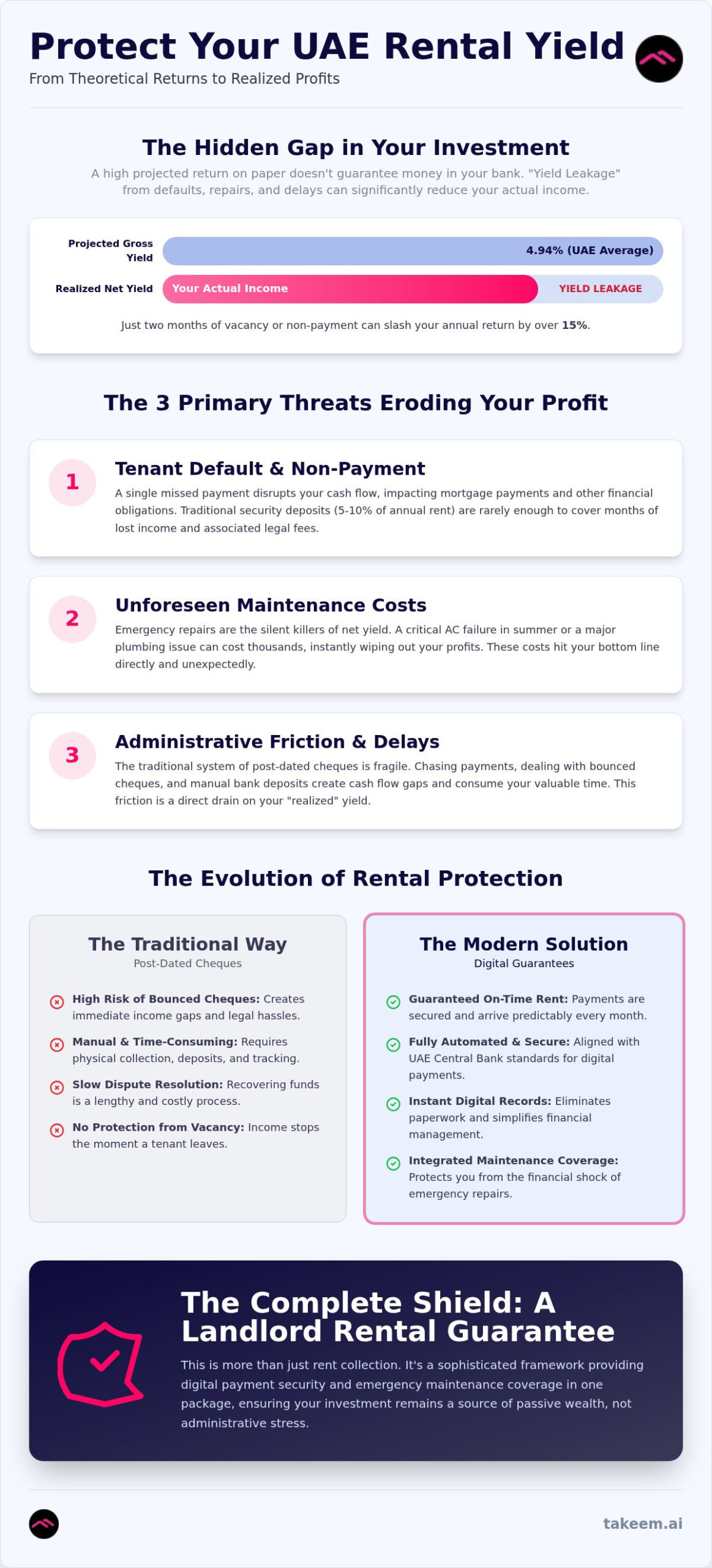
    With average UAE gross rental yields sitting at 4.94% in 2026, a single unbudgeted emergency repair can instantly dissolve your quarterly profit margins. You likely recognize that keeping a property in peak condition is essential for long-term growth, yet managing a reliable landlord maintenance service UAE wide often feels like a fragmented, high-stress chore. Between chasing multiple vendors and facing tenants who use minor leaks as leverage for non-payment, the traditional approach to upkeep is failing modern investors. It’s time to stop viewing repairs as a recurring headache and start seeing them as a strategic financial safeguard.

    This article demonstrates how to transform maintenance from a reactive expense into a sophisticated shield for your rental income. You’ll learn to integrate property care into a broader protection strategy that secures your assets against market volatility and new regulatory standards. We will explore how combining emergency repairs with digital Direct Debit collection and rental guarantees creates a seamless, predictable environment for your portfolio. By the end, you’ll have a clear roadmap to minimizing disputes while maximizing your net returns in an increasingly regulated landscape.

    Key Takeaways

    • Learn why shifting from reactive repairs to an integrated landlord maintenance service UAE is essential for protecting your net rental yields in 2026.
    • Identify the critical MEP and HVAC maintenance requirements necessary to prevent catastrophic property damage and costly tenant disputes.
    • Discover how to align your property’s maintenance schedule with your rent collection cycles to ensure a seamless and predictable cash flow.
    • Compare the long-term financial benefits of Annual Maintenance Contracts (AMCs) against the inherent risks of “pay-as-you-go” repair models.
    • Understand how modern fintech solutions combine emergency maintenance with rental guarantees and Direct Debit to provide total income security.

    The Evolution of Landlord Maintenance in the UAE

    Integrated landlord maintenance is no longer just a service list; it’s a proactive asset protection strategy. It merges physical repairs with a sophisticated layer of financial income security. In the 2026 market, the traditional “call-on-demand” model is failing investors. Waiting for a crisis before acting leads to inflated emergency fees and tenant friction. A professional landlord maintenance service UAE wide ensures that your property remains a high-performing asset rather than a source of unpredictable costs.

    A well-maintained property is your strongest defense against tenant default. When you provide a seamless living experience, you remove the common excuses used to delay or skip rent payments. This approach directly supports strong returns across the UAE market, where gross residential yields can reach as high as 8.7% in specific apartment communities. By treating maintenance as a financial shield, you protect the very foundation of your rental income.

    From Reactive Repairs to Proactive Protection

    The “patch-and-fix” approach carries hidden costs that eventually cripple your ROI. Minor issues often mask deeper structural depreciation that devalues the asset over time. Under current building quality and safety standards in the UAE, non-compliance with maintenance requirements can result in significant penalties, sometimes reaching up to د.إ1 million for severe defects. Utilizing a landlord maintenance service UAE provides the 24/7 emergency coverage necessary to stop small leaks from becoming financial disasters. Modern proptech now facilitates this by offering digital oversight, replacing the old, cumbersome methods of traditional upkeep with transparent, tech-forward solutions.

    Why Maintenance is a Financial Strategy

    Tenant retention is the most effective way to minimize the “vacancy gap.” Every day your property sits empty, your annual yield drops. Rapid turnover maintenance and reliable emergency responses keep tenants satisfied and contracts renewed. In the current market, maintenance is a prerequisite for comprehensive landlord income protection UAE. You simply can’t secure your rent if you don’t secure the asset first. By aligning physical repairs with your financial goals, you ensure your investment remains stable, profitable, and resilient against market fluctuations.

    Essential Components of a Professional Maintenance Service

    A professional landlord maintenance service UAE wide doesn’t just react to problems; it anticipates them. In the specific climate of the Emirates, facility management is actually a financial risk-mitigation tool. Relying on ad-hoc repairs is a gamble that often results in emergency call-out fees and disgruntled tenants. By standardizing service quality across your entire portfolio, you ensure that every asset receives the same high level of care, regardless of its location within the UAE.

    The distinction between emergency response and scheduled preventive maintenance is clear. While emergency coverage acts as a vital safety net, scheduled cycles are what truly preserve your rental yield. Proactive checks reduce the likelihood of catastrophic failures that could force a tenant to vacate or withhold rent. This systematic approach transforms maintenance from a burden into a predictable, manageable component of your broader wealth management strategy.

    MEP: The Core of Your Asset’s Health

    Mechanical, Electrical, and Plumbing (MEP) systems are the lifeblood of any property. Neglecting these leads to rapid depreciation and potential legal liabilities under the building safety laws implemented in March 2026. Consider these essential focus areas:

    • Plumbing and Drainage: Undetected leaks behind walls can cause structural damage and mold. Regular inspections prevent water damage before it requires a total renovation.
    • Electrical Safety: Ensuring all wiring and panels comply with national safety standards is critical for fire prevention and tenant security.
    • Certified Technicians: Using unlicensed handymen is a significant risk. Certified professionals are non-negotiable for insurance purposes; most providers won’t honor claims if repairs weren’t handled by qualified experts.

    Integrating these technical essentials with a digital income protection plan allows you to secure your rental assets while removing the friction of vendor management.

    HVAC Management in the UAE Heat

    In the UAE, air conditioning isn’t a luxury; it’s a critical utility. A failing HVAC system in mid-summer is the fastest way to lose a reliable tenant and face a high-stakes emergency repair bill. Professional cleaning and gas-level checks ensure the units run efficiently, which keeps utility costs down and tenant satisfaction high. Preventive cleaning cycles, ideally performed twice a year, help you avoid the peak-season rush and the inflated costs associated with summer breakdowns. HVAC maintenance is a core asset preservation requirement in the UAE that protects both the physical structural integrity and the financial performance of a rental property.

    Comparing Maintenance Models: AMC vs. Integrated Guarantees

    Selecting the right landlord maintenance service UAE wide requires a clear understanding of how different models impact your bottom line. Most investors choose between three paths: reactive “pay-as-you-go” repairs, traditional Annual Maintenance Contracts (AMC), or modern integrated guarantees. While the reactive approach might seem cost-effective initially, it’s often the most expensive strategy. Emergency call-out fees and the lack of priority response times can quickly erode your quarterly profits. In a market where tenant satisfaction is directly linked to retention, relying on ad-hoc fixes is a high-stakes gamble.

    Traditional AMCs offer more predictability by providing a set number of service visits for a fixed annual fee. They’re a step up from reactive repairs but often fall short for the sophisticated investor. The primary issue is the lack of alignment between the service provider and your financial goals. A standard maintenance company focuses on the repair itself, not the continuity of your rental income. This creates a gap that can lead to disputes, especially when maintenance delays become a tenant’s justification for withholding rent.

    The Limitations of Traditional AMCs

    Traditional AMCs often prioritize volume over specific asset health. You might pay for a package that includes four AC cleanings, but if the service doesn’t address underlying MEP issues, you’re still vulnerable to catastrophic failures. For remote property investors, managing multiple AMCs across a diverse portfolio is an administrative nightmare. Juggling different contracts, expiration dates, and vendor quality levels creates friction. This fragmented approach lacks the “shield” effect needed to truly protect a high-yield investment in the 2026 landscape. Understanding the financial reality of emergency maintenance for rental portfolios UAE is essential before committing to any single model.

    The Rise of Integrated Protection Packages

    Integrated protection packages represent the next phase of property technology in the UAE. These models bundle emergency maintenance directly with rental guarantees, creating a single point of accountability for both the asset’s condition and its income. When your maintenance provider is also the entity guaranteeing your rent, their incentive to keep the property in peak condition is perfectly aligned with yours. It’s a proactive partnership rather than a simple vendor relationship.

    This model thrives on digital efficiency and fintech innovation. By transitioning from physical cheques to secure Direct Debit, the entire lifecycle of the tenancy becomes automated. One partner manages the facility upkeep while simultaneously ensuring that monthly payments are collected and protected. For the modern investor, this integrated approach removes the stress of managing vendors and tenants separately. It provides a seamless, tech-led solution that secures your assets while providing total peace of mind.

    Choosing UAE Landlord Maintenance for Better Rental Yield

    How to Build a Maintenance Strategy That Protects Rental Yield

    Creating a resilient maintenance strategy requires moving beyond the traditional “fix-it” mindset. It’s about engineering a system where physical upkeep and financial security work in tandem. To maximize your returns in 2026, you must treat your property like a high-performance asset that requires precision management. This five-step roadmap ensures your landlord maintenance service UAE strategy supports your long-term wealth goals.

    • Step 1: Conduct a Professional Audit. You can’t protect what you haven’t assessed. Start with a baseline evaluation of all MEP and HVAC systems to identify potential points of failure before they become expensive emergencies.
    • Step 2: Synchronize Maintenance with Rent Cycles. Align your preventive servicing visits with your rent collection dates. Ensuring the property is in top condition right before a payment is due maximizes tenant goodwill and reduces friction.
    • Step 3: Deploy Digital Reporting. Transparency is key to tenant satisfaction. Implement a digital system where tenants can log requests instantly, allowing you to track response times and service quality in real-time.
    • Step 4: Secure an Integrated Rental Guarantee. Shift the risk by choosing a guarantee that includes 24/7 emergency coverage. This ensures that even if a major issue occurs, your income remains protected.
    • Step 5: Link Maintenance to Digital Payments. Transitioning to digital rent collection allows you to automate the entire lifecycle of the tenancy, making maintenance a seamless part of your financial flow.

    Aligning Maintenance with Digital Rent Collection

    Speed is your greatest asset in preventing tenant disputes. When a repair is handled within hours, it eliminates the “rent withholding” excuse that many tenants use to delay payments. By using Direct Debit, you create a secure financial channel where rent is collected automatically while maintenance acts as a proactive shield for that income. This digital integration is a fundamental part of modernizing UAE rentals. It removes the administrative delays of physical cheques and ensures that your cash flow remains uninterrupted by facility issues.

    Selecting the Right National UAE Partner

    Your maintenance partner must provide consistent quality across the national UAE market. A localized handyman simply cannot offer the scalability or the technical sophistication needed for a professional portfolio. You need a landlord maintenance service UAE that understands the intersection of fintech and proptech. They should offer 24/7 availability to ensure that emergency issues don’t lead to structural depreciation or tenant turnover. A tech-savvy guide will help you stay one step ahead of your property’s needs, turning maintenance into a competitive advantage. To secure your portfolio with a modern approach, explore our integrated rental guarantees today.

    Takeem: Integrating Maintenance with Rental Income Security

    Takeem provides the definitive answer to the fragmentation of traditional property management. By merging an emergency landlord maintenance service UAE wide with a robust rental guarantee, we’ve created a fintech-led shield for your assets. This isn’t just about fixing a broken AC; it’s about ensuring that physical defects never compromise your financial stability. Large-scale investors are increasingly moving away from traditional management models toward this integrated approach because it offers a level of predictability that was once impossible in the UAE market.

    A key driver of this stability is the transition from post-dated cheques to secure Direct Debit. Cheques are a legacy friction point that often leads to payment delays, especially when maintenance issues arise. By automating rent collection through Direct Debit, we create a seamless digital environment where your income is 100% stable. This technological shift allows us to link the physical health of your property directly to your monthly cash flow, removing the administrative stress of manual oversight and vendor chasing. For a comprehensive overview of how to safeguard your returns beyond just repairs, our guide to landlord income protection UAE covers the full spectrum of modern fintech solutions available in 2026.

    The Takeem Shield: Emergency Protection Included

    Within a Takeem guarantee, emergency maintenance is a standard feature designed to protect the structural and financial integrity of your asset. We handle the critical repairs that would otherwise cause tenant dissatisfaction or long-term depreciation. Our team acts as the primary facilitator, managing the technical details so you don’t have to. This proactive care is essential for property portfolio rental income optimization. When the asset is protected by a professional landlord maintenance service UAE, the income remains secure.

    The Future of UAE Landlordship

    The modern investor requires a partner that is as tech-savvy as they are. Takeem offers the peace of mind that comes from a single point of accountability for both facility management and financial protection. You no longer need to juggle multiple vendors or worry about the vacancy gap caused by unresolved repairs. Getting started is a straightforward process that begins with securing a comprehensive rental guarantee with maintenance. This ensures your portfolio is shielded from the unpredictability of the 2026 market.

    Don’t leave your yields to chance. Secure your income and your asset today by integrating your maintenance strategy with a partner that understands the future of UAE real estate. It’s time to experience the calm efficiency of a truly modern landlord solution.

    Future-Proofing Your UAE Rental Assets

    The shift toward integrated property protection is the defining trend for UAE investors in 2026. By treating maintenance as a core component of your financial strategy rather than a reactive cost, you insulate your portfolio from the high costs of structural depreciation and tenant turnover. We’ve explored how professional MEP and HVAC management act as the first line of defense against income loss. Modern fintech solutions now bridge the gap between facility upkeep and seamless rent collection, ensuring your investment remains both physically and financially sound.

    Choosing a comprehensive landlord maintenance service UAE wide is no longer a standalone decision; it’s an investment in your asset’s longevity and your own peace of mind. National coverage ensures your entire portfolio receives standardized care while digital tools remove the friction of traditional management. It’s time to transition from fragmented oversight to a unified, tech-forward shield that prioritizes your net yield. Your assets deserve the highest level of protection and a partner that stays one step ahead of your needs.

    Take the next step in securing your financial future. You can protect your rental income and asset value with Takeem’s Integrated Guarantee today. With emergency maintenance included and seamless Direct Debit collection, you’ll experience a new standard of property ownership. Build a more resilient portfolio with the experts who understand the future of the UAE market.

    Frequently Asked Questions

    Is emergency maintenance included in a standard rental guarantee in the UAE?

    Yes, Takeem includes emergency property maintenance as a standard feature within its Rental Guarantee. This integration ensures that the physical asset is protected alongside the financial income. Unlike traditional guarantees that only cover rent defaults, this model acts as a proactive shield. It prevents minor technical failures from escalating into major structural damage or tenant disputes that could jeopardize your monthly returns.

    Can a tenant stop paying rent if maintenance issues are not addressed?

    Legally, tenants in the UAE generally cannot withhold rent as a self-help measure, but they can file a dispute with the Rental Disputes Settlement Centre (RDC). If a landlord maintenance service UAE is not provided for major repairs, the RDC may allow a rent reduction or contract termination. To avoid this legal friction, ensuring prompt repairs is essential for maintaining the validity of your income stream and avoiding costly penalties.

    What is the difference between an AMC and emergency maintenance coverage?

    An Annual Maintenance Contract (AMC) typically covers scheduled preventive visits and a set number of minor call-outs for a fixed fee. Emergency maintenance coverage, especially when integrated into a rental guarantee, focuses on rapid response to critical failures like major leaks or electrical outages. While an AMC is about routine upkeep, emergency coverage is a financial risk-mitigation tool designed to protect the property’s immediate habitability and your rental yield.

    How does digital rent collection via Direct Debit help with property maintenance?

    Digital collection via Direct Debit creates a transparent and automated financial flow that removes the friction of physical cheques. When rent is collected digitally, it’s easier to synchronize maintenance schedules with payment dates. This seamless integration ensures that funds are available for necessary repairs and reduces the likelihood of tenants using maintenance delays as an excuse to cancel cheques or delay their monthly payments.

    Do I need a separate maintenance contract if I have a rental guarantee?

    With Takeem, you don’t necessarily need a separate contract for emergency issues because emergency maintenance is already integrated into the Rental Guarantee. This streamlined approach provides a single point of contact for both financial security and critical facility care. However, for non-emergency or cosmetic upgrades, you might still choose to engage a specialized landlord maintenance service UAE provider to maintain the property’s premium market positioning.

    What qualifies as an ’emergency’ in landlord maintenance services?

    An emergency typically involves any sudden failure that makes the property uninhabitable or poses an immediate risk to the structure. This includes total power failure, major water bursts, complete AC breakdown during summer months, or serious drainage blockages. These issues require immediate intervention to prevent structural depreciation and ensure tenant safety, which is why they are prioritized within integrated protection packages to minimize long-term financial impact.

    How can I manage maintenance for multiple properties across the UAE?

    Managing a diverse portfolio is most efficient when using a partner with national UAE coverage and a centralized digital platform. Instead of juggling various local vendors, a single tech-savvy facilitator can oversee repairs and rent collection simultaneously. This unified model provides consistent service quality across different Emirates. It allows investors to monitor their entire portfolio’s health and income status through a single, transparent interface.

    Does Takeem handle maintenance for large property portfolios?

    Yes, Takeem specifically offers a Rental Guarantee for Property Investors with Large Property Portfolios that includes integrated emergency maintenance. This service is designed for scalability and efficiency, allowing institutional investors to protect multiple assets under one sophisticated umbrella. By combining digital rent collection with proactive facility care, we help large-scale landlords maintain high net yields while significantly reducing the administrative burden of traditional property management.

  • Rental Yield Protection UAE: How to Secure Your Property Investment in 2026

    Rental Yield Protection UAE: How to Secure Your Property Investment in 2026

    Your property’s potential return is irrelevant if the income never reaches your account. In a market where the average gross rental yield in the UAE reached 4.94% in the second quarter of 2026, every dirham lost to administrative friction or tenant default threatens your long-term strategy. Securing rental yield protection UAE is no longer just about picking the right location; it’s about modernizing how you collect and safeguard your money. You shouldn’t have to spend your time chasing payments or worrying about a bounced cheque disrupting your mortgage obligations.

    You likely agree that the traditional system of post-dated cheques feels increasingly fragile in a digital-first economy. This guide promises to show you how to eliminate cash flow gaps and shield your net profits from emergency maintenance costs using advanced fintech tools. We will explore the shift toward Direct Debit mandates, the impact of the 2026 AI-powered National Rental Index, and how you can ensure your investment remains a source of passive wealth rather than a source of administrative stress. By the end, you’ll know exactly how to secure a guaranteed monthly cash flow for your entire portfolio.

    Key Takeaways

    • Learn how to implement rental yield protection UAE strategies to move beyond theoretical returns and secure your “realised yield” through proactive risk management.
    • Identify the primary threats to your net income, specifically how emergency maintenance and tenant defaults can be mitigated with modern fintech solutions.
    • Understand why transitioning from traditional post-dated cheques to automated Direct Debit mandates is essential for maintaining a resilient and predictable cash flow.
    • Follow a structured framework to audit your current rent collection methods and identify leakages that are currently eroding your property portfolio’s performance.
    • Discover how a Landlord Rental Guarantee acts as a sophisticated shield, providing both digital payment security and emergency maintenance coverage in one package.

    Rental Yield Protection: Why it’s Essential in the UAE

    Rental yield protection UAE isn’t just a financial metric; it’s a proactive risk management strategy designed to safeguard your wealth. While many investors focus solely on the initial purchase price, the most successful ones prioritize the security of their ongoing cash flow. In the UAE’s maturing market of 2026, protecting your income means building a sophisticated shield against the friction of manual collection and the unpredictability of maintenance. It is the vital difference between a theoretical profit on a spreadsheet and a tangible bank balance you can actually use.

    The Difference Between Projected and Realised Yield

    A high ROI on paper doesn’t always translate to financial freedom. You might see impressive figures when understanding property valuation, but those numbers can quickly erode if the execution fails. If a tenant defaults or a property sits vacant for two months, your annual return can drop by 15% or more. Most investors track gross yield (the headline figure) or net yield (which accounts for standard operating costs). However, these don’t tell the full story. Realised yield is the net income actually cleared in the landlord’s account. Fintech solutions now close the gap between projection and reality by ensuring that collection delays or “vacancy months” don’t turn into permanent losses for your portfolio.

    The Evolution of Landlord Protection in the UAE

    The UAE is undergoing a national shift from physical post-dated cheques to secure digital mandates. For decades, landlords relied on paper security, but the 2026 landscape demands greater efficiency and transparency. Modern proptech is rapidly replacing traditional property management models with automated systems that prioritize speed and legal compliance. By utilizing Direct Debit, you align with current UAE Central Bank standards and eliminate the administrative burden of manual deposits. This digital transformation provides a level of security that traditional methods simply cannot match. It isn’t just about convenience; it’s about establishing a resilient framework that protects your assets from market volatility. With the 2026 AI-powered Dubai Smart Rental Index providing unprecedented transparency, the focus for savvy investors has shifted from guessing property values to securing the execution of their rental income.

    This evolution is particularly crucial now that average gross rental yields in the UAE have stabilized around 4.94% as of mid-2026. When margins are precise, you don’t have room for “yield leakage” caused by bounced cheques or administrative errors. Embracing a digital-first approach to rental yield protection UAE ensures that your investment remains a source of passive wealth rather than a full-time job.

    The Three Primary Threats to Your Rental Yield

    Securing a high-performing property is only half the battle. Even with the UAE’s robust market dynamics, three persistent threats can quietly erode your returns. Understanding these risks is the first step toward implementing effective rental yield protection UAE. From legal hurdles to unexpected repairs, these “yield killers” turn a profitable asset into a financial burden if left unmanaged. It’s not just about the market price; it’s about the security of the execution.

    Tenant Default and Non-Payment Risks

    A single missed payment creates a significant ripple effect through your financial planning. If you’re balancing a mortgage or reinvesting income, a cash flow gap can be devastating. While the Dubai Land Department provides a clear regulatory framework for disputes, the eviction process remains a costly and time-consuming endeavor. Traditional security deposits, typically ranging from 5% to 10% of annual rent, are rarely enough to cover months of unpaid rent and legal fees. Protecting your income against tenant insolvency or sudden departure is essential to maintaining a stable portfolio. You need a system that ensures your money arrives regardless of the tenant’s immediate circumstances.

    Unforeseen Maintenance and Asset Depreciation

    Emergency repairs are the hidden enemies of net yield. While many investors budget 1% of the property value for annual upkeep, a single AC failure in the peak of summer or a major plumbing emergency can cost thousands of dirhams in an instant. These costs hit your net yield calculation immediately. Beyond the direct expense, slow response times lead to tenant dissatisfaction and higher turnover rates. Rapid maintenance isn’t just about fixing a pipe; it’s about asset preservation and tenant retention. Integrating emergency maintenance into your broader income protection strategy ensures that sudden out-of-pocket expenses don’t wipe out your monthly profits. It’s about shifting from reactive spending to a proactive, shielded approach.

    Administrative friction also plays a role in yield leakage. The time spent chasing payments, manually processing cheques, and managing communications adds up. This hidden cost of manual processing reduces your overall efficiency. Transitioning to a Landlord Rental Guarantee allows you to automate these processes and focus on growth rather than logistics. In a market as fast-paced as the UAE, your time is often your most valuable asset. Eliminating the stress of manual collection ensures that your investment remains truly passive and protected from market volatility.

    Comparing Yield Protection Strategies: Guarantees vs. Traditional Methods

    For decades, the post-dated cheque was the bedrock of UAE real estate. In 2026, that bedrock has crumbled. Relying on paper promises in a digital economy is a risk that modern investors don’t need to take. When you compare traditional methods to modern rental yield protection UAE, the shift toward fintech isn’t just about convenience; it’s about financial survival in a competitive market. You need a system that prioritizes reliability over tradition.

    The Death of the Post-Dated Cheque

    Cheques are increasingly becoming a liability for the modern UAE landlord. A bounced cheque doesn’t just represent a cash flow gap; it initiates a cumbersome legal process that can drain your resources. In contrast, the UAE Central Bank’s support for Direct Debit mandates has revolutionized rent collection. Direct Debit offers automation that reduces human error and significantly lowers the rate of payment failures. By digitizing your collection, you improve the “quality” of your yield. You’re no longer holding a promise to pay; you’re using a system designed for reliability and legal clarity. It’s a cleaner, faster, and more secure way to manage your income.

    Rental Guarantees: A New Standard for Investors

    A rental guarantee is a fundamental shift in how you view your income. Standard property management focuses on the physical asset, but it doesn’t shield you from the financial impact if a tenant stops paying. A guarantee ensures you receive your rent on time, every month, even if the tenant is delayed or defaults. This provides a level of peace of mind that traditional property management cannot replicate. It turns your property into a truly passive asset. For a deeper look at these mechanisms, see our Complete Guide to UAE Rent Guarantee Services.

    Evaluating the ROI of a rental guarantee service fee requires looking beyond the immediate cost. While self-insurance, setting aside a portion of your income for emergencies, is a common tactic, it’s an inefficient use of capital. It ties up funds that could be reinvested elsewhere in your portfolio. A third-party income protection package acts as a predictable expense that eliminates the risk of catastrophic loss. In an environment where average gross yields sit at 4.94%, protecting every decimal point of your return is the only way to ensure long-term growth. You’re trading a small, fixed fee for the total elimination of income volatility and the administrative burden of manual collection.

    Rental Yield Protection UAE: How to Secure Your Property Investment in 2026

    Building a Resilient Framework for Rental Income Security

    Creating a robust system for your property assets requires more than just finding a reliable tenant. It demands a structured approach that addresses every potential point of failure in the rental lifecycle. To achieve true rental yield protection UAE, you must move beyond reactive management and implement a framework that prioritizes automation and financial certainty. This process begins with a cold, hard look at your current operations to identify where “yield leakage” is occurring.

    • Step 1: Audit your collection. Calculate the time and cost spent on manual follow-ups, bank visits, and processing physical cheques.
    • Step 2: Transition to Direct Debit. Align your properties with the national shift toward digital mandates to ensure payments are pulled automatically on the due date.
    • Step 3: Establish a maintenance protocol. Ensure you have a system that handles emergencies instantly, preventing minor issues from becoming expensive repairs.
    • Step 4: Layer a financial guarantee. Secure your contract with a guarantee that pays out even if the tenant’s account is empty.

    Automating the Collection Process

    The “chasing culture” that has historically defined UAE real estate is a significant drain on your resources. When you’re managing multiple units, manual follow-ups become a full-time job that adds zero value to your bottom line. Modern fintech solutions eliminate this friction by providing transparent, real-time reporting for your entire portfolio. You shouldn’t have to guess when your funds will clear or worry about the validity of a signature. For a step-by-step breakdown on modernizing your approach, read our guide on how to Stop Chasing Rent in the UAE: A Modern Landlord’s Guide. This shift doesn’t just save time; it improves the reliability of your cash flow and allows you to scale your investments without increasing your workload.

    Mitigating Asset Risk with Proactive Maintenance

    Maintenance is often viewed as an unavoidable cost, but it’s actually a critical component of rental yield protection UAE. Reactive repairs are almost always more expensive than proactive upkeep. By integrating emergency maintenance into your income protection strategy, you preserve the underlying value of your asset while keeping tenants satisfied. A happy tenant is more likely to renew, which reduces the massive costs associated with vacancy periods and re-leasing fees. Moving to a protected maintenance model means you no longer face a “stress tax” every time a pipe leaks or an AC unit fails during the summer. You gain the confidence that your property is being looked after by professionals, allowing you to remain a truly passive investor. Secure your investment today with a Landlord Rental Guarantee that covers both your income and your property’s physical integrity.

    Maximising Portfolio Performance with Takeem’s Rental Guarantee

    Takeem offers a comprehensive shield for your property assets, moving beyond simple collection to provide absolute financial certainty. By integrating the Landlord Rental Guarantee with a secure Direct Debit setup, the platform removes the variables that typically lead to yield leakage. This isn’t just about collecting rent; it’s about professionalising your entire investment framework. Whether you are managing a single unit or a large-scale property portfolio, the goal remains the same: ensuring that your projected returns become your realised income.

    A Modern Alternative to Traditional Management

    Traditional property management often stops at the physical door, leaving the financial risk of non-payment entirely on your shoulders. Takeem is the logical choice for the tech-forward investor because it replaces the uncertainty of post-dated cheques with the stability of digital payments. This shift aligns with the UAE’s broader digital transformation, providing a level of security that paper-based systems can’t match. For a deep dive into how these systems operate, consult The Ultimate Guide to Landlord Rental Guarantees in the UAE (2026).

    The mechanics of the service are designed for calm efficiency. Once your tenants are onboarded to the Direct Debit system, payments are pulled automatically. If a tenant defaults or a payment fails, the guarantee triggers to protect your income for up to six months. This allows you to maintain your financial obligations, such as mortgage payments or service charges, without the stress of a cash flow gap. It is a sophisticated approach to rental yield protection UAE that scales effortlessly across multiple properties.

    Securing Monthly Cash Flow for Long-Term Growth

    Guaranteed income allows for better financial planning and faster reinvestment. When you know exactly when your funds will arrive, you can make bold decisions about expanding your portfolio. Takeem also plays a crucial role in professionalising the landlord-tenant relationship. By removing the need for manual “chasing” and providing transparent digital reporting, the platform reduces friction and fosters long-term tenant retention.

    • Integrated Maintenance: Emergency repairs are handled as part of the guarantee, preventing sudden out-of-pocket expenses.
    • Digital Certainty: Direct Debit mandates ensure that payment collection is legally compliant and automated.
    • Portfolio Scalability: Manage hundreds of units with the same level of oversight and protection as a single property.

    The added value of integrated emergency maintenance services cannot be overstated. As discussed in previous sections, maintenance is often a “hidden” yield killer. By wrapping this service into the guarantee package, Takeem ensures that your net profits remain protected from the volatility of repair costs. This holistic strategy preserves the underlying value of your asset while securing your monthly cash flow. Don’t leave your returns to chance in a maturing market. Protect your rental yield today with Takeem and experience the peace of mind that comes with a truly shielded investment.

    Future-Proof Your UAE Property Portfolio

    The landscape of property investment is shifting from manual management to digital certainty. You’ve seen how moving beyond the fragility of post-dated cheques and embracing automated collection allows you to transition from a reactive landlord to a sophisticated investor. By identifying yield leakages and implementing a resilient framework, you safeguard your returns against market volatility and the high cost of manual administration. True success in 2026 is defined by the security of your execution, not just the value of your title deed.

    Achieving absolute rental yield protection UAE requires a partner that understands the intersection of finance and property technology. Takeem provides this essential shield by replacing unreliable paper promises with a secure digital Direct Debit system. Because our guarantee includes 24/7 emergency property maintenance, your assets are protected from both financial defaults and physical depreciation. Trusted by landlords across the national UAE market, our platform ensures your cash flow remains steady and your growth remains predictable.

    Secure your rental income with Takeem’s digital guarantee and reclaim your time. Your journey toward a truly passive and protected investment starts with a single digital mandate.

    Frequently Asked Questions

    Is rental yield protection the same as landlord insurance?

    No, rental yield protection UAE is a specialized financial service, whereas landlord insurance typically focuses on physical damage or liability. While insurance might cover the structure of your building, yield protection ensures the actual cash flow reaches your bank account. It acts as a proactive shield against tenant defaults and administrative friction, providing a level of income security that traditional insurance policies don’t offer.

    How does Direct Debit help in protecting my rental yield in the UAE?

    Direct Debit protects your yield by replacing the high-risk manual cheque system with an automated digital mandate. It pulls funds directly from the tenant’s bank account on the due date, which significantly reduces the chances of missed payments or bounced cheques. This automation eliminates the “chasing culture” and ensures your cash flow remains steady and predictable throughout the year.

    What happens if a tenant fails to pay when I have a rental guarantee?

    If a tenant fails to meet their payment obligations, the Landlord Rental Guarantee triggers to protect your income for up to six months. You’ll receive your monthly rent as scheduled, even if the tenant’s account is empty. This prevents cash flow gaps and ensures you can meet your own financial commitments, such as mortgage payments or service charges, without any interruption.

    Can I get rental yield protection for an existing tenancy agreement?

    Yes, you can secure protection for an ongoing tenancy as long as the tenant transitions to the digital payment platform. This allows you to upgrade the security of your existing assets without waiting for a new contract cycle. It’s a strategic move for landlords who want to modernize their current portfolio and eliminate the stress of manual rent collection immediately.

    Does Takeem cover emergency maintenance for all types of properties?

    Takeem includes emergency property maintenance as part of the Landlord Rental Guarantee for residential units. This coverage ensures that urgent repairs are handled instantly by professionals, which preserves the underlying value of your asset. By integrating maintenance into the guarantee, you avoid the sudden, out-of-pocket expenses that often wipe out an entire month’s net profit.

    How much does rental yield protection typically cost for a UAE landlord?

    The cost of rental yield protection UAE is usually a small, fixed percentage of the annual rental income. While specific rates vary based on the property and portfolio size, it’s designed to be a predictable expense that replaces the unpredictable costs of defaults and repairs. You’re trading a minor fee for the total elimination of income volatility and administrative burden.

    Is the transition from cheques to Direct Debit legally mandated across the UAE?

    While physical cheques are still in use, the UAE Central Bank has established the Direct Debit System (UAEDDS) as the preferred modern framework for recurring payments. It isn’t a universal legal mandate yet, but regulatory bodies like the Dubai Land Department are increasingly encouraging digital adoption. Moving to Direct Debit aligns your portfolio with the national shift toward a more transparent and secure real estate market.

    Can property agents offer Takeem rental guarantees to their clients?

    Yes, property agents can offer the Landlord Rental Guarantee to their clients and earn healthy commissions for each successful setup. This allows agents to provide a sophisticated, value-added service that secures their clients’ investments. By offering a guaranteed income solution, agents can distinguish themselves in the market while ensuring their landlords enjoy a seamless, professionalized rental experience.