

Tag: tenancy contracts

  • Landlord Rent Protection Schemes in the UAE: Rent and Eviction

    Landlord Rent Protection Schemes in the UAE: Rent and Eviction

    A rent protection scheme can help reduce the impact of missed rental income, but it does not replace the tenancy contract or legal eviction process. A landlord rent protection scheme in the UAE is a contractual arrangement, and its protection depends on its terms. Eviction procedures depend on the rules that apply to the property.

    It is understandable to want clarity about rent collection, contract terms and a tenant’s default. Different parties may handle these responsibilities, so it is important to know what a scheme covers and what remains governed by the tenancy contract and applicable rules. This guide explains how rental income schemes work, how contracts and payments are managed, and how eviction before a lease ends may be handled. It also explains how a rental guarantee can support landlords without confusing income protection with property management or the legal right to evict.

    Key Takeaways

    • Understand how tenancy contracts, rent collection and payment arrangements fit together, and which responsibilities stay with the landlord.
    • Compare the kinds of rental income protection available and identify what each arrangement is designed to cover.
    • Learn which policy terms and exclusions can affect protection when a tenant defaults.
    • See how Takeem’s Landlord Rental Guarantee can support landlords seeking rental income protection, with emergency property maintenance included as part of the guarantee.

    Contract and payment management responsibilities

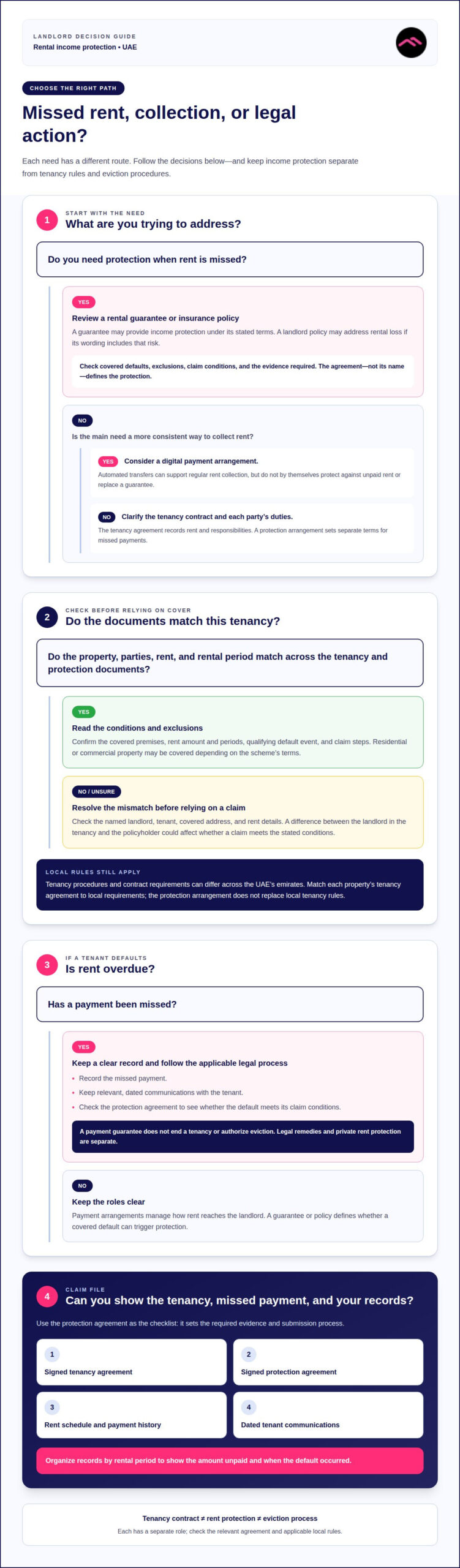
    A tenancy agreement records the rent and each party’s duties. A protection arrangement sets separate terms for missed payments. Make sure each document clearly states its role and the property it covers.

    Available Rent Protection Options

    Rent protection options include rental guarantees and insurance policies, while payment arrangements determine how rent is collected. Their value depends on the landlord’s needs: protection against a covered income loss is different from a way to receive regular payments. Residential and commercial properties may be covered, depending on the scheme’s terms. Check which property types and events are included before deciding whether an arrangement suits a tenancy.

    Differences Across Emirates

    Tenancy procedures and contract requirements are local, so they can differ across the UAE’s emirates. This matters when a landlord owns properties in more than one emirate: a notice or renewal process for one tenancy may not apply to another. Match each property’s tenancy agreement to the local requirements, then review the protection arrangement separately. Its contractual terms do not replace local tenancy rules.

    Protection Against Tenant Default

    Legal remedies and private rent protection are separate parts of a landlord’s response to default. A payment guarantee does not end a tenancy or authorize eviction. If rent is overdue, record the missed payment, keep relevant communications and follow the applicable legal process. The protection agreement governs whether the default meets its conditions for a claim.

    Required Documents and Claims Process

    A claim file links the tenancy, missed payment and landlord’s actions. The protection agreement sets out the required evidence and submission process, so use it as your checklist. Relevant records may include the signed tenancy and protection agreements, rent schedule, payment history and dated tenant communications. Organize these by rental period to show the amount unpaid and when the default occurred.

    What rent protection schemes are available to landlords in the UAE?

    Distinguish protection against lost rent from services that collect payments. A rental guarantee or insurance policy sets out whether a defined tenant default triggers a payment. A payment arrangement manages how rent reaches the landlord. The agreement determines the coverage, exclusions and claim conditions for every landlord rent protection scheme UAE property owners might consider.

    • Rental guarantee: A contractual arrangement may provide income protection under stated terms. The agreement defines covered defaults and the process for making a claim.
    • Insurance policy: A landlord policy may address rental loss if its wording includes that risk. Review the covered events and exclusions, not just the policy name.
    • Digital payment arrangement: Automated transfers can support regular rent collection. They do not, by themselves, protect against unpaid rent or replace a guarantee.

    These options address different needs. A landlord seeking protection when rent is missed should understand the guarantee or policy terms. One seeking a more consistent collection process may focus on payment arrangements. Combining them helps only when each has a clear role.

    Security deposits are another part of the rental framework, but they aren’t the same as ongoing income protection. In the UAE, the typical deposit is 5% of annual rent for an unfurnished property and 10% for a furnished property. The deposit provides security under the tenancy, while a protection arrangement’s scope comes from its own agreement.

    Dubai tenancy law does not explicitly require landlords or tenants to carry insurance. It is therefore important to distinguish legal requirements from voluntary contractual arrangements. Before relying on a scheme, identify the risk it protects against, how to make a claim and which tenancy or payment records support it. The terms show whether the arrangement suits the property and rental needs.
    Landlord Rent Protection Schemes in the UAE: Rent and Eviction

    What are the eligibility requirements and exclusions for UAE rent protection policies?

    Eligibility depends on the protection agreement, property and tenancy covered. Landlords should distinguish policy conditions from tenancy-law requirements: a clause in one agreement does not automatically apply to another. Before relying on a policy for a specific tenancy, read its definitions of landlord, tenant, premises and rent.

    Start with the property and rental details in the tenancy agreement. Check that the covered address, named landlord, tenant and rent period match the documents supporting the protection arrangement. For example, a difference between the landlord named in the tenancy and the policyholder could affect whether a claim meets the stated conditions.

    • Covered property: Confirm whether the agreement applies to the specific residential or commercial premises.
    • Covered rent: Identify which rent amount and rental periods the arrangement uses.
    • Default event: Check what tenant action or missed payment qualifies under the wording.
    • Claim conditions: Note the evidence and notice steps the agreement requires.

    Exclusions remove particular events or circumstances from cover. Wording varies by agreement, so do not assume every policy treats arrears, contract disputes or property damage alike. For example, an agreement may cover unpaid rent but exclude another type of loss. These are separate issues and should not be treated as interchangeable.

    Use a practical review: match the tenancy agreement to the protection document, then find the clauses on eligibility, exclusions and claims. Check how the agreement treats tenancy amendments, changes of tenant or rent, and missed payments that began before cover started. These details can affect whether a later claim meets the agreed conditions.

    Keep the signed tenancy agreement, payment records and written communications together. If a tenant falls behind, the date and period of each unpaid amount can help establish the sequence of events. The protection agreement is the key reference for eligibility and exclusions. A security deposit or payment collection method does not change its terms.

    Does UAE law protect landlords against tenant non-payment or default?

    UAE tenancy law and rent protection agreements address different risks. The law sets out the landlord’s available legal remedies, while a private agreement may address rental income under its own terms. Neither replaces the other.

    In Dubai, a landlord may seek eviction for non-payment if the tenant has failed to pay even after thirty (30) days’ notice, according to the Dubai Land Department. The notice period is a legal step, not an automatic eviction. If the tenant still occupies the property, the landlord must pursue the relevant process rather than treating the lease as ended.

    Keep the rent claim separate from possession of the property. An unpaid instalment creates an arrears issue, while eviction concerns the tenant’s right to remain. For example, a landlord may need to document the missed payment and notice, then use the appropriate dispute process if the matter remains unresolved. A rent guarantee or policy operates under its contract and does not itself grant possession.

    In Dubai, the Rental Dispute Centre’s Arbitration Department aims to resolve rental disputes within 15 days. That stated aim concerns dispute resolution, not a promise that every non-payment case will conclude within that period. Keep the tenancy agreement, rent schedule, payment record and notice together, so the timeline is clear if the dispute reaches the Centre.

    For a landlord, the practical distinction is straightforward: follow the legal route for eviction, and use a separate contractual arrangement for any covered rental loss. The arrangement’s wording determines the covered event and claim requirements. To explore a landlord rental guarantee as an income-protection option, review how its terms address missed rent alongside the tenancy process.

    Dubai tenancy law sets no specific rental deposit amount but requires its return at tenancy end. The landlord holds it during the tenancy rather than placing it with a third-party deposit holder. For annual rent of AED 100,000, a typical deposit is AED 5,000 for an unfurnished property and AED 10,000 for a furnished property.

    Takeem: Landlord Rental Guarantee

    Takeem offers a Landlord Rental Guarantee for landlords seeking rental income protection alongside their tenancy arrangements. It may suit landlords concerned about missed rent, while the tenancy contract and legal process continue to govern the landlord-tenant relationship.

    Property investors with large portfolios can use Takeem’s Rental Guarantee for Property Investors with Large property Portfolios, which includes emergency property maintenance. Takeem also sets up Direct Debit for landlords to accept monthly tenant payments digitally. This supports payment administration, while the guarantee addresses rental protection under its terms.

    Agents can also sell Takeem’s Landlord Rental Guarantee for healthy commissions. The right option depends on whether you are a landlord, portfolio investor or agent looking for a relevant rental guarantee. Contact Takeem to discuss the Landlord Rental Guarantee.

    Make your next rental decision with confidence

    Decide what you want to make more predictable: rental income, payment administration or both. This priority can guide your review of a landlord rent protection scheme in the UAE and help you focus on terms that suit your properties.

    For a single property, start with the outcome you need. For a portfolio, consider how a consistent approach could work across different tenancies. Agents can explore whether a rental guarantee suits the landlords they support. A clear view of your needs makes it easier to assess a landlord rent protection scheme in the UAE.

    Contact Takeem to discuss your rental needs and consider a practical next step for your properties. A focused decision can help you approach future rental arrangements with confidence.

    Frequently Asked Questions

    What are Rental Income Schemes?

    Rental income schemes are designed to support landlords’ rental income or rent collection. A landlord may use a rental guarantee for protection under agreed terms, while digital payment collection can help receive monthly rent without traditional cheques. These arrangements serve different purposes. Decide whether your priority is income protection, payment administration or both before choosing.

    How does rent guarantee insurance work for UAE landlords?

    A rent guarantee sets out the conditions under which a landlord may receive support after a tenant defaults. The agreement defines its scope and claim requirements, so the label alone does not establish what is covered. Keep the rent schedule and payment history aligned with the tenancy records. Digital collection can simplify payment administration, but it is separate from the guarantee’s terms.

    Which UAE insurers offer rental income protection, and what do policies cover?

    An insurer’s name alone does not show whether a policy protects rental income. Coverage depends on the policy wording, including covered events, exclusions, evidence requirements and the claim process. When comparing insurance with a rental guarantee, distinguish the product types and read the terms for the specific property and tenancy. Do not assume a general property policy covers missed rent.

  • How to Set Up Direct Debit Rent Collection in Dubai

    How to Set Up Direct Debit Rent Collection in Dubai

    Setting up direct debit rent collection in the UAE starts with an agreed rent schedule and a digital mandate authorised by the tenant through UAE PASS. Once active, the mandate lets rent be debited from the tenant’s designated bank account on the agreed dates. Record the schedule and payment method in the tenancy contract and register the contract with Ejari or the relevant local authority. UAE tenancy regulations require the lease to state the rent payment method, according to government guidelines.

    Cheques have long been familiar in the UAE’s rental market, so it is reasonable to want clarity on consent, payment dates and how the switch works. This guide explains how the UAE Direct Debit System handles recurring rent, how tenants authorise a mandate through UAE PASS, and what landlords need to arrange before collection begins. It also covers how monthly, quarterly or other mutually agreed instalments fit with the tenancy contract, and what to consider when moving from cheques to automated payments with Takeem.

    Key Takeaways

    • Set out the rent amount, payment method and instalment schedule in the tenancy contract, then register the contract with Ejari.
    • Understand how a tenant authorises a digital mandate through UAE PASS and what happens on scheduled payment dates.
    • Learn what to consider when choosing a bank or payment provider for recurring rent collection, including how the setup fits the agreed tenancy terms.
    • See how a landlord can use direct debit setup to accept monthly tenant payments and how a Rental Guarantee may fit broader rental needs.

    What is Direct Debit and why should you use it?

    Direct Debit lets a tenant authorise recurring rent deductions from a designated account on agreed dates. For landlords, scheduled payments can make rental cash flow easier to plan than collecting dated cheques individually.

    Unlike cheques, bank transfers and payment apps, Direct Debit uses an authorised mandate to collect recurring payments automatically. It does not rely on a cheque or on the tenant initiating each transfer. Dubai tenancy rules also matter: according to the Government of Dubai, the lease must state the rent payment method, and the tenancy contract is registered through Ejari.

    1. Complete Tenant and Landlord Sign-Up

      First, agree on the payment method and schedule, then make sure the tenancy contract records those terms. The landlord or property management company arranges collection, and the tenant authorises the mandate digitally through UAE PASS. Before authorisation, confirm that the designated payment account, amount and dates match the agreed rental terms.

    2. Set Up Automatic Rent Deductions

      Set debit dates to match the tenancy contract, then have the tenant approve the mandate through UAE PASS. After setup, rent is collected automatically from the designated account on those dates. The schedule can follow the parties’ agreed instalments, whether monthly, quarterly or another frequency stated in the contract. Confirm the amount and timing before authorisation to avoid a mismatch with the lease.

    3. Switch from Cheques During a Tenancy

      A tenancy renewal is a practical time to switch from post-dated cheques to Direct Debit. Agree on the revised payment schedule and record the method in the renewed contract registered with Ejari. An existing cheque arrangement does not change automatically, so align the new mandate’s start date with the contract terms and any cheques already issued.

    Direct debit services for real estate and property management

    For Dubai landlords and property management teams, Direct Debit can automate recurring rent collection while keeping the agreed payment terms in place. Use these steps to decide whether it suits a property or portfolio.

    1. Confirm the property and collection arrangement. The UAE Direct Debit System is described as available for residential and commercial properties. A landlord can arrange collection directly, or a participating property management company can coordinate payments for a managed property. Direct Debit is optional in Dubai, and post-dated cheques remain an accepted payment method. Choose between cheques and a digital alternative according to the tenancy terms and the parties’ agreement.
    2. Check whether the management company participates. Participation in Dubai’s Flexi Rent initiative is voluntary for eligible property management companies, so it is not a universal requirement for managed properties. Participating companies continue to manage tenancy contracts and payment processes through their existing systems and procedures. Confirm how the process aligns with each tenant’s contract, bank account and agreed payment dates. The tenant still authorises the Direct Debit mandate through UAE PASS.
    3. Match the service to the portfolio’s payment needs. Participating companies may offer monthly, quarterly or semi-annual instalments, depending on their arrangements. Landlords managing several units can map each property’s rent schedule to its individual tenancy contract instead of assuming one cycle suits every tenant. This makes collection easier to administer while keeping each payment tied to its agreed terms. Direct Debit can reduce cheque handling, but contracts and payment records still need to be managed.

    How to Set Up Direct Debit Rent Collection in Dubai

    How UAE Direct Debit rent collection works

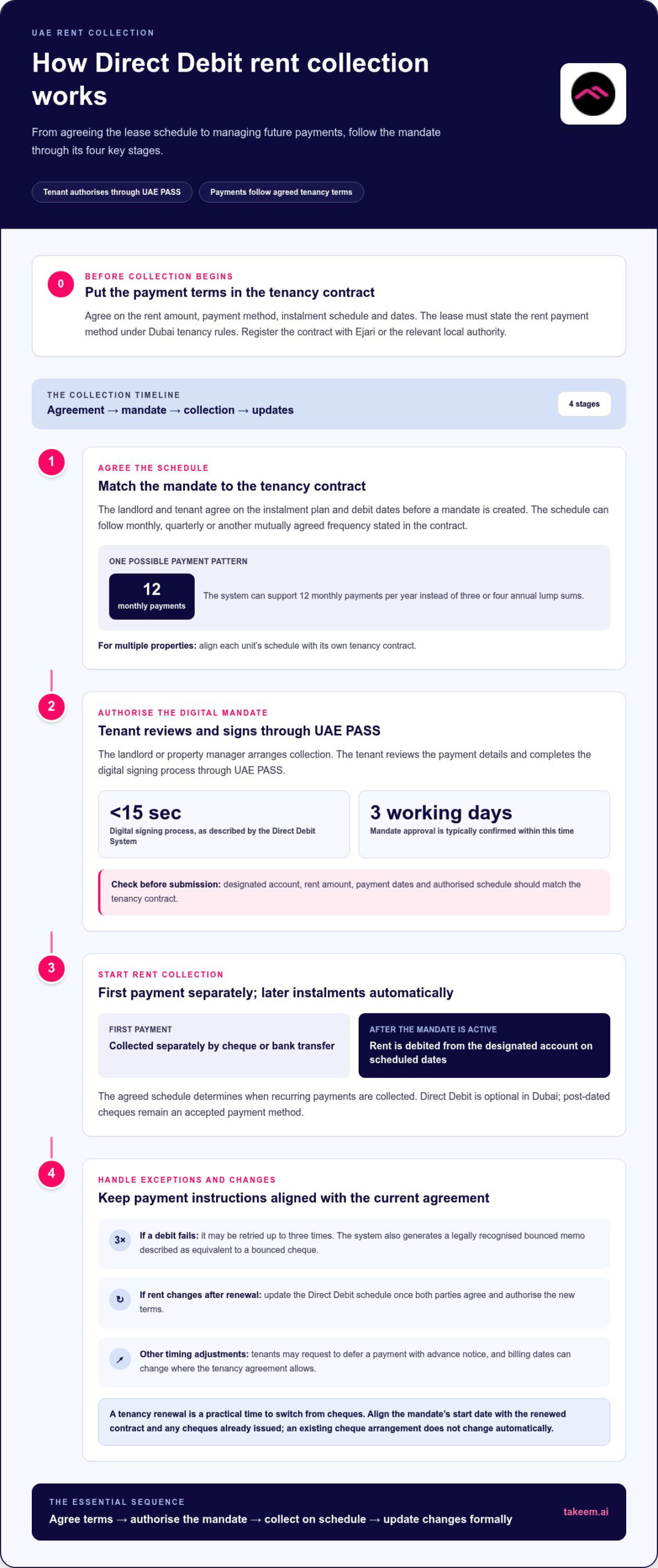
    1. Match the payment schedule to the tenancy contract before creating a mandate. The UAE Direct Debit System can support recurring rent payments, including 12 monthly payments per year instead of three or four annual lump sums. The landlord and tenant must agree on the instalment plan and dates. For a property portfolio, keep each unit’s schedule aligned with its own tenancy contract, rather than applying one cycle to every tenant.
    2. Send the mandate for the tenant’s UAE PASS authorisation. The tenant reviews the payment details and completes the digital signing process, which the Direct Debit System says takes under 15 seconds. Mandate approval is typically confirmed within three working days. Check that the account, rent amount, payment dates and authorised schedule match the tenancy contract before submission, so the automated instruction reflects the parties’ agreed terms.
    3. Plan how the first rent payment will be collected. Under the described process, the first payment is collected separately by cheque or bank transfer, while the mandate covers later instalments. Once active, the system debits rent on scheduled dates. If a debit fails, it may be retried up to three times. The system also generates a legally recognised bounced memo described as equivalent to a bounced cheque.
    4. Keep the mandate aligned with any change to the tenancy terms. If rent changes after renewal, update the Direct Debit schedule once both parties agree and authorise the new terms. Tenants may request to defer a payment with advance notice, and billing dates can change where the tenancy agreement allows. Treat each change as a schedule update, not an informal adjustment, so future payments follow the current contract.

    Which banks and payment providers offer rent direct debit in Dubai?

    1. Use the UAE Direct Debit System rather than assuming every bank offers a landlord-facing rent product. The system is regulated by the Central Bank of the UAE and operates under a sponsor bank licence. Banks provide the account infrastructure, while a payment provider or collection platform can organise the rent mandate and scheduled collection. For tenants, the practical test is whether the provider can set up a mandate for the agreed rent schedule and the tenant can authorise it digitally.
    2. Understand how the payment provider connects the landlord, tenant and bank account. The provider should present the amount, dates and tenancy terms for the tenant to authorise through UAE PASS. Check how it handles mandate status, payment confirmations and failed debits, then compare that process with the landlord’s existing rent records. Bank transfers or card payments may also be available through some property arrangements, but they are separate from recurring Direct Debit authorisation.
    3. Choose the setup around the tenancy, not simply the bank brand. Confirm that the rent collection schedule matches the contract and that the tenant can authorise the specified account. For landlords managing multiple properties, check that the process keeps each mandate and payment record connected to its own tenancy. Takeem provides Direct Debit setup for landlords to digitally accept monthly tenant payments, offering a direct route to automate collection without treating every bank’s mobile app as a rent collection service.

    Takeem: Landlord Rental Guarantee

    Takeem offers a Landlord Rental Guarantee alongside Direct Debit setup for landlords who want to accept monthly tenant payments digitally. Direct Debit helps organise collection around the agreed payment schedule, while the guarantee is a separate option for landlords seeking rental protection.

    Property investors with large portfolios can consider Takeem’s Rental Guarantee for Property Investors with Large property Portfolios. Agents can also offer the Landlord Rental Guarantee to clients as a commission opportunity. The Rental Guarantee includes emergency property maintenance service as part of the package.

    If you’re considering a guarantee or digital rent collection for your properties, contact Takeem to discuss your needs.

    Make Your Next Rent Cycle More Intentional

    Use the next rental cycle to plan your approach. Decide whether your priority is reducing cheque handling, establishing a clearer payment routine or protecting rental income. Direct debit rent collection in Dubai works best as part of a considered plan for managing each property, not as an isolated payment change. Choose an arrangement that suits your tenants and supports your wider investment plans.

    Takeem offers a Landlord Rental Guarantee for individual landlords and a Rental Guarantee for Property Investors with Large property Portfolios. Agents can also sell the Landlord Rental Guarantee for healthy commissions. These options serve different roles in the rental market, from individual landlords and portfolio investors to agents.

    Explore the next step for your rental collection plans and contact Takeem about rent collection. A considered change can help you move forward with greater clarity.

    Frequently Asked Questions

    What are the benefits of paying rent by Direct Debit in the UAE?

    Direct Debit automates recurring rent payments, so tenants do not need to initiate each transfer or prepare a cheque for every due date. For landlords, scheduled collection can make rental cash flow easier to plan. Payment confirmations and online records can also provide both parties with a clearer transaction history. Tenants should still keep enough funds available and check the mandate details against the agreed schedule.

    What if I’m already mid-lease and cheques have been issued?

    Tenants in Dubai who pay rent by post-dated cheque can switch to Direct Debit when the tenancy contract is renewed. Until then, follow the current payment arrangement and do not assume issued cheques are automatically replaced by a new mandate. At renewal, agree on the revised method and schedule with the landlord, then align the renewed contract and mandate before the new collection cycle begins.

    What if my rent amount changes, such as at renewal?

    Update the Direct Debit schedule after the landlord and tenant agree on the renewed rent and authorise the revised terms. If the renewal changes the rental amount, for example, the existing mandate should not be treated as approval for the new amount. Keep the updated schedule consistent with the tenancy paperwork, and confirm the revised mandate details before its first scheduled debit.

    What if there aren’t enough funds on the day?

    If a scheduled debit fails, it may be retried up to three times. The process can also generate a legally recognised bounced memo described as equivalent to a bounced cheque. Keep the designated account funded before the due date. If a payment needs to be deferred, tenants may request this in advance rather than waiting until a debit has failed.

    How does Direct Debit rent collection work in Dubai?

    The tenant authorises a recurring rent mandate digitally through UAE PASS, and rent is collected from the designated account on the agreed dates. The schedule follows the tenancy terms rather than an assumed standard cycle. After a successful payment, tenants can access transaction records to track rent paid and keep documentation for future rental administration.

    How can landlords set up Direct Debit rent collection in Dubai?

    For landlords arranging direct debit rent collection in Dubai, start by agreeing on a payment schedule with the tenant and ensuring it matches the tenancy terms. The landlord arranges the Direct Debit setup, and the tenant authorises the mandate through UAE PASS. Takeem helps landlords accept monthly tenant payments digitally through Direct Debit setup, alongside its Landlord Rental Guarantee.