

Securing an eviction order against a defaulting tenant doesn’t safeguard your cash flow; it usually means you’ve already absorbed months of preventable rental arrears. When payment dates lapse and rent goes unpaid, the urge to intervene immediately is understandable. However, attempting informal self-help measures like changing locks or disconnecting basic utilities exposes landlords to severe statutory penalties. Following the formal legal process for tenant eviction in UAE dispute resolution tribunals remains your only valid route to repossess your property and recover outstanding funds.
Managing this system successfully requires strict procedural precision. You must document every default, adhere to statutory notice periods, and avoid administrative missteps that can prompt immediate case dismissal. In this guide, you’ll master mandatory notice protocols, learn how to prepare filings that withstand tribunal scrutiny, and discover how modern safeguards like automated Direct Debit collection and rental guarantees protect your income before payment disputes even start.
Here is your comprehensive roadmap for handling tenancy defaults lawfully while keeping your rental cash flow fully intact.
Key Takeaways
- Understand lawful grounds for lease termination to ensure you never risk severe statutory penalties through prohibited self-help actions like lock changes or utility cutoffs.
- Navigate each stage of the formal legal process for tenant eviction in UAE dispute committees with exact procedural compliance to avoid immediate case dismissal.
- Distinguish between standard 30-day contractual breach notifications and mandatory 12-month non-renewal notices dispatched through official legal channels.
- Account for the true financial drag of dispute litigation, including administrative filing expenditures and protracted periods of unpaid occupancy.
- Protect ongoing portfolio cash flow by replacing vulnerable paper cheques with automated Direct Debit collection and proactive landlord rental guarantees.
Understanding the Statutory Grounds for Lawful Tenant Eviction in the UAE
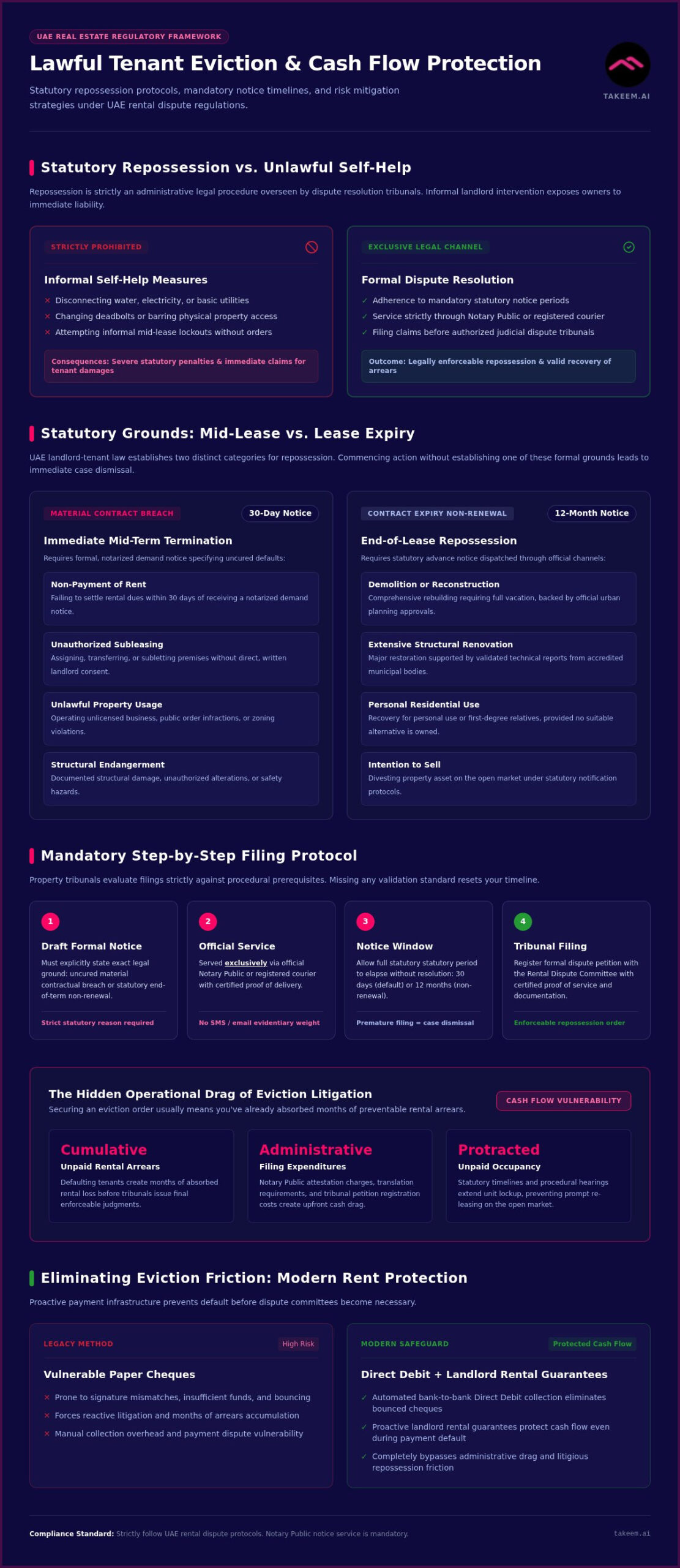
Statutory tenancy repossession is a strictly regulated administrative procedure overseen by authorized judicial committees rather than an informal owner prerogative. Fundamental principles of landlord-tenant law ensure both parties remain protected from arbitrary actions. Under federal regulations, landlords cannot resort to self-help measures. Disconnecting water or electricity, barring access, or changing deadbolts constitutes an unlawful eviction that invites severe statutory penalties and immediate claims for tenant damages.
Property owners must navigate repossession through two distinct categories: immediate termination due to material contract violations, or end-of-lease repossession based on statutory non-renewal rights. Adhering to the formal legal process for tenant eviction in UAE dispute bodies is mandatory regardless of the underlying reason.
Eviction Triggers Arising from Material Contractual Breach
When an occupant breaches substantive obligations during an active lease term, the owner can initiate eviction proceedings before the contract expires. Common grounds include:
- Non-payment of rent: Failing to settle rental dues within thirty days of receiving a formal, notarized demand notice.
- Unauthorized subleasing: Assigning, transferring, or subletting any portion of the premises without direct, written consent from the landlord.
- Unlawful property usage: Operating an unlicensed commercial activity, causing public order infractions, or utilizing residential spaces contrary to zoning rules.
- Structural endangerment: Inflicting documented structural damage, unauthorized alterations, or persistent health hazards that risk building safety.
Lawful Reasons for Non-Renewal Eviction Upon Contract Expiry
If no contractual violation has occurred, property owners cannot terminate a tenancy mid-term. Repossession can only occur upon lease expiration under specific, legally sanctioned grounds requiring advance statutory notice:
- Demolition or reconstruction: Comprehensive rebuilding works that require complete vacation of the structure, backed by official urban planning approvals.
- Extensive structural renovation: Major restoration projects that prevent normal tenant occupancy, supported by validated technical reports from accredited municipal engineering bodies.
- Personal residential use: Recovery of the real estate unit for personal occupancy by the property owner or their first-degree relatives, provided no suitable alternative property is owned.
- Intention to sell: Divesting the property asset on the open market under statutory notification protocols.
Navigating these categories requires absolute precision. Commencing the legal process for tenant eviction in UAE rental committees without establishing one of these formal grounds leads to immediate case dismissal and unnecessary administrative expense.
The Step-by-Step Legal Eviction Process for UAE Property Owners
Reclaiming a property requires following a linear, highly technical protocol. Property tribunals assess every filing strictly against statutory requirements; missing a single procedural prerequisite can reset your entire timeline. Understanding how the legal process for tenant eviction in UAE dispute bodies functions from initial notice to formal handover protects you from costly administrative dismissals.
Step 1: Serving Mandatory Notice via Notary Public
The eviction procedure begins before any committee filing. Landlords must prepare a formal notice explicitly stating the reason for termination, whether addressing an uncured breach or an end-of-term repossession. This document must be served exclusively through an official Notary Public or an accredited registered courier with certified proof of delivery. Digital text messages, casual emails, and verbal demands carry no evidentiary weight before rental tribunals and will invalidate your claim.
Step 2: Registering a Claim with the Rental Dispute Committee
Once the statutory notice period expires without resolution, you can submit a formal dispute petition. Your submission file must include authenticated tenancy contracts, certified title deeds, calculation sheets for outstanding payments, and official proof of service receipts. Proceedings unfold through distinct tribunal phases:
- Preliminary document verification: Tribunal case officers review the legal standing of the applicant and confirm mandatory notification compliance.
- Reconciliation stage: Settlement committees convene mediation sessions to seek an amicable agreement, such as structured repayment schedules, before advancing to formal litigation.
- First-instance judicial review: If mediation fails, judges examine contractual merits, assess documentation, and issue a binding eviction judgment.
Step 3: Enforcement Proceedings and Physical Repossession
Securing a favorable verdict does not grant an immediate right to take back the keys. Once statutory appeal windows lapse, the landlord must open an enforcement file with the execution department. Court bailiffs serve an execution notice on the occupant. If the tenant still refuses to vacate, enforcement officers coordinate physical site repossession, supervise locksmith lock replacements, and catalogue remaining personal effects under formal inventory rules.
Because executing this statutory roadmap demands significant administrative stamina, forward-thinking owners leverage modern financial tools like a Landlord Rental Guarantee to protect active cash flow while navigating lengthy dispute procedures.
Statutory Notice Periods, Essential Documentation, and Prohibited Landlord Actions
Clarity around statutory timelines separates successful tenancy enforcement from prolonged procedural stagnation. A common misstep among property owners involves conflating notices issued for active contractual defaults with those required for scheduled non-renewals. Aligning your filing with the correct statutory timeline is essential when undertaking the legal process for tenant eviction in UAE dispute bodies.
Comparing the 30-Day and 12-Month Notice Frameworks
The law establishes two distinct notification pathways based on the underlying grounds for action:
- 30-day notice for material breach: Applied strictly when an occupant defaults on rental payments, subleases without authorization, or causes documented structural harm. This gives the tenant a thirty-day cure period from the date of formal service.
- 12-month notice for statutory non-renewal: Reserved exclusively for legitimate end-of-lease repossession, such as taking back the property for personal residence, selling the unit, or carrying out approved demolition and comprehensive reconstruction.
Both categories require formal notarization. Delivering a notice through standard email or informal messaging does not trigger the statutory timeline, rendering subsequent tribunal claims procedurally defective.
Mandatory Document Checklist for Rental Tribunals
Rental dispute committees operate under rigorous evidentiary standards. To ensure your claim proceeds smoothly through evaluation, compile a verified legal dossier containing:
- The attested tenancy contract alongside valid title deed records confirming legal ownership.
- Notarized notification copies accompanied by certified delivery receipts proving official service.
- Documented financial transaction records, such as formal bank return memos and returned cheques confirming unpaid balances.
- Legally certified Arabic translations of all foundational tenancy agreements, notifications, and written communications.
Prohibited Actions: Severe Legal Risks of Self-Help Evictions
Facing uncooperative occupants often creates significant operational strain, but taking matters into your own hands carries severe legal liabilities. Federal statutes strictly prohibit landlords from disconnecting electricity, shutting off air conditioning, terminating domestic water supplies, or restricting access to the premises.
Entering the unit without tenant permission or changing door cylinders constitutes a criminal offense. Dispute committees possess statutory authority to issue emergency orders forcing immediate tenant reinstatement, impose substantial punitive fines on the landlord, and award financial compensation to the tenant. The only protected, legally enforceable route is through the formal legal process for tenant eviction in UAE judicial channels.
The Hidden Operational Costs and Financial Drag of Eviction Litigation
Filing a dispute petition is often viewed merely as an administrative hurdle. In reality, the legal process for tenant eviction in UAE dispute bodies exposes property owners to substantial capital drag that extends well past upfront filing expenses. Between direct disbursements and interrupted yields, litigation quietly erodes investment performance.
Direct Expenditures Versus Compounding Lost Rental Income
Litigation requires immediate liquidity. Owners must finance dispute committee registration fees, legal representation retainers, translation services, and subsequent enforcement filing costs. Yet these initial outlays represent only a fraction of the total exposure.
- Uncompensated occupancy: Defaulting occupants typically remain in the unit for months during tribunal hearings and enforcement scheduling without paying rent.
- Blocked reinvestment: Capital that should generate steady quarterly returns sits trapped in a non-performing asset.
- Unrecoverable judgments: Winning a favorable restitution order does not ensure liquidity. Indebted tenants frequently lack accessible local bank balances, leaving cash awards uncollected.
Proactively understanding how avoiding rental disputes preserves baseline yields gives landlords a substantial operational advantage over traditional reactive approaches.
Physical Asset Degradation and Unmonitored Maintenance Issues
Strained tenancy relationships quickly degrade physical property standards. When an occupant stops paying rent, their incentive to maintain the home disappears entirely. Routine wear accelerates, minor plumbing leaks go unreported, and central air conditioning systems suffer from neglected servicing.
These deferred maintenance issues compound silently over months of contested occupancy. By the time bailiffs execute physical repossession, rectifying extensive water damage or repairing structural fixtures regularly exhausts the retained security deposit. The owner then faces unexpected refurbishment bills alongside prolonged marketing vacancy to make the unit tenantable again.
Litigation secures legal possession, but it cannot undo cumulative financial and physical depreciation. To insulate your portfolio against payment freezes and unmonitored property wear during defaults, secure a comprehensive Landlord Rental Guarantee before signing your next lease agreement.
Eliminating Eviction Friction: Modern Rent Collection and Income Guarantees
Mastering the legal process for tenant eviction in UAE tribunals is an essential defensive skill, but relying on litigation to resolve payment defaults is fundamentally reactive. Traditional dispute resolution forces property owners to absorb months of interrupted cash flow while waiting for enforcement officers to act. Forward-thinking investors don’t wait for arrears to trigger legal battles. Instead, they implement structural financial safeguards that eliminate collection friction entirely.
Replacing Paper Cheques with Automated Direct Debit Infrastructure
For decades, physical post-dated cheques served as the standard rent collection instrument. Today, paper cheques introduce unnecessary vulnerability. They bounce, create administrative overhead, require manual bank runs, and frequently spark hostile financial disputes. Modern property portfolios avoid these vulnerabilities by shifting to automated, Central Bank-aligned Direct Debit systems.
Direct Debit establishes programmatic recurring deductions directly from the tenant’s bank account. This automated mechanism simplifies monthly budgeting for tenants, which dramatically lowers default incentives while giving landlords predictable transaction timelines. Adopting a modern rental guarantee with direct debit transforms chaotic cheque cycles into streamlined, reliable digital revenue.
Securing Guaranteed Monthly Cash Flow and Asset Protection
Eliminating courtroom friction requires decoupling your personal liquidity from individual tenant solvency. Comprehensive rental guarantee solutions ensure that landlords receive their scheduled rental disbursements on time, even if an occupant defaults or delays payment. You no longer have to navigate tribunal hearings or enforcement queues simply to meet debt obligations or maintain portfolio cash reserves.
Asset preservation extends beyond monetary disbursements. When tenancies sour, physical maintenance typically suffers. Securing coverage that includes integrated emergency property maintenance ensures certified technicians resolve critical electrical, air conditioning, and plumbing breakdowns immediately. This preserves structural integrity and prevents compounding asset degradation before issues escalate into costly disputes.
Rather than managing the prolonged, stressful legal process for tenant eviction in UAE courts, modern property owners insulate their investments upfront. Securing a structured landlord rental guarantee delivers total financial resilience, protecting your monthly disbursements and property value regardless of market volatility.
Transform Tenancy Risk into Predictable Rental Yields
Navigating the formal legal process for tenant eviction in UAE dispute committees establishes your lawful right to repossess an asset, but litigation shouldn’t be your primary financial backstop. Absorbing unpaid arrears, managing rigid statutory notice timelines, and risking physical asset wear during enforcement delays places unnecessary strain on your balance sheet.
Smart property owners protect their yields by eliminating payment friction before it escalates to tribunal filings. Shifting from paper cheques to automated Direct Debit establishes seamless collection, while a structured guarantee safeguards your monthly disbursements even during tenant payment default cycles. Paired with integrated emergency property maintenance, your portfolio stays fully defended against both financial and operational disruption.
Take control of your cash flow today. Protect your rental income with Takeem and build long-term resilience across your property investments.
Frequently Asked Questions
Can a landlord evict a tenant immediately for non-payment of rent in the UAE?
No, immediate evictions are strictly prohibited under federal regulations. Landlords must deliver a formal 30-day payment demand served via an official Notary Public or registered courier before registering a claim. If the tenant settles the outstanding arrears within that 30-day cure window, the eviction grounds become void, and the tenancy agreement remains legally active.
Is it legal for a UAE landlord to change door locks or disconnect utilities?
No, self-help eviction acts are strictly illegal nationwide. Shutting off electricity, water, or cooling systems, or changing physical locks to bar an occupant, violates statutory tenancy laws. Tenants subjected to these measures can immediately petition the dispute tribunal for urgent restoration orders, and landlords face severe financial penalties and criminal exposure for unlawful entry.
How long does the formal legal eviction process take through rental dispute tribunals?
The timeline varies depending on tribunal caseloads and enforcement schedules. Initiating the legal process for tenant eviction in UAE dispute bodies typically takes several months from the expiration of the statutory notice period. This progression includes the initial reconciliation phase, formal first-instance judicial hearings, statutory appeal periods, and the subsequent execution phase overseen by court bailiffs.
What is the statutory notice period required to evict a tenant in the UAE?
Notice periods depend directly on the reason for eviction. Material contractual breaches, including non-payment of rent or unauthorized subletting, require a 30-day written notice served through official channels. Conversely, non-renewal claims based on property demolition, extensive structural renovations, personal residential use, or an intention to sell mandate an advance 12-month notice served via Notary Public.
Can a tenant be evicted if the landlord intends to sell the property?
Yes, selling a property is a valid statutory ground for eviction, but it requires strict compliance. The owner must serve a formal 12-month eviction notice exclusively through a Notary Public or registered courier. Crucially, repossession takes effect only upon lease expiry after the full notice period concludes; landlords cannot terminate an active fixed-term lease mid-cycle simply to sell.
What documents are required to file a rental eviction case in the UAE?
Filing a case requires a verified legal dossier proving ownership and default. Property owners must submit the attested tenancy contract, valid title deed, certified bank return memos for bounced cheques or failed transactions, and the authenticated delivery receipt confirming official Notary Public service. All foreign-language documentation must be accompanied by certified, legally attested Arabic translations.
How does a landlord rental guarantee protect against tenant eviction delays?
A landlord rental guarantee decouples your cash flow from the slow legal process for tenant eviction in UAE courts. Instead of absorbing months of unpaid occupancy while navigating tribunal hearings, the guarantee maintains scheduled monthly rental disbursements directly to your account. Paired with automated Direct Debit and emergency maintenance coverage, it protects your capital and asset condition entirely during default disputes.