

A fully occupied property can still produce weak returns if its costs are too high. Rental cash flow is the income left after expenses are subtracted from income, so consistent rental cash flow for investors depends on both protecting income and controlling costs.
Rent matters, but retaining a reliable tenant can be just as important as setting the right rent. Turnover can bring vacancies, maintenance costs and extra work. Set targets for each unit rather than relying on one figure for every property.
This article explains how tenant retention, digital rent collection and regular expense reviews can support steadier returns in the UAE. You’ll learn how to assess cash flow per rental unit and set property-specific targets to spot pressure points before they disrupt your investment plan.
Key Takeaways
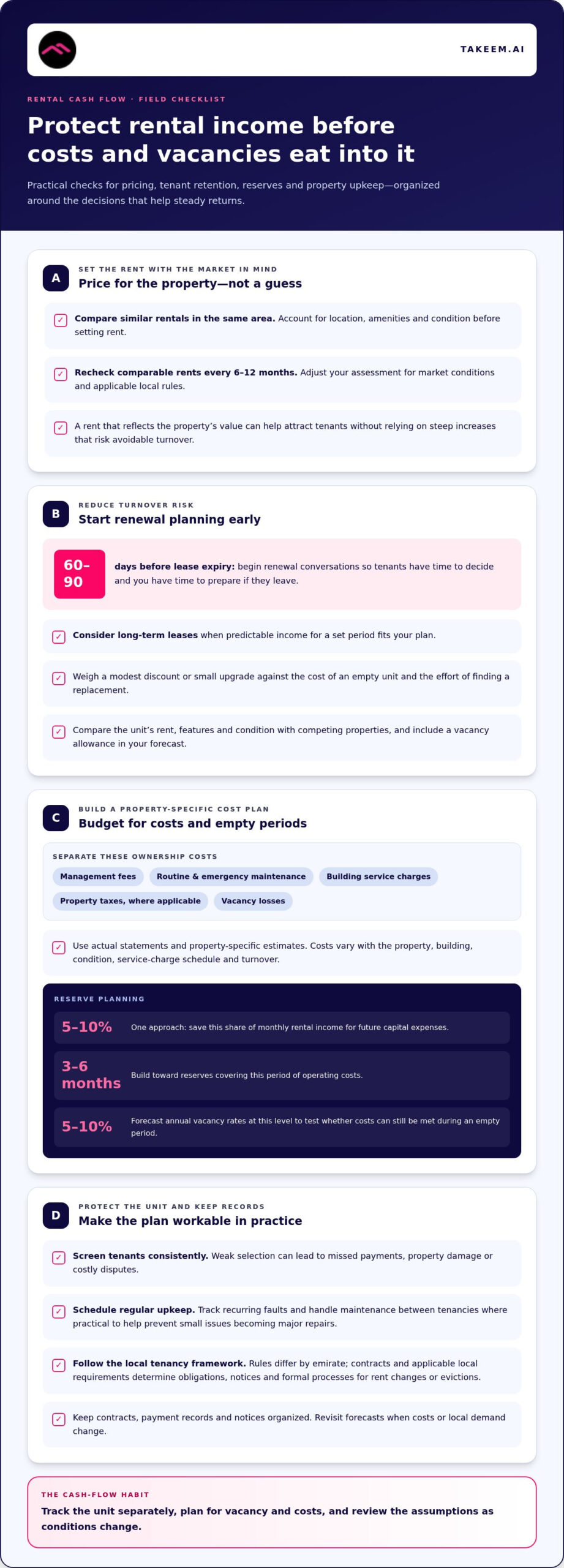
- Compare similar rentals in the same area, accounting for location, amenities and condition, to set a competitive rent.
- Start lease renewal conversations 60-90 days before expiry to give good tenants time to decide and help reduce vacancy gaps.
- Use digital rent collection and timely renewal reminders to streamline routine processes and support tenant retention.
- Assess returns per unit after expenses, then consider whether a Landlord Rental Guarantee could support your income planning.
1. Reducing vacancies and retaining tenants
Vacancies interrupt income, while frequent turnover adds cleaning, repair and advertising work. Compare similar properties in the same area before setting rent, accounting for location, amenities and condition. Review comparable rents every 6-12 months, adjusting your assessment for market conditions and applicable local rules. A rent that reflects the property’s value can help attract tenants without relying on steep increases that risk avoidable turnover.
Retention starts before a lease expires. Begin renewal conversations 60-90 days ahead, giving tenants time to consider their plans and giving you time to prepare if they leave. Long-term leases can provide predictable income for a set period. Renewal incentives, such as a modest discount or small upgrade, may be worth considering against the cost of an empty unit and the effort of finding a replacement.
In the UAE, tenancy rules differ by emirate, and the contract and applicable local framework determine landlord and tenant obligations. Rent changes and evictions must follow the relevant emirate’s requirements, including any required notice and formal process. Keep contracts, payment records and notices organized, and follow the applicable procedure before changing terms or ending a tenancy.
Build ownership budgets that separate property-management fees, routine and emergency maintenance, building service charges, property taxes where applicable, and vacancy losses. Costs vary with the property, building, condition, service-charge schedule and turnover. Use actual statements and property-specific estimates rather than applying a foreign average.
Assess demand by comparing similar listings and considering population growth, employment trends and new housing developments. Screen prospective tenants carefully using consistent criteria: weak selection can lead to missed payments, property damage or costly disputes. To gauge vacancy risk, compare the unit’s rent, features and condition with competing properties, then include a vacancy allowance in your forecast.
Plan reserves alongside retention. One approach is to save 5-10% of monthly rental income for future capital expenses, then build toward reserves covering 3-6 months of operating costs. Forecast annual vacancy rates of 5-10% to test whether payments for maintenance, service charges and property taxes can still be met during an empty period. Review the forecast when costs or local demand change, especially across larger portfolios where one unit’s vacancy can affect overall profit.
Regular maintenance can prevent small issues from becoming major repairs that disrupt occupancy. Track recurring faults and schedule upkeep between tenancies where practical. This helps present the unit to prospective tenants and identify repairs before they become urgent. Clear renewal dates, payment records and reserve targets help investors manage vacancy exposure as part of a steady cash-flow plan.
2. Using data and technology to improve rental returns
Better decisions start with clean records. For each property, log rent collected, operating expenses, financing payments, repairs, service charges and vacancy periods. A digital ledger or spreadsheet can separate recurring costs from one-off capital work, making it easier to see whether rental income is producing positive cash flow. Update records monthly so late payments or rising costs show up before they distort the annual picture.
Use three measures together because each answers a different question. Net operating income (NOI) is rental income minus operating expenses, before debt service. Capitalization rate, or cap rate, is NOI divided by current market value. Cash-on-cash return compares annual pre-tax cash flow with the cash invested, including capital used for the purchase and improvements. Together, these measures show operating performance, property yield and return on invested cash.
For example, a higher cap rate can indicate stronger income relative to a property’s current value, but it doesn’t show financing costs. Cash-on-cash return reflects financing and cash invested, but can shift when loan terms or repair needs change. Compare both measures across properties, using consistent expense assumptions. A cash-on-cash return target of 8-12% or higher may be a starting point, depending on the market, but it isn’t a substitute for reviewing the property’s own risks.
In the UAE, tax treatment and tenancy or registration requirements depend on the emirate, ownership structure and investor circumstances. Include applicable fees, building service charges, financing costs and tax treatment in your model before estimating net returns.
Technology can make reviews more timely. Digital rent collection creates a clearer payment record, while renewal reminders and expense tracking can help investors spot missed income or cost changes. Combine these records with rental comparables, property features, amenities and market conditions to estimate rental value. Population growth, employment rates and new housing developments can inform demand assumptions. Track appreciation separately from operating income.
Test your forecast against changing conditions instead of relying on one optimistic projection. Model shifts in rental income, financing costs, repairs and vacancy assumptions, then compare actual results with projected figures. If expenses rise or collection slows, the gap points to an issue to investigate. Comparing results across properties can also show whether a larger portfolio balances risk or concentrates it in similar units.
To streamline monthly payment records, landlords can explore digital rent-collection options as part of a disciplined reporting process. This technology supports visibility; the return still depends on rent, costs, financing and property performance.
3. Cash flow targets per rental unit
A unit-level target makes portfolio performance easier to compare. Start with monthly rent collected, then subtract operating expenses, mortgage payments, insurance, repairs, service charges and vacancy allowances. The remainder is monthly cash flow. Track each property separately before combining results, so a stronger unit doesn’t conceal a weaker one.
The 1% rule offers a quick screening benchmark: monthly rent should equal at least 1% of a property’s purchase price. It’s a starting guideline, not a guarantee of profit. For a UAE rental, test the ratio against local comparable properties and realistic expenses. A purchase price and monthly rent can look balanced on paper, yet financing or service charges may narrow the actual margin.
Another rough check is the 50% rule. It estimates operating costs at half of income, before mortgage principal and interest. The estimate can flag a deal that needs closer review, but actual costs vary by property condition, insurance, repairs and building charges. The broader operating-expense range in the research is 35-45% of gross rent. Treat both rules as screening tools, then replace estimates with property-specific figures.
For a portfolio target, calculate cash flow after bills for every unit. A common benchmark suggests targeting 8% cash-flow return on investment, but the result depends on purchase capital and recurring costs. Compare properties using the same method and time period. A unit that generates lower monthly cash flow may still fit if its costs, risks and appreciation prospects support the wider investment plan.
In the UAE, financing terms and mortgage costs depend on the lender, borrower and property. Compare fixed-rate and adjustable-rate structures, down-payment requirements, interest, lender charges and repayment schedules. A larger down payment can reduce monthly mortgage payments, while adjustable-rate payments may change over time. Include insurance and expected repairs in the same model; otherwise, projected returns can overstate available cash.
Use a simple unit-level worksheet to track monthly rent, collection status, operating expenses, mortgage, insurance and reserve contributions. Compare actual results with your target each month. If expenses repeatedly exceed the plan, identify the cause before trying to maximize rent. A rent increase can’t fix an inaccurate forecast or persistent maintenance costs.
For more predictable rent collection, explore digital rent-payment setup as one part of your monthly tracking process. Clear records help you assess whether each property meets its target and where the portfolio needs attention.
A common guideline targets $100 to $200 in monthly cash flow per rental unit after bills are paid. Under it, a three-unit rental property should generate at least $300 in cash flow, while a six-unit rental building should generate at least $600 in cash flow.
Takeem: Landlord Rental Guarantee
Takeem offers a Landlord Rental Guarantee for landlords who want more structure around rental income planning. It can be relevant when vacancies or missed tenant payments make cash-flow forecasts harder to manage. Investors with larger portfolios can use the Rental Guarantee for Property Investors with Large property Portfolios. The Rental Guarantee also includes emergency property maintenance, linking income planning with an essential property expense.
For landlords, the next step is to consider how a rental guarantee fits alongside unit-level targets, reserves and payment records. Agents can also sell the Landlord Rental Guarantee for healthy commissions. Review the offering details and decide whether it aligns with your rental strategy. Visit takeem.ai to learn more or contact Takeem.
Make your rental plan work for the next decision
A rental strategy is most useful when it guides decisions before pressure builds. Set a regular review schedule, define which changes need attention, and record why you adjust your approach. This gives you a clear reference when a lease approaches renewal, costs shift or a new investment opportunity arises. Consistent rental cash flow for investors isn’t a target to set and forget. It takes deliberate decisions based on each property’s performance over time.
Take the next step with a focused conversation about the income challenges you want to address and how they fit your investment plans. Contact Takeem to discuss its rental guarantee and digital rent collection solutions for your needs, alongside your own review of property performance and costs.
Contact Takeem to discuss your rental cash flow, and move forward with a clearer plan for your portfolio.
Frequently Asked Questions
What is cash flow in real estate?
Cash flow is what remains from a property’s rental receipts after related expenses are paid. If rent covers operating costs, financing and repairs, the property has positive cash flow; if bills exceed collected income, it has negative cash flow. Compare rent actually received with expenses paid during the same period, not just the rent stated in the lease.
What is consistent rental cash flow in real estate investing?
It means rental properties produce a reasonably predictable amount of net income across reporting periods, rather than relying on one unusually strong month. Consistent rental cash flow for investors doesn’t mean every month will match exactly. Track actual receipts and expenses against a forecast, then investigate recurring gaps, such as delayed collections or costs that regularly exceed expectations.
What strategies help stabilize rental income and reduce cash-flow risks?
Build a forecast for 12 to 36 months and test how it performs if interest rates rise by 1-2%. Investors can also diversify across property types or locations, reducing reliance on one market segment. Compare actual results with forecast assumptions regularly, then adjust investment decisions when demand, financing conditions or operating performance change.