
Tag: Tenant Screening

  • How to Choose Reliable Tenants: A Fair, Evidence-Based Screening Process

    How to Choose Reliable Tenants: A Fair, Evidence-Based Screening Process

    What if the strongest rental applicant isn’t the one with the neatest paperwork? If you’re wondering how to choose reliable tenants, it’s understandable to focus on the risk of late or missed rent. A more confident decision comes from weighing relevant evidence consistently, not searching for a risk-free applicant.

    A clear process helps you compare applications fairly, recognise strengths, and follow up when information is missing or unclear. This guide explains how to set consistent criteria, review details such as rental history and ability to meet the rent, and verify information appropriately. You’ll also learn why a gap deserves a follow-up question rather than an automatic rejection.

    Screening is one part of managing rental risk, not a guarantee of what will happen after move-in. Once you’ve selected a tenant, practical payment processes and rental income protection can complement your decision. In the UAE, Takeem supports landlords with digital monthly rent collection through Direct Debit and rental guarantees, with emergency property maintenance included in its guarantee service.

    Key Takeaways

    • Learn how to choose reliable tenants by assessing applicants against clear, relevant criteria rather than relying on first impressions.
    • Set out requirements and requested documents before reviewing applications, then use the same verification steps for each applicant.
    • Compare evidence, follow-up needs, and assessment notes so different circumstances don’t lead to unfair comparisons.
    • Use neutral follow-up questions to clarify gaps, and base your decision on the complete application rather than expecting a flawless applicant.
    • After selection, use clear tenancy terms, consistent payment processes, and organised records to support practical rental expectations.

    Why choosing reliable tenants takes more than a good first impression

    A tenancy decision can affect your rental cash flow, the care your property receives, and the working relationship you build with the person living there. A friendly conversation may feel reassuring, but it can’t show the whole picture. Nor can a polished application tell you on its own how a tenancy will unfold.

    When considering how to choose reliable tenants, assess whether relevant information supports an applicant’s ability and willingness to meet the agreed obligations. Screening helps you estimate risk; it can’t predict every future event or guarantee that rent will always be paid on time. A sound process makes the decision more considered, not risk-free.

    Evidence-based assessment weighs verifiable information against consistent criteria. An assumption relies on appearance, personal background, or a first impression. Keeping that distinction clear helps you focus on the tenancy rather than subjective impressions.

    What does a reliable tenant mean in practice?

    Reliability is best assessed through relevant indicators, not a single supposed sign. Clear communication, consistent information across an application, and a willingness to clarify a reasonable question can help you understand an applicant’s circumstances. Where information can be appropriately verified, that may add useful context.

    No single document, income source, or personal trait proves how someone will behave in the future. Treat evidence as part of the wider picture, and separate what an applicant has shown from what you might infer. Avoid stereotypes and comparisons based on superficial similarities.

    Why a consistent process protects both sides

    Set relevant criteria before reviewing applications, then apply them in the same way to each applicant. This makes comparisons more orderly and gives you a clear basis for recording whether information met a requirement, needs follow-up, or remains insufficient. Consistent notes also help you revisit the decision without relying on memory or an initial impression.

    Transparency benefits applicants, too. Stating requirements and requested documents at the outset helps people understand what you’ll assess and gives them a fair opportunity to provide relevant information. It also helps establish practical expectations before a tenancy begins, reducing avoidable misunderstandings.

    Screening is part of a wider set of decisions about responsibilities, communication, and rental risk. The broad overview of landlord-tenant law provides context on the legal framework governing these relationships. For UAE-specific decisions, don’t assume a general international overview determines local requirements. Clear expectations matter after selection, too. This guidance on avoiding rental disputes in the UAE explores related risk-management considerations.

    A measured approach improves the quality of the decision without promising certainty. Define reliability through relevant evidence and apply your standards consistently to assess applicants with greater confidence and fairness.

    How to screen rental applicants using a repeatable process

    A repeatable workflow turns a stack of applications into a structured decision. It also helps you explain what you assessed and why, rather than relying on memory or changing your standards as you go. Before inviting applications, tell prospective tenants what information you’ll request and which relevant criteria you’ll use.

    Set the criteria before reviewing applications

    Choose criteria connected to the tenancy, such as the applicant’s ability to meet the rent and willingness to agree to the proposed tenancy terms. Use the same core questions and assessment steps for each person. Avoid relying on protected characteristics, personal background, or assumptions unsupported by relevant evidence. Screening rules can depend on applicable requirements, so verify current UAE and relevant emirate rules before deciding what to ask or assess.

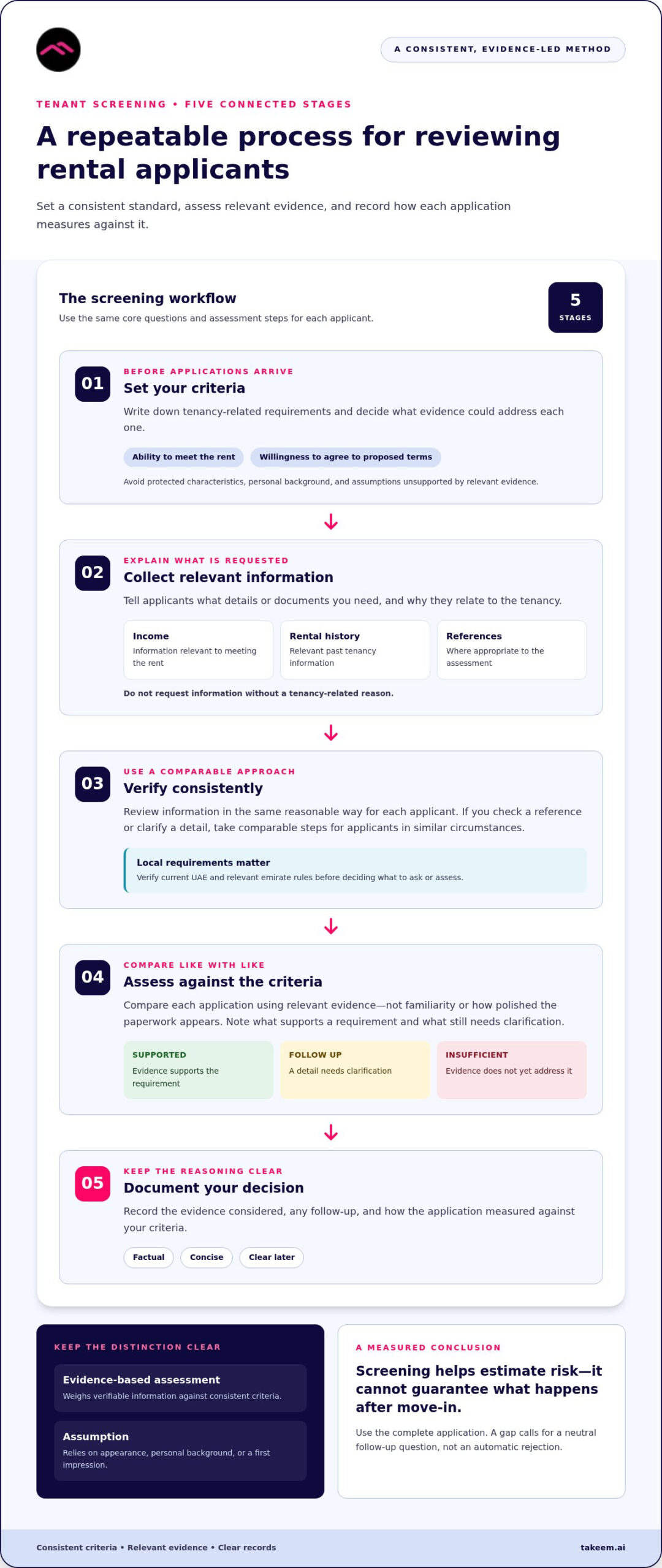
    1. Set your criteria. Write down the relevant requirements before applications arrive. Decide what evidence could address each one, and use consistent standards for everyone.
    2. Collect relevant information. Tell applicants what documents or details you’re requesting, such as information about income, rental history, or references where appropriate. Explain the purpose and don’t request information without a tenancy-related reason.
    3. Verify consistently. Review information using the same reasonable approach for each applicant. If you check a reference or clarify a detail, take comparable steps for other applicants in similar circumstances.
    4. Compare against the criteria. Assess each application based on relevant evidence, not on who seems most familiar or presents information in the most polished format. Note where the evidence supports a requirement and where clarification is still needed.
    5. Document your decision. Record the evidence considered, any follow-up, and how the application measured against your criteria. Keep the explanation factual and concise so the reasoning remains clear later.

    Set criteria, collect relevant information, verify it consistently, compare applications against the same standards, and document your reasoning. Each step informs a decision but cannot guarantee a tenancy outcome.

    Verify relevant details and keep a clear record

    Compare income details with other relevant information an applicant provides, and review references or rental history where appropriate and permitted. Look for consistency, not perfection. If a date, amount, or reference is unclear, ask a neutral follow-up question that gives the applicant a chance to explain. A gap is a reason to clarify, not an automatic trigger for rejection.

    Handle application information with care. Collect and retain only what’s appropriate for screening, and verify current UAE and applicable emirate requirements for data collection, use, and retention when setting your process. Don’t assume every check is permitted or necessary. A clear record captures relevant facts and reasoning, not subjective commentary.

    Once you’ve assessed applicants, screening can sit alongside other rental-risk measures. Landlords can consider rental guarantee options for landlords as a separate way to manage rental income risk. A guarantee complements careful tenant selection; it doesn’t replace consistent assessment or eliminate every tenancy risk.

    How to compare applicants fairly when their circumstances differ

    Applicants may provide different kinds of evidence, have different income patterns, or have varying levels of rental history. A fair comparison doesn’t require identical circumstances. It means applying the same relevant standards, giving each applicant a reasonable opportunity to clarify information, and recording what the evidence does and doesn’t show.

    Use a simple comparison table to keep the assessment focused. Complete one for each applicant, using the same criteria and neutral language. Avoid ranking applicants by who seems most familiar or presents the most polished application.

    Criteria Evidence provided Follow-up needed Assessment notes
    Ability to meet rent Income information relevant to the applicant’s circumstances Clarify a gap or explain variable amounts Record how the information relates to the stated criterion
    Rental history Available rental records or references Ask for context if details are incomplete Note what the evidence can reasonably establish
    Communication Responses to tenancy-related questions Follow up on an unanswered point Describe the response factually, without inferring character

    A missing document and conflicting information aren’t the same thing. Missing information means you don’t yet have evidence to assess a point. A discrepancy, such as dates or amounts that don’t align across documents, needs careful clarification. Neither should be treated as a conclusion by itself. Give the applicant a chance to explain, then record whether the response resolves the question.

    Which signals are useful, and which are not proof?

    A consistent payment history, where relevant information is available, can provide context about past obligations. Responsive communication can show how an applicant handles tenancy-related questions. Neither predicts every future action. References may support an assessment, but consider what the referee can reasonably confirm, such as the nature and duration of a previous tenancy. A positive reference is not a guarantee.

    Nationality, family status, accent, and appearance aren’t evidence of payment reliability. Keep comparisons tied to relevant information and avoid turning personal impressions into criteria. A polished application may be easy to review, but presentation alone doesn’t prove future conduct.

    How to handle gaps, unusual income, or limited rental history

    Ask neutral, consistent questions when income varies, documents need context, or an applicant has little rental history. For a self-employed applicant, assess relevant information using the same underlying standard you apply to other applicants, while recognising that supporting evidence may look different. Limited rental history is a gap in one type of evidence, not proof of unreliability.

    When deciding how to choose reliable tenants, weigh evidence against the same relevant standards without expecting every applicant’s circumstances to look alike. A careful comparison supports a reasoned decision, not certainty.
    How to Choose Reliable Tenants: A Fair, Evidence-Based Screening Process

    How to make a confident decision without expecting zero risk

    A strong decision doesn’t require a flawless application. It requires weighing the complete information against criteria set in advance, then being clear about what the evidence supports and what remains uncertain. Compare each applicant against the same essential requirements while allowing for differences in how they document their circumstances.

    Screening can inform a rental decision, but it can’t remove every tenancy risk or guarantee what happens after move-in. The goal is a reasoned choice, not certainty. If a relevant detail is unclear, ask a neutral question and consider the response alongside the rest of the application.

    A practical decision framework for landlords

    Use a short matrix to separate evidence from unanswered questions and material concerns. “Material” means directly relevant to a pre-set tenancy criterion, not simply unusual or unfamiliar. Record facts rather than labels, and check applicable UAE and emirate requirements before making or communicating a decision.

    Strengths
    Relevant information supports the stated criteria. Note what the evidence shows without treating it as a promise of future conduct.

    Unanswered questions
    A document or detail is missing or unclear. Identify the specific point to clarify and whether the applicant’s response resolves it.

    Material concerns
    Verified information conflicts with a relevant criterion or remains insufficient after reasonable follow-up. Record the evidence and its connection to the criterion.

    After reviewing the matrix, consider the application as a whole. A strength in one area doesn’t automatically cancel a material concern in another, and an unanswered question shouldn’t be treated as a confirmed problem. If follow-up provides relevant context, update your notes. If essential information remains insufficient, base the decision on that gap and your stated criteria, not speculation.

    How to communicate a decision professionally

    Once you’ve reached a decision, communicate it respectfully and without unnecessary delay. Keep any explanation factual and consistent with the criteria you applied. Don’t disclose another applicant’s personal information or compare people in a way that reveals private details. Before sending a decision, make sure your records support the reason you plan to give and that your communication follows applicable requirements.

    If an applicant needs to provide further information, state the specific point clearly and allow a reasonable opportunity to respond within your process. For a declined application, avoid vague judgments about character; refer only to relevant criteria and the information assessed. A professional, consistent explanation helps keep the process clear for both parties.

    Choosing a tenant is one part of managing rental risk. After assessing applicants, landlords may also consider rental income protection for landlords as a complementary measure. Takeem’s rental guarantee options offer another way to consider income protection alongside a careful, evidence-based decision.

    Protecting Rental Income After Choosing a Tenant

    Careful screening helps you make an informed selection, but it’s only one part of managing a tenancy. Once you’ve selected an applicant, clear written terms, an organised payment process, and accurate records help turn expectations into practical routines. Separate safeguards can also help you manage rental income risk without treating any one measure as a substitute for responsible tenant selection.

    Set clear expectations once an applicant is selected

    Make sure the tenancy terms clearly set out the rent, due dates, responsibilities, and agreed communication channels. Both parties should understand what’s expected and how tenancy-related matters will be handled. Keep relevant records, such as payment information and important communications, organised so you can refer to them if a question arises.

    A predictable payment arrangement can make collection easier to administer. Digital monthly rent collection through Direct Debit is an option for landlords who want to accept tenant payments digitally. A payment method is an administrative tool, not evidence that a tenant will always pay on time. Clear arrangements support a well-run tenancy, but they don’t predict individual behaviour.

    For practical context on post-selection processes, explore the guide to Direct Debit rent collection. It discusses how payment administration can fit into a broader approach to managing rental arrangements.

    Add income protection as a separate layer of risk management

    Tenant assessment and rental income protection address different questions. Screening considers whether relevant information supports an applicant’s ability and willingness to meet agreed obligations. A rental guarantee is a separate consideration for landlords concerned about rental income risk. It doesn’t screen applicants or remove every risk, and it shouldn’t be a reason to relax a fair, evidence-based selection process.

    Takeem provides rental guarantees for landlords and property investors in the UAE and facilitates digital monthly rent collection through Direct Debit. Emergency property maintenance is included as part of its rental guarantee service. These options support rental-risk management and tenancy administration after you’ve assessed an application. They complement, rather than replace, clear terms, consistent records, and sound judgment.

    As you consider how to choose reliable tenants, keep the stages distinct: assess applicants fairly, agree clear expectations with the selected tenant, then consider how payment administration and income protection fit your needs. The UAE landlord guide to rental guarantees offers further context on this separate layer of protection.

    If you’re reviewing ways to support rental income and payment processes after selection, explore Takeem’s landlord solutions as part of your broader approach to managing rental risk.

    Make your next rental decision with confidence

    Put your screening approach into practice with the next application you receive. A consistent process becomes more useful when you keep your criteria clear, assess evidence carefully, and review whether each step supports a fair decision. That gives you a practical foundation for deciding how to choose reliable tenants without expecting any process to predict every outcome.

    Then consider what will support the tenancy after selection. Clear payment arrangements and appropriate safeguards can complement your decision, while keeping the tenant assessment grounded in evidence. Takeem offers landlords rental income protection and digital payment options, with emergency property maintenance included in its rental guarantee service.

    Take the next step at your pace. Explore Takeem’s landlord solutions to see how they may fit into your approach to rental risk. With a clear process and practical support in place, you can move forward with greater confidence.

    Frequently Asked Questions

    Is a credit report enough to tell whether a tenant is reliable?

    No. A credit report offers limited information and can’t establish how someone will act throughout a tenancy. If a report is lawfully accessible and relevant, consider it alongside other appropriate evidence, such as the application and references. A report may raise a question that needs context rather than settle the decision. Before relying on one, verify current UAE requirements for access, consent, and personal-data handling.

    Can I reject a rental applicant who has no previous landlord reference?

    Not solely because the reference is missing. The applicant may be renting for the first time, or a previous landlord may be unavailable. Ask a neutral question about the gap, then assess other relevant evidence using your established criteria. A missing reference is different from a reference that raises a substantiated concern. Keep your reasoning tied to documented information and check applicable requirements before requesting or using personal data.

    How can I assess a self-employed tenant’s ability to pay rent?

    Assess relevant evidence consistently rather than assuming self-employment means income is unreliable. If appropriate and permitted, you might ask for documents that help explain income patterns, such as records covering different periods. Give the applicant a chance to explain fluctuations or gaps, then consider whether the information supports their ability to meet the proposed rent. Before collecting financial documents, verify current rules on requests and personal-data handling.

    What should I do if an applicant’s documents contain conflicting information?

    Pause and identify the exact discrepancy before drawing a conclusion. For example, if dates or amounts differ between documents, ask the applicant to clarify the specific point or provide corrected information. Assess the response using the same criteria applied to other applicants, and record what changed or remains unresolved. A discrepancy alone isn’t proof of misconduct. Make sure your checks and records follow applicable UAE requirements.

    Can landlords ask for personal information during tenant screening?

    Request information only when it’s relevant to assessing the tenancy, and handle it responsibly. Explain why you need a particular document rather than collecting extra personal details “just in case.” What you may request, how you may use it, and how long you may retain it can depend on applicable rules and circumstances. Verify current UAE and relevant emirate requirements before collecting or storing applicant information.

    Does choosing a reliable tenant guarantee that rent will always be paid on time?

    No. Screening can help you make a more informed choice, but a tenant’s circumstances can change, so no assessment can promise every payment will arrive on time. Clear written terms and an agreed payment process help set expectations and keep rent administration orderly. If you want to consider income protection, assess rental guarantee options separately from screening. They’re an additional risk-management consideration, not proof that a tenant will never miss rent.

  • Tenant Screening vs. Rent Guarantee in the UAE: A 2026 Landlord Checklist

    Tenant Screening vs. Rent Guarantee in the UAE: A 2026 Landlord Checklist

    What if a tenant passes every check but struggles to pay rent months later? In the UAE, tenant screening vs rent guarantee is not an either-or choice. Screening helps you assess risk before signing, while a rental guarantee is designed to protect rental income if non-payment occurs under its terms.

    Thorough checks support a consistent, fair decision, but they can’t predict every change in a tenant’s circumstances. Since April 2026, the Etihad Credit Bureau’s Tenant Screening service has allowed landlords to request a prospective tenant’s credit score with the tenant’s consent through UAE PASS. That score offers useful insight, not a promise of future payment.

    This 2026 checklist explains what screening can and can’t tell you, and how to weigh additional income protection for your UAE property. You’ll compare practical checks with the role of a rental guarantee, then consider how Takeem’s guarantee, emergency maintenance coverage and separate Direct Debit rent collection may fit into your approach. The goal is to make a clear decision based on your property’s risks, not to choose between prevention and protection as if they were substitutes.

    Key Takeaways

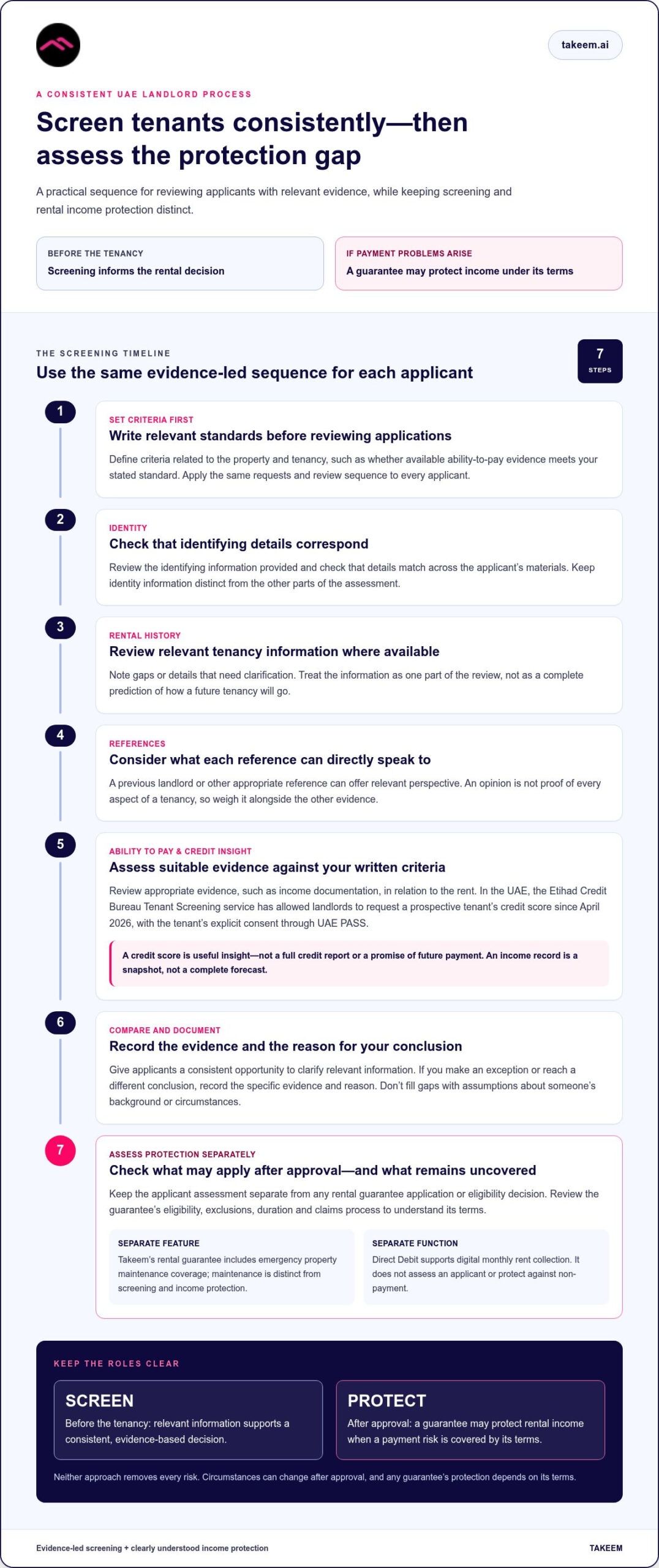
    • Set written, relevant criteria and apply them consistently. Keep identity, rental history, references and ability-to-pay evidence distinct.
    • Understand the difference in tenant screening vs rent guarantee: screening informs your decision, while a guarantee offers an additional form of rental income protection.
    • Use the checklist to identify which risks your screening process can address and where uncertainty remains for your property.
    • Record your applicant assessment separately from any rental guarantee application or eligibility decision.
    • Explore how Takeem’s rental guarantee, emergency maintenance coverage and separate Direct Debit rent collection can support your approach.

    Tenant screening vs. rent guarantee: what risk does each address?

    As a UAE landlord, you can assess an applicant before agreeing to a tenancy, protect rental income if payment problems arise later, or use both approaches. Tenant screening gathers relevant information before a tenancy to support a consistent rental decision. A rent guarantee is a separate service intended to protect rental income under its terms. One informs your choice; the other may offer protection if a covered risk occurs.

    This distinction matters because an approval reflects information available at a particular time. Employment, income and personal circumstances can change after move-in. Even a careful assessment can’t foresee every later disruption, so treat screening as a decision-making tool, not a promise of future payment or a trouble-free tenancy.

    What does tenant screening tell a landlord?

    Screening helps you review relevant information, such as identity, rental history, references and evidence of ability to pay. The purpose of tenant screening is to inform selection through a repeatable process. In the UAE, the Etihad Credit Bureau’s Tenant Screening service, launched in April 2026, lets landlords request a prospective tenant’s credit score with explicit consent through UAE PASS. It provides a score, not a full credit report.

    Compare evidence against criteria you apply consistently. An income record is evidence to assess; a guess based on someone’s name, nationality or appearance is an assumption. Neither a credit score nor a reference predicts every future event. A tenant may face hardship after approval, even when the information available supported a reasonable decision.

    What does a rent guarantee address?

    A rent guarantee focuses on income protection, not on deciding whether an applicant is suitable. It is intended to help protect rental income in circumstances covered by the service. The specific protection depends on the terms, including eligibility, exclusions, duration and the claims process. Review those details before including a guarantee in your property’s risk plan.

    Takeem’s rental guarantee serves landlords and property investors across the UAE and includes emergency property maintenance coverage. That maintenance component is an additional feature, distinct from screening and income protection itself. Digital monthly rent collection through Direct Debit is another practical feature, but collecting rent digitally does not assess an applicant or protect against non-payment.

    Screening assesses the applicant before the tenancy; a rent guarantee is a separate layer intended to protect income if a covered payment risk arises afterward. In practice, the approaches address different questions:

    • Before approval: Does the available, relevant information support proceeding with this applicant?
    • After approval: What income protection applies if payment problems occur under the service terms?
    • Across both: Which risks remain outside the information reviewed or the protection provided?

    Considering both stages helps you avoid treating a strong application as certainty. A consistent screening process supports a fair, evidence-based choice, while a suitable income-protection layer can address a different exposure. Neither removes every risk, but together they can support a more considered rental protection decision.

    How to screen tenants consistently across the UAE

    A repeatable process helps you compare applications using relevant evidence instead of instinct. Set your criteria before reviewing applicants, then follow the same sequence for each person. This makes decisions easier to explain and supports a consistent process across your rental properties.

    Which applicant details should landlords assess?

    Organise the review by information type. Request only details that help assess the proposed tenancy, and make the same requests of each applicant. Separate identity information from rental history, references and ability-to-pay evidence so that one strong or weak document doesn’t determine the whole decision by default.

    • Identity: Check that the applicant’s identifying details correspond across the information provided.
    • Rental history: Review relevant past tenancy information where available, noting gaps or matters that need clarification.
    • References: Consider what a previous landlord or other appropriate reference can directly speak to. Don’t treat an opinion as proof of every aspect of a tenancy.
    • Ability to pay: Review suitable evidence, such as income documentation, in relation to the rent and your written criteria. One document is a snapshot, not a complete forecast.

    Evidence may be incomplete or come in different formats. Give applicants a consistent opportunity to provide relevant clarification, and record what informed your assessment. Don’t fill gaps with assumptions about a person’s background or circumstances.

    How can landlords keep the process fair and documented?

    Write criteria that relate to the property and tenancy, such as whether the available ability-to-pay evidence meets your stated standard. Apply those criteria in the same order to each application. If you make an exception or reach a different conclusion, record the specific evidence and reason rather than relying on a general impression.

    A practical workflow is to:

    • Define the criteria and documents needed before advertising or reviewing applications.
    • Assess identity, rental history, references and ability-to-pay evidence separately.
    • Note missing information, clarifications received and the reason for the final decision.
    • Keep applicant records securely, restrict access to people who need them for the assessment, and avoid collecting information without a clear purpose.

    UAE tenancy administration and data-handling requirements can depend on the relevant jurisdiction and on how information is collected or used. Don’t assume a process used for one emirate automatically applies throughout the country. Before adopting a checklist, verify current requirements for the property’s location and your screening process, including how applicant information should be handled and retained.

    A written record also helps keep applicant selection separate from any later protection decision. In the tenant screening vs rent guarantee comparison, screening documents why you assessed an applicant in a particular way; a guarantee application has its own eligibility criteria and terms. If you’re considering a separate income-protection layer, explore Takeem’s rental guarantee for landlords and property investors across the UAE.

    Tenant screening vs. rent guarantee: compare protection, limits, and fit

    These approaches address different stages of rental risk. Screening helps you decide whether to proceed with an applicant; a rent guarantee may help protect income if a covered payment problem occurs. There is no universal winner. Identify the gap you need to manage, then understand what each approach can realistically do.

    Comparison point Tenant screening Rent guarantee
    Timing Before agreeing to a tenancy, while assessing an applicant. Relevant under the service terms if a covered issue arises during the applicable period.
    Purpose Inform a rental decision using relevant applicant information. Provide a separate layer of rental income protection.
    Information or basis Application details and supporting evidence, such as identity, rental history, references and ability-to-pay information. Eligibility assessment and the guarantee’s written terms, including covered circumstances.
    Key limitation A decision input, not a promise of future payment or tenancy outcomes. Protection is not universal. Eligibility, exclusions, duration and claims requirements depend on the service terms.

    The comparison shows why neither approach should be mistaken for the other. A well-supported applicant assessment can help you make a considered choice, but circumstances may change after move-in. A guarantee, in turn, doesn’t decide whether an applicant is a suitable match. Its value depends on whether the property and situation meet the eligibility requirements and whether the event falls within its cover.

    When is stronger screening the immediate priority?

    Start by strengthening screening if your criteria are unclear, applicants receive different requests, or decisions rely heavily on informal impressions. Written, property-relevant criteria and a record of the evidence considered make decisions more consistent and easier to explain. This improves the process, not the certainty of the outcome. Screening can’t remove every risk of non-payment, damage or tenancy difficulty.

    When might a rent guarantee add another layer?

    Consider a guarantee when maintaining rental income is a priority and you want protection beyond the information available at application stage. Compare its eligibility, exclusions, duration and claims process with your needs. Don’t assume every missed payment or tenancy issue is covered. Screening and income protection can work together: one informs selection, while the other may respond to specified risks after approval.

    For landlords weighing that additional layer, explore rental income protection with Takeem. Takeem’s rental guarantee is available to landlords and property investors across the UAE. Compare its terms with the risks you want to address, and keep the guarantee decision distinct from your applicant assessment.

    Tenant Screening vs. Rent Guarantee in the UAE: A 2026 Landlord Checklist

    UAE landlord checklist: make screening and income protection work together

    A reliable rental protection process has two distinct records: one explains how you assessed the applicant, and the other captures any separate decision about income protection. Keep both tied to the property and tenancy. This is useful when you rent in more than one emirate, where documentation and administrative processes may differ. Verify current requirements for the property’s location rather than assuming one checklist applies everywhere.

    Before approving an applicant

    Set your criteria in writing before reviewing applications. Specify the information needed to assess identity, rental history, references and ability to pay, and request it consistently. Then check that each application is complete enough to assess against those criteria. If something is missing, record the gap and any relevant clarification instead of filling it with an assumption.

    • Confirm relevance: Collect only information that supports the stated rental decision.
    • Keep evidence distinct: Note which documents, references or other information informed each part of the assessment.
    • Record the rationale: Explain how the evidence relates to your criteria and why you reached your decision.
    • Protect applicant information: Store records securely, limit access appropriately and verify current UAE requirements for handling personal data.

    Keep the record factual and concise. For example, note whether the evidence provided met a written ability-to-pay criterion, rather than describing an applicant with a broad personal judgement. A clear rationale supports consistency if you review the decision later or compare applications for another property.

    Before relying on a rent guarantee

    Assess income protection separately from tenant selection. Read the service terms and understand who or what is eligible, which circumstances are covered, what exclusions apply, the relevant duration and what steps a claim requires. Don’t treat a guarantee as automatic or unconditional. Protection depends on the terms and on whether the circumstances meet them.

    • Match protection to the property: Consider how important predictable rental income is to your plans and what financial exposure you want to address.
    • Map the process: Understand how the guarantee fits with the tenancy documentation, payment schedule and your records of rent due and received.
    • Separate decisions: Keep applicant screening notes distinct from any guarantee application or eligibility decision.
    • Review operational features: Digital monthly rent collection through Direct Debit can support payment administration, but it’s separate from screening and doesn’t itself provide income protection.

    This practical tenant screening vs rent guarantee checklist helps you identify what your decision process covers and where an additional protection layer may fit. Takeem’s rental guarantee serves landlords and property investors across the UAE and includes emergency property maintenance coverage. Explore Takeem’s rental income protection as you build an approach that pairs consistent applicant assessment with a clear understanding of service terms.

    How Takeem adds rental income protection beyond screening

    A sound applicant review helps you make a consistent tenancy decision, but it can’t tell you how a tenant’s circumstances may change later. Takeem’s rental guarantee gives landlords and property investors across the UAE an additional rental income protection option, not a substitute for screening. The two can fit at different points in your process: assess the applicant, make your tenancy decision, then consider whether a guarantee suits your remaining income risk.

    Takeem’s service also includes emergency property maintenance coverage. This is a practical component of the rental guarantee, not a screening feature. Digital monthly rent collection through Direct Debit is another operational option. It supports rent collection but doesn’t assess an applicant or replace income protection.

    How does Takeem fit after tenant screening?

    Keep the steps distinct. Review the application against your written criteria, document the evidence behind your tenancy decision, then consider whether additional income protection suits the property and your priorities. A guarantee’s eligibility and protection depend on the applicable service terms and covered circumstances. Don’t treat it as automatic or assume every situation is included.

    For a closer look at how this type of protection fits a landlord’s wider approach, see Takeem’s guide to landlord rental guarantees in the UAE. Use the details to inform your decision while keeping the applicant assessment and guarantee decision separate.

    What practical steps can landlords take next?

    Turn your screening process into a short, repeatable record. Confirm the application is complete, review the same relevant categories for each applicant, note the evidence and rationale, and store personal information carefully. Then identify the main income risk that remains for the property. Is your priority smoother rent collection, protection if a covered payment issue occurs, or coordinating both?

    • Review your criteria: Make sure they’re written, relevant to the tenancy and consistently applied.
    • Identify the gap: Note what your applicant review can’t predict once the tenancy begins.
    • Understand the terms: Consider eligibility, covered circumstances, exclusions, duration and claim steps before relying on any protection.
    • Separate collection from protection: Direct Debit can support monthly rent collection, while the rental guarantee addresses income protection under its terms.

    This is the practical distinction behind tenant screening vs rent guarantee: one informs whom you approve; the other may add protection after that decision, subject to its terms. If you’re ready to consider that additional layer, explore Takeem’s rental guarantee service and its digital rent collection approach.

    Build a rental protection plan that fits your next tenancy

    Decide where uncertainty matters most for your property. Set a clear standard for applicant decisions, then consider whether the remaining income risk calls for additional protection. This turns tenant screening vs rent guarantee into a practical planning choice, not a contest between interchangeable tools.

    As you put that approach into practice, keep your screening records, tenancy administration and protection decisions organised. Revisit the plan when your property or rental priorities change, and understand the applicable service terms before relying on any protection. A considered process can help you make confident decisions without assuming that any one measure removes every risk.

    Takeem serves landlords and property investors across the UAE with a rental guarantee that includes emergency property maintenance coverage, alongside a separate Direct Debit setup for digital monthly rent collection. Explore Takeem’s rental guarantee service to consider how these options could fit your rental approach. With clear criteria and protection chosen for your needs, you can move forward with greater confidence.

    Frequently Asked Questions

    Is tenant screening enough to protect rental income in the UAE?

    No. Tenant screening vs rent guarantee compares assessing an applicant with considering protection if a later payment problem occurs. Verified income at application time, for example, can support a decision but can’t show whether the tenant’s circumstances will change months later. If you need another layer, compare service terms carefully and consider how delayed rent could affect your property finances.

    Can a rent guarantee replace tenant screening?

    No. A rent guarantee doesn’t replace an applicant review. Screening helps you decide whether to enter a tenancy; a guarantee has separate eligibility conditions and terms. Keep those decisions distinct. Choosing a tenant doesn’t automatically mean the property qualifies for protection, and a guarantee application doesn’t establish whether the applicant meets your rental criteria. Review both processes before finalising your arrangements.

    What should landlords check when screening a tenant in the UAE?

    Review identifying and tenancy information, relevant rental history, appropriate references and evidence that helps you assess ability to pay. Consider what each item demonstrates: a reference may speak to a past tenancy, while income evidence offers a limited view of finances. Keep notes tied to written criteria, and avoid collecting details without a clear assessment purpose. Verify current UAE requirements for tenancy documents and personal information handling.

    Does tenant screening guarantee that rent will be paid on time?

    No. Screening reflects information available during the application, not every later change in a tenant’s life, so it can’t guarantee timely rent payments. If a payment is late, compare the amount and due date against your records and tenancy documents. Keep communications and payment records organised. Any additional protection depends on the service terms and whether the situation meets its conditions.

    Is a rent guarantee the same as landlord insurance?

    Not necessarily. The terms may refer to different arrangements, and a name alone doesn’t establish what a contract or policy covers. A rent guarantee may focus on rental income protection, while an insurance policy may address other defined risks. Before deciding, check the wording for covered events, exclusions, eligibility and claim requirements. Don’t assume one arrangement includes the protections of another.

    Can landlords use tenant screening and a rent guarantee together?

    Yes. They can form separate parts of a landlord’s approach, provided the property and situation meet the guarantee’s terms. To keep the processes clear, file applicant assessment notes separately from guarantee documents, then keep tenancy and rent-payment records organised as well. This makes it easier to see which decision each record supports if you need to review it later.

    What happens if a tenant passes screening but later misses rent?

    Passing screening doesn’t prevent a later missed payment. Check the tenancy records and payment history, retain relevant communications, and follow the applicable procedures for the property’s jurisdiction. If you have a rental guarantee, review its terms and required documentation before relying on it, since eligibility and response depend on the circumstances. Verify current UAE requirements before taking formal action; don’t assume the same process applies everywhere.

  • UAE Property Market Risks: 2026 Landlord Guide

    UAE Property Market Risks: 2026 Landlord Guide

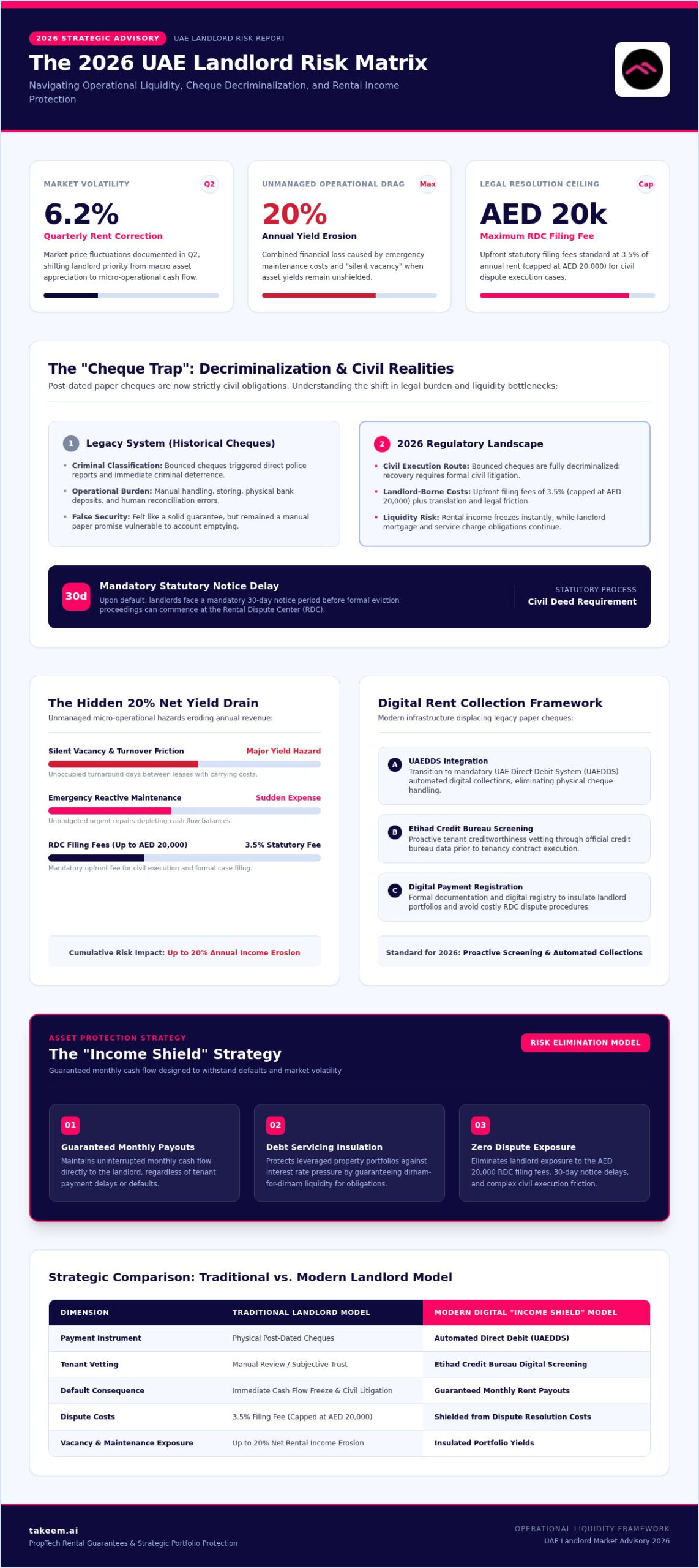
    In 2026, the greatest threat to your portfolio isn’t a dip in market prices, it’s the sudden obsolescence of the paper cheque. While many investors focus on the 6.2% quarterly rent correction seen in Q2, the real UAE property market risks for landlords lie in operational liquidity and the decriminalization of bounced cheques. When a payment fails today, you’re no longer looking at a police matter but a civil execution process that can cost up to AED 20,000 in filing fees alone. It’s a frustrating reality where traditional security feels increasingly like a liability.

    You’ve likely felt the administrative weight of managing post-dated cheques or the sting of unexpected emergency maintenance bills that eat into your yields. We understand that your goal isn’t just to own property, it’s to secure a reliable, hands-off income stream. This guide identifies the most critical financial and operational hurdles facing the market right now. You’ll learn how to insulate your portfolio from volatility using modern digital tools, ensuring guaranteed monthly cash flow regardless of tenant defaults or market shifts. We’re moving beyond the cheque trap into a new era of asset protection.

    Key Takeaways

    • Understand why 2026 requires a shift from tracking macro market trends to managing micro-operational hazards like the “cheque trap.”
    • Identify how emergency maintenance and “silent vacancy” can erode up to 20% of your annual rental income if left unmanaged.
    • Learn to utilize digital screening tools and the Etihad Credit Bureau to vet tenant creditworthiness before signing a lease.
    • Discover how to insulate your portfolio against UAE property market risks for landlords by transitioning from physical cheques to automated Direct Debit collections.
    • Explore the “Income Shield” strategy to secure guaranteed monthly rent payouts, ensuring your cash flow remains uninterrupted even during tenant defaults.

    The national property market has entered a phase of sophisticated maturity. For years, investors focused on broad market swings and capital appreciation. In 2026, that focus has shifted. The most significant UAE property market risks for landlords are no longer just about property prices; they’re about operational liquidity and the friction of outdated collection methods. Rising interest rates have increased the pressure on leveraged portfolios, making every dirham of rental income critical for debt servicing. Traditional property management often fails here because it treats rent collection as an administrative task rather than a financial lifeline.

    Macro-Economic vs. Operational Risks

    While global market cycles still influence demand, the day-to-day survival of a portfolio depends on micro-level efficiency. Looking at the broader UAE property market history and cycles, we see a transition from speculative growth to a yield-driven economy. Relying on physical cheques in this digital landscape creates a dangerous liquidity gap. When a cheque bounces, your cash flow stops instantly, but your mortgage and maintenance obligations don’t. This yield gap is often widened by unmanaged operational expenses that eat into your net profit. Modern landlords must prioritize income protection over simple unit management to keep their portfolios healthy.

    The Evolving Regulatory Environment

    The regulatory landscape in 2026 demands higher levels of transparency and digital integration. The Rental Dispute Center (RDC) has streamlined its processes, but it remains a reactive solution. Filing a formal case requires an upfront fee of 3.5% of the annual rent, subject to a maximum cap of AED 20,000. For many, avoiding rental disputes through better documentation and digital payment registration is the only sustainable path.

    The move toward mandatory digital payment registration via the UAE Direct Debit System (UAEDDS) is designed to phase out the old cheque culture. This shift isn’t just a legal requirement; it’s a strategic move to insulate your assets from the volatility of manual rent collection. By adopting digital-first strategies, you ensure that your portfolio remains a secure financial asset rather than an administrative burden. Proactive screening and automated collections are now the baseline for professional property investment in the region.

    The Financial Volatility of Tenant Defaults and the “Cheque Trap”

    For decades, physical cheques were the undisputed bedrock of the UAE rental market. In 2026, they represent one of the most significant UAE property market risks for landlords. While a post-dated cheque feels like a solid guarantee, it’s actually just a promise that can be broken without warning. When a payment fails, the financial impact ripples through your entire portfolio. You aren’t just losing a month of rent; you’re entering a cycle of legal friction that includes filing fees, translation costs, and the mandatory 30-day notice period before eviction proceedings can even begin.

    The timeline of a typical default is a drain on resources. From the moment a cheque bounces, a landlord must navigate a civil process that often takes months to resolve. According to the RICS Global Commercial Property Monitor, market sentiment is increasingly sensitive to these operational bottlenecks. If a tenant empties their account or leaves the country, the legal right to a “civil execution deed” won’t recover your funds. This is why modernizing UAE rentals through digital adoption has become the standard for professional investors who prioritize liquidity over tradition.

    The Limitations of Post-Dated Cheques

    Cheques offer a false sense of security because their legal status has changed. Bounced cheques are now treated exclusively as civil matters rather than criminal offenses. This shift removed the immediate deterrent of police intervention, placing the burden of recovery entirely on the landlord’s shoulders. For those managing large portfolios, the administrative weight of tracking, storing, and depositing hundreds of physical papers is a massive operational risk. It’s a manual system in a digital world, and it’s prone to human error and processing delays.

    Transitioning to Digital Rent Collection

    The UAE Direct Debit System (UAEDDS) is the modern answer to the “cheque trap.” By automating rent collection, you remove the friction that often leads to late payments or administrative excuses. Digital payments ensure a predictable cash flow, allowing you to meet your own financial obligations, such as mortgage payments or service charges, without stress. It creates a seamless experience for professional tenants who prefer digital transparency. You can start securing your monthly income today by moving away from paper and embracing an automated, tech-forward approach to rent collection.

    Operational Hazards: Maintenance, Vacancy, and Asset Value Erosion

    While missed payments are a visible threat to liquidity, operational drain is often the silent killer of long-term yields. In the local market, emergency repairs can consume between 15% and 20% of your annual rental income if they aren’t managed through a structured framework. These costs represent significant UAE property market risks for landlords, as they are often unpredictable and require immediate capital. Beyond the immediate financial hit, failing to maintain the physical integrity of your unit leads to asset value erosion, making it harder to command premium rents or achieve a high resale price in the future.

    We often see the phenomenon of “silent vacancy,” where a property is technically occupied, but the net profit is zero. This happens when high turnover costs, emergency call-out fees, and administrative friction outpace the incoming rent. To stay secure, you must move away from a reactive mindset. Utilizing rental guarantees with maintenance ensures that your yield is protected from these sudden spikes in expenditure, allowing for a truly hands-off investment experience.

    The Impact of Maintenance on ROI

    The UAE climate puts immense pressure on a building’s core infrastructure. Air conditioning systems, plumbing, and electrical grids operate under high-stress conditions for most of the year. When an AC compressor fails in mid-summer, the cost of an emergency replacement can wipe out months of profit. Deferred maintenance only compounds these issues; a small leak that isn’t addressed quickly can lead to structural damage and mold, which are far more expensive to remediate. Proactive repair coverage acts as a vital hedge against the rising costs of spare parts and skilled labor, keeping your ROI predictable and stable.

    Vacancy Risk and Portfolio Stability

    Vacancy is more than just a lack of income; it’s a period of active expense. Even when a unit is empty, you’re responsible for service charges, cooling fees, and security. Calculating the real cost of a property sitting empty for just one month reveals a significant dent in your annual performance. To minimize this, you need to understand the official UAE leasing and rental dispute regulations to ensure smooth transitions between tenants without legal delays.

    Reducing turnover is the most effective way to stabilize your portfolio. Tenants who experience responsive maintenance and professional management are far more likely to renew their leases, even if market prices fluctuate. If you’re managing multiple units, optimising property portfolio rental income requires a shift toward automated systems that handle both collections and repairs, ensuring your assets remain profitable and your time remains your own.

    UAE Property Market Risks: 2026 Landlord Guide

    Strategic Risk Mitigation: A Checklist for Modern Landlords

    Managing UAE property market risks for landlords in 2026 demands a proactive strategy that replaces hope with hard data. You should start by performing a rigorous financial audit of your current rent collection methods. If you’re still relying on physical cheques, you’re carrying unnecessary administrative weight and liquidity risk. It’s also vital to review your property insurance policies to ensure they cover loss of rent. Many standard policies in the region contain gaps that leave you exposed during a lengthy default or eviction process. By identifying these vulnerabilities early, you can implement a tech-forward management system that automates notifications and tracks payment trends in real time.

    The most effective way to insulate your portfolio is to offload financial liability entirely. Partnering with a guarantee provider allows you to transfer the risks of tenant defaults and emergency maintenance spikes to a specialist. This transformation turns your rental units into secure, predictable financial assets. Instead of chasing payments, you can focus on expanding your portfolio with the confidence that your monthly cash flow is protected by a professional shield.

    Due Diligence and Tenant Screening

    Modern landlords must move beyond basic employer references and look at verified financial history. The rollout of federal tenant screening services via the Etihad Credit Bureau and UAE PASS has changed the landscape for due diligence. A tenant risk profile is a data-driven assessment of a prospective renter’s financial reliability, calculated by aggregating credit scores and historical payment behaviors via the Etihad Credit Bureau. Utilizing these digital tools ensures that you’re leasing to individuals with a proven track record of meeting their obligations, reducing the likelihood of future disputes.

    Technology as a Risk Shield

    Centralizing your portfolio data allows you to spot non-payment trends across multiple units before they become critical issues. Fintech solutions now bridge the gap between landlords and banks, offering a level of security that traditional paper-based methods simply can’t match. This is precisely why real estate agents are now recommending rental guarantees to their clients to build long-term trust and protect yields. By adopting these modern standards, you’re not just managing a property; you’re safeguarding your financial future against UAE property market risks for landlords.

    Ready to eliminate the uncertainty from your portfolio? Secure your rental income today with a professional guarantee.

    Takeem: Eliminating Landlord Risk with Guaranteed Rental Income

    Takeem represents a fundamental shift in how investors view their portfolios. Instead of managing physical units, you’re managing a secure financial asset. By addressing the primary UAE property market risks for landlords, Takeem removes the volatility inherent in traditional tenancy agreements. The “Income Shield” ensures that you receive your rent on time, every time, even if your tenant defaults or delays payment. This isn’t just a collection service; it’s a comprehensive financial safeguard that allows you to scale your investments with absolute certainty. We’ve moved beyond the era of reactive legal battles into a new standard of proactive asset protection.

    Seamless digital integration is at the heart of this modern approach. By moving your portfolio to a Direct Debit system, you eliminate the “cheque trap” and the administrative burden of manual deposits. This transition to the UAE Direct Debit System (UAEDDS) provides a level of security that paper-based methods can’t match. Additionally, Takeem integrates emergency maintenance into your income strategy. This means that sudden plumbing, electrical, or AC failures don’t eat into your yields, providing 24/7 protection for both your cash flow and your asset’s physical integrity. You no longer have to worry about the 15-20% yield erosion typically caused by unmanaged repairs.

    The Takeem Advantage for Investors

    Fixed monthly payments allow for precise financial planning and easier debt servicing. Whether you own a single unit or manage a large property portfolio, Takeem provides a uniform layer of protection that traditional management often lacks. This hands-off experience prioritizes your peace of mind, allowing you to enjoy the benefits of property ownership without the stress of tenant disputes or unexpected costs. It’s a professional shield designed for the modern investor who values efficiency and reliability. You can finally treat your real estate investments with the same predictability as a high-yield savings account or a government bond.

    Getting Started with a Risk-Free Portfolio

    The onboarding process is designed to be as streamlined as the digital payments it facilitates. You can secure both new and existing tenancies, ensuring that your entire portfolio is protected from day one. Takeem doesn’t replace your relationship with your existing real estate agent; instead, it provides them with a powerful tool to enhance your investment’s security. By working together, we ensure that your yield is maximized and your risks are minimized. It’s time to move beyond the uncertainty of the past and embrace a tech-forward future. Protect your rental income today with Takeem and experience the confidence of a truly guaranteed return.

    Future-Proofing Your Portfolio in a Digital Economy

    The landscape of property investment has fundamentally shifted. Success in 2026 isn’t just about finding the right unit; it’s about eliminating the operational friction that erodes your returns. We’ve explored how transitioning to digital Direct Debit collections and offloading maintenance liabilities can transform a high-stress portfolio into a predictable financial asset. By addressing UAE property market risks for landlords through proactive technology rather than reactive litigation, you secure your future against market volatility. You’ve worked hard to build your portfolio, and it deserves a management style that matches its value.

    Takeem provides the sophisticated shield you need to thrive. You’ll benefit from 100% digital rent collection and the reassurance of emergency maintenance coverage included in your plan. Most importantly, you receive your guaranteed monthly rent regardless of whether the tenant pays on time. It’s time to stop chasing cheques and start growing your wealth with total peace of mind. Embrace the efficiency of a tech-forward strategy that prioritizes your liquidity and protects your asset’s integrity for the long term.

    Secure Your Rental Income with Takeem’s Landlord Rental Guarantee. Your path to a truly hands-off, secure investment starts today.

    Frequently Asked Questions

    What are the most common property market risks for landlords in the UAE?

    The most significant UAE property market risks for landlords include tenant non-payment and the high costs of emergency repairs. Since the decriminalization of bounced cheques in 2022, recovering funds has become a civil matter that often involves lengthy court proceedings and high filing fees. Additionally, market corrections and “silent vacancy” can erode your net profit. Implementing a digital collection system and a rental guarantee helps mitigate these operational hazards by ensuring consistent cash flow.

    How does a rental guarantee protect me if a tenant stops paying rent?

    A rental guarantee acts as a financial shield by ensuring you receive your monthly rent payouts even if a tenant defaults. Instead of navigating the Rental Dispute Center yourself, the guarantee provider takes on the risk and the administrative burden of recovery. This ensures your mortgage payments and service charges are met without delay. It transforms your property into a secure asset with a predictable income stream, regardless of the tenant’s individual financial situation.

    Can I switch from cheques to Direct Debit mid-tenancy?

    You can transition from traditional cheques to digital Direct Debit mid-tenancy by signing a simple contract addendum with your tenant. This modern approach replaces the administrative headache of storing and depositing physical papers with the secure UAE Direct Debit System. It’s a seamless process that professional tenants often prefer for its transparency. Switching early helps you avoid the “cheque trap” and ensures your rent collection is automated for the remainder of the lease term.

    Is emergency property maintenance included in a rental guarantee?

    Yes, emergency property maintenance is a core component of the Takeem rental guarantee package. This service covers critical repairs to plumbing, electrical systems, and air conditioning that could otherwise consume a significant portion of your annual yield. By including these repairs in the guarantee, we protect both your immediate cash flow and the long-term value of your asset. You won’t have to worry about sudden, large invoices disrupting your financial planning or portfolio stability.

    What happens to my rental income if the property becomes uninhabitable?

    If a major issue makes your property uninhabitable, the emergency maintenance portion of your guarantee package kicks in to resolve the problem immediately. Rapid response is vital to minimize vacancy periods and protect your rental income. While traditional insurance might have gaps in loss-of-rent coverage, an integrated guarantee ensures that repairs are prioritized. This proactive approach keeps your asset in top condition and ensures that your income stream is restored as quickly as possible.

    How do rental guarantees affect my overall rental yield?

    While there’s a service fee for a rental guarantee, it often improves your net yield by eliminating the most volatile UAE property market risks for landlords. Unplanned maintenance and tenant defaults can easily wipe out 20% of your annual profit. A guarantee provides a fixed cost that covers these variables, making your financial planning accurate and your returns predictable. It’s an investment in security that prevents the catastrophic losses associated with prolonged legal disputes.

    Are digital rent payments legally recognized by UAE authorities?

    Digital rent payments via the UAE Direct Debit System are fully recognized and encouraged by federal authorities. This system is designed to modernize the real estate sector and reduce the legal friction caused by physical cheques. Using digital payments provides a clear, verifiable audit trail that is admissible in any regulatory discussion. It aligns your portfolio with the national push toward a tech-forward economy, making your rental process more efficient, transparent, and legally robust.

    Why is Direct Debit safer than post-dated cheques for landlords?

    Direct Debit is safer because it’s an automated pull from the tenant’s account, reducing the risk of human error or “forgotten” deposits. Since bounced cheques are now civil deed executions rather than criminal offenses, they no longer offer the same deterrent they once did. Direct Debit integrates with modern screening tools to ensure the tenant has a reliable credit history. It provides a more consistent, professional way to manage liquidity without the hassle of paper.