

What if the strongest rental applicant isn’t the one with the neatest paperwork? If you’re wondering how to choose reliable tenants, it’s understandable to focus on the risk of late or missed rent. A more confident decision comes from weighing relevant evidence consistently, not searching for a risk-free applicant.
A clear process helps you compare applications fairly, recognise strengths, and follow up when information is missing or unclear. This guide explains how to set consistent criteria, review details such as rental history and ability to meet the rent, and verify information appropriately. You’ll also learn why a gap deserves a follow-up question rather than an automatic rejection.
Screening is one part of managing rental risk, not a guarantee of what will happen after move-in. Once you’ve selected a tenant, practical payment processes and rental income protection can complement your decision. In the UAE, Takeem supports landlords with digital monthly rent collection through Direct Debit and rental guarantees, with emergency property maintenance included in its guarantee service.
Key Takeaways
- Learn how to choose reliable tenants by assessing applicants against clear, relevant criteria rather than relying on first impressions.
- Set out requirements and requested documents before reviewing applications, then use the same verification steps for each applicant.
- Compare evidence, follow-up needs, and assessment notes so different circumstances don’t lead to unfair comparisons.
- Use neutral follow-up questions to clarify gaps, and base your decision on the complete application rather than expecting a flawless applicant.
- After selection, use clear tenancy terms, consistent payment processes, and organised records to support practical rental expectations.
Why choosing reliable tenants takes more than a good first impression
A tenancy decision can affect your rental cash flow, the care your property receives, and the working relationship you build with the person living there. A friendly conversation may feel reassuring, but it can’t show the whole picture. Nor can a polished application tell you on its own how a tenancy will unfold.
When considering how to choose reliable tenants, assess whether relevant information supports an applicant’s ability and willingness to meet the agreed obligations. Screening helps you estimate risk; it can’t predict every future event or guarantee that rent will always be paid on time. A sound process makes the decision more considered, not risk-free.
Evidence-based assessment weighs verifiable information against consistent criteria. An assumption relies on appearance, personal background, or a first impression. Keeping that distinction clear helps you focus on the tenancy rather than subjective impressions.
What does a reliable tenant mean in practice?
Reliability is best assessed through relevant indicators, not a single supposed sign. Clear communication, consistent information across an application, and a willingness to clarify a reasonable question can help you understand an applicant’s circumstances. Where information can be appropriately verified, that may add useful context.
No single document, income source, or personal trait proves how someone will behave in the future. Treat evidence as part of the wider picture, and separate what an applicant has shown from what you might infer. Avoid stereotypes and comparisons based on superficial similarities.
Why a consistent process protects both sides
Set relevant criteria before reviewing applications, then apply them in the same way to each applicant. This makes comparisons more orderly and gives you a clear basis for recording whether information met a requirement, needs follow-up, or remains insufficient. Consistent notes also help you revisit the decision without relying on memory or an initial impression.
Transparency benefits applicants, too. Stating requirements and requested documents at the outset helps people understand what you’ll assess and gives them a fair opportunity to provide relevant information. It also helps establish practical expectations before a tenancy begins, reducing avoidable misunderstandings.
Screening is part of a wider set of decisions about responsibilities, communication, and rental risk. The broad overview of landlord-tenant law provides context on the legal framework governing these relationships. For UAE-specific decisions, don’t assume a general international overview determines local requirements. Clear expectations matter after selection, too. This guidance on avoiding rental disputes in the UAE explores related risk-management considerations.
A measured approach improves the quality of the decision without promising certainty. Define reliability through relevant evidence and apply your standards consistently to assess applicants with greater confidence and fairness.
How to screen rental applicants using a repeatable process
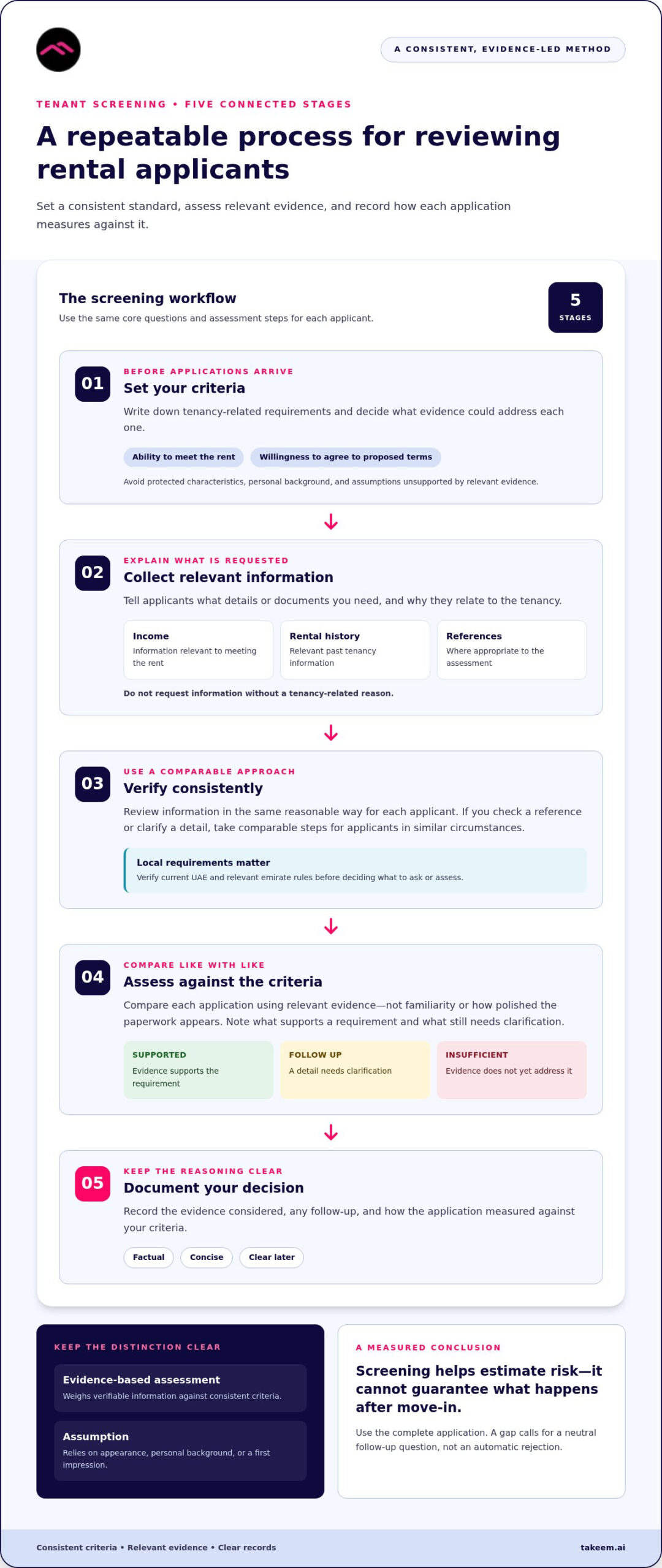
A repeatable workflow turns a stack of applications into a structured decision. It also helps you explain what you assessed and why, rather than relying on memory or changing your standards as you go. Before inviting applications, tell prospective tenants what information you’ll request and which relevant criteria you’ll use.
Set the criteria before reviewing applications
Choose criteria connected to the tenancy, such as the applicant’s ability to meet the rent and willingness to agree to the proposed tenancy terms. Use the same core questions and assessment steps for each person. Avoid relying on protected characteristics, personal background, or assumptions unsupported by relevant evidence. Screening rules can depend on applicable requirements, so verify current UAE and relevant emirate rules before deciding what to ask or assess.
- Set your criteria. Write down the relevant requirements before applications arrive. Decide what evidence could address each one, and use consistent standards for everyone.
- Collect relevant information. Tell applicants what documents or details you’re requesting, such as information about income, rental history, or references where appropriate. Explain the purpose and don’t request information without a tenancy-related reason.
- Verify consistently. Review information using the same reasonable approach for each applicant. If you check a reference or clarify a detail, take comparable steps for other applicants in similar circumstances.
- Compare against the criteria. Assess each application based on relevant evidence, not on who seems most familiar or presents information in the most polished format. Note where the evidence supports a requirement and where clarification is still needed.
- Document your decision. Record the evidence considered, any follow-up, and how the application measured against your criteria. Keep the explanation factual and concise so the reasoning remains clear later.
Set criteria, collect relevant information, verify it consistently, compare applications against the same standards, and document your reasoning. Each step informs a decision but cannot guarantee a tenancy outcome.
Verify relevant details and keep a clear record
Compare income details with other relevant information an applicant provides, and review references or rental history where appropriate and permitted. Look for consistency, not perfection. If a date, amount, or reference is unclear, ask a neutral follow-up question that gives the applicant a chance to explain. A gap is a reason to clarify, not an automatic trigger for rejection.
Handle application information with care. Collect and retain only what’s appropriate for screening, and verify current UAE and applicable emirate requirements for data collection, use, and retention when setting your process. Don’t assume every check is permitted or necessary. A clear record captures relevant facts and reasoning, not subjective commentary.
Once you’ve assessed applicants, screening can sit alongside other rental-risk measures. Landlords can consider rental guarantee options for landlords as a separate way to manage rental income risk. A guarantee complements careful tenant selection; it doesn’t replace consistent assessment or eliminate every tenancy risk.
How to compare applicants fairly when their circumstances differ
Applicants may provide different kinds of evidence, have different income patterns, or have varying levels of rental history. A fair comparison doesn’t require identical circumstances. It means applying the same relevant standards, giving each applicant a reasonable opportunity to clarify information, and recording what the evidence does and doesn’t show.
Use a simple comparison table to keep the assessment focused. Complete one for each applicant, using the same criteria and neutral language. Avoid ranking applicants by who seems most familiar or presents the most polished application.
| Criteria | Evidence provided | Follow-up needed | Assessment notes |
|---|---|---|---|
| Ability to meet rent | Income information relevant to the applicant’s circumstances | Clarify a gap or explain variable amounts | Record how the information relates to the stated criterion |
| Rental history | Available rental records or references | Ask for context if details are incomplete | Note what the evidence can reasonably establish |
| Communication | Responses to tenancy-related questions | Follow up on an unanswered point | Describe the response factually, without inferring character |
A missing document and conflicting information aren’t the same thing. Missing information means you don’t yet have evidence to assess a point. A discrepancy, such as dates or amounts that don’t align across documents, needs careful clarification. Neither should be treated as a conclusion by itself. Give the applicant a chance to explain, then record whether the response resolves the question.
Which signals are useful, and which are not proof?
A consistent payment history, where relevant information is available, can provide context about past obligations. Responsive communication can show how an applicant handles tenancy-related questions. Neither predicts every future action. References may support an assessment, but consider what the referee can reasonably confirm, such as the nature and duration of a previous tenancy. A positive reference is not a guarantee.
Nationality, family status, accent, and appearance aren’t evidence of payment reliability. Keep comparisons tied to relevant information and avoid turning personal impressions into criteria. A polished application may be easy to review, but presentation alone doesn’t prove future conduct.
How to handle gaps, unusual income, or limited rental history
Ask neutral, consistent questions when income varies, documents need context, or an applicant has little rental history. For a self-employed applicant, assess relevant information using the same underlying standard you apply to other applicants, while recognising that supporting evidence may look different. Limited rental history is a gap in one type of evidence, not proof of unreliability.
When deciding how to choose reliable tenants, weigh evidence against the same relevant standards without expecting every applicant’s circumstances to look alike. A careful comparison supports a reasoned decision, not certainty.
How to make a confident decision without expecting zero risk
A strong decision doesn’t require a flawless application. It requires weighing the complete information against criteria set in advance, then being clear about what the evidence supports and what remains uncertain. Compare each applicant against the same essential requirements while allowing for differences in how they document their circumstances.
Screening can inform a rental decision, but it can’t remove every tenancy risk or guarantee what happens after move-in. The goal is a reasoned choice, not certainty. If a relevant detail is unclear, ask a neutral question and consider the response alongside the rest of the application.
A practical decision framework for landlords
Use a short matrix to separate evidence from unanswered questions and material concerns. “Material” means directly relevant to a pre-set tenancy criterion, not simply unusual or unfamiliar. Record facts rather than labels, and check applicable UAE and emirate requirements before making or communicating a decision.
Strengths
Relevant information supports the stated criteria. Note what the evidence shows without treating it as a promise of future conduct.
Unanswered questions
A document or detail is missing or unclear. Identify the specific point to clarify and whether the applicant’s response resolves it.
Material concerns
Verified information conflicts with a relevant criterion or remains insufficient after reasonable follow-up. Record the evidence and its connection to the criterion.
After reviewing the matrix, consider the application as a whole. A strength in one area doesn’t automatically cancel a material concern in another, and an unanswered question shouldn’t be treated as a confirmed problem. If follow-up provides relevant context, update your notes. If essential information remains insufficient, base the decision on that gap and your stated criteria, not speculation.
How to communicate a decision professionally
Once you’ve reached a decision, communicate it respectfully and without unnecessary delay. Keep any explanation factual and consistent with the criteria you applied. Don’t disclose another applicant’s personal information or compare people in a way that reveals private details. Before sending a decision, make sure your records support the reason you plan to give and that your communication follows applicable requirements.
If an applicant needs to provide further information, state the specific point clearly and allow a reasonable opportunity to respond within your process. For a declined application, avoid vague judgments about character; refer only to relevant criteria and the information assessed. A professional, consistent explanation helps keep the process clear for both parties.
Choosing a tenant is one part of managing rental risk. After assessing applicants, landlords may also consider rental income protection for landlords as a complementary measure. Takeem’s rental guarantee options offer another way to consider income protection alongside a careful, evidence-based decision.
Protecting Rental Income After Choosing a Tenant
Careful screening helps you make an informed selection, but it’s only one part of managing a tenancy. Once you’ve selected an applicant, clear written terms, an organised payment process, and accurate records help turn expectations into practical routines. Separate safeguards can also help you manage rental income risk without treating any one measure as a substitute for responsible tenant selection.
Set clear expectations once an applicant is selected
Make sure the tenancy terms clearly set out the rent, due dates, responsibilities, and agreed communication channels. Both parties should understand what’s expected and how tenancy-related matters will be handled. Keep relevant records, such as payment information and important communications, organised so you can refer to them if a question arises.
A predictable payment arrangement can make collection easier to administer. Digital monthly rent collection through Direct Debit is an option for landlords who want to accept tenant payments digitally. A payment method is an administrative tool, not evidence that a tenant will always pay on time. Clear arrangements support a well-run tenancy, but they don’t predict individual behaviour.
For practical context on post-selection processes, explore the guide to Direct Debit rent collection. It discusses how payment administration can fit into a broader approach to managing rental arrangements.
Add income protection as a separate layer of risk management
Tenant assessment and rental income protection address different questions. Screening considers whether relevant information supports an applicant’s ability and willingness to meet agreed obligations. A rental guarantee is a separate consideration for landlords concerned about rental income risk. It doesn’t screen applicants or remove every risk, and it shouldn’t be a reason to relax a fair, evidence-based selection process.
Takeem provides rental guarantees for landlords and property investors in the UAE and facilitates digital monthly rent collection through Direct Debit. Emergency property maintenance is included as part of its rental guarantee service. These options support rental-risk management and tenancy administration after you’ve assessed an application. They complement, rather than replace, clear terms, consistent records, and sound judgment.
As you consider how to choose reliable tenants, keep the stages distinct: assess applicants fairly, agree clear expectations with the selected tenant, then consider how payment administration and income protection fit your needs. The UAE landlord guide to rental guarantees offers further context on this separate layer of protection.
If you’re reviewing ways to support rental income and payment processes after selection, explore Takeem’s landlord solutions as part of your broader approach to managing rental risk.
Make your next rental decision with confidence
Put your screening approach into practice with the next application you receive. A consistent process becomes more useful when you keep your criteria clear, assess evidence carefully, and review whether each step supports a fair decision. That gives you a practical foundation for deciding how to choose reliable tenants without expecting any process to predict every outcome.
Then consider what will support the tenancy after selection. Clear payment arrangements and appropriate safeguards can complement your decision, while keeping the tenant assessment grounded in evidence. Takeem offers landlords rental income protection and digital payment options, with emergency property maintenance included in its rental guarantee service.
Take the next step at your pace. Explore Takeem’s landlord solutions to see how they may fit into your approach to rental risk. With a clear process and practical support in place, you can move forward with greater confidence.
Frequently Asked Questions
Is a credit report enough to tell whether a tenant is reliable?
No. A credit report offers limited information and can’t establish how someone will act throughout a tenancy. If a report is lawfully accessible and relevant, consider it alongside other appropriate evidence, such as the application and references. A report may raise a question that needs context rather than settle the decision. Before relying on one, verify current UAE requirements for access, consent, and personal-data handling.
Can I reject a rental applicant who has no previous landlord reference?
Not solely because the reference is missing. The applicant may be renting for the first time, or a previous landlord may be unavailable. Ask a neutral question about the gap, then assess other relevant evidence using your established criteria. A missing reference is different from a reference that raises a substantiated concern. Keep your reasoning tied to documented information and check applicable requirements before requesting or using personal data.
How can I assess a self-employed tenant’s ability to pay rent?
Assess relevant evidence consistently rather than assuming self-employment means income is unreliable. If appropriate and permitted, you might ask for documents that help explain income patterns, such as records covering different periods. Give the applicant a chance to explain fluctuations or gaps, then consider whether the information supports their ability to meet the proposed rent. Before collecting financial documents, verify current rules on requests and personal-data handling.
What should I do if an applicant’s documents contain conflicting information?
Pause and identify the exact discrepancy before drawing a conclusion. For example, if dates or amounts differ between documents, ask the applicant to clarify the specific point or provide corrected information. Assess the response using the same criteria applied to other applicants, and record what changed or remains unresolved. A discrepancy alone isn’t proof of misconduct. Make sure your checks and records follow applicable UAE requirements.
Can landlords ask for personal information during tenant screening?
Request information only when it’s relevant to assessing the tenancy, and handle it responsibly. Explain why you need a particular document rather than collecting extra personal details “just in case.” What you may request, how you may use it, and how long you may retain it can depend on applicable rules and circumstances. Verify current UAE and relevant emirate requirements before collecting or storing applicant information.
Does choosing a reliable tenant guarantee that rent will always be paid on time?
No. Screening can help you make a more informed choice, but a tenant’s circumstances can change, so no assessment can promise every payment will arrive on time. Clear written terms and an agreed payment process help set expectations and keep rent administration orderly. If you want to consider income protection, assess rental guarantee options separately from screening. They’re an additional risk-management consideration, not proof that a tenant will never miss rent.