
Tag: UAE rentals

  • How to Explain Direct Debit for Rent to Tenants

    How to Explain Direct Debit for Rent to Tenants

    The mandate matters as much as the payment method. Direct debit allows a landlord to collect rent from a tenant’s bank account on agreed dates after the tenant authorizes the payments. The landlord and tenant agree on the payment frequency and record it in the rental agreement. To explain direct debit to tenants clearly, show how the mandate puts those agreed terms into scheduled bank payments.

    Tenants reasonably want to know when money will leave their account and how the arrangement fits their rental agreement. Explain the amount, payment dates and authorization in plain language so both sides understand how payments will work.

    This guide explains how rent direct debit works, what a mandate means for a tenancy, and what tenants need to arrange. It also covers the practical benefits for tenants and landlords, so you can discuss the option with confidence and set clear expectations before payments begin.

    Key Takeaways

    • Agree on the rent amount, payment frequency and dates with the landlord, then make sure the terms are reflected in the rental agreement and mandate.
    • Explain that a signed mandate authorizes scheduled rent collections, so tenants understand what will be deducted and when.
    • Prepare for setup with a UAE bank account that supports direct debit and the rental and banking details the arrangement requires.
    • Encourage tenants to monitor account activity and act promptly if a rent deduction is incorrect or a payment is returned.

    Benefits for tenants and landlords

    Explain how scheduled rent collection works for both parties. Focus on practical differences for tenants managing payments and landlords receiving rent.

    1. Explain the benefits of direct debit

      Describe the benefit for each party, then make it concrete. A tenant can plan around an agreed collection date rather than arrange a post-dated cheque. Scheduled payments can make rent easier to organize. For landlords, direct debit provides a consistent collection method and makes expected income easier to anticipate.

    2. Clarify possible payment fees

      Explain any payment charges before the tenant authorizes collection. Fees depend on the payment arrangement, so distinguish landlord processing costs from any charges the tenant may be responsible for. If the landlord’s setup involves a processing charge, clarify who pays it. Don’t suggest the tenant’s bank will charge a fee unless that applies under the agreed arrangement.

    3. Describe the payment date in practical terms. If rent is collected monthly, tell the tenant the agreed date and how the transaction will appear in their account. This gives them a reference when reviewing a bank statement or setting a transaction alert. Encourage tenants to monitor deductions and promptly contact the landlord if a payment differs from the agreed amount.
    4. Set clear expectations about payment reliability. Direct debit does not remove the need to keep sufficient funds in the tenant’s account. If funds are insufficient, the bank may reject the scheduled payment. Explain how the tenant should follow up after a failed collection and how the landlord records rent received. That way, both parties can resolve a missed payment rather than assume it went through.

    Direct debit mandates and rental agreements

    Keep the mandate consistent with the rent terms both parties have agreed to. Explain that it authorizes collections, while the rental agreement records the tenancy’s payment arrangement.

    1. Gather the information needed for setup

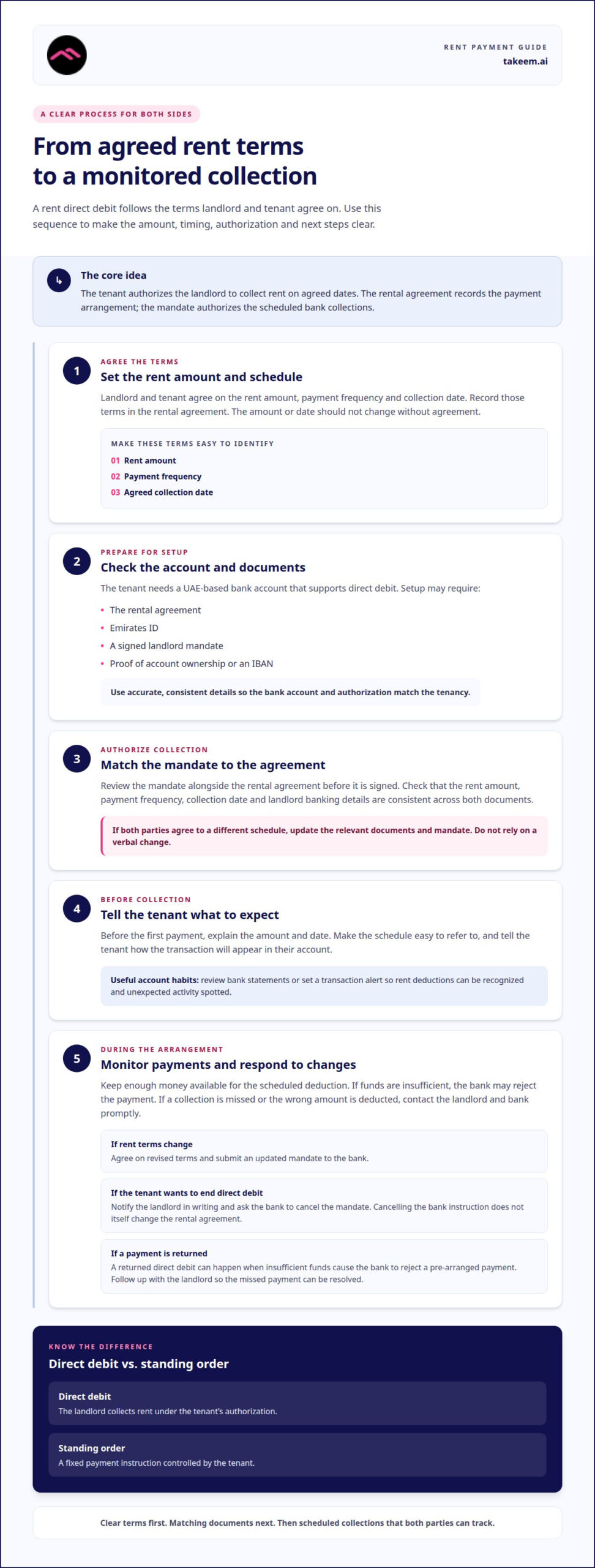
      Prepare the tenancy and banking details before completing the mandate. Setup may require the rental agreement, Emirates ID, signed landlord mandate and proof of account ownership or an IBAN. The tenant also needs a UAE-based bank account that supports direct debit. Use accurate, consistent details so the account and authorization match the correct tenancy.

    2. Explain the mandate and rental agreement

      Review the mandate alongside the rental agreement before the tenant signs. The mandate authorizes collection, while the agreement sets out the rent terms accepted by both parties. Ensure the amount, payment frequency, date and landlord banking details are consistent across the documents. If both parties agree to a different schedule, update the relevant documents and mandate rather than relying on a verbal change.

    3. Explain the arrangement in the context of the specific tenancy. The landlord and tenant should agree on a payment method and schedule that work for both, then record the rent terms in their agreement. Tenants can raise direct debit during contract discussions or renewal. The arrangement uses a UAE-based bank account that supports direct debit, and the signed mandate should clearly identify the agreed collection terms.
    4. Clarify how tenants can respond to changes or errors. If rent terms change, the tenant and landlord should agree on the new arrangement, then submit an updated mandate to the bank. To end a direct debit, tenants should notify the landlord in writing and ask their bank to cancel the mandate. If the wrong amount is deducted, contact the landlord and bank immediately. Landlords arranging digital rent collection can use direct debit setup for landlords to accept monthly tenant payments.

    How to Explain Direct Debit for Rent to Tenants

    How recurring bank collections work

    Explain the agreed collection schedule, then describe how a payment moves from authorization to collection. A straightforward example helps tenants know what to expect.

    1. Explain the rent amount and collection schedule

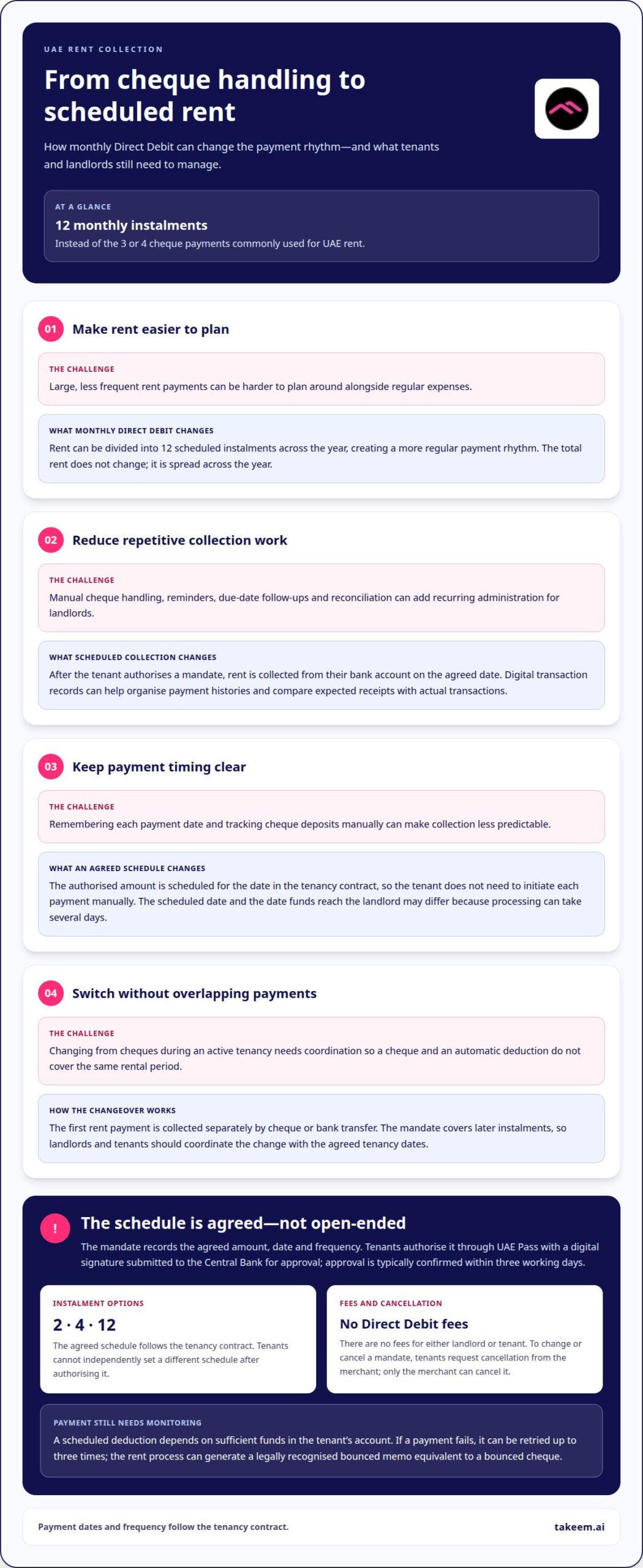
      State the rent amount, payment date and frequency agreed by the landlord and tenant. A useful explanation of direct debit starts with those terms, then describes scheduled collection in plain language. The authorization allows rent to be collected without the tenant approving every payment separately. Don’t imply that the amount or date can change without agreement.

    2. Give notice before collection

      Tell tenants the amount and collection date before the first payment, and make the schedule easy to refer to. Any notice should match the agreed arrangement and help the tenant recognize the collection. Encourage tenants to review bank statements or set transaction alerts. These habits can help them identify rent deductions and spot unexpected activity.

    3. Explain how tenants can change or cancel the arrangement. A tenant can cancel a direct debit through their bank at any time, but should also notify the landlord in writing. If the rent or collection frequency changes, both parties should agree on revised terms and submit an updated mandate to the bank. Cancelling the bank instruction does not itself change the rental agreement.
    4. Describe what happens if collection fails. A returned direct debit occurs when insufficient funds cause the bank to reject a pre-arranged payment, according to the European Union. Explain that tenants should keep enough money available for the scheduled deduction. If the amount collected is incorrect, tenants should contact the landlord and their bank promptly to address the error and clarify the next payment.
    5. Distinguish direct debit from a standing order. Direct debit lets a landlord collect rent under the tenant’s authorization, while a standing order is a fixed instruction controlled by the tenant. For landlords explaining direct debit to tenants, this contrast makes clear who initiates the recurring payment. If rent terms change, review the mandate and payment instructions to keep them consistent with the agreed arrangement.

    Tenant Info Needed for Rent Direct Debit Setup

    1. Start with a UAE-based bank account that supports direct debit. This is the essential account requirement for using rent direct debit in the UAE. Have the account holder’s name and bank details ready, since they connect the tenant’s account to the authorization. An account that does not support direct debit cannot be used for this payment method.
    2. Prepare the rental agreement and Emirates ID for setup. The agreement identifies the tenancy and records the agreed rent terms, while the Emirates ID identifies the tenant. Keep the details consistent across both documents. For example, use the tenant’s legal name as it appears on the ID, rather than a shortened version that could make it harder to match records.
    3. Include proof of bank account ownership or the account’s IBAN. These details identify the account from which rent will be collected. Before submitting the mandate, compare the account holder’s name and IBAN with the information entered on it. A mistyped digit or mismatched name can delay setup or create uncertainty about which account was authorized.
    4. Complete the landlord’s signed mandate and review its payment details before authorization. The mandate records permission to collect rent and should match the amount and schedule in the rental agreement. For example, if the agreement sets quarterly payments, the mandate should not show monthly collection. Resolve any discrepancies before signing rather than relying on verbal explanations later.
    5. Organize the documents as one setup pack: rental agreement, Emirates ID, signed landlord mandate, and account ownership proof or IBAN. Keep a copy of the completed mandate and the agreed payment terms for reference. If you’re a landlord arranging digital rent collection, use digital direct debit setup to accept monthly tenant payments.

    Takeem: Direct Debit setup for Landlords to digitally accept monthly payments from tenants

    Takeem helps landlords set up Direct Debit to accept monthly rent payments digitally. This is a practical option when both parties have agreed on the payment schedule and the landlord wants to collect rent digitally.

    A clear setup makes the conversation straightforward: explain the agreed amount and date, outline what the mandate authorizes, and ensure the tenant knows which bank account will be used. The arrangement should reflect the rental agreement so the payment process and tenancy terms stay aligned. For landlords seeking broader rental protection, Takeem also offers a Landlord Rental Guarantee.

    To discuss setting up Direct Debit for your rental payments, contact Takeem.

    Make clear rent payments part of a stronger tenancy

    Clear communication about payments can support an organized tenancy. Treat the mandate as part of an ongoing conversation, not just a form to complete at setup. If the tenancy changes, revisit the payment arrangement with the tenant and keep it aligned with the agreed terms. This helps both sides know what to expect and where to raise questions.

    The clearest way to explain direct debit to tenants is to connect the authorization with the practical experience of paying rent. Use straightforward language, welcome questions and focus on the agreed arrangement. For landlords and property professionals seeking broader rental support, Takeem also offers Rental Guarantee for Property Investors with Large property Portfolios and Landlord Rental Guarantee that Agents can sell for healthy commissions.

    When you’re ready to explore digital rent payments for your property, contact Takeem to discuss your rent payment setup. A clear conversation is a confident next step toward a smoother process for everyone involved.

    Frequently Asked Questions

    Why Direct Debit for Rent Payments?

    Direct Debit can make recurring rent collection more structured for tenants and landlords. Tenants can plan around a scheduled withdrawal, while landlords can reduce the need to handle post-dated cheques. For example, a tenant paying monthly can plan around the agreed collection date. The arrangement works best when both parties understand it and agree to use this payment method.

    What is the difference between a direct debit and a standing order?

    A direct debit authorizes the landlord to collect rent under agreed terms; a standing order instructs the bank to send a fixed payment. With a standing order, the tenant controls the instruction and arranges changes through their bank. For example, if the rent terms change, the tenant may need to update the standing order. Direct debit instead relies on the collection mandate and agreed terms.

    What is direct debit and how does it work for rent payments?

    Direct Debit allows a landlord to collect rent from a tenant’s bank account on agreed dates after the tenant authorizes the payments. Collection follows the agreed schedule. Before agreeing, both parties should ensure the rental payment arrangement and collection details match. Discuss whether the property accepts this payment method as part of agreeing on the tenancy.

    How does direct debit compare with standing orders and bank transfers for paying rent?

    With Direct Debit, the landlord collects rent under the tenant’s authorization; a standing order is a recurring payment instruction managed by the tenant. A bank transfer is generally initiated by the tenant for an individual payment, rather than collected under an ongoing mandate. For example, someone paying manually must initiate each transfer. The suitable option depends on the agreed tenancy terms and how both parties prefer to manage rent.

    What should tenants do if a rent direct debit is incorrect?

    The UK Direct Debit Guarantee requires payments taken in error to be refunded. In Dubai, tenants should contact their landlord and bank immediately if the wrong amount is deducted.

  • Modernizing UAE Rentals: A Landlord’s Guide to Rental Guarantees and Direct Debit

    Modernizing UAE Rentals: A Landlord’s Guide to Rental Guarantees and Direct Debit

    What if the most stressful part of being a landlord in the UAE, the physical collection and processing of paper cheques, became entirely obsolete? Most property owners are tired of managing stacks of post-dated paper while worrying about the financial impact of a bounced payment. It’s a traditional system that feels increasingly out of step with a global tech hub. By implementing a Central Bank-approved rental guarantee with direct debit UAE landlords can finally trade manual uncertainty for automated, secure cash flow.

    You’ve likely felt the sting of a tenant default or the exhaustion of the legal process required to recover funds. This article will show you how to eliminate those risks while securing your rental income through the UAE’s digital payment revolution. We’ll explore how modern property technology provides up to six months of rent protection and integrates emergency maintenance into a single, paperless workflow. You’ll learn how to transition to a streamlined collection system that protects your portfolio, reduces your administrative burden, and respects your time.

    Key Takeaways

    • Understand the structural shift from paper-based cheques to digital collections and why this evolution is essential for modern property management.
    • Discover how a rental guarantee with direct debit UAE secures your income with up to six months of rent coverage against tenant default.
    • Learn the practical steps to implement a paperless, automated payment system that transforms your annual cash flow into reliable monthly deposits.
    • Explore the added value of integrated emergency maintenance services that protect your asset while reducing daily administrative friction.
    • Compare the security and success rates of modern digital payments against the high-risk tradition of physical, post-dated cheques.

    The Evolution of UAE Rent Collection: From Cheques to Direct Debit

    The UAE rental landscape is undergoing its most significant transformation in decades. For years, the post-dated cheque was the undisputed king of rent collection, serving as both a payment method and a form of security. As we move through 2026, this paper-based tradition is giving way to a more efficient, digital-first reality. Modern landlords are realizing that physical cheques are a relic of a slower era, replaced by the precision of the UAE Direct Debit System (UAEDDS).

    At its core, understanding What is Direct Debit? is essential for any property investor. It’s a legal, recurring payment mechanism that allows for the automated transfer of funds from a tenant’s bank account to yours. Unlike the rigid nature of annual or quarterly cheques, this system offers a flexible framework that aligns with modern financial standards and the Dubai Paperless Strategy.

    Why Post-Dated Cheques are Becoming Obsolete

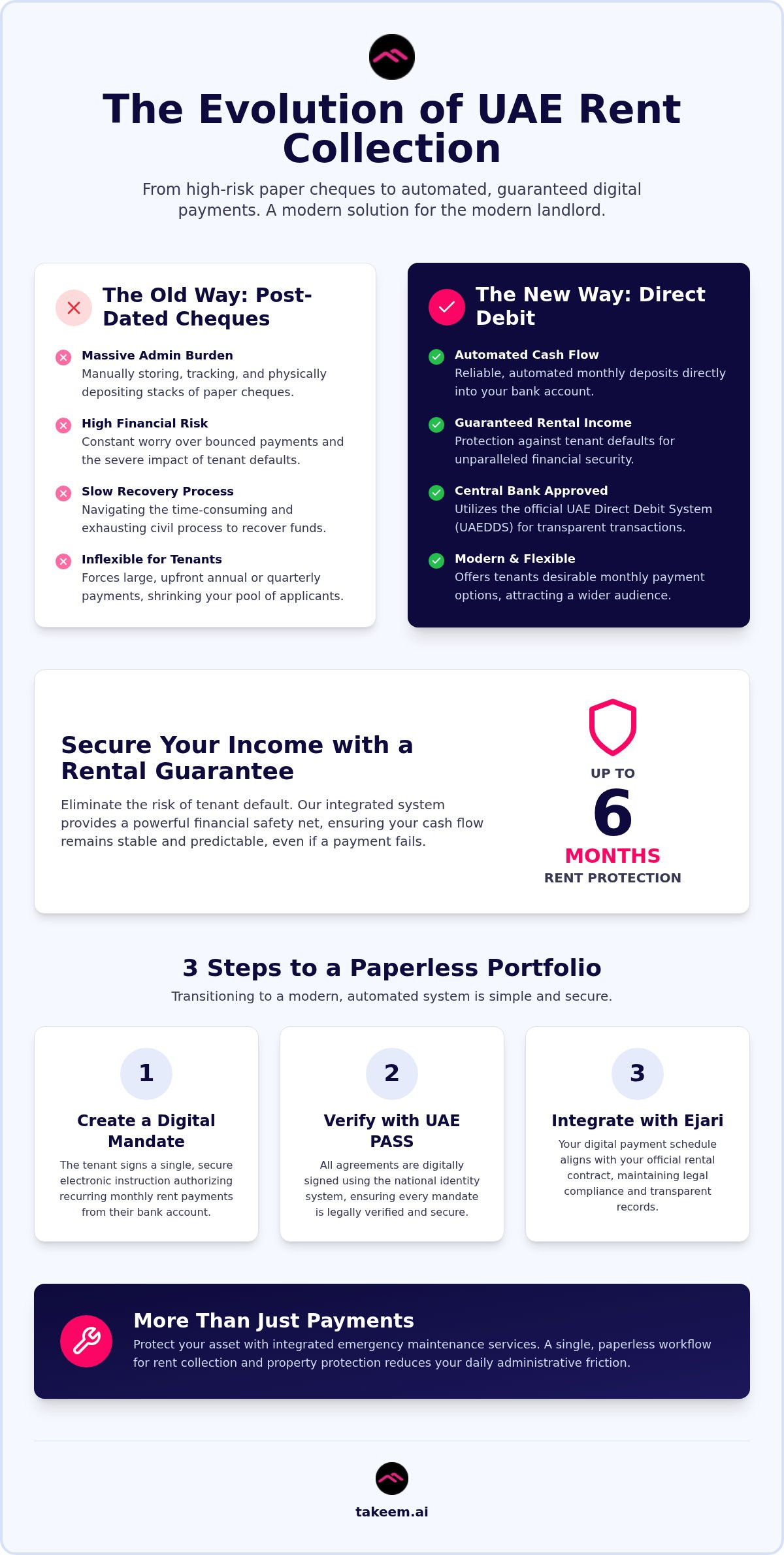
    Managing a property portfolio shouldn’t feel like running a stationery shop. Storing, tracking, and physically depositing hundreds of cheques creates a massive administrative burden. If a cheque bounces, the legal landscape has shifted significantly. While the act was largely decriminalized in 2022, the civil process for recovery remains a time-consuming hurdle for landlords who rely on traditional methods. Understanding the myths and modern reality of a bounced rent cheque UAE landlords face in 2026 is essential before deciding which payment system best protects your investment.

    Tenant preferences are also driving this change. Residents increasingly seek the ability to pay monthly to better manage their household liquidity. Traditional cheque-based systems often force tenants into large, upfront payments that can limit your pool of potential applicants. By moving away from paper, you remove these barriers while professionalizing your operations. It’s a shift that prioritizes efficiency over tradition. To fully appreciate what this transition means for your bottom line, exploring the benefits of direct debit for landlords UAE reveals how automated collections can fundamentally transform your rental business.

    The Rise of the UAE Direct Debit System (UAEDDS)

    The UAE Central Bank has been a key facilitator in this digital shift, providing the infrastructure for secure, automated payments. This isn’t just about convenience; it’s about transparency. Every transaction through the UAEDDS leaves a clear digital trail that protects both parties and integrates directly with modern banking apps.

    When you implement a rental guarantee with direct debit UAE landlords gain a level of security that cheques could never provide. The integration of fintech solutions into the national rental ecosystem means payments aren’t just automated; they’re protected. This evolution ensures that even if a digital transfer fails, your monthly cash flow remains steady. It’s a sophisticated shield against the unpredictability of the traditional market.

    How to Implement Direct Debit for Your Rental Properties

    Moving away from physical cheques requires a shift in mindset and a few technical prerequisites. It’s not just about swapping paper for an app; it’s about establishing a secure, bank-to-bank connection. Both parties need to use UAE PASS for digital signatures, ensuring that every agreement is verified by national identity standards. This process leverages the UAE’s Official Direct Debit System, which provides a regulated framework for recurring payments.

    Setting Up the Digital Payment Mandate

    A digital mandate is the engine of this new system. Instead of signing 12 cheques, the tenant signs a single electronic instruction. This mandate authorizes their bank to transfer the rent amount on a specific date each month. Using a secure platform ensures that bank details are verified instantly, which drastically reduces the risk of administrative errors or failed transfers. When you combine a rental guarantee with direct debit UAE landlords can rest easy knowing the system is both automated and protected.

    Integrating with National Rental Registries

    For a digital payment schedule to be fully effective, it must align with your official rental contract, such as Ejari in Dubai. Your digital payment mandate should mirror the terms of your registered tenancy agreement to maintain legal compliance. This integration ensures that your payment data is reflected in national systems, providing a transparent record of your rental income. It’s a proactive way to manage your portfolio while staying within the boundaries of UAE rental laws.

    If you’re managing an existing tenancy, the contract renewal period is the ideal time to make the switch. You don’t need to wait for a new tenant to modernize your cash flow. Simply update the payment terms in the renewal offer and guide the tenant through the digital setup. It’s a smooth transition that benefits both sides: the tenant enjoys monthly flexibility, and you gain automated reliability. If you’re looking for a partner to handle this transition, you can easily set up direct debit for landlords to digitally accept monthly payments without the typical technical headaches.

    The technical requirements are straightforward. Landlords need a valid UAE bank account and a registered property, while tenants must have a steady income source and a local bank account. Once these are in place, the digital mandate can be issued and signed within minutes, replacing the need to physically store and deposit a stack of paper cheques for the remainder of the year.

    Cheques vs. Direct Debit: A Security and Efficiency Comparison

    The traditional reliance on post-dated cheques in the UAE was built on a perceived sense of security. However, physical paper is inherently vulnerable. Cheques can be lost, damaged, or rejected due to minor signature mismatches, creating unnecessary friction between you and your tenant. Transitioning to a rental guarantee with direct debit UAE removes these human-centric failure points. Digital payments operate on a system of precision, ensuring that the transfer of funds is triggered automatically without the need for manual intervention or physical storage.

    Success rates for digital transactions are significantly higher than those for physical cheques. While a cheque might sit in a drawer for months before being deposited, a digital mandate is verified at the point of setup. This verification process confirms the tenant’s bank details and account status instantly. If a digital payment fails, the system provides an immediate, timestamped notification. This allows for proactive resolution rather than waiting for a bank to return a physical slip days after a failed deposit attempt. For a detailed breakdown of how these advantages stack up under the latest regulations, the 2026 guide to direct debit benefits for UAE landlords provides a comprehensive look at the financial protections now available to property owners.

    Financial Predictability and Cash Flow

    The shift from the traditional 1 to 4 cheque model to a 12-payment digital schedule fundamentally changes your ROI. Large, quarterly payments often place a significant strain on a tenant’s liquidity, which can increase the risk of a major default. By spreading the annual rent across 12 automated monthly payments, you create a more sustainable financial environment for the tenant. For the landlord, this results in a smooth, predictable monthly income stream that is easier to manage and reinvest. Portfolio investors find this particularly beneficial, as automated reconciliation replaces the nightmare of tracking hundreds of individual paper slips. Investors seeking to maximise their returns should also explore strategies for optimising property portfolio rental income UAE to build a truly resilient, automated income system across all their holdings.

    Administrative Time Savings

    Modern property management is about reclaiming your time. Using a digital system eliminates the need for regular trips to the bank to deposit physical cheques. Everything is handled within a secure digital ecosystem that integrates with your bookkeeping software. This automation simplifies your financial reporting and makes the auditing process for tax purposes far more straightforward. You no longer need to maintain physical ledgers or worry about the “human error” associated with manual data entry. The system provides a transparent, unalterable record of every successful transaction, giving you total visibility over your investment’s performance without the administrative headache.

    Legal recourse has also evolved. Since the decriminalization of bounced cheques in 2022, the “security” of a physical cheque has become largely symbolic. Digital defaults provide the same legal standing for civil claims but with better documentation. You have a clear, digital trail of the mandate, the attempted transaction, and the failure notice, which can be used to trigger the protections of a rental guarantee. Many landlords still hold misconceptions about their rights in these situations, and separating fact from fiction around the bounced rent cheque UAE legal landscape can help you make more informed decisions about your recovery options. This modern approach ensures you aren’t just collecting rent; you’re securing your future cash flow with the most robust tools available in the 2026 market.

    Modernizing UAE Rentals: A Landlord’s Guide to Rental Guarantees and Direct Debit

    The Critical Role of Rental Guarantees in Digital Systems

    Automation is a powerful tool for efficiency, but it isn’t a shield against financial hardship or tenant default. A digital mandate only works when there are funds available in the tenant’s account. This is the exact point where a payment system’s utility ends and the need for a safety net begins. By implementing a rental guarantee with direct debit UAE landlords can bridge the gap between a failed transaction and their actual bank balance. It ensures that your investment remains a source of predictable income rather than a collection headache.

    A rental guarantee acts as a sophisticated layer of protection that sits on top of your digital collection system. While the Direct Debit handles the day-to-day logistics, the guarantee handles the risk. If a monthly transfer fails due to insufficient funds or a tenant’s sudden financial distress, the guarantee kicks in to maintain your cash flow. This synergy creates a truly hands-off investment experience where the technology manages the process and the guarantee manages the uncertainty.

    Income Protection: Beyond the Payment Portal

    In the current UAE market, a robust rental guarantee typically provides coverage for up to six months of unpaid rent. This specific timeframe is designed to give landlords enough breathing room to navigate legal processes or find a new tenant without losing their monthly yield. It’s a proactive solution to the “what if” scenarios that often keep property owners awake at night. You aren’t just relying on a tenant’s promise to pay; you’re relying on a verified financial product that secures your ROI regardless of the tenant’s immediate liquidity.

    Asset Protection through Emergency Maintenance

    Securing your income also requires protecting the physical asset that generates it. This is why modern guarantees often integrate emergency property maintenance as a core feature. If a major leak occurs or the air conditioning fails, immediate intervention is required to prevent long-term damage and avoid a vacancy. Having these services bundled into your guarantee package means you don’t have to scramble for contractors or worry about the cost of urgent repairs. It preserves the property’s value and ensures your tenant remains satisfied, which is the best way to secure long-term rental income.

    This integrated approach transforms property management from a series of reactive tasks into a streamlined, professional operation. You gain the confidence to offer monthly payment plans because you know the downside is fully covered. To protect your portfolio from the risks of default and damage, you can secure a Landlord Rental Guarantee that bundles digital collections with comprehensive income and asset protection. It’s the most effective way to modernize your rental business while maintaining absolute peace of mind.

    Securing Your Investment with Takeem’s Integrated Solutions

    Modernizing your rental business requires a partner that understands the intersection of finance and property technology. Takeem provides a sophisticated shield that combines the GCC’s first rental guarantee with a seamless digital collection system. By choosing a rental guarantee with direct debit UAE landlords can finally retire the manual chequebook and embrace a system built for the 2026 market. This bundled approach ensures that your income is protected, your payments are automated, and your asset is maintained through a single, professional interface.

    It’s about more than just technology. It’s about a commitment to efficiency that benefits every stakeholder in the rental ecosystem. While individual landlords gain peace of mind, real estate agents can leverage the rental guarantee for real estate agents to offer their clients a superior level of security while earning healthy commissions. This creates a more professional market where risk is managed proactively rather than reactively.

    A Comprehensive Shield for Property Investors

    For those managing extensive assets, the complexity of tracking multiple payment dates and maintenance requests can be overwhelming. Takeem offers a specialized Rental Guarantee for Property Investors with Large property Portfolios, designed to centralize risk management across hundreds of units. This platform doesn’t just collect rent; it provides a macro-level view of your portfolio’s financial health. Through strategic partnerships with major national property portals like Bayut and dubizzle, Takeem ensures that your properties are backed by the most recognized names in UAE real estate.

    The efficiency of digital rent collection becomes even more apparent at scale. You can move away from the “cheque ritual” and transition to a paperless environment where every unit’s income is guaranteed for up to six months. This structural stability allows you to focus on growth rather than chasing defaults or managing physical paperwork.

    Getting Started: The Transition to Takeem

    The move toward a paperless rental business is a structured, supported process. Onboarding your properties and tenants to the Takeem platform is designed to be intuitive, with dedicated support to guide you through the digital setup. You’ll start by verifying your property details and inviting your tenants to sign their digital mandates via UAE PASS. This creates a legally binding, Central Bank-approved payment schedule that replaces traditional cheques for good.

    Once the system is live, the automation takes over. You’ll receive real-time notifications for every successful transaction, and the integrated emergency maintenance service remains on standby to protect your property’s value. It’s a transition that replaces administrative friction with calm efficiency. By finalizing your move to Takeem, you aren’t just changing how you collect rent; you’re future-proofing your investment with the most robust protection available in the Emirates.

    Future-Proofing Your Rental Income for the Digital Era

    The shift toward a digital-first rental market is no longer a future prediction; it’s today’s reality. By moving away from the administrative burden of physical cheques, you reclaim your time and professionalize your portfolio. Efficiency, however, is only half the battle. Implementing a rental guarantee with direct debit UAE provides the dual security of automated collections and a robust financial safety net.

    As the GCC’s first Rental Guarantee provider, Takeem offers a bundled solution that includes up to 6 months of rent protection and integrated emergency maintenance. This comprehensive approach ensures that your cash flow remains steady, even if a digital mandate fails. You don’t have to manage the risks of tenant default or property damage alone. Take the step toward a more reliable, paperless investment strategy today.

    Modernize your rent collection and secure your income with Takeem. Embracing this digital transformation is the most effective way to ensure your property investment remains a source of steady growth and absolute peace of mind.

    Frequently Asked Questions

    Is Direct Debit for rent legally binding in the UAE?

    Yes, Direct Debit is a legally binding and fully recognized payment method in the Emirates. It operates under the infrastructure of the UAE Central Bank’s Direct Debit System (UAEDDS). This mechanism allows for the automated, digital transfer of funds, replacing the need for traditional post-dated cheques while maintaining full legal compliance with local rental regulations and property laws.

    What happens if a tenant’s Direct Debit payment fails?

    If a payment fails due to insufficient funds, the system triggers an immediate notification to both the landlord and tenant. When using a rental guarantee with direct debit UAE, this failure doesn’t result in a loss of income for the landlord. The guarantee covers the unpaid rent for up to six months, ensuring your monthly cash flow remains uninterrupted while the default is resolved.

    How does a Rental Guarantee differ from standard property insurance?

    A Rental Guarantee focuses on securing your monthly income, whereas standard property insurance typically covers physical damage to the structure or contents. While insurance protects against fire or flooding, a guarantee shields you from the financial impact of tenant default. Takeem’s solution is unique because it bundles this income protection with emergency maintenance, providing a more comprehensive shield for your investment.

    Can I use Direct Debit for existing tenancy contracts?

    You can absolutely transition existing tenancy contracts to a digital payment schedule. The most efficient time to implement this change is during the contract renewal period. However, you can also switch mid-term by signing a mutual addendum to the tenancy agreement and setting up the digital mandate via UAE PASS to replace any remaining post-dated cheques.

    Are there fees for landlords to set up Direct Debit rent collection?

    Landlords should expect standard service fees associated with the setup and management of digital payment systems and guarantee products. These costs are typically offset by the significant reduction in administrative labor and the elimination of financial risks associated with bounced cheques. For specific details on service charges, you should review the terms provided during the onboarding process on the digital platform.

    How does the emergency maintenance cover work in Takeem’s package?

    Emergency maintenance cover is an integrated feature of the Rental Guarantee package designed to protect your asset’s value. If a critical issue like a major plumbing leak or total AC failure occurs, the service provides immediate professional intervention. This proactive approach prevents small maintenance problems from escalating into costly repairs or causing tenant dissatisfaction that could lead to a vacancy.

    Is a Rental Guarantee available for both residential and commercial properties?

    Rental Guarantees are primarily tailored for residential properties, serving individual landlords and large portfolio investors alike. While the system is optimized for the residential market, investors with diverse portfolios should consult with a specialist to see how these digital tools can be applied to their specific assets. The goal is to provide a consistent, secure income stream across all eligible units in your portfolio.

    Do I still need to register my contract with national systems if using Direct Debit?

    Yes, you must still register your tenancy contract through national systems like Ejari in Dubai. Using Direct Debit is a payment mechanism, but it does not replace the legal requirement for official contract registration. In fact, your digital payment mandate must mirror the terms and dates specified in your registered contract to ensure full legal transparency and compliance with UAE laws.