

For rent collection for non-resident landlords, who pays withholding tax depends on where the property is. In Ireland, a tenant paying rent directly to a non-resident landlord must withhold 20%; under the UK scheme, the letting agent or tenant generally withholds tax at 20% and sends it to HMRC.
Living in the UAE does not determine how rent from an overseas property is taxed. The property’s location shapes the collection process and may determine which tax rules apply. This guide explains who may handle withholding, how rent can reach you abroad, what records to keep, and how late payments affect cash flow. It also compares UK and Irish arrangements, showing why you should understand how rent is collected and income reported before relying on it to cover costs.
Key Takeaways
- Withholding rules depend on where the rental property is located, not where you live. Identify the relevant country’s process before deciding how rent should be collected.
- For UK rental income, approval to receive rent without tax deduction involves applying under the Non-resident Landlords Scheme before leaving the UK.
- Collecting UAE rent from abroad calls for clear payment records and a reliable way to track what is due, received and outstanding.
- Late rent can disrupt cashflow even when the expected income is clear. Understand the payment schedule and follow-up process so you can plan around delays.
- Compare the tax and collection arrangements with the support available for rental income and property maintenance to decide what best fits your needs.
Approval to receive rent without tax deduction
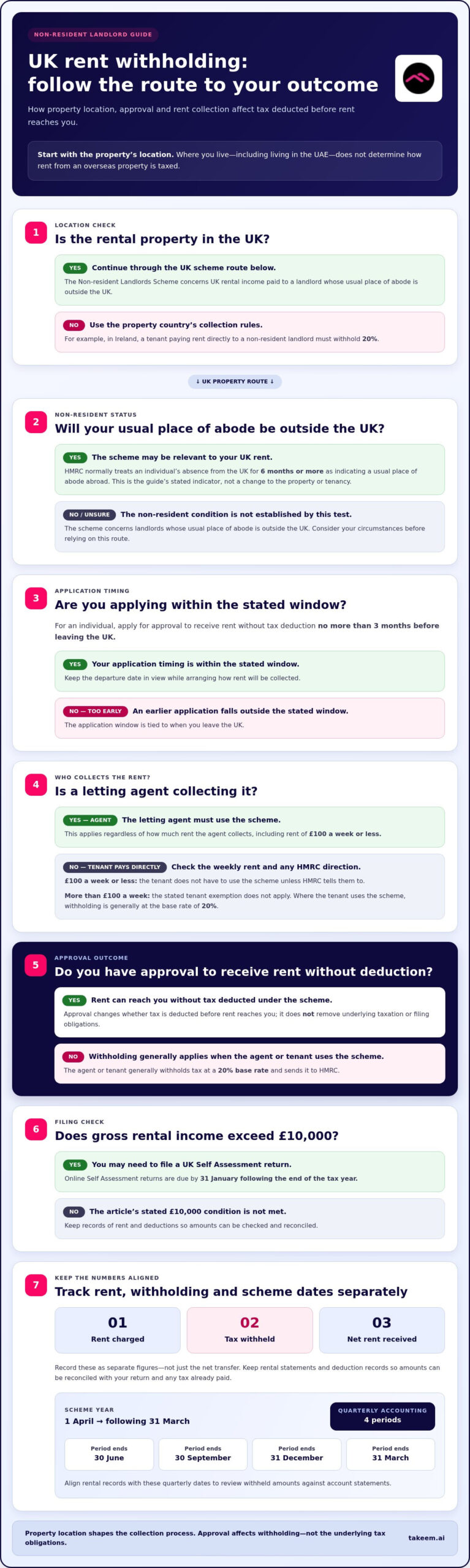
If you leave the UK to live abroad, approval under the Non-resident Landlords Scheme can change how your rental income is collected. An individual should apply no more than 3 months before leaving the UK. Applying earlier falls outside the stated application window, so the departure date matters when arranging rent collection.
The scheme concerns UK rental income paid to a landlord whose usual place of abode is outside the UK. HMRC normally treats an individual’s absence from the UK of 6 months or more as indicating a usual place of abode abroad. That test helps explain why a landlord moving to the UAE may need to consider the scheme, even if the property and tenancy remain unchanged.
Approval is about whether tax is deducted before rent reaches you. Without approval, a letting agent or tenant using the scheme generally withholds tax at a base rate of 20% and sends it to HMRC. Approval to receive rent without that deduction can therefore affect the amount arriving in your account, but it does not remove your underlying taxation or filing obligations.
The rules distinguish letting agents from tenants. A letting agent must use the scheme regardless of how much rent it collects, including rent of £100 a week or less. A tenant paying rent of £100 a week or less does not have to use the scheme unless HMRC tells them to. That distinction matters if you collect rent directly from a tenant rather than through an agent.
Approval also does not settle the final tax calculation. A non-resident landlord may need to file a UK Self Assessment return if gross rental income exceeds £10,000. Online Self Assessment returns are due by 31 January following the end of the tax year. Keep rental statements and records of deductions so the amounts collected can be reconciled with your return and any tax already paid.
For planning, record three figures separately: rent charged, tax withheld, and net rent received. If an agent deducts tax, for example, record the gross rent and deduction separately rather than treating the net transfer as the full rent. This makes it easier to check payments, prepare tax records, and track any credit claimed against a later liability.
The UK scheme year runs from 1 April to the following 31 March. Agents and tenants required to use the scheme account for tax quarterly, for periods ending on 30 June, 30 September, 31 December and 31 March. Aligning your rental records with those dates makes withheld amounts easier to review alongside account statements.
Challenges of collecting UAE rent from abroad
Across the UAE, compare rent collection methods by payment channel, access to records, and follow-up on late payments. The practical arrangements depend on the tenancy agreement and how you receive and track rent. Review the details for each property rather than assuming one setup applies throughout the country.
Distance can make routine oversight less immediate. If you live abroad, you may not notice a missed transfer promptly or have easy access to local account information. Set a clear process for checking rent due, payments received, and outstanding balances. Keep the tenancy agreement, payment confirmations, and tenant communications together so each entry has supporting context.
Cross-border transfers can affect the amount that reaches the landlord. Traditional banks may include exchange-rate markups of 2% to 4% on cross-border transfers for UAE property landlords. Compare the amount sent with the amount credited, and record the transfer currency and applied conversion details. This makes rental income easier to reconcile and helps explain differences between rent collected and funds received abroad.
Consider tax treatment separately. The property’s location determines which country’s rules may apply to rental income; living in the UAE does not, by itself, settle overseas tax obligations. Withholding may depend on where the property is and how rent is paid. Keep UAE collection records separate from documents for an overseas tax return, and record each deduction separately from rent charged.
Digital collection can reduce reliance on manual reminders, but setup still takes coordination. In the UAE, digital rent collection setup typically takes a few days, while approval for digital rent payment setups usually takes 24 to 48 hours. Prepare the tenant and property details, confirm the agreed payment channel, and retain the setup confirmation. These steps help identify whether a delay relates to onboarding or a missed payment.
- Payment trail: Save the due date, transfer confirmation, amount received, and currency conversion details.
- Follow-up: Record the date of each reminder and the tenant’s response, creating a clear timeline if rent is late.
- Tax records: Keep rent statements separate from tax records for the country where the property is located.
For a UAE tenancy, the Leave and License Agreement typically sets rent due on the 1st of each calendar month. Use that agreed date to schedule account reviews and flag an absent payment promptly. A consistent digital process can make this routine easier to manage from abroad; explore a digital rent collection setup as one way to structure payment acceptance.
Collection arrangements depend on the tenancy agreement and how rent is received and tracked. Compare payment channels, access to records, and follow-up on late payments for each property rather than assuming the same setup applies across the UAE.
Rent payment collection and late-payment follow-up
A landlord can arrange for tenants to pay rent directly; a property manager is not automatically needed to receive payments. If you live abroad, decide who will monitor receipts, follow up on delays, and keep a clear record of each transaction.
Set the payment method and due date in the tenancy agreement, then use consistent payment references. A digital Direct Debit setup can help landlords accept monthly tenant payments. Match each receipt to the relevant rental period, and record any shortfall separately rather than marking the month as fully paid.
Make late-payment follow-up a clear written process, not an informal exchange that can get lost across time zones. Compare the amount due with the account credit, then send a reminder identifying the rental period and balance. Log the reminder date, the tenant’s response, and any agreed next step. If payment remains outstanding, keep the correspondence with the tenancy and payment records.
Appointing a collection agent is an operational choice, not a transfer of every landlord obligation. A handover file can include the tenancy agreement, property and tenant details, payment instructions, and written authority describing the agent’s role. Keep a copy of that authority and clarify who can receive rent, issue receipts, and contact the tenant. This defines the agent’s responsibilities without implying that the landlord’s liability or tax-return responsibilities automatically transfer.
For UAE rent collection, charges for property management depend on the agreed service scope, property, and contract. A collection-only arrangement is different from broader management work, so compare what the charge covers, such as payment tracking, reminders, or tenant communication. The price depends on the case and is given after a quote request; the scope of work and property arrangements affect it.
Keep tax treatment separate from payment administration. Landlord withholding can refer to rules in another country, where a tenant or collection agent may have to deduct tax before remitting rent. Do not automatically apply an overseas withholding rate to UAE rent. If the property is abroad, record any deduction separately and retain the supporting statement for the relevant tax return.
- Register each payment: Match receipts to the agreement, tenant, and rental period.
- Track arrears: Record missed amounts, reminders, and responses in one dated log.
- Reconcile transfers: Compare the sent amount with the credited amount; cross-border bank markups can range from 2% to 4%.
A consistent routine makes late payments visible and gives the landlord or collection agent a clear record for follow-up. It also separates rent collection from wider property management, so each party understands which tasks they handle.
Cashflow implications for non-resident landlords
Withholding tax changes when rental income reaches you, even if the tenant pays on time. For an Ireland property, a tenant paying rent directly to a non-resident landlord must withhold 20% of rental payments under the system effective from 1 July 2023. Plan using the net amount received, not the gross rent shown in the agreement.
Timing matters as much as the deduction. In Ireland, tenants or collection agents must submit a Rental Notification and the 20% withholding tax payment to Revenue within 21 days of paying rent. That creates a reporting and payment step alongside the rent transfer. Keep the payment date and notification record together to reconcile cash received with the amount reported.
A collection agent can change the handling, but not every arrangement has the same cashflow effect. Irish collection agents may set up 20% Rental Notification payments each month. If an agent collects rent and follows the applicable NLWT process, the landlord’s records should show gross rent, tax withheld, and net proceeds separately. This makes the annual rental picture clearer when preparing a tax return.
For UK properties, letting agents and tenants using the Non-resident Landlords Scheme generally withhold tax at a base rate of 20%. Required agents and tenants account for tax quarterly, with periods ending on 30 June, 30 September, 31 December, and 31 March. Those dates can create a gap between rent collection and tax remittance, so align your cashflow forecast with the scheme’s reporting cycle.
Build your rental cash-flow records around money actually available to use. Separate expected rent from deductions, transfer delays, and property costs, then compare bank credits with rent statements regularly. If a statement shows gross rent but the bank receives less, record the withholding or transfer deduction as a separate entry. This supports accurate bookkeeping without mistaking a smaller deposit for a tenant shortfall.
- Forecast net receipts: Apply the relevant withholding rules before assigning rent to recurring costs.
- Track tax timing: Record rent dates, deductions, and required notifications in one schedule.
- Reconcile annually: Compare the rental ledger with bank statements and tax return figures.
A written agreement should clarify who collects rent and records deductions. Review it alongside your tax records when arrangements change, such as appointing a collection agent or changing the payment method. If you receive rent from multiple properties, track each property’s income separately. Separate ledgers make late payments, withholding, and annual totals easier to identify.
What laws and rules apply to rent collection by non-resident landlords in the UAE?
For a UAE property, start with the tenancy agreement and the emirate where the property is located. These details frame the landlord-tenant arrangement and agreed payment process. If you live abroad, distinguish local rent collection from tax rules that may apply in another country because of your residence or other circumstances.
Do not automatically apply UK or Irish non-resident withholding rules to UAE rent. The 20% rates discussed in those systems relate to their own jurisdictions, not a universal deduction for overseas landlords. For a property in any UAE emirate, keep the rent charged and received clearly recorded, then assess any separate overseas tax reporting against the property and landlord’s circumstances.
The agreement is the practical reference point for payment dates, accepted payment methods, and the parties’ responsibilities. For example, rent is typically due on the 1st of each calendar month under a Leave and License Agreement. Keep the signed agreement, payment instructions, receipts, and messages about changes together. These records help explain a missed or partial payment without confusing it with a tax deduction.
Describe collection arrangements accurately. If a tenant pays you directly, retain evidence of each transfer. If an agent receives rent, document their authority and assigned tasks, such as issuing receipts or sending payment reminders. This record distinguishes rent collection from wider property management and clarifies who handles each communication.
If you have overseas reporting obligations, keep UAE property records separate from tax documents prepared for another jurisdiction. A ledger can show the rental period, gross rent, payment date, amount credited, and any currency conversion. Keep supporting bank statements with the corresponding agreement and receipt. This helps reconcile reported rental income with actual deposits and identify the reason for any difference.
Non-resident status alone does not explain every obligation. The property’s location, your tax residence, and the rules in each relevant jurisdiction can affect reporting. For example, a UAE-based owner with a property in the UK may need to consider UK rules separately from UAE tenancy documents. Keep each country’s records distinct rather than assuming one set of documents meets every requirement.
A reliable payment process supports accurate records, whether rent is paid directly or through an authorized collection arrangement. Digital rent collection setup in the UAE typically takes a few days, giving landlords a practical route to organize monthly payments. A consistent ledger and documented payment channel also make it easier to spot overdue rent and follow up with the tenant.
To structure monthly rent acceptance, explore digital rent collection options for UAE landlords.
Takeem: Landlord Rental Guarantee
Takeem’s Landlord Rental Guarantee can support you when you want rental income protection alongside your existing collection arrangements. Takeem also offers a Rental Guarantee for property investors with large portfolios. Emergency property maintenance is included as part of the Rental Guarantee, connecting rental support with a practical property need.
A rental guarantee does not replace understanding your tax or reporting obligations. It works alongside your records, payment process, and any applicable overseas tax arrangements. Real estate agents can also partner with Takeem to offer rental guarantee solutions to their clients in exchange for commissions.
If you’re reviewing how to support rental income and property maintenance, contact Takeem or visit takeem.ai.
Make your next rental decision with clarity
Managing an overseas property works best when payment processes, tax records, and income expectations support the same plan. At your next tenancy review, decide what you will handle directly, what needs a documented process, and where you want additional support. This makes rent collection for non-resident landlords part of a wider approach to protecting predictable property income, rather than a task addressed only after a payment is late.
For landlords seeking added rental income support, Takeem offers a Landlord Rental Guarantee, including an option for property investors with large portfolios. Real estate agents can also partner with Takeem to offer the guarantee to clients in exchange for commissions. Consider how these services fit your portfolio and approach to rental risk, alongside the tax and cash-flow arrangements relevant to your property.
Take a practical next step and discuss your rental needs with Takeem. Contact Takeem about rent collection and explore an approach that fits your property plans.
Frequently Asked Questions
Who pays the 20% non-resident landlord withholding tax?
The party responsible depends on the property’s country. Under Ireland’s NLWT, when rent is paid directly to a non-resident landlord, the tenant withholds 20% and pays it to Revenue; a collection agent can also withhold and submit Rental Notifications. Under the UK scheme, a letting agent or tenant required to use it generally deducts 20% and remits it to HMRC. These rules relate to those countries, not automatically to UAE rent.
How does rent collection work for non-resident landlords in the UAE?
For a UAE rental, collection follows the payment terms agreed between landlord and tenant. You can receive rent directly or arrange a digital payment method. Takeem provides Direct Debit setup so landlords can accept monthly tenant payments digitally. Match each receipt to its rental period and agreement, then reconcile it against your account records. Consider tax rules for an overseas property separately from the UAE payment process.
How can tenants pay rent to a landlord living abroad in the UAE?
Tenants can use the payment method set out in their UAE tenancy agreement, including a digital monthly payment arrangement. Provide clear instructions and use consistent payment references to match each transfer to the correct rental period. Takeem provides Direct Debit setup for landlords to accept monthly tenant payments digitally, reducing the need to manage each payment manually.
What are the risks of collecting UAE rent from overseas, including late or bounced payments?
A payment may arrive late, fail to appear in the expected account, or be returned. If you are abroad, delayed visibility can make arrears harder to spot and rental income more difficult to plan around. Compare account records with the agreed due date, retain evidence of returned transactions, and log follow-up with the tenant. Record rent as received only once the payment is credited to the account.