

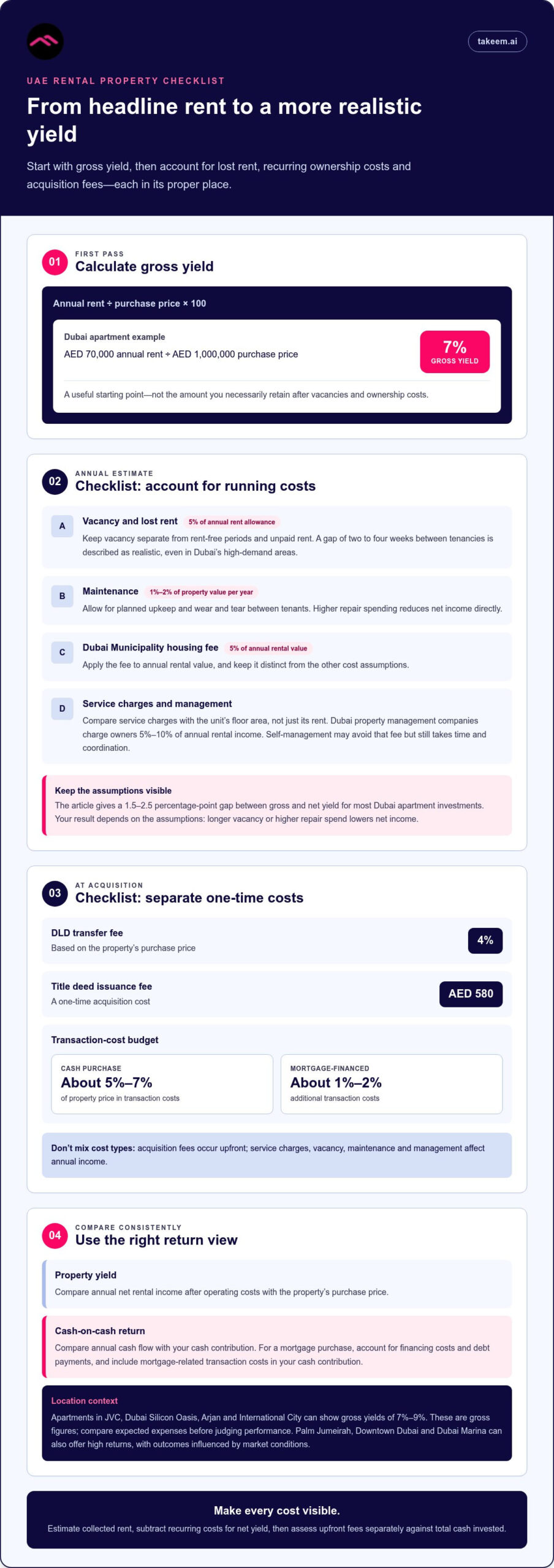
A 7% gross yield can look very different once vacancy and ownership costs are included. When calculating true rental yield in the UAE, divide annual rent by the purchase price for gross yield, then account for costs and unoccupied periods to estimate net yield. For example, a Dubai apartment bought for د.إ 1,000,000 and rented for د.إ 70,000 per year has a gross rental yield of 7%.
That headline figure is a useful starting point, but it doesn’t show how much you may actually retain. A realistic estimate accounts for property costs and time between tenancies.
This guide explains how to calculate gross and net yield, account for vacancy and ownership expenses, and assess how property type, location and DLD transfer fees affect the result. You’ll be better equipped to compare UAE investment properties beyond their advertised rent.
Key Takeaways
- Compare local yield figures carefully: Dubai apartments in JVC, Dubai Silicon Oasis, Arjan and International City can show gross yields of 7% to 9%, while costs reduce net returns.
- Build vacancy, service charges, the housing fee and maintenance into your estimate to get a more realistic view of rental income.
- Include Dubai’s 4% DLD transfer fee and other purchase costs when assessing your total investment, not just the property price.
- If rental-income protection is part of your plan, explore Takeem’s Landlord Rental Guarantee, which includes emergency property maintenance.
Rental yield by location and property type
Location and property type shape both rent potential and recurring costs. In Dubai, apartments in JVC, Dubai Silicon Oasis, Arjan, and International City produce gross rental yields of 7% to 9%. These are gross figures, so compare them with expected expenses before judging performance. Palm Jumeirah, Downtown Dubai, and Dubai Marina can also offer high real estate returns, but market conditions influence outcomes.
Service charges can change the comparison. Compare the charge with the unit’s floor area, not just its rent.
Property management also affects net income. Dubai management companies charge owners 5% to 10% of annual rental income. A self-managed property may avoid that fee, while still requiring time and coordination for tenancy issues and repairs. Include the management approach in every property comparison.
Cash and mortgage purchases affect cash-on-cash return differently. A mortgage adds financing costs and debt payments, reducing the cash flow available to the owner; cash-on-cash return compares annual cash flow with the investor’s cash contribution. Mortgage-financed Dubai purchases add approximately 1% to 2% in transaction costs.
Rental yield measures property performance, not an investor’s tax assessment. Treat rental income and property gains as separate tax questions, since the applicable treatment depends on the owner’s circumstances and holding structure.
Dubai Decree No. (43) of 2013 sets a maximum permitted rent increase of 0% when current rent is up to 10% below the market average. Tenancy contract terms, renewal timing, and eviction rules can also affect income continuity, so include potential turnover when forecasting rent.
Common risks include vacancy, service charges, management fees and maintenance. Dubai’s summer months tend to be slower for the real estate market, which can affect returns. Compare each property’s location, type, costs and likely rental demand instead of relying on a single headline yield.
Using rent, vacancy and ownership-cost assumptions
Estimate net yield using the rent you expect to collect, not just the advertised annual amount. Then account for vacancy and recurring ownership costs to see how your assumptions affect the result.
Maintenance and Vacancy Allowances
Allow for both planned upkeep and gaps between tenancies. A maintenance allowance of 1% to 2% of property value per year can account for wear and tear between tenants. A 5% vacancy allowance on annual rent provides a separate buffer, while a two-week to four-week vacancy between tenancies is realistic even in Dubai’s high-demand areas.
Add community charges to the same estimate. The Dubai Municipality housing fee is 5% of the annual rental value. Keep each cost distinct so you can adjust assumptions without obscuring their effect.
Rent-Free Periods and Bad Debt
Vacancy reduces collected rent, while rent-free periods lower income even when a property is occupied. Unpaid rent has a similar effect, so base your net-yield calculation on expected receipts rather than contracted rent.
For a practical estimate, subtract expected lost rent and recurring costs from annual rent, then compare the result with the property’s value. Keep vacancy and non-payment as separate allowances so you can see which assumption is driving the change.
Apply the Dubai Municipality housing fee to annual rental value, then account for service charges and maintenance. The gap between gross and net rental yield for most Dubai apartment investments is 1.5 to 2.5 percentage points. Your assumptions matter: a longer vacancy or higher repair spend reduces net income directly.
Landlords who want to streamline monthly rent acceptance can consider a digital Direct Debit setup. It supports payment collection, while vacancy and maintenance still need their own allowances in the yield calculation.
Acquisition costs and DLD transfer fees
A Dubai rental property’s purchase price is only part of its initial investment. The Dubai Land Department (DLD) transfer fee is 4% of the purchase price, and the title deed issuance fee is AED 580. Include these one-time charges when estimating the capital required to acquire the property.
For a cash purchase in Dubai, transaction costs are approximately 5% to 7% of the property price. Mortgage-financed purchases add approximately 1% to 2% in transaction costs. These figures help set an acquisition budget, but they also affect how you interpret the investment’s return.
Keep operating expenses separate from purchase costs. Service charges, maintenance, vacancy and management affect annual income; DLD transfer and title deed fees arise during acquisition. This separation shows which costs recur and which occur at the outset.
To compare yields, calculate annual net rental income after operating costs and compare it with the property’s purchase price. To account for entry costs, also compare the return with your total cash invested, including acquisition charges. The first view measures property performance; the second shows how upfront costs affect your return.
Mortgage financing changes the amount of cash invested and adds financing obligations. To calculate cash-on-cash return, compare annual cash flow after operating expenses and mortgage payments with your cash contribution. Include mortgage-related transaction costs in that contribution rather than treating the property price as your only upfront outlay.
Use a consistent method for every Dubai property you compare. Record the purchase price, 4% DLD transfer fee, AED 580 title deed issuance fee, and other transaction costs. Then estimate annual rent after operating costs. This makes the effect of acquisition costs visible instead of allowing one-time fees to disappear from the investment calculation.
Gross rental yield calculation
Gross yield gives a first-pass comparison of rent against a property’s purchase price. Calculate it as annual rent divided by purchase price, then multiply by 100. Dubai apartments have an average gross rental yield of approximately 7%, but an average cannot predict a specific unit’s return.
Use a consistent calculation for every property. First, set the annual rent figure using the expected rent for that unit. Next, divide by the purchase price, not the down payment or mortgage amount. Finally, multiply by 100 to express the result as a percentage. The formula is: annual rent ÷ purchase price × 100 = gross rental yield.
For a useful comparison, use inputs covering the same period and property type. Compare annual apartment rent with apartment purchase prices rather than mixing apartments and villas. Use the same rent basis across shortlisted properties, too. Projected rent and signed tenancy rent are different inputs, so label estimates clearly.
Gross yield excludes vacancy, service charges, maintenance, management costs and financing. It’s quick to calculate, but incomplete as a measure of spendable income. Use it to screen or compare properties, then subtract operating expenses to estimate net yield. Keep acquisition fees separate when assessing the full investment, as they affect the total capital committed.
Dubai apartment yields vary by location and ownership costs, so a percentage alone can obscure important differences. Check that rent assumptions reflect the unit and community, then compare the gross yield with expected expenses. A higher gross yield does not automatically mean higher net income if recurring costs are also greater.
Use gross yield as the opening calculation, not the final decision. For landlords focused on steadier rental income, explore rental income protection as a separate part of the investment plan.
Takeem: Landlord Rental Guarantee
Takeem offers a Landlord Rental Guarantee for property owners seeking more structure around rental income. The guarantee includes emergency property maintenance, connecting income planning with an ownership concern that can affect net returns.
For landlords with larger portfolios, Takeem also offers a Rental Guarantee for Property Investors with Large property Portfolios. This may be relevant when you’re considering how rental income arrangements fit across multiple properties. Agents can also sell Takeem’s Landlord Rental Guarantee for healthy commissions.
A yield calculation helps you understand expected property performance; a rental guarantee is a separate way to address rental-income uncertainty. Consider the offering in light of your portfolio and investment approach. To discuss Takeem’s Landlord Rental Guarantee, contact Takeem.
Make your next property decision with confidence
A yield estimate is most useful when you revisit it as your investment changes. A new tenancy, updated operating assumptions or a shift in your ownership goals can all change what you expect from a property. Treat the calculation as a working decision tool, not a figure to set once and forget.
Use your analysis of calculating true rental yield in the UAE to identify what matters most in your case: projected income, reliable rent collection or managing ownership risks. If rental-income support is your next step, Takeem offers a Landlord Rental Guarantee, including an option for investors with large property portfolios. Agents can also sell the guarantee for healthy commissions.
To discuss your rental-income needs, contact Takeem about UAE rental yield. A clear next step can help you move from estimates to a more considered investment plan.
Frequently Asked Questions
How do you calculate gross and net rental yield for a UAE property?
Gross yield compares annual rent with the purchase price; net yield accounts for recurring operating expenses. Divide annual rent by the purchase price and multiply by 100 for gross yield. For net yield, subtract operating expenses from annual rent before dividing. Keep the calculation period consistent, and distinguish estimated rent from rent supported by an existing tenancy agreement.
What costs should be included when calculating true rental yield in the UAE?
Include costs that reduce rental income or require ongoing owner spending, such as service charges, maintenance, vacancy, management and the Dubai Municipality housing fee. Separate recurring expenses from acquisition costs, which arise when buying. This distinction helps you compare annual property performance with the full cash needed to purchase and hold the investment.
What are typical property management fees and leasing costs in the UAE?
In Dubai, property management companies charge owners 5% to 10% of annual rental income. Leasing costs should also be reflected when they apply, because tenant placement expenses reduce the owner’s net proceeds. Track management and leasing separately in your forecast: one may recur during ownership, while leasing costs relate to securing or replacing a tenant.
How do Dubai Land Department fees, registration charges, and agency commissions affect rental yield?
Dubai’s DLD transfer fee is 4% of the purchase price, and the title deed issuance fee is AED 580. These acquisition charges increase the capital invested, lowering returns measured against total investment. Agency commissions reduce income or increase transaction costs, depending on the service and timing, so include them in the relevant year’s cash-flow calculation.
What are average rental yields by area and property type in Dubai, Abu Dhabi, and other UAE emirates?
Dubai apartments in JVC, Dubai Silicon Oasis, Arjan, and International City have gross yield benchmarks of 7% to 9%; Dubai apartments average approximately 7%. These figures don’t describe Abu Dhabi or other emirates. For those markets, compare like-for-like properties using local rent, purchase price, vacancy, and ownership expenses rather than applying Dubai benchmarks nationwide.