

Transaction income is only one part of an agent’s earning potential. To understand how real estate agents can earn ancillary income, start with the factors behind core earnings: completed deals, property values, and the brokerage commission split. Additional revenue may come from referrals and rental-related partnerships.
Commissions can fluctuate with the pace and value of transactions, so it’s understandable to look for ways to build a more varied income mix without losing focus on clients. In the UAE, agents can explore referral fees, partnerships with property management providers and rent collection services as complementary opportunities.
This article explains the factors that shape agent earnings and how these income streams work in practice. You’ll see where management partnerships can fit, how referral arrangements may generate commission, and how rent collection can create another avenue for agents to serve landlords.
Key Takeaways
- Assess how deal volume, property value and your brokerage split shape the income you take home.
- Explore management partnerships as a way to connect landlords with support while creating another potential revenue stream.
- Understand how referral agreements and clearly defined commission terms can make introductions more valuable.
- Consider rent collection and landlord rental guarantee offerings as additional ways to support landlord clients.
Agent income and compensation
Agent earnings can come from completed property transactions and complementary services. A clear view of how real estate agents can earn ancillary income starts with separating commission from additional work, then considering the agreement and effort involved.
Ancillary Services Agents Can Offer
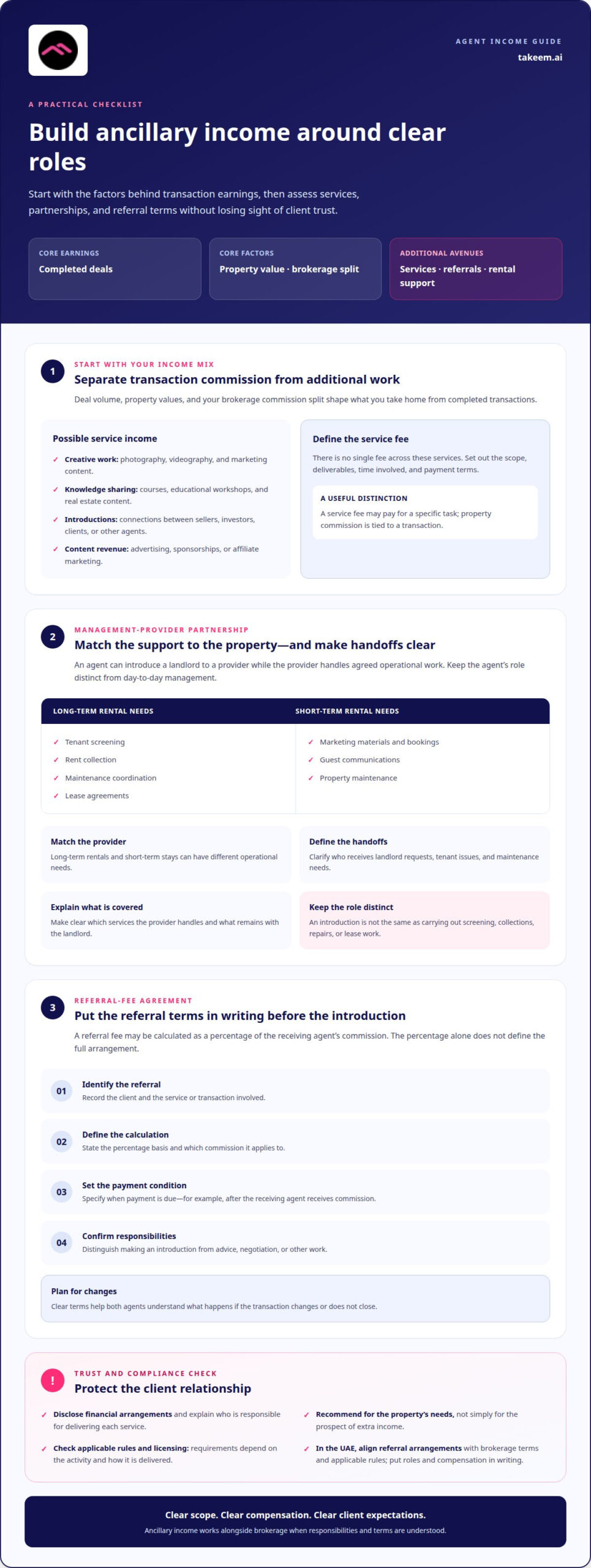
Ancillary services complement a property transaction. Examples include photography, marketing content, educational workshops, and introductions between sellers and investors. Agents can consider these alongside brokerage work. Whether an additional licence is needed depends on the activity and how it is delivered; calling a service “ancillary” does not settle that question. Define your role before offering extra services.
Typical Ancillary Service Fees
Ancillary service fees are payments agreed for work beyond the main property transaction. There is no single fee for photography, workshops, referrals, or marketing support. The scope, deliverables, time required, and payment terms shape the arrangement. Unlike property commission, a service fee may cover a specific task rather than a completed sale. Set out the work and payment basis clearly so you can assess the expected earnings.
Common Ancillary Income Sources
Common income sources include referral commissions, rental-property services, photography or videography, and courses or workshops. Real estate content may also earn money through advertising, sponsorships, or affiliate marketing. Each option requires different skills and effort. When planning how real estate agents can earn ancillary income, consider whether the stream suits your client relationships and fits alongside your existing responsibilities.
Risks include conflicts of interest if compensation influences a recommendation, and confusion about who delivers a service. Explain relevant financial arrangements to clients and define each party’s responsibilities. Referral terms should also clarify how payment is calculated and when it is due. These steps help keep additional income arrangements transparent and protect client trust.
Partnering with a management provider
A management-provider partnership connects an agent’s landlord relationships with operational support for rental properties. It can extend service beyond a listing while keeping the agent’s role distinct from day-to-day management.
For example, a landlord may need help coordinating tenant screening, rent collection, maintenance, or lease agreements. Short-term rental managers may also handle marketing materials, bookings, guest communications, and property maintenance. These defined responsibilities help agents explain the partnership’s value to landlords and property investors without implying they personally deliver every service.
Clarify the arrangement before making introductions. Set out the agent’s role, the service provider’s responsibilities, and how compensation works. An agent may introduce a landlord, while the service provider handles the agreed work. A written arrangement can prevent confusion about who communicates with tenants, coordinates repairs, or manages lease paperwork.
- Match the provider to the property: Long-term rentals and short-term stays can involve different operational needs.
- Define handoffs: Specify how landlord requests, tenant issues, and maintenance needs reach the responsible party.
- Explain the arrangement: Landlords should understand which services the provider handles and what remains with them.
- Keep the role clear: Distinguish an introduction from directly carrying out management tasks.
This clarity matters when an agent serves landlords, tenants, and buyers. A landlord-focused recommendation should reflect the property’s needs, not simply the prospect of extra income. Agents should also identify whether their intended activities require a licence under applicable rules. The tasks and business structure matter, so don’t present a referral as permission to perform rental-management work.
Partnership income depends on the agreed arrangement and the agent’s role. An introduction may create a different opportunity from directly managing rental properties and earning management fees. Keep compensation terms separate from the provider’s service scope. Clear boundaries help landlords know who handles screening, collections, maintenance, and lease agreements, while agents can build a more consistent property-support network.
Referral fees
A referral fee compensates an agent for introducing a client to another agent who completes a transaction. The fee may be calculated as a percentage of the receiving agent’s commission, linking the referring agent’s earnings to the completed deal.
Agree on the terms before making an introduction. Record which client or transaction the referral covers, how the percentage is calculated, and when payment is due. For example, an agreement might state that payment follows the receiving agent’s receipt of commission. Clear terms help both agents understand what happens if a transaction changes or does not close.
In the UAE, referral arrangements should align with the agent’s brokerage terms and applicable rules for the activity. Put the referral relationship, compensation basis, and each party’s role in writing, then disclose them clearly to relevant parties before making the introduction.
- Identify the referral: Record the client and the service or transaction involved.
- Define the calculation: State the percentage basis and which commission it applies to.
- Set the payment condition: Clarify the event that triggers payment, such as the referred agent receiving commission.
- Confirm responsibilities: Distinguish the introduction from advice, negotiation, or other work.
Referrals can turn an agent’s professional network into an income source without requiring property ownership. But the percentage alone doesn’t determine whether an arrangement is worthwhile. Consider the effort needed to qualify the lead, communicate the client’s needs, and coordinate a smooth handoff. A useful referral connects the client with a suitable agent, not simply the person offering the largest fee.
Conflicts can arise if compensation affects which agent is recommended. Explain the referral arrangement transparently and keep the client’s needs central. Brokerage approval and a written record can also clarify how the referral fits the agent’s working relationship. Referral income can then complement transaction earnings while preserving trust between clients and agents.
Referral arrangements should follow the agent’s brokerage terms and applicable rules for the activity. Put the referral relationship, compensation basis, and each party’s role in writing, and disclose them clearly to relevant parties before making the introduction.
Referral fees may be calculated as a percentage of the receiving agent’s commission, with the percentage and payment conditions agreed in advance.
Rent collection
Rent collection can create an ongoing service relationship between an agent, landlord, and tenant. Agents can connect landlords with support for rent collection or help them set up digital payments, while keeping responsibility for rental operations clear. The distinction matters: facilitating payments is not the same as handling every aspect of a rental. For example, an agent might help a landlord arrange digital monthly payments while another party handles other tenancy matters.
Digital payments can simplify the monthly process. A landlord can arrange direct debit to accept recurring tenant payments electronically. Clear payment records help landlords track incoming rent and identify missed payments. Agents can support this process by explaining the payment arrangement and directing landlords to an appropriate service, while keeping responsibility for tenancy operations clear.
Income depends on the agreed service and compensation structure, not simply the property’s rent. A fee for an introduction differs from compensation for a defined collection service. The landlord’s demand for support can also vary by property type, from a standard rental to a luxury home, and by the work involved. Set expectations around the tasks and payment terms before the arrangement begins.
- Define the task: Separate payment setup from screening, lease administration, and maintenance.
- Clarify the payment flow: Identify who receives rent and how the landlord records each payment.
- Set compensation terms: Agree whether the agent receives income for an introduction or a defined service.
- Explain responsibilities: Make clear who handles tenant questions and late-payment follow-up.
Rent-related services can complement transaction earnings, but they don’t automatically replace a salary or guarantee steady income. The result depends on the service provided, landlord demand, and the arrangement’s terms. For a digital option that helps landlords accept monthly tenant payments, explore direct debit setup for landlords.
Takeem: Landlord Rental Guarantee that Agents can sell for healthy commissions
Takeem gives agents a landlord-focused option to discuss when clients need rental-related support beyond a property transaction. Agents can sell Takeem’s Landlord Rental Guarantee for commissions, creating an additional income opportunity alongside their existing work.
The offering may suit landlords seeking a Rental Guarantee, including property investors with large portfolios. Emergency property maintenance is included as part of the Rental Guarantee, giving agents a relevant service to introduce to landlords who value support with rental-property needs. It also gives agents a focused solution to discuss rather than adding unrelated services to their business.
For agents serving landlords or investors, consider whether the offering fits the client’s rental needs and your brokerage’s referral arrangements. Contact Takeem to discuss the Landlord Rental Guarantee.
Build your next income opportunity
Choose an additional revenue stream that fits the clients you already serve. The question of how real estate agents can earn ancillary income becomes practical when you match a landlord’s needs with a clearly defined service and understand your role in the arrangement.
For agents working with landlords and property investors, Takeem offers a Landlord Rental Guarantee, including an option for investors with large property portfolios. Agents can also sell the guarantee for commissions. It’s a landlord-focused option to consider when developing partnerships that complement your brokerage work.
Start with a conversation about the needs of your landlord clients and the kind of partnership that could serve them. Contact Takeem to discuss management partnerships and explore a practical next step for your real estate business.
Build thoughtfully, keep client needs at the centre, and choose opportunities that strengthen the relationships behind your work.
Frequently Asked Questions
What Impacts How Much You Earn?
Completed deal volume, property value, and your brokerage commission split all affect agent earnings. Ancillary income also depends on the arrangement: referrals, ongoing rental services, and one-off tasks can produce different income patterns. For example, a steady leasing pipeline may contribute differently from occasional high-value sales. Track each stream separately to see which supports your business consistently.
How much can real estate agents earn from property management, referrals, and leasing?
There’s no single amount; earnings depend on the service, transaction value, and agreed compensation. Rental-service fees may be calculated as a percentage of monthly rent, while referral fees may be a percentage of the commission earned by the agent receiving the referral. Leasing income depends on the lease and commission arrangement. Compare the time and work involved, not just gross income.
Can real estate agents earn income from mortgage, title, or insurance referrals?
Referral income from mortgage, title, or insurance introductions depends on whether the activity and compensation arrangement comply with applicable UAE requirements and brokerage terms. Treat each category separately rather than assuming one referral agreement covers them all. Record the introduction, service, and payment basis, and explain any financial interest clearly to the client before making a recommendation.
How can agents start a property management or rental service?
Start by defining the service and the responsibilities it includes. For example, decide whether the work covers rent collection, tenant communication, maintenance coordination, or lease administration. Establish who handles each task, how records are maintained, and how issues are escalated. Before moving beyond introductions, align the service structure with brokerage terms and applicable requirements for the activities involved.
Which ancillary income streams are most profitable for real estate agents?
No single income stream is most profitable for every agent. Ongoing rental-related work may create repeat income, while referrals can generate compensation tied to completed transactions. Courses, content, and property media require different effort and delivery. Compare net returns by considering time, operating costs, repeat business, and fit with your client base. A smaller, repeatable stream may suit your practice better than a larger but irregular opportunity.