

Tag: cash flow

  • UAE Property Portfolio Rent Collection Guide 2026

    UAE Property Portfolio Rent Collection Guide 2026

    A rent payment isn’t fully under control just because it has arrived. Across several properties, due dates, payment records and follow-ups can quickly become scattered, making property portfolio rent collection harder to track and cash flow less predictable.

    If you manage payments across a portfolio, you need a clear view of what’s been collected, what’s outstanding and what needs attention. Repeating manual reminders each month takes time, while moving from post-dated cheques to digital monthly payments can feel like a major change. A consistent process can help you make that transition without losing visibility.

    This guide explains how to build a reliable rent collection workflow for your UAE properties, from setting up payment records to facilitating monthly Direct Debit collection. It also covers how to approach a transition from cheques and consider rental guarantees and emergency maintenance as part of a broader plan for rental income.

    Key Takeaways

    • Bring rent obligations, payment status and reconciled records into one portfolio-wide view so outstanding items are easier to identify.
    • Use a repeatable property portfolio rent collection workflow, with clear responsibility for records, reminders and reporting.
    • Compare cheques, Direct Debit and software-led tracking by their effect on payment administration, tenant steps and oversight.
    • Roll out a consistent process in stages: map properties, standardise records, pilot the workflow, then review it before expanding.
    • Consider digital monthly collection alongside rental guarantees and emergency maintenance when planning for more predictable rental income.

    Property portfolio rent collection: where fragmented processes create friction

    Property portfolio rent collection is the process of requesting, recording, monitoring and reconciling rent across multiple properties. It gives landlords a consistent way to track each payment obligation instead of relying on scattered reminders, bank records or memory. An effective process shows what was due, what arrived and what still needs attention.

    Rent collection is one part of a broader set of property responsibilities. Property management can also include maintenance, tenant relations and financial management, as outlined in this Property Management Overview. Rent collection focuses on the movement and recording of rental payments. It doesn’t replace broader property management, accounting or tenant administration, though accurate collection records can support those activities.

    What changes when rent collection spans multiple properties?

    Each property may have its own tenancy dates, payment arrangements and records. As the portfolio grows, landlords need to coordinate more due dates and check more sources to understand the overall position. For example, a payment noted in a message may never be entered in the main tracker. The rent may have arrived, but the portfolio overview still shows it as outstanding.

    A late payment is a specific exception to follow up. Repeatedly missing updates, unclear ownership of records or inconsistent tracking point to a process problem. Treating each delay as a one-off can leave the same administrative gap in place. A shared routine makes exceptions easier to spot and handle consistently.

    Which collection signals should a landlord be able to see?

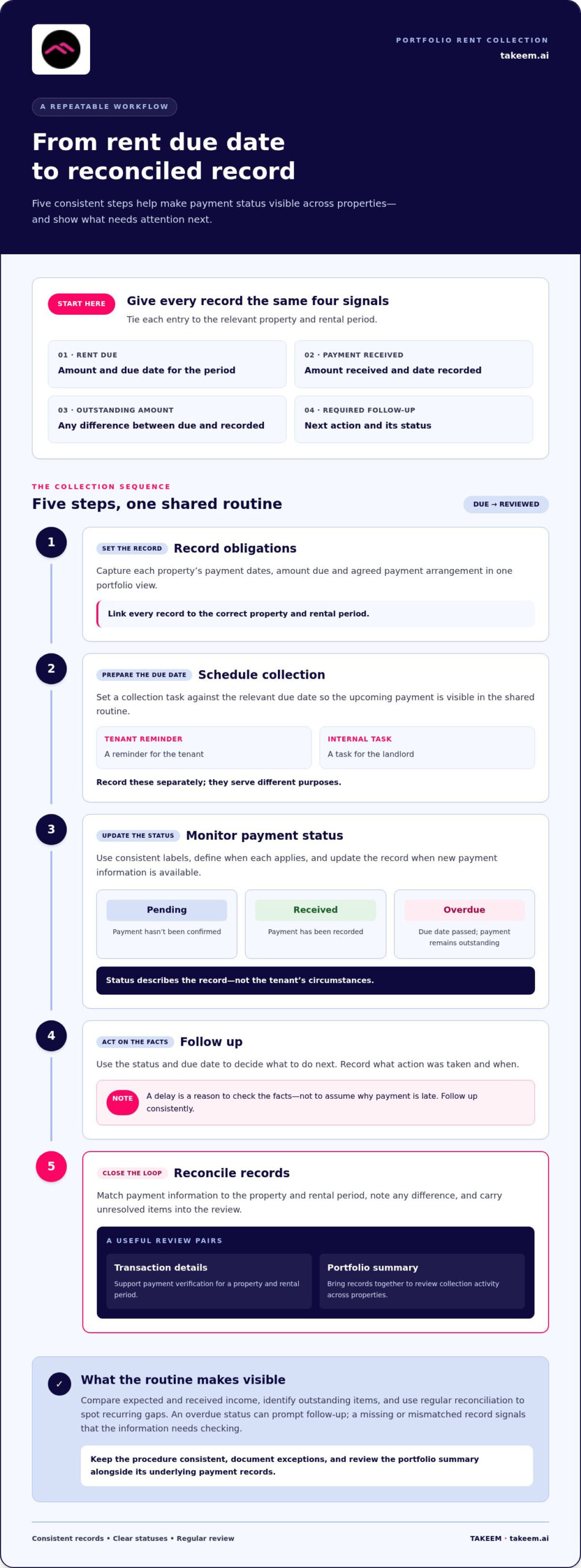
    For each property and tenancy, a useful record should answer four questions: what rent is due, what payment has been received, what amount remains outstanding and what follow-up is required. Tie each entry to the relevant property and payment period so you can review individual cases and the portfolio as a whole.

    • Rent due: the amount and due date recorded for the period.
    • Payment received: the amount received and the date it was recorded.
    • Outstanding amount: any difference between the amount due and the payment recorded.
    • Required follow-up: the next action and its status, such as a reminder to send or a payment to verify.

    Consistent records let landlords compare expected and received income, supporting cash flow planning without guaranteeing a particular outcome. The overview is only as reliable as its inputs. If a payment or follow-up isn’t recorded promptly, portfolio-level visibility can lag behind what has actually happened. Start with complete records and update them regularly.

    How a reliable property portfolio rent collection workflow operates

    A dependable workflow turns each tenancy’s payment terms into a repeatable sequence. For property portfolio rent collection, the goal isn’t simply to mark payments as received. It’s to move from the amount due to a reviewed, reconciled record, with a clear next step whenever a payment needs attention.

    1. Record obligations. Capture each property’s payment dates, amount due and agreed payment arrangement in one portfolio view. Tie each record to the correct property and rental period.
    2. Schedule collection. Set a collection task against the relevant due date. A tenant reminder and an internal task for the landlord serve different purposes, so record them separately.
    3. Monitor status. Use consistent labels such as pending, received and overdue. Define when each label applies, then update it when new payment information is available.
    4. Follow up. Use the status and due date to decide what to do next. Record what action was taken and when. Don’t assume the reason for a delay before speaking with the tenant.
    5. Reconcile records. Match payment information to the property and rental period, note any difference, and carry unresolved items into the review.

    These steps make exceptions visible, but don’t automatically resolve them. An overdue status can prompt timely follow-up, while a missing or mismatched record signals that the information needs checking. Keep the procedure consistent, with a documented exception where a tenancy’s agreed arrangement differs.

    From rent due date to payment-status review

    Bring tenancy payment dates into a shared calendar or tracker instead of managing each property through a separate routine. Use “pending” for a payment that hasn’t been confirmed, “received” once it has been recorded, and “overdue” when the due date has passed and the payment remains outstanding. These labels describe the record, not the tenant’s circumstances. Follow up based on the facts available.

    Why reconciliation and reporting matter as portfolios grow

    A transaction record captures an individual payment, including its property and rental period. A portfolio summary brings those records together to show collection activity across properties. Both are useful: transaction details support verification, while the summary helps landlords review the whole portfolio. Regular reconciliation can reveal recurring gaps, such as payments that take longer to record or follow-ups that remain open. Those patterns give landlords a practical basis for refining the workflow.

    Portfolio visibility depends on consistent payment records and regular review. Set a recurring review point, compare the portfolio summary with the underlying payment entries, and note any item that still needs action. For landlords introducing digital monthly collection, Direct Debit setup for landlords can form part of a consistent collection workflow.

    Cheques, Direct Debit, and rent collection software: compare the workflow

    These approaches address different parts of rent collection. Cheques are a payment method landlords coordinate and track. Direct Debit supports recurring digital collection, while rent collection software helps organise payment information. A landlord can use a payment method alongside a tracking tool, but neither a recordkeeping system nor a payment channel is the same as rental income protection.

    Approach Payment administration Visibility Tenant process Portfolio oversight
    Cheque-based collection Requires coordination of cheque dates and receipt records. Depends on recording cheque status and updating records consistently. Payment is made by cheque according to the agreed arrangement. Landlords bring separate property records together for a portfolio view.
    Digital Direct Debit Collection is organised digitally on a recurring basis. Payment information still needs to be reviewed and recorded clearly. Tenants follow a digital process to authorise collection. Consistent records help landlords review activity across properties.
    Software-led tracking Helps organise collection information; the payment method is separate. Can bring records into a structured view, depending on the tool and its setup. Doesn’t determine by itself how a tenant makes payment. Can support reporting, but accuracy depends on complete, updated inputs.

    No single approach suits every tenancy. An existing cheque arrangement may remain practical for some properties, while digital monthly collection may suit others. Treat the move as an operational choice: compare how each arrangement fits the tenancy, the records you need and the time required to administer it. For context on the transition, see this UAE guide to rental guarantees and Direct Debit.

    What changes when a landlord moves from cheques to digital monthly collection?

    The work shifts from tracking individual cheque dates and receipt updates to organising recurring digital collection and reviewing its status. Landlords still need a clear record for each tenancy and a defined follow-up process for exceptions. A gradual transition gives landlords and tenants time to adjust their routines without requiring every property to move at once.

    When does rent collection software help, and what does it not replace?

    Tracking tools can organise payment information and make portfolio reporting easier to review. They don’t collect rent or protect rental income by themselves. Takeem facilitates digital monthly collection through Direct Debit setup and provides rental guarantee services as a separate income-protection consideration. Landlords planning a digital workflow can explore Direct Debit setup for landlords as part of that decision.
    UAE Property Portfolio Rent Collection Guide 2026

    How to organise rent collection across a growing UAE property portfolio

    Adding properties can make an informal collection routine harder to maintain. A phased rollout lets landlords standardise the essentials, test the workflow and preserve a clear record as payment arrangements change. Start with the information you already have, then expand once the pilot process is working consistently.

    1. Map the portfolio. List every property and tenancy, including payment dates, current collection method, relevant records and known open payment items.
    2. Standardise the register. Use consistent property names, date formats and payment-status labels. This makes records easier to compare and reduces confusion when reviewing multiple tenancies.
    3. Select the workflow. Decide how payments will be collected, where records will be kept, who will update them and how exceptions will be followed up. Keep the process practical for the portfolio’s current arrangements.
    4. Pilot on a manageable subset. Test the workflow with properties that reflect the portfolio’s different payment arrangements. Use the pilot to identify unclear steps before expanding the process.
    5. Onboard and review. Explain payment-process changes to tenants, share required setup steps and keep existing records accessible. Review unresolved items and refine the workflow before applying it across the portfolio.

    For a broader investor perspective on organising income across properties, see these portfolio rental income strategies for UAE investors.

    Create a portfolio-wide collection register

    Include a property identifier, tenancy payment schedule, collection method, current payment status and a reference to supporting records. Assign responsibility for routine updates and exception follow-up, even if the landlord handles both. Define what each status means and record the date of each update, so another authorised person can understand an entry without relying on informal context.

    Introduce a new collection process without losing visibility

    Explain the payment process, timing and required setup steps clearly to tenants. During a transition, retain access to earlier records and distinguish existing arrangements from new ones in the register. Review the pilot at a set interval. Check incomplete entries, pending setup and unresolved payment items, then adjust instructions or responsibilities before a wider rollout.

    Regular review can show where the workflow needs attention, such as a recurring delay in recording a payment or a step tenants find unclear. Use these observations to make practical improvements without assuming every tenancy should follow an identical process. Landlords introducing digital monthly collection can explore Direct Debit setup for landlords as one part of their rollout plan.

    How Takeem supports portfolio rent collection and income protection

    A consistent collection process helps landlords track payment activity, but it addresses only one part of rental income planning. Takeem supports landlords and property investors across the UAE with Direct Debit setup for digital monthly rent collection, alongside rental guarantee services for individual landlords and large property portfolios. These services bring payment workflow and income protection into the same broader conversation without treating them as the same thing.

    With Direct Debit setup, landlords can digitally accept monthly payments from tenants. This provides a route from cheque-based routines to digital collection, while keeping the landlord’s own records and review process central. For a portfolio, consider this collection approach alongside each property’s payment arrangements rather than assuming one workflow automatically fits every tenancy.

    Connecting digital collection with rental income protection

    Digital collection concerns how monthly payments are accepted. A rental guarantee addresses a different landlord concern: rental income protection under the service’s terms. Those terms govern the protection, so landlords should consider them separately from the steps involved in setting up collection. Don’t assume a payment delay or property issue receives identical treatment in every case.

    Emergency property maintenance is included as part of Takeem’s rental guarantee service. It’s a relevant consideration for landlords weighing income protection and property-related support together, but it isn’t a rent tracking feature or a substitute for clear payment records. The landlord rental guarantee guide offers further context on how guarantees fit into a landlord’s planning.

    A clear next step for landlords and property investors

    Before choosing a new approach to property portfolio rent collection, bring together a few essentials. A concise overview helps clarify what you need from monthly collection and what you want to protect across the portfolio:

    • Property count and tenancy mix: note the properties involved and any differences in payment arrangements.
    • Current payment process: identify how rent is accepted and where payment records are maintained.
    • Portfolio priorities: decide whether your focus is digital monthly collection, rental income protection or both.

    This preparation gives landlords and investors a clearer basis for considering how Direct Debit setup and rental guarantee support may fit their needs. Takeem’s services connect digital collection with a broader approach to rental income, with emergency property maintenance included as part of the rental guarantee service. Explore Takeem’s portfolio rent collection and protection approach to consider the next step for your portfolio.

    Make your next collection step deliberate

    Your next move doesn’t need to change every tenancy at once. Choose one improvement that fits your portfolio’s current priorities, assign it an owner and set a review point. That could mean making records easier to maintain, introducing digital monthly collection or considering how income protection fits your wider investment plan.

    Takeem facilitates digital monthly rent collection through Direct Debit setup and provides rental guarantee services for individual landlords and investors with large portfolios. Emergency property maintenance is included as part of the rental guarantee service. These options let landlords consider payment workflow and protection as related, but distinct, parts of their approach to rental income.

    Use your portfolio’s size, existing payment arrangements and priorities to decide what a practical next step looks like. A more deliberate property portfolio rent collection process can begin with one clear change and grow as your needs evolve.

    Explore Takeem’s digital rent collection and rental guarantee support to take the next step for your portfolio.

    Frequently Asked Questions

    How can I collect rent across multiple properties more efficiently?

    Use one repeatable process across your properties while preserving each tenancy’s specific payment arrangement. For example, align collection reviews with a regular weekly or monthly routine instead of checking each property only when a due date comes to mind. A central portfolio view can help you spot unresolved items, and a consistent process makes property portfolio rent collection easier to oversee as you add properties.

    Can landlords in the UAE collect rent through Direct Debit?

    Yes. Landlords can use Direct Debit setup to accept digital monthly rent payments from tenants. It offers an alternative to coordinating post-dated cheques, with the tenant and landlord following the relevant setup process. Takeem facilitates this transition for landlords. As with any payment method, keep a clear record of what was expected and what was received so you can review collection activity.

    Is rent collection software the same as rental income protection?

    No. Rent collection software organises payment information and related records, while rental income protection is a separate service with its own terms. A tracker may help you identify a payment that needs follow-up, but it doesn’t protect income if rent is missed. Consider each need separately: operational visibility on one side, and the protection offered under a rental guarantee’s terms on the other.

    What should a property portfolio rent collection tracker include?

    Alongside payment status, include a property reference, tenancy period, agreed collection method, due date, amount expected, amount recorded and the source or date of the latest update. A notes field can capture a discrepancy, such as a payment that appears in a bank record but hasn’t yet been matched to a tenancy. These details make reviews more useful and help distinguish missing information from an unpaid amount.

    How do I move tenants from cheque-based rent payments to digital collection?

    Plan the change tenancy by tenancy. Explain what is changing, when the new process is intended to begin and what setup action the tenant needs to complete. Keep the existing arrangement and its records visible until the digital process is established, so the transition doesn’t create a gap in your tracking. Provide a clear way to raise setup questions, then record the transition status for each tenancy.

    Does a rent guarantee service manage my property portfolio?

    No. A rental guarantee service and property management are different. A guarantee relates to rental income protection under its terms. Property management can include broader operational responsibilities for a property. Takeem provides rental guarantee services for individual landlords and investors with large portfolios, but the guarantee doesn’t replace a landlord’s wider property or tenant administration responsibilities.

    How can landlords protect a rental portfolio from missed payments?

    Combine accurate payment records and a defined follow-up routine with a separate review of rental income protection. If a payment is missed, document the amount, tenancy period and communication so the situation can be assessed using accurate information. Takeem’s rental guarantee service is one option for landlords and investors to consider. The applicable terms determine the protection, so don’t assume every delay is treated identically.

  • How to Secure Monthly Rental Income in the UAE

    How to Secure Monthly Rental Income in the UAE

    What if a property with an attractive rental yield still leaves you uncertain about next month’s cash flow? To secure monthly rental income, look beyond the rent stated in the tenancy agreement. Vacancies, late payments, maintenance needs and operating expenses can all affect what actually reaches your account.

    It’s reasonable to expect rent to provide a dependable return, but gross income and usable cash flow aren’t the same. Rental yield shows how rent compares with a property’s value; it doesn’t account for every cost or interruption. And when payment arrangements are harder to track, planning ahead can become more difficult.

    This guide explains how to make rental cash flow more predictable in the UAE. You’ll learn to distinguish yield from dependable income, reduce avoidable disruption and assess whether a rental guarantee or digital monthly collection could suit your property. We’ll also cover how maintenance coverage can support attention to your asset. Takeem serves individual landlords and property investors, including owners of large portfolios, across the UAE with rental guarantee services and Direct Debit setup for monthly rent collection.

    Key Takeaways

    • To secure monthly rental income, assess net cash flow after expenses and vacancy periods, not just rental yield.
    • Separate payment delays, vacancies, operating costs and property issues so you can match each risk with a practical response.
    • Cash reserves, tenant communication, digital collection and rental guarantees address different parts of income disruption.
    • Review expected and actual receipts, expenses and property issues each month to see where your cash-flow plan needs attention.
    • Takeem offers UAE landlords rental guarantee services, Direct Debit setup for monthly rent collection and emergency maintenance coverage as part of its rental guarantee.

    Secure monthly rental income starts with a realistic cash-flow view

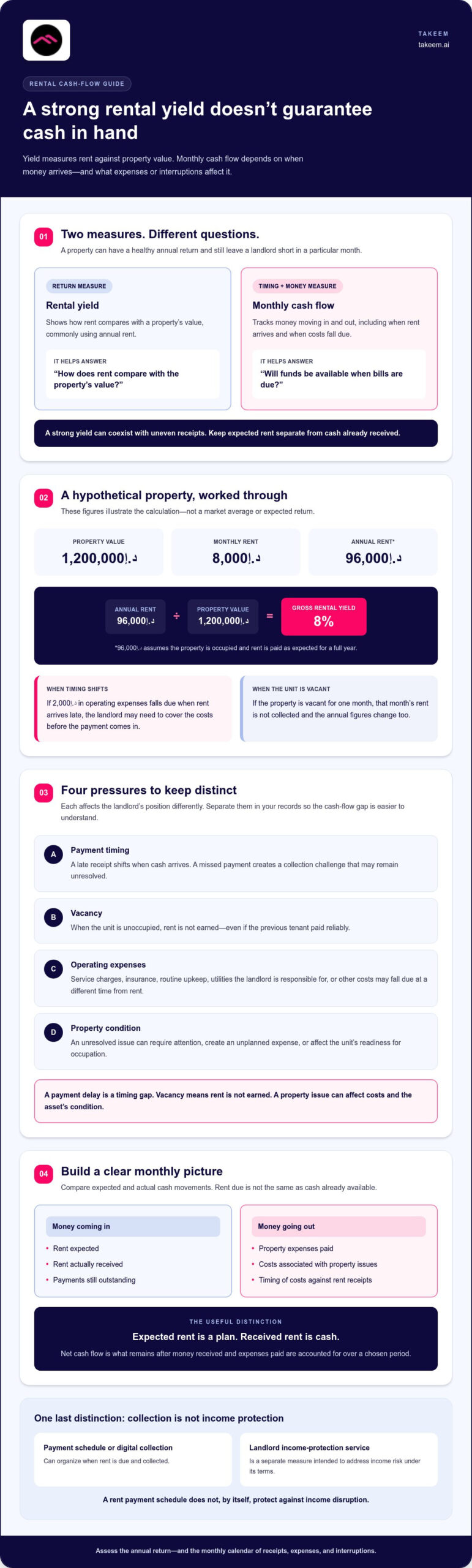
    A rental property can show a healthy annual return and still leave a landlord short of cash in a particular month. A return calculation measures performance over a period, while monthly cash flow depends on when rent arrives and when costs fall due. To secure monthly rental income, plan around the money available after expenses and timing gaps, not the rent amount alone.

    Start by separating four figures. Gross rent is the rent due before deductions. Operating expenses are the costs of owning and maintaining the property. Vacancy periods are intervals when the unit earns no rent. Net cash flow is what remains after money received and expenses paid are accounted for over a chosen period. A general introduction to the rental relationship and rental agreements is available in Renting.

    Secure income doesn’t mean eliminating every risk. It means understanding what could interrupt receipts, estimating the effect and having a plan to manage disruptions. Rental cash-flow resilience is the ability to manage timing gaps, vacancies and property costs without treating expected rent as guaranteed cash.

    Rental yield and monthly cash flow are not the same

    Yield is a return measure, commonly expressed as annual rent relative to a property’s value. Cash flow tracks money moving in and out. Yield can help compare investment performance, but it doesn’t show whether funds will be available when bills are due.

    Hypothetical example: A property valued at د.إ1,200,000 brings in د.إ8,000 monthly, or د.إ96,000 over a full year if occupied and paid as expected. That equals an 8% gross rental yield. If د.إ2,000 in operating expenses falls due in a month when rent arrives late, the landlord may need to cover those costs before receiving the payment. If the property is vacant for one month, that month’s rent is not collected and the annual figures change too. These figures illustrate the calculation, not a market average or expected return.

    Assess both the annual picture and the monthly calendar. A strong yield can coexist with uneven receipts, so keep expected rent separate from cash already received.

    Which disruptions can unsettle a landlord’s income?

    Different interruptions call for different responses. A vacancy means no rent is earned while the property is unoccupied. A late or missed payment can shift expected cash into a later month or leave a gap. An unexpected property issue may add an expense or affect the unit’s ability to earn rent. Gross yield alone doesn’t capture these effects fully.

    Separate these risks in your cash-flow records instead of grouping them as general uncertainty. Payment timing concerns collection; vacancy concerns whether rent is earned; property issues can affect costs and the asset’s condition. Distinguishing them makes it easier to choose a relevant response for each risk.

    How rental income becomes less predictable, and what each risk means

    Income disruption can come from several sources. A useful plan separates the issue into four categories: payment timing, vacancy, operating expenses and property condition. Each affects the landlord’s position differently and calls for a different response. That distinction matters if you want to secure monthly rental income without assuming that a rent schedule removes every risk.

    A payment arrangement sets out how rent is due and collected. A landlord income-protection service is a separate measure intended to address income risk under its terms. A rent payment schedule can organize when rent is due; it does not, by itself, protect a landlord from income disruption. Digital collection can structure monthly payments, while income protection addresses a different part of the cash-flow picture.

    Payment timing, vacancy, and expenses affect cash flow differently

    A late receipt changes when cash arrives; it isn’t automatically a permanent loss. A missed payment creates a collection challenge that may remain unresolved. Vacancy is different: rent isn’t earned while the unit is unoccupied, even if the previous tenant paid reliably. This distinction helps landlords identify whether they’re dealing with a timing gap, a possible loss or a break between tenancies.

    Recurring costs can also make a steady rent figure feel less dependable. Depending on the property and its arrangements, a landlord may need to account for service charges, insurance, routine upkeep, utilities they are responsible for, or other operating expenses. These costs may fall due at a different time from rent. The Bureau of Economic Analysis uses a specific national-accounts measure called Rental Income of Persons; for a practical monthly review, track actual receipts and property expenses rather than treating rent due as cash already available.

    Keep a simple distinction in your records: what was expected, what arrived, what remains outstanding and what costs were paid. This won’t prevent a late payment or vacancy, but it will make the size and timing of a cash-flow gap clearer.

    Property condition is part of income planning

    An unresolved property issue can demand attention, create an unplanned expense or affect the unit’s readiness for occupation. Include it in income planning because it can influence both costs and the property’s ability to earn rent. Record the issue and its financial relevance separately from payment status, so the two risks don’t blur together.

    Emergency maintenance coverage is distinct from general property management. It relates to maintenance support under the applicable service terms and should not be treated as a service that manages every aspect of a rental. Takeem’s rental guarantee includes emergency property maintenance coverage, while its Direct Debit setup supports digital monthly rent collection. Landlords considering these distinct approaches can explore Takeem’s rental income support as part of broader cash-flow planning.

    Compare income-security approaches by the risk they address

    No single measure covers every reason rental cash flow may change. Cash reserves can help you handle a shortfall, digital collection can organize payment processing, tenant communication can support clear expectations, and a rental guarantee may provide income protection according to its terms. To secure monthly rental income, first identify the risk you want to address, then choose a response that fits it.

    Match each measure to the problem it can address

    Use this comparison to distinguish practical cash-flow tools from protection. The “does not address” column matters because it helps prevent a useful measure from being mistaken for a complete solution.

    Risk Possible response What it addresses What it does not address
    A temporary cash shortfall Cash reserves Provides funds the landlord can draw on for planned costs or a gap in receipts. Does not prevent vacancies, late payments or unexpected expenses.
    Manual payment handling Digital payment collection, such as Direct Debit setup Moves collection away from cheque-based processes and can make monthly payment handling more structured. Does not ensure rent is paid or protect income if a payment is missed.
    Unclear payment expectations Tenant communication Helps keep payment dates, arrangements and relevant updates clear between landlord and tenant. Does not replace a collection process or provide income protection.
    Income disruption Rental guarantee service May provide a form of income protection, as defined by the service terms. Does not necessarily address every loss or property cost; coverage, exclusions and conditions shape its role.

    Digital collection and income protection solve different problems. A Direct Debit setup can streamline how monthly payments are collected, but it is not itself an income guarantee. A reserve offers flexibility but uses the landlord’s own funds. A rental guarantee is a separate service, so its terms determine what protection applies and in which circumstances.

    Assess trade-offs before changing your rental approach

    Compare each option by three practical measures: administrative effort, cash-flow visibility and the risk it is designed to address. Manual cheque-based collection may require more follow-up and reconciliation. Digital collection can structure the process, while communication supports coordination. Reserves require planning and access to funds; a guarantee is a service governed by its terms.

    Before relying on any protection, review eligibility, coverage conditions, payment timing and exclusions. Check how those terms apply to the risk you’re assessing. Landlords comparing income protection options can use this landlord rental guarantee guide as a starting point. For owners managing multiple properties, the property portfolio rental income guide offers a broader lens for evaluating cash-flow planning across a portfolio.

    How to Secure Monthly Rental Income in the UAE

    Build a practical monthly rental-income review

    A short monthly review can turn scattered payment and property information into a clearer view of what needs attention. It won’t prevent a missed payment or unexpected cost, but it can help you spot changes and decide what to follow up. Use the same review structure each month so comparisons remain useful.

    Track expected income against actual receipts

    Use one consistent record for each property. Include rent due dates, amounts received, outstanding amounts, expenses and property issues. Digital records can make recurring patterns easier to review, but their value depends on keeping entries current and checking them against what actually happened.

    1. Expected receipts: Record the rent due, amount and agreed payment date for the month. Note any known change, such as a tenancy beginning or ending.
    2. Actual receipts: Enter each payment when received, including its date and amount. Compare it with the expected figure instead of assuming that rent due has already become available cash.
    3. Outstanding amounts: Note what remains unpaid and any communication or follow-up already made. This gives you a clear record of the open item without treating a delay as resolved.
    4. Expenses: Log operating costs paid during the period and costs you know are approaching. This helps distinguish gross rent from funds available after expenses.
    5. Property issues and next actions: Record unresolved issues, the action taken or planned, and who is responsible for following up. Add a review date so open items don’t disappear between monthly checks.

    For one property, focus on its receipts, costs and outstanding actions. If you own several units, use the same categories for each and then review the records together to identify items needing attention. This is an oversight routine, not a substitute for a broader portfolio plan or professional advice.

    Review property and payment risks before they compound

    Look for changes, not just totals. Has a payment arrived later than expected? Is a unit approaching a vacancy? Has a property issue remained open across review periods? A change may warrant follow-up, but tracking alone doesn’t prevent income disruption. Record the next action and its status so you can see what remains unresolved.

    If a rental guarantee or other protection applies, review the relevant terms when assessing an income issue. Eligibility, coverage conditions, payment timing and exclusions determine how the service relates to your situation. For property-condition questions, the rental guarantee and maintenance guide provides a focused reference. A regular review can help you decide whether digital collection or income protection may fit your needs as you work to secure monthly rental income.

    Takeem supports UAE landlords with Direct Debit setup for monthly rent collection and rental guarantee services. Explore Takeem’s rental income support to see how these distinct elements may fit into your planning.

    How Takeem can support more secure monthly rental income

    Once you’ve separated payment collection from income protection and property upkeep, it’s easier to assess which support could fit your rental plan. Takeem serves landlords and property investors across the UAE, including individual landlords and investors with large portfolios. Its services address distinct parts of rental cash-flow management rather than treating payment processing and protection as the same thing.

    Combine income protection with digital rent collection

    Takeem’s landlord rental guarantee is an income-protection service. Its role depends on the applicable terms, including coverage conditions, exclusions and payment arrangements. Review those details against your property and cash-flow needs before relying on the service as part of your income plan.

    Separately, Takeem facilitates digital monthly rent collection through Direct Debit setup, allowing landlords to accept monthly tenant payments digitally. This offers an alternative to cheque-based collection processes. It supports the payment-collection side of the plan, but it should not be read as a guarantee that a payment will be made or received on a particular date.

    Think of these elements as complementary, not interchangeable:

    • Rental guarantee: A landlord income-protection service, with its role defined by the applicable terms.
    • Direct Debit setup: A digital method for accepting monthly rent payments from tenants.

    For an individual landlord, these may address separate concerns around income protection and payment handling. For investors managing larger portfolios, distinguishing the two can also clarify which properties use digital collection and which are covered by a rental guarantee arrangement.

    Include property upkeep in the income-security picture

    Property condition belongs in cash-flow planning because issues with an asset can require attention and affect its ongoing use. Takeem’s rental guarantee offering includes emergency property maintenance service. This is a distinct part of the offering, connected to property upkeep alongside income planning. It should not be confused with general property management or assumed to cover every repair or property issue.

    Review the applicable service terms to understand coverage conditions, exclusions and payment conditions. This helps you assess how the rental guarantee and its maintenance element fit your property, while considering Direct Debit separately as a collection method. Evaluate the arrangement on its stated terms rather than assuming every disruption or expense is covered.

    If you’re looking to secure monthly rental income with a clearer view of income protection, monthly digital collection and property upkeep, explore Takeem’s rental guarantee service.

    Make your next rental decision with greater clarity

    A more dependable rental plan starts with a clear next step: decide which cash-flow uncertainty matters most for your property, then assess support that addresses that specific need. If you’re considering income protection, review the applicable coverage and payment conditions so your expectations align with the service terms. A clear decision can make future rental planning easier to manage.

    For landlords seeking to secure monthly rental income, the goal isn’t to remove every uncertainty. It’s to choose an approach that fits your property and gives you a more informed basis for planning. Takeem supports landlords and property investors across the UAE with rental guarantee services, Direct Debit setup and emergency property maintenance coverage as part of its rental guarantee offering.

    Explore Takeem’s rental guarantee service to consider how it could fit your rental income plan. A practical, well-matched approach can help you move forward with greater confidence.

    Frequently Asked Questions

    What does secure monthly rental income mean?

    Secure monthly rental income means building a rental plan around cash you can reasonably expect to receive while recognizing that interruptions can happen. It doesn’t mean risk-free returns or identical receipts every month. For example, a landlord can distinguish rent scheduled for the month from funds already received, then plan property commitments around confirmed cash rather than assumptions.

    Can a landlord make rental income more predictable?

    Yes. Landlords can improve visibility and prepare for uncertainty, although no routine removes every risk. Keep payment records consistent, understand recurring property costs and decide in advance how you’ll respond to a vacancy or delayed receipt. Reviewing several months together can reveal whether a disruption is isolated or becoming a pattern, helping you make an informed adjustment to your rental plan.

    Is rental yield the same as monthly rental income?

    No. Yield helps assess a property’s rental return relative to its value, while monthly rental income concerns the rent received over a particular month. Use yield when comparing investment performance, then examine the payment calendar and costs to assess whether the property can meet near-term commitments. A property may look attractive on an annual measure but still have months when cash is tight.

    How can landlords collect rent digitally in the UAE?

    Landlords can use Direct Debit setup to accept monthly tenant payments digitally instead of relying on cheque-based collection. Takeem facilitates this setup for landlords. A digital payment method can make the collection process easier to record, but it doesn’t itself protect against missed or delayed rent. Keep agreed payment details and your own records aligned so you can identify discrepancies promptly.

    Does a rental guarantee protect against every loss of rental income?

    No rental guarantee should be assumed to cover every loss or expense. Its role depends on the applicable terms, including coverage conditions, exclusions and payment conditions. Before relying on one in your cash-flow plan, identify which situations it addresses and which remain your responsibility. For instance, don’t assume income protection automatically covers unrelated property costs or every period without a tenant.

    Can emergency maintenance coverage help protect rental income?

    It can support attention to property condition, which may matter to a unit’s ongoing use and rental potential. Takeem includes emergency property maintenance service as part of its rental guarantee offering. This doesn’t mean every repair, cost or interruption is covered, or that maintenance guarantees uninterrupted rent. Review the relevant terms to understand how the maintenance element applies alongside the income-protection service.

    What should landlords track each month to monitor rental income?

    Record rent expected and received, payment dates, outstanding amounts, property expenses, vacancies and unresolved property issues. Add a short note on the reason for any difference and the next follow-up action. For useful comparisons, keep the same categories from month to month and review changes against previous periods. That record supports planning, but it can’t by itself prevent a payment delay or loss.