

What if a property with an attractive rental yield still leaves you uncertain about next month’s cash flow? To secure monthly rental income, look beyond the rent stated in the tenancy agreement. Vacancies, late payments, maintenance needs and operating expenses can all affect what actually reaches your account.
It’s reasonable to expect rent to provide a dependable return, but gross income and usable cash flow aren’t the same. Rental yield shows how rent compares with a property’s value; it doesn’t account for every cost or interruption. And when payment arrangements are harder to track, planning ahead can become more difficult.
This guide explains how to make rental cash flow more predictable in the UAE. You’ll learn to distinguish yield from dependable income, reduce avoidable disruption and assess whether a rental guarantee or digital monthly collection could suit your property. We’ll also cover how maintenance coverage can support attention to your asset. Takeem serves individual landlords and property investors, including owners of large portfolios, across the UAE with rental guarantee services and Direct Debit setup for monthly rent collection.
Key Takeaways
- To secure monthly rental income, assess net cash flow after expenses and vacancy periods, not just rental yield.
- Separate payment delays, vacancies, operating costs and property issues so you can match each risk with a practical response.
- Cash reserves, tenant communication, digital collection and rental guarantees address different parts of income disruption.
- Review expected and actual receipts, expenses and property issues each month to see where your cash-flow plan needs attention.
- Takeem offers UAE landlords rental guarantee services, Direct Debit setup for monthly rent collection and emergency maintenance coverage as part of its rental guarantee.
Secure monthly rental income starts with a realistic cash-flow view
A rental property can show a healthy annual return and still leave a landlord short of cash in a particular month. A return calculation measures performance over a period, while monthly cash flow depends on when rent arrives and when costs fall due. To secure monthly rental income, plan around the money available after expenses and timing gaps, not the rent amount alone.
Start by separating four figures. Gross rent is the rent due before deductions. Operating expenses are the costs of owning and maintaining the property. Vacancy periods are intervals when the unit earns no rent. Net cash flow is what remains after money received and expenses paid are accounted for over a chosen period. A general introduction to the rental relationship and rental agreements is available in Renting.
Secure income doesn’t mean eliminating every risk. It means understanding what could interrupt receipts, estimating the effect and having a plan to manage disruptions. Rental cash-flow resilience is the ability to manage timing gaps, vacancies and property costs without treating expected rent as guaranteed cash.
Rental yield and monthly cash flow are not the same
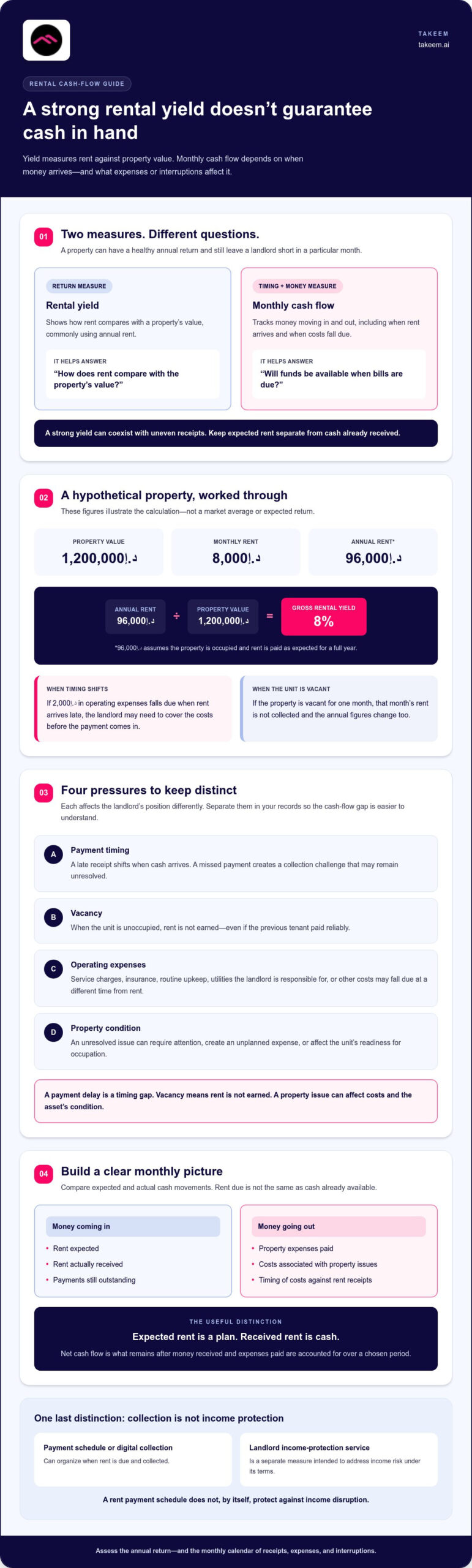
Yield is a return measure, commonly expressed as annual rent relative to a property’s value. Cash flow tracks money moving in and out. Yield can help compare investment performance, but it doesn’t show whether funds will be available when bills are due.
Hypothetical example: A property valued at د.إ1,200,000 brings in د.إ8,000 monthly, or د.إ96,000 over a full year if occupied and paid as expected. That equals an 8% gross rental yield. If د.إ2,000 in operating expenses falls due in a month when rent arrives late, the landlord may need to cover those costs before receiving the payment. If the property is vacant for one month, that month’s rent is not collected and the annual figures change too. These figures illustrate the calculation, not a market average or expected return.
Assess both the annual picture and the monthly calendar. A strong yield can coexist with uneven receipts, so keep expected rent separate from cash already received.
Which disruptions can unsettle a landlord’s income?
Different interruptions call for different responses. A vacancy means no rent is earned while the property is unoccupied. A late or missed payment can shift expected cash into a later month or leave a gap. An unexpected property issue may add an expense or affect the unit’s ability to earn rent. Gross yield alone doesn’t capture these effects fully.
Separate these risks in your cash-flow records instead of grouping them as general uncertainty. Payment timing concerns collection; vacancy concerns whether rent is earned; property issues can affect costs and the asset’s condition. Distinguishing them makes it easier to choose a relevant response for each risk.
How rental income becomes less predictable, and what each risk means
Income disruption can come from several sources. A useful plan separates the issue into four categories: payment timing, vacancy, operating expenses and property condition. Each affects the landlord’s position differently and calls for a different response. That distinction matters if you want to secure monthly rental income without assuming that a rent schedule removes every risk.
A payment arrangement sets out how rent is due and collected. A landlord income-protection service is a separate measure intended to address income risk under its terms. A rent payment schedule can organize when rent is due; it does not, by itself, protect a landlord from income disruption. Digital collection can structure monthly payments, while income protection addresses a different part of the cash-flow picture.
Payment timing, vacancy, and expenses affect cash flow differently
A late receipt changes when cash arrives; it isn’t automatically a permanent loss. A missed payment creates a collection challenge that may remain unresolved. Vacancy is different: rent isn’t earned while the unit is unoccupied, even if the previous tenant paid reliably. This distinction helps landlords identify whether they’re dealing with a timing gap, a possible loss or a break between tenancies.
Recurring costs can also make a steady rent figure feel less dependable. Depending on the property and its arrangements, a landlord may need to account for service charges, insurance, routine upkeep, utilities they are responsible for, or other operating expenses. These costs may fall due at a different time from rent. The Bureau of Economic Analysis uses a specific national-accounts measure called Rental Income of Persons; for a practical monthly review, track actual receipts and property expenses rather than treating rent due as cash already available.
Keep a simple distinction in your records: what was expected, what arrived, what remains outstanding and what costs were paid. This won’t prevent a late payment or vacancy, but it will make the size and timing of a cash-flow gap clearer.
Property condition is part of income planning
An unresolved property issue can demand attention, create an unplanned expense or affect the unit’s readiness for occupation. Include it in income planning because it can influence both costs and the property’s ability to earn rent. Record the issue and its financial relevance separately from payment status, so the two risks don’t blur together.
Emergency maintenance coverage is distinct from general property management. It relates to maintenance support under the applicable service terms and should not be treated as a service that manages every aspect of a rental. Takeem’s rental guarantee includes emergency property maintenance coverage, while its Direct Debit setup supports digital monthly rent collection. Landlords considering these distinct approaches can explore Takeem’s rental income support as part of broader cash-flow planning.
Compare income-security approaches by the risk they address
No single measure covers every reason rental cash flow may change. Cash reserves can help you handle a shortfall, digital collection can organize payment processing, tenant communication can support clear expectations, and a rental guarantee may provide income protection according to its terms. To secure monthly rental income, first identify the risk you want to address, then choose a response that fits it.
Match each measure to the problem it can address
Use this comparison to distinguish practical cash-flow tools from protection. The “does not address” column matters because it helps prevent a useful measure from being mistaken for a complete solution.
| Risk | Possible response | What it addresses | What it does not address |
|---|---|---|---|
| A temporary cash shortfall | Cash reserves | Provides funds the landlord can draw on for planned costs or a gap in receipts. | Does not prevent vacancies, late payments or unexpected expenses. |
| Manual payment handling | Digital payment collection, such as Direct Debit setup | Moves collection away from cheque-based processes and can make monthly payment handling more structured. | Does not ensure rent is paid or protect income if a payment is missed. |
| Unclear payment expectations | Tenant communication | Helps keep payment dates, arrangements and relevant updates clear between landlord and tenant. | Does not replace a collection process or provide income protection. |
| Income disruption | Rental guarantee service | May provide a form of income protection, as defined by the service terms. | Does not necessarily address every loss or property cost; coverage, exclusions and conditions shape its role. |
Digital collection and income protection solve different problems. A Direct Debit setup can streamline how monthly payments are collected, but it is not itself an income guarantee. A reserve offers flexibility but uses the landlord’s own funds. A rental guarantee is a separate service, so its terms determine what protection applies and in which circumstances.
Assess trade-offs before changing your rental approach
Compare each option by three practical measures: administrative effort, cash-flow visibility and the risk it is designed to address. Manual cheque-based collection may require more follow-up and reconciliation. Digital collection can structure the process, while communication supports coordination. Reserves require planning and access to funds; a guarantee is a service governed by its terms.
Before relying on any protection, review eligibility, coverage conditions, payment timing and exclusions. Check how those terms apply to the risk you’re assessing. Landlords comparing income protection options can use this landlord rental guarantee guide as a starting point. For owners managing multiple properties, the property portfolio rental income guide offers a broader lens for evaluating cash-flow planning across a portfolio.
Build a practical monthly rental-income review
A short monthly review can turn scattered payment and property information into a clearer view of what needs attention. It won’t prevent a missed payment or unexpected cost, but it can help you spot changes and decide what to follow up. Use the same review structure each month so comparisons remain useful.
Track expected income against actual receipts
Use one consistent record for each property. Include rent due dates, amounts received, outstanding amounts, expenses and property issues. Digital records can make recurring patterns easier to review, but their value depends on keeping entries current and checking them against what actually happened.
- Expected receipts: Record the rent due, amount and agreed payment date for the month. Note any known change, such as a tenancy beginning or ending.
- Actual receipts: Enter each payment when received, including its date and amount. Compare it with the expected figure instead of assuming that rent due has already become available cash.
- Outstanding amounts: Note what remains unpaid and any communication or follow-up already made. This gives you a clear record of the open item without treating a delay as resolved.
- Expenses: Log operating costs paid during the period and costs you know are approaching. This helps distinguish gross rent from funds available after expenses.
- Property issues and next actions: Record unresolved issues, the action taken or planned, and who is responsible for following up. Add a review date so open items don’t disappear between monthly checks.
For one property, focus on its receipts, costs and outstanding actions. If you own several units, use the same categories for each and then review the records together to identify items needing attention. This is an oversight routine, not a substitute for a broader portfolio plan or professional advice.
Review property and payment risks before they compound
Look for changes, not just totals. Has a payment arrived later than expected? Is a unit approaching a vacancy? Has a property issue remained open across review periods? A change may warrant follow-up, but tracking alone doesn’t prevent income disruption. Record the next action and its status so you can see what remains unresolved.
If a rental guarantee or other protection applies, review the relevant terms when assessing an income issue. Eligibility, coverage conditions, payment timing and exclusions determine how the service relates to your situation. For property-condition questions, the rental guarantee and maintenance guide provides a focused reference. A regular review can help you decide whether digital collection or income protection may fit your needs as you work to secure monthly rental income.
Takeem supports UAE landlords with Direct Debit setup for monthly rent collection and rental guarantee services. Explore Takeem’s rental income support to see how these distinct elements may fit into your planning.
How Takeem can support more secure monthly rental income
Once you’ve separated payment collection from income protection and property upkeep, it’s easier to assess which support could fit your rental plan. Takeem serves landlords and property investors across the UAE, including individual landlords and investors with large portfolios. Its services address distinct parts of rental cash-flow management rather than treating payment processing and protection as the same thing.
Combine income protection with digital rent collection
Takeem’s landlord rental guarantee is an income-protection service. Its role depends on the applicable terms, including coverage conditions, exclusions and payment arrangements. Review those details against your property and cash-flow needs before relying on the service as part of your income plan.
Separately, Takeem facilitates digital monthly rent collection through Direct Debit setup, allowing landlords to accept monthly tenant payments digitally. This offers an alternative to cheque-based collection processes. It supports the payment-collection side of the plan, but it should not be read as a guarantee that a payment will be made or received on a particular date.
Think of these elements as complementary, not interchangeable:
- Rental guarantee: A landlord income-protection service, with its role defined by the applicable terms.
- Direct Debit setup: A digital method for accepting monthly rent payments from tenants.
For an individual landlord, these may address separate concerns around income protection and payment handling. For investors managing larger portfolios, distinguishing the two can also clarify which properties use digital collection and which are covered by a rental guarantee arrangement.
Include property upkeep in the income-security picture
Property condition belongs in cash-flow planning because issues with an asset can require attention and affect its ongoing use. Takeem’s rental guarantee offering includes emergency property maintenance service. This is a distinct part of the offering, connected to property upkeep alongside income planning. It should not be confused with general property management or assumed to cover every repair or property issue.
Review the applicable service terms to understand coverage conditions, exclusions and payment conditions. This helps you assess how the rental guarantee and its maintenance element fit your property, while considering Direct Debit separately as a collection method. Evaluate the arrangement on its stated terms rather than assuming every disruption or expense is covered.
If you’re looking to secure monthly rental income with a clearer view of income protection, monthly digital collection and property upkeep, explore Takeem’s rental guarantee service.
Make your next rental decision with greater clarity
A more dependable rental plan starts with a clear next step: decide which cash-flow uncertainty matters most for your property, then assess support that addresses that specific need. If you’re considering income protection, review the applicable coverage and payment conditions so your expectations align with the service terms. A clear decision can make future rental planning easier to manage.
For landlords seeking to secure monthly rental income, the goal isn’t to remove every uncertainty. It’s to choose an approach that fits your property and gives you a more informed basis for planning. Takeem supports landlords and property investors across the UAE with rental guarantee services, Direct Debit setup and emergency property maintenance coverage as part of its rental guarantee offering.
Explore Takeem’s rental guarantee service to consider how it could fit your rental income plan. A practical, well-matched approach can help you move forward with greater confidence.
Frequently Asked Questions
What does secure monthly rental income mean?
Secure monthly rental income means building a rental plan around cash you can reasonably expect to receive while recognizing that interruptions can happen. It doesn’t mean risk-free returns or identical receipts every month. For example, a landlord can distinguish rent scheduled for the month from funds already received, then plan property commitments around confirmed cash rather than assumptions.
Can a landlord make rental income more predictable?
Yes. Landlords can improve visibility and prepare for uncertainty, although no routine removes every risk. Keep payment records consistent, understand recurring property costs and decide in advance how you’ll respond to a vacancy or delayed receipt. Reviewing several months together can reveal whether a disruption is isolated or becoming a pattern, helping you make an informed adjustment to your rental plan.
Is rental yield the same as monthly rental income?
No. Yield helps assess a property’s rental return relative to its value, while monthly rental income concerns the rent received over a particular month. Use yield when comparing investment performance, then examine the payment calendar and costs to assess whether the property can meet near-term commitments. A property may look attractive on an annual measure but still have months when cash is tight.
How can landlords collect rent digitally in the UAE?
Landlords can use Direct Debit setup to accept monthly tenant payments digitally instead of relying on cheque-based collection. Takeem facilitates this setup for landlords. A digital payment method can make the collection process easier to record, but it doesn’t itself protect against missed or delayed rent. Keep agreed payment details and your own records aligned so you can identify discrepancies promptly.
Does a rental guarantee protect against every loss of rental income?
No rental guarantee should be assumed to cover every loss or expense. Its role depends on the applicable terms, including coverage conditions, exclusions and payment conditions. Before relying on one in your cash-flow plan, identify which situations it addresses and which remain your responsibility. For instance, don’t assume income protection automatically covers unrelated property costs or every period without a tenant.
Can emergency maintenance coverage help protect rental income?
It can support attention to property condition, which may matter to a unit’s ongoing use and rental potential. Takeem includes emergency property maintenance service as part of its rental guarantee offering. This doesn’t mean every repair, cost or interruption is covered, or that maintenance guarantees uninterrupted rent. Review the relevant terms to understand how the maintenance element applies alongside the income-protection service.
What should landlords track each month to monitor rental income?
Record rent expected and received, payment dates, outstanding amounts, property expenses, vacancies and unresolved property issues. Add a short note on the reason for any difference and the next follow-up action. For useful comparisons, keep the same categories from month to month and review changes against previous periods. That record supports planning, but it can’t by itself prevent a payment delay or loss.