
Tag: Dubai Landlords

  • Landlord Financial Tools in the UAE: 2026 Guide

    Landlord Financial Tools in the UAE: 2026 Guide

    When rent arrives late or property costs rise, a record of rent due alone won’t show whether your portfolio is on track. The right landlord financial tools UAE landlords use should make rent received, expenses and net cash flow easier to monitor, while reducing the effort of payment administration.

    It’s understandable to look for one platform that handles everything. In practice, a clear setup connects tools with different roles: digital collection supports monthly rent payments, while rental income protection addresses the risk of tenant non-payment. These functions can work together, but they aren’t interchangeable.

    This 2026 guide explains the main financial tools available to UAE landlords and how to choose a practical combination for your property count and priorities. You’ll learn what to look for in cash-flow tracking, digital rent collection and income protection, and how Takeem’s Direct Debit setup and Rental Guarantee fit into that picture. The aim is a clearer view of rental performance and a more organised approach to payments, without treating one service as an all-purpose financial platform.

    Key Takeaways

    • See how landlord financial tools Dubai can support clear rental records, digital payments and income protection, without treating them as one all-purpose platform.
    • Distinguish gross rent, operating expenses and net cash flow to assess a property’s financial performance more clearly.
    • Compare spreadsheets and accounting tools, digital rent collection and rental income protection by the job each performs.
    • Use a practical workflow to organise property records, select a collection method and review results across one property or a portfolio.
    • Understand how Takeem’s Direct Debit setup and Rental Guarantee address separate parts of rental finance administration for landlords and investors across the UAE.

    Role of Landlord Financial Tools in the UAE Market

    Landlord financial tools help owners collect, track and protect rental income. They bring recurring tasks into a more consistent process: confirming whether rent arrived, recording property expenses and assessing what remains after costs. For a landlord with one property, clear records make monthly reviews easier. Across a portfolio, consistent categories help show which properties need closer attention.

    The phrase landlord financial tools Dubai can refer to several kinds of support, not one all-purpose platform. Payment collection handles how rent is received. Cash-flow tracking organises income and expenses for review. Rental income protection addresses the financial risk of a tenant not paying. Each function solves a different problem.

    Financial tools also have boundaries. They are not automatically property-management services, tenant finance or listing platforms. A listing platform helps market a property; tenant finance concerns how a tenant pays or funds rent. Neither necessarily provides an owner with organised financial records or protection against non-payment. Landlords can combine separate tools to cover distinct needs instead of expecting one system to do everything.

    Regulatory context matters too. Rental frameworks and processes can vary across the UAE, so landlords should understand the rules that apply to each tenancy. The Real Estate Regulatory Agency (RERA) is one part of the broader regulatory landscape. A financial record-keeping process can help landlords stay organised, but it doesn’t replace understanding the requirements that apply to a specific tenancy.

    Which rental finance tasks can digital tools support?

    Digital workflows can reduce scattered notes and manual follow-ups by keeping key financial details in a consistent place. Depending on the tools used, landlords can record rent received, log operating expenses and review payment status against expected rent dates. For example, a pending payment status can prompt a follow-up, while an expense entry helps explain why net cash flow changed that month.

    • Collection: Accept rent through a digital payment workflow rather than relying only on cheque-based administration.
    • Tracking: Organise rent and expense records by property and period.
    • Review: Compare expected payments with recorded receipts to identify items needing attention.

    These tools support visibility and administration. A tracking tool can show that rent is outstanding, but recording or reminding doesn’t ensure payment. Collection and income protection are separate functions.

    Financial tools versus property management

    Financial tools focus on the money side of renting: receiving payments, organising financial information or protecting rental income. Property management covers broader operational work associated with running a property. The distinction is useful when comparing services: a collection method or financial record system should not be assumed to handle operational responsibilities.

    Featured-snippet distinction: Landlord financial tools help collect, track or protect rental income; property management handles broader property operations.

    For a practical setup, identify the gap first. If payments are hard to follow, focus on collection and payment records. If expenses are unclear, standardise tracking. If non-payment is the concern, consider income protection as a separate layer. Combining functions can make rental finances easier to monitor without confusing administration with protection.

    How rental cash-flow tools reveal the health of a property

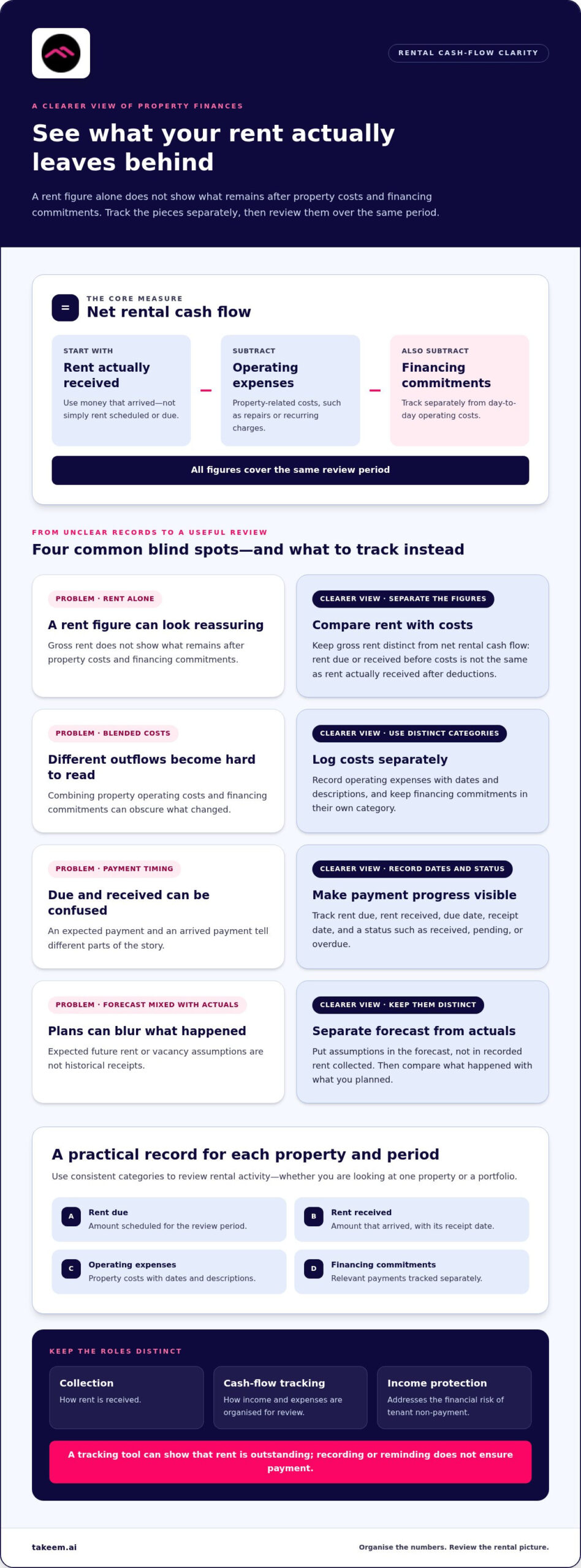
    A rent figure on its own can look reassuring, but it doesn’t show what remains after property costs and financing commitments. Cash-flow tracking brings those figures together so landlords can see what came in, what went out and what is still due. It’s a practical way to review a property’s financial activity, not a full investment-yield calculation.

    Net rental cash flow is rent actually received minus operating expenses and financing commitments over the same period. Gross rent is the rent due or received before costs are deducted. Operating expenses are property-related costs, such as repairs or recurring charges. Track financing commitments separately so they aren’t mixed up with day-to-day operating costs.

    Which figures should landlords monitor?

    Use separate categories for rent due, rent received, operating expenses and financing commitments. Record dates as well as amounts: the due date shows when payment was expected, while the receipt date shows when funds arrived. Add a clear status, such as received, pending or overdue, to distinguish timing delays from missing records.

    • Rent due: The amount scheduled for the review period.
    • Rent received: The amount that has actually arrived, with its receipt date.
    • Operating expenses: Costs paid or incurred for the property, with dates and descriptions.
    • Financing commitments: Relevant payments tracked separately from operating costs.

    Keep forecasts distinct from actuals. If you expect a property to be vacant for part of a future period, record that assumption in the forecast, not as rent collected. This keeps historical results factual and makes it easier to compare what happened with what you planned.

    Illustrative example, hypothetical figures only: Suppose a property has د.إ 8,000 in rent received during a month, د.إ 1,200 in operating expenses and a د.إ 2,500 financing commitment. Its net cash flow for that period is د.إ 4,300. If rent was due earlier but arrived later, record both dates so the monthly view reflects timing as well as the final amount.

    How to use a cash-flow review without overcomplicating it

    Set a consistent monthly review and use the same categories for every property. Start by matching recorded receipts against rent due, then enter expenses and financing commitments. Finally, compare actual figures with the previous period or your forecast. A simple, repeatable process is more useful than a complicated dashboard that’s difficult to keep current.

    Review each property before combining figures into a portfolio total. A portfolio summary gives an overall view, but property-level records help explain differences. One property may have higher expenses, while another may show a payment delay. Combining figures too early can hide those details and make comparisons less useful.

    Update records when payments or costs occur, then review actual receipts and expenses regularly. Tracking can support informed decisions, but it doesn’t promise improved returns or replace tailored financial advice. For landlords considering a separate layer for payment administration or income protection, digital rent collection and rental income protection address those needs alongside cash-flow tracking.

    Compare landlord financial tools by the job they perform

    Choosing among landlord financial tools in Dubai is easier when you start with the problem you need to solve. A spreadsheet or accounting tool helps organise financial records. Digital collection supports receiving rent. Rental income protection addresses the risk of non-payment. These functions can complement one another, but they aren’t interchangeable, and no single tool needs to cover every need.

    Function Benefit Limitation
    Spreadsheet or accounting tool Organises rent, expenses and other financial entries for review. Records depend on accurate, timely data entry; a record alone doesn’t collect rent or protect income.
    Digital rent collection Provides a digital workflow for receiving rent and can reduce reliance on cheque-based administration. Collection handles payment administration, not full cash-flow analysis or protection from non-payment.
    Rental income protection Addresses the financial exposure associated with tenant non-payment. It doesn’t replace payment records, expense tracking or regular cash-flow reviews.

    Cash-flow tracking tools versus digital rent collection

    Tracking records and organises figures; digital collection supports the payment process. For example, a landlord might use a spreadsheet to record the rent expected and the date it arrives, while a separate collection setup enables tenants to pay digitally. The landlord can then compare payment information with their records to reconcile receipts. Don’t assume the two tools connect automatically: the workflow may involve entering or checking details separately. Neither function alone ensures rent will be paid.

    Match the choice to the bottleneck. If you can’t easily see rent received alongside expenses, improve record-keeping. If manual payment administration takes time, consider a digital collection method. Takeem’s Direct Debit setup supports landlords in digitally accepting monthly tenant payments, while financial records remain a separate part of monitoring property performance.

    Income protection and maintenance are different safeguards

    Rental income protection is distinct from both recording a payment and processing it. It addresses income uncertainty rather than documenting whether rent arrived. Takeem’s Rental Guarantee protects landlords against tenant non-payment, but landlords still need clear records to review receipts and expenses. Protection and tracking answer different questions.

    Emergency property maintenance is another distinct feature. It can support property upkeep, but it isn’t a cash-flow tool and doesn’t replace financial records or payment collection. Takeem includes emergency property maintenance as part of its Rental Guarantee service. For a closer look at how those elements relate, explore this guide to rental guarantees with maintenance.

    A practical setup may combine a record-keeping method, a collection workflow and income protection, with each assigned a clear role. Prioritise the gap that causes the most friction, then add other functions where they address a distinct need. That keeps the system understandable and avoids expecting a payment or protection service to do the work of an accounting tool.
    Landlord Financial Tools in the UAE: 2026 Guide

    Build a practical financial workflow for one property or a portfolio

    A reliable workflow makes financial administration repeatable. Start with the records you need, choose a suitable way to collect rent, then review actual activity on a regular schedule. The setup can stay simple for one property and expand as your portfolio grows. Assign each step a clear purpose rather than expecting one tool to handle every financial task.

    1. Map the properties. Give each property a distinct record and note its tenancy periods, rent due dates and relevant payment details. This creates a clear starting point for monitoring income and expenses.
    2. Standardise the records. Use the same categories across properties, such as rent due, rent received, operating expenses and financing commitments. Record dates and payment status consistently, too.
    3. Choose a collection method. Decide how tenants will pay and how you’ll record each receipt. A digital option, such as Direct Debit setup, can support monthly rent collection. Keep the resulting payment information available for reconciliation.
    4. Review the results. Compare expected rent with actual receipts, enter expenses and examine property-level cash flow before drawing conclusions about the whole portfolio.

    Separate one-time setup from recurring administration. Initial setup means creating property records, choosing consistent categories and establishing the collection workflow. Recurring work means recording receipts and expenses, checking payment status and reviewing results. Keeping these routines distinct helps prevent an organised setup from becoming outdated through inconsistent follow-through.

    A repeatable monthly review for rental finances

    At each monthly review, compare rent due with rent received and note timing differences rather than treating a late receipt as if it arrived on the due date. Categorise actual operating expenses the same way each month, then compare the current period with earlier ones. One unusual month can prompt a closer look, but it isn’t enough on its own to establish a lasting trend.

    Keep forecasts separate from actual records. If you expect a vacancy or a future cost, label it as an assumption; don’t enter it as collected rent or an expense already paid. This gives you a dependable record of what happened while keeping planning information useful.

    When a landlord has several properties

    Use shared reporting categories but preserve an individual record for every property. First review each property’s income, expenses and payment timing. Then interpret the combined portfolio figures. This helps identify whether an overall change comes from one property or appears across several, and supports meaningful comparisons without losing detail. For deeper analysis, see this property portfolio rental income guide.

    For landlords looking to make monthly collection part of the workflow, this guide to setting up Direct Debit for landlords covers the setup topic. Landlords exploring landlord financial tools Dubai can also consider how digital collection and rental income protection fit alongside their own records. Explore Takeem’s Direct Debit and Rental Guarantee services as potential parts of that setup.

    How Takeem connects rental income protection with digital collection

    Once the roles of tracking, collection and income protection are clear, landlords can decide which functions their setup needs. Takeem serves landlords and property investors across the UAE with rental guarantee services and Direct Debit setup for digital monthly rent collection. These offerings address related but distinct parts of rental finance administration: one protects against tenant non-payment, while the other supports the process of accepting monthly payments.

    Rental guarantee and digital monthly collection

    A rental guarantee is relevant when a landlord wants to address the financial risk of tenant non-payment. Direct Debit setup gives landlords a digital method to accept monthly tenant payments. Neither replaces the landlord’s own financial records. Continue recording rent due, receipts and expenses so you can review actual cash flow, whether rent is collected digitally or through another agreed method.

    Used together, these functions can contribute to a broader financial workflow: digital collection supports payment administration, rental guarantee addresses income exposure, and separate records provide visibility into what was received and spent. Keep the roles distinct. A collection process doesn’t by itself provide income protection, and a rental guarantee isn’t a general-purpose accounting system. For a deeper explanation of how rental guarantees work, see this UAE rental guarantee guide.

    Takeem’s Rental Guarantee service also includes emergency property maintenance. This property upkeep feature is part of the rental guarantee service, not a substitute for payment records, cash-flow reviews or a property-management service. Keeping these distinctions clear helps landlords understand what each part of a financial setup is intended to address.

    What landlords can consider as a next step

    Start with the issue you most want to address. If rent administration is difficult to follow, consider whether a digital monthly collection method fits your workflow. If income uncertainty is the priority, explore rental guarantee as a separate protection function. If both matter, consider how collection and protection can sit alongside your existing records. The right combination depends on your portfolio and financial priorities.

    Landlord financial tools Dubai searches often bring together services that perform very different jobs. Takeem focuses on rental income protection and Direct Debit setup for landlords, not property management or standalone accounting software. You can use your preferred record-keeping method to monitor receipts, expenses and property-level performance.

    If you’re ready to explore how digital collection or rental income protection could fit your rental finance workflow, explore Takeem’s landlord solutions.

    Set your next rental finance priority

    Your next step doesn’t need to be a full system overhaul. Choose one point of friction to address first, such as uncertainty about payment status or a desire to protect rental income. A focused decision makes it easier to see whether a tool is helping and keeps your process manageable as your property needs change.

    Think of your setup as something you can refine over time, not a permanent technology decision. The landlord financial tools Dubai landlords choose should fit the way they handle rent and records today, while leaving room to adapt as their priorities or portfolio evolve. Keep the goal practical: make financial decisions with a clearer view of what needs attention.

    If you’re ready to explore options for rent collection and income protection, explore Takeem’s landlord solutions. A considered first step can make rental finance administration feel more organised and easier to manage.

    Frequently Asked Questions

    Can landlords in the UAE collect rent digitally instead of using cheques?

    Yes, landlords can use digital methods to accept rent, including monthly Direct Debit when the arrangement is set up for the tenancy. Before changing methods, agree on how payment will be made and keep a record of the arrangement, due dates and receipts. Takeem provides Direct Debit setup for landlords to digitally accept monthly tenant payments. Digital collection changes the payment workflow; it doesn’t remove the need to track what was received.

    What financial records should a landlord keep for each rental property?

    Keep records that let you trace each transaction to a property and tenancy. A practical file can include the tenancy agreement, rent schedule, payment confirmations, expense invoices and receipts, and notes explaining unusual adjustments or refunds. Record dates and payment references where available. For example, attach a repair invoice to the relevant property record instead of storing it only in a general inbox. Consistent documentation makes later reviews and queries easier to resolve.

    How can a landlord track rental cash flow each month?

    Use a monthly cut-off date and reconcile the period against bank or payment records, rather than relying on memory. Mark each expected receipt as received, pending or outstanding, then match expenses to invoices or receipts. Compare the month with previous periods, but investigate a change before treating it as a pattern. The phrase landlord financial tools Dubai covers different ways to organise this process, from a simple ledger to accounting software.

    Are rental guarantees the same as landlord insurance?

    No, don’t assume they provide the same protection. A rental guarantee is designed around rental income risk, while landlord insurance is governed by the specific policy and risks it covers. Their scope, conditions and exclusions can differ. Compare the written terms rather than relying on the product label, and consider whether maintenance is included as a separate service feature. Takeem’s Rental Guarantee addresses tenant non-payment and includes emergency property maintenance.

    Can financial tools help landlords manage properties from abroad?

    They can make financial oversight more convenient from a distance if the landlord can access payment records and property accounts digitally. For example, a landlord abroad could review recorded receipts and expenses without waiting for paper files to be sent. However, financial tools don’t automatically handle inspections, tenant communication or other operational property-management tasks. Set clear processes for who records transactions and how supporting documents are stored, so remote reviews remain useful.

    What should landlords compare before adopting a digital rent collection tool?

    Compare how the payment method fits your tenancy schedule and what steps tenants must take to use it. Review any applicable charges, how you’ll identify and reconcile receipts, and what information is available when a payment is delayed or not recorded. Consider how the process will fit your existing records, too. A clear collection workflow should make payment administration easier to follow without being mistaken for income protection or accounting software.

  • How to Get a Rental Guarantee in the UAE: The 2026 Landlord Guide

    How to Get a Rental Guarantee in the UAE: The 2026 Landlord Guide

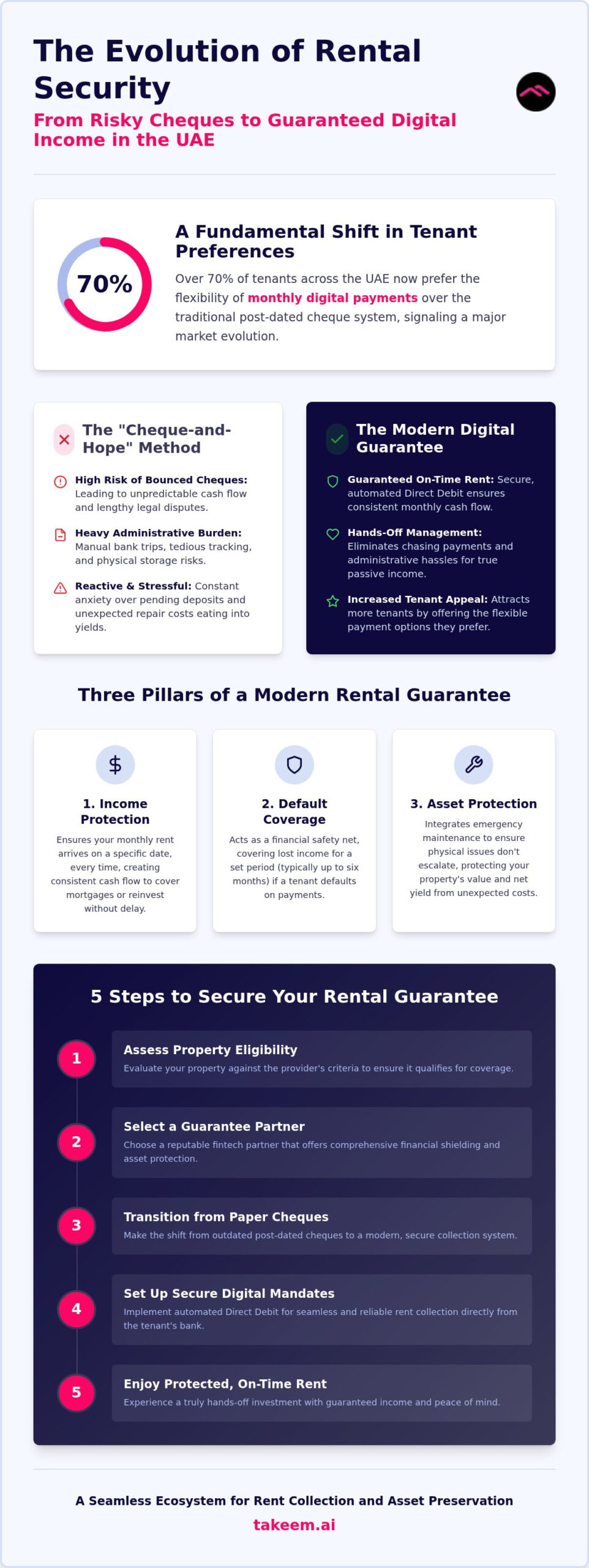
    Did you know that over 70% of tenants across the UAE now prefer monthly payment options over the traditional post-dated cheque system? This shift represents a fundamental change in the property market, yet many landlords still rely on the outdated “cheque-and-hope” method. You’re likely familiar with the anxiety of a pending deposit or the frustration of an unexpected maintenance bill suddenly eating into your quarterly yields. It’s a stressful, reactive way to manage what should be a stable, passive investment.

    This guide explains how to get a rental guarantee in Dubai and the wider UAE to finally secure your property with modern digital protection. By moving away from physical cheques and toward secure Direct Debit systems, you can achieve the consistent cash flow you deserve. We’ll show you how to protect both the physical and financial value of your assets while enjoying a truly hands-off management experience that eliminates the hassle of chasing payments.

    We’ll explore the transition to digital mandates, the benefits of integrated emergency maintenance coverage, and the streamlined steps to implementing a professional rental guarantee for your portfolio in 2026.

    Key Takeaways

    • Understand the critical difference between developer yield promises and true third-party rental income protection that secures your monthly cash flow.
    • Learn exactly how to get a rental guarantee in Dubai and the wider UAE by transitioning from traditional paper cheques to secure, automated digital collection.
    • Discover the five essential steps to assess your property’s eligibility and select a guarantee partner that offers comprehensive financial shielding.
    • See how integrating emergency property maintenance into your guarantee protects your net yields from being eroded by unexpected repair costs.
    • Explore how modern fintech solutions like Takeem provide a seamless, hands-off ecosystem for rent collection and asset preservation.

    What is a Landlord Rental Guarantee in the UAE?

    A landlord rental guarantee in the UAE is a sophisticated financial service designed to decouple your income from your tenant’s immediate liquidity. It ensures that you receive your rent on a specific date, regardless of whether the tenant has paid or defaulted. This is a significant departure from the traditional “cheque-and-hope” model that has dominated the region for decades. While developers often advertise “guaranteed yields” to sell off-plan units, those are typically marketing incentives. A true third-party guarantee is a robust fintech solution that protects individual investors across the secondary market.

    As the market matures in 2026, proptech platforms are making these shields accessible to everyone from single-unit owners to large portfolio managers. If you’re researching how to get a rental guarantee in Dubai or elsewhere in the UAE, it’s vital to understand that this isn’t just insurance. It’s an end-to-end ecosystem for asset security that reflects a maturing, globalized property market.

    The Core Components of a Modern Guarantee

    Modern guarantees focus on three pillars of protection. First, income protection ensures your monthly deposit arrives on time, every time. This creates the consistent cash flow needed to cover mortgages or reinvest without delay. Second, default coverage acts as a financial safety net. If a tenant stops paying, the guarantee provider covers the lost income for a set period, typically up to six months. Finally, asset protection integrates emergency maintenance. This ensures that physical issues don’t escalate into financial disasters that erode your net yield.

    Why Traditional Methods Are No Longer Enough

    Relying on post-dated cheques is increasingly risky in a digital-first economy. Cheques can bounce, be lost, or require manual trips to the bank, creating a heavy administrative burden. The concept is similar to a Loan guarantee, where a third party assumes the risk of the primary debtor. In the rental world, this shift is essential for stability as tenants increasingly demand flexible payment options like the DLD “Flexi Rent” initiative.

    Manual collection also leaves you vulnerable to legal hassles. Learning avoiding rental disputes UAE is much easier when you have a digital buffer between you and the tenant. By automating the process through a guarantee, you remove the friction that often leads to missed payments and damaged relationships. It’s a proactive approach that prioritizes your peace of mind over reactive collection efforts.

    The Shift from Post-Dated Cheques to Digital Rent Collection

    The era of the post-dated cheque is rapidly closing. For decades, UAE landlords relied on physical paper as their primary security measure, but the limitations of this system are now undeniable. Cheques can be lost, forged, or bounced, often leading to lengthy legal delays and administrative headaches. In 2026, the market is embracing digital mandates as the new standard for reliability. Understanding how to get a rental guarantee in Dubai or across the UAE starts with this fundamental shift toward automation. By adopting digital collection, you align your investment with Dubai Land Department regulations and the growing “Flexi Rent” initiative.

    Direct Debit provides a secure, automated path for funds to move directly from the tenant’s bank to yours. It eliminates the manual labor of depositing cheques and the anxiety of waiting for them to clear. For tenants, the appeal is equally strong. Research shows that over 70% of UAE tenants now prefer monthly installments over large quarterly hits to their cash flow. This flexibility actually reduces the risk of a tenant not paying rent UAE, as smaller, frequent payments are significantly easier for most households to manage than bulk sums.

    Direct Debit vs. Cheques: A Security Comparison

    Digital mandates remove human error from the equation. Unlike a cheque that sits in a drawer for months, a Direct Debit mandate is a live financial link. If a payment fails, the system identifies the issue instantly, allowing for immediate resolution. This predictability is vital for property portfolio management. It allows you to forecast your income with precision and ensures your yields remain stable. If you’re looking to modernize your portfolio, you can explore digital collection tools that bridge the gap between traditional leases and modern fintech.

    The Role of Fintech in Rental Security

    Proptech platforms now offer real-time tracking of every rental transaction. Both parties receive automated notifications, which fosters a culture of transparency and trust. This visibility serves as the essential trigger for a rental guarantee. When the system detects a missed payment, the guarantee protocol initiates immediately. You don’t have to wait for a bank to return a physical cheque to know there’s a problem. This speed and efficiency are what make modern digital guarantees far superior to the cumbersome methods of the past. To understand the broader context of these changes, exploring the evolution of landlord fintech solutions in the UAE reveals how 2026 trends like “Rent Now, Pay Later” schemes are reshaping the entire property management landscape.

    5 Steps to Secure a Rental Guarantee for Your Property

    Implementing a rental guarantee is a streamlined process that moves your property into the modern era of asset management. While many landlords assume these protections are only for new developments, the reality is that any established property can be shielded. If you’re looking into how to get a rental guarantee in Dubai or across the UAE, following a structured path ensures your coverage is legally sound and financially robust. It’s about replacing uncertainty with a systematic approach to income security.

    • Step 1: Assess Eligibility. Providers review your current lease terms and the property’s legal standing.
    • Step 2: Choose a Comprehensive Partner. Select a provider that handles both the digital collection of rent and the financial protection of your yield.
    • Step 3: Transition to Digital Mandates. Move away from paper cheques to a secure Direct Debit setup. This aligns with the broader market shift to monthly payments, which significantly enhances tenant retention and satisfaction.
    • Step 4: Establish Maintenance Protocols. Link your guarantee to an emergency maintenance service to prevent physical issues from eroding your net profit.
    • Step 5: Finalize and Activate. Sign the digital agreement to trigger your protection and start receiving automated deposits.

    Evaluating Your Property and Tenant

    Guarantee providers prioritize transparency and legality. A valid Ejari registration is the non-negotiable foundation for any guarantee in the UAE. It provides the legal framework necessary to enforce terms and verify the rental value. Additionally, providers look for realistic rental pricing. Setting a price that aligns with current market data ensures the guarantee is sustainable. It also confirms that the tenant can comfortably meet their obligations without financial strain, which is the first line of defense against default.

    Onboarding Your Tenant to the New System

    The transition from cheques to digital mandates requires clear communication. Many tenants welcome the change, as it allows them to manage their cash flow more effectively. When you’re explaining how to get a rental guarantee in Dubai, focus on the convenience of automated payments and the elimination of manual bank trips. Legally, updating payment terms involves a simple amendment to the existing contract. This proactive step modernizes the tenant’s experience and makes your property more competitive in a digital-first market. Landlords seeking a deeper understanding of how these tools are reshaping the industry can benefit from reviewing the latest landlord fintech solution UAE trends for 2026, which detail the most impactful innovations driving this transformation.

    How to Get a Rental Guarantee in the UAE: The 2026 Landlord Guide

    Protecting Asset Value: Why Maintenance is Part of the Guarantee

    Many landlords view rent collection and property maintenance as separate silos. This is a strategic error. A single burst pipe or a failed AC unit can instantly wipe out months of profit. When you’re considering how to get a rental guarantee in Dubai or across the UAE, you must look beyond the monthly deposit. A comprehensive guarantee should act as a shield for the property’s physical integrity as much as its financial output. By integrating maintenance, you ensure that your investment remains a high-performing asset rather than a source of constant liability.

    Emergency Repairs and Income Stability

    Maintenance disputes are among the most common reasons for rent withholding in the UAE. A tenant faced with a non-functional water heater or electrical fault often feels justified in delaying payments. An integrated guarantee removes this friction by providing a 24/7 emergency response. This proactive management prevents small issues from escalating into expensive structural damage. It also reduces your operational stress, as you’re no longer the first point of contact for midnight emergencies. You can secure your property with an integrated maintenance guarantee to stabilize your long-term returns and eliminate these common pain points.

    The Long-Term View: Yield vs. Net Income

    Calculating your annual ROI requires looking at net income, not just the gross rent on the contract. Unexpected repairs are the primary cause of yield erosion. A “guaranteed” rent figure is effectively meaningless if your outgoings remain volatile and unpredictable. Modern guarantee models fix these costs by including emergency coverage, allowing for precise financial planning. Maintenance integration is the ultimate hedge against rental volatility.

    This approach also protects the long-term resale value of your property. Consistent, professional upkeep ensures that when it’s time to exit the investment, the asset is in peak condition. A well-maintained property commands a higher market price and attracts premium tenants, creating a virtuous cycle of value preservation. By securing a guarantee that includes maintenance, you aren’t just protecting today’s rent; you’re protecting tomorrow’s equity.

    Choosing Takeem for Your UAE Rental Guarantee

    Takeem represents the next evolution in property investment security. While traditional methods rely on the physical exchange of paper and the hope that funds are available, Takeem provides a robust fintech shield for landlords across the UAE. Unlike developer-led schemes that are often restricted to specific off-plan projects, this solution is designed for the secondary market. It empowers individual investors and portfolio managers to professionalize their operations. If you are researching how to get a rental guarantee in Dubai or any other part of the UAE, Takeem offers a streamlined path to financial certainty.

    The platform functions as a comprehensive ecosystem by combining digital rent collection, ironclad income guarantees, and emergency maintenance. This integrated approach ensures that your property remains a source of passive income rather than a management burden. The process is designed for speed and transparency. Once your property is onboarded, the system handles the transition from cheques to digital mandates, ensuring your first guaranteed payment arrives on schedule without the need for manual intervention.

    Real estate agents also play a vital role in this digital transformation. Takeem offers dedicated partnerships that allow agents to provide these guarantee solutions to their clients. This not only adds a layer of security for the landlord but also provides agents with healthy commissions. It creates a more stable rental market where every stakeholder benefits from increased transparency and reduced financial risk.

    The Takeem Advantage for Property Investors

    Managing a large property portfolio requires precision and scalability. Takeem replaces the fragmented “cheque run” with a single digital dashboard that provides real-time visibility into your entire asset base. By implementing automated Direct Debit, you eliminate the administrative friction that typically plagues high-volume investors. This system ensures consistent income regardless of market fluctuations, allowing you to reinvest with confidence. It’s a proactive tool that prioritizes your peace of mind by securing the financial pulse of your investments. Landlords who want to fully leverage these capabilities can explore how proptech for rent collection UAE is transforming the way property investors manage their portfolios in 2026.

    How to Get Started Today

    Securing your investment is a straightforward process that begins with a professional assessment. Every landlord’s needs are unique, so the first step involves reviewing your current portfolio to ensure all documentation is in order. You’ll need a valid Ejari registration and a current tenancy contract to activate the protection framework. When you’re ready to learn more about how to get a rental guarantee in Dubai or the wider UAE, our team provides the technical and legal guidance needed for a seamless transition.

    The shift to digital security is not just a trend; it’s a necessity for the modern investor. You can secure your rental income with Takeem’s digital guarantee today and experience the benefits of a truly hands-off, protected investment strategy.

    Modernize Your Property Strategy for 2026

    The rental landscape in the UAE has fundamentally shifted away from the “cheque-and-hope” era toward a fintech-driven future. By embracing digital mandates and integrated maintenance, you’re not just collecting rent; you’re actively preserving the financial and physical value of your asset. You now understand the essential steps of how to get a rental guarantee in Dubai and across the country to replace manual collection with automated peace of mind. This transition ensures your cash flow remains predictable while your property stays in peak condition for years to come.

    It’s time to transition your portfolio to a system that prioritizes long-term stability. Takeem facilitates a seamless move from physical cheques to secure Direct Debit, ensuring your income remains consistent regardless of market shifts. With emergency maintenance included in every guarantee, your net yields are protected from the unexpected costs that often erode profit. Protect your rental income with Takeem’s digital guarantee and maintenance solutions. Join the growing number of property investors across the UAE who’ve already modernized their approach for a more secure, hands-off future.

    Frequently Asked Questions

    Is a rental guarantee legally binding in the UAE?

    A rental guarantee is a legally binding contract when issued by a licensed financial technology provider in the UAE. Its enforceability depends on the mandatory registration of the tenancy contract through the Ejari system. This legal framework ensures that both the landlord’s income and the provider’s obligations are recognized by the relevant authorities. It’s a professional alternative to traditional personal guarantees, offering a higher level of institutional security for property investors.

    How much does a rental guarantee service typically cost for a landlord?

    Service fees for rental guarantees are typically calculated as a percentage of the annual rent. These costs are often offset by the increased yields gained through consistent cash flow and the elimination of manual collection expenses. While specific rates depend on the size of your portfolio and the level of maintenance coverage included, the value lies in the financial shield provided. Landlords should request a tailored quote to understand the exact investment for their specific properties.

    What happens if my tenant refuses to switch to Direct Debit?

    If a tenant is hesitant to move away from cheques, you should highlight the benefits of monthly digital payments. Most tenants prefer the flexibility of smaller, automated installments over large quarterly payments. If you’re wondering how to get a rental guarantee in Dubai or the wider UAE, remember that digital mandates are the foundation of modern protection. If a tenant refuses, the guarantee might not be applicable until the next contract renewal cycle begins.

    Does the guarantee cover the full amount of rent if a tenant defaults?

    Most guarantee packages cover missed rental payments for a significant period, often up to six months of the annual contract value. This protection triggers as soon as the digital collection system identifies a default. It ensures you don’t face a sudden income gap while resolving the situation with the tenant. This coverage is essential for maintaining mortgage payments and other financial obligations that rely on a steady, predictable rental income stream.

    Can I get a rental guarantee for an existing tenancy or only new ones?

    You can absolutely secure a guarantee for an active tenancy. The process involves migrating the current payment schedule to a digital Direct Debit mandate and verifying that the existing contract is registered and in good standing. This is a popular option for landlords who want to modernize their management style mid-lease. It allows you to implement professional income protection without waiting for the current tenant to vacate or for the lease to expire.

    What specific maintenance services are included in the guarantee package?

    The maintenance component focuses on emergency repairs that could damage the property’s physical or financial value. This includes urgent plumbing issues, electrical failures, and locksmith services. By resolving these problems quickly through a 24/7 response team, the guarantee prevents minor faults from becoming major expenses. It’s a proactive way to manage your asset while ensuring the tenant remains satisfied and the property stays in peak condition for the long term.

    How does digital rent collection differ from a standard bank transfer?

    Digital rent collection via Direct Debit is an automated process where funds are pulled directly from the tenant’s account on a set date. Unlike a standard bank transfer, which requires the tenant to manually initiate the payment, digital mandates remove the risk of human error or forgetfulness. This automation is what allows providers to offer a guarantee. It creates a transparent, trackable history of every transaction that both the landlord and provider can monitor. For a comprehensive overview of how these systems work in practice, the proptech rent collection UAE landlord guide for 2026 offers detailed insights into transitioning from traditional cheques to fully automated digital collection.

    What is the notice period for activating the rental default protection?

    Default protection usually activates within a few days of a failed payment notification. When the digital collection system records a bounce or a failed mandate, the guarantee protocol begins immediately. This rapid response is much faster than the weeks or months it can take to resolve a bounced cheque through traditional legal channels. Knowing how to get a rental guarantee in Dubai means understanding that speed of activation is the key to protecting your ROI.