

What if the traditional post-dated cheque was actually the biggest vulnerability in your property portfolio? Dealing with a tenant not paying rent UAE is more than just a financial hurdle; it’s a source of intense stress that disrupts your cash flow and peace of mind. You’ve likely spent hours worrying about unresponsive tenants or the daunting costs of legal proceedings. We understand that your property is an investment that requires protection, not a source of constant friction.
This guide provides the clarity you need to resolve current defaults and the strategy to ensure they don’t happen again. You’ll discover the exact legal steps for 2026, from understanding filing fees to mastering the mandatory 30-day notice period. We’ll walk you through the Rental Dispute Center process while showing you how to modernize your approach with digital collections and rental guarantees. By the end of this article, you’ll know how to recover unpaid rent quickly and how to implement a sophisticated shield that protects your monthly income from future uncertainty.
Key Takeaways
- Learn the critical first steps to take when dealing with a tenant not paying rent UAE, including the legal necessity of formal notice and Ejari verification.
- Master the filing requirements for the Rental Dispute Center (RDC) to recover unpaid funds and navigate the 2026 fee structure with professional confidence.
- Quantify the true financial impact of defaults by factoring in non-refundable filing fees and the hidden costs of property vacancy.
- Modernize your portfolio by replacing outdated post-dated cheques with secure Direct Debit systems for seamless, automated rent collection.
- Implement a sophisticated shield through a Landlord Rental Guarantee to ensure your cash flow remains uninterrupted regardless of tenant behavior.
Initial Steps: What to Do the Moment Rent is Overdue
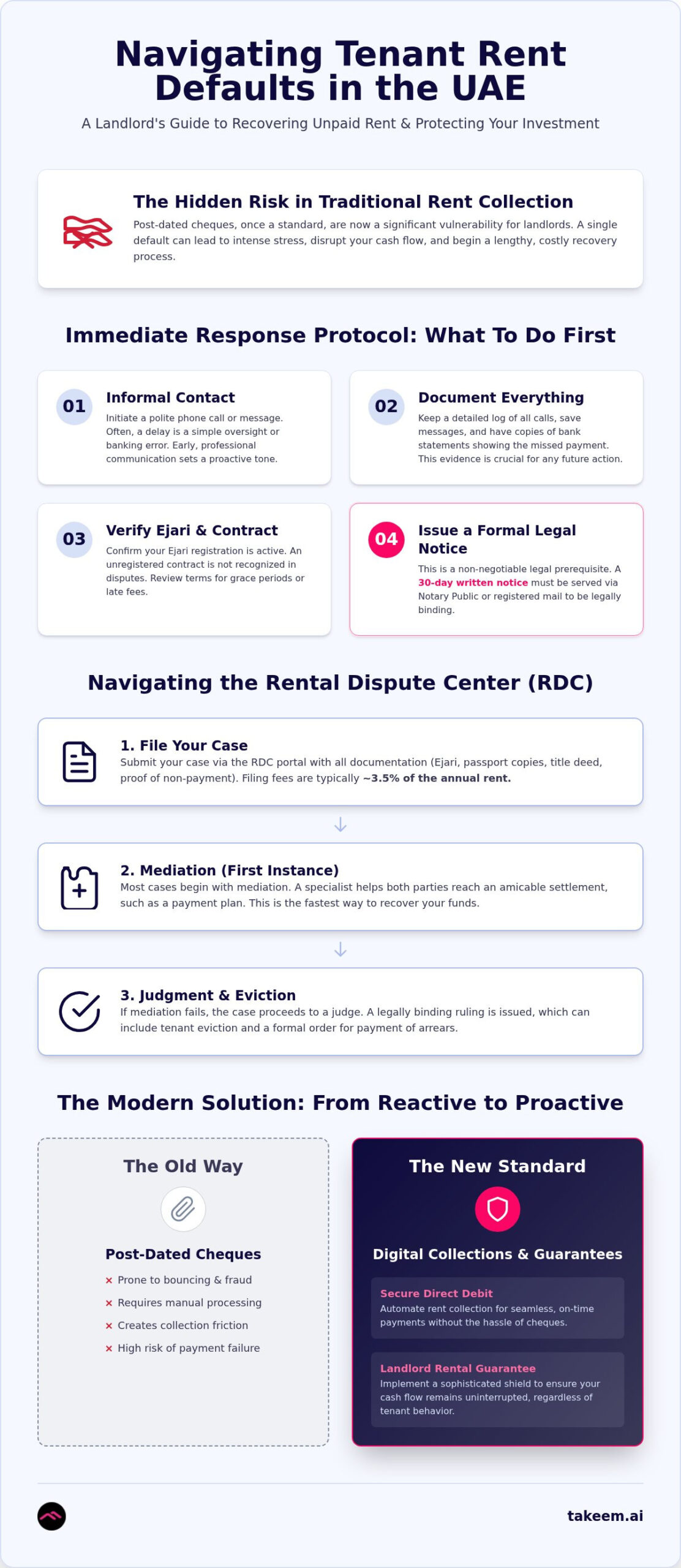
A missed payment doesn’t always signal a crisis, but it does require immediate, methodical attention. Your first priority is to maintain professional composure while acting with speed. In the UAE, dealing with a tenant not paying rent UAE requires a balance of clear communication and strict adherence to national regulations. Don’t wait for weeks to pass. Start by initiating informal contact via a polite phone call or message. Often, a delay is simply the result of a technical banking error or a temporary oversight. By reaching out early, you establish a proactive tone and rule out simple mistakes before escalating the situation.
If informal attempts don’t yield results, you must transition to a more structured approach. Document every interaction from day one. Keep a log of calls, save your messages, and ensure you have copies of all relevant bank statements showing the missing credit. This timeline serves as your primary shield if you eventually need to present your case to the authorities. Building a clear evidence trail now reduces friction and uncertainty later in the process.
Verifying the Ejari and Contract Terms
Before taking legal steps, you must ensure your administrative foundation is flawless. Your Ejari registration is the most critical document in this phase. Across the Emirates, a tenancy contract that isn’t registered with the appropriate authorities isn’t recognized for dispute resolution. Confirm that your registration is active and that the rental amount and payment dates perfectly match your current claim. Understanding the fundamentals of Landlord-tenant law is essential for any property owner facing a payment default. You should also review the “additional terms” section of your contract. Some agreements include specific grace periods or late payment penalties that dictate how soon you can proceed with a formal notice. Ensuring the tenant’s contact information is current for the legal service of notices is also vital.
Issuing the Formal Legal Notice
When informal communication fails to resolve the debt, you must issue a formal legal notice. This is a non-negotiable prerequisite for any future eviction or recovery case. According to established regulations, specifically Article 25(1) of the governing rental law, you must provide the tenant with a 30-day written notice to pay the overdue rent. This notice isn’t just a standard email; it must be served via a Notary Public or through registered mail to be legally binding. Your notice should clearly state the exact amount owed and the specific 30-day deadline for rectification. Always keep the original receipt and proof of delivery. These documents are your entry ticket to the local settlement committee. Without them, your case will likely be dismissed, causing further delays and loss of income.
Navigating the UAE Rental Dispute Center (RDC)
The Rental Dispute Center (RDC) serves as the primary judicial arm for resolving conflicts between landlords and tenants. When the mandatory 30-day notice period expires and the debt remains outstanding, this institution becomes your essential pathway to a formal resolution. It provides a specialized environment designed to handle non-payment cases with professional efficiency. Moving your case to the RDC signals that you’re prepared to enforce your rights through the proper legal channels, moving beyond informal requests to a structured judicial process that carries the weight of the law.
Filing Your Case and Mediation
Initiating a case requires you to submit an application through the official RDC portal using your digital identity, such as the UAE Pass. You must have your documentation ready for upload. This includes your active Ejari certificate, passport copies for both parties, the property title deed, and documented proof of the missed payments. National filing fees are typically calculated as a percentage of the annual rent, often around 3.5 percent, with established minimum and maximum caps. Additional administrative charges for process service and innovation fees also apply during this stage.
Most cases begin in the mediation stage, often referred to as the “First Instance.” During these sessions, a mediator works with both parties to reach an amicable settlement. This is a crucial opportunity to recover funds without a full hearing. Common outcomes include a court-sanctioned payment plan or a full recovery of the arrears. If your goal is to resolve a situation involving a tenant not paying rent UAE, mediation is often the fastest way to restore your monthly cash flow while maintaining a professional relationship.
The Eviction Process for Non-Payment
If mediation doesn’t result in a settlement, the case proceeds to a judge who can issue a formal eviction order. The legal grounds for eviction are firmly established once the 30-day notice period expires without the tenant rectifying the default. Once you receive a favorable judgment, the Execution Department takes over the enforcement. They manage the physical handover of the property and ensure the tenant vacates the premises according to the court’s timeline. It’s often wise to consult with legal professionals during this phase to ensure every procedural requirement is met, as technical errors can cause frustrating delays.
The entire RDC process, while effective, demands significant time and administrative effort. To avoid the stress of legal filings and the uncertainty of hearings, you might consider how to modernize your property portfolio by implementing digital collection systems and rental guarantees that protect your income from the very first day of the lease.
The Real Cost of Tenant Default and Legal Recovery
Many landlords assume the only loss during a default is the missing monthly credit. This is a dangerous misconception. When you encounter a tenant not paying rent UAE, the financial bleeding extends far beyond the surface level of the debt. You’re facing a multi-layered drain on your resources that can take months to rectify. Understanding these costs is essential for any investor who wants to maintain a healthy bottom line in the 2026 market.
You must account for the non-refundable filing fees at the Rental Dispute Center. As established, this is 3.5 percent of your annual rent. If you have a property renting for AED 150,000, you’re looking at a mandatory AED 5,250 outlay just to start the recovery process. For investors with mortgage obligations, this cash flow gap is compounded. You’re paying the bank out of pocket while your primary income source remains stagnant. There is also the “vacancy cost.” The legal process can take significant time, and during this period, the property is legally tied up. You cannot re-list it or move a paying tenant in until the execution order is finalized. This period of forced inactivity often costs landlords more than the original debt itself.
Hidden Financial Drains
Beyond the RDC fees, you must calculate the cost of legal representation and Notary Public services. While some landlords represent themselves, the complexity of current regulations often makes professional help necessary. There is also the risk of property neglect. Contentious non-payment periods sometimes lead to tenants ignoring maintenance issues or, in extreme cases, causing intentional damage. Proactively avoiding rental disputes in the UAE is the only way to shield your asset from these secondary risks. These hidden drains can quickly evaporate your annual yield.
Opportunity Cost for Investors
A single default can severely derail the ROI of a diversified property portfolio. It’s not just about the money; it’s about the “mental tax.” The hours spent drafting notices, attending mediation, and following up with the Execution Department represent time stolen from your growth strategy. You could be analyzing new acquisitions or optimizing existing yields. Instead, you’re stuck in administrative loops. In 2026, time is a landlord’s most valuable asset. Protecting that time requires moving away from reactive legal battles toward proactive, digital-first income security. A sophisticated investor knows that preventing a tenant not paying rent UAE is always more profitable than chasing one through the courts.
Modern Prevention: Moving Beyond Traditional Cheques
Legal recourse is a vital safety net, but the most successful landlords in the 2026 market focus on prevention rather than cure. Relying on post-dated cheques is a reactive strategy that often leaves you vulnerable to the very risks you’re trying to avoid. While cheques were once the standard for security, they’ve become a source of administrative friction and financial uncertainty. Transitioning to a digital-first approach allows you to eliminate the root causes of payment delays before they escalate into a legal crisis.
Modern property technology platforms now offer a level of transparency and reporting that traditional methods simply can’t match. By digitizing your collection process, you gain a real-time view of your portfolio’s health. This proactive stance ensures that a tenant not paying rent UAE becomes a rare anomaly rather than a recurring threat to your stability. You’re not just collecting rent; you’re building a sophisticated shield around your investment.
The Flaws of the Cheque System
The traditional cheque system is riddled with manual vulnerabilities. Bounced cheques are a primary driver of landlord stress, often requiring police reports and lengthy bank follow-ups to resolve. Even when a tenant has the funds, simple human errors like signature mismatches or incorrect dates can trigger weeks of delays. This manual effort is a significant drain on your time. Furthermore, the risk of cheque fraud or lost documents adds an unnecessary layer of anxiety to every transaction. You can read more about the transition in our guide on modernizing UAE rentals: cheques vs Direct Debit. Moving away from this outdated model is the first step toward a seamless ownership experience.
Direct Debit: The 2026 Standard
Direct Debit has emerged as the gold standard for secure, automated rent collection. Unlike cheques, which require physical handling and manual deposit, Direct Debit pulls funds automatically from the tenant’s account on the exact due date. This system is fully integrated with national banking frameworks, ensuring a level of reliability that paper-based systems lack. It significantly reduces the administrative burden for both parties, creating a professional and frictionless relationship.
Digital collection isn’t just about convenience; it’s a prerequisite for the most advanced financial protections available today. Most modern rental guarantees require a digital payment trail to remain valid. By implementing these systems, you ensure your income is protected by technology and backed by financial institutions. The broader shift toward landlord fintech solutions in the UAE is reshaping how property investors secure and automate their rental income in 2026. If you’re ready to secure your cash flow, you should set up Direct Debit today to experience the peace of mind that comes with automated, guaranteed payments. Eliminating the possibility of a tenant not paying rent UAE starts with changing how you accept those payments.
The Takeem Solution: Guaranteed Income and Asset Protection
Resolving a situation with a tenant not paying rent UAE doesn’t have to be a solo journey fraught with legal uncertainty. While previous sections detailed the friction of the RDC and the hidden costs of default, Takeem provides a streamlined alternative that eliminates these pain points. We act as a sophisticated shield for your property portfolio. By combining financial technology with robust income protection, we’ve created a modern standard for property ownership that prioritizes your peace of mind and financial stability. You’re no longer left waiting for a court order to restore your cash flow.
How the Landlord Rental Guarantee Works
The core of our platform is the Landlord Rental Guarantee. This isn’t just a service; it’s a commitment to your monthly stability. When a tenant defaults, the traditional landlord faces immediate financial strain and a long wait for judicial resolution. With Takeem, your rental income is protected. We ensure you receive your funds regardless of the tenant’s actions, effectively removing the risk of non-payment from your balance sheet. You can explore the mechanics in detail through The Ultimate Guide to Landlord Rental Guarantees.
We also facilitate the transition to digital payments effortlessly. Our team handles the Direct Debit setup for you, moving your properties away from the vulnerabilities of paper cheques. For property investors with large portfolios, we offer bulk guarantee solutions that secure hundreds of units under a single, efficient framework. This scalability allows you to grow your investments without increasing your exposure to administrative stress. It’s the difference between managing a crisis and managing an asset.
Preserving Value with Maintenance Coverage
Asset protection extends beyond just the monthly credit. A vacant or contentious property is often a neglected one. To counter this, our package includes an integrated emergency property maintenance service. This provides 24/7 coverage for critical issues, ensuring that a broken pipe or electrical failure doesn’t escalate into a costly renovation project. By addressing problems the moment they arise, we preserve the long-term market value of your asset. Our service providers are vetted for speed and reliability, giving you a secondary layer of protection against property neglect.
This dual-layered approach, protecting your income and your physical property, is what defines the modern landlord’s toolkit in 2026. You no longer have to choose between high yields and high stress. You can secure your rental income with Takeem today and transform how you manage your UAE property investments. Our goal is to make the experience of a tenant not paying rent UAE a historical footnote rather than a present-day crisis.
Securing Your Future as a Modern UAE Landlord
Managing a tenant not paying rent UAE doesn’t have to be a source of constant anxiety. While understanding the RDC process and the 30-day notice period is essential for immediate resolution, the long-term success of your portfolio depends on modernization. By replacing manual cheques with automated systems and securing your income through a professional guarantee, you eliminate the friction that traditional property management often creates. You’ve worked hard to build your portfolio; protecting it should be the simplest part of your strategy.
Takeem offers a sophisticated shield designed for the 2026 market. You’ll receive guaranteed monthly income regardless of your tenant’s payment status. We also provide a seamless Direct Debit setup to replace outdated cheques and include emergency maintenance coverage to preserve your asset’s value. It’s time to move beyond the stress of defaults and focus on growing your investments with total confidence. Switch to Guaranteed Rent with Takeem today and experience the peace of mind you deserve. Your property is a vital asset; let’s keep it protected and profitable.
Frequently Asked Questions
What is the first thing a landlord should do if a tenant doesn’t pay rent in the UAE?
Your first step should be initiating informal communication to rule out technical banking errors or simple oversights. If the tenant remains unresponsive, verify that your Ejari registration is active and review your contract for specific payment terms. This proactive approach helps resolve a tenant not paying rent UAE before it escalates. Always document these early interactions to establish a clear timeline for potential legal proceedings.
How long does the eviction process take for non-payment of rent?
The timeline typically begins with a mandatory 30-day formal notice period served via Notary Public. If the tenant doesn’t pay within this window, you can file a case at the Rental Dispute Center. Mediation usually occurs within a few weeks; however, a full eviction order and enforcement by the Execution Department can extend the total timeframe to several months. The exact duration depends on the court’s current schedule.
Can I cut off utilities if my tenant is not paying rent?
No, you cannot legally disconnect water, electricity, or other utilities as a means of pressure. Doing so violates UAE rental regulations and can result in significant penalties or legal action against you. The only legal path for resolution is through the official channels of the Rental Dispute Center. Landlords must follow the established judicial process to recover funds or regain possession of the property without resorting to self-help measures.
What are the costs involved in filing a case at the Rental Dispute Center?
Filing a case in 2026 involves a main fee of 3.5 percent of the annual rent. This fee has a minimum charge of AED 500 and a maximum of AED 20,000 for eviction or rent claims. You should also budget for administrative charges, including process service fees of AED 100 and innovation fees. If you file through a Real Estate Services Trustees Centre, additional VAT and service charges will apply to the total.
Is a post-dated cheque still legally binding in the UAE?
Post-dated cheques remain legally binding, but they’re increasingly viewed as an outdated security measure in the modern property market. Bounced cheques no longer carry the same criminal weight as in previous years, making them less effective as a deterrent. Most forward-thinking landlords are transitioning to digital Direct Debit systems. These systems provide a more secure, automated, and professional way to collect rent while reducing the administrative burden of physical cheque management.
How does a rental guarantee protect me from tenant default?
A rental guarantee acts as a sophisticated financial shield for your property portfolio. If a tenant defaults, a service like Takeem ensures you continue to receive your monthly income regardless of the tenant’s payment status. This protection eliminates the stress and cash flow disruptions associated with a tenant not paying rent UAE. Additionally, these packages often include emergency maintenance coverage, which helps preserve the long-term market value of your physical asset. If you want to understand exactly how to get a rental guarantee in Dubai and the wider UAE, our dedicated 2026 landlord guide walks you through every step of the process.
What is the 30-day notice period for non-payment, and is it mandatory?
Yes, the 30-day notice period is a mandatory legal requirement under Article 25(1) of the rental laws. You must serve this formal written notice via Notary Public or registered mail before you can initiate eviction proceedings. This period gives the tenant a final opportunity to rectify the default. If you fail to provide this notice or serve it incorrectly, the Rental Dispute Center will likely dismiss your case, causing significant delays and loss of income.
Can I settle a rental dispute without going to court?
You can absolutely settle a dispute through the Rental Dispute Center’s mediation stage, often called the First Instance. A neutral mediator works with both parties to reach an amicable agreement, such as a structured payment plan. This process is faster and less adversarial than a formal hearing. Many landlords find that professional mediation resolves the issue efficiently while restoring the cash flow needed to maintain their property investments without further legal conflict.