Tag: tenancy agreements

  • Essential landlord checklist before move-in

    Essential landlord checklist before move-in

    The paperwork is only one part of a well-prepared handover. An essential checklist for new landlords in the UAE starts with the title deed, passport copy and Emirates ID. The person signing the tenancy contract must be the owner or hold the owner’s power of attorney, alongside required local lease registration where applicable.

    Before the tenant moves in, Takeem helps you document the property’s condition and utility meter readings, organise the keys and building access, and clarify how utilities and maintenance will be handled. A clear record helps both parties understand the property’s starting condition and their responsibilities.

    This checklist covers the records to prepare, the photos and readings to capture, and the access details and move-in arrangements to confirm. It also highlights lease clauses worth reviewing, including maintenance responsibilities and early termination, so you can complete the handover with fewer loose ends.

    Key Takeaways

    • Prepare ownership and tenancy records, then create a signed move-in record with dated photos and utility readings.
    • List every key, access card, remote and parking detail handed over, and account for any building move-in approval.
    • Coordinate Ejari, utility activation and building services before move-in so access and essential connections are ready.
    • Clarify repair responsibilities and early-termination terms in the lease; Takeem’s Direct Debit setup can help landlords accept tenant payments digitally.

    Recording property details and utility meter readings

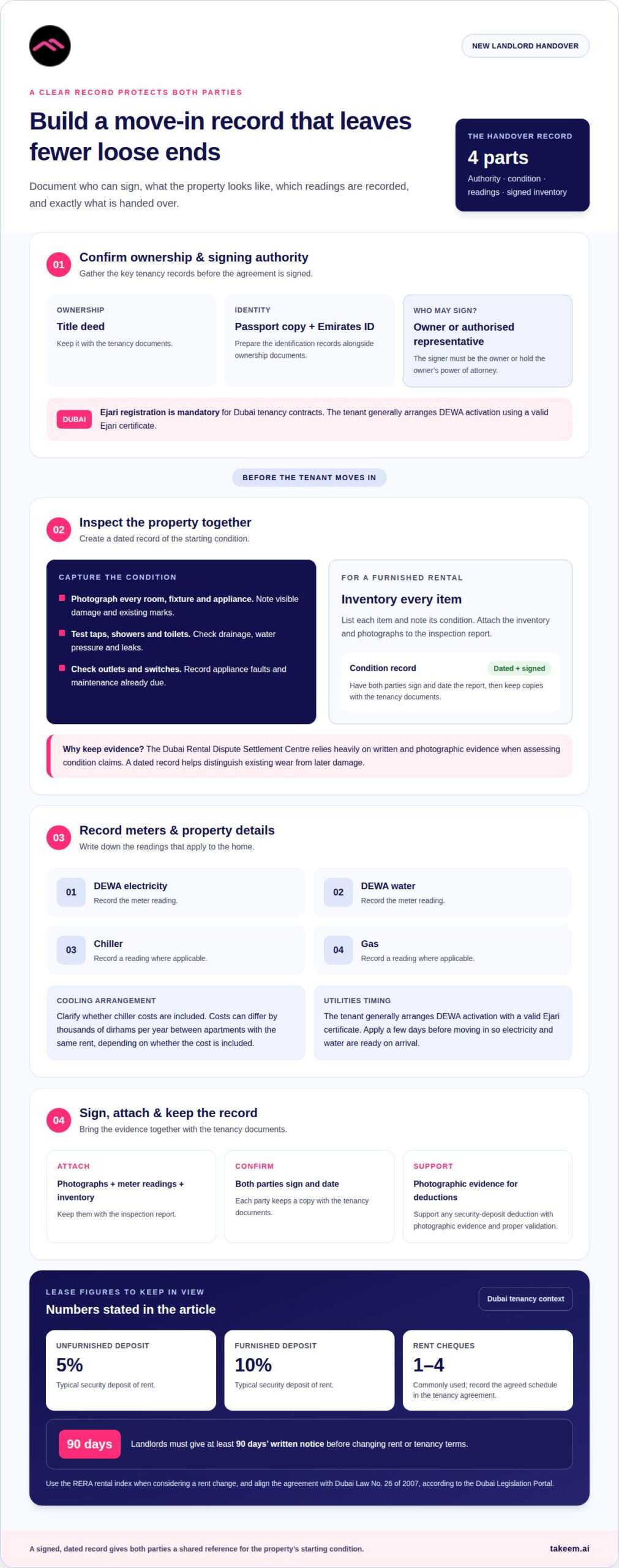
    An essential checklist for new landlords in Dubai starts with records that establish ownership and signing authority. Keep the title deed, passport copy and Emirates ID with the tenancy documents. The person signing the tenancy agreement must be the owner or hold the owner’s power of attorney.

    Inspect the property with the tenant before handover. Photograph every room, fixture and appliance, and note visible damage or existing marks. Test taps, showers and toilets, then check drainage, water pressure, leaks, outlets and switches. A dated, signed report gives both parties a shared record of the property’s condition.

    • Record DEWA electricity and water meter readings, plus chiller and gas readings where applicable.
    • For a furnished rental, list each item and note its condition.
    • Record appliance faults or maintenance already due before the tenant moves in.

    Attach photographs, readings and the inventory to the inspection report. Have both parties sign and date it, then keep copies with the tenancy documents. The Dubai Rental Dispute Settlement Centre relies heavily on written and photographic evidence when assessing condition claims. This essential checklist for new landlords in Dubai also helps distinguish existing wear from later damage.

    Typical security deposits are 5% of rent for an unfurnished rental and 10% for a furnished one. Support any deduction with photographic evidence and proper validation. Dubai rental agreements commonly use one to four rent cheques, so record the agreed schedule in the tenancy agreement.

    Landlords must give at least 90 days’ written notice before changing rent or tenancy terms. Use the RERA rental index when considering a rent change, and align the agreement with Dubai Law No. 26 of 2007, according to the Dubai Legislation Portal.

    Ejari registration is mandatory for Dubai tenancy contracts. Without it, the contract does not provide DEWA activation or standing at the Rental Dispute Settlement Centre. Keep insurance policies, service-charge records and ongoing property bills together. These costs depend on the property and the cover or services selected.

    Building access, parking and move-in procedures

    Some Dubai buildings require formal move-in approval before a tenant can bring in furniture or arrange a move. Include the building’s approval process in the handover plan, and record any booking details, access instructions or restrictions provided by building management. This helps prevent confusion on move-in day.

    For utilities, the tenant generally arranges activation with DEWA using a valid Ejari certificate. Apply a few days before moving in so electricity and water are ready on arrival. Cooling arrangements need separate attention: chiller costs can differ by thousands of dirhams per year between apartments with the same rent, depending on whether the cost is included.

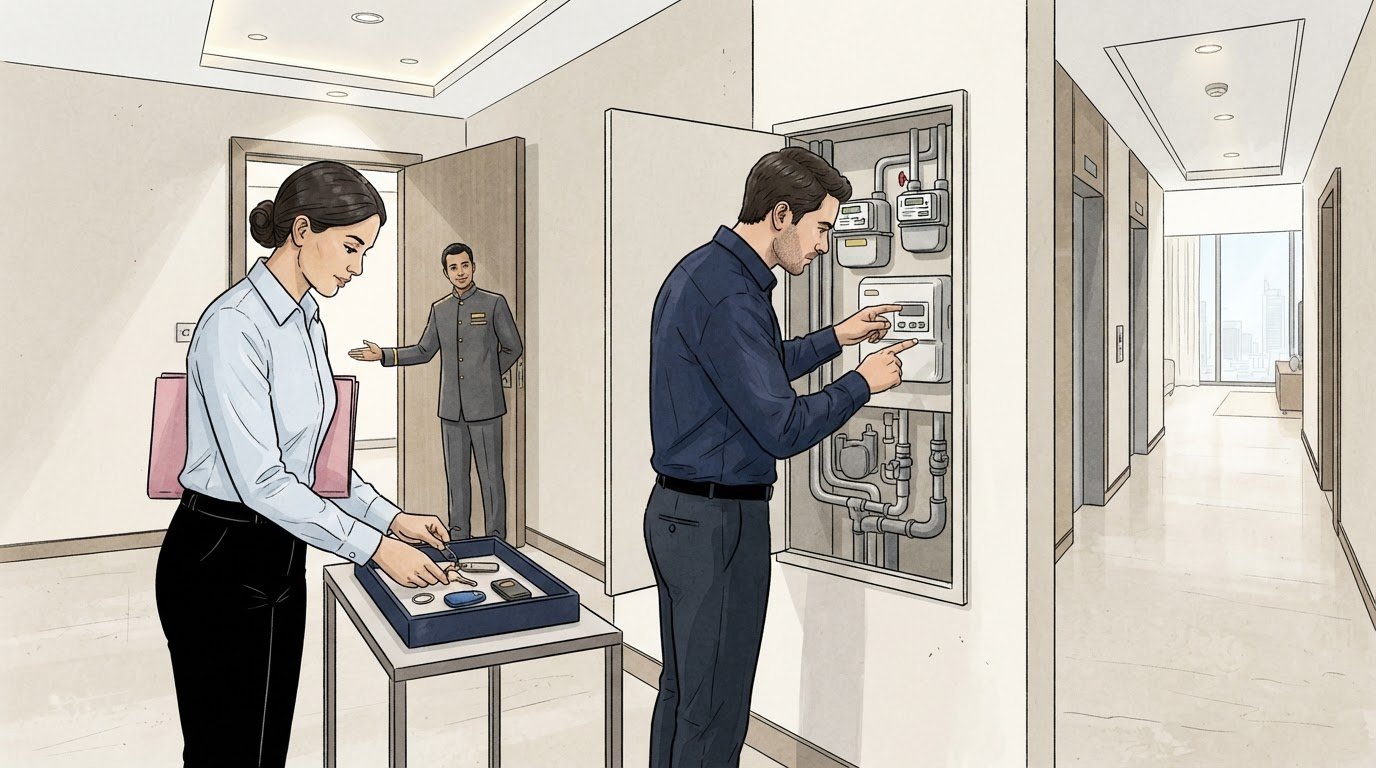
    • Write down the number of keys, access cards, parking remotes, gate openers and mailbox keys handed over.
    • Record which doors, gates or shared facilities each card or remote opens, without including sensitive access codes in a widely shared record.
    • Identify any parking bay assigned to the rental and note its access method in the contract or handover record.
    • Settle final utility bills and collect keys, remotes and access cards when the tenancy ends.

    During handover, have the tenant acknowledge receipt of each item in writing. A signed inventory makes it easier to compare what was provided with what is returned, helping reduce disputes about missing keys or access devices. Keep a copy with the property documents and signed tenancy contract.

    Make the move-in sequence clear: secure any building approval, agree on the move date, arrange utility activation, then hand over the documented access items. Dubai has two main telecom providers for tenants setting up internet. Keeping provider arrangements and building instructions in the move-in record gives both parties a clear reference.

    For landlords who also want to streamline rent collection after move-in, digital tenant payment setup can support accepting monthly payments.
    Essential landlord checklist before move-in

    Confirming parking, gas, internet and move-in permits

    Make building access part of the move-in plan, not a last-minute detail. Some Dubai buildings require formal move-in approval, so establish the process and arrange the required approval before the tenant’s moving date. Keep the approval details with the tenancy contract and move-in record, giving the tenant a clear reference for the scheduled move.

    Clarify parking arrangements too. Identify the bay assigned to the rental, explain how the tenant can access it, and record any parking remote handed over. If parking is not included in the rental, state that clearly in the agreement. Clear terms help avoid disputes about whether a space forms part of the rent.

    • Record the parking bay, access method and any remote provided.
    • Note whether the home has piped gas, as not all Dubai apartments do.
    • Clarify who arranges gas service and whether the tenant needs a separate connection.
    • Include building move-in approval instructions with the handover documents.

    Check the gas arrangement before the tenant plans to use a cooker or other gas appliance. If the property has no piped supply, explain the arrangement for that home. When gas is connected, record relevant readings at handover alongside the other utility details.

    For internet, television and phone setup, identify the available connection points and any equipment provided with the property. Dubai has two main telecom providers. The tenant can use the tenancy documents and registered Ejari details when arranging service. Clarify whether existing equipment stays in the home or belongs to the outgoing occupant.

    Coordinate the practical steps: confirm any building approval, identify parking access, document the gas arrangement, and share the information needed for internet and TV setup. Arrange utility activation a few days before move-in so electricity and water are active on arrival. A written record supports a smooth handover and makes each party’s responsibilities easier to follow.

    Reviewing maintenance and early-termination clauses

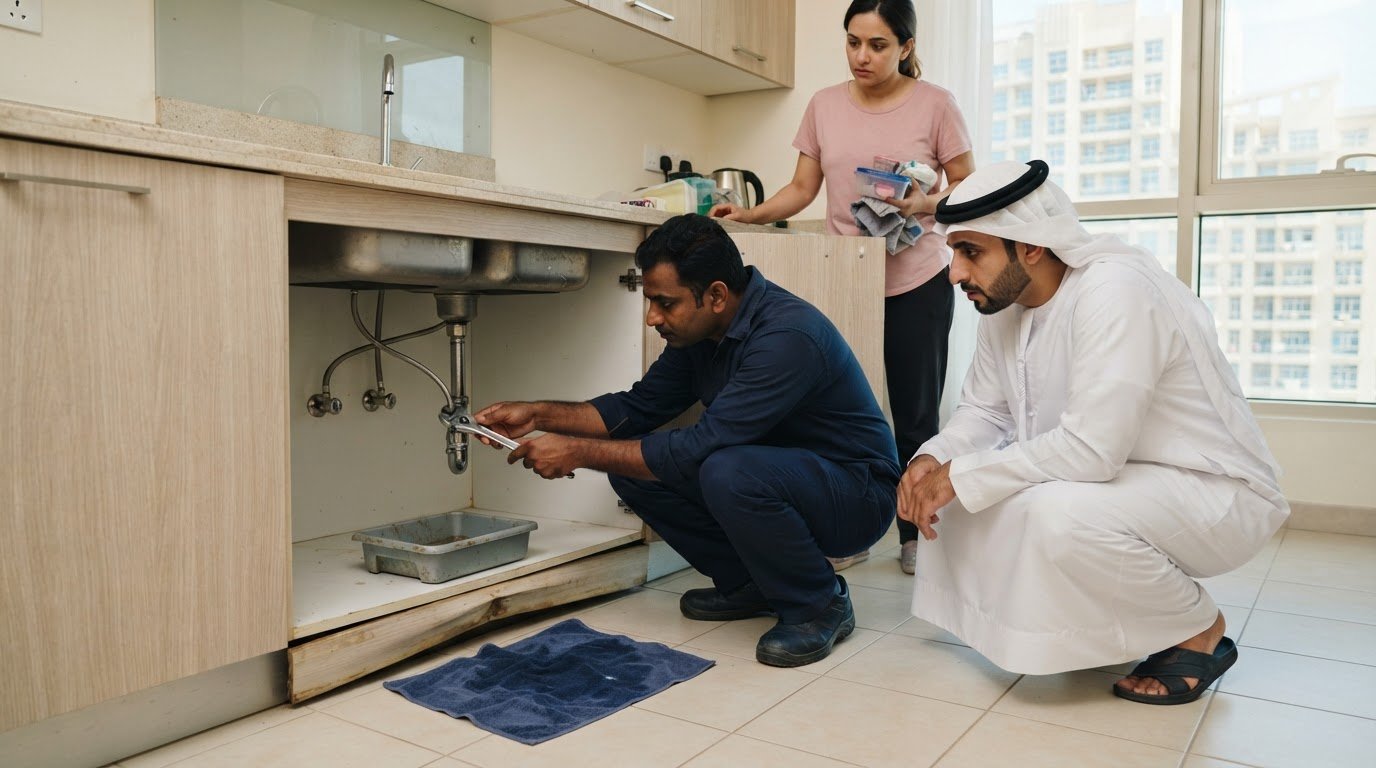
    Before renting an apartment in Dubai, set out maintenance responsibilities in the tenancy agreement. Landlords are normally responsible for property maintenance and repairs. The contract can assign minor maintenance to the tenant, so define what counts as minor work and who arranges it.

    Be specific. State who handles AC servicing, plumbing problems and appliance repairs. AED 500 is a common maintenance-cost threshold in Dubai rental contracts, but the agreement should explain how its threshold applies. Record the process for reporting a fault, arranging access and approving work. This avoids uncertainty when a repair affects the property’s use.

    Before move-in, test the provided appliances and note any maintenance due. Keep an inspection record describing existing faults and the condition of each appliance. A landlord must provide a safe, habitable property before handover. Clear notes help distinguish a known issue from a later repair request.

    • Specify responsibility for routine servicing and urgent repairs.
    • Set out how the tenant reports problems and how access is arranged.
    • Clarify responsibility for minor maintenance in the tenancy agreement.
    • Address subleasing, repairs and key return in any relevant lease addendum.

    Include an early-termination clause that explains the agreed process, notice method and any applicable conditions. For eviction in specific cases, Dubai landlords must provide 12 months’ written notice. This is not a blanket notice period for every tenancy ending, so state the relevant contractual process clearly and keep written notices with the property records.

    Routine repainting at the end of a tenancy is the owner’s responsibility. Document the property’s condition in a joint inspection, then use the signed record to clarify any discussion about repairs or repainting.

    For landlords looking to combine rental protection with emergency property maintenance, explore the Landlord Rental Guarantee.

    Takeem: Direct Debit setup for Landlords to digitally accept monthly payments from tenants

    Takeem provides landlords with Direct Debit setup to digitally accept monthly tenant payments. It can be a practical next step once the tenancy agreement, property records and move-in arrangements are in place, especially if you want to collect rent digitally.

    Set up the payment arrangement alongside the agreed rent schedule, and keep the tenancy documents clear. Digital acceptance supports rent collection, while the signed agreement remains the record of the tenant’s payment obligations. For landlords seeking rental protection too, Takeem offers a Landlord Rental Guarantee that includes emergency property maintenance.

    To explore digital rent collection for your property, contact Takeem about its Direct Debit setup for landlords.

    Set up your rental for the next stage

    A prepared tenancy is the start of a repeatable rental process. Turn the essential checklist for new landlords in Dubai into a consistent standard for each new tenant, then keep your records and payment arrangements organised throughout the tenancy. That discipline can make future handovers easier to manage.

    For additional rental support, Takeem offers a Landlord Rental Guarantee, including an option for property investors with large portfolios. Agents can also sell the guarantee for healthy commissions. Choose support that fits your role and rental needs while keeping the clear agreement and records that underpin the tenancy.

    Ready to discuss the next step for your rental? Contact Takeem about your rental. A considered setup now can help you move forward with greater clarity and confidence.

    Frequently Asked Questions

    What documents do landlords need in Dubai?

    Landlords generally need a title deed, passport copy and Emirates ID to document ownership and identify the parties to the rental. If someone signs for the owner, that person must hold the owner’s power of attorney. Keep the tenancy agreement and Ejari certificate with these records. A clear file can also include the unit details and signed handover documents, connecting the paperwork to the correct home.

    Are there companies that can manage tenancy contracts and related processes?

    Yes. Property management companies in Dubai may help find tenants, prepare rental agreements and support timely rent payments. These services cover broader tenancy processes. Takeem provides landlords with Direct Debit setup to digitally accept monthly tenant payments. This supports rent collection, but is not the same as managing tenancy contracts or the full rental process.

    Can a landlord modify a tenancy contract?

    Yes, tenancy terms can be amended, but landlords must give tenants at least 90 days’ written notice before changing rent or amending tenancy terms. Put any agreed change in a written record, identify the clause being changed and have both parties sign it. Keep that signed amendment with the original agreement so the current terms are easy to distinguish from earlier wording.

    How do I avoid rental scams in Dubai?

    Verify the broker’s registration for free through the Dubai REST app or Dubai Brokers app. Confirm that the person signing has authority from the property owner, and ensure the tenancy contract will be registered in Ejari. Keep payment records and signed documents together, and don’t rely on informal messages as proof of an agreement. These steps help establish who is involved and which property the rental concerns.

    How do I know if the rent I am quoted is fair?

    Use the RERA rental index as a reference when assessing a proposed rent or increase, then compare the property with similar homes. Consider the apartment’s condition, furnishing, location and whether cooling costs are included, since chiller arrangements can materially affect yearly expenses. Review the specific tenancy terms too: the rent alone may not reflect the full cost of occupying the property.

    How many cheques is normal for Dubai rent?

    Dubai rental agreements commonly use one to four rent cheques. The number determines how payments are divided across the rental period, so read the payment dates and amounts in the tenancy agreement before signing. Confirm, for example, that each cheque’s date matches the agreed schedule. Keep a copy of the payment terms with the contract to avoid confusion later.
  • Four first-time landlord mistakes to avoid in the UAE

    Four first-time landlord mistakes to avoid in the UAE

    Rental income is only part of the return; service and maintenance charges can reshape a property’s costs. The four first-time landlord mistakes to avoid in the UAE are underbudgeting refurbishment and ongoing charges, leaving property preparation too late, relying on verbal or unclear rental terms, and attempting tenant removal without following the applicable legal process.

    It’s easy to focus on rent and overlook the costs and timing that shape a tenancy from the start. Annual service charges vary by community and developer and may cover shared facilities such as pools, gyms, security, and landscaping. This guide explains how to budget for refurbishment and recurring charges, prepare a property before marketing it, document rental terms, and understand why proper notice and records matter if a tenancy breaks down. Some requirements vary by emirate, so don’t assume Dubai rules apply across the UAE.

    Key Takeaways

    • Build a refurbishment budget that accounts for unexpected repairs, not just visible upgrades.
    • Plan inspections and essential work before marketing the property to reduce avoidable delays.
    • Put tenancy terms in writing and follow the correct notice process if seeking eviction.
    • Factor community service charges into your rental calculations, as they can affect net returns.

    1. Allowing a contingency for refurbishment costs

    Refurbishment costs often go beyond the visible repair. A dated kitchen may also need plumbing or electrical work, fresh paint, or replacement fittings before you market the property. List the work you know is needed, get written estimates, and set aside a contingency for problems uncovered during the project. This helps reserve your budget for essential repairs instead of letting cosmetic upgrades consume the available funds.

    Dubai ownership costs also continue after refurbishment. They can cover shared facilities, including pools, gyms, security, and landscaping. Dubai’s annual housing fee is 5% of the property’s rental value, divided into 12 monthly payments added to the DEWA bill. Include maintenance and these recurring charges when estimating net rental income.

    UAE landlords can consider building, contents, liability, and rent-loss insurance. Coverage depends on each policy’s insured events, limits, and exclusions, so don’t assume one policy covers every property or rental risk.

    Keep dispute expenses in a separate reserve, rather than treating them as routine service charges. In Dubai, the Rental Disputes Centre filing fee is 3.5% of annual rent, with a minimum of AED 500 and a maximum of AED 20,000. These costs may matter if a rental dispute proceeds to filing.

    Build a property-cost worksheet before setting the rent. Record refurbishment estimates, recurring service charges, maintenance, the housing fee, insurance, and any applicable dispute administration expenses. Compare expected rental income with these obligations, not just the purchase price. Update the worksheet when extra work is identified or annual community charges change. This gives you a more realistic picture of ownership costs and helps you plan for responsible maintenance and rental.

    2. Allowing enough time for property preparation

    One of the first-time landlord mistakes to avoid in the UAE is marketing a home before repairs, cleaning, and access arrangements are ready. Begin with a walkthrough, then schedule maintenance, cleaning, and photography in that order. This prevents contractor work from undoing a fresh clean or making listing photographs inaccurate. For a property in Dubai, also plan viewings around building access and tenant availability.

    Compare investment potential before setting the rent. Review comparable properties, price per square foot, rental yield, and resale potential together. A lower purchase price doesn’t automatically mean stronger returns if rental demand or resale prospects are weaker. Research the local rental market and set an asking price that reflects similar homes, rather than the return you hope to achieve.

    Prepare marketing materials that represent the finished property accurately. Photograph each room in daylight, show practical features such as storage and parking, and make sure the listing description matches the unit. Schedule viewings and record enquiries, attendance, and feedback. A competitively priced Dubai property marketed professionally may take from a few days to a few weeks to secure a tenant, so avoid assuming a move-in date before interest develops.

    Another first-time landlord mistake to avoid in the UAE is leaving a listing unchanged when it attracts little interest. Review the asking price, photos, description, and viewing access, then adjust what is underperforming. After tenants leave, inspect the property and record the condition of appliances, fixtures, walls, and keys. Arrange repairs before the next photos or viewings, and keep payment records with tenancy and Ejari registration details.

    For a more organised monthly rent process, consider a digital Direct Debit setup for landlords. Coordinating payments with preparation and marketing can help make each tenancy easier to administer.

    Set rent after researching the market and aim for a price that is competitive and aligned with similar properties. A careful condition check is just as important: it can reveal overlooked maintenance that needs attention before you present the property to prospective tenants. Schedule inspections consistently, including when circumstances make it harder to visit the property.

    Four first-time landlord mistakes to avoid in the UAE

    3. Avoiding verbal agreements and unlawful tenant removal

    A verbal agreement can leave rent, payment dates, deposit terms, and repair responsibilities open to dispute. Put the tenancy terms in a written contract, keep signed records and messages, and register Dubai tenancy contracts through Ejari. These records clarify each party’s rights and obligations if the tenancy changes or a disagreement reaches the Rental Disputes Centre.

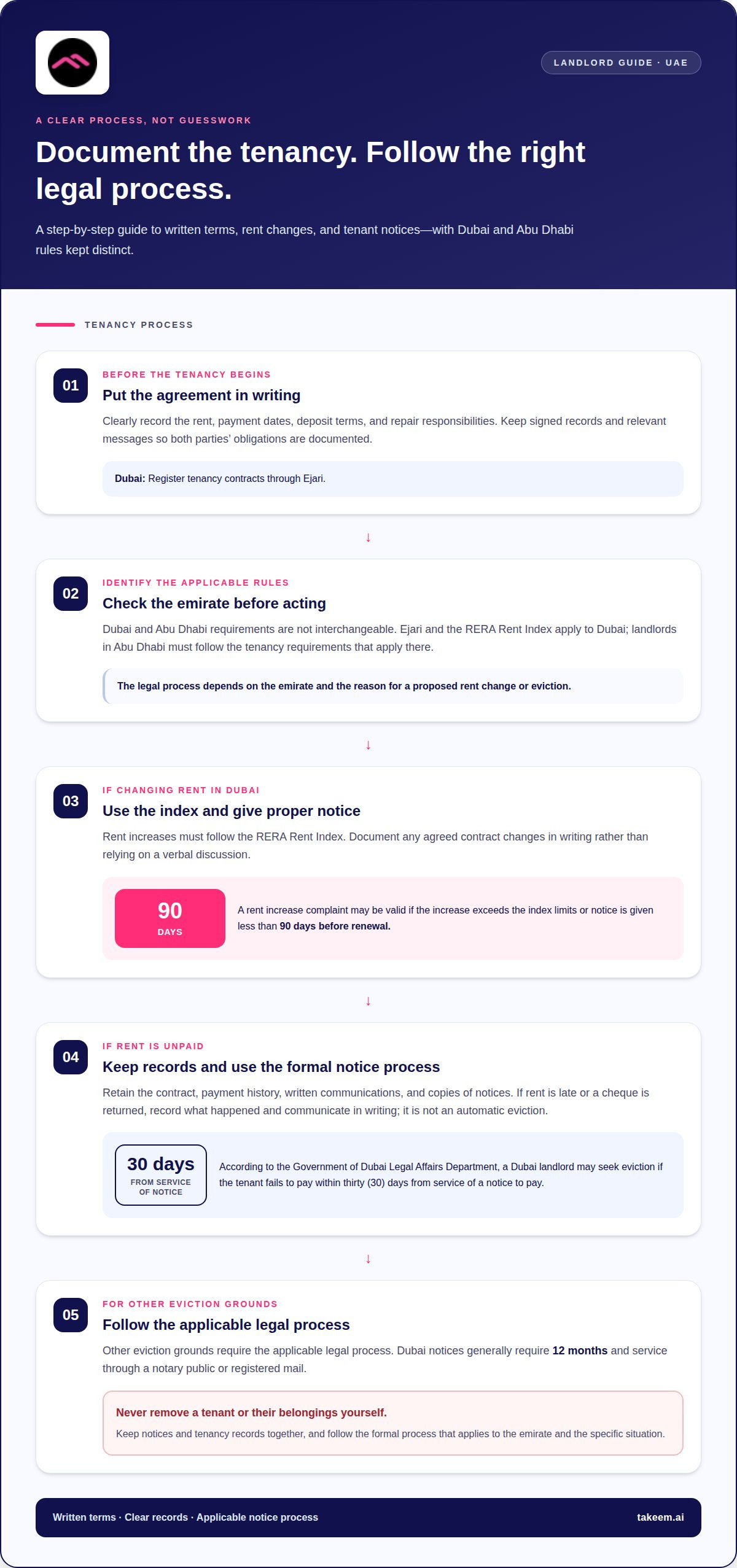
    Dubai and Abu Dhabi rules are not interchangeable. Ejari and the RERA Rent Index apply to Dubai, while landlords in Abu Dhabi must follow the tenancy requirements that apply there. The legal process depends on the emirate and the reason for a proposed rent change or eviction.

    In Dubai, rent increases must follow the RERA Rent Index, and landlords must provide proper notice. A rent increase complaint may be valid if the increase exceeds the index limits or notice comes less than 90 days before renewal. Don’t rely on a verbal discussion to change the contract; document agreed changes in writing.

    For unpaid rent, retain the contract, payment history, written communications, and copies of notices. According to the Government of Dubai Legal Affairs Department, a Dubai landlord may seek eviction if the tenant fails to pay rent within thirty (30) days from service of a notice to pay. Other eviction grounds require the applicable legal process; Dubai notices generally require 12 months and service through a notary public or registered mail. Never remove a tenant or their belongings yourself.

    Screen prospective tenants through due diligence and keep relevant documents with the tenancy record. If rent is late or a cheque is returned, record what happened, communicate in writing, and follow the formal notice process rather than treating it as an automatic eviction. Weigh a real estate agent’s fee against the specific tenant-finding service and support provided, and clarify responsibilities before agreeing.

    Plan tenant changeovers around the contract end date. Schedule an inspection, record the property’s condition, and allow time for repairs and new viewings. A period without a tenant can reduce rental income, so coordinate the outgoing tenant’s handover with the next marketing and registration steps.

    4. Service and maintenance charges

    Service charges can reduce rental income even when a unit stays occupied. Treat them as a recurring ownership cost, separate from repairs inside the home. Charges vary by community and developer, so neighbouring buildings may have different cost structures. Compare the property’s charges with expected rent before deciding whether the investment works.

    Ask what the annual charge covers and how it is calculated. Shared facilities may include pools, gyms, security, and landscaping. Note which costs appear on the service-charge statement and which remain separate, such as private maintenance. A clear breakdown helps avoid mistakes, such as assuming shared-area upkeep covers a leaking tap inside the apartment.

    Build a simple annual cash-flow overview. Record rental income, service charges, planned maintenance, and any periods without tenants, then calculate what remains after these costs. If a charge rises or an unexpected repair comes up, update the calculation before spending on optional improvements. This gives you a practical basis for assessing whether the property remains financially viable.

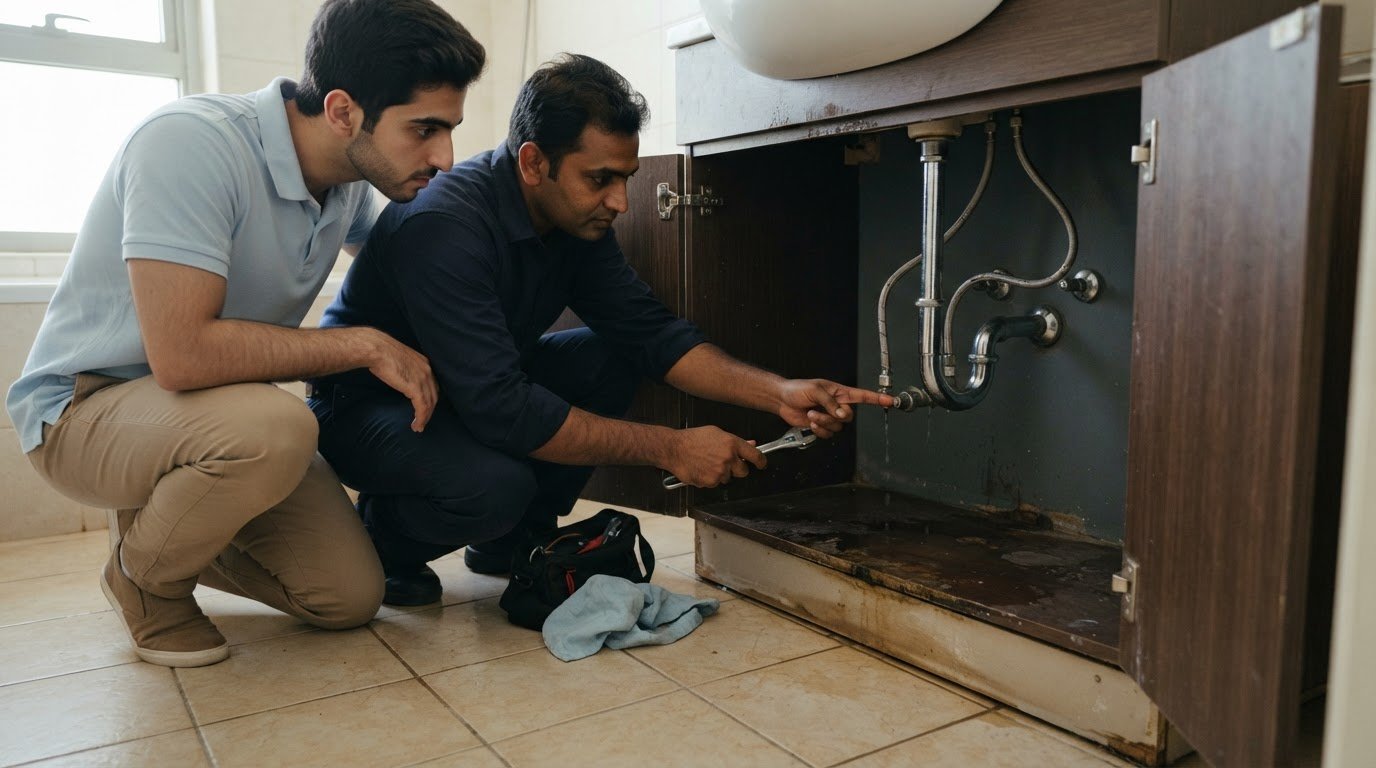
    Who pays for repairs depends on the tenancy contract and applicable emirate rules. In Dubai, major property repairs are the landlord’s responsibility. Set out routine maintenance responsibilities in the written agreement, then keep repair requests, invoices, and completion dates together. For example, document whether a minor fixture repair falls to the tenant or landlord instead of leaving the question unresolved during the tenancy.

    Maintenance planning also helps protect the condition of the building and unit. Record reported issues, arrange necessary work, and retain evidence of completed repairs. Don’t treat a service-charge payment as proof that every repair inside the property is covered. Separate community costs from landlord maintenance, then review both when renewing your rental budget.

    For a maintenance plan that includes emergency property maintenance, explore property maintenance support as part of a rental guarantee.

    Takeem: Direct Debit setup for Landlords to digitally accept monthly payments from tenants

    Takeem helps landlords set up Direct Debit to accept monthly rent payments digitally from tenants. This can be a practical next step when tracking payments through separate messages or records becomes difficult. A clear digital payment process can make rent administration more organised, while the tenancy contract continues to define payment terms and each party’s obligations.

    Landlords seeking rental income protection can also consider Takeem’s Landlord Rental Guarantee. Property investors with large portfolios can explore the related Rental Guarantee offering. Choose the option that best fits your priority, whether that is accepting monthly payments or protecting rental income.

    If you’re ready to discuss a digital payment setup for your rental, contact Takeem.

    Turn your first tenancy into a stronger operating routine

    Your first rental can lay the foundation for a more deliberate approach to property ownership. Make each decision part of a repeatable system: organise key records, review the investment’s performance, and use what each tenancy teaches you to improve the next one. This discipline can clarify future decisions, whether you own one home or plan to grow your portfolio.

    The most important first-time landlord mistakes to avoid in the UAE often become habits: relying on memory, making decisions without a clear record, or leaving every task until it feels urgent. A consistent process gives you a better view of your responsibilities and helps you act purposefully as your rental business develops.

    If you’re ready to explore support for your landlord needs, see how Takeem can help. Take the next step with a clear plan and build your experience with confidence.

    Frequently Asked Questions

    How do Dubai and Abu Dhabi tenancy laws differ for landlords?

    Dubai uses Ejari and the RERA Rent Index, while Abu Dhabi landlords must follow the tenancy requirements that apply there. The rules vary by emirate and are not interchangeable.

    What are the current rent increase rules and notice periods in Dubai and Abu Dhabi?

    In Dubai, rent increases must follow the RERA Rent Index and landlords must give proper notice. A complaint may be valid if an increase exceeds the index limits or notice is given less than 90 days before renewal. Abu Dhabi landlords must follow the requirements applicable there.

    How should landlords screen tenants and verify documents in the UAE?

    Screen prospective tenants through due diligence and keep relevant documents with the tenancy record. Put the agreement in a written contract, retain signed records and messages, and register Dubai tenancy contracts through Ejari.

  • How to Set Up Direct Debit for a Tenant’s Rent

    How to Set Up Direct Debit for a Tenant’s Rent

    Rental cheques aren’t the only way to schedule rent in the UAE. If you’re considering how to set up direct debit for a tenant, the key step is to have the tenant authorise recurring rent collection from their nominated UAE bank account on agreed due dates. A standing order works differently: the tenant instructs their bank to send each payment.

    It’s understandable to want rent collection to be predictable without asking the tenant to arrange a manual transfer each time. Direct debit offers a digital alternative to cheques, with a payment schedule agreed around the tenancy terms and authorised by the tenant.

    This guide explains what direct debit means, how rent collection is set up, and what to agree before payments begin. You’ll also learn how to switch from rental cheques and what to consider when arranging setup support, so you can decide whether this approach suits your tenancy.

    Key Takeaways

    • Arrange direct debit alongside the tenancy terms so the payment schedule and tenant authorisation are clear from the outset.
    • Understand how a provider coordinates recurring rent collection from the tenant’s nominated account and keeps payment details aligned with agreed terms.
    • Consider how scheduled payments can reduce the need for tenants to make manual transfers while keeping the rent routine predictable.
    • Plan a move from rental cheques around the tenancy agreement, with advance notice if the payment method changes during the lease.

    How a provider sets up direct debit at the start of a tenancy

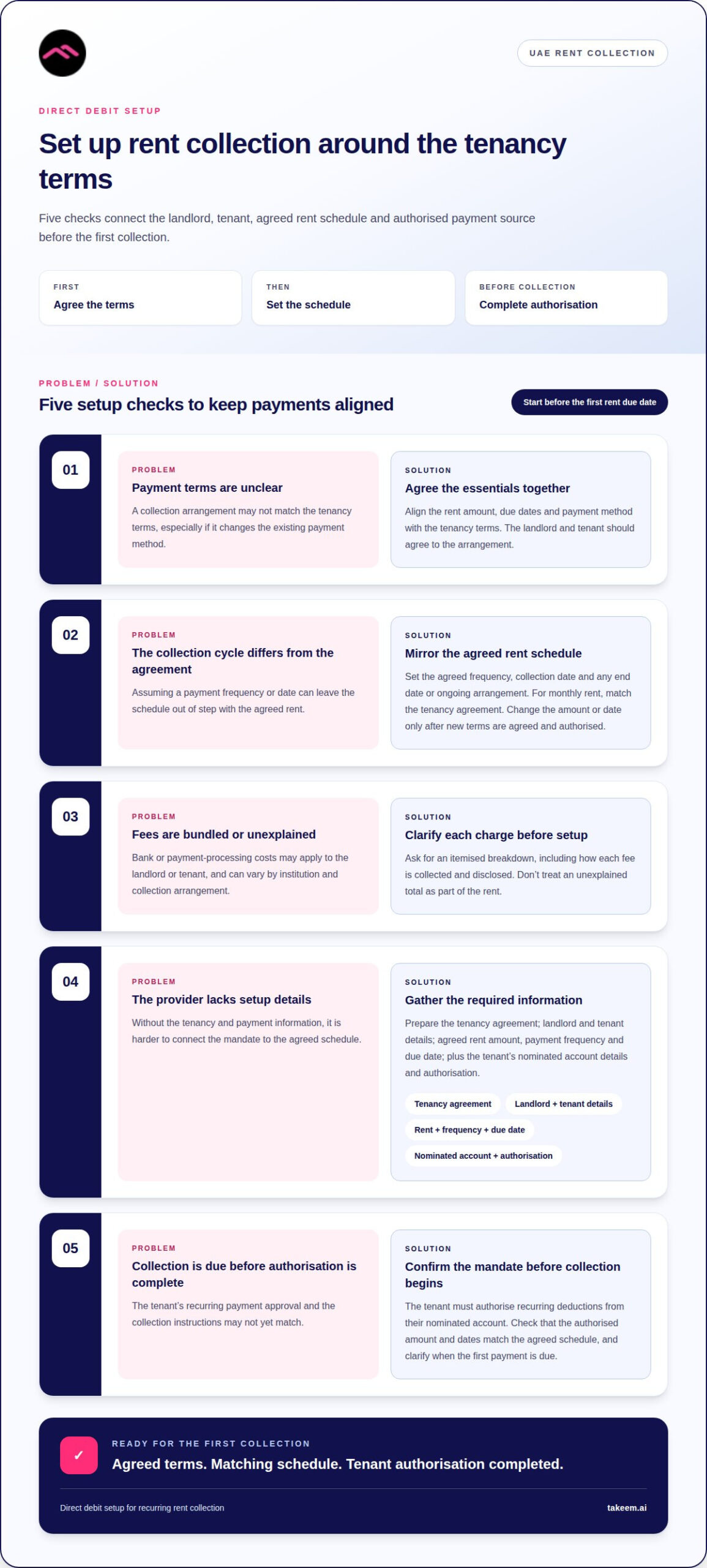
    The setup connects the landlord, tenant, and tenancy terms to the payment schedule. Start before the first rent due date to leave time to agree on the schedule and complete the tenant’s authorisation.

    1. Align the payment method with the tenancy terms. In the UAE, rent collected by direct debit should match the agreed rent amount, due dates, and payment method. The tenant must authorise recurring deductions from their nominated account. The landlord and tenant should agree to the arrangement, especially if it changes the existing terms.
    2. Set the schedule around the agreed rent. The payment schedule should reflect the agreed frequency, collection date, and any end date or ongoing arrangement. If rent is due monthly, for example, set the schedule to match the tenancy agreement rather than assuming a different cycle. If the rent or due date changes, update the schedule only after the new terms are agreed and authorised.
    3. Check Bank and Provider Fees

      Before setup, clarify any fees that apply to the landlord or tenant, including bank or payment-processing charges. Costs can vary according to the institutions and collection arrangement. Ask for an itemised breakdown and how each fee is collected and disclosed. Don’t treat an unexplained total as part of the rent.

    4. Provide the Required Documents and Information

      Provide the tenancy agreement, landlord and tenant details, agreed rent amount, payment frequency, and due date. The tenant’s nominated account details and authorisation are also needed to arrange collection. These details connect the payment mandate to the tenancy and help keep the schedule consistent with the agreed terms.

    5. Complete tenant authorisation before collection begins. The tenant must approve recurring payments from their nominated account. Confirm that the authorised schedule matches the agreed amount and dates. This step links the tenancy details to the collection instructions and clarifies when the first payment is due.

    How a provider collects rent from a tenant’s nominated bank account or credit card

    The provider connects the tenant’s authorisation to the agreed rent schedule, then tracks each collection against the tenancy record.

    1. Choose a provider for the payment method and records you need. For UAE rent collection, look for support for authorised bank-account debits, clear payment records, and updates when tenancy terms change. Understand how payments are identified and how missed or unsuccessful collections are reported. These details help landlords manage rent without checking for each manual transfer.
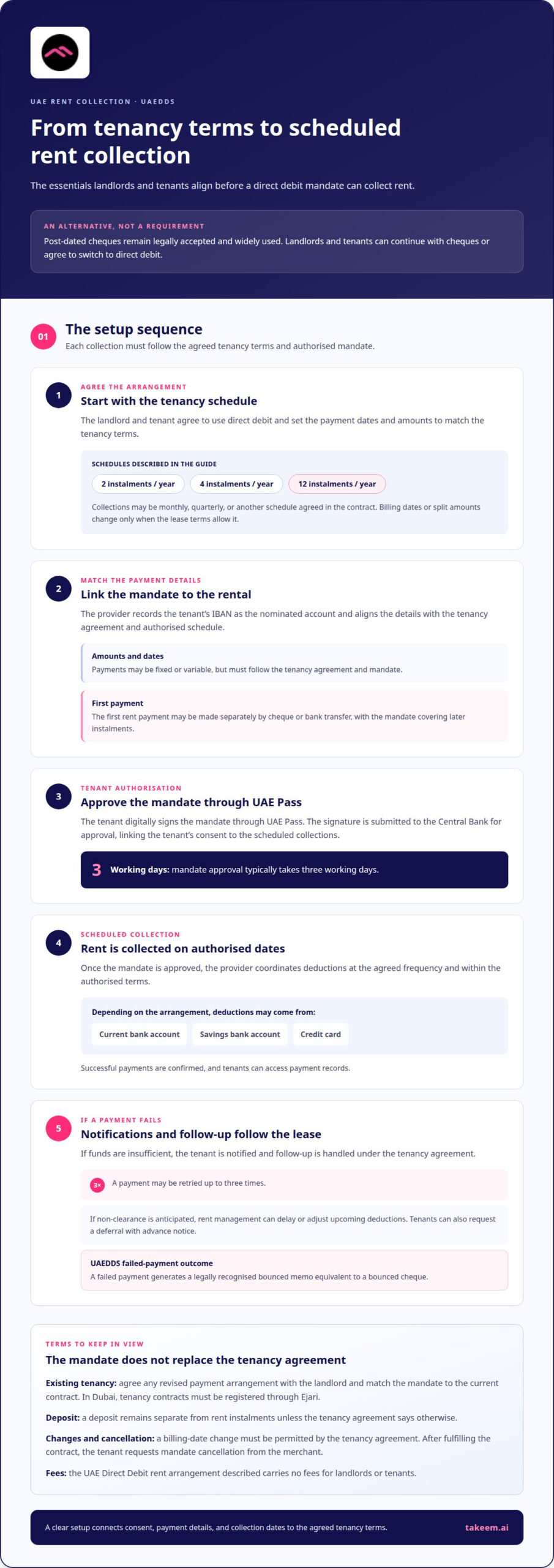
    2. Link the tenant’s authorisation to the right payment source. The Direct Debit System says recurring payments can be authorised using UAE PASS biometrics. The tenant’s mandate should identify the nominated account and match the agreed rent schedule. If the agreed method is a credit card, the provider must process card authorisation, not treat it as a bank-account debit.
    3. Schedule each collection for the agreed due date. According to the Direct Debit System, scheduled payments are automatically debited from the payer’s preferred UAE bank account on that date. Collection follows the authorised schedule. If rent terms change, update the payment amount or date only after the landlord and tenant agree to and authorise the new arrangement.
    4. Match incoming payments to the tenancy. A tenant reference linked to the rent record helps identify which tenancy a payment relates to. This makes reconciliation clearer for landlords handling several properties. Payment confirmations and records should also be accessible, so the tenant and landlord can refer to the same collection history.
    5. Keep the collection record current. Review the schedule when a tenancy is renewed, rent changes, or the tenant changes their authorised payment source. A provider that manages these updates and records supports a more orderly process than relying on separate manual notes. For a streamlined digital rent collection setup, use a service designed for landlords and recurring tenant payments.

    How to Set Up Direct Debit for a Tenant’s Rent

    Convenience for tenants

    Scheduled collections can reduce the effort tenants spend arranging rent manually. These steps show how direct debit can fit into a tenant’s monthly routine.

    1. Explain the payment schedule before activation. Make sure the tenant can see the agreed collection date and recurring amount. This helps them plan rent alongside other monthly commitments. Reviewing the schedule and upcoming payment can be more reliable than relying on memory or arranging a manual transfer each time.
    2. Set up useful advance notifications. Direct Debit services can send tenants SMS and email notifications before a scheduled deduction. A reminder gives notice of the upcoming collection and its amount. During setup, clarify when and how notifications are sent, so the tenant knows where to look for updates.
    3. Make schedule details easy to review. Tenants benefit from access to their payment schedule and upcoming collections. A provider can present the dates and amounts in an accessible record, helping tenants plan ahead. This is particularly useful when a tenant wants to check the next due date without searching through old messages or manually reviewing previous transfers.
    4. Communicate changes promptly. When the landlord and tenant agree to new terms, update the authorised payment details and notify the tenant. Clear communication helps distinguish the current arrangement from an earlier schedule. The tenant can review the revised date or amount before the next collection.
    5. Keep manual payment tasks to a minimum. Manually transferring rent or paying in cash can be inconvenient. With an authorised recurring schedule, the tenant does not need to initiate each payment. They should still track the agreed schedule and ensure funds are available. Payment records provide a practical reference for completed collections.

    Direct debit as an alternative to rental cheques

    1. Compare the payment pattern with the tenancy agreement. Rental cheques set out payment dates in advance, while direct debit uses an authorised schedule for recurring collections. Monthly rent can be collected by direct debit when that matches the agreed terms. It can follow post-dated cheque dates only if the landlord and tenant agree to and authorise that schedule.
    2. Choose a suitable point to switch. Tenants who have already issued rent cheques may be able to move to direct debit at renewal or earlier, depending on their agreement. Review which cheque dates are still outstanding and how the proposed debit schedule fits. Agree on the transition before replacing the existing arrangement, so both parties know which method applies to each instalment.
    3. Give advance notice if the lease is still running. If switching tenants to direct debit during a lease, notify them in advance. Explain the change, first collection date, and scheduled amount. If a cheque already covers an upcoming rent period, clarify how it fits with the new arrangement before starting a debit.
    4. Keep the new schedule tied to agreed terms. Direct debit replaces the tenant’s repeated payment action, not the need for a clear agreement. The authorised amount and dates should match the tenancy terms. If rent or the billing date changes, agree on the revised terms and authorise the updated schedule before collection. This prevents cheque dates and debit instructions from conflicting.
    5. Make the switch a documented handover. Record which payment method applies, the date direct debit begins, and how any existing cheques are treated. This gives the tenant and landlord a shared reference if a payment appears under the old method. For landlords moving from cheques to recurring digital collections, arrange direct debit rent setup around the agreed tenancy schedule.

    Takeem: Direct Debit setup for Landlords to digitally accept monthly payments from tenants

    Takeem helps landlords set up direct debit to accept monthly rent payments from tenants digitally. It’s a practical option when you’ve agreed to move from rental cheques or manual transfers to an authorised recurring schedule. The setup connects the tenant’s nominated payment method to the rent terms agreed for the tenancy.

    Landlords can use Takeem’s digital collection service on its own or alongside a Landlord Rental Guarantee. Property investors with large portfolios can also explore the Rental Guarantee for Property Investors with Large property Portfolios. The right fit depends on whether you need digital rent collection alone or broader support through a rental guarantee.

    Ready to arrange digital rent collection for your tenancy? Contact Takeem to discuss direct debit setup.

    Make rent collection part of a clearer tenancy process

    Decide how digital rent collection will fit your tenancy workflow. Consider who will coordinate tenant authorisation, how payment records will be reviewed, and how agreed schedule changes will be communicated. Settling these details helps landlords and tenants begin with shared expectations.

    For landlords, deciding how to set up direct debit for a tenant is an opportunity to modernise rent collection in a way that fits their portfolio. Takeem provides direct debit setup for landlords and rental guarantees, including an option agents can sell for healthy commissions. Choose the support that matches your role and property needs, then move forward with an agreed process.

    Contact Takeem about rent collection to discuss the next step. A more organised payment process can begin with one practical decision.

    Frequently Asked Questions

    What is a direct debit?

    A direct debit lets a tenant authorise recurring rent collection from a nominated UAE bank account. For landlords considering how to set up direct debit for a tenant’s rent, the process links the tenant’s approval to an agreed payment schedule. Rather than initiating a bank transfer for every instalment, the tenant authorises a mandate. The amount and timing should match the tenancy terms and authorisation.

    What about control?

    The tenant gives permission for recurring collections through a mandate that sets out the authorised payment arrangement. When setting up direct debit for a tenant, link that authorisation to the agreed terms. A tenant who needs to defer a debit can make a request in advance. Keep the request and response in writing for a clear record.

    What if I’m already mid-lease and cheques have been issued?

    A mid-lease switch needs a clear handover between cheque payments and the new debit schedule. List the rent instalments covered by issued cheques, then agree which instalment will be the first collected by direct debit. If a cheque already covers the next rent period, for example, set the debit start date for a later agreed instalment to avoid confusion about what has been paid.

    What if my rent amount changes, such as at renewal?

    A rent change should affect direct debit only after the landlord and tenant agree to the new terms. Then update the schedule and have the tenant authorise the revised amount before collection. At renewal, compare the new rent amount and due date with the existing mandate. Don’t assume the old authorisation automatically covers a different payment.

    What if there aren’t enough funds on the day?

    If the nominated account does not have sufficient funds, the scheduled collection may not complete. The tenant should promptly contact the landlord or property manager and arrange payment using the method agreed for the tenancy. The landlord can then record the payment against the correct rent period. Don’t assume a failed debit will be retried automatically, as this depends on the provider’s process.

    Will I still get receipts?

    Successful debit payments are confirmed, and tenants can access payment records, according to the Direct Debit System. Keep the relevant confirmation with the tenancy documents and use it to identify the payment date and rent period. If the landlord or agency also issues a separate receipt, retain it alongside the confirmation for a clear record of rent paid.

  • Explaining Rental Protection Benefits to Property Owners

    Explaining Rental Protection Benefits to Property Owners

    Rental protection doesn’t remove an owner’s responsibilities. It helps define which rental risks are covered and how they’re handled. To explain rental protection benefits to property owners, distinguish that protection from ownership itself: in the UAE, owners can lease property for rental income, while the tenancy agreement and applicable requirements shape each party’s responsibilities.

    It’s reasonable to want a clear picture of what protection changes. Renting can bring risks involving income, property issues, and disagreements, but no arrangement makes every concern disappear. Protection can clarify where support applies and where your own obligations remain.

    This guide explains how rental protection can address defined property risks, what owners remain responsible for, and why the rental agreement matters. It also shows how a rental guarantee can fit into an owner’s approach to rental uncertainty.

    Key Takeaways

    • Separate the risks a rental arrangement may cover from the responsibilities that remain with you as the property owner.
    • Understand how protection for lost rent or property damage depends on the plan’s coverage terms.
    • Review exclusions and limits to see where a protection plan may leave gaps.
    • Distinguish rental protection from landlord insurance and a tenant’s security deposit before deciding how each fits your approach.

    Allocation of property risks

    In the UAE, renting a property creates responsibilities for both owners and tenants. Rental protection can address specified financial risks, but it doesn’t transfer ownership duties or replace the tenancy agreement.

    Comparing Rental Protection, Insurance, and Deposits

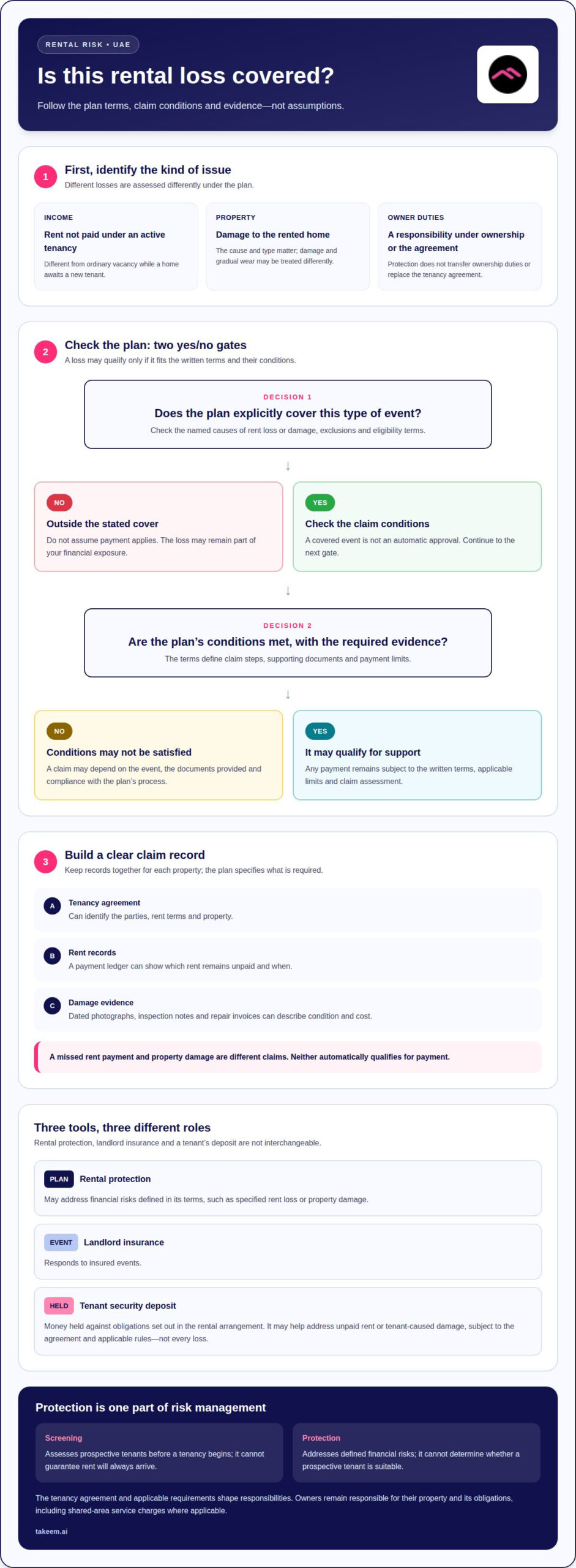
    Rental protection, landlord insurance, and tenant security deposits address different risks, so they shouldn’t be treated as interchangeable. A protection plan may address risks defined in its terms; insurance responds to insured events, while a deposit is money held against obligations set out in the rental arrangement.

    For example, a deposit may help address unpaid rent or tenant-caused damage, subject to the agreement and applicable rules. It doesn’t automatically cover every loss. Distinguish income support from damage cover, and both from your own financial responsibilities as the property owner.

    Covered Rent Loss and Property Damage

    Rental protection addresses lost rent or property damage only when the event falls within the plan’s stated cover. Its terms set out the qualifying events, evidence, limits, and steps the owner must follow. A missed payment and damage to a property are different claims, and neither automatically qualifies for payment.

    To make a claim, follow the plan’s process and provide the tenancy agreement, rent records, and evidence of the loss. The plan terms specify the required documents. Keep payment records and dated evidence of damage to help establish what happened and when.

    Policy Exclusions and Limitations

    Exclusions and limits define which events, losses, or circumstances fall outside a protection plan. Before relying on it, read the terms for eligibility, claim conditions, payment limits, and excluded causes. For instance, don’t assume a plan covering specified rent loss also covers repairs unless its terms say so.

    These boundaries matter when estimating your remaining exposure. A claim may depend on the event, the documents provided, and compliance with the plan’s conditions. The rental agreement also matters: it sets the parties’ responsibilities, while local requirements and the property’s condition may create separate obligations.

    Risks of Relying on Protection Instead of Screening

    Rental protection addresses defined financial risks; tenant screening assesses prospective tenants before a tenancy begins. Relying on protection alone can leave owners facing avoidable disruption, disputes, or losses outside the plan’s scope. Screening and protection serve different purposes, so neither replaces the other.

    For example, protection can’t determine whether a prospective tenant is suitable, and screening can’t guarantee that rent will always arrive. Use the tenancy agreement to clarify responsibilities, keep relevant records, and treat protection as one part of risk management. Owners remain responsible for their property and its obligations, including shared-area service charges where applicable.

    What does landlord rental protection typically cover, including lost rent and property damage?

    Rental protection is defined by its written terms, which specify whether it addresses lost rent, property damage, or both. Unpaid rent under an active tenancy and a damaged fixture are different losses. The terms determine what qualifies, what evidence supports a claim, and what limits apply.

    Lost-rent protection focuses on income interrupted by a covered event. It differs from ordinary vacancy: no rent is due while a home awaits a new tenant, whereas unpaid rent under an existing agreement involves a tenant’s payment obligation. The plan’s conditions determine whether either situation qualifies and for what period.

    Property-damage protection concerns damage to the rented home, but the cause and type matter. A broken appliance, a damaged wall, and gradual wear aren’t automatically treated alike. The written terms explain which events qualify, what exclusions apply, and whether repair costs are covered.

    • Rent records: A payment ledger can show which rent remains unpaid and when.
    • Tenancy documents: The signed agreement can identify the parties, rent terms, and property.
    • Damage evidence: Dated photographs, inspection notes, and repair invoices can describe the condition and cost.

    Keep these records together for each property. A photograph taken before a tenant moves in, for example, can help distinguish pre-existing wear from later damage. An invoice describes the repair, while the tenancy agreement connects a claim to the rental arrangement. The plan’s claim process specifies which documents are required.

    Rental protection and emergency maintenance address different needs. Maintenance concerns the response to a property issue; protection concerns the risks described in its terms. Takeem’s Landlord Rental Guarantee includes emergency property maintenance as part of the guarantee. To understand how its terms relate to your rental income and property, explore Landlord Rental Guarantee details.

    Explaining Rental Protection Benefits to Property Owners

    What exclusions and limitations apply to rental protection policies?

    Plan terms define excluded events, covered losses, and payment limits. An exclusion means a particular cause or circumstance falls outside the agreement. For example, unpaid rent during an eligible tenancy differs from rent lost while a property is vacant between tenants. The contract determines which situation qualifies.

    Damage claims also depend on the cause and description. A sudden break to a fixture and gradual wear are distinct examples, and the plan wording determines how each is treated. Identify whether damage cover applies, which causes are excluded, and what evidence is needed to support a claim.

    • Eligible tenancy: Terms can define the rental agreement or occupancy required for cover.
    • Covered event: A policy can limit support to named causes of rent loss or damage.
    • Payment limit: The contract can set a maximum amount or covered period.
    • Claim conditions: Required records and notification steps can affect eligibility.

    These boundaries matter when estimating your exposure. If a plan covers rent loss only for a defined period, unpaid rent beyond that period falls outside that cover. If a damaged door resulted from a cause excluded by the agreement, repair costs may remain the owner’s responsibility.

    A useful way to explain rental protection benefits to property owners is to read each condition alongside the tenancy agreement. The agreement identifies the parties, rent obligations, and property; the protection terms set separate claim rules. For rent claims, payment records show what remains unpaid. For damage, dated photographs and repair documents describe the loss.

    Distinguishing exclusions from limits is central to explaining rental protection benefits to property owners. An exclusion removes a type of event from cover; a limit caps support for an otherwise eligible claim. For example, a plan might address specified rent loss while limiting the amount or period. This distinction clarifies what the protection does and which risks the owner retains.

    How do rental protection plans compare with landlord insurance and tenant security deposits?

    Rental protection, landlord insurance, and a tenant security deposit are separate tools, each governed by its own terms. A rent guarantee may address rental income under defined conditions; insurance responds to insured events, while a deposit is held against obligations under the tenancy agreement. Don’t assume one arrangement covers the risks addressed by another.

    For example, if a tenant misses a payment, a protection plan may address the rent loss if its terms apply. Landlord insurance instead depends on the insured event and policy wording. A damaged fixture might fall within an insurance policy, a protection plan, or neither, depending on the cause and each agreement’s cover. Identify which document governs each potential loss.

    A security deposit works differently. It relates to the tenancy and can be applied to obligations addressed by the rental agreement, such as unpaid amounts or damage. It isn’t automatically a substitute for insurance or income protection. If repair costs exceed the deposit, the owner may still face an uncovered balance.

    • Rental protection: Identify whether rent loss, damage, or another risk is covered by the plan.
    • Landlord insurance: Match the event, such as accidental damage, to the policy wording.
    • Security deposit: Check which tenant obligations the agreement allows it to address.

    Consider a tenant who leaves both damage and unpaid rent. The deposit may relate to obligations under the agreement, insurance may respond to eligible damage, and rental protection may address eligible rent loss. Each outcome depends on separate terms, evidence, and claim conditions. These arrangements don’t create three payments for one loss.

    For a UAE property owner, the practical step is to map each risk to the document that governs it. Keep the tenancy agreement, deposit records, insurance policy, and protection terms distinct. This makes overlaps and gaps easier to spot before a dispute or claim, and clarifies who handles each responsibility.

    Takeem

    Takeem helps property owners manage rental-related risks through its Landlord Rental Guarantee and rental guarantees for investors with large property portfolios. These options provide a defined approach to rental uncertainty, and the guarantee includes emergency property maintenance.

    The right fit depends on the kind of rental risk you want to address and the scale of your portfolio. Agents can also sell the Landlord Rental Guarantee for healthy commissions. For landlords, a Direct Debit setup can support digital acceptance of monthly tenant payments.

    Use these distinctions to identify where a rental guarantee may complement your existing arrangements, rather than replace ownership responsibilities, insurance, or tenant screening. To discuss rental protection for your property, contact Takeem.

    Make your next rental decision with clarity

    Turn your understanding into a practical risk plan for each property. Decide which uncertainties you’re prepared to carry, which need protection, and how each arrangement fits alongside your existing responsibilities. This gives you a clearer basis for future rental decisions, rather than relying on the label attached to a plan.

    A practical way to explain rental protection benefits to property owners is to connect each benefit to a real decision: what you want to protect, what conditions apply, and what remains your responsibility. Revisit your assessment when your rental arrangements or portfolio change. Clear priorities can help you choose an approach that fits the property and your plans.

    If you’re ready to explore how rental protection could fit your situation, contact Takeem to discuss your rental. A considered next step can help you move forward with greater confidence.

    Frequently Asked Questions

    What are the benefits of rental protection for property owners?

    Rental protection can help owners manage income uncertainty and support them against defined rental risks. For example, an owner relying on rent to meet mortgage repayments may value a plan addressing eligible rent loss. Takeem also offers landlords Direct Debit setup to accept monthly tenant payments digitally, helping streamline rent collection. Protection complements, rather than removes, the owner’s responsibilities for the property.

    What types of rental protection insurance are available to landlords?

    Landlords may consider products addressing rental income, property damage, or both, while landlord insurance generally relates to insured property risks. A rental guarantee is distinct, focusing on rental income under its terms. To compare options, identify the financial exposure you want to manage, then match it to the product’s stated purpose. A product’s name alone doesn’t establish what it covers.