

Rental protection doesn’t remove an owner’s responsibilities. It helps define which rental risks are covered and how they’re handled. To explain rental protection benefits to property owners, distinguish that protection from ownership itself: in the UAE, owners can lease property for rental income, while the tenancy agreement and applicable requirements shape each party’s responsibilities.
It’s reasonable to want a clear picture of what protection changes. Renting can bring risks involving income, property issues, and disagreements, but no arrangement makes every concern disappear. Protection can clarify where support applies and where your own obligations remain.
This guide explains how rental protection can address defined property risks, what owners remain responsible for, and why the rental agreement matters. It also shows how a rental guarantee can fit into an owner’s approach to rental uncertainty.
Key Takeaways
- Separate the risks a rental arrangement may cover from the responsibilities that remain with you as the property owner.
- Understand how protection for lost rent or property damage depends on the plan’s coverage terms.
- Review exclusions and limits to see where a protection plan may leave gaps.
- Distinguish rental protection from landlord insurance and a tenant’s security deposit before deciding how each fits your approach.
Allocation of property risks
In the UAE, renting a property creates responsibilities for both owners and tenants. Rental protection can address specified financial risks, but it doesn’t transfer ownership duties or replace the tenancy agreement.
Comparing Rental Protection, Insurance, and Deposits
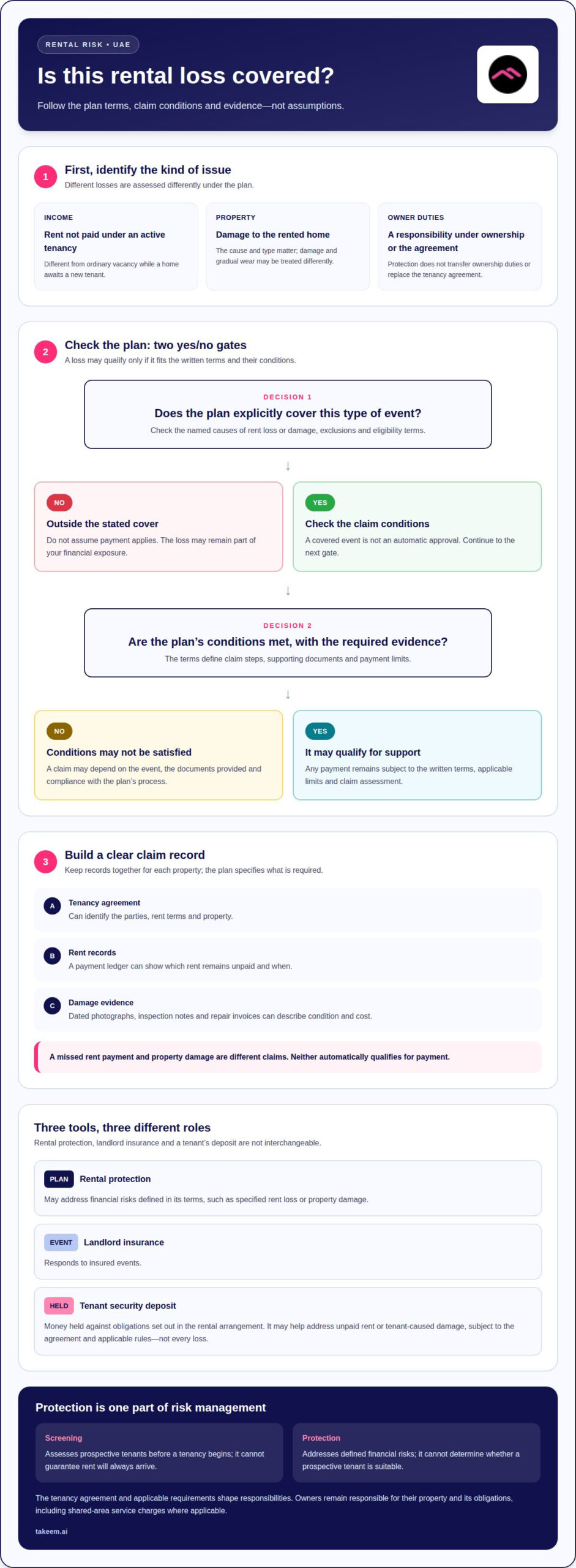
Rental protection, landlord insurance, and tenant security deposits address different risks, so they shouldn’t be treated as interchangeable. A protection plan may address risks defined in its terms; insurance responds to insured events, while a deposit is money held against obligations set out in the rental arrangement.
For example, a deposit may help address unpaid rent or tenant-caused damage, subject to the agreement and applicable rules. It doesn’t automatically cover every loss. Distinguish income support from damage cover, and both from your own financial responsibilities as the property owner.
Covered Rent Loss and Property Damage
Rental protection addresses lost rent or property damage only when the event falls within the plan’s stated cover. Its terms set out the qualifying events, evidence, limits, and steps the owner must follow. A missed payment and damage to a property are different claims, and neither automatically qualifies for payment.
To make a claim, follow the plan’s process and provide the tenancy agreement, rent records, and evidence of the loss. The plan terms specify the required documents. Keep payment records and dated evidence of damage to help establish what happened and when.
Policy Exclusions and Limitations
Exclusions and limits define which events, losses, or circumstances fall outside a protection plan. Before relying on it, read the terms for eligibility, claim conditions, payment limits, and excluded causes. For instance, don’t assume a plan covering specified rent loss also covers repairs unless its terms say so.
These boundaries matter when estimating your remaining exposure. A claim may depend on the event, the documents provided, and compliance with the plan’s conditions. The rental agreement also matters: it sets the parties’ responsibilities, while local requirements and the property’s condition may create separate obligations.
Risks of Relying on Protection Instead of Screening
Rental protection addresses defined financial risks; tenant screening assesses prospective tenants before a tenancy begins. Relying on protection alone can leave owners facing avoidable disruption, disputes, or losses outside the plan’s scope. Screening and protection serve different purposes, so neither replaces the other.
For example, protection can’t determine whether a prospective tenant is suitable, and screening can’t guarantee that rent will always arrive. Use the tenancy agreement to clarify responsibilities, keep relevant records, and treat protection as one part of risk management. Owners remain responsible for their property and its obligations, including shared-area service charges where applicable.
What does landlord rental protection typically cover, including lost rent and property damage?
Rental protection is defined by its written terms, which specify whether it addresses lost rent, property damage, or both. Unpaid rent under an active tenancy and a damaged fixture are different losses. The terms determine what qualifies, what evidence supports a claim, and what limits apply.
Lost-rent protection focuses on income interrupted by a covered event. It differs from ordinary vacancy: no rent is due while a home awaits a new tenant, whereas unpaid rent under an existing agreement involves a tenant’s payment obligation. The plan’s conditions determine whether either situation qualifies and for what period.
Property-damage protection concerns damage to the rented home, but the cause and type matter. A broken appliance, a damaged wall, and gradual wear aren’t automatically treated alike. The written terms explain which events qualify, what exclusions apply, and whether repair costs are covered.
- Rent records: A payment ledger can show which rent remains unpaid and when.
- Tenancy documents: The signed agreement can identify the parties, rent terms, and property.
- Damage evidence: Dated photographs, inspection notes, and repair invoices can describe the condition and cost.
Keep these records together for each property. A photograph taken before a tenant moves in, for example, can help distinguish pre-existing wear from later damage. An invoice describes the repair, while the tenancy agreement connects a claim to the rental arrangement. The plan’s claim process specifies which documents are required.
Rental protection and emergency maintenance address different needs. Maintenance concerns the response to a property issue; protection concerns the risks described in its terms. Takeem’s Landlord Rental Guarantee includes emergency property maintenance as part of the guarantee. To understand how its terms relate to your rental income and property, explore Landlord Rental Guarantee details.
What exclusions and limitations apply to rental protection policies?
Plan terms define excluded events, covered losses, and payment limits. An exclusion means a particular cause or circumstance falls outside the agreement. For example, unpaid rent during an eligible tenancy differs from rent lost while a property is vacant between tenants. The contract determines which situation qualifies.
Damage claims also depend on the cause and description. A sudden break to a fixture and gradual wear are distinct examples, and the plan wording determines how each is treated. Identify whether damage cover applies, which causes are excluded, and what evidence is needed to support a claim.
- Eligible tenancy: Terms can define the rental agreement or occupancy required for cover.
- Covered event: A policy can limit support to named causes of rent loss or damage.
- Payment limit: The contract can set a maximum amount or covered period.
- Claim conditions: Required records and notification steps can affect eligibility.
These boundaries matter when estimating your exposure. If a plan covers rent loss only for a defined period, unpaid rent beyond that period falls outside that cover. If a damaged door resulted from a cause excluded by the agreement, repair costs may remain the owner’s responsibility.
A useful way to explain rental protection benefits to property owners is to read each condition alongside the tenancy agreement. The agreement identifies the parties, rent obligations, and property; the protection terms set separate claim rules. For rent claims, payment records show what remains unpaid. For damage, dated photographs and repair documents describe the loss.
Distinguishing exclusions from limits is central to explaining rental protection benefits to property owners. An exclusion removes a type of event from cover; a limit caps support for an otherwise eligible claim. For example, a plan might address specified rent loss while limiting the amount or period. This distinction clarifies what the protection does and which risks the owner retains.
How do rental protection plans compare with landlord insurance and tenant security deposits?
Rental protection, landlord insurance, and a tenant security deposit are separate tools, each governed by its own terms. A rent guarantee may address rental income under defined conditions; insurance responds to insured events, while a deposit is held against obligations under the tenancy agreement. Don’t assume one arrangement covers the risks addressed by another.
For example, if a tenant misses a payment, a protection plan may address the rent loss if its terms apply. Landlord insurance instead depends on the insured event and policy wording. A damaged fixture might fall within an insurance policy, a protection plan, or neither, depending on the cause and each agreement’s cover. Identify which document governs each potential loss.
A security deposit works differently. It relates to the tenancy and can be applied to obligations addressed by the rental agreement, such as unpaid amounts or damage. It isn’t automatically a substitute for insurance or income protection. If repair costs exceed the deposit, the owner may still face an uncovered balance.
- Rental protection: Identify whether rent loss, damage, or another risk is covered by the plan.
- Landlord insurance: Match the event, such as accidental damage, to the policy wording.
- Security deposit: Check which tenant obligations the agreement allows it to address.
Consider a tenant who leaves both damage and unpaid rent. The deposit may relate to obligations under the agreement, insurance may respond to eligible damage, and rental protection may address eligible rent loss. Each outcome depends on separate terms, evidence, and claim conditions. These arrangements don’t create three payments for one loss.
For a UAE property owner, the practical step is to map each risk to the document that governs it. Keep the tenancy agreement, deposit records, insurance policy, and protection terms distinct. This makes overlaps and gaps easier to spot before a dispute or claim, and clarifies who handles each responsibility.
Takeem
Takeem helps property owners manage rental-related risks through its Landlord Rental Guarantee and rental guarantees for investors with large property portfolios. These options provide a defined approach to rental uncertainty, and the guarantee includes emergency property maintenance.
The right fit depends on the kind of rental risk you want to address and the scale of your portfolio. Agents can also sell the Landlord Rental Guarantee for healthy commissions. For landlords, a Direct Debit setup can support digital acceptance of monthly tenant payments.
Use these distinctions to identify where a rental guarantee may complement your existing arrangements, rather than replace ownership responsibilities, insurance, or tenant screening. To discuss rental protection for your property, contact Takeem.
Make your next rental decision with clarity
Turn your understanding into a practical risk plan for each property. Decide which uncertainties you’re prepared to carry, which need protection, and how each arrangement fits alongside your existing responsibilities. This gives you a clearer basis for future rental decisions, rather than relying on the label attached to a plan.
A practical way to explain rental protection benefits to property owners is to connect each benefit to a real decision: what you want to protect, what conditions apply, and what remains your responsibility. Revisit your assessment when your rental arrangements or portfolio change. Clear priorities can help you choose an approach that fits the property and your plans.
If you’re ready to explore how rental protection could fit your situation, contact Takeem to discuss your rental. A considered next step can help you move forward with greater confidence.
Frequently Asked Questions
What are the benefits of rental protection for property owners?
Rental protection can help owners manage income uncertainty and support them against defined rental risks. For example, an owner relying on rent to meet mortgage repayments may value a plan addressing eligible rent loss. Takeem also offers landlords Direct Debit setup to accept monthly tenant payments digitally, helping streamline rent collection. Protection complements, rather than removes, the owner’s responsibilities for the property.
What types of rental protection insurance are available to landlords?
Landlords may consider products addressing rental income, property damage, or both, while landlord insurance generally relates to insured property risks. A rental guarantee is distinct, focusing on rental income under its terms. To compare options, identify the financial exposure you want to manage, then match it to the product’s stated purpose. A product’s name alone doesn’t establish what it covers.