Tag: UAE property

  • Emergency Maintenance Cover for UAE Landlords: What Is Excluded

    Emergency Maintenance Cover for UAE Landlords: What Is Excluded

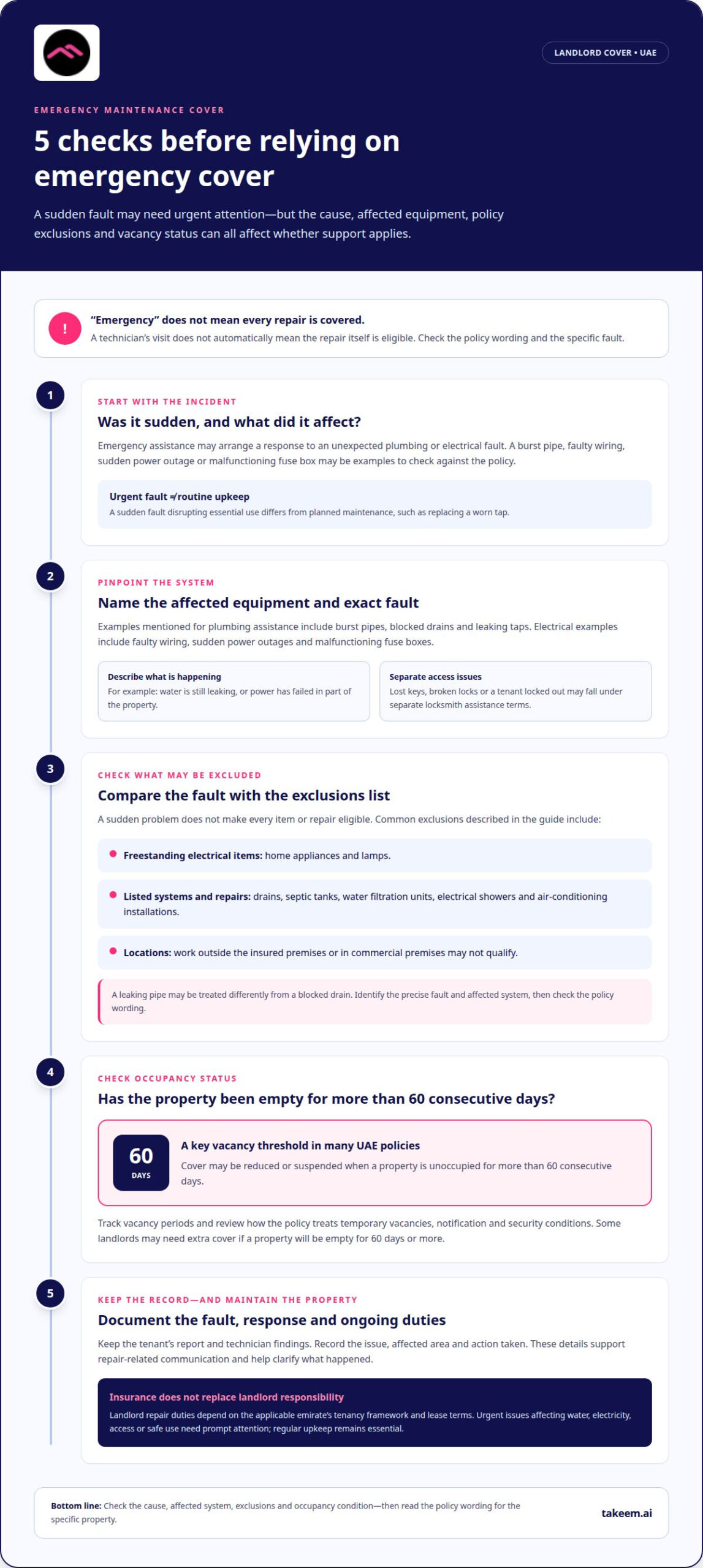
    An urgent repair can still fall outside your policy. Emergency maintenance cover for landlords in the UAE may include sudden plumbing or electrical failures, but exclusions can include home appliances, lamps, air conditioning installations and some drain repairs. Many UAE insurance policies reduce or suspend cover when a property is unoccupied for more than 60 consecutive days.

    That distinction matters: “emergency” doesn’t mean every repair is covered, and insurance doesn’t remove a landlord’s responsibility to maintain a rental property. The policy wording, cause of the fault and occupancy status can all affect what support applies.

    This guide explains which plumbing and electrical emergencies may qualify, what exclusions and vacancy conditions mean, and how landlord duties, inspections and maintenance fit together. You’ll be better equipped to understand where cover may help and where regular upkeep remains essential.

    Key Takeaways

    • Distinguish sudden plumbing or electrical failures from routine upkeep, since the cause and type of repair affect whether emergency support applies.
    • Review exclusions for the property, fixtures and systems before relying on cover for a repair.
    • Use regular property inspections to spot maintenance issues early and keep a clear record of their condition.
    • Understand how emergency support fits alongside your ongoing responsibility to maintain a safe, usable rental property.

    Emergency plumbing and electrical assistance

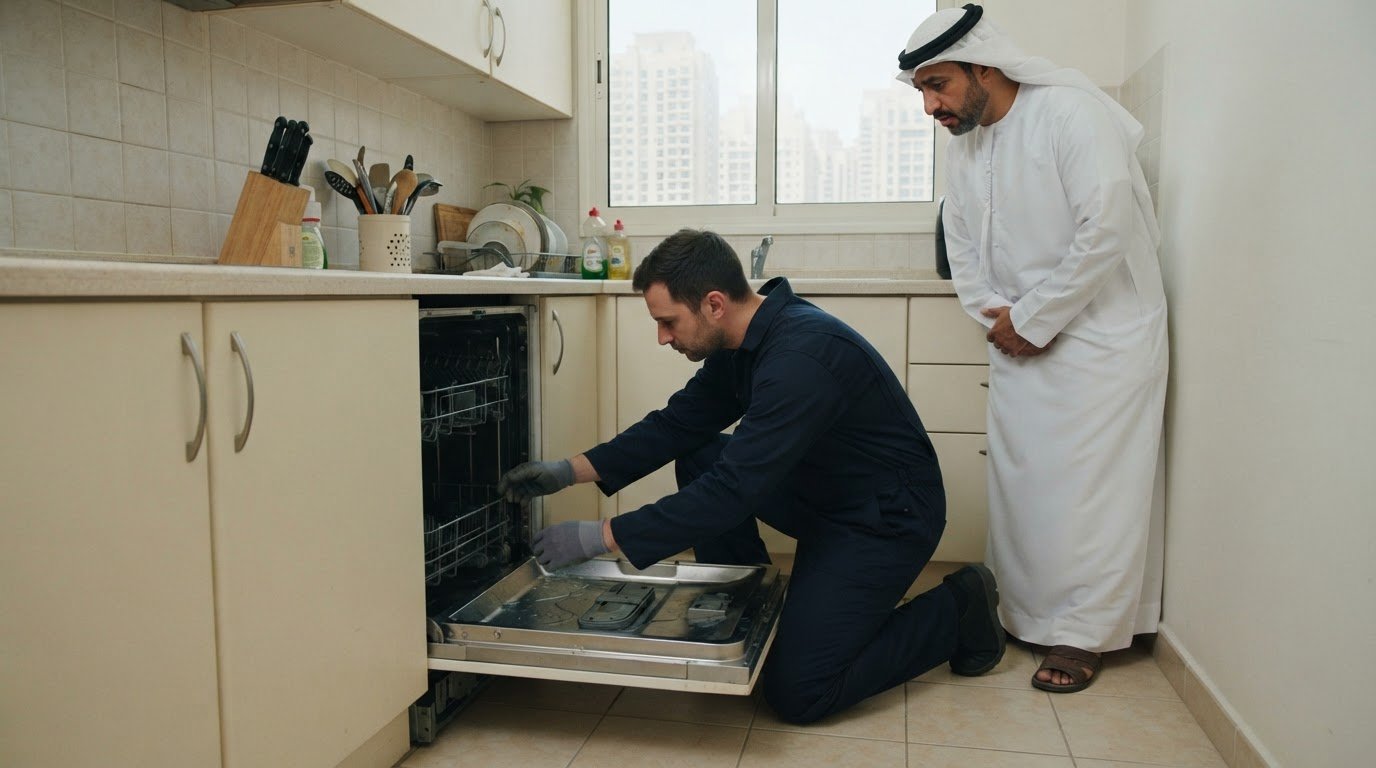
    Emergency cover may arrange help for sudden plumbing or electrical failures, such as a burst pipe or faulty wiring. The key is urgency: a sudden fault that disrupts essential use differs from routine maintenance, such as replacing a worn tap.

    Plumbing and Electrical Assistance

    Emergency plumbing and electrical assistance means arranging a response to an unexpected fault affecting water or power. A burst pipe can damage nearby surfaces, while exposed faulty wiring can pose a safety risk. Knowing which incidents may qualify helps landlords distinguish urgent repairs from planned upkeep and understand where support may apply.

    Examples include burst pipes, blocked drains and leaking taps. Electrical emergencies may involve faulty wiring, sudden power outages or malfunctioning fuse boxes. A broken appliance or lamp is different: freestanding electrical items may be excluded. The affected equipment and cause of the failure help determine whether the incident meets the policy terms.

    Emergency Callouts

    An emergency callout is a visit arranged to assess and address a sudden fault at the insured property. The professional may identify the immediate problem and carry out an emergency repair. The initial response may differ from later work needed to complete repairs or replace a system.

    When reporting a fault, describe what happened and its immediate impact. Explain, for example, whether water is still leaking or power has failed in part of the property. Keep the tenant’s report and any technician findings as incident records. These details help clarify the problem and support repair-related communication.

    Some emergency cover may also include locksmith assistance for lost keys, broken locks or a tenant locked out. Treat access problems separately from plumbing or electrical faults. A damaged entrance lock can also create a security concern if the property cannot be secured. The policy wording determines whether locksmith help is included and which circumstances qualify.

    Policy exclusions and unoccupancy limits

    Emergency cover has limits: a sudden fault does not make every repair eligible. For UAE rental properties, exclusions and vacancy conditions can determine whether a callout or claim falls within the policy.

    Common Policy Limits

    Policy limits define which properties, repairs and circumstances qualify for support. A problem inside an insured apartment may still involve an excluded system or location. Read the policy wording alongside its summary, and compare the scope and exclusions across quotes rather than assuming similar policies cover the same repairs.

    Occupancy is another key condition. Many UAE insurance policies reduce or suspend cover if a property is unoccupied for more than 60 consecutive days. A vacant apartment between tenants can therefore face different terms from a continuously occupied rental. Keep track of vacancy periods and review the policy’s unoccupancy wording before relying on emergency assistance.

    That limit concerns the property’s occupancy, not simply whether a landlord visits occasionally. For example, a unit left empty while its owner is overseas could cross the stated threshold. Some landlords may need extra cover if the property will be empty for 60 days or more. Check how the policy treats temporary vacancies and what notification or security conditions apply.

    Emergency Cover Exclusions

    Exclusions are repairs, locations or equipment a policy does not cover. A technician’s visit does not mean the repair itself is covered. Common exclusions include work outside the insured premises and work in commercial premises, even if the landlord also owns nearby apartments.

    Excluded items may include freestanding electrical equipment, such as home appliances and lamps. Listed exclusions also include repairs to drains, septic tanks, water filtration units, electrical showers and air-conditioning installations. A leaking pipe may be treated differently from a blocked drain, so identify the affected system and precise fault when reviewing the terms.

    Compare the exclusion list with the property’s actual systems and likely maintenance needs. For rental units that will be vacant, rental property maintenance support can be a useful next consideration alongside insurance terms.
    Emergency Maintenance Cover for UAE Landlords: What Is Excluded

    Dubai landlord repair responsibilities

    Landlord repair duties depend on the applicable emirate’s tenancy framework and the lease terms. Apply the requirements relevant to the property, rather than assuming one emirate’s rules apply throughout the UAE.

    Delaying an urgent repair can worsen damage, interrupt essential services or create safety and security concerns. A leak left unattended, for example, may spread and affect more of the home.

    Landlord Maintenance Responsibilities

    Landlord maintenance responsibility means addressing defects that affect a tenant’s use of the rented property. The lease and relevant local rules help determine which repairs fall to the landlord and how maintenance is handled. Separate structural concerns from routine care, then record who is responsible for each issue in the tenancy documents.

    Classify reported faults by urgency and impact. Problems affecting water, electricity, access or safe use need prompt attention; routine wear can be scheduled. For each report, document the issue, affected area and action taken. This creates a clear record for tenants, repair providers and insurers.

    Repair obligations can differ across emirates, so apply the rules that govern the property and tenancy. Don’t assume that a repair timeframe or responsibility from another emirate applies to your rental. The lease can also clarify arrangements for fixtures, appliances and routine upkeep.

    Risks of Delayed Urgent Repairs

    Delays can turn a contained fault into wider property damage. A leak may spread into flooring or walls, an electrical fault can affect safe use, and a broken entrance lock can compromise security. The consequences depend on the fault, its location and how quickly it is addressed.

    Respond to tenant reports with a documented assessment and repair plan. Record when the issue was raised, what it affects and updates from the repair provider. If essential services are disrupted, prioritize restoring them. Clear records help explain the response and distinguish the original fault from damage that developed later.

    Insurance does not replace maintenance duties. Keep repair records separate from policy documents, and use the applicable tenancy terms to guide responsibility. This supports consistent decisions across a rental portfolio without assuming every emirate follows the same procedures.

    Property inspections and emergency maintenance oversight

    Inspections help landlords spot developing faults before tenants report an emergency. A slow leak beneath a sink, for example, can be recorded and addressed before it damages nearby cabinets or flooring.

    Emergency maintenance plans arrange help for defined urgent faults, while pay-as-you-go repairs are arranged as needed. A home warranty generally focuses on listed systems or items. Compare each option’s scope, exclusions and repair process to decide what suits your property.

    Coverage depends on each plan’s terms. If you own rental properties across the UAE, check that the stated coverage applies to the relevant properties and locations rather than assuming a plan automatically covers every property nationwide.

    Use each inspection to build a clear property record. Note the date, location within the property and condition of visible systems, such as taps, sockets, air-conditioning units and door locks. Record tenant reports alongside inspection findings, then distinguish an active fault from wear that can be scheduled for routine maintenance.

    Photos can document the condition of a ceiling stain, damaged fitting or appliance during an inspection. Keep repair updates and technician findings with the same property record. This creates a timeline of tenant reports, inspection findings and subsequent action.

    Separate the building’s condition from tenant contents. A damaged fixed cabinet and a tenant’s personal appliance are different items, and policy exclusions may treat them differently. Inspection notes can also flag access or security concerns, such as a loose entrance lock, without implying that every issue qualifies for emergency cover.

    Use inspection records to track maintenance obligations and recurring faults, not as a substitute for insurance terms. Explore emergency maintenance oversight as part of a more organized approach to rental-property upkeep.

    Takeem: Landlord Rental Guarantee

    Takeem’s Landlord Rental Guarantee includes an emergency property maintenance service. For landlords considering emergency repairs alongside rental income protection, this brings maintenance support into a broader rental-focused offering.

    This may suit landlords seeking a rental guarantee that includes emergency property maintenance. Property investors with large portfolios can consider Takeem’s Rental Guarantee for Property Investors with Large property Portfolios. The maintenance service does not replace your responsibility to maintain the property or change insurance policy exclusions, so keep those terms and obligations clear.

    To discuss Takeem’s Landlord Rental Guarantee, contact Takeem or visit takeem.ai.

    Turn maintenance planning into a clear next step

    Use what you’ve learned to create a practical maintenance process for each rental property. Keep policy wording, inspection notes and repair records easy to access, so decisions start with a clear picture of the property. A considered approach to emergency maintenance cover for landlords in the UAE can help align cover with how you manage your rental portfolio.

    Takeem offers a Landlord Rental Guarantee, including an emergency property maintenance service as part of the Rental Guarantee. Agents can also sell Takeem’s Landlord Rental Guarantee for healthy commissions. If you’re considering how maintenance support fits your landlord needs, contact Takeem about landlord maintenance and explore a suitable next step.

    Thoughtful planning puts you in a stronger position to respond calmly when a property issue arises.

    Frequently Asked Questions

    What’s Not Covered?

    Cover commonly excludes work outside the insured premises, commercial premises and certain systems or equipment. For example, a fault in a freestanding lamp may be treated differently from a fault in fixed wiring. Vacancy conditions can also affect cover. Compare exclusions with the fixtures and systems in your rental, then note any gaps before relying on the policy for repairs.

    Is It Mandatory in the UAE?

    No, home insurance isn’t legally mandatory anywhere in the UAE. A mortgage lender may require property insurance for the loan’s duration, so practical requirements can depend on how you own and finance the property. Insurance requirements also differ from maintenance responsibilities: plan for repairs separately rather than treating a policy as a substitute for upkeep.

    What does landlord emergency cover include?

    Landlord emergency cover may arrange assistance for sudden plumbing or electrical failures, and some plans may include locksmith help. The policy defines eligible incidents and areas of the property. A sudden fault affecting a fixed system, for instance, may be treated differently from a tenant’s appliance. Distinguish emergency assistance from insurance for damage to the building, contents or rental income.

    What happens if I need to make a claim?

    Notify your insurance provider about the issue or damage when making an emergency home insurance claim. Clearly explain when the problem began, which areas it affects and what steps you took to limit further damage. Keep dated photos, tenant messages and technician findings together. These records help explain the event and distinguish the original fault from later damage.

    What does emergency maintenance cover for landlords in the UAE include?

    Emergency maintenance cover for landlords in the UAE may include help arranging urgent plumbing or electrical repairs, with locksmith assistance available under some plans. It is designed for sudden problems, not every maintenance task. When comparing options, check which systems and premises qualify, how vacancy is treated, and whether the arrangement covers assistance, repair work or both.

    What counts as an emergency under UAE landlord maintenance contracts?

    An emergency is generally a sudden fault requiring prompt attention to address safety, security or essential use of the property. A burst pipe or electrical failure may fit that description; repainting a room or replacing a worn fitting is usually planned maintenance. The contract sets the boundary, so describe the fault and its immediate impact clearly when reporting it.

  • Understanding Landlord Rights in Abu Dhabi: 2026 Guide

    Understanding Landlord Rights in Abu Dhabi: 2026 Guide

    A landlord’s strongest protection isn’t simply what the tenancy contract says. It comes from aligning the contract with legal duties and keeping a clear record of every important step. If you’re seeking understanding landlord rights in Abu Dhabi, knowing how those pieces fit together can help you handle rent, repairs, notices, and tenant disputes with greater confidence.

    It’s reasonable to want clear answers about what you can require, what you’re responsible for, and how to respond when a tenant disagrees. The rules can differ across the UAE, and the 0% rent increase cap introduced on June 2, 2026, makes it especially important to check which requirements apply to your property and contract. This guide explains the main landlord rights and responsibilities, the records and written notices to keep, and the steps to take if a dispute arises, from conciliation through Taswea to a formal ruling by the Rental Dispute Settlement Committee. It also distinguishes legal protections from optional operational tools, such as digital rent collection and rental guarantees.

    Key Takeaways

    • Understanding landlord rights in Abu Dhabi starts with distinguishing legal and contractual entitlements from informal rental practices.
    • Use the signed tenancy agreement as a reference for agreed rent, duration, payment terms, and each party’s responsibilities.
    • Before acting on rent changes, maintenance, property access, renewal, or termination, check the relevant contract terms and applicable rules.
    • Build a clear dispute record by preserving documents and communicating in writing, then identify the official route for your specific case.
    • Digital rent collection can help organise payment records, but operational tools don’t replace legal compliance or alter either party’s rights.

    What landlord rights in Abu Dhabi mean in practice

    Landlord rights are the legal and contractual entitlements a property owner may rely on during a tenancy, within the limits of the duties owed to the tenant. They are not a blanket licence to act as the landlord chooses: each entitlement depends on the applicable law, the tenancy agreement, and the circumstances of the property. This guide focuses on the relevant tenancy framework. Procedures elsewhere in the UAE may differ.

    Understanding landlord rights in Abu Dhabi means looking at the applicable rules and the agreement together, rather than relying on informal rental practices or assumptions carried over from another emirate. A term written into an agreement can help clarify what the parties agreed, but it doesn’t override a legal requirement.

    Which rules shape a landlord’s rights?

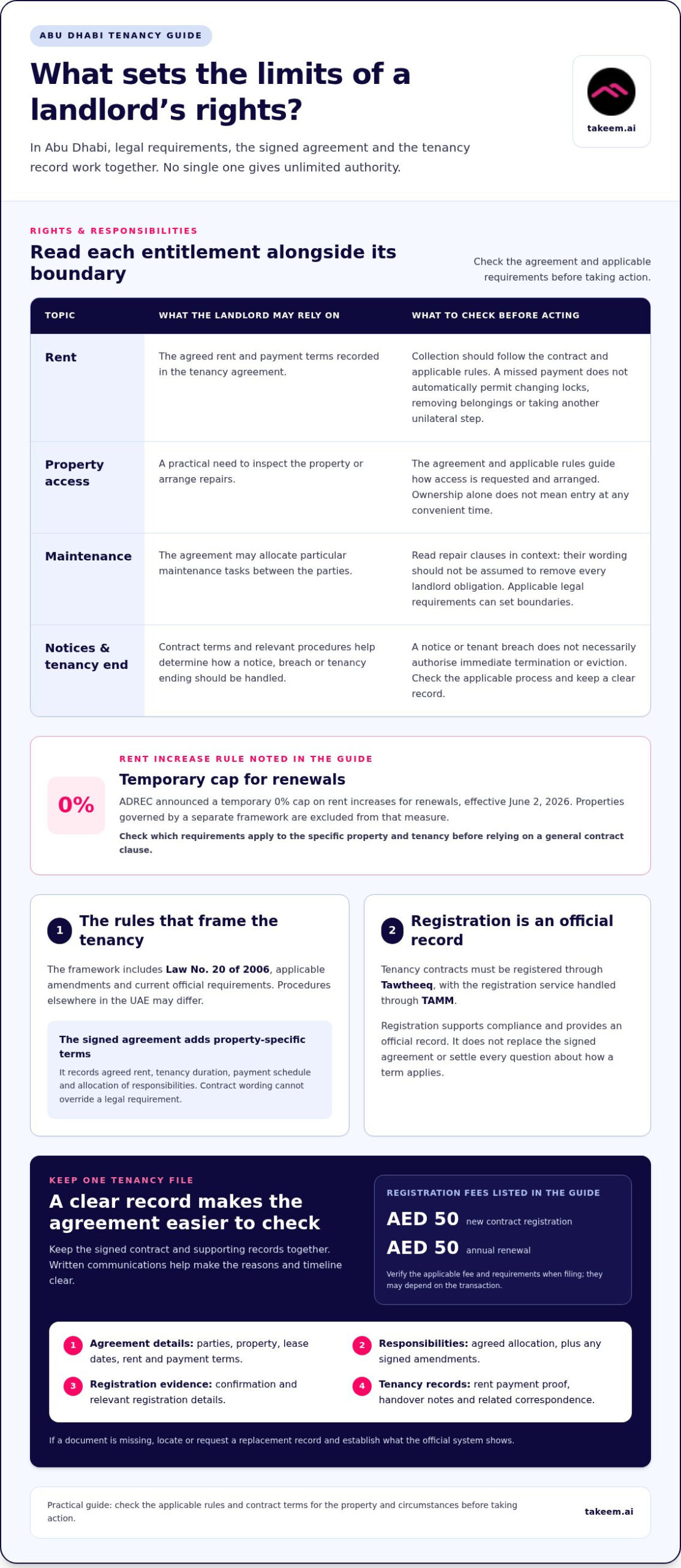
    The tenancy framework includes Law No. 20 of 2006, alongside applicable amendments and current official requirements. The signed agreement adds property-specific terms, such as the rent, duration, payment schedule, and allocation of responsibilities. Together, these sources help establish what each party can expect. For a general introduction to the legal relationship, see Landlord-tenant law; local rules determine how that relationship works.

    Tawtheeq is the tenancy contract registration system, and tenancy contracts must be registered. Registration provides an official record of the tenancy; it doesn’t replace the signed agreement or settle every question about how a term applies. Before acting, check current official guidance and the contract’s registration details. For example, ADREC announced a temporary 0% cap on rent increases for renewals effective June 2, 2026, with properties governed by a separate framework excluded from that measure. This illustrates why a general contract clause may need to be read alongside rules that apply to the property and tenancy.

    Rights come with responsibilities

    A landlord may expect rent to be paid according to the agreed terms, but collection should follow the contract and applicable rules. A missed payment doesn’t automatically give the landlord authority to change the locks, remove a tenant’s belongings, or take another unilateral step. The proper response depends on the agreement and the relevant legal process.

    Property access requires similar care. A landlord may have a practical reason to inspect or arrange repairs, but the agreement and applicable rules should guide how access is requested and arranged. Ownership alone doesn’t grant permission to enter whenever convenient. Keep written records of requests and agreed arrangements.

    Maintenance, property condition, notices, privacy, and the end of a tenancy also need a case-specific review. The agreement may allocate certain tasks, while legal requirements can set boundaries on that allocation. For instance, a repair clause should be read in context, not assumed to remove every landlord obligation. Likewise, a notice or tenant breach doesn’t necessarily authorise immediate termination or eviction. Check the relevant terms and official procedures before taking action, and document communications so the reasons and timeline are clear.

    How Abu Dhabi tenancy contracts and registration affect landlord rights

    A signed tenancy agreement turns the parties’ understanding into a written record. It can help establish the agreed rent, lease duration, payment schedule, and allocation of responsibilities if a question or dispute arises. It is important evidence, but it doesn’t operate in isolation: applicable law and current requirements still apply, and contract wording cannot override them.

    Keep the signed agreement, details of the parties and property, lease dates, rent and payment terms, agreed responsibilities, registration evidence, amendments, and handover records together. This concise file makes it easier to check what was agreed and identify any missing or disputed information.

    What to document in the tenancy agreement

    Check that the agreement identifies the landlord and tenant, accurately describes the property, and states the tenancy term, rent, payment schedule, and responsibilities agreed by the parties. If the parties later change a term, keep the signed amendment with the original contract. Don’t rely on an informal conversation to prove a change.

    Keep handover records, such as condition notes and relevant correspondence, in the same tenancy file. They can help clarify what was recorded at the start of the lease and how later concerns were raised. A sample clause found online may not suit the property or comply with current requirements, so don’t assume copying it makes it legally sufficient.

    Why registration and records matter

    Tenancy contracts are registered through Tawtheeq, with the registration service handled through TAMM. Registration creates an official record and supports compliance, while a copy of the signed agreement and related documents preserves the detail behind that record. To access the government service, landlords can use Register a Tenancy Contract through TAMM. The current guidance lists a fee of د.إ 50 for a new contract registration and د.إ 50 for an annual renewal; verify the applicable fee and requirements when filing, as they may depend on the transaction.

    Keep the registration confirmation alongside the contract, amendments, and proof of rent payments. If a document is missing, locate or request a replacement record and establish what the official system shows. Don’t assume that one missing copy automatically removes every landlord right. The effect of a registration gap can depend on the circumstances, and failure to register may weaken a landlord’s position in a dispute. Check current requirements and seek appropriate legal guidance where the consequences are unclear.

    Registration and income protection serve different purposes. A rental guarantee is an income-management option, not a substitute for a valid contract, registration, or compliance with landlord duties. Landlords comparing operational tools can review rental guarantee options separately from their legal obligations.

    Rent, maintenance, access, and ending a tenancy: where rights need care

    Rent, repairs, access, and tenancy endings can raise urgent questions, but acting quickly isn’t the same as acting lawfully. Understanding landlord rights in Abu Dhabi means checking the specific agreement alongside rules that apply to the property and situation. Use the table as a starting point, not a substitute for reviewing current requirements before taking action.

    Issue Landlord’s possible interest Tenant’s corresponding interest What to verify
    Rent Receive payment as agreed Pay under the agreed terms Contract, payment history, applicable rent rules
    Maintenance Keep the property in usable condition Have necessary repairs addressed and meet agreed upkeep duties Repair type, contract allocation, applicable legal duties
    Access Inspect or arrange necessary work Privacy and agreed arrangements for entry Contract terms, purpose, communication, applicable rules
    Ending a tenancy Seek non-renewal or termination where permitted Receive valid notice and follow the applicable process Reason, notice method and timing, relevant procedure

    Rent, repairs, and access during the tenancy

    Read rent terms together with receipts, bank records, or other payment evidence. If a payment is late or disputed, document the amount, due date, and communication rather than assuming the disagreement permits immediate action. The tenancy framework generally places major maintenance and necessary repairs on the landlord unless the agreement provides otherwise; tenants are generally responsible for minor repairs and ordinary upkeep. The specific issue and contract still matter.

    Keep written records of repair requests, responses, and any agreed access arrangements. Ownership alone doesn’t establish permission to enter at any time. Don’t force entry, change locks, or interrupt essential services to pressure a tenant. Check the agreement and applicable rules before arranging access or responding to a breach.

    Renewal, termination, and eviction

    These terms describe different events. Expiry is the end date written into a lease; non-renewal is a decision not to continue it. Termination means ending a tenancy under an applicable basis or process, while eviction concerns the tenant’s removal from the property. Don’t treat one event as automatic authority for another.

    For non-renewal, current guidance under Law No. 20 of 2006 states that written notice must be given at least two months before expiry for residential tenancies and three months for commercial tenancies. Confirm the rule that applies to the property and contract, including the correct notice method and any relevant amendments. Other termination or eviction grounds require their own verification; a tenant’s alleged breach doesn’t, by itself, justify self-help eviction. Use the applicable formal procedure and preserve notices and delivery records.

    Understanding Landlord Rights in Abu Dhabi: 2026 Guide

    A practical process for documenting and resolving landlord-tenant disputes

    A rent disagreement or repair complaint can escalate when the facts are scattered across messages, receipts, and handwritten notes. A clear sequence helps you assess the issue, communicate accurately, and identify the appropriate official route. Understanding landlord rights in Abu Dhabi also means recognising that evidence supports your position, but can’t guarantee a particular outcome.

    1. Review the agreement. Identify the relevant clause, dates, payment terms, and any signed changes. Compare the issue with what the parties agreed, then consider applicable rules.
    2. Preserve the evidence. Keep the signed contract and amendments, Tawtheeq registration evidence, payment records, notices, inspection records, and repair correspondence. Save dated messages and retain copies in a secure, organised file.
    3. Communicate in writing. State the issue, relevant dates, and requested next step in a calm, factual way. Keep a copy of each message and any reply. Avoid threats or assumptions about what the other party must do.
    4. Identify the official route. If direct communication doesn’t resolve the matter, verify the appropriate dispute channel and current filing instructions for your case before submitting anything.

    Build a clear evidence trail

    Before seeking dispute resolution, organise the contract, registration record, payment history, notices, inspection evidence, and repair communications in date order. A short timeline can clarify when the issue began, what each party said, and what steps followed. Keep original files where possible, label copies clearly, and distinguish confirmed facts from your interpretation. This preparation makes the record easier to review, but it doesn’t determine how a dispute will be decided.

    Good documentation can also help prevent misunderstandings from turning into formal claims. Clear payment records, prompt written updates, and a record of agreed actions create a shared reference point. For additional prevention practices, consult the site’s guide to avoiding rental disputes.

    Use the appropriate formal route

    The dispute process begins with conciliation through the Abu Dhabi Real Estate Settlement Centre, known as Taswea. If the parties don’t reach agreement, the matter can proceed to the Rental Dispute Settlement Committee (RDSC) for a formal ruling. The correct route and procedure depend on the dispute, so verify the current jurisdiction and official instructions before filing.

    Check the latest guidance for the required documents, filing channel, deadlines, and applicable fees. The research available for this guide reports a typical filing fee of 3.5% to 4% of annual rent, capped at د.إ 10,000 for standard lease claims, but confirm the amount and how it applies to your case with the relevant authority. A qualified UAE legal professional can help interpret contract terms and case-specific requirements. This guide is general information, not legal advice.

    Accurate payment records can make routine rent administration easier to track. Explore digital rent collection options as an operational tool, separate from legal compliance and dispute procedures.

    Protect rental operations while respecting landlord rights

    Legal compliance sets the boundaries of a tenancy. Operational tools can make routine tasks easier, but they don’t change those boundaries. Understanding landlord rights in Abu Dhabi means keeping that distinction clear: rent collection systems and income-management services may support administration, while the contract and applicable law continue to define the parties’ rights and duties.

    Digital rent collection as an operational option

    For landlords who want to move beyond relying only on cheques, Direct Debit can support recurring digital rent collection. A digital process can make it easier to organise payment entries and review whether expected instalments were received. Takeem facilitates Direct Debit setup for landlords to accept monthly tenant payments digitally.

    Keep payment records alongside the tenancy file, and record any missed, partial, or disputed payment accurately. A digital transaction history is useful for administration and may help establish what was paid and when. It doesn’t, by itself, prove that every legal or contractual requirement has been met. Landlords still need to follow the agreed payment terms, maintain required records, and address any disagreement through the appropriate process.

    Choosing a payment method is a practical decision, not a change to the tenancy. Direct Debit doesn’t amend the agreement, create a new right to collect rent, or decide what happens after a payment fails. Make sure the payment arrangement is clearly understood by both parties and consistent with the tenancy terms. Store records securely and keep communications about payment changes in writing.

    Where a rental guarantee fits, and where it doesn’t

    A rental guarantee can be considered as an optional income-management service. Takeem offers rental guarantees to landlords and property investors. The service is separate from the legal relationship created by a tenancy agreement: it doesn’t determine tenant obligations, expand a landlord’s statutory rights, or replace compliance with applicable law.

    Keep the purpose clear. A guarantee is a commercial arrangement, not a legal remedy for a tenancy breach and not a substitute for documenting the agreement, following notice requirements, or using the proper dispute process. Review its terms as a separate operational decision, while continuing to manage the tenancy in line with current rules. This distinction helps landlords assess practical support without confusing it with legal protection.

    Clear administration can reduce avoidable uncertainty, but no payment tool or income service removes the need to handle each tenancy lawfully. For a practical option to support rental income management, explore Takeem’s Landlord Rental Guarantee service. Before acting on a rent, maintenance, notice, or dispute issue, verify the current requirements that apply to your property and contract.

    Make your next tenancy decision with confidence

    Strong rental operations start with a simple habit: pause before acting, check the current rule that applies, and keep a clear record of the decision. That discipline turns understanding landlord rights in Abu Dhabi into a practical approach you can carry into each tenancy, even when circumstances change. For case-specific questions, seek qualified legal advice and verify the latest official guidance before relying on a notice, contract term, or procedure.

    Operational support can help keep routine rental tasks organised without changing either party’s legal position. Takeem facilitates digital rent collection through Direct Debit and offers rental guarantees that include emergency property maintenance as part of the service. These are optional operational tools, not substitutes for legal compliance or a way to determine tenant rights.

    If you’re considering an income-management option for your rental, explore Takeem’s landlord rental guarantee service. With current information, careful records, and a measured next step, you can manage your tenancy with greater clarity and confidence.

    Frequently Asked Questions

    Can a landlord increase rent in Abu Dhabi?

    For renewals, the temporary rent freeze sets the annual increase cap at 0%, effective June 2, 2026, until further notice, according to ADREC. For a new lease on a previously rented property, the rent is capped at the rate in the most recent registered tenancy contract. Properties governed by a separate framework are excluded from the freeze. Check the property’s applicable rules before setting or changing rent.

    How much notice must a landlord give before ending a tenancy in Abu Dhabi?

    For non-renewal, current guidance states that written notice must be given at least two months before a residential contract expires, or three months before a commercial contract expires. These periods concern non-renewal, not every kind of termination or eviction. Check the lease and applicable rules to confirm the required notice method and timing for your situation. Keep a copy of the notice and evidence of when it was delivered.

    Can a landlord evict a tenant without going through a formal process?

    No. A landlord shouldn’t remove a tenant, change locks, or cut essential services to force them out. Even if rent is overdue or another contract term appears to have been breached, the landlord must use the applicable formal process rather than taking unilateral action. Keep records of the issue and communications, then verify the correct dispute route and requirements for the specific case before acting.

    Who is responsible for repairs in a rented property?

    Generally, the landlord is responsible for major maintenance and necessary repairs that keep the property fit for use, unless the tenancy agreement provides otherwise. Tenants are generally responsible for minor repairs and ordinary upkeep. For example, a structural problem may call for a different response than routine care. Review the contract and applicable rules, document the reported issue, and keep records of repair arrangements and completed work.

    Does a landlord have the right to enter a rented property?

    Not simply because they own it. Entry should be handled in line with the tenancy agreement and applicable rules, while respecting the tenant’s privacy. For a planned inspection or repair, communicate the purpose and proposed arrangements in writing and retain the response. Don’t assume that a tenant’s breach automatically permits entry. If access is disputed, review the relevant terms and seek guidance before attempting to enter.

    What happens if a tenancy contract is not registered in Abu Dhabi?

    Tawtheeq registration is mandatory. An unregistered contract may create practical problems, including difficulties for the tenant activating utilities or obtaining parking permits, and may weaken the landlord’s position if a dispute arises. It doesn’t automatically establish that every landlord right disappears. For understanding landlord rights in Abu Dhabi, distinguish the missing registration record from the underlying contract, then check the current official requirements and how they apply.

    Where can a landlord resolve a rental dispute in Abu Dhabi?

    Rental disputes begin with conciliation through the Abu Dhabi Real Estate Settlement Centre, known as Taswea. If the parties can’t reach an agreement, the matter may proceed to the Rental Dispute Settlement Committee for a formal ruling. Before filing, verify the correct route, jurisdiction, documents, fees, deadlines, and submission method for your case through current official guidance. A qualified UAE legal professional can help interpret case-specific issues.

    Can a landlord collect rent through Direct Debit instead of cheques?

    Yes, digital monthly rent collection through Direct Debit can be an operational alternative to relying only on cheques. Make sure the payment method is agreed and consistent with the tenancy terms; don’t assume a landlord can change the agreed method unilaterally. Keep transaction records and follow up on failed or disputed payments through the usual agreed and lawful channels. Takeem facilitates Direct Debit setup for landlords accepting monthly tenant payments digitally.

  • Guaranteed Rent Schemes in the UAE: A Landlord’s 2026 Guide

    Guaranteed Rent Schemes in the UAE: A Landlord’s 2026 Guide

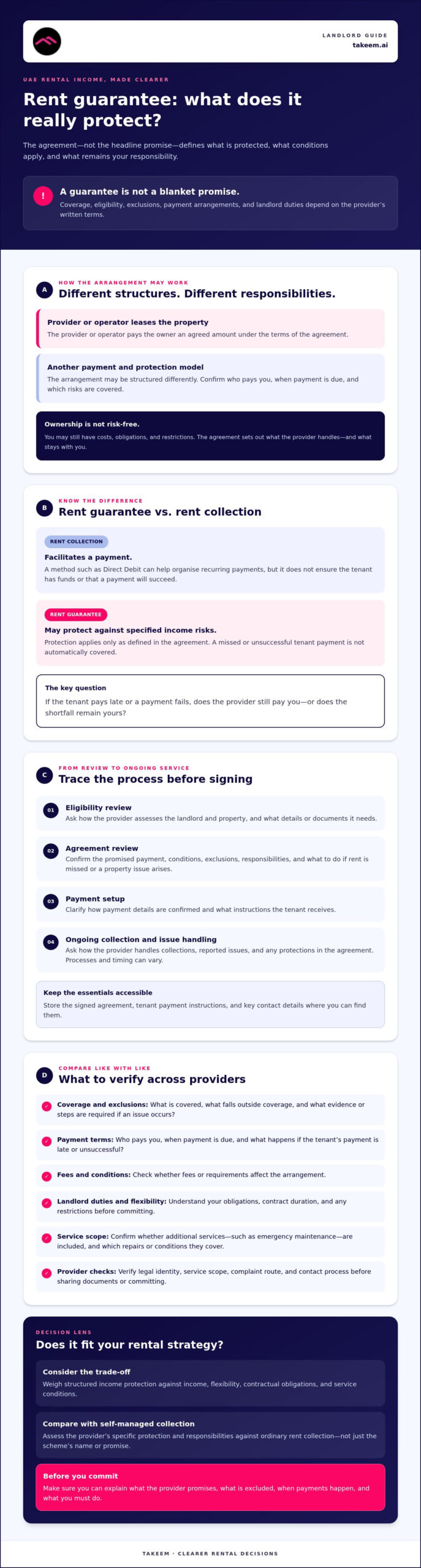
    What happens to your cash flow when a tenant misses a payment, and does a rent guarantee actually protect you? A guaranteed rent scheme Dubai landlords consider can offer more predictable income, but the agreement, not the headline promise, determines what is protected.

    It’s reasonable to want greater certainty without giving up more income or flexibility than you intend. Schemes can use different structures: a provider or operator may lease the property and pay the owner an agreed amount, or the agreement may set out another payment and protection model. Before you commit, check what happens when rent is late, which exclusions apply, and whether fees or conditions affect the arrangement.

    This guide explains how rent guarantee schemes work in the UAE and how they differ from ordinary rent collection. You’ll learn what to compare, which payment and protection details to verify, and how to assess whether a Takeem provider fits your rental strategy. It also covers contract duration, income trade-offs, and payment processes, so you can review an offer with clearer expectations before signing.

    Key Takeaways

    • A guaranteed rent scheme Dubai landlords consider is only as clear as its agreement. Check what the provider promises, what conditions apply, and what falls outside the coverage.
    • Before signing, map the process from eligibility review and payment setup to ongoing collection, and clarify each party’s responsibilities.
    • Compare providers using the same criteria, including exclusions, fees, payment timing, and landlord duties. Weigh these against self-managed rent collection.
    • Verify the provider’s legal identity, service scope, complaint route, and contact process before sharing documents or committing.
    • Assess whether structured income protection and digital collection suit your rental strategy, while accounting for contractual obligations and service conditions.

    What Is a Guaranteed Rent Scheme in the UAE, and What Does It Promise?

    A guaranteed rent scheme is an agreement in which a provider commits to pay a landlord rent or another agreed amount under specified terms. The arrangement may shift certain rental-income risks to the provider, but it doesn’t make property ownership risk-free. You may still have costs, obligations, and restrictions. The agreement defines what the provider is responsible for and what remains yours.

    The structure can vary. A provider or operator may lease the property and pay the owner an agreed sum; another arrangement may use a different payment and protection model. The basic idea of a guaranteed rental transaction is that an owner receives an agreed sum from another party that takes on rental-related responsibilities. For a UAE-focused overview, see this UAE landlord rental guarantee guide.

    A guaranteed rent scheme Dubai landlords consider should be assessed by its written terms, not its name or headline promise. Coverage, eligibility, exclusions, payment arrangements, and landlord responsibilities depend on the provider’s agreement. A guarantee is also different from property management: it covers specified income or services, while property management involves broader oversight. Don’t assume a rent guarantee includes that work.

    What can a guaranteed rent scheme cover?

    Depending on the agreement, a scheme may address particular rental-income risks or set out agreed payments to the landlord. These features aren’t standard across the market. Check whether payment depends on the property being occupied, whether missed tenant payments are covered, and what conditions apply. Read the exclusions and eligibility requirements, and confirm in writing what evidence or steps the provider requires if an issue arises.

    Check any additional package services separately from the payment terms. For example, a provider may include emergency property maintenance, but that doesn’t automatically mean every repair is covered. Confirm the service scope, conditions, and your responsibilities before relying on it.

    How is a rent guarantee different from rent collection?

    Rent collection facilitates payment. A rent guarantee may protect against specified income risks, but only as defined in the agreement. A collection method such as Direct Debit can help organise recurring payments, but it doesn’t ensure that a tenant has funds available or guarantee that a payment will succeed.

    Ask who is expected to pay you, when payments are due, and what happens if a tenant’s payment is late or unsuccessful. Then check whether the provider’s stated protection applies in that situation or whether the shortfall remains yours. This distinction helps you compare a guarantee with ordinary rent collection based on actual responsibilities, not assumptions.

    How a UAE Rent Guarantee Works: Agreements, Payments, and Responsibilities

    A rent guarantee process typically starts with the provider checking whether the landlord and property meet its criteria. Before agreeing, clarify what information is needed, what the provider commits to pay, how payments are handled, and which situations are excluded. The agreement should identify each party’s role, including what you must do if a tenant misses a payment or a property issue arises.

    After you review and sign the terms, setup may involve confirming payment details and giving the tenant instructions for paying rent. The provider may have separate processes for collecting payments, handling reported issues, or applying the agreement’s protections. Don’t assume these steps or their timing are standard. Ask the provider to explain its current process, and keep the signed agreement, payment instructions, and key contact details accessible. For more context, read this UAE guide to rental guarantees and Direct Debit.

    What should landlords expect during setup?

    Ask what property and landlord details or documents the provider needs, how it assesses eligibility, and what must be completed before the arrangement starts. These are points to confirm, not a universal checklist. Setup steps and timing vary, so verify Takeem’s current process directly rather than relying on an assumed start date. Store the final agreement and tenant payment instructions where you can find them easily.

    Payment instructions and provider processes are separate. The tenant needs clear directions on how and when to pay; the provider should explain how payments are collected or processed under the agreement. Direct Debit can support monthly digital rent collection, but it doesn’t guarantee that a tenant’s payment will succeed. If you’re considering a guaranteed rent scheme Dubai landlords can use, confirm what happens after an unsuccessful payment and whether any income protection applies.

    Which responsibilities remain with the landlord?

    Confirm who communicates with the tenant, receives reports, and handles service requests. A rental guarantee doesn’t automatically include full property management, so establish which tasks stay with you and which, if any, the provider agrees to perform. If emergency maintenance is included, check its written scope, conditions, reporting process, and any landlord responsibilities.

    Takeem provides rental guarantee services, facilitates monthly digital rent collection through Direct Debit, and includes emergency property maintenance as part of its rental guarantee service. Confirm the precise terms and process directly. Reviewing Takeem’s landlord rental guarantee information can help you identify questions about eligibility, payments, and responsibilities before proceeding.

    How to Compare Guaranteed Rent Schemes: Terms, Fees, and Alternatives

    Start your comparison with the written offer, not the scheme’s label. A provider may describe a payment as guaranteed, but the agreement determines what qualifies, when payment is due, and what happens if conditions aren’t met. The written agreement matters more than the label because it defines the protection, exclusions, and obligations you can actually rely on.

    Use the same questions for each provider. Terms and service fees vary, so request full fee details and payment conditions in writing instead of relying on broad claims or unverified pricing.

    Compare What to check
    Coverage How does the agreement define covered rent or income? Which circumstances can affect payment?
    Exclusions and eligibility Which properties or landlords qualify, and what situations are excluded or conditional?
    Fees What service fees apply, how are they charged, and can any other charges arise under the agreement?
    Payment timing Who pays you, when are payments due, and how are late or unsuccessful tenant payments handled?
    Landlord duties What reporting, tenant communication, maintenance, or other obligations remain yours?

    Which agreement terms should landlords compare?

    Read the definitions closely. Confirm how the provider defines covered rent, what makes a property eligible, and which exclusions or events can affect payment. Ask how you must report a missed payment, how the provider assesses it, and what happens next. Review cancellation and renewal terms, including any duties that continue after the agreement ends. A guaranteed rent scheme Dubai offer is easier to assess when these answers are explicit and consistent across providers.

    Compare the guarantee with self-managed rent collection based on the service you need. Managing collection yourself may give you direct oversight of payment instructions and follow-up. A guarantee may provide specific income protection under agreed conditions. Neither approach suits every landlord; consider your tolerance for payment uncertainty, preferred level of involvement, and the actual scope and cost of each option.

    When might digital rent collection be useful?

    Recurring digital collection, such as Direct Debit, may reduce reliance on cheque-based workflows and help organise monthly payments. It doesn’t guarantee a successful payment, and setup may depend on the tenant, account, and provider process. Review the Direct Debit setup guide for landlords, then confirm the applicable requirements and payment handling directly with the provider.

    Guaranteed Rent Schemes in the UAE: A Landlord’s 2026 Guide

    A Landlord’s Due-Diligence Checklist Before Choosing a Rent Guarantee

    A checklist helps you test a provider’s promises before sharing sensitive documents or signing. A polished proposal isn’t a substitute for checking who you’re contracting with, what the service includes, and how the agreement works in practice. For a guaranteed rent scheme Dubai landlords are considering, confirm each point in writing and keep the provider’s responses with the contract.

    • Verify the provider’s legal identity. Confirm the contracting entity’s full legal name and check that it matches the name on the agreement and payment instructions.
    • Define the protection. Ask which events are covered, which are excluded, what conditions apply, and what information is needed to submit a request.
    • Clarify the money flow. Confirm all service fees, who pays you, the payment schedule, and how late or unsuccessful payments are handled.
    • Understand the process. Request the setup steps, reporting route, complaint process, and contact method for routine questions and service requests.
    • Check the exit terms. Review cancellation, renewal, and continuing obligations, including any notice requirements stated in the agreement.
    • Get maintenance details in writing. If maintenance is included, confirm its scope and conditions, how to report an issue, and any stated service response times.

    What questions should you ask a provider?

    Ask the provider to explain how it assesses eligibility and handles a missed payment, from your first notification through its decision under the agreement. Request written answers about fees, payment timing, setup, exclusions, and cancellation instead of relying on verbal assurances. For maintenance, clarify what is included and what remains your responsibility. This UAE guide to rental guarantees with maintenance can help you frame your questions.

    How can you assess service fit for your property?

    Compare the provider’s documented eligibility criteria with your property and tenancy details before sending records. Then map its workflow against your current rent collection and record-keeping process: who receives payment updates, where you keep supporting documents, and how you’ll follow up on an issue. Legal or regulatory requirements can depend on the specific arrangement, so seek advice from qualified UAE counsel if you’re unsure how the agreement applies.

    After completing these checks, you can review Takeem’s landlord guarantee service and confirm its current eligibility, fees, coverage, and processes directly before deciding whether it fits your requirements.

    Is a Guaranteed Rent Scheme Right for Your UAE Property?

    A rent guarantee may be worth exploring if you value a defined payment process and want to reduce the manual work involved in collecting rent. It isn’t automatically right for every landlord or property. The decision depends on the agreement’s protection, fees, eligibility rules, and obligations, as well as how much control you want over rent collection and tenant communication.

    Which landlords may benefit from a structured guarantee?

    Individual landlords and investors managing larger property portfolios may value agreed payment processes and digital collection options. Recurring Direct Debit collection can support monthly payment administration, while a rental guarantee may address specified income risks under its terms. Neither feature guarantees a particular financial outcome. Consider whether the service matches your property and tenancy, and weigh its convenience against exclusions, conditions, fees, and contractual limits.

    Compare the proposed arrangement with your current process. If you already collect rent efficiently and are comfortable handling follow-up, self-managed collection may remain suitable. If you want support with defined rental-income arrangements and digital payment collection, a provider may be worth assessing. Focus on the agreement and the tasks it actually covers, rather than assuming a guarantee includes full property management.

    What are the next steps to explore Takeem?

    Before contacting a provider, note your property details, tenancy arrangements, and preferred payment process. Prepare questions about eligibility, fees, payment timing, exclusions, cancellation terms, and the responsibilities you would retain. This makes it easier to assess whether a proposal fits your rental strategy and compare its written terms with your requirements.

    Takeem provides rental guarantee services for individual landlords and property investors with large portfolios, facilitates monthly digital rent collection through Direct Debit, and includes emergency property maintenance as part of its rental guarantee service. Confirm current terms, fees, eligibility, payment processes, and the precise scope and conditions of maintenance directly with Takeem. Review the agreement before signing, and ask for written clarification wherever a term is unclear.

    To explore whether the service may fit your property, explore rental guarantee options with Takeem and discuss your requirements and current service details with the provider.

    Choose a Rental Arrangement With Clear Terms

    A rent guarantee can offer a more structured approach to rental income, but it isn’t a promise of risk-free ownership. The agreement defines what protection applies, when payments are made, which exclusions matter, and what responsibilities remain with you. Compare those details with ordinary rent collection, and confirm fees, eligibility, cancellation terms, and any maintenance conditions before signing.

    If you’re assessing a guaranteed rent scheme Dubai landlords may consider, focus on whether its payment process and protections fit your property and rental strategy. Takeem serves landlords and property investors across the UAE, combining rental guarantee support with Direct Debit collection and emergency maintenance as part of its rental guarantee service. Confirm current terms, the payment process, and maintenance scope directly before deciding.

    Explore rental guarantee options with Takeem and discuss your requirements with the provider. Start by asking clear questions and carefully reviewing the agreement.

    Frequently Asked Questions

    What is a guaranteed rent scheme?

    A guaranteed rent scheme is an agreement where a provider commits to pay a landlord rent or another agreed amount under defined conditions. The agreement explains what income protection applies, how payments are arranged, and which exclusions or landlord duties may affect it. It isn’t a promise of risk-free ownership, and the name alone doesn’t establish the level of protection. Review the written terms before deciding whether the arrangement fits your property.

    Is guaranteed rent the same as rent collection?

    No. Rent collection facilitates the tenant’s payment, while a rent guarantee may address specified rental-income risks under the provider’s agreement. Direct Debit, for example, can support monthly digital collection, but it doesn’t ensure that a tenant’s payment will succeed. Check who collects rent, who pays you, and what happens after a late or unsuccessful payment. Those details distinguish payment administration from contractual income protection.

    How does a guaranteed rent scheme work in the UAE?

    A landlord typically checks eligibility, reviews the provider’s agreement, completes the required setup, and follows the payment and reporting process set out in writing. The agreement should clarify covered rent, payment arrangements, exclusions, fees, and each party’s responsibilities. A guaranteed rent scheme Dubai landlords consider may differ from another provider’s offer, so confirm current terms directly rather than assuming one standard model applies across the UAE.

    What happens if a tenant misses a rent payment?

    The next steps depend on the signed agreement. It may specify how quickly you must report the missed payment, what information the provider needs, how the event is assessed, and whether it qualifies for protection. Don’t assume every missed or delayed payment is covered. Ask the provider to explain the process and exclusions before signing, and keep payment records and required communications accessible.

    Can a guaranteed rent scheme replace post-dated cheques?

    A rent guarantee and a payment method are separate parts of an arrangement. Takeem facilitates monthly digital rent collection through Direct Debit, which can help landlords transition from traditional cheque-based collection. Setup requirements and payment options may depend on the provider and tenancy. Confirm with the provider and tenant how payments will be authorised, collected, and recorded, and whether existing payment instructions need to change.

    How much does a guaranteed rent scheme cost?

    Costs vary by provider and agreement, so there isn’t one fee that applies to every landlord or property. Request a written breakdown of service fees, how and when they’re charged, and whether other conditions could affect the total cost. Compare those details with the scope of protection, payment process, exclusions, and your responsibilities. Confirm Takeem’s current fees directly before committing.

    Does a rent guarantee include property maintenance?

    Maintenance isn’t automatically included in every rent guarantee; check the specific agreement for its scope and conditions. Takeem includes an emergency property maintenance service as part of its rental guarantee offering, but landlords should confirm what qualifies, how to report a request, and what responsibilities remain with them. A maintenance component doesn’t by itself mean the provider offers full property management or covers every repair.

  • Rental Guarantee vs. Property Insurance in the UAE: A Landlord’s Guide to Total Protection

    Rental Guarantee vs. Property Insurance in the UAE: A Landlord’s Guide to Total Protection

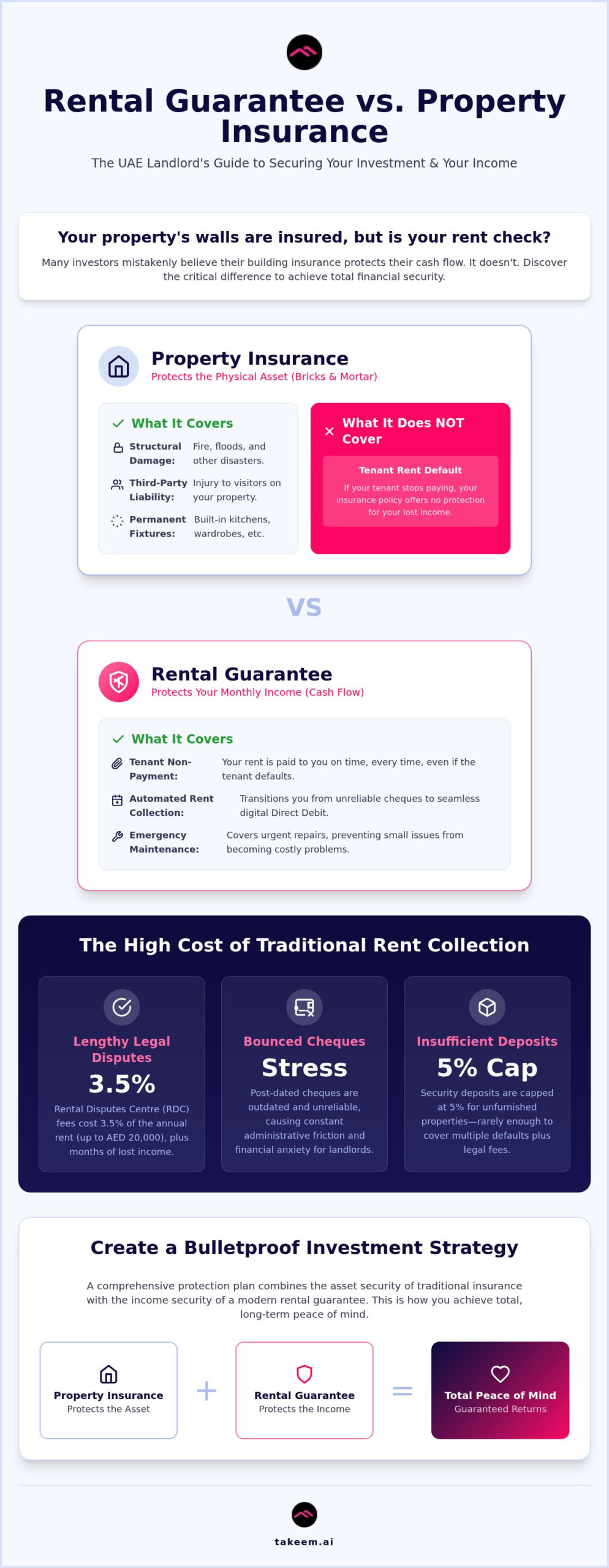
    What if you discovered that the insurance policy protecting your property’s walls does absolutely nothing to protect the rent hitting your bank account? It’s a sobering realization for many investors who find themselves caught in the middle of the rental guarantee vs property insurance UAE debate only after a tenant stops paying. While one safeguards the bricks and mortar, the other ensures your monthly income remains uninterrupted regardless of tenant behavior.

    We understand the stress of chasing unreliable payments and the sudden sting of emergency repair costs. It’s exhausting to manage a portfolio when you’re constantly looking over your shoulder for the next bounced cheque or a legal hurdle that could drain your returns. You’ve worked hard to build your wealth, and you shouldn’t have to act as a debt collector just to see a profit from your investment.

    This guide provides a clear framework for distinguishing between physical asset protection and rental income security. You’ll discover how to automate your rent collection through digital Direct Debits and leverage modern shields that cover everything from tenant non-payment to urgent maintenance. By the end, you’ll know exactly how to secure your UAE property investment for total, long-term peace of mind.

    Key Takeaways

    • Distinguish between safeguarding your property’s physical structure and securing your actual monthly income to ensure consistent liquidity.
    • Transition from the stress of bounced cheques to a modernized system using digital Direct Debit for seamless, automated rent collection.
    • Navigate the rental guarantee vs property insurance UAE landscape to understand how each service addresses different risks like tenant default or structural damage.
    • Learn how integrated emergency maintenance services within a rental guarantee can prevent minor repairs from becoming major financial drains.
    • Create a comprehensive protection strategy that combines traditional insurance with tech-forward guarantees to bulletproof your investment portfolio.

    Understanding Income Risk in the UAE Rental Market (2026)

    The UAE rental market is experiencing a significant transformation. With over 200,000 tenancy contracts registered in the first half of 2026 alone, the volume of transactions is reaching new heights. However, this rapid growth brings fresh complexities. Traditional security measures, once considered the gold standard, are proving insufficient against modern financial risks. Many investors mistakenly believe that building insurance provides a safety net for every scenario. In reality, there’s a stark divide in the rental guarantee vs property insurance UAE discussion: one protects the structure, while the other protects your cash flow.

    Physical asset safety doesn’t equate to financial liquidity. Market volatility can impact rental yields overnight. If a tenant defaults, your yield evaporates, yet your mortgage and service charges remain due. This creates a dangerous gap. Landlords are now moving toward proactive risk management models that treat rent as a guaranteed financial product rather than a variable outcome. You shouldn’t have to wait for a crisis to realize your income isn’t as secure as you thought.

    The Evolution from Post-Dated Cheques to Digital Payments

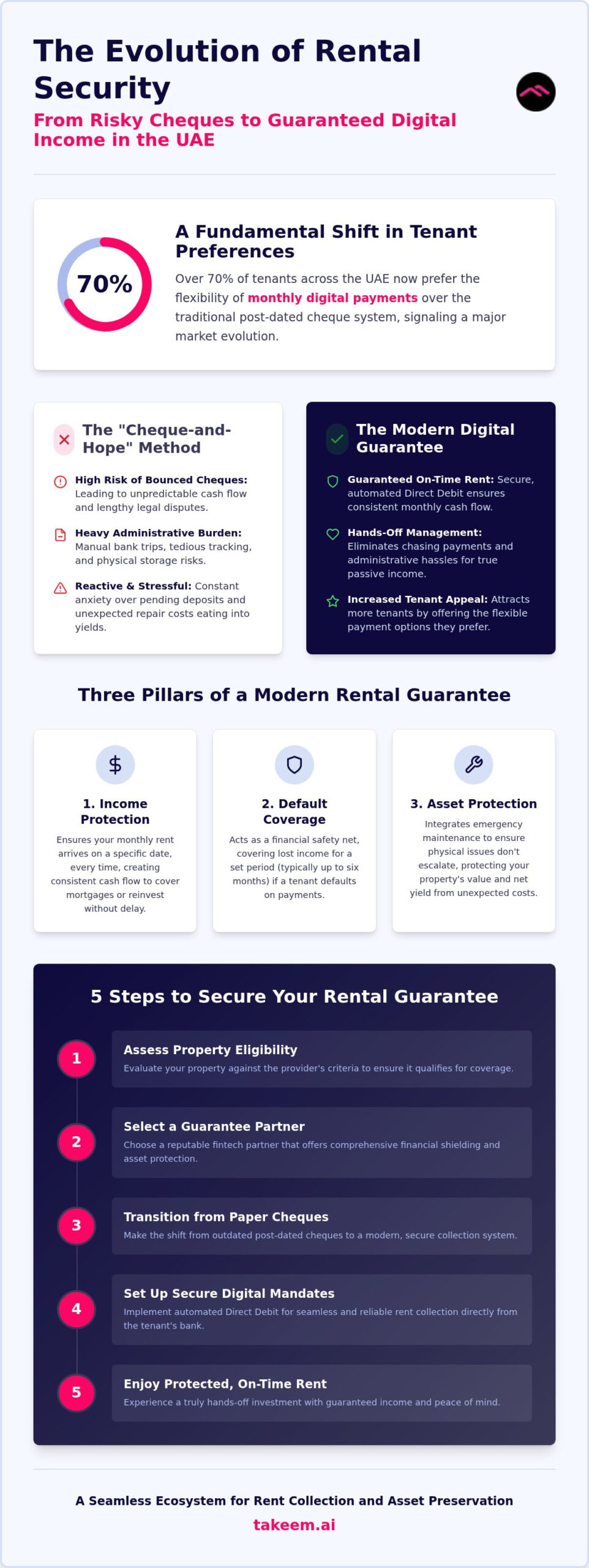
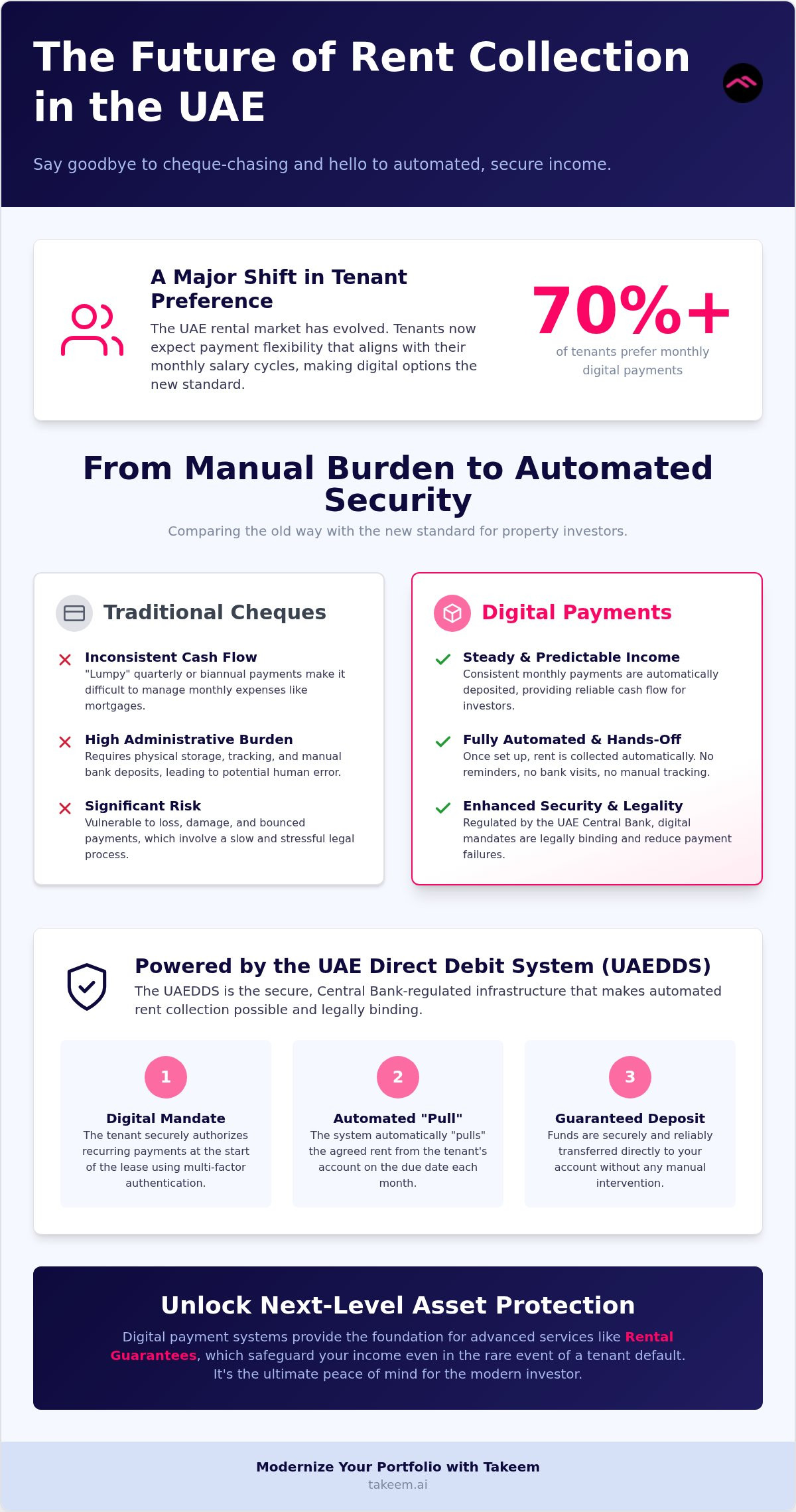
    The reliance on post-dated cheques is declining. In a modern economy, these paper promises are prone to failure and administrative friction. Digital payments, specifically Direct Debit, are becoming the preferred standard across the UAE. Regulatory shifts now favor these automated systems because they reduce payment failure at the source. This transition isn’t just about convenience; it’s about shifting the global concept of rent insurance into a localized, digital-first reality. By moving away from cheques, you eliminate the “bounced payment” stress that has plagued the market for decades.

    Why Traditional Methods Fail to Protect Cash Flow

    Relying on legal recourse or security deposits is often a losing game. Filing a dispute with the Rental Disputes Centre (RDC) costs 3.5% of the annual rent, with fees reaching up to AED 20,000. These costs, combined with months of lost income, create a “liquidity trap” for the owner. Security deposits, capped at 5% for unfurnished properties, are rarely enough to cover multiple months of default plus legal fees. When comparing a rental guarantee vs property insurance UAE, it’s clear that traditional insurance won’t pay your mortgage if the tenant stops paying. Proactive guarantees bridge this gap, ensuring that your investment remains a source of income, not a liability.

    Property Insurance: Safeguarding the Physical Asset

    Property insurance is the bedrock of risk management for any real estate owner. It’s not just a strategic choice; for investors with mortgages, it’s a mandatory requirement. This coverage protects the physical shell of your investment, acting as a shield against the catastrophic. Fire, floods, and structural failures fall under this umbrella. The World Bank’s assessment of UAE property registration highlights the efficiency and stability of the local market, but even the most secure property requires protection from physical damage. When weighing the rental guarantee vs property insurance UAE debate, it’s essential to remember that insurance looks at the bricks, while guarantees look at the bank account.

    What Standard Home Insurance Covers (and What it Doesn’t)

    Standard policies focus on the tangible. They typically cover structural integrity, including walls, roofs, and foundations. They also extend to permanent fixtures like built-in wardrobes and kitchen units. A critical component is third-party liability, which provides coverage if a visitor or neighbor is injured due to a fault in your property. However, it’s vital to distinguish between ‘Homeowner Insurance’ and ‘Landlord Insurance’. If you’re renting out the unit, a standard homeowner policy might be voided. The risk profile of a tenant is different from an owner-occupier, so you need a policy specifically designed for landlords to maintain valid coverage.

    Insurance does not cover the intentional financial default of a tenant. If a tenant decides to stop paying rent despite the property being in perfect condition, your insurance provider will not reimburse those losses. It’s a protection for the asset, not the business operation of being a landlord.

    The Reality of Insurance Payouts for Rent Default

    Many landlords are surprised to find that ‘Loss of Rent’ clauses in standard insurance policies are highly restrictive. These clauses typically only activate if the property becomes uninhabitable due to a covered physical event, such as a fire or major leak. If your tenant simply disappears or stops paying while the property remains functional, insurance won’t step in. This is a primary reason why the rental guarantee vs property insurance UAE distinction is so critical for cash flow management.

    • Physical Trigger: Payouts require structural damage first.
    • High Deductibles: You often pay a significant portion of the claim yourself.
    • Claims Latency: Traditional insurance claims can take weeks or months to process.

    To bridge the gap between physical protection and financial certainty, you might consider a comprehensive rental guarantee that picks up where your insurance leaves off, ensuring your yield is never at the mercy of tenant behavior.

    Rental Guarantees: Protecting Your Monthly Yield

    A rental guarantee represents the next evolution in property technology. Unlike traditional insurance, which acts as a reactive safety net, a modern rental guarantee is a proactive financial buffer. It ensures that your monthly yield remains stable regardless of whether a tenant pays on time. While there’s much discussion regarding the rental guarantee vs property insurance UAE landscape, the core difference lies in the guarantor’s role. In this model, a fintech platform steps in as a reliable facilitator, ensuring 100% payment occupancy for your portfolio. This isn’t just a service; it’s a digital shield for your cash flow.

    This model is rapidly becoming the standard for sophisticated investors across the UAE. It removes the friction of property management by providing a guaranteed income stream. You no longer need to worry about the specific date a tenant transfers funds. Instead, you receive your rent like clockwork, allowing you to meet your own financial obligations with total confidence. Understanding the nuances of property insurance for rental properties in the UAE is vital for asset safety, but only a guarantee secures the operational liquidity of your investment.

    The Mechanics of a Rental Guarantee Service

    The process starts with a seamless Direct Debit setup. This replaces the administrative burden of handling physical cheques or manual transfers. Once the system is live, the payout process becomes automated. If a tenant is late or a payment fails, the guarantee triggers an automated payout to the landlord. You move from the stress of chasing payments to the simplicity of receiving digital reports. It’s a shift toward a more institutionalized way of managing private rental property, where technology handles the risk and you enjoy the returns.

    Integrated Maintenance: Preserving Value Beyond the Rent

    Emergency property maintenance is often the missing piece in a landlord’s protection strategy. A leaking pipe or a broken cooling system can quickly escalate into a legal dispute or a tenant withholding rent. By integrating emergency maintenance into the rental guarantee, you create a comprehensive financial shield. Quick repairs prevent minor issues from turning into major capital expenditures that drain your profits. This synergy ensures that the rental guarantee vs property insurance UAE choice isn’t just about money, but about the total health of your asset.

    • Immediate Response: Repairs are handled before they impact the tenant’s willingness to pay.
    • Value Preservation: Rapid intervention ensures the long-term appreciation of the physical asset.
    • Synergy: Maintenance coverage and income security work together to eliminate the most common causes of rental default.

    When you evaluate your protection options, consider that insurance covers the disaster, but a guarantee manages the day-to-day stability of your yield. It’s the difference between being covered for a fire and being certain that your mortgage is paid every single month.

    Rental Guarantee vs. Property Insurance in the UAE: A Landlord’s Guide to Total Protection

    Side-by-Side Comparison: Coverage, Cost, and Claims

    Choosing the right protection requires a clear understanding of what triggers a payout. In the rental guarantee vs property insurance UAE comparison, the primary difference lies in the nature of the risk. Property insurance triggers during physical crises like fire, flood, or structural failure. It protects your capital asset from becoming a total loss. Conversely, a rental guarantee triggers during financial friction, such as a tenant’s non-payment or a late transfer. While insurance keeps the building standing, the guarantee keeps the investment performing.

    The cost structures also reflect these different goals. Annual insurance premiums are typically fixed costs based on the property’s reconstruction value. They’re a necessary expense for long-term safety. Rental guarantees usually operate on service-based fees that scale with the rental value. This isn’t just a cost; it’s an investment in operational efficiency. By shifting from DIY collection to managed digital collection, you replace the administrative burden of chasing payments with a streamlined, automated system.

    Payout Speed: Insurance Claims vs. Guaranteed Income

    Liquidity is the lifeblood of any property portfolio. Traditional insurance claims often involve a 30 to 90 day cycle for assessment and payout. This delay can be devastating if you’re relying on that income to cover mortgage installments or service charges. A rental guarantee operates on a scheduled day reliability. Because the system is built on digital Direct Debit, the payout is automated. You receive your rent on the expected date even if the tenant’s payment is delayed, effectively removing the stress of missed financial obligations.

    Liability vs. Liquidity: Choosing the Right Shield

    The most successful investors don’t choose one over the other. They adopt a hybrid approach. Liability protection via insurance is a baseline requirement, but liquidity protection via a guarantee is what allows a portfolio to scale. As your holdings grow, the complexity of managing multiple tenants increases. Mapping your protection types to different tenant profiles ensures that every unit remains profitable. For example, high-turnover units benefit significantly from the automated maintenance and payment security of a guarantee.

    To see how this modern protection model fits your specific portfolio, you can explore the Landlord Rental Guarantee and secure your monthly income today. This dual-layer strategy ensures that your investment is protected from both physical damage and financial default, providing the total peace of mind every landlord deserves.

    Takeem: The Modern Landlord’s Comprehensive Security Suite

    Takeem provides a national solution for UAE landlords who want to move beyond the limitations of traditional protection. While previous sections have outlined the rental guarantee vs property insurance UAE debate, Takeem represents the practical application of these concepts into a single, streamlined workflow. We serve as a digital shield, combining financial security with operational excellence. By integrating modern proptech with the reliability of institutional finance, we ensure that your monthly income is never left to chance. As of 2026, Takeem has already onboarded over 95,000 units, representing more than AED 9 billion in annual rental value across the UAE.

    We bridge the gap between traditional banking and modern property technology. Our platform acts as a sophisticated facilitator, allowing you to focus on growth while we handle the risk. This institutional-grade security is no longer reserved for large corporations; it’s now accessible to every individual investor seeking peace of mind.

    Replacing Cheques with Direct Debit

    The transition to digital rent collection is a fundamental shift in the UAE market. Takeem facilitates a step-by-step move from manual, cheque-based systems to automated Direct Debit. This doesn’t just benefit the landlord. It enhances tenant relationships by offering the flexibility of monthly payments, which reduces the financial strain on the renter and lowers the probability of default. It effectively removes the friction of “bounced cheque” stress and administrative follow-ups. For a deeper look at this transition, read our guide on Modernizing UAE Rentals: A Landlord’s Guide to Rental Guarantees and Direct Debit.

    Total Portfolio Protection for Investors

    Managing risk across a diverse portfolio requires more than just insurance. It requires visibility and control. Takeem offers a single dashboard where investors can monitor multiple units and track guaranteed payments in real-time. This level of oversight is paired with emergency property maintenance, which acts as a critical component of yield optimization. By addressing repairs immediately, you prevent small issues from impacting your long-term returns. This integrated approach is essential for Optimising Property Portfolio Rental Income in the UAE: The 2026 Investor’s Guide.

    We also empower real estate agents to provide superior security to their clients. Through our commission-based partnership model, agents can offer the Landlord Rental Guarantee as a value-added service. This builds trust and professional authority, positioning the agent as a tech-savvy guide in a competitive market. Takeem is the comprehensive suite that turns property investment into a truly passive, risk-free enterprise.

    Securing the Future of Your Property Investment

    The choice between a rental guarantee vs property insurance UAE is not a matter of selecting one over the other. It’s about building a comprehensive defense that protects both your physical asset and your financial liquidity. While insurance manages the risk of structural damage, a rental guarantee ensures that your investment continues to perform regardless of market volatility or tenant behavior. You’ve seen how modernizing your approach through digital Direct Debit collection eliminates the friction of traditional cheques and provides a steady, predictable income stream.

    By integrating emergency maintenance into this framework, you preserve the long-term value of your units while enjoying guaranteed monthly cash flow. This proactive strategy allows you to scale your portfolio with confidence, knowing that every unit is shielded by institutional-grade technology. It’s time to stop chasing payments and start focusing on your growth.

    Secure your rental income with Takeem’s guarantee today and experience the peace of mind that comes with total protection. Your investment deserves a modern shield.

    Frequently Asked Questions

    Is a rental guarantee the same as landlord insurance?

    No, they’re distinct protection models. Landlord insurance typically focuses on the physical structure and third-party liability. A rental guarantee is a fintech-driven solution that secures your actual income. When evaluating a rental guarantee vs property insurance UAE, think of insurance as protecting the bricks and mortar, while the guarantee protects the monthly performance of your cash flow. One is for disasters; the other is for financial reliability.

    Does property insurance cover a tenant not paying rent in the UAE?

    Standard property insurance in the UAE rarely covers simple rent default. Most policies only offer “loss of rent” coverage if the building is physically damaged by a covered event, like a fire, making it uninhabitable. If a tenant stops paying but the property is fine, insurance won’t help. This is why landlords use guarantees to bridge the gap between physical safety and financial liquidity.

    How does Takeem’s rental guarantee work with Direct Debit?

    Takeem integrates Direct Debit to replace the administrative burden of post-dated cheques. The system automatically pulls rent from the tenant’s account on a monthly basis. If the tenant has insufficient funds, the guarantee service ensures the landlord still receives the scheduled payment. It transforms the collection process into a digital, hands-off experience that prioritizes the landlord’s cash flow stability without the need for manual follow-ups.

    Is emergency maintenance included in a standard UAE property insurance policy?

    Standard policies usually exclude minor emergency maintenance. They’re designed for significant structural losses rather than a leaking pipe or a cooling system failure. Takeem includes emergency property maintenance as a core part of its rental guarantee. This ensures that urgent issues are resolved quickly, protecting the asset’s value and preventing maintenance disputes from leading to tenant payment defaults or long-term structural damage.

    Can I have both property insurance and a rental guarantee?

    Yes, and combining both is the most effective way to achieve total protection. Insurance provides the mandatory structural coverage often required by lenders, while a guarantee provides the income security needed for mortgage payments. Using them together creates a comprehensive shield that covers every possible risk, from a natural disaster to a tenant’s sudden change in financial circumstances, ensuring your investment remains profitable.

    What happens if a tenant defaults while I have a Takeem guarantee?

    If a tenant defaults, your income remains uninterrupted. Takeem’s system detects the failed Direct Debit and triggers the guarantee payout to your account on the scheduled day. The platform then manages the recovery process and administrative hurdles. You don’t have to deal with the stress of legal filings or chasing payments, as your yield is already secured by the digital guarantee framework.

    Is Direct Debit legally recognized for rent collection in the UAE?

    Direct Debit is fully recognized and increasingly encouraged as a secure method for rent collection across the UAE. It provides a transparent, digital trail that reduces the risks associated with physical cheques. Regulatory shifts are moving toward these automated systems because they offer better protection for both parties. It’s a modernized approach that aligns with the country’s push for a digital-first economy and reduces payment friction.

    How much does a rental guarantee cost compared to traditional insurance?

    Insurance premiums are typically based on the property’s reconstruction cost and are paid annually. Rental guarantee fees are service-based and tied to the rental value of the property. While the structures differ, the guarantee provides a broader operational benefit by automating collection and including maintenance. Both are essential investments for any serious landlord looking to minimize risk and maximize the performance of their national property portfolio.

  • How to Get a Rental Guarantee in the UAE: The 2026 Landlord Guide

    How to Get a Rental Guarantee in the UAE: The 2026 Landlord Guide

    Did you know that over 70% of tenants across the UAE now prefer monthly payment options over the traditional post-dated cheque system? This shift represents a fundamental change in the property market, yet many landlords still rely on the outdated “cheque-and-hope” method. You’re likely familiar with the anxiety of a pending deposit or the frustration of an unexpected maintenance bill suddenly eating into your quarterly yields. It’s a stressful, reactive way to manage what should be a stable, passive investment.

    This guide explains how to get a rental guarantee in Dubai and the wider UAE to finally secure your property with modern digital protection. By moving away from physical cheques and toward secure Direct Debit systems, you can achieve the consistent cash flow you deserve. We’ll show you how to protect both the physical and financial value of your assets while enjoying a truly hands-off management experience that eliminates the hassle of chasing payments.

    We’ll explore the transition to digital mandates, the benefits of integrated emergency maintenance coverage, and the streamlined steps to implementing a professional rental guarantee for your portfolio in 2026.

    Key Takeaways

    • Understand the critical difference between developer yield promises and true third-party rental income protection that secures your monthly cash flow.
    • Learn exactly how to get a rental guarantee in Dubai and the wider UAE by transitioning from traditional paper cheques to secure, automated digital collection.
    • Discover the five essential steps to assess your property’s eligibility and select a guarantee partner that offers comprehensive financial shielding.
    • See how integrating emergency property maintenance into your guarantee protects your net yields from being eroded by unexpected repair costs.
    • Explore how modern fintech solutions like Takeem provide a seamless, hands-off ecosystem for rent collection and asset preservation.

    What is a Landlord Rental Guarantee in the UAE?

    A landlord rental guarantee in the UAE is a sophisticated financial service designed to decouple your income from your tenant’s immediate liquidity. It ensures that you receive your rent on a specific date, regardless of whether the tenant has paid or defaulted. This is a significant departure from the traditional “cheque-and-hope” model that has dominated the region for decades. While developers often advertise “guaranteed yields” to sell off-plan units, those are typically marketing incentives. A true third-party guarantee is a robust fintech solution that protects individual investors across the secondary market.

    As the market matures in 2026, proptech platforms are making these shields accessible to everyone from single-unit owners to large portfolio managers. If you’re researching how to get a rental guarantee in Dubai or elsewhere in the UAE, it’s vital to understand that this isn’t just insurance. It’s an end-to-end ecosystem for asset security that reflects a maturing, globalized property market.

    The Core Components of a Modern Guarantee

    Modern guarantees focus on three pillars of protection. First, income protection ensures your monthly deposit arrives on time, every time. This creates the consistent cash flow needed to cover mortgages or reinvest without delay. Second, default coverage acts as a financial safety net. If a tenant stops paying, the guarantee provider covers the lost income for a set period, typically up to six months. Finally, asset protection integrates emergency maintenance. This ensures that physical issues don’t escalate into financial disasters that erode your net yield.

    Why Traditional Methods Are No Longer Enough

    Relying on post-dated cheques is increasingly risky in a digital-first economy. Cheques can bounce, be lost, or require manual trips to the bank, creating a heavy administrative burden. The concept is similar to a Loan guarantee, where a third party assumes the risk of the primary debtor. In the rental world, this shift is essential for stability as tenants increasingly demand flexible payment options like the DLD “Flexi Rent” initiative.

    Manual collection also leaves you vulnerable to legal hassles. Learning avoiding rental disputes UAE is much easier when you have a digital buffer between you and the tenant. By automating the process through a guarantee, you remove the friction that often leads to missed payments and damaged relationships. It’s a proactive approach that prioritizes your peace of mind over reactive collection efforts.

    The Shift from Post-Dated Cheques to Digital Rent Collection

    The era of the post-dated cheque is rapidly closing. For decades, UAE landlords relied on physical paper as their primary security measure, but the limitations of this system are now undeniable. Cheques can be lost, forged, or bounced, often leading to lengthy legal delays and administrative headaches. In 2026, the market is embracing digital mandates as the new standard for reliability. Understanding how to get a rental guarantee in Dubai or across the UAE starts with this fundamental shift toward automation. By adopting digital collection, you align your investment with Dubai Land Department regulations and the growing “Flexi Rent” initiative.

    Direct Debit provides a secure, automated path for funds to move directly from the tenant’s bank to yours. It eliminates the manual labor of depositing cheques and the anxiety of waiting for them to clear. For tenants, the appeal is equally strong. Research shows that over 70% of UAE tenants now prefer monthly installments over large quarterly hits to their cash flow. This flexibility actually reduces the risk of a tenant not paying rent UAE, as smaller, frequent payments are significantly easier for most households to manage than bulk sums.

    Direct Debit vs. Cheques: A Security Comparison

    Digital mandates remove human error from the equation. Unlike a cheque that sits in a drawer for months, a Direct Debit mandate is a live financial link. If a payment fails, the system identifies the issue instantly, allowing for immediate resolution. This predictability is vital for property portfolio management. It allows you to forecast your income with precision and ensures your yields remain stable. If you’re looking to modernize your portfolio, you can explore digital collection tools that bridge the gap between traditional leases and modern fintech.

    The Role of Fintech in Rental Security

    Proptech platforms now offer real-time tracking of every rental transaction. Both parties receive automated notifications, which fosters a culture of transparency and trust. This visibility serves as the essential trigger for a rental guarantee. When the system detects a missed payment, the guarantee protocol initiates immediately. You don’t have to wait for a bank to return a physical cheque to know there’s a problem. This speed and efficiency are what make modern digital guarantees far superior to the cumbersome methods of the past. To understand the broader context of these changes, exploring the evolution of landlord fintech solutions in the UAE reveals how 2026 trends like “Rent Now, Pay Later” schemes are reshaping the entire property management landscape.

    5 Steps to Secure a Rental Guarantee for Your Property

    Implementing a rental guarantee is a streamlined process that moves your property into the modern era of asset management. While many landlords assume these protections are only for new developments, the reality is that any established property can be shielded. If you’re looking into how to get a rental guarantee in Dubai or across the UAE, following a structured path ensures your coverage is legally sound and financially robust. It’s about replacing uncertainty with a systematic approach to income security.

    • Step 1: Assess Eligibility. Providers review your current lease terms and the property’s legal standing.
    • Step 2: Choose a Comprehensive Partner. Select a provider that handles both the digital collection of rent and the financial protection of your yield.
    • Step 3: Transition to Digital Mandates. Move away from paper cheques to a secure Direct Debit setup. This aligns with the broader market shift to monthly payments, which significantly enhances tenant retention and satisfaction.
    • Step 4: Establish Maintenance Protocols. Link your guarantee to an emergency maintenance service to prevent physical issues from eroding your net profit.
    • Step 5: Finalize and Activate. Sign the digital agreement to trigger your protection and start receiving automated deposits.

    Evaluating Your Property and Tenant

    Guarantee providers prioritize transparency and legality. A valid Ejari registration is the non-negotiable foundation for any guarantee in the UAE. It provides the legal framework necessary to enforce terms and verify the rental value. Additionally, providers look for realistic rental pricing. Setting a price that aligns with current market data ensures the guarantee is sustainable. It also confirms that the tenant can comfortably meet their obligations without financial strain, which is the first line of defense against default.

    Onboarding Your Tenant to the New System

    The transition from cheques to digital mandates requires clear communication. Many tenants welcome the change, as it allows them to manage their cash flow more effectively. When you’re explaining how to get a rental guarantee in Dubai, focus on the convenience of automated payments and the elimination of manual bank trips. Legally, updating payment terms involves a simple amendment to the existing contract. This proactive step modernizes the tenant’s experience and makes your property more competitive in a digital-first market. Landlords seeking a deeper understanding of how these tools are reshaping the industry can benefit from reviewing the latest landlord fintech solution UAE trends for 2026, which detail the most impactful innovations driving this transformation.

    How to Get a Rental Guarantee in the UAE: The 2026 Landlord Guide

    Protecting Asset Value: Why Maintenance is Part of the Guarantee

    Many landlords view rent collection and property maintenance as separate silos. This is a strategic error. A single burst pipe or a failed AC unit can instantly wipe out months of profit. When you’re considering how to get a rental guarantee in Dubai or across the UAE, you must look beyond the monthly deposit. A comprehensive guarantee should act as a shield for the property’s physical integrity as much as its financial output. By integrating maintenance, you ensure that your investment remains a high-performing asset rather than a source of constant liability.

    Emergency Repairs and Income Stability

    Maintenance disputes are among the most common reasons for rent withholding in the UAE. A tenant faced with a non-functional water heater or electrical fault often feels justified in delaying payments. An integrated guarantee removes this friction by providing a 24/7 emergency response. This proactive management prevents small issues from escalating into expensive structural damage. It also reduces your operational stress, as you’re no longer the first point of contact for midnight emergencies. You can secure your property with an integrated maintenance guarantee to stabilize your long-term returns and eliminate these common pain points.

    The Long-Term View: Yield vs. Net Income

    Calculating your annual ROI requires looking at net income, not just the gross rent on the contract. Unexpected repairs are the primary cause of yield erosion. A “guaranteed” rent figure is effectively meaningless if your outgoings remain volatile and unpredictable. Modern guarantee models fix these costs by including emergency coverage, allowing for precise financial planning. Maintenance integration is the ultimate hedge against rental volatility.

    This approach also protects the long-term resale value of your property. Consistent, professional upkeep ensures that when it’s time to exit the investment, the asset is in peak condition. A well-maintained property commands a higher market price and attracts premium tenants, creating a virtuous cycle of value preservation. By securing a guarantee that includes maintenance, you aren’t just protecting today’s rent; you’re protecting tomorrow’s equity.

    Choosing Takeem for Your UAE Rental Guarantee

    Takeem represents the next evolution in property investment security. While traditional methods rely on the physical exchange of paper and the hope that funds are available, Takeem provides a robust fintech shield for landlords across the UAE. Unlike developer-led schemes that are often restricted to specific off-plan projects, this solution is designed for the secondary market. It empowers individual investors and portfolio managers to professionalize their operations. If you are researching how to get a rental guarantee in Dubai or any other part of the UAE, Takeem offers a streamlined path to financial certainty.

    The platform functions as a comprehensive ecosystem by combining digital rent collection, ironclad income guarantees, and emergency maintenance. This integrated approach ensures that your property remains a source of passive income rather than a management burden. The process is designed for speed and transparency. Once your property is onboarded, the system handles the transition from cheques to digital mandates, ensuring your first guaranteed payment arrives on schedule without the need for manual intervention.

    Real estate agents also play a vital role in this digital transformation. Takeem offers dedicated partnerships that allow agents to provide these guarantee solutions to their clients. This not only adds a layer of security for the landlord but also provides agents with healthy commissions. It creates a more stable rental market where every stakeholder benefits from increased transparency and reduced financial risk.

    The Takeem Advantage for Property Investors

    Managing a large property portfolio requires precision and scalability. Takeem replaces the fragmented “cheque run” with a single digital dashboard that provides real-time visibility into your entire asset base. By implementing automated Direct Debit, you eliminate the administrative friction that typically plagues high-volume investors. This system ensures consistent income regardless of market fluctuations, allowing you to reinvest with confidence. It’s a proactive tool that prioritizes your peace of mind by securing the financial pulse of your investments. Landlords who want to fully leverage these capabilities can explore how proptech for rent collection UAE is transforming the way property investors manage their portfolios in 2026.

    How to Get Started Today

    Securing your investment is a straightforward process that begins with a professional assessment. Every landlord’s needs are unique, so the first step involves reviewing your current portfolio to ensure all documentation is in order. You’ll need a valid Ejari registration and a current tenancy contract to activate the protection framework. When you’re ready to learn more about how to get a rental guarantee in Dubai or the wider UAE, our team provides the technical and legal guidance needed for a seamless transition.

    The shift to digital security is not just a trend; it’s a necessity for the modern investor. You can secure your rental income with Takeem’s digital guarantee today and experience the benefits of a truly hands-off, protected investment strategy.

    Modernize Your Property Strategy for 2026

    The rental landscape in the UAE has fundamentally shifted away from the “cheque-and-hope” era toward a fintech-driven future. By embracing digital mandates and integrated maintenance, you’re not just collecting rent; you’re actively preserving the financial and physical value of your asset. You now understand the essential steps of how to get a rental guarantee in Dubai and across the country to replace manual collection with automated peace of mind. This transition ensures your cash flow remains predictable while your property stays in peak condition for years to come.

    It’s time to transition your portfolio to a system that prioritizes long-term stability. Takeem facilitates a seamless move from physical cheques to secure Direct Debit, ensuring your income remains consistent regardless of market shifts. With emergency maintenance included in every guarantee, your net yields are protected from the unexpected costs that often erode profit. Protect your rental income with Takeem’s digital guarantee and maintenance solutions. Join the growing number of property investors across the UAE who’ve already modernized their approach for a more secure, hands-off future.

    Frequently Asked Questions

    Is a rental guarantee legally binding in the UAE?

    A rental guarantee is a legally binding contract when issued by a licensed financial technology provider in the UAE. Its enforceability depends on the mandatory registration of the tenancy contract through the Ejari system. This legal framework ensures that both the landlord’s income and the provider’s obligations are recognized by the relevant authorities. It’s a professional alternative to traditional personal guarantees, offering a higher level of institutional security for property investors.

    How much does a rental guarantee service typically cost for a landlord?

    Service fees for rental guarantees are typically calculated as a percentage of the annual rent. These costs are often offset by the increased yields gained through consistent cash flow and the elimination of manual collection expenses. While specific rates depend on the size of your portfolio and the level of maintenance coverage included, the value lies in the financial shield provided. Landlords should request a tailored quote to understand the exact investment for their specific properties.

    What happens if my tenant refuses to switch to Direct Debit?

    If a tenant is hesitant to move away from cheques, you should highlight the benefits of monthly digital payments. Most tenants prefer the flexibility of smaller, automated installments over large quarterly payments. If you’re wondering how to get a rental guarantee in Dubai or the wider UAE, remember that digital mandates are the foundation of modern protection. If a tenant refuses, the guarantee might not be applicable until the next contract renewal cycle begins.

    Does the guarantee cover the full amount of rent if a tenant defaults?

    Most guarantee packages cover missed rental payments for a significant period, often up to six months of the annual contract value. This protection triggers as soon as the digital collection system identifies a default. It ensures you don’t face a sudden income gap while resolving the situation with the tenant. This coverage is essential for maintaining mortgage payments and other financial obligations that rely on a steady, predictable rental income stream.

    Can I get a rental guarantee for an existing tenancy or only new ones?

    You can absolutely secure a guarantee for an active tenancy. The process involves migrating the current payment schedule to a digital Direct Debit mandate and verifying that the existing contract is registered and in good standing. This is a popular option for landlords who want to modernize their management style mid-lease. It allows you to implement professional income protection without waiting for the current tenant to vacate or for the lease to expire.

    What specific maintenance services are included in the guarantee package?

    The maintenance component focuses on emergency repairs that could damage the property’s physical or financial value. This includes urgent plumbing issues, electrical failures, and locksmith services. By resolving these problems quickly through a 24/7 response team, the guarantee prevents minor faults from becoming major expenses. It’s a proactive way to manage your asset while ensuring the tenant remains satisfied and the property stays in peak condition for the long term.

    How does digital rent collection differ from a standard bank transfer?

    Digital rent collection via Direct Debit is an automated process where funds are pulled directly from the tenant’s account on a set date. Unlike a standard bank transfer, which requires the tenant to manually initiate the payment, digital mandates remove the risk of human error or forgetfulness. This automation is what allows providers to offer a guarantee. It creates a transparent, trackable history of every transaction that both the landlord and provider can monitor. For a comprehensive overview of how these systems work in practice, the proptech rent collection UAE landlord guide for 2026 offers detailed insights into transitioning from traditional cheques to fully automated digital collection.

    What is the notice period for activating the rental default protection?

    Default protection usually activates within a few days of a failed payment notification. When the digital collection system records a bounce or a failed mandate, the guarantee protocol begins immediately. This rapid response is much faster than the weeks or months it can take to resolve a bounced cheque through traditional legal channels. Knowing how to get a rental guarantee in Dubai means understanding that speed of activation is the key to protecting your ROI.

  • The Evolution of Digital Rent Payments in the UAE: A 2026 Landlord Guide

    The Evolution of Digital Rent Payments in the UAE: A 2026 Landlord Guide

    Over 70% of UAE tenants now prefer paying rent in monthly installments to match their salary cycles. This shift signals a definitive end to the traditional “cheque-chasing” era for property investors. You’ve likely spent years managing physical cheques, worrying about the administrative burden of bounced payments, or dealing with the stress of inconsistent cash flow. Adapting to digital rent payments UAE is no longer just an option; it’s the essential infrastructure for modern asset protection.

    We understand that your priority is a hands-off, reliable income stream. This guide will show you how to transition from traditional cheques to secure, automated collections that safeguard your portfolio. We’ll explore the latest 2026 regulations, the security of the UAE Direct Debit System (UAEDDS), and how a rental guarantee ensures you’re paid even if a tenant defaults. You’re about to discover a more efficient, professional way to manage your assets with total peace of mind.

    Key Takeaways

    • Understand why the UAE is moving toward a digital-first ecosystem and how phasing out physical cheques reduces your administrative burden.
    • Discover how the UAEDDS provides a secure, Central Bank-regulated framework for recurring digital rent payments UAE to ensure consistent collection.
    • Compare the cash flow benefits and enhanced security of automated monthly cycles against the inherent risks of lost or damaged post-dated cheques.
    • Follow a clear, two-step roadmap to assess your current agreements and successfully modernize your property portfolio’s payment infrastructure.
    • Learn how digital payment systems unlock advanced protection through rental guarantees that safeguard your income even in the event of tenant defaults.

    The Shift from Physical Cheques to Digital Rent Payments in the UAE

    The historical reliance on post-dated cheques (PDCs) defined the UAE property market for decades. Landlords viewed these physical slips as the ultimate security measure, yet they’ve always carried inherent risks. As we move through 2026, the market is rapidly transitioning to a digital-first rental ecosystem. This evolution isn’t just about moving money; it’s about replacing an analog burden with a sophisticated, automated infrastructure that protects your time and your capital.

    True digital rent payments UAE go far beyond simple bank transfers. While a manual transfer requires tenant action every month, a digital payment system utilizes a pre-authorized Direct Debit System to pull funds automatically. This modernization is heavily supported by the Central Bank of the UAE, which has developed the financial rails to make these transactions legally binding. Adopting digital rent payments UAE ensures your income is collected with the same authority as a physical cheque, but with significantly more efficiency.

    The Limitations of the Traditional Cheque System

    The administrative weight of PDCs is a significant drain on a landlord’s time. You’ve likely felt the frustration of managing physical paperwork that belongs in a different era. The traditional system forces you to handle several pain points:

    • Physically storing and tracking dozens of cheque leaves across a portfolio.
    • Manually depositing payments at the bank and waiting for clearance.
    • Dealing with the risk and legal hurdles of a bounced cheque.
    • Managing “lumpy” cash flow from quarterly payments instead of steady monthly income.

    These manual tasks are prone to human error and logistical delays. When a cheque bounces, the legal recovery process is often slow and stressful. Furthermore, relying on large, infrequent payments makes it difficult for investors to manage monthly mortgage obligations or maintenance costs with precision.

    Regulatory Drivers for Digital Transformation

    The shift is fueled by national initiatives aiming for a completely paperless economy. The UAE government has paved the way by ensuring that digital rental agreements and payment mandates carry the same legal weight as their physical counterparts. This isn’t a temporary trend; it’s a structural change to how property business is conducted.

    The UAE Direct Debit System (UAEDDS) serves as the backbone of this transformation. It provides a secure, nationwide framework that allows for seamless, recurring payments. By moving away from paper, the market gains transparency and efficiency. This regulatory support gives landlords the confidence to retire the chequebook and embrace a more stable, tech-forward approach to income collection that aligns with global financial standards.

    Understanding the UAE Direct Debit System (UAEDDS) for Rentals

    The UAE Direct Debit System (UAEDDS) serves as the sophisticated engine behind modern property management. Unlike a standard bank transfer, where you’re dependent on a tenant manually initiating a “push” payment, a Direct Debit mandate operates as a “pull” mechanism. This means the system automatically retrieves the agreed amount from the tenant’s account on a specific date. It’s a fundamental shift in control that empowers landlords to manage their cash flow with precision.

    Security remains a cornerstone of this national infrastructure. Every digital mandate is protected by multi-factor authentication, often integrated with the UAE Pass; this ensures that only verified account holders can authorize transactions. This level of oversight significantly reduces the risk of fraud or unauthorized reversals. Because these digital rent payments UAE are regulated by the Central Bank, they offer a level of protection that manual transfers simply can’t match. They also integrate directly with national rental registration systems, creating a transparent, legally binding trail for every dirham collected.

    How Direct Debit Mandates Work for Landlords

    UAEDDS is the Central Bank-backed infrastructure for recurring payments. Setting up a digital mandate is a streamlined process that happens at the very start of the lease. Once the tenant signs the digital authorization, the schedule for digital rent payments UAE is locked into the banking system. You won’t need to remind tenants or wait for them to log into their banking apps every month. The collection is entirely hands-off, pulling the rent directly into your account on the due date without fail.

    Benefits of Automation for Property Investors

    Automation eliminates the “human error” that often plagues traditional collection methods. You’ll no longer deal with forgotten transfers or the logistical delays of depositing physical cheques. Instead, you gain access to real-time tracking and instant notifications for every successful transaction. For those managing large portfolios, this data feeds directly into financial reporting tools. It provides a clear, bird’s-eye view of your rental income without the need for manual reconciliation. If you’re looking to modernize your approach, exploring a Direct Debit setup for landlords is the most effective way to secure your monthly revenue.

    Digital Payments vs. Post-Dated Cheques: A Comparative Analysis

    The comparison between physical paper and digital infrastructure reveals a stark contrast in asset protection. While post-dated cheques were once the standard for security, they’re physically vulnerable to loss, damage, or theft. In contrast, digital rent payments UAE utilize bank-grade encryption and secure digital mandates that can’t be misplaced. This transition from physical to digital isn’t just about convenience; it’s about eliminating the single point of failure inherent in paper-based systems.

    Cash flow management is where the difference becomes most apparent. Traditional cheque cycles often force landlords to wait three or six months for a single large payment. This creates “lumpy” cash flow that complicates mortgage payments and maintenance budgeting. Digital systems facilitate a smooth, monthly income stream that aligns with a landlord’s recurring expenses. By automating the collection, you’re ensuring that capital is working for you immediately rather than sitting in a desk drawer as a future-dated cheque.

    Risk Mitigation and Tenant Default

    Digital systems act as an early warning mechanism. If a tenant’s account has insufficient funds, a digital platform flags the issue days before a cheque would have even reached the bank. This proactive insight allows for immediate communication and resolution. It’s also important to recognize the legal shift in the UAE where bounced cheques have largely transitioned from criminal to civil matters. Digital mandates provide a clear, indisputable record of the payment obligation, making legal enforcement more straightforward. Modern tenants also prefer this method. With over 70% of residents seeking monthly installments, offering digital options makes your property more competitive in a tech-forward market.

    Operational Scalability for Large Portfolios

    Managing a single property with cheques is a chore; managing a portfolio of 50 or 100 units is an administrative nightmare. Portfolio investors often face the daunting task of tracking, storing, and depositing thousands of cheques every year. This manual overhead requires dedicated staff and significant time, increasing the risk of human error.

    Through digital automation, property portfolio rental income UAE is optimized by removing these manual bottlenecks. Fintech solutions allow property management teams to focus on asset growth rather than chasing paper. By reducing the cost of collection and the time spent on manual reconciliation, investors can scale their portfolios without a proportional increase in administrative overhead. It’s a cleaner, faster, and more professional way to manage high-value real estate assets.

    The Evolution of Digital Rent Payments in the UAE: A 2026 Landlord Guide

    How to Transition Your Rental Property to Digital Payments

    Transitioning your portfolio to a digital ecosystem is a strategic move that requires a structured approach. It’s more than just changing a payment method; it’s about upgrading your entire management workflow for the modern market. Follow these five steps to implement digital rent payments UAE seamlessly across your properties.

    • Step 1: Audit your portfolio. Review current tenancy agreements to identify when existing cheque cycles expire. This allows you to plan the transition for renewals or new move-ins without disrupting current arrangements.
    • Step 2: Partner with a fintech expert. Select a provider that offers direct integration with the UAE Direct Debit System (UAEDDS). This ensures your collections are backed by national banking infrastructure and carry full legal weight.
    • Step 3: Clear communication. Inform tenants about the shift early. Explain that moving to digital payments removes the hassle of physical cheques and allows for more flexible, monthly budgeting.
    • Step 4: Execute the mandate. During the contract signing or renewal process, have the tenant authorize the digital mandate. This replaces the need for collecting, storing, and depositing a stack of physical papers.
    • Step 5: Monitor your dashboard. Use a digital portal to track successful collections in real time. This replaces manual bank visits and spreadsheet reconciliation with automated, transparent reporting.

    Onboarding Tenants to Digital Systems

    Success depends on tenant buy-in. Most residents already prefer monthly installments, so highlighting this flexibility is a powerful incentive for them to switch. You can use direct debit for landlords UAE to simplify the entire move-in process. Instead of asking for four or six large cheques, you offer a streamlined digital authorization that takes minutes to complete. Providing clear, step-by-step instructions on how to authorize the mandate through secure banking channels reduces friction and builds trust from day one.

    Legal and Contractual Considerations

    Your tenancy contracts must reflect this digital evolution. It’s vital to update payment clauses to specify that rent will be collected via UAEDDS rather than physical cheques. These updates ensure you remain compliant with national rental laws and registration requirements. Linking digital payments to the official rental contract is a legal necessity to ensure the transaction remains enforceable under UAE law. If you’re ready to secure your income, you can start your Direct Debit setup for landlords today to automate your entire portfolio with confidence.

    Taking Protection Further: Digital Payments and Rental Guarantees

    Digital payments serve as the critical entry point to a higher tier of asset protection. While automation handles the mechanics of collection, the true evolution for landlords lies in securing the income itself. Implementing digital rent payments UAE provides the transparency and data trail required to back a professional guarantee. It’s the difference between having an efficient collection tool and having a bulletproof financial safety net that covers you when things go wrong.

    A standard payment platform merely facilitates the transfer of funds. If a tenant’s account is empty, the process stops, and you’re left chasing the balance. A full income guarantee ensures that you’re paid regardless of the tenant’s financial situation. This shift transforms your property from a variable risk into a predictable monthly asset. It provides the stability needed to reinvest or manage high-leverage portfolios without the constant fear of a sudden income gap. By bridging the gap between fintech and insurance, you create a professional environment where your revenue is never in doubt.

    The Takeem Rental Guarantee Advantage

    The core advantage of our approach is moving from “hoping for payment” to “guaranteed monthly income.” Even with the most secure digital systems, life happens; tenants may face unexpected financial hurdles. A landlord rental guarantee acts as a sophisticated shield against these market volatilities. It ensures that your cash flow remains uninterrupted, protecting your long-term ROI and providing peace of mind that cheques alone could never offer.

    This protection is especially vital for investors with large property portfolios. When you’re managing multiple units, a single default can disrupt your entire financial strategy. By integrating digital rent payments UAE with a rental guarantee, you create a self-sustaining ecosystem. Your income is protected, your reporting is automated, and your investment remains secure even during tenant transitions or defaults. You’re no longer just a collector; you’re a strategic asset manager.

    Emergency Maintenance: Protecting the Physical Asset

    Income protection isn’t just about the money in the bank; it’s about the condition of the physical asset. Emergency property maintenance is a critical component of a comprehensive protection strategy. If a major leak or electrical failure occurs, the value of your asset can depreciate rapidly if not handled with speed and expertise. Takeem includes emergency maintenance as part of the rental guarantee package to prevent this depreciation and ensure tenant satisfaction.

    The synergy between automated payments and 24/7 property care creates a truly hands-off experience. You don’t just stop chasing rent; you stop managing crises. This holistic approach ensures that both your monthly revenue and your property’s long-term market value are shielded from traditional industry pain points. It’s the final step in the evolution of modern UAE landlording, turning a complex job into a streamlined, high-performance investment.

    Secure Your Property Portfolio’s Future

    The transition from physical cheques to digital infrastructure represents a fundamental upgrade for property investors. By embracing digital rent payments UAE, you eliminate the administrative friction of manual deposits and the financial uncertainty of bounced cheques. The Central Bank’s UAEDDS framework provides a secure, nationwide standard that empowers you to manage your cash flow with modern precision and legal authority.

    Moving beyond simple collection, the integration of income guarantees and maintenance support creates a truly hands-off investment experience. It’s time to retire the chequebook and adopt a system built for the high-tech 2026 market. You can secure your rental income with Takeem’s Digital Collection and Guarantee; this gives you access to a UAE-wide rental income guarantee, automated Direct Debit collection, and 24/7 emergency maintenance coverage. Protecting your high-value assets has never been more seamless.

    The future of UAE real estate is paperless, automated, and guaranteed. By taking these steps today, you’re positioning your portfolio for long-term growth and total peace of mind.

    Frequently Asked Questions

    Are digital rent payments legal across all of the UAE?

    Yes, digital rent payments are fully legal and supported across the entire UAE. The Central Bank of the UAE regulates the Direct Debit System, ensuring these transactions carry the same weight as traditional methods. This national framework provides a secure and standardized way for landlords to collect rent digitally. It’s part of the country’s broader push toward a paperless economy, making digital mandates a modern, legally recognized alternative to physical cheques.

    What happens if a tenant has insufficient funds for a Direct Debit payment?

    If a tenant has insufficient funds, the system provides an immediate notification of the failed transaction. This is a significant advantage over physical cheques, which can take days to bounce and process. You can then contact the tenant to resolve the issue or initiate legal recovery. For landlords using a rental guarantee, the income remains protected. The guarantee ensures your cash flow continues even when a tenant’s bank account cannot cover the monthly rent.

    Can I switch from cheques to digital payments in the middle of a lease?

    You can transition to digital rent payments UAE in the middle of a lease if both you and your tenant agree to the change. You’ll need to sign a contract addendum and set up the digital mandate through your chosen provider. While many landlords wait for the renewal period to modernize their agreements, a mid-term switch is a practical way to resolve cheque-management issues immediately and stabilize your monthly cash flow.

    How much does it cost for a landlord to set up digital rent collection?

    The cost of setting up digital rent collection depends on the level of protection and the service provider you choose. Most landlords view this as a strategic operational expense that pays for itself through time savings and reduced administrative overhead. By eliminating manual bank visits and cheque tracking, you reduce the hidden costs of traditional property management. The investment provides a professional infrastructure that supports long-term portfolio growth and income stability.

    Do I still need to register the contract if I use digital payments?

    Yes, registering your rental contract with the appropriate national authorities remains a mandatory requirement. Digital payment mandates don’t replace legal registration; they work alongside it. To ensure your digital collection is fully enforceable under UAE law, the payment schedule must be clearly linked to your registered tenancy agreement. This creates a transparent, legally binding trail that protects both the landlord and the tenant throughout the lease term.

    Is the UAE Direct Debit System safer than holding a physical cheque?

    The UAE Direct Debit System is significantly safer than holding physical paper. Physical cheques are vulnerable to being lost, damaged, or stolen, which creates massive legal and financial headaches. Digital mandates use bank-grade encryption and secure authentication via the UAE Pass to verify every transaction. This modern approach provides a transparent audit trail and reduces the risk of fraud, offering a level of security that analog systems simply can’t match.

    Can property agents manage digital payments on behalf of landlords?

    Property agents can certainly manage digital payment setups on behalf of their clients. Many forward-thinking agencies now utilize these systems to offer a more professional service to landlords. By setting up Direct Debit mandates, agents can automate the collection process, reducing their own administrative burden while providing landlords with more reliable reporting. It’s an efficient way for agents to manage large portfolios while ensuring their clients receive consistent, on-time payments.

    Does a digital payment system guarantee that I will receive my rent?

    A digital payment system automates the collection, but it doesn’t inherently guarantee the funds if a tenant defaults. To achieve total income security, you must combine your payment system with a Landlord Rental Guarantee. This specific service ensures that you receive your monthly rent even if the tenant fails to pay. While digital rent payments UAE streamline the process, the guarantee provides the ultimate financial shield for your property investment.