
Across the UAE, the commission payer often depends on the specific deal rather than simply on who represents the buyer or seller. For residential secondary-market sales, buyers commonly pay a 2% commission; on off-plan purchases, developers usually pay agents directly. For a typical one-year rental contract, agents commonly charge 5% of the annual rent. A commission structure for real estate agent partners also sets how the agency and agent share the commission they earn.
It’s easy to focus on the headline rate and overlook the terms that determine the final amount. At Takeem, this guide explains who pays in different transactions, what can affect commission rates, how negotiation works, and how agents and agencies divide their share. You’ll also see why property type, deal structure, and partner agreements matter, so you can clarify the arrangement before a transaction moves forward.
Key Takeaways
- Identify who pays by distinguishing secondary-market sales, off-plan purchases, and rental agreements.
- Understand how property type, transaction value, and the terms of an agreement can shape the commission.
- Know which deal conditions can create room to negotiate and how to make the arrangement clear between partners.
- See how agents and agencies divide commission, and how Takeem’s Landlord Rental Guarantee gives agents an additional offering to sell to landlords.
Factors affecting commission rates
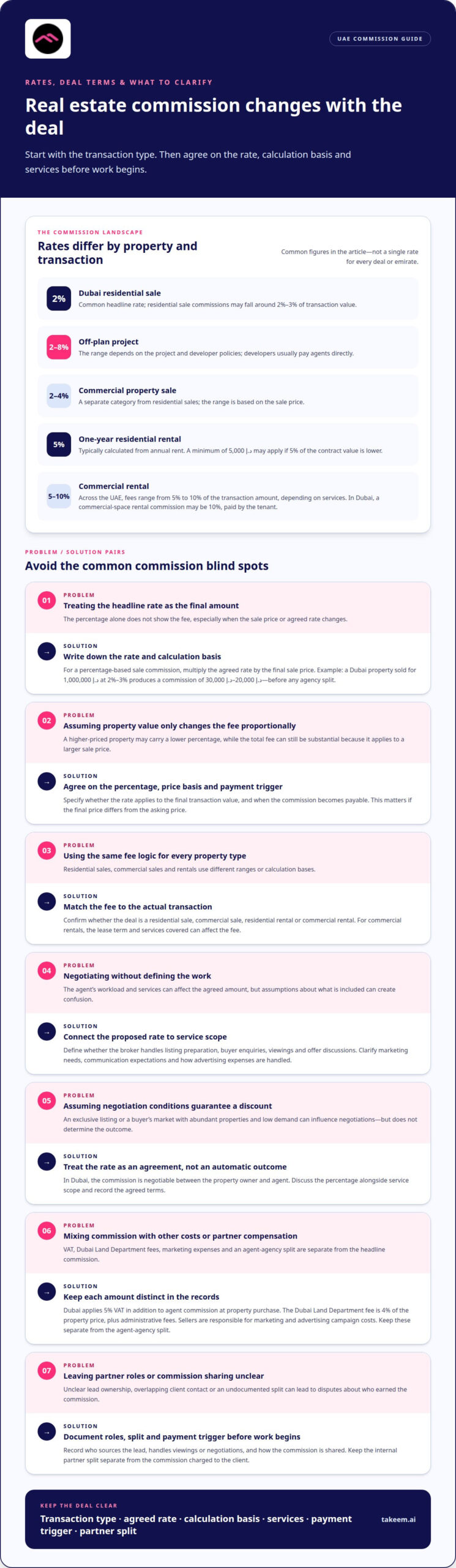
In Dubai, a residential sale commonly carries a 2% agent commission, but the final commission rate can depend on property type, transaction terms, and the agreement between the parties. Off-plan project commissions range from 2% to 8%, depending on the project and developer policies. An exclusive listing or a buyer’s market with abundant properties and low demand can also influence negotiations.
Property value matters, too. Commission percentages may decrease as value rises, while the agent’s workload and the services covered can affect the agreed amount. For example, the sale of a home and the leasing of a commercial space involve different work and fee structures. Dubai rental agents typically charge 5% of annual rent for a one-year residential contract. A minimum of د.إ 5,000 may apply when 5% of the contract value is lower.
In Dubai, commission rates are negotiable between the property owner and the agent. The Real Estate Regulatory Agency (RERA) regulates brokerage activities and sets guidelines for agents and agencies, but the commission itself remains subject to the parties’ agreement. This is a Dubai-specific answer, not a single rate that applies across every emirate.
Tax and licensing have separate considerations. In Dubai, 5% VAT is applied in addition to the real estate agent’s commission at the time of property purchase. Keep the agreed agent-agency split distinct from the VAT amount in the transaction records. RERA’s brokerage guidelines are relevant to agent and agency arrangements in Dubai.
Agent partners can divide leads, listings, and transaction duties by agreement. One partner might source a lead while another handles viewings or negotiations. Record each person’s role and the commission-sharing terms before work begins. That makes the commission structure for real estate agent partners clear when a deal closes.
Unclear lead ownership, overlapping client contact, or an undocumented split can lead to disputes over who earned the commission and how much each partner receives. Set out the payment trigger and the split in writing before marketing or negotiations begin.
A separate cost affects the transaction budget: the Dubai Land Department fee is 4% of the property price, plus administrative fees. This is distinct from agent commission, so account for it separately when calculating a sale’s total transaction costs.
Property type and value effects on commissions
Property type changes the basis and scale of a commission in Dubai. Residential sale commissions commonly fall around 2% to 3% of the transaction value, while commercial property sales can range from 2% to 4% of the sale price. These are different transaction categories, so a residential listing rate shouldn’t automatically be applied to an office or retail unit.
For a percentage-based sale commission, multiply the agreed rate by the final sale price. For example, a Dubai property sold for د.إ 1,000,000 at 2% to 3% produces a commission of د.إ 20,000 to د.إ 30,000. The calculation uses the sale value, not the agent’s eventual share after an agency split. For investing decisions, that distinction helps parties separate the transaction cost from partner compensation.
Property value can influence both the commission percentage and the total fee. A higher-priced property may carry a lower percentage, but the fee can still be substantial because it applies to a larger sale price. Identify the rate, calculation basis, and payment trigger in the listing agreement. This avoids confusion if the final price differs from the asking price.
Commercial rentals use another basis. In Dubai, a commercial-space rental commission may be 10% paid by the tenant; across the UAE, commercial rental fees range from 5% to 10% of the transaction amount, depending on the consultant’s services. A lease’s term and the work covered can therefore affect the fee. Don’t treat a sale commission and rental commission as interchangeable.
Clarify how marketing and property-related expenses will be handled. In Dubai, sellers are responsible for costs related to marketing and advertising campaigns. These expenses are separate from the broker’s commission, so the listing terms should distinguish campaign costs from compensation. For example, specify whether the commission covers brokerage work and whether advertising is a separate transaction cost.
Commission flexibility and negotiation
Dubai’s typical residential sale commission is 2%, but the rate is negotiable between the property owner and agent. That gives the parties room to discuss the percentage alongside the service scope, rather than treating a typical rate as fixed. A useful negotiation starts by defining what the broker will handle, such as listing preparation, buyer enquiries, viewings, and offer discussions.
Compare the work and terms on each side of the proposal. An exclusive listing with one Dubai agent or agency may qualify for a reduced commission rate. In a buyer’s market, where properties are abundant and demand is low, agents may also be more willing to negotiate a lower rate. These conditions can shape the discussion, but they do not determine its outcome.
Keep the calculation clear. If the commission is a percentage of the sale price, state whether the agreed percentage applies to the final transaction value. For example, a 2% rate on a sale completed at a different amount from the listing price should be calculated using the agreed basis. Defining that basis prevents later disagreements between buyers, sellers, and brokers.
Make service expectations specific. An agent’s local expertise, the property’s marketing needs, and the expected level of communication can all inform the proposed rate. Record which services are included, how marketing expenses are handled, and when the commission becomes payable. This ties the negotiated percentage to the actual work rather than assumptions.
For agent partners, settle the internal split separately from the commission charged to the client. Document who manages the listing, handles buyer contact, and leads negotiations, then explain how each contribution affects the partners’ shares. A clear commission structure for real estate agent partners can reduce friction if duties change during the transaction.
Review the full agreement before marketing begins. Confirm the rate, calculation basis, included services, expense treatment, and partner allocation in writing. This gives everyone a shared reference if the sale price, workload, or transaction plan changes.
Agent and agency commission shares
In Dubai, an agent’s share depends on the brokerage agreement, the transaction, and each partner’s contribution. Keep the client-facing commission separate from internal splits and referral arrangements.
Referral Fees Between Partners
A referral fee is an agreed share or payment for introducing a lead that proceeds to a transaction. It matters because the referring partner may contribute the client relationship without handling the listing or negotiation. Some agents also receive referral fees for directing clients to professionals such as mortgage brokers or inspectors. Partners should distinguish those referrals from property-sale commission and agree who receives payment, and when, before making an introduction.
Common Partnership Commission Structures
A common Dubai arrangement divides the transaction commission between agent and agency. Agents usually receive 50% of the total commission, while a top agent may receive up to 70%. For example, with a total commission of د.إ 20,000, an equal split gives the agent د.إ 10,000 and the agency د.إ 10,000. The agreement can allocate shares differently based on responsibilities or the type of transaction. Rental agents may receive one month’s rent or a percentage of total rent for the lease term, so selling and rental structures need separate terms.
Documenting Splits in Written Agreements
A written agreement records the percentage or amount each partner receives, the transaction that triggers payment, and the duties tied to each share. It should also distinguish brokerage commission from transaction costs, such as marketing and advertising expenses, so costs aren’t mistaken for commission deductions. State how referral fees affect the split and identify who is responsible for each cost. These details provide a clear basis for calculating and distributing proceeds after completion.
Compensation arrangements can take forms other than a commission share: agents may receive a specific dollar amount, a flat fee, a percentage of the sale price, an hourly rate, or cooperative compensation under NAR rules. Identifying the applicable arrangement helps distinguish the agent’s compensation from the agency’s share.
Takeem: Landlord Rental Guarantee that Agents can sell for healthy commissions
Takeem offers a Landlord Rental Guarantee that agents can sell for commissions, giving them an additional option in conversations with landlords beyond a property sale or rental. It may be relevant when landlords want a rental guarantee, including property investors with large portfolios.
The Rental Guarantee also includes emergency property maintenance. This links rental support with a practical property need while keeping the offer distinct from a real estate sale commission or an agent-agency split. Agents can consider whether it fits the landlord’s situation and explain it as part of a broader discussion about rental arrangements.
To discuss the Landlord Rental Guarantee, contact Takeem.
Build your next partnership opportunity
A clear commission structure for real estate agent partners can support stronger working relationships and encourage agents to think beyond individual transactions. Consider the recurring needs your landlord clients raise and whether a relevant offering could add value to your relationship with them.
Takeem offers a Landlord Rental Guarantee, including an option agents can sell for commissions. Its Rental Guarantee for Property Investors with Large property Portfolios may also suit conversations with portfolio owners. These offerings give agents a potential next step when landlords are looking for rental-related support.
Explore whether this opportunity fits your landlord relationships and business approach. Ask Takeem about agent commissions and take the next step with clarity.
Frequently Asked Questions
Who pays the commission?
In Dubai secondary-market property sales, buyers commonly pay the commission; for off-plan purchases, developers usually pay agents directly. For rentals, the payer depends on the transaction terms, so the agreement should identify who is responsible. Commission is typically paid at closing, after the transaction is complete. Keep it separate from other transaction costs when reviewing the final settlement.
How are real estate agent commissions split between partners?
In Dubai, agents usually receive 50% of the total transaction commission, and a top agent may receive up to 70%. These figures describe agent-agency sharing, not an automatic split between two agent partners. For a partner arrangement, define how the share is allocated if one agent brings the lead and another handles the transaction, and record how any referral fee affects their agreed portions.