
Tag: Ejari

  • Landlord guide to RERA laws Dubai: duties and rent rules

    Landlord guide to RERA laws Dubai: duties and rent rules

    Rent rules across the UAE are not simply a matter of setting a payment date and enforcing it. A practical landlord guide to RERA laws in Dubai and nationwide starts with the tenancy contract and the legal notice process: Dubai Law No. (26) of 2007 regulates landlord-tenant relationships, and according to the Dubai Legislation Portal, a landlord may seek eviction for unpaid rent if the tenant has not paid within 30 days after receiving written notification.

    As part of our national services at Takeem, landlords need to understand their responsibilities during a tenancy, how permitted rent increases are calculated, and what steps apply if a tenant does not pay or a landlord refuses rent. The right approach depends on the agreement and the rules that apply, so keep clear records and give proper notice. This landlord guide to RERA laws in Dubai explains key tenancy rules, landlord obligations, rent increases and payment disputes, helping you make informed decisions about what to do next.

    Key Takeaways

    • Understand which Dubai tenancy law governs your rental and how it shapes landlord and tenant responsibilities.
    • Learn why a written tenancy contract and Ejari registration matter for a clear rental record.
    • Use the rent-increase rules and rental index to understand whether an adjustment may be permitted.
    • Know how payment terms, written notice and the dispute process can affect rent refusal or non-payment.

    What Governs Your Rental According to Dubai Tenancy Law?

    Dubai’s rental rules govern contracts, rent adjustments and disputes. Knowing which authority handles each issue helps landlords follow the correct process.

    Dubai Rental Law and Regulatory Authorities

    Dubai Law No. (26) of 2007 regulates landlord-tenant relationships in Dubai, according to the Dubai Legislation Portal. The Real Estate Regulatory Agency (RERA) oversees rental-law implementation, while the Rental Disputes Settlement Centre (RDC) handles rental disputes. Ejari is Dubai’s system for regulating rental agreements. These roles matter: registration records the rental agreement, and the RDC is the forum for disputes rather than the rental regulator.

    Unpaid Rent Dispute Procedures

    The RDC handles disputes when a landlord and tenant cannot resolve a rental issue directly. A landlord may seek eviction if the tenant fails to pay rent within 30 days after receiving written notification, according to the Dubai Legislation Portal. Keep the tenancy agreement, payment records and written notice together to clarify the amount and timeline in dispute. The RDC aims to expedite resolution, giving parties a formal route for addressing unpaid rent.

    Smart Rental Index and Rent Increases

    The Smart Rental Index is part of Dubai’s rent-adjustment framework, which also references Law No. 2 of 2011. It helps place proposed rent increases against an index average for comparable rentals. If the current rent is at or within 10% of the rental index average, a landlord cannot increase it. That threshold makes the current rent’s position against the index central to assessing an adjustment.

    RERA Rental Index and Rent Calculator

    The RERA Rental Index and calculator help assess whether a rent increase may be permitted. The calculator uses the property’s location, type, current rent and number of rooms to compare the rent with the relevant index average. A general impression of market rents is not enough to establish eligibility. Using details specific to the property gives landlords and tenants a clearer basis for discussing rent at renewal.

    Landlord Obligations Dubai: What You’re On the Hook For?

    Dubai landlords must follow the written tenancy agreement and applicable tenancy legislation. The rules cover registration, property condition, rent changes and valid notices.

    Tenancy Contracts and Ejari Registration

    A written tenancy contract records the agreed rental terms, while Ejari registration records the rental agreement. Under Article 4 of Law No. (26) of 2007, a tenancy contract makes the agreement official. Registration gives both parties a clearer record of the property, rent, and contract period. Ejari registration costs approximately د.إ220.

    Landlord and Tenant Rights and Responsibilities

    Landlords must provide a property fit for living in and handle structural and major repairs under Article 16 of Law No. (26) of 2007. Article 34 protects tenants from utility disconnection or lockouts during an active tenancy. Tenants must pay rent and utilities as agreed and maintain the property. Commercial tenants may face eviction if premises remain unoccupied for 30 consecutive days or 90 non-consecutive days in a year without valid reason, unless otherwise agreed.

    Tenancy Legislation and Recent Changes

    Law No. (33) of 2008 amended Dubai’s tenancy framework under Law No. (26) of 2007. Either party proposing contract amendments must give notice at least 90 days before expiry. Filing fees are one cost to consider when pursuing a rental dispute. Ejari registration and dispute filing are separate costs. A landlord who breaches tenancy obligations may face a rental dispute handled by the RDC.

    Eviction, Renewal, and Ending Tenancies

    For specified eviction grounds, landlords must give at least 12 months’ written notice before the eviction date. The notice must be served through a Notary Public or registered mail. A valid fixed-term contract cannot be ended unilaterally during its term unless both parties agree. If a tenant remains after expiry and the landlord doesn’t object, the lease renews for another year under the same terms. For rent administration, digital rent collection can help landlords accept monthly payments.

    Landlord guide to RERA laws Dubai: duties and rent rules

    Decree No. 43 of 2013 and rent increases

    Dubai’s rent-increase rules link the permitted adjustment to how far the current rent is below the RERA Rent Index average. That difference sets the maximum increase a landlord may propose.

    Decree-Based Rent Increase Rules

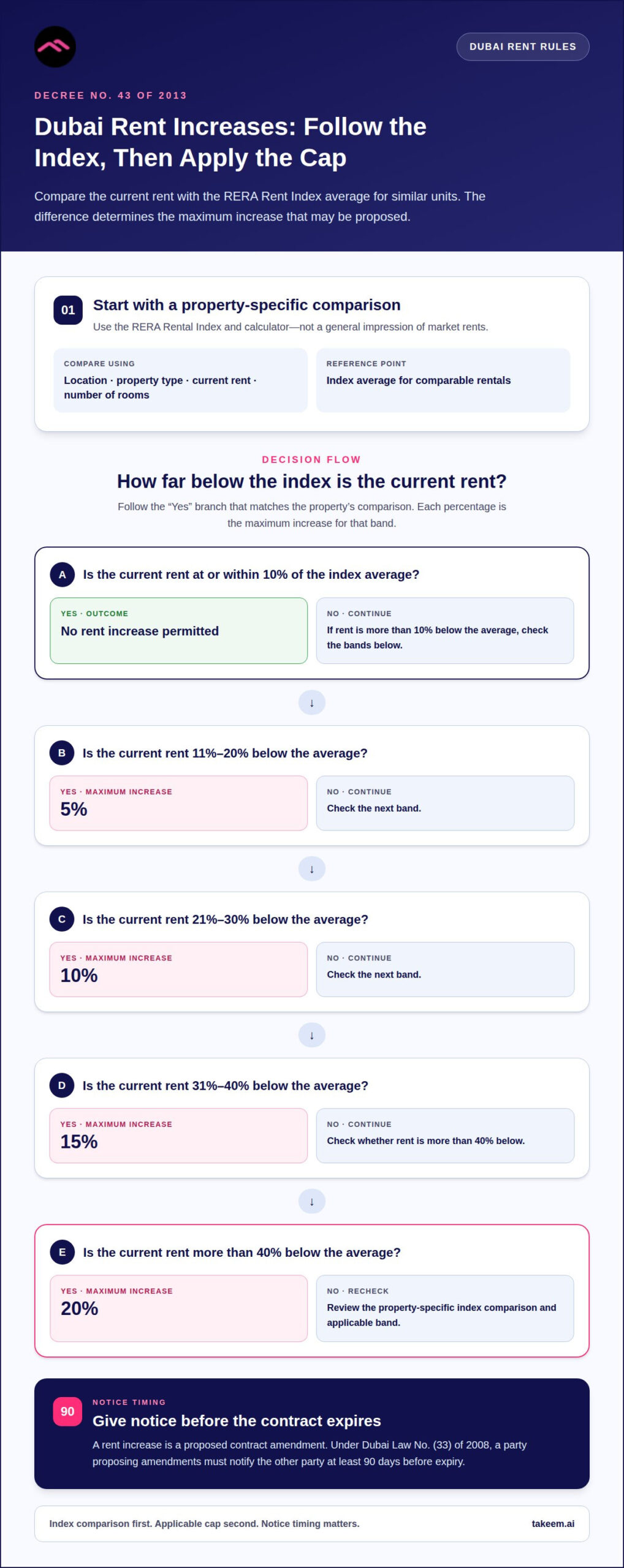
    Dubai Decree No. 43 of 2013 sets maximum rent increases according to the difference between current rent and the index average for similar units. The bands limit how much landlords can propose at renewal, even when market asking rents have changed. For landlords and tenants, comparing the current rent with the relevant average is the starting point for understanding an adjustment, not simply choosing a new figure.

    The applicable band depends on the percentage by which the current rent falls below the index average, and any proposed increase must stay within that band. Comparing the figures helps both parties discuss renewal terms and avoid proposing an amount above the permitted limit.

    RERA Rent Index Bands

    The bands set four maximum increases: 5% when rent is 11% to 20% below the average, 10% when it is 21% to 30% below, and 15% when it is 31% to 40% below. When current rent is more than 40% below the average, the maximum increase is 20%.

    Apply the band to the difference from the comparable-unit average, not to a general estimate of real estate prices. For instance, a rent 25% below the average falls within the 10% maximum band. The comparison gives both parties a consistent basis for considering a renewal proposal.

    Required Rent Increase Notice

    A rent increase is a proposed contract amendment, so timing matters. Under Dubai Law No. (33) of 2008, a party proposing amendments must notify the other party at least 90 days before the contract expires. This gives landlords and tenants time to consider the change before renewal, rather than introducing it after the existing term ends.

    A tenant has 30 days to respond to a proposed rent increase. Keep the proposal and response connected to the contract’s expiry date, so both parties can follow the notice timeline. The notice and response timelines serve different purposes: one concerns raising a proposed amendment, while the other gives the tenant time to answer.

    Rent payment and refusal to accept rent

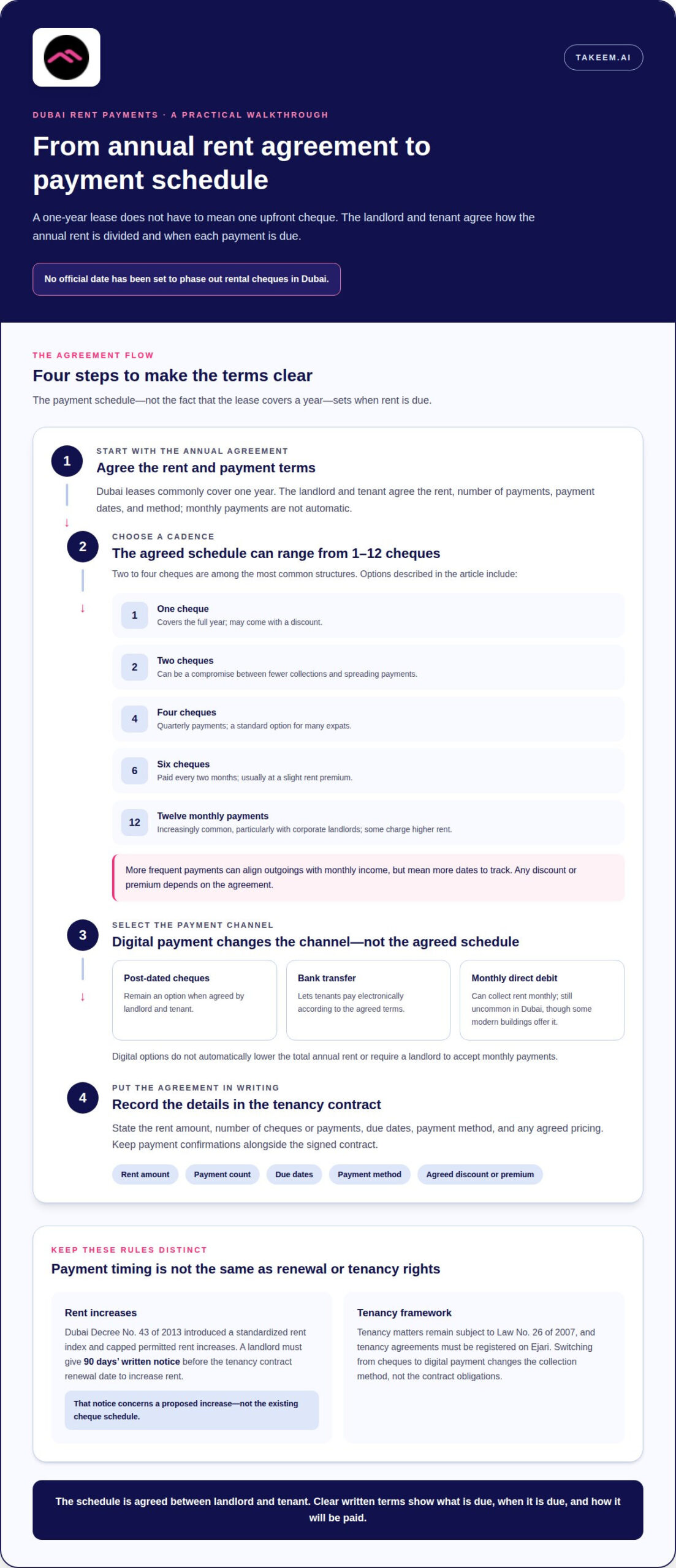
    The tenancy agreement sets the payment schedule if it specifies rent dates and instalments. If it does not state payment dates, rent is payable in four equal instalments in advance each year. Keep the signed agreement and payment records together so you can establish the agreed dates and amounts if a dispute arises.

    If a landlord refuses a payment, the parties may disagree about whether rent was offered or received. Record the date, amount and method of the attempted payment, along with any response. Keep messages, transfer records and other evidence. These details help distinguish non-payment from a dispute about accepting or processing rent.

    If the parties cannot resolve the issue, the Rental Disputes Settlement Centre handles rental disputes in Dubai. Organise the contract, payment schedule, communications and payment evidence into a clear timeline. This provides a formal route to resolve the dispute instead of relying on informal exchanges. The Dubai Land Department lists the Centre as part of Dubai’s rental-dispute framework.

    A filing fee may apply when a dispute is brought to the Centre. The usual fee is 3.5% of the disputed amount, subject to a minimum of د.إ500 and a cap of د.إ20,000. This is a dispute-filing cost, not a rent charge. Keep the disputed figure and supporting records clear when preparing the case.

    For landlords, the practical takeaway is to make the contract’s payment terms clear and preserve evidence whenever rent is offered, received or refused. A documented record supports a more focused discussion and helps explain each party’s position if settlement is needed. To digitally accept recurring monthly tenant payments, set up Direct Debit for rent collection.

    Takeem: Direct Debit setup for Landlords to digitally accept monthly payments from tenants

    Takeem provides Direct Debit setup so landlords can accept monthly tenant payments digitally. It may suit landlords seeking a digital method for recurring rent collection alongside the payment terms in their tenancy agreement. Direct Debit setup supports collection but does not change the agreement, rent due dates or Dubai’s legal notice requirements. Those remain governed by the contract and applicable tenancy rules.

    After setting clear payment terms and keeping accurate records, landlords can consider support for managing rental income. Takeem also offers a Landlord Rental Guarantee and a Rental Guarantee for Property Investors with Large property Portfolios. These are separate from Direct Debit setup.

    To discuss Direct Debit setup for tenant payments, contact Takeem.

    Make Your Next Rental Decision With Confidence

    Use this landlord guide to RERA laws in Dubai as a reference when setting up your rental processes. Consider which parts of your operation need support, such as digital rent collection or rental income protection. Takeem offers a Landlord Rental Guarantee, a Rental Guarantee for Property Investors with Large property Portfolios, and a Landlord Rental Guarantee that Agents can sell for healthy commissions.

    Each option addresses a different rental need, so consider what fits your role and portfolio. Clear payment arrangements and a suitable support model can help you approach landlord responsibilities with greater structure. For a conversation about your rental requirements, contact Takeem to discuss your rental.

    Consider your rental priorities and take the next step that best fits them.

    Frequently Asked Questions

    RERA Rental Index: How Much You Can Charge?

    The permitted increase depends on how far the current rent is below the average for comparable units. The maximum bands are 5%, 10%, 15% and 20%, with the applicable band determined by that gap. For a property-specific assessment, the rent calculator uses location, property type, current rent and number of rooms. Compare similar units before discussing a renewal figure.

    What Are RERA Tenancy Laws?

    Dubai tenancy rules govern the relationship between landlords and tenants, including contracts, property responsibilities, rent changes and disputes. A landlord guide to RERA laws in Dubai helps explain how Law No. (26) of 2007 and its amendment, Law No. (33) of 2008, apply. For example, proposed contract changes must be communicated before expiry within the required notice period. A written agreement clarifies each party’s obligations.

    What Happens If a Tenant Doesn’t Pay Rent?

    A landlord may seek eviction if rent remains unpaid 30 days after the tenant receives written notification. Keep the notice, tenancy agreement and payment history together to show the amount claimed and relevant dates. If the parties cannot resolve the disagreement, the Rental Disputes Settlement Centre handles rental disputes. A clear chronology helps distinguish missed payment from a delayed or disputed payment.

    What is the difference between DLD and RERA?

    The Dubai Land Department (DLD) established the Real Estate Regulatory Agency (RERA), which oversees the implementation of Dubai’s rental laws. RERA’s responsibilities include rental regulation and the rental index. Although their names are related, the DLD and RERA are different bodies. Understanding RERA’s regulatory role helps landlords distinguish oversight from the process for resolving a specific tenancy dispute.

    What landlords must follow?

    Landlords must meet their obligations under the tenancy contract and Dubai rental legislation. For example, Article 16 of Law No. (26) of 2007 makes landlords responsible for providing a property fit to live in and handling structural and major repairs. They must also follow applicable notice rules when proposing contract amendments or seeking eviction. Keep contract terms and formal communications consistent.

    What should you do if there is a rent problem in Dubai?

    First identify whether the issue concerns missed payment, refusal to accept rent or a disagreement about an increase. Gather the tenancy agreement, payment records and relevant written messages, then put the events in date order. This landlord guide to RERA laws in Dubai can help you understand the relevant rental process. If direct discussion does not resolve the matter, the Rental Disputes Settlement Centre handles disputes in Dubai.

  • How to Set Up Direct Debit Rent Collection in Dubai

    How to Set Up Direct Debit Rent Collection in Dubai

    Setting up direct debit rent collection in the UAE starts with an agreed rent schedule and a digital mandate authorised by the tenant through UAE PASS. Once active, the mandate lets rent be debited from the tenant’s designated bank account on the agreed dates. Record the schedule and payment method in the tenancy contract and register the contract with Ejari or the relevant local authority. UAE tenancy regulations require the lease to state the rent payment method, according to government guidelines.

    Cheques have long been familiar in the UAE’s rental market, so it is reasonable to want clarity on consent, payment dates and how the switch works. This guide explains how the UAE Direct Debit System handles recurring rent, how tenants authorise a mandate through UAE PASS, and what landlords need to arrange before collection begins. It also covers how monthly, quarterly or other mutually agreed instalments fit with the tenancy contract, and what to consider when moving from cheques to automated payments with Takeem.

    Key Takeaways

    • Set out the rent amount, payment method and instalment schedule in the tenancy contract, then register the contract with Ejari.
    • Understand how a tenant authorises a digital mandate through UAE PASS and what happens on scheduled payment dates.
    • Learn what to consider when choosing a bank or payment provider for recurring rent collection, including how the setup fits the agreed tenancy terms.
    • See how a landlord can use direct debit setup to accept monthly tenant payments and how a Rental Guarantee may fit broader rental needs.

    What is Direct Debit and why should you use it?

    Direct Debit lets a tenant authorise recurring rent deductions from a designated account on agreed dates. For landlords, scheduled payments can make rental cash flow easier to plan than collecting dated cheques individually.

    Unlike cheques, bank transfers and payment apps, Direct Debit uses an authorised mandate to collect recurring payments automatically. It does not rely on a cheque or on the tenant initiating each transfer. Dubai tenancy rules also matter: according to the Government of Dubai, the lease must state the rent payment method, and the tenancy contract is registered through Ejari.

    1. Complete Tenant and Landlord Sign-Up

      First, agree on the payment method and schedule, then make sure the tenancy contract records those terms. The landlord or property management company arranges collection, and the tenant authorises the mandate digitally through UAE PASS. Before authorisation, confirm that the designated payment account, amount and dates match the agreed rental terms.

    2. Set Up Automatic Rent Deductions

      Set debit dates to match the tenancy contract, then have the tenant approve the mandate through UAE PASS. After setup, rent is collected automatically from the designated account on those dates. The schedule can follow the parties’ agreed instalments, whether monthly, quarterly or another frequency stated in the contract. Confirm the amount and timing before authorisation to avoid a mismatch with the lease.

    3. Switch from Cheques During a Tenancy

      A tenancy renewal is a practical time to switch from post-dated cheques to Direct Debit. Agree on the revised payment schedule and record the method in the renewed contract registered with Ejari. An existing cheque arrangement does not change automatically, so align the new mandate’s start date with the contract terms and any cheques already issued.

    Direct debit services for real estate and property management

    For Dubai landlords and property management teams, Direct Debit can automate recurring rent collection while keeping the agreed payment terms in place. Use these steps to decide whether it suits a property or portfolio.

    1. Confirm the property and collection arrangement. The UAE Direct Debit System is described as available for residential and commercial properties. A landlord can arrange collection directly, or a participating property management company can coordinate payments for a managed property. Direct Debit is optional in Dubai, and post-dated cheques remain an accepted payment method. Choose between cheques and a digital alternative according to the tenancy terms and the parties’ agreement.
    2. Check whether the management company participates. Participation in Dubai’s Flexi Rent initiative is voluntary for eligible property management companies, so it is not a universal requirement for managed properties. Participating companies continue to manage tenancy contracts and payment processes through their existing systems and procedures. Confirm how the process aligns with each tenant’s contract, bank account and agreed payment dates. The tenant still authorises the Direct Debit mandate through UAE PASS.
    3. Match the service to the portfolio’s payment needs. Participating companies may offer monthly, quarterly or semi-annual instalments, depending on their arrangements. Landlords managing several units can map each property’s rent schedule to its individual tenancy contract instead of assuming one cycle suits every tenant. This makes collection easier to administer while keeping each payment tied to its agreed terms. Direct Debit can reduce cheque handling, but contracts and payment records still need to be managed.

    How to Set Up Direct Debit Rent Collection in Dubai

    How UAE Direct Debit rent collection works

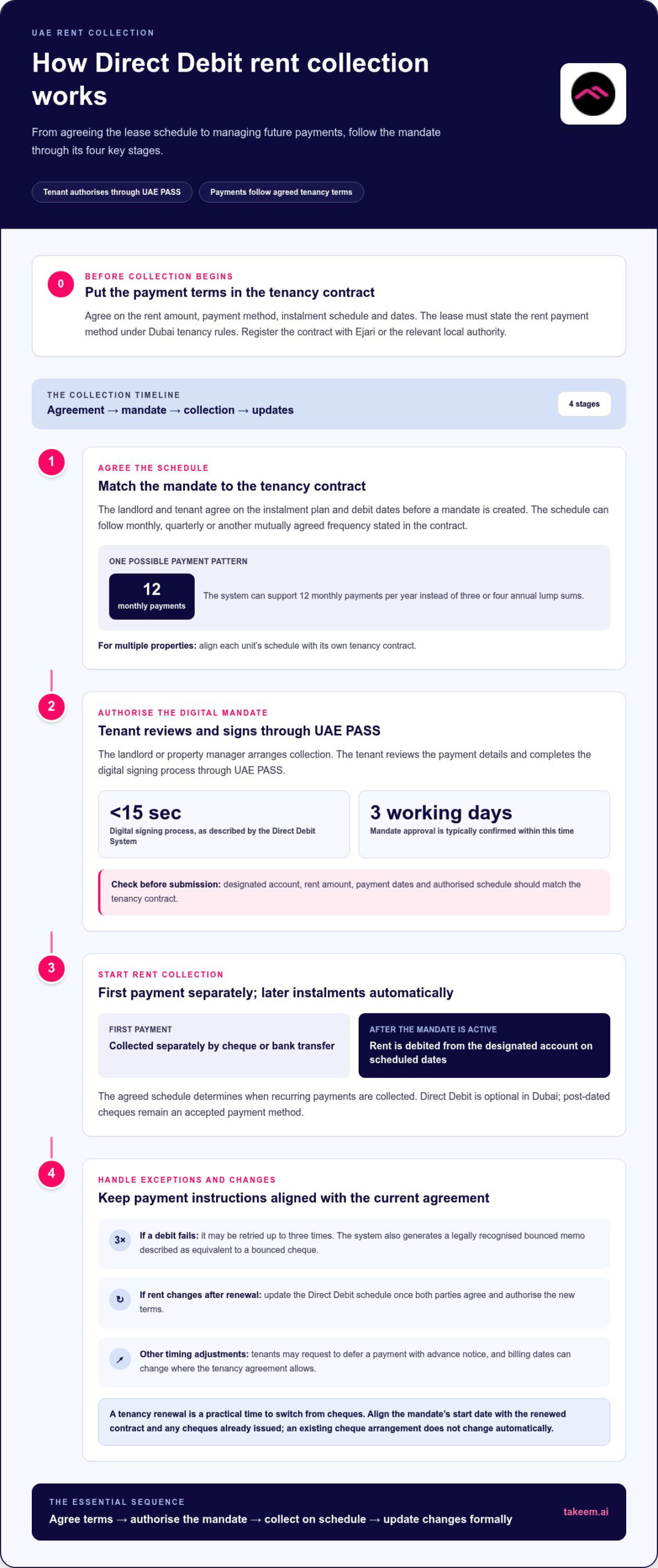
    1. Match the payment schedule to the tenancy contract before creating a mandate. The UAE Direct Debit System can support recurring rent payments, including 12 monthly payments per year instead of three or four annual lump sums. The landlord and tenant must agree on the instalment plan and dates. For a property portfolio, keep each unit’s schedule aligned with its own tenancy contract, rather than applying one cycle to every tenant.
    2. Send the mandate for the tenant’s UAE PASS authorisation. The tenant reviews the payment details and completes the digital signing process, which the Direct Debit System says takes under 15 seconds. Mandate approval is typically confirmed within three working days. Check that the account, rent amount, payment dates and authorised schedule match the tenancy contract before submission, so the automated instruction reflects the parties’ agreed terms.
    3. Plan how the first rent payment will be collected. Under the described process, the first payment is collected separately by cheque or bank transfer, while the mandate covers later instalments. Once active, the system debits rent on scheduled dates. If a debit fails, it may be retried up to three times. The system also generates a legally recognised bounced memo described as equivalent to a bounced cheque.
    4. Keep the mandate aligned with any change to the tenancy terms. If rent changes after renewal, update the Direct Debit schedule once both parties agree and authorise the new terms. Tenants may request to defer a payment with advance notice, and billing dates can change where the tenancy agreement allows. Treat each change as a schedule update, not an informal adjustment, so future payments follow the current contract.

    Which banks and payment providers offer rent direct debit in Dubai?

    1. Use the UAE Direct Debit System rather than assuming every bank offers a landlord-facing rent product. The system is regulated by the Central Bank of the UAE and operates under a sponsor bank licence. Banks provide the account infrastructure, while a payment provider or collection platform can organise the rent mandate and scheduled collection. For tenants, the practical test is whether the provider can set up a mandate for the agreed rent schedule and the tenant can authorise it digitally.
    2. Understand how the payment provider connects the landlord, tenant and bank account. The provider should present the amount, dates and tenancy terms for the tenant to authorise through UAE PASS. Check how it handles mandate status, payment confirmations and failed debits, then compare that process with the landlord’s existing rent records. Bank transfers or card payments may also be available through some property arrangements, but they are separate from recurring Direct Debit authorisation.
    3. Choose the setup around the tenancy, not simply the bank brand. Confirm that the rent collection schedule matches the contract and that the tenant can authorise the specified account. For landlords managing multiple properties, check that the process keeps each mandate and payment record connected to its own tenancy. Takeem provides Direct Debit setup for landlords to digitally accept monthly tenant payments, offering a direct route to automate collection without treating every bank’s mobile app as a rent collection service.

    Takeem: Landlord Rental Guarantee

    Takeem offers a Landlord Rental Guarantee alongside Direct Debit setup for landlords who want to accept monthly tenant payments digitally. Direct Debit helps organise collection around the agreed payment schedule, while the guarantee is a separate option for landlords seeking rental protection.

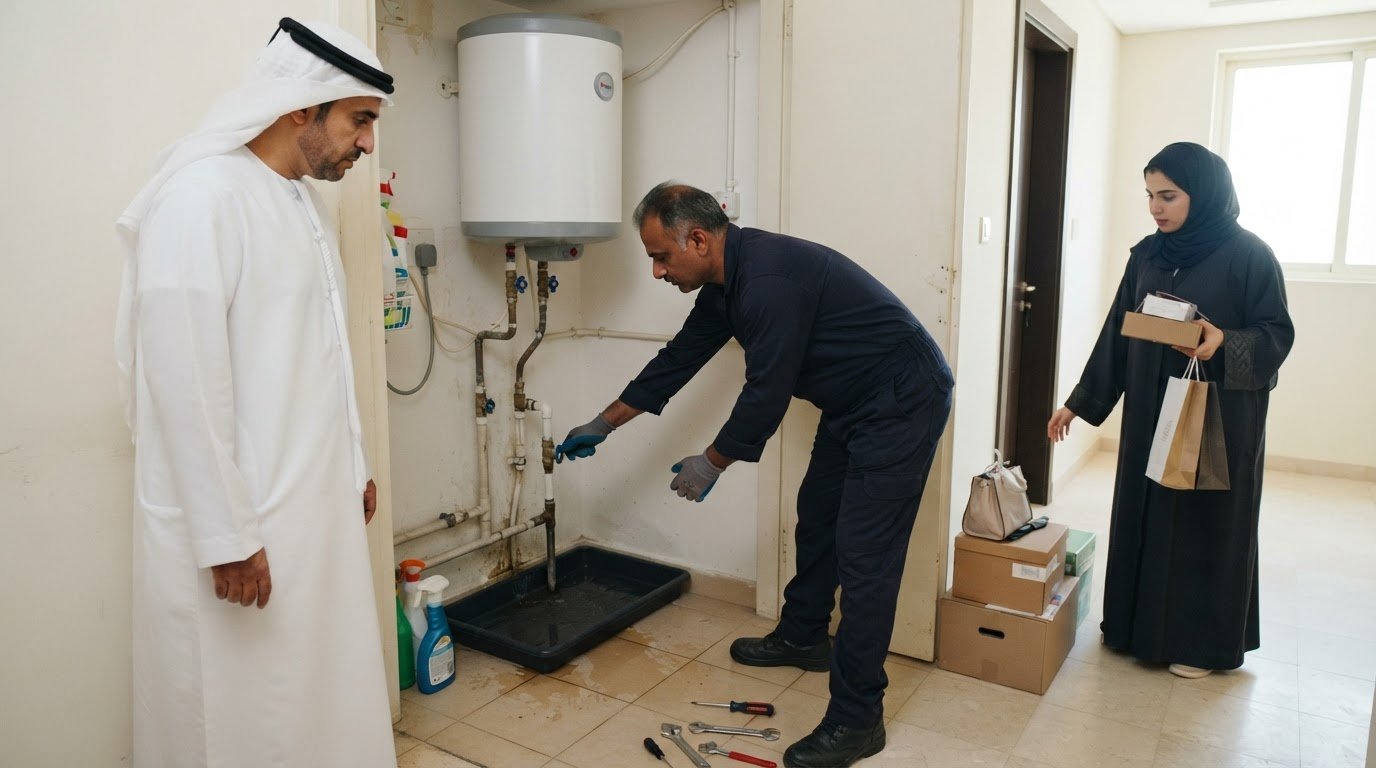
    Property investors with large portfolios can consider Takeem’s Rental Guarantee for Property Investors with Large property Portfolios. Agents can also offer the Landlord Rental Guarantee to clients as a commission opportunity. The Rental Guarantee includes emergency property maintenance service as part of the package.

    If you’re considering a guarantee or digital rent collection for your properties, contact Takeem to discuss your needs.

    Make Your Next Rent Cycle More Intentional

    Use the next rental cycle to plan your approach. Decide whether your priority is reducing cheque handling, establishing a clearer payment routine or protecting rental income. Direct debit rent collection in Dubai works best as part of a considered plan for managing each property, not as an isolated payment change. Choose an arrangement that suits your tenants and supports your wider investment plans.

    Takeem offers a Landlord Rental Guarantee for individual landlords and a Rental Guarantee for Property Investors with Large property Portfolios. Agents can also sell the Landlord Rental Guarantee for healthy commissions. These options serve different roles in the rental market, from individual landlords and portfolio investors to agents.

    Explore the next step for your rental collection plans and contact Takeem about rent collection. A considered change can help you move forward with greater clarity.

    Frequently Asked Questions

    What are the benefits of paying rent by Direct Debit in the UAE?

    Direct Debit automates recurring rent payments, so tenants do not need to initiate each transfer or prepare a cheque for every due date. For landlords, scheduled collection can make rental cash flow easier to plan. Payment confirmations and online records can also provide both parties with a clearer transaction history. Tenants should still keep enough funds available and check the mandate details against the agreed schedule.

    What if I’m already mid-lease and cheques have been issued?

    Tenants in Dubai who pay rent by post-dated cheque can switch to Direct Debit when the tenancy contract is renewed. Until then, follow the current payment arrangement and do not assume issued cheques are automatically replaced by a new mandate. At renewal, agree on the revised method and schedule with the landlord, then align the renewed contract and mandate before the new collection cycle begins.

    What if my rent amount changes, such as at renewal?

    Update the Direct Debit schedule after the landlord and tenant agree on the renewed rent and authorise the revised terms. If the renewal changes the rental amount, for example, the existing mandate should not be treated as approval for the new amount. Keep the updated schedule consistent with the tenancy paperwork, and confirm the revised mandate details before its first scheduled debit.

    What if there aren’t enough funds on the day?

    If a scheduled debit fails, it may be retried up to three times. The process can also generate a legally recognised bounced memo described as equivalent to a bounced cheque. Keep the designated account funded before the due date. If a payment needs to be deferred, tenants may request this in advance rather than waiting until a debit has failed.

    How does Direct Debit rent collection work in Dubai?

    The tenant authorises a recurring rent mandate digitally through UAE PASS, and rent is collected from the designated account on the agreed dates. The schedule follows the tenancy terms rather than an assumed standard cycle. After a successful payment, tenants can access transaction records to track rent paid and keep documentation for future rental administration.

    How can landlords set up Direct Debit rent collection in Dubai?

    For landlords arranging direct debit rent collection in Dubai, start by agreeing on a payment schedule with the tenant and ensuring it matches the tenancy terms. The landlord arranges the Direct Debit setup, and the tenant authorises the mandate through UAE PASS. Takeem helps landlords accept monthly tenant payments digitally through Direct Debit setup, alongside its Landlord Rental Guarantee.

  • How to Become a Landlord in UAE: Rent, Repairs and Fees

    How to Become a Landlord in UAE: Rent, Repairs and Fees

    If you’re considering how to become a landlord in the UAE, start by checking the rental rules in the emirate where the property is located. Tenancy contracts must be registered with the relevant authority: Dubai uses Ejari, while Abu Dhabi uses Tawtheeq. Fees, maintenance duties and rent collection arrangements can also vary by emirate and by the terms of the tenancy agreement.

    It’s easy to assume the landlord pays every fee or that the tenant handles every repair, but the actual split needs to be understood before the lease begins. This guide explains who may pay rental and broker fees, how landlords and tenants typically share maintenance responsibilities, and what to consider when collecting rent. You’ll also see how rent payment arrangements work and why clear contract terms matter, so you can plan the practical side of renting with more confidence.

    Key Takeaways

    • Register the tenancy through the relevant emirate’s system: Ejari in Dubai and Tawtheeq in Abu Dhabi.
    • Set out maintenance responsibilities in the tenancy agreement, distinguishing essential repairs from minor upkeep.
    • Agree on rent payment timing and instalments in advance, and clarify who pays each rental-related fee and broker commission.
    • For Abu Dhabi leases, the municipality fee is 5% of the rental value or rental index, whichever is higher, and is added to the tenant’s utility bill across 12 months.
    • Prepare property and identity documents, and understand the local rules that apply before renting out a property.

    Is a landlord responsible for property maintenance?

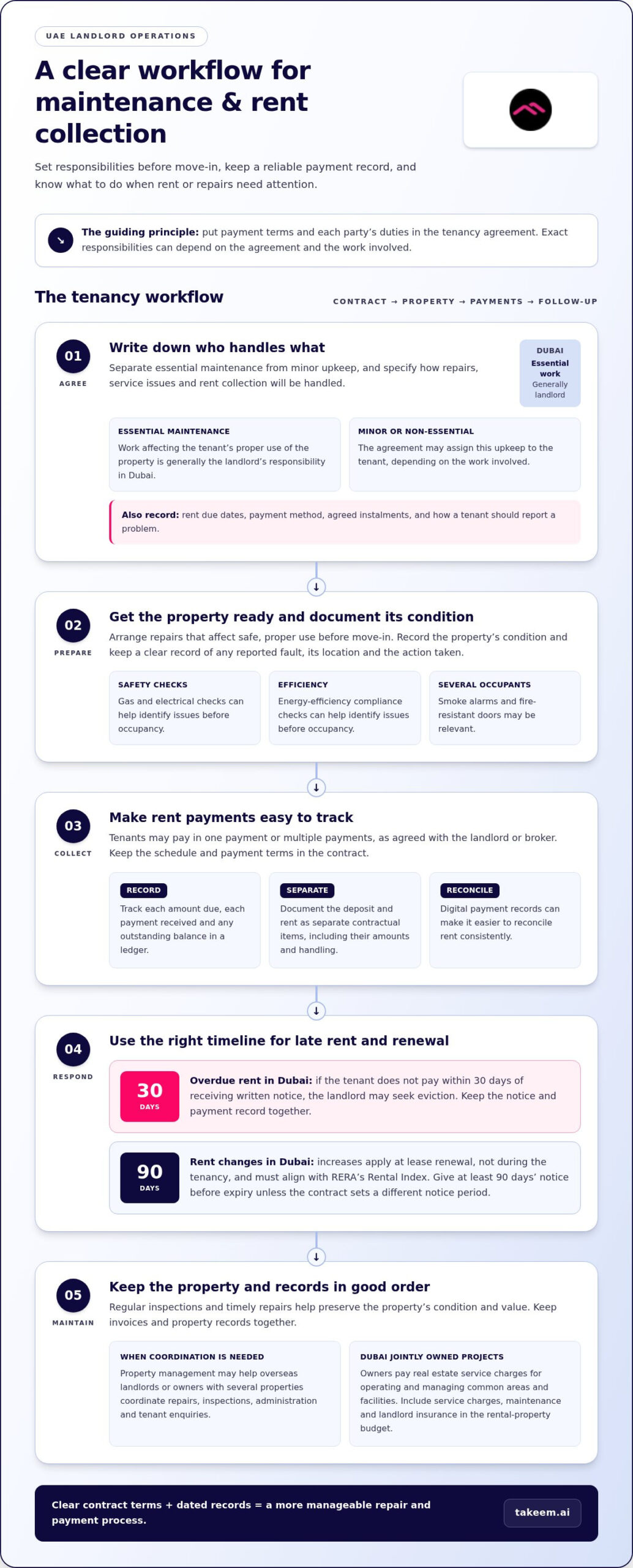
    Generally, yes. In Dubai, landlords are responsible for essential maintenance that affects a tenant’s proper use of the property. The tenancy agreement should set out how repairs, service issues and rent collection are handled, and distinguish essential work from minor upkeep. Depending on the agreement and the work involved, minor or non-essential maintenance may be assigned to the tenant. Clear terms help both parties understand their responsibilities before a repair becomes urgent.

    Registration is part of setting up a tenancy. Across the UAE, lease agreements must be registered with the relevant authority in each emirate. In Dubai, submit the tenancy contract for Ejari registration through the Dubai REST app or Dubai Land Department website; the listed registration fee is AED 100, plus a AED 10 knowledge fee and a AED 10 innovation fee. In Abu Dhabi, register the tenancy contract through Tawtheeq. In Sharjah, lease contracts are registered with Sharjah Municipality; elsewhere, registration follows the relevant local authority’s process.

    Dubai also applies a housing fee calculated at 5% of yearly rental charges. This is separate from the Ejari registration charges, so account for both when planning rental costs. Once registered, the agreement provides a formal record of the tenancy. Keep the signed contract and registration details with the property documents, so key terms and notices can be referred to if a maintenance or payment issue arises.

    Tenant identification and payment documents help complete the lease. To conclude a UAE lease with a landlord or real estate agent, the tenant must provide a passport copy, a valid residence visa, an Emirates ID and post-dated cheques covering the agreed lease period. Set out the rent schedule and payment dates in the agreement, then keep a record of the cheques received. These documents help both sides track their contractual obligations.

    To find and screen applicants, advertise the property, review applications and assess proof of identity and income, credit checks and references. Checks may include a UAE residence visa. Compare each application with the tenancy terms, payment schedule and property requirements, then document the agreed conditions before signing.

    Before move-in, arrange repairs that affect safe, proper use and record the property’s condition. Gas and electrical safety checks, as well as checks for energy-efficiency compliance, can help identify issues before occupancy. For a tenancy involving several occupants, fire-safety measures such as smoke alarms and fire-resistant doors may also be relevant. The written agreement should specify who handles essential repairs, minor upkeep, service repairs and rent collection, and explain how the tenant should report a problem. Clear instructions make maintenance easier to coordinate and reduce confusion about who must act.

    Maintenance, repairs and rent collection

    Plan repairs by distinguishing essential maintenance from minor upkeep. In Dubai, landlords generally handle essential work that affects a tenant’s proper use of the property. Depending on the work involved, the tenancy agreement can assign minor or non-essential maintenance to the tenant. Record each reported fault, its location and the action taken. For example, a leak that affects the use of a room needs prompt attention, while routine upkeep can follow the agreement’s allocation of responsibilities.

    Make rent collection predictable by recording the due dates, payment method, and agreed instalments in the contract. UAE tenants may pay rent in one payment or multiple payments, as agreed with the landlord or broker. Keep a ledger showing each amount due, payment received, and outstanding balance. A deposit and rent are separate contractual items, so document their amounts and handling separately. Digital payment records can make reconciliation easier; digital rent collection can support a consistent payment process.

    In Dubai, overdue rent has a defined legal consequence. A landlord may seek eviction if the tenant fails to pay within 30 days of receiving written notice. Keep the notice and payment record together, because both help establish the timeline. Rent changes also require planning: increases apply at lease renewal, not during the tenancy, and must align with RERA’s Rental Index. Give at least 90 days’ notice before expiry unless the contract sets a different notice period.

    Regular inspections and timely repairs help preserve a property’s condition and value. Landlords who live overseas or own several properties may find property management useful for coordinating repairs, inspections, administration and tenant enquiries. Owners in jointly owned Dubai projects also pay real estate service charges for operating and managing common areas and facilities. Include these charges, maintenance and landlord insurance in the rental-property budget, and keep invoices with the property records.

    Landlord licence and permit requirements depend on the emirate and rental model. Long-term tenancy contracts must be registered with the relevant authority, while Dubai short-term rentals require separate licensing. Short-term lets also involve more frequent maintenance and guest management, so account for these demands in the operating plan.

    Rental yield compares rental income with purchase and ownership costs. Rents depend on location, property type, condition and demand. Property management fees vary with the agreed service scope and responsibilities, so assess the cost against the tasks included.

    Who should pay the fees, tenant or landlord?

    There is no single payer for every rental cost: responsibility depends on the type of fee and the applicable emirate rules. Separate government charges, owner expenses and broker commission, then record the agreed payment responsibilities clearly.

    Tawtheeq and Municipality Fees

    Tawtheeq is Abu Dhabi’s system for registering tenancy contracts, while the municipality fee is charged through the tenant’s utility bill. The distinction matters because the landlord registers the lease, but the fee is collected from the tenant over time.

    In Abu Dhabi, the municipality fee is 5% of the rental value or rental index, whichever is higher. It is added to the tenant’s monthly water and electricity bill across 12 months. Landlords should account for that collection method when explaining payments and preparing the rental agreement. Keep the registered contract and billing details together, so both parties can trace the fee and its basis.

    Dubai Transaction and Ejari Registration

    Dubai requires real estate transactions involving ownership, transfer or change to be registered with the Dubai Land Department; unregistered transactions are considered invalid. Ejari registers the tenancy agreement and creates a formal record of the landlord-tenant relationship. These are separate processes, so registering ownership does not replace tenancy registration.

    Use the Dubai REST app or Dubai Land Department website to register the tenancy, and make the contract’s fee arrangements clear. Creating an Ejari account is free, but registration has separate fees. Dubai rules also prevent a lease from being registered while earlier lease contracts remain unregistered. Any proposed changes to a registered tenancy agreement should be handled carefully and in line with the agreed terms. A landlord may enter the leased home only with the tenant’s permission, unless the agreement contains an access clause allowing otherwise. That clause helps define access for inspections or repairs.

    Landlord Taxes and Service Charges

    Landlord costs include housing fees, property service charges and any broker commission agreed for letting. In Dubai, the housing fee is calculated at 5% of yearly rental charges. Owners of units in jointly owned projects also pay service charges for operating and managing shared areas and facilities. Include these recurring obligations when assessing the property’s rental income.

    Some UAE real estate brokers may charge commission of up to 5% of total rent. The agreement with the broker should make the commission arrangement and payer explicit, rather than leaving the payment unclear after a tenant is found. Keep that charge separate from government registration fees and owner service charges. This makes rental payments easier to reconcile and helps prevent avoidable disputes about who owes each amount.

    How to Become a Landlord in UAE: Rent, Repairs and Fees

    The UAE is a federation of seven emirates, and rental rules can differ between them. Start by identifying the emirate where the property sits, then follow its tenancy and registration requirements. In Dubai, Law No. (26) of 2007 regulates landlord-tenant relationships. Law No. (33) of 2008 amends articles of Law No. (26) of 2007 and governs those relationships. These laws make the written tenancy agreement central to recording each party’s obligations.

    Prepare ownership and identity documents before marketing a Dubai property. Landlords typically need the title deed, a passport or Emirates ID, and property details. If an agent will market the unit, prepare a signed agreement authorising the agent to do so. These records establish the owner’s authority to rent the property and give the agent a clear basis for advertising and arranging viewings.

    Register the tenancy with the authority responsible for the property’s emirate. Dubai uses Ejari, Abu Dhabi requires Tawtheeq, and Sharjah registers lease contracts through Sharjah Municipality. In other emirates, follow local registration rules. Registration formalises the rental agreement and supports related tenancy arrangements. Keep the signed contract and registration record with the title deed and property details, so you can refer to the agreed terms during the tenancy.

    Set out practical responsibilities in the contract before signing. Specify rent collection arrangements, maintenance duties, repair reporting and any notice requirements. In Dubai, the landlord is generally responsible for essential maintenance that affects the tenant’s proper use of the home. Depending on the agreement and the work involved, minor or non-essential maintenance may be assigned to the tenant. Clear terms help both parties know what to do when a repair arises.

    Handle the security deposit and property condition transparently. Record the deposit terms in the agreement and document the property’s condition at move-in. This gives both sides a practical reference when assessing damage or reasonable wear at the end of the tenancy.

    Additional requirements may apply when renting to multiple tenants or using a short-term rental model. Renting to multiple tenants can involve stricter licensing requirements and safety regulations, including fire-safety measures. Dubai short-term rentals require separate licensing and involve more frequent guest management and maintenance. Before advertising, identify the intended rental arrangement and align the property’s permissions, safety preparations, contract and registration with that use. For a complex ownership or tenancy arrangement, legal advice can help clarify the rules in the relevant emirate.

    Can a foreigner buy and rent out property in the UAE

    Foreign nationals can buy and rent out property where the relevant emirate’s ownership rules allow it. The UAE has seven emirates, and property rules can differ between them. Confirm that the property’s location and ownership arrangement permit your intended use. Then ensure the ownership documents match the person or entity signing the tenancy agreement.

    For a Dubai property, keep the title deed, passport or Emirates ID, and property details together. These are typical documents landlords need when preparing to rent out a property. If an agent will market it, a signed agreement authorising that work is also typically needed. This paperwork establishes the owner’s authority and helps align the property advertisement, tenancy contract and registration details.

    Before committing to a purchase, assess the rental model. Dubai long-term rental contracts are usually annual, while short-term stays can range from a few days to months. Short-term rentals require separate licensing and more frequent guest management and maintenance. Account for expected demand, property location, rental income goals, repair coordination and licensing before choosing between the models.

    After acquiring the property, register each tenancy through the relevant emirate’s system. Dubai uses Ejari, Abu Dhabi uses Tawtheeq, and Sharjah registers lease contracts with Sharjah Municipality. Registration formalises the rental agreement. Keep the title deed, signed contract and registration record together, especially if you live outside the UAE or use an authorised agent to market the property.

    Plan for ongoing ownership obligations, not just the purchase. Dubai landlords are generally responsible for essential maintenance that affects the tenant’s proper use of the property. The agreement can allocate minor or non-essential maintenance according to the work involved. Owners in jointly owned Dubai projects also pay service charges for common areas and facilities. Include these recurring responsibilities when estimating rental-property income and costs.

    For overseas owners, a practical operating plan should cover rent collection, tenant communication, repair reporting and inspection coordination. The tenancy agreement should state payment arrangements and maintenance responsibilities clearly. In Dubai, landlords must give at least 90 days’ notice before a rent increase at renewal, unless the contract agrees a different notice period. This timeline matters when managing renewals from abroad.

    Once ownership eligibility and local registration are clear, organise the rental operation around the property’s location and intended use. Owners with investment portfolios can explore rental-income support as part of planning for rental continuity.

    Takeem: Landlord Rental Guarantee

    Takeem offers a Landlord Rental Guarantee for landlords planning their rental income. It can suit individual owners as well as property investors with large portfolios. Emergency property maintenance is included in the Rental Guarantee, connecting rental support with a practical property need.

    Landlords can consider how rental income and urgent maintenance fit into their ownership plans. Agents can also sell Takeem’s Landlord Rental Guarantee and earn commissions. This offering addresses a different need from property management, so consider it when rental guarantees and emergency maintenance are relevant to your requirements.

    Visit takeem.ai to learn more about Takeem’s Landlord Rental Guarantee.

    Build a rental plan you can sustain

    Turn your ownership goals into a practical operating plan. Decide how involved you want to be in tenant communication, income tracking and property upkeep, then make sure your approach fits the time and resources you can commit. A clear plan for how to become a landlord in UAE helps you move from purchase decisions to consistent ownership.

    Consider how predictable rental income fits your wider investment plans. Takeem offers a Landlord Rental Guarantee, including an option for property investors with large portfolios. Agents can also sell the guarantee and earn commissions. These offerings may be relevant if rental income planning is part of your next move.

    Explore whether this support suits your ownership goals and rental approach. Contact Takeem about your rental to discuss the Landlord Rental Guarantee. With a plan that reflects your priorities, you can take the next step as a UAE landlord with greater clarity.

    Frequently Asked Questions

    Can an owner increase rent every year or only at renewal?

    In Dubai, rent increases can apply only at lease renewal, not during the tenancy. The amount must align with RERA’s Rental Index, and the landlord must give at least 90 days’ notice before expiry unless the contract specifies another notice period. For example, review the applicable index and send notice within the contract’s stated timeframe. Rules elsewhere in the UAE may differ by emirate.

    How do I register my property in the Ejari system?

    In Dubai, submit the tenancy contract through the Dubai REST app or Dubai Land Department website. Prepare the signed agreement and property details, and check the registration requirements before proceeding. After registration, keep the Ejari record with the contract. Since the contract cannot be altered after registration, settle the terms before submitting it.

    What are the UAE landlord and tenant rights and obligations?

    Rights and duties depend on the emirate and the signed tenancy agreement. In Dubai, the landlord generally handles essential maintenance, while the tenant follows the payment and property-use terms. For example, specify how the tenant reports a fault and how the parties arrange access for repairs. A Dubai landlord needs the tenant’s permission to enter, unless the contract includes an access clause allowing otherwise.

    What are the rules for security deposits, rent increases, and eviction in the UAE?

    In Dubai, a landlord may request a security deposit commonly set at one or two months’ rent; the agreement should state its terms. Rent increases apply at renewal under RERA’s Rental Index. For unpaid rent, a landlord may seek eviction if the tenant fails to pay within 30 days after written notice. Eviction for specified reasons such as sale or personal use requires 12 months’ written notice.

    What risks and insurance should UAE landlords consider?

    Budget for interrupted rent, repairs, insurance, agency charges, legal obligations and, in jointly owned Dubai projects, service charges for common areas. These costs affect the income left after rent is collected. Review what landlord insurance covers and excludes in relation to the property’s risks, then keep maintenance records and tenancy documents organised. Insurance can support risk planning, but it does not remove contractual maintenance duties.

  • Tenant Not Paying Rent in the UAE? A Landlord’s 2026 Guide to Resolution and Prevention

    Tenant Not Paying Rent in the UAE? A Landlord’s 2026 Guide to Resolution and Prevention

    What if the traditional post-dated cheque was actually the biggest vulnerability in your property portfolio? Dealing with a tenant not paying rent UAE is more than just a financial hurdle; it’s a source of intense stress that disrupts your cash flow and peace of mind. You’ve likely spent hours worrying about unresponsive tenants or the daunting costs of legal proceedings. We understand that your property is an investment that requires protection, not a source of constant friction.

    This guide provides the clarity you need to resolve current defaults and the strategy to ensure they don’t happen again. You’ll discover the exact legal steps for 2026, from understanding filing fees to mastering the mandatory 30-day notice period. We’ll walk you through the Rental Dispute Center process while showing you how to modernize your approach with digital collections and rental guarantees. By the end of this article, you’ll know how to recover unpaid rent quickly and how to implement a sophisticated shield that protects your monthly income from future uncertainty.

    Key Takeaways

    • Learn the critical first steps to take when dealing with a tenant not paying rent UAE, including the legal necessity of formal notice and Ejari verification.
    • Master the filing requirements for the Rental Dispute Center (RDC) to recover unpaid funds and navigate the 2026 fee structure with professional confidence.
    • Quantify the true financial impact of defaults by factoring in non-refundable filing fees and the hidden costs of property vacancy.
    • Modernize your portfolio by replacing outdated post-dated cheques with secure Direct Debit systems for seamless, automated rent collection.
    • Implement a sophisticated shield through a Landlord Rental Guarantee to ensure your cash flow remains uninterrupted regardless of tenant behavior.

    Initial Steps: What to Do the Moment Rent is Overdue

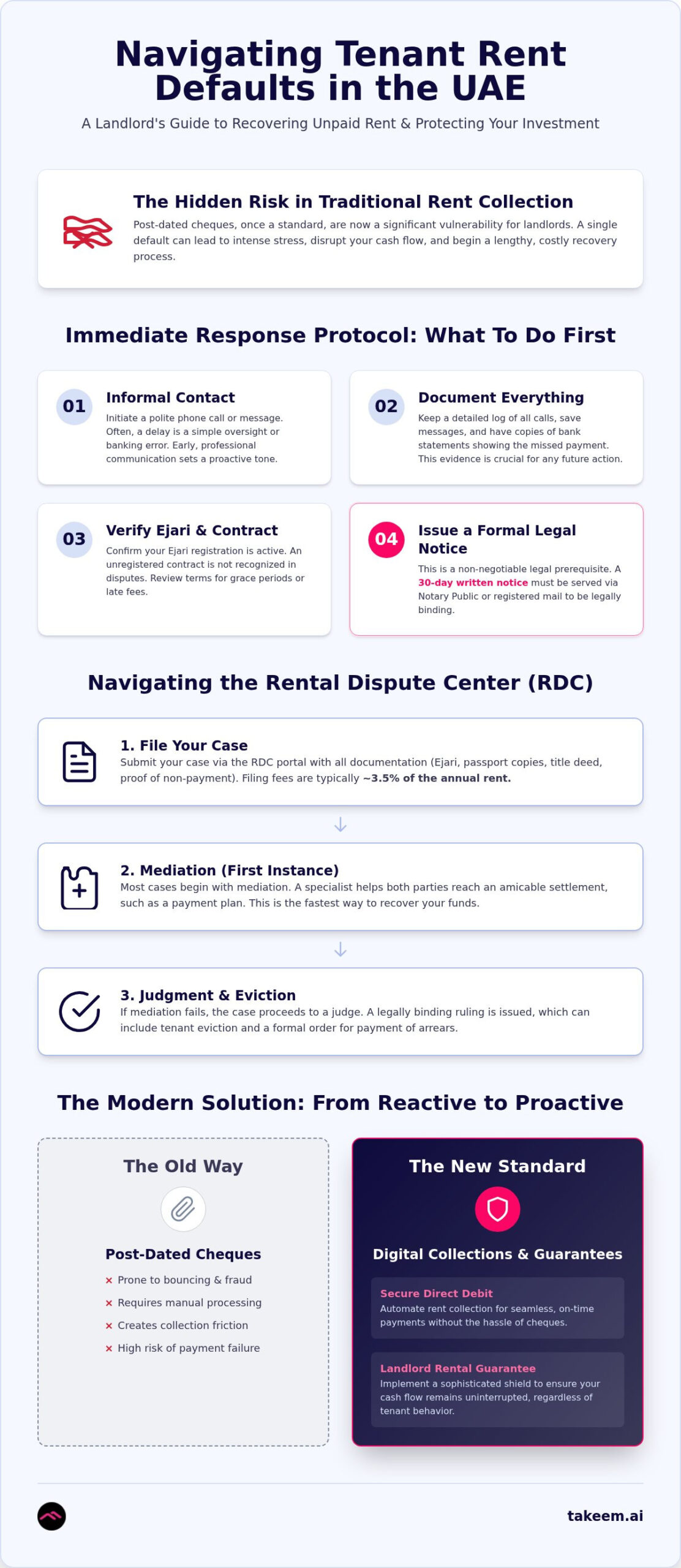
    A missed payment doesn’t always signal a crisis, but it does require immediate, methodical attention. Your first priority is to maintain professional composure while acting with speed. In the UAE, dealing with a tenant not paying rent UAE requires a balance of clear communication and strict adherence to national regulations. Don’t wait for weeks to pass. Start by initiating informal contact via a polite phone call or message. Often, a delay is simply the result of a technical banking error or a temporary oversight. By reaching out early, you establish a proactive tone and rule out simple mistakes before escalating the situation.

    If informal attempts don’t yield results, you must transition to a more structured approach. Document every interaction from day one. Keep a log of calls, save your messages, and ensure you have copies of all relevant bank statements showing the missing credit. This timeline serves as your primary shield if you eventually need to present your case to the authorities. Building a clear evidence trail now reduces friction and uncertainty later in the process.

    Verifying the Ejari and Contract Terms

    Before taking legal steps, you must ensure your administrative foundation is flawless. Your Ejari registration is the most critical document in this phase. Across the Emirates, a tenancy contract that isn’t registered with the appropriate authorities isn’t recognized for dispute resolution. Confirm that your registration is active and that the rental amount and payment dates perfectly match your current claim. Understanding the fundamentals of Landlord-tenant law is essential for any property owner facing a payment default. You should also review the “additional terms” section of your contract. Some agreements include specific grace periods or late payment penalties that dictate how soon you can proceed with a formal notice. Ensuring the tenant’s contact information is current for the legal service of notices is also vital.

    Issuing the Formal Legal Notice

    When informal communication fails to resolve the debt, you must issue a formal legal notice. This is a non-negotiable prerequisite for any future eviction or recovery case. According to established regulations, specifically Article 25(1) of the governing rental law, you must provide the tenant with a 30-day written notice to pay the overdue rent. This notice isn’t just a standard email; it must be served via a Notary Public or through registered mail to be legally binding. Your notice should clearly state the exact amount owed and the specific 30-day deadline for rectification. Always keep the original receipt and proof of delivery. These documents are your entry ticket to the local settlement committee. Without them, your case will likely be dismissed, causing further delays and loss of income.

    The Rental Dispute Center (RDC) serves as the primary judicial arm for resolving conflicts between landlords and tenants. When the mandatory 30-day notice period expires and the debt remains outstanding, this institution becomes your essential pathway to a formal resolution. It provides a specialized environment designed to handle non-payment cases with professional efficiency. Moving your case to the RDC signals that you’re prepared to enforce your rights through the proper legal channels, moving beyond informal requests to a structured judicial process that carries the weight of the law.

    Filing Your Case and Mediation

    Initiating a case requires you to submit an application through the official RDC portal using your digital identity, such as the UAE Pass. You must have your documentation ready for upload. This includes your active Ejari certificate, passport copies for both parties, the property title deed, and documented proof of the missed payments. National filing fees are typically calculated as a percentage of the annual rent, often around 3.5 percent, with established minimum and maximum caps. Additional administrative charges for process service and innovation fees also apply during this stage.

    Most cases begin in the mediation stage, often referred to as the “First Instance.” During these sessions, a mediator works with both parties to reach an amicable settlement. This is a crucial opportunity to recover funds without a full hearing. Common outcomes include a court-sanctioned payment plan or a full recovery of the arrears. If your goal is to resolve a situation involving a tenant not paying rent UAE, mediation is often the fastest way to restore your monthly cash flow while maintaining a professional relationship.

    The Eviction Process for Non-Payment

    If mediation doesn’t result in a settlement, the case proceeds to a judge who can issue a formal eviction order. The legal grounds for eviction are firmly established once the 30-day notice period expires without the tenant rectifying the default. Once you receive a favorable judgment, the Execution Department takes over the enforcement. They manage the physical handover of the property and ensure the tenant vacates the premises according to the court’s timeline. It’s often wise to consult with legal professionals during this phase to ensure every procedural requirement is met, as technical errors can cause frustrating delays.

    The entire RDC process, while effective, demands significant time and administrative effort. To avoid the stress of legal filings and the uncertainty of hearings, you might consider how to modernize your property portfolio by implementing digital collection systems and rental guarantees that protect your income from the very first day of the lease.

    Many landlords assume the only loss during a default is the missing monthly credit. This is a dangerous misconception. When you encounter a tenant not paying rent UAE, the financial bleeding extends far beyond the surface level of the debt. You’re facing a multi-layered drain on your resources that can take months to rectify. Understanding these costs is essential for any investor who wants to maintain a healthy bottom line in the 2026 market.

    You must account for the non-refundable filing fees at the Rental Dispute Center. As established, this is 3.5 percent of your annual rent. If you have a property renting for AED 150,000, you’re looking at a mandatory AED 5,250 outlay just to start the recovery process. For investors with mortgage obligations, this cash flow gap is compounded. You’re paying the bank out of pocket while your primary income source remains stagnant. There is also the “vacancy cost.” The legal process can take significant time, and during this period, the property is legally tied up. You cannot re-list it or move a paying tenant in until the execution order is finalized. This period of forced inactivity often costs landlords more than the original debt itself.

    Hidden Financial Drains

    Beyond the RDC fees, you must calculate the cost of legal representation and Notary Public services. While some landlords represent themselves, the complexity of current regulations often makes professional help necessary. There is also the risk of property neglect. Contentious non-payment periods sometimes lead to tenants ignoring maintenance issues or, in extreme cases, causing intentional damage. Proactively avoiding rental disputes in the UAE is the only way to shield your asset from these secondary risks. These hidden drains can quickly evaporate your annual yield.

    Opportunity Cost for Investors

    A single default can severely derail the ROI of a diversified property portfolio. It’s not just about the money; it’s about the “mental tax.” The hours spent drafting notices, attending mediation, and following up with the Execution Department represent time stolen from your growth strategy. You could be analyzing new acquisitions or optimizing existing yields. Instead, you’re stuck in administrative loops. In 2026, time is a landlord’s most valuable asset. Protecting that time requires moving away from reactive legal battles toward proactive, digital-first income security. A sophisticated investor knows that preventing a tenant not paying rent UAE is always more profitable than chasing one through the courts.

    Tenant Not Paying Rent in the UAE? A Landlord’s 2026 Guide to Resolution and Prevention

    Modern Prevention: Moving Beyond Traditional Cheques

    Legal recourse is a vital safety net, but the most successful landlords in the 2026 market focus on prevention rather than cure. Relying on post-dated cheques is a reactive strategy that often leaves you vulnerable to the very risks you’re trying to avoid. While cheques were once the standard for security, they’ve become a source of administrative friction and financial uncertainty. Transitioning to a digital-first approach allows you to eliminate the root causes of payment delays before they escalate into a legal crisis.

    Modern property technology platforms now offer a level of transparency and reporting that traditional methods simply can’t match. By digitizing your collection process, you gain a real-time view of your portfolio’s health. This proactive stance ensures that a tenant not paying rent UAE becomes a rare anomaly rather than a recurring threat to your stability. You’re not just collecting rent; you’re building a sophisticated shield around your investment.

    The Flaws of the Cheque System

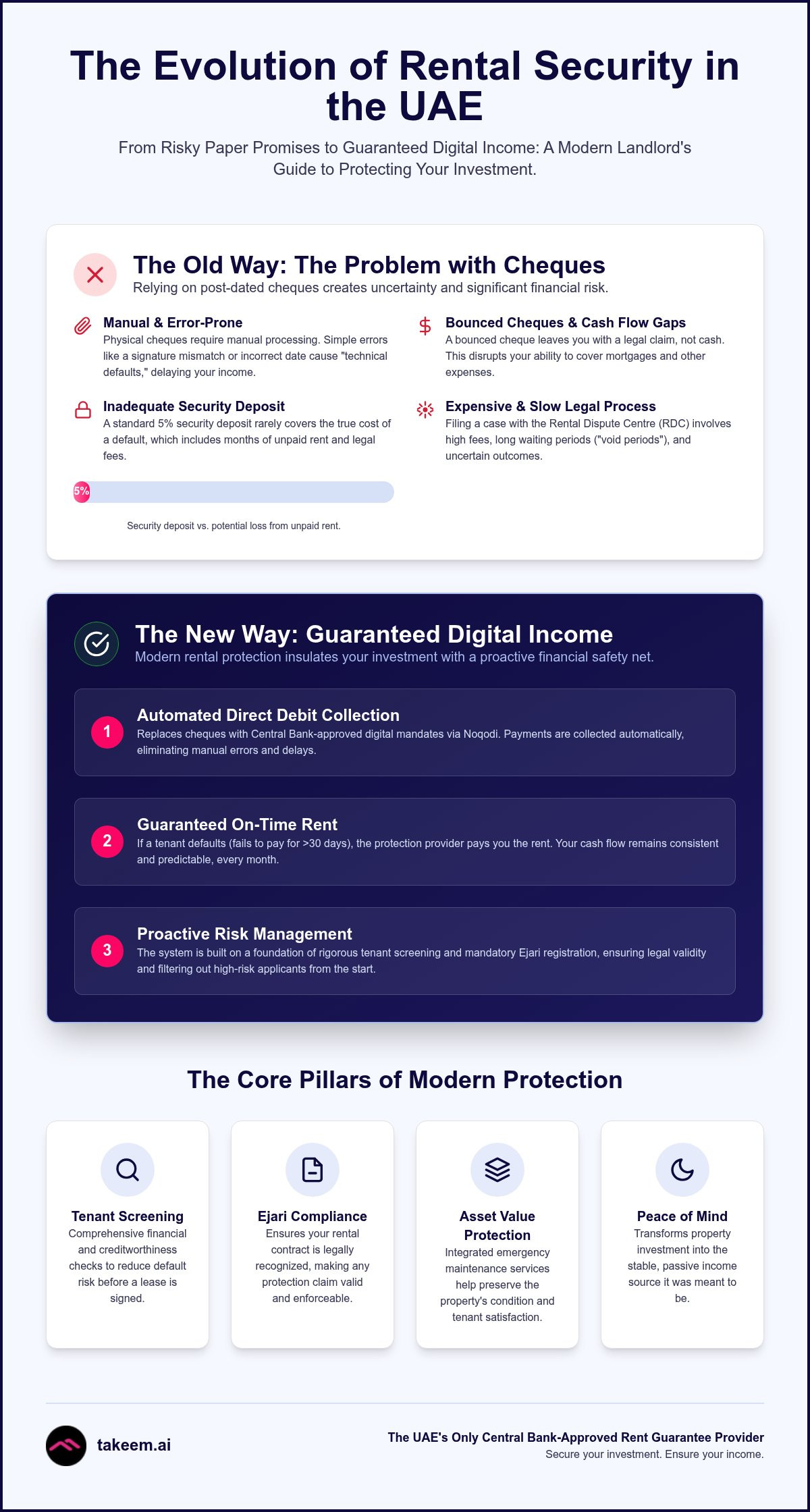
    The traditional cheque system is riddled with manual vulnerabilities. Bounced cheques are a primary driver of landlord stress, often requiring police reports and lengthy bank follow-ups to resolve. Even when a tenant has the funds, simple human errors like signature mismatches or incorrect dates can trigger weeks of delays. This manual effort is a significant drain on your time. Furthermore, the risk of cheque fraud or lost documents adds an unnecessary layer of anxiety to every transaction. You can read more about the transition in our guide on modernizing UAE rentals: cheques vs Direct Debit. Moving away from this outdated model is the first step toward a seamless ownership experience.

    Direct Debit: The 2026 Standard

    Direct Debit has emerged as the gold standard for secure, automated rent collection. Unlike cheques, which require physical handling and manual deposit, Direct Debit pulls funds automatically from the tenant’s account on the exact due date. This system is fully integrated with national banking frameworks, ensuring a level of reliability that paper-based systems lack. It significantly reduces the administrative burden for both parties, creating a professional and frictionless relationship.

    Digital collection isn’t just about convenience; it’s a prerequisite for the most advanced financial protections available today. Most modern rental guarantees require a digital payment trail to remain valid. By implementing these systems, you ensure your income is protected by technology and backed by financial institutions. The broader shift toward landlord fintech solutions in the UAE is reshaping how property investors secure and automate their rental income in 2026. If you’re ready to secure your cash flow, you should set up Direct Debit today to experience the peace of mind that comes with automated, guaranteed payments. Eliminating the possibility of a tenant not paying rent UAE starts with changing how you accept those payments.

    The Takeem Solution: Guaranteed Income and Asset Protection

    Resolving a situation with a tenant not paying rent UAE doesn’t have to be a solo journey fraught with legal uncertainty. While previous sections detailed the friction of the RDC and the hidden costs of default, Takeem provides a streamlined alternative that eliminates these pain points. We act as a sophisticated shield for your property portfolio. By combining financial technology with robust income protection, we’ve created a modern standard for property ownership that prioritizes your peace of mind and financial stability. You’re no longer left waiting for a court order to restore your cash flow.

    How the Landlord Rental Guarantee Works

    The core of our platform is the Landlord Rental Guarantee. This isn’t just a service; it’s a commitment to your monthly stability. When a tenant defaults, the traditional landlord faces immediate financial strain and a long wait for judicial resolution. With Takeem, your rental income is protected. We ensure you receive your funds regardless of the tenant’s actions, effectively removing the risk of non-payment from your balance sheet. You can explore the mechanics in detail through The Ultimate Guide to Landlord Rental Guarantees.

    We also facilitate the transition to digital payments effortlessly. Our team handles the Direct Debit setup for you, moving your properties away from the vulnerabilities of paper cheques. For property investors with large portfolios, we offer bulk guarantee solutions that secure hundreds of units under a single, efficient framework. This scalability allows you to grow your investments without increasing your exposure to administrative stress. It’s the difference between managing a crisis and managing an asset.

    Preserving Value with Maintenance Coverage

    Asset protection extends beyond just the monthly credit. A vacant or contentious property is often a neglected one. To counter this, our package includes an integrated emergency property maintenance service. This provides 24/7 coverage for critical issues, ensuring that a broken pipe or electrical failure doesn’t escalate into a costly renovation project. By addressing problems the moment they arise, we preserve the long-term market value of your asset. Our service providers are vetted for speed and reliability, giving you a secondary layer of protection against property neglect.

    This dual-layered approach, protecting your income and your physical property, is what defines the modern landlord’s toolkit in 2026. You no longer have to choose between high yields and high stress. You can secure your rental income with Takeem today and transform how you manage your UAE property investments. Our goal is to make the experience of a tenant not paying rent UAE a historical footnote rather than a present-day crisis.

    Securing Your Future as a Modern UAE Landlord

    Managing a tenant not paying rent UAE doesn’t have to be a source of constant anxiety. While understanding the RDC process and the 30-day notice period is essential for immediate resolution, the long-term success of your portfolio depends on modernization. By replacing manual cheques with automated systems and securing your income through a professional guarantee, you eliminate the friction that traditional property management often creates. You’ve worked hard to build your portfolio; protecting it should be the simplest part of your strategy.

    Takeem offers a sophisticated shield designed for the 2026 market. You’ll receive guaranteed monthly income regardless of your tenant’s payment status. We also provide a seamless Direct Debit setup to replace outdated cheques and include emergency maintenance coverage to preserve your asset’s value. It’s time to move beyond the stress of defaults and focus on growing your investments with total confidence. Switch to Guaranteed Rent with Takeem today and experience the peace of mind you deserve. Your property is a vital asset; let’s keep it protected and profitable.

    Frequently Asked Questions

    What is the first thing a landlord should do if a tenant doesn’t pay rent in the UAE?

    Your first step should be initiating informal communication to rule out technical banking errors or simple oversights. If the tenant remains unresponsive, verify that your Ejari registration is active and review your contract for specific payment terms. This proactive approach helps resolve a tenant not paying rent UAE before it escalates. Always document these early interactions to establish a clear timeline for potential legal proceedings.

    How long does the eviction process take for non-payment of rent?

    The timeline typically begins with a mandatory 30-day formal notice period served via Notary Public. If the tenant doesn’t pay within this window, you can file a case at the Rental Dispute Center. Mediation usually occurs within a few weeks; however, a full eviction order and enforcement by the Execution Department can extend the total timeframe to several months. The exact duration depends on the court’s current schedule.

    Can I cut off utilities if my tenant is not paying rent?

    No, you cannot legally disconnect water, electricity, or other utilities as a means of pressure. Doing so violates UAE rental regulations and can result in significant penalties or legal action against you. The only legal path for resolution is through the official channels of the Rental Dispute Center. Landlords must follow the established judicial process to recover funds or regain possession of the property without resorting to self-help measures.

    What are the costs involved in filing a case at the Rental Dispute Center?

    Filing a case in 2026 involves a main fee of 3.5 percent of the annual rent. This fee has a minimum charge of AED 500 and a maximum of AED 20,000 for eviction or rent claims. You should also budget for administrative charges, including process service fees of AED 100 and innovation fees. If you file through a Real Estate Services Trustees Centre, additional VAT and service charges will apply to the total.

    Is a post-dated cheque still legally binding in the UAE?

    Post-dated cheques remain legally binding, but they’re increasingly viewed as an outdated security measure in the modern property market. Bounced cheques no longer carry the same criminal weight as in previous years, making them less effective as a deterrent. Most forward-thinking landlords are transitioning to digital Direct Debit systems. These systems provide a more secure, automated, and professional way to collect rent while reducing the administrative burden of physical cheque management.

    How does a rental guarantee protect me from tenant default?

    A rental guarantee acts as a sophisticated financial shield for your property portfolio. If a tenant defaults, a service like Takeem ensures you continue to receive your monthly income regardless of the tenant’s payment status. This protection eliminates the stress and cash flow disruptions associated with a tenant not paying rent UAE. Additionally, these packages often include emergency maintenance coverage, which helps preserve the long-term market value of your physical asset. If you want to understand exactly how to get a rental guarantee in Dubai and the wider UAE, our dedicated 2026 landlord guide walks you through every step of the process.

    What is the 30-day notice period for non-payment, and is it mandatory?

    Yes, the 30-day notice period is a mandatory legal requirement under Article 25(1) of the rental laws. You must serve this formal written notice via Notary Public or registered mail before you can initiate eviction proceedings. This period gives the tenant a final opportunity to rectify the default. If you fail to provide this notice or serve it incorrectly, the Rental Dispute Center will likely dismiss your case, causing significant delays and loss of income.

    Can I settle a rental dispute without going to court?

    You can absolutely settle a dispute through the Rental Dispute Center’s mediation stage, often called the First Instance. A neutral mediator works with both parties to reach an amicable agreement, such as a structured payment plan. This process is faster and less adversarial than a formal hearing. Many landlords find that professional mediation resolves the issue efficiently while restoring the cash flow needed to maintain their property investments without further legal conflict.

  • Property Investor Income Protection Checklist: Securing UAE Rental Yields in 2026

    Property Investor Income Protection Checklist: Securing UAE Rental Yields in 2026

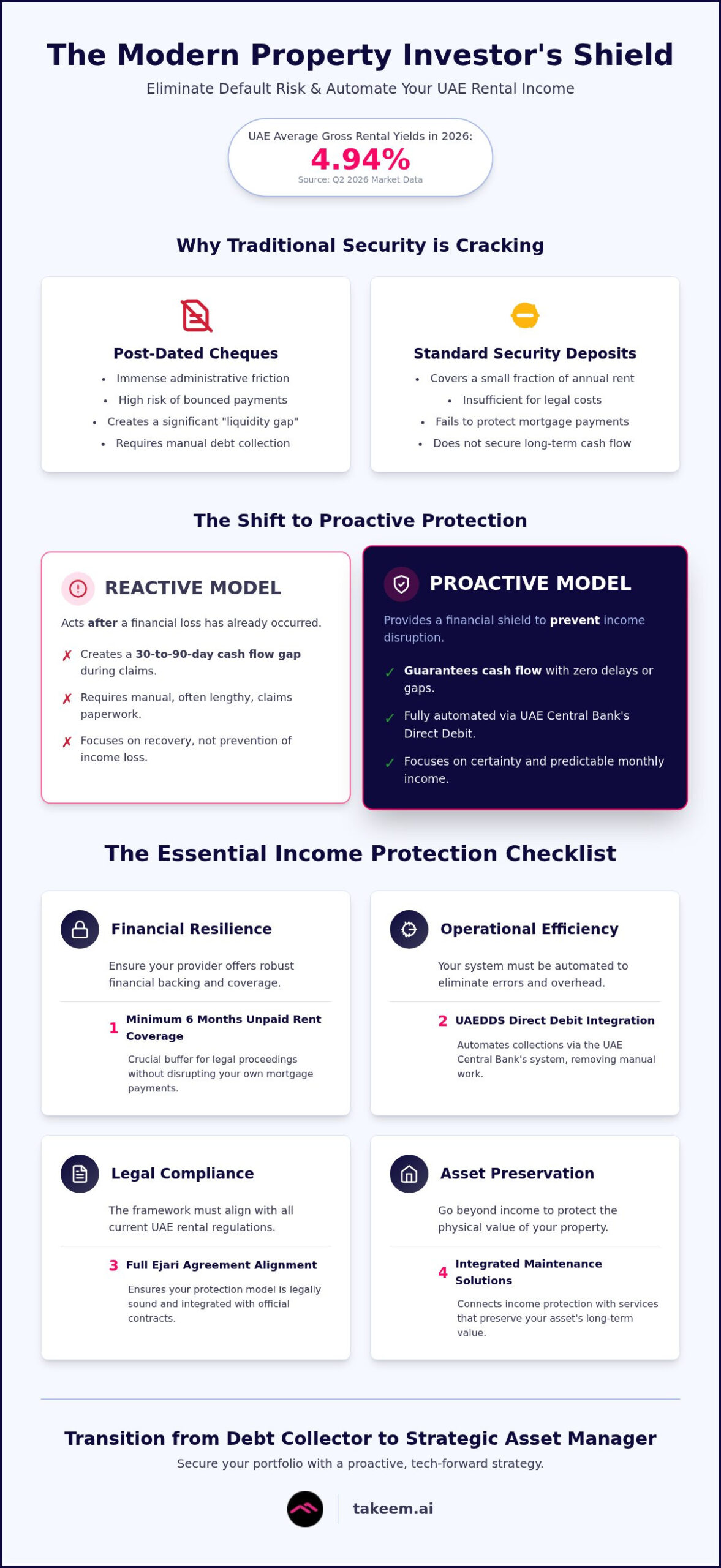
    With average gross rental yields in the UAE hitting 4.94% in 2026, why is one of the world’s most sophisticated markets still tethered to the uncertainty of physical cheques? You’ve likely felt the weight of administrative burdens or the anxiety of a potential tenant default. It’s exhausting to manage stacks of paperwork while facing high legal costs and time delays if a payment fails. You invested in real estate for freedom, not to become a manual debt collector. Reliable property investor income protection shouldn’t be an optional luxury; it’s the foundation of a modern, scalable portfolio.

    This article provides a definitive checklist to help you eliminate rental default risks and automate your income through digital protection. We’ll show you how to secure a truly passive income stream with zero manual chasing and predictable monthly cash flow for your mortgage obligations. By the end of this guide, you’ll understand how to leverage UAE-wide digital rent collection and integrated maintenance to preserve your asset value. It’s time to transition from reactive management to a proactive, tech-forward strategy that guarantees your yields stay secure in 2026.

    Key Takeaways

    • Discover why traditional post-dated cheques are no longer sufficient for modern portfolios and how UAE-wide digital Direct Debit provides superior payment certainty.
    • Learn how to implement a proactive framework for property investor income protection that eliminates the typical 30-to-90-day cash flow gap found in standard insurance.
    • Identify the essential financial and operational criteria for your checklist, from verified payout durations to seamless integration with national collection systems.
    • Get a clear roadmap for auditing your existing Ejari agreements and communicating the benefits of automated security to your tenants during renewal.
    • Understand how to scale your investments by transitioning from a manual debt collector to a strategic asset manager using integrated rental guarantees.

    The Evolution of Property Investor Income Protection in the UAE

    In 2026, the UAE real estate market has reached a level of maturity where manual processes feel like a liability. For years, investors relied on post-dated cheques as their primary shield. Today, that shield is cracking. Modern property investor income protection has evolved from a simple paper trail into a sophisticated digital ecosystem. This transformation isn’t just about technology; it’s a fundamental psychological shift. Savvy investors no longer see themselves as rent collectors. They’re strategic asset managers focused on securing predictable yields in a market where average gross rental yields reached 4.94% in the second quarter of 2026. This shift demands a more robust financial shield to handle the increased scale of modern portfolios.

    Why Traditional Security Deposits and Cheques Fail

    Managing hundreds of physical cheques across a national portfolio creates immense administrative friction. It’s not just the paperwork; it’s the risk. While the legal environment has evolved, the “liquidity gap” remains a significant threat. If a cheque bounces, the time between the default and a legal recovery can span months. During this period, your mortgage and service charge obligations don’t stop. Traditional security deposits rarely cover more than a small fraction of the annual rent, leaving you exposed to potential shortfalls. In the 2026 regulatory climate, relying on physical paper is a gamble that most high-stakes investors can’t afford to take. You need a system that removes the human element from the collection process entirely.

    The Rise of Integrated Rental Guarantees

    Unlike standard landlord insurance, which often acts reactively after a loss occurs, integrated rental guarantees provide a proactive financial shield. These solutions work in tandem with the UAE Central Bank’s Direct Debit System (UAEDDS) to ensure payments are automated and verified. This model is distinct from traditional rent guarantee insurance because it focuses on preventing the default before it happens while guaranteeing the cash flow if it does. Institutional investors have already pivoted to this model. They prioritize digital certainty over manual chasing because it allows them to scale portfolios without increasing headcount. By integrating digital collection with property investor income protection, you’re not just buying a policy; you’re installing a professional infrastructure for your wealth.

    The Essential Income Protection Checklist for Property Portfolios

    Securing a portfolio in 2026 requires more than just a signed lease; it demands a rigorous vetting of your security layers. While the market is thriving, your net profit depends on how effectively you mitigate friction. A comprehensive approach to property investor income protection starts with a checklist that covers four critical pillars: financial resilience, operational efficiency, legal compliance, and asset preservation. Without these, you’re essentially self-insuring against an unpredictable landscape. It’s about building a system that works even when you’re not watching.

    Financial and Legal Security Requirements

    The first step is evaluating the depth of your financial shield. You need to ensure your coverage spans at least six months of unpaid rent. This duration is vital because it provides a sufficient buffer to handle legal proceedings without disrupting your cash flow for mortgage or service charge payments. Verify that the provider has the financial resilience to honor these payouts during market shifts. Legally, any protection model must align with current Ejari standards. It should also account for the latest UAE rental income tax laws to ensure your net yields remain protected after all obligations are met. A transparent, automated payment trail is the only way to maintain clear records for both regulatory compliance and personal peace of mind.

    Operational and Asset Preservation Features

    Operational excellence is the second half of the equation. If your system still requires manual data entry or physical cheque collection, it’s already obsolete. A modern solution must integrate with the UAE Central Bank’s Direct Debit System to eliminate human error and administrative overhead. You also need real-time oversight. A centralized dashboard allows you to monitor your entire portfolio’s performance at a glance. Beyond just money, protecting the physical asset is non-negotiable. Integrated 24/7 emergency maintenance prevents minor leaks from turning into major tenant disputes or costly property damage. To see how these elements function as a single unit, you can explore the comprehensive rental guarantee solutions designed for large-scale portfolios.

    • Coverage Depth: Minimum of 6 months of rent protection.
    • Digital Integration: Full UAEDDS-integrated rent collection.
    • Real-time Oversight: Centralized digital dashboard for all units.
    • Asset Shield: 24/7 emergency property maintenance included.
    • Legal Alignment: Full compliance with Ejari and current tax regulations.

    This checklist serves as your roadmap to a hands-off investment experience. By checking these boxes, you move away from the stress of manual chasing and toward a model of calm efficiency. You’re not just protecting an income stream; you’re securing your time and your future growth.

    Beyond Insurance: Comparing Reactive vs. Proactive Protection Models

    Many investors mistake standard insurance for a complete safety net. It’s not. Traditional policies are reactive by design; they trigger only after a loss is finalized. This leaves you to carry the financial weight while you wait for a claims adjuster to approve your case. True property investor income protection functions as a proactive digital shield. It maintains your cash flow without the friction of a claims department or the uncertainty of a 90-day waiting period. By moving beyond reactive models, you secure your portfolio against the “Bermuda Triangle” of claims: underinsurance, hidden penalties, and narrow exclusions that often leave landlords empty-handed.

    The Cash Flow Gap in Traditional Insurance

    Standard insurance often leaves a 30-to-90-day gap between a tenant’s missed payment and your first reimbursement check. This delay creates a liquidity crisis for those who rely on rent to cover mortgages or service charges. Documenting these losses manually is a burden. You have to prove every missed payment and demonstrate that you followed all legal steps perfectly. This administrative hurdle is why optimising property portfolio rental income in the UAE requires immediate liquidity. A digital guarantee ensures that your income remains uninterrupted, regardless of whether the tenant is currently paying. It bridges the gap that insurance ignores.

    Risk Mitigation Through Real-Time Data

    Modern fintech solutions allow you to monitor tenant payment behavior in real-time. Instead of waiting for a cheque to bounce, digital systems identify payment risks before they become total defaults. This allows for proactive intervention, such as automated reminders or early mediation, rather than reactive legal action. By reducing the professional distance between you and your tenant through automation, you foster a more stable rental relationship. You aren’t just reacting to a crisis; you’re using data to prevent it. In the 2026 market, the cost-benefit analysis is clear. A market-average 4% service fee for a guarantee is significantly lower than the 8.33% loss incurred by just a single month of vacancy. Investing in property investor income protection is simply a more efficient way to manage risk. For a deeper understanding of how the New Civil Code and fintech integration reshape your obligations, the complete guide to property asset protection UAE outlines the full regulatory and digital landscape for 2026.

    Property Investor Income Protection Checklist: Securing UAE Rental Yields in 2026

    Implementation Guide: Transitioning to Digital Rental Security

    Moving from a traditional cheque-based system to a digital framework requires a methodical approach. It’s about auditing your current status and setting a new standard for your portfolio’s future. In 2026, the transition is streamlined by the UAE Central Bank’s Direct Debit System (UAEDDS), which serves as the backbone for modern property investor income protection. By following a structured implementation guide, you can eliminate the manual friction that often leads to payment delays and disputes. This process transforms your role from a reactive collector into a strategic asset manager with full oversight of your cash flow.

    Auditing and Modernizing Lease Agreements

    The first step involves a comprehensive audit of your existing Ejari agreements. Identify which units are nearing renewal, as these provide the perfect window to introduce digital security. Instead of requesting a stack of paper cheques, you can now transition tenants to digital Direct Debit authorizations. This modernization is especially critical for those managing a rental guarantee multiple properties UAE setup. Using a master agreement allows you to bring your entire portfolio under one protective umbrella; this simplifies your administrative oversight and ensures consistent coverage across every unit. You’ll no longer need to track individual paper mandates for each property in your collection.

    Tenant Onboarding and Communication

    Success depends on clear, solution-oriented communication. Tenants often prefer the convenience of digital payments once they understand the benefits to their own financial planning. Highlighting the shift from large, lump-sum cheques to predictable monthly Direct Debits can improve tenant retention and satisfaction. Explain how the UAEDDS process provides them with a transparent, bank-verified record of every payment made. To further enhance the value proposition, introduce the integrated 24/7 maintenance portal. This ensures that emergency repairs are handled immediately, preventing minor issues from escalating into major conflicts. When tenants see that digital security also means better service, the onboarding process becomes a collaborative success.

    By integrating these digital workflows, you’re not just protecting your income; you’re professionalizing the entire tenant experience. This dual focus on security and service is what defines the most successful portfolios in the 2026 market. If you’re ready to start this transition, you can digitize your portfolio security through a unified platform designed for national scale. This proactive step ensures your yields remain secure while your administrative burden disappears.

    Scaling Your UAE Portfolio with Takeem’s Integrated Solutions

    Scaling a portfolio shouldn’t mean scaling your stress. As you expand your footprint across the UAE, the complexity of managing multiple tenants and payment cycles increases. Takeem acts as a national infrastructure for rental certainty, allowing you to grow without the traditional friction of manual oversight. For institutional investors and family offices, this means moving away from fragmented insurance policies toward a unified property investor income protection strategy. It’s about building a foundation that supports thousands of units as easily as it supports one. You’re not just adding properties; you’re expanding a secure, automated ecosystem.

    Scalable Protections for Large Portfolios

    Managing hundreds of residential units requires more than just a spreadsheet; it demands a single source of truth. Takeem’s digital dashboard provides real-time financial oversight and unified reporting that simplifies audit compliance. You can monitor collection rates and guarantee statuses across your entire national asset group from one interface. This centralized approach allows for better risk diversification, ensuring that a single default doesn’t ripple through your cash flow. By July 2026, the platform had already onboarded over 100,000 units, representing the high-capacity infrastructure required for institutional-grade management and family office security.

    Preserving Yield Through Asset Protection

    Income security is only half the battle; the physical state of your property is the other. Many investors overlook how property maintenance coverage UAE directly impacts their net yield. Critical plumbing or electrical failures often lead to rent withholding or tenant disputes that disrupt your income stream. Takeem’s integrated 24/7 emergency maintenance ensures these issues are resolved before they escalate. This proactive care protects the long-term ROI of your assets in a competitive market where tenants prioritize well-maintained homes. It’s a strategic shield that preserves both your cash flow and your property’s market value over time.

    Real estate agents also find significant value in these integrated solutions. By offering a Landlord Rental Guarantee, agents build deeper trust with their clients and position themselves as facilitators of secure, hands-off wealth. This partnership model transforms the traditional agency relationship into a long-term strategic alliance. Whether you’re an individual owner or managing an institutional fund, property investor income protection through Takeem provides the stability needed to navigate the UAE’s dynamic real estate landscape with confidence. It’s time to let technology handle the friction while you focus on the growth.

    Future-Proof Your UAE Portfolio with Digital Certainty

    The 2026 UAE market offers immense potential for growth, but success requires moving past the administrative friction of the past. You’ve seen how the shift from physical cheques to UAEDDS-integrated systems creates a foundation for truly passive wealth. By adopting a proactive checklist, you ensure that your cash flow remains steady regardless of individual tenant behavior. This modern approach to property investor income protection isn’t just about financial security; it’s about reclaiming your time and professionalizing your asset management. You’re no longer chasing payments; you’re overseeing a high-performance machine.

    Securing your yields shouldn’t be a manual task. You can now bridge the gap between reactive insurance and total certainty with a solution that provides insurance-backed protection for up to 6 months of rent and includes 24/7 integrated emergency maintenance support. This level of protection preserves your asset value while ensuring UAEDDS-compliant digital rent collection across your entire national portfolio. Secure your national UAE property portfolio with Takeem’s rental guarantee today.

    Your journey from a manual debt collector to a strategic asset manager starts with a single digital step. The infrastructure for risk-free investment is ready; it’s time to let it work for you. Build your future on a foundation of calm efficiency and watch your UAE portfolio thrive. For a real-world perspective on how modern landlords are achieving guaranteed rental cash flow UAE wide through digital transformation, the 2026 case study reveals the practical mechanics behind this shift.

    Frequently Asked Questions

    Is property investor income protection legally enforceable in the UAE?

    Income protection is fully enforceable through civil contracts and digital mandates in the UAE. These agreements are anchored in the legal framework of the UAE Central Bank’s Direct Debit System and Ejari registration. By formalizing the guarantee as a contractual obligation, you ensure that your rental income is protected under national law. This professional structure provides a secure alternative to the traditional reliance on physical security tools that often lead to legal delays.

    How does a rental guarantee differ from standard landlord insurance?

    A rental guarantee provides proactive cash flow protection, while standard landlord insurance is typically reactive. Standard insurance requires you to file a claim and wait for a loss to be finalized; this often results in a 30-to-90-day liquidity gap. In contrast, property investor income protection ensures your monthly payments continue automatically if a tenant defaults. This digital model eliminates the burden of proof and the administrative friction associated with traditional insurance claims.

    Can I implement income protection for an existing tenant using cheques?

    You can implement protection for existing tenants, though the transition to digital Direct Debit is recommended for maximum efficiency. While some models can wrap around existing cheque-based agreements, the most robust security is achieved by modernizing the lease at the next renewal. This shift allows you to move away from the manual tracking of physical paper. It ensures your income is backed by the stability of a digital mandate rather than a paper promise.

    What happens if a tenant fails to authorize a Direct Debit payment?

    If a tenant fails to authorize a Direct Debit payment, the protection mechanism triggers an immediate payout to the landlord. The system doesn’t wait for a legal resolution or a bounced cheque notification; it prioritizes your cash flow first. The provider then handles the recovery process directly with the tenant. This seamless transition ensures that your mortgage and service charge obligations are met on time, regardless of the tenant’s current liquidity status.

    Does the guarantee cover the legal costs of tenant eviction?

    Yes, a comprehensive property investor income protection plan typically covers the legal costs associated with tenant recovery and eviction. This includes the professional fees for legal representation and the administrative costs of the UAE’s eviction process. By integrating these costs into the guarantee, you avoid the high out-of-pocket expenses that usually follow a default. This protection ensures that your net yields aren’t eroded by the price of regaining possession of your asset.

    How much does a comprehensive income protection plan cost in 2026?

    In the 2026 market, the cost for comprehensive income protection typically aligns with a small percentage of the annual rental value. While specific fees vary based on the portfolio size and coverage depth, industry averages suggest this is a strategic investment compared to the cost of a single month of vacancy. You should evaluate the service fee against the total value of guaranteed cash flow, integrated maintenance, and the elimination of manual collection overhead.

    Is emergency property maintenance included in all income protection plans?

    Emergency property maintenance is an essential component of the Landlord Rental Guarantee. This integrated service handles critical plumbing, electrical, and cooling issues 24/7 to prevent tenant disputes and property damage. By addressing these repairs immediately, the system removes the common excuse for rent withholding. It’s a proactive measure that preserves both your asset value and your relationship with the tenant while ensuring the property remains in peak condition for the long term.

    How long does the onboarding process take for a large property portfolio?

    The onboarding process for a large property portfolio is designed for speed and efficiency. Most institutional investors can digitize their entire collection of units within a few business days through a centralized dashboard. This involves migrating tenant data and setting up digital Direct Debit mandates for upcoming payment cycles. The goal is a smooth transition that doesn’t disrupt current cash flows; this allows you to scale your portfolio with national infrastructure support almost immediately.

  • Rental Default Protection in the UAE: A Landlord’s Guide to Secure Income

    Rental Default Protection in the UAE: A Landlord’s Guide to Secure Income

    What if the stressful era of chasing bounced cheques and filing expensive cases at rental dispute tribunals was finally over? With the UAE’s dynamic rental market representing significant value and countless contracts annually, the stakes for property investors have never been higher. You likely entered the market for stable, passive income, yet you often find yourself managing cash flow gaps or navigating complex legal evictions instead. It’s a frustrating reality that can stall your financial growth and drain your time.

    This guide reveals how to insulate your property investment using comprehensive rental default protection UAE strategies that combine digital collection with income guarantees. We’ll show you how to replace outdated paper promises with Central Bank-approved direct debits and automated maintenance coverage. You’ll discover how these modern fintech tools ensure your monthly cash flow remains consistent, allowing you to protect your asset’s value and enjoy true peace of mind without the friction of traditional tenant disputes.

    Key Takeaways

    • Learn how modern rental default protection UAE has evolved from simple security deposits into a comprehensive financial safety net for your property portfolio.
    • Discover why switching from traditional post-dated cheques to automated Direct Debit mandates eliminates common "technical defaults" and administrative errors.
    • Understand the vital role of Ejari registration in validating your income protection and ensuring your legal standing during a dispute.
    • Explore how integrated emergency maintenance services act as a silent protector of your asset’s value and tenant payment compliance.
    • Get a clear roadmap for using Takeem’s digital platform to automate monthly rent collection and guarantee consistent cash flow regardless of tenant delays.

    What is Rental Default Protection in the UAE?

    In the UAE’s fast-moving property market, a landlord’s primary goal is predictable cash flow. Rental default protection UAE serves as a sophisticated financial safety net designed to ensure you receive your rental income even if a tenant stops paying. While traditional security deposits, usually 5% of the annual rent, provide a small buffer for damages, they rarely cover the massive financial gap left by months of unpaid rent. We’re seeing a fundamental shift toward comprehensive income guarantees that offer a much more robust shield for your investment.

    By August 2026, the "cheque-only" era has effectively ended as landlords demand more than just a piece of paper that might bounce. This transition is supported by the integration of the Ejari system with the Noqodi Direct Debit platform, making automated payments the new standard for modern investors. It’s no longer enough to rely on manual collection when digital systems can automate the entire process while providing an extra layer of security.

    It’s vital to distinguish between a managed rental guarantee service and standard Rent insurance. While basic insurance might pay out after a lengthy claim process, a managed service like Takeem’s, which is the only Central Bank-approved rent guarantee provider in the UAE, integrates digital collection and proactive protection. This modern approach transforms rental default protection UAE from a reactive insurance policy into a proactive management tool that streamlines your entire portfolio.

    The Cost of Tenant Default for Landlords

    Rental default is defined as the failure to meet lease obligations for over 30 days. When a tenant stops paying, the financial damage extends far beyond the missing monthly deposit.

    • Void periods: The time spent in legal disputes can leave your property empty and non-earning for months while the case proceeds.
    • Mortgage pressure: If you rely on rent to cover your AED mortgage repayments, a default can trigger personal financial instability and bank penalties.
    • Hidden fees: Filing a case with the Rental Dispute Centre (RDC) involves significant administrative costs, processing fees, and potential legal representation expenses.

    Why Traditional Cheques are a Modern Risk

    Managing physical cheques is a cumbersome, manual process prone to human error. A signature mismatch or an incorrect date can lead to a technical default that delays your payment and forces you to restart the collection process. You’re essentially holding a promise that requires physical logistics to fulfill, which feels increasingly outdated in a tech-forward market like Dubai or Abu Dhabi.

    Even though a bounced cheque remains a serious matter in the UAE, the legal process doesn’t put money back in your bank account instantly. You’re left with a legal claim rather than liquid cash. Digital systems provide the speed and reliability that physical paper simply cannot match, ensuring your income is protected from the moment the rent is due.

    The Mechanics of Income Protection: How It Works

    Modern rental default protection UAE operates as a sophisticated financial buffer between your bank account and your tenant’s payment behavior. Instead of the landlord bears the full weight of a missed payment, the guarantee provider steps into the middle of the transaction. This structure ensures that your liquidity remains untouched even if the tenant’s bank account is empty. It’s a shift from a reactive legal approach to a proactive financial model that prioritizes your monthly cash flow over the slow process of litigation.

    The underwriting process for these guarantees is rigorous. It begins with comprehensive tenant screening, which evaluates the tenant’s financial history and creditworthiness before the lease is even signed. This layer of protection is essential because it filters out high-risk applicants, reducing the likelihood of a default before it occurs. According to recent UAE residential property market analysis, the surge in rental demand has made robust screening even more critical to maintain portfolio stability. Standard coverage typically protects the full monthly rent amount and can include legal costs, though it’s important to verify specific limits regarding property damage or utility arrears.

    Ejari Compliance and Legal Validity

    In the UAE, a registered Ejari contract is the non-negotiable foundation of any protection scheme. Without this official registration, your lease isn’t legally recognized by the Dubai Land Department or the Rental Dispute Centre, which would render any protection claim invalid. Digital contracts are now streamlining this setup, allowing the protection to activate the moment the Ejari is issued. This alignment ensures that your lease terms comply with national property laws, providing a solid legal standing if you ever need to enforce the "Possession" clause of your agreement.

    The Claims Process vs. Automated Payouts

    Traditional rent insurance often involves a cumbersome claims process. You’d typically have to submit piles of documentation, wait for a claims adjuster to review the case, and endure a waiting period that could last weeks or months. This lag creates the very cash flow gap you were trying to avoid. Modern fintech-driven guarantees change this dynamic by focusing on income continuity. If a payment is missed via the digital collection system, the guarantee can trigger an automated payout to keep your finances steady while the provider handles the recovery process.

    This protection remains in effect until the property is either vacated or re-let, covering the critical "void period" that usually drains an investor’s reserves. If you’re looking to insulate your portfolio from these risks, exploring a modern rental guarantee can provide the security you need without the administrative headache. By automating the payout mechanism, these platforms ensure that your mortgage obligations and maintenance costs are always met on time, regardless of tenant delays.

    Cheques vs. Direct Debit: The First Line of Defence

    While traditional post-dated cheques have long been the standard in the local market, they’re often the weakest link in your income security. A physical cheque is a manual promise, subject to human error, logistical delays, and technical failures. By contrast, automated Direct Debit mandates create a direct, digital link between the tenant’s bank account and your own. This shift is a critical component of rental default protection UAE because it addresses the root cause of many payment delays before they escalate into expensive legal disputes.

    Technical defaults often happen for trivial reasons. A signature that doesn’t quite match the bank’s records, a slightly smudged date, or a landlord simply forgetting to deposit the paper on time can stall your cash flow for weeks. Digital systems eliminate these friction points entirely. The UAE Central Bank’s Direct Debit System (UAEDDS) provides a highly secure framework for these transactions. It ensures that mandates are verified and processed with the same level of authority as a cheque but with the efficiency of modern fintech. For landlords, this means moving from a system of "hope and chase" to one of "confirm and collect."

    Why Landlords are Switching to Digital Collection

    The days of the "cheque run"-driving to various properties or bank branches to collect and deposit physical paper-are becoming a thing of the past. Digital collection offers real-time tracking, giving you instant notifications if a payment is successful or if a mandate fails. This transparency allows you to address issues immediately rather than discovering a problem days later at the bank counter. It also professionalises the relationship. Tenants often prefer the convenience of monthly digital payments over issuing large, intimidating cheques once or twice a year, which can significantly improve long-term retention and tenant satisfaction.

    Setting Up Direct Debit for Your Properties

    Transitioning to digital payments is most effective when done during the contract renewal period. You’ll need to set up a mandate through a certified provider, which the tenant then authorises using their bank credentials or UAE Pass. If a tenant is hesitant, it’s helpful to explain the benefits from their perspective. It’s more secure than a cheque, allows for easier monthly budgeting, and eliminates the risk of accidental late fees caused by bank processing delays. Direct Debit is now the preferred rental payment method for institutional investors in the UAE. By adopting these systems early, individual landlords can enjoy the same level of security and efficiency as the market’s largest players, ensuring their rental default protection UAE strategy is built on a solid digital foundation.

    Rental Default Protection in the UAE: A Landlord's Guide to Secure Income

    Emergency Maintenance: Protecting Asset Value

    While most investors focus on the financial side of rental default protection UAE, the physical integrity of your property is a silent but equally critical risk to your income. A property in disrepair is a liability that invites disputes and often justifies payment delays in the eyes of a tenant. If a major system fails, such as the AC during a peak Dubai summer, the tenant’s legal and moral obligation to pay rent on time becomes a point of contention. By integrating emergency maintenance into your protection strategy, you remove the most common excuses for non-payment before they ever arise.

    Modern property protection packages now treat 24/7 emergency support as a standard feature rather than an optional extra. This proactive approach ensures that minor issues don’t escalate into major structural liabilities that could drain your reserves. When maintenance is handled through a managed guarantee system, the landlord is no longer the first point of contact for a midnight plumbing crisis. Instead, a professional response team takes over, ensuring the tenant’s safety and the property’s value remain intact without your direct intervention.

    The Impact of Repairs on Rental Yield

    Rapid response times do more than just fix a leak; they preserve your long-term asset value and protect your annual yield. High tenant turnover is one of the most significant expenses for UAE landlords, often costing thousands in re-listing fees and void periods. Providing high-quality, reliable maintenance support is the most effective way to improve tenant retention. By integrating these repair costs into your overall protection service fee, you create a predictable expense model. This shields your cash flow from the sudden financial shocks of major system failures that would otherwise require immediate, out-of-pocket AED payments. For a deeper look at how to safeguard your returns from these risks, explore this comprehensive guide on rental yield protection UAE and the fintech tools reshaping income security in 2026.

    Common Emergency Coverage Areas

    In the UAE’s specific climate, certain failures are classified as immediate emergencies because they affect the habitability of the home. Modern coverage typically focuses on these high-impact areas:

    • Climate Control: Rapid AC repair or replacement during high-temperature months.
    • Plumbing and Electrical: Addressing burst pipes, major leaks, or total power failures that pose safety risks.
    • Security Services: Emergency locksmith services for lockouts or broken glazing that compromises property security.

    It’s important to distinguish these from cosmetic maintenance, which focuses on aesthetics like painting or minor cabinetry adjustments. Emergency coverage is about functional integrity. To secure both your monthly income and your property’s physical condition, you can sign up for a rental guarantee that includes emergency maintenance. This combined approach ensures that your investment remains a high-performing asset that attracts and keeps quality tenants.

    Securing Your Future with Takeem’s Rental Guarantee

    Takeem represents the next evolution of property investment in the Emirates. By merging advanced fintech with robust financial underwriting, Takeem provides a comprehensive rental default protection UAE solution that addresses every major pain point a landlord faces. It isn’t just a reactive insurance product; it’s a proactive ecosystem that manages the entire lifecycle of your rental income. From the moment a tenant signs their digital mandate to the day they vacate, your cash flow is shielded by the UAE’s only Central Bank-approved rent guarantee provider.

    The core of this service is "Monthly Certainty." In a market where rental trends can shift, having a guaranteed date for your income allows you to plan your own financial obligations with total confidence. Whether you’re paying off a mortgage or reinvesting in new units, the stress of "will they pay this month?" is replaced by a predictable, automated deposit. This reliability is why major platforms like Bayut and dubizzle have partnered with Takeem, recognizing it as the gold standard for secure property transactions in 2026.

    Real estate agents are also rapidly adopting this technology to differentiate their listings. By offering a property with a pre-integrated Landlord Rental Guarantee , agents provide immediate peace of mind to their clients. This added value makes properties more attractive to serious investors and streamlines the closing process, as the most significant risk factor-tenant non-payment-is already mitigated.

    Takeem for Portfolio Investors

    For those managing multiple units or entire residential buildings, Takeem offers a sophisticated way to scale rental default protection UAE across a diverse portfolio. Instead of tracking dozens of individual cheques and bank transfers, institutional property owners can utilize a centralized digital dashboard. This platform provides real-time reporting on all active mandates, successful collections, and maintenance status. Bulk guarantee solutions ensure that even the largest portfolios remain liquid and profitable, with streamlined underwriting that respects the complexity of large-scale property management.

    Getting Started with Digital Rent Collection

    Registering your property is a straightforward, digital-first process. Once your unit is onboarded, the system integrates your rental collection with emergency maintenance coverage, creating a total safety net for your investment. You can transition existing tenants during their next renewal or set up new leases from day one. This modern approach ensures your asset remains in peak condition while your bank account stays protected from the friction of traditional defaults. Don’t leave your investment’s success to chance. Secure your rental income today with Takeem and experience the calm efficiency of a truly protected property portfolio.

    Future-Proof Your Property Portfolio

    The transition from traditional, paper-based rent collection to a tech-driven ecosystem is no longer a luxury for UAE landlords; it’s a strategic necessity. By embracing rental default protection UAE, you’ve learned how to eliminate the risks of bounced cheques and costly legal delays. You now understand that securing your income involves more than just a signed contract. It requires end-to-end digital rent collection via Direct Debit, Ejari-compliant income guarantees, and integrated emergency property maintenance to preserve your asset’s long-term value.

    Takeem provides the sophisticated shield your investment deserves, replacing uncertainty with monthly financial clarity. This modern approach ensures your mortgage payments and maintenance costs are always covered, regardless of tenant behavior. It’s time to step away from the administrative burden of manual property management and enjoy the calm efficiency of a truly protected investment. Switch to secure digital rent collection and guarantee your income with Takeem. Your path to a stress-free, high-performing portfolio starts with a single digital mandate.

    Frequently Asked Questions

    What happens if a tenant stops paying rent and I have a guarantee?

    The guarantee provider steps in to cover the missing payments while managing the recovery process directly with the tenant. This ensures your cash flow remains uninterrupted, allowing you to meet mortgage or maintenance obligations without waiting for a legal resolution through the Rental Dispute Centre. It’s a proactive way to maintain liquidity while the provider handles the administrative and legal burden of the default.

    Is rental default protection the same as home insurance in the UAE?

    No, they serve different purposes. Home insurance typically covers structural damage, theft, or fire, while rental default protection UAE specifically secures your rental income against tenant non-payment. Takeem’s solution goes further by integrating digital collection and emergency maintenance into a single protective package, whereas standard insurance is often a reactive policy with lengthy claims processes.

    Can I set up Direct Debit for rent collection if my tenant is already halfway through their lease?

    Yes, you can transition to Direct Debit mid-lease, provided both you and the tenant agree to the change. The tenant will need to authorize the digital mandate via the UAE Direct Debit System (UAEDDS), which then replaces any remaining physical cheques. This is a common way for landlords to professionalize their collection process before the next formal contract renewal.

    Does the rental guarantee cover property damage caused by the tenant?

    Standard rental guarantees focus on income protection rather than malicious damage or cosmetic issues. However, Takeem’s package includes emergency maintenance for functional failures like AC or plumbing crises that affect the home’s habitability. For significant structural damage or intentional destruction, you should ensure you have a separate comprehensive home insurance policy alongside your income guarantee.

    How much does rental default protection typically cost for a landlord?

    The cost for rental default protection UAE is typically structured as a percentage of the total annual rent. While specific rates vary based on the property type and portfolio size, the investment is designed to be a fraction of the potential losses from a single month of vacancy or a protracted legal eviction process. It’s a predictable business expense that replaces the unpredictable cost of tenant defaults.

    Is Ejari registration mandatory to qualify for Takeem’s rental guarantee?

    Yes, a valid Ejari is a non-negotiable requirement for any legitimate protection scheme in the UAE. Ejari registration provides the legal framework for the tenancy, and without it, the guarantee cannot be validated or enforced in the event of a dispute. Ensuring your contract is registered is the first step in securing your legal standing and your rental income.

    What qualifies as an ’emergency’ under the property maintenance coverage?

    An emergency is defined as a sudden failure that makes the property uninhabitable or poses an immediate safety risk. This includes total AC failure during the summer months, major plumbing leaks, electrical blackouts, or security breaches like broken external locks. Cosmetic repairs, such as painting or minor cabinetry adjustments, aren’t covered under the emergency maintenance protocols.

    How does the UAE Direct Debit system protect landlords better than cheques?

    Direct Debit eliminates common "technical defaults" associated with physical paper, such as signature mismatches, smudged dates, or forgotten deposits. It’s a secure, Central Bank-approved system that automates the collection process directly from the tenant’s bank account. This provides a clear digital trail and real-time notifications, making it far more reliable than the traditional "hope and chase" method of managing cheques.