
Tag: landlord guide

  • Protecting UAE Rental Income: 2026 Landlord Guide

    Protecting UAE Rental Income: 2026 Landlord Guide

    Rent collection and rental-income protection solve different problems. Digital payments can make it easier to track what’s due, but they can’t by themselves protect cash flow when rent is delayed or unpaid. If you want to protect rental income UAE properties generate, start by understanding where payment collection ends and income protection begins.

    It’s understandable to want more predictable rent without adding admin or relying on unclear promises. A rental guarantee may offer a different kind of protection from a payment-collection service, but the details matter. Coverage, exclusions, eligibility and processes can vary, so check the terms rather than relying on a product name or headline claim.

    This guide explains how digital Direct Debit collection and rental guarantees address different needs, what to review before choosing an approach, and how to assess a guarantee’s terms. Use the practical steps to identify the risks that matter for your property and decide what to investigate next.

    Key Takeaways

    • To protect rental income UAE landlords should identify whether the main concern is late payment, non-payment, admin effort or property emergencies.
    • Compare digital rent collection, rental guarantees and maintenance support by the problem each addresses and its limits.
    • Before relying on a rental guarantee, confirm its eligibility, covered circumstances, exclusions, process and timing in writing.
    • Use a step-by-step plan to review your rent process and select protection that fits your property and circumstances.
    • Assess Takeem’s rental guarantee, Direct Debit collection and included emergency maintenance against your needs and the service terms.

    Why protecting rental income in the UAE starts with identifying the risk

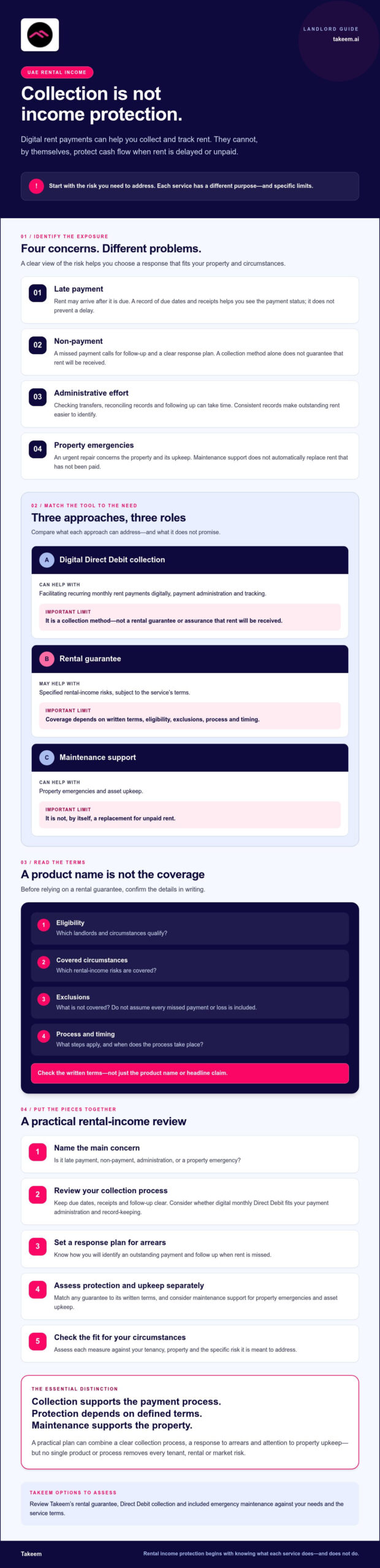
    Before choosing a payment method or protection service, identify what could interrupt your rental cash flow. A late payment, missed rent, time spent tracking payments and an urgent property repair are different problems. One solution may help with one risk without addressing the others.

    Rental-income protection is a strategy for improving payment reliability, planning for rent default and maintaining the property, while recognising that each measure has specific terms and limits. This is a useful starting point for landlords looking to protect rental income UAE properties generate.

    Which rental-income risks should UAE landlords plan for?

    Payment delays and non-payment both affect cash flow, but they are not the same. A tenant who pays late may still meet the rent obligation, while a missed payment calls for follow-up and a clear response plan. Keeping a record of what is due helps you track the situation, but it does not prevent either outcome.

    Administrative friction is another operational concern. Manually checking transfers, reconciling records and following up on uncertain payment status can take time. A consistent process for recording due dates, receipts and follow-up can make outstanding rent easier to identify. The admin involved does not automatically mean a financial loss, but it can make payment status less clear.

    Property emergencies create a different exposure. A sudden maintenance issue may affect the condition or usability of an asset, but maintenance support does not automatically replace rent that hasn’t been paid. Treat cash-flow protection and asset upkeep as related but distinct parts of a landlord’s plan.

    What does protecting rental income mean in practice?

    Start by separating the payment process from the response to non-payment. A collection method, including digital monthly payments through Direct Debit, can facilitate rent collection and help with tracking. It does not, by itself, establish that income will be protected if rent remains unpaid.

    A rental guarantee may address a different part of the risk, but the name alone does not tell you what it provides. Review the actual terms and confirm in writing which landlords and circumstances are eligible, what is covered, what is excluded, and how the process and timing work. Do not assume that a guarantee covers every missed payment or every loss.

    A practical approach combines a clear collection process, a response plan for arrears and suitable attention to the property’s upkeep. The right mix depends on your tenancy and circumstances. No single product or process removes every tenant, rental or market risk, so assess each measure by the specific gap it is intended to address.

    Compare rent collection, rental guarantees, and maintenance support

    These approaches address different parts of a landlord’s exposure. A collection method helps handle payments, a rental guarantee may provide protection in defined circumstances, and maintenance support focuses on the property itself. Comparing them by purpose and limits makes it easier to decide how to protect rental income UAE properties generate without assuming one service covers every risk.

    Approach Problem it addresses Key limit to understand
    Direct Debit collection Facilitates recurring monthly rent payments digitally and can support payment administration and tracking. It is a collection method, not a rental guarantee or assurance that rent will be received.
    Rental guarantee May address specified rental-income risks, subject to the service’s terms. Coverage depends on written terms, eligibility, exclusions and the stated process.
    Maintenance support Helps address property emergencies and asset upkeep. Maintenance support is not, by itself, a replacement for unpaid rent.

    How do Direct Debit and traditional collection differ?

    Direct Debit facilitates digital monthly rent collection. Consider whether a recurring digital method fits your payment administration and record-keeping practices. Traditional collection may involve different steps for recording receipts and following up, depending on the arrangement. Neither method alone guarantees that a payment will be made. For broader context on digital rental practices, read about modernizing UAE rentals with Direct Debit.

    What can a rental guarantee and maintenance support address?

    A rental guarantee is separate from the mechanism used to collect rent. Before relying on one, review its written terms and confirm eligibility, covered circumstances, exclusions, process and timing. Heriot-Watt University’s real estate market research provides broader context on the investment environment, but the specific service contract defines the guarantee’s terms. For a closer look at landlord rental guarantees in the UAE, assess the service details against your own requirements.

    Emergency maintenance can support asset upkeep, but it serves a different purpose from rental-income protection. Takeem offers rental guarantees, Direct Debit facilitation and emergency property maintenance as part of its rental guarantee service. Landlords considering these options can review Takeem’s rental guarantee and collection options and check the current terms to understand how each component applies.

    How to assess a rental guarantee before relying on it

    A rental guarantee is only as clear as its contract terms. Broad claims about protection do not tell you whether your property qualifies, which situations are covered or what steps you must take if rent is not received. Before choosing a service to help protect rental income UAE properties generate, get the details in writing and review them against your tenancy and cash-flow needs.

    Which questions should landlords ask about coverage?

    Use this checklist to turn general assurances into points you can verify:

    • Eligibility: Which landlords and property types can apply? Are there conditions relating to the tenancy or property?
    • Covered events: What circumstances qualify for protection, and what events are excluded?
    • Process: How do you report a missed payment or submit a claim? What records or supporting documents may be required?
    • Timing and limits: What timeframes, coverage limits, fees or other conditions apply? Verify each detail in the current terms rather than assuming it.
    • Responsibilities: What actions must you take, and when, to follow the stated process?

    Keep the written terms and any clarifications together. If an answer is unclear or only provided verbally, ask for it in writing before relying on it. Do not assume that a particular missed payment qualifies, or that support begins at a specific time, unless the contract says so.

    How should landlords compare service providers?

    Compare the written scope and process, not just the headline promise. Separate three functions: rent collection, rental-income protection and property maintenance. Check whether each is included, how it works and whether its terms are documented. Direct Debit, for example, facilitates digital monthly collection; it should not be treated as proof that unpaid rent is covered.

    For any rental guarantee, examine eligibility, covered circumstances, exclusions, documentation requirements and the stated process. Verify payout timing, coverage limits and fees in the current agreement. Assess maintenance separately: a service described as rental guarantee with maintenance in the UAE may support asset upkeep, but that wording alone does not establish that repairs replace rent or form part of income coverage.

    Takeem provides rental guarantees to individual landlords and property investors, including those with large portfolios. Its service also facilitates monthly rent collection through Direct Debit, and emergency property maintenance is included as part of the rental guarantee service. These service features are not a substitute for checking the current terms. Verify eligibility, exclusions, processes, timing and any coverage limits directly before deciding whether the arrangement fits your property.
    Protecting UAE Rental Income: 2026 Landlord Guide

    Build a practical UAE rental-income protection plan

    A useful plan starts with how you manage the tenancy today, not with an assumption about which product you need. Review how rent moves from due date to recorded payment, where follow-up can stall, and what you would do if a payment or property issue arose. This gives you a clearer basis to protect rental income UAE properties generate and match each measure to a specific need.

    A five-step process for reviewing your current setup

    1. Map the rent process. Write down how you request rent, how tenants pay, where you record receipts and how you follow up on amounts that appear late or missing. Note manual steps that create extra work or uncertainty.
    2. Keep one clear record. Track payment dates and status, follow-up messages and replies, and any agreed next steps. Keep relevant tenancy documents and communications together so you can check the timeline when needed.
    3. Identify the main exposure. Decide whether your priority is smoother collection, planning for non-payment or responding to property emergencies. These concerns can overlap, but each calls for a different response.
    4. Review documents and service terms. Read the tenancy documents and any existing service agreements. Check responsibilities, processes and stated limits rather than relying on informal descriptions. For legal questions or a contract dispute, seek advice from a qualified UAE adviser.
    5. Choose a proportionate next step. Match the option to the gap you identified, then record how it fits into your existing process. Revisit the setup when the tenancy or your needs change.

    Match each need to the right next step

    If the friction is in collecting and tracking monthly payments, consider whether Direct Debit suits your rent process. It can facilitate digital monthly collection, but it does not itself protect against unpaid rent. If your concern is income loss in defined circumstances, assess a rental guarantee by reviewing its current written eligibility, coverage, exclusions and process. Do not assume providers offer identical terms.

    For urgent property issues, consider maintenance support as a separate part of asset upkeep. It may address property needs, but it should not be treated as a replacement for rent. Keep notes on the issue, communications and any action taken, just as you would for payment matters.

    Takeem provides rental guarantees, facilitates monthly rent collection through Direct Debit, and includes emergency property maintenance as part of its rental guarantee service. If those options match the gaps in your review, explore Takeem’s landlord options and verify the current terms before deciding.

    Explore Takeem’s rental guarantee and digital collection options

    Once you’ve identified the risks that matter and know what to check in a service agreement, compare your needs with the available options. Takeem provides rental guarantees for UAE landlords and property investors, including investors with large portfolios. It also facilitates monthly rent collection through Direct Debit and includes emergency property maintenance as part of its rental guarantee service.

    How Takeem’s services relate to common landlord needs

    Each service component has a distinct role. Direct Debit can facilitate recurring monthly rent payments digitally, which may suit landlords looking to simplify collection. It is not itself a rental guarantee, so assess it as a payment method rather than protection against rent not received.

    A rental guarantee addresses income-protection needs according to its service terms. Before deciding, confirm eligibility, covered circumstances, exclusions, processes and any stated limits in writing. Emergency maintenance is an included service component relating to property upkeep. Check its scope and conditions, and do not treat it as unlimited cover or a substitute for rental-income protection.

    For landlords considering how to protect rental income UAE properties generate, the useful question is not simply whether a service offers multiple features. Check whether each feature addresses a specific need in your plan and whether you understand the applicable terms.

    What to prepare before exploring a solution

    A little preparation can make a conversation more focused. Note how many properties you own, how you currently collect and track rent, and which issue is your priority: payment administration, potential non-payment or property emergencies. Then prepare questions about eligibility, exclusions, service processes and where the written terms explain coverage and limits.

    If you manage a larger portfolio, clarify whether the service is suitable for your circumstances rather than assuming the same terms apply to every landlord or property. Compare the information you receive with your current agreements, and request written clarification where a detail is unclear. This gives you a practical basis for deciding whether an option fits, without relying on broad marketing language.

    Have your property and collection details ready? Discuss your rental-income needs with Takeem and review the relevant service terms before making a decision.

    Make your next rental-income decision with confidence

    A practical plan to protect rental income UAE properties generate begins by identifying the risk: payment administration, rent that may not be received or unexpected property issues. Match each concern to an appropriate option, and review written eligibility, coverage, exclusions and processes before relying on a rental guarantee.

    Takeem offers rental guarantees for landlords and property investors, facilitates digital monthly rent collection through Direct Debit, and includes emergency property maintenance as part of its rental guarantee service. These features address different needs, so check the current terms to understand how each applies to your property and circumstances.

    To explore an approach that fits your needs, contact Takeem about rental-income protection and review the relevant service terms before making a decision.

    Frequently Asked Questions

    How can I protect my rental income in the UAE?

    Use a layered plan that addresses payment collection, potential non-payment and property upkeep separately. Keep a clear record of rent due, payments received and tenant communications. If digital monthly collection could simplify administration, assess a Direct Debit option. If you’re seeking to protect rental income UAE properties generate against defined default risks, review rental guarantee terms carefully. Consider maintenance support for property issues, but do not treat it as a replacement for unpaid rent.

    Does Direct Debit guarantee that a tenant will pay rent?

    No. Direct Debit is a way to facilitate recurring digital monthly rent collection, not a guarantee that funds will be received. It can help structure the collection process, but landlords should still monitor payment status and follow up on missed or delayed payments. Ask how the setup works, what records are available and what happens if a payment is not completed. Consider a separate rental guarantee only if its written terms suit your needs.

    What does a rental guarantee cover for UAE landlords?

    Coverage depends on the provider’s written service terms, so there isn’t one universal answer. Check which events qualify, what landlord or property eligibility conditions apply, and what exclusions or limits are stated. Takeem offers rental guarantee services for landlords and property investors. Before relying on any service, request the current terms and confirm the covered circumstances and process in writing rather than assuming every missed payment qualifies.

    Can a rental guarantee protect income from tenant default?

    It may address income loss in defined circumstances, but whether tenant default is covered depends on the specific agreement. Check how the contract defines a qualifying event, what steps you must take, what documents may be needed and whether exclusions apply. Do not assume protection begins automatically when rent is missed or that every default is covered. Confirm the claim process and any stated timing or coverage limits directly in the current terms.

    How do I compare rental guarantee providers in the UAE?

    Compare the written service scope, eligibility criteria, covered circumstances, exclusions and process. Ask each provider to clarify how a claim or service request is submitted, what documentation may be required, and which limits, fees or timing conditions apply. Separate rental-income protection from digital collection and maintenance support in your comparison. Similar marketing language does not mean services have identical terms, so assess the agreement itself before making a decision.

    Is emergency property maintenance the same as rental income protection?

    No. Emergency property maintenance concerns property upkeep, while rental-income protection addresses defined circumstances where rent may not be received. A maintenance service may help respond to an issue affecting the asset, but it does not automatically replace rent or compensate for a payment delay. Takeem includes emergency property maintenance as part of its rental guarantee service. Review the current service terms to understand its scope and how it relates to the guarantee.

    What should I check before signing a rental guarantee agreement?

    Confirm eligibility, covered events, exclusions, limits, fees, the process for making a claim and any stated timing in the written agreement. Check what evidence or documentation may be required and what responsibilities you must meet. Ask for written clarification if any wording is unclear, and keep the agreement with your tenancy and payment records. For legal questions or a contract dispute, seek advice from a qualified UAE adviser.

  • Digital Rent Collection in Dubai: The Landlord’s Guide to Secure UAE Payments

    Digital Rent Collection in Dubai: The Landlord’s Guide to Secure UAE Payments

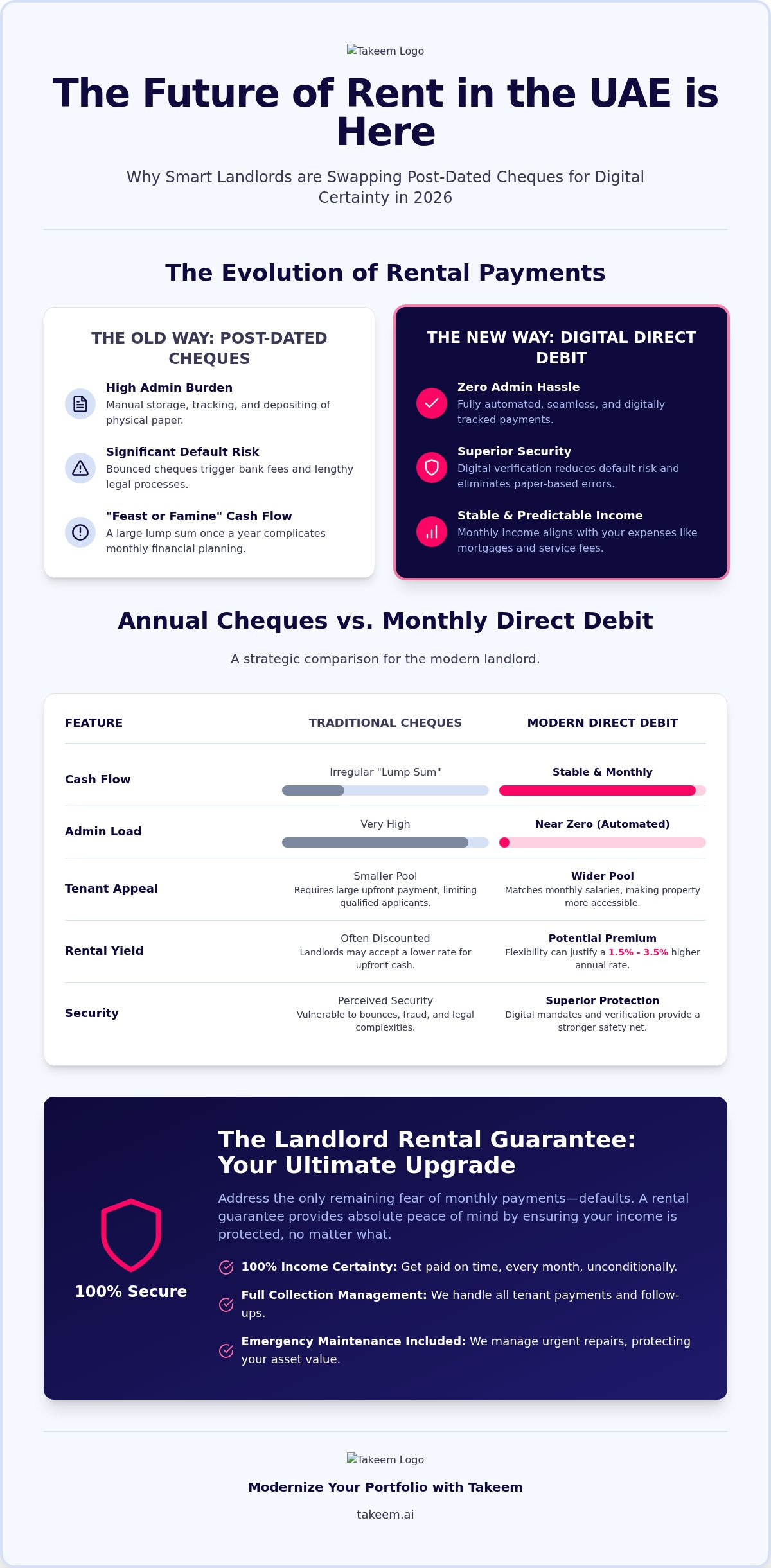
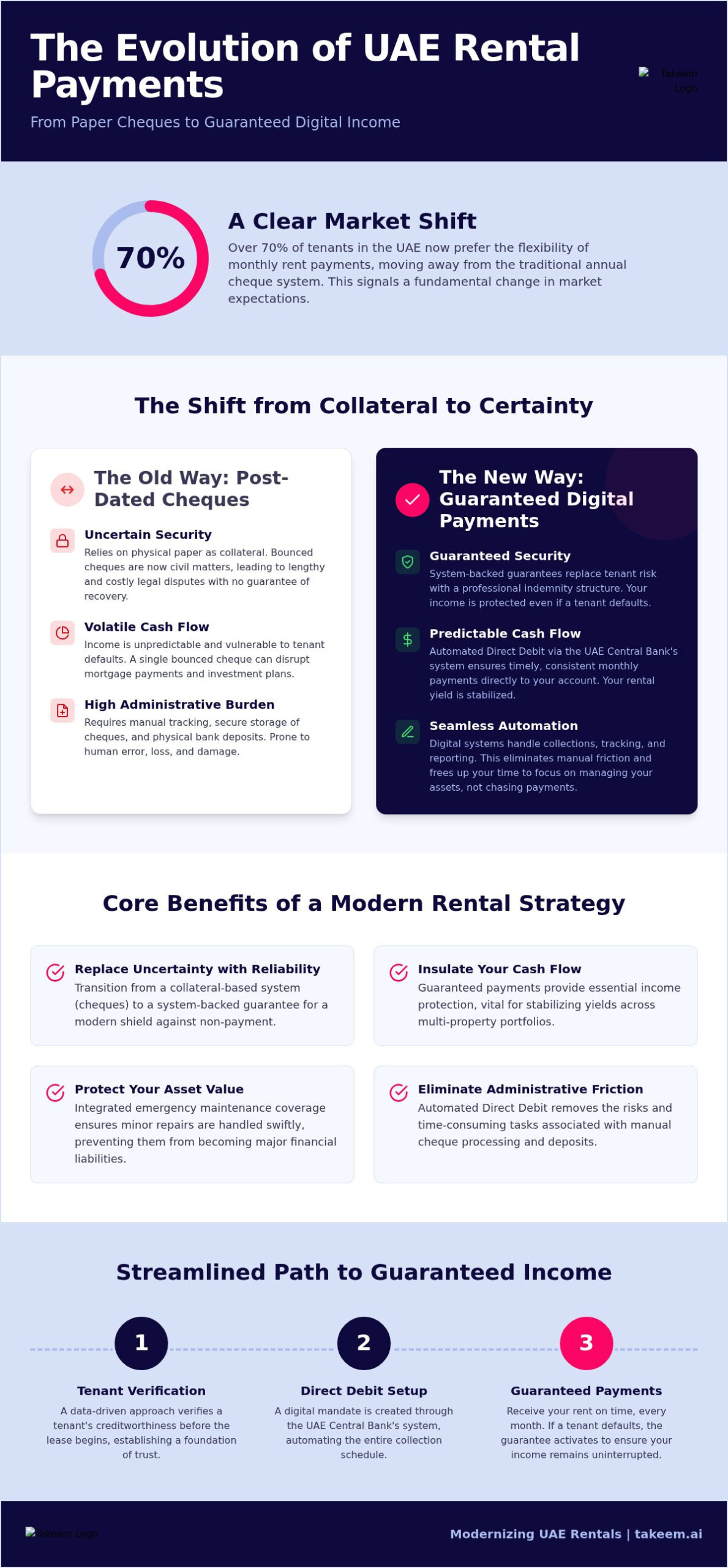
    Looking into digital rent collection UAE options can help landlords move away from tracking post-dated cheques and following up on delayed payments. Across the Emirates, scheduled monthly payments through Direct Debit offer an alternative that can reduce manual processing and support a more consistent rent collection routine.

    Cheques may feel familiar, but a payment method alone can’t remove the uncertainty of a returned cheque or delayed resolution. Digital collection offers a more streamlined way to receive rent. A rental guarantee is separate and may provide another layer of protection for rental income, subject to its terms.

    This guide explains how to transition from cheque-based rent collection to Direct Debit through Takeem, what to review when setting up digital payments, and how automated collection differs from income protection. It also covers how a digital payment process and a rental guarantee can support a more structured approach to rental operations.

    Key Takeaways

    • Learn how digital rent collection can replace cheque handling with scheduled monthly Direct Debit payments.
    • Compare digital collection with post-dated cheques by considering payment processing and administrative work.
    • Prepare for a transition by reviewing tenancy agreements, payment schedules and cheque expiry dates before choosing a Direct Debit provider.
    • Understand the difference between automated collection and a rental guarantee: one supports rent collection, while the other may protect income if a tenant defaults.
    • Consider how a rental guarantee package that includes emergency property maintenance can offer landlords additional support.

    Modernising UAE Real Estate: The Evolution of Digital Rent Collection

    Digital rent collection replaces paper-based payment handling with electronic methods, such as Direct Debit, to collect rent on an agreed schedule. Instead of storing post-dated cheques and arranging deposits, landlords can use a digital process for recurring payments and keep clearer records. Across the UAE, this shift reflects a broader move towards connected, paperless financial processes in the property sector.

    Digital workflows can make rental transactions easier to track by bringing payment schedules and records together. Landlords and tenants can check whether a payment was scheduled, processed or needs attention. Digital collection doesn’t remove every payment risk, and it doesn’t make cheques unlawful. Post-dated cheques remain a legal and widely used method in the UAE. The practical difference is that landlords and investors can choose a more automated approach for their rental operations.

    The Limitations of the Traditional Cheque System

    Physical cheques require ongoing administration. Landlords or their representatives must store them securely, monitor due dates and deposit each cheque. If a cheque is returned for insufficient funds, expected rent may not arrive on time. Under UAE rules in effect in 2026, insufficient-funds cases are generally handled through civil enforcement, including a possible court execution case. Fraud-related conduct can still carry criminal consequences, so recovering funds may involve legal steps and delays.

    Why UAE Landlords Are Embracing Digital Transformation

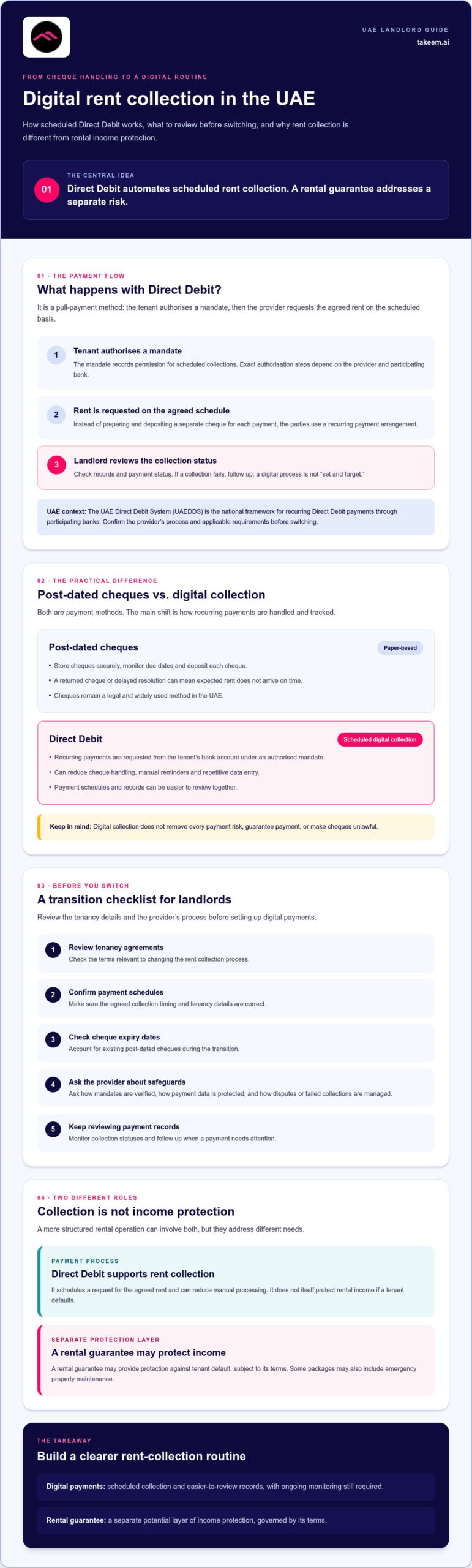
    With Direct Debit, a tenant authorises a payment that is collected from their bank account on a scheduled basis. It is a pull-payment method, distinct from a tenant manually initiating each transfer. The underlying Direct Debit system supports recurring payments, but landlords should confirm the provider’s process and applicable UAE requirements before switching.

    Monthly collection can help landlords plan cash flow more consistently than relying on a small number of quarterly or bi-annual payments. It may also give tenants a payment rhythm aligned with regular income. Payment frequency can support convenience, but it can’t guarantee tenant retention.

    For investors, digital processes can reduce cheque handling and make payment activity easier to review across a portfolio. Direct Debit setup offers one route to scheduled monthly rent collection, while a rental guarantee addresses a separate concern: protection against tenant default. Together, they can support a more considered approach to rental operations.

    How Direct Debit Facilitates Seamless Rental Payments

    Direct Debit is an automated pull-payment method. After a tenant authorises a mandate, the payment provider requests the agreed rent from the tenant’s bank account according to the schedule. Instead of preparing and depositing a separate cheque for each payment, both parties use a recurring payment arrangement. Scheduled collection can reduce manual reminders and data entry, but landlords should still monitor payment status and follow up if a collection fails.

    For tenants, a predictable monthly schedule can make payment timing easier to manage. For landlords, it can support a steadier collection routine and reduce repetitive administration. It is not a true “set and forget” system: landlords should continue reviewing records and checking that the payment mandate and tenancy details are correct.

    Security and Authorisation in Digital Payments

    The UAE Direct Debit System (UAEDDS) is the national framework for processing recurring Direct Debit payments through participating banks. A digital mandate records the tenant’s authorisation for scheduled collections, reducing reliance on issuing a new physical cheque for each payment. The exact authorisation steps and available protections depend on the provider and participating bank. Before setup, ask how mandates are verified, how payment data is protected, and how to manage a dispute or failed collection. For wider regulatory context, consult this overview of UAE fintech regulations.

    Don’t assume every fintech uses the same encryption or data-protection controls. Review the provider’s documentation and confirm how it handles access, records, consent changes and payment notifications. Clear answers help you decide whether the process suits your tenants and portfolio.

    Clearer Oversight for Property Investors

    For landlords with multiple properties, coordinating cheque dates and manually updating records can become difficult to scale. A digital process can bring payment schedules and records together. If a provider offers a dashboard, landlords may be able to review collection statuses in one place. Confirm what information is available and how often it updates rather than assuming every platform provides real-time reporting.

    Automation can reduce human error, such as recording the wrong due date or overlooking a cheque. It won’t eliminate every mistake, so check tenancy details and payment instructions before activating a mandate. Takeem provides Direct Debit setup for landlords and connects digital collection with rental income protection. Learn more about rental guarantee with direct debit UAE, or explore Takeem’s landlord solutions to see how these services may fit your collection process.

    Digital Collection vs. Post-Dated Cheques: A Risk Analysis

    Digital rent collection and post-dated cheques organise rent payments differently, but neither method removes every risk. Cheques require landlords to store each payment and deposit it on the due date, after which the bank must process it. Direct Debit follows an authorised schedule, so collection can take place without handling a physical cheque. Processing times depend on the banks and payment arrangements involved. Confirm when funds are expected to reach your account rather than assuming every digital payment clears instantly.

    For tenants, writing several cheques at the start of a tenancy can mean planning around large, less frequent payments. An agreed monthly digital mandate can make payment timing more predictable. For landlords, the operational difference is the amount of recurring manual work: tracking cheque dates, arranging deposits and recording outcomes, compared with reviewing scheduled collections and their status. The time saved varies by portfolio and process, so track your current administrative workload and compare it after a transition rather than relying on a generic estimate.

    Legal and Financial Security

    Post-dated cheques remain legal and widely used in the UAE, but the legal position on bounced cheques has changed. Under Federal Decree-Law No. 14 of 2020, effective January 2, 2022, insufficient-funds cases are generally handled through civil enforcement rather than criminal prosecution. A holder may pursue an execution case, and banks must make partial payment when funds are available. Fraud-related conduct can still carry criminal consequences. Digital collection avoids cheque handling, but a failed collection may still require follow-up. Neither method should be mistaken for guaranteed income.

    Digital payment histories can make it easier to review scheduled collections, payment outcomes and communications if a disagreement arises. Keep the tenancy agreement and relevant records together. Digital records can help clarify what happened, but they don’t replace the agreement or resolve a dispute by themselves. To reduce the risk of rental disputes, use clear terms and consistent documentation. Bank fees vary by institution and payment method, so compare applicable charges before assuming digital collection will cost less than cheque processing.

    Operational Efficiency for Modern Landlords

    Automation reduces repeated tasks, but it won’t eliminate administration. Landlords still need to review collection status, maintain accurate tenant and payment details, and agree on any change to a payment date with the tenant. Check whether the provider allows mandate updates and how those changes take effect. An organised digital process can create a more professional experience for tenants, while transparent communication remains important to satisfaction and retention.

    When assessing digital rent collection Dubai options, weigh the convenience of scheduled payments against processing timelines, provider terms and the separate protection you may need if rent is not received.

    Digital Rent Collection in Dubai: The Landlord’s Guide to Secure UAE Payments

    Steps to Transition a Property Portfolio to Digital Payments

    A smooth move from cheques to Direct Debit starts with an inventory, not a rushed portfolio-wide switch. Review each tenancy agreement, payment schedule and cheque expiry date. Note renewal dates, tenant contact details, rent amounts and any payment exceptions. This gives you a clear view of which tenancies to consider first and where you may need to clarify contract terms or coordinate a change with the tenant.

    • Audit your records: Match each property and tenant to the correct rent amount, due date, agreement and remaining cheques.
    • Assess providers: Ask how their Direct Debit setup works in the UAE, what authorisation tenants must provide, how failed collections are reported and what records you can access.
    • Plan the changeover: Agree on the timing with tenants and avoid overlapping a digital collection with a cheque for the same rent period.
    • Test and review: Confirm mandate details before activation, then check the first collection and reconcile it against your tenancy records.

    Onboard Tenants with Clear Communication

    Explain the change in practical terms: the tenant authorises scheduled rent collection, receives clear payment information and no longer needs to prepare a separate cheque for each due date. Set out the collection date, how the mandate is authorised, where questions should go and what happens if a payment doesn’t complete. Avoid promising that a collection can never fail. Reassurance comes from transparent steps and a clear record of consent. Real estate agents can also support conversations with landlords and explore a rental guarantee for real estate agents.

    Scale Consistently Across Multiple Properties

    For a larger portfolio, use a consistent record format across every unit. Standardise property identifiers, tenant names, payment dates and reference details so collections can be reconciled and reviewed without guesswork. If your provider offers a central dashboard, check whether it can show collection status across units and export records for financial reporting. Don’t assume every platform has the same tracking or reporting functions.

    Roll out in manageable groups, review the first payment cycle for each group, then resolve data or communication gaps before moving on. This creates a repeatable process for managing property portfolio rental income UAE without losing sight of individual tenancy details. Takeem provides Direct Debit setup for landlords. Explore Takeem’s landlord Direct Debit setup as you plan your transition.

    Beyond Collection: Integrating Rental Guarantees and Maintenance

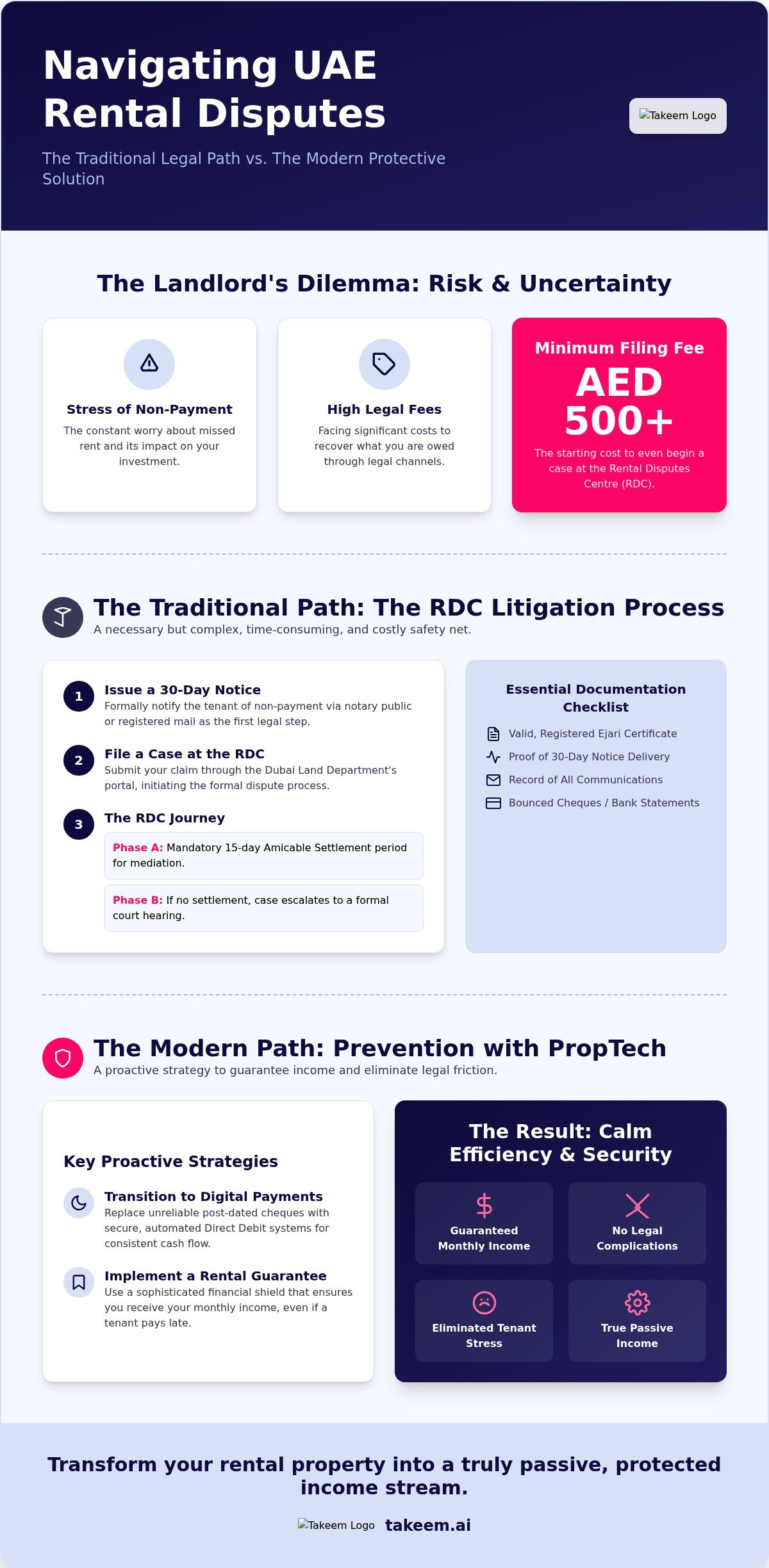
    Automating rent collection makes payments easier to schedule and track, but it can’t prevent a tenant from defaulting. Landlords need to distinguish between collecting rent and protecting rental income. Direct Debit streamlines the payment process. A rental guarantee provides a separate layer of protection if a tenant fails to pay, subject to the guarantee’s terms.

    This distinction matters for investors planning around rental income. A scheduled payment that doesn’t complete still needs attention. A guarantee may help address the income risk, while clear records and an agreed process help landlords respond to a missed payment. Review the provider’s terms so you understand what’s covered and what steps apply if a tenant defaults.

    The Value of Combining Income Protection and Maintenance

    Takeem offers a Landlord Rental Guarantee that includes emergency property maintenance. These services address different concerns: tenant default can affect expected income, while an urgent property issue may need attention to protect the home and support a positive tenancy experience. Combining both in a guarantee package can simplify how landlords consider income protection and property upkeep, but it doesn’t mean rent collection prevents maintenance problems.

    Maintenance matters to tenants, too. Addressing property issues appropriately can support a more dependable rental experience and help protect the asset over time. Check the service’s scope and process with the provider so you know what is included and how maintenance requests are handled.

    Planning for a More Hands-Off Investment

    Digital payments, a rental guarantee and emergency maintenance can reduce some recurring tasks and uncertainty, helping landlords take a more investment-focused role. They don’t make ownership entirely passive or replace property management. Landlords still need to understand their agreements, review payment records and stay informed about the property and tenant relationship.

    For longer-term financial planning, it is useful to separate expected rent from protection against default. Scheduled digital collection can make payment activity easier to monitor, while a rental guarantee may offer additional peace of mind if a tenant fails to pay. Together, these measures can support a more structured approach to income planning, but confirm the guarantee’s terms rather than assuming every situation is covered.

    To explore how Direct Debit setup and rental income protection could fit your portfolio, review Takeem’s landlord solutions.

    Digital Rent Collection Dubai: Build a More Secure, Modern Rental Strategy

    Moving from post-dated cheques to Direct Debit can simplify monthly rent collection and reduce repetitive manual handling. Automation is only one part of a resilient rental strategy: payment records help you monitor collections, while a rental guarantee can provide a separate layer of protection if a tenant defaults.

    For landlords exploring digital rent collection Dubai, the opportunity is to combine a smoother payment process with more structured income planning. Takeem supports the transition to monthly Direct Debit and offers a Landlord Rental Guarantee that includes emergency property maintenance. Review the terms carefully to understand the protection provided and what the maintenance service covers.

    You don’t need to modernise every tenancy at once. Start by reviewing agreements and payment dates, communicate clearly with tenants, then check the first digital collection cycle. A deliberate transition can help you build a more efficient rental process while keeping individual tenancy details in view.

    Explore Takeem’s digital rent collection and rental guarantee to take the next step towards a more structured approach to managing rental income.

    Frequently Asked Questions

    Is digital rent collection legally valid in the UAE?

    Digital rent collection can be used for rental payments in the UAE, provided the payment method is agreed and set up appropriately. Post-dated cheques also remain a legal payment method. Check your tenancy agreement, confirm any required amendment with the tenant, and ask the payment provider about its Direct Debit process and applicable requirements. For current regulatory guidance, consult a qualified UAE legal professional or the relevant authority.

    Can I replace existing post-dated cheques with Direct Debit mid-tenancy?

    A mid-tenancy change usually requires coordination with the tenant and agreement on the revised payment arrangement. Review the tenancy contract first, then document the new method, collection dates and any changes to payment terms in writing. Coordinate the transition with your provider so a Direct Debit collection doesn’t overlap with a cheque for the same rent period. Don’t cancel or disregard existing cheques until the replacement arrangement is confirmed.

    What happens if a tenant’s Direct Debit payment fails?

    A failed collection means the rent hasn’t been received through that payment attempt. Check the provider’s notification for the reason, then contact the tenant promptly to agree on the next step. Follow the provider’s process for correcting account or mandate details and arranging another payment. Don’t assume a rental guarantee automatically covers every failed collection. If you have one, review its terms, eligibility conditions and notification requirements.

    How does digital rent collection benefit property investors with large portfolios?

    Digital collection can reduce the work of tracking cheque dates, arranging deposits and manually recording payments across multiple properties. A consistent schedule and organised payment records can make it easier to review rental income and identify collections that need follow-up. If a provider offers a portfolio dashboard or reporting tools, check what information it shows and how often it updates. Automation helps with oversight, but accurate property and tenant data still matters.

    Does digital collection require a specific type of UAE bank account?

    Account requirements depend on the Direct Debit provider and the banks involved, so confirm them before onboarding tenants. Ask whether rent is collected from the tenant’s account, where landlord payments are deposited, and whether any account eligibility or verification steps apply. Also check what account details are needed, who can access them and how payment records are provided. Don’t assume every provider supports the same banks or account types.

    Are there additional fees for landlords using digital rent collection services?

    Fees can vary by provider, bank and service arrangement, so review the current terms before choosing a setup. Ask for an itemised explanation of any setup, collection, transaction or account-related charges, and clarify whether a failed payment or mandate change could incur a fee. Compare the full cost with your existing process rather than assuming digital collection is free or always less expensive. Confirm charges directly with the provider.

    How do I set up a rental guarantee alongside digital collection?

    Contact a provider that offers both landlord rental guarantees and Direct Debit setup, then review each service’s terms separately. Ask what the guarantee covers, what exclusions or conditions apply, and what steps you must take if a tenant defaults. Takeem provides rental guarantees and helps landlords set up monthly Direct Debit collection. Its guarantee package also includes emergency property maintenance. Confirm the specific coverage and process before proceeding.

    Is my tenant’s financial data secure when using digital payment platforms?

    Security depends on the provider’s systems and processes, so ask how it protects payment details and limits access to tenant information. Before setup, check how the tenant authorises the mandate, how data is stored and shared, and what procedures apply if information is exposed or a payment is disputed. Review the provider’s privacy and security documentation, and use its official channels for submitting account details. Avoid assuming all platforms use identical protections.

  • UAE Tenant Eviction Process: Landlord Guide (2026)

    UAE Tenant Eviction Process: Landlord Guide (2026)

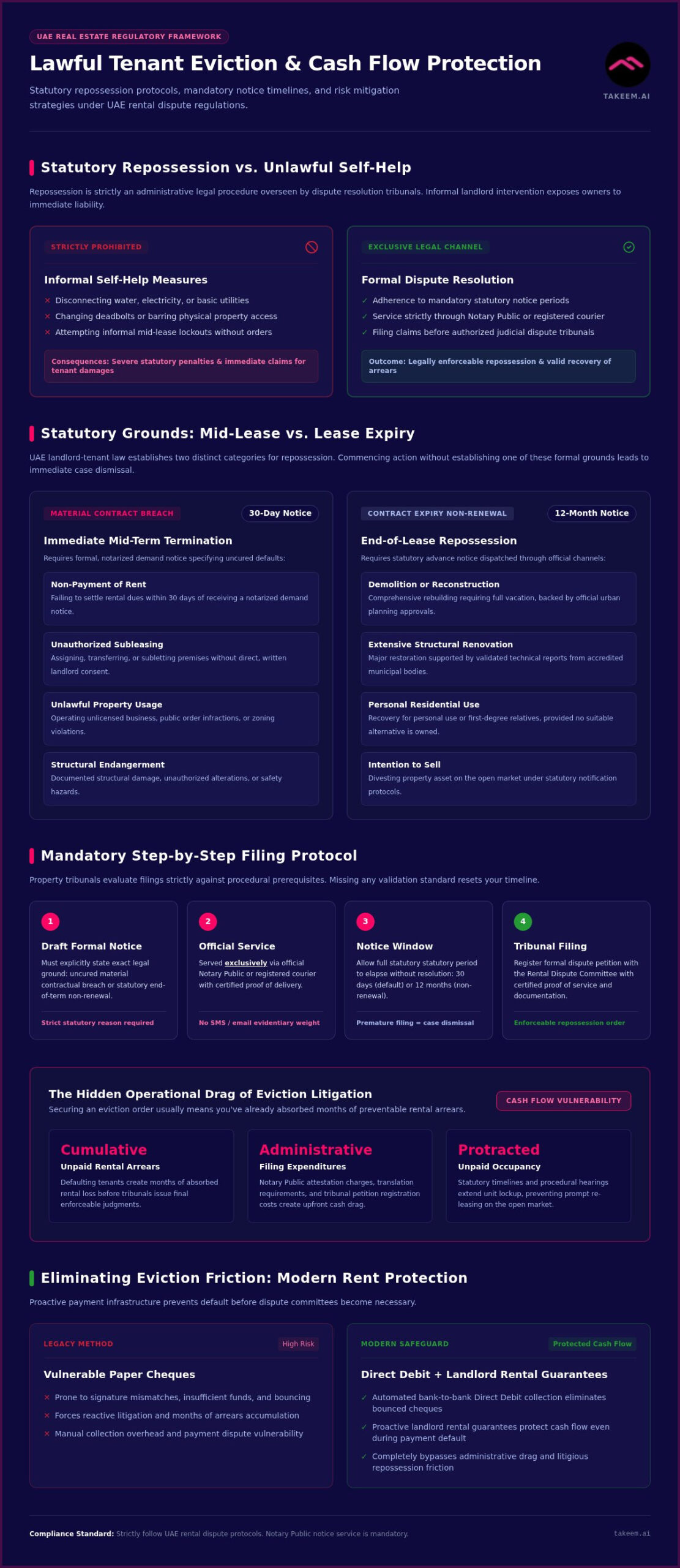
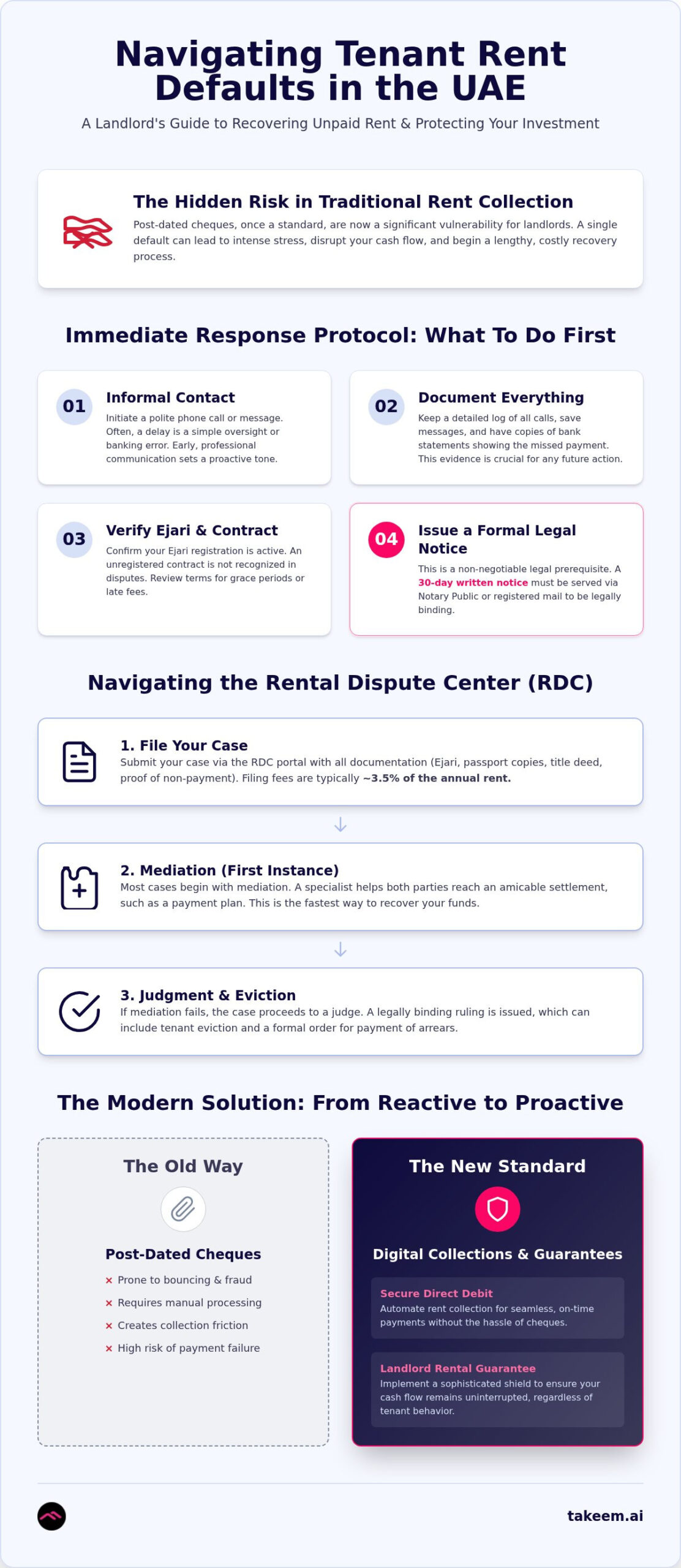
    Securing an eviction order against a defaulting tenant doesn’t safeguard your cash flow; it usually means you’ve already absorbed months of preventable rental arrears. When payment dates lapse and rent goes unpaid, the urge to intervene immediately is understandable. However, attempting informal self-help measures like changing locks or disconnecting basic utilities exposes landlords to severe statutory penalties. Following the formal legal process for tenant eviction in UAE dispute resolution tribunals remains your only valid route to repossess your property and recover outstanding funds.

    Managing this system successfully requires strict procedural precision. You must document every default, adhere to statutory notice periods, and avoid administrative missteps that can prompt immediate case dismissal. In this guide, you’ll master mandatory notice protocols, learn how to prepare filings that withstand tribunal scrutiny, and discover how modern safeguards like automated Direct Debit collection and rental guarantees protect your income before payment disputes even start.

    Here is your comprehensive roadmap for handling tenancy defaults lawfully while keeping your rental cash flow fully intact.

    Key Takeaways

    • Understand lawful grounds for lease termination to ensure you never risk severe statutory penalties through prohibited self-help actions like lock changes or utility cutoffs.
    • Navigate each stage of the formal legal process for tenant eviction in UAE dispute committees with exact procedural compliance to avoid immediate case dismissal.
    • Distinguish between standard 30-day contractual breach notifications and mandatory 12-month non-renewal notices dispatched through official legal channels.
    • Account for the true financial drag of dispute litigation, including administrative filing expenditures and protracted periods of unpaid occupancy.
    • Protect ongoing portfolio cash flow by replacing vulnerable paper cheques with automated Direct Debit collection and proactive landlord rental guarantees.

    Understanding the Statutory Grounds for Lawful Tenant Eviction in the UAE

    Statutory tenancy repossession is a strictly regulated administrative procedure overseen by authorized judicial committees rather than an informal owner prerogative. Fundamental principles of landlord-tenant law ensure both parties remain protected from arbitrary actions. Under federal regulations, landlords cannot resort to self-help measures. Disconnecting water or electricity, barring access, or changing deadbolts constitutes an unlawful eviction that invites severe statutory penalties and immediate claims for tenant damages.

    Property owners must navigate repossession through two distinct categories: immediate termination due to material contract violations, or end-of-lease repossession based on statutory non-renewal rights. Adhering to the formal legal process for tenant eviction in UAE dispute bodies is mandatory regardless of the underlying reason.

    Eviction Triggers Arising from Material Contractual Breach

    When an occupant breaches substantive obligations during an active lease term, the owner can initiate eviction proceedings before the contract expires. Common grounds include:

    • Non-payment of rent: Failing to settle rental dues within thirty days of receiving a formal, notarized demand notice.
    • Unauthorized subleasing: Assigning, transferring, or subletting any portion of the premises without direct, written consent from the landlord.
    • Unlawful property usage: Operating an unlicensed commercial activity, causing public order infractions, or utilizing residential spaces contrary to zoning rules.
    • Structural endangerment: Inflicting documented structural damage, unauthorized alterations, or persistent health hazards that risk building safety.

    Lawful Reasons for Non-Renewal Eviction Upon Contract Expiry

    If no contractual violation has occurred, property owners cannot terminate a tenancy mid-term. Repossession can only occur upon lease expiration under specific, legally sanctioned grounds requiring advance statutory notice:

    • Demolition or reconstruction: Comprehensive rebuilding works that require complete vacation of the structure, backed by official urban planning approvals.
    • Extensive structural renovation: Major restoration projects that prevent normal tenant occupancy, supported by validated technical reports from accredited municipal engineering bodies.
    • Personal residential use: Recovery of the real estate unit for personal occupancy by the property owner or their first-degree relatives, provided no suitable alternative property is owned.
    • Intention to sell: Divesting the property asset on the open market under statutory notification protocols.

    Navigating these categories requires absolute precision. Commencing the legal process for tenant eviction in UAE rental committees without establishing one of these formal grounds leads to immediate case dismissal and unnecessary administrative expense.

    Reclaiming a property requires following a linear, highly technical protocol. Property tribunals assess every filing strictly against statutory requirements; missing a single procedural prerequisite can reset your entire timeline. Understanding how the legal process for tenant eviction in UAE dispute bodies functions from initial notice to formal handover protects you from costly administrative dismissals.

    Step 1: Serving Mandatory Notice via Notary Public

    The eviction procedure begins before any committee filing. Landlords must prepare a formal notice explicitly stating the reason for termination, whether addressing an uncured breach or an end-of-term repossession. This document must be served exclusively through an official Notary Public or an accredited registered courier with certified proof of delivery. Digital text messages, casual emails, and verbal demands carry no evidentiary weight before rental tribunals and will invalidate your claim.

    Step 2: Registering a Claim with the Rental Dispute Committee

    Once the statutory notice period expires without resolution, you can submit a formal dispute petition. Your submission file must include authenticated tenancy contracts, certified title deeds, calculation sheets for outstanding payments, and official proof of service receipts. Proceedings unfold through distinct tribunal phases:

    • Preliminary document verification: Tribunal case officers review the legal standing of the applicant and confirm mandatory notification compliance.
    • Reconciliation stage: Settlement committees convene mediation sessions to seek an amicable agreement, such as structured repayment schedules, before advancing to formal litigation.
    • First-instance judicial review: If mediation fails, judges examine contractual merits, assess documentation, and issue a binding eviction judgment.

    Step 3: Enforcement Proceedings and Physical Repossession

    Securing a favorable verdict does not grant an immediate right to take back the keys. Once statutory appeal windows lapse, the landlord must open an enforcement file with the execution department. Court bailiffs serve an execution notice on the occupant. If the tenant still refuses to vacate, enforcement officers coordinate physical site repossession, supervise locksmith lock replacements, and catalogue remaining personal effects under formal inventory rules.

    Because executing this statutory roadmap demands significant administrative stamina, forward-thinking owners leverage modern financial tools like a Landlord Rental Guarantee to protect active cash flow while navigating lengthy dispute procedures.

    Statutory Notice Periods, Essential Documentation, and Prohibited Landlord Actions

    Clarity around statutory timelines separates successful tenancy enforcement from prolonged procedural stagnation. A common misstep among property owners involves conflating notices issued for active contractual defaults with those required for scheduled non-renewals. Aligning your filing with the correct statutory timeline is essential when undertaking the legal process for tenant eviction in UAE dispute bodies.

    Comparing the 30-Day and 12-Month Notice Frameworks

    The law establishes two distinct notification pathways based on the underlying grounds for action:

    • 30-day notice for material breach: Applied strictly when an occupant defaults on rental payments, subleases without authorization, or causes documented structural harm. This gives the tenant a thirty-day cure period from the date of formal service.
    • 12-month notice for statutory non-renewal: Reserved exclusively for legitimate end-of-lease repossession, such as taking back the property for personal residence, selling the unit, or carrying out approved demolition and comprehensive reconstruction.

    Both categories require formal notarization. Delivering a notice through standard email or informal messaging does not trigger the statutory timeline, rendering subsequent tribunal claims procedurally defective.

    Mandatory Document Checklist for Rental Tribunals

    Rental dispute committees operate under rigorous evidentiary standards. To ensure your claim proceeds smoothly through evaluation, compile a verified legal dossier containing:

    • The attested tenancy contract alongside valid title deed records confirming legal ownership.
    • Notarized notification copies accompanied by certified delivery receipts proving official service.
    • Documented financial transaction records, such as formal bank return memos and returned cheques confirming unpaid balances.
    • Legally certified Arabic translations of all foundational tenancy agreements, notifications, and written communications.

    Prohibited Actions: Severe Legal Risks of Self-Help Evictions

    Facing uncooperative occupants often creates significant operational strain, but taking matters into your own hands carries severe legal liabilities. Federal statutes strictly prohibit landlords from disconnecting electricity, shutting off air conditioning, terminating domestic water supplies, or restricting access to the premises.

    Entering the unit without tenant permission or changing door cylinders constitutes a criminal offense. Dispute committees possess statutory authority to issue emergency orders forcing immediate tenant reinstatement, impose substantial punitive fines on the landlord, and award financial compensation to the tenant. The only protected, legally enforceable route is through the formal legal process for tenant eviction in UAE judicial channels.

    UAE Tenant Eviction Process: Landlord Guide (2026)

    The Hidden Operational Costs and Financial Drag of Eviction Litigation

    Filing a dispute petition is often viewed merely as an administrative hurdle. In reality, the legal process for tenant eviction in UAE dispute bodies exposes property owners to substantial capital drag that extends well past upfront filing expenses. Between direct disbursements and interrupted yields, litigation quietly erodes investment performance.

    Direct Expenditures Versus Compounding Lost Rental Income

    Litigation requires immediate liquidity. Owners must finance dispute committee registration fees, legal representation retainers, translation services, and subsequent enforcement filing costs. Yet these initial outlays represent only a fraction of the total exposure.

    • Uncompensated occupancy: Defaulting occupants typically remain in the unit for months during tribunal hearings and enforcement scheduling without paying rent.
    • Blocked reinvestment: Capital that should generate steady quarterly returns sits trapped in a non-performing asset.
    • Unrecoverable judgments: Winning a favorable restitution order does not ensure liquidity. Indebted tenants frequently lack accessible local bank balances, leaving cash awards uncollected.

    Proactively understanding how avoiding rental disputes preserves baseline yields gives landlords a substantial operational advantage over traditional reactive approaches.

    Physical Asset Degradation and Unmonitored Maintenance Issues

    Strained tenancy relationships quickly degrade physical property standards. When an occupant stops paying rent, their incentive to maintain the home disappears entirely. Routine wear accelerates, minor plumbing leaks go unreported, and central air conditioning systems suffer from neglected servicing.

    These deferred maintenance issues compound silently over months of contested occupancy. By the time bailiffs execute physical repossession, rectifying extensive water damage or repairing structural fixtures regularly exhausts the retained security deposit. The owner then faces unexpected refurbishment bills alongside prolonged marketing vacancy to make the unit tenantable again.

    Litigation secures legal possession, but it cannot undo cumulative financial and physical depreciation. To insulate your portfolio against payment freezes and unmonitored property wear during defaults, secure a comprehensive Landlord Rental Guarantee before signing your next lease agreement.

    Eliminating Eviction Friction: Modern Rent Collection and Income Guarantees

    Mastering the legal process for tenant eviction in UAE tribunals is an essential defensive skill, but relying on litigation to resolve payment defaults is fundamentally reactive. Traditional dispute resolution forces property owners to absorb months of interrupted cash flow while waiting for enforcement officers to act. Forward-thinking investors don’t wait for arrears to trigger legal battles. Instead, they implement structural financial safeguards that eliminate collection friction entirely.

    Replacing Paper Cheques with Automated Direct Debit Infrastructure

    For decades, physical post-dated cheques served as the standard rent collection instrument. Today, paper cheques introduce unnecessary vulnerability. They bounce, create administrative overhead, require manual bank runs, and frequently spark hostile financial disputes. Modern property portfolios avoid these vulnerabilities by shifting to automated, Central Bank-aligned Direct Debit systems.

    Direct Debit establishes programmatic recurring deductions directly from the tenant’s bank account. This automated mechanism simplifies monthly budgeting for tenants, which dramatically lowers default incentives while giving landlords predictable transaction timelines. Adopting a modern rental guarantee with direct debit transforms chaotic cheque cycles into streamlined, reliable digital revenue.

    Securing Guaranteed Monthly Cash Flow and Asset Protection

    Eliminating courtroom friction requires decoupling your personal liquidity from individual tenant solvency. Comprehensive rental guarantee solutions ensure that landlords receive their scheduled rental disbursements on time, even if an occupant defaults or delays payment. You no longer have to navigate tribunal hearings or enforcement queues simply to meet debt obligations or maintain portfolio cash reserves.

    Asset preservation extends beyond monetary disbursements. When tenancies sour, physical maintenance typically suffers. Securing coverage that includes integrated emergency property maintenance ensures certified technicians resolve critical electrical, air conditioning, and plumbing breakdowns immediately. This preserves structural integrity and prevents compounding asset degradation before issues escalate into costly disputes.

    Rather than managing the prolonged, stressful legal process for tenant eviction in UAE courts, modern property owners insulate their investments upfront. Securing a structured landlord rental guarantee delivers total financial resilience, protecting your monthly disbursements and property value regardless of market volatility.

    Transform Tenancy Risk into Predictable Rental Yields

    Navigating the formal legal process for tenant eviction in UAE dispute committees establishes your lawful right to repossess an asset, but litigation shouldn’t be your primary financial backstop. Absorbing unpaid arrears, managing rigid statutory notice timelines, and risking physical asset wear during enforcement delays places unnecessary strain on your balance sheet.

    Smart property owners protect their yields by eliminating payment friction before it escalates to tribunal filings. Shifting from paper cheques to automated Direct Debit establishes seamless collection, while a structured guarantee safeguards your monthly disbursements even during tenant payment default cycles. Paired with integrated emergency property maintenance, your portfolio stays fully defended against both financial and operational disruption.

    Take control of your cash flow today. Protect your rental income with Takeem and build long-term resilience across your property investments.

    Frequently Asked Questions

    Can a landlord evict a tenant immediately for non-payment of rent in the UAE?

    No, immediate evictions are strictly prohibited under federal regulations. Landlords must deliver a formal 30-day payment demand served via an official Notary Public or registered courier before registering a claim. If the tenant settles the outstanding arrears within that 30-day cure window, the eviction grounds become void, and the tenancy agreement remains legally active.

    Is it legal for a UAE landlord to change door locks or disconnect utilities?

    No, self-help eviction acts are strictly illegal nationwide. Shutting off electricity, water, or cooling systems, or changing physical locks to bar an occupant, violates statutory tenancy laws. Tenants subjected to these measures can immediately petition the dispute tribunal for urgent restoration orders, and landlords face severe financial penalties and criminal exposure for unlawful entry.

    How long does the formal legal eviction process take through rental dispute tribunals?

    The timeline varies depending on tribunal caseloads and enforcement schedules. Initiating the legal process for tenant eviction in UAE dispute bodies typically takes several months from the expiration of the statutory notice period. This progression includes the initial reconciliation phase, formal first-instance judicial hearings, statutory appeal periods, and the subsequent execution phase overseen by court bailiffs.

    What is the statutory notice period required to evict a tenant in the UAE?

    Notice periods depend directly on the reason for eviction. Material contractual breaches, including non-payment of rent or unauthorized subletting, require a 30-day written notice served through official channels. Conversely, non-renewal claims based on property demolition, extensive structural renovations, personal residential use, or an intention to sell mandate an advance 12-month notice served via Notary Public.

    Can a tenant be evicted if the landlord intends to sell the property?

    Yes, selling a property is a valid statutory ground for eviction, but it requires strict compliance. The owner must serve a formal 12-month eviction notice exclusively through a Notary Public or registered courier. Crucially, repossession takes effect only upon lease expiry after the full notice period concludes; landlords cannot terminate an active fixed-term lease mid-cycle simply to sell.

    What documents are required to file a rental eviction case in the UAE?

    Filing a case requires a verified legal dossier proving ownership and default. Property owners must submit the attested tenancy contract, valid title deed, certified bank return memos for bounced cheques or failed transactions, and the authenticated delivery receipt confirming official Notary Public service. All foreign-language documentation must be accompanied by certified, legally attested Arabic translations.

    How does a landlord rental guarantee protect against tenant eviction delays?

    A landlord rental guarantee decouples your cash flow from the slow legal process for tenant eviction in UAE courts. Instead of absorbing months of unpaid occupancy while navigating tribunal hearings, the guarantee maintains scheduled monthly rental disbursements directly to your account. Paired with automated Direct Debit and emergency maintenance coverage, it protects your capital and asset condition entirely during default disputes.

  • What Happens If a Tenant’s Cheque Bounces in Dubai? A 2026 Landlord Guide

    What Happens If a Tenant’s Cheque Bounces in Dubai? A 2026 Landlord Guide

    You’ve just received that dreaded notification from the bank: “Insufficient Funds.” In the past, this meant a trip to the police station, but in 2026, the rules of the game have fundamentally changed. The shift from criminal penalties to civil enforcement has left many property owners feeling exposed and uncertain about their financial security. We understand the immediate stress that comes with a missed payment, especially when your own mortgage obligations don’t stop just because your tenant’s cash flow did. The anxiety of wondering what happens if a tenant’s cheque bounces in Dubai is a burden no landlord should have to carry in a modern market.

    This guide will demystify the current legal framework, showing you exactly how to navigate the Rental Disputes Center to recover your funds quickly. You’ll discover how the law now treats cheques as enforceable instruments, allowing for faster debt recovery without lengthy court battles. More importantly, we’ll show you how to move beyond the bounced cheque headache entirely. We’ll preview how to leverage fintech solutions like digital Direct Debits and rental guarantees to ensure your income is protected, regardless of your tenant’s bank balance. It’s time to replace outdated paper risks with seamless, guaranteed digital stability.

    Key Takeaways

    • Learn how UAE regulations have shifted from criminal penalties to civil enforcement, transforming how you’ll recover unpaid rent in 2026.
    • Understand exactly what happens if a tenant’s cheque bounces in Dubai, including the mandatory 30-day notice period and bank notification protocols.
    • Discover how to use the Rental Dispute Centre to treat a returned cheque as an enforceable instrument for immediate asset attachment.
    • Explore the transition to digital Direct Debits to automate your collections and remove the friction of physical cheque handling.
    • See how a rental income guarantee can secure your cash flow by providing a protective shield against tenant defaults and payment delays.

    Immediate Consequences of a Bounced Rent Cheque in the UAE

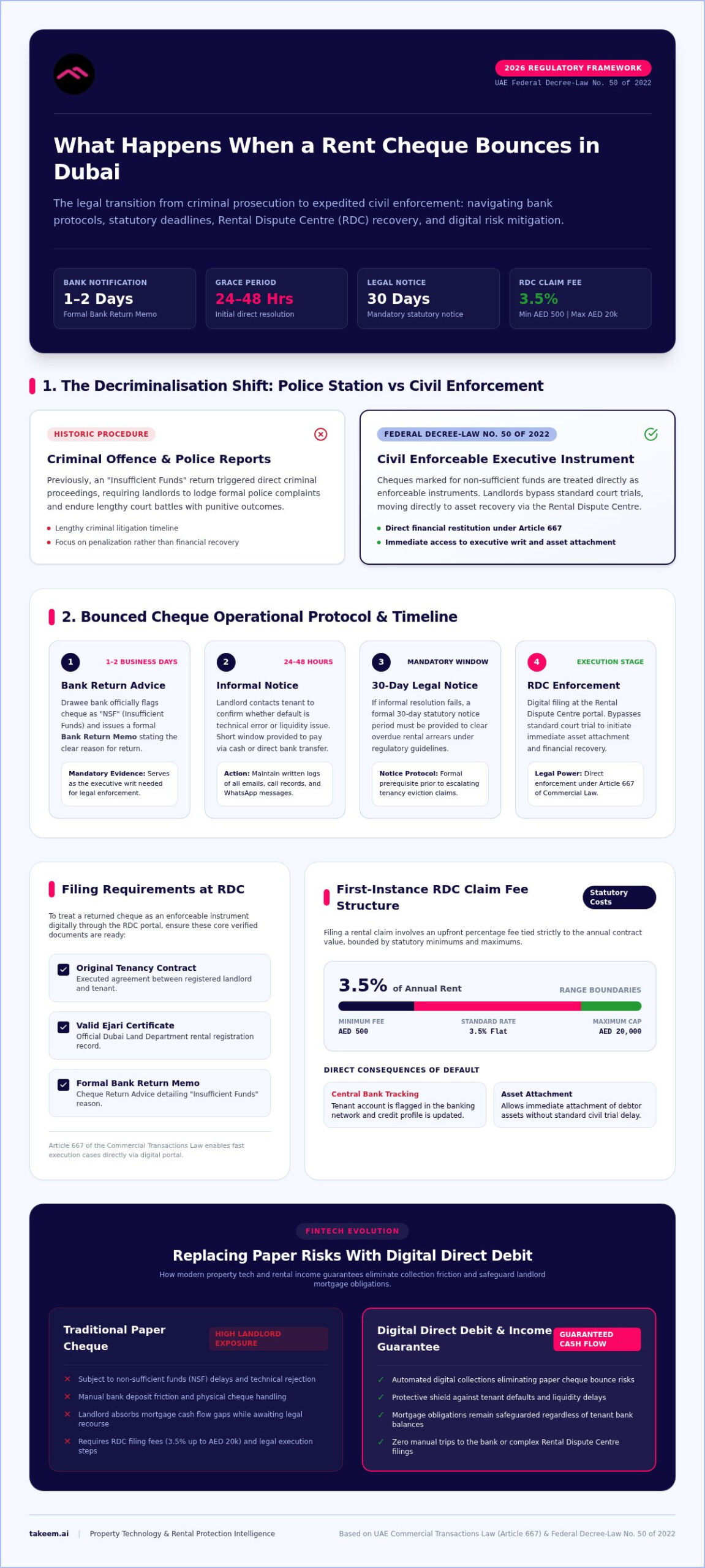
    When a bank refuses to process a payment due to insufficient funds, the instrument is officially classified as a dishonoured cheque. Understanding what happens if a tenant’s cheque bounces in Dubai starts with recognizing that this isn’t just a missed deadline; it’s a financial trigger. Under Federal Decree-Law No. 50 of 2022, while the act of bouncing a cheque for non-sufficient funds is no longer an automatic criminal offense, it remains a serious civil matter. The moment the bank marks the cheque as “NSF,” a digital trail begins that impacts both parties immediately. This shift in the law means the focus has moved from police reports to direct financial recovery.

    The Role of the Bank and Notification

    Modern UAE banking systems are highly integrated with the Central Bank. When you present a rent cheque that can’t be cleared, the drawee bank is legally required to notify the bearer of the reason for rejection. This usually happens within one to two business days. The bank generates a formal “Cheque Return Advice” or “Bank Return Memo,” which serves as the primary legal evidence of the default. This document is the essential first step in the recovery process, as it transforms the paper cheque into an enforceable executive writ. Simultaneously, the bank logs the incident, which can lead to the tenant’s account being flagged and their credit profile being updated to reflect the default. For a landlord, this memo is your golden ticket to the Rental Disputes Center.

    Initial Landlord-Tenant Communication

    Your first move should be professional and proactive. Contact the tenant immediately to confirm if the bounce was a technical error or a genuine liquidity issue. It’s standard practice to offer a short grace period, typically 24 to 48 hours, for the tenant to provide the funds via bank transfer or cash. However, you must document every interaction. If the tenant doesn’t resolve the balance within this window, you’ll need to prepare for more formal steps. Keep a record of all emails, WhatsApp messages, and call logs. These records support your case if you eventually need to file a claim at the Rental Disputes Center. Clear, firm communication often resolves the issue before it escalates into a legal battle.

    As a landlord, you have the right to demand a clear “Reason for Return” statement from the bank. This statement is vital for distinguishing between a simple balance issue and potential bad faith, such as a closed account or an intentionally altered signature. While these immediate consequences create significant stress, modern property technology is moving toward eliminating these manual hurdles. Transitioning to a digital Direct Debit setup or securing a Landlord Rental Guarantee provides a sophisticated shield, ensuring your cash flow remains steady even when a tenant’s bank account doesn’t cooperate.

    Recovering unpaid rent used to be a long, punitive process. Today, the focus has shifted toward speed and financial restoration. If you’re wondering what happens if a tenant’s cheque bounces in Dubai, the answer lies within the Rental Dispute Centre (RDC). Instead of starting a criminal case, you now leverage the cheque’s status as an enforceable executive instrument. This means you don’t necessarily have to sit through a months-long trial to get a judgment. You can go straight to enforcement. This shift ensures that landlords can pursue their funds with professional efficiency rather than waiting on criminal proceedings.

    To begin the process, you’ll need a specific set of documents. Ensure you have your original tenancy contract, a valid Ejari certificate, and the formal bank return memo. These pieces of evidence allow you to file a claim digitally through the RDC portal. Filing a first-instance rental claim typically requires a fee of 3.5% of the annual rent, with a minimum of AED 500 and a cap of AED 20,000. While the legal system is robust, many landlords are choosing to avoid these hurdles entirely by switching to digital direct debit rent collection. This modern approach reduces the likelihood of ever needing to visit the RDC.

    Filing an Execution Case

    Under Article 667 of the Commercial Transactions Law, a bounced cheque with an “insufficient funds” certificate carries the power of a writ of execution. You can file an execution case directly. An execution judge can then issue orders to recover the debt without a full trial on the merits of the case. In 2026, these resolutions are faster than ever, often resulting in account garnishments or travel bans for the debtor within weeks. This streamlined path ensures your capital isn’t locked away in a legal vacuum for years. If you want to bypass this stress, consider a rental guarantee solution that keeps your income flowing while the legalities are handled in the background.

    Eviction Procedures for Non-Payment

    While recovering the money is one goal, regaining control of your property is another. To evict a tenant for non-payment, you must strictly follow Article 25 of the Dubai Tenancy Law. This requires serving a formal 30-day notice through a Notary Public or registered mail. If the tenant fails to pay within those 30 calendar days, the RDC can issue an eviction order. Stick to the legal framework to ensure your rights remain protected. Using the law correctly is the only way to secure your investment and maintain your reputation as a professional landlord.

    The legal landscape for UAE property investors reached a turning point with the full implementation of Federal Decree-Law No. 50 of 2022. By 2026, the transition from criminal to civil enforcement is complete. Many owners still ask what happens if a tenant’s cheque bounces in Dubai now that jail time isn’t the standard penalty for insufficient funds. The reality is that the law has prioritized financial restitution over punitive measures. This shift allows you to focus on recovering your capital rather than navigating the criminal justice system. It’s a move toward a more commercial, efficient market that favors active recovery.

    Understanding Civil vs. Criminal Liability

    Under current Rental Dispute Centre (RDC) guidelines, criminal liability is strictly reserved for cases demonstrating fraud or bad faith. This includes instances where a tenant intentionally signs in a way that prevents clearance, closes an account before the cheque is presented, or issues a stop-payment order without a legal basis. For the vast majority of landlords, a default due to non-sufficient funds is now a civil matter. The cheque itself is now a writ of execution under UAE law, granting you the power to skip the trial phase and move directly to asset attachment. This streamlined mechanism is designed to settle debts without the delays of traditional litigation.

    Mitigating Risk in a Decriminalised Market

    Relying on paper cheques in a decriminalised market can feel like holding a false security. While civil enforcement is faster than it used to be, it still requires your time and legal fees to manage. Smart investors are shifting their focus from recovery to prevention. You can find detailed strategies for avoiding rental disputes in the UAE by adopting tech-driven verification and payment systems. The cost-benefit analysis of pursuing legal action often reveals that preventing a default is far more profitable than chasing one through the courts. Modern landlords are choosing tools that provide a protective shield before the bank even processes a payment.

    None of these protections work effectively without a valid Ejari. A registered contract is your primary foundation for any legal claim in the UAE. Without it, you lack the standing to use the RDC’s streamlined execution services or verify what happens if a tenant’s cheque bounces in Dubai regarding your specific unit. Ensure your documentation is flawless and your tenancy is registered from day one. This proactive approach, combined with modern fintech solutions, ensures your portfolio remains resilient in a changing regulatory environment.

    What Happens If a Tenant's Cheque Bounces in Dubai? A 2026 Landlord Guide

    Transitioning to Secure Digital Rent Collection via Direct Debit

    The UAE is rapidly moving away from the cumbersome era of paper cheques. For years, the market relied on physical booklets, but the rise of digital proptech has introduced a more stable alternative. Direct Debit systems, integrated with the UAE Central Bank’s UAEDDS, provide a level of oversight that physical instruments simply can’t match. You no longer need to store stacks of post-dated cheques in a safe or manually deposit them at a bank branch. Instead, the system handles the heavy lifting, providing real-time tracking and automated notifications for every transaction.

    This technology changes the psychological dynamic between you and your tenant. When a payment is automated, it fosters a monthly subscription mindset similar to utility bills or gym memberships. This shift significantly reduces the likelihood of a default. Rather than asking what happens if a tenant’s cheque bounces in Dubai, you’re looking at a dashboard that confirms a successful transfer. If a payment fails, automated retries can be triggered instantly, often resolving the issue before you even realize there was a glitch in the tenant’s account balance.

    The Benefits of Digital Monthly Payments

    Moving to a monthly payment schedule through digital mandates improves tenant affordability. When tenants aren’t pressured to provide massive lump-sum payments via four cheques, their financial stress drops, and your risk of a total default decreases. This model creates a predictable cash flow that integrates seamlessly with modern financial management tools. You can view your entire portfolio’s performance at a glance and access funds without the typical three-day clearing wait. For a deeper look at this evolution, read our guide on Modernizing UAE Rentals: From Cheques to Direct Debit.

    Setting Up a Direct Debit System

    Transitioning to this system requires a digital mandate, authenticated through the tenant’s banking app or UAE Pass. This process aligns with the Central Bank’s UAEDDS and Noqodi payment gateways, ensuring your collections are legally robust and compliant with national standards. You don’t need a physical cheque book anymore; the digital mandate serves as the permanent authorization for the entire lease term. It’s a cleaner, more professional way to manage property assets in 2026. You can set up your digital rent collection today and eliminate the risks associated with traditional banking instruments.

    The era of manual banking is closing. By adopting these fintech solutions, you’re not just avoiding a headache; you’re future-proofing your investment strategy. You gain a level of transparency that paper cheques could never provide, allowing you to focus on growing your portfolio rather than chasing payments. Secure, digital, and automated collection is the new standard for the sophisticated UAE landlord.

    Eliminating Rental Risk with Takeem’s Income Guarantee

    The ultimate goal for any property investor is to achieve passive income without the friction of administrative disputes. Instead of constantly worrying about what happens if a tenant’s cheque bounces in Dubai, modern landlords are shifting toward a model where income is promised, not just expected. Takeem’s Landlord Rental Guarantee represents this shift, moving the burden of default risk away from the owner and onto a sophisticated fintech platform. By doing so, you transform your property from a source of potential legal stress into a reliable financial asset. This isn’t just about collecting money; it’s about institutionalizing the security of your yield.

    Why a Guarantee Beats a Cheque

    Traditional cheques are reactive; they only tell you there’s a problem after the damage is already done. Even with the Rental Dispute Centre’s streamlined execution files, you’re still looking at weeks or months of legal uncertainty. A Landlord Rental Guarantee provides immediate cash flow stability. If a tenant defaults, the guarantee kicks in to cover the rent, ensuring your mortgage payments and reinvestment plans remain on track. This financial shield offers a level of security that no paper instrument can match. For a deeper dive into how these schemes function, consult The Definitive Guide to Landlord Rental Guarantees.

    Proactive Asset Protection

    True security goes beyond just the monthly rent. Takeem integrates income protection with an emergency property maintenance service to safeguard the physical value of your investment. This dual approach is especially valuable for property investors with large property portfolios who cannot afford to manage individual defaults or urgent repairs across dozens of units. With over 117,000 active units protected as of late 2026, the system is built to handle high-volume demands with calm efficiency. We manage the entire collection and default process, acting as a reliable facilitator that stays one step ahead of your needs.

    Transitioning to a secure, cheque-free future means you’ll never have to ask what happens if a tenant’s cheque bounces in Dubai again. You gain the freedom to scale your portfolio with confidence, knowing that both your income and your assets are under a professional protective shield. It’s time to leave the uncertainty of 20th-century banking behind and embrace a modern, guaranteed approach to property investment.

    Securing Your Financial Future in a Digital Market

    The UAE property market has evolved into a sophisticated, civil-led landscape where financial recovery is prioritized over criminal punishment. While understanding what happens if a tenant’s cheque bounces in Dubai is essential for any property owner, the most successful investors are those who move beyond the risks of paper banking. You now have the tools to treat cheques as executive instruments for faster recovery, but the ultimate goal is to remove the possibility of default from your balance sheet entirely.

    By transitioning to digital collection and institutional guarantees, you protect your cash flow from the unpredictability of human behavior. Takeem provides a comprehensive shield that includes guaranteed monthly payments regardless of tenant default and integrated emergency maintenance coverage. This seamless transition from paper cheques to Direct Debit ensures your portfolio remains resilient and profitable. Secure your rental income today with Takeem’s digital guarantee and enjoy the peace of mind that comes with a truly protected investment. Your path to a stress-free rental yield starts here.

    Frequently Asked Questions

    Is a bounced cheque still a criminal offence in the UAE in 2026?

    No, a bounced cheque for insufficient funds is generally a civil matter in the UAE. Under Federal Decree-Law No. 50 of 2022, the legal system shifted toward commercial execution rather than police action. Criminal charges only apply if you can prove fraud, such as the tenant closing their account before the cheque was presented. For most landlords, the focus is now on civil recovery through the courts rather than criminal prosecution.

    What is the first thing a landlord should do when a rent cheque bounces?

    You must immediately request a formal Cheque Return Advice from your bank. This document serves as the primary evidence of default. Once you have this, contact your tenant to see if the issue was a technical error. If they don’t replace the funds within 24 to 48 hours, this memo allows you to proceed with a civil execution file to recover the debt through the proper channels.

    Can I evict a tenant immediately if their cheque bounces?

    Immediate eviction isn’t permitted under national tenancy laws. You’re required to serve a formal 30-day notice via the Notary Public or registered mail. If the tenant fails to pay within this period, you can then file an eviction case. Understanding what happens if a tenant’s cheque bounces in Dubai involves following these specific statutory timelines to ensure your legal rights remain fully protected during the dispute resolution process.

    How long does the Rental Dispute Centre take to resolve a bounced cheque case?

    Execution cases for returned cheques are significantly faster than traditional lawsuits. Since the cheque acts as a writ of execution, you can often receive an enforcement order within a few weeks. This process bypasses the trial phase, allowing a judge to order bank account freezes or travel bans quickly. It’s a highly efficient mechanism designed to restore your cash flow with minimal administrative delay compared to standard litigation.

    What are the fees for filing a case at the Rental Dispute Centre?

    Filing a standard rental claim at the Rental Dispute Centre costs 3.5% of the annual rent. This fee has a minimum of AED 500 and a maximum cap of AED 20,000. If you’re specifically filing for the execution of a bounced cheque, there are additional administrative costs for process service and electronic requests. These fees are a necessary investment to secure a legally binding recovery order and protect your investment yield.

    How does Direct Debit help prevent rent payment defaults?

    Direct Debit replaces the manual uncertainty of cheques with automated, digital mandates. It fosters a monthly payment mindset for tenants, which naturally reduces the risk of major defaults. The system provides real-time tracking and automated retries if a payment fails initially. This proactive approach eliminates the physical handling of post-dated cheques and aligns your rental collection with modern, national banking standards for maximum security and predictable cash flow.

    Can I travel if I have a bounced cheque case against me as a tenant?

    Yes, a tenant can face a travel ban if a landlord files an execution case for a bounced cheque. Once the court issues an execution order, the judge has the authority to impose travel restrictions until the debt is settled. This is one of the most effective civil tools available to ensure tenants take their financial obligations seriously. It remains a primary deterrent in the current national legal framework for debt recovery.

    What is a rental guarantee and how does it protect my income?

    A Landlord Rental Guarantee is a professional shield that ensures you receive your rent even if the tenant defaults. Takeem’s solution provides guaranteed monthly payments, effectively removing the risk of a bounced payment from your portfolio. It also includes emergency property maintenance coverage to protect your asset’s physical condition. This comprehensive service allows you to focus on portfolio growth while the platform manages the complexities of collection and default risk management.

  • Monthly Rent vs. Annual Cheques: The UAE Landlord’s Guide to 2026

    Monthly Rent vs. Annual Cheques: The UAE Landlord’s Guide to 2026

    The era of the post-dated cheque is finally coming to an end, and for UAE landlords, this is the most significant security upgrade in a generation. You’ve likely spent years relying on a physical stack of paper as your only safety net, even while dreading the administrative headache and the constant risk of a default. When weighing the pros and cons of monthly rent vs annual cheques in 2026, the traditional method no longer offers the protection it once did. It’s time to trade manual stress for digital certainty.

    We understand that predictable cash flow is the heartbeat of your investment. This guide reveals how the UAE rental market is shifting toward a digital-first model that secures your income without the legal vulnerabilities of traditional paper. You’ll discover how to stabilize your revenue, reduce administrative burdens, and increase tenant retention by embracing modern payment standards. We’ll break down the latest 2026 regulations and show you exactly how to protect your assets with a sophisticated, tech-driven approach to property management that prioritizes your peace of mind.

    Key Takeaways

    • Understand how the 2026 UAE rental landscape has shifted from physical paper to digital-first expectations, prioritizing speed and efficiency.
    • Compare the strategic benefits of monthly rent vs annual cheques to secure a more predictable and stable cash flow for your property portfolio.
    • Learn why traditional cheques are no longer the ultimate security measure and how digital systems offer superior protection against rental defaults.
    • Discover the practical steps to modernize your lease agreements and transition to a seamless, automated Direct Debit collection system.
    • Explore how a Landlord Rental Guarantee provides 100% income certainty while handling both payment collection and emergency maintenance.

    The Evolution of Rental Payments in the UAE Market

    For decades, the UAE rental market operated on a foundation of physical paper. Post-dated cheques (PDCs) were the standard because they provided landlords with a perceived legal safety net. In an era before sophisticated credit scoring and digital banking, a physical cheque was the ultimate commitment. But as we move through 2026, the traditional “1-cheque” or “4-cheque” models are becoming relics of a slower age. The Central Bank of the UAE has actively promoted the transition toward a cheque-less society, replacing manual processes with automated, secure digital frameworks.

    Landlords are no longer just competing on property quality; they’re competing on the ease of the transaction. The debate of monthly rent vs annual cheques is now centered on efficiency and risk mitigation. By moving away from rigid annual payments, proactive investors are securing their income streams while aligning with the national push for digital transformation. This evolution represents a shift from reactive collection to proactive financial management.

    From Post-Dated Cheques to Digital Standards

    Managing a portfolio of physical cheques is an administrative burden that modern technology has finally solved. Storing, tracking, and manually depositing paper is prone to human error and physical loss. It’s a friction-heavy process that complicates financial forecasting and adds layers of unnecessary work for property owners.

    “Relying on paper-based systems creates unnecessary friction that slows down the growth of even the most robust property portfolios.”

    With the widespread adoption of UAEPASS and digital signatures, lease agreements are now finalized in minutes rather than days. These tools, integrated with the Ejari registration system, provide a secure foundation for digital rent collection. This infrastructure ensures that every contract is legally recorded while enabling the seamless transition to automated monthly payments.

    Why the Market is Moving Toward Monthly Cycles

    Today’s tenants expect payment flexibility that mirrors their monthly income cycles. When comparing monthly rent vs annual cheques, the monthly model significantly broadens your pool of qualified applicants. Most UAE professionals manage their finances on a 30-day loop, and offering terms that match this reality makes your property more attractive and accessible.

    • Better Cash Flow: Monthly payments match the monthly salary cycles of UAE professionals, reducing the financial strain on tenants.
    • Higher Retention: Tenants are more likely to renew when the payment structure is manageable and integrated into their digital banking habits.
    • Reduced Vacancy: Properties offering flexible terms often see shorter vacancy periods compared to those demanding single-cheque payments.

    This shift isn’t just about convenience. It’s a strategic move to ensure your assets remain high-performing in a competitive market that increasingly values agility and digital transparency.

    Comparing Annual Cheques vs. Monthly Direct Debit

    Choosing between monthly rent vs annual cheques is essentially a choice between front-loaded cash and operational stability. While a single-cheque payment provides immediate liquidity, it often forces landlords to accept a lower annual rate in exchange for the upfront bulk. Conversely, monthly payments allow you to capture a premium for the flexibility offered to the tenant. Research indicates that platforms offering monthly payment options in 2026 often include convenience fees ranging from 1.5% to 3.5% of the annual rent. This shift ensures your property remains competitive while maximizing the total annual yield.

    The Hidden Costs of Cheque Management

    Physical cheques carry risks that aren’t always visible on the balance sheet. Bounced cheques incur bank fees and trigger a time-consuming legal recovery process. There’s also the constant risk of paper being lost, damaged, or incorrectly filled out; these issues require manual intervention and awkward conversations with tenants. Switching to a Direct Debit setup for landlords eliminates these human error factors. Automated systems ensure that the digital rent collection UAE market thrives on is precise, verifiable, and stress-free.

    Cash Flow Advantages of Monthly Collection

    Most property investors face monthly obligations, such as mortgage repayments and service charges. Receiving a massive lump sum once a year creates a “feast or famine” cycle that can complicate long-term financial planning. Monthly Direct Debits align your income directly with these recurring expenses. This steady rhythm improves the overall liquidity of your portfolio, making it easier to reinvest capital or handle unexpected repairs without dipping into personal reserves.

    Security in the 2026 market is no longer tied to a piece of paper. It’s tied to the reliability of the system. While cheques were once considered the ultimate safeguard, digital mandates provide a more transparent and enforceable trail of payment history. By offering monthly terms, you aren’t just assisting the tenant; you’re building a “set and forget” income stream that requires zero manual tracking. This modern approach transforms your property from a high-maintenance chore into a streamlined financial asset.

    Solving the Security Gap: Why Landlords Fear Monthly Rent

    The transition to monthly payments often triggers a specific anxiety for property owners: the fear of twelve potential failures instead of one. If a tenant defaults on a monthly installment, landlords worry they lack the leverage provided by a physical cheque. However, the debate over monthly rent vs annual cheques requires a cold look at modern legal realities. In 2026, the security once offered by post-dated cheques has largely shifted toward digital mandates that provide better transparency and faster resolution.

    Security isn’t found in the physical possession of paper. It’s found in the speed of information and the reliability of the collection system. While a single-cheque payment feels like a guarantee, it’s actually a single point of failure. Digital systems offer a continuous stream of data that allows you to manage risks in real time.

    The Myth of Cheque Security in 2026

    Holding a physical cheque feels secure; it’s a tangible asset in your hand. Yet, this is often a false sense of security. A cheque is merely a promise to pay, and in the current UAE legal system, the decriminalization of most bounced cheque cases has changed the enforcement dynamic. Pursuing a bounced cheque through the courts can be a lengthy, expensive process that doesn’t guarantee the immediate recovery of funds. Physical paper doesn’t ensure that the money is actually in the account when the date arrives.

    Relying on paper also means you only discover a lack of funds when you attempt to deposit the cheque. This delay creates a blind spot in your financial planning. By understanding the shift in regulations, you can better implement strategies for Avoiding Rental Disputes in the UAE. Modern landlords are realizing that a bank-verified digital mandate is a more reliable indicator of a tenant’s financial health than a stack of paper.

    How Direct Debit and Fintech Bridge the Trust Gap

    The UAE Direct Debit System (UAEDDS) replaces the uncertainty of paper with technical precision. When a payment is processed digitally, the system provides immediate feedback. If a transaction fails, you’re notified instantly, allowing for rapid intervention rather than waiting for a bank’s manual return process. This speed is critical for maintaining a stable portfolio.

    Fintech acts as a sophisticated shield against non-payment by integrating automated notifications and traceable payment histories. These systems create a bank-verified paper trail that is far more robust than a single physical document. When you weigh monthly rent vs annual cheques, the digital model offers a level of oversight that was previously impossible. It bridges the trust gap by providing both parties with a transparent, efficient, and legally recognized framework for every transaction.

    Monthly Rent vs. Annual Cheques: The UAE Landlord’s Guide to 2026

    Moving your portfolio to a digital model is a strategic upgrade that doesn’t require the overhead of a full property management firm. It starts with a clear audit of your current assets. Review your existing lease agreements to identify upcoming renewal dates. These milestones are the perfect opportunity to introduce the shift from monthly rent vs annual cheques without disrupting active contracts. By phasing the transition, you can test digital workflows on a few units before scaling across your entire portfolio.

    Legal Framework for Direct Debit in the UAE

    To ensure a smooth transition, your contracts must reflect modern payment standards. Update your lease clauses to specify Direct Debit as the primary collection method. This ensures compliance with national financial regulations and aligns with the UAE Central Bank’s push for digital adoption. For a deeper look at specific clause requirements, consult our Modernizing UAE Rentals guide. This proactive legal stance protects you while streamlining the onboarding of new tenants.

    Once the legal foundation is set, the next steps involve selecting a technical partner and securing your income. Follow this logical progression to modernize your operations:

    • Select a partner: Choose a provider for Direct Debit setup for landlords to automate monthly collection.
    • Integrate guarantees: Layer your collection with a Landlord Rental Guarantee to ensure 100% income security regardless of tenant behavior.
    • Automate reconciliation: Use digital dashboards to sync payments with your accounting, simplifying tax reporting and financial tracking.

    Communicating the Change to Tenants

    Success depends on how you frame the change. Tenants often view the move to monthly payments as a massive benefit. It eliminates the cost of chequebooks and helps them budget more effectively alongside their salaries. When communicating, emphasize that this is a value-add service. Clear, digital communication reduces friction and addresses concerns about automated withdrawals. Framing the shift as a move toward convenience makes the transition feel like an upgrade rather than an imposition.

    If you encounter resistance, focus on the convenience of the digital experience. There are no physical cheques to sign, courier, or replace if lost. By highlighting the security of the UAE Direct Debit System, you build trust while modernizing your operations. The goal is a seamless experience where the debate of monthly rent vs annual cheques is resolved by the sheer efficiency of the new system.

    Takeem: Guaranteed Rental Income for the Modern Landlord

    The debate over monthly rent vs annual cheques often leaves landlords caught between tenant demand for flexibility and their own need for financial security. Takeem resolves this conflict by providing a fintech-first solution that prioritizes the landlord’s safety. By shifting the risk away from the property owner, we ensure that your cash flow remains uninterrupted regardless of tenant behavior. Large portfolio investors are increasingly adopting our platform to de-risk their UAE assets because it standardizes income across hundreds of units. This predictability is the foundation of institutional-grade property management in a digital economy.

    Beyond Collection: The Power of a Rental Guarantee

    Most digital platforms focus solely on the mechanics of collection, leaving the landlord to bear the risk of a failed transaction. Takeem goes further by providing a true Landlord Rental Guarantee. If a tenant’s Direct Debit fails, Takeem steps in to pay you directly. This mechanism ensures that your income is 100% certain, allowing you to plan reinvestments or mortgage payments with total confidence. It provides the sophisticated oversight needed for Optimising Property Portfolio Rental Income. You’re no longer just collecting rent; you’re managing a guaranteed financial asset with a protective expert by your side.

    Our Direct Debit setup for landlords digitally accepts monthly payments while maintaining the legal rigor required in the UAE market. It replaces the administrative burden of physical paper with a streamlined, automated process. This integration is essential for modernizing your operations without sacrificing the peace of mind that used to come from holding a physical annual cheque. It’s a seamless transition that benefits both the landlord’s balance sheet and the tenant’s experience.

    Integrated Maintenance and Asset Protection

    Protecting your income is only half the battle; protecting the physical property is equally vital for long-term rental yield. Takeem includes emergency property maintenance as part of its guarantee package. This secondary layer of protection ensures that urgent repairs are handled swiftly, preventing minor issues from escalating into expensive structural damage. Maintenance coverage isn’t just a perk; it’s a yield-protection strategy. When emergency repairs are integrated into your rental guarantee, you ensure the asset remains in peak condition for future renewals.

    High-performing portfolios require both financial stability and physical integrity. By combining guaranteed income with maintenance coverage, Takeem offers a sophisticated shield against the most common pain points in the industry. You can now offer the flexible terms tenants want while enjoying a level of security that exceeds the old cheque-book model. The modern choice of monthly rent vs annual cheques is clear when your income is backed by a professional guarantee. Secure your portfolio today with a Landlord Rental Guarantee and transform how you manage your UAE investments.

    Secure the Future of Your Property Portfolio

    The transition from physical paper to digital mandates is the most significant evolution in the UAE rental landscape. Modern investors recognize that holding onto traditional methods creates unnecessary friction and administrative strain. When evaluating monthly rent vs annual cheques, the strategic advantage lies in the consistency and transparency of automated systems. You can now offer the flexible terms tenants expect while maintaining a level of security that paper cheques simply cannot match in the current legal environment.

    By modernizing your collection process, you transform your property into a high-performing financial asset that requires zero manual tracking. Takeem acts as your protective expert, providing a sophisticated shield that covers every aspect of your investment’s health. Secure your rental income today with Takeem’s Landlord Rental Guarantee to enjoy guaranteed monthly payments even if tenants default, 24/7 emergency maintenance coverage, and a seamless digital Direct Debit setup. It’s time to trade manual stress for the calm efficiency of a tech-forward portfolio. Your path to a more stable and profitable future starts with a single digital step.

    Frequently Asked Questions

    Is monthly rent collection legal for UAE landlords in 2026?

    Monthly rent collection is fully legal and officially encouraged by UAE regulators in 2026. While landlords aren’t mandated to offer monthly terms, the Central Bank of the UAE and national land departments promote the UAE Direct Debit System (UAEDDS) as a modern alternative to paper. This shift aligns the market with global standards and provides a transparent framework for both parties within the legal tenancy structure across the country.

    What happens if a tenant’s Direct Debit payment fails?

    If a Direct Debit fails, the system provides immediate digital notification, allowing you to address the issue instantly. For landlords using the Takeem Landlord Rental Guarantee, this failure doesn’t impact your cash flow. Takeem pays the rent even if the tenant defaults, ensuring 100% income certainty. This eliminates the waiting period and legal uncertainty typically associated with waiting for a bounced cheque to be returned by the bank’s manual processing department.

    Are Direct Debit payments safer than post-dated cheques for landlords?

    Digital mandates are significantly safer than post-dated cheques in the 2026 landscape. The decriminalization of most bounced cheque cases has reduced their traditional legal leverage. In contrast, digital payments provide a verifiable, bank-sanctioned trail and immediate transparency. When comparing monthly rent vs annual cheques, digital systems offer superior risk management by identifying payment issues in real time rather than months after a paper cheque was signed, allowing for much faster resolution.

    How do I set up Direct Debit for my rental property without a management company?

    You don’t need a traditional property management company to implement digital collection. Takeem provides a direct-to-landlord portal for Direct Debit setup, allowing you to digitally accept monthly payments from tenants. This fintech-first approach gives you institutional-grade tools without the high fees of a management firm. You simply register your property, invite your tenant to the mandate, and the system automates the recurring collection process on your behalf while providing full visibility of your income.

    Does Takeem’s rental guarantee cover the entire year’s rent?

    Yes, the Takeem Landlord Rental Guarantee is designed to protect your total contracted income for the duration of the lease agreement. Whether you manage an individual unit or a large portfolio, the guarantee ensures you receive your monthly payments regardless of tenant behavior. This provides a level of financial stability that traditional 1-cheque or 4-cheque models cannot replicate, as your revenue becomes a guaranteed, predictable stream for the full year.

    Is emergency maintenance included in all Takeem rental guarantee packages?

    Emergency property maintenance is a standard feature included in Takeem’s rental guarantee packages. This service provides 24/7 coverage for urgent repairs, such as plumbing or electrical failures, protecting your asset’s physical value. By integrating maintenance with income protection, the package acts as a comprehensive shield for your investment. This ensures that minor emergencies don’t escalate into costly structural issues that could impact your long-term rental yield or tenant retention rates.

    Can I switch my current cheque-paying tenant to monthly Direct Debit mid-lease?

    You can switch an existing tenant to monthly Direct Debit mid-lease by signing a simple addendum to the tenancy contract. This amendment must be registered to ensure the new payment terms are legally recognized. Many tenants welcome the transition when weighing monthly rent vs annual cheques, as it improves their personal budgeting. Once the addendum is signed, you can initiate the digital setup to replace the remaining post-dated cheques currently in your possession.

    What are the bank fees associated with Direct Debit vs. cheques in the UAE?

    Traditional cheques often incur hidden costs, including bank fees for bounces and the administrative time-cost of manual deposits. While platforms facilitating digital payments in 2026 may charge convenience fees ranging from 1.5% to 3.5% of the annual rent, these are often offset by the premium landlords can charge for flexible terms. Digital collection reduces the financial risk of human error and legal recovery costs, making it a more cost-effective solution for maintaining long-term portfolio liquidity.

  • Guaranteed Monthly Rent Payments in the UAE: The Landlord’s Guide to Secure Income (2026)

    Guaranteed Monthly Rent Payments in the UAE: The Landlord’s Guide to Secure Income (2026)

    Did you know that over 70% of tenants in the UAE now prefer monthly payment options over the traditional post-dated cheque system? While the market has shifted, many landlords still find themselves stuck in a cycle of financial uncertainty. You’ve likely dealt with the stress of a bounced cheque or the sudden gap in cash flow when a tenant defaults. It’s a frustrating hurdle that can derail your investment strategy, especially since most bounced cheques are now treated as civil matters. The era of relying on physical paper is ending. You can now secure guaranteed monthly rent payments UAE through modern digital frameworks that prioritize your financial security.

    This guide shows you how to eliminate collection risks and replace outdated manual processes with seamless Direct Debit systems. We’ll explore how a comprehensive rental guarantee doesn’t just protect your income; it also shields your asset from unexpected maintenance costs. You’ll discover a path to predictable cash flow and digital-first property management. We’re moving toward a future where your rental yield is protected by technology rather than just trust. This roadmap will help you modernize your portfolio for 2026 and ensure your income remains steady.

    Key Takeaways

    • Transitioning from collateral-based cheques to system-backed guarantees replaces financial uncertainty with a reliable, modern shield against non-payment.
    • Digital Direct Debit setups automate your income collection, removing the friction and administrative risks associated with manual cheque processing.
    • Implementing guaranteed monthly rent payments UAE provides essential cash flow insulation, which is vital for stabilizing yields across multi-property portfolios.
    • Integrated emergency maintenance coverage safeguards your asset value by ensuring minor repairs are handled before they become major financial liabilities.
    • Modernize your rental strategy by following a streamlined verification process to transition existing tenancies into a secure, guaranteed income model.

    What are Guaranteed Monthly Rent Payments in the UAE?

    The rental landscape in the Emirates is undergoing a fundamental transformation. For decades, landlords relied on a stack of post-dated cheques as their only defense against financial loss. Today, the concept of What are Guaranteed Monthly Rent Payments? has evolved into a sophisticated financial shield. Instead of physical paper, property owners now use system-based guarantees to ensure their income arrives on time, every time. This shift is essential because the traditional “collateral-based” model is failing to meet the demands of a fast-paced digital economy. By moving to guaranteed monthly rent payments UAE, you’re choosing a proactive framework that prioritizes consistent cash flow over the hope that a cheque won’t bounce.

    Takeem serves as a vital bridge in this new era. We provide a national security framework that allows landlords to move away from the anxiety of manual collections. In 2026, the trend is clear: landlords are adopting monthly digital cycles to match the cash flow preferences of modern tenants while insulating themselves from the risks of default. It’s about replacing an outdated “trust but verify” system with a “guaranteed and automated” one.

    The Mechanics of a Modern Rental Guarantee

    Modern guarantees function by replacing tenant-side risk with a professional indemnity structure. When a tenant defaults, the guarantee steps in to cover the financial gap. This ensures your mortgage payments or reinvestment plans remain uninterrupted. This process relies heavily on advanced fintech tools that verify a tenant’s creditworthiness before the lease even begins. It’s a data-driven approach to security that traditional methods lack. For a deeper dive into these operational details, you can consult the ultimate guide to landlord rental guarantees. These systems provide the stability required to manage property portfolios with total confidence.

    Why Traditional Cheques are No Longer Sufficient

    The administrative burden of managing physical cheques is becoming unsustainable. You have to store them securely, transport them to banks, and manually track deposit dates. Beyond the logistics, the legal landscape has shifted significantly. Since the 2022 decriminalization of most bounced cheque cases, these documents no longer carry the same weight as a deterrent. They’ve become civil matters that can lead to lengthy court delays and legal fees.

    Automated systems remove this volatility. By using digital collection methods, you eliminate the “bounced cheque” culture entirely. The system handles the heavy lifting, providing a level of calm efficiency that physical paper simply cannot match. Transitioning to guaranteed monthly rent payments UAE means you’re no longer chasing payments; you’re simply managing an asset. It’s a cleaner, more professional way to handle property investments in a digital-first market.

    Cheques vs. Direct Debit: The Digital Transformation of UAE Rent

    The traditional reliance on post-dated cheques is rapidly becoming a relic of the past. As we move through 2026, the UAE Central Bank’s Direct Debit System (UAEDDS) has emerged as the gold standard for secure, paperless transactions. Unlike physical cheques, which are prone to damage, loss, or signature mismatches, Direct Debit offers a digital-first approach that integrates directly with your banking portal. This transition is a core component of achieving guaranteed monthly rent payments UAE, as it replaces the manual “drop-off” culture with a synchronized, automated schedule. For landlords, this means the end of monthly trips to the bank and the elimination of the administrative friction that typically plagues property management.

    Security is the primary driver behind this transformation. While a cheque is a static promise of payment, a Direct Debit mandate is a dynamic instruction backed by national digital infrastructure. It provides a level of transparency that physical paper cannot match. You can track payment statuses in real-time and maintain a clear digital audit trail for every transaction. This level of oversight is essential for those who want to modernizing UAE rentals and align their portfolios with the country’s broader digital economy goals. By removing the human element from the collection process, you significantly reduce the risk of clerical errors or forgotten deposits.

    How Direct Debit Setup Works for Landlords

    The onboarding process is designed for speed and clarity. Tenants sign a digital mandate through a secure payment gateway, which is then linked directly to the rental contract. This setup ensures that every payment is compliant with national digital standards from day one. There’s no need for complex paperwork; the system handles the verification of bank details and schedules the monthly debits automatically. It’s a streamlined solution that respects both your time and the tenant’s preference for digital convenience. If you’re ready to upgrade your collection method, you can explore our digital setup options to get started.

    Eliminating the Risk of Bounced Payments

    One of the most significant advantages of digital collection is the handling of failed transactions. In the old system, a bounced cheque meant a trip to the police station or a civil court filing. With Direct Debit, the system can initiate automated retries and send instant notifications if a payment fails. This proactive approach often resolves issues before they escalate into defaults. Furthermore, the digital footprint created by these transactions simplifies legal recourse if it ever becomes necessary. Tenants also experience a psychological shift. They tend to prioritize automated debits over manual cheques because the process is invisible and consistent. This leads to higher collection rates and a more stable income stream for your property investments.

    Securing Property Portfolios with Income Protection

    Managing a single rental unit requires diligence; managing a diverse portfolio requires a strategy rooted in “cash flow insulation.” For an investor with multiple properties, the statistical probability of facing a tenant default or a payment delay increases with every new acquisition. A sudden gap in one unit’s income can disrupt the debt service or maintenance budget of the entire group. Utilizing guaranteed monthly rent payments UAE provides a safety net that ensures your total annual yield remains within projected ranges, even if individual tenancies face challenges. This level of stability is essential for those focused on optimising property portfolio rental income. By centralizing your income security through a single guarantee framework, you transform a collection of volatile contracts into a stable financial asset.

    The risk of simultaneous vacancies or defaults across a portfolio can be devastating for an investor’s liquidity. Traditional cheque-based systems offer no protection against these “black swan” events. Modern guarantees act as a sophisticated shield, absorbing the impact of tenant-side financial instability so your personal or business accounts don’t have to. It’s about moving from a reactive mindset to a proactive one where your income is protected by a national security framework rather than just a tenant’s promise.

    Risk Mitigation for Large-Scale Investors

    Diversification is a standard investment principle, yet many landlords leave their rental income exposed to the whims of individual tenant circumstances. Large-scale investors are increasingly moving toward third-party guarantee providers to offload this specific risk. This approach allows you to scale your holdings without a proportional increase in administrative overhead. You aren’t the one monitoring dozens of different payment cycles; the system handles the heavy lifting, ensuring institutional-grade reliability across your entire footprint. This is why institutional investors prefer guaranteed monthly models; they prioritize the “calm efficiency” of a system that works in the background.

    Financial Planning and Yield Stability

    Predictability is the cornerstone of sophisticated financial planning. By turning variable rental income into a fixed, predictable flow, you gain a significant advantage when negotiating mortgage terms or leverage strategies. Financial institutions view guaranteed income as a lower-risk profile, which can lead to better financing opportunities for future acquisitions. Takeem specifically supports national investors with bulk guarantee solutions designed to protect large-scale yields. This ensures your investment remains a source of growth rather than a source of stress, providing guaranteed monthly rent payments UAE that align with your long-term wealth objectives.

    Guaranteed Monthly Rent Payments in the UAE: The Landlord’s Guide to Secure Income (2026)

    The Value of Integrated Emergency Property Maintenance

    Securing your income is a significant milestone, but true financial peace of mind requires a broader perspective. Income protection is fundamentally incomplete without asset protection. If a pipe bursts or an electrical fault occurs, the resulting damage can quickly erase the gains of a stable rental yield. By integrating emergency support into the framework of guaranteed monthly rent payments UAE, you create a comprehensive safety net. This approach ensures that your property remains a high-performing asset rather than a liability waiting for a repair bill. You’ll find a detailed breakdown of these benefits in the landlord’s guide to rental guarantees with maintenance. It’s about building a fortress around your investment that guards both the cash flow and the physical structure.

    Emergency maintenance isn’t just a convenience; it’s a risk mitigation tool. When you’re providing guaranteed monthly rent payments UAE, you’re promising a professional experience to your tenants. Fulfilling that promise requires a system that can handle the unexpected without hesitation. A proactive maintenance strategy prevents minor issues from escalating into major liabilities that could compromise the property’s habitability or legal compliance.

    Protecting Long-Term Asset Value

    Rapid response is the key to preserving your Return on Investment (ROI). A minor leak that’s ignored for forty-eight hours can lead to structural damage or mold, both of which are expensive to remediate. When emergency maintenance is included in your guarantee, these issues are handled immediately. This doesn’t just protect the building; it protects your relationship with the tenant. High-quality maintenance is one of the most effective ways to reduce tenant turnover. A satisfied tenant is more likely to renew, which further stabilizes your cash flow. When you conduct a cost-benefit analysis, the value of “included” maintenance far outweighs the volatile and often inflated costs of on-demand repairs.

    A Hands-Off Experience for the Modern Landlord

    The modern landlord prioritizes efficiency and a “hands-off” management style. This means eliminating the dreaded midnight phone call for emergency repairs. Takeem’s package includes 24/7 support, ensuring that urgent issues are addressed by a national network of vetted professionals without requiring your direct intervention. There’s a powerful synergy between digital rent collection and digital maintenance requests. Both systems work together to provide a seamless experience for the tenant while you maintain full oversight through a digital audit trail. It’s a sophisticated shield that guards your time as much as your wallet. To enhance your investment strategy, you can secure your property with integrated maintenance today and experience true calm efficiency.

    How to Implement a Rental Guarantee Strategy

    Transitioning from traditional, paper-based collection to a modern, system-backed model is a deliberate step toward institutional-grade security. It doesn’t require a complete overhaul of your current operations; rather, it’s a streamlined upgrade that replaces manual friction with digital precision. Whether you’re managing a single apartment or a nationwide portfolio, the implementation of guaranteed monthly rent payments UAE follows a logical path that prioritizes speed and legal compliance. This process ensures that every stakeholder, from the landlord to the tenant, is protected by a transparent and enforceable framework.

    The shift is particularly effective because it bridges the gap between the old “cheque-and-wait” culture and the new era of fintech-driven stability. By following a structured onboarding path, you can convert existing tenancies or set up new ones with total confidence in your future cash flow.

    Setting Up Your Guaranteed Income Stream

    Implementing your new strategy involves three primary phases designed to verify risk and automate rewards. First, a comprehensive property and tenancy assessment is conducted. This step utilizes advanced data points to verify the tenant’s creditworthiness and the property’s suitability for the guarantee. It removes the guesswork that often leads to defaults later in the lease term.

    Second, the system moves to Direct Debit authorization and digital contract signing. As we explored in earlier sections, this replaces physical cheques with a UAE Central Bank-backed mandate. This digital transition is seamless for the tenant and provides you with a clear audit trail. Finally, the guarantee and maintenance coverage are activated. Once live, your guaranteed monthly rent payments UAE are secured, and the integrated emergency support network is ready to protect your asset 24/7. This three-step approach ensures a smooth handover with zero gaps in protection.

    The Agent’s Role in Rental Guarantees

    Real estate agents serve as the vital facilitators of this digital transformation. By offering Takeem’s solutions to their clients, agents transition from being simple transaction brokers to becoming protective experts. This shift builds significant trust and long-term loyalty with landlords who are tired of the stress associated with bounced cheques. Agents who lead with security-focused solutions often see higher retention rates and a more professional reputation in a competitive market.

    To support this ecosystem, Takeem provides a clear partnership structure. Agents earn healthy commissions for referring landlords to the guarantee program, creating a new revenue stream while providing a superior service. This synergy between proptech and professional expertise is what defines the market in 2026. For a deeper look at how to leverage these tools, professionals should consult the agent’s guide to rental guarantees. Embracing this strategy allows you to offer a sophisticated shield that benefits everyone involved in the rental lifecycle.

    Modernize Your Property Investment for a Secure Future

    The transition from manual, paper-based collections to an automated financial framework is no longer just an option; it’s a necessity for the modern landlord. By embracing guaranteed monthly rent payments UAE, you remove the volatility of bounced cheques and replace it with the calm efficiency of a system-backed income stream. We’ve explored how digital Direct Debit integration and integrated emergency maintenance work together to insulate your portfolio from both financial defaults and physical asset degradation. This holistic approach ensures that your yields remain predictable and your time remains your own.

    Whether you’re a single-unit owner or an investor managing a national portfolio, the path to a hands-off management experience is clear. Real estate professionals also play a pivotal role, leveraging commission-ready partnership programs to build lasting client trust through superior security. It’s time to step away from the administrative burdens of the past and into a proactive era of property technology. Secure your rental income with Takeem’s national guarantee today and experience the peace of mind that comes with a truly protected investment. Your future cash flow deserves the stability of a modern institution.

    Frequently Asked Questions

    Is a rental guarantee legally binding in the UAE?

    Yes, rental guarantees are legally binding commercial contracts in the UAE. They function as indemnity agreements that protect landlords against financial loss from tenant defaults. Takeem’s framework ensures your guaranteed monthly rent payments UAE are backed by a robust legal structure within national regulations. This provides a professional alternative to the traditional reliance on physical cheques. You gain a reliable layer of protection that’s enforceable under civil law.

    How does Direct Debit replace the traditional post-dated cheque system?

    Direct Debit replaces cheques by using the UAE Central Bank’s digital infrastructure. Instead of collecting physical paper, you set up a digital mandate through Takeem. This authorization allows the system to pull funds directly from the tenant’s bank account on the scheduled date. It eliminates the risk of signature mismatches or lost paper. The process is fully automated, removing the need for manual banking trips and manual deposit tracking.

    What happens if a tenant fails to pay their rent on time?

    If a tenant fails to pay, the guarantee takes effect immediately. Takeem covers the missing payment to ensure your cash flow remains consistent and predictable. You don’t have to worry about the immediate financial gap or the stress of chasing the tenant. The system handles the default notification and recovery process while you continue to receive your expected income. This proactive approach prevents a single default from disrupting your overall investment strategy.

    Does the rental guarantee cover the full amount of the monthly rent?

    The guarantee covers the full amount of the monthly rent as agreed in the tenancy contract. This ensures your annual yield remains stable even if a tenant faces financial difficulties. By securing guaranteed monthly rent payments UAE, you’re protecting your entire income stream from the risk of non-payment. It’s a comprehensive financial shield that prioritizes your liquidity and protects your mortgage or reinvestment plans throughout the year.

    What kind of emergency maintenance is included in the Takeem guarantee?

    Takeem’s Landlord Rental Guarantee includes coverage for urgent repairs that threaten property integrity or tenant safety. This includes emergency plumbing leaks, major electrical failures, and essential structural issues. The goal is to provide a rapid response that prevents minor problems from becoming expensive liabilities. You get access to a national network of vetted professionals available 24/7 to handle these critical situations without requiring your direct intervention or manual coordination.

    Can I switch to a rental guarantee if my tenant is already mid-lease?

    You can certainly transition an active tenancy to a guaranteed model. The process involves a verification of the tenant’s current payment history and their digital creditworthiness. Once the tenant authorizes the Direct Debit mandate, the guarantee and maintenance coverage can be activated for the remainder of the lease term. It’s a straightforward way to modernize your existing portfolio and secure your future income without waiting for a lease renewal.

    How much does a rental guarantee service cost for a UAE landlord?

    Service fees for rental guarantees are determined by the rental value and the specific requirements of your portfolio. These fees cover the cost of the financial indemnity and the integrated emergency maintenance services. Because we provide customized solutions for individual landlords and large-scale investors, we recommend requesting a personalized quote. This ensures you receive a professional assessment of your security needs without any hidden administrative costs or unexpected surprises.

    Is the guarantee available for all types of residential properties nationally?

    Takeem provides national coverage for all standard residential assets across the United Arab Emirates. Whether you own an apartment or a villa, you can access our guarantee services as long as the tenancy meets our verification standards. We don’t limit our protection to specific regions, ensuring that landlords everywhere can benefit from digital rent collection and integrated asset protection. It’s a truly national solution designed for the modern property investor.

  • Tenant Not Paying Rent in the UAE? A Landlord’s 2026 Guide to Resolution and Prevention

    Tenant Not Paying Rent in the UAE? A Landlord’s 2026 Guide to Resolution and Prevention

    What if the traditional post-dated cheque was actually the biggest vulnerability in your property portfolio? Dealing with a tenant not paying rent UAE is more than just a financial hurdle; it’s a source of intense stress that disrupts your cash flow and peace of mind. You’ve likely spent hours worrying about unresponsive tenants or the daunting costs of legal proceedings. We understand that your property is an investment that requires protection, not a source of constant friction.

    This guide provides the clarity you need to resolve current defaults and the strategy to ensure they don’t happen again. You’ll discover the exact legal steps for 2026, from understanding filing fees to mastering the mandatory 30-day notice period. We’ll walk you through the Rental Dispute Center process while showing you how to modernize your approach with digital collections and rental guarantees. By the end of this article, you’ll know how to recover unpaid rent quickly and how to implement a sophisticated shield that protects your monthly income from future uncertainty.

    Key Takeaways

    • Learn the critical first steps to take when dealing with a tenant not paying rent UAE, including the legal necessity of formal notice and Ejari verification.
    • Master the filing requirements for the Rental Dispute Center (RDC) to recover unpaid funds and navigate the 2026 fee structure with professional confidence.
    • Quantify the true financial impact of defaults by factoring in non-refundable filing fees and the hidden costs of property vacancy.
    • Modernize your portfolio by replacing outdated post-dated cheques with secure Direct Debit systems for seamless, automated rent collection.
    • Implement a sophisticated shield through a Landlord Rental Guarantee to ensure your cash flow remains uninterrupted regardless of tenant behavior.

    Initial Steps: What to Do the Moment Rent is Overdue

    A missed payment doesn’t always signal a crisis, but it does require immediate, methodical attention. Your first priority is to maintain professional composure while acting with speed. In the UAE, dealing with a tenant not paying rent UAE requires a balance of clear communication and strict adherence to national regulations. Don’t wait for weeks to pass. Start by initiating informal contact via a polite phone call or message. Often, a delay is simply the result of a technical banking error or a temporary oversight. By reaching out early, you establish a proactive tone and rule out simple mistakes before escalating the situation.

    If informal attempts don’t yield results, you must transition to a more structured approach. Document every interaction from day one. Keep a log of calls, save your messages, and ensure you have copies of all relevant bank statements showing the missing credit. This timeline serves as your primary shield if you eventually need to present your case to the authorities. Building a clear evidence trail now reduces friction and uncertainty later in the process.

    Verifying the Ejari and Contract Terms

    Before taking legal steps, you must ensure your administrative foundation is flawless. Your Ejari registration is the most critical document in this phase. Across the Emirates, a tenancy contract that isn’t registered with the appropriate authorities isn’t recognized for dispute resolution. Confirm that your registration is active and that the rental amount and payment dates perfectly match your current claim. Understanding the fundamentals of Landlord-tenant law is essential for any property owner facing a payment default. You should also review the “additional terms” section of your contract. Some agreements include specific grace periods or late payment penalties that dictate how soon you can proceed with a formal notice. Ensuring the tenant’s contact information is current for the legal service of notices is also vital.

    Issuing the Formal Legal Notice

    When informal communication fails to resolve the debt, you must issue a formal legal notice. This is a non-negotiable prerequisite for any future eviction or recovery case. According to established regulations, specifically Article 25(1) of the governing rental law, you must provide the tenant with a 30-day written notice to pay the overdue rent. This notice isn’t just a standard email; it must be served via a Notary Public or through registered mail to be legally binding. Your notice should clearly state the exact amount owed and the specific 30-day deadline for rectification. Always keep the original receipt and proof of delivery. These documents are your entry ticket to the local settlement committee. Without them, your case will likely be dismissed, causing further delays and loss of income.

    The Rental Dispute Center (RDC) serves as the primary judicial arm for resolving conflicts between landlords and tenants. When the mandatory 30-day notice period expires and the debt remains outstanding, this institution becomes your essential pathway to a formal resolution. It provides a specialized environment designed to handle non-payment cases with professional efficiency. Moving your case to the RDC signals that you’re prepared to enforce your rights through the proper legal channels, moving beyond informal requests to a structured judicial process that carries the weight of the law.

    Filing Your Case and Mediation

    Initiating a case requires you to submit an application through the official RDC portal using your digital identity, such as the UAE Pass. You must have your documentation ready for upload. This includes your active Ejari certificate, passport copies for both parties, the property title deed, and documented proof of the missed payments. National filing fees are typically calculated as a percentage of the annual rent, often around 3.5 percent, with established minimum and maximum caps. Additional administrative charges for process service and innovation fees also apply during this stage.

    Most cases begin in the mediation stage, often referred to as the “First Instance.” During these sessions, a mediator works with both parties to reach an amicable settlement. This is a crucial opportunity to recover funds without a full hearing. Common outcomes include a court-sanctioned payment plan or a full recovery of the arrears. If your goal is to resolve a situation involving a tenant not paying rent UAE, mediation is often the fastest way to restore your monthly cash flow while maintaining a professional relationship.

    The Eviction Process for Non-Payment

    If mediation doesn’t result in a settlement, the case proceeds to a judge who can issue a formal eviction order. The legal grounds for eviction are firmly established once the 30-day notice period expires without the tenant rectifying the default. Once you receive a favorable judgment, the Execution Department takes over the enforcement. They manage the physical handover of the property and ensure the tenant vacates the premises according to the court’s timeline. It’s often wise to consult with legal professionals during this phase to ensure every procedural requirement is met, as technical errors can cause frustrating delays.

    The entire RDC process, while effective, demands significant time and administrative effort. To avoid the stress of legal filings and the uncertainty of hearings, you might consider how to modernize your property portfolio by implementing digital collection systems and rental guarantees that protect your income from the very first day of the lease.

    Many landlords assume the only loss during a default is the missing monthly credit. This is a dangerous misconception. When you encounter a tenant not paying rent UAE, the financial bleeding extends far beyond the surface level of the debt. You’re facing a multi-layered drain on your resources that can take months to rectify. Understanding these costs is essential for any investor who wants to maintain a healthy bottom line in the 2026 market.

    You must account for the non-refundable filing fees at the Rental Dispute Center. As established, this is 3.5 percent of your annual rent. If you have a property renting for AED 150,000, you’re looking at a mandatory AED 5,250 outlay just to start the recovery process. For investors with mortgage obligations, this cash flow gap is compounded. You’re paying the bank out of pocket while your primary income source remains stagnant. There is also the “vacancy cost.” The legal process can take significant time, and during this period, the property is legally tied up. You cannot re-list it or move a paying tenant in until the execution order is finalized. This period of forced inactivity often costs landlords more than the original debt itself.

    Hidden Financial Drains

    Beyond the RDC fees, you must calculate the cost of legal representation and Notary Public services. While some landlords represent themselves, the complexity of current regulations often makes professional help necessary. There is also the risk of property neglect. Contentious non-payment periods sometimes lead to tenants ignoring maintenance issues or, in extreme cases, causing intentional damage. Proactively avoiding rental disputes in the UAE is the only way to shield your asset from these secondary risks. These hidden drains can quickly evaporate your annual yield.

    Opportunity Cost for Investors

    A single default can severely derail the ROI of a diversified property portfolio. It’s not just about the money; it’s about the “mental tax.” The hours spent drafting notices, attending mediation, and following up with the Execution Department represent time stolen from your growth strategy. You could be analyzing new acquisitions or optimizing existing yields. Instead, you’re stuck in administrative loops. In 2026, time is a landlord’s most valuable asset. Protecting that time requires moving away from reactive legal battles toward proactive, digital-first income security. A sophisticated investor knows that preventing a tenant not paying rent UAE is always more profitable than chasing one through the courts.

    Tenant Not Paying Rent in the UAE? A Landlord’s 2026 Guide to Resolution and Prevention

    Modern Prevention: Moving Beyond Traditional Cheques

    Legal recourse is a vital safety net, but the most successful landlords in the 2026 market focus on prevention rather than cure. Relying on post-dated cheques is a reactive strategy that often leaves you vulnerable to the very risks you’re trying to avoid. While cheques were once the standard for security, they’ve become a source of administrative friction and financial uncertainty. Transitioning to a digital-first approach allows you to eliminate the root causes of payment delays before they escalate into a legal crisis.

    Modern property technology platforms now offer a level of transparency and reporting that traditional methods simply can’t match. By digitizing your collection process, you gain a real-time view of your portfolio’s health. This proactive stance ensures that a tenant not paying rent UAE becomes a rare anomaly rather than a recurring threat to your stability. You’re not just collecting rent; you’re building a sophisticated shield around your investment.

    The Flaws of the Cheque System

    The traditional cheque system is riddled with manual vulnerabilities. Bounced cheques are a primary driver of landlord stress, often requiring police reports and lengthy bank follow-ups to resolve. Even when a tenant has the funds, simple human errors like signature mismatches or incorrect dates can trigger weeks of delays. This manual effort is a significant drain on your time. Furthermore, the risk of cheque fraud or lost documents adds an unnecessary layer of anxiety to every transaction. You can read more about the transition in our guide on modernizing UAE rentals: cheques vs Direct Debit. Moving away from this outdated model is the first step toward a seamless ownership experience.

    Direct Debit: The 2026 Standard

    Direct Debit has emerged as the gold standard for secure, automated rent collection. Unlike cheques, which require physical handling and manual deposit, Direct Debit pulls funds automatically from the tenant’s account on the exact due date. This system is fully integrated with national banking frameworks, ensuring a level of reliability that paper-based systems lack. It significantly reduces the administrative burden for both parties, creating a professional and frictionless relationship.

    Digital collection isn’t just about convenience; it’s a prerequisite for the most advanced financial protections available today. Most modern rental guarantees require a digital payment trail to remain valid. By implementing these systems, you ensure your income is protected by technology and backed by financial institutions. The broader shift toward landlord fintech solutions in the UAE is reshaping how property investors secure and automate their rental income in 2026. If you’re ready to secure your cash flow, you should set up Direct Debit today to experience the peace of mind that comes with automated, guaranteed payments. Eliminating the possibility of a tenant not paying rent UAE starts with changing how you accept those payments.

    The Takeem Solution: Guaranteed Income and Asset Protection

    Resolving a situation with a tenant not paying rent UAE doesn’t have to be a solo journey fraught with legal uncertainty. While previous sections detailed the friction of the RDC and the hidden costs of default, Takeem provides a streamlined alternative that eliminates these pain points. We act as a sophisticated shield for your property portfolio. By combining financial technology with robust income protection, we’ve created a modern standard for property ownership that prioritizes your peace of mind and financial stability. You’re no longer left waiting for a court order to restore your cash flow.

    How the Landlord Rental Guarantee Works

    The core of our platform is the Landlord Rental Guarantee. This isn’t just a service; it’s a commitment to your monthly stability. When a tenant defaults, the traditional landlord faces immediate financial strain and a long wait for judicial resolution. With Takeem, your rental income is protected. We ensure you receive your funds regardless of the tenant’s actions, effectively removing the risk of non-payment from your balance sheet. You can explore the mechanics in detail through The Ultimate Guide to Landlord Rental Guarantees.

    We also facilitate the transition to digital payments effortlessly. Our team handles the Direct Debit setup for you, moving your properties away from the vulnerabilities of paper cheques. For property investors with large portfolios, we offer bulk guarantee solutions that secure hundreds of units under a single, efficient framework. This scalability allows you to grow your investments without increasing your exposure to administrative stress. It’s the difference between managing a crisis and managing an asset.

    Preserving Value with Maintenance Coverage

    Asset protection extends beyond just the monthly credit. A vacant or contentious property is often a neglected one. To counter this, our package includes an integrated emergency property maintenance service. This provides 24/7 coverage for critical issues, ensuring that a broken pipe or electrical failure doesn’t escalate into a costly renovation project. By addressing problems the moment they arise, we preserve the long-term market value of your asset. Our service providers are vetted for speed and reliability, giving you a secondary layer of protection against property neglect.

    This dual-layered approach, protecting your income and your physical property, is what defines the modern landlord’s toolkit in 2026. You no longer have to choose between high yields and high stress. You can secure your rental income with Takeem today and transform how you manage your UAE property investments. Our goal is to make the experience of a tenant not paying rent UAE a historical footnote rather than a present-day crisis.

    Securing Your Future as a Modern UAE Landlord

    Managing a tenant not paying rent UAE doesn’t have to be a source of constant anxiety. While understanding the RDC process and the 30-day notice period is essential for immediate resolution, the long-term success of your portfolio depends on modernization. By replacing manual cheques with automated systems and securing your income through a professional guarantee, you eliminate the friction that traditional property management often creates. You’ve worked hard to build your portfolio; protecting it should be the simplest part of your strategy.

    Takeem offers a sophisticated shield designed for the 2026 market. You’ll receive guaranteed monthly income regardless of your tenant’s payment status. We also provide a seamless Direct Debit setup to replace outdated cheques and include emergency maintenance coverage to preserve your asset’s value. It’s time to move beyond the stress of defaults and focus on growing your investments with total confidence. Switch to Guaranteed Rent with Takeem today and experience the peace of mind you deserve. Your property is a vital asset; let’s keep it protected and profitable.

    Frequently Asked Questions

    What is the first thing a landlord should do if a tenant doesn’t pay rent in the UAE?

    Your first step should be initiating informal communication to rule out technical banking errors or simple oversights. If the tenant remains unresponsive, verify that your Ejari registration is active and review your contract for specific payment terms. This proactive approach helps resolve a tenant not paying rent UAE before it escalates. Always document these early interactions to establish a clear timeline for potential legal proceedings.

    How long does the eviction process take for non-payment of rent?

    The timeline typically begins with a mandatory 30-day formal notice period served via Notary Public. If the tenant doesn’t pay within this window, you can file a case at the Rental Dispute Center. Mediation usually occurs within a few weeks; however, a full eviction order and enforcement by the Execution Department can extend the total timeframe to several months. The exact duration depends on the court’s current schedule.

    Can I cut off utilities if my tenant is not paying rent?

    No, you cannot legally disconnect water, electricity, or other utilities as a means of pressure. Doing so violates UAE rental regulations and can result in significant penalties or legal action against you. The only legal path for resolution is through the official channels of the Rental Dispute Center. Landlords must follow the established judicial process to recover funds or regain possession of the property without resorting to self-help measures.

    What are the costs involved in filing a case at the Rental Dispute Center?

    Filing a case in 2026 involves a main fee of 3.5 percent of the annual rent. This fee has a minimum charge of AED 500 and a maximum of AED 20,000 for eviction or rent claims. You should also budget for administrative charges, including process service fees of AED 100 and innovation fees. If you file through a Real Estate Services Trustees Centre, additional VAT and service charges will apply to the total.

    Is a post-dated cheque still legally binding in the UAE?

    Post-dated cheques remain legally binding, but they’re increasingly viewed as an outdated security measure in the modern property market. Bounced cheques no longer carry the same criminal weight as in previous years, making them less effective as a deterrent. Most forward-thinking landlords are transitioning to digital Direct Debit systems. These systems provide a more secure, automated, and professional way to collect rent while reducing the administrative burden of physical cheque management.

    How does a rental guarantee protect me from tenant default?

    A rental guarantee acts as a sophisticated financial shield for your property portfolio. If a tenant defaults, a service like Takeem ensures you continue to receive your monthly income regardless of the tenant’s payment status. This protection eliminates the stress and cash flow disruptions associated with a tenant not paying rent UAE. Additionally, these packages often include emergency maintenance coverage, which helps preserve the long-term market value of your physical asset. If you want to understand exactly how to get a rental guarantee in Dubai and the wider UAE, our dedicated 2026 landlord guide walks you through every step of the process.

    What is the 30-day notice period for non-payment, and is it mandatory?

    Yes, the 30-day notice period is a mandatory legal requirement under Article 25(1) of the rental laws. You must serve this formal written notice via Notary Public or registered mail before you can initiate eviction proceedings. This period gives the tenant a final opportunity to rectify the default. If you fail to provide this notice or serve it incorrectly, the Rental Dispute Center will likely dismiss your case, causing significant delays and loss of income.

    Can I settle a rental dispute without going to court?

    You can absolutely settle a dispute through the Rental Dispute Center’s mediation stage, often called the First Instance. A neutral mediator works with both parties to reach an amicable agreement, such as a structured payment plan. This process is faster and less adversarial than a formal hearing. Many landlords find that professional mediation resolves the issue efficiently while restoring the cash flow needed to maintain their property investments without further legal conflict.

  • Avoiding Rental Disputes in the UAE: A Landlord’s Guide to Income Protection

    Avoiding Rental Disputes in the UAE: A Landlord’s Guide to Income Protection

    What if the most effective strategy for managing property conflict wasn’t a better lawyer, but a system that makes litigation obsolete? For many landlords in the UAE, the stress of non-payment and the looming threat of high legal fees are constant companions. You’ve likely felt the uncertainty of recovering missed rent while facing a minimum filing fee of AED 500 at the Rental Disputes Centre. It’s a common struggle, but avoiding rental disputes in the UAE doesn’t have to mean constant vigilance or aggressive collection tactics.

    In this guide, we’ll help you master the current legal framework while discovering how modern fintech solutions now eliminate the need for traditional court cases entirely. We’ll provide a clear roadmap for navigating the RDC and introduce the digital strategies that guarantee your monthly income. You’ll learn how to transition from the outdated world of paper cheques to a secure, automated environment that protects your investment and your peace of mind. By the end of this article, you’ll have the tools to transform your rental property into a truly passive, protected income stream.

    Key Takeaways

    • Gain a comprehensive understanding of the Rental Disputes Centre (RDC) framework and the documentation required to navigate the legal process effectively.
    • Evaluate the true financial and operational costs of litigation, including filing fees and the “opportunity cost” of lost time during proceedings.
    • Discover proactive strategies for avoiding rental disputes Dubai by transitioning from traditional post-dated cheques to secure digital Direct Debit systems.
    • Learn how a Landlord Rental Guarantee acts as a sophisticated shield, ensuring consistent monthly income regardless of tenant payment delays.
    • Master the shift toward PropTech solutions that provide calm efficiency and eliminate the friction of manual property financial management.

    Understanding the Rental Disputes Centre Process in the UAE

    The Rental Disputes Centre (RDC) serves as the judicial arm of the Dubai Land Department, specifically designed to settle disagreements between landlords and tenants. Its core objective is maintaining market stability through fair adjudication, ensuring that the property sector remains attractive for investors and reliable for residents. Primary triggers for filing a case often include non-payment of rent, unlawful eviction, or significant maintenance disagreements that neither party can resolve independently. The RDC is the specialised judicial body for resolving rental conflicts in the UAE. By centralising these issues, the government provides a transparent environment where property owners can seek recourse when their income is threatened.

    The Legal Framework Governing Your Rental Income

    Your property investment is protected by a robust set of national laws designed to balance the rights of owners and occupiers. Central to this system is the Real Estate Regulatory Agency (RERA), which oversees the implementation of rental laws and the rental index. You must have a registered Ejari contract to gain any legal standing; without it, the RDC cannot officially recognise the tenancy or hear your case. The system operates as a “judiciary of the first instance,” which means it’s structured to provide swift, expert decisions through specialised committees. This approach helps prevent the backlog seen in traditional courts, offering a more efficient path to justice for landlords facing financial defaults.

    When Should a Landlord Initiate a Formal Dispute?

    Knowing when to step into the legal arena is crucial for avoiding rental disputes Dubai from escalating into long-term financial disasters. You shouldn’t wait indefinitely for a tenant to resolve arrears. The legal threshold usually begins with a formal 30-day notice for non-payment, delivered via notary public or registered mail. A common misconception among new investors is that a landlord can immediately evict a tenant for a single bounced cheque or a missed payment. In reality, you must follow the specific legal requirements set by the RDC to ensure an eviction is lawful and enforceable.

    Effective documentation is your best defence. Before filing a formal case, ensure you have a clear paper trail that demonstrates your attempts to resolve the issue amicably. This proactive approach not only strengthens your legal position but often encourages tenants to settle debts before the matter reaches a courtroom. Key evidence you’ll need includes:

    • A valid, registered Ejari certificate.
    • Proof of a 30-day notice delivered through official channels.
    • A clear record of all communication regarding the debt.
    • Copies of any bounced cheques or bank statements showing non-payment.

    Taking these steps early ensures that if you do reach the RDC, your case is handled with the calm efficiency the system is designed to provide. While the judicial process is a necessary safety net, it’s always preferable to have systems in place that prevent these conflicts from arising in the first place.

    Step-by-Step Guide to Navigating a Rental Dispute Case

    Navigating the legal corridors of the RDC requires precision and patience. While your primary goal remains avoiding rental disputes Dubai, having a clear understanding of the procedural steps ensures you aren’t left vulnerable if a conflict arises. The journey begins with the Dubai Land Department, where you must file your claim through their digital portal or an authorised typing centre. You’ll need your registered Ejari certificate, passport copies for both parties, and proof that a formal notice was served via a notary public. Missing even one document can stall your case for weeks.

    Stage 1: The Amicable Settlement Phase

    The RDC prioritises mediation through the Amicable Settlement Centre. This mandatory 15-day window allows mediators to facilitate a compromise between you and your tenant to avoid full-scale litigation. If you reach an agreement, the resulting document is legally binding and carries the weight of an executive deed. This means it can be enforced immediately without further judicial review. Should the tenant fail to appear for mediation sessions or refuse to settle, the case automatically escalates to the Department of First Instance for a formal hearing.

    Stage 2: Formal Litigation and Metaverse Hearings

    Formal litigation has entered a new era with the integration of metaverse technology. Remote hearings allow you to present your case to a judge in a digital environment, making the process significantly more efficient for busy property owners. In the current market, you can typically expect a judicial verdict within 30 to 60 days of the initial filing. This transition to the First Instance Circuit involves a deeper judicial review of the evidence you’ve provided. It’s a high-stakes environment where the quality of your documentation directly determines the success of your claim.

    Stage 3: Execution and Fund Recovery

    Winning a judgement is only the first step; you must then enforce it through the Execution Department. This final stage involves recovering owed rent and managing eviction orders if the tenant remains in the property. While the system is robust, delays can occur during the execution phase if the tenant files an appeal or if administrative processes take longer than expected. To bypass these lengthy court timelines and the uncertainty of recovering missed rent, many investors are now opting for a Landlord Rental Guarantee to secure their monthly income regardless of tenant behaviour.

    By understanding this roadmap, you can better manage your expectations and prepare for the administrative load involved. Litigation is a reactive measure that consumes both time and capital. Proactive management remains the most effective shield for your rental portfolio.

    Evaluating the Financial and Operational Costs of Litigation

    While the RDC provides a clear path to justice, the financial reality of filing a case often surprises landlords. Beyond the headline filing fee of 3.5% of the annual rent, a series of administrative costs quickly accumulate. For standard eviction cases, the maximum fee is capped at AED 20,000, but this can climb to AED 35,000 if you’re pursuing both financial claims and eviction. You’ll also encounter fixed charges like the AED 100 process service fee, AED 105 for fast-track notifications, and mandatory knowledge and innovation fees. These upfront expenses represent a significant barrier to avoiding rental disputes Dubai, especially when your primary goal is protecting your yield.

    The true “Opportunity Cost” of litigation is often found in the time lost. A case can stretch across several months, during which your property remains occupied without generating income. This period of non-payment directly erodes your return on investment (ROI). If a verdict is reached and the tenant chooses to appeal, the legal system requires a 50% deposit of the claimed amount to contest the decision. While this protects against frivolous appeals, it also means your capital remains tied up in court accounts for even longer, further delaying your access to essential cash flow.

    The Hidden Costs of a Bounced Cheque

    A bounced cheque is more than just a failed transaction; it’s a catalyst for a chain of expenses. All documents submitted to the court must be translated into Arabic by certified professionals, adding another layer of cost. If you hire legal representation, those fees can easily exceed the initial filing costs. When rent is withheld, property maintenance budgets are often the first to suffer. This creates a dangerous cycle where deferred repairs lead to asset devaluation, making it harder to re-rent the unit at market rates once the dispute is finally settled. If you’re currently dealing with a tenant not paying rent in the UAE, understanding these cascading costs is the first step toward choosing a smarter resolution strategy.

    The Emotional and Operational Burden on Landlords

    Individual property owners often experience significant stress when managing uncertain income and legal proceedings simultaneously. For portfolio investors, the burden is multiplied. Managing multiple disputes requires dedicated resources and constant oversight, pulling focus away from growth and acquisition. This operational friction is exactly what modern fintech aims to solve. By automating the collection process and providing income security, you can maintain the stability of a traditional financial entity with the agility of a tech-forward startup. This ensures your focus remains on your portfolio’s performance rather than court dates.

    Avoiding Rental Disputes in the UAE: A Landlord’s Guide to Income Protection

    Proactive Strategies for Avoiding Rental Disputes

    Litigation is a reactive failure. The modern landlord focuses on prevention. Avoiding rental disputes Dubai requires a shift from manual oversight to automated systems that protect your bottom line. One of the most powerful tools available today is the RDC’s “Rental Case History” service. This allows you to screen potential tenants by checking their past involvement in rental litigations. It provides a data-driven layer of security before the contract is even signed. By identifying high-risk applicants early, you eliminate the most common cause of future courtroom visits.

    Replacing Cheques with Direct Debit

    The UAE is rapidly moving toward a cheque-free rental market. Paper cheques are prone to human error, physical loss, and the high-stress risk of “bounced” transactions. By implementing Direct Debit, you ensure automated, consistent monthly cash flow. This digital transformation simplifies rent collection for both parties. It removes the need for physical meetings or manual bank transfers. It creates a seamless financial environment where payments are processed with calm efficiency; this significantly reduces the friction that leads to legal conflict. Automation doesn’t just save time; it builds trust through transparency and reliable scheduling.

    Beyond payment methods, the most robust proactive measure is a landlord rental guarantee. This solution acts as a sophisticated shield, ensuring you receive your rent even if the tenant faces financial difficulties. It moves the risk away from your personal balance sheet and onto a tech-forward platform designed to handle financial volatility. This strategy allows you to maintain the stability of a traditional financial entity while enjoying the agility of a modern startup. If you want to understand the practical steps involved, our detailed guide on how to get a rental guarantee in Dubai walks you through the entire process of securing your property with modern digital protection.

    Integrated Maintenance as a Dispute Shield

    Maintenance disagreements are a primary cause of tenant-led disputes at the RDC. When repairs are delayed, tenants often feel justified in withholding rent. This creates a stalemate that usually ends in litigation. Providing emergency property maintenance as part of your rental agreement acts as a vital dispute shield. It keeps tenants satisfied and ensures the property remains in top condition, preserving its long-term asset value. When a tenant knows their home is well-maintained, they are far more likely to adhere to their payment obligations. Satisfied tenants are rarely the cause of legal headaches.

    If you’re ready to secure your portfolio and eliminate the stress of manual rent collection, you can digitally accept monthly payments through a secure system and experience the peace of mind that comes with guaranteed income. Transitioning to these digital tools is the most effective way to protect your investment in the current market.

    Takeem’s Digital Guarantee: The Modern Shield for Landlords

    Traditional property management is often a game of catch-up. You wait for a cheque to clear, you wait for a tenant to respond to a notice, and you wait for a court date. Takeem flips this script by introducing a proactive, tech-driven alternative. By integrating advanced financial technology, the platform creates a state of calm efficiency for property owners. It isn’t just a payment tool; it’s a comprehensive risk management ecosystem. For both individual landlords and those managing large property portfolios, this system acts as a sophisticated shield against the volatility of the rental market. It effectively shifts the entire risk profile of your investment away from your personal balance sheet.

    This innovation is the ultimate tool for avoiding rental disputes Dubai. In a traditional setup, a tenant default triggers a cascade of legal fees and administrative stress. With Takeem, the digital guarantee ensures your income remains uninterrupted even if a tenant faces financial difficulties. You’re no longer forced to choose between absorbing a loss or paying 3.5% of your annual rent to file a case. Partnering with real estate agents further strengthens this protection, as they can now provide their clients with a level of financial security that traditional agencies simply can’t match.

    Guaranteed Monthly Income Without the Stress

    The primary pain point for any landlord is the uncertainty of monthly cash flow. Takeem solves this by ensuring you receive your rent on time, every time, regardless of tenant issues. This immediate liquidity is vital for optimising property portfolio rental income. When you remove the threat of non-payment, you eliminate the need to ever visit the Rental Disputes Centre. You’re no longer a debt collector; you’re a strategic investor. This scalable solution allows portfolio owners to project their yields with total confidence, knowing their capital isn’t at the mercy of a single bounced cheque.

    Modernising Your Rental Strategy

    Transitioning to a litigation-free investment journey starts with a simple digital setup. By moving to Direct Debit, you replace the archaic post-dated cheque system with a secure, automated process. This isn’t just about convenience; it’s about stability. Takeem integrates emergency property maintenance into this plan, addressing the root cause of many tenant disagreements before they escalate. When maintenance is handled with professional speed, tenant satisfaction remains high, and the likelihood of conflict vanishes.

    This modern approach allows you to focus on portfolio growth rather than legal recovery. You gain the stability of a traditional financial institution with the agility of a cutting-edge startup. Avoiding rental disputes Dubai becomes a natural byproduct of a well-structured, tech-forward management strategy. It’s time to leave the stress of the courtroom behind and embrace a future where your rental income is as reliable as your vision for the future.

    The Path to Litigation-Free Property Management

    Protecting your property investment in the UAE requires a shift from reactive litigation to proactive prevention. While mastering the RDC framework provides a necessary safety net, the true goal for any sophisticated investor is avoiding rental disputes Dubai through smarter financial management. You’ve seen how the hidden costs of court cases and the stress of non-payment can erode your yields and peace of mind. By transitioning to digital systems, you eliminate the friction that leads to conflict and secure the long-term stability of your portfolio.

    It’s time to modernise your approach. You can secure your rental income with Takeem’s digital guarantee today and experience the calm efficiency of a tech-forward solution. This system provides total peace of mind by ensuring your income arrives on time, every time, through a seamless transition to secure monthly Direct Debit payments. With 24/7 emergency property maintenance coverage included, you preserve your asset’s value while keeping tenants satisfied and your cash flow uninterrupted.

    Step into a future where your rental income is predictable and your portfolio is protected. You have the tools to build a more stable, professional, and profitable investment journey starting now. Your journey toward a litigation-free portfolio is just one digital step away.

    Frequently Asked Questions

    How long does the Rental Disputes Centre process usually take from filing to verdict?

    The Rental Disputes Centre process typically takes between 30 and 60 days to reach a judicial verdict in the First Instance Circuit. This timeline begins once the mandatory 15-day Amicable Settlement phase concludes without a resolution. While metaverse hearings have significantly improved efficiency, complex cases involving both financial claims and eviction may require additional sessions. Property owners should account for this duration when calculating potential vacancy periods and impact on their annual cash flow.

    What are the current fees for filing a rental dispute case in the UAE?

    Filing a case requires a fee of 3.5% of the annual rent or the specific claimed amount. The minimum fee is AED 500, while the maximum is capped at AED 20,000 for standard cases. If your claim involves both eviction and financial recovery, the maximum fee increases to AED 35,000. You’ll also encounter fixed administrative charges like the AED 100 process service fee and the AED 105 fast-track notification fee for each filing.

    Can I evict a tenant immediately if they stop paying rent?

    You cannot evict a tenant immediately, even for persistent non-payment. UAE law requires landlords to serve a formal 30-day notice through a notary public or registered mail before they can initiate a case at the RDC. Attempting an immediate eviction or cutting off essential utilities is illegal and can lead to significant penalties against the property owner. Following the established legal roadmap is the only way to recover your property while protecting your legal standing.

    Is the Amicable Settlement stage mandatory for all rental disputes?

    Yes, the Amicable Settlement stage is a mandatory first step for resolving most disagreements at the RDC. This 15-day mediation phase allows specialised committees to facilitate a compromise between both parties without the need for a full trial. If an agreement is reached, it’s documented as a legally binding settlement with the weight of an executive deed. If mediation fails, the case is then referred to the Department of First Instance for a formal judicial verdict.

    What documents are required to file a case at the RDC?

    To file a case, you must provide a valid Ejari registration certificate, passport and Emirates ID copies for both parties, and proof of the 30-day notice delivery. You’ll also need evidence of the dispute, such as original bounced cheques or bank statements showing missed payments. All documents not in Arabic must be translated by a certified professional. Having these records organised is essential for avoiding rental disputes Dubai from becoming prolonged due to administrative errors.

    How does using Direct Debit help in avoiding rental disputes?

    Direct Debit helps in avoiding rental disputes Dubai by automating the rent collection process and eliminating the risks associated with physical cheques. Unlike post-dated cheques, which can be lost or bounced, digital payments are processed through a secure banking framework. This reduces the friction between landlords and tenants, ensuring that payments are consistent and transparent. It creates a modern, professional relationship that minimises the potential for the financial misunderstandings that typically lead to litigation.

    Can a landlord appeal a judgement from the Rental Disputes Centre?

    Landlords can appeal a judgement, but strict conditions apply to the process. To contest a verdict from the First Instance Circuit, you must generally deposit 50% of the claimed amount with the court. This requirement ensures that only serious appeals proceed and prevents the system from being clogged with frivolous claims. The appeal must be filed within a specific timeframe, usually 15 days from the date the initial judgement was issued, depending on the case type.

    What is the “Rental Case History” service and how should landlords use it?

    The “Rental Case History” is a screening service provided by the RDC that allows landlords to check a prospective tenant’s past litigation record. By entering the tenant’s details, you can see if they’ve been involved in previous disputes or court-ordered evictions. This is a vital tool for risk assessment before signing a contract. Using this data-driven approach helps you select reliable tenants and serves as a primary strategy for resolving and preventing tenant non-payment issues in the UAE before they escalate to formal litigation.

  • Modernizing UAE Rentals: A Landlord’s Guide to Rental Guarantees and Direct Debit

    Modernizing UAE Rentals: A Landlord’s Guide to Rental Guarantees and Direct Debit

    What if the most stressful part of being a landlord in the UAE, the physical collection and processing of paper cheques, became entirely obsolete? Most property owners are tired of managing stacks of post-dated paper while worrying about the financial impact of a bounced payment. It’s a traditional system that feels increasingly out of step with a global tech hub. By implementing a Central Bank-approved rental guarantee with direct debit UAE landlords can finally trade manual uncertainty for automated, secure cash flow.

    You’ve likely felt the sting of a tenant default or the exhaustion of the legal process required to recover funds. This article will show you how to eliminate those risks while securing your rental income through the UAE’s digital payment revolution. We’ll explore how modern property technology provides up to six months of rent protection and integrates emergency maintenance into a single, paperless workflow. You’ll learn how to transition to a streamlined collection system that protects your portfolio, reduces your administrative burden, and respects your time.

    Key Takeaways

    • Understand the structural shift from paper-based cheques to digital collections and why this evolution is essential for modern property management.
    • Discover how a rental guarantee with direct debit UAE secures your income with up to six months of rent coverage against tenant default.
    • Learn the practical steps to implement a paperless, automated payment system that transforms your annual cash flow into reliable monthly deposits.
    • Explore the added value of integrated emergency maintenance services that protect your asset while reducing daily administrative friction.
    • Compare the security and success rates of modern digital payments against the high-risk tradition of physical, post-dated cheques.

    The Evolution of UAE Rent Collection: From Cheques to Direct Debit

    The UAE rental landscape is undergoing its most significant transformation in decades. For years, the post-dated cheque was the undisputed king of rent collection, serving as both a payment method and a form of security. As we move through 2026, this paper-based tradition is giving way to a more efficient, digital-first reality. Modern landlords are realizing that physical cheques are a relic of a slower era, replaced by the precision of the UAE Direct Debit System (UAEDDS).

    At its core, understanding What is Direct Debit? is essential for any property investor. It’s a legal, recurring payment mechanism that allows for the automated transfer of funds from a tenant’s bank account to yours. Unlike the rigid nature of annual or quarterly cheques, this system offers a flexible framework that aligns with modern financial standards and the Dubai Paperless Strategy.

    Why Post-Dated Cheques are Becoming Obsolete

    Managing a property portfolio shouldn’t feel like running a stationery shop. Storing, tracking, and physically depositing hundreds of cheques creates a massive administrative burden. If a cheque bounces, the legal landscape has shifted significantly. While the act was largely decriminalized in 2022, the civil process for recovery remains a time-consuming hurdle for landlords who rely on traditional methods. Understanding the myths and modern reality of a bounced rent cheque UAE landlords face in 2026 is essential before deciding which payment system best protects your investment.

    Tenant preferences are also driving this change. Residents increasingly seek the ability to pay monthly to better manage their household liquidity. Traditional cheque-based systems often force tenants into large, upfront payments that can limit your pool of potential applicants. By moving away from paper, you remove these barriers while professionalizing your operations. It’s a shift that prioritizes efficiency over tradition. To fully appreciate what this transition means for your bottom line, exploring the benefits of direct debit for landlords UAE reveals how automated collections can fundamentally transform your rental business.

    The Rise of the UAE Direct Debit System (UAEDDS)

    The UAE Central Bank has been a key facilitator in this digital shift, providing the infrastructure for secure, automated payments. This isn’t just about convenience; it’s about transparency. Every transaction through the UAEDDS leaves a clear digital trail that protects both parties and integrates directly with modern banking apps.

    When you implement a rental guarantee with direct debit UAE landlords gain a level of security that cheques could never provide. The integration of fintech solutions into the national rental ecosystem means payments aren’t just automated; they’re protected. This evolution ensures that even if a digital transfer fails, your monthly cash flow remains steady. It’s a sophisticated shield against the unpredictability of the traditional market.

    How to Implement Direct Debit for Your Rental Properties

    Moving away from physical cheques requires a shift in mindset and a few technical prerequisites. It’s not just about swapping paper for an app; it’s about establishing a secure, bank-to-bank connection. Both parties need to use UAE PASS for digital signatures, ensuring that every agreement is verified by national identity standards. This process leverages the UAE’s Official Direct Debit System, which provides a regulated framework for recurring payments.

    Setting Up the Digital Payment Mandate

    A digital mandate is the engine of this new system. Instead of signing 12 cheques, the tenant signs a single electronic instruction. This mandate authorizes their bank to transfer the rent amount on a specific date each month. Using a secure platform ensures that bank details are verified instantly, which drastically reduces the risk of administrative errors or failed transfers. When you combine a rental guarantee with direct debit UAE landlords can rest easy knowing the system is both automated and protected.

    Integrating with National Rental Registries

    For a digital payment schedule to be fully effective, it must align with your official rental contract, such as Ejari in Dubai. Your digital payment mandate should mirror the terms of your registered tenancy agreement to maintain legal compliance. This integration ensures that your payment data is reflected in national systems, providing a transparent record of your rental income. It’s a proactive way to manage your portfolio while staying within the boundaries of UAE rental laws.

    If you’re managing an existing tenancy, the contract renewal period is the ideal time to make the switch. You don’t need to wait for a new tenant to modernize your cash flow. Simply update the payment terms in the renewal offer and guide the tenant through the digital setup. It’s a smooth transition that benefits both sides: the tenant enjoys monthly flexibility, and you gain automated reliability. If you’re looking for a partner to handle this transition, you can easily set up direct debit for landlords to digitally accept monthly payments without the typical technical headaches.

    The technical requirements are straightforward. Landlords need a valid UAE bank account and a registered property, while tenants must have a steady income source and a local bank account. Once these are in place, the digital mandate can be issued and signed within minutes, replacing the need to physically store and deposit a stack of paper cheques for the remainder of the year.

    Cheques vs. Direct Debit: A Security and Efficiency Comparison

    The traditional reliance on post-dated cheques in the UAE was built on a perceived sense of security. However, physical paper is inherently vulnerable. Cheques can be lost, damaged, or rejected due to minor signature mismatches, creating unnecessary friction between you and your tenant. Transitioning to a rental guarantee with direct debit UAE removes these human-centric failure points. Digital payments operate on a system of precision, ensuring that the transfer of funds is triggered automatically without the need for manual intervention or physical storage.

    Success rates for digital transactions are significantly higher than those for physical cheques. While a cheque might sit in a drawer for months before being deposited, a digital mandate is verified at the point of setup. This verification process confirms the tenant’s bank details and account status instantly. If a digital payment fails, the system provides an immediate, timestamped notification. This allows for proactive resolution rather than waiting for a bank to return a physical slip days after a failed deposit attempt. For a detailed breakdown of how these advantages stack up under the latest regulations, the 2026 guide to direct debit benefits for UAE landlords provides a comprehensive look at the financial protections now available to property owners.

    Financial Predictability and Cash Flow

    The shift from the traditional 1 to 4 cheque model to a 12-payment digital schedule fundamentally changes your ROI. Large, quarterly payments often place a significant strain on a tenant’s liquidity, which can increase the risk of a major default. By spreading the annual rent across 12 automated monthly payments, you create a more sustainable financial environment for the tenant. For the landlord, this results in a smooth, predictable monthly income stream that is easier to manage and reinvest. Portfolio investors find this particularly beneficial, as automated reconciliation replaces the nightmare of tracking hundreds of individual paper slips. Investors seeking to maximise their returns should also explore strategies for optimising property portfolio rental income UAE to build a truly resilient, automated income system across all their holdings.

    Administrative Time Savings

    Modern property management is about reclaiming your time. Using a digital system eliminates the need for regular trips to the bank to deposit physical cheques. Everything is handled within a secure digital ecosystem that integrates with your bookkeeping software. This automation simplifies your financial reporting and makes the auditing process for tax purposes far more straightforward. You no longer need to maintain physical ledgers or worry about the “human error” associated with manual data entry. The system provides a transparent, unalterable record of every successful transaction, giving you total visibility over your investment’s performance without the administrative headache.

    Legal recourse has also evolved. Since the decriminalization of bounced cheques in 2022, the “security” of a physical cheque has become largely symbolic. Digital defaults provide the same legal standing for civil claims but with better documentation. You have a clear, digital trail of the mandate, the attempted transaction, and the failure notice, which can be used to trigger the protections of a rental guarantee. Many landlords still hold misconceptions about their rights in these situations, and separating fact from fiction around the bounced rent cheque UAE legal landscape can help you make more informed decisions about your recovery options. This modern approach ensures you aren’t just collecting rent; you’re securing your future cash flow with the most robust tools available in the 2026 market.

    Modernizing UAE Rentals: A Landlord’s Guide to Rental Guarantees and Direct Debit

    The Critical Role of Rental Guarantees in Digital Systems

    Automation is a powerful tool for efficiency, but it isn’t a shield against financial hardship or tenant default. A digital mandate only works when there are funds available in the tenant’s account. This is the exact point where a payment system’s utility ends and the need for a safety net begins. By implementing a rental guarantee with direct debit UAE landlords can bridge the gap between a failed transaction and their actual bank balance. It ensures that your investment remains a source of predictable income rather than a collection headache.

    A rental guarantee acts as a sophisticated layer of protection that sits on top of your digital collection system. While the Direct Debit handles the day-to-day logistics, the guarantee handles the risk. If a monthly transfer fails due to insufficient funds or a tenant’s sudden financial distress, the guarantee kicks in to maintain your cash flow. This synergy creates a truly hands-off investment experience where the technology manages the process and the guarantee manages the uncertainty.

    Income Protection: Beyond the Payment Portal

    In the current UAE market, a robust rental guarantee typically provides coverage for up to six months of unpaid rent. This specific timeframe is designed to give landlords enough breathing room to navigate legal processes or find a new tenant without losing their monthly yield. It’s a proactive solution to the “what if” scenarios that often keep property owners awake at night. You aren’t just relying on a tenant’s promise to pay; you’re relying on a verified financial product that secures your ROI regardless of the tenant’s immediate liquidity.

    Asset Protection through Emergency Maintenance

    Securing your income also requires protecting the physical asset that generates it. This is why modern guarantees often integrate emergency property maintenance as a core feature. If a major leak occurs or the air conditioning fails, immediate intervention is required to prevent long-term damage and avoid a vacancy. Having these services bundled into your guarantee package means you don’t have to scramble for contractors or worry about the cost of urgent repairs. It preserves the property’s value and ensures your tenant remains satisfied, which is the best way to secure long-term rental income.

    This integrated approach transforms property management from a series of reactive tasks into a streamlined, professional operation. You gain the confidence to offer monthly payment plans because you know the downside is fully covered. To protect your portfolio from the risks of default and damage, you can secure a Landlord Rental Guarantee that bundles digital collections with comprehensive income and asset protection. It’s the most effective way to modernize your rental business while maintaining absolute peace of mind.

    Securing Your Investment with Takeem’s Integrated Solutions

    Modernizing your rental business requires a partner that understands the intersection of finance and property technology. Takeem provides a sophisticated shield that combines the GCC’s first rental guarantee with a seamless digital collection system. By choosing a rental guarantee with direct debit UAE landlords can finally retire the manual chequebook and embrace a system built for the 2026 market. This bundled approach ensures that your income is protected, your payments are automated, and your asset is maintained through a single, professional interface.

    It’s about more than just technology. It’s about a commitment to efficiency that benefits every stakeholder in the rental ecosystem. While individual landlords gain peace of mind, real estate agents can leverage the rental guarantee for real estate agents to offer their clients a superior level of security while earning healthy commissions. This creates a more professional market where risk is managed proactively rather than reactively.

    A Comprehensive Shield for Property Investors

    For those managing extensive assets, the complexity of tracking multiple payment dates and maintenance requests can be overwhelming. Takeem offers a specialized Rental Guarantee for Property Investors with Large property Portfolios, designed to centralize risk management across hundreds of units. This platform doesn’t just collect rent; it provides a macro-level view of your portfolio’s financial health. Through strategic partnerships with major national property portals like Bayut and dubizzle, Takeem ensures that your properties are backed by the most recognized names in UAE real estate.

    The efficiency of digital rent collection becomes even more apparent at scale. You can move away from the “cheque ritual” and transition to a paperless environment where every unit’s income is guaranteed for up to six months. This structural stability allows you to focus on growth rather than chasing defaults or managing physical paperwork.

    Getting Started: The Transition to Takeem

    The move toward a paperless rental business is a structured, supported process. Onboarding your properties and tenants to the Takeem platform is designed to be intuitive, with dedicated support to guide you through the digital setup. You’ll start by verifying your property details and inviting your tenants to sign their digital mandates via UAE PASS. This creates a legally binding, Central Bank-approved payment schedule that replaces traditional cheques for good.

    Once the system is live, the automation takes over. You’ll receive real-time notifications for every successful transaction, and the integrated emergency maintenance service remains on standby to protect your property’s value. It’s a transition that replaces administrative friction with calm efficiency. By finalizing your move to Takeem, you aren’t just changing how you collect rent; you’re future-proofing your investment with the most robust protection available in the Emirates.

    Future-Proofing Your Rental Income for the Digital Era

    The shift toward a digital-first rental market is no longer a future prediction; it’s today’s reality. By moving away from the administrative burden of physical cheques, you reclaim your time and professionalize your portfolio. Efficiency, however, is only half the battle. Implementing a rental guarantee with direct debit UAE provides the dual security of automated collections and a robust financial safety net.

    As the GCC’s first Rental Guarantee provider, Takeem offers a bundled solution that includes up to 6 months of rent protection and integrated emergency maintenance. This comprehensive approach ensures that your cash flow remains steady, even if a digital mandate fails. You don’t have to manage the risks of tenant default or property damage alone. Take the step toward a more reliable, paperless investment strategy today.

    Modernize your rent collection and secure your income with Takeem. Embracing this digital transformation is the most effective way to ensure your property investment remains a source of steady growth and absolute peace of mind.

    Frequently Asked Questions

    Is Direct Debit for rent legally binding in the UAE?

    Yes, Direct Debit is a legally binding and fully recognized payment method in the Emirates. It operates under the infrastructure of the UAE Central Bank’s Direct Debit System (UAEDDS). This mechanism allows for the automated, digital transfer of funds, replacing the need for traditional post-dated cheques while maintaining full legal compliance with local rental regulations and property laws.

    What happens if a tenant’s Direct Debit payment fails?

    If a payment fails due to insufficient funds, the system triggers an immediate notification to both the landlord and tenant. When using a rental guarantee with direct debit UAE, this failure doesn’t result in a loss of income for the landlord. The guarantee covers the unpaid rent for up to six months, ensuring your monthly cash flow remains uninterrupted while the default is resolved.

    How does a Rental Guarantee differ from standard property insurance?

    A Rental Guarantee focuses on securing your monthly income, whereas standard property insurance typically covers physical damage to the structure or contents. While insurance protects against fire or flooding, a guarantee shields you from the financial impact of tenant default. Takeem’s solution is unique because it bundles this income protection with emergency maintenance, providing a more comprehensive shield for your investment.

    Can I use Direct Debit for existing tenancy contracts?

    You can absolutely transition existing tenancy contracts to a digital payment schedule. The most efficient time to implement this change is during the contract renewal period. However, you can also switch mid-term by signing a mutual addendum to the tenancy agreement and setting up the digital mandate via UAE PASS to replace any remaining post-dated cheques.

    Are there fees for landlords to set up Direct Debit rent collection?

    Landlords should expect standard service fees associated with the setup and management of digital payment systems and guarantee products. These costs are typically offset by the significant reduction in administrative labor and the elimination of financial risks associated with bounced cheques. For specific details on service charges, you should review the terms provided during the onboarding process on the digital platform.

    How does the emergency maintenance cover work in Takeem’s package?

    Emergency maintenance cover is an integrated feature of the Rental Guarantee package designed to protect your asset’s value. If a critical issue like a major plumbing leak or total AC failure occurs, the service provides immediate professional intervention. This proactive approach prevents small maintenance problems from escalating into costly repairs or causing tenant dissatisfaction that could lead to a vacancy.

    Is a Rental Guarantee available for both residential and commercial properties?

    Rental Guarantees are primarily tailored for residential properties, serving individual landlords and large portfolio investors alike. While the system is optimized for the residential market, investors with diverse portfolios should consult with a specialist to see how these digital tools can be applied to their specific assets. The goal is to provide a consistent, secure income stream across all eligible units in your portfolio.

    Do I still need to register my contract with national systems if using Direct Debit?

    Yes, you must still register your tenancy contract through national systems like Ejari in Dubai. Using Direct Debit is a payment mechanism, but it does not replace the legal requirement for official contract registration. In fact, your digital payment mandate must mirror the terms and dates specified in your registered contract to ensure full legal transparency and compliance with UAE laws.