
Tag: property management Dubai

  • Cost of Evicting a Tenant in Dubai: Fees and Process

    Cost of Evicting a Tenant in Dubai: Fees and Process

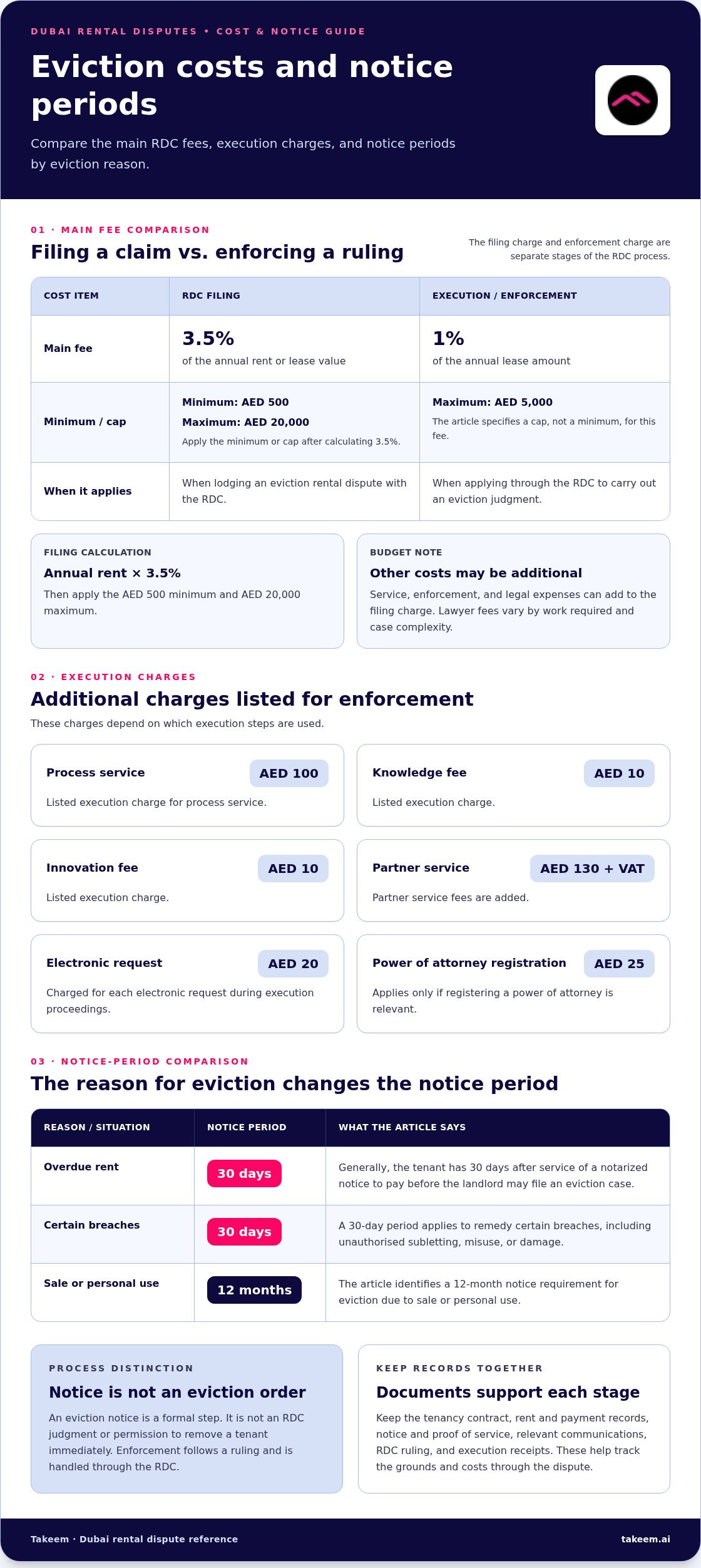
    The cost of evicting a tenant in Dubai includes a Rental Disputes Center filing fee of 3.5% of the annual rent, with a minimum of AED 500 and a cap of AED 20,000. Eviction enforcement adds a fee of 1% of the annual lease amount, capped at AED 5,000. The notice period depends on the reason: non-payment and certain breaches generally involve a 30-day notice, while eviction for sale or personal use requires 12 months’ notice.

    An eviction notice is a formal step, not an order to remove a tenant immediately. The cost of evicting a tenant in Dubai and the timeline depend on whether the parties settle or the dispute proceeds to a hearing and enforcement. This guide explains how RDC filing and enforcement fees work, what can affect the timeline, and the rules for eviction due to personal use or sale, so you can understand the process before deciding what to do next.

    Key Takeaways

    • Estimate the RDC filing fee using the annual rent, then account for the minimum and maximum fee limits.
    • Match the notice period to the reason for eviction, since non-payment and personal-use cases follow different rules.
    • Build settlement and hearing time into your plans; mediation may resolve a dispute before a full hearing.
    • Budget separately for service and enforcement costs, which can add to the initial filing expense.
    • For eviction due to sale or personal use, understand the notice requirements and restrictions that may apply after the tenant leaves.

    How much does it cost to file an eviction case at the RDC in 2026?

    Dubai’s Rental Disputes Center (RDC) registration fee for an eviction dispute is 3.5% of annual rent, subject to a minimum of AED 500 and a cap of AED 20,000. The total depends on the rent and any additional filing, service, enforcement, or legal costs.

    RDC Registration Fee

    The registration fee is the main charge for lodging an eviction rental dispute with Dubai’s RDC, also called the Rental Disputes Settlement Centre. Calculate 3.5% of the annual rent or lease value, then apply the AED 500 minimum and AED 20,000 maximum. For example, a calculated fee below AED 500 is raised to the minimum; a calculation above AED 20,000 is capped.

    The landlord filing the claim should budget for the registration charge. Keep the tenancy contract, rent records, notices, and relevant communications together, so the case documents support the stated grounds for eviction. A tenant who remains after the notice period may face an RDC case, but filing does not by itself establish that the landlord’s claim will succeed.

    Responsibility for Eviction Costs

    Responsibility for eviction costs concerns who pays charges as a case proceeds, so it matters when setting a realistic budget. The landlord bringing the claim should plan to pay the RDC registration fee at filing. The tenant may incur separate expenses responding to the dispute, while the final treatment of case costs depends on the decision and circumstances.

    Keep filing receipts and records of each expense. This helps distinguish the initial payment from any costs addressed later in the dispute.

    Lawyer Charges and Estimated Total

    Lawyer charges are professional fees for work such as preparing a claim, reviewing evidence, or attending proceedings. They are separate from the RDC registration calculation. Fees vary with the work required, the dispute’s complexity, and whether the case proceeds beyond filing, so there is no single charge that applies to every eviction.

    The total cost of evicting a tenant in Dubai therefore starts with 3.5% of annual rent, subject to the AED 500 minimum and AED 20,000 cap, then adds relevant service, enforcement, and legal expenses. Without the annual rent and case scope, a single total would be misleading. Use the fee formula first, then itemise other costs.

    Tenant Challenges and Cost Recovery

    A tenant can challenge an eviction claim by responding to the RDC dispute and presenting relevant tenancy records, payment evidence, and communications. A notice or claim can be disputed on its facts, and the RDC considers the evidence presented by both sides.

    A tenant seeking to recover costs can include the request in the dispute and keep receipts supporting the amount claimed. Recovery is not automatic; it depends on the case and the RDC’s ruling. For either party, clear records help connect each claimed expense to the rental dispute.

    What Is an Eviction Notice?

    An eviction notice is a formal written notice stating why a landlord seeks possession and what action the tenant must take. In Dubai, notice periods are described under Law No. (26) of 2007, as amended by Law No. (33) of 2008, according to Government of Dubai.

    The notice gives the tenant a defined period to respond or remedy a breach. For overdue rent, the tenant generally has 30 days after service of a notarized notice to pay before the landlord may file an eviction case. A 30-day period also applies to remedy certain breaches, including unauthorised subletting, misuse, or damage.

    Service matters. A landlord may send the notice through registered email, the official WhatsApp or mobile number recorded in the Ejari contract, registered mail, or a licensed legal notification provider. A notary public can notarise the notice. Keep the notice and proof of service, as these help establish when the response period began.

    From Notice to RDC Proceedings

    If the tenant does not comply within the applicable period, the landlord may file a rental dispute with Dubai’s Rental Disputes Center (RDC), also known as the Rental Disputes Settlement Centre. The claim should identify the tenancy agreement, the stated reason for eviction, and the steps already taken. The notice is evidence, not an RDC judgment or permission to remove the tenant.

    After a ruling, enforcement is a separate stage. A landlord seeking to carry out an eviction judgment applies for execution through the RDC. The enforcement fee is 1% of the annual lease amount, capped at AED 5,000. The execution process applies the judgment through formal channels, rather than allowing a landlord to bypass the RDC.

    Enforcement Fees and Practical Records

    RDC eviction enforcement can include further charges beyond the percentage fee. The listed execution charges include AED 100 for process service, AED 10 as a knowledge fee, and AED 10 as an innovation fee. Partner service fees of AED 130 plus VAT are also added, while each electronic request during execution proceedings costs AED 20. Registering a power of attorney, if applicable, costs AED 25.

    These charges depend on which execution steps are used. For example, the AED 25 power-of-attorney registration fee applies only when relevant, and electronic request fees depend on requests submitted. Keep the lease contract, payment history, notice, service evidence, RDC ruling, and execution receipts together. Those records help distinguish notice-stage expenses from fees incurred after judgment.

    Before filing or enforcement, match the reason in the notice to the supporting documents and applicable period. A tenant disputing the claim should respond through the RDC rather than treating the notice as a final order. Landlords should follow the RDC process after the notice period: changing locks or cutting utilities is not a lawful substitute for an eviction order.

    Amicable settlement and case timelines

    The usual path runs from written eviction notice to the response period, RDC filing, possible settlement, hearing, judgment, and enforcement. A non-payment dispute may take around two to four months from notice service to enforcement, while mediation at Dubai’s Rental Disputes Settlement Centre often reaches settlement within 15 days.

    Timelines depend on the reason for eviction and whether the parties resolve the rental dispute. For unpaid rent, the tenant generally has 30 days after service of a notarized notice to pay before filing. If the tenant does not remedy the issue, the landlord can file with the RDC and provide the notice and supporting records.

    An illustrative RDC timeline places notice service on Day 1 and filing on Day 30. Hearings are typically held within 30-45 days of filing. First-instance rulings are targeted within about 30 days, although the hearing date, evidence, and case progress affect when a decision arrives.

    Settlement can shorten the route to a decision. At mediation, the landlord and tenant can discuss payment, move-out arrangements, or another written agreement. RDC mediation often achieves settlement within 15 days, but a failed negotiation means the dispute continues through hearings and judgment.

    If no agreement is reached, an illustrative timeline places the first-instance hearing and judgment around Day 60-75. The appeal window and start of execution fall around Day 75-90 in that example. A tenant appealing an RDC judgment must file within 15 days, so the decision and its deadlines need prompt attention.

    Enforcement follows the judgment and any applicable appeal stage. The illustrative timeline estimates enforcement and physical eviction around Day 90-120. These milestones explain why a filed rental dispute is not resolved immediately: notice, hearing, judgment, and execution are separate stages, each requiring time.

    Registered mail, registered email, or another permitted service method creates a record of when the eviction notice was sent. Retain the written notice, delivery evidence, rental contract, payment history, and settlement communications. These documents help establish the notice date and clarify which events occurred before filing.

    Lease expiry follows a longer schedule than the non-payment example. A Dubai eviction upon lease expiry has a realistic planning window of 13 to 16 months, including the 12-month notice period. A landlord should distinguish that route from a breach-based claim, because the applicable notice and process change the expected timeline.

    Use the timeline as a planning framework, not a fixed deadline. The RDC caseload, the tenant’s response, mediation outcome, hearing schedule, and enforcement steps all affect the final date. Accurate service records help the parties identify the right next step at each stage.
    Cost of Evicting a Tenant in Dubai: Fees and Process

    Eviction for personal use or sale

    At tenancy end, grounds include sale, use by the owner or a first-degree relative, demolition, or major renovation. Non-payment, lease expiry, and landlord-use cases differ mainly in their notice periods and timelines. Filing fees are based on annual rent.

    Grounds for Eviction

    Specified grounds for eviction at the end of a Dubai tenancy include selling the property, personal use by the owner or a first-degree relative, demolition, and major renovation. The ground matters because it determines the notice requirement and the evidence needed to support the landlord’s claim.

    For sale, personal use, demolition, or major renovation, the landlord must give 12 months’ notice before the intended eviction date. The legal framework includes Law No. (26) of 2007, amended by Law No. (33) of 2008, according to Government of Dubai. A legal notice should clearly state the reason and intended date, with proof that it was served through a permitted method.

    For a planned demolition or renovation, the tenant has the first right of refusal to return once the property is ready, provided the tenant is informed within 30 days of the notice. That future right makes the stated grounds and the notice record important beyond the move-out date. Keep the registered service evidence and any relevant plans or sale documentation with the tenancy records.

    Costs Across Eviction Case Types

    Eviction costs cover expenses related to notice, filing, and any later enforcement. Comparing case types matters because the notice period can affect how long the landlord carries rental and legal costs before possession changes.

    For non-payment, a tenant generally has 30 days after service of a notarized notice to pay before the landlord may file. A non-payment eviction may take around two to four months from notice service to enforcement. Lease expiry requires a different planning horizon: an eviction upon expiry may take 13 to 16 months, including the 12-month notice period.

    For sale or personal use, the required notice is 12 months before the intended eviction date. The filing fee is based on annual rent, not on whether the landlord cites non-payment, lease expiry, or personal use. Later expenses can vary with service, execution, and whether the parties settle or proceed to judgment.

    Commercial cases have an additional restriction: after eviction for personal use, the landlord cannot rent the property to someone else for three years. The stated purpose is therefore more than a formality. If a rental dispute reaches the RDC, the landlord should keep the legal notice, registered delivery record, and documents supporting the grounds together.

    A notary can formalise the notice, while the RDC determines a contested claim through its proceedings. A notice alone is not a judgment, and a landlord must use the formal process to enforce an eviction. Tenants can review the stated grounds, notice date, and supporting records to identify what to address in a response.

    What are the court, service, and execution fees for evicting a tenant in Dubai?

    Dubai’s Rental Disputes Center (RDC) charges can arise at filing and again during enforcement. Separate the registration fee from execution charges, then add only applicable service or document costs. This avoids treating every listed fee as payable in every eviction case.

    For enforcement, the RDC fee is 1% of the annual lease amount, capped at AED 5,000. For example, calculate the percentage against the annual lease amount, then apply the cap if the result exceeds AED 5,000. This execution fee follows the judgment stage; it is separate from the initial rental dispute registration fee.

    Other listed enforcement charges include:

    • AED 100 for process service.
    • AED 10 as a knowledge fee and AED 10 as an innovation fee.
    • AED 130 plus VAT in partner service fees.
    • AED 20 for each electronic request submitted during execution proceedings.
    • AED 25 to register a power of attorney, if applicable.

    These amounts have different triggers. The AED 25 charge applies only when registering a power of attorney, while AED 20 applies per electronic request. Partner service fees are listed in addition to enforcement fees. Add those items according to the steps taken, rather than assuming one flat total applies to every execution file.

    Translation can be another document cost: one quoted Dubai schedule lists AED 100 when the tenant is not of Arabic nationality. It is a quoted fee, not an RDC court charge. Notice preparation and legal representation are separate expenses, and their cost depends on the work and case requirements. Keep invoices separate from RDC receipts when calculating the outlay.

    For a practical estimate, begin with the annual lease amount and apply the 1% enforcement rate, subject to the AED 5,000 cap. Then include process service, knowledge and innovation fees, partner service fees, and any applicable power-of-attorney or electronic-request charges. Add translation only where needed. This itemised approach makes clear which amounts relate to the RDC and which arise from additional services.

    Landlords can also separate dispute costs from rent collection operations. A digital Direct Debit setup for monthly tenant payments supports accepting rent digitally; it does not replace an RDC filing or enforcement process. For an eviction file, retain the judgment, execution receipts, service records, and invoices so each cost has a corresponding document.

    Takeem: Landlord Rental Guarantee

    Takeem offers a Landlord Rental Guarantee for landlords seeking support with rental-related risk alongside the formal RDC process. It does not replace an eviction notice, filing, or enforcement, but it can help landlords plan for rental income and property costs.

    Property investors with large portfolios can consider Takeem’s Rental Guarantee for Property Investors with Large property Portfolios. Agents can also sell the Landlord Rental Guarantee for healthy commissions. Emergency property maintenance is included in the Rental Guarantee, providing support beyond the eviction process.

    To learn how Takeem’s Landlord Rental Guarantee can support rental planning alongside eviction rules, visit takeem.ai.

    Plan for steadier rental operations

    An eviction dispute can expose gaps in a landlord’s wider rental strategy, from income planning to preparing for vacant periods. Consider how you will manage rental risk before the next tenancy begins. The cost of evicting a tenant in Dubai is one part of that decision; consistent rent collection and a clear plan for property-related needs also matter.

    Takeem offers a Landlord Rental Guarantee, including an option for property investors with large portfolios. Agents can also sell the guarantee for healthy commissions. These options may suit landlords considering how to support rental income beyond handling an individual dispute.

    Take the next step at a pace that suits your property strategy. Contact Takeem to discuss its Landlord Rental Guarantee and explore whether it fits your needs. A thoughtful plan can help you move forward with greater clarity.

    Frequently Asked Questions

    Legal Notice to Tenant to Vacate: Which Notice Applies?

    The reason for eviction determines which notice applies. For overdue rent or certain remediable breaches, including unauthorised subletting, misuse, or damage, the tenant generally receives 30 days to remedy the issue. Sale, personal use, demolition, or major renovation requires 12 months’ notice before the intended eviction date. Identify the ground clearly in the notice, because the applicable period and supporting documents differ.

    Can a Tenant Be Evicted Immediately in Dubai?

    No. A landlord cannot immediately remove a tenant by changing the locks or cutting utilities. The landlord must follow the applicable notice process and, if the tenant does not comply, pursue the matter through the Rental Disputes Center (RDC). Physical eviction requires an RDC order and formal enforcement. A tenant who receives a notice should keep it and its delivery details, then respond through the proper dispute process if they contest the claim.

    Can a landlord evict a tenant before the tenancy contract expires?

    A landlord may pursue eviction before the contract ends for grounds such as unpaid rent or certain unresolved breaches, but must follow the relevant notice and RDC process. For unpaid rent, the tenant generally has 30 days after service of a notarized notice to pay before filing. Sale or personal use follows a different route, with notice required before the intended eviction date. The contract and stated reason shape the process.

    What are the Dubai Rental Dispute Center (RDC) filing fees for an eviction case?

    The RDC registration fee for an eviction dispute is 3.5% of annual rent or lease value, with a minimum of AED 500 and a maximum of AED 20,000. For example, calculate the percentage against the annual rent, then apply the minimum or cap if needed. This is the filing registration charge, not a complete estimate of legal, service, or enforcement expenses that may arise later.

    How much notice must a landlord give to evict a tenant in Dubai, and how must it be served?

    The notice period depends on the eviction ground: it is generally 30 days for overdue rent or certain breaches, and 12 months for sale, personal use, demolition, or major renovation. A landlord may serve notice through registered email, registered mail, a licensed legal notification provider, or the official WhatsApp or mobile number listed in the Ejari contract. Keep proof of service and the notice copy.

    What extra costs can arise from enforcement, unpaid rent, or property handover in a Dubai eviction?

    Enforcement can add a fee of 1% of the annual lease amount, capped at AED 5,000, plus charges such as AED 100 for process service and AED 20 for each electronic execution request. Unpaid rent should be calculated from the payment record and distinguished from enforcement expenses. At handover, document the property’s condition and any damage with dated records, then separate supported repair claims from ordinary wear.

  • Digital Rent Collection in Dubai: The Landlord’s Guide to Secure UAE Payments

    Digital Rent Collection in Dubai: The Landlord’s Guide to Secure UAE Payments

    Looking into digital rent collection UAE options can help landlords move away from tracking post-dated cheques and following up on delayed payments. Across the Emirates, scheduled monthly payments through Direct Debit offer an alternative that can reduce manual processing and support a more consistent rent collection routine.

    Cheques may feel familiar, but a payment method alone can’t remove the uncertainty of a returned cheque or delayed resolution. Digital collection offers a more streamlined way to receive rent. A rental guarantee is separate and may provide another layer of protection for rental income, subject to its terms.

    This guide explains how to transition from cheque-based rent collection to Direct Debit through Takeem, what to review when setting up digital payments, and how automated collection differs from income protection. It also covers how a digital payment process and a rental guarantee can support a more structured approach to rental operations.

    Key Takeaways

    • Learn how digital rent collection can replace cheque handling with scheduled monthly Direct Debit payments.
    • Compare digital collection with post-dated cheques by considering payment processing and administrative work.
    • Prepare for a transition by reviewing tenancy agreements, payment schedules and cheque expiry dates before choosing a Direct Debit provider.
    • Understand the difference between automated collection and a rental guarantee: one supports rent collection, while the other may protect income if a tenant defaults.
    • Consider how a rental guarantee package that includes emergency property maintenance can offer landlords additional support.

    Modernising UAE Real Estate: The Evolution of Digital Rent Collection

    Digital rent collection replaces paper-based payment handling with electronic methods, such as Direct Debit, to collect rent on an agreed schedule. Instead of storing post-dated cheques and arranging deposits, landlords can use a digital process for recurring payments and keep clearer records. Across the UAE, this shift reflects a broader move towards connected, paperless financial processes in the property sector.

    Digital workflows can make rental transactions easier to track by bringing payment schedules and records together. Landlords and tenants can check whether a payment was scheduled, processed or needs attention. Digital collection doesn’t remove every payment risk, and it doesn’t make cheques unlawful. Post-dated cheques remain a legal and widely used method in the UAE. The practical difference is that landlords and investors can choose a more automated approach for their rental operations.

    The Limitations of the Traditional Cheque System

    Physical cheques require ongoing administration. Landlords or their representatives must store them securely, monitor due dates and deposit each cheque. If a cheque is returned for insufficient funds, expected rent may not arrive on time. Under UAE rules in effect in 2026, insufficient-funds cases are generally handled through civil enforcement, including a possible court execution case. Fraud-related conduct can still carry criminal consequences, so recovering funds may involve legal steps and delays.

    Why UAE Landlords Are Embracing Digital Transformation

    With Direct Debit, a tenant authorises a payment that is collected from their bank account on a scheduled basis. It is a pull-payment method, distinct from a tenant manually initiating each transfer. The underlying Direct Debit system supports recurring payments, but landlords should confirm the provider’s process and applicable UAE requirements before switching.

    Monthly collection can help landlords plan cash flow more consistently than relying on a small number of quarterly or bi-annual payments. It may also give tenants a payment rhythm aligned with regular income. Payment frequency can support convenience, but it can’t guarantee tenant retention.

    For investors, digital processes can reduce cheque handling and make payment activity easier to review across a portfolio. Direct Debit setup offers one route to scheduled monthly rent collection, while a rental guarantee addresses a separate concern: protection against tenant default. Together, they can support a more considered approach to rental operations.

    How Direct Debit Facilitates Seamless Rental Payments

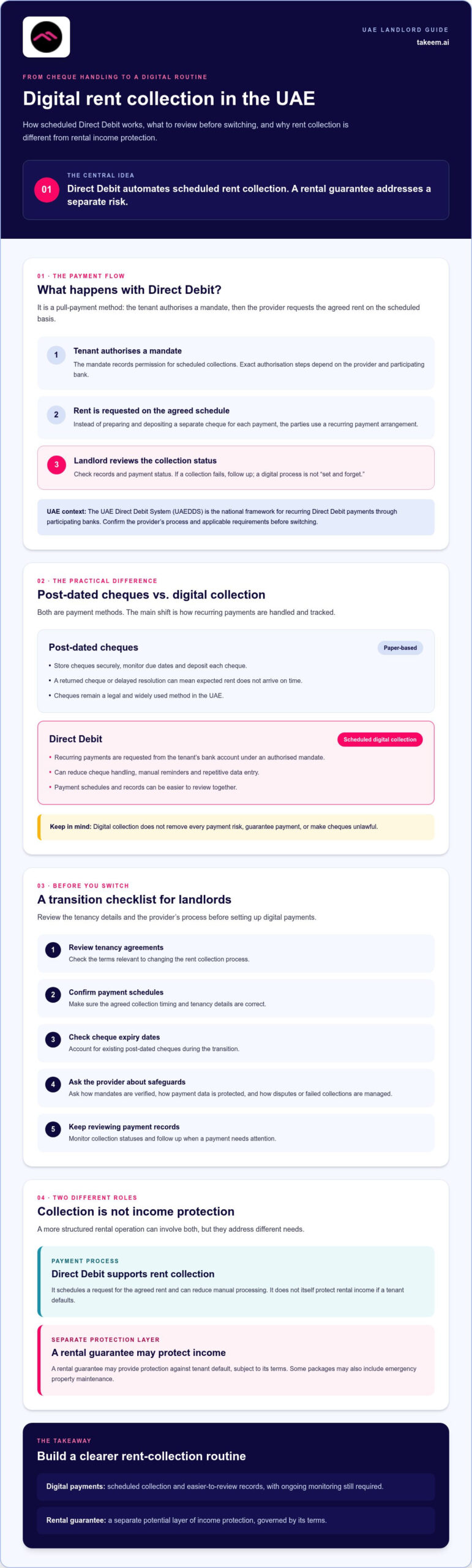
    Direct Debit is an automated pull-payment method. After a tenant authorises a mandate, the payment provider requests the agreed rent from the tenant’s bank account according to the schedule. Instead of preparing and depositing a separate cheque for each payment, both parties use a recurring payment arrangement. Scheduled collection can reduce manual reminders and data entry, but landlords should still monitor payment status and follow up if a collection fails.

    For tenants, a predictable monthly schedule can make payment timing easier to manage. For landlords, it can support a steadier collection routine and reduce repetitive administration. It is not a true “set and forget” system: landlords should continue reviewing records and checking that the payment mandate and tenancy details are correct.

    Security and Authorisation in Digital Payments

    The UAE Direct Debit System (UAEDDS) is the national framework for processing recurring Direct Debit payments through participating banks. A digital mandate records the tenant’s authorisation for scheduled collections, reducing reliance on issuing a new physical cheque for each payment. The exact authorisation steps and available protections depend on the provider and participating bank. Before setup, ask how mandates are verified, how payment data is protected, and how to manage a dispute or failed collection. For wider regulatory context, consult this overview of UAE fintech regulations.

    Don’t assume every fintech uses the same encryption or data-protection controls. Review the provider’s documentation and confirm how it handles access, records, consent changes and payment notifications. Clear answers help you decide whether the process suits your tenants and portfolio.

    Clearer Oversight for Property Investors

    For landlords with multiple properties, coordinating cheque dates and manually updating records can become difficult to scale. A digital process can bring payment schedules and records together. If a provider offers a dashboard, landlords may be able to review collection statuses in one place. Confirm what information is available and how often it updates rather than assuming every platform provides real-time reporting.

    Automation can reduce human error, such as recording the wrong due date or overlooking a cheque. It won’t eliminate every mistake, so check tenancy details and payment instructions before activating a mandate. Takeem provides Direct Debit setup for landlords and connects digital collection with rental income protection. Learn more about rental guarantee with direct debit UAE, or explore Takeem’s landlord solutions to see how these services may fit your collection process.

    Digital Collection vs. Post-Dated Cheques: A Risk Analysis

    Digital rent collection and post-dated cheques organise rent payments differently, but neither method removes every risk. Cheques require landlords to store each payment and deposit it on the due date, after which the bank must process it. Direct Debit follows an authorised schedule, so collection can take place without handling a physical cheque. Processing times depend on the banks and payment arrangements involved. Confirm when funds are expected to reach your account rather than assuming every digital payment clears instantly.

    For tenants, writing several cheques at the start of a tenancy can mean planning around large, less frequent payments. An agreed monthly digital mandate can make payment timing more predictable. For landlords, the operational difference is the amount of recurring manual work: tracking cheque dates, arranging deposits and recording outcomes, compared with reviewing scheduled collections and their status. The time saved varies by portfolio and process, so track your current administrative workload and compare it after a transition rather than relying on a generic estimate.

    Legal and Financial Security

    Post-dated cheques remain legal and widely used in the UAE, but the legal position on bounced cheques has changed. Under Federal Decree-Law No. 14 of 2020, effective January 2, 2022, insufficient-funds cases are generally handled through civil enforcement rather than criminal prosecution. A holder may pursue an execution case, and banks must make partial payment when funds are available. Fraud-related conduct can still carry criminal consequences. Digital collection avoids cheque handling, but a failed collection may still require follow-up. Neither method should be mistaken for guaranteed income.

    Digital payment histories can make it easier to review scheduled collections, payment outcomes and communications if a disagreement arises. Keep the tenancy agreement and relevant records together. Digital records can help clarify what happened, but they don’t replace the agreement or resolve a dispute by themselves. To reduce the risk of rental disputes, use clear terms and consistent documentation. Bank fees vary by institution and payment method, so compare applicable charges before assuming digital collection will cost less than cheque processing.

    Operational Efficiency for Modern Landlords

    Automation reduces repeated tasks, but it won’t eliminate administration. Landlords still need to review collection status, maintain accurate tenant and payment details, and agree on any change to a payment date with the tenant. Check whether the provider allows mandate updates and how those changes take effect. An organised digital process can create a more professional experience for tenants, while transparent communication remains important to satisfaction and retention.

    When assessing digital rent collection Dubai options, weigh the convenience of scheduled payments against processing timelines, provider terms and the separate protection you may need if rent is not received.

    Digital Rent Collection in Dubai: The Landlord’s Guide to Secure UAE Payments

    Steps to Transition a Property Portfolio to Digital Payments

    A smooth move from cheques to Direct Debit starts with an inventory, not a rushed portfolio-wide switch. Review each tenancy agreement, payment schedule and cheque expiry date. Note renewal dates, tenant contact details, rent amounts and any payment exceptions. This gives you a clear view of which tenancies to consider first and where you may need to clarify contract terms or coordinate a change with the tenant.

    • Audit your records: Match each property and tenant to the correct rent amount, due date, agreement and remaining cheques.
    • Assess providers: Ask how their Direct Debit setup works in the UAE, what authorisation tenants must provide, how failed collections are reported and what records you can access.
    • Plan the changeover: Agree on the timing with tenants and avoid overlapping a digital collection with a cheque for the same rent period.
    • Test and review: Confirm mandate details before activation, then check the first collection and reconcile it against your tenancy records.

    Onboard Tenants with Clear Communication

    Explain the change in practical terms: the tenant authorises scheduled rent collection, receives clear payment information and no longer needs to prepare a separate cheque for each due date. Set out the collection date, how the mandate is authorised, where questions should go and what happens if a payment doesn’t complete. Avoid promising that a collection can never fail. Reassurance comes from transparent steps and a clear record of consent. Real estate agents can also support conversations with landlords and explore a rental guarantee for real estate agents.

    Scale Consistently Across Multiple Properties

    For a larger portfolio, use a consistent record format across every unit. Standardise property identifiers, tenant names, payment dates and reference details so collections can be reconciled and reviewed without guesswork. If your provider offers a central dashboard, check whether it can show collection status across units and export records for financial reporting. Don’t assume every platform has the same tracking or reporting functions.

    Roll out in manageable groups, review the first payment cycle for each group, then resolve data or communication gaps before moving on. This creates a repeatable process for managing property portfolio rental income UAE without losing sight of individual tenancy details. Takeem provides Direct Debit setup for landlords. Explore Takeem’s landlord Direct Debit setup as you plan your transition.

    Beyond Collection: Integrating Rental Guarantees and Maintenance

    Automating rent collection makes payments easier to schedule and track, but it can’t prevent a tenant from defaulting. Landlords need to distinguish between collecting rent and protecting rental income. Direct Debit streamlines the payment process. A rental guarantee provides a separate layer of protection if a tenant fails to pay, subject to the guarantee’s terms.

    This distinction matters for investors planning around rental income. A scheduled payment that doesn’t complete still needs attention. A guarantee may help address the income risk, while clear records and an agreed process help landlords respond to a missed payment. Review the provider’s terms so you understand what’s covered and what steps apply if a tenant defaults.

    The Value of Combining Income Protection and Maintenance

    Takeem offers a Landlord Rental Guarantee that includes emergency property maintenance. These services address different concerns: tenant default can affect expected income, while an urgent property issue may need attention to protect the home and support a positive tenancy experience. Combining both in a guarantee package can simplify how landlords consider income protection and property upkeep, but it doesn’t mean rent collection prevents maintenance problems.

    Maintenance matters to tenants, too. Addressing property issues appropriately can support a more dependable rental experience and help protect the asset over time. Check the service’s scope and process with the provider so you know what is included and how maintenance requests are handled.

    Planning for a More Hands-Off Investment

    Digital payments, a rental guarantee and emergency maintenance can reduce some recurring tasks and uncertainty, helping landlords take a more investment-focused role. They don’t make ownership entirely passive or replace property management. Landlords still need to understand their agreements, review payment records and stay informed about the property and tenant relationship.

    For longer-term financial planning, it is useful to separate expected rent from protection against default. Scheduled digital collection can make payment activity easier to monitor, while a rental guarantee may offer additional peace of mind if a tenant fails to pay. Together, these measures can support a more structured approach to income planning, but confirm the guarantee’s terms rather than assuming every situation is covered.

    To explore how Direct Debit setup and rental income protection could fit your portfolio, review Takeem’s landlord solutions.

    Digital Rent Collection Dubai: Build a More Secure, Modern Rental Strategy

    Moving from post-dated cheques to Direct Debit can simplify monthly rent collection and reduce repetitive manual handling. Automation is only one part of a resilient rental strategy: payment records help you monitor collections, while a rental guarantee can provide a separate layer of protection if a tenant defaults.

    For landlords exploring digital rent collection Dubai, the opportunity is to combine a smoother payment process with more structured income planning. Takeem supports the transition to monthly Direct Debit and offers a Landlord Rental Guarantee that includes emergency property maintenance. Review the terms carefully to understand the protection provided and what the maintenance service covers.

    You don’t need to modernise every tenancy at once. Start by reviewing agreements and payment dates, communicate clearly with tenants, then check the first digital collection cycle. A deliberate transition can help you build a more efficient rental process while keeping individual tenancy details in view.

    Explore Takeem’s digital rent collection and rental guarantee to take the next step towards a more structured approach to managing rental income.

    Frequently Asked Questions

    Is digital rent collection legally valid in the UAE?

    Digital rent collection can be used for rental payments in the UAE, provided the payment method is agreed and set up appropriately. Post-dated cheques also remain a legal payment method. Check your tenancy agreement, confirm any required amendment with the tenant, and ask the payment provider about its Direct Debit process and applicable requirements. For current regulatory guidance, consult a qualified UAE legal professional or the relevant authority.

    Can I replace existing post-dated cheques with Direct Debit mid-tenancy?

    A mid-tenancy change usually requires coordination with the tenant and agreement on the revised payment arrangement. Review the tenancy contract first, then document the new method, collection dates and any changes to payment terms in writing. Coordinate the transition with your provider so a Direct Debit collection doesn’t overlap with a cheque for the same rent period. Don’t cancel or disregard existing cheques until the replacement arrangement is confirmed.

    What happens if a tenant’s Direct Debit payment fails?

    A failed collection means the rent hasn’t been received through that payment attempt. Check the provider’s notification for the reason, then contact the tenant promptly to agree on the next step. Follow the provider’s process for correcting account or mandate details and arranging another payment. Don’t assume a rental guarantee automatically covers every failed collection. If you have one, review its terms, eligibility conditions and notification requirements.

    How does digital rent collection benefit property investors with large portfolios?

    Digital collection can reduce the work of tracking cheque dates, arranging deposits and manually recording payments across multiple properties. A consistent schedule and organised payment records can make it easier to review rental income and identify collections that need follow-up. If a provider offers a portfolio dashboard or reporting tools, check what information it shows and how often it updates. Automation helps with oversight, but accurate property and tenant data still matters.

    Does digital collection require a specific type of UAE bank account?

    Account requirements depend on the Direct Debit provider and the banks involved, so confirm them before onboarding tenants. Ask whether rent is collected from the tenant’s account, where landlord payments are deposited, and whether any account eligibility or verification steps apply. Also check what account details are needed, who can access them and how payment records are provided. Don’t assume every provider supports the same banks or account types.

    Are there additional fees for landlords using digital rent collection services?

    Fees can vary by provider, bank and service arrangement, so review the current terms before choosing a setup. Ask for an itemised explanation of any setup, collection, transaction or account-related charges, and clarify whether a failed payment or mandate change could incur a fee. Compare the full cost with your existing process rather than assuming digital collection is free or always less expensive. Confirm charges directly with the provider.

    How do I set up a rental guarantee alongside digital collection?

    Contact a provider that offers both landlord rental guarantees and Direct Debit setup, then review each service’s terms separately. Ask what the guarantee covers, what exclusions or conditions apply, and what steps you must take if a tenant defaults. Takeem provides rental guarantees and helps landlords set up monthly Direct Debit collection. Its guarantee package also includes emergency property maintenance. Confirm the specific coverage and process before proceeding.

    Is my tenant’s financial data secure when using digital payment platforms?

    Security depends on the provider’s systems and processes, so ask how it protects payment details and limits access to tenant information. Before setup, check how the tenant authorises the mandate, how data is stored and shared, and what procedures apply if information is exposed or a payment is disputed. Review the provider’s privacy and security documentation, and use its official channels for submitting account details. Avoid assuming all platforms use identical protections.

  • Rent Collection for UAE Landlords: 2026 Guide

    Rent Collection for UAE Landlords: 2026 Guide

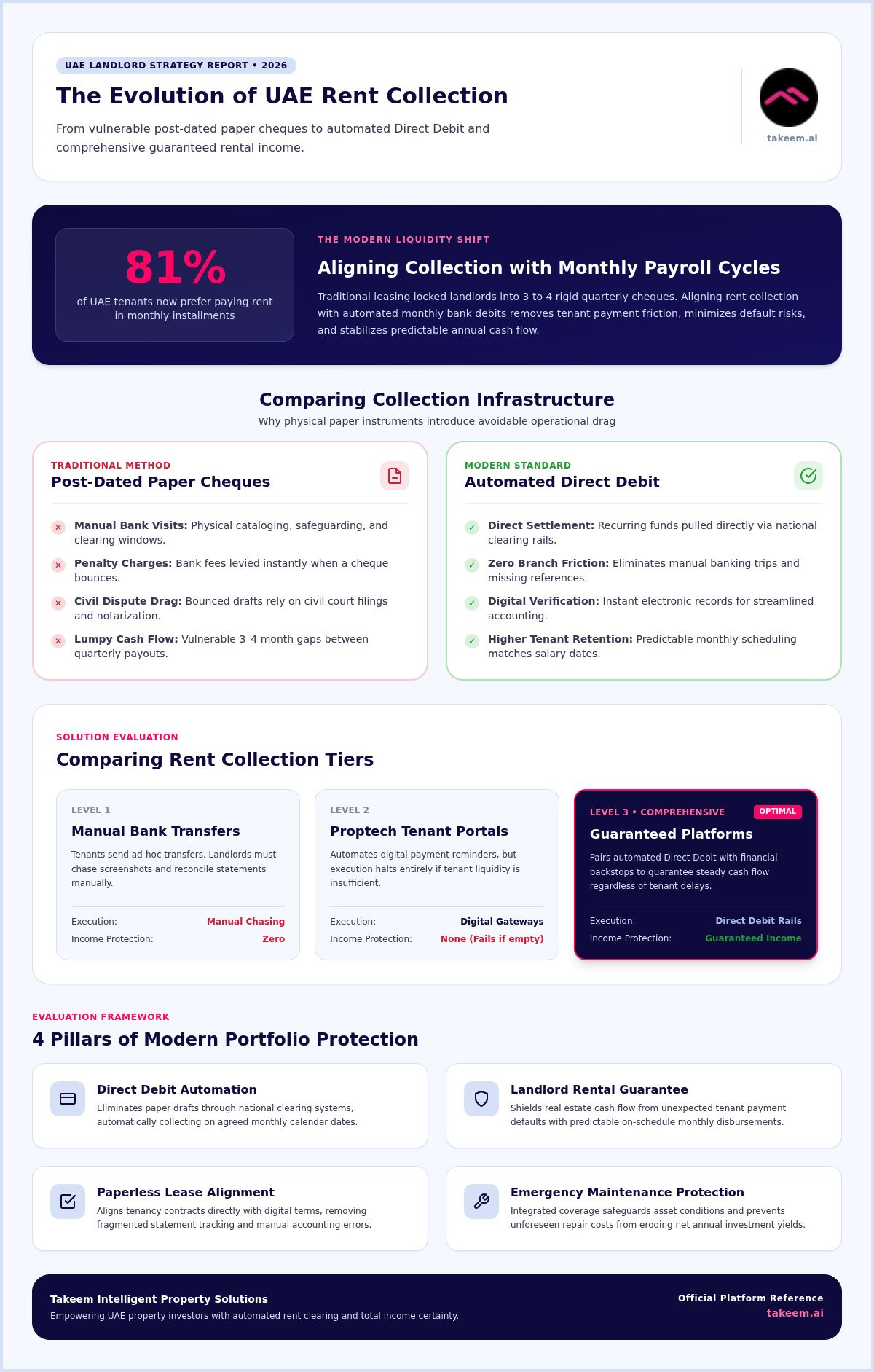
    Roughly 81% of tenants across the UAE now prefer paying rent in monthly installments, yet countless property owners remain tied to manual tracking and post-dated paper cheques. If you are searching for the most dependable rent collection solution UAE landlord portfolios can rely on in 2026, simple payment processing is no longer enough to protect your investments.

    You already know the frustration of chasing late transfers, handling the administrative drag of bank trips, and worrying about bounced cheques. When tenant liquidity challenges arise or sudden emergency maintenance bills hit, unexpected cash flow interruptions can quickly erode your net yields and disrupt your broader investment strategy.

    It doesn’t have to be this stressful. In this guide, you’ll discover how to eliminate paper cheques entirely, automate monthly deposits straight into your bank account, and secure guaranteed rental income regardless of tenant payment delays. Here is everything you need to know to transform rent collection into a modern, resilient, and hands-off income stream nationwide.

    Key Takeaways

    • Transitioning from physical cheques to automated Direct Debit establishes seamless recurring cash flow while cutting manual banking trips.
    • Choosing the right rent collection solution UAE landlord portfolios require means looking beyond basic payment processing to secure true financial protection.
    • Aligning tenancy contracts with digital payment terms streamlines monthly reconciliation and creates an entirely paperless leasing experience.
    • Pairing recurring collections with a landlord rental guarantee shields your investment from sudden cash flow interruptions caused by tenant payment defaults.
    • Integrated emergency maintenance coverage safeguards your asset condition and prevents unexpected repair bills from compromising your net yields nationwide.

    The Shift in UAE Rent Collection: Moving Beyond Post-Dated Cheques

    For decades, property transactions across the country relied almost exclusively on paper payment instruments. Landlords routinely required tenants to hand over three or four physical drafts to secure an annual lease. Today, modern financial technology has completely redefined this workflow. Digital rent collection replaces cumbersome physical handoffs with automated, recurring bank transfers that settle directly into your account on a fixed schedule. Paper cannot compete. Instead of waiting for irregular lump sums that leave you vulnerable between quarters, recurring digital deposits establish steady, reliable cash flow throughout the year.

    Recent legal evolutions nationwide have accelerated this transition. Cheques returned for insufficient funds are now handled primarily through civil mechanisms rather than criminal deterrents, removing the perceived security paper once held. When paper drafts fail to guarantee protection, relying on manual paper trails introduces unnecessary exposure. Choosing an automated rent collection solution UAE landlord portfolios can depend on has quickly become an operational necessity for protecting real estate yields.

    The Hidden Vulnerabilities of Physical Cheques

    Managing properties through post-dated cheques creates perpetual administrative drag. You must manually collect, catalog, safeguard, and physically deposit drafts across strict clearing windows. Delays happen constantly. When a cheque bounces, your financial institution levies penalty charges while your income halts instantly. Pursuing delinquent rent requires formal dispute filings, document notarization, and prolonged legal steps that can drag on for months. It’s an exhausting, high-friction cycle that drains your time, inflates administrative overhead, and exposes your cash flow to avoidable disruption.

    The Rise of Digital Monthly Rent Systems

    National consumer banking habits have shifted firmly toward digital automation. Modern tenants manage their living expenses around monthly payroll cycles, making massive quarterly payments a major source of financial strain. Aligning your property with automated Direct Debit networks matches real-world consumer liquidity. Payments execute automatically from the tenant’s bank account on an agreed date. This structured cadence reduces payment defaults, removes awkward payment reminders, and drives higher tenant retention rates across your properties.

    Core Criteria for Evaluating a Rent Collection Solution in the UAE

    Selecting the right rent collection system requires looking past surface-level conveniences. While standard bank transfers or manual online banking portals remove the chore of visiting physical branches, they leave critical operational gaps wide open. Evaluating a rent collection solution UAE landlord portfolios need involves assessing four distinct capabilities: payment execution reliability, default mitigation, automated reconciliation, and integrated asset preservation.

    Most options fall short on real financial protection:

    • Manual Bank Transfers: Involve continuous administrative follow-ups, delayed confirmation screenshots, and zero protection against missed payments.
    • Proptech Tenant Portals: Automate notifications, but execution stalls completely if the tenant’s account lacks adequate funds.
    • Comprehensive Guaranteed Platforms: Combine automated recurring bank debits with financial backstops that ensure continuous cash flow regardless of tenant liquidity.

    Direct Debit Automation vs Manual Bank Deposits

    Manual bank transfers require constant reconciliation against fragmented statements. Tenants forget transaction references, send partial payments, or miss deadlines entirely. In contrast, automated Direct Debit leverages established national clearing rails to pull funds directly from the tenant’s account on the due date. The process executes seamlessly in the background, eliminates administrative error, and produces instant digital verification for transparent record-keeping across all your properties.

    Payment Processing vs Comprehensive Rental Guarantees

    Payment gateways process money only when funds exist. If a tenant faces a sudden financial crunch, the transaction simply fails, leaving your cash flow entirely stranded. Comprehensive platforms bridge this vulnerability by pairing automated clearing with a Landlord Rental Guarantee. Instead of waiting indefinitely for delinquent payments, your monthly disbursements arrive predictably as scheduled. You can explore the ultimate guide to landlord rental guarantees to understand how these advanced protection structures isolate your balance sheet from tenant default risk.

    Integrated Asset Protection and Maintenance Coverage

    Cash flow stability depends heavily on physical asset preservation. When urgent plumbing leaks, electrical failures, or air conditioning breakdowns occur, unaddressed issues frequently lead to disputed leases and withheld rent. A truly robust collection platform incorporates emergency property maintenance service directly into its protection framework. By resolving urgent repairs quickly before property degradation occurs, you safeguard your capital asset value while preserving strong tenant relations. To modernise your property operations with guaranteed monthly cash flow and built-in maintenance protection, review how you can streamline your portfolio through Takeem.

    How to Implement Digital Rent Collection Step-by-Step

    Switching your properties from paper cheques to an automated collection framework is straightforward when you follow a structured operational sequence. Rather than coordinating manual cheque handovers at lease signing, you establish a direct digital connection with your tenant’s bank account. Setting up a dedicated rent collection solution UAE landlord portfolios can rely on requires aligning your tenancy documentation, securing verified banking mandates, and defining clear protocols for recurring payouts.

    Implementing this transition involves four practical stages:

    • Lease Alignment: State clearly in the tenancy contract addendum that recurring rent will be collected via digital Direct Debit.
    • Digital Mandate Registration: Secure authenticated electronic authorization from the tenant linking their domestic bank account.
    • Schedule Configuration: Align monthly deduction dates with the lease term and specify the destination account for disbursements.
    • Default Protocol Activation: Connect the collection schedule to an active guarantee structure to protect cash flow against unpaid cycles.

    Configuring the Digital Direct Debit Mandate

    The transition begins with legal consent. Tenants complete a paperless onboarding workflow that verifies their identity and authorises recurring debits through standard national clearing infrastructure. Digital signatures replace physical cheque signing sessions entirely. For practical insight on structuring these agreements, read our guide to modernizing UAE rentals through Direct Debit to ensure your onboarding complies with banking standards nationwide.

    Establishing Structured Payment Schedules

    Once authorized, the system maps the payment schedule directly to your tenancy dates. Funds are debited automatically on the agreed calendar day each month, eliminating the need to chase transfers or send awkward payment reminders. Automated advance notices notify the tenant before every processing event. Settled funds disburse directly into your specified private or corporate bank account, giving you transparent visibility over incoming revenue across single units or broader property portfolios.

    Handling Exceptions and Default Protocols

    Even automated systems occasionally encounter transient hiccups, such as temporary account freezes or insufficient balances. A comprehensive framework executes automated retry attempts over calibrated intervals to capture funds without administrative intervention. If non-payment persists, default protocols trigger immediately. Rather than leaving you stranded without cash flow while initiating lengthy dispute filings, an integrated Landlord Rental Guarantee steps in to issue scheduled payouts directly to you, maintaining uninterrupted balance sheet performance throughout the lease term.

    Rent Collection for UAE Landlords: 2026 Guide

    Financial and Portfolio Impact of Modernized Rent Collection

    Quantifying the return on investment from automated systems requires measuring both recovered administrative hours and balance sheet stability. Landlords spending hours each month manually cross-referencing bank statements, coordinating physical draft pickups, and reconciling deposits incur substantial hidden overhead. Automating rent recovery reclaims productive working days each financial quarter. More importantly, predictable monthly inflows preserve essential liquidity ratios. Mortgage obligations, service fees, and sinking fund allocations require steady capital; fluctuating lump sums or delayed payments threaten those commitments immediately.

    Implementing an institutional rent collection solution UAE landlord portfolios depend on directly reinforces your debt service coverage ratio (DSCR). Lenders evaluate income consistency when underwriting real estate financing across properties nationwide. When rental income flows automatically through verified clearing rails on fixed dates, financing terms improve and credit assessments become straightforward.

    Eliminating Cash Flow Gaps in Multi-Property Portfolios

    Managing ten, twenty, or fifty units compounds administrative friction exponentially. Staggered lease dates, varying cheque cycles, and disparate banking channels create fragmented reporting. A single tenant non-payment event across a leveraged portfolio can disrupt debt payments on other assets. Centralized digital clearing aggregates all incoming revenue streams into a unified overview, ensuring that non-payment on one unit does not impair liquidity across the remainder. Review our strategic guide on optimising property portfolio rental income for advanced risk diversification frameworks.

    Tenant Relationship Enhancement and Lease Renewals

    Chasing cheque replacements, managing lost drafts, and issuing formal legal notices introduces immediate friction into tenant interactions. Friction destroys renewals. Transitioning to recurring digital debits removes personal emotion from financial compliance. Transactions occur transparently in the background, matching modern corporate compensation cycles. Occupants enjoy manageable monthly budgeting without the stress of writing massive cheques, resulting in longer tenancies and fewer vacant leasing periods. If you manage multiple properties and want to remove administrative burdens while securing continuous income, explore Takeem’s portfolio solutions today.

    Selecting Takeem: Automated Collection Coupled with Guaranteed Income

    Most collection gateways stop functioning the second an account balance comes up short. Takeem provides the comprehensive rent collection solution UAE landlord portfolios need by uniting direct banking execution with institutional balance sheet protection. Rather than handing over leasing control to an expensive property management firm or relying on basic payment processing rails, landlords retain full autonomy while eliminating income vulnerability. Serving over 117,000 units across the UAE proptech ecosystem, Takeem operates as a specialized fintech bridge that guarantees uninterrupted revenue across individual units and multi-property investor portfolios nationwide.

    Real estate brokers and property advisors also leverage this framework. Through a structured partner ecosystem, agents offer the Landlord Rental Guarantee directly to their clients, earning healthy commissions while delivering institutional-grade security that accelerates lease closings.

    Zero Payment Disruption with Landlord Rental Guarantees

    Disrupted cash flow forces property owners into reactive legal filings and cash flow deficits. Takeem insulates your returns through an active Landlord Rental Guarantee. If a tenant faces unexpected liquidity challenges or delays a monthly transfer, your scheduled disbursement arrives on time regardless. The platform handles necessary recovery protocols without dragging you through bureaucratic debt-collection procedures, providing effortless certainty for both private landlords and institutional asset managers.

    Integrated Asset Protection and Fast Onboarding

    Operational stability requires physical risk mitigation alongside financial execution. Sudden plumbing ruptures, electrical failures, or cooling breakdowns often spark tenant friction, leading directly to withheld rent. Takeem resolves this exposure by integrating emergency property maintenance service straight into its rental guarantee structure. Urgent repairs are resolved rapidly by vetted professionals, protecting asset value and tenant satisfaction before disputes occur. Onboarding takes only minutes, enabling rapid nationwide enrollment for single apartments or extensive residential portfolios. Learn how rental guarantees with maintenance protect your physical capital while guaranteeing your monthly rental income.

    Modernise and Protect Your UAE Rental Yields

    Relying on physical cheques and chasing late payments exposes your balance sheet to unnecessary volatility. Shifting to automated Direct Debit establishes predictable cash flow, eliminates manual banking friction, and aligns with tenant expectations for structured monthly budgeting. Real financial resilience requires more than basic payment processing. The definitive rent collection solution UAE landlord portfolios need combines automated clearing rails with institutional income protection and rapid repair intervention.

    You don’t have to absorb collection risks alone. Takeem delivers a complete operational shield, trusted across 117,000+ rental units nationwide. By uniting automated Direct Debit with a comprehensive Landlord Rental Guarantee and built-in emergency property maintenance coverage, your disbursements arrive on time while your asset value stays protected. Secure Your Rental Income with Takeem Today and transform your properties into an effortless, guaranteed income stream.

    Frequently Asked Questions

    How does digital rent collection work without physical post-dated cheques in the UAE?

    Digital rent collection operates through authenticated Direct Debit mandates that automatically pull funds from the tenant’s domestic bank account. During lease onboarding, the tenant authorizes recurring electronic deductions aligned with the tenancy agreement. On each scheduled monthly date, the banking clearing system debits the agreed amount and transfers it directly into the landlord’s account, completely bypassing paper cheques, branch visits, and manual deposit tracking.

    Can a landlord collect rent monthly via Direct Debit across the UAE?

    Yes, landlords can legally and operationally collect monthly rent via Direct Debit nationwide across both residential and commercial properties. Establishing a modern rent collection solution UAE landlord portfolios need involves adding a digital payment clause to the standard tenancy contract. Once signed, the tenant registers their bank mandate electronically, allowing recurring monthly rent deductions that fit standard payroll schedules without requiring multi-cheque agreements.

    What happens if a tenant has insufficient funds on their rent collection date?

    When an account lacks sufficient balance, the digital system automatically re-attempts debit processing over scheduled intervals. If payment fails completely, traditional payment gateways leave landlords without income. With Takeem, the Landlord Rental Guarantee activates immediately. You receive your full monthly disbursement on schedule, while the platform manages tenant communication and payment recovery protocols in the background, keeping your cash flow entirely uninterrupted.

    Is digital rent collection legally binding for UAE residential and commercial leases?

    Yes, digital rent collection mandates and electronic signatures are fully recognized and legally binding nationwide. Digital Direct Debit authorisations comply with national banking regulations and electronic transaction laws. When paired with registered tenancy contracts, these automated mandates hold full legal standing, replacing the necessity of holding negotiable paper instruments like cheques while offering clear, auditable transaction trails for dispute resolution.

    Does a rent collection solution replace the need for traditional property management?

    A digital rent collection platform replaces the financial chasing, cheque handling, and payment risk of self-management without requiring full property management delegation. Takeem does not provide property management. Instead, it serves as a focused fintech bridge, delivering automated Direct Debit collection, guaranteed monthly payouts, and emergency property maintenance coverage. Landlords retain complete leasing control while eliminating the operational headaches often tied to management contracts.

    How quickly are funds disbursed to the landlord after collection?

    Rental disbursements are processed and deposited directly into your designated bank account on your agreed monthly payout date. Utilizing an automated rent collection solution UAE landlord investors trust ensures steady cash flow timing. Even if a tenant’s transaction encounters a clearing delay or liquidity failure, an active Landlord Rental Guarantee disburses your funds on time, guaranteeing that mortgage obligations and operational expenses are met without disruption.

    Can multi-property investors manage national portfolios through a single collection platform?

    Yes, multi-unit investors can consolidate their entire residential or commercial portfolio into a single, unified digital platform nationwide. Centralised systems aggregate staggered lease renewals, recurring Direct Debit schedules, and monthly disbursements across multiple properties into one dashboard. This eliminates fragmented bank tracking, insulates portfolio-level cash flow against individual unit defaults, and streamlines financial reporting for investors scaling their assets across the country.