

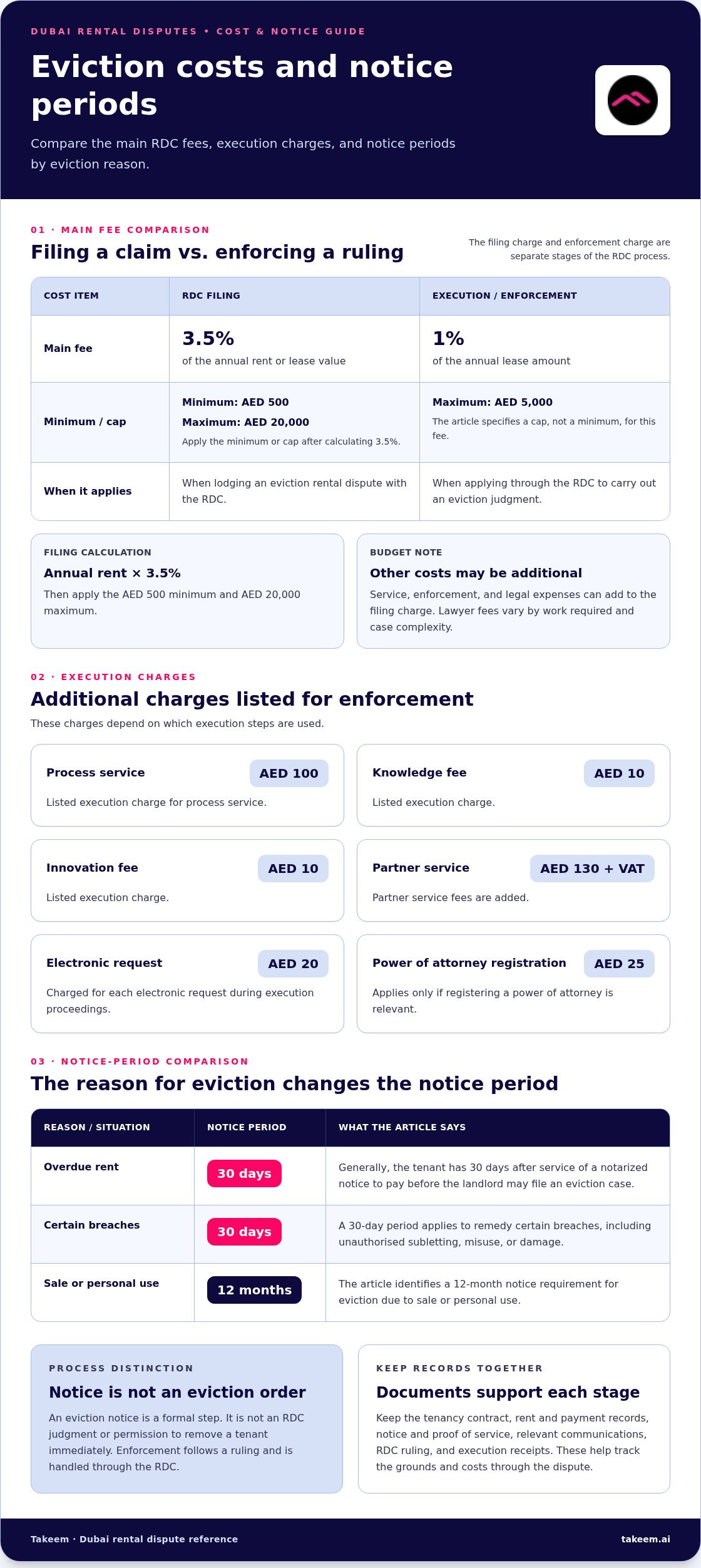
The cost of evicting a tenant in Dubai includes a Rental Disputes Center filing fee of 3.5% of the annual rent, with a minimum of AED 500 and a cap of AED 20,000. Eviction enforcement adds a fee of 1% of the annual lease amount, capped at AED 5,000. The notice period depends on the reason: non-payment and certain breaches generally involve a 30-day notice, while eviction for sale or personal use requires 12 months’ notice.
An eviction notice is a formal step, not an order to remove a tenant immediately. The cost of evicting a tenant in Dubai and the timeline depend on whether the parties settle or the dispute proceeds to a hearing and enforcement. This guide explains how RDC filing and enforcement fees work, what can affect the timeline, and the rules for eviction due to personal use or sale, so you can understand the process before deciding what to do next.
Key Takeaways
- Estimate the RDC filing fee using the annual rent, then account for the minimum and maximum fee limits.
- Match the notice period to the reason for eviction, since non-payment and personal-use cases follow different rules.
- Build settlement and hearing time into your plans; mediation may resolve a dispute before a full hearing.
- Budget separately for service and enforcement costs, which can add to the initial filing expense.
- For eviction due to sale or personal use, understand the notice requirements and restrictions that may apply after the tenant leaves.
How much does it cost to file an eviction case at the RDC in 2026?
Dubai’s Rental Disputes Center (RDC) registration fee for an eviction dispute is 3.5% of annual rent, subject to a minimum of AED 500 and a cap of AED 20,000. The total depends on the rent and any additional filing, service, enforcement, or legal costs.
RDC Registration Fee
The registration fee is the main charge for lodging an eviction rental dispute with Dubai’s RDC, also called the Rental Disputes Settlement Centre. Calculate 3.5% of the annual rent or lease value, then apply the AED 500 minimum and AED 20,000 maximum. For example, a calculated fee below AED 500 is raised to the minimum; a calculation above AED 20,000 is capped.
The landlord filing the claim should budget for the registration charge. Keep the tenancy contract, rent records, notices, and relevant communications together, so the case documents support the stated grounds for eviction. A tenant who remains after the notice period may face an RDC case, but filing does not by itself establish that the landlord’s claim will succeed.
Responsibility for Eviction Costs
Responsibility for eviction costs concerns who pays charges as a case proceeds, so it matters when setting a realistic budget. The landlord bringing the claim should plan to pay the RDC registration fee at filing. The tenant may incur separate expenses responding to the dispute, while the final treatment of case costs depends on the decision and circumstances.
Keep filing receipts and records of each expense. This helps distinguish the initial payment from any costs addressed later in the dispute.
Lawyer Charges and Estimated Total
Lawyer charges are professional fees for work such as preparing a claim, reviewing evidence, or attending proceedings. They are separate from the RDC registration calculation. Fees vary with the work required, the dispute’s complexity, and whether the case proceeds beyond filing, so there is no single charge that applies to every eviction.
The total cost of evicting a tenant in Dubai therefore starts with 3.5% of annual rent, subject to the AED 500 minimum and AED 20,000 cap, then adds relevant service, enforcement, and legal expenses. Without the annual rent and case scope, a single total would be misleading. Use the fee formula first, then itemise other costs.
Tenant Challenges and Cost Recovery
A tenant can challenge an eviction claim by responding to the RDC dispute and presenting relevant tenancy records, payment evidence, and communications. A notice or claim can be disputed on its facts, and the RDC considers the evidence presented by both sides.
A tenant seeking to recover costs can include the request in the dispute and keep receipts supporting the amount claimed. Recovery is not automatic; it depends on the case and the RDC’s ruling. For either party, clear records help connect each claimed expense to the rental dispute.
What Is an Eviction Notice?
An eviction notice is a formal written notice stating why a landlord seeks possession and what action the tenant must take. In Dubai, notice periods are described under Law No. (26) of 2007, as amended by Law No. (33) of 2008, according to Government of Dubai.
The notice gives the tenant a defined period to respond or remedy a breach. For overdue rent, the tenant generally has 30 days after service of a notarized notice to pay before the landlord may file an eviction case. A 30-day period also applies to remedy certain breaches, including unauthorised subletting, misuse, or damage.
Service matters. A landlord may send the notice through registered email, the official WhatsApp or mobile number recorded in the Ejari contract, registered mail, or a licensed legal notification provider. A notary public can notarise the notice. Keep the notice and proof of service, as these help establish when the response period began.
From Notice to RDC Proceedings
If the tenant does not comply within the applicable period, the landlord may file a rental dispute with Dubai’s Rental Disputes Center (RDC), also known as the Rental Disputes Settlement Centre. The claim should identify the tenancy agreement, the stated reason for eviction, and the steps already taken. The notice is evidence, not an RDC judgment or permission to remove the tenant.
After a ruling, enforcement is a separate stage. A landlord seeking to carry out an eviction judgment applies for execution through the RDC. The enforcement fee is 1% of the annual lease amount, capped at AED 5,000. The execution process applies the judgment through formal channels, rather than allowing a landlord to bypass the RDC.
Enforcement Fees and Practical Records
RDC eviction enforcement can include further charges beyond the percentage fee. The listed execution charges include AED 100 for process service, AED 10 as a knowledge fee, and AED 10 as an innovation fee. Partner service fees of AED 130 plus VAT are also added, while each electronic request during execution proceedings costs AED 20. Registering a power of attorney, if applicable, costs AED 25.
These charges depend on which execution steps are used. For example, the AED 25 power-of-attorney registration fee applies only when relevant, and electronic request fees depend on requests submitted. Keep the lease contract, payment history, notice, service evidence, RDC ruling, and execution receipts together. Those records help distinguish notice-stage expenses from fees incurred after judgment.
Before filing or enforcement, match the reason in the notice to the supporting documents and applicable period. A tenant disputing the claim should respond through the RDC rather than treating the notice as a final order. Landlords should follow the RDC process after the notice period: changing locks or cutting utilities is not a lawful substitute for an eviction order.
Amicable settlement and case timelines
The usual path runs from written eviction notice to the response period, RDC filing, possible settlement, hearing, judgment, and enforcement. A non-payment dispute may take around two to four months from notice service to enforcement, while mediation at Dubai’s Rental Disputes Settlement Centre often reaches settlement within 15 days.
Timelines depend on the reason for eviction and whether the parties resolve the rental dispute. For unpaid rent, the tenant generally has 30 days after service of a notarized notice to pay before filing. If the tenant does not remedy the issue, the landlord can file with the RDC and provide the notice and supporting records.
An illustrative RDC timeline places notice service on Day 1 and filing on Day 30. Hearings are typically held within 30-45 days of filing. First-instance rulings are targeted within about 30 days, although the hearing date, evidence, and case progress affect when a decision arrives.
Settlement can shorten the route to a decision. At mediation, the landlord and tenant can discuss payment, move-out arrangements, or another written agreement. RDC mediation often achieves settlement within 15 days, but a failed negotiation means the dispute continues through hearings and judgment.
If no agreement is reached, an illustrative timeline places the first-instance hearing and judgment around Day 60-75. The appeal window and start of execution fall around Day 75-90 in that example. A tenant appealing an RDC judgment must file within 15 days, so the decision and its deadlines need prompt attention.
Enforcement follows the judgment and any applicable appeal stage. The illustrative timeline estimates enforcement and physical eviction around Day 90-120. These milestones explain why a filed rental dispute is not resolved immediately: notice, hearing, judgment, and execution are separate stages, each requiring time.
Registered mail, registered email, or another permitted service method creates a record of when the eviction notice was sent. Retain the written notice, delivery evidence, rental contract, payment history, and settlement communications. These documents help establish the notice date and clarify which events occurred before filing.
Lease expiry follows a longer schedule than the non-payment example. A Dubai eviction upon lease expiry has a realistic planning window of 13 to 16 months, including the 12-month notice period. A landlord should distinguish that route from a breach-based claim, because the applicable notice and process change the expected timeline.
Use the timeline as a planning framework, not a fixed deadline. The RDC caseload, the tenant’s response, mediation outcome, hearing schedule, and enforcement steps all affect the final date. Accurate service records help the parties identify the right next step at each stage.
Eviction for personal use or sale
At tenancy end, grounds include sale, use by the owner or a first-degree relative, demolition, or major renovation. Non-payment, lease expiry, and landlord-use cases differ mainly in their notice periods and timelines. Filing fees are based on annual rent.
Grounds for Eviction
Specified grounds for eviction at the end of a Dubai tenancy include selling the property, personal use by the owner or a first-degree relative, demolition, and major renovation. The ground matters because it determines the notice requirement and the evidence needed to support the landlord’s claim.
For sale, personal use, demolition, or major renovation, the landlord must give 12 months’ notice before the intended eviction date. The legal framework includes Law No. (26) of 2007, amended by Law No. (33) of 2008, according to Government of Dubai. A legal notice should clearly state the reason and intended date, with proof that it was served through a permitted method.
For a planned demolition or renovation, the tenant has the first right of refusal to return once the property is ready, provided the tenant is informed within 30 days of the notice. That future right makes the stated grounds and the notice record important beyond the move-out date. Keep the registered service evidence and any relevant plans or sale documentation with the tenancy records.
Costs Across Eviction Case Types
Eviction costs cover expenses related to notice, filing, and any later enforcement. Comparing case types matters because the notice period can affect how long the landlord carries rental and legal costs before possession changes.
For non-payment, a tenant generally has 30 days after service of a notarized notice to pay before the landlord may file. A non-payment eviction may take around two to four months from notice service to enforcement. Lease expiry requires a different planning horizon: an eviction upon expiry may take 13 to 16 months, including the 12-month notice period.
For sale or personal use, the required notice is 12 months before the intended eviction date. The filing fee is based on annual rent, not on whether the landlord cites non-payment, lease expiry, or personal use. Later expenses can vary with service, execution, and whether the parties settle or proceed to judgment.
Commercial cases have an additional restriction: after eviction for personal use, the landlord cannot rent the property to someone else for three years. The stated purpose is therefore more than a formality. If a rental dispute reaches the RDC, the landlord should keep the legal notice, registered delivery record, and documents supporting the grounds together.
A notary can formalise the notice, while the RDC determines a contested claim through its proceedings. A notice alone is not a judgment, and a landlord must use the formal process to enforce an eviction. Tenants can review the stated grounds, notice date, and supporting records to identify what to address in a response.
What are the court, service, and execution fees for evicting a tenant in Dubai?
Dubai’s Rental Disputes Center (RDC) charges can arise at filing and again during enforcement. Separate the registration fee from execution charges, then add only applicable service or document costs. This avoids treating every listed fee as payable in every eviction case.
For enforcement, the RDC fee is 1% of the annual lease amount, capped at AED 5,000. For example, calculate the percentage against the annual lease amount, then apply the cap if the result exceeds AED 5,000. This execution fee follows the judgment stage; it is separate from the initial rental dispute registration fee.
Other listed enforcement charges include:
- AED 100 for process service.
- AED 10 as a knowledge fee and AED 10 as an innovation fee.
- AED 130 plus VAT in partner service fees.
- AED 20 for each electronic request submitted during execution proceedings.
- AED 25 to register a power of attorney, if applicable.
These amounts have different triggers. The AED 25 charge applies only when registering a power of attorney, while AED 20 applies per electronic request. Partner service fees are listed in addition to enforcement fees. Add those items according to the steps taken, rather than assuming one flat total applies to every execution file.
Translation can be another document cost: one quoted Dubai schedule lists AED 100 when the tenant is not of Arabic nationality. It is a quoted fee, not an RDC court charge. Notice preparation and legal representation are separate expenses, and their cost depends on the work and case requirements. Keep invoices separate from RDC receipts when calculating the outlay.
For a practical estimate, begin with the annual lease amount and apply the 1% enforcement rate, subject to the AED 5,000 cap. Then include process service, knowledge and innovation fees, partner service fees, and any applicable power-of-attorney or electronic-request charges. Add translation only where needed. This itemised approach makes clear which amounts relate to the RDC and which arise from additional services.
Landlords can also separate dispute costs from rent collection operations. A digital Direct Debit setup for monthly tenant payments supports accepting rent digitally; it does not replace an RDC filing or enforcement process. For an eviction file, retain the judgment, execution receipts, service records, and invoices so each cost has a corresponding document.
Takeem: Landlord Rental Guarantee
Takeem offers a Landlord Rental Guarantee for landlords seeking support with rental-related risk alongside the formal RDC process. It does not replace an eviction notice, filing, or enforcement, but it can help landlords plan for rental income and property costs.
Property investors with large portfolios can consider Takeem’s Rental Guarantee for Property Investors with Large property Portfolios. Agents can also sell the Landlord Rental Guarantee for healthy commissions. Emergency property maintenance is included in the Rental Guarantee, providing support beyond the eviction process.
To learn how Takeem’s Landlord Rental Guarantee can support rental planning alongside eviction rules, visit takeem.ai.
Plan for steadier rental operations
An eviction dispute can expose gaps in a landlord’s wider rental strategy, from income planning to preparing for vacant periods. Consider how you will manage rental risk before the next tenancy begins. The cost of evicting a tenant in Dubai is one part of that decision; consistent rent collection and a clear plan for property-related needs also matter.
Takeem offers a Landlord Rental Guarantee, including an option for property investors with large portfolios. Agents can also sell the guarantee for healthy commissions. These options may suit landlords considering how to support rental income beyond handling an individual dispute.
Take the next step at a pace that suits your property strategy. Contact Takeem to discuss its Landlord Rental Guarantee and explore whether it fits your needs. A thoughtful plan can help you move forward with greater clarity.
Frequently Asked Questions
Legal Notice to Tenant to Vacate: Which Notice Applies?
The reason for eviction determines which notice applies. For overdue rent or certain remediable breaches, including unauthorised subletting, misuse, or damage, the tenant generally receives 30 days to remedy the issue. Sale, personal use, demolition, or major renovation requires 12 months’ notice before the intended eviction date. Identify the ground clearly in the notice, because the applicable period and supporting documents differ.
Can a Tenant Be Evicted Immediately in Dubai?
No. A landlord cannot immediately remove a tenant by changing the locks or cutting utilities. The landlord must follow the applicable notice process and, if the tenant does not comply, pursue the matter through the Rental Disputes Center (RDC). Physical eviction requires an RDC order and formal enforcement. A tenant who receives a notice should keep it and its delivery details, then respond through the proper dispute process if they contest the claim.
Can a landlord evict a tenant before the tenancy contract expires?
A landlord may pursue eviction before the contract ends for grounds such as unpaid rent or certain unresolved breaches, but must follow the relevant notice and RDC process. For unpaid rent, the tenant generally has 30 days after service of a notarized notice to pay before filing. Sale or personal use follows a different route, with notice required before the intended eviction date. The contract and stated reason shape the process.
What are the Dubai Rental Dispute Center (RDC) filing fees for an eviction case?
The RDC registration fee for an eviction dispute is 3.5% of annual rent or lease value, with a minimum of AED 500 and a maximum of AED 20,000. For example, calculate the percentage against the annual rent, then apply the minimum or cap if needed. This is the filing registration charge, not a complete estimate of legal, service, or enforcement expenses that may arise later.
How much notice must a landlord give to evict a tenant in Dubai, and how must it be served?
The notice period depends on the eviction ground: it is generally 30 days for overdue rent or certain breaches, and 12 months for sale, personal use, demolition, or major renovation. A landlord may serve notice through registered email, registered mail, a licensed legal notification provider, or the official WhatsApp or mobile number listed in the Ejari contract. Keep proof of service and the notice copy.
What extra costs can arise from enforcement, unpaid rent, or property handover in a Dubai eviction?
Enforcement can add a fee of 1% of the annual lease amount, capped at AED 5,000, plus charges such as AED 100 for process service and AED 20 for each electronic execution request. Unpaid rent should be calculated from the payment record and distinguished from enforcement expenses. At handover, document the property’s condition and any damage with dated records, then separate supported repair claims from ordinary wear.