
Tag: Property Management UAE

  • Missed Rent Protection: 2026 UAE Landlord Guide

    Missed Rent Protection: 2026 UAE Landlord Guide

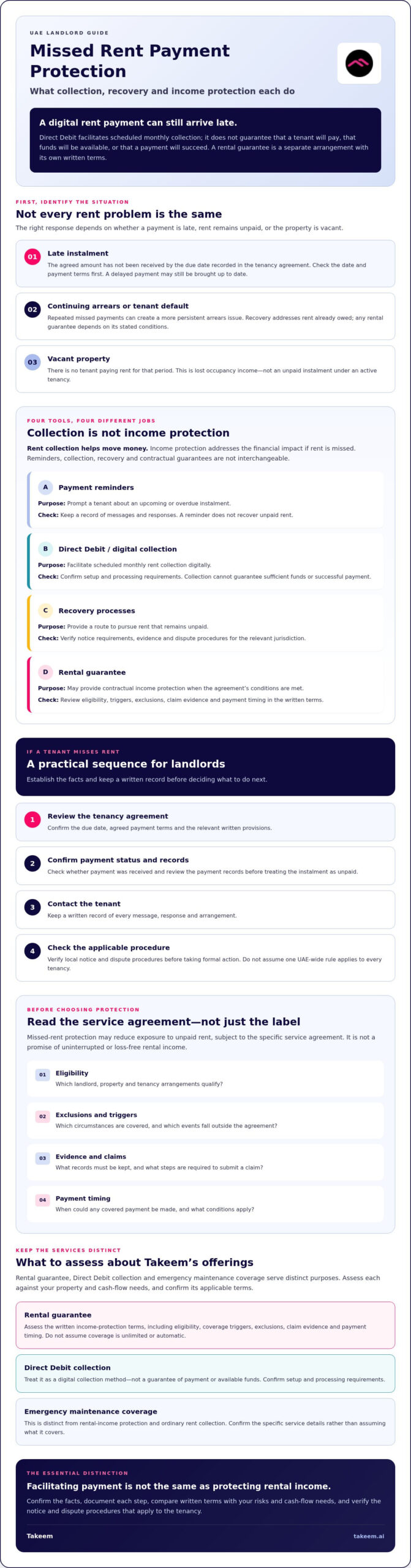
    A rent payment can be easy to collect digitally and still arrive late. For UAE landlords, missed rent payment protection UAE starts with understanding that payment tools and income protection solve different problems: Direct Debit can facilitate monthly collection, but it doesn’t guarantee a tenant will pay.

    An overdue instalment can unsettle cash flow, especially when property costs continue on schedule. Start with the facts: confirm the payment status, review the tenancy agreement and payment records, and keep a written record of every message or arrangement before deciding what to do next.

    This guide explains what missed-rent protection can and can’t do, what to document after a late payment, and how to compare options with your property and cash-flow needs across the UAE in mind. It distinguishes digital rent collection from a rental guarantee and outlines what to confirm about coverage, eligibility, exclusions, and claims. This gives you a clearer basis for weighing protection’s value and limits.

    Key Takeaways

    • Learn how a late instalment differs from ongoing arrears, tenant default, and a vacant property.
    • Compare reminders, digital collection, recovery steps, and contractual guarantees by the risks they address and the evidence they may require.
    • Use a practical sequence after a missed payment: review the agreement, confirm payment records, contact the tenant, and document each step.
    • Assess missed rent payment protection UAE options against your property and cash-flow needs, and verify applicable notice and dispute procedures.
    • See how Takeem’s rental guarantee, Direct Debit collection, and emergency maintenance coverage serve distinct purposes, and what details to confirm before choosing.

    Missed rent payment protection in the UAE: what does it actually mean?

    A rent payment is missed when the agreed amount hasn’t been received by the due date recorded in the tenancy agreement. Start by checking that date and the agreed payment terms. A lease is a contractual arrangement for the use of an asset in return for payment; the lease agreement sets out the terms the landlord and tenant have agreed to follow.

    Missed-rent protection is an arrangement intended to help reduce a landlord’s exposure to unpaid rent, subject to the specific service agreement. It can support income resilience, but it shouldn’t be understood as a promise of uninterrupted or loss-free rental income.

    When does late rent become a landlord protection concern?

    One delayed instalment isn’t automatically the same as continuing arrears or tenant default. A payment may arrive late and then be brought up to date; repeated missed payments can create a more persistent arrears issue. A vacant property is different: there’s no tenant paying rent for that period, so the issue is lost occupancy income rather than an unpaid instalment under an active tenancy.

    The distinction matters because prevention, collection, recovery, and income protection address different stages of the risk. Reminders may prompt payment. Digital collection can facilitate payment, but it doesn’t guarantee funds will be available or received. Recovery steps address rent already owed, while a rental guarantee may offer income protection under its stated terms. The agreement and applicable jurisdiction can affect available remedies and procedures, so don’t assume one UAE-wide rule applies to every tenancy.

    What can missed-rent protection cover, and what might it not cover?

    Coverage depends on the specific service agreement, so check the written terms rather than relying on a broad label such as “protection.” Rental-income protection is distinct from vacancy cover, property-damage cover, and ordinary maintenance. A service may address one risk without addressing the others.

    Before choosing an option, confirm the details that determine whether it fits your needs:

    • Eligibility: Which landlord, property, and tenancy arrangements qualify?
    • Exclusions and triggers: What circumstances are covered, and what events fall outside the agreement?
    • Evidence and claims: What records must you keep, and what steps must you follow to submit a claim?
    • Payment timing: When could any covered payment be made, and what conditions apply?

    These checks make missed rent payment protection UAE easier to assess realistically. Compare the written terms with your property’s risks and cash-flow needs, and verify local notice and dispute procedures before taking formal action.

    How rent collection, recovery, and income protection address different risks

    A missed payment can call for more than one response, but the tools aren’t interchangeable. A reminder may prompt a tenant to pay; a collection method helps process a scheduled payment; recovery addresses rent already overdue; and a rental guarantee may offer income protection under its own agreement. The right next step depends on what has happened and which risk you need to address.

    Rent collection helps move money; rental-income protection addresses the financial impact if rent is missed. Neither should be mistaken for the other.

    Approach What it does What to check
    Payment reminders Prompts the tenant about an upcoming or overdue instalment. Keep a record of messages and any response; a reminder doesn’t recover unpaid rent.
    Direct Debit Facilitates scheduled monthly rent collection digitally. Confirm setup and processing requirements. Collection can’t guarantee sufficient funds or successful payment.
    Recovery processes Provide a route to pursue rent that remains unpaid. Verify notice requirements, evidence, and dispute procedures for the relevant jurisdiction.
    Rental guarantees May provide contractual income protection when the agreement’s conditions are met. Review eligibility, triggers, exclusions, claim evidence, and payment timing in the service terms.

    Does Direct Debit protect a landlord if rent is missed?

    No. Direct Debit is a digital method for facilitating scheduled monthly collection, not a promise that a payment will be made or funds will be available. If an instalment doesn’t arrive, check the payment record and take the appropriate next steps. For more detail, read this landlord’s guide to rental guarantees and Direct Debit.

    How is a rental guarantee different from rent recovery?

    A guarantee is governed by its own terms and conditions. Recovery is a separate process for pursuing overdue rent through the applicable procedures. One doesn’t automatically replace the other, and a guarantee shouldn’t be treated as a resolution of the tenant’s arrears. Check the contract and current jurisdiction-specific requirements before acting. This UAE landlord rental guarantee guide can help you understand what to review.

    When weighing missed rent payment protection UAE options, first identify whether the immediate need is smoother collection, recovery of arrears, or contractual income protection. You can also review Takeem’s rental guarantee and digital collection options as part of your assessment, then verify the relevant terms directly.

    Compare missed rent payment protection options before choosing a safeguard

    The right safeguard depends on the risk you need to manage, not the strength of a headline promise. Compare each option by what it addresses, what records it relies on, how you use it, and where its limits lie. A reminder or collection tool may support payment routines; neither is automatically a substitute for contractual income protection.

    Digital collection can help facilitate scheduled rent payments, but it can’t guarantee that rent will be paid or protect income if a payment is missed.

    Option Risk addressed Evidence and process to check Key limitation
    Self-managed reminders Missed or overlooked payment dates Keep copies of reminders, tenant replies, and payment records; agree any revised date in writing. A reminder may prompt action, but it doesn’t recover rent or replace income.
    Digital collection Practical handling of scheduled payments Confirm setup requirements, payment records, and how unsuccessful collection is reported. It facilitates collection; it doesn’t ensure sufficient funds or successful payment.
    Recovery advice Understanding steps for pursuing overdue rent Check which documents and communications are needed, and verify procedures for the relevant jurisdiction. Advice is not itself payment or income protection; formal processes may take time.
    Contractual rental guarantee Rental-income risk, subject to the agreement Review qualifying circumstances, exclusions, evidence, notification deadlines, claim steps, and payment timing. Terms govern what may be covered; don’t assume every missed payment qualifies.

    Read the exact agreement before treating a rental guarantee as part of your cash-flow plan. Ask how it handles existing arrears, changes to a tenancy, and unresolved disputes. Keep maintenance separate in your comparison too: emergency property maintenance can support property care, but it isn’t the same as cover for unpaid rent. Confirm what maintenance coverage includes rather than assuming it replaces rental income.

    Which questions reveal whether a rental guarantee fits?

    Ask which missed-payment circumstances qualify and which exclusions apply. Confirm what records you must provide, when you must notify the provider, how a claim proceeds, and when any payment may be made. Clarify how the terms treat arrears that began before cover, tenancy changes, or an unresolved dispute. If a point isn’t clear in writing, request clarification before relying on it.

    How should landlords compare protection against their own exposure?

    Consider how much your property-related cash flow depends on each rent payment, how many properties you hold, and whether your current collection process is easy to manage. A landlord with one property may prioritise straightforward records and a clear response plan; a portfolio investor may also weigh consistency and administrative workload across properties. For a broader portfolio perspective, see this investor guide to protecting rental income across a property portfolio.

    Use these checks to assess missed rent payment protection UAE options against your actual exposure, rather than assuming one tool solves every part of the problem. You can also review Takeem’s rental guarantee options and verify the current terms that apply to your circumstances.
    Missed Rent Protection: 2026 UAE Landlord Guide

    Checklist for Landlords: When a Tenant Misses Rent

    Act methodically. A clear record helps you establish whether the payment is delayed, confirm what the agreement requires, and follow the right process for the property’s jurisdiction.

    • 1. Check the tenancy agreement. Confirm the rent due date, amount, payment method, and any relevant terms for late or missed instalments.
    • 2. Confirm your records. Review account activity and payment notifications before treating rent as unpaid. Check whether a payment is pending, partially received, or recorded against a different period.
    • 3. Contact the tenant. Ask about the payment and agree on any proposed next step in writing. Keep the communication factual and retain the tenant’s response.
    • 4. Document each action. Record dates, amounts due and received, reminders sent, and any agreed arrangement. Review a rental protection agreement promptly for notification windows and evidence requirements, even while you clarify the payment status.
    • 5. Verify the formal process. Before issuing formal notice or starting recovery action, check the requirements that apply to the tenancy and jurisdiction.

    What records should a landlord assemble after a missed payment?

    Gather the signed tenancy agreement, payment schedule, relevant account records, and correspondence with the tenant. Create a simple timeline showing when rent was due, what was received, when reminders were sent, and what next steps were agreed. If you have a protection agreement, check its required claim documents before submitting anything. Keep copies together so you can respond accurately if asked for supporting evidence.

    When should landlords seek jurisdiction-specific advice?

    Seek qualified local advice before taking formal action or relying on a notice period found online. Requirements and dispute procedures can differ across the UAE, so don’t apply another emirate’s process or assume a general grace-period claim fits your tenancy. For further context, read this guide to avoiding rental disputes and protecting income.

    A consistent process can make missed rent payment protection UAE easier to manage, but it doesn’t replace checking your agreement or the applicable local procedures. To assess an option alongside your checklist, explore Takeem’s rental income protection.

    How to assess Takeem’s rental guarantee and digital collection

    Takeem provides a rental guarantee for landlords and property investors across the UAE, alongside Direct Debit setup to support monthly digital rent collection. These address different needs. The guarantee is a contractual option to assess for rental-income protection, while Direct Debit facilitates collection. Setting up Direct Debit doesn’t ensure funds are available or guarantee that rent will be paid.

    Emergency property maintenance is included as part of Takeem’s rental guarantee service. It supports property care, but it isn’t a substitute for missed-rent protection. Before deciding whether the service fits, review the applicable terms and keep these functions distinct.

    What should landlords confirm before considering Takeem?

    Request the current written terms and confirm which missed-payment circumstances qualify, what exclusions apply, and what eligibility requirements must be met. Ask about notification deadlines, required claim evidence, each claim step, and payment timing. For Direct Debit, verify setup requirements and how collection activity or an unsuccessful payment is recorded. Also ask how emergency maintenance coverage works and which situations it includes.

    These checks help you assess the service on its actual scope, rather than assuming every late payment or maintenance issue is handled in the same way.

    How can landlords take the next step with confidence?

    Compare the confirmed terms with your tenancy arrangements, portfolio needs, and current collection process. Before discussing suitability, prepare relevant property and payment information, such as the tenancy details, payment schedule, and records of how rent is currently collected. This can keep the conversation focused and help identify points that still need clarification.

    If you’re considering missed rent payment protection UAE, use the review to distinguish income protection from payment collection and property care. Explore rental income protection with Takeem and confirm the terms that apply to your circumstances.

    Build a clearer plan for protecting rental income

    Effective missed rent payment protection UAE starts with separating three jobs: collecting rent, responding when it’s overdue, and protecting rental income under a contractual agreement. Digital payment collection can support the monthly process, but it isn’t a guarantee of payment. After a missed instalment, check your records, document communication, review any protection terms, and verify the notice and dispute procedures that apply to the tenancy.

    Takeem provides a rental guarantee service for landlords and property investors across the UAE, with Direct Debit setup to facilitate monthly digital rent collection. Emergency property maintenance is included as part of the rental guarantee service and supports property care, a separate need from missed-rent protection. Review the current terms carefully to understand what applies to your property and circumstances.

    Ready to compare these options with your rental needs? Explore Takeem’s rental guarantee and digital rent collection, confirm the applicable terms, and take your next step with greater clarity.

    Frequently Asked Questions

    What should a landlord do first when a tenant misses rent in the UAE?

    Start by checking the tenancy agreement for the rent due date and payment terms, then confirm your account records before treating the instalment as unpaid. Contact the tenant calmly to ask about the payment and keep a written record of the exchange and any agreed next step. Check your protection agreement for notification deadlines, and verify notice or dispute procedures for the applicable jurisdiction before taking formal action.

    Does Direct Debit guarantee rent payment if a tenant misses an instalment?

    No. Direct Debit is a digital method for facilitating scheduled monthly rent collection, not a guarantee that funds will be available or a payment will succeed. If an instalment doesn’t arrive, check the payment records and follow up with the tenant. If you use a rental guarantee, assess it separately by reviewing its current terms, eligibility, exclusions, evidence requirements, and claim process.

    Can a rental guarantee protect a landlord from every missed rent payment?

    No rental guarantee should be assumed to cover every missed payment. The applicable service agreement determines which circumstances qualify, what exclusions apply, and what the landlord must do to meet claim requirements. Before relying on protection, confirm eligibility, notification deadlines, required evidence, claim steps, and payment timing in writing. A guarantee also shouldn’t be confused with recovery procedures for pursuing rent owed by a tenant.

    What documents may be needed to make a missed-rent protection claim?

    Requirements depend on the protection agreement, so check its claim instructions before submitting documents. Landlords may need the tenancy agreement, payment schedule, account or collection records, and correspondence with the tenant, including reminders and any written payment arrangement. Keep a dated record of rent due, amounts received, and actions taken. Ask the provider to confirm the exact evidence required and any deadline for notification.

    How is a missed rent payment different from a vacant property?

    A missed rent payment is an instalment not received by its agreed due date while the tenancy is in place. A vacant property has no tenant occupying it for that period, so the issue is lost occupancy income rather than unpaid rent under an active tenancy. These are different risks, and a rental guarantee’s terms may treat them differently. Confirm whether vacancy is addressed rather than assuming it is covered.

    What happens if a tenant does not respond after rent is overdue?

    Keep a record of your contact attempts and the payment status, then review the tenancy agreement and any protection terms for required next steps or notification deadlines. Before sending formal notice or pursuing recovery, verify the requirements and dispute procedures for the relevant UAE jurisdiction, or consult a qualified local adviser. Don’t assume an online grace-period claim or another jurisdiction’s process applies to your tenancy.

    Does Takeem’s emergency maintenance coverage replace missed rental income?

    No. Takeem’s emergency property maintenance coverage is included as part of its rental guarantee service and supports property care. It isn’t a substitute for missed-rent protection or a guarantee that rent will be collected. Review the current service terms to understand which maintenance situations are included, and assess rental-income protection separately by checking its eligibility, coverage triggers, exclusions, claim steps, and payment timing.

  • Tenant Rent Default Risk in the UAE: Protect Rental Profit

    Tenant Rent Default Risk in the UAE: Protect Rental Profit

    What happens to your rental profit when a tenant misses a payment, and how long can your cash flow absorb the gap? For UAE landlords, tenant rent default risk UAE is more than an overdue instalment: arrears can build, reduce income available for expenses, and make it harder to predict when rent will arrive. A vacant property creates a different loss because there’s no tenant or rent to collect.

    It’s reasonable to want dependable rental income, but no collection method or protection should be treated as a promise that default won’t happen. Understanding the difference between late rent, ongoing default, and vacancy helps you identify your exposure and assess what each option can and can’t address.

    This guide explains how missed payments can reduce rental profit, compares practical ways to manage exposure across the UAE, and outlines what to check before choosing a rental guarantee or digital collection option. Direct Debit can streamline monthly rent collection without guaranteeing payment, while emergency maintenance coverage supports property care rather than replacing lost rent.

    Key Takeaways

    • Distinguish overdue rent, tenant default, and a void period to identify which income risk you’re facing.
    • Trace how missed payments can affect rental profit alongside ongoing ownership and reletting costs.
    • Assess tenant rent default risk UAE with a practical comparison of payment processes, digital collection, and rental guarantees.
    • Review payment terms, cash-flow sensitivity, and records to make your exposure clearer before choosing protections.
    • Check the terms and limitations of each option: Direct Debit supports collection, while a rental guarantee and emergency maintenance address different needs.

    Tenant rent default risk in the UAE: what landlords should distinguish first

    An expected rent payment hasn’t arrived. Is it a short delay, a growing arrears balance, or the start of a longer income gap? That uncertainty can make it difficult to plan for property expenses. To assess tenant rent default risk UAE landlords need to separate the missed payment, the tenant’s ongoing payment situation, and any period when the property has no tenant.

    What counts as missed rent or tenant default?

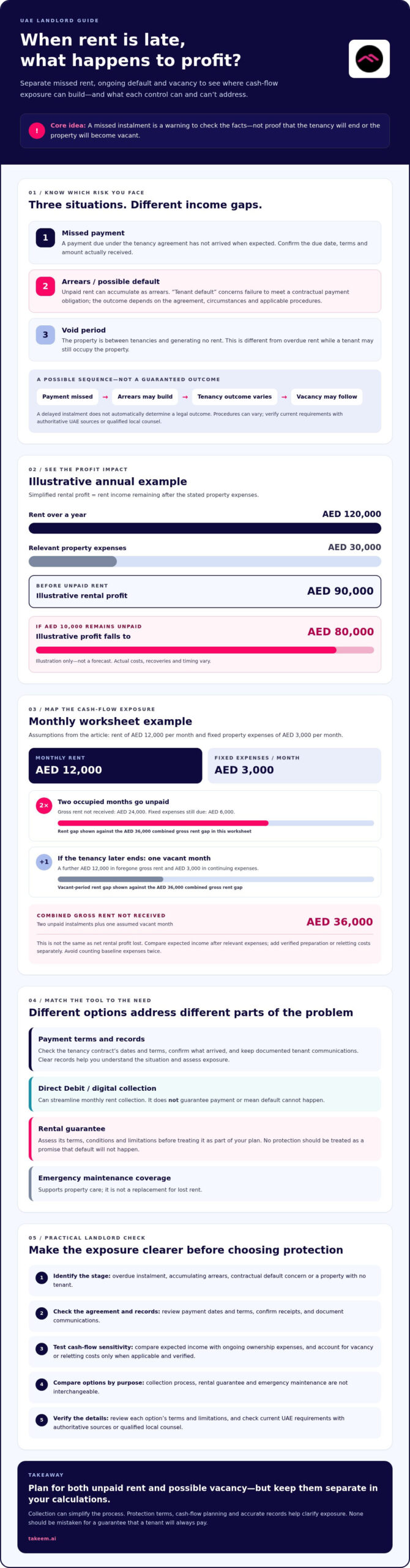
    A missed payment is a payment due under the tenancy agreement that hasn’t arrived when expected. Rent arrears are rent payments that remain unpaid and accumulate over time. Tenant default describes a failure to meet a contractual payment obligation, but whether a particular situation amounts to default, and what follows, depends on the agreement, circumstances, and applicable procedures.

    One delayed instalment doesn’t automatically determine a legal outcome. Start with the records: check the payment dates and terms in the tenancy contract, confirm what has actually been received, and keep documented communications with the tenant. Landlords can review information about the Ejari registration system as part of understanding tenancy registration. Verify current requirements and any legal implications with authoritative UAE sources or qualified local counsel. Procedures can vary, so don’t assume the same steps apply in every situation.

    How is tenant default different from a void period?

    A void period is time when a property is between tenancies and generating no rent. By contrast, a tenant may still occupy the property while rent is overdue. Default may eventually lead to a vacant property, but that outcome and its timing aren’t automatic. Keeping the terms clear helps landlords assess whether the immediate concern is unpaid rent, lost rent between tenancies, or both.

    Hypothetical example: Suppose a property earns AED 120,000 in rent over a year and has AED 30,000 in relevant property expenses. Rental profit, simplified here as income remaining after those expenses, is AED 90,000. If AED 10,000 of rent remains unpaid and expenses are unchanged, the illustrative profit falls to AED 80,000. This example isn’t a forecast: actual costs, recoveries, and timing vary.

    That distinction matters because ownership costs may continue whether rent is late or the property is empty. A void period can also involve costs to prepare the property for reletting. Treating arrears and vacancy as separate risks gives landlords a clearer basis for deciding what records, cash-flow planning, and protections to assess next.

    How tenant default can reduce rental profit and create further exposure

    A missed instalment is the start of a possible sequence, not proof that a property will become vacant. As payments remain outstanding, rent arrears may build. The landlord may follow up under the tenancy agreement and applicable procedures; the tenancy may then be resolved, continued, or eventually end. Only after it ends might a void period begin, and the timing depends on the circumstances and process. This distinction helps landlords assess tenant rent default risk UAE without treating every stage as a certain outcome.

    Which financial effects should landlords include?

    Separate the income you expected from cash obligations and any additional costs. Fixed ownership expenses may continue while rent is unpaid or the property is vacant. Include reletting costs only when they apply and can be verified. Use the following as an illustrative worksheet, not a market average or forecast:

    • Assumptions: Monthly rent of AED 12,000; fixed property expenses of AED 3,000 per month.
    • While occupied: Two instalments go unpaid. Gross rent not received is AED 24,000, while AED 6,000 in fixed expenses still falls due.
    • If the tenancy later ends: Assume one further month without a tenant, adding AED 12,000 in foregone gross rent and AED 3,000 in continuing expenses.
    • If verified: Add any actual, relevant property-preparation or reletting costs separately.

    Under these assumptions, the missed and vacant-period rent totals AED 36,000 in gross income not received. That isn’t the same as net rental profit lost. Compare the amount with expected income after relevant expenses, and account separately for applicable additional costs. Don’t count ordinary expenses twice if they were already included in your baseline profit calculation. Individual properties and expense structures differ.

    Lost rent during occupancy is unpaid income from a tenant still in the property; lost rent during a void period is income that can’t accrue because no tenancy is in place.

    When can default turn into a void-period risk?

    A tenancy ending can create a vacancy, but default doesn’t automatically end an agreement or set a move-out date. Include reletting time as a separate planning assumption, not a guaranteed consequence. For a fuller breakdown of the impact of missed rental payments, consult the published guide alongside your own records and property figures.

    Planning can also start before a tenancy begins. The Etihad Credit Bureau tenant screening announcement is a useful reference when exploring screening options. Verify current availability and any applicable requirements before relying on a service. To compare a rental guarantee with digital rent collection, review Takeem’s rental-risk options and check the relevant terms for your circumstances.

    Compare UAE rent-risk controls: payment collection, processes, and guarantees

    No single measure addresses every source of rental-income uncertainty. A clear process helps landlords track obligations and respond consistently. Digital collection changes how payments are requested and received, while a rental guarantee may offer protection subject to its written terms. Compare each option against the specific exposure you want to manage rather than assuming that any one of them prevents tenant default.

    Control Purpose and potential benefit Limitations and questions to verify
    Landlord processes Keep payment terms, due dates, records, and communications organised. This can make it easier to spot an overdue payment and know what to check next. Good records don’t recover rent by themselves. Check what the tenancy agreement says, what procedures apply, and which notices or documents may be relevant. Verify legal steps with current authoritative UAE sources or qualified local counsel.
    Digital collection Provides a digital way to collect monthly rent. Direct Debit setup can replace post-dated cheques as a collection method and may make payment tracking more straightforward. It doesn’t guarantee successful collection or prevent default. Ask how setup works, what happens if a payment isn’t collected, and what records are available. Confirm the process with the provider.
    Rental guarantee May provide a defined form of protection for landlords, depending on the product’s terms and the landlord’s eligibility. Coverage, exclusions, claim evidence, and payment conditions can differ. Review the current written terms and ask how arrears, tenancy changes, and periods without a tenant are treated.

    What can digital rent collection change?

    Takeem’s Direct Debit setup lets landlords digitally accept monthly tenant payments. Compared with post-dated cheques, it changes the collection method, not the underlying payment obligation. A scheduled digital collection can still fail, so landlords should continue to monitor records and follow their agreed process. For more detail, see the published guide to modernising UAE rent collection with Direct Debit.

    What should landlords verify in a rental guarantee?

    Read the current written terms before treating a guarantee as a fit for your tenant rent default risk UAE plan. Confirm covered events, eligibility, exclusions, required claim evidence, and payment conditions. Ask specifically how the arrangement handles accumulated arrears, changes to a tenancy, and any time when the property has no tenant. For context, consult the published UAE guide to landlord rental guarantees, then compare its explanation with the terms offered to you.

    These controls can complement one another, but they serve different purposes. A landlord might use organised records to manage follow-up, digital collection to handle monthly payments, and separately assess whether a rental guarantee matches their exposure. Compare the practical details before choosing. Don’t assume a collection tool provides income protection or that a guarantee covers every period or loss.

    Tenant Rent Default Risk in the UAE: Protect Rental Profit

    A practical UAE checklist for assessing tenant default exposure

    A useful review turns uncertainty into decisions you can document. Before a tenancy begins, assess the payment arrangement and your ability to absorb disruption. If a payment is missed, verify the facts and follow the relevant agreement and procedures rather than acting on assumptions. This checklist can help UAE landlords assess tenant rent default risk UAE without treating any outcome as inevitable.

    What should landlords review before a tenancy begins?

    Start with the paperwork and cash flow. Check the tenancy agreement, rent amount and due dates, payment method, and how you and the tenant will communicate about payment questions. Confirm that relevant registrations and records are in order for your circumstances. For tenant checks or other safeguards, seek qualified UAE guidance on what’s lawful and appropriate.

    • Payment terms: Note when rent is due, how it should be paid, and what the agreement says about a missed instalment.
    • Documentation: Set up a clear record of the agreement, payment dates, receipts, notices, and landlord-tenant communications.
    • Cash-flow sensitivity: Test several scenarios using your actual figures. For example, model one missed instalment, several unpaid instalments, and a separate period with no tenant. Include continuing property expenses and any reletting costs you can verify. These are planning scenarios, not predictions or typical UAE outcomes.
    • Available protections: Compare collection methods and any rental guarantee against the specific risks you want to address. Review current written terms, including eligibility, exclusions, evidence, and payment conditions.

    What should landlords do after a payment is missed?

    First, check the bank or collection record against the payment schedule in the tenancy agreement. Contact the tenant with a clear, factual message, then retain dated copies of the communication and any response. Record the amount outstanding and update the payment history. If a notice or formal step may be required, verify the applicable procedure with a qualified UAE professional. Don’t rely on assumed timelines or attempt self-help measures.

    Next, revisit your cash-flow scenarios. Separate rent still outstanding from costs that continue, and consider vacancy only if the tenancy ends. If you have a rental guarantee, check its claim process and required evidence promptly against the current written terms. A collection service can support the payment process, but it doesn’t itself guarantee successful collection.

    Quick checklist: Prevention means reviewing terms and appropriate checks; collection means tracking payments and keeping dated records; income protection means assessing written guarantee terms; vacancy planning means modelling reletting time separately from arrears.

    If you’re comparing protections, review Takeem’s rental guarantee and Direct Debit options and confirm which terms fit your circumstances.

    How Takeem’s rental guarantee and digital collection fit into a landlord’s plan

    Once you’ve mapped your exposure and reviewed the available controls, assess whether a provider’s services fit your rental plan. Takeem serves individual landlords and property investors with large portfolios across the UAE. Its service categories include landlord rental guarantees, digital monthly rent collection through Direct Debit, and emergency property maintenance as part of the rental guarantee service.

    These options address different needs. Direct Debit provides a digital method for accepting monthly rent, but it doesn’t prevent default or guarantee successful collection. Assess a rental guarantee against its written terms and your own risk scenarios. Emergency maintenance supports property care; don’t assume it covers rent losses.

    Which landlord situations may warrant exploring a rental guarantee?

    Landlords who want to assess ways to manage the financial impact of missed rent may wish to compare rental guarantees with their cash-flow needs. This may include an individual landlord with limited capacity to absorb an income interruption or an investor reviewing exposure across a larger portfolio. Neither situation means a particular product is automatically suitable. Compare the actual written coverage with scenarios you’ve modelled, including arrears and any possible period without a tenant.

    What should landlords ask before taking the next step?

    Request current details before deciding. Ask what events are covered, who is eligible, what exclusions apply, what evidence a claim requires, and how payment conditions work. Clarify how the terms address arrears, tenancy changes, and vacancy. These details determine whether the arrangement matches your tenant rent default risk UAE plan. Don’t rely on a general description in place of the current agreement.

    For Direct Debit, confirm how setup works, what information or authorisation is required, how payment activity is recorded, and what responsibilities remain with you if a collection doesn’t go through. Keep your own tenancy and payment records, and verify any applicable legal or procedural questions with qualified UAE professionals. A digital process may simplify collection, but it doesn’t replace those responsibilities.

    Check the fit for both your property and portfolio needs. Review the terms, limitations, and process before making a decision, and compare them with your own cash-flow assumptions rather than expecting a particular outcome.

    Explore Takeem’s rental guarantee and digital rent collection to review the available service information and assess whether it suits your circumstances.

    Build a rental plan around the risks you can control

    Protecting rental profit starts with clear distinctions: arrears are unpaid rent, while a void period is time without a tenant. They affect income in different ways. Tenant rent default risk UAE landlords face is best assessed by looking at payment terms, records, ongoing expenses, and possible vacancy separately.

    Landlord processes, digital collection, and rental guarantees serve different purposes. Direct Debit can support monthly rent collection, but it doesn’t guarantee payment. Before choosing a rental guarantee, check current eligibility, covered events, exclusions, claim evidence, and payment conditions against your own cash-flow scenarios.

    Takeem offers rental guarantee services to landlords and property investors across the UAE, supports digital monthly rent collection through Direct Debit, and includes emergency property maintenance as part of its rental guarantee package. Verify current service terms, including the maintenance scope, before deciding whether the options fit your needs.

    To compare the available options, explore Takeem’s rental guarantee and digital rent collection and review the service information for your circumstances.

    Frequently Asked Questions

    What is tenant rent default risk for a UAE landlord?

    Tenant rent default risk UAE landlords face is the possibility that a tenant doesn’t pay rent as agreed, reducing the income available for property expenses and affecting cash flow. A missed instalment is a payment event; arrears are rent that remains unpaid, while default depends on the agreement and circumstances. This risk is distinct from a void period, when the property has no tenant and isn’t generating rent.

    How can a missed rent payment affect rental profit?

    A missed rent payment can reduce rental profit because expected income is lower while relevant ownership expenses may continue. If rent is due but not received, calculate the unpaid amount separately from recurring property costs and any verified expenses associated with reletting. Don’t treat gross rent not received as the same as net profit lost. The actual impact depends on your income, expenses, timing, and any later recovery.

    Is a tenant default the same as a void period?

    No. Tenant default concerns a failure to meet a payment obligation under the tenancy agreement, while a void period is time when the property is between tenancies and earning no rent. A tenant may remain in occupation while rent is overdue, so default doesn’t automatically mean the property is vacant. A tenancy ending may lead to a void period, but whether and when that happens depends on the circumstances and applicable process.

    Can Direct Debit prevent a tenant from defaulting on rent?

    No. Direct Debit changes how monthly rent is collected; it doesn’t ensure that a payment will be made or prevent a tenant from defaulting. It gives landlords a digital collection method, and Takeem offers Direct Debit setup for accepting monthly tenant payments. Landlords should still monitor collection records, check the tenancy’s payment terms, and follow up appropriately if a payment doesn’t arrive.

    What should a UAE landlord check in a rental guarantee?

    Review the current written terms before deciding whether a rental guarantee suits your circumstances. Check covered events, eligibility, exclusions, required claim evidence, the claims process, and payment conditions. Ask how the arrangement treats accumulated arrears, tenancy changes, and periods when the property has no tenant. Compare those details with your own cash-flow scenarios, and seek clarification rather than relying on broad descriptions or assuming every loss is covered.

    What should I do when a tenant misses a rent payment in the UAE?

    Check your payment records and tenancy agreement first, then contact the tenant with a clear, factual message. Keep dated records of the missed payment, notices, agreements, and communications. Avoid assuming that one delay determines a legal outcome, and don’t take self-help action based on general advice. If you’re considering a formal step, verify the current procedure with a qualified UAE professional, since applicable requirements can depend on the circumstances.

    Can a rental guarantee cover a vacant property or void period?

    It depends on the specific guarantee’s written terms, so don’t assume a vacant period is covered. Ask the provider directly whether protection applies to unpaid rent while a tenant remains in the property, time after a tenancy ends, or both. Confirm eligibility, exclusions, claim evidence, and payment conditions in writing. This distinction matters because arrears and rent foregone while a property is vacant are separate exposures.

  • Tenant Not Paying Rent in the UAE? A Landlord’s 2026 Guide to Resolution and Prevention

    Tenant Not Paying Rent in the UAE? A Landlord’s 2026 Guide to Resolution and Prevention

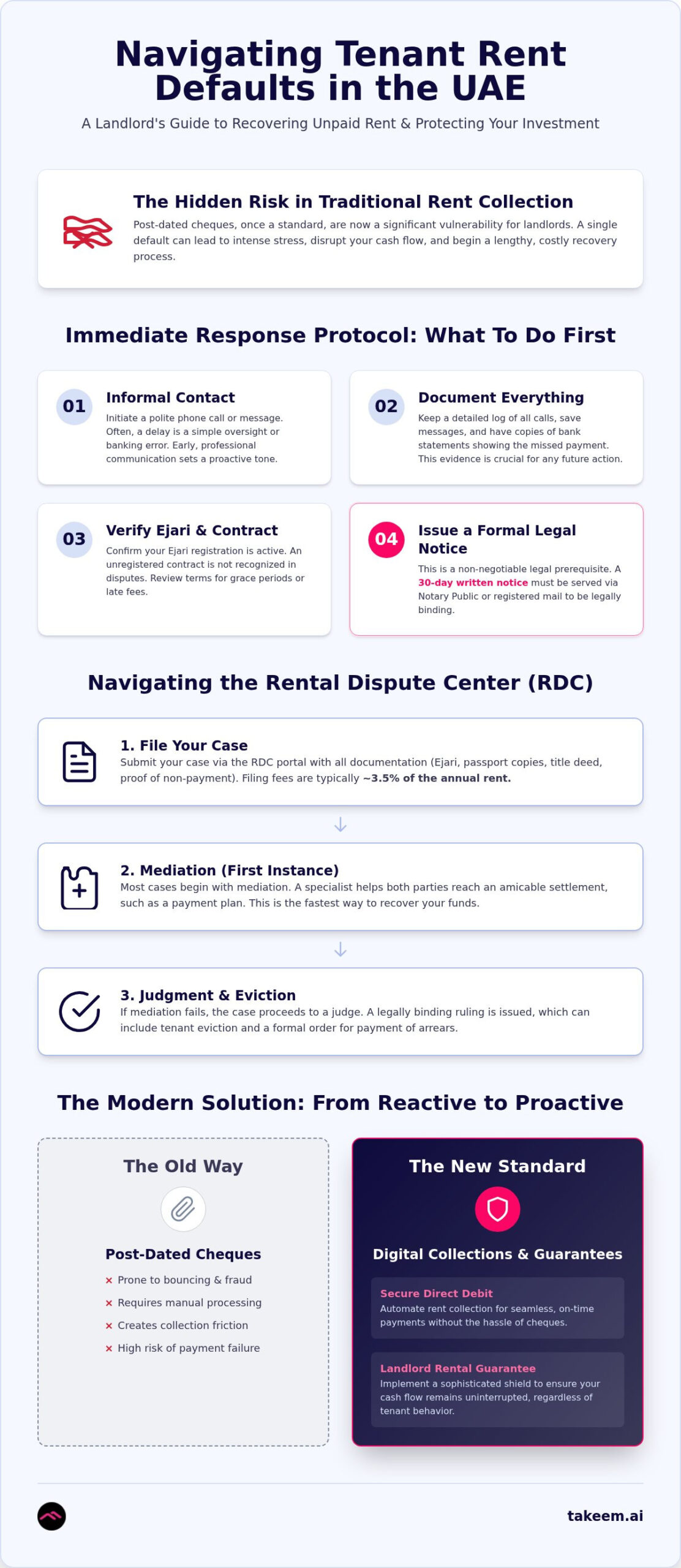
    What if the traditional post-dated cheque was actually the biggest vulnerability in your property portfolio? Dealing with a tenant not paying rent UAE is more than just a financial hurdle; it’s a source of intense stress that disrupts your cash flow and peace of mind. You’ve likely spent hours worrying about unresponsive tenants or the daunting costs of legal proceedings. We understand that your property is an investment that requires protection, not a source of constant friction.

    This guide provides the clarity you need to resolve current defaults and the strategy to ensure they don’t happen again. You’ll discover the exact legal steps for 2026, from understanding filing fees to mastering the mandatory 30-day notice period. We’ll walk you through the Rental Dispute Center process while showing you how to modernize your approach with digital collections and rental guarantees. By the end of this article, you’ll know how to recover unpaid rent quickly and how to implement a sophisticated shield that protects your monthly income from future uncertainty.

    Key Takeaways

    • Learn the critical first steps to take when dealing with a tenant not paying rent UAE, including the legal necessity of formal notice and Ejari verification.
    • Master the filing requirements for the Rental Dispute Center (RDC) to recover unpaid funds and navigate the 2026 fee structure with professional confidence.
    • Quantify the true financial impact of defaults by factoring in non-refundable filing fees and the hidden costs of property vacancy.
    • Modernize your portfolio by replacing outdated post-dated cheques with secure Direct Debit systems for seamless, automated rent collection.
    • Implement a sophisticated shield through a Landlord Rental Guarantee to ensure your cash flow remains uninterrupted regardless of tenant behavior.

    Initial Steps: What to Do the Moment Rent is Overdue

    A missed payment doesn’t always signal a crisis, but it does require immediate, methodical attention. Your first priority is to maintain professional composure while acting with speed. In the UAE, dealing with a tenant not paying rent UAE requires a balance of clear communication and strict adherence to national regulations. Don’t wait for weeks to pass. Start by initiating informal contact via a polite phone call or message. Often, a delay is simply the result of a technical banking error or a temporary oversight. By reaching out early, you establish a proactive tone and rule out simple mistakes before escalating the situation.

    If informal attempts don’t yield results, you must transition to a more structured approach. Document every interaction from day one. Keep a log of calls, save your messages, and ensure you have copies of all relevant bank statements showing the missing credit. This timeline serves as your primary shield if you eventually need to present your case to the authorities. Building a clear evidence trail now reduces friction and uncertainty later in the process.

    Verifying the Ejari and Contract Terms

    Before taking legal steps, you must ensure your administrative foundation is flawless. Your Ejari registration is the most critical document in this phase. Across the Emirates, a tenancy contract that isn’t registered with the appropriate authorities isn’t recognized for dispute resolution. Confirm that your registration is active and that the rental amount and payment dates perfectly match your current claim. Understanding the fundamentals of Landlord-tenant law is essential for any property owner facing a payment default. You should also review the “additional terms” section of your contract. Some agreements include specific grace periods or late payment penalties that dictate how soon you can proceed with a formal notice. Ensuring the tenant’s contact information is current for the legal service of notices is also vital.

    Issuing the Formal Legal Notice

    When informal communication fails to resolve the debt, you must issue a formal legal notice. This is a non-negotiable prerequisite for any future eviction or recovery case. According to established regulations, specifically Article 25(1) of the governing rental law, you must provide the tenant with a 30-day written notice to pay the overdue rent. This notice isn’t just a standard email; it must be served via a Notary Public or through registered mail to be legally binding. Your notice should clearly state the exact amount owed and the specific 30-day deadline for rectification. Always keep the original receipt and proof of delivery. These documents are your entry ticket to the local settlement committee. Without them, your case will likely be dismissed, causing further delays and loss of income.

    The Rental Dispute Center (RDC) serves as the primary judicial arm for resolving conflicts between landlords and tenants. When the mandatory 30-day notice period expires and the debt remains outstanding, this institution becomes your essential pathway to a formal resolution. It provides a specialized environment designed to handle non-payment cases with professional efficiency. Moving your case to the RDC signals that you’re prepared to enforce your rights through the proper legal channels, moving beyond informal requests to a structured judicial process that carries the weight of the law.

    Filing Your Case and Mediation

    Initiating a case requires you to submit an application through the official RDC portal using your digital identity, such as the UAE Pass. You must have your documentation ready for upload. This includes your active Ejari certificate, passport copies for both parties, the property title deed, and documented proof of the missed payments. National filing fees are typically calculated as a percentage of the annual rent, often around 3.5 percent, with established minimum and maximum caps. Additional administrative charges for process service and innovation fees also apply during this stage.

    Most cases begin in the mediation stage, often referred to as the “First Instance.” During these sessions, a mediator works with both parties to reach an amicable settlement. This is a crucial opportunity to recover funds without a full hearing. Common outcomes include a court-sanctioned payment plan or a full recovery of the arrears. If your goal is to resolve a situation involving a tenant not paying rent UAE, mediation is often the fastest way to restore your monthly cash flow while maintaining a professional relationship.

    The Eviction Process for Non-Payment

    If mediation doesn’t result in a settlement, the case proceeds to a judge who can issue a formal eviction order. The legal grounds for eviction are firmly established once the 30-day notice period expires without the tenant rectifying the default. Once you receive a favorable judgment, the Execution Department takes over the enforcement. They manage the physical handover of the property and ensure the tenant vacates the premises according to the court’s timeline. It’s often wise to consult with legal professionals during this phase to ensure every procedural requirement is met, as technical errors can cause frustrating delays.

    The entire RDC process, while effective, demands significant time and administrative effort. To avoid the stress of legal filings and the uncertainty of hearings, you might consider how to modernize your property portfolio by implementing digital collection systems and rental guarantees that protect your income from the very first day of the lease.

    Many landlords assume the only loss during a default is the missing monthly credit. This is a dangerous misconception. When you encounter a tenant not paying rent UAE, the financial bleeding extends far beyond the surface level of the debt. You’re facing a multi-layered drain on your resources that can take months to rectify. Understanding these costs is essential for any investor who wants to maintain a healthy bottom line in the 2026 market.

    You must account for the non-refundable filing fees at the Rental Dispute Center. As established, this is 3.5 percent of your annual rent. If you have a property renting for AED 150,000, you’re looking at a mandatory AED 5,250 outlay just to start the recovery process. For investors with mortgage obligations, this cash flow gap is compounded. You’re paying the bank out of pocket while your primary income source remains stagnant. There is also the “vacancy cost.” The legal process can take significant time, and during this period, the property is legally tied up. You cannot re-list it or move a paying tenant in until the execution order is finalized. This period of forced inactivity often costs landlords more than the original debt itself.

    Hidden Financial Drains

    Beyond the RDC fees, you must calculate the cost of legal representation and Notary Public services. While some landlords represent themselves, the complexity of current regulations often makes professional help necessary. There is also the risk of property neglect. Contentious non-payment periods sometimes lead to tenants ignoring maintenance issues or, in extreme cases, causing intentional damage. Proactively avoiding rental disputes in the UAE is the only way to shield your asset from these secondary risks. These hidden drains can quickly evaporate your annual yield.

    Opportunity Cost for Investors

    A single default can severely derail the ROI of a diversified property portfolio. It’s not just about the money; it’s about the “mental tax.” The hours spent drafting notices, attending mediation, and following up with the Execution Department represent time stolen from your growth strategy. You could be analyzing new acquisitions or optimizing existing yields. Instead, you’re stuck in administrative loops. In 2026, time is a landlord’s most valuable asset. Protecting that time requires moving away from reactive legal battles toward proactive, digital-first income security. A sophisticated investor knows that preventing a tenant not paying rent UAE is always more profitable than chasing one through the courts.

    Tenant Not Paying Rent in the UAE? A Landlord’s 2026 Guide to Resolution and Prevention

    Modern Prevention: Moving Beyond Traditional Cheques

    Legal recourse is a vital safety net, but the most successful landlords in the 2026 market focus on prevention rather than cure. Relying on post-dated cheques is a reactive strategy that often leaves you vulnerable to the very risks you’re trying to avoid. While cheques were once the standard for security, they’ve become a source of administrative friction and financial uncertainty. Transitioning to a digital-first approach allows you to eliminate the root causes of payment delays before they escalate into a legal crisis.

    Modern property technology platforms now offer a level of transparency and reporting that traditional methods simply can’t match. By digitizing your collection process, you gain a real-time view of your portfolio’s health. This proactive stance ensures that a tenant not paying rent UAE becomes a rare anomaly rather than a recurring threat to your stability. You’re not just collecting rent; you’re building a sophisticated shield around your investment.

    The Flaws of the Cheque System

    The traditional cheque system is riddled with manual vulnerabilities. Bounced cheques are a primary driver of landlord stress, often requiring police reports and lengthy bank follow-ups to resolve. Even when a tenant has the funds, simple human errors like signature mismatches or incorrect dates can trigger weeks of delays. This manual effort is a significant drain on your time. Furthermore, the risk of cheque fraud or lost documents adds an unnecessary layer of anxiety to every transaction. You can read more about the transition in our guide on modernizing UAE rentals: cheques vs Direct Debit. Moving away from this outdated model is the first step toward a seamless ownership experience.

    Direct Debit: The 2026 Standard

    Direct Debit has emerged as the gold standard for secure, automated rent collection. Unlike cheques, which require physical handling and manual deposit, Direct Debit pulls funds automatically from the tenant’s account on the exact due date. This system is fully integrated with national banking frameworks, ensuring a level of reliability that paper-based systems lack. It significantly reduces the administrative burden for both parties, creating a professional and frictionless relationship.

    Digital collection isn’t just about convenience; it’s a prerequisite for the most advanced financial protections available today. Most modern rental guarantees require a digital payment trail to remain valid. By implementing these systems, you ensure your income is protected by technology and backed by financial institutions. The broader shift toward landlord fintech solutions in the UAE is reshaping how property investors secure and automate their rental income in 2026. If you’re ready to secure your cash flow, you should set up Direct Debit today to experience the peace of mind that comes with automated, guaranteed payments. Eliminating the possibility of a tenant not paying rent UAE starts with changing how you accept those payments.

    The Takeem Solution: Guaranteed Income and Asset Protection

    Resolving a situation with a tenant not paying rent UAE doesn’t have to be a solo journey fraught with legal uncertainty. While previous sections detailed the friction of the RDC and the hidden costs of default, Takeem provides a streamlined alternative that eliminates these pain points. We act as a sophisticated shield for your property portfolio. By combining financial technology with robust income protection, we’ve created a modern standard for property ownership that prioritizes your peace of mind and financial stability. You’re no longer left waiting for a court order to restore your cash flow.

    How the Landlord Rental Guarantee Works

    The core of our platform is the Landlord Rental Guarantee. This isn’t just a service; it’s a commitment to your monthly stability. When a tenant defaults, the traditional landlord faces immediate financial strain and a long wait for judicial resolution. With Takeem, your rental income is protected. We ensure you receive your funds regardless of the tenant’s actions, effectively removing the risk of non-payment from your balance sheet. You can explore the mechanics in detail through The Ultimate Guide to Landlord Rental Guarantees.

    We also facilitate the transition to digital payments effortlessly. Our team handles the Direct Debit setup for you, moving your properties away from the vulnerabilities of paper cheques. For property investors with large portfolios, we offer bulk guarantee solutions that secure hundreds of units under a single, efficient framework. This scalability allows you to grow your investments without increasing your exposure to administrative stress. It’s the difference between managing a crisis and managing an asset.

    Preserving Value with Maintenance Coverage

    Asset protection extends beyond just the monthly credit. A vacant or contentious property is often a neglected one. To counter this, our package includes an integrated emergency property maintenance service. This provides 24/7 coverage for critical issues, ensuring that a broken pipe or electrical failure doesn’t escalate into a costly renovation project. By addressing problems the moment they arise, we preserve the long-term market value of your asset. Our service providers are vetted for speed and reliability, giving you a secondary layer of protection against property neglect.

    This dual-layered approach, protecting your income and your physical property, is what defines the modern landlord’s toolkit in 2026. You no longer have to choose between high yields and high stress. You can secure your rental income with Takeem today and transform how you manage your UAE property investments. Our goal is to make the experience of a tenant not paying rent UAE a historical footnote rather than a present-day crisis.

    Securing Your Future as a Modern UAE Landlord

    Managing a tenant not paying rent UAE doesn’t have to be a source of constant anxiety. While understanding the RDC process and the 30-day notice period is essential for immediate resolution, the long-term success of your portfolio depends on modernization. By replacing manual cheques with automated systems and securing your income through a professional guarantee, you eliminate the friction that traditional property management often creates. You’ve worked hard to build your portfolio; protecting it should be the simplest part of your strategy.

    Takeem offers a sophisticated shield designed for the 2026 market. You’ll receive guaranteed monthly income regardless of your tenant’s payment status. We also provide a seamless Direct Debit setup to replace outdated cheques and include emergency maintenance coverage to preserve your asset’s value. It’s time to move beyond the stress of defaults and focus on growing your investments with total confidence. Switch to Guaranteed Rent with Takeem today and experience the peace of mind you deserve. Your property is a vital asset; let’s keep it protected and profitable.

    Frequently Asked Questions

    What is the first thing a landlord should do if a tenant doesn’t pay rent in the UAE?

    Your first step should be initiating informal communication to rule out technical banking errors or simple oversights. If the tenant remains unresponsive, verify that your Ejari registration is active and review your contract for specific payment terms. This proactive approach helps resolve a tenant not paying rent UAE before it escalates. Always document these early interactions to establish a clear timeline for potential legal proceedings.

    How long does the eviction process take for non-payment of rent?

    The timeline typically begins with a mandatory 30-day formal notice period served via Notary Public. If the tenant doesn’t pay within this window, you can file a case at the Rental Dispute Center. Mediation usually occurs within a few weeks; however, a full eviction order and enforcement by the Execution Department can extend the total timeframe to several months. The exact duration depends on the court’s current schedule.

    Can I cut off utilities if my tenant is not paying rent?

    No, you cannot legally disconnect water, electricity, or other utilities as a means of pressure. Doing so violates UAE rental regulations and can result in significant penalties or legal action against you. The only legal path for resolution is through the official channels of the Rental Dispute Center. Landlords must follow the established judicial process to recover funds or regain possession of the property without resorting to self-help measures.

    What are the costs involved in filing a case at the Rental Dispute Center?

    Filing a case in 2026 involves a main fee of 3.5 percent of the annual rent. This fee has a minimum charge of AED 500 and a maximum of AED 20,000 for eviction or rent claims. You should also budget for administrative charges, including process service fees of AED 100 and innovation fees. If you file through a Real Estate Services Trustees Centre, additional VAT and service charges will apply to the total.

    Is a post-dated cheque still legally binding in the UAE?

    Post-dated cheques remain legally binding, but they’re increasingly viewed as an outdated security measure in the modern property market. Bounced cheques no longer carry the same criminal weight as in previous years, making them less effective as a deterrent. Most forward-thinking landlords are transitioning to digital Direct Debit systems. These systems provide a more secure, automated, and professional way to collect rent while reducing the administrative burden of physical cheque management.

    How does a rental guarantee protect me from tenant default?

    A rental guarantee acts as a sophisticated financial shield for your property portfolio. If a tenant defaults, a service like Takeem ensures you continue to receive your monthly income regardless of the tenant’s payment status. This protection eliminates the stress and cash flow disruptions associated with a tenant not paying rent UAE. Additionally, these packages often include emergency maintenance coverage, which helps preserve the long-term market value of your physical asset. If you want to understand exactly how to get a rental guarantee in Dubai and the wider UAE, our dedicated 2026 landlord guide walks you through every step of the process.

    What is the 30-day notice period for non-payment, and is it mandatory?

    Yes, the 30-day notice period is a mandatory legal requirement under Article 25(1) of the rental laws. You must serve this formal written notice via Notary Public or registered mail before you can initiate eviction proceedings. This period gives the tenant a final opportunity to rectify the default. If you fail to provide this notice or serve it incorrectly, the Rental Dispute Center will likely dismiss your case, causing significant delays and loss of income.

    Can I settle a rental dispute without going to court?

    You can absolutely settle a dispute through the Rental Dispute Center’s mediation stage, often called the First Instance. A neutral mediator works with both parties to reach an amicable agreement, such as a structured payment plan. This process is faster and less adversarial than a formal hearing. Many landlords find that professional mediation resolves the issue efficiently while restoring the cash flow needed to maintain their property investments without further legal conflict.