

What happens to your rental profit when a tenant misses a payment, and how long can your cash flow absorb the gap? For UAE landlords, tenant rent default risk UAE is more than an overdue instalment: arrears can build, reduce income available for expenses, and make it harder to predict when rent will arrive. A vacant property creates a different loss because there’s no tenant or rent to collect.
It’s reasonable to want dependable rental income, but no collection method or protection should be treated as a promise that default won’t happen. Understanding the difference between late rent, ongoing default, and vacancy helps you identify your exposure and assess what each option can and can’t address.
This guide explains how missed payments can reduce rental profit, compares practical ways to manage exposure across the UAE, and outlines what to check before choosing a rental guarantee or digital collection option. Direct Debit can streamline monthly rent collection without guaranteeing payment, while emergency maintenance coverage supports property care rather than replacing lost rent.
Key Takeaways
- Distinguish overdue rent, tenant default, and a void period to identify which income risk you’re facing.
- Trace how missed payments can affect rental profit alongside ongoing ownership and reletting costs.
- Assess tenant rent default risk UAE with a practical comparison of payment processes, digital collection, and rental guarantees.
- Review payment terms, cash-flow sensitivity, and records to make your exposure clearer before choosing protections.
- Check the terms and limitations of each option: Direct Debit supports collection, while a rental guarantee and emergency maintenance address different needs.
Tenant rent default risk in the UAE: what landlords should distinguish first
An expected rent payment hasn’t arrived. Is it a short delay, a growing arrears balance, or the start of a longer income gap? That uncertainty can make it difficult to plan for property expenses. To assess tenant rent default risk UAE landlords need to separate the missed payment, the tenant’s ongoing payment situation, and any period when the property has no tenant.
What counts as missed rent or tenant default?
A missed payment is a payment due under the tenancy agreement that hasn’t arrived when expected. Rent arrears are rent payments that remain unpaid and accumulate over time. Tenant default describes a failure to meet a contractual payment obligation, but whether a particular situation amounts to default, and what follows, depends on the agreement, circumstances, and applicable procedures.
One delayed instalment doesn’t automatically determine a legal outcome. Start with the records: check the payment dates and terms in the tenancy contract, confirm what has actually been received, and keep documented communications with the tenant. Landlords can review information about the Ejari registration system as part of understanding tenancy registration. Verify current requirements and any legal implications with authoritative UAE sources or qualified local counsel. Procedures can vary, so don’t assume the same steps apply in every situation.
How is tenant default different from a void period?
A void period is time when a property is between tenancies and generating no rent. By contrast, a tenant may still occupy the property while rent is overdue. Default may eventually lead to a vacant property, but that outcome and its timing aren’t automatic. Keeping the terms clear helps landlords assess whether the immediate concern is unpaid rent, lost rent between tenancies, or both.
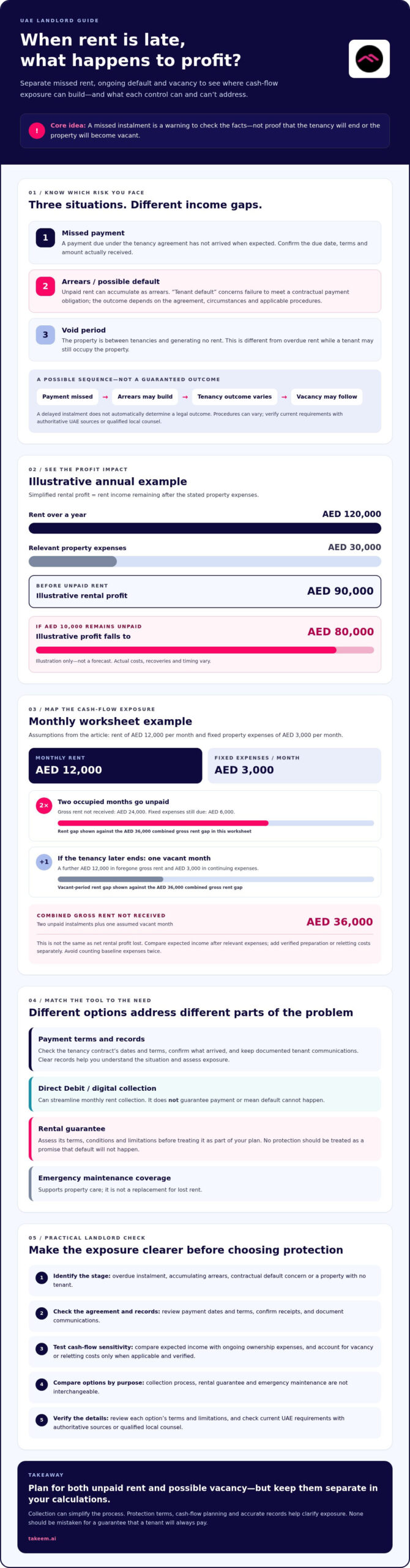
Hypothetical example: Suppose a property earns AED 120,000 in rent over a year and has AED 30,000 in relevant property expenses. Rental profit, simplified here as income remaining after those expenses, is AED 90,000. If AED 10,000 of rent remains unpaid and expenses are unchanged, the illustrative profit falls to AED 80,000. This example isn’t a forecast: actual costs, recoveries, and timing vary.
That distinction matters because ownership costs may continue whether rent is late or the property is empty. A void period can also involve costs to prepare the property for reletting. Treating arrears and vacancy as separate risks gives landlords a clearer basis for deciding what records, cash-flow planning, and protections to assess next.
How tenant default can reduce rental profit and create further exposure
A missed instalment is the start of a possible sequence, not proof that a property will become vacant. As payments remain outstanding, rent arrears may build. The landlord may follow up under the tenancy agreement and applicable procedures; the tenancy may then be resolved, continued, or eventually end. Only after it ends might a void period begin, and the timing depends on the circumstances and process. This distinction helps landlords assess tenant rent default risk UAE without treating every stage as a certain outcome.
Which financial effects should landlords include?
Separate the income you expected from cash obligations and any additional costs. Fixed ownership expenses may continue while rent is unpaid or the property is vacant. Include reletting costs only when they apply and can be verified. Use the following as an illustrative worksheet, not a market average or forecast:
- Assumptions: Monthly rent of AED 12,000; fixed property expenses of AED 3,000 per month.
- While occupied: Two instalments go unpaid. Gross rent not received is AED 24,000, while AED 6,000 in fixed expenses still falls due.
- If the tenancy later ends: Assume one further month without a tenant, adding AED 12,000 in foregone gross rent and AED 3,000 in continuing expenses.
- If verified: Add any actual, relevant property-preparation or reletting costs separately.
Under these assumptions, the missed and vacant-period rent totals AED 36,000 in gross income not received. That isn’t the same as net rental profit lost. Compare the amount with expected income after relevant expenses, and account separately for applicable additional costs. Don’t count ordinary expenses twice if they were already included in your baseline profit calculation. Individual properties and expense structures differ.
Lost rent during occupancy is unpaid income from a tenant still in the property; lost rent during a void period is income that can’t accrue because no tenancy is in place.
When can default turn into a void-period risk?
A tenancy ending can create a vacancy, but default doesn’t automatically end an agreement or set a move-out date. Include reletting time as a separate planning assumption, not a guaranteed consequence. For a fuller breakdown of the impact of missed rental payments, consult the published guide alongside your own records and property figures.
Planning can also start before a tenancy begins. The Etihad Credit Bureau tenant screening announcement is a useful reference when exploring screening options. Verify current availability and any applicable requirements before relying on a service. To compare a rental guarantee with digital rent collection, review Takeem’s rental-risk options and check the relevant terms for your circumstances.
Compare UAE rent-risk controls: payment collection, processes, and guarantees
No single measure addresses every source of rental-income uncertainty. A clear process helps landlords track obligations and respond consistently. Digital collection changes how payments are requested and received, while a rental guarantee may offer protection subject to its written terms. Compare each option against the specific exposure you want to manage rather than assuming that any one of them prevents tenant default.
| Control | Purpose and potential benefit | Limitations and questions to verify |
|---|---|---|
| Landlord processes | Keep payment terms, due dates, records, and communications organised. This can make it easier to spot an overdue payment and know what to check next. | Good records don’t recover rent by themselves. Check what the tenancy agreement says, what procedures apply, and which notices or documents may be relevant. Verify legal steps with current authoritative UAE sources or qualified local counsel. |
| Digital collection | Provides a digital way to collect monthly rent. Direct Debit setup can replace post-dated cheques as a collection method and may make payment tracking more straightforward. | It doesn’t guarantee successful collection or prevent default. Ask how setup works, what happens if a payment isn’t collected, and what records are available. Confirm the process with the provider. |
| Rental guarantee | May provide a defined form of protection for landlords, depending on the product’s terms and the landlord’s eligibility. | Coverage, exclusions, claim evidence, and payment conditions can differ. Review the current written terms and ask how arrears, tenancy changes, and periods without a tenant are treated. |
What can digital rent collection change?
Takeem’s Direct Debit setup lets landlords digitally accept monthly tenant payments. Compared with post-dated cheques, it changes the collection method, not the underlying payment obligation. A scheduled digital collection can still fail, so landlords should continue to monitor records and follow their agreed process. For more detail, see the published guide to modernising UAE rent collection with Direct Debit.
What should landlords verify in a rental guarantee?
Read the current written terms before treating a guarantee as a fit for your tenant rent default risk UAE plan. Confirm covered events, eligibility, exclusions, required claim evidence, and payment conditions. Ask specifically how the arrangement handles accumulated arrears, changes to a tenancy, and any time when the property has no tenant. For context, consult the published UAE guide to landlord rental guarantees, then compare its explanation with the terms offered to you.
These controls can complement one another, but they serve different purposes. A landlord might use organised records to manage follow-up, digital collection to handle monthly payments, and separately assess whether a rental guarantee matches their exposure. Compare the practical details before choosing. Don’t assume a collection tool provides income protection or that a guarantee covers every period or loss.
A practical UAE checklist for assessing tenant default exposure
A useful review turns uncertainty into decisions you can document. Before a tenancy begins, assess the payment arrangement and your ability to absorb disruption. If a payment is missed, verify the facts and follow the relevant agreement and procedures rather than acting on assumptions. This checklist can help UAE landlords assess tenant rent default risk UAE without treating any outcome as inevitable.
What should landlords review before a tenancy begins?
Start with the paperwork and cash flow. Check the tenancy agreement, rent amount and due dates, payment method, and how you and the tenant will communicate about payment questions. Confirm that relevant registrations and records are in order for your circumstances. For tenant checks or other safeguards, seek qualified UAE guidance on what’s lawful and appropriate.
- Payment terms: Note when rent is due, how it should be paid, and what the agreement says about a missed instalment.
- Documentation: Set up a clear record of the agreement, payment dates, receipts, notices, and landlord-tenant communications.
- Cash-flow sensitivity: Test several scenarios using your actual figures. For example, model one missed instalment, several unpaid instalments, and a separate period with no tenant. Include continuing property expenses and any reletting costs you can verify. These are planning scenarios, not predictions or typical UAE outcomes.
- Available protections: Compare collection methods and any rental guarantee against the specific risks you want to address. Review current written terms, including eligibility, exclusions, evidence, and payment conditions.
What should landlords do after a payment is missed?
First, check the bank or collection record against the payment schedule in the tenancy agreement. Contact the tenant with a clear, factual message, then retain dated copies of the communication and any response. Record the amount outstanding and update the payment history. If a notice or formal step may be required, verify the applicable procedure with a qualified UAE professional. Don’t rely on assumed timelines or attempt self-help measures.
Next, revisit your cash-flow scenarios. Separate rent still outstanding from costs that continue, and consider vacancy only if the tenancy ends. If you have a rental guarantee, check its claim process and required evidence promptly against the current written terms. A collection service can support the payment process, but it doesn’t itself guarantee successful collection.
Quick checklist: Prevention means reviewing terms and appropriate checks; collection means tracking payments and keeping dated records; income protection means assessing written guarantee terms; vacancy planning means modelling reletting time separately from arrears.
If you’re comparing protections, review Takeem’s rental guarantee and Direct Debit options and confirm which terms fit your circumstances.
How Takeem’s rental guarantee and digital collection fit into a landlord’s plan
Once you’ve mapped your exposure and reviewed the available controls, assess whether a provider’s services fit your rental plan. Takeem serves individual landlords and property investors with large portfolios across the UAE. Its service categories include landlord rental guarantees, digital monthly rent collection through Direct Debit, and emergency property maintenance as part of the rental guarantee service.
These options address different needs. Direct Debit provides a digital method for accepting monthly rent, but it doesn’t prevent default or guarantee successful collection. Assess a rental guarantee against its written terms and your own risk scenarios. Emergency maintenance supports property care; don’t assume it covers rent losses.
Which landlord situations may warrant exploring a rental guarantee?
Landlords who want to assess ways to manage the financial impact of missed rent may wish to compare rental guarantees with their cash-flow needs. This may include an individual landlord with limited capacity to absorb an income interruption or an investor reviewing exposure across a larger portfolio. Neither situation means a particular product is automatically suitable. Compare the actual written coverage with scenarios you’ve modelled, including arrears and any possible period without a tenant.
What should landlords ask before taking the next step?
Request current details before deciding. Ask what events are covered, who is eligible, what exclusions apply, what evidence a claim requires, and how payment conditions work. Clarify how the terms address arrears, tenancy changes, and vacancy. These details determine whether the arrangement matches your tenant rent default risk UAE plan. Don’t rely on a general description in place of the current agreement.
For Direct Debit, confirm how setup works, what information or authorisation is required, how payment activity is recorded, and what responsibilities remain with you if a collection doesn’t go through. Keep your own tenancy and payment records, and verify any applicable legal or procedural questions with qualified UAE professionals. A digital process may simplify collection, but it doesn’t replace those responsibilities.
Check the fit for both your property and portfolio needs. Review the terms, limitations, and process before making a decision, and compare them with your own cash-flow assumptions rather than expecting a particular outcome.
Explore Takeem’s rental guarantee and digital rent collection to review the available service information and assess whether it suits your circumstances.
Build a rental plan around the risks you can control
Protecting rental profit starts with clear distinctions: arrears are unpaid rent, while a void period is time without a tenant. They affect income in different ways. Tenant rent default risk UAE landlords face is best assessed by looking at payment terms, records, ongoing expenses, and possible vacancy separately.
Landlord processes, digital collection, and rental guarantees serve different purposes. Direct Debit can support monthly rent collection, but it doesn’t guarantee payment. Before choosing a rental guarantee, check current eligibility, covered events, exclusions, claim evidence, and payment conditions against your own cash-flow scenarios.
Takeem offers rental guarantee services to landlords and property investors across the UAE, supports digital monthly rent collection through Direct Debit, and includes emergency property maintenance as part of its rental guarantee package. Verify current service terms, including the maintenance scope, before deciding whether the options fit your needs.
To compare the available options, explore Takeem’s rental guarantee and digital rent collection and review the service information for your circumstances.
Frequently Asked Questions
What is tenant rent default risk for a UAE landlord?
Tenant rent default risk UAE landlords face is the possibility that a tenant doesn’t pay rent as agreed, reducing the income available for property expenses and affecting cash flow. A missed instalment is a payment event; arrears are rent that remains unpaid, while default depends on the agreement and circumstances. This risk is distinct from a void period, when the property has no tenant and isn’t generating rent.
How can a missed rent payment affect rental profit?
A missed rent payment can reduce rental profit because expected income is lower while relevant ownership expenses may continue. If rent is due but not received, calculate the unpaid amount separately from recurring property costs and any verified expenses associated with reletting. Don’t treat gross rent not received as the same as net profit lost. The actual impact depends on your income, expenses, timing, and any later recovery.
Is a tenant default the same as a void period?
No. Tenant default concerns a failure to meet a payment obligation under the tenancy agreement, while a void period is time when the property is between tenancies and earning no rent. A tenant may remain in occupation while rent is overdue, so default doesn’t automatically mean the property is vacant. A tenancy ending may lead to a void period, but whether and when that happens depends on the circumstances and applicable process.
Can Direct Debit prevent a tenant from defaulting on rent?
No. Direct Debit changes how monthly rent is collected; it doesn’t ensure that a payment will be made or prevent a tenant from defaulting. It gives landlords a digital collection method, and Takeem offers Direct Debit setup for accepting monthly tenant payments. Landlords should still monitor collection records, check the tenancy’s payment terms, and follow up appropriately if a payment doesn’t arrive.
What should a UAE landlord check in a rental guarantee?
Review the current written terms before deciding whether a rental guarantee suits your circumstances. Check covered events, eligibility, exclusions, required claim evidence, the claims process, and payment conditions. Ask how the arrangement treats accumulated arrears, tenancy changes, and periods when the property has no tenant. Compare those details with your own cash-flow scenarios, and seek clarification rather than relying on broad descriptions or assuming every loss is covered.
What should I do when a tenant misses a rent payment in the UAE?
Check your payment records and tenancy agreement first, then contact the tenant with a clear, factual message. Keep dated records of the missed payment, notices, agreements, and communications. Avoid assuming that one delay determines a legal outcome, and don’t take self-help action based on general advice. If you’re considering a formal step, verify the current procedure with a qualified UAE professional, since applicable requirements can depend on the circumstances.
Can a rental guarantee cover a vacant property or void period?
It depends on the specific guarantee’s written terms, so don’t assume a vacant period is covered. Ask the provider directly whether protection applies to unpaid rent while a tenant remains in the property, time after a tenancy ends, or both. Confirm eligibility, exclusions, claim evidence, and payment conditions in writing. This distinction matters because arrears and rent foregone while a property is vacant are separate exposures.