

What if a missed rent payment is only the first sign of a wider risk? For UAE landlords, income gaps, delayed maintenance and manual payment follow-up can quickly put pressure on cash flow and property condition. Effective landlord risk management solutions connect these issues instead of treating each one as an isolated problem.
It’s understandable to focus first on rent arriving on time. A reliable plan also needs clear records, consistent collection processes and timely responses when a property needs attention. Prioritise risks by how they could affect your income or asset, and by how much control you have over them.
This guide sets out a practical framework for assessing risks and building repeatable processes across your portfolio. You’ll learn how to organise documentation, strengthen rent collection and respond to maintenance needs, and where digital Direct Debit and a rental guarantee can support a broader approach. Takeem provides landlords with a rental guarantee that includes emergency property maintenance, alongside Direct Debit setup for monthly rent collection. These services address specific pressure points and can fit into a wider risk plan.
Key Takeaways
- Prioritise risks by their potential effect on rental income and property condition. Separate issues you can control from those you can only prepare for.
- Use a simple risk register to record each exposure, its likelihood and impact, the control in place, who owns the next step and when to review it.
- Compare landlord risk management solutions by the specific risk they address, and understand the limits of each control.
- Build repeatable routines for payment records, issue escalation and planned maintenance before and during each tenancy.
- Consider how digital monthly rent collection and a rental guarantee with emergency maintenance can support a broader landlord risk plan.
Landlord Risk Management in the UAE: What Can Put Rental Income and Property at Risk?
Landlord risk management is the process of identifying, prioritising and reducing threats to rental income and property condition. For UAE landlords, it means looking beyond one missed payment or repair and understanding how everyday processes connect. If payment records are hard to follow, it may take longer to spot a gap and act. If a property issue has no clear owner, follow-up can stall. Incomplete records make it harder to understand what happened and decide what to do next.
Some risks are shaped by events outside a landlord’s control. A tenant’s circumstances may change, or an unexpected incident may affect a property. Other exposures come from processes landlords can strengthen, such as keeping payment records, setting a clear route for reporting issues and tracking maintenance follow-up. Good risk planning reduces avoidable gaps and prepares you to respond to situations you cannot prevent.
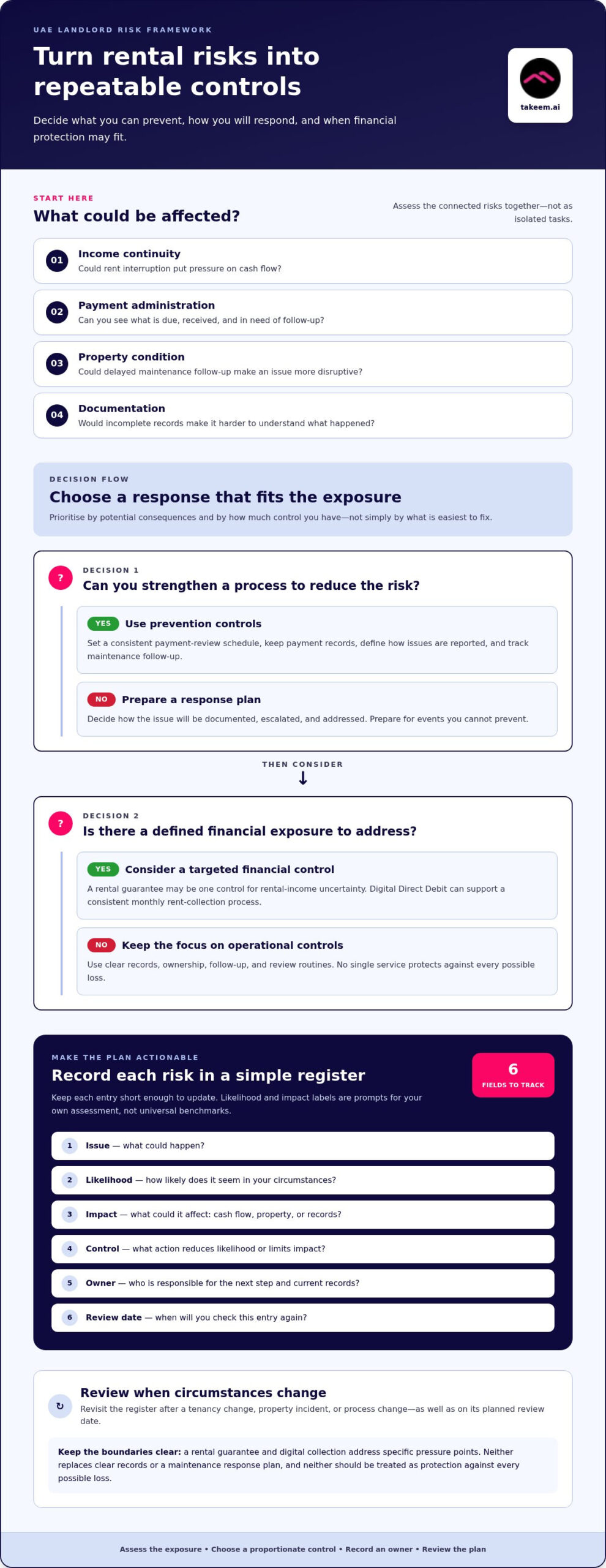
The principles behind Risk management apply here: identify what could happen, consider its consequences and choose a proportionate response. For a rental property, assess four connected areas: income continuity, payment administration, property condition and documentation. For example, a missed payment needs both a clear record and a follow-up process. Reviewing these areas together helps reveal gaps a single-task checklist might miss.
Which risks matter most to UAE landlords?
Rent interruption can put pressure on cash flow, but missed payments can have different causes and shouldn’t all be handled in the same way. Manual collection can make it harder to see what is due, what has arrived and which payments need follow-up. Incomplete records can slow down a review of payment history or property issues. A delayed maintenance response may also allow a manageable problem to become more disruptive.
The impact depends on the circumstances. A landlord with one property may experience an income gap differently from an investor overseeing several leases, where the same administrative weakness can recur across a portfolio. Property condition, tenancy arrangements and the processes already in place also affect which risks deserve attention first. Start with the exposure that could have the greatest effect, not simply the task that is easiest to fix.
Risk management is broader than insurance or a guarantee
Think in three layers: prevention means improving processes before problems arise; response planning means deciding how to document, escalate and address an issue; and financial protection means considering tools that may help with a defined financial exposure. A rental guarantee can be one control for rental-income uncertainty, while digital monthly collection can support a consistent payment process. Neither replaces clear records or a maintenance response plan, and no single service should be treated as protection against every possible loss.
The UAE is a national rental market, but tenancy procedures can differ by emirate and may change. Keep operational risk planning distinct from legal assumptions, and verify current local procedures against authoritative sources before acting on a tenancy matter.
How UAE Landlords Can Build a Practical Rental Risk Framework
A practical framework turns risk awareness into routine action. It doesn’t need complex software: a clear process and a simple register can show what needs attention, who owns the next step and when to review it. This approach can work for an individual landlord or a portfolio investor. Use this five-step workflow:
- List exposures. Note where income, property condition or records could be affected, such as missed payments, delayed maintenance follow-up or incomplete payment tracking.
- Estimate impact. Consider the possible effect on cash flow, the property and your ability to understand or document decisions. Use plain labels such as low, medium or high rather than treating an invented score as an industry standard.
- Select a control. Choose a practical action that reduces the likelihood of an issue or helps limit its impact. For example, set a consistent schedule for reviewing payments and a documented follow-up process for gaps.
- Assign an owner. Name the person responsible for carrying out the control and keeping its records current.
- Set a review date. Revisit the entry after a tenancy change, property incident or process change, as well as on its planned review date.
Prioritise risks by their consequences, not just by how easy they are to fix. A risk that could disrupt income across several properties may deserve attention before a minor administrative gap affecting one tenancy. The most useful landlord risk management solutions address a clear exposure and fit into a repeatable process.
Create a rental-property risk register
Keep each entry short enough to update. Record the issue, likelihood, impact, control, responsible person and next review date. These labels are prompts for your own decisions, not universal benchmarks.
- Issue: Rent payment is missed.
- Likelihood / impact: Medium / high, based on your assessment.
- Control: Check payment records regularly and follow a documented route for recording and following up on a missed payment.
- Owner / review: Assigned landlord or authorised representative / next scheduled review date.
This format makes open actions visible and gives you a consistent way to compare risks across properties. Update an entry when circumstances change, rather than relying on memory or scattered notes. If the same issue appears repeatedly, review whether the control is being followed or needs to change.
Keep tenancy and payment records organised
Store relevant tenancy contracts, payment records, maintenance requests, work updates and communications in a consistent, accessible structure. Clear records help you spot payment patterns, distinguish completed tasks from outstanding ones and follow the sequence of decisions if an issue develops. Use a consistent file-naming approach or record format so that a payment or maintenance entry can be connected to the relevant tenancy and follow-up.
To support a documented payment process with digital monthly collection, explore landlord rental guarantee and Direct Debit options as part of your wider framework.
Compare Landlord Risk Management Solutions by the Risk They Address
Choose controls by the exposure you need to manage, then combine them where risks overlap. Documentation helps clarify what happened, a payment process makes collection easier to track, and maintenance follow-up supports property care. A rental guarantee may help address income uncertainty, subject to its terms. Each control manages or reduces a particular exposure; none removes every risk.
Use this comparison as a starting point. The right mix depends on the property, the landlord’s capacity to manage follow-up and the scale of the portfolio.
| Risk addressed | How the control helps | Limitations |
|---|---|---|
| Unclear or incomplete records | Organised tenancy, payment, maintenance and communication records make decisions and open actions easier to review. | Records support understanding and follow-up, but don’t prevent an incident or guarantee a particular outcome. |
| Inconsistent payment administration | A regular collection process, including digital monthly collection through Direct Debit instead of post-dated cheques, can make payments easier to track. | A collection method doesn’t remove the possibility of a missed or unsuccessful payment. Follow-up and clear records still matter. |
| Property issues requiring attention | A documented reporting and escalation route helps clarify who will act and what needs follow-up. | Response processes can support property care, but can’t prevent every fault or determine the outcome of every repair. |
| Rental-income uncertainty | A rental guarantee may provide a financial control for landlords concerned about income continuity. | Its application depends on the guarantee’s terms. Don’t assume every missed payment, dispute or loss is covered. |
Rental guarantees and income continuity
A rental guarantee is one possible part of a wider plan, not a substitute for payment records, tenancy documentation or a clear follow-up process. Consider how it relates to the specific income risk you want to manage, and understand that protection is subject to the service terms. Takeem’s rental guarantee includes emergency property maintenance as part of the offering. This can bring income protection and an element of property care into the same service, while leaving landlords responsible for their wider records and oversight.
Digital collection and property-care controls
Direct Debit supports digital monthly rent collection instead of relying on post-dated cheques. It can create a consistent collection process alongside payment tracking and follow-up. Pair the collection routine with a clear route for logging property issues and tracking actions. Explore the guide to rental guarantees and Direct Debit for more detail. To consider how these controls fit together, review Takeem’s landlord rental guarantee and Direct Debit options.
A Landlord Risk Management Checklist for UAE Rental Properties
A checklist makes good intentions repeatable. Use the stages below to connect payment administration, property care and records, whether you oversee one rental or a growing portfolio. Treat it as an operational guide, not a substitute for checking current tenancy requirements with authoritative UAE sources relevant to the property.
Before a tenancy
- Organise key information. Keep the tenancy contract, agreed payment details and relevant property information together in a secure, accessible record system. Limit access to authorised parties.
- Set the payment routine. Decide how incoming payments will be recorded, reviewed and followed up. Identify who checks payment status and where outstanding queries will be logged.
- Plan issue escalation. Write down how a property issue is reported, how its priority is assessed, who is responsible for the next action and how follow-up is recorded.
- Plan maintenance follow-up. Note any known property-care actions and establish a way to track reported issues through to an update or recorded outcome.
- Check local requirements. Verify relevant tenancy procedures using current, authoritative sources. Avoid relying on an old checklist when rules or circumstances may have changed.
During a tenancy
Keep the routine visible and consistent. Record payments as they arrive, note gaps or questions, and document follow-up rather than relying on memory. Log maintenance reports with the date received, action owner, status and next follow-up. Clear records make it easier to see what remains unresolved and help prevent separate tasks from slipping between people.
- Review incoming payments and open queries on a regular schedule.
- Record relevant tenant communications and decisions alongside the related payment or property issue.
- Update maintenance entries as actions progress, including planned follow-up.
- For multiple properties, use a consistent record format so emerging patterns are easier to compare across the portfolio.
Review when circumstances change
Revisit your controls after a payment disruption, urgent repair, tenancy change or portfolio expansion. Ask whether the response was clear, whether records captured key decisions and whether responsibilities were understood. If similar issues recur, prioritise the process creating the greatest exposure to cash flow, property condition or incomplete documentation. These practical landlord risk management solutions work best when reviewed and adjusted, not filed away after setup.
Use the checklist alongside any wider income-protection plan. A rental guarantee can be one part of that plan, while digital monthly collection can support a consistent payment routine. Explore rental guarantee and Direct Debit options for your landlord risk plan.
How Takeem Fits into a Broader UAE Landlord Risk Plan
Takeem’s services support specific parts of a landlord’s risk plan, while documentation, payment oversight and regular reviews remain important landlord-led controls. A rental guarantee can help address rental-income uncertainty, and emergency property maintenance is included as part of Takeem’s rental guarantee service. These measures can sit alongside clear records and defined processes without being treated as protection against every possible loss.
Connect income protection with a clear payment process
For landlords moving away from post-dated cheques, Takeem provides Direct Debit setup for digital monthly rent collection. A defined collection process can make payments easier to track and outstanding items easier to follow up, especially when records are kept consistently. Landlords should continue to monitor payment activity and document decisions.
Income protection and payment administration address different parts of the same exposure. A rental guarantee may support income continuity, subject to its terms; a regular collection process helps keep payment activity visible. Read this UAE guide to rental-income protection and disputes for more context.
Choose a next step that matches your property setup
An individual landlord may consider a rental guarantee when income continuity is a priority. Investors with larger portfolios can consider how consistent payment collection and risk oversight can work across multiple properties. Real estate agents can partner with Takeem to offer rental guarantee solutions to landlord clients. In each case, the service should fit within a wider plan that tracks payments, records property issues and reviews changing risks.
Landlord risk management solutions work best as a connected system, not a single fix. If a rental guarantee or digital monthly collection could support your current approach, explore Takeem’s landlord solutions.
Make Your Rental Risk Plan Work for You
Strong landlord risk management solutions work together: clear records make payment and maintenance activity easier to track, regular reviews help you spot changing exposures, and carefully chosen controls can reduce pressure on rental income and property condition. No single measure removes every risk, so build a plan around your property, your capacity and your portfolio.
Takeem supports individual landlords and investors with larger portfolios through rental guarantee services, digital monthly rent collection via Direct Debit, and emergency property maintenance as part of its rental guarantee service. These options can complement, rather than replace, your own documentation, payment oversight and review routine.
If you’re ready to explore how these services could fit your rental setup, explore Takeem’s rental guarantee and digital collection solutions. Start with the risks that matter most to you, then strengthen your process one practical step at a time.
Frequently Asked Questions
What are landlord risk management solutions?
Landlord risk management solutions are processes and services that help identify, prioritise and manage threats to rental income and property condition. They can include organised tenancy and payment records, a consistent rent collection process, planned maintenance follow-up and financial protection such as a rental guarantee. Each control addresses particular exposures, so landlords should combine practical measures rather than expect one solution to prevent every issue or loss.
How can landlords protect rental income in the UAE?
Landlords can support income continuity by keeping clear payment records, setting a regular collection and follow-up routine, and reviewing unresolved payment issues. Digital monthly collection can make payment administration more consistent, while a rental guarantee may provide another form of support, subject to its terms. Maintain relevant tenancy and communication records, and verify current local tenancy procedures using authoritative UAE sources before taking action on a tenancy matter.
Can landlords in the UAE collect rent through Direct Debit instead of cheques?
Yes. Takeem helps landlords move from post-dated cheques to digital monthly rent collection through Direct Debit setup. A defined collection process can make it easier to track expected and received payments and identify items that need follow-up. Landlords should continue recording payment activity and outstanding queries as part of their wider income oversight. Direct Debit supports collection administration; it doesn’t remove the need to monitor payments.
Does a rental guarantee cover every landlord risk?
No. A rental guarantee is one possible control for rental-income uncertainty, and its application depends on the service terms. Don’t assume it covers every missed payment, dispute, property issue or financial loss. Landlords can use it alongside clear records, regular payment oversight and a documented maintenance response process. Review the terms to understand the protection provided, then identify any risks that still need separate controls.
How should landlords manage emergency property maintenance risk?
Set a clear route for reporting property issues, assessing priority, assigning responsibility and tracking follow-up. Keep a record of the reported issue, communications, actions and current status so unresolved work remains visible. A timely, documented response supports ongoing property care, though it can’t prevent every fault or guarantee a particular outcome. Takeem includes emergency property maintenance as part of its rental guarantee service.
What should landlords include in a rental property risk register?
Record each risk, its likelihood and potential impact, the control in place, the responsible person and the next review date. For a missed-payment risk, an entry might note a regular payment review and a documented follow-up route. Use simple labels such as low, medium or high based on your own assessment, rather than treating them as universal scores. Update entries when circumstances or controls change.
How often should a landlord review their risk management plan?
Set a recurring review schedule that suits your property or portfolio, and revisit the plan whenever circumstances change. Useful triggers include a tenancy change, payment disruption, urgent repair, a change to collection or maintenance processes, or portfolio growth. Check whether controls were followed, records are complete and open actions have an owner. For tenancy procedures, verify current requirements with authoritative sources relevant to the property’s location in the UAE.