
Tag: Direct Debit UAE

  • Rent Management for UAE Landlords: 2026 Practical Guide

    Rent Management for UAE Landlords: 2026 Practical Guide

    Rent management isn’t one job. Treating it as one can leave gaps in records, follow-ups and income protection. For rent management for landlords UAE-wide, separate the key tasks: collecting rent, caring for the property and managing the risk of missed payments.

    If you’re juggling payment dates, tenant reminders and scattered records, the pressure is familiar. A useful system makes rent status easier to see without adding unnecessary administration. This practical 2026 guide explains the core responsibilities, compares self-management, digital payment tools and property-management support, and helps you choose an approach for a single property or a growing portfolio.

    You’ll also see how to modernise monthly collection while keeping your existing property-management arrangements. Takeem supports digital rent collection through Direct Debit setup and provides rental-income protection through its Landlord Rental Guarantee, which includes emergency property maintenance coverage. These services can make payment tracking more structured and support rental income, while each responsibility stays clear.

    Key Takeaways

    • Separate rent administration from leasing, tenant relations, repairs and broader property-management responsibilities to identify gaps in your process.
    • Set a consistent workflow for recording payment schedules, tracking receipts, reconciling records and following up on exceptions.
    • Compare self-management, software, full property management and specialist support by control, time, visibility and operational scope.
    • For rent management for landlords UAE-wide, choose a process that matches your property count and gives you a reliable routine for reviewing payments.
    • Keep your existing management arrangements while considering focused support for digital rent collection or rental-income protection.

    What rent management for UAE landlords actually includes

    Rent management is the organisation of rental payment schedules, collection, records and follow-up. It gives a landlord a clear way to see what is due, what has arrived and what still needs attention. For rent management for landlords UAE-wide, distinguish this payment process from the broader work of leasing a property, maintaining tenant relationships, arranging inspections or coordinating repairs.

    These activities can connect, but they are not interchangeable. A property manager may oversee several aspects of a rental, while rent management focuses on the movement and documentation of rent. Understanding Property Management provides useful context: property management covers a wider set of responsibilities, with rent administration as one possible part.

    Which rent-management tasks remain the landlord’s responsibility?

    Whether you handle the work personally or delegate it, each core task needs a clear owner. Use this checklist to establish who does what:

    • Set and communicate the agreed payment schedule.
    • Monitor incoming payments against expected dates and amounts.
    • Keep organised records of rent due, rent received and any outstanding balance.
    • Follow up with the tenant when a payment appears overdue or a record needs clarification.

    Landlords decide how much of this work to manage themselves and how much to assign to a property manager or another support service. Delegation doesn’t remove the need for visibility: owners and investors still benefit from knowing which payments have been recorded and which issues need attention. Assign responsibility for recording receipts and following up on exceptions, so nothing falls between roles.

    Rent management versus property management

    Rent management centres on payment administration. Full property management can extend to tenant communication, leasing coordination, inspections and maintenance coordination. The exact scope depends on the arrangement, so define which person or service handles each task. Software may help organise payment information, but using a digital tool doesn’t automatically assign responsibility for tenant communication, repairs or property decisions.

    Rent collection tracks and records rental payments; full property management coordinates the wider operation of a property. Keeping that distinction clear helps prevent gaps, such as assuming that a payment tool will also handle a maintenance request. It also helps landlords identify the support they need: a simpler collection process, broader operational assistance, or separate arrangements for both.

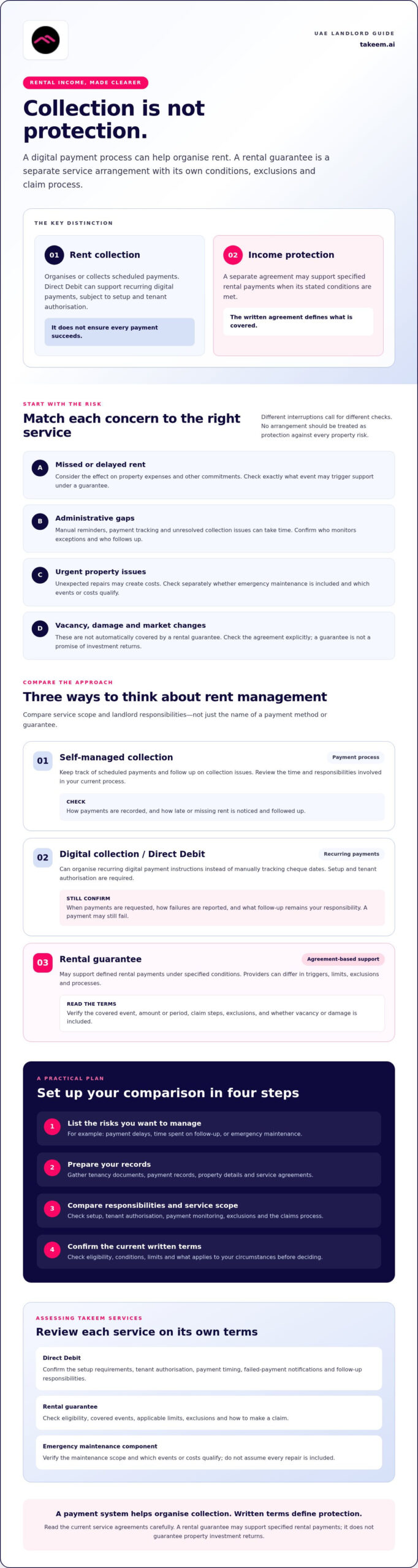
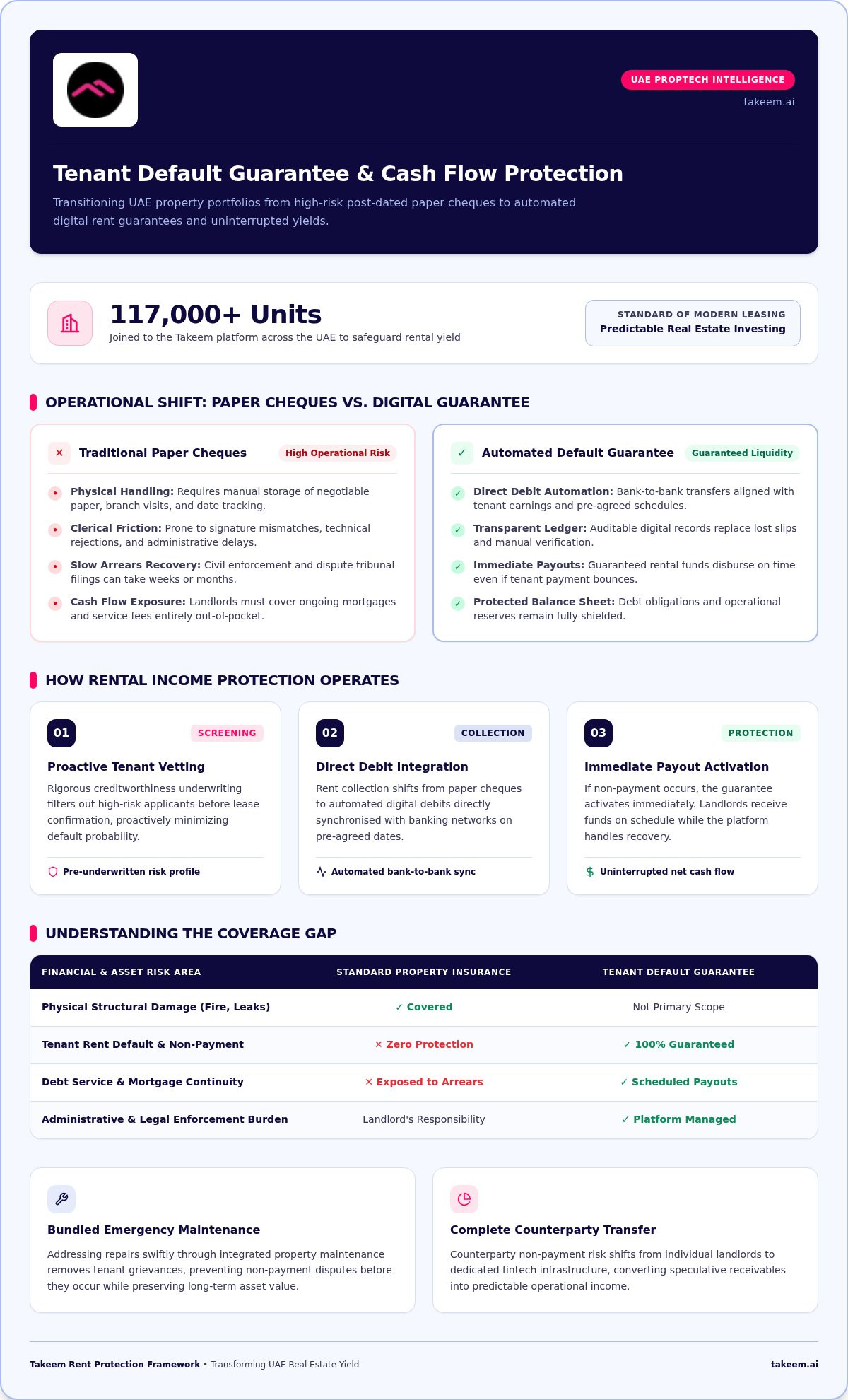
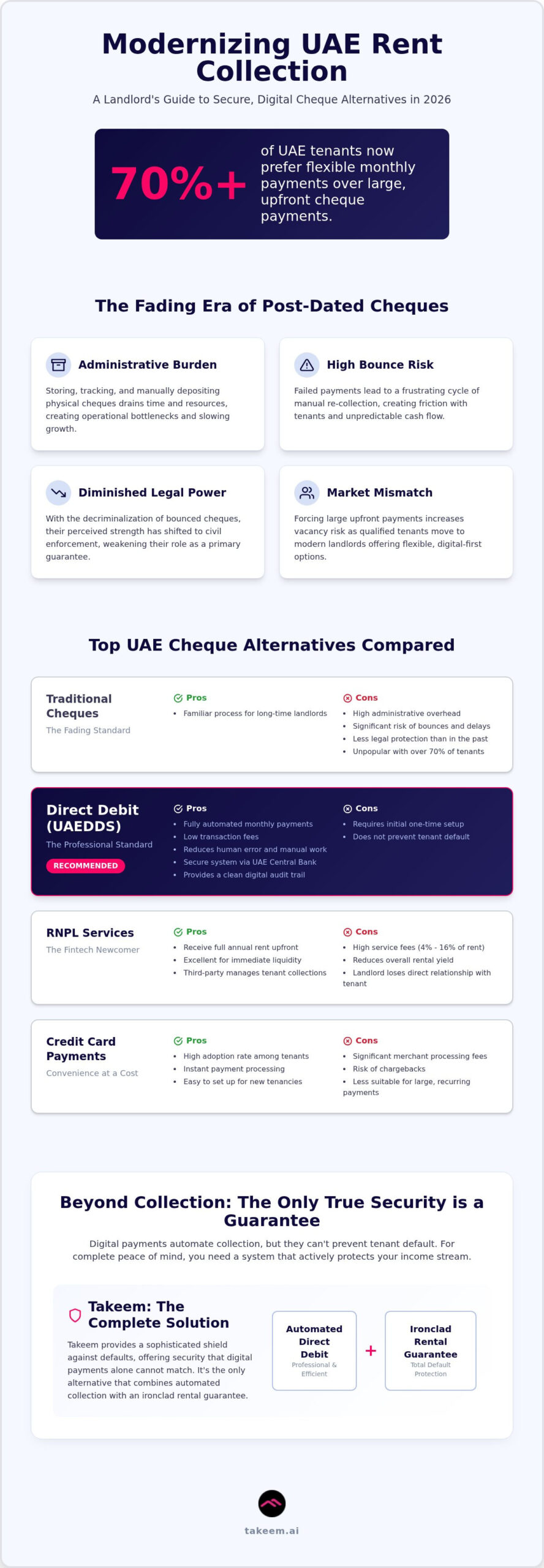
    Digital rent collection and rental-income protection address different needs. Digital collection changes how payments are accepted and recorded; it doesn’t, by itself, protect rental income if a payment is missed. Takeem offers Direct Debit setup for landlords to accept monthly rent digitally as an alternative to post-dated cheques, as well as a Landlord Rental Guarantee that includes emergency property maintenance coverage. Landlords can assess each service separately while retaining their existing property-management arrangements.

    How a rent-management system works from payment setup to records

    A reliable system turns rent collection into a repeatable cycle rather than a series of reminders and scattered notes. Whether you use cheques or digital collection, keep the agreed payment arrangement, incoming payments and follow-up records connected. This makes expected income easier to review and helps you catch a missing entry before it becomes a larger record-keeping problem.

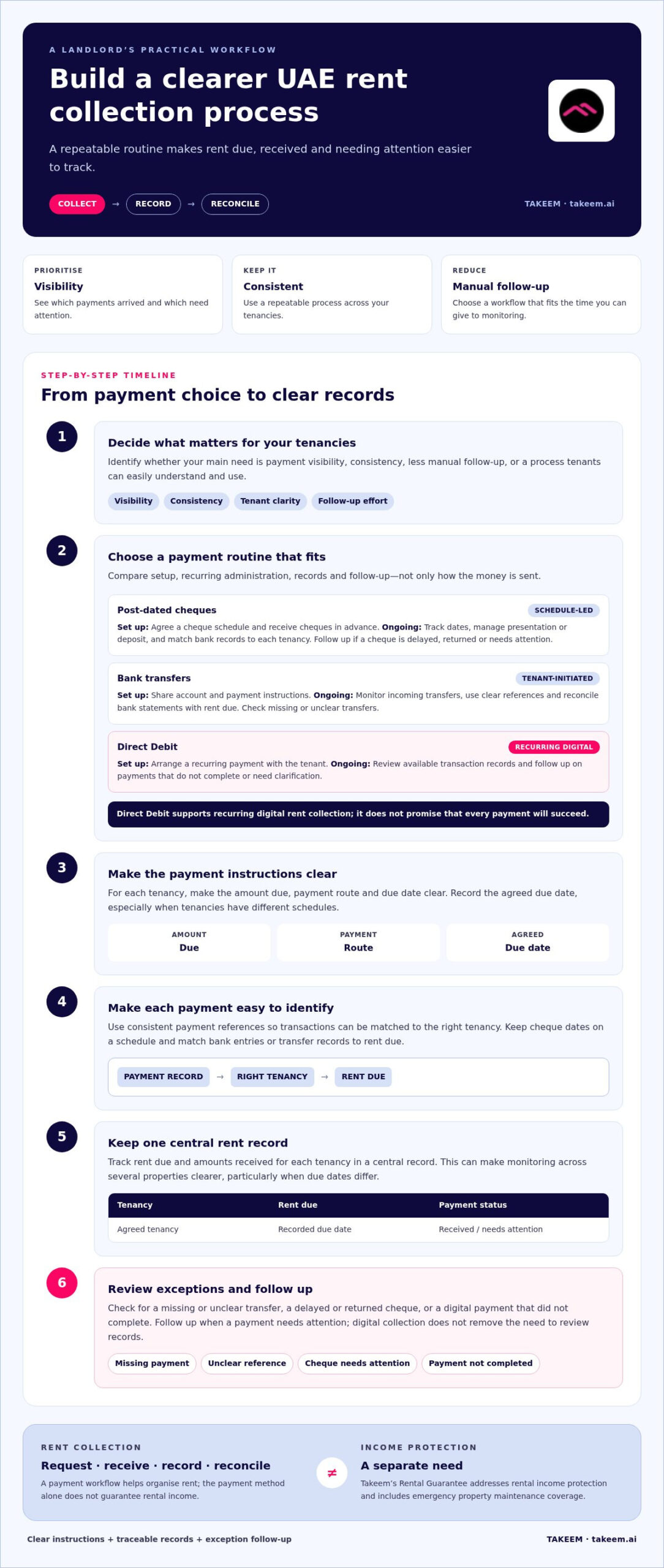
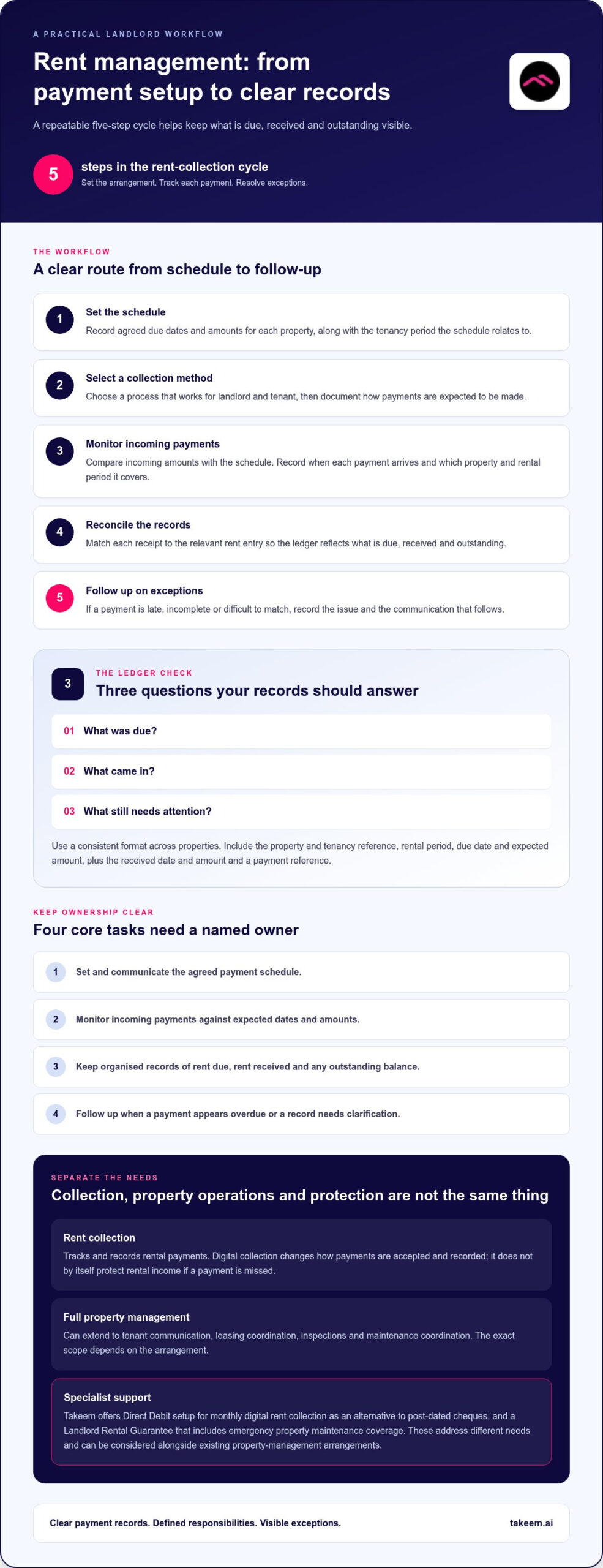
    Use this workflow as a practical starting point:

    1. Set the schedule. Record the agreed due dates and amounts for each property, along with the tenancy period the schedule relates to.
    2. Select a collection method. Choose a process that works for the landlord and tenant, and document how payments are expected to be made.
    3. Monitor payments. Compare incoming amounts with the schedule. Record when each payment arrives and which property and rental period it covers.
    4. Reconcile the records. Match each receipt to the relevant rent entry so your ledger reflects what is due, received and outstanding.
    5. Follow up on exceptions. If a payment is late, incomplete or difficult to match, record the issue and the communication that follows.

    Moving from cheque-based collection to digital monthly payments

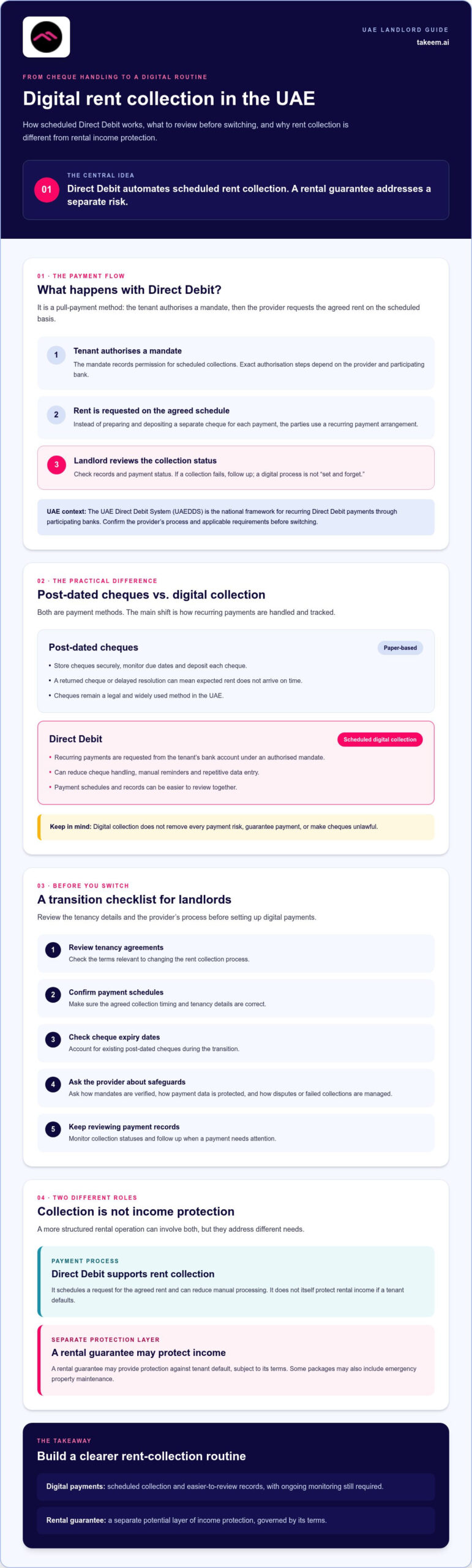
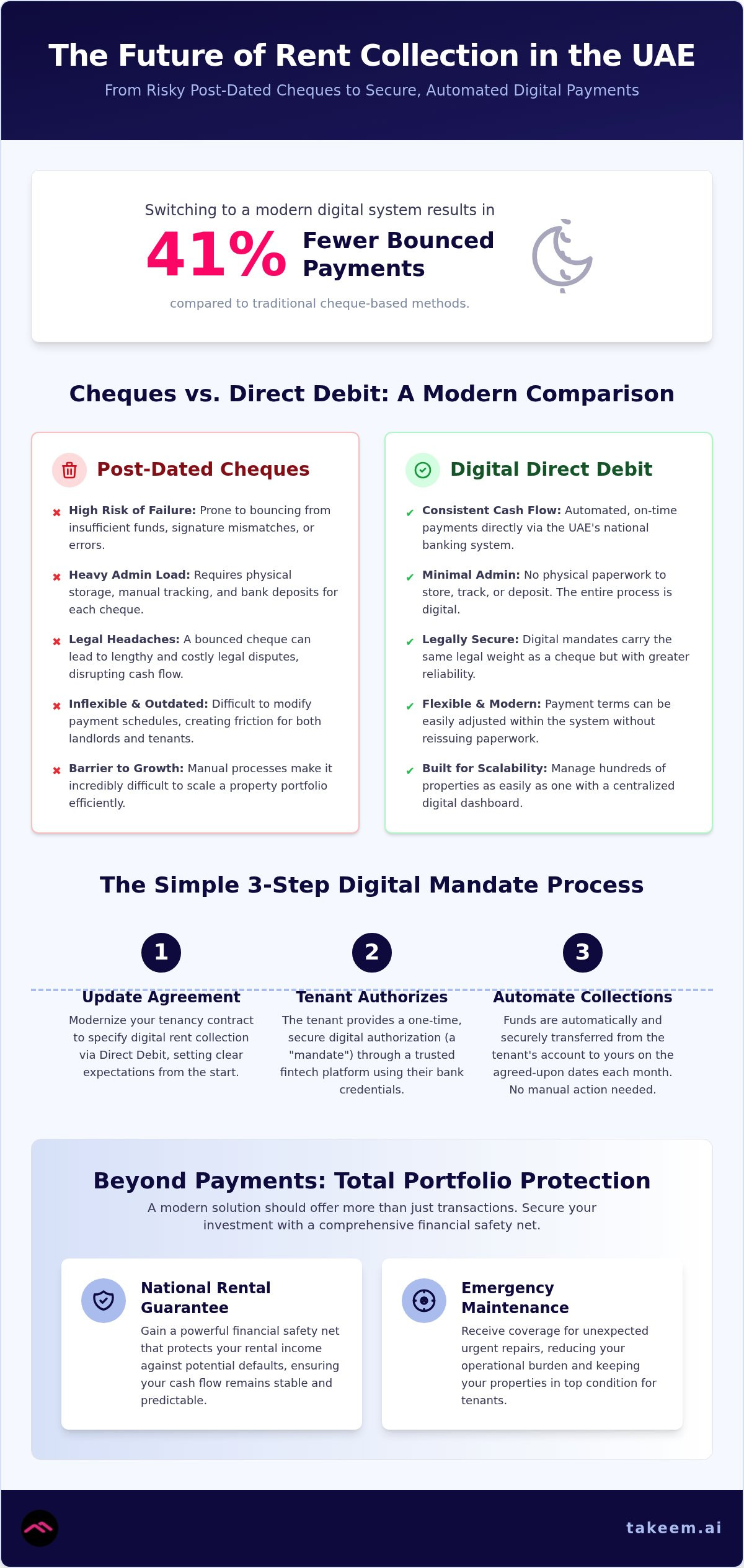
    Post-dated cheques require landlords to handle and track payment instruments against future due dates. Digital monthly collection replaces repeated cheque handling with a recurring payment process. Make the transition clear for everyone involved: agree on the payment arrangement with the tenant, including the schedule, and use consistent references so both sides can identify payments in their records. For more context, see this guide to modernising UAE rentals with rental guarantees and Direct Debit.

    Keeping rent records clear and usable

    A useful rent ledger doesn’t need to be complicated. It needs enough detail to answer three questions: what was due, what came in, and what still needs attention? Use the same format across properties, whether your records are in a spreadsheet or another system.

    • Property and tenancy reference, plus the relevant rental period.
    • Payment due date and expected amount.
    • Date and amount received, with a reference that helps match the payment.
    • Any outstanding balance and a note of relevant tenant communication.

    A complete rent-payment record shows what was due, what was received, when it arrived and what remains unresolved. Reviewing entries in the same format helps a single-property landlord check payment status at a glance. For an investor with several properties, consistent records make it easier to compare expected and received income without relying on separate notes or memory.

    Digital collection can make the payment process more structured, but it doesn’t mean every payment issue disappears or that all administration is removed. Landlords who want to accept monthly rent digitally can explore Takeem’s Direct Debit setup for landlords, alongside a clear record-keeping and follow-up routine.

    Which rent-management approach fits your UAE rental property?

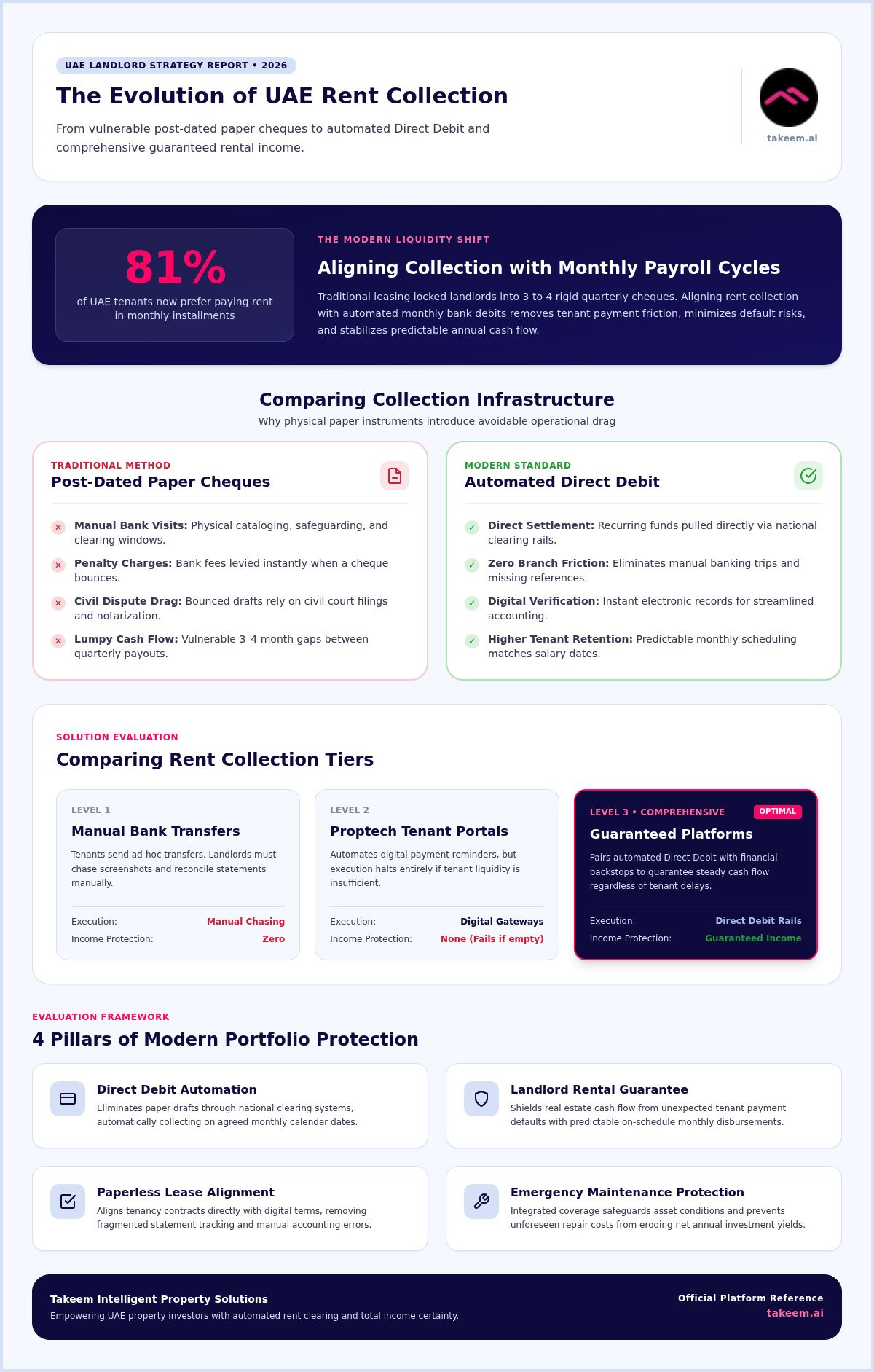
    The right setup depends on how many properties you oversee, how much time you can commit and where you want support. A tool can organise payments while leaving decisions with you. A property manager can take on broader operational work. Specialist rent support focuses on collection or rental-income protection. These approaches can also complement one another.

    Use this comparison to identify the level of support that matches your workload:

    Approach Control Time required Payment visibility Operational scope Who remains responsible?
    Self-management High Landlord handles tracking and follow-up Depends on the landlord’s records Rent administration The landlord
    Rent-management software High Time needed to maintain records and review exceptions Can bring payment information into an organised record Administrative support, depending on the tool The landlord retains responsibility for decisions and follow-up
    Full property management Shared or delegated, depending on the arrangement Can reduce the landlord’s direct operational workload Depends on reporting and agreed processes May cover rent alongside tenant and property operations Responsibilities are divided by the management arrangement
    Specialist rent support Landlord retains property oversight Focused support for specific rent needs Depends on the collection setup Digital collection or rental-income protection The landlord or existing manager retains wider property responsibilities

    When self-management or software may be enough

    An organised landlord with a small number of rent payments may be comfortable maintaining a schedule, checking receipts and following up personally. Software can help keep records together and support a consistent routine, but the landlord still reviews entries and handles exceptions. This administrative convenience differs from rental-income protection: a clearer ledger can show a payment issue, but it doesn’t itself protect against income disruption.

    When specialist rent support may add value

    Specialist support can suit landlords who want digital monthly collection, rental-income protection, or both, while retaining their existing property-management arrangements. These are separate needs. A rental guarantee addresses rental-income protection, while broader property operations can remain within the landlord’s existing arrangement. For more detail on the protection aspect, see the UAE landlord rental guarantee guide.

    For rent management for landlords UAE-wide, start with the gap you want to close. If the challenge is fragmented records, establish a consistent system. If it’s repeated cheque handling, consider digital monthly collection. If your priority is rental-income protection, assess that separately from property operations. Takeem supports landlords with Direct Debit setup and rental guarantees, which can fit alongside the management approach you already use. Explore Takeem’s rent support for landlords to learn about these focused services.
    Rent Management for UAE Landlords: 2026 Practical Guide

    How to build a practical rent-management process for your portfolio

    A dependable process starts with a clear picture of your properties and how each tenancy is paid. Build a simple property register, then use the same sequence for each rent cycle. This creates a routine you can manage yourself or share with an existing manager, while keeping payment administration distinct from other property tasks.

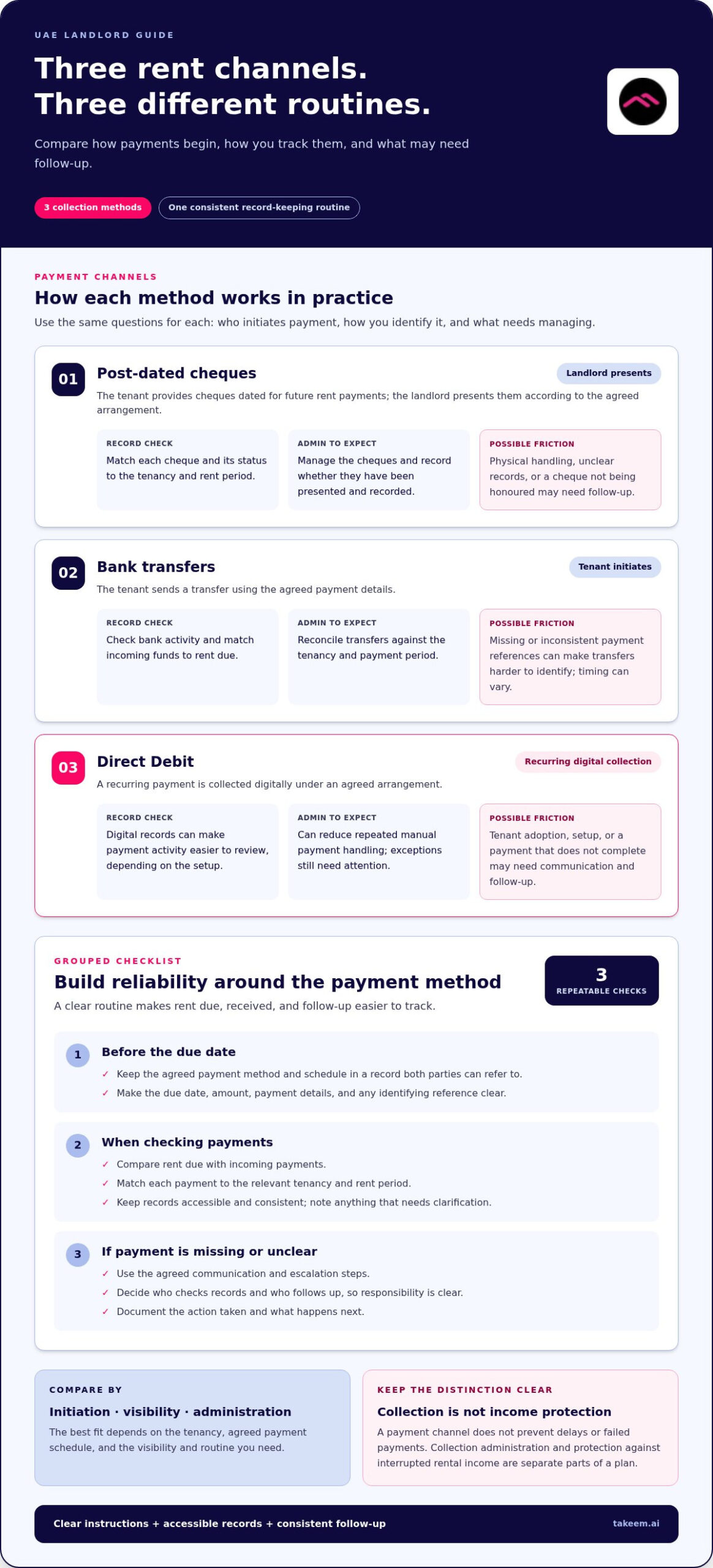
    1. Map your properties. List each property, tenancy, payment arrangement and the person responsible for recording or following up on payments.
    2. Standardise schedules. Record due dates and expected amounts in one consistent format. Keep individual arrangements visible rather than relying on memory or separate message threads.
    3. Select a collection method. Note how rent is expected to be paid and keep the agreed arrangement easy to reference.
    4. Reconcile each cycle. Update records against payments received and flag anything that doesn’t match the schedule.
    5. Review exceptions. Track late, partial or difficult-to-identify payments, along with follow-up, to see whether recurring issues point to a process gap.

    Create a repeatable rent calendar and review routine

    Put due dates, payment checks, record updates and follow-up points on a calendar or in another system you review consistently. A single-property owner may only need a brief monthly check of the rent schedule and ledger. A portfolio investor may find it more useful to review a consolidated summary, then examine exceptions property by property. A consistent routine reduces reliance on memory, and reviewing recurring issues can reveal where a schedule, payment reference or communication process needs attention.

    Include tenant communication in the workflow. Keep a clear note of relevant payment discussions and their outcomes, so future follow-up has context. Store rent records in an organised, accessible way and decide who can update them if responsibilities are shared. These are practical record-keeping habits, not a substitute for advice on any specific retention obligation.

    For investors managing several properties, a portfolio-wide view can connect payment records to broader income planning without losing detail for each tenancy. The UAE property portfolio rental income guide explores that wider perspective.

    Separate payment administration from property-care planning

    Rent collection and maintenance coordination serve different purposes. Keep payment entries in a rent ledger, and record property-care matters separately, including the issue raised, relevant communication and its status. Use consistent property references across both records so they’re easy to connect when needed, without mixing repair updates into payment totals. Takeem’s rental guarantee includes emergency property maintenance coverage; see the guide to rental guarantees with maintenance coverage for more detail.

    Choose a process you can sustain as your portfolio changes. For support with digital monthly rent collection or rental-income protection, explore Takeem’s landlord rent solutions.

    How Takeem supports rent collection and income protection

    Once you’ve identified whether your priority is payment administration, income protection or property care, choose support for that specific need. Takeem helps landlords and property investors with two distinct services: Direct Debit setup for digital monthly rent collection and rental guarantees. These can complement an existing property-management arrangement, with each service focused on its particular role in the rental process.

    Digital collection and rental-income protection serve different needs

    Direct Debit setup gives landlords a way to accept monthly rent payments digitally, as an alternative to handling post-dated cheques. It addresses the collection method and supports a more structured payment process. A rental guarantee addresses a different concern: rental-income protection. It is a distinct service from payment collection. The guide to securing rental income against tenant default explains this protection need in more detail.

    Property care is another distinct responsibility. Takeem’s rental guarantee service includes emergency property maintenance coverage. Landlords can keep their existing arrangements for tenant relations and broader property operations while using focused support for rent collection or income protection.

    Choose a next step that matches your landlord priorities

    If you mainly want to move away from repeated cheque handling, digital monthly collection may be the relevant function to explore. If your concern is protecting rental income, a rental guarantee may better match that priority. Landlords considering both collection and protection can assess the two separately, then decide how they fit alongside their current process. Choose based on the gap you want to address rather than assuming every part of a rental setup needs to change.

    For rent management for landlords UAE-wide, keep the functions clear: collection supports how rent is accepted, a guarantee provides rental-income protection, and property management covers broader operational responsibilities. Takeem’s services focus on digital collection and rental guarantees, which landlords can consider alongside their arrangements for tenant communication, leasing coordination and property operations.

    Review your current payment process and decide whether digital collection, rental-income protection or both would address a specific need. Then explore Takeem’s landlord solutions to learn about its Direct Debit setup and rental guarantee service.

    Make your next rent-management step count

    A more dependable rental-income process doesn’t require changing everything at once. Start by identifying the point that creates the most friction: payment handling, unclear records or concern about income disruption. Then address that need while keeping the responsibilities you already manage well in place. This focused approach can make rent management for landlords UAE-wide easier to maintain as your property needs evolve.

    Takeem supports landlords across the UAE with Direct Debit setup for digital monthly rent collection and rental guarantees. Emergency property maintenance coverage is included with its rental guarantee service. These focused services can sit alongside your existing arrangements.

    Choose the next step that fits your priorities and build from there. Explore Takeem’s landlord solutions to see how digital collection and rental-income protection may fit your rental process. Start with one practical decision, then refine your system as your portfolio grows.

    Frequently Asked Questions

    What does rent management mean for a landlord in the UAE?

    Rent management is the practical system a landlord uses to organise rental payments and track their status. It can include setting payment expectations, checking receipts and maintaining records that support financial planning. For example, an owner reviewing a property’s monthly income can use the rent record to distinguish an amount received from one that still needs follow-up. The right routine depends on the landlord’s properties and preferred level of involvement.

    Is rent management the same as property management?

    No. Rent management focuses on payment administration, while property management may also cover leasing, tenant communication, inspections and maintenance coordination. A landlord might use a simple ledger to track rent but handle repairs through a separate arrangement. Defining each responsibility helps avoid assumptions about who responds to a tenant or updates a record. For rent management for landlords UAE-wide, this distinction helps you choose support for a specific workload rather than assuming every task belongs to one service.

    Can landlords in the UAE collect rent through Direct Debit?

    Yes, landlords can use Direct Debit setup to accept monthly rent payments digitally. Takeem supports this collection method as an alternative to post-dated cheques. Before changing payment methods, make the arrangement clear with the tenant and keep expected dates and payment references consistent in your records. Direct Debit supports collection, but landlords should still review receipts and follow up on any payment that appears missing or difficult to match.

    How can a landlord keep track of rent payments across multiple properties?

    Use one consistent record format while keeping a separate, identifiable entry for each property and tenancy. For example, a portfolio owner can review a combined list of upcoming due dates, then filter or sort by property to investigate an outstanding balance. Keep payment dates, amounts and relevant follow-up notes together. A regular review routine helps reveal missing entries and makes it easier to prepare a clear income overview without relying on messages or memory.

    Does a rental guarantee include property management?

    A rental guarantee and full property management serve different purposes. Full property management may involve a wider set of tenant and property operations. Takeem’s rental guarantee service includes emergency property maintenance coverage, alongside rental-income protection. Landlords can retain their arrangements for leasing, tenant relations and general upkeep while considering a rental guarantee as focused support for rental income.

    What should landlords compare when choosing a rent-management approach?

    Compare how much time you can commit, how much control you want, how clearly you’ll see payment status and which tasks need support. A landlord with a straightforward payment routine may prefer to keep administration in-house. An investor managing several tenancies may value consistent reporting or targeted collection support. Also distinguish record-keeping convenience from income protection: a system that tracks rent and a service that protects rental income address different needs.

    Can a landlord use rent-collection support without outsourcing property management?

    Yes. Landlords can use focused support for rent collection while continuing to manage the property themselves or keeping their existing management arrangement. For instance, a landlord could adopt digital monthly collection but still handle tenant communication and maintenance coordination separately. Define who records payments, follows up on exceptions and manages property operations. Clear boundaries let each part of the rental process work as intended.

  • Automated Rental Income: 2026 Guide for UAE Landlords

    Automated Rental Income: 2026 Guide for UAE Landlords

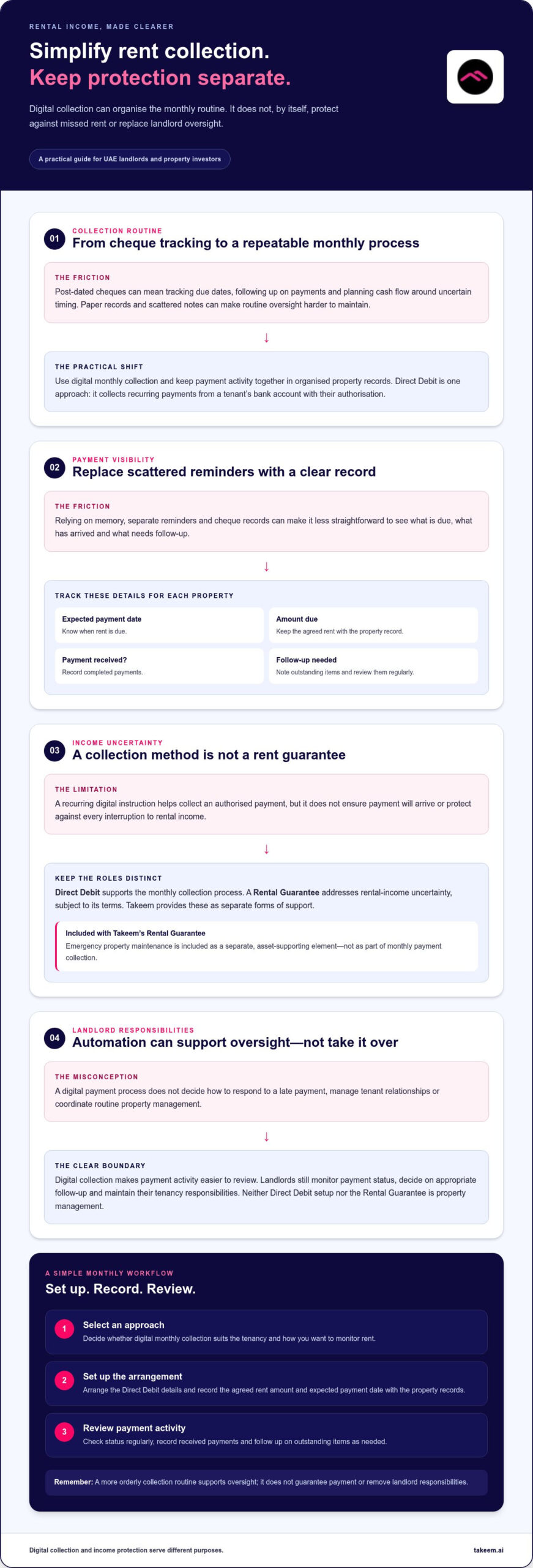
    What if making rental income more predictable didn’t require handing over control of your property? For landlords searching for automated rental income, the practical starting point is a simpler way to collect rent each month. Post-dated cheques can mean tracking due dates, following up on payments and planning cash flow around uncertain timing. Digital collection can reduce that administration, but it doesn’t automatically protect against missed rent.

    It helps to separate the moving parts. Direct Debit setup supports monthly digital rent collection, while a rental guarantee addresses income uncertainty as a separate service. Takeem provides both for landlords and property investors across the UAE, with emergency property maintenance included in its Rental Guarantee service. Neither service is property management.

    This guide explains what can be automated, how digital collection compares with cheque-based administration, and where income protection fits. It also shows how to organise payment records and choose a practical next step without confusing a smoother collection process with protection against every disruption.

    Key Takeaways

    • See which rental-income tasks can be digitised, from payment records to a consistent monthly collection routine.
    • Understand how automated rental income Dubai can streamline administration without removing landlord oversight or responsibilities.
    • Compare Direct Debit, rental guarantees and property management by the different needs each addresses.
    • Use a staged checklist to organise property records and track payment status across one or more properties.
    • See how Takeem’s Direct Debit setup and Rental Guarantee serve distinct roles, with emergency property maintenance included in the guarantee service.

    What Does Automated Rental Income Mean for UAE Landlords?

    Automated rental income means using digital processes to collect rent, record payment activity and track what is due. Instead of relying only on cheque dates, paper records and manual reminders, a landlord can use digital collection and organised records to follow monthly payments. For landlords exploring automated rental income Dubai, the goal is not to remove oversight. It is to make that oversight easier to maintain.

    Moving from post-dated cheques to digital monthly collection changes how rent is administered, not the landlord’s role. A digital process can make payment activity easier to review, but it doesn’t decide how to respond to a late payment or replace attention to tenancy responsibilities.

    Payment automation organises how rent is collected; rental-income protection addresses the risk of income being interrupted. These services are related, but they do different jobs.

    Which parts of rent administration can be automated?

    Digital collection involves setting up a payment method for rent and using it for recurring monthly payments. Direct Debit is one approach: it allows payments to be collected from a tenant’s bank account with their authorisation. For a plain-language overview of the method, see Direct Debit Explained. Takeem provides Direct Debit setup for landlords moving to digital monthly rent collection.

    Digital records can also make routine oversight more consistent. Record the expected rent date, whether payment has been received and any follow-up needed. Keeping this information together makes upcoming and completed payments easier to review and can support cash-flow planning. It won’t ensure a payment arrives, but it can reduce reliance on scattered notes or memory.

    Collection is only one part of owning a rental property. A payment process doesn’t coordinate maintenance, manage tenant relationships or make broader property-management decisions. Keeping these responsibilities distinct shows what digital collection can simplify and what still needs separate attention.

    What automation cannot promise on its own

    A recurring digital instruction doesn’t guarantee that rent will always be paid. Payment processing is a way to collect an authorised payment, not protection against every interruption to rental income. If a payment is missed, the landlord still needs to understand the situation and decide what action is appropriate under the tenancy arrangement.

    Income protection is a separate consideration. A rental guarantee addresses rental-income uncertainty subject to its terms, while Direct Debit supports the collection process. Takeem provides both as distinct forms of rental-income support. Its Rental Guarantee also includes emergency property maintenance, an asset-supporting element separate from monthly payment collection.

    Automation also doesn’t replace landlord decisions, tenancy obligations or professional advice. Treat it as administrative support: establish a clear collection routine, keep records organised and review payment status regularly. Digital tools can make rent oversight more orderly without taking responsibility away from the landlord.

    How Digital Rent Collection Works from Setup to Monthly Payment

    A practical digital collection routine has three parts: choose an approach, establish the payment arrangement, then review each month’s activity. This creates a repeatable process instead of relying on separate reminders and cheque records. For landlords considering automated rental income Dubai, the aim is to make payment administration easier to follow while keeping a clear view of what is due and received.

    Direct Debit is a method for collecting recurring payments from a bank account with the payer’s authorisation. In a rental arrangement, the landlord sets up digital monthly collection with the tenant. Takeem provides Direct Debit setup to support the move from post-dated cheques to digital payments. Keep the agreed payment details and expected date in the property records, and use the applicable setup details to guide the process.

    A useful workflow is to:

    • Select an approach: Decide whether digital monthly collection suits the tenancy and how you want to monitor rent.
    • Set it up: Arrange the Direct Debit details and record the agreed rent amount and expected payment date with the property records.
    • Review activity: Check payment status regularly, record received payments and follow up on outstanding items as needed.

    Moving from cheque handling to digital collection

    With post-dated cheques, landlords may need to organise cheque dates and track which payments are due. Digital monthly collection changes the routine: payment details and records can be reviewed as part of a recurring monthly process. Cheques remain part of some rental arrangements, so consider the transition property by property rather than assuming the same approach suits every tenancy.

    Consistency is the benefit. A regular review routine helps landlords spot an outstanding payment and see what income is expected, without confusing collection with income protection. Takeem’s guide to rental guarantees and Direct Debit explains how these two parts of rental-income support serve different purposes.

    What landlords should track after setup

    Keep a simple record for each property, whether in a spreadsheet or a system you already use. Include the expected payment date, amount due, whether payment has been received and any outstanding item that needs follow-up. Add notes when you take action, so the record shows the payment’s current status, not just its due date.

    For a portfolio, consistent records make it easier to review properties together and identify payments that need attention. A clear monthly routine could involve checking each property’s status on a chosen day, updating the records and noting anything unresolved. This supports planning without suggesting that digital collection prevents missed payments.

    Landlords looking to streamline monthly collection can explore Takeem’s landlord solutions, including Direct Debit setup and rental-income support.

    Direct Debit, Rental Guarantees, and Property Management: What Is Different?

    These services can all relate to rental income, but they address different needs. Direct Debit provides a way to collect payments. A rental guarantee offers income-protection support under its applicable terms. Property management covers a broader range of property-related responsibilities. Separating these roles helps landlords identify what they need without assuming a digital payment method includes protection or day-to-day management.

    Use this comparison to identify the task each option supports:

    Option Purpose Landlord task supported Important limitation
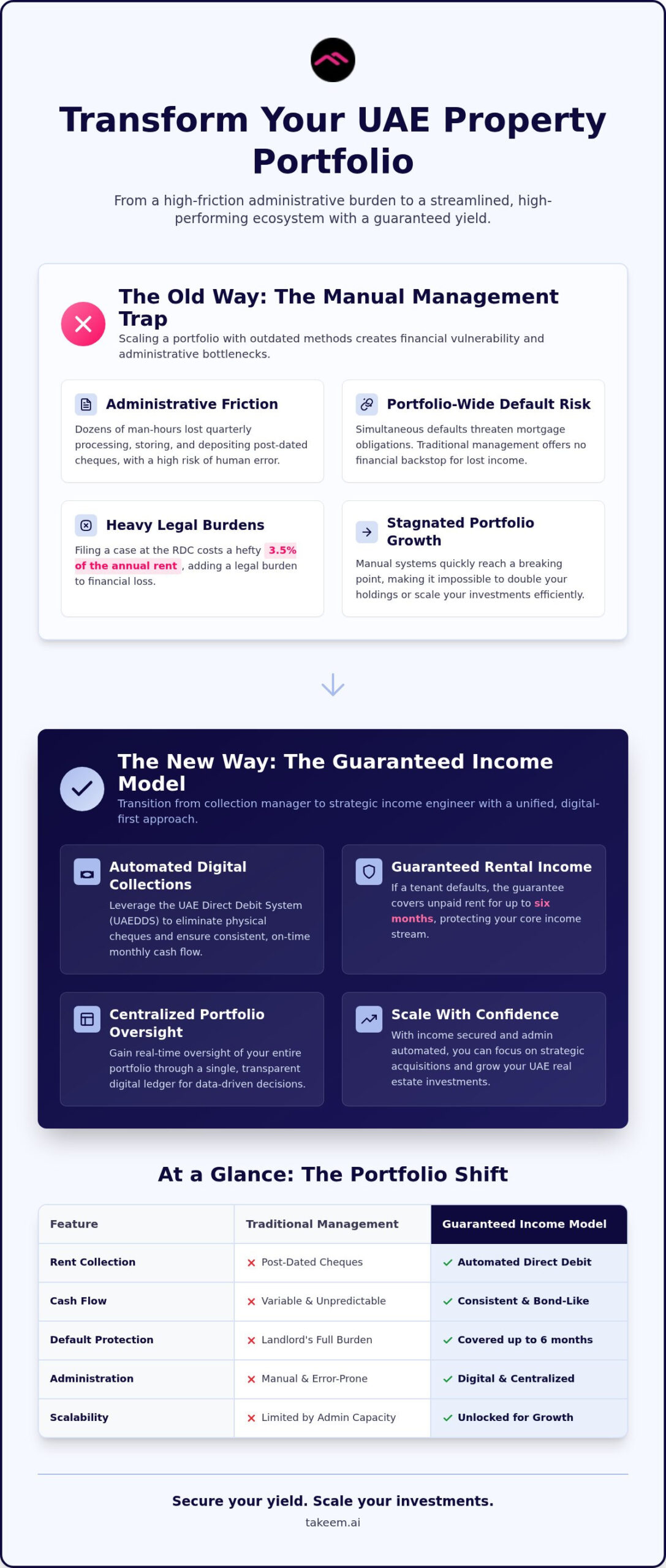
    Direct Debit Collect rent digitally from a tenant’s bank account with authorisation. Organising recurring rent collection and reviewing payment activity. It’s a payment method, not a guarantee that rent will always arrive.
    Rental guarantee Provide rental-income protection support under the service terms. Addressing income uncertainty through a separate support arrangement. Conditions and coverage depend on the applicable terms; it isn’t a payment collection method.
    Property management Handle broader responsibilities associated with managing a property. Coordinating property-related tasks beyond rent collection. Neither Direct Debit nor a rental guarantee should be treated as full property management.

    Digital collection versus rental-income protection

    Think of collection as the route rent takes to reach the landlord, and protection as a separate response to income uncertainty. Takeem provides both Direct Debit setup and rental guarantee services, but each has a distinct purpose. A landlord rental guarantee guide can help clarify what to consider when reviewing the protection side. For automated rental income Dubai, assess collection and protection separately.

    For example, a landlord may use digital collection to organise monthly payments and make payment activity easier to review. That setup alone doesn’t protect against missed rent. A rental guarantee is a separate service, and its scope depends on its applicable terms. Neither option removes the landlord’s own decisions and responsibilities.

    Where emergency maintenance fits

    Takeem’s Rental Guarantee includes emergency property maintenance coverage. This is an included element of the service, not a claim to coordinate every routine repair or provide broad property management. Understanding that boundary helps landlords distinguish asset-supporting coverage from ongoing maintenance administration. The rental guarantee and maintenance guide explores how maintenance fits alongside income protection.

    Consider each need on its own: payment collection, income protection and broader property responsibilities. This makes it easier to choose support that matches the task without assuming one service covers every part of rental ownership.

    Automated Rental Income: 2026 Guide for UAE Landlords

    How to Introduce Automated Rent Collection Across Your Properties

    A smooth transition starts with your current process, not with a new tool. Before introducing digital collection, map how each property handles rent today. Note the payment approach, expected dates, where you record receipt and how you follow up on outstanding amounts. This gives you a practical baseline and shows which repetitive steps may be simpler to manage through a consistent digital process.

    Start with a clear picture of your rental workflow

    Review each property individually. One tenancy may use post-dated cheques, while another may already follow a monthly digital routine. Record the differences rather than assuming every tenant or agreement can move in the same way. Then identify manual tasks, such as updating payment notes or checking separate records, that a consistent digital process could make easier to oversee.

    Keep communication clear throughout the change. Tenants should understand the collection arrangement and the payment details relevant to their tenancy. Landlords need to retain a clear view of expected and received rent. Digital collection can streamline administration, but it doesn’t remove the need to monitor activity or address questions and outstanding payments.

    Use this staged checklist to plan the transition:

    • Map the process: Record how each property currently collects rent and how payment status is tracked.
    • Organise the records: Keep property and tenancy details, expected payment dates and receipt status together.
    • Set the routine: Choose a regular time to review collection activity and update records.
    • Account for the arrangement: Use the relevant service terms and setup details to guide the plan for each property.

    Consistent digital records make rental-income oversight clearer by showing what is due, what has arrived and what still needs attention. That visibility can support cash-flow planning, but it doesn’t guarantee payment or replace landlord judgment.

    Adapt the process for a larger portfolio

    With multiple properties, inconsistent record-keeping can make a monthly review harder than it needs to be. Use the same basic fields for each property, such as expected payment date, amount due, payment status and follow-up required. A consistent process helps you compare like with like and spot unresolved items without relying on memory or searching through unrelated notes.

    Keep the system practical. You don’t need a particular dashboard, integration or reporting format to establish good oversight. Start with reliable records and a routine you can maintain, then adapt it to the size and needs of your portfolio. The property portfolio income guide offers further context for investors organising rental income across multiple properties.

    For a practical next step, explore Takeem’s landlord solutions, including Direct Debit setup for digital monthly rent collection.

    How Takeem Connects Digital Rent Collection with Income Protection

    Takeem provides landlords and property investors with two distinct forms of rental-income support: Direct Debit setup for monthly digital rent collection, and a Rental Guarantee that provides income-protection support under its service terms. They address separate priorities within a rental-income plan. Digital collection helps organise administration; the guarantee offers a separate layer of support. Neither is full property management or a promise that every payment will arrive.

    For landlords exploring automated rental income Dubai, the value lies in matching support to the task. A consistent collection routine can make payment oversight easier to maintain, while a rental guarantee addresses income uncertainty under its applicable terms. Takeem’s Rental Guarantee also includes emergency property maintenance coverage. This is an included element of the guarantee service, not a promise to handle every repair or routine maintenance task.

    A practical fit for individual landlords and investors

    For an individual landlord, monthly digital collection can reduce the effort of organising recurring payments and reviewing their status. Investors with multiple properties can use a consistent record-keeping routine across their portfolio to see which payments are due and which have been received. The Rental Guarantee is a separate option for income protection, with its scope governed by the relevant service terms.

    The distinction matters. Direct Debit supports the collection process; it doesn’t itself protect rental income. A guarantee doesn’t replace collection setup or the landlord’s own oversight. Considering each need separately helps keep the arrangement clear, whether the priority is reducing cheque administration, addressing income uncertainty or both.

    Choose a next step that matches your priority

    Start with the friction you want to reduce. If handling post-dated cheques and tracking monthly payments takes too much administration, Direct Debit setup offers a route to digital monthly collection. If your main concern is rental-income uncertainty, review Takeem’s Rental Guarantee as a separate form of support. The applicable terms determine the guarantee’s scope, so don’t assume it covers every circumstance.

    Before deciding, note how rent is currently collected, what you want to make easier and which properties the change should apply to. This review can help you focus on the right next step without adding unnecessary complexity or treating a collection method as income protection.

    Takeem connects digital collection and rental-income support while keeping their roles distinct. Explore rental-income solutions with Takeem to find support that fits your priority.

    Make Your Next Rent Cycle Easier to Oversee

    A useful next step doesn’t have to involve changing every property at once. Choose one part of your rental-income process that creates avoidable friction, such as tracking payment status or organising collection dates. Set a clear routine around it, then use what you learn to decide whether to extend the approach across your portfolio. Small, deliberate changes can make automated rental income Dubai easier to manage without adding layers of administration.

    As you plan, keep your priorities distinct. If you want a more organised collection process, focus on digital monthly payment setup. If you’re considering income protection, review the relevant rental guarantee terms and how they fit your circumstances. Takeem supports landlords and property investors across the UAE with these separate forms of rental-income support, and emergency property maintenance is included as part of its Rental Guarantee service.

    Choose the step that addresses your immediate priority, then build from there. Explore Takeem’s rental-income solutions and move toward a clearer approach to overseeing your rental income.

    Frequently Asked Questions

    Can rental income be automated?

    Yes, landlords can automate parts of rent administration, including recurring collection and payment record-keeping. For example, a landlord with monthly rent due on a set date can use digital collection and record each payment’s status. Exceptions still need attention, and landlords remain responsible for decisions about their properties. Automation can make a routine more consistent, but it can’t remove every manual task or guarantee income.

    How does Direct Debit rent collection work for landlords in the UAE?

    Direct Debit lets a landlord collect recurring rent from a tenant’s bank account after the tenant authorises the arrangement. The landlord sets up the collection details, monitors payment activity and records the outcome. Takeem provides Direct Debit setup for landlords seeking digital monthly rent collection. Keep the agreed payment details and any changes organised with the relevant tenancy records.

    Does automated rent collection guarantee that tenants will pay?

    No. Automated collection provides a way to request or collect a payment, but it doesn’t ensure the tenant’s payment will be completed. If income protection is also a priority, consider a rental guarantee as a separate form of support and review its applicable service terms. Landlords looking at automated rental income Dubai should treat collection and protection as distinct parts of their plan, not interchangeable services.

    What happens if a tenant’s Direct Debit payment fails?

    A failed payment means the landlord should check the recorded status rather than assume why the transaction didn’t complete. Note the due date, the status shown and any follow-up. Then communicate with the tenant through the agreed channel to understand the next step under the tenancy arrangement. Direct Debit setup doesn’t resolve a missed payment automatically, so maintain a clear record of any outstanding rent and action taken.

    Can landlords use digital rent collection for multiple properties?

    Yes. Landlords can organise digital collection across multiple properties while keeping each tenancy’s payment details and status distinct. Use a consistent record format with property reference, tenant, amount due, expected date and payment status. This makes it easier to review the portfolio without mixing up transactions. Takeem provides rental-income services for landlords and property investors, including those with large property portfolios.

    Does rental-income automation replace property management?

    No. Automating rent collection supports payment administration, not the full range of property-management responsibilities. Landlords still make decisions about their properties, maintain tenancy records and handle matters outside the collection process. Keep a separate process for maintenance, tenant communication and other property tasks. This distinction sets realistic expectations about what digital collection can simplify and what still requires landlord attention.

    Can a rental guarantee include emergency property maintenance?

    Yes. Takeem’s Rental Guarantee includes emergency property maintenance coverage as part of the service. This is a specific included element, not a promise to cover every repair or replace routine property management. Landlords considering a guarantee should review the applicable service terms to understand its scope and how it relates to their property. Keeping maintenance records and reporting issues through the relevant process can also help with oversight.

  • Landlord Risk Management Solutions: A Practical UAE Guide

    Landlord Risk Management Solutions: A Practical UAE Guide

    What if a missed rent payment is only the first sign of a wider risk? For UAE landlords, income gaps, delayed maintenance and manual payment follow-up can quickly put pressure on cash flow and property condition. Effective landlord risk management solutions connect these issues instead of treating each one as an isolated problem.

    It’s understandable to focus first on rent arriving on time. A reliable plan also needs clear records, consistent collection processes and timely responses when a property needs attention. Prioritise risks by how they could affect your income or asset, and by how much control you have over them.

    This guide sets out a practical framework for assessing risks and building repeatable processes across your portfolio. You’ll learn how to organise documentation, strengthen rent collection and respond to maintenance needs, and where digital Direct Debit and a rental guarantee can support a broader approach. Takeem provides landlords with a rental guarantee that includes emergency property maintenance, alongside Direct Debit setup for monthly rent collection. These services address specific pressure points and can fit into a wider risk plan.

    Key Takeaways

    • Prioritise risks by their potential effect on rental income and property condition. Separate issues you can control from those you can only prepare for.
    • Use a simple risk register to record each exposure, its likelihood and impact, the control in place, who owns the next step and when to review it.
    • Compare landlord risk management solutions by the specific risk they address, and understand the limits of each control.
    • Build repeatable routines for payment records, issue escalation and planned maintenance before and during each tenancy.
    • Consider how digital monthly rent collection and a rental guarantee with emergency maintenance can support a broader landlord risk plan.

    Landlord Risk Management in the UAE: What Can Put Rental Income and Property at Risk?

    Landlord risk management is the process of identifying, prioritising and reducing threats to rental income and property condition. For UAE landlords, it means looking beyond one missed payment or repair and understanding how everyday processes connect. If payment records are hard to follow, it may take longer to spot a gap and act. If a property issue has no clear owner, follow-up can stall. Incomplete records make it harder to understand what happened and decide what to do next.

    Some risks are shaped by events outside a landlord’s control. A tenant’s circumstances may change, or an unexpected incident may affect a property. Other exposures come from processes landlords can strengthen, such as keeping payment records, setting a clear route for reporting issues and tracking maintenance follow-up. Good risk planning reduces avoidable gaps and prepares you to respond to situations you cannot prevent.

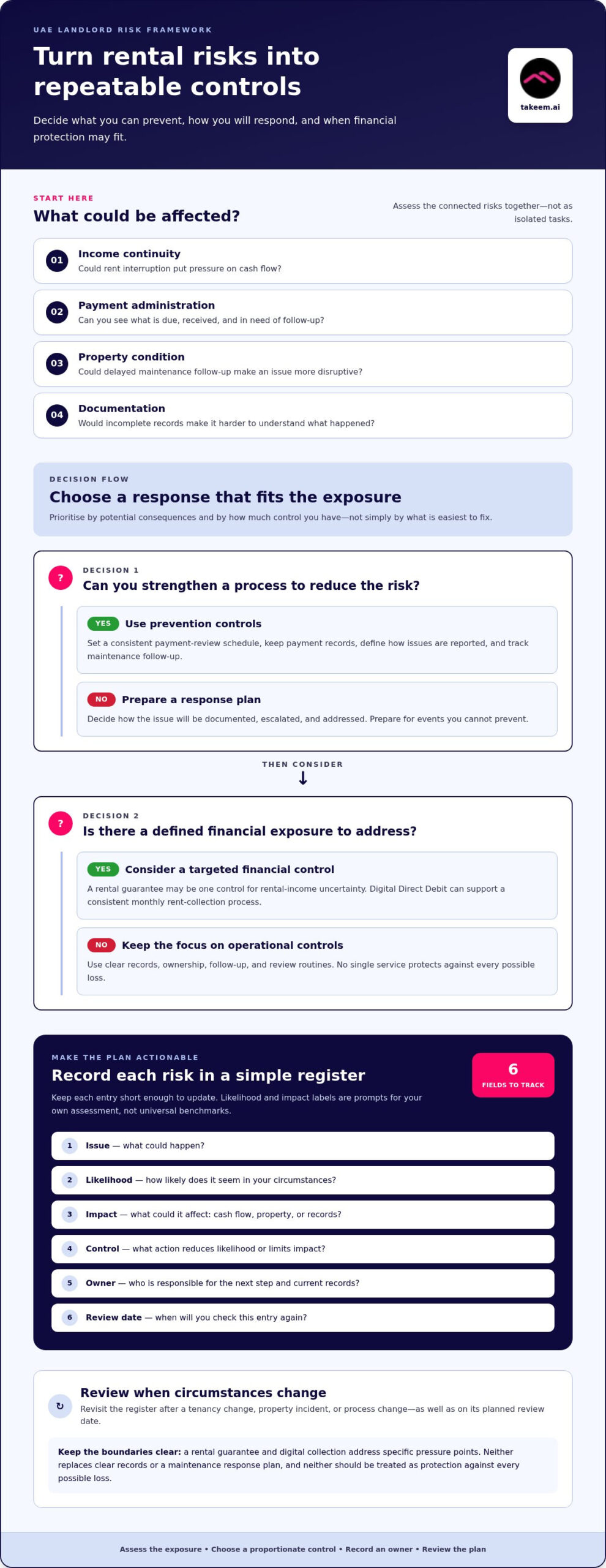
    The principles behind Risk management apply here: identify what could happen, consider its consequences and choose a proportionate response. For a rental property, assess four connected areas: income continuity, payment administration, property condition and documentation. For example, a missed payment needs both a clear record and a follow-up process. Reviewing these areas together helps reveal gaps a single-task checklist might miss.

    Which risks matter most to UAE landlords?

    Rent interruption can put pressure on cash flow, but missed payments can have different causes and shouldn’t all be handled in the same way. Manual collection can make it harder to see what is due, what has arrived and which payments need follow-up. Incomplete records can slow down a review of payment history or property issues. A delayed maintenance response may also allow a manageable problem to become more disruptive.

    The impact depends on the circumstances. A landlord with one property may experience an income gap differently from an investor overseeing several leases, where the same administrative weakness can recur across a portfolio. Property condition, tenancy arrangements and the processes already in place also affect which risks deserve attention first. Start with the exposure that could have the greatest effect, not simply the task that is easiest to fix.

    Risk management is broader than insurance or a guarantee

    Think in three layers: prevention means improving processes before problems arise; response planning means deciding how to document, escalate and address an issue; and financial protection means considering tools that may help with a defined financial exposure. A rental guarantee can be one control for rental-income uncertainty, while digital monthly collection can support a consistent payment process. Neither replaces clear records or a maintenance response plan, and no single service should be treated as protection against every possible loss.

    The UAE is a national rental market, but tenancy procedures can differ by emirate and may change. Keep operational risk planning distinct from legal assumptions, and verify current local procedures against authoritative sources before acting on a tenancy matter.

    How UAE Landlords Can Build a Practical Rental Risk Framework

    A practical framework turns risk awareness into routine action. It doesn’t need complex software: a clear process and a simple register can show what needs attention, who owns the next step and when to review it. This approach can work for an individual landlord or a portfolio investor. Use this five-step workflow:

    1. List exposures. Note where income, property condition or records could be affected, such as missed payments, delayed maintenance follow-up or incomplete payment tracking.
    2. Estimate impact. Consider the possible effect on cash flow, the property and your ability to understand or document decisions. Use plain labels such as low, medium or high rather than treating an invented score as an industry standard.
    3. Select a control. Choose a practical action that reduces the likelihood of an issue or helps limit its impact. For example, set a consistent schedule for reviewing payments and a documented follow-up process for gaps.
    4. Assign an owner. Name the person responsible for carrying out the control and keeping its records current.
    5. Set a review date. Revisit the entry after a tenancy change, property incident or process change, as well as on its planned review date.

    Prioritise risks by their consequences, not just by how easy they are to fix. A risk that could disrupt income across several properties may deserve attention before a minor administrative gap affecting one tenancy. The most useful landlord risk management solutions address a clear exposure and fit into a repeatable process.

    Create a rental-property risk register

    Keep each entry short enough to update. Record the issue, likelihood, impact, control, responsible person and next review date. These labels are prompts for your own decisions, not universal benchmarks.

    • Issue: Rent payment is missed.
    • Likelihood / impact: Medium / high, based on your assessment.
    • Control: Check payment records regularly and follow a documented route for recording and following up on a missed payment.
    • Owner / review: Assigned landlord or authorised representative / next scheduled review date.

    This format makes open actions visible and gives you a consistent way to compare risks across properties. Update an entry when circumstances change, rather than relying on memory or scattered notes. If the same issue appears repeatedly, review whether the control is being followed or needs to change.

    Keep tenancy and payment records organised

    Store relevant tenancy contracts, payment records, maintenance requests, work updates and communications in a consistent, accessible structure. Clear records help you spot payment patterns, distinguish completed tasks from outstanding ones and follow the sequence of decisions if an issue develops. Use a consistent file-naming approach or record format so that a payment or maintenance entry can be connected to the relevant tenancy and follow-up.

    To support a documented payment process with digital monthly collection, explore landlord rental guarantee and Direct Debit options as part of your wider framework.

    Compare Landlord Risk Management Solutions by the Risk They Address

    Choose controls by the exposure you need to manage, then combine them where risks overlap. Documentation helps clarify what happened, a payment process makes collection easier to track, and maintenance follow-up supports property care. A rental guarantee may help address income uncertainty, subject to its terms. Each control manages or reduces a particular exposure; none removes every risk.

    Use this comparison as a starting point. The right mix depends on the property, the landlord’s capacity to manage follow-up and the scale of the portfolio.

    Risk addressed How the control helps Limitations
    Unclear or incomplete records Organised tenancy, payment, maintenance and communication records make decisions and open actions easier to review. Records support understanding and follow-up, but don’t prevent an incident or guarantee a particular outcome.
    Inconsistent payment administration A regular collection process, including digital monthly collection through Direct Debit instead of post-dated cheques, can make payments easier to track. A collection method doesn’t remove the possibility of a missed or unsuccessful payment. Follow-up and clear records still matter.
    Property issues requiring attention A documented reporting and escalation route helps clarify who will act and what needs follow-up. Response processes can support property care, but can’t prevent every fault or determine the outcome of every repair.
    Rental-income uncertainty A rental guarantee may provide a financial control for landlords concerned about income continuity. Its application depends on the guarantee’s terms. Don’t assume every missed payment, dispute or loss is covered.

    Rental guarantees and income continuity

    A rental guarantee is one possible part of a wider plan, not a substitute for payment records, tenancy documentation or a clear follow-up process. Consider how it relates to the specific income risk you want to manage, and understand that protection is subject to the service terms. Takeem’s rental guarantee includes emergency property maintenance as part of the offering. This can bring income protection and an element of property care into the same service, while leaving landlords responsible for their wider records and oversight.

    Digital collection and property-care controls

    Direct Debit supports digital monthly rent collection instead of relying on post-dated cheques. It can create a consistent collection process alongside payment tracking and follow-up. Pair the collection routine with a clear route for logging property issues and tracking actions. Explore the guide to rental guarantees and Direct Debit for more detail. To consider how these controls fit together, review Takeem’s landlord rental guarantee and Direct Debit options.

    Landlord Risk Management Solutions: A Practical UAE Guide

    A Landlord Risk Management Checklist for UAE Rental Properties

    A checklist makes good intentions repeatable. Use the stages below to connect payment administration, property care and records, whether you oversee one rental or a growing portfolio. Treat it as an operational guide, not a substitute for checking current tenancy requirements with authoritative UAE sources relevant to the property.

    Before a tenancy

    • Organise key information. Keep the tenancy contract, agreed payment details and relevant property information together in a secure, accessible record system. Limit access to authorised parties.
    • Set the payment routine. Decide how incoming payments will be recorded, reviewed and followed up. Identify who checks payment status and where outstanding queries will be logged.
    • Plan issue escalation. Write down how a property issue is reported, how its priority is assessed, who is responsible for the next action and how follow-up is recorded.
    • Plan maintenance follow-up. Note any known property-care actions and establish a way to track reported issues through to an update or recorded outcome.
    • Check local requirements. Verify relevant tenancy procedures using current, authoritative sources. Avoid relying on an old checklist when rules or circumstances may have changed.

    During a tenancy

    Keep the routine visible and consistent. Record payments as they arrive, note gaps or questions, and document follow-up rather than relying on memory. Log maintenance reports with the date received, action owner, status and next follow-up. Clear records make it easier to see what remains unresolved and help prevent separate tasks from slipping between people.

    • Review incoming payments and open queries on a regular schedule.
    • Record relevant tenant communications and decisions alongside the related payment or property issue.
    • Update maintenance entries as actions progress, including planned follow-up.
    • For multiple properties, use a consistent record format so emerging patterns are easier to compare across the portfolio.

    Review when circumstances change

    Revisit your controls after a payment disruption, urgent repair, tenancy change or portfolio expansion. Ask whether the response was clear, whether records captured key decisions and whether responsibilities were understood. If similar issues recur, prioritise the process creating the greatest exposure to cash flow, property condition or incomplete documentation. These practical landlord risk management solutions work best when reviewed and adjusted, not filed away after setup.

    Use the checklist alongside any wider income-protection plan. A rental guarantee can be one part of that plan, while digital monthly collection can support a consistent payment routine. Explore rental guarantee and Direct Debit options for your landlord risk plan.

    How Takeem Fits into a Broader UAE Landlord Risk Plan

    Takeem’s services support specific parts of a landlord’s risk plan, while documentation, payment oversight and regular reviews remain important landlord-led controls. A rental guarantee can help address rental-income uncertainty, and emergency property maintenance is included as part of Takeem’s rental guarantee service. These measures can sit alongside clear records and defined processes without being treated as protection against every possible loss.

    Connect income protection with a clear payment process

    For landlords moving away from post-dated cheques, Takeem provides Direct Debit setup for digital monthly rent collection. A defined collection process can make payments easier to track and outstanding items easier to follow up, especially when records are kept consistently. Landlords should continue to monitor payment activity and document decisions.

    Income protection and payment administration address different parts of the same exposure. A rental guarantee may support income continuity, subject to its terms; a regular collection process helps keep payment activity visible. Read this UAE guide to rental-income protection and disputes for more context.

    Choose a next step that matches your property setup

    An individual landlord may consider a rental guarantee when income continuity is a priority. Investors with larger portfolios can consider how consistent payment collection and risk oversight can work across multiple properties. Real estate agents can partner with Takeem to offer rental guarantee solutions to landlord clients. In each case, the service should fit within a wider plan that tracks payments, records property issues and reviews changing risks.

    Landlord risk management solutions work best as a connected system, not a single fix. If a rental guarantee or digital monthly collection could support your current approach, explore Takeem’s landlord solutions.

    Make Your Rental Risk Plan Work for You

    Strong landlord risk management solutions work together: clear records make payment and maintenance activity easier to track, regular reviews help you spot changing exposures, and carefully chosen controls can reduce pressure on rental income and property condition. No single measure removes every risk, so build a plan around your property, your capacity and your portfolio.

    Takeem supports individual landlords and investors with larger portfolios through rental guarantee services, digital monthly rent collection via Direct Debit, and emergency property maintenance as part of its rental guarantee service. These options can complement, rather than replace, your own documentation, payment oversight and review routine.

    If you’re ready to explore how these services could fit your rental setup, explore Takeem’s rental guarantee and digital collection solutions. Start with the risks that matter most to you, then strengthen your process one practical step at a time.

    Frequently Asked Questions

    What are landlord risk management solutions?

    Landlord risk management solutions are processes and services that help identify, prioritise and manage threats to rental income and property condition. They can include organised tenancy and payment records, a consistent rent collection process, planned maintenance follow-up and financial protection such as a rental guarantee. Each control addresses particular exposures, so landlords should combine practical measures rather than expect one solution to prevent every issue or loss.

    How can landlords protect rental income in the UAE?

    Landlords can support income continuity by keeping clear payment records, setting a regular collection and follow-up routine, and reviewing unresolved payment issues. Digital monthly collection can make payment administration more consistent, while a rental guarantee may provide another form of support, subject to its terms. Maintain relevant tenancy and communication records, and verify current local tenancy procedures using authoritative UAE sources before taking action on a tenancy matter.

    Can landlords in the UAE collect rent through Direct Debit instead of cheques?

    Yes. Takeem helps landlords move from post-dated cheques to digital monthly rent collection through Direct Debit setup. A defined collection process can make it easier to track expected and received payments and identify items that need follow-up. Landlords should continue recording payment activity and outstanding queries as part of their wider income oversight. Direct Debit supports collection administration; it doesn’t remove the need to monitor payments.

    Does a rental guarantee cover every landlord risk?

    No. A rental guarantee is one possible control for rental-income uncertainty, and its application depends on the service terms. Don’t assume it covers every missed payment, dispute, property issue or financial loss. Landlords can use it alongside clear records, regular payment oversight and a documented maintenance response process. Review the terms to understand the protection provided, then identify any risks that still need separate controls.

    How should landlords manage emergency property maintenance risk?

    Set a clear route for reporting property issues, assessing priority, assigning responsibility and tracking follow-up. Keep a record of the reported issue, communications, actions and current status so unresolved work remains visible. A timely, documented response supports ongoing property care, though it can’t prevent every fault or guarantee a particular outcome. Takeem includes emergency property maintenance as part of its rental guarantee service.

    What should landlords include in a rental property risk register?

    Record each risk, its likelihood and potential impact, the control in place, the responsible person and the next review date. For a missed-payment risk, an entry might note a regular payment review and a documented follow-up route. Use simple labels such as low, medium or high based on your own assessment, rather than treating them as universal scores. Update entries when circumstances or controls change.

    How often should a landlord review their risk management plan?

    Set a recurring review schedule that suits your property or portfolio, and revisit the plan whenever circumstances change. Useful triggers include a tenancy change, payment disruption, urgent repair, a change to collection or maintenance processes, or portfolio growth. Check whether controls were followed, records are complete and open actions have an owner. For tenancy procedures, verify current requirements with authoritative sources relevant to the property’s location in the UAE.

  • Rental Guarantee Cost vs. Risk of Default: A UAE Landlord’s Decision Guide

    Rental Guarantee Cost vs. Risk of Default: A UAE Landlord’s Decision Guide

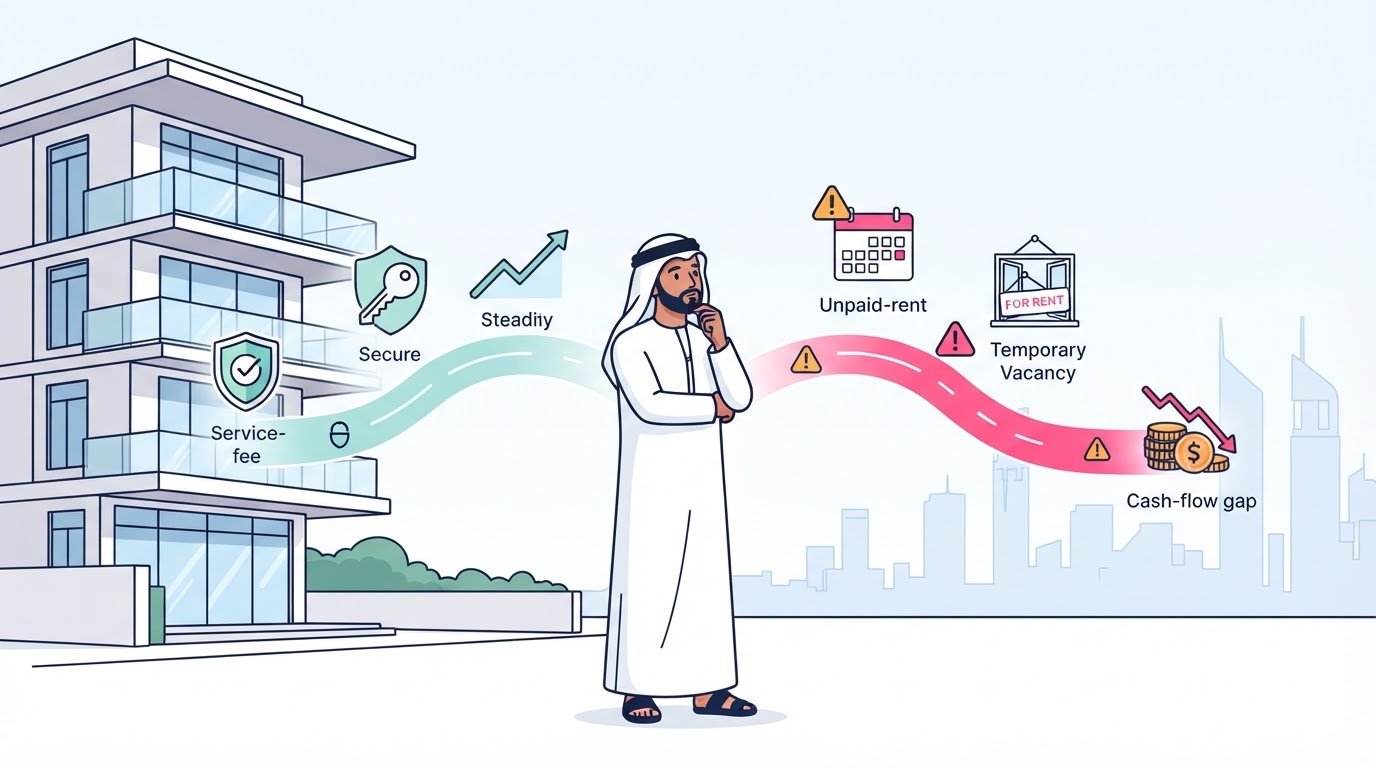
    The lower-cost option may leave your rental income more exposed. For UAE landlords, the cost of rental guarantee vs risk of default is not simply a predictable fee compared with an uncertain missed payment. A tenant default can also create a longer cash-flow gap, time spent re-letting the property and pressure on your investment returns.

    It makes sense to weigh a recurring service fee carefully, especially when the timing and scale of a default are uncertain. A more useful question is how much a realistic downside scenario could cost you in AED, and whether the guarantee agreement addresses the risks you want to manage.

    This guide shows you how to estimate exposure from rent arrears and vacancy, then compare that estimate with a guarantee fee over the same period. It also explains which agreement terms to review before deciding. Takeem’s rental guarantee can be considered alongside digital Direct Debit for monthly rent collection and the emergency property maintenance included in the service.

    Key Takeaways

    • Assess the cost of rental guarantee vs risk of default by comparing the fee with a clearly defined downside scenario over the same period.
    • Estimate exposure using unpaid rent and relevant disruption costs, then identify the point at which a potential loss equals the fee.
    • Compare a guarantee with self-insuring: avoiding a service fee also means retaining the financial risk and administration of a default.
    • Review the agreement’s protection scope, conditions, exclusions and claims process to understand how its terms fit your priorities.
    • Assess rent protection separately from Direct Debit collection, and include emergency maintenance in your wider review of Takeem’s rental guarantee.

    Rental guarantee cost vs. default risk: what are landlords actually comparing?

    The cost of rental guarantee vs risk of default compares a known service fee with a potential loss if rent goes unpaid. The fee is planned; the loss is uncertain. It might be limited to a late payment, or grow if arrears continue, the property becomes vacant, or expected income is needed to meet property obligations.

    Default exposure is the landlord’s potential financial loss from unpaid rent and related disruption before any protection under an agreement is applied. This separates the risk you want to manage from the fee you would pay for a service. A rental guarantee generally involves transferring some rental-income risk to another party, as outlined in this neutral overview of what a rental guarantee is. Its value depends on the written agreement, not the label alone.

    What does a rental guarantee fee pay for?

    Assess the service package alongside its agreement. Takeem provides a rental guarantee for UAE landlords and property investors, supports monthly rent collection through Direct Debit, and includes emergency property maintenance within its guarantee service. These features address different needs: income protection, payment administration and maintenance support. Read the agreement to understand its scope and conditions. Do not assume a particular event, payment timeline, limit or exclusion applies unless the wording says so.

    What counts as the risk of tenant default?

    Start with unpaid rent, then consider the possible knock-on effects. A missed payment can create a short-term cash-flow gap. Prolonged arrears can increase the amount outstanding, while a vacant period after a tenancy ends can extend the loss of rental income. Recovery efforts can also take time, even if they do not create a direct cost.

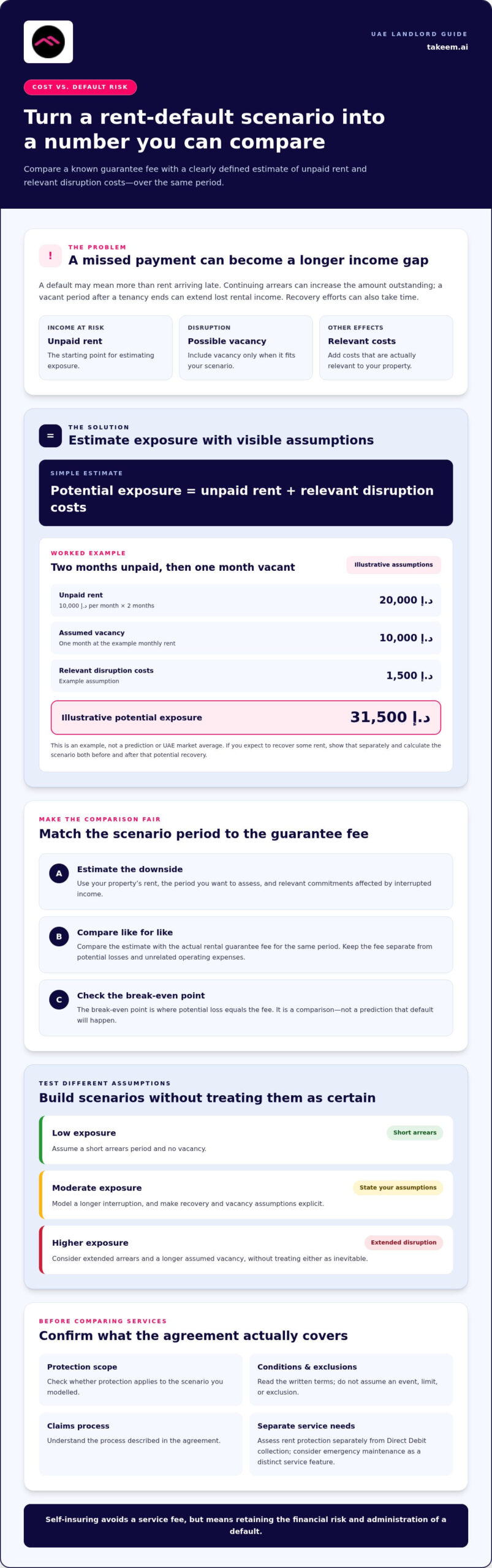
    The impact depends on the rent, the duration of the disruption and the property’s obligations. For a simple illustration, a landlord receiving د.إ 8,000 per month could model one month of unpaid rent separately from several months of arrears and a subsequent vacant period. This is an example, not a prediction or UAE market average. Add only relevant disruption costs, then compare the total exposure with the guarantee’s actual fee and written protection terms.

    How to estimate your rental default exposure and break-even point

    Use your own figures to make the decision concrete. Start with this simple formula:

    Potential exposure = unpaid rent + relevant disruption costs

    Compare the estimate with the actual rental guarantee fee for the same period. The break-even point is a comparison, not a prediction that default will happen. It shows how much potential loss would equal the fee. You can then check whether the agreement’s protection applies to the scenario you modelled. The formal risk assessment framework from the National Institute of Standards and Technology offers a structured approach to identifying risks and assessing their potential impact, principles landlords can apply to their own estimates.

    Which figures should landlords include in the calculation?

    Use the property’s rent, the period you want to assess and known property commitments that could be affected by an income interruption. Model different arrears durations, and state your assumptions about recovery and any vacancy that might follow. Keep each input visible so you can adjust it instead of treating one scenario as certain.

    For example, suppose a landlord uses monthly rent of د.إ 10,000, assumes two months of unpaid rent, and adds one month of vacancy plus د.إ 1,500 in relevant disruption costs. The illustrative exposure is د.إ 31,500: د.إ 20,000 in unpaid rent, د.إ 10,000 in assumed vacancy and د.إ 1,500 in disruption costs. These are example assumptions, not a forecast or market average. If you expect to recover some rent, show that separately and calculate the scenario both before and after that potential recovery.

    How can you compare scenarios without false precision?

    Build low, moderate and higher-exposure scenarios using assumptions that fit your property and planning horizon. Keep the guarantee fee separate from potential losses and unrelated operating expenses. Then compare the fee with the protection that may apply over the same period, using the agreement’s terms.

    • Low exposure: a short arrears period, with no assumed vacancy.
    • Moderate exposure: a longer interruption, with recovery and vacancy assumptions stated.
    • Higher exposure: extended arrears and a longer assumed vacancy, without treating either as inevitable.

    The cost of rental guarantee vs risk of default is easier to assess when each scenario uses clear inputs and matching time periods. Include Takeem’s rental guarantee in your comparison, and review the rental guarantee service alongside your exposure estimate and the written agreement.

    Rental guarantee vs. self-insuring against default: compare the trade-offs

    Self-insuring means retaining the financial risk instead of paying a service fee to transfer or manage specified risks. It may suit a landlord with enough reserves to absorb an interruption, but it is not automatically cheaper or safer. A rental guarantee can support more predictable income planning, subject to its agreement. It does not remove every risk: the written terms determine what protection applies.

    A reliable tenant can make protection seem unnecessary. But the decision is about the financial impact of interrupted rent, not a prediction about a tenant’s behaviour. Focus on your property’s exposure, the reserves available to absorb a loss and the specific risks addressed by the agreement. This keeps the comparison grounded in your circumstances.

    Consideration Self-insuring Rental guarantee
    Fee certainty No guarantee service fee, but losses can be uncertain. A service fee is part of the cost; compare it with the protection stated in the agreement.
    Retained risk The landlord remains responsible for losses if rent goes unpaid. Specified risks may be managed or transferred according to the agreement’s scope and conditions.
    Administration The landlord handles rent follow-up and related administration. Direct Debit can support digital monthly rent collection; this is payment administration, distinct from rent protection.
    Maintenance support Maintenance arrangements remain separate from self-insuring against default. Takeem’s guarantee service includes emergency property maintenance. Consider this separately from rent protection and its written terms.

    When might retaining the risk suit a landlord?

    Keeping the risk may be workable if a temporary income interruption would not destabilise your wider finances. Consider the reserves available for each property and whether rental income is concentrated in one asset or spread across a portfolio. Self-insuring avoids a service fee, but you still carry the potential loss, recovery effort and cash-flow pressure. It is not universally cheaper or safer.

    When might predictable protection be more valuable?

    Some landlords prefer steadier planning to retaining every rent-related uncertainty. For a larger portfolio, consistent administration and visibility across properties may also matter. Assess maintenance support as a separate service value, not as proof that rent protection covers a particular expense. The cost of rental guarantee vs risk of default comes down to your capacity to absorb a loss and the specific risks addressed by the agreement.

    Rental Guarantee Cost vs. Risk of Default: A UAE Landlord’s Decision Guide

    Which rental guarantee terms matter most when weighing its cost?

    A headline description cannot tell you how a guarantee will work in a specific case. The written agreement sets out the protection available, so compare its scope and conditions with the default scenarios you used to estimate exposure. A service fee is easier to evaluate when you understand what it covers, what it does not, and what steps you must take to make a claim.

    How should landlords assess coverage and exclusions?

    Read the agreement for the circumstances treated as covered default, the evidence or actions required from you, and how to start a claim. Note any stated timeframes, limits and exclusions. Do not assume one guarantee follows another’s terms, or that a broad label means every unpaid-rent situation is covered. The contract wording determines what protection applies to your property and circumstances.

    Use this checklist as you review the agreement:

    • Protection scope: Which default circumstances are described?
    • Conditions: What records, notices or other actions are required?
    • Timeframes and limits: What does the agreement specify, and for how long?
    • Exclusions: Which situations fall outside the stated protection?
    • Claim process: How is a claim submitted, and what information is needed?
    • Service fee: What period does it cover, and how does it compare with your exposure over that same period?

    How do collection and maintenance features affect value?

    Direct Debit provides a digital method for collecting monthly rent. It supports payment administration, but it is not rent protection by itself. Assess it as a separate feature: it can modernise payment collection, while the guarantee agreement governs the protection it provides.

    Takeem’s rental guarantee also includes emergency property maintenance. Consider this as a separate service component that may matter to asset care, and review its terms separately from the agreement’s income-protection provisions. Maintenance support does not, by itself, change the scope of rent protection.

    The cost of rental guarantee vs risk of default is best judged against the agreement’s wording, not the service label or a list of features alone. Review Takeem’s rental guarantee and maintenance service as part of your comparison, then match its terms to the risks you want to manage.

    Decide whether a rental guarantee fits your UAE property strategy

    A useful decision does not start with the fee alone. Work through your exposure, the agreement and the service features in sequence. Your decision should reflect your property, cash-flow priorities and tolerance for uncertainty, not a prediction that a tenant will default.

    A practical decision checklist for landlords and investors

    • Record your assumptions: Note the rent, the period you are assessing and any property commitments that depend on rental income.
    • Model plausible disruption: Consider different arrears durations and any possible vacancy. Keep assumptions visible so you can revise them.
    • Match scenarios to the agreement: Compare each scenario with the stated protection, conditions, exclusions and claim process.
    • Compare like with like: Set the service fee beside the potential exposure over the same period, then assess whether the service features add value for your strategy.
    • Review as circumstances change: Revisit the calculation if your portfolio, cash-flow needs or investment plans change.

    For a single property, a short interruption may have a different effect than it would across a portfolio with concentrated rental income. Reassess the figures as your holdings and priorities evolve. A decision that fits today may need another look after an acquisition, a change in financing commitments or a shift in how much uncertainty you are comfortable retaining.

    What does a more predictable rent process look like?

    Digital monthly collection through Direct Debit offers an alternative to relying on post-dated cheques for rent administration. Collection and income protection play different roles: Direct Debit supports the monthly payment process, while the rental guarantee’s written terms define its protection. Takeem’s guarantee service also includes emergency property maintenance, a separate component to consider alongside rent-related protection.

    For more context, consult a UAE rental guarantee guide when reviewing the protection model, and a digital rent collection guide when considering how monthly payments are administered. Together, these topics can help you assess the service as a whole without assuming collection itself prevents default or that maintenance changes the guarantee’s coverage.

    After estimating your exposure and reviewing the terms, consider Takeem’s landlord rental guarantee for rental-income planning alongside digital rent collection and emergency maintenance support.

    Make a clearer decision for your rental strategy

    The cost of rental guarantee vs risk of default is best assessed using your own figures, not a prediction about whether a tenant will pay. Estimate plausible rent disruption and related costs, then compare that exposure with the fee over the same period.

    Next, read the agreement closely. Its stated protection, conditions and claims process determine how the guarantee applies. Assess service features separately: Direct Debit supports digital monthly rent collection, while emergency property maintenance is included within Takeem’s rental guarantee service. These features address distinct needs and can each inform your rental-income planning.

    With a clear view of your exposure and priorities, you can decide whether retaining the risk or choosing more predictable support fits your property strategy. Explore Takeem’s rental guarantee for landlords to take a more informed step toward managing rental income.

    Frequently Asked Questions

    Is a rental guarantee worth the cost compared with tenant default?

    It depends on the service fee, your potential exposure and the agreement’s exact scope. To assess the cost of rental guarantee vs risk of default, compare the fee with realistic scenarios for unpaid rent and related disruption over the same period. Do not assume default is certain or that every loss is covered. Consider how much financial uncertainty you are comfortable retaining and whether the agreement’s protection and related services suit your needs.

    How do I calculate the break-even point for a rental guarantee?

    Compare the guarantee fee for a chosen period with your estimated exposure if rent goes unpaid during that period. Your scenario can include unpaid rent and relevant disruption costs, based on assumptions you can explain and adjust. Break-even is a comparison tool, not a forecast that default will occur. Review the agreement’s scope, conditions and exclusions too, since the fee can only be meaningfully compared with risks the service addresses.

    Does a rental guarantee cover every missed rent payment?

    No. Do not assume every missed payment or default circumstance is covered. The protection available depends on the specific agreement, including its conditions, limits, exclusions, required actions and claim process. Read the wording before comparing a guarantee with self-insuring. Identify the exact risk you are considering and check whether the agreement addresses it. A service label or general description alone cannot establish how protection applies to your circumstances.

    Can Direct Debit prevent tenant default?

    No. Direct Debit provides a digital method for collecting monthly rent, but it does not eliminate default risk or replace income protection. These features address different parts of the payment process: collection supports rent administration, while the rental guarantee agreement defines its protection. Assess each separately, considering the administration of digital collection alongside the written terms that govern protection and its role in your rental-income planning.

    What costs should landlords include when assessing default risk?

    Start with rent that could go unpaid, then consider the duration of disruption and property commitments affected by an income gap. Make assumptions about potential recovery time and vacancy explicit so you can adjust them. Use figures for your own property rather than unsupported market averages. Compare the resulting scenarios with the guarantee fee over a matching period, and review whether the agreement addresses the risks in your calculation.

    Does a rental guarantee include property maintenance?

    Maintenance support depends on the service and its agreement, so assess it as a separate component rather than assuming every guarantee includes it. Takeem’s rental guarantee service includes emergency property maintenance. Consider how this feature relates to your asset-care needs, and read the applicable terms for its scope and conditions. Keep maintenance value separate from your rent-default calculation so you can assess both clearly.

  • Guaranteeing Rental Income in UAE: 2026 Landlord Guide

    Guaranteeing Rental Income in UAE: 2026 Landlord Guide

    A rent collection system can make payments easier to track, but it doesn’t by itself protect you if a tenant doesn’t pay. For UAE landlords, understanding how to guarantee rental income starts with separating payment collection from income protection, then checking exactly what any protection service covers.

    It’s reasonable to want rent to arrive on time and in full without repeated follow-ups or managing post-dated cheques. A clear collection process can make payments easier to manage, while written protection terms help you understand what may happen if payments stop.

    This guide explains the difference between digital rent collection and a rental guarantee, and how to compare options by eligibility, exclusions, claims processes, and service scope. It also provides steps for organising collection and assessing Takeem’s Direct Debit and rental guarantee services, including the emergency maintenance component. Confirm current terms and conditions before deciding, so you know what applies to your circumstances.

    Key Takeaways

    • Learn how to guarantee rental income by distinguishing payment collection from protection if a tenant doesn’t pay.
    • Understand how Direct Debit can support recurring digital rent payments, subject to setup and tenant authorisation.
    • Compare self-managed collection, digital collection, and rental guarantees by reviewing service scope, landlord responsibilities, exclusions, and terms.
    • Prepare tenancy documents, payment records, property details, and service agreements before comparing options.
    • Assess Takeem’s UAE rental guarantee and Direct Debit services, and confirm current eligibility, conditions, claims processes, and maintenance scope.

    How to Guarantee Rental Income: Start by Identifying the Risk

    A tenancy schedule tells you when rent is due, but it can’t ensure that payment will arrive on time or in full. A tenant may miss a payment, a collection instruction may need attention, or an urgent property issue may affect your finances. Before deciding how to guarantee rental income, identify which risks you need to manage. Each may call for a different solution.

    A rental income guarantee is a service arrangement that provides defined support when specified conditions are met. The term doesn’t describe one standard product: providers may set different payment triggers, limits, exclusions, and processes. The guaranteed rental model, for example, can involve an owner receiving an agreed sum while another party assumes vacancy risk. Don’t assume every rental guarantee works this way. Read the written agreement to understand who bears each risk.

    A rental income guarantee may support agreed rental payments; it doesn’t guarantee the property’s investment returns. Vacancy, property damage, market changes, and operating expenses can affect an investment even if a service addresses a defined non-payment risk.

    What does a rental income guarantee actually protect?

    A guarantee is intended to support income continuity under the conditions in its service agreement. Before relying on that support, confirm what event triggers it, what amount or period may be covered, how to make a claim, and which exclusions apply. Ask specifically whether vacancy or damage is included. The word “guarantee” alone doesn’t confirm that either is covered.

    Which rental income risks should landlords assess first?

    Start with the interruptions that could put pressure on your cash flow:

    • Missed or delayed payments: Consider how a late or absent payment would affect property expenses and other commitments.
    • Administrative gaps: Manual reminders, payment tracking, and unresolved collection issues can take time and make it harder to spot problems promptly.
    • Urgent property issues: Unexpected repairs may need attention and create costs. Check separately whether a service includes emergency maintenance and which events or costs qualify.
    • Vacancy and market changes: These risks differ from tenant non-payment. Check explicitly whether an agreement addresses them instead of assuming it does.

    A payment method can help organise or collect scheduled payments, but it doesn’t necessarily protect you if a tenant doesn’t pay. A separate agreement may address specified income risks, subject to its terms. List your main concerns, such as payment delays, time spent on follow-up, or emergency maintenance, then match each one to the relevant service provision. Consider your cash-flow needs, portfolio size, and tolerance for interruptions. This makes it easier to compare options without treating any arrangement as protection against every property risk.

    How Rental Guarantees and Digital Rent Collection Work

    Digital collection and rental income protection can work alongside each other, but they solve different problems. Direct Debit arranges recurring digital payments from a tenant, subject to setup and the tenant’s authorisation. It can make monthly collection easier to organise than manually tracking cheque dates. It doesn’t ensure every payment succeeds or, by itself, protect a landlord if rent isn’t paid.

    A typical setup involves agreeing on a payment schedule, establishing and authorising payment instructions, monitoring collections, and following up on exceptions such as a failed or missing payment. Before switching methods, confirm how authorisation works, when payments are requested, how failed payments are reported, and what follow-up remains your responsibility. For relevant rental procedures and guidance, consult the government guidance.

    What changes when rent moves from cheques to Direct Debit?

    Rather than checking each cheque date and manually recording receipt, a recurring digital process can help organise payment instructions and flag exceptions. You still need to monitor rent and follow up with the tenant if a payment fails. Ask who receives failure notifications, what information they provide, and what steps you must take. Make sure setup requirements and tenant authorisation are clear before the arrangement begins.

    How does collection differ from income protection?

    Think of collection as the payment process and protection as a separate contractual arrangement. Support under a rental guarantee depends on its agreement, including applicable conditions and exclusions. Read both service scopes instead of assuming a digital payment method includes protection or that a guarantee automatically includes collection administration.

    Payment administration

    • Sets how and when rent is requested and received.
    • May help organise recurring payments and identify collection exceptions.
    • Doesn’t automatically cover missed rent or other interruptions to income.

    Protection under a guarantee agreement

    • Defines which specified income risks may qualify for support.
    • Sets the applicable triggers, process, limits, and exclusions.
    • Requires review of the written agreement; the word “guarantee” isn’t enough to establish coverage.

    Compare these functions separately before choosing an arrangement. Takeem offers Direct Debit setup for monthly tenant payments and a rental guarantee as a distinct service. If you’re exploring rental guarantee and Direct Debit options, check the current setup requirements and guarantee terms. For a broader overview, see Modernizing UAE Rentals: A Landlord’s Guide to Rental Guarantees and Direct Debit.

    Compare Rental Income Protection Options Before You Commit

    The right approach depends on what you need to solve. Self-managed collection, digital collection, and a rental guarantee serve different purposes, and none is automatically the best fit for every landlord. To decide how to guarantee rental income, compare the practical workload and the specific risks addressed, not just the service label.

    Option Purpose and income-risk support Landlord involvement and scope Questions to verify
    Self-managed collection Landlord requests and tracks rent directly. It doesn’t itself protect against non-payment. Landlord handles payment records, reminders, and follow-up. How will you track due dates, missed payments, and communications?
    Digital collection Organises recurring payment instructions. It may streamline collection, but isn’t automatically income protection. Setup, authorisation, monitoring, and failed-payment follow-up still need to be understood. What are the setup steps, and how are failed payments handled?
    Rental guarantee May support income continuity for specified events under a separate agreement. Scope and landlord responsibilities depend on the written terms. What qualifies, what’s excluded, and what evidence or action is required?

    Digital collection may suit landlords who want a more structured recurring payment process. If a defined non-payment risk could disrupt your cash flow, compare guarantee agreements as well. First assess your income needs and tolerance for interruptions, then confirm exactly what each agreement covers. A guarantee’s value depends on its conditions, exclusions, and fit with your circumstances, not its name alone.

    What should you compare in a guarantee agreement?

    Check the agreement for eligibility, covered events, exclusions, claim evidence, payment conditions, and cancellation provisions. Ask who handles tenant communication and what responsibilities remain yours. Confirm any service fees directly with the provider rather than relying on assumed or market-average figures. If maintenance is included, verify which emergencies and repair costs fall within its scope.

    Property management is a separate service category. Don’t assume a rental guarantee or digital collection setup includes tenant coordination, property upkeep, or broader management tasks. Check each service scope independently so you know what is and isn’t included.

    For more detail, consult The Ultimate Guide to Landlord Rental Guarantees in the UAE (2026). Use it alongside the agreement itself: only the written terms can clarify the provider’s current eligibility requirements, coverage conditions, and exclusions.

    Guaranteeing Rental Income in UAE: 2026 Landlord Guide

    How to Set Up a Practical Rental Income Protection Plan

    A useful plan turns broad concerns into clear actions: understand your cash-flow needs, review your current process, compare written terms, and record who is responsible for each step. This makes it easier to judge how to guarantee rental income in a way that fits your properties, without assuming one service addresses every risk.

    Prepare the right information first

    Gather the records a provider may need to assess your situation and explain its terms:

    • Tenancy documents: Keep the contract, rent schedule, and relevant tenancy correspondence together.
    • Payment records: Note payment dates, delays, missed payments, and any follow-up or resolution.
    • Property details: Assemble the information needed to identify each property and understand its circumstances.
    • Current agreements: Include existing collection, guarantee, insurance, or maintenance documents that may affect responsibilities.

    Write down your current collection routine too: who checks payments, how a late payment is flagged, and who contacts the tenant. If you have multiple properties, decide whether you need consistent processes or consolidated reporting, then ask providers how their service handles those needs.

    Ask questions that clarify the limits

    Request current written terms and ask providers to answer important questions in writing. For a guarantee, check which events qualify, what evidence is required, what is excluded, and what conditions apply to any payment support. Confirm notification deadlines, service duration, cancellation provisions, and which tenant communications or follow-up actions remain your responsibility.

    Be specific about any additional service components. If emergency maintenance is included, ask which events and repair costs qualify, how support is arranged, and what you must do. For Direct Debit, confirm setup steps, tenant authorisation, payment scheduling, and how failed collections are handled. Don’t rely on verbal descriptions when a detail could affect your decision.

    Compare, document, and review

    Compare the answers with your income requirements and existing process. Record what each option covers, its exclusions, your obligations, and any service fees quoted directly by the provider. Before agreeing, have a qualified UAE legal or financial professional review questions about applicable requirements or your individual circumstances.

    Once you choose an arrangement, keep the service agreement, tenancy records, payment instructions, and escalation steps accessible. Set a reminder to review them when a tenancy or service term changes. For further context on reducing conflict around rental income, read Avoiding Rental Disputes in the UAE: A Landlord’s Guide to Income Protection.

    To assess a rental guarantee and digital payment setup for your circumstances, review Takeem’s landlord services and confirm the current terms, eligibility, and service scope directly.

    How Takeem Can Support a More Predictable Rental Income Process

    Once you’ve separated payment collection from income protection and identified what to check, assess services against your rental process. Takeem provides rental guarantee services for landlords and property investors across the UAE, alongside Direct Debit setup for digital monthly rent collection. These services address related but distinct needs, and eligibility, outcomes, and conditions depend on the relevant terms.

    How do Takeem’s guarantee and Direct Debit services fit together?

    The rental guarantee is the income-protection component: its written agreement defines the circumstances in which support may apply. Direct Debit addresses payment administration by arranging recurring digital payments from tenants, subject to setup and authorisation. Using digital collection doesn’t, by itself, mean missed payments are covered. Review the two service scopes separately, even if you’re considering them together.

    Takeem’s rental guarantee also includes emergency property maintenance as a service component. Before relying on it, ask which emergencies and repair costs are included and what conditions apply. If you own several properties or have particular tenancy arrangements, ask how the current agreement applies to each property rather than assuming the same eligibility or terms across your portfolio.

    What should you confirm before taking the next step?

    Ask Takeem for current written information on the details that could affect your decision. Confirm:

    • Guarantee terms: Eligibility, covered conditions, exclusions, applicable service fees, and the claims process.
    • Maintenance scope: Which emergencies and repair costs are included, and what steps or responsibilities apply.
    • Direct Debit setup: How payment instructions are established, what tenant authorisation is required, and how collection issues are handled.
    • Your responsibilities: What you must monitor, report, document, or communicate under each service.

    Written answers help you compare the service with your cash-flow needs and existing arrangements. They also make it easier to distinguish the payment process from any protection that may apply under a guarantee agreement. If you’re considering how to guarantee rental income, don’t rely on a general description alone. Check the actual terms for your property and tenancy before deciding.

    Explore Takeem’s rental income guarantee and digital collection services and ask for the current written terms, including eligibility, exclusions, claims requirements, Direct Debit setup, and maintenance scope.

    Build a Clearer Plan for Rental Income

    A more predictable rental income process starts with knowing which risks you want to address. Digital collection can organise recurring payments, while a rental guarantee may provide support for specified situations under its written terms. They serve different purposes, so compare eligibility, exclusions, responsibilities, and claims conditions before choosing an arrangement.

    That distinction is central to understanding how to guarantee rental income: no service should be assumed to cover every interruption or investment risk. Review your tenancy and payment records, clarify your cash-flow needs, and confirm the exact scope of any protection and maintenance support.

    Takeem serves landlords and property investors across the UAE with rental guarantee support, Direct Debit setup for digital monthly rent collection, and emergency property maintenance as a component of its guarantee service. Confirm current eligibility, written terms, payment setup, and maintenance scope for your circumstances.

    Explore Takeem’s rental guarantee and digital rent collection services, then use the written details to decide on your next step. A clear process can make rental income management more organised. Contact Takeem to ask about current terms and whether its services fit your needs.

    Frequently Asked Questions

    Can rental income be guaranteed in the UAE?

    Rental guarantee services are available in the UAE, but they don’t make rental income certain in every circumstance. Each provider sets its own eligibility criteria, coverage conditions, exclusions, and process in a written agreement. To understand how to guarantee rental income for your situation, check which events qualify and what responsibilities remain yours. Takeem provides rental guarantee services for landlords and property investors across the UAE, subject to its current terms.

    How can landlords protect rental income from missed payments?

    Start by choosing a clear collection process and deciding how you’ll respond to a missed or delayed payment. Keep the tenancy agreement, payment records, and tenant communications organised. Digital collection can help structure recurring payment instructions, while a rental guarantee may provide support for specified situations under its agreement. Compare the terms carefully, including exclusions, notification requirements, and any evidence needed to make a claim.

    Does Direct Debit guarantee that rent will be paid?

    No. Direct Debit arranges recurring digital payment instructions, subject to setup and tenant authorisation, but it doesn’t ensure every payment will succeed. A payment may still require follow-up. Confirm when collections are scheduled, how failed payments are reported, and what action the landlord must take. Direct Debit concerns how rent is collected; any income protection depends on a separate agreement with its own conditions.

    What should I check in a rental guarantee agreement?

    Read the current written agreement and verify eligibility, covered events, exclusions, payment conditions, claims evidence, notification deadlines, service duration, and cancellation provisions. Ask who handles tenant communication and which tasks remain your responsibility. If the service includes maintenance, request a clear explanation of qualifying emergencies and repair costs. Confirm any service fees directly with the provider, and don’t rely on a general description in place of the contract.

    Can I combine digital rent collection with a rental guarantee?

    Yes, landlords can consider digital rent collection alongside a rental guarantee, but the two services perform different functions and may have separate setup steps and terms. Direct Debit supports recurring payment collection, while the guarantee agreement defines whether support applies to specified income risks. Before combining them, confirm tenant authorisation requirements, failed-payment handling, eligibility, coverage conditions, and how the services work together for your property and tenancy.

    Does a rental guarantee cover property maintenance and repairs?

    Not necessarily. Maintenance and repair coverage depends on the provider and the written service terms, so don’t assume it’s included because an arrangement is called a rental guarantee. Takeem includes an emergency property maintenance service as part of its rental guarantee, but landlords should confirm which emergencies and repair costs qualify, what conditions apply, and what steps they must follow before relying on that service component.

    Is a rental guarantee the same as property management?

    No. A rental guarantee is a service arrangement that may provide support for defined income risks under written conditions. Property management is a distinct service category and may involve responsibilities beyond collection or income protection. Check the provider’s stated service scope rather than assuming tenant communication, property upkeep, or broader management tasks are included. Takeem offers rental guarantee and Direct Debit services, not property management.

  • Digital Rent Collection in Dubai: The Landlord’s Guide to Secure UAE Payments

    Digital Rent Collection in Dubai: The Landlord’s Guide to Secure UAE Payments

    Looking into digital rent collection UAE options can help landlords move away from tracking post-dated cheques and following up on delayed payments. Across the Emirates, scheduled monthly payments through Direct Debit offer an alternative that can reduce manual processing and support a more consistent rent collection routine.

    Cheques may feel familiar, but a payment method alone can’t remove the uncertainty of a returned cheque or delayed resolution. Digital collection offers a more streamlined way to receive rent. A rental guarantee is separate and may provide another layer of protection for rental income, subject to its terms.

    This guide explains how to transition from cheque-based rent collection to Direct Debit through Takeem, what to review when setting up digital payments, and how automated collection differs from income protection. It also covers how a digital payment process and a rental guarantee can support a more structured approach to rental operations.

    Key Takeaways

    • Learn how digital rent collection can replace cheque handling with scheduled monthly Direct Debit payments.
    • Compare digital collection with post-dated cheques by considering payment processing and administrative work.
    • Prepare for a transition by reviewing tenancy agreements, payment schedules and cheque expiry dates before choosing a Direct Debit provider.
    • Understand the difference between automated collection and a rental guarantee: one supports rent collection, while the other may protect income if a tenant defaults.
    • Consider how a rental guarantee package that includes emergency property maintenance can offer landlords additional support.

    Modernising UAE Real Estate: The Evolution of Digital Rent Collection

    Digital rent collection replaces paper-based payment handling with electronic methods, such as Direct Debit, to collect rent on an agreed schedule. Instead of storing post-dated cheques and arranging deposits, landlords can use a digital process for recurring payments and keep clearer records. Across the UAE, this shift reflects a broader move towards connected, paperless financial processes in the property sector.

    Digital workflows can make rental transactions easier to track by bringing payment schedules and records together. Landlords and tenants can check whether a payment was scheduled, processed or needs attention. Digital collection doesn’t remove every payment risk, and it doesn’t make cheques unlawful. Post-dated cheques remain a legal and widely used method in the UAE. The practical difference is that landlords and investors can choose a more automated approach for their rental operations.

    The Limitations of the Traditional Cheque System

    Physical cheques require ongoing administration. Landlords or their representatives must store them securely, monitor due dates and deposit each cheque. If a cheque is returned for insufficient funds, expected rent may not arrive on time. Under UAE rules in effect in 2026, insufficient-funds cases are generally handled through civil enforcement, including a possible court execution case. Fraud-related conduct can still carry criminal consequences, so recovering funds may involve legal steps and delays.

    Why UAE Landlords Are Embracing Digital Transformation

    With Direct Debit, a tenant authorises a payment that is collected from their bank account on a scheduled basis. It is a pull-payment method, distinct from a tenant manually initiating each transfer. The underlying Direct Debit system supports recurring payments, but landlords should confirm the provider’s process and applicable UAE requirements before switching.

    Monthly collection can help landlords plan cash flow more consistently than relying on a small number of quarterly or bi-annual payments. It may also give tenants a payment rhythm aligned with regular income. Payment frequency can support convenience, but it can’t guarantee tenant retention.

    For investors, digital processes can reduce cheque handling and make payment activity easier to review across a portfolio. Direct Debit setup offers one route to scheduled monthly rent collection, while a rental guarantee addresses a separate concern: protection against tenant default. Together, they can support a more considered approach to rental operations.

    How Direct Debit Facilitates Seamless Rental Payments

    Direct Debit is an automated pull-payment method. After a tenant authorises a mandate, the payment provider requests the agreed rent from the tenant’s bank account according to the schedule. Instead of preparing and depositing a separate cheque for each payment, both parties use a recurring payment arrangement. Scheduled collection can reduce manual reminders and data entry, but landlords should still monitor payment status and follow up if a collection fails.

    For tenants, a predictable monthly schedule can make payment timing easier to manage. For landlords, it can support a steadier collection routine and reduce repetitive administration. It is not a true “set and forget” system: landlords should continue reviewing records and checking that the payment mandate and tenancy details are correct.

    Security and Authorisation in Digital Payments

    The UAE Direct Debit System (UAEDDS) is the national framework for processing recurring Direct Debit payments through participating banks. A digital mandate records the tenant’s authorisation for scheduled collections, reducing reliance on issuing a new physical cheque for each payment. The exact authorisation steps and available protections depend on the provider and participating bank. Before setup, ask how mandates are verified, how payment data is protected, and how to manage a dispute or failed collection. For wider regulatory context, consult this overview of UAE fintech regulations.

    Don’t assume every fintech uses the same encryption or data-protection controls. Review the provider’s documentation and confirm how it handles access, records, consent changes and payment notifications. Clear answers help you decide whether the process suits your tenants and portfolio.

    Clearer Oversight for Property Investors

    For landlords with multiple properties, coordinating cheque dates and manually updating records can become difficult to scale. A digital process can bring payment schedules and records together. If a provider offers a dashboard, landlords may be able to review collection statuses in one place. Confirm what information is available and how often it updates rather than assuming every platform provides real-time reporting.

    Automation can reduce human error, such as recording the wrong due date or overlooking a cheque. It won’t eliminate every mistake, so check tenancy details and payment instructions before activating a mandate. Takeem provides Direct Debit setup for landlords and connects digital collection with rental income protection. Learn more about rental guarantee with direct debit UAE, or explore Takeem’s landlord solutions to see how these services may fit your collection process.

    Digital Collection vs. Post-Dated Cheques: A Risk Analysis

    Digital rent collection and post-dated cheques organise rent payments differently, but neither method removes every risk. Cheques require landlords to store each payment and deposit it on the due date, after which the bank must process it. Direct Debit follows an authorised schedule, so collection can take place without handling a physical cheque. Processing times depend on the banks and payment arrangements involved. Confirm when funds are expected to reach your account rather than assuming every digital payment clears instantly.

    For tenants, writing several cheques at the start of a tenancy can mean planning around large, less frequent payments. An agreed monthly digital mandate can make payment timing more predictable. For landlords, the operational difference is the amount of recurring manual work: tracking cheque dates, arranging deposits and recording outcomes, compared with reviewing scheduled collections and their status. The time saved varies by portfolio and process, so track your current administrative workload and compare it after a transition rather than relying on a generic estimate.

    Legal and Financial Security

    Post-dated cheques remain legal and widely used in the UAE, but the legal position on bounced cheques has changed. Under Federal Decree-Law No. 14 of 2020, effective January 2, 2022, insufficient-funds cases are generally handled through civil enforcement rather than criminal prosecution. A holder may pursue an execution case, and banks must make partial payment when funds are available. Fraud-related conduct can still carry criminal consequences. Digital collection avoids cheque handling, but a failed collection may still require follow-up. Neither method should be mistaken for guaranteed income.

    Digital payment histories can make it easier to review scheduled collections, payment outcomes and communications if a disagreement arises. Keep the tenancy agreement and relevant records together. Digital records can help clarify what happened, but they don’t replace the agreement or resolve a dispute by themselves. To reduce the risk of rental disputes, use clear terms and consistent documentation. Bank fees vary by institution and payment method, so compare applicable charges before assuming digital collection will cost less than cheque processing.

    Operational Efficiency for Modern Landlords

    Automation reduces repeated tasks, but it won’t eliminate administration. Landlords still need to review collection status, maintain accurate tenant and payment details, and agree on any change to a payment date with the tenant. Check whether the provider allows mandate updates and how those changes take effect. An organised digital process can create a more professional experience for tenants, while transparent communication remains important to satisfaction and retention.

    When assessing digital rent collection Dubai options, weigh the convenience of scheduled payments against processing timelines, provider terms and the separate protection you may need if rent is not received.

    Digital Rent Collection in Dubai: The Landlord’s Guide to Secure UAE Payments

    Steps to Transition a Property Portfolio to Digital Payments

    A smooth move from cheques to Direct Debit starts with an inventory, not a rushed portfolio-wide switch. Review each tenancy agreement, payment schedule and cheque expiry date. Note renewal dates, tenant contact details, rent amounts and any payment exceptions. This gives you a clear view of which tenancies to consider first and where you may need to clarify contract terms or coordinate a change with the tenant.

    • Audit your records: Match each property and tenant to the correct rent amount, due date, agreement and remaining cheques.
    • Assess providers: Ask how their Direct Debit setup works in the UAE, what authorisation tenants must provide, how failed collections are reported and what records you can access.
    • Plan the changeover: Agree on the timing with tenants and avoid overlapping a digital collection with a cheque for the same rent period.
    • Test and review: Confirm mandate details before activation, then check the first collection and reconcile it against your tenancy records.

    Onboard Tenants with Clear Communication

    Explain the change in practical terms: the tenant authorises scheduled rent collection, receives clear payment information and no longer needs to prepare a separate cheque for each due date. Set out the collection date, how the mandate is authorised, where questions should go and what happens if a payment doesn’t complete. Avoid promising that a collection can never fail. Reassurance comes from transparent steps and a clear record of consent. Real estate agents can also support conversations with landlords and explore a rental guarantee for real estate agents.

    Scale Consistently Across Multiple Properties

    For a larger portfolio, use a consistent record format across every unit. Standardise property identifiers, tenant names, payment dates and reference details so collections can be reconciled and reviewed without guesswork. If your provider offers a central dashboard, check whether it can show collection status across units and export records for financial reporting. Don’t assume every platform has the same tracking or reporting functions.

    Roll out in manageable groups, review the first payment cycle for each group, then resolve data or communication gaps before moving on. This creates a repeatable process for managing property portfolio rental income UAE without losing sight of individual tenancy details. Takeem provides Direct Debit setup for landlords. Explore Takeem’s landlord Direct Debit setup as you plan your transition.

    Beyond Collection: Integrating Rental Guarantees and Maintenance

    Automating rent collection makes payments easier to schedule and track, but it can’t prevent a tenant from defaulting. Landlords need to distinguish between collecting rent and protecting rental income. Direct Debit streamlines the payment process. A rental guarantee provides a separate layer of protection if a tenant fails to pay, subject to the guarantee’s terms.

    This distinction matters for investors planning around rental income. A scheduled payment that doesn’t complete still needs attention. A guarantee may help address the income risk, while clear records and an agreed process help landlords respond to a missed payment. Review the provider’s terms so you understand what’s covered and what steps apply if a tenant defaults.

    The Value of Combining Income Protection and Maintenance

    Takeem offers a Landlord Rental Guarantee that includes emergency property maintenance. These services address different concerns: tenant default can affect expected income, while an urgent property issue may need attention to protect the home and support a positive tenancy experience. Combining both in a guarantee package can simplify how landlords consider income protection and property upkeep, but it doesn’t mean rent collection prevents maintenance problems.

    Maintenance matters to tenants, too. Addressing property issues appropriately can support a more dependable rental experience and help protect the asset over time. Check the service’s scope and process with the provider so you know what is included and how maintenance requests are handled.

    Planning for a More Hands-Off Investment

    Digital payments, a rental guarantee and emergency maintenance can reduce some recurring tasks and uncertainty, helping landlords take a more investment-focused role. They don’t make ownership entirely passive or replace property management. Landlords still need to understand their agreements, review payment records and stay informed about the property and tenant relationship.

    For longer-term financial planning, it is useful to separate expected rent from protection against default. Scheduled digital collection can make payment activity easier to monitor, while a rental guarantee may offer additional peace of mind if a tenant fails to pay. Together, these measures can support a more structured approach to income planning, but confirm the guarantee’s terms rather than assuming every situation is covered.

    To explore how Direct Debit setup and rental income protection could fit your portfolio, review Takeem’s landlord solutions.

    Digital Rent Collection Dubai: Build a More Secure, Modern Rental Strategy

    Moving from post-dated cheques to Direct Debit can simplify monthly rent collection and reduce repetitive manual handling. Automation is only one part of a resilient rental strategy: payment records help you monitor collections, while a rental guarantee can provide a separate layer of protection if a tenant defaults.

    For landlords exploring digital rent collection Dubai, the opportunity is to combine a smoother payment process with more structured income planning. Takeem supports the transition to monthly Direct Debit and offers a Landlord Rental Guarantee that includes emergency property maintenance. Review the terms carefully to understand the protection provided and what the maintenance service covers.

    You don’t need to modernise every tenancy at once. Start by reviewing agreements and payment dates, communicate clearly with tenants, then check the first digital collection cycle. A deliberate transition can help you build a more efficient rental process while keeping individual tenancy details in view.

    Explore Takeem’s digital rent collection and rental guarantee to take the next step towards a more structured approach to managing rental income.

    Frequently Asked Questions

    Is digital rent collection legally valid in the UAE?

    Digital rent collection can be used for rental payments in the UAE, provided the payment method is agreed and set up appropriately. Post-dated cheques also remain a legal payment method. Check your tenancy agreement, confirm any required amendment with the tenant, and ask the payment provider about its Direct Debit process and applicable requirements. For current regulatory guidance, consult a qualified UAE legal professional or the relevant authority.

    Can I replace existing post-dated cheques with Direct Debit mid-tenancy?

    A mid-tenancy change usually requires coordination with the tenant and agreement on the revised payment arrangement. Review the tenancy contract first, then document the new method, collection dates and any changes to payment terms in writing. Coordinate the transition with your provider so a Direct Debit collection doesn’t overlap with a cheque for the same rent period. Don’t cancel or disregard existing cheques until the replacement arrangement is confirmed.

    What happens if a tenant’s Direct Debit payment fails?

    A failed collection means the rent hasn’t been received through that payment attempt. Check the provider’s notification for the reason, then contact the tenant promptly to agree on the next step. Follow the provider’s process for correcting account or mandate details and arranging another payment. Don’t assume a rental guarantee automatically covers every failed collection. If you have one, review its terms, eligibility conditions and notification requirements.

    How does digital rent collection benefit property investors with large portfolios?

    Digital collection can reduce the work of tracking cheque dates, arranging deposits and manually recording payments across multiple properties. A consistent schedule and organised payment records can make it easier to review rental income and identify collections that need follow-up. If a provider offers a portfolio dashboard or reporting tools, check what information it shows and how often it updates. Automation helps with oversight, but accurate property and tenant data still matters.

    Does digital collection require a specific type of UAE bank account?

    Account requirements depend on the Direct Debit provider and the banks involved, so confirm them before onboarding tenants. Ask whether rent is collected from the tenant’s account, where landlord payments are deposited, and whether any account eligibility or verification steps apply. Also check what account details are needed, who can access them and how payment records are provided. Don’t assume every provider supports the same banks or account types.

    Are there additional fees for landlords using digital rent collection services?

    Fees can vary by provider, bank and service arrangement, so review the current terms before choosing a setup. Ask for an itemised explanation of any setup, collection, transaction or account-related charges, and clarify whether a failed payment or mandate change could incur a fee. Compare the full cost with your existing process rather than assuming digital collection is free or always less expensive. Confirm charges directly with the provider.

    How do I set up a rental guarantee alongside digital collection?

    Contact a provider that offers both landlord rental guarantees and Direct Debit setup, then review each service’s terms separately. Ask what the guarantee covers, what exclusions or conditions apply, and what steps you must take if a tenant defaults. Takeem provides rental guarantees and helps landlords set up monthly Direct Debit collection. Its guarantee package also includes emergency property maintenance. Confirm the specific coverage and process before proceeding.

    Is my tenant’s financial data secure when using digital payment platforms?

    Security depends on the provider’s systems and processes, so ask how it protects payment details and limits access to tenant information. Before setup, check how the tenant authorises the mandate, how data is stored and shared, and what procedures apply if information is exposed or a payment is disputed. Review the provider’s privacy and security documentation, and use its official channels for submitting account details. Avoid assuming all platforms use identical protections.

  • Rent Collection for UAE Landlords: 2026 Guide

    Rent Collection for UAE Landlords: 2026 Guide

    Roughly 81% of tenants across the UAE now prefer paying rent in monthly installments, yet countless property owners remain tied to manual tracking and post-dated paper cheques. If you are searching for the most dependable rent collection solution UAE landlord portfolios can rely on in 2026, simple payment processing is no longer enough to protect your investments.

    You already know the frustration of chasing late transfers, handling the administrative drag of bank trips, and worrying about bounced cheques. When tenant liquidity challenges arise or sudden emergency maintenance bills hit, unexpected cash flow interruptions can quickly erode your net yields and disrupt your broader investment strategy.

    It doesn’t have to be this stressful. In this guide, you’ll discover how to eliminate paper cheques entirely, automate monthly deposits straight into your bank account, and secure guaranteed rental income regardless of tenant payment delays. Here is everything you need to know to transform rent collection into a modern, resilient, and hands-off income stream nationwide.

    Key Takeaways

    • Transitioning from physical cheques to automated Direct Debit establishes seamless recurring cash flow while cutting manual banking trips.
    • Choosing the right rent collection solution UAE landlord portfolios require means looking beyond basic payment processing to secure true financial protection.
    • Aligning tenancy contracts with digital payment terms streamlines monthly reconciliation and creates an entirely paperless leasing experience.
    • Pairing recurring collections with a landlord rental guarantee shields your investment from sudden cash flow interruptions caused by tenant payment defaults.
    • Integrated emergency maintenance coverage safeguards your asset condition and prevents unexpected repair bills from compromising your net yields nationwide.

    The Shift in UAE Rent Collection: Moving Beyond Post-Dated Cheques

    For decades, property transactions across the country relied almost exclusively on paper payment instruments. Landlords routinely required tenants to hand over three or four physical drafts to secure an annual lease. Today, modern financial technology has completely redefined this workflow. Digital rent collection replaces cumbersome physical handoffs with automated, recurring bank transfers that settle directly into your account on a fixed schedule. Paper cannot compete. Instead of waiting for irregular lump sums that leave you vulnerable between quarters, recurring digital deposits establish steady, reliable cash flow throughout the year.

    Recent legal evolutions nationwide have accelerated this transition. Cheques returned for insufficient funds are now handled primarily through civil mechanisms rather than criminal deterrents, removing the perceived security paper once held. When paper drafts fail to guarantee protection, relying on manual paper trails introduces unnecessary exposure. Choosing an automated rent collection solution UAE landlord portfolios can depend on has quickly become an operational necessity for protecting real estate yields.

    The Hidden Vulnerabilities of Physical Cheques

    Managing properties through post-dated cheques creates perpetual administrative drag. You must manually collect, catalog, safeguard, and physically deposit drafts across strict clearing windows. Delays happen constantly. When a cheque bounces, your financial institution levies penalty charges while your income halts instantly. Pursuing delinquent rent requires formal dispute filings, document notarization, and prolonged legal steps that can drag on for months. It’s an exhausting, high-friction cycle that drains your time, inflates administrative overhead, and exposes your cash flow to avoidable disruption.

    The Rise of Digital Monthly Rent Systems

    National consumer banking habits have shifted firmly toward digital automation. Modern tenants manage their living expenses around monthly payroll cycles, making massive quarterly payments a major source of financial strain. Aligning your property with automated Direct Debit networks matches real-world consumer liquidity. Payments execute automatically from the tenant’s bank account on an agreed date. This structured cadence reduces payment defaults, removes awkward payment reminders, and drives higher tenant retention rates across your properties.

    Core Criteria for Evaluating a Rent Collection Solution in the UAE

    Selecting the right rent collection system requires looking past surface-level conveniences. While standard bank transfers or manual online banking portals remove the chore of visiting physical branches, they leave critical operational gaps wide open. Evaluating a rent collection solution UAE landlord portfolios need involves assessing four distinct capabilities: payment execution reliability, default mitigation, automated reconciliation, and integrated asset preservation.

    Most options fall short on real financial protection:

    • Manual Bank Transfers: Involve continuous administrative follow-ups, delayed confirmation screenshots, and zero protection against missed payments.
    • Proptech Tenant Portals: Automate notifications, but execution stalls completely if the tenant’s account lacks adequate funds.
    • Comprehensive Guaranteed Platforms: Combine automated recurring bank debits with financial backstops that ensure continuous cash flow regardless of tenant liquidity.

    Direct Debit Automation vs Manual Bank Deposits

    Manual bank transfers require constant reconciliation against fragmented statements. Tenants forget transaction references, send partial payments, or miss deadlines entirely. In contrast, automated Direct Debit leverages established national clearing rails to pull funds directly from the tenant’s account on the due date. The process executes seamlessly in the background, eliminates administrative error, and produces instant digital verification for transparent record-keeping across all your properties.

    Payment Processing vs Comprehensive Rental Guarantees

    Payment gateways process money only when funds exist. If a tenant faces a sudden financial crunch, the transaction simply fails, leaving your cash flow entirely stranded. Comprehensive platforms bridge this vulnerability by pairing automated clearing with a Landlord Rental Guarantee. Instead of waiting indefinitely for delinquent payments, your monthly disbursements arrive predictably as scheduled. You can explore the ultimate guide to landlord rental guarantees to understand how these advanced protection structures isolate your balance sheet from tenant default risk.

    Integrated Asset Protection and Maintenance Coverage

    Cash flow stability depends heavily on physical asset preservation. When urgent plumbing leaks, electrical failures, or air conditioning breakdowns occur, unaddressed issues frequently lead to disputed leases and withheld rent. A truly robust collection platform incorporates emergency property maintenance service directly into its protection framework. By resolving urgent repairs quickly before property degradation occurs, you safeguard your capital asset value while preserving strong tenant relations. To modernise your property operations with guaranteed monthly cash flow and built-in maintenance protection, review how you can streamline your portfolio through Takeem.

    How to Implement Digital Rent Collection Step-by-Step

    Switching your properties from paper cheques to an automated collection framework is straightforward when you follow a structured operational sequence. Rather than coordinating manual cheque handovers at lease signing, you establish a direct digital connection with your tenant’s bank account. Setting up a dedicated rent collection solution UAE landlord portfolios can rely on requires aligning your tenancy documentation, securing verified banking mandates, and defining clear protocols for recurring payouts.

    Implementing this transition involves four practical stages:

    • Lease Alignment: State clearly in the tenancy contract addendum that recurring rent will be collected via digital Direct Debit.
    • Digital Mandate Registration: Secure authenticated electronic authorization from the tenant linking their domestic bank account.
    • Schedule Configuration: Align monthly deduction dates with the lease term and specify the destination account for disbursements.
    • Default Protocol Activation: Connect the collection schedule to an active guarantee structure to protect cash flow against unpaid cycles.

    Configuring the Digital Direct Debit Mandate

    The transition begins with legal consent. Tenants complete a paperless onboarding workflow that verifies their identity and authorises recurring debits through standard national clearing infrastructure. Digital signatures replace physical cheque signing sessions entirely. For practical insight on structuring these agreements, read our guide to modernizing UAE rentals through Direct Debit to ensure your onboarding complies with banking standards nationwide.

    Establishing Structured Payment Schedules

    Once authorized, the system maps the payment schedule directly to your tenancy dates. Funds are debited automatically on the agreed calendar day each month, eliminating the need to chase transfers or send awkward payment reminders. Automated advance notices notify the tenant before every processing event. Settled funds disburse directly into your specified private or corporate bank account, giving you transparent visibility over incoming revenue across single units or broader property portfolios.

    Handling Exceptions and Default Protocols

    Even automated systems occasionally encounter transient hiccups, such as temporary account freezes or insufficient balances. A comprehensive framework executes automated retry attempts over calibrated intervals to capture funds without administrative intervention. If non-payment persists, default protocols trigger immediately. Rather than leaving you stranded without cash flow while initiating lengthy dispute filings, an integrated Landlord Rental Guarantee steps in to issue scheduled payouts directly to you, maintaining uninterrupted balance sheet performance throughout the lease term.

    Rent Collection for UAE Landlords: 2026 Guide

    Financial and Portfolio Impact of Modernized Rent Collection

    Quantifying the return on investment from automated systems requires measuring both recovered administrative hours and balance sheet stability. Landlords spending hours each month manually cross-referencing bank statements, coordinating physical draft pickups, and reconciling deposits incur substantial hidden overhead. Automating rent recovery reclaims productive working days each financial quarter. More importantly, predictable monthly inflows preserve essential liquidity ratios. Mortgage obligations, service fees, and sinking fund allocations require steady capital; fluctuating lump sums or delayed payments threaten those commitments immediately.

    Implementing an institutional rent collection solution UAE landlord portfolios depend on directly reinforces your debt service coverage ratio (DSCR). Lenders evaluate income consistency when underwriting real estate financing across properties nationwide. When rental income flows automatically through verified clearing rails on fixed dates, financing terms improve and credit assessments become straightforward.

    Eliminating Cash Flow Gaps in Multi-Property Portfolios

    Managing ten, twenty, or fifty units compounds administrative friction exponentially. Staggered lease dates, varying cheque cycles, and disparate banking channels create fragmented reporting. A single tenant non-payment event across a leveraged portfolio can disrupt debt payments on other assets. Centralized digital clearing aggregates all incoming revenue streams into a unified overview, ensuring that non-payment on one unit does not impair liquidity across the remainder. Review our strategic guide on optimising property portfolio rental income for advanced risk diversification frameworks.

    Tenant Relationship Enhancement and Lease Renewals

    Chasing cheque replacements, managing lost drafts, and issuing formal legal notices introduces immediate friction into tenant interactions. Friction destroys renewals. Transitioning to recurring digital debits removes personal emotion from financial compliance. Transactions occur transparently in the background, matching modern corporate compensation cycles. Occupants enjoy manageable monthly budgeting without the stress of writing massive cheques, resulting in longer tenancies and fewer vacant leasing periods. If you manage multiple properties and want to remove administrative burdens while securing continuous income, explore Takeem’s portfolio solutions today.

    Selecting Takeem: Automated Collection Coupled with Guaranteed Income

    Most collection gateways stop functioning the second an account balance comes up short. Takeem provides the comprehensive rent collection solution UAE landlord portfolios need by uniting direct banking execution with institutional balance sheet protection. Rather than handing over leasing control to an expensive property management firm or relying on basic payment processing rails, landlords retain full autonomy while eliminating income vulnerability. Serving over 117,000 units across the UAE proptech ecosystem, Takeem operates as a specialized fintech bridge that guarantees uninterrupted revenue across individual units and multi-property investor portfolios nationwide.

    Real estate brokers and property advisors also leverage this framework. Through a structured partner ecosystem, agents offer the Landlord Rental Guarantee directly to their clients, earning healthy commissions while delivering institutional-grade security that accelerates lease closings.

    Zero Payment Disruption with Landlord Rental Guarantees

    Disrupted cash flow forces property owners into reactive legal filings and cash flow deficits. Takeem insulates your returns through an active Landlord Rental Guarantee. If a tenant faces unexpected liquidity challenges or delays a monthly transfer, your scheduled disbursement arrives on time regardless. The platform handles necessary recovery protocols without dragging you through bureaucratic debt-collection procedures, providing effortless certainty for both private landlords and institutional asset managers.

    Integrated Asset Protection and Fast Onboarding

    Operational stability requires physical risk mitigation alongside financial execution. Sudden plumbing ruptures, electrical failures, or cooling breakdowns often spark tenant friction, leading directly to withheld rent. Takeem resolves this exposure by integrating emergency property maintenance service straight into its rental guarantee structure. Urgent repairs are resolved rapidly by vetted professionals, protecting asset value and tenant satisfaction before disputes occur. Onboarding takes only minutes, enabling rapid nationwide enrollment for single apartments or extensive residential portfolios. Learn how rental guarantees with maintenance protect your physical capital while guaranteeing your monthly rental income.

    Modernise and Protect Your UAE Rental Yields

    Relying on physical cheques and chasing late payments exposes your balance sheet to unnecessary volatility. Shifting to automated Direct Debit establishes predictable cash flow, eliminates manual banking friction, and aligns with tenant expectations for structured monthly budgeting. Real financial resilience requires more than basic payment processing. The definitive rent collection solution UAE landlord portfolios need combines automated clearing rails with institutional income protection and rapid repair intervention.

    You don’t have to absorb collection risks alone. Takeem delivers a complete operational shield, trusted across 117,000+ rental units nationwide. By uniting automated Direct Debit with a comprehensive Landlord Rental Guarantee and built-in emergency property maintenance coverage, your disbursements arrive on time while your asset value stays protected. Secure Your Rental Income with Takeem Today and transform your properties into an effortless, guaranteed income stream.

    Frequently Asked Questions

    How does digital rent collection work without physical post-dated cheques in the UAE?

    Digital rent collection operates through authenticated Direct Debit mandates that automatically pull funds from the tenant’s domestic bank account. During lease onboarding, the tenant authorizes recurring electronic deductions aligned with the tenancy agreement. On each scheduled monthly date, the banking clearing system debits the agreed amount and transfers it directly into the landlord’s account, completely bypassing paper cheques, branch visits, and manual deposit tracking.

    Can a landlord collect rent monthly via Direct Debit across the UAE?

    Yes, landlords can legally and operationally collect monthly rent via Direct Debit nationwide across both residential and commercial properties. Establishing a modern rent collection solution UAE landlord portfolios need involves adding a digital payment clause to the standard tenancy contract. Once signed, the tenant registers their bank mandate electronically, allowing recurring monthly rent deductions that fit standard payroll schedules without requiring multi-cheque agreements.

    What happens if a tenant has insufficient funds on their rent collection date?

    When an account lacks sufficient balance, the digital system automatically re-attempts debit processing over scheduled intervals. If payment fails completely, traditional payment gateways leave landlords without income. With Takeem, the Landlord Rental Guarantee activates immediately. You receive your full monthly disbursement on schedule, while the platform manages tenant communication and payment recovery protocols in the background, keeping your cash flow entirely uninterrupted.

    Is digital rent collection legally binding for UAE residential and commercial leases?

    Yes, digital rent collection mandates and electronic signatures are fully recognized and legally binding nationwide. Digital Direct Debit authorisations comply with national banking regulations and electronic transaction laws. When paired with registered tenancy contracts, these automated mandates hold full legal standing, replacing the necessity of holding negotiable paper instruments like cheques while offering clear, auditable transaction trails for dispute resolution.

    Does a rent collection solution replace the need for traditional property management?

    A digital rent collection platform replaces the financial chasing, cheque handling, and payment risk of self-management without requiring full property management delegation. Takeem does not provide property management. Instead, it serves as a focused fintech bridge, delivering automated Direct Debit collection, guaranteed monthly payouts, and emergency property maintenance coverage. Landlords retain complete leasing control while eliminating the operational headaches often tied to management contracts.

    How quickly are funds disbursed to the landlord after collection?

    Rental disbursements are processed and deposited directly into your designated bank account on your agreed monthly payout date. Utilizing an automated rent collection solution UAE landlord investors trust ensures steady cash flow timing. Even if a tenant’s transaction encounters a clearing delay or liquidity failure, an active Landlord Rental Guarantee disburses your funds on time, guaranteeing that mortgage obligations and operational expenses are met without disruption.

    Can multi-property investors manage national portfolios through a single collection platform?

    Yes, multi-unit investors can consolidate their entire residential or commercial portfolio into a single, unified digital platform nationwide. Centralised systems aggregate staggered lease renewals, recurring Direct Debit schedules, and monthly disbursements across multiple properties into one dashboard. This eliminates fragmented bank tracking, insulates portfolio-level cash flow against individual unit defaults, and streamlines financial reporting for investors scaling their assets across the country.

  • Tenant Default Guarantee UAE: Complete Landlord Protection Guide (2026)

    Tenant Default Guarantee UAE: Complete Landlord Protection Guide (2026)

    A post-dated paper cheque is no longer the ironclad financial safety net property investors once counted on. When rent bounces, landlords instantly face tedious legal filings, lost time, and unexpected cash flow interruptions that directly threaten mortgage and operational commitments. That’s why securing a reliable tenant default guarantee UAE property owners trust has become an essential strategy. Instead of chasing arrears reactively through cumbersome administrative channels, modern rental security safeguards your balance sheet before disruptions happen.

    Managing rental property shouldn’t involve continuous manual follow-ups, dispute resolution stress, or tenant liquidity surprises. You entered the property market for dependable returns, not administrative headaches. In this guide, you’ll discover how a tenant default guarantee protects your UAE rental income against non-payment, bounced cheques, and costly vacancies. We’ll explore how transitioning to automated digital Direct Debit collections, paired with bundled emergency maintenance coverage, delivers uninterrupted monthly cash flow and total portfolio preservation across the country.

    Key Takeaways

    • Understand how an active tenant default guarantee UAE property owners utilize safeguards cash flow far more effectively than standard property insurance.
    • Eliminate the administrative strain and legal vulnerability of bounced paper cheques by adopting automated Direct Debit payments.
    • Learn how to evaluate rent guarantee solutions based on payout speed and rigorous tenant screening to protect essential debt service commitments.
    • Discover why bundling emergency property maintenance prevents tenant non-payment disputes and preserves long-term asset value.
    • Follow a practical implementation roadmap to audit active leases and onboard property portfolios onto digital protection platforms without disruption.

    Understanding Tenant Default Guarantee: How Rental Income Protection Operates

    A tenant default guarantee is a contractual financial mechanism that secures a property owner’s rental income against non-payment. While standard property insurance covers physical building damage from fires or leaks, it leaves operational cash flow completely unprotected when an occupant defaults. A dedicated tenant default guarantee UAE landlords adopt bridges this critical gap. By transferring the counterparty risk from the individual property owner to a dedicated fintech platform, landlords transform speculative receivables into guaranteed monthly cash flow.

    Rental arrears inflict severe disruption on real estate balance sheets. A sudden missed payment quickly derails mortgage amortisation schedules, service fee obligations, and maintenance reserves. When portfolio owners manage multiple units, even a single prolonged default triggers compounding operational friction. Across the UAE, progressive property investors are moving away from manual collection uncertainties, embracing financial technology platforms like Takeem to safeguard their yield. With over 117,000 units joined to the platform, digital rent protection has established itself as the modern standard for predictable real estate investing.

    The Mechanics of a Tenant Default Guarantee

    How does the protection function in daily practice? The process operates through three streamlined steps:

    • Proactive Tenant Vetting: Before issuing coverage, the platform assesses tenant creditworthiness through rigorous underwriting, filtering out high-risk applicants early.
    • Automated Direct Debit Integration: Collections shift from paper cheques to automated digital debits, synchronised directly with banking networks.
    • Immediate Payout Activation: If a tenant defaults or faces liquidity delays, the guarantee activates. Guaranteed funds disburse directly to the landlord’s account on schedule, preserving steady cash flow while the platform manages recovery.

    Why Traditional Leases Expose Landlords to Payment Risk

    Conventional tenancy setups place all the burden of non-payment on the individual owner. Collecting rent manually or presenting post-dated paper cheques creates ongoing friction. If an instalment fails, the landlord is left to serve formal legal notices, file claims before rental dispute tribunals, and wait months for administrative resolution. During that recovery period, outgoing property expenses don’t pause. Mortgages must still be paid, building maintenance must continue, and liquidity drains away. By replacing outdated payment instruments with a modern tenant default guarantee UAE investors rely on, property owners eliminate payment uncertainty entirely and secure uninterrupted net operating income.

    The Pitfalls of Post-Dated Cheques Versus Automated Rent Guarantees

    For decades, post-dated cheques served as the primary payment method for property leasing across the country. In practice, a paper cheque offers only the illusion of financial security. Holding a drawer full of paper slips does not guarantee liquidity when deposit day arrives. Pairing automated Direct Debit technology with a robust tenant default guarantee UAE landlords rely on eliminates this exposure, transforming erratic physical collection into predictable digital revenue.

    The Operational Risks of Relying on Cheques

    Manual cheque processing introduces continuous friction for property owners. Landlords must physically store negotiable paper, track maturity dates, visit bank branches, and manage clerical rejections like signature mismatches. When a cheque bounces, the recovery path becomes frustrating and slow. Even though updated federal commercial laws treat dishonoured cheques as executive deeds for direct civil enforcement, filing claims and waiting for asset attachment still takes weeks or months. During that delay, mortgage obligations don’t stop, forcing landlords to cover property overheads out of pocket.

    Transforming Collections with Direct Debit Integration

    Direct Debit solves the structural flaws of paper-based leasing by automating bank-to-bank transfers. Payments execute automatically from the tenant’s bank account on pre-agreed dates, creating an auditable, transparent ledger. This shift matches how modern residents budget their earnings, removing the friction of large lump-sum commitments. To examine this transition step by step, read our comprehensive overview on Modernizing Rent: Moving from Cheques to Direct Debit.

    When you combine automated digital bank debits with an integrated tenant default guarantee UAE property investors depend on, tenant liquidity gaps no longer threaten your yield. Rent lands in your account on schedule, while the platform handles recovery in the background. If you want to protect your portfolio against payment failures, switching to Takeem rental protection delivers effortless security and steady net operating income.

    Key Evaluation Criteria: Choosing the Right Rent Guarantee Solution

    Selecting the right rental protection partner requires a structured approach. Not every guarantee model provides identical liquidity assurances, legal delegation, or operational software. To protect residential yields effectively, property investors must evaluate prospective providers across four core benchmarks:

    • Disbursement Speed: Rapid payment triggers that protect mortgage and operational schedules without delay.
    • Underwriting Rigor: Robust digital screening standards that filter high-risk applicants before contracts begin.
    • Recovery Delegation: Complete provider assumption of dispute filings and legal enforcement during default events.
    • Fintech Integration: Centralised dashboard tracking combined with automated Direct Debit payment rails.

    Assessing these criteria ensures that your chosen tenant default guarantee UAE provider acts as an active financial shield rather than an administrative bottleneck.

    Coverage Scope, Payout Timelines, and Recovery Terms

    Payout speed directly determines whether debt service and service fees stay current. If a tenant defaults, waiting weeks for claim assessments defeats the purpose of cash flow security. Leading providers disburse funds directly to your bank account immediately after an unpaid rent milestone, bridging liquidity gaps effortlessly.

    Equally critical is full recovery delegation. The platform should assume entire responsibility for issuing formal notices and managing legal enforcement proceedings. This insulates you from time-consuming dispute administration. For a detailed breakdown of policy terms and structural mechanics, check The Definitive Guide to Landlord Rental Guarantees in the UAE.

    Fintech Platform Usability and Automation Capabilities

    A dependable tenant default guarantee UAE framework relies on modern financial technology. Managing properties through spreadsheets and manual bank checks creates unnecessary blind spots. Intuitive landlord dashboards deliver real-time transparency across active leases, upcoming payment schedules, and account verifications.

    Direct Debit automation forms the backbone of this efficiency. By linking tenancy contracts directly to secure national banking infrastructure, recurring collections happen seamlessly without manual intervention. Look for solutions that provide responsive, bilingual account support to resolve technical questions quickly and keep property operations running smoothly.

    Tenant Default Guarantee UAE: Complete Landlord Protection Guide (2026)

    Preserving Asset Yield: Integrating Maintenance with Default Guarantees

    Rental default rarely happens in complete isolation. In many leasing relationships, payment non-compliance begins as a retaliatory response to unresolved maintenance failures. When air conditioning breaks down in peak summer or severe plumbing leaks go unaddressed, frustrated occupants often withhold payments or initiate formal dispute proceedings. A forward-thinking tenant default guarantee UAE landlords implement doesn’t just treat the financial symptom. It actively removes the operational catalyst by bundling rapid emergency maintenance directly into the coverage.

    How Maintenance Conflicts Precipitate Rental Defaults

    When vital systems fail, residential tenancies strain quickly. Landlords hold clear statutory obligations to maintain essential cooling, electrical, and structural plumbing infrastructure in workable order. Neglecting critical repairs gives occupants defensible leverage to contest non-payment claims before statutory dispute committees, delaying financial recovery. Routine disputes over cooling failures or pipe leaks can freeze revenue for months. To examine dispute mitigation strategies in detail, consult The Landlord’s Guide to Rental Guarantees with Maintenance.

    The Advantage of Bundled Emergency Property Protection

    Integrating emergency property maintenance directly into a rental guarantee provides complete asset preservation. Instead of property owners coordinating ad-hoc technicians during sudden breakdowns, emergency repair protocols resolve urgent mechanical, electrical, and plumbing failures swiftly.

    This integrated framework delivers decisive operational benefits:

    • Preserved Asset Condition: Immediate emergency interventions stop localised failures, such as water leaks or electrical faults, from turning into costly capital repairs.
    • Conflict Elimination: Timely emergency repairs keep tenants satisfied, eliminating the primary friction point used to excuse payment delays.
    • Reduced Overhead: Property investors avoid unexpected out-of-pocket service charges by relying on structured emergency coverage.

    Safeguarding physical property condition directly reinforces income stability. When physical asset protection and financial security operate side by side under a single tenant default guarantee UAE framework, portfolio owners enjoy total peace of mind. To shield both your real estate investment and your monthly cash flow, secure your rental guarantee with Takeem.

    Implementing a Tenant Default Guarantee for Your Property Portfolio

    Adopting modern rent protection across your residential assets requires a clear, methodical transition. Rather than waiting for a payment failure or an expired lease, proactive investors begin by auditing existing tenancy agreements. Identifying upcoming lease renewals gives you the perfect window to replace legacy payment structures. Setting up an active tenant default guarantee UAE landlords rely on ensures that your properties transition into guaranteed, predictable revenue generators without operational downtime.

    Step-by-Step Onboarding and Tenant Alignment

    Onboarding your assets onto a fintech protection platform follows a straightforward sequence:

    • Documentation Review: Compile registered tenancy contracts, title deeds, and tenant identification details to establish account verification.
    • Direct Debit Authorisation: Present digital Direct Debit setup to incoming or renewing tenants, replacing the need for multiple post-dated paper cheques.
    • Bank Mandate Confirmation: Confirm electronic bank mandates through secure national banking rails, locking in automated recurring transfers.
    • Coverage Activation: Activate the rental guarantee alongside bundled emergency maintenance protection before executing the final lease documentation.

    Tenants readily embrace this shift because predictable monthly debits ease household budgeting far better than large, infrequent payouts.

    Securing Long-Term Yield Across Multiple Rental Units

    Managing several residential units compounds administrative vulnerability if collections remain fragmented. Consolidating your assets under a single intuitive dashboard gives you complete portfolio transparency. You monitor payment clearances, track active lease renewals, and oversee maintenance statuses in real time.

    Standardising rent protection across your entire portfolio effectively neutralises cross-property arrears risk. If an unexpected vacancy or tenant liquidity crisis impacts one unit, the guarantee keeps disbursements flowing seamlessly, preventing cross-collateral strain on other investments. Collaborating with leasing agents who offer guaranteed rent frameworks also attracts higher-calibre tenants who value streamlined, professional digital agreements. For institutional scaling strategies and multi-unit portfolio risk management, review our dedicated guide on Portfolio Protection for Large-Scale Property Investors. Adopting a unified tenant default guarantee UAE framework provides the institutional resilience needed to expand your holdings with total confidence.

    Future-Proof Your Rental Income with Intelligent Protection

    Relying on manual collections and post-dated paper cheques leaves property yields unnecessarily exposed to administrative friction and payment defaults. Modern real estate investing demands financial predictability over reactive dispute resolution. By establishing an active tenant default guarantee UAE property owners rely on, you effectively insulate your cash flow from unexpected tenant payment delays while eliminating the stress of manual banking.

    Combining automated Direct Debit collections with integrated emergency maintenance protection creates an end-to-end operational shield. Your monthly income arrives on schedule, minor repair issues get resolved before sparking lease disputes, and your asset retains its long-term capital value. You don’t have to manage payment vulnerabilities or debt service risks alone.

    Trusted across 117,000+ rental units nationwide, Takeem provides a seamless transition from post-dated paper cheques into automated financial stability. Take control of your real estate investments today and Protect Your Rental Income with Takeem to enjoy consistent, stress-free returns across your entire portfolio.

    Frequently Asked Questions

    What is a tenant default guarantee and how does it protect landlords?

    A tenant default guarantee is a contractual financial mechanism that protects landlords by securing monthly rental income against tenant non-payment. If an occupant defaults or delays payment, the guarantee platform steps in to disburse scheduled funds directly to the landlord’s account. This shields property owners from cash flow interruptions, legal chasing, and the costly downtime associated with formal dispute proceedings across the country.

    How does Direct Debit replace traditional post-dated rental cheques?

    Direct Debit replaces paper cheques by establishing secure, automated bank-to-bank electronic transfers. Once a tenant confirms a digital mandate via national banking rails, rent deducts automatically on pre-agreed dates. Landlords avoid collecting physical paper, travelling to bank branches, or handling dishonoured payments. It transforms sporadic, administrative cheque presentations into a continuous, transparent digital payment trail that suits modern household budgeting.

    What happens if a tenant misses a monthly rent payment under the guarantee?

    When a tenant misses a scheduled rent deduction, the platform activates the protection immediately. The landlord receives the full guaranteed disbursement on time, ensuring mortgages, service charges, and property commitments remain fully funded. Meanwhile, the platform assumes recovery operations and engages the tenant directly. Landlords stay insulated from the administrative friction of serving formal legal notices or filing claims before rental dispute tribunals.

    Can a tenant default guarantee be applied to existing tenancy contracts?

    Yes, you can apply a tenant default guarantee UAE landlords trust to existing tenancy agreements, most commonly during lease renewals. Landlords audit active agreements and onboard tenants onto digital Direct Debit before executing renewal documents. Prospective tenancies can also be onboarded prior to move-in, letting landlords implement continuous protection across both legacy occupancies and new leases without interrupting cash flow.

    Does the guarantee package include physical property emergency repairs?

    Yes, comprehensive rental guarantee packages integrate emergency property maintenance coverage to protect physical asset condition. Urgent issues involving cooling systems, severe plumbing leaks, or electrical faults receive prompt intervention by certified service teams. Resolving sudden repairs quickly preserves capital asset value, keeps tenants satisfied, and stops property maintenance conflicts from escalating into retaliatory rent withholding or complex tribunal filings.

    Is a tenant default guarantee the same as standard property insurance?

    No, they fulfill completely different financial functions. Standard building insurance protects against physical structural damage resulting from fires, natural perils, or major water leaks, but it excludes tenant non-payment risks. A tenant default guarantee safeguards operational income, ensuring landlords receive monthly rent regardless of tenant insolvency. Pairing building insurance with an active default guarantee creates complete physical and financial asset protection.

    How does automated rent collection improve cash flow for portfolio investors?

    Automated rent collection via Direct Debit eliminates the administrative chaos of tracking dozens of post-dated cheques across multiple banks. Portfolio investors gain real-time visibility into incoming payments, cleared funds, and lease renewals through a single dashboard. Synchronised recurring transfers standardise cash inflows, making debt service, vendor contracts, and property maintenance forecasting predictable while neutralising the cross-property contagion risk of unexpected arrears.

  • Digital Rent Payments in Dubai: Guide for UAE Landlords

    Digital Rent Payments in Dubai: Guide for UAE Landlords

    Did you know that switching to a modern digital system can result in 41% fewer bounced payments compared to traditional methods? For years, property owners across the UAE have relied on stacks of post-dated cheques, despite the constant anxiety of a signature mismatch or the risk of insufficient funds. You’ve likely spent far too many hours manually managing physical paperwork or worrying about the legal headaches that follow a returned cheque. It’s a cumbersome process that often feels out of step with the nation’s rapid digital transformation.

    Modernizing your property portfolio with digital rent payment solutions Dubai is no longer just a convenience; it’s a strategic necessity for long-term financial security. You deserve a system that works as hard as you do, providing automated monthly cash flow without the friction of legacy paper trails. This guide shows you exactly how to transition from outdated cheques to a secure, tech-driven framework that protects your rental income. We’ll explore how Direct Debit technology and comprehensive rental guarantees work together to provide steady cash flow, legal security, and total peace of mind for your rental business.

    Key Takeaways

    • Modernize your rental business by moving away from manual cheque management toward automated digital rent payment solutions Dubai that integrate directly with the national banking infrastructure.
    • Discover how Direct Debit mandates streamline fund movement, providing faster processing speeds and a significant reduction in the administrative friction associated with physical paperwork.
    • Compare the reliability of digital mandates against legacy post-dated cheques to eliminate the uncertainty of bounced payments and ensure consistent monthly cash flow.
    • Follow a practical roadmap to update your tenancy agreements for digital compatibility and select a fintech partner that offers integrated income protection.
    • Learn how to secure your property portfolio with a national rental guarantee that provides a financial safety net and emergency maintenance coverage.

    The Evolution of Rental Payments: Why Digital Solutions are Replacing Cheques

    The national rental market is undergoing a fundamental shift in how transactions are handled. For decades, the post-dated cheque (PDC) served as the primary instrument for securing rental income. It was a physical commitment. However, the evolution of rental payments has reached a turning point where paper is no longer practical. National initiatives are driving a transition toward a “cheque-less” society, moving the industry toward higher efficiency and reduced risk.

    Investors managing large portfolios often find themselves buried under administrative tasks. Storing, tracking, and depositing hundreds of physical cheques every month creates significant operational drag. Modern digital rent payment solutions Dubai address this by automating the entire lifecycle of a payment. This transformation isn’t just about convenience; it’s about building a scalable foundation for property portfolios that can grow without increasing manual labor.

    The Limitations of Post-Dated Cheques

    Relying on physical cheques presents an administrative nightmare. Each slip of paper must be physically stored, tracked against a calendar, and manually deposited at a bank. If a signature doesn’t match or a date is written incorrectly, the payment fails before it even reaches the clearing house. The legal and financial consequences of a bounced cheque are severe, often leading to lengthy disputes and disrupted cash flow. For those trying to scale a portfolio, managing these paper risks becomes a barrier to growth. It’s difficult to maintain professional oversight when your primary security relies on a piece of paper that can be lost or damaged.

    Defining Modern Digital Collection Systems

    Modern systems go far beyond a simple bank transfer initiated by a tenant. While a manual transfer requires the tenant to remember the due date and log in to their app, automated systems remove the human element. The UAE Direct Debit System (UAEDDS) provides a national standard for these recurring transactions, ensuring that funds move securely and predictably. Integration of digital rent payment solutions Dubai ensures that payments are triggered on the exact due date without requiring manual intervention from either party. Digital rent collection is the automated, legally-backed transfer of funds from tenant to landlord. This creates a seamless experience that mirrors the efficiency of a modern financial institution.

    How Direct Debit Works for UAE Landlords and Investors

    Direct Debit is the engine behind modern rental management across the Emirates. Unlike manual transfers or cheques, it operates through a standardized digital framework connected directly to the national banking infrastructure. This system ensures that funds move precisely on the agreed date without requiring any action from either party once established. By utilizing digital rent payment solutions Dubai, investors can replace the uncertainty of physical collections with a reliable, automated stream of income that respects their time and professional boundaries.

    The Direct Debit Mandate Process

    A mandate is a digital authorization provided by the tenant that allows a landlord’s chosen platform to collect specific amounts on set dates. Understanding how direct debit rent payments work is essential for setting clear expectations with your residents. Tenants authorize this through secure portals, often using their digital ID or bank credentials. This digital mandate carries the same legal weight as a physical signature but offers significantly more flexibility. If a payment schedule needs to be modified, it can be adjusted within the system according to national guidelines. This avoids the tedious process of returning and reissuing physical cheques whenever terms change.

    Fintech Integration and Security

    Fintech platforms act as the secure bridge between the landlord and the national banking network. These platforms must adhere to strict encryption and data protection standards required for UAE financial services. By removing the risk of human error, such as a landlord forgetting to deposit a cheque or a tenant miscalculating a transfer date, the system maintains a high level of accuracy. The implementation of digital rent payment solutions Dubai within your operations eliminates the need for manual tracking. For landlords with multiple units, the efficiency of automated reconciliation is invaluable. Every transaction is logged in real-time, providing an audit trail that physical cheques simply cannot match. This level of transparency ensures that you always have a clear view of your portfolio’s performance.

    The transition to a digital-first approach means you no longer have to guess when your funds will arrive. Automated notifications keep you informed the moment a payment is initiated and settled. This real-time visibility allows for better financial planning and faster reinvestment strategies. If you’re looking to modernize your collection process, you can explore how to set up secure Direct Debit for your properties to ensure your cash flow remains uninterrupted and fully protected.

    Cheques vs. Direct Debit: A Risk and Efficiency Comparison

    Choosing between legacy paper and modern automation is a choice between manual risk and systemic reliability. Physical cheques are notoriously fragile. A simple signature mismatch or a missing date can stall your cash flow for weeks. In contrast, digital rent payment solutions Dubai offer a resilient alternative. Data shows that digital systems result in 41% fewer bounced payments than traditional methods. This reliability isn’t just a convenience; it’s a fundamental upgrade to your business model.

    Processing speed also favors the digital approach. While a cheque requires physical transit and bank clearance times, a digital mandate moves funds with precision. Modern tenants also value this transparency. They prefer seeing their payment history on a dashboard rather than wondering when a landlord will finally deposit their post-dated cheque. This shift reduces friction and builds a more professional relationship between both parties. You’ll also eliminate the hidden costs of manual management, such as courier fees and the time spent on bank visits.

    Security and Default Mitigation

    When a physical cheque bounces, the recovery process is often slow and confrontational. You’re left holding a piece of paper with no immediate recourse. Digital systems handle failures with much higher efficiency. If a transaction doesn’t go through, the system provides instant notification and allows for automated re-attempts. This proactive approach is a core part of Avoiding Rental Disputes in the UAE. It ensures that minor issues don’t escalate into long-term income losses, providing a layer of protection that paper simply cannot offer.

    Operational Scalability for Investors

    Scaling a portfolio with physical cheques is an administrative trap. Managing 100 units means tracking 100 or more individual pieces of paper every month. A digital dashboard consolidates this entire operation into a single view. You can monitor your entire portfolio’s health in seconds, significantly reducing the administrative overhead that eats into your yields. This level of oversight is vital for Optimising Property Portfolio Rental Income. By removing the manual burden, you free up time to focus on acquisition and growth rather than chasing signatures and bank visits.

    Digital Rent Payments in Dubai: Guide for UAE Landlords

    Implementing Digital Rent Collection: A Step-by-Step Roadmap

    Transitioning to a digital-first model is a deliberate process that ensures your property portfolio remains protected and efficient. It’s not just about changing software; it’s about shifting your operational culture to a more reliable standard. By integrating digital rent payment solutions Dubai, you create a streamlined environment where manual intervention is the exception rather than the rule. This roadmap provides the clarity needed to move your operations into the modern era with confidence.

    Legal Preparation and Contracts

    Your first task is ensuring legal documents reflect these new methods. While Ejari registration remains the national standard, your supplementary tenancy agreements must explicitly state that payments will be collected via Direct Debit. This clarity prevents misunderstandings and provides a solid legal footing for both parties. When speaking with residents, focus on the convenience of cheque-free living. They no longer need to worry about the security of physical chequebooks or the risk of missing a payment due to logistical issues. The transition period is the phase where legacy cheques are phased out for active mandates. During this time, you’ll securely return post-dated cheques to tenants as their digital authorizations go live, building trust through transparency.

    Platform Setup and Automation

    Once the legal groundwork is laid, you can focus on the technical implementation. Choosing a fintech partner that offers both collection services and income protection is vital for long-term stability. You’ll need to connect your corporate or personal bank account to a secure collection gateway that complies with national financial regulations. This connection allows for the automated movement of funds on the exact date specified in your agreements.

    Setting up the system involves more than just picking dates. You should establish automated reminders that notify tenants a few days before a collection occurs, reducing the likelihood of insufficient funds. Additionally, modern platforms allow you to integrate emergency maintenance alerts directly into your management workflow. This ensures that your assets are protected physically as well as financially. If you’re ready to start this transition, you can onboard your properties today to begin collecting rent digitally while securing your annual income.

    Takeem: Beyond Payments with the National Rental Guarantee

    While many platforms focus solely on the transaction, true financial security requires a deeper layer of protection. Takeem elevates the standard by combining automated collection with the UAE’s first Central Bank-approved rental guarantee. This approach ensures that your monthly income isn’t just scheduled; it’s guaranteed. By integrating digital rent payment solutions Dubai, you secure a reliable cash flow that remains uninterrupted even if a tenant defaults on their obligations. It’s a shift from merely processing payments to actively protecting your investment’s future.

    The Power of the Rental Guarantee

    The primary risk for any property investor is the uncertainty of tenant behavior. A bounced cheque or a missed transfer can disrupt your mortgage payments and investment cycles. Takeem’s Landlord Rental Guarantee acts as a sophisticated shield, providing 100% coverage for your expected income. This safety net allows you to manage your portfolio with the same confidence as a major financial institution. For a deeper look at these protections, consult The Definitive Guide to Landlord Rental Guarantees. It’s about moving from a reactive stance to a proactive, protected position where your yields are secured regardless of market fluctuations.

    Integrated Asset Maintenance and Value

    Preserving the physical integrity of your property is just as vital as securing the rent. Emergency repairs can be costly and stressful, often occurring at the most inconvenient times. Takeem includes emergency property maintenance as a core component of its guarantee package. This integrated service ensures that urgent issues are addressed promptly by qualified professionals, preventing minor leaks from becoming major structural problems. This holistic approach is detailed in The Landlord’s Guide to Rental Guarantees with Maintenance. By protecting both your cash flow and your asset’s physical condition, you maintain long-term property value and high tenant satisfaction.

    Real estate agents also play a crucial role in this ecosystem. By helping their clients transition to digital rent payment solutions Dubai, they aren’t just modernizing a portfolio; they’re earning healthy commissions. This partnership model rewards agents for introducing sophisticated security measures to their network, creating a win-win scenario for all parties involved. It’s a modern way to grow a real estate business while providing tangible, high-value protection to investors who value stability and innovation.

    Securing Your Rental Future in the UAE

    Transitioning from manual cheque management to automated systems isn’t just a trend; it’s a fundamental upgrade for your property business. By adopting digital rent payment solutions Dubai, you eliminate the constant risk of bounced cheques and the administrative burden of physical paperwork. You’ve seen how Direct Debit mandates provide a secure, legally-backed bridge between tenants and landlords, ensuring funds move with precision. Combining this technology with a comprehensive rental guarantee creates a sophisticated shield for your portfolio. You can now protect your cash flow against defaults while preserving asset value through integrated emergency maintenance. This modern approach allows you to scale your investments with absolute confidence and professional oversight. It’s time to leave legacy paper behind and embrace a system built for the future of the Emirates. Modernise your rent collection with Takeem’s Digital Guarantee to experience the calm efficiency of a fully protected rental income. Your growth starts with a more secure foundation.

    Frequently Asked Questions

    Is Direct Debit legally recognized for rent payments in the UAE?

    Direct Debit is fully recognized as a legal and secure method for rent collection across the Emirates. The UAE Central Bank supports the UAEDDS framework to streamline recurring payments and reduce the national reliance on paper instruments. This digital mandate carries the same legal weight as a physical signature on a cheque. It provides a more transparent audit trail for both landlords and tenants, making it the preferred standard for modern property management.

    Can I stop using post-dated cheques for existing tenancies?

    You can transition to digital collection at any point during a tenancy if both the landlord and tenant agree to a contract amendment. Once you’ve established a secure mandate, you’ll enter a transition period where physical cheques are phased out. It’s standard practice to return the remaining post-dated cheques to the tenant once the first digital payment is successfully processed. This move simplifies your administrative tasks and eliminates the risk of cheque loss.

    What is the difference between a digital payment solution and a rental guarantee?

    A digital payment solution is the tool used to move money, whereas a rental guarantee is a financial shield that protects your income. While many digital rent payment solutions Dubai focus on the mechanics of the transfer, they don’t necessarily protect you if the tenant’s account is empty. Takeem’s guarantee ensures you receive your rent on time even if the tenant defaults, providing a level of security that a simple bank transfer cannot match.

    How does Takeem handle a tenant who fails to pay their rent?

    When a tenant fails to meet their payment obligation, Takeem activates the rental guarantee to pay the landlord directly. This proactive approach ensures your monthly cash flow stays consistent regardless of the tenant’s financial situation. You don’t have to deal with the stress of chasing payments or managing legal disputes alone. The platform handles the recovery process while you continue to receive your guaranteed income without any interruption or administrative friction.

    Is emergency maintenance included in all digital rent payment plans?

    Emergency property maintenance is specifically included as part of Takeem’s Landlord Rental Guarantee package to help preserve your property’s long-term value. This isn’t a standard feature of basic payment apps; it’s a specialized service designed for comprehensive asset protection. If an urgent repair is needed, the guarantee covers the response to ensure the issue doesn’t escalate. This integrated approach protects your physical investment just as effectively as it secures your monthly rental income.

    How do real estate agents benefit from partnering with Takeem?

    Real estate agents can earn healthy commissions by helping their clients transition to more secure and automated property management tools. Partnering with Takeem allows agents to provide a value-added service that protects the landlord’s income and the property’s physical condition. It’s a strategic way for agents to build stronger relationships with high-volume investors while modernizing their service portfolio. This partnership creates a more professional and reliable rental ecosystem for everyone involved in the transaction.

    Does the tenant need a specific UAE bank account for Direct Debit setup?

    Tenants must have a valid account with a UAE-based financial institution that participates in the national Direct Debit System. Most major banks across the country are fully integrated, allowing for a smooth and secure setup process through digital portals. The system uses the tenant’s existing banking infrastructure to authorize recurring mandates without the need for manual monthly intervention. This ensures that funds move reliably between accounts on the exact dates specified in the tenancy contract.

    What happens if a tenant wants to revert to paying by cheque?

    While a tenant might request a return to cheques, landlords aren’t obligated to agree if the contract specifies digital payments. Reverting to paper reintroduces the administrative nightmare of tracking, storing, and depositing physical slips. Most property owners find that digital rent payment solutions Dubai offer much higher reliability and transparency. Sticking with a digital mandate protects you from the high risk of bounced cheques and ensures your income remains guaranteed and fully automated.

  • Secure Rental Guarantees for Multiple UAE Properties (2026)

    Secure Rental Guarantees for Multiple UAE Properties (2026)

    If you are managing a portfolio of twenty units, why are you still spending your weekends chasing twenty different pieces of paper? The era of the post-dated cheque is rapidly fading, yet many investors still struggle with the administrative weight of manual collections and the constant fear of simultaneous defaults. You know that scaling your investments requires more than just buying more units; it demands a smarter way to protect your yield. Securing a rental guarantee multiple properties UAE wide allows you to transition from a collection manager to a strategic income engineer.

    We understand that the friction of coordinating emergency maintenance and managing fragmented payment schedules can stall your growth. This article provides a clear, step-by-step roadmap to protecting your entire portfolio through a unified digital collection system and a centralized guarantee. You will learn how to automate your monthly cash flow, eliminate physical cheque handling, and gain a sophisticated shield against market volatility. By the end of this guide, you will have the tools to transform your UAE property holdings into a streamlined, high-performing ecosystem that runs with calm efficiency.

    Key Takeaways

    • Modernize your collection process by replacing cumbersome post-dated cheques with a streamlined, automated digital system.
    • Discover how a rental guarantee multiple properties UAE wide mitigates the risk of simultaneous defaults across your entire portfolio.
    • Learn to implement Direct Debit to automate income streams and ensure consistent, monthly cash flow for every unit you own.
    • Understand the critical link between integrated emergency maintenance and safeguarding your long-term rental yields against unexpected costs.
    • Explore how a centralized dashboard provides the oversight needed to scale your real estate investments with professional confidence.

    The Challenges of Managing Multiple Rental Properties in the UAE

    Managing a single rental unit in the UAE is a straightforward task. Managing a portfolio of ten, twenty, or fifty units is a complex logistical marathon. By 2026, the sophistication of the local market has increased, making manual oversight a significant liability for the modern investor. The core issue isn’t just the properties themselves; it’s the friction of outdated financial systems that haven’t kept pace with your growth. When you scale, the traditional methods of collection don’t just slow you down; they create genuine financial vulnerability.

    Administrative Friction in Multi-Unit Portfolios

    Every new unit adds a layer of paperwork that can quickly become overwhelming. If you’re still relying on post-dated cheques, you’re essentially running a high-stakes filing department rather than an investment business. Investors lose dozens of man-hours every quarter just processing, storing, and depositing physical paper. Human error is inevitable when tracking dozens of different payment cycles across various buildings. A single misplaced cheque or a missed deposit date leads to weeks of administrative delays and unnecessary tension with tenants. These physical bottlenecks are the primary reason many portfolios stagnate; you simply can’t double your holdings if your current management system is already at its breaking point.

    The Financial Risk of Portfolio-Wide Vacancy or Default

    When you own multiple properties, risk is often concentrated rather than diversified. A single tenant default is a minor inconvenience for a one-unit landlord, but for a portfolio owner, simultaneous defaults across several units can threaten mortgage obligations and stall your entire investment strategy. Filing cases at the Rental Dispute Centre (RDC) requires a fee of 3.5% of the annual rent, which adds a heavy legal burden on top of the lost income. Traditional property management firms handle the “who” and the “where,” but they rarely address the “how much.” They focus on maintenance and tenant sourcing, yet they don’t provide a financial backstop when a tenant stops paying.

    This gap in protection is why a rental guarantee multiple properties UAE strategy has become the standard for sophisticated investors. Understanding what is a rental guarantee is the first step toward decoupling your monthly income from individual tenant behavior. Modern investors are moving away from the “hope-based” model of traditional management toward a “guaranteed yield” model. This shift ensures that your cash flow remains predictable and your portfolio remains resilient, regardless of individual tenant issues or localized market shifts. By removing the uncertainty of rent collection, you gain the freedom to focus on strategic acquisition and long-term growth.

    What is a Rental Guarantee for Multiple Properties?

    A bulk rental guarantee is a consolidated financial instrument designed specifically for investors who oversee diverse asset classes. It functions as a sophisticated fintech layer that sits between your portfolio and the inherent risks of the rental market. While traditional property management focuses on the physical upkeep of a unit, a rental guarantee multiple properties UAE system prioritizes the stability of your income. It transforms your collection process from a series of individual tenant interactions into a unified, predictable revenue stream.

    Income Security as a Financial Asset

    For the professional investor, rent shouldn’t be a variable collection effort; it should perform like a fixed-income bond. The core mechanism of a modern guarantee ensures that if a tenant defaults, the provider steps in to cover the unpaid rent for a set period, typically up to six months. This protection allows you to meet mortgage obligations and operational costs without dipping into your personal cash reserves. To qualify for this national UAE guarantee, properties generally need to meet standard compliance checks and be registered through official channels. This proactive approach treats your portfolio as a single financial entity, providing a shield that individual insurance policies often fail to offer. It’s about engineering a “guaranteed yield” that remains resilient regardless of localized tenant issues. For a structured approach to eliminating these risks, review this comprehensive property investor income protection checklist for securing UAE rental yields in 2026.

    The Digital Infrastructure: UAEDDS and Direct Debit

    The backbone of this modern model is the UAE Direct Debit System (UAEDDS). This digital infrastructure is designed to replace the antiquated reliance on post-dated cheques with a seamless, automated payment flow. By moving to digital collection, you gain access to a transparent ledger that provides real-time oversight of your entire portfolio’s performance. Digital payments are significantly more enforceable than traditional paper methods because they are integrated directly with the banking system, reducing the likelihood of administrative disputes.

    This shift to digital automation is a legal and operational necessity in 2026. It removes the friction of manual handling and ensures that every payment is tracked and secured. If you’re looking to transition your holdings into this modern framework, you can explore how a digital rental guarantee can unify your collection process. By centralizing your oversight through a digital platform, you eliminate the “cheque trap” and replace it with a system built for scale and security. This infrastructure doesn’t just protect your current income; it creates the stable foundation required for aggressive portfolio expansion.

    Step-by-Step: Transitioning Your Portfolio to a Guaranteed Income Model

    Moving from a fragmented, cheque-based system to a unified digital model requires a methodical approach. It’s about engineering stability across your holdings while reducing the administrative load. Implementing a rental guarantee multiple properties UAE framework ensures that every unit contributes to a predictable cash flow without the friction of manual oversight. This transition replaces the anxiety of “what if” with the certainty of a secure, fintech-driven income stream.

    Phase 1: Portfolio Audit and Digital Onboarding

    Start by auditing your current lease agreements and payment schedules. You should identify units with a history of late payments or upcoming renewals to prioritize them for immediate protection. During this phase, gather essential documentation such as Title Deeds, Ejari certificates, and owner identification for bulk property registration on the digital platform. This is also the time to set your target yield for the fiscal year, ensuring that your guaranteed income aligns with your broader investment goals. By centralizing this data, you create a clear baseline for your portfolio’s performance and prepare for a seamless digital migration.

    Phase 2: Tenant Transition and Payment Setup

    Transparent communication is vital when shifting tenants to a digital payment model. Highlight the convenience of the new system; tenants no longer need to worry about the logistical burden of physical cheque delivery or the severe legal risks associated with bounced cheques. From a legal perspective, you’ll need to update lease payment clauses to reflect the shift to the UAE Direct Debit System (UAEDDS). This mandate ensures that rent is collected automatically and securely on the scheduled date every month. Most investors find that a typical 10-unit portfolio can be fully onboarded and activated within fourteen business days once all documentation is verified.

    Once the mandates are in place, you can activate consolidated portfolio monitoring. This provides a real-time dashboard view of your income and automatically triggers emergency maintenance coverage for every unit. This integrated approach safeguards both your cash flow and your physical assets simultaneously, allowing you to scale your investments with professional confidence. By removing the manual bottlenecks of collection, you free up your time to focus on strategic acquisition and long-term asset growth.

    Secure Rental Guarantees for Multiple UAE Properties (2026)

    Optimizing Portfolio Yield with Integrated Maintenance

    Protecting your cash flow involves more than just securing the rent; it requires safeguarding the physical environment that generates that rent. In a competitive 2026 market, tenant retention is closely tied to the speed and quality of property upkeep. If a major AC failure or plumbing emergency occurs in one of your units, the disruption can quickly lead to vacancy or legal disputes. Integrating maintenance into a rental guarantee multiple properties UAE strategy ensures that physical risks don’t undermine your financial security. It bridges the gap between financial protection and operational excellence.

    Emergency Repairs: The Silent Yield Killer

    Emergency maintenance acts as a silent yield killer when managed reactively. If you’re coordinating repairs for twenty units across different locations, the administrative overhead and variable costs of third-party contractors can erase a month’s profit in days. Standardizing response times across your entire portfolio is essential for maintaining tenant satisfaction and asset integrity. By including emergency maintenance in your guarantee package, you replace unpredictable, high-cost repairs with a streamlined, pre-vetted service. This proactive layer of protection ensures that urgent issues are resolved before they escalate into expensive structural damage or tenant departures. It’s a cost-benefit win that transforms a potential liability into a predictable operational expense.

    Protecting Asset Value for Long-Term Investors

    Long-term investors recognize that consistent maintenance is the primary defense against portfolio decay. A property’s condition directly dictates its future rental increases and overall market value. When repairs are centralized and automated, you prevent the gradual degradation that often plagues large, unmanaged holdings. This systematic approach allows you to justify premium rates and stay ahead of the RERA Smart Rental Index. Centralizing repair requests across your properties eliminates the chaos of managing disparate service providers, giving you a high-level view of recurring issues.

    This oversight allows for predictive maintenance, where you can identify patterns of wear and address them before they become critical failures. For a deeper look at maximizing your returns through strategic oversight, read our Optimising Property Portfolio Rental Income in the UAE: The 2026 Investor’s Guide. Protecting the physical asset is just as critical as protecting the digital payment stream. You can set up a rental guarantee with integrated maintenance today to ensure your portfolio remains both profitable and well-preserved for years to come.

    Scaling Your UAE Real Estate Investments with Takeem

    Scaling a property portfolio shouldn’t mean scaling your stress levels. By 2026, the gap between successful institutional investors and struggling landlords is defined by their technology stack. Takeem acts as the operating system for your holdings, providing the sophisticated infrastructure needed to manage growth without the typical administrative friction. A rental guarantee multiple properties UAE setup provides the financial bedrock required for aggressive expansion. When your income is guaranteed and your collection is automated, you can secure financing for new acquisitions with total confidence.

    The Investor’s Dashboard: Transparency at Scale

    Managing twenty units shouldn’t feel twenty times harder than managing one. Takeem’s unified dashboard offers real-time tracking of income across every rental unit in your portfolio. You get a single, clear view of your financial health without digging through spreadsheets or bank statements. Automated reporting simplifies tax and financial planning, while maintenance logs are integrated directly into the interface. This centralized oversight ensures that you spend less time on administration and more time on high-level strategy. It’s about having total transparency so you can make data-driven decisions for your next investment move.

    Future-Proofing Your Portfolio for 2026 and Beyond

    The UAE’s transition away from paper cheques is now a permanent reality. Relying on antiquated systems isn’t just inefficient; it’s an operational risk that can stall your progress. Staying ahead of regulatory shifts in the proptech sector is essential for maintaining a competitive edge in a modern market. Takeem’s Direct Debit system ensures your collection process remains compliant, secure, and professional on a national scale. For a comprehensive overview of how these systems protect your interests, read The Ultimate Guide to Landlord Rental Guarantees in the UAE (2026).

    Partnering with Takeem allows you to operate with the precision of an institutional investor. You can scale from five units to fifty without adding a single hour to your administrative week. By automating the collection and maintenance process, you build a resilient, future-proof portfolio that thrives in any market condition. It’s time to stop managing cheques and start engineering your growth. Takeem provides the agility of a startup with the stability of a traditional financial entity, giving you the perfect platform for long-term success.

    Consolidate Your Portfolio Success

    Transitioning to a modern management model is no longer optional for investors seeking to scale in 2026. You’ve seen how moving away from the administrative “cheque trap” toward a digital-first approach provides the stability needed for aggressive growth. By implementing a rental guarantee multiple properties UAE wide, you shift the burden of collection and default risk to a secure fintech platform. This ensures your monthly cash flow remains predictable while your assets are protected by integrated emergency maintenance coverage.

    Takeem offers specialized solutions for large property portfolios that replace manual friction with calm efficiency. You gain a centralized dashboard for national-scale operations and digital rent collection via Direct Debit. This sophisticated shield allows you to focus on strategic acquisitions instead of chasing individual payments. It’s time to engineer a more resilient future for your holdings. Secure your entire UAE property portfolio with Takeem today and experience the peace of mind that comes with professional income protection. Your path to institutional-grade management starts here.

    Frequently Asked Questions

    Can I get a rental guarantee for properties located in different Emirates?

    Yes, you can secure a guarantee for properties located anywhere within the UAE. Our platform provides national coverage, allowing you to unify your portfolio’s protection under a single digital interface regardless of which Emirate each unit is situated in. This centralized approach eliminates the need to manage different service providers for different regions, ensuring a consistent standard of income security and maintenance across your entire real estate footprint.

    How many properties do I need to have to qualify for a portfolio guarantee?

    There is no rigid minimum number of units required to begin protecting your assets with Takeem. While our specialized solutions are designed to handle the complexities of large property portfolios, we support investors at various stages of growth. Whether you are transitioning five units or fifty, you can implement a rental guarantee multiple properties UAE wide to automate your collections and secure your monthly yield against the risks of tenant default.

    What happens to my guarantee if a tenant refuses to switch to Direct Debit?

    The rental guarantee is fundamentally tied to the digital Direct Debit system to ensure secure, automated payments. If an existing tenant is hesitant to switch, we recommend introducing the change during the lease renewal process. Since the guarantee relies on the transparency and reliability of the UAE Direct Debit System (UAEDDS), coverage typically only activates once the digital mandate is established. This ensures that your income remains protected by a verifiable payment trail.

    Is maintenance coverage mandatory for all properties in my portfolio?

    Emergency maintenance coverage is an integrated component of our rental guarantee to ensure your asset value is fully protected. By including this service for every property in your portfolio, we create a comprehensive shield that safeguards both your cash flow and the physical condition of your units. This unified approach prevents unexpected repair costs from derailing your monthly returns and ensures that all maintenance requests are handled with the same professional speed.

    How long does it take to set up a rental guarantee for multiple units?

    The setup process is designed for speed and minimal disruption to your operations. For a typical portfolio of ten units, the transition to a guaranteed income model usually takes approximately fourteen business days once all necessary documentation is verified. This timeframe includes the digital onboarding of your properties, the audit of your current lease agreements, and the establishment of Direct Debit mandates for each unit, allowing you to scale with calm efficiency.

    Does a rental guarantee cover the legal costs of tenant eviction?

    Our primary focus is providing income security by covering up to six months of unpaid rent in the event of a tenant default. While the guarantee ensures your cash flow remains stable during a dispute, it does not directly cover the legal fees associated with eviction proceedings at the Rental Dispute Centre. However, by securing your income through a rental guarantee multiple properties UAE wide, you maintain the financial liquidity needed to handle legal obligations without straining your capital.

    Can I add new properties to my existing Takeem guarantee mid-year?

    Yes, you can seamlessly add new acquisitions to your existing guarantee at any point during the year. Our platform is built to act as the operating system for your growing portfolio, allowing for the rapid digital onboarding of new units as you expand. Each new property is integrated into your unified dashboard, ensuring that your income protection and emergency maintenance coverage scale instantly alongside your investments without requiring separate, cumbersome contracts for each asset.

    How much does a rental guarantee service cost for a large portfolio?

    The cost of securing a rental guarantee for a large portfolio is typically structured as a percentage of the total annual rent. This fee covers the entire ecosystem of protection, including digital rent collection, income security against defaults, and integrated emergency maintenance. While specific rates vary based on the size and profile of your holdings, the investment is designed to be offset by the significant reduction in administrative overhead and the elimination of manual collection risks. To ensure you have every safeguard in place, follow our step-by-step property investor income protection checklist for UAE rental yields before finalizing your coverage. For a complete framework on shielding your investments from legal volatility and tenant non-payment, explore our guide on property asset protection UAE strategies for landlords and investors in 2026.

  • UAE Cheque Alternatives: 2026 Landlord Comparison Guide

    UAE Cheque Alternatives: 2026 Landlord Comparison Guide

    Over 70% of UAE tenants now prefer monthly payment options over the traditional post-dated cheque system. While the security of a physical cheque once felt absolute, the reality in 2026 involves administrative headaches and the constant risk of a bounce. You’ve likely spent too much time chasing payments or managing manual deposits, only to face friction from tenants who struggle with massive upfront costs. Finding reliable UAE cheque alternatives for rent isn’t just about convenience anymore; it’s about staying competitive in a market that demands digital efficiency.

    It’s time to trade the stress of paper-based collections for a system that offers both flexibility and ironclad security. This guide explores the most robust digital alternatives available today, from the UAE Central Bank’s Direct Debit System (UAEDDS) to advanced rental guarantees. You’ll discover how to automate your monthly income stream and reduce vacancy rates while maintaining legal protection that meets or exceeds traditional methods. We’ll compare the top 2026 solutions to help you modernise your portfolio with total peace of mind.

    Key Takeaways

    • Understand why the 2026 rental market has shifted away from the traditional 1-4 cheque model toward more flexible, digital-first payment standards.
    • Evaluate the top UAE cheque alternatives for rent to find a solution that balances tenant convenience with your need for a secure, automated income stream.
    • Learn the essential steps to transition your portfolio to Direct Debit, ensuring full compliance with the Central Bank of the UAE’s latest digital regulations.
    • Identify the operational differences between various payment methods to ensure you maintain legal protection and control over your rental collection process.
    • Discover how a professional Rental Guarantee provides a sophisticated shield against tenant defaults, offering security that digital payments alone cannot match.

    The Evolution of UAE Rental Payments: Why Cheques are Fading

    For decades, the UAE property market relied on post-dated cheques as the primary instrument for securing rental income. Landlords viewed these physical slips as a guarantee, largely because of the criminal penalties previously associated with them. However, the market in 2026 has moved past this manual era. The administrative burden of storing, tracking, and depositing paper documents is a significant drain on your resources. It’s no longer just a minor inconvenience; it’s a structural inefficiency that slows down your business growth and complicates your financial tracking.

    The legal landscape has also transformed significantly. With the decriminalisation of bounced cheques, the perceived “strength” of a physical document has shifted toward civil enforcement. This means the primary reason many landlords held onto cheques has largely evaporated. You’re now managing a paper-based system that offers less immediate protection than it did a decade ago. Proactive investors are pivoting toward UAE cheque alternatives for rent to reclaim their time and secure their cash flow through more reliable, automated digital channels.

    The Problem with Post-Dated Cheques in 2026

    Physical cheques create a constant bottleneck in your operations. They are prone to damage, loss, and the recurring threat of high bounce rates. When a payment fails, you’re stuck in a loop of manual re-collection that creates unnecessary friction with your tenants. Research shows that over 70% of UAE tenants now prefer monthly installments to align with their salary cycles. Forcing a quarterly or bi-annual payment schedule often leads to higher default risks and increased vacancy rates. If you aren’t offering flexible payment options, you’re likely losing qualified tenants to more modern, tech-savvy landlords.

    Regulatory Drivers for Digital Transformation

    The move toward digital isn’t just a trend; it’s a regulatory mandate. The Central Bank of the UAE’s Direct Debit System (UAEDDS) provides a secure, automated infrastructure that is rapidly replacing the old way of doing business. This system integrates seamlessly with national paperless initiatives, providing a clear digital footprint for regulatory authorities. Digital payments improve transparency and simplify the reporting process for land departments across the Emirates. By adopting these modern systems, you ensure your portfolio remains compliant with the latest 2026 standards while benefiting from a more streamlined, automated income stream.

    Top 3 UAE Cheque Alternatives for Rent Compared

    As paper-based payments become obsolete, landlords are evaluating several digital pathways to secure their income. The right choice among UAE cheque alternatives for rent depends on your risk tolerance, portfolio size, and cash flow requirements. A one-size-fits-all approach rarely works for large portfolios where administrative efficiency is paramount. Every modern solution must integrate seamlessly with the respective lease registration systems to ensure your contracts remain legally enforceable across the Emirates. This transparency is vital for maintaining a professional standing with the relevant regulatory authorities.

    Direct Debit: The Professional Standard

    Direct Debit via the UAE Central Bank’s UAEDDS is the most reliable evolution for the rental market. It allows for automated monthly pulls directly from tenant bank accounts, creating a seamless rhythm for both parties. This method typically carries lower transaction fees compared to credit card processing. It’s built for stability. For landlords managing multiple units, this system reduces the risk of human error in tracking payments and eliminates the need for manual bank visits. It provides a clean, digital audit trail that simplifies your year-end accounting.

    Rent Now Pay Later (RNPL): The Fintech Newcomer

    RNPL services act as a financing bridge. A third-party provider pays you the full annual rent upfront, then collects monthly installments from the tenant. This provides immediate liquidity, which is excellent for investors looking to reinvest capital quickly into new property acquisitions. However, this convenience comes with higher service fees, usually ranging from 4% to 5% of the annual rent. In some cases, these fees can reach 16% depending on the tenant’s credit profile. It’s a powerful tool for cash flow, but the costs must be weighed against your expected yields.

    Credit Card Payments: Convenience at a Cost

    Accepting rent via credit card offers high tenant adoption because it allows them to earn rewards and manage their own liquidity. Processing is nearly instant, providing a fast setup for new tenancies. The downside involves significant merchant fees that can eat into your net income. Landlords also face the risk of chargebacks and payment disputes, which can be difficult to resolve without a professional intermediary. If you want the ease of digital collection without the high fees of credit cards, a Direct Debit setup is often the more sustainable choice for long-term portfolio growth.

    Direct Debit vs. RNPL: A Landlord’s Risk Analysis

    Choosing between Direct Debit and Rent Now Pay Later (RNPL) requires a clear understanding of where the risk lies. While both serve as effective UAE cheque alternatives for rent, they operate on fundamentally different financial models. Direct Debit focuses on automating a direct relationship between you and your tenant. In contrast, RNPL introduces a third-party financier into the equation. This choice impacts not just your monthly cash flow, but also your legal standing and the long-term health of your tenant relationships.

    Operational control is the primary differentiator. With Direct Debit, you maintain a clear, unencumbered path to your rental income. If a tenant stops paying, you know immediately and can take action. RNPL providers often pay the full year’s rent upfront, which sounds ideal for liquidity, but it shifts the tenant’s obligation from “rent” to “debt.” This can change the dynamic of the tenancy, making it feel more like a loan repayment than a housing agreement. For investors with multiple properties across the UAE, maintaining professional, stable relationships is often more valuable than a one-time cash injection.

    Control and Transparency in Collection

    Direct Debit offers superior data transparency for portfolio management. You receive real-time updates on successful collections, allowing for precise financial forecasting and accounting. RNPL can sometimes feel like a “black box” where the landlord is disconnected from the tenant’s actual financial health. If a tenant needs to move out early or modify their contract mid-term, RNPL arrangements become notoriously complex to unwind. Direct Debit systems are agile, allowing you to pause or adjust payments without navigating the rigid terms of a third-party lending agreement.

    Security and Default Mitigation

    The perceived security of RNPL comes at a high price. While the upfront payment mitigates immediate default risk, the service fees often exceed the cost of professional rental guarantees. It’s also vital to understand that if an RNPL provider faces liquidity issues, your upfront payment could be at risk before it even reaches your account. For a deeper look at why traditional security methods are evolving, read about Bounced Rent Cheque UAE: 5 Myths and the Modern Reality for Landlords in 2026. Ultimately, a Direct Debit system combined with a dedicated rental guarantee provides the same income security as RNPL but with lower fees and significantly more operational flexibility.

    UAE Cheque Alternatives: 2026 Landlord Comparison Guide

    Setting Up Digital Rent Collection: A Step-by-Step Guide

    Transitioning from traditional methods to a paperless system is a strategic move that requires a methodical approach. You aren’t just changing how you receive money; you’re upgrading your entire operational standard. Selecting the right UAE cheque alternatives for rent is the first step; the second is ensuring your technical setup aligns with your legal protections. This process begins with clear communication and ends with a fully integrated digital audit trail that simplifies your portfolio management.

    The Digital Onboarding Process

    The shift starts with gathering the correct data. You’ll need your tenant’s International Bank Account Number (IBAN) along with a formal authorization for Direct Debit under the UAEDDS framework. Verifying the Emirates ID and residency status through digital signature platforms is essential for a secure setup. Once the technical link is established, you must register the specific digital payment method within the Ejari system. This step is vital because it ensures the tenancy contract is enforceable under national laws. Without this registration, you lose the primary legal shield that makes digital collection so attractive for professional investors.

    Effective onboarding follows a logical sequence:

    • Provide written notice to tenants at least 90 days before contract renewal regarding the switch to digital payments.
    • Secure digital authorization via a Central Bank-compliant mandate form.
    • Verify tenant credentials using UAE PASS or equivalent digital identity systems to ensure signatures are legally binding.
    • Update the Ejari record to reflect the new payment frequency and method.

    Updating Legal Contracts

    Your tenancy agreements must evolve alongside your payment methods. It’s critical to include specific clauses that detail the transition to digital rent collection. These updates should clearly outline the timeline for monthly pulls and the specific responsibilities of both parties. You also need to define the process for handling failed transactions. Establishing clear notice periods and grace periods helps maintain a professional relationship while protecting your income. For a more detailed breakdown of these technical requirements, consult The Landlord’s Guide to Setting Up Direct Debit Payments.

    Maintaining compliance with national rental regulations is the final piece of the puzzle. As the UAE continues its drive toward a paperless government, staying ahead of these requirements protects your portfolio from future regulatory shifts. By choosing professional UAE cheque alternatives for rent, you’re investing in the long-term stability of your real estate business. If you’re ready to leave the administrative hassle of physical deposits behind, you can modernise your rental collection today with a system built for the 2026 market.

    Takeem: The Only Alternative That Includes a Rental Guarantee

    Adopting digital payments is a vital step for any modern landlord, but automation alone doesn’t solve the fundamental risk of non-payment. A Direct Debit can fail just as easily as a cheque can bounce if the funds aren’t available. While other UAE cheque alternatives for rent focus purely on the transaction, Takeem addresses the underlying need for financial certainty. We’ve built a system that combines the efficiency of digital collection with the ironclad security of a professional Landlord Rental Guarantee. This dual approach ensures your cash flow remains uninterrupted, regardless of your tenant’s immediate bank balance.

    For property investors with large portfolios, the administrative relief of Direct Debit is significant. However, the true value lies in the protection of the underlying asset. By shifting to a model that prioritises guaranteed income, you’re not just modernising your collection; you’re de-risking your entire investment. This is particularly relevant for real estate agents who partner with us. They can offer their clients a superior level of security while earning healthy commissions, creating a professional ecosystem where everyone wins.

    Guaranteed Income, Not Just Automated Payments

    The Takeem Landlord Rental Guarantee acts as a sophisticated shield against tenant default. In a traditional setup, a failed payment triggers a stressful cycle of notices and legal follow-ups. With Takeem, the guarantee ensures you get paid even if the tenant fails to meet their obligation. This financial shield provides a level of peace of mind that physical cheques or standalone digital wallets simply can’t match. It’s the ultimate evolution of the rental market, where technology and finance converge to protect the landlord. To understand how this fits into the broader market shift, explore our guide on Modernizing UAE Rentals: A Landlord’s Guide to Rental Guarantees and Direct Debit.

    Asset Protection Through Emergency Maintenance

    Maintaining rental yields in 2026 requires more than just timely payments; it requires proactive asset management. Takeem includes an emergency property maintenance service as a core component of the Rental Guarantee. When a critical issue arises, we handle the repair to prevent minor problems from escalating into costly devaluations. This integrated approach simplifies the landlord experience by combining financial security with essential property care. You don’t have to juggle multiple vendors or worry about your property’s condition during a tenancy. By choosing Takeem as your preferred choice among UAE cheque alternatives for rent, you’re securing your income and your asset’s future in one seamless motion.

    Future-Proof Your Portfolio for a Paperless Era

    The transition toward digital rental standards is a reality for the 2026 market. You’ve seen how traditional paper methods create administrative friction and leave you vulnerable to collection delays. By embracing UAE cheque alternatives for rent, you align your portfolio with national digital mandates while meeting the modern tenant’s demand for monthly flexibility. However, simply switching to a digital wallet isn’t enough to protect your long-term yields. Success in the modern market requires a more robust approach.

    The most successful investors are those who combine automated collection with a professional financial shield. Takeem bridges this gap by offering a seamless Direct Debit setup paired with a comprehensive Landlord Rental Guarantee. This ensures your income remains protected even in the event of a tenant default. Additionally, our integrated emergency property maintenance coverage prevents asset devaluation by handling critical repairs immediately. It’s time to leave the stress of manual deposits behind and move toward a more stable, automated future.

    Secure your rental income with Takeem’s Rental Guarantee today and experience the peace of mind that comes with a truly modernised rental strategy. Your portfolio deserves the protection of 2026’s most advanced financial tools.

    Frequently Asked Questions

    Is it legal to collect rent via Direct Debit instead of cheques in the UAE?

    Yes, it is fully legal and encouraged by the Central Bank of the UAE. The UAEDDS framework provides a secure, automated infrastructure that serves as one of the most reliable UAE cheque alternatives for rent available in 2026. This system integrates with national paperless initiatives, ensuring that digital mandates are legally binding and recognised by regulatory authorities across the Emirates for all residential tenancies.

    What happens if a Direct Debit transaction fails or a tenant has insufficient funds?

    If a transaction fails due to insufficient funds, the system notifies you immediately. Unlike a bounced cheque, which requires manual re-collection, a failed Direct Debit can be re-attempted or managed through your guarantee provider. With the Takeem Landlord Rental Guarantee, your income is protected, ensuring you receive your funds even if the tenant’s account balance is inadequate at the time of the monthly pull.

    Can I use Direct Debit for existing tenancy contracts or only for new ones?

    You can transition existing tenants to Direct Debit at any point, provided both parties agree to the change in writing. It is standard practice to update the payment terms during the contract renewal period to ensure a clean transition. You’ll need to secure a signed mandate from the tenant and update the Ejari registration to reflect the shift from physical cheques to digital monthly collections.

    How does a Rental Guarantee differ from traditional property insurance?

    Traditional property insurance typically covers physical damage or liability, but it rarely protects against loss of rent. A Rental Guarantee specifically secures your income stream by covering tenant defaults. Takeem goes a step further by including emergency property maintenance within the guarantee, protecting both your monthly cash flow and the long-term value of your real estate asset against the risks of tenant non-payment.

    Do I still need to register my contract with Ejari if I use digital payments?

    Yes, Ejari registration remains mandatory for all tenancy contracts in the UAE, regardless of the payment method you choose. Registering your contract ensures that your digital payment terms are legally enforceable and recognised by the authorities in the event of a dispute. Digital collection systems are designed to work alongside Ejari to maintain full transparency and regulatory compliance for every unit in your portfolio.

    Are there any hidden fees for landlords when switching to cheque alternatives?

    Transparency is a core feature of professional digital systems. While some third-party financing options carry higher service fees, Direct Debit setups generally offer lower transaction costs than credit card processing. When evaluating various UAE cheque alternatives for rent, it’s important to weigh transaction costs against the significant time saved by eliminating manual banking and the administrative hassle of physical cheque storage and tracking.

    How does Takeem’s emergency maintenance service work for landlords?

    Our emergency maintenance service is integrated directly into the Rental Guarantee. When a critical repair is needed, we coordinate the response to prevent asset devaluation and ensure tenant safety. This service simplifies your management duties by removing the need to source and vet contractors during an emergency, providing a seamless experience that combines financial protection with professional property care for your entire portfolio.

    Can property agents earn commissions by recommending Takeem to landlords?

    Yes, we maintain active partnerships with real estate agents across the UAE. Agents can earn healthy commissions by introducing their landlord clients to Takeem’s suite of services, including our Landlord Rental Guarantee and Direct Debit setup. This partnership allows agents to provide their clients with a superior level of income security while adding a modern, value-added service to their own professional offerings in the 2026 market.

  • Property Investment Protection in Dubai: The 2026 National UAE Investor Guide

    Property Investment Protection in Dubai: The 2026 National UAE Investor Guide

    What if the traditional post-dated cheque, once the bedrock of UAE real estate, is now the biggest vulnerability in your portfolio? In 2026, property investment protection in the UAE has moved beyond simple legal paperwork into the realm of automated fintech and operational security. You’ve likely felt the stress of a bounced cheque or the sudden drain of a surprise maintenance bill that wipes out your monthly profit. It’s frustrating to watch your ROI fluctuate because of factors that feel entirely out of your control.

    We understand that you want predictability and total security for your hard-earned assets. This guide will show you how to lock in your cash flow and secure your properties using the latest national UAE security standards. We’ll explore the definitive shift to the UAE Central Bank’s Direct Debit System and the rise of modern rental guarantees that ensure you never miss a payment. From eliminating paper-based risks to automating emergency repairs, you’re about to master the new gold standard for safeguarding your UAE property portfolio in a digital-first market.

    Key Takeaways

    • Understand how the 2026 regulatory landscape has evolved, making property investment protection Dubai a multi-layered strategy that combines legal rights with advanced fintech safeguards.
    • Discover how a Landlord Rental Guarantee provides a reliable financial safety net, insulating your monthly cash flow from the risks of tenant non-payment.
    • Learn why transitioning from post-dated cheques to the UAE National Direct Debit System is essential for eliminating payment defaults and administrative friction.
    • Identify the critical role of emergency maintenance coverage in preventing asset depreciation and ensuring the long-term preservation of your property’s value.
    • Explore the streamlined process for scaling your national portfolio by migrating to a secure proptech platform designed for modern investor needs.

    The UAE property market has matured into a global destination for sophisticated capital. It’s no longer a market defined by speculation; instead, it’s a regulated environment where international investors seek stability. While the legal foundation is strong, true property investment protection Dubai has evolved. It now requires a multi-layered strategy that spans legal, financial, and operational safeguards to truly secure your wealth.

    In the 2026 market, the conversation has shifted from “safe buying” to “safe owning.” Most investors know their initial purchase is protected by strict escrow regulations. The real risk now lies in the operational phase: the years spent managing tenants and maintaining the physical asset. Property investment protection is the seamless integration of guaranteed rental income and proactive asset maintenance.

    The Three Pillars of Modern Investor Security

    To build a resilient portfolio, you must look at security through three distinct lenses:

    • Legal Protection: This is your baseline. You benefit from freehold ownership rights and the oversight of the Real Estate Regulatory Agency (RERA), which mandates escrow accounts for all off-plan projects to protect your principal.
    • Financial Protection: This layer secures your monthly cash flow. It involves using financial tools to insulate your income from tenant defaults, ensuring you receive your rent even if a tenant faces liquidity issues.
    • Asset Protection: This focuses on the physical unit. It involves preventative care and emergency maintenance to ensure your property value doesn’t erode due to neglect or delayed repairs.

    National Standards for Rental Security

    The UAE’s regulatory evolution has been relentless in its pursuit of transparency. We’ve moved from the era of manual Ejari registrations to a fully integrated digital ecosystem. Proptech now plays a central role by providing real-time data for both individual owners and those managing large portfolios. This digital shift provides a level of oversight that traditional property management simply can’t match.

    Traditional management often falls short because it’s reactive. It waits for a problem to happen before solving it. High-yield property investment protection Dubai requires a proactive stance. By leveraging modern technology, investors can now automate rent collection and maintenance schedules, turning a complex physical asset into a predictable financial instrument. This systemic approach reduces friction and ensures that your investment remains a source of passive income rather than a source of stress.

    Guaranteed Rental Income: The Mechanics of Modern Income Protection

    Yield figures in the UAE are impressive, but they don’t tell the whole story. A paper yield of 7% means nothing if a tenant defaults or a cheque bounces. This is where modern property investment protection Dubai strategies pivot from hope to certainty. A landlord rental guarantee acts as a sophisticated financial safety net. It ensures that your bank account receives the expected funds on time, regardless of the tenant’s immediate financial situation or liquidity.

    For investors with mortgage obligations, this isn’t just a luxury; it’s a necessity. Missing a payment because of a bounced cheque can impact your credit standing and lead to costly late fees. By securing your income, you maximize your net effective yield. You’re effectively removing the “risk premium” associated with residential rentals. This stability is a key reason why the government revises real estate investor visa rules periodically to encourage long-term commitment. The UAE environment is designed for those who treat property as a professional asset class rather than a side hobby.

    How Rental Guarantees Mitigate Default Risk

    The process begins with rigorous tenant vetting. We look beyond basic documents to assess long-term stability and payment history. If a payment is delayed or missed, the guarantee provider steps in to cover the rent. The risk shifts from your personal balance sheet to a tech-enabled institution. You don’t have to worry about legal filings, police reports for bounced cheques, or the stress of chasing payments. The provider handles the friction and the recovery process, while you enjoy uninterrupted liquidity for your lifestyle or reinvestment needs.

    Benefits for Large Portfolio Investors

    Managing ten or twenty units across different Emirates is a massive logistical hurdle. Portfolio investors often face fragmented reporting and inconsistent cash flows that make financial planning difficult. A rental guarantee standardizes the entire experience. It turns a scattered collection of assets into a single, predictable revenue stream that looks great on a balance sheet. You can plan your next acquisition with total confidence, knowing your existing units are performing as expected every single month. It’s about professionalizing your approach to property investment protection Dubai. To see how this fits your specific portfolio needs, you can explore the Landlord Rental Guarantee options available today.

    Cheques vs. Direct Debit: Eliminating the Risk of Rental Default

    For decades, the post-dated cheque was the only way to manage rentals in the Emirates. It was a physical security measure that, ironically, created significant operational insecurity for owners. In the modern context of property investment protection Dubai, relying on paper in a digital-first economy is an unnecessary strategic risk. While cheques were once the legal standard, they’re now the primary source of administrative friction and payment failure.

    The UAE Direct Debit System (UAEDDS) is the primary tool for modernizing rent collection, replacing manual paperwork with secure, automated digital mandates. This shift isn’t just about convenience; it’s about institutional-grade security. Transitioning to digital collection removes the human error associated with physical cheque management and bank processing delays.

    The Problem with Post-Dated Cheques

    Physical cheques carry hidden costs that erode your net yield. You face the administrative burden of secure storage and the recurring task of manual bank deposits. When a cheque bounces, the result is immediate financial and legal friction. You’re forced to deal with police reports and RERA filings just to access funds that were already promised to you. This reactive cycle is the opposite of modern protection. Additionally, the lack of flexibility in cheque installments often leads to tenant liquidity issues, as large quarterly payments are harder to manage than steady monthly outflows.

    The Strategic Advantage of Direct Debit

    Direct Debit transforms your rental income into a predictable, automated stream. By implementing a rental guarantee with direct debit UAE, you align your property with the national standard for financial efficiency. Automation improves tenant retention because it simplifies their lives, reducing the likelihood of “accidental” defaults.

    Professional investors gain a significant edge through enhanced data security and clear audit trails. Every transaction is recorded digitally, providing a transparent financial history that’s essential for portfolio reporting or future financing. Digital mandates are harder to dispute and easier to manage at scale. This systemic approach is a cornerstone of property investment protection Dubai, ensuring that your time is spent on growth rather than chasing paper. It’s a clean, efficient, and proactive way to secure your capital in 2026.

    Property Investment Protection in Dubai: The 2026 National UAE Investor Guide

    Preserving Long-Term Asset Value with Emergency Maintenance Coverage

    Financial security is only one side of the coin. If the physical structure of your unit deteriorates, the most secure rent collection system in the world won’t save your ROI. True property investment protection Dubai requires a holistic approach that treats the physical asset as the foundation of your wealth. A property in disrepair doesn’t just lose market value; it drives away high-quality tenants and increases vacancy periods. In a competitive market like the UAE, the condition of your apartment or villa is your strongest leverage for maintaining premium rental rates.

    High-value national property assets require 24/7 protection. A burst pipe at 3:00 AM or a failed AC unit in the middle of a July afternoon can’t wait for business hours. When these issues are ignored, they escalate into structural damage that costs significantly more to fix. Integrating emergency maintenance into your income protection strategy ensures that your property remains a top-tier asset without requiring your constant personal attention.

    The Hidden Costs of Deferred Maintenance

    Many owners underestimate how quickly small issues compound. A minor leak can lead to mold or flooring damage, which directly impacts your property’s resale value and long-term rental yields. For international investors, managing these emergencies from a distance is a significant source of stress. You’re often at the mercy of unknown contractors who may overcharge for sub-standard work. Proactive maintenance reduces the likelihood of major structural failures, allowing you to sleep soundly knowing your capital is physically secure.

    Integrating Maintenance into the Guarantee

    The most efficient way to manage a portfolio is through a single point of contact. By bundling emergency maintenance with your rental guarantee, you eliminate the need to juggle multiple service providers. This integration ensures that quality standards are maintained across your entire national portfolio, regardless of where the units are located. It also stabilizes your monthly expenses. Instead of facing sudden, large out-of-pocket costs for urgent repairs, you benefit from a predictable coverage model. This professionalized approach turns a potentially chaotic operational burden into a streamlined, tech-enabled process. You can secure both your income and your asset’s physical integrity by opting for an integrated rental guarantee with maintenance coverage today.

    Scaling Your National Portfolio with Takeem’s Secure Proptech

    Expanding a real estate portfolio across the UAE requires more than just capital; it requires an operational system that can handle complexity without increasing risk. With Dubai’s property market recording over AED 252 billion in transactions in the first quarter of 2026 alone, the pace of growth is relentless. Takeem acts as a protective shield for investors, transforming a collection of individual units into a professional, tech-enabled asset class. By centralizing property investment protection Dubai into a single platform, you can scale your holdings without being limited by the administrative weight of traditional management.

    For real estate agents, the Landlord Rental Guarantee represents a powerful tool for client retention and market differentiation. Agents can offer these protections to their clients, earning healthy commissions while providing a level of security that traditional agencies can’t match. It’s a shift from simply closing a sale to providing long-term investment stability, ensuring that every landlord they represent enjoys a frictionless ownership experience.

    The Takeem Advantage for Professional Landlords

    Professional landlords need predictability to fuel their next acquisition. Takeem removes the “cheque-chasing” bottleneck by digitizing the entire collection process through the UAE National Direct Debit System. This digital-first approach provides several key advantages for scaling:

    • Guaranteed Income: You receive your rent on time, every time, allowing for aggressive yet safe portfolio expansion.
    • Comprehensive Shielding: Your protection covers both the financial side (tenant payments) and the physical side (emergency maintenance).
    • Operational Efficiency: Automated reporting and digital audit trails replace manual spreadsheets and physical cheque storage.

    Getting Started: A Frictionless Transition

    Transitioning your existing portfolio to a secure digital environment is a straightforward process designed to minimize disruption for you and your tenants. You don’t have to wait for a new contract to start; you can begin modernizing your property investment protection Dubai today. The roadmap to a secure digital payment stream follows a simple, logical path:

    First, you set up the Direct Debit mandate for your current tenants. This replaces the need for future post-dated cheques and establishes a secure link to the UAE Central Bank’s system. Next, you activate your rental guarantee and emergency maintenance coverage through the Takeem platform. This step immediately transfers the risk of non-payment and repair emergencies away from your personal balance sheet. Finally, you can request a national portfolio risk assessment. This provides a deep dive into your holdings, identifying potential vulnerabilities and ensuring every unit is optimized for maximum protection and yield. By following this roadmap, you secure your next rental payment digitally and position your portfolio for sustainable growth in the 2026 market.

    Future-Proofing Your UAE Real Estate Legacy

    Success in the 2026 market requires a shift from reactive management to proactive shielding. By moving away from the vulnerabilities of post-dated cheques and embracing the UAE National Direct Debit System, you eliminate the primary source of rental default. True property investment protection Dubai isn’t just about legal rights; it’s about operational excellence that secures your income and preserves your physical asset’s value through automated maintenance. You’ve seen how modern fintech can transform a high-maintenance portfolio into a streamlined, high-yield financial instrument.

    Takeem provides the essential infrastructure for this transformation. With guaranteed monthly rental income and 24/7 emergency property maintenance included, you can scale your holdings across the Emirates with total peace of mind. The seamless transition from cheques to Direct Debit ensures your cash flow remains uninterrupted and your tenants remain satisfied. It’s time to professionalize your approach and protect your wealth from traditional market frictions.

    Take the next step toward a more secure financial future. Secure your national UAE property portfolio with Takeem’s rental guarantee today. Your journey toward stress-free ownership starts with a single digital mandate.

    Frequently Asked Questions

    Is property investment protection mandatory for landlords in the UAE?

    Property investment protection Dubai isn’t legally mandated, but it’s become an operational standard for sophisticated investors. While the government provides a strong legal framework, the responsibility for securing rental income and physical asset value lies with the owner. Choosing to implement these safeguards protects you from the volatility of tenant behavior and unexpected maintenance costs that can erode your net yields. It’s a proactive choice for long-term wealth security.

    How does a rental guarantee differ from standard property insurance?

    Standard property insurance typically covers structural damage or liability resulting from fire or accidents. In contrast, a rental guarantee specifically secures your cash flow by protecting against tenant non-payment. It acts as a financial safety net that ensures you receive your monthly rent on time. Many guarantee packages also include emergency maintenance, which covers the immediate repairs that traditional insurance policies often exclude from their scope.

    Can I switch from post-dated cheques to Direct Debit mid-tenancy?

    You can absolutely transition to Direct Debit during an active lease. The process involves getting the tenant to sign a digital mandate, which then replaces the remaining post-dated cheques in your possession. Most tenants prefer this shift because it removes the stress of manual cheque management and allows for more flexible monthly budgeting. It’s a clean, efficient way to modernize your collection process without waiting for a contract renewal.

    What happens if a tenant defaults while I am under a rental guarantee?

    If a tenant fails to make a payment, the guarantee provider steps in to cover the rent. You won’t have to wait for legal proceedings or police reports to access your funds. The service ensures your liquidity remains intact while the provider handles the recovery and legal friction with the tenant. This shift of risk from your balance sheet to a professional entity is the core benefit of modern property investment protection Dubai.

    Does the emergency maintenance coverage include major structural repairs?

    Emergency maintenance coverage focuses on urgent, immediate repairs like plumbing leaks, electrical failures, or AC breakdowns. These are the issues that require a 24/7 response to prevent further damage or tenant displacement. While major structural overhauls or renovations aren’t typically included, the proactive nature of this coverage often prevents small issues from escalating into the kind of massive structural problems that require heavy capital expenditure later.

    How does digital rent collection improve my overall rental yield?

    Digital collection improves your yield by eliminating the administrative costs of manual cheque processing and reducing the risk of bounced payments. It also tends to improve tenant retention, as the convenience of automated payments makes staying in your property more attractive. By removing these hidden costs and stabilizing your income, you maximize the net effective return on your capital compared to traditional, manual methods that involve significant friction.

    Is Takeem’s service available for properties across the entire UAE?

    Yes, Takeem provides national coverage across all seven Emirates. Whether your portfolio is concentrated in Dubai’s freehold zones or spread across Abu Dhabi and Sharjah, you can implement the same level of protection and digital collection. This national reach allows portfolio investors to standardize their management and reporting, ensuring a consistent experience for both the landlord and the tenants regardless of the property’s specific location in the country.

    What are the benefits for real estate agents partnering with Takeem?

    Agents benefit by offering a high-value security product that differentiates them from competitors. Partnering with Takeem allows agents to earn healthy commissions while providing their clients with a robust Landlord Rental Guarantee. It shifts the agent’s role from a simple transaction facilitator to a strategic advisor who protects the client’s long-term wealth. This added value leads to higher client satisfaction, stronger trust, and more frequent repeat business from investors.