

A familiar payment method isn’t automatically a dependable one. For UAE landlords, reliable rent collection methods make it clear when rent is due, whether it has arrived, and how it’s recorded, without creating a cycle of manual follow-ups.
It’s reasonable to want a straightforward way to collect rent, especially when missed payments or unclear records add stress to everyday administration. Post-dated cheques remain one option, while digital collection through Direct Debit offers an alternative for monthly payments. The right fit depends on the tenancy, agreed payment schedule, and the visibility you need.
This guide compares common collection approaches and shows how to build a consistent process for recording payments and following up when they’re overdue. It also explains how digital rent collection can work alongside a separate rental guarantee, so you can assess payment administration and income protection as distinct parts of your plan.
Key Takeaways
- Reliable rent collection methods combine a suitable payment option with clear records and a consistent follow-up routine.
- Compare post-dated cheques, bank transfers, and Direct Debit by how payments are initiated, recorded, and managed.
- Choose an approach that fits your tenancy arrangements, payment schedule, and capacity to handle routine administration.
- Agree on the payment method and schedule, then use a repeatable workflow to reconcile incoming rent and address exceptions.
- Takeem’s Direct Debit setup supports monthly digital rent collection, while its rental guarantee serves a separate income-protection role.
What Makes a Rent Collection Method Reliable for UAE Landlords?
A payment method is only one part of dependable rent administration. A transfer, cheque, or Direct Debit describes how money is paid; reliability comes from the repeatable steps around it. Landlords need to know what is due, when to expect it, how to confirm receipt, and what to do if it doesn’t arrive as planned.
“A rent collection method is the payment channel; a rent collection process is the agreed routine for requesting, recording, checking, and following up on rent.” This distinction matters because landlords and tenants may have different preferences and payment arrangements. A convenient channel helps, but clear instructions and accessible records make payments easier to manage consistently.
Missed payments, manual administration, and uncertainty are practical concerns. If you have to search bank entries, old messages, and reminders to find out whether rent arrived, even a completed payment can be difficult to reconcile. A dependable process reduces that ambiguity without assuming that any payment channel prevents delays or failed payments.
How to assess rent collection reliability
Start with predictable instructions. The tenant and landlord should understand the agreed payment method, due date, amount, and any reference needed to identify the payment. Clear expectations help prevent avoidable confusion, especially when arrangements differ between tenancies.
Next, consider how easily you can compare rent due with rent received. Keep payment records accessible and consistent, so each entry can be matched to the relevant tenancy and period. Decide who checks the records, who follows up on a missing or unclear payment, and what happens next. Assigning responsibility and setting a clear sequence replaces guesswork with a routine.
- Before the due date: Keep the agreed payment instructions and schedule in a record both parties can refer to.
- When checking payments: Match incoming funds to the tenancy and rent period, and note anything that needs clarification.
- If payment is not recorded: Follow the agreed communication and escalation steps, and document the action taken.
Why one payment channel cannot solve every collection risk
A payment channel helps move rent from tenant to landlord. It doesn’t determine how records are reviewed, who handles a late or unclear payment, or how a landlord manages the possibility of interrupted rental income. These concerns are related, but they call for different parts of a plan.
The right channel depends on the tenancy arrangement, expected payment schedule, and what works for both parties. A landlord looking for a digital monthly routine may prioritise different features from one whose existing arrangement uses another method. Whichever channel you choose, keep clear records and assign responsibility for follow-up.
Income protection is separate from collection convenience. A streamlined way to accept rent can improve administration, but it should not be treated as protection against interrupted rental income. Assess the payment routine on its own merits, then consider whether separate protection is relevant to your circumstances.
How Common Rent Collection Methods Work in Practice
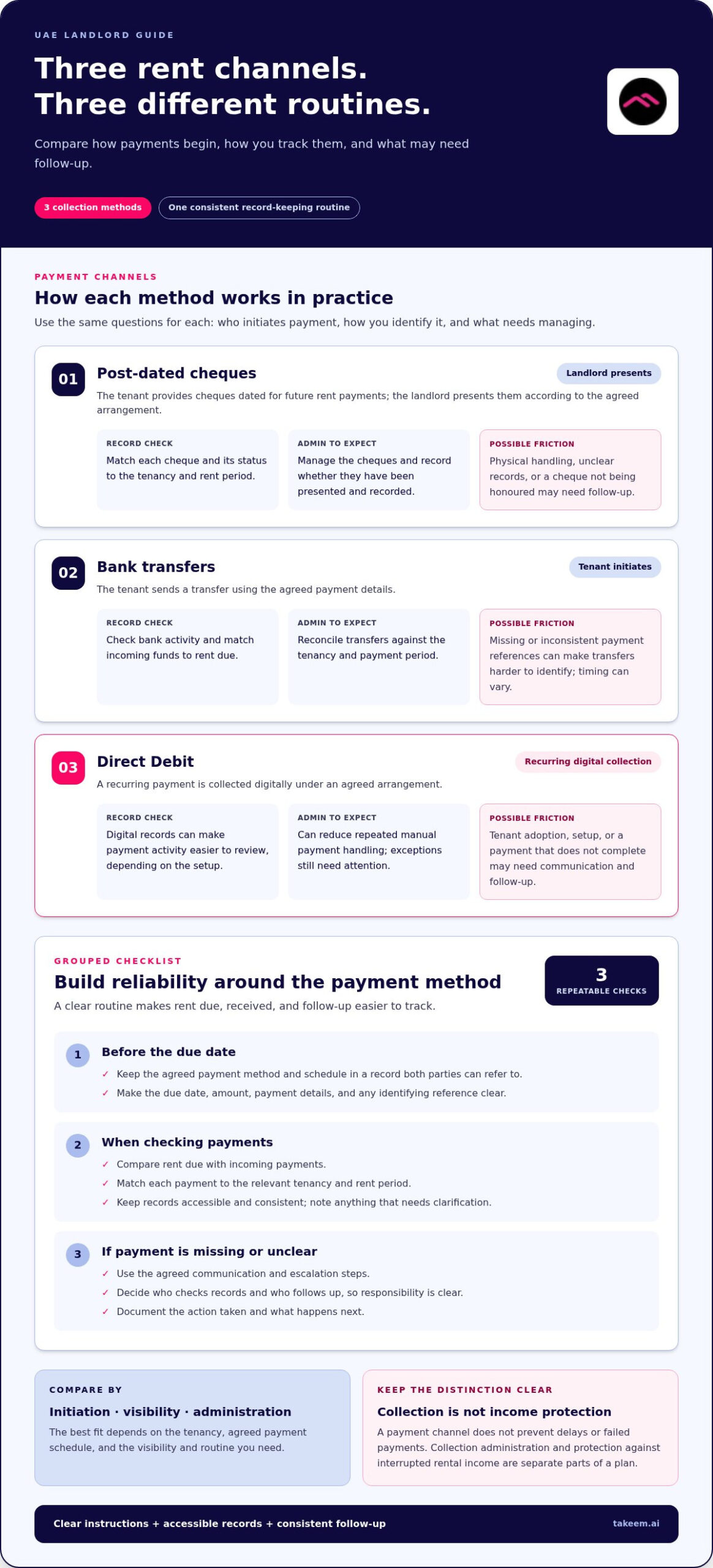
Post-dated cheques, bank transfers, and Direct Debit each create a different collection routine. To compare them, consider who initiates each payment, how clearly you can match it to rent due, and what you’ll need to do if it’s late, missing, or difficult to identify. No channel guarantees punctual payment or eliminates the possibility of a failed payment.
| Method | Payment initiation | Record visibility | Administration | Possible friction |
|---|---|---|---|---|
| Post-dated cheques | The tenant provides cheques dated for future rent payments; the landlord presents them according to the agreed arrangement. | Cheque records and bank activity can help track payment, but the landlord may need to match each cheque to the relevant tenancy and period. | Requires managing the cheques and recording their status. | Physical handling, unclear records, or a cheque not being honoured may require follow-up. |
| Bank transfers | The tenant initiates a transfer using the agreed payment details. | Bank activity can show incoming funds; identifying the tenancy may depend on the payment reference and the landlord’s records. | The landlord may need to check account activity and reconcile transfers against rent due. | Missing or inconsistent references can make a payment harder to identify; payment timing can vary. |
| Direct Debit | A recurring payment is collected digitally under an agreed arrangement. | Digital records can make payment activity easier to review, depending on the collection setup. | Can reduce repeated manual payment handling, while exceptions still need attention. | Tenant adoption, setup, or a payment that does not complete can require communication and follow-up. |
Cheques and bank transfers: familiar methods, different workflows
With cheques, landlords typically track which future-dated payments relate to each rent period and whether they’ve been deposited and recorded. With transfers, the tenant initiates payment, so the landlord checks account activity and matches incoming funds to the tenancy. Manual tracking can become more demanding as the number of payments grows, especially when records or references are inconsistent. Practices can also differ between tenancies and banks.
Direct Debit for recurring monthly rent collection
Direct Debit is a way to collect recurring monthly payments digitally under an agreed arrangement, rather than relying on the tenant to initiate each transfer. A centralised digital collection routine can make payment activity easier to review and reduce repeated manual handling. You still need to monitor records and follow up on exceptions. Takeem provides Direct Debit setup for landlords accepting monthly digital rent payments, as an alternative to relying on post-dated cheques.
For more context on how digital collection relates to rental guarantees, read this UAE rental Direct Debit and guarantee guide. Details about Takeem’s Direct Debit setup are available online.
Which Rent Collection Method Fits Your Property and Payment Needs?
The best fit is a method you can administer consistently and your tenant can follow clearly. Before choosing, consider how often rent is due, who initiates payment, how you’ll confirm receipt, and how you’ll handle exceptions. A channel that works smoothly for one tenancy may add unnecessary steps to another.
“The right rent collection method depends on the tenancy arrangement and the workflow needed to track payments and respond to exceptions.” Compare reliable rent collection methods by practical fit, not just familiarity or convenience.
- Visibility: Can you readily tell whether a payment has arrived and which rent period it covers?
- Record keeping: Can you maintain a consistent record without searching across multiple sources?
- Routine effort: How much recurring checking, handling, and reconciliation will the method require?
- Exceptions: Is it clear what you’ll do if a payment is late, missing, or hard to identify?
Digital collection may feel like an extra step if you’re used to an established routine. A transition means aligning the tenant with the agreed payment arrangement, clarifying instructions and due dates, and deciding how payment records will be reviewed. Allow time to establish the routine. The aim is to reduce avoidable handling, not introduce a process nobody understands.
For individual landlords and single-property arrangements
For one tenancy, a simple record can be enough if it shows the rent period, due date, amount expected, and whether payment was received. Decide how you’ll check for payment and keep that record current. If monthly digital collection fits the agreed schedule and both parties understand the arrangement, it can offer a consistent routine. Let the agreed terms and clear communication guide your choice.
For investors managing multiple rental properties
As a portfolio grows, separate tracking habits can make it harder to see what’s outstanding across tenancies. A consistent way to record expected and received rent, identify each property, and review exceptions makes reconciliation more structured. Consider whether your chosen channel gives you the visibility you need, and whether you can apply the same review routine across properties without losing tenancy-level detail.
For investors assessing collection alongside wider portfolio planning, the UAE property portfolio rental income guide offers related context. Before relying on a method as your routine, define how payments will be identified, reviewed, and followed up. This makes it easier to judge whether the method remains practical as tenant arrangements or portfolio needs change.
How to Build a More Dependable Rent Collection Process
A clear routine makes reliable rent collection methods easier to manage, whichever payment channel you use. Set expectations with the tenant, keep records in one accessible place, and decide in advance how you’ll check and follow up on payments. The steps below create a practical workflow without assuming payments will always arrive as expected.
Set clear payment expectations and keep records
Make sure you and the tenant understand the agreed payment method and schedule. Record the due date, payment channel, amount, any reference to use, and who is responsible for checking and recording receipt. Keep this information accessible so you can refer to it if questions arise. Your records should let you compare rent expected with payments received without relying on memory or scattered messages.
Use a consistent reference for each payment where the chosen channel allows it, and update the record as you reconcile activity. Keep communications factual, timely, and aligned with the tenancy agreement. If the agreement or payment arrangement changes, record the updated details and make sure both parties understand them.
Plan for exceptions without overpromising
A payment that doesn’t appear when expected may be delayed, incomplete, or difficult to match to a tenancy. Check the relevant transaction records first. If the payment still can’t be identified, contact the tenant neutrally and share the details you’re trying to reconcile. Record the response and agree on the next step. For legal or contractual questions, seek qualified UAE guidance rather than relying on assumptions.
Use this workflow for each tenancy:
- Agree on the arrangement. Confirm the payment method, schedule, due date, amount, reference details, and each party’s role.
- Document the terms. Keep the agreed information in a format you can access and refer to consistently.
- Prepare a rent record. Track each expected payment against the relevant tenancy and rental period.
- Review payment activity. Check the appropriate records around the agreed schedule, then match received funds to the rent entry.
- Log the outcome. Mark the payment as reconciled or note what remains unclear, including any follow-up already taken.
- Follow up on exceptions. Verify the records, contact the tenant factually if needed, and document the next action without assuming the cause or outcome.
This process works with cheques, transfers, or recurring digital collection. Consistency matters more than adding unnecessary administration: use the same record-keeping approach for each rent period, then review whether it remains workable as tenancy arrangements change.
For landlords who want monthly digital collection in their workflow, Takeem’s Direct Debit setup offers an alternative to relying on post-dated cheques.
How Takeem Connects Digital Rent Collection with Income Protection
Once you’ve identified the payment routine that suits your tenancy, consider whether you also want a separate form of rental protection. These needs are connected, but they aren’t interchangeable. A payment channel helps manage how rent is collected; a rental guarantee addresses a different landlord concern.
Move from traditional cheques towards monthly digital collection
For landlords seeking a digital alternative to relying on post-dated cheques, Takeem provides Direct Debit setup to accept monthly rent payments from tenants. This supports a recurring collection routine and reduces reliance on manually handling a cheque for each rent period. It doesn’t mean every tenant will adopt the same arrangement or that every payment will complete as expected, so agreed terms, clear communication, and record keeping still matter.
Consider how a monthly digital arrangement would fit your tenancy, how you’ll review payment activity, and how you’ll handle an exception. This keeps the change grounded in your collection priorities instead of treating digital payment as a solution to every administration challenge. For context on the separate role of guarantees, read this landlord rental guarantee guide for the UAE.
Consider collection and rental guarantees as complementary tools
Direct Debit setup relates to collecting monthly payments. Takeem’s rental guarantee is a separate service for landlords and property investors, with emergency property maintenance included. Assess each service according to the need it addresses: one concerns the collection routine, while the other provides a separate rental guarantee. Neither replaces the other.
Before exploring either option, clarify what you want to improve. Is your priority to establish a recurring digital collection routine, or are you considering a rental guarantee as a separate part of your landlord planning? Keeping those questions distinct helps you see how each service may fit without assuming that a payment method itself provides income protection.
Reliable rent collection methods work best when the channel and surrounding process match the tenancy. If monthly digital collection fits your payment priorities, Takeem’s Direct Debit setup offers an alternative to relying on post-dated cheques. You can consider a rental guarantee separately, according to your needs as a landlord or property investor.
Explore Takeem’s rent collection and rental guarantee solutions to see how these separate options fit your priorities.
Make Your Next Rent Cycle Easier to Manage
Start by identifying where your current routine creates the most friction. Is it handling payments, matching them to the right tenancy, or deciding how to respond when something doesn’t go as planned? Use your answer to shape a process you can maintain and that works for your tenant. The most useful reliable rent collection methods fit the arrangement and support clear, consistent administration.
If monthly digital collection is part of your plan, Takeem provides Direct Debit setup for landlords. Its rental guarantee service is a separate option for landlords and property investors, with emergency property maintenance included. Considering each need separately helps you make an informed choice without confusing payment administration with income protection.
Explore Takeem’s digital rent collection and rental guarantee solutions as you decide what should come next in your rent collection process. A clear, manageable routine is a practical step towards greater confidence in your landlord administration.
Frequently Asked Questions
Can landlords in the UAE collect rent monthly instead of using post-dated cheques?
Yes, landlords and tenants can agree to monthly rent payments instead of arranging post-dated cheques. Monthly payment requests are a consideration in the UAE, but landlords aren’t generally required to accept them. Set out the agreed payment cadence, due date, and channel in the tenancy arrangement. If you’re changing an existing agreement or unsure how its terms apply, seek qualified UAE guidance before making the change.
Is Direct Debit a reliable way to collect rent from tenants?
Direct Debit can support a planned digital arrangement for recurring monthly rent. Reliability still depends on a clear agreement, useful payment records, and checking whether each collection completed. It can’t guarantee that funds will be available or that every payment will succeed. Treat it as one of the reliable rent collection methods, and keep a process for investigating exceptions instead of assuming a scheduled collection is a completed payment.
What happens if a rent payment fails or appears late?
First, check the transaction record and payment reference to see whether the rent is pending, missing, or difficult to match. If the record still doesn’t clarify the status, contact the tenant neutrally with the relevant rent period and ask for information that may help reconcile it. Note the exchange and next step. For disputes or questions about contractual consequences, get qualified UAE advice.
How can landlords keep clear records of rent payments?
Use one rent log for each property or tenancy, with fields for the period due, due date, amount expected, date received, payment reference, and reconciliation status. For example, if a transfer arrives without a useful reference, mark it as unidentified until you can match it, rather than recording it against the wrong rent period. Keep supporting transaction records alongside the log so entries can be reviewed later.
Can digital rent collection work for a landlord with several properties?
Yes, digital collection can be used across multiple properties if you can distinguish each payment and tenancy in your records. Use a consistent identifier for each property and tenant, then keep an overview of payment status alongside detailed tenancy records. This helps reveal which entries need attention without losing the information needed to resolve an individual payment query.
Do tenants need to agree to a digital rent collection method?
Landlords should agree the digital payment arrangement with tenants rather than assume they’ll adopt it. Explain which method will be used, the payment schedule, and what details help identify each payment. Make sure the written tenancy terms and practical instructions are consistent. If the parties want to change an existing arrangement, record the change clearly and seek qualified UAE guidance on contractual questions.
Does a rental guarantee replace the need for a rent collection method?
No. A rental guarantee and a rent collection method address different needs. The collection method is how the tenant’s rent payment is arranged; a guarantee is a separate service for landlords and property investors. It doesn’t remove the need to know what rent is due or keep track of payment activity. Review the guarantee’s terms separately, and don’t assume it changes the agreed payment process.